What to develop, in what order, and how to carry it through the whole day
This page is not a collection of meditation techniques to choose from randomly. It is a map of the gradual training. Each stage prepares the conditions for the next: conduct supports restraint; restraint supports clear knowing; clear knowing supports calm; calm supports jhāna; and the developed mind investigates experience through vipassanā for release.
Practice does not begin and end with sitting meditation.
The training continues while eating, walking, speaking, working, reading, resting and meeting the six sense doors. Formal meditation becomes effective when the rest of the day has been supporting rather than undoing the same development.
See the whole path before entering one topic
The studies below are arranged as one connected development. A later stage should not be isolated from the supporting conditions that make it possible.
Train in sequence rather than collecting techniques
The aim is not to finish articles. The aim is to establish conditions in life and mind strongly enough that the next stage can genuinely develop.
Establish the foundation
Begin with Sīla and guarding the sense doors. A mind repeatedly agitated by misconduct, regret or uncontrolled stimulation cannot be made settled simply by sitting down.
- Abandon bodily, verbal and mental misconduct
- Strengthen hiri and ottappa
- Guard what is taken up through the six doors
- Reduce the causes of agitation before meditation begins
Train throughout ordinary life
Bring moderation, wakefulness and sati-sampajañña into the whole day. Washing, bathing, dressing, eating, working, reading, entertainment and rest all become fields of training.
- Know purpose and suitability
- Eat with moderation
- Protect wakefulness and energy
- Know what citta is doing as activities change
Develop the mind
When the supporting conditions are established, cultivate Samatha and Jhāna. Formal sitting is then a continuation of the day’s training rather than a rescue operation from a scattered day.
- Recognise and abandon the hindrances
- Develop calming repeatedly
- Allow collectedness to deepen
- Bhāveti and bahulīkaroti — develop and make much of it
Investigate for release
With the developed mind, investigate the five khandhas, six sense bases, feeling, craving, dependent arising, impermanence and appropriation. Vipassanā is directed toward abandoning the conditions sustaining birth and death.
- See arising dependent on conditions
- Observe vedanā without automatically feeding taṇhā
- Examine “me”, “mine” and appropriation
- Orient the training toward cessation, not merely better experience
Read less. Practise more. Return when experience raises the next question.
Do not try to read every study in every category. Start with the stage you are presently training in. Read the key material, put it into practice, observe what actually happens, and return when your experience exposes a weakness or raises a question. Move forward when the supporting condition has become sufficiently established — not simply because an article has been read.
Need the larger map?
The main Practice hub explains how the individual areas fit together and how to diagnose where training is presently weak.
Open only the stage you are presently training in. Each section can then be viewed in Cards or Compact mode. Sīla is open first; the later stages remain folded until you need them.

02 • SENSE RESTRAINT — Indriya-saṁvara
Guarding the six sense doors and understanding how contact conditions reaction.
Indriya-saṁvara
Teachings on guarding the six sense doors and understanding how contact with sights, sounds, smells, tastes, touches and thoughts conditions reaction.
Showing 1–12 of 20 studies

AN 5.55 Mātāputtasutta
This important sutta explains in detail on how a man gets involved with woman and how a woman gets involved with man irrespective of whatever designations they create and how the lust…
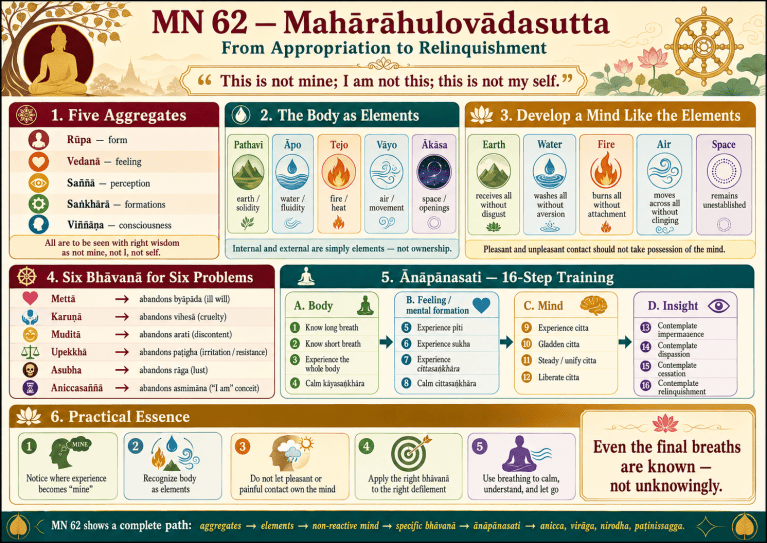
MN 62 Maharahulovadasutta
MN 62 Mahārāhulovādasutta is far more than a discourse on mindfulness of breathing. The Buddha gives Rāhula a complete training: seeing the five aggregates and elements without ownership, developing a mind that…
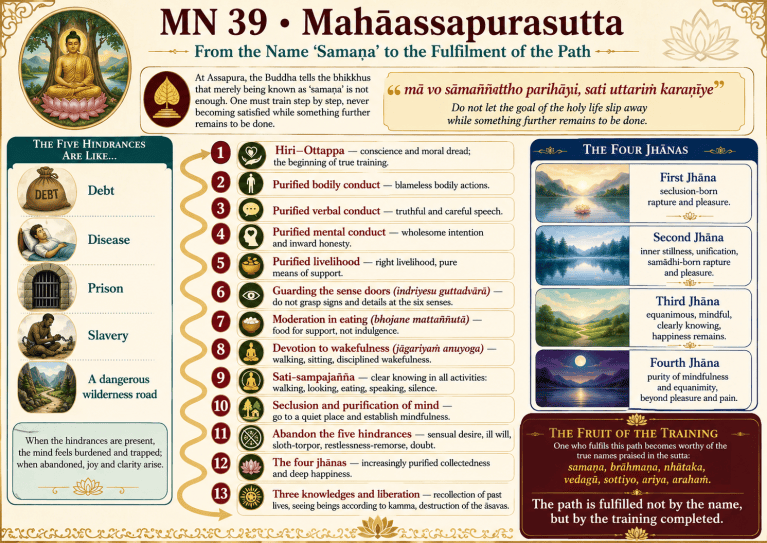
MN39 Mahāassapurasutta
MN 39 presents the Buddha’s gradual training as a cumulative path from hiri-ottappa and purified conduct through sense restraint, moderation, wakefulness, sati-sampajañña, jhāna, and finally the destruction of the āsavas. MN 39…
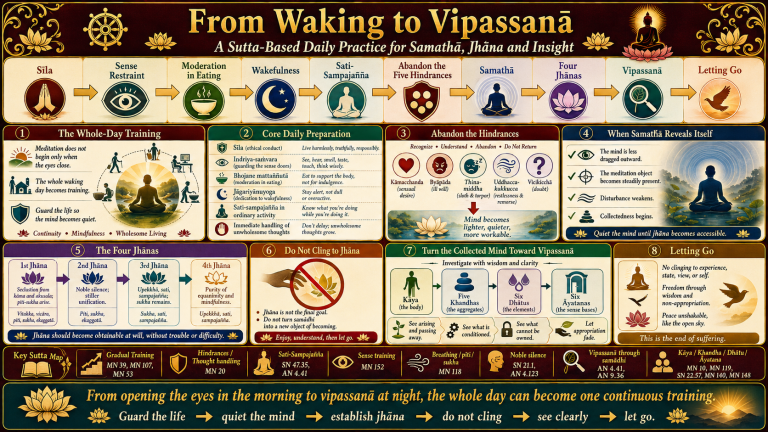
From Daily Discipline to Samathā, Jhāna and Vipassanā
From Waking to Vipassanā presents meditation as a continuous training rather than an isolated sitting practice. Drawing especially on MN 39, MN 107 and MN 53, it shows how sīla, guarding the…
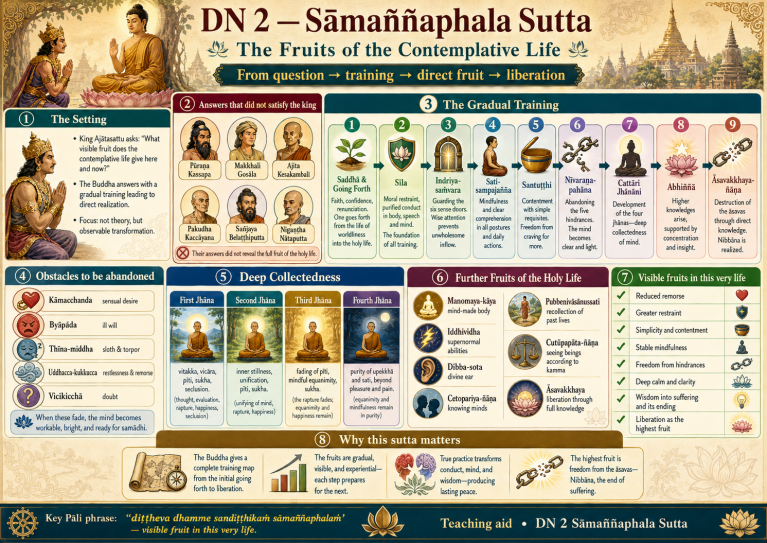
DN 2 — Sāmaññaphalasutta
Maps the gradual training from sīla and sense restraint through sati-sampajañña, abandonment of the hindrances and jhāna to the destruction of the āsavas.
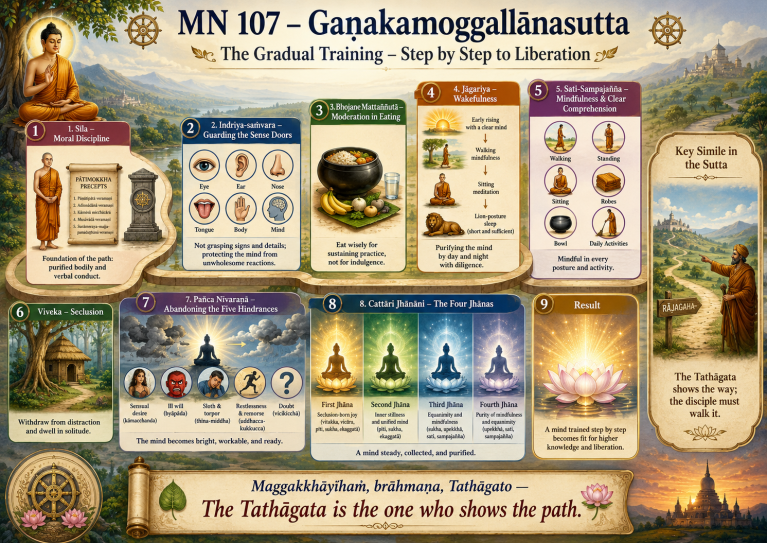
MN 107 — Gaṇakamoggallānasutta
Presents the Buddha’s gradual training step by step, from sīla and sense restraint through moderation, wakefulness, hindrance abandonment and jhāna toward liberation.
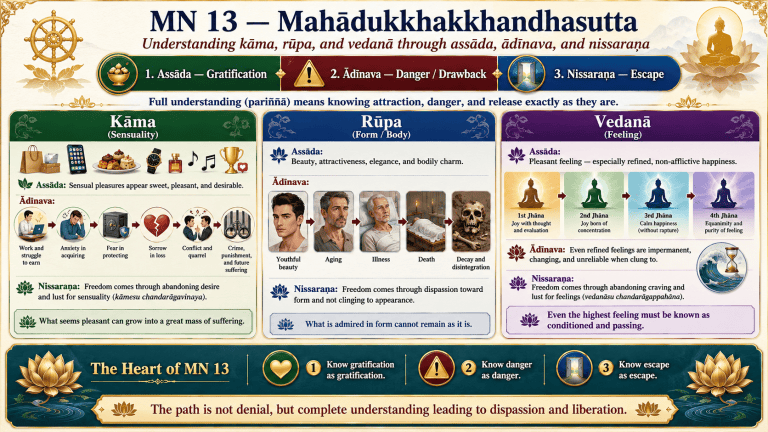
MN 13 — Mahādukkhakkhandhasutta
Explains full understanding of sensuality, form and feeling through three aspects—gratification, danger and escape—rather than through abstract belief or partial analysis.
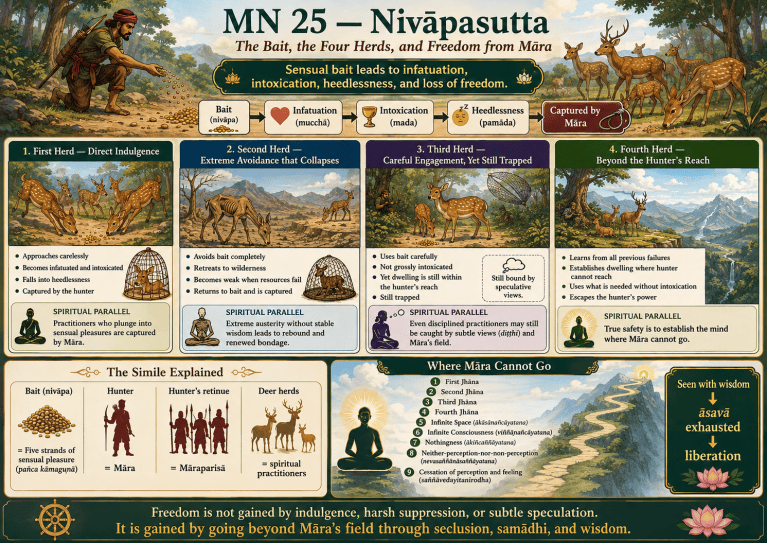
MN 25 — Nivāpasutta
Uses the hunter-and-bait simile to show how sensuality and heedlessness trap beings, and how restraint, seclusion and deep meditative development lead beyond Māra’s reach.
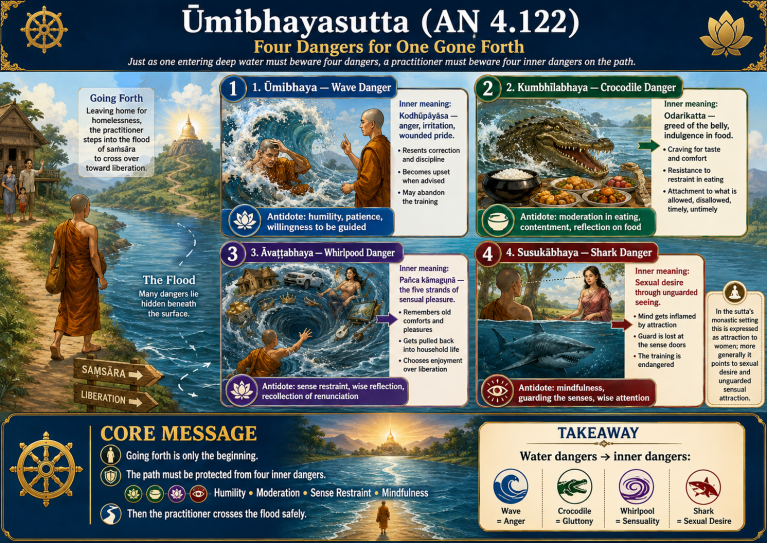
AN 4.122 — Ūmibhayasutta
Uses waves, crocodiles, whirlpools and sharks to represent four dangers that can overturn a practitioner: wounded pride, attachment to food, sensuality and attraction to the opposite sex.

SN 35.244 — Dukkhadhammasutta
Shows how insight into the five aggregates and the six sense doors changes one’s relationship to sensuality, exposing danger and supporting dispassion and release.
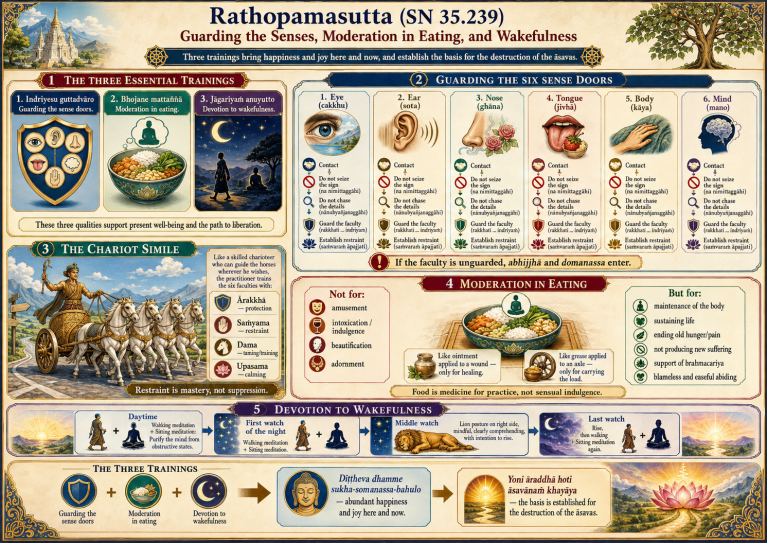
SN 35.239 — Rathopamasutta
Uses the chariot simile to emphasize three foundations of serious practice: guarding the sense doors, moderation in eating and devotion to wakefulness.
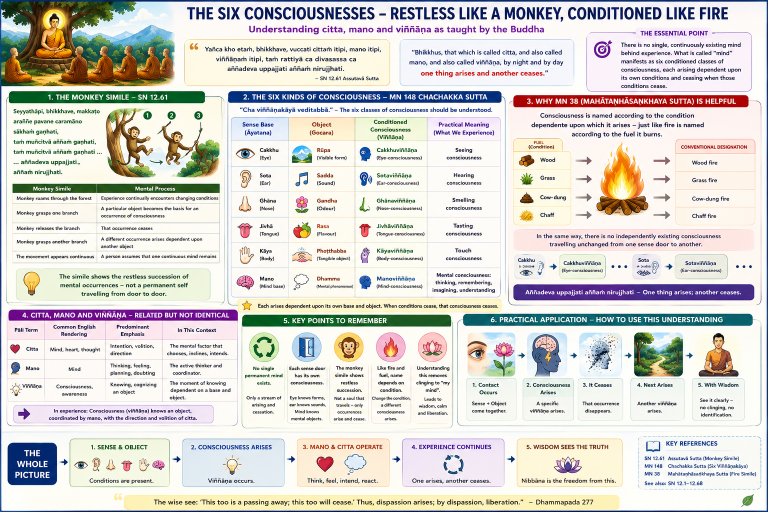
Sense Doors – How to understand?
Introduction There are 6 consciousness depending upon the type of the senses. The Buddha does not present a single permanent “mind” that remains unchanged while merely looking through six different windows. What…
Page 1 of 2
03 • MODERATION — Bhojane mattaññutā
Moderation in eating as part of the gradual training and support for clarity and wakefulness.
Bhojane mattaññutā
Training in moderation in eating as part of the gradual training and as support for clarity, wakefulness and sustained practice.
Showing 1–8 of 8 studies
MN39 Mahāassapurasutta
MN 39 presents the Buddha’s gradual training as a cumulative path from hiri-ottappa and purified conduct through sense restraint, moderation, wakefulness, sati-sampajañña, jhāna, and finally the destruction of the āsavas. MN 39…
From Daily Discipline to Samathā, Jhāna and Vipassanā
From Waking to Vipassanā presents meditation as a continuous training rather than an isolated sitting practice. Drawing especially on MN 39, MN 107 and MN 53, it shows how sīla, guarding the…
DN 2 — Sāmaññaphalasutta
Maps the gradual training from sīla and sense restraint through sati-sampajañña, abandonment of the hindrances and jhāna to the destruction of the āsavas.
MN 107 — Gaṇakamoggallānasutta
Presents the Buddha’s gradual training step by step, from sīla and sense restraint through moderation, wakefulness, hindrance abandonment and jhāna toward liberation.
AN 4.122 — Ūmibhayasutta
Uses waves, crocodiles, whirlpools and sharks to represent four dangers that can overturn a practitioner: wounded pride, attachment to food, sensuality and attraction to the opposite sex.
SN 35.239 — Rathopamasutta
Uses the chariot simile to emphasize three foundations of serious practice: guarding the sense doors, moderation in eating and devotion to wakefulness.
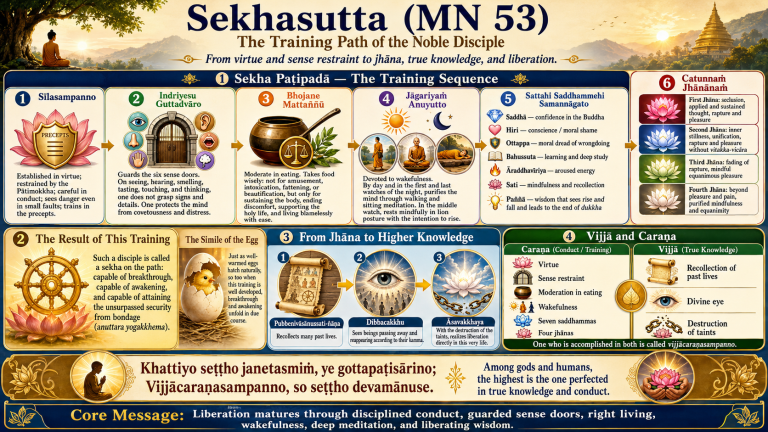
MN 53 — Sekhasutta
Presents the trainee’s development through conduct and knowledge, including sīla, sense restraint, moderation, wakefulness, seven good qualities, jhāna and the three higher knowledges.

Snp 4.16 — Sāriputtasutta: Like a Silversmith Refining Silver
Uses Snp 4.16 as a practical guide for householders, showing how silence, restraint, careful speech, moderation and gradual refinement can turn daily life into training.
04 • WAKEFULNESS — Jāgariyānuyoga
Disciplined use of day and night, sleep, walking and sitting as continuous cultivation.
Jāgariyānuyoga
Teachings on wakefulness, disciplined use of day and night, sleep, walking and sitting as continuous cultivation.
Showing 1–9 of 9 studies
AN 5.55 Mātāputtasutta
This important sutta explains in detail on how a man gets involved with woman and how a woman gets involved with man irrespective of whatever designations they create and how the lust…
MN39 Mahāassapurasutta
MN 39 presents the Buddha’s gradual training as a cumulative path from hiri-ottappa and purified conduct through sense restraint, moderation, wakefulness, sati-sampajañña, jhāna, and finally the destruction of the āsavas. MN 39…
From Daily Discipline to Samathā, Jhāna and Vipassanā
From Waking to Vipassanā presents meditation as a continuous training rather than an isolated sitting practice. Drawing especially on MN 39, MN 107 and MN 53, it shows how sīla, guarding the…
DN 2 — Sāmaññaphalasutta
Maps the gradual training from sīla and sense restraint through sati-sampajañña, abandonment of the hindrances and jhāna to the destruction of the āsavas.
MN 107 — Gaṇakamoggallānasutta
Presents the Buddha’s gradual training step by step, from sīla and sense restraint through moderation, wakefulness, hindrance abandonment and jhāna toward liberation.
SN 35.239 — Rathopamasutta
Uses the chariot simile to emphasize three foundations of serious practice: guarding the sense doors, moderation in eating and devotion to wakefulness.
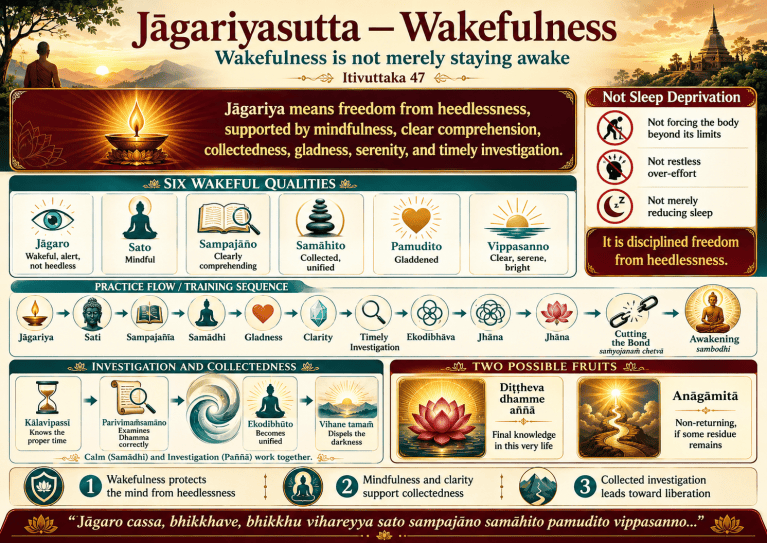
Iti 47 — Jāgariyasutta
Defines jāgariya as more than staying awake: true wakefulness combines sati, sampajañña, samādhi, gladness, investigation and jhāna to dispel ignorance.
MN 53 — Sekhasutta
Presents the trainee’s development through conduct and knowledge, including sīla, sense restraint, moderation, wakefulness, seven good qualities, jhāna and the three higher knowledges.
Snp 4.16 — Sāriputtasutta: Like a Silversmith Refining Silver
Uses Snp 4.16 as a practical guide for householders, showing how silence, restraint, careful speech, moderation and gradual refinement can turn daily life into training.
05 • CLEAR KNOWING — Sati-Sampajañña
Sati and clear comprehension through the four postures and ordinary activities of daily life.
Sati-Sampajañña
Training in sati and clear comprehension throughout the four postures and the ordinary activities of daily life.
Showing 1–12 of 30 studies
AN 5.55 Mātāputtasutta
This important sutta explains in detail on how a man gets involved with woman and how a woman gets involved with man irrespective of whatever designations they create and how the lust…
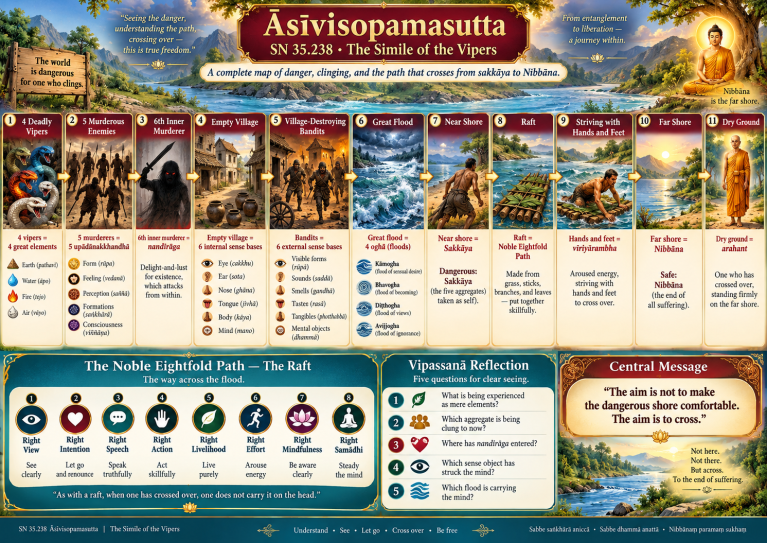
SN 35.238 Āsīvisopamasutta
This sutta provies strong Vipassanā treatment of: body as four elements, why the Buddha specifies upādānakkhandha, nandīrāga as the danger carried within, the six bases as suñña, sense objects as continual impact,…
MN 62 Maharahulovadasutta
MN 62 Mahārāhulovādasutta is far more than a discourse on mindfulness of breathing. The Buddha gives Rāhula a complete training: seeing the five aggregates and elements without ownership, developing a mind that…
MN39 Mahāassapurasutta
MN 39 presents the Buddha’s gradual training as a cumulative path from hiri-ottappa and purified conduct through sense restraint, moderation, wakefulness, sati-sampajañña, jhāna, and finally the destruction of the āsavas. MN 39…

What is Sati?
Sati is one of the most frequently used—and frequently oversimplified—terms in the Buddha’s teaching. Often translated merely as “mindfulness” or “present-moment awareness,” its meaning becomes much richer when SN 48.10, MN 118,…
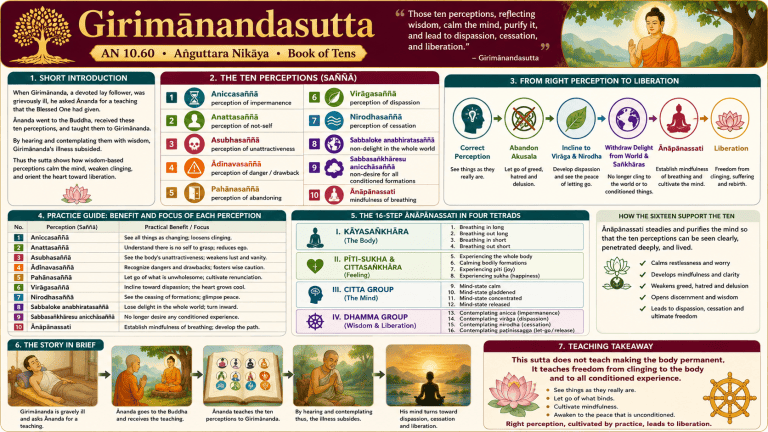
AN 10.60 Girimānandasutta
AN 10.60, the Girimānandasutta, is a profound discourse in which the Buddha responds to the grave illness of Venerable Girimānanda by teaching ten perceptions that radically transform how a practitioner understands the…
From Daily Discipline to Samathā, Jhāna and Vipassanā
From Waking to Vipassanā presents meditation as a continuous training rather than an isolated sitting practice. Drawing especially on MN 39, MN 107 and MN 53, it shows how sīla, guarding the…
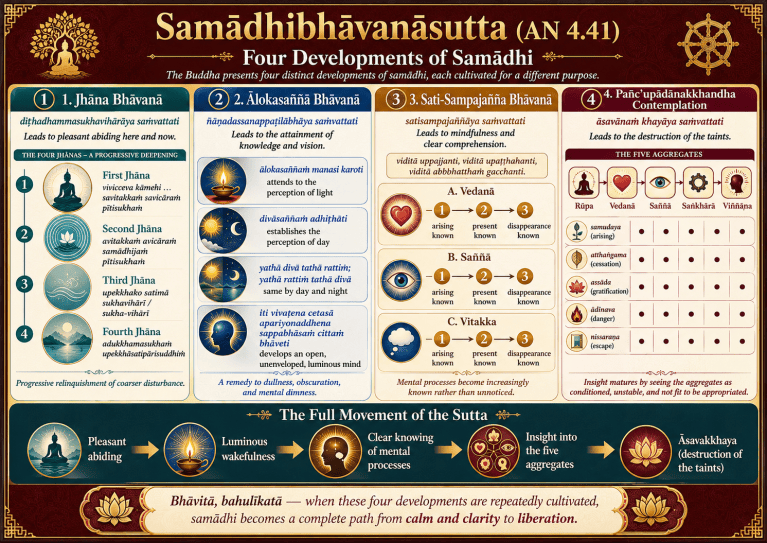
AN 4.41 — Samādhibhāvanāsutta
Distinguishes four developments of samādhi, each cultivated for a different purpose: pleasant abiding, knowledge and vision, sati-sampajañña, and destruction of the āsavas.
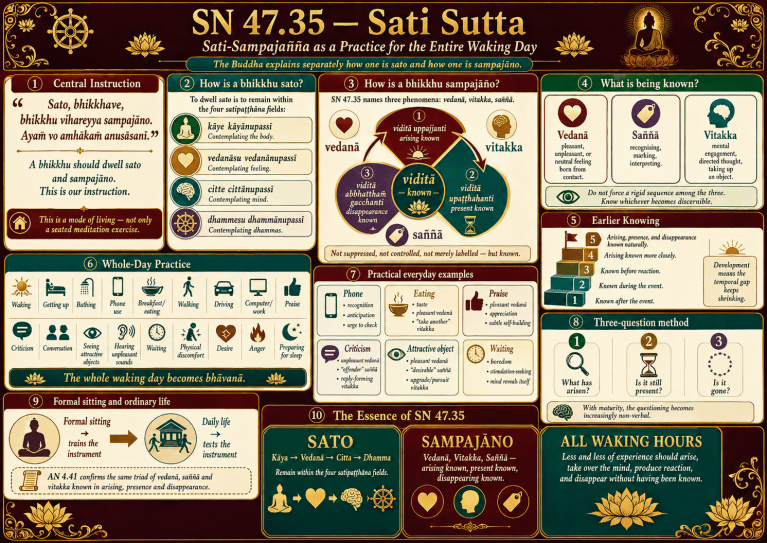
SN 47.35 — Satisutta
Clarifies sati through the four satipaṭṭhānas and explains sampajañña as direct knowing of vedanā, vitakka and saññā as they arise, remain and disappear.
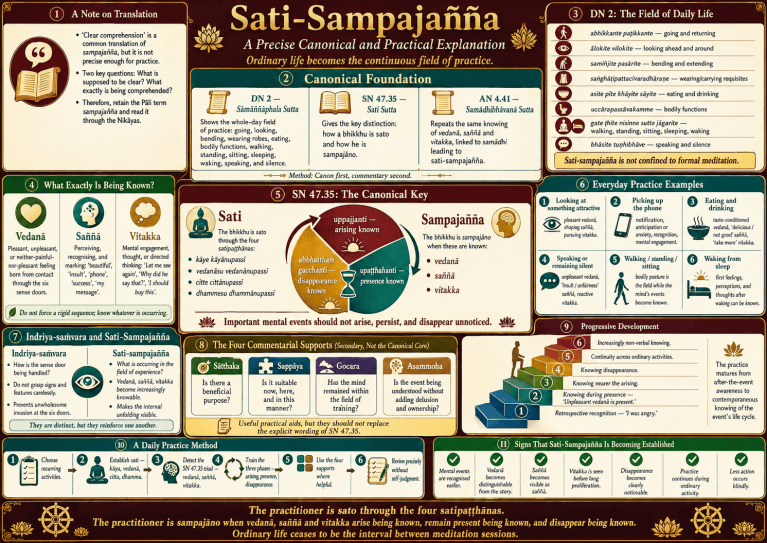
Sati-Sampajañña
Complete listening edition Listen to the full Sati-Sampajañña explanation A continuous reading of this entire page, including the canonical foundation, daily-life examples, practical development, and conclusion. Your browser does not support audio…
DN 2 — Sāmaññaphalasutta
Maps the gradual training from sīla and sense restraint through sati-sampajañña, abandonment of the hindrances and jhāna to the destruction of the āsavas.
MN 107 — Gaṇakamoggallānasutta
Presents the Buddha’s gradual training step by step, from sīla and sense restraint through moderation, wakefulness, hindrance abandonment and jhāna toward liberation.
Page 1 of 3
06 • CALMING — Samatha
Calming the mind, abandoning hindrances and establishing conditions for deeper collectedness.
Samatha
Teachings on calming and settling the mind, abandoning the hindrances and establishing the conditions for deeper collectedness.
Showing 1–12 of 27 studies
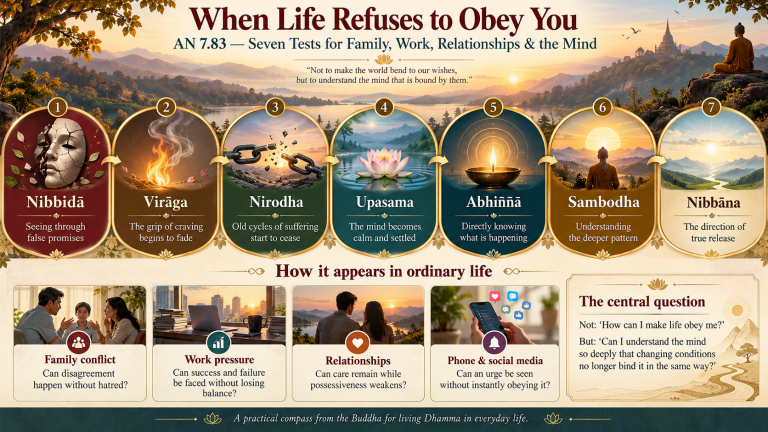
When life refuses to obey you?
When life does not go in your way, what would you like to do? Are you going to fight with it or find out the reasons why this is not working? Can…
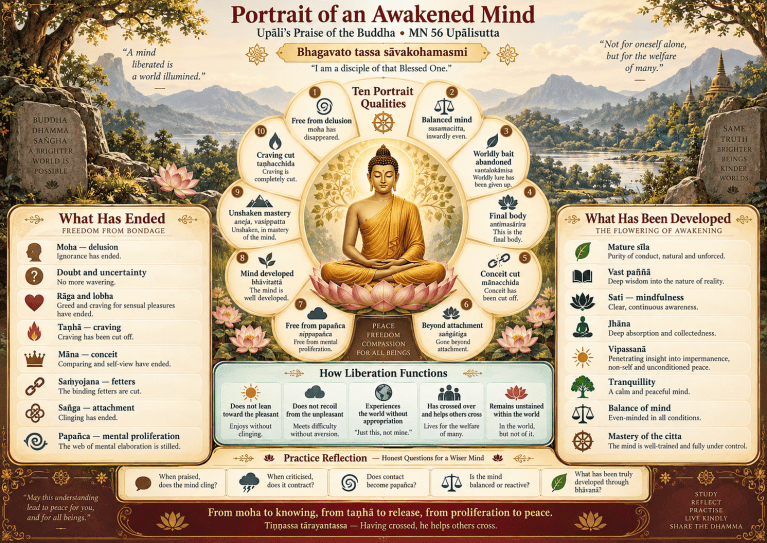
MN 56 Portrait of an Awakened Mind: Upāli’s Praise of the Buddha
Ten remarkable verses in which the householder Upāli describes the Buddha through freedom from delusion, craving, conceit, attachment, papañca and the fetters — while also highlighting sīla, paññā, jhāna, vipassanā, mastery and…

SN 46.55 Saṅgāravasutta
This is an excellent sutta to see the hindrances in more detailed way and workout that leading to seven awakening factors
AN 5.55 Mātāputtasutta
This important sutta explains in detail on how a man gets involved with woman and how a woman gets involved with man irrespective of whatever designations they create and how the lust…
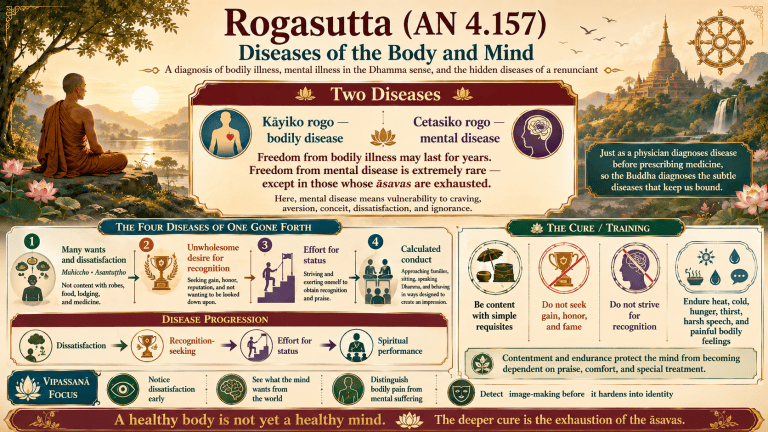
AN 4.157 Rogasutta
A person can have no diseases even for 100 years, but none can confirm that they don't have mental diseases even for an hour or less since cetasika roga or disease is…
MN 62 Maharahulovadasutta
MN 62 Mahārāhulovādasutta is far more than a discourse on mindfulness of breathing. The Buddha gives Rāhula a complete training: seeing the five aggregates and elements without ownership, developing a mind that…
MN39 Mahāassapurasutta
MN 39 presents the Buddha’s gradual training as a cumulative path from hiri-ottappa and purified conduct through sense restraint, moderation, wakefulness, sati-sampajañña, jhāna, and finally the destruction of the āsavas. MN 39…
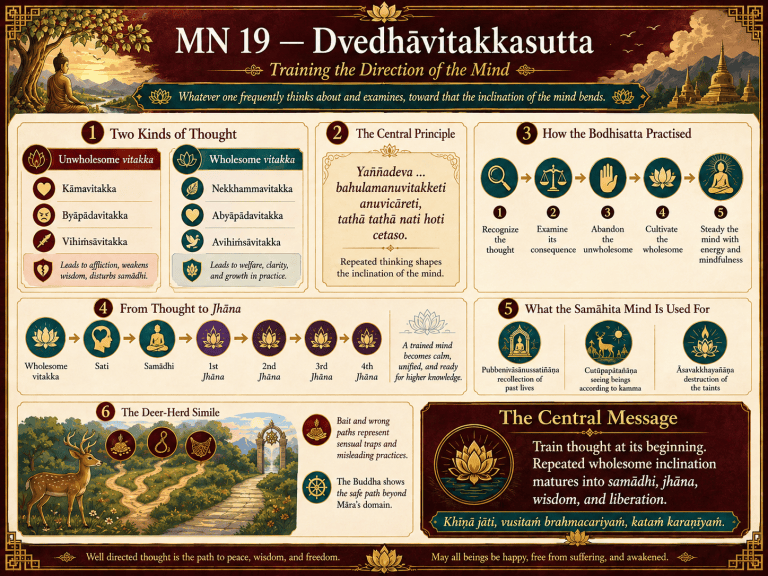
MN 19 Dvedhāvitakkasutta
MN 19, the Dvedhāvitakkasutta, is a remarkably practical discourse in which the Buddha describes how, before awakening, he trained his own mind by dividing thought into two directions: kāma, byāpāda and vihiṁsā…
From Daily Discipline to Samathā, Jhāna and Vipassanā
From Waking to Vipassanā presents meditation as a continuous training rather than an isolated sitting practice. Drawing especially on MN 39, MN 107 and MN 53, it shows how sīla, guarding the…
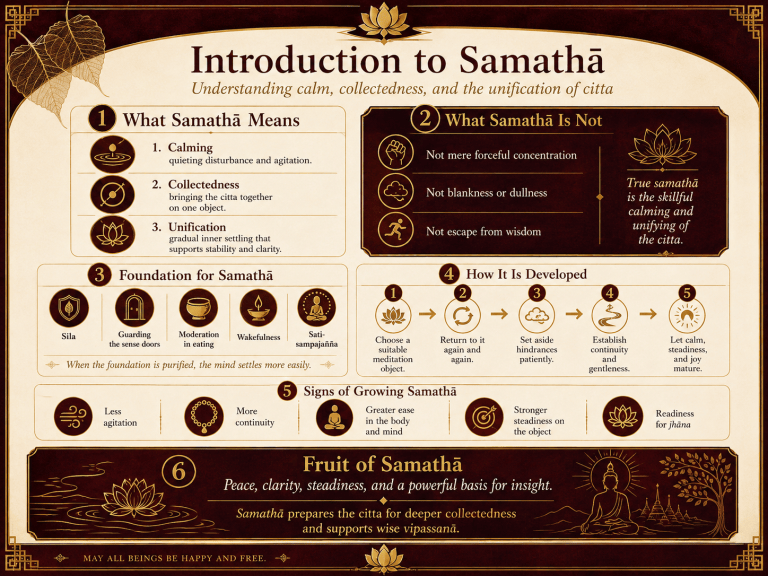
Introduction to Samathā
It is very important to understand on what is Samathā in proper sense and this essay just covers that by introducing what is Samathā
DN 2 — Sāmaññaphalasutta
Maps the gradual training from sīla and sense restraint through sati-sampajañña, abandonment of the hindrances and jhāna to the destruction of the āsavas.
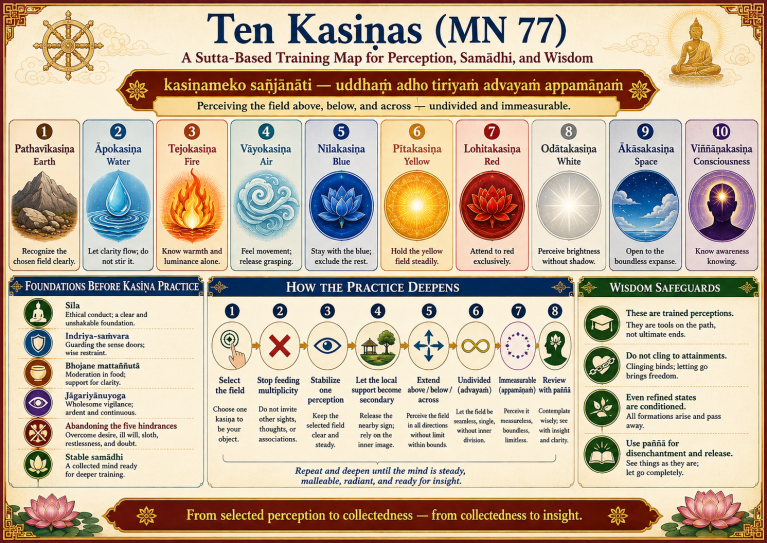
Ten Kasiṇas
The Ten Kasiṇas in MN 77 present a profound training in saññā — perception. The Buddha describes ten totalities—earth, water, fire, air, blue, yellow, red, white, space, and consciousness—and applies the same…
Page 1 of 3
07 • DEEP COLLECTEDNESS — Jhāna
The rūpa-jhānas, arūpa attainments and their role in the Buddha’s path of development.
Jhāna
Teachings and practice concerning the rūpa-jhānas, arūpa attainments and their role in the Buddha’s path of development.
Showing 13–23 of 23 studies

MN 26 — Pāsarāsisutta
Contrasts the ignoble search for security within what is itself subject to birth, aging and death with the noble search for the unborn, unaging and deathless.

AN 8.66 — Vimokkhasutta
Maps eight meditative liberations from refined mastery of form through the formless attainments, culminating in cessation of perception and feeling.
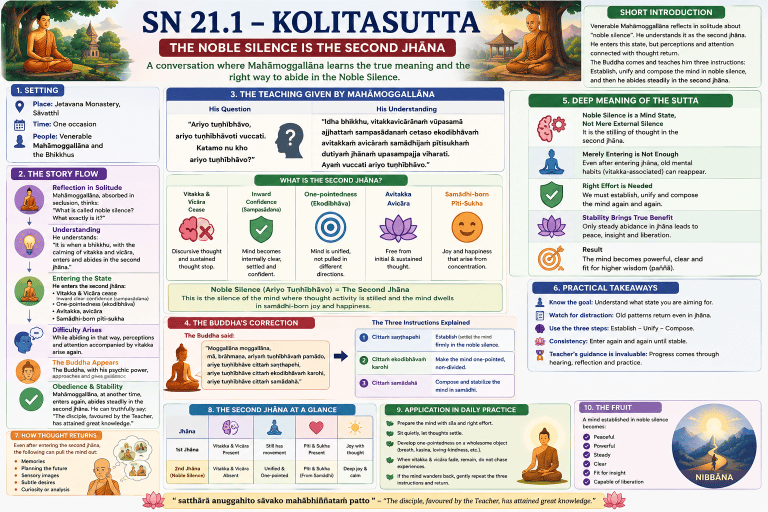
SN 21.1 — Kolitasutta
Defines ariya tuṇhībhāva, noble silence, through the second jhāna where vitakka and vicāra subside and the mind becomes inwardly unified and clear.
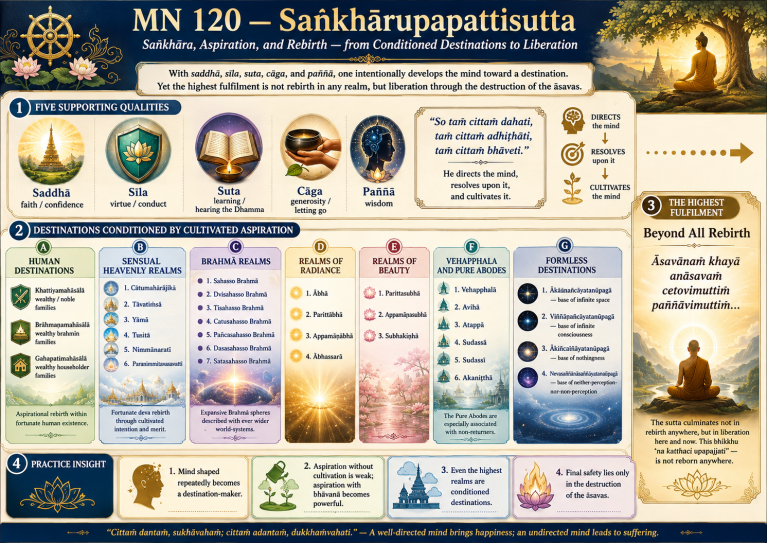
MN 120 — Saṅkhārupapattisutta: From Cultivated Intention to Rebirth—and Beyond Every Rebirth
Explains how intention, determination and repeated cultivation—supported by saddhā, sīla, suta, cāga and paññā—can condition rebirth, while the highest aim is ending rebirth entirely.
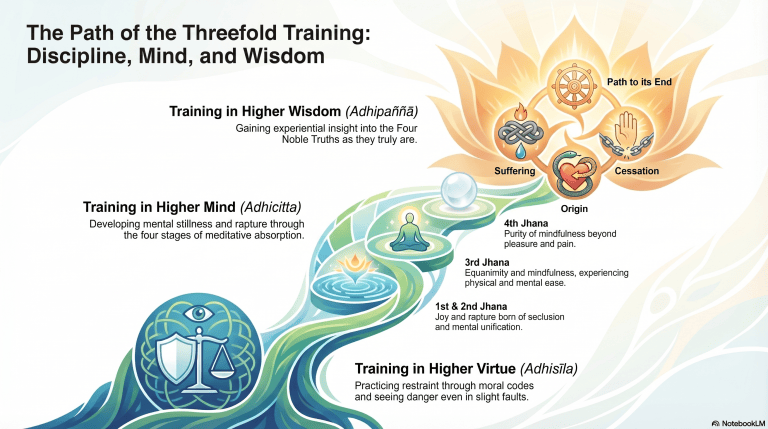
AN 3.89 — Paṭhamasikkhattayasutta: The Threefold Training for Discipline and Wisdom
Presents the Buddha’s training as adhisīla, adhicitta and adhipaññā, showing how higher discipline, collected mind and wisdom develop as one integrated path.
MN 53 — Sekhasutta
Presents the trainee’s development through conduct and knowledge, including sīla, sense restraint, moderation, wakefulness, seven good qualities, jhāna and the three higher knowledges.

Jhāna as Purification
Bhikkuvagga explains jhāna in a most refined way thus clearing off the doubts in the hearts of practitioner
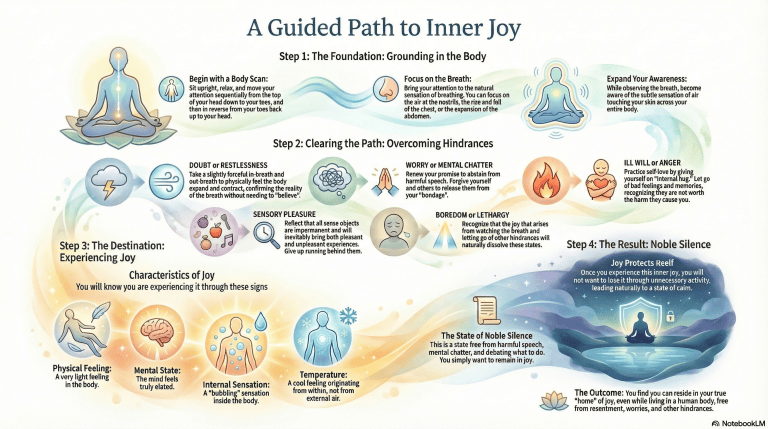
Day 5 – The Path to Internal Joy and Noble Silence
Brisbane Retreat – Day 5: Morning Practice Entering into 2nd jhānaReady? Make your body upright. Relax the body. And now observe the sweat or any other sensation that is appearing the body.…
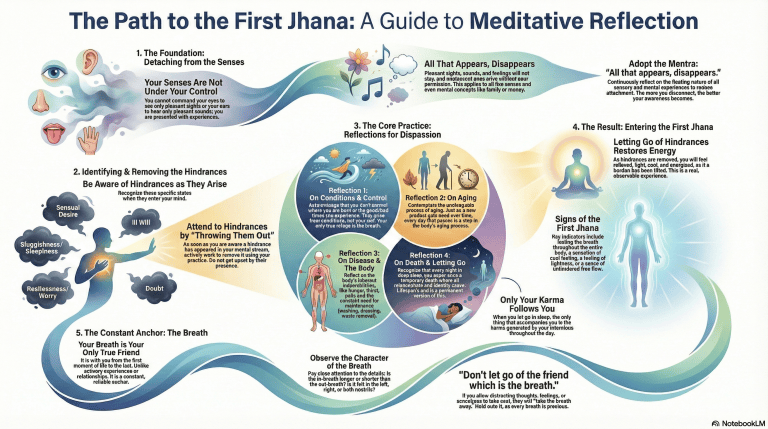
Day 4 – Mindfulness of the Breath and the Path to Jhana
Brisbane Retreat – Day 4: Morning Practice Entering into 1st JhānaLet us continue working on the defilements and the hindrances as we looked in the morning. Reflect upon the five senses and…

MN 120 — Saṅkhārupapattisutta: Directing Rebirth—or Ending Rebirth Entirely
Explains how faith, virtue, learning, generosity, wisdom and repeated aspiration can condition rebirth in chosen realms, while their highest use is ending rebirth altogether.
Snp 4.16 — Sāriputtasutta: Like a Silversmith Refining Silver
Uses Snp 4.16 as a practical guide for householders, showing how silence, restraint, careful speech, moderation and gradual refinement can turn daily life into training.
Page 2 of 2
08 • INSIGHT — Vipassanā
Investigation of conditioned experience, including khandhas, sense bases and dependent arising.
Vipassanā
Insight training through direct investigation of conditioned experience, including khandhas, sense bases, dependent arising, impermanence, suffering and not-self.
Showing 1–12 of 50 studies
When life refuses to obey you?
When life does not go in your way, what would you like to do? Are you going to fight with it or find out the reasons why this is not working? Can…
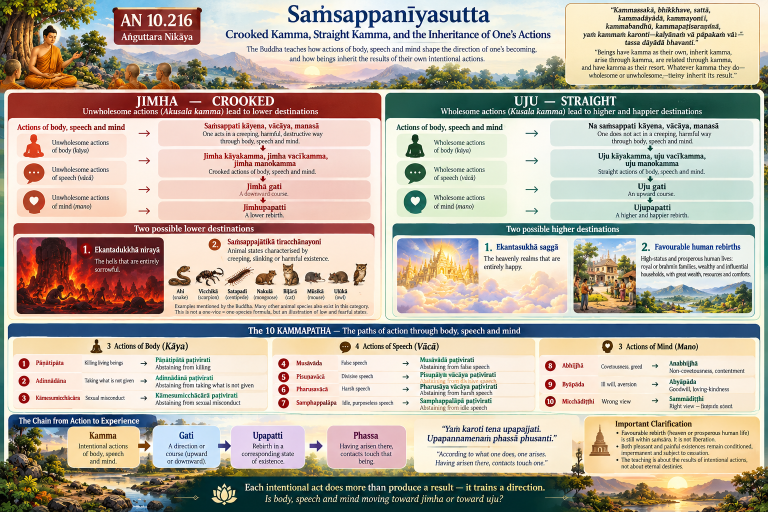
AN 10.216 Saṁsappanīyasutta
A fantastic sutta that explains on how beings would be reborn in lower realms and Buddha explains the name of animals while doing good deeds get into heaven or human birth
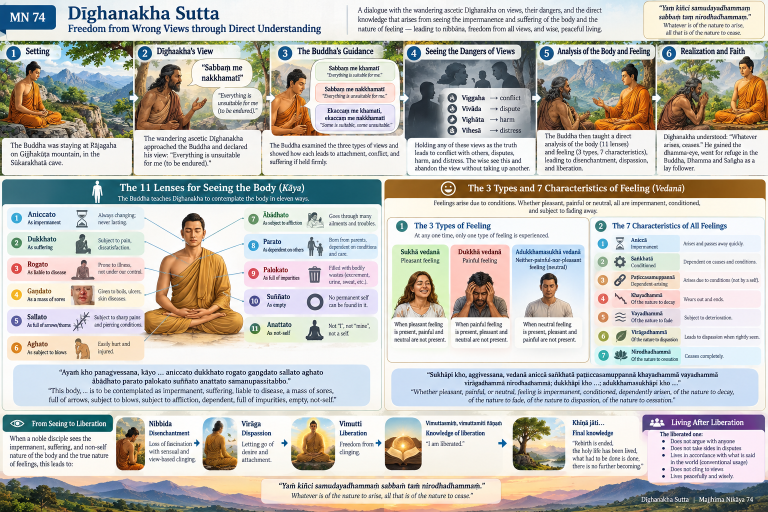
MN 74 Dīghanakhasutta
An exceptional sutta that explains step by step progression on how to attain Vipassana and get liberated from Samsara. In this sutta, Sariputta attains Arahat phala samapatti
SN 35.238 Āsīvisopamasutta
This sutta provies strong Vipassanā treatment of: body as four elements, why the Buddha specifies upādānakkhandha, nandīrāga as the danger carried within, the six bases as suñña, sense objects as continual impact,…
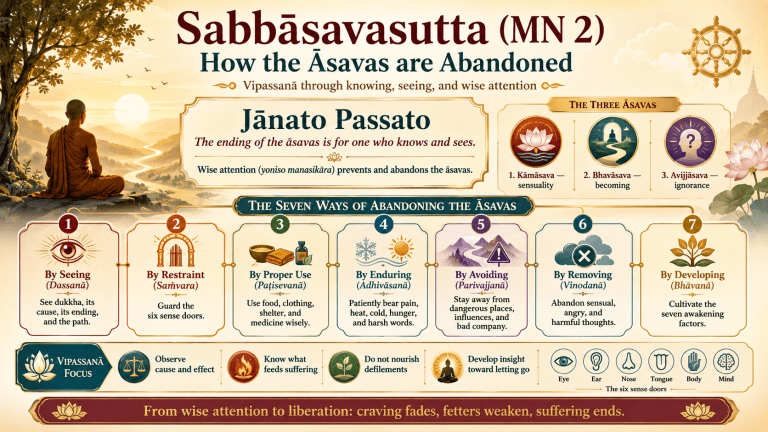
MN 2 Sabbāsavasutta
This important sutta explains the asavas or fermentations that we have accumulated and what should be removed and what should be developed in this place
MN 62 Maharahulovadasutta
MN 62 Mahārāhulovādasutta is far more than a discourse on mindfulness of breathing. The Buddha gives Rāhula a complete training: seeing the five aggregates and elements without ownership, developing a mind that…
MN39 Mahāassapurasutta
MN 39 presents the Buddha’s gradual training as a cumulative path from hiri-ottappa and purified conduct through sense restraint, moderation, wakefulness, sati-sampajañña, jhāna, and finally the destruction of the āsavas. MN 39…
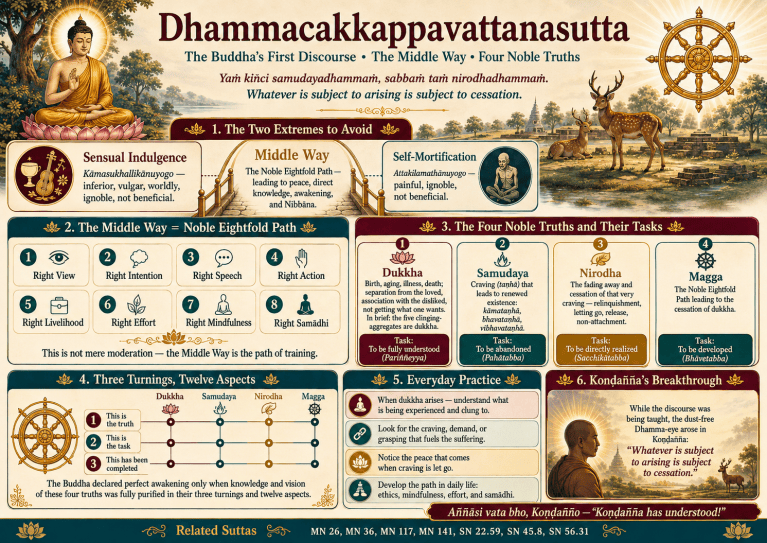
SN56.11 Dhammacakkappavattanasutta
The Dhammacakkappavattanasutta (SN 56.11) is the discourse in which the Buddha first set the Dhamma wheel in motion at Isipatana. Yet its importance goes far beyond being the first teaching after his…
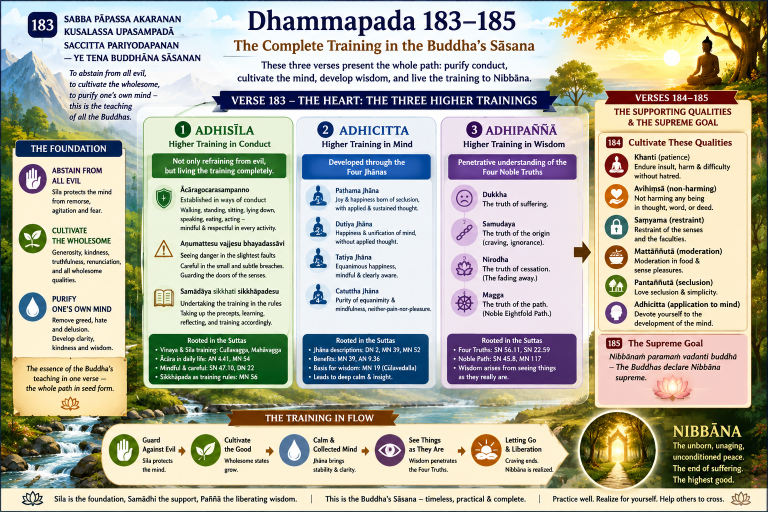
Dhammapada 183 – 185
Dhammapada verses 183–185 are often read as simple ethical instructions, but together they present a remarkably complete summary of the Buddha’s training. Verse 183 can be understood through the three higher trainings:…
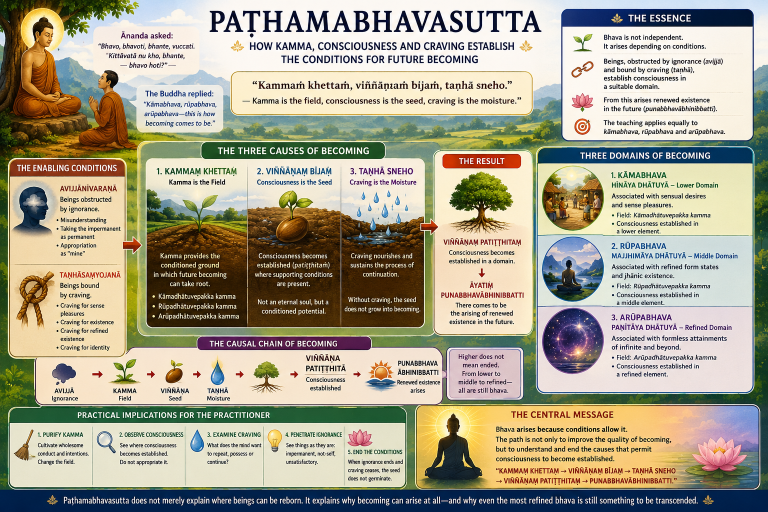
AN 3.76 Paṭhamabhavasutta
Short Introduction The Paṭhamabhavasutta gives a remarkably concise explanation of how bhava—becoming and renewed existence—comes to be. In response to Venerable Ānanda, the Buddha describes the causal process through a powerful agricultural…
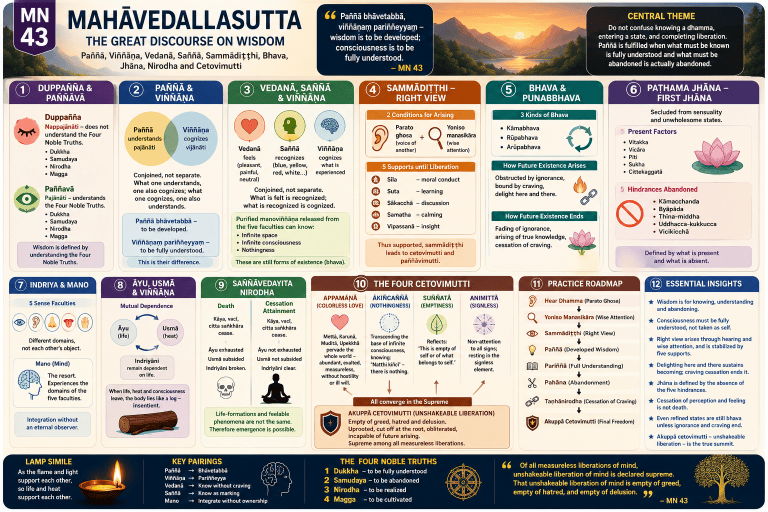
MN 43 Mahāvedallasutta
The Mahāvedallasutta is one of the most analytically rich discourses in the Middle Length Discourses. Rather than presenting a single linear sermon, it unfolds as a sustained dialogue in which Venerable Mahākoṭṭhika…
AN 10.60 Girimānandasutta
AN 10.60, the Girimānandasutta, is a profound discourse in which the Buddha responds to the grave illness of Venerable Girimānanda by teaching ten perceptions that radically transform how a practitioner understands the…
Page 1 of 5
09 • LIBERATION — Nibbāna & Noble Attainments
Cessation, fetters and the noble attainments from Sotāpanna through Arahant.
Nibbāna & Noble Attainments
Teachings on cessation, fetters and the noble attainments from Sotāpanna through Arahant, with the ending of birth and death as the goal.
Showing 1–12 of 41 studies
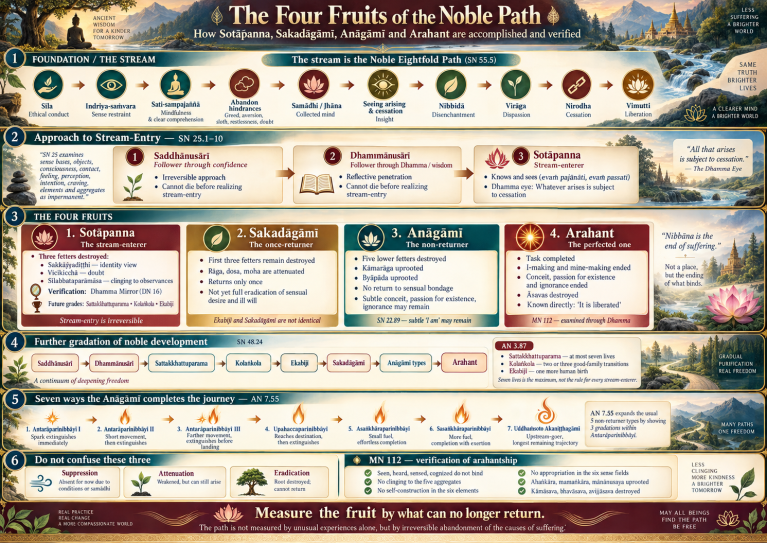
The Four Fruits of the Noble Path
This essay focuses upon four fruits as in Sotapanna, Sakadagami, Anāgami and Arahat on how to know where one has reached including the sutta references
MN39 Mahāassapurasutta
MN 39 presents the Buddha’s gradual training as a cumulative path from hiri-ottappa and purified conduct through sense restraint, moderation, wakefulness, sati-sampajañña, jhāna, and finally the destruction of the āsavas. MN 39…
SN56.11 Dhammacakkappavattanasutta
The Dhammacakkappavattanasutta (SN 56.11) is the discourse in which the Buddha first set the Dhamma wheel in motion at Isipatana. Yet its importance goes far beyond being the first teaching after his…
Dhammapada 183 – 185
Dhammapada verses 183–185 are often read as simple ethical instructions, but together they present a remarkably complete summary of the Buddha’s training. Verse 183 can be understood through the three higher trainings:…
AN 3.76 Paṭhamabhavasutta
Short Introduction The Paṭhamabhavasutta gives a remarkably concise explanation of how bhava—becoming and renewed existence—comes to be. In response to Venerable Ānanda, the Buddha describes the causal process through a powerful agricultural…
MN 43 Mahāvedallasutta
The Mahāvedallasutta is one of the most analytically rich discourses in the Middle Length Discourses. Rather than presenting a single linear sermon, it unfolds as a sustained dialogue in which Venerable Mahākoṭṭhika…
AN 10.60 Girimānandasutta
AN 10.60, the Girimānandasutta, is a profound discourse in which the Buddha responds to the grave illness of Venerable Girimānanda by teaching ten perceptions that radically transform how a practitioner understands the…
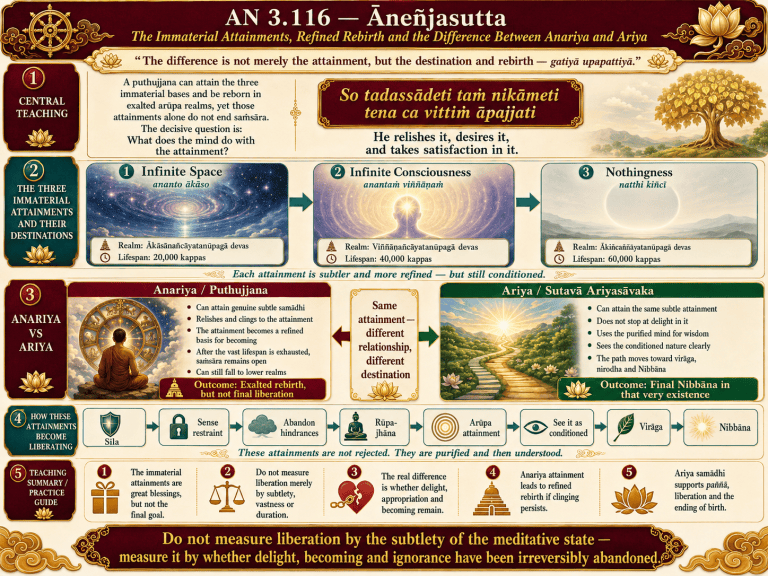
AN 3.116 Āneñjasutta
AN 3.116, the Āneñjasutta, is an important discourse for understanding the difference between sublime meditative attainment and final liberation. The Buddha shows that a practitioner may attain the bases of infinite space,…
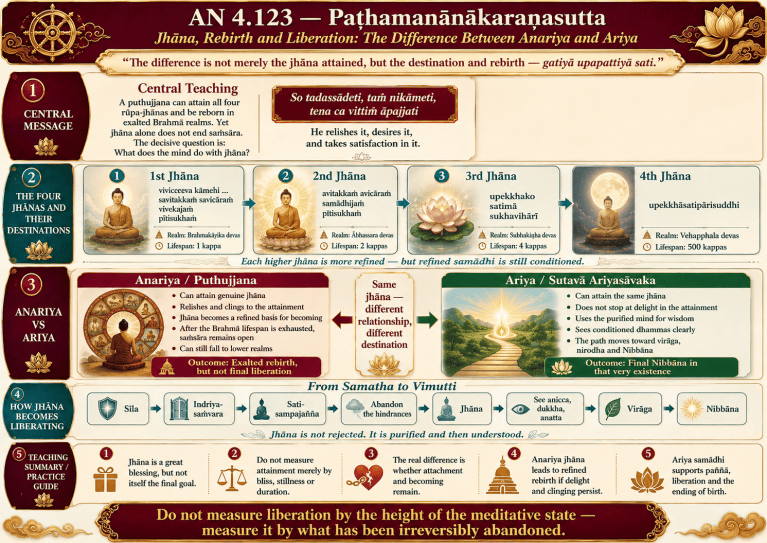
AN 4.123 Paṭhamanānākaraṇasutta
AN 4.123, the Paṭhamanānākaraṇasutta, is an important discourse for understanding the difference between jhāna attainment and liberation. The Buddha shows that even an uninstructed puthujjana can develop the four rūpa-jhānas, dwell in…
From Daily Discipline to Samathā, Jhāna and Vipassanā
From Waking to Vipassanā presents meditation as a continuous training rather than an isolated sitting practice. Drawing especially on MN 39, MN 107 and MN 53, it shows how sīla, guarding the…
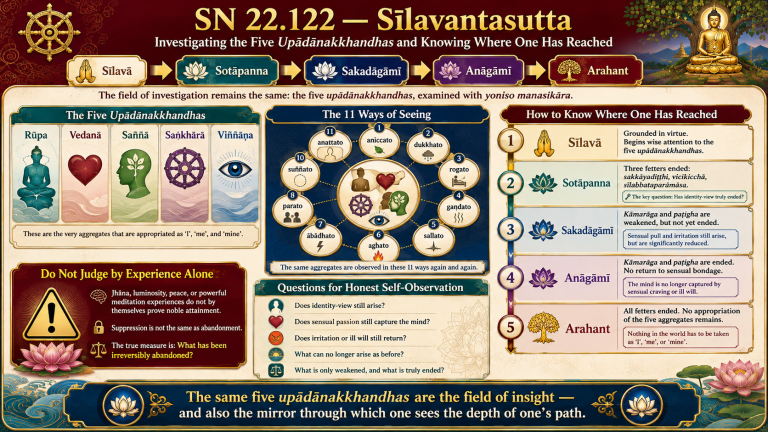
SN 22.122 — Sīlavantasutta
Shows how contemplation of the five aggregates remains central throughout the stages of the noble path, from virtuous practitioner through the four levels of awakening.
DN 2 — Sāmaññaphalasutta
Maps the gradual training from sīla and sense restraint through sati-sampajañña, abandonment of the hindrances and jhāna to the destruction of the āsavas.
Page 1 of 4
ADDITIONAL MATERIAL — For Everyday Practice
Earlier supporting material retained while remaining posts are progressively classified into the training path.
For Everyday Practice
Existing everyday-practice material retained here while the remaining posts are progressively classified into the Training Path above.
Showing 1–12 of 29 studies

From Character to Rebirth
This essay takes into consideration many sutta's which relate to how rebirth happens in lower realm and how one can protect oneself from being born in those realms by practicing morality and…
SN 46.55 Saṅgāravasutta
This is an excellent sutta to see the hindrances in more detailed way and workout that leading to seven awakening factors
AN 5.55 Mātāputtasutta
This important sutta explains in detail on how a man gets involved with woman and how a woman gets involved with man irrespective of whatever designations they create and how the lust…
MN 2 Sabbāsavasutta
This important sutta explains the asavas or fermentations that we have accumulated and what should be removed and what should be developed in this place
MN 62 Maharahulovadasutta
MN 62 Mahārāhulovādasutta is far more than a discourse on mindfulness of breathing. The Buddha gives Rāhula a complete training: seeing the five aggregates and elements without ownership, developing a mind that…
What is Sati?
Sati is one of the most frequently used—and frequently oversimplified—terms in the Buddha’s teaching. Often translated merely as “mindfulness” or “present-moment awareness,” its meaning becomes much richer when SN 48.10, MN 118,…
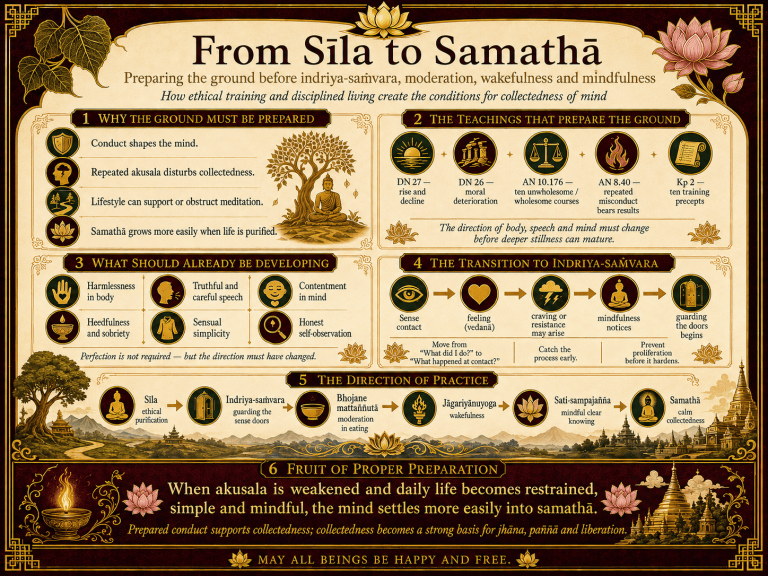
From Sīla to Samathā
From Sīla to Samathā presents the Buddha’s training as one continuous progression rather than a collection of separate practices. Before guarding the sense doors or trying to establish samathā, the practitioner must…
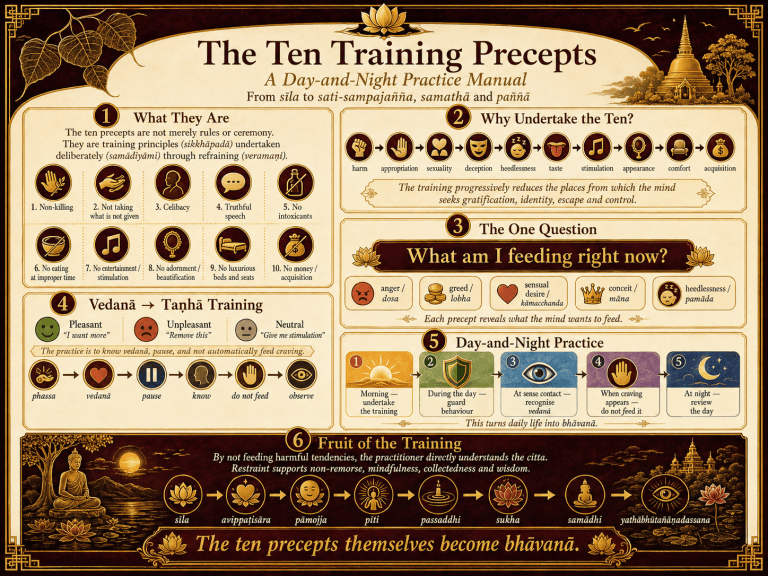
KP 2 — Dasasikkhāpada
Explores the Ten Training Precepts as practical training in restraint, simplicity and purification of conduct that supports deeper development of the mind.
From Daily Discipline to Samathā, Jhāna and Vipassanā
From Waking to Vipassanā presents meditation as a continuous training rather than an isolated sitting practice. Drawing especially on MN 39, MN 107 and MN 53, it shows how sīla, guarding the…
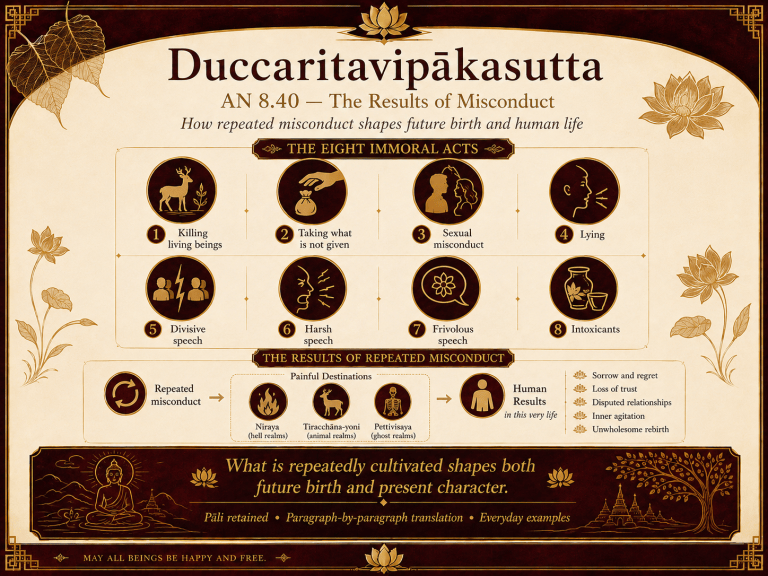
AN 8.40 — Duccaritavipākasutta
Explains how repeatedly cultivated misconduct gains strength and produces consequences, showing sīla as a lived pattern of action rather than merely a set of rules.
Introduction to Samathā
It is very important to understand on what is Samathā in proper sense and this essay just covers that by introducing what is Samathā
AN 4.41 — Samādhibhāvanāsutta
Distinguishes four developments of samādhi, each cultivated for a different purpose: pleasant abiding, knowledge and vision, sati-sampajañña, and destruction of the āsavas.
Page 1 of 3