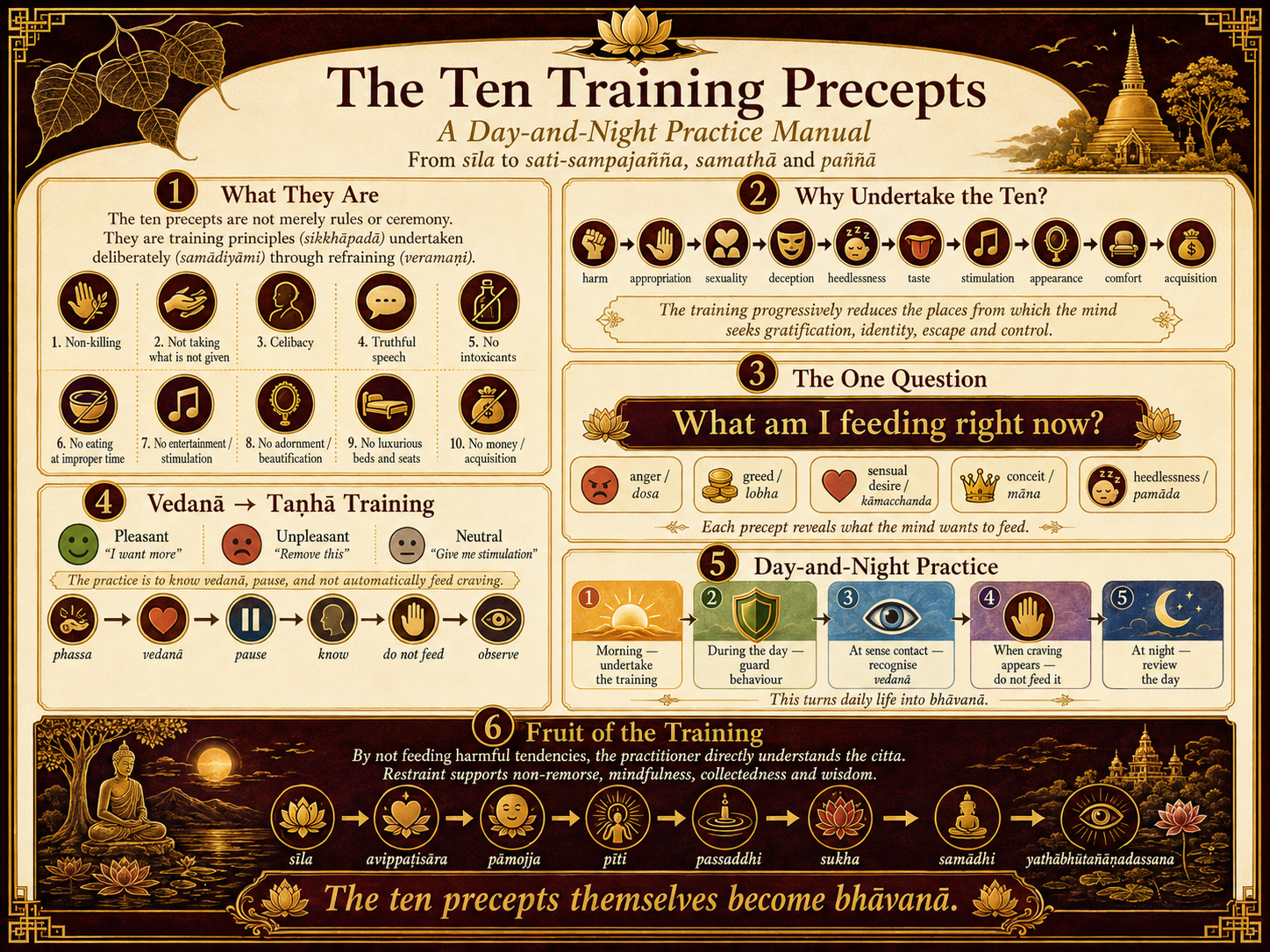
 VISUAL SUMMARYSee this study in a pictureOpen the complete infographic for a visual overview before or after reading the full study.View infographic →
The ten training precepts are:
I undertake the training of abstaining from killing living beings.
I undertake the training of abstaining from taking what has not been given.
I undertake the training of abstaining from sexual activity.
I undertake the training of abstaining from false speech.
I undertake the training of abstaining from intoxicants that are a basis for heedlessness.
I undertake the training of abstaining from eating at an improper time.
I undertake the training of abstaining from dancing, singing, music and entertainments.
I undertake the training of abstaining from garlands, perfumes, cosmetics, adornment and beautification.
I undertake the training of abstaining from high and luxurious beds and seats.
I undertake the training of abstaining from accepting gold and money.
Three words occurring repeatedly in these formulas deserve particular attention:
The practitioner is therefore not merely promising:
“I will not do these ten things.”
The undertaking is deeper:
“Whenever the conditions for this behaviour arise, I shall use that very situation to train and understand the mind.”
Once approached in this way, the ten precepts cease to be ceremonial rules. They become a twenty-four-hour laboratory for observing lobha, dosa, moha, taṇhā, upādāna, māna and pamāda.
The ordinary mind continually moves toward what is pleasant, away from what is unpleasant, and seeks security around what it calls “I” and “mine.”
The ten precepts progressively interfere with these habitual movements.
There is therefore a striking progression:
harm → appropriation → sexuality → deception → heedlessness → taste → stimulation → appearance → comfort → acquisition
The practitioner is intentionally reducing the number of places from which the mind obtains gratification, identity, escape and control.
This is why the ten precepts should not be regarded merely as morality.
They establish the conditions favourable for bhāvanā.
The Buddha repeatedly presents wholesome sīla as giving rise to avippaṭisāra — non-remorse, from which gladness, joy, tranquillity, happiness and samādhi can develop.
Thus sīla is not something that must be completed before “real meditation” begins.
Sīla is already altering the conditions from which samādhi becomes possible.
When examining a breach of a precept, three different kinds of consequence should be distinguished.
2.1 Ethical or Kammic Consequence
Intentional actions such as killing, stealing and knowingly speaking falsehood are themselves akusala.
They cannot be placed on the same level as sleeping on a comfortable bed or eating after noon.
This distinction is essential.
2.2 Consequence for Training
A practitioner who voluntarily undertakes celibacy, restricted eating, abstinence from entertainment, simplicity in clothing and bedding, and non-acquisition is deliberately training nekkhamma — renunciation.
If every time desire appears the undertaking is abandoned, the mind learns:
“My resolution does not decide my behaviour. Craving decides.”
That has consequences for bhāvanā even where the action itself is not equivalent to grave ethical misconduct.
2.3 Immediate Consequence in Citta
This is perhaps the most useful level for day-to-day practice.
Instead of asking only:
“Did I technically break the precept?”
ask:
“What did I just strengthen?”
Did I strengthen:
This is where the precepts become meditation.
Every precept in this manual is examined through seven practical dimensions:
The purpose is not merely to establish whether a rule has been kept.
The deeper purpose is to discover:
At what point did the mind begin negotiating with craving, aversion, identity or heedlessness?
The following table is the working summary of the entire manual. It can be read in the morning before beginning the day, referred to whenever uncertainty arises, and reviewed again before sleeping.
The central question throughout is:
“What has arisen in the mind, what is it asking me to do, and what happens if I do not feed it?”
Table navigation: scroll horizontally to see all columns; the header labels have also been wrapped onto shorter lines for easier reading.
The Ten in One Line
For rapid recollection:
LIFE → PROPERTY → CELIBACY → TRUTH → HEEDFULNESS → FOOD → STIMULATION → APPEARANCE → COMFORT → ACQUISITION
Or:
The Vedanā Ready Reckoner
The practical sequence is:
phassa → vedanā → pause → know → do not automatically feed → observe
The training is not to prevent vedanā.
It is to discover that:
vedanā does not have to become taṇhā, and taṇhā does not have to become action.
The Seven-Point Rapid Check
When there is insufficient time even for the seven-point check, remember:
“What am I feeding right now?”
If the answer is:
dosa, lobha, kāmacchanda, māna, pamāda, rasataṇhā, sensory hunger, identity, comfort-attachment or acquisition,
the practice is not simply:
“Stop.”
It is:
“Know what has arisen. Do not automatically nourish it. Observe what happens when it is not fed.”
This is the bridge from:
sīla → sati-sampajañña → samathā → paññā.
01 Pāṇātipātā veramaṇisikkhāpadaṁ samādiyāmi — Abstaining from Killing Living Beings
1. Practical Meaning
The practitioner deliberately refrains from intentionally destroying living beings.
But the deeper practice begins long before killing occurs.
Before physical violence there may be:
irritation → rejection → aversion → hostility → wish to remove → wish to destroy.
Therefore this precept trains avihiṁsā and weakens dosa and vihiṁsā.
2. Situations in Daily or Retreat Life
Notice the mental movement:
“I want this being or this person to disappear because their presence is unpleasant.”
That itself is already the field of practice.
3. Borderline Situations
Unintentional injury is not the same as intentional destruction.
Accidentally stepping on an insect should not be psychologically treated like deliberately crushing it.
Similarly, reasonable protection against genuine danger is different from intentional cruelty.
The key question is:
Was there an intention to destroy life?
But even when no killing occurs, irritation remains useful material for understanding dosa.
4. Sati-Sampajañña Questions
Remember:
“This being too does not want suffering.”
5. Vedanā → Taṇhā Analysis
Mosquito bite.
Phassa.
Unpleasant vedanā.
Then:
“I do not want this.”
Then:
“I want it gone.”
Then perhaps:
“I will kill it.”
The precept creates space between unpleasant vedanā and destructive action.
6. Evening Assessment
7. Signs Dosa Is Weakening
The strongest sign is not:
“I controlled my anger.”
It is:
“The same situation no longer generates much anger.”
02 Adinnādānā veramaṇisikkhāpadaṁ samādiyāmi — Abstaining from Taking What Has Not Been Given
1. Practical Meaning
The obvious meaning is not stealing.
The deeper principle is:
Do not appropriate what has not been given.
The principal tendencies are lobha, possessiveness and entitlement.
2. Situations
The mind may say:
“It is only a small thing.”
The training asks:
“Was it given?”
3. Borderline Situations
Shared facilities involve implied permission.
The purpose is not obsessive fear of touching things.
The issue is knowingly crossing agreed boundaries.
When uncertain:
Ask.
4. Sati-Sampajañña Questions
5. Vedanā → Taṇhā
An attractive object is seen.
Pleasant vedanā.
“I like it.”
Then:
“I want it.”
Then:
“Perhaps I can take it.”
The training interrupts:
pleasant vedanā → wanting → appropriation.
6. Evening Assessment
7. Signs Lobha Is Weakening
Most importantly:
Seeing something attractive no longer automatically produces, “How can I obtain this?”
03 Abrahmacariyā veramaṇisikkhāpadaṁ samādiyāmi — Complete Celibacy
1. Practical Meaning
Here the wording is abrahmacariya, not merely abstinence from sexual misconduct.
The training means complete sexual abstinence and learning not deliberately to nourish erotic thought.
The principal tendencies being weakened are kāmarāga and kāmacchanda.
2. Situations
The second look is often more informative than the first.
3. Borderline Situations
Attraction itself is not identical with a breach.
Pleasant perception may arise naturally.
The practical question is:
What happens next?
Do I continue looking?
Do I mentally elaborate?
Replay the image?
Seek another contact?
This avoids repression while maintaining restraint.
4. Sati-Sampajañña Questions
5. Vedanā → Taṇhā
Sight contact.
Pleasant vedanā.
Recognition of attractiveness.
Then:
“I want more.”
More looking.
More imagination.
More contact.
More memory.
The precept exposes kāma-taṇhā requesting continuation.
6. Evening Assessment
7. Signs Kāmacchanda Is Weakening
Eventually:
“The object may still be recognised as attractive, but the compulsion to possess or experience it has weakened.”
04 Musāvādā veramaṇisikkhāpadaṁ samādiyāmi — Abstaining from False Speech
1. Practical Meaning
Do not knowingly represent what is false as true or what is true as false.
The deeper problem is construction of an alternative reality to protect or enlarge “me.”
2. Situations
This becomes especially serious when spiritual attainments are involved.
3. Borderline Situations
Not revealing every fact is not automatically lying.
Silence is not necessarily deception.
A sincere mistake is different from deliberate falsehood.
Ask:
“Am I knowingly causing another person to believe something I know to be untrue?”
4. Sati-Sampajañña Questions
5. Vedanā → Taṇhā
An uncomfortable question is asked.
Unpleasant vedanā.
Then fear:
“If I tell the truth, I may look bad.”
Then craving:
“I want to preserve my reputation.”
False speech becomes the strategy.
Thus lying may reveal upādāna around identity.
6. Evening Assessment
7. Signs the Defilement Is Weakening
05 Surāmerayamajjapamādaṭṭhānā veramaṇisikkhāpadaṁ samādiyāmi — Abstaining from Intoxicants That Become a Basis for Heedlessness
1. Practical Meaning
The critical word is pamādaṭṭhāna — a basis for heedlessness.
The training protects appamāda.
2. Situations
Someone offers alcohol socially.
The thought arises: “Just a little.”
An intoxicating substance is used to escape discomfort.
One wants relief from boredom, anxiety or distress.
The deeper question is:
“Why does the mind want consciousness altered?”
3. Borderline Situations
Necessary medical treatment should not be confused with recreational intoxication.
Purpose matters.
The issue is intentionally clouding awareness for pleasure or escape.
4. Sati-Sampajañña Questions
5. Vedanā → Taṇhā
Unpleasant mental experience occurs.
Then:
“I don’t want this.”
Then:
“Give me something that changes how I feel.”
The substance becomes an instrument for escaping vedanā.
6. Evening Assessment
7. Signs Pamāda Is Weakening
Eventually:
“Why would I deliberately make the mind less capable of knowing?”
06 Vikālabhojanā veramaṇisikkhāpadaṁ samādiyāmi — Abstaining from Eating at the Wrong Time
1. Practical Meaning
The traditional discipline involves abstaining from food after noon until the following dawn.
The deeper training concerns dependence upon taste and repeated gratification through food.
2. Situations
3. Borderline Situations
Medical requirements must be handled intelligently.
The purpose is not bodily harm.
But distinguish genuine necessity from craving presenting itself as health concern.
Ask:
“Does the body require nourishment, or does the mind request taste?”
4. Sati-Sampajañña Questions
5. Vedanā → Taṇhā
A food memory appears.
Pleasant vedanā.
Anticipation.
Then:
“I would like something.”
Do nothing.
Observe.
Craving intensifies.
Changes.
Creates images.
Negotiates.
Then eventually passes.
This is direct learning.
6. Evening Assessment
7. Signs Rasataṇhā Is Weakening
Food returns to supporting the body rather than entertaining the mind.
07 Naccagītavāditavisūkadassanā veramaṇisikkhāpadaṁ samādiyāmi — Abstaining from Entertainment and Sensory Stimulation
1. Practical Meaning
The principle is not merely ancient performances.
It is:
Do not continually stimulate the mind through entertainment.
In modern practice this includes recreational:
videos,
television,
movies,
music,
short-form video,
social media,
gaming,
news scrolling,
and purposeless browsing.
2. Situations
The thought arises:
“I need something interesting.”
That sentence itself reveals the problem.
3. Borderline Situations
Necessary communication is different from recreation.
Instructional material is not automatically entertainment.
Ask:
“Purpose or stimulation?”
4. Sati-Sampajañña Questions
5. Vedanā → Taṇhā
Neutral or mildly unpleasant vedanā appears.
The mind labels it:
“boring.”
Craving says:
“Give me something.”
The phone or entertainment promises stimulation.
Thus the practitioner discovers difficulty remaining with neutral vedanā.
6. Evening Assessment
7. Signs Sensory Hunger Is Weakening
Absence of stimulation begins to feel peaceful rather than empty.
08 Mālāgandhavilepanadhāraṇamaṇḍanavibhūsanaṭṭhānā veramaṇisikkhāpadaṁ samādiyāmi — Abstaining from Adornment and Beautification
1. Practical Meaning
This does not mean neglecting hygiene.
Cleaning and caring for the body is different from deliberately constructing an attractive identity.
The deeper tendencies are māna, kāmarāga and attachment to rūpa.
2. Situations
3. Borderline Situations
Soap, medical skin care, sunscreen and hygiene are not automatically adornment.
Ask:
“Am I caring for the body or constructing an image?”
4. Sati-Sampajañña Questions
Or am I checking:
“How do I look?”
5. Vedanā → Taṇhā
Mirror contact.
Pleasant or unpleasant vedanā.
Comparison.
Then:
“I want this part to look different.”
The mind constructs an improved “me.”
6. Evening Assessment
7. Signs Attachment to Appearance Is Weakening
The body becomes:
a rūpa process to be cared for and understood rather than an object from which “I” must obtain value.
09 Uccāsayanamahāsayanā veramaṇisikkhāpadaṁ samādiyāmi — Abstaining from High and Luxurious Beds and Seats
1. Practical Meaning
The principle is simplicity rather than self-torture.
This precept exposes dependence upon physical comfort.
2. Situations
3. Borderline Situations
Medical conditions may require support.
Injury prevention is not indulgence.
Ask:
“Necessary support or luxury demanded by preference?”
4. Sati-Sampajañña Questions
5. Vedanā → Taṇhā
Unpleasant bodily vedanā.
Immediately:
“I must move.”
Sometimes moving is appropriate.
But notice:
unpleasant vedanā → demand for relief.
Learn the difference between:
“The body requires adjustment”
and
“I cannot tolerate this.”
6. Evening Assessment
7. Signs Comfort-Attachment Is Weakening
One discovers:
“Comfort is pleasant, but it is no longer a condition for contentment.”
10 Jātarūparajatapaṭiggahaṇā veramaṇisikkhāpadaṁ samādiyāmi — Abstaining from Accepting Gold and Money
1. Practical Meaning
For a lay practitioner undertaking serious ten-precept observance, a useful practical implementation is:
Arrange necessities beforehand and suspend unnecessary buying, selling, shopping and financial activity during the period.
The deeper issue is acquisition, ownership, security and control.
2. Situations
3. Borderline Situations
Emergency expenditure and necessary travel arrangements are different from recreational shopping.
The important question is:
“Can I temporarily live without acquisition?”
4. Sati-Sampajañña Questions
5. Vedanā → Taṇhā
An attractive object is seen.
Pleasant vedanā.
Then:
“I want that.”
Money allows:
“I can obtain it.”
Money thereby functions psychologically as stored possibility for future gratification.
6. Evening Assessment
7. Signs Acquisition Is Weakening
“Enough” increasingly becomes a quality of mind rather than an amount of possessions.
04 How to Remember All Ten Throughout the Day
Remember:
LIFE — PROPERTY — CELIBACY — TRUTH — HEEDFULNESS
FOOD — STIMULATION — APPEARANCE — COMFORT — ACQUISITION
The first five regulate major ethical and behavioural domains.
The later five deliberately simplify sensual and material life.
During afternoon and evening especially observe:
food, stimulation, appearance, comfort and acquisition.
These become more visible as ordinary activity subsides.
05 The Most Important Recollection
Throughout the day ask:
“What am I feeding right now?”
If anger is followed:
dosa is being fed.
If something ungiven is appropriated:
lobha is being fed.
If erotic thought is deliberately continued:
kāmacchanda is being fed.
If truth is distorted:
identity and delusion are being fed.
If awareness is deliberately dulled:
pamāda is being fed.
If food is unnecessarily pursued:
rasataṇhā is being fed.
If stimulation is repeatedly sought:
sensory hunger is being fed.
If appearance becomes central:
māna and rūpa-upādāna are being fed.
If luxury becomes necessary:
comfort-attachment is being fed.
If acquisition dominates:
lobha and upādāna are being fed.
Thus the ten become one training:
Do not continually provide nutriment to taṇhā, dosa, moha, māna and pamāda.
06 Morning Practice
Immediately after waking, recite each precept slowly.
After each one establish its practical intention.
Today no living being will intentionally be harmed through me.
Today nothing ungiven will knowingly be appropriated.
Today sexual desire will not deliberately be fed.
Today truth will be more important than protecting my image.
Today clarity and appamāda will be protected.
Today food will support the body rather than entertain craving.
Today the mind will not continually seek external stimulation.
Today the body will be cared for without constructing identity through decoration.
Today simplicity will be sufficient.
Today nothing unnecessary needs to be acquired.
07 The Three-Second Practice Before Action
Before significant action introduce a small gap.
Ask:
“What is motivating this?”
Look for:
or:
This three-second gap is where sīla meets sati.
08 Bringing Sati-Sampajañña Into Every Precept
Why am I doing this? Does it serve a worthwhile purpose?
Even if there is a purpose, is this action suitable and supportive under present conditions?
Has sati remained established, or has the mind wandered into attraction, aversion and proliferation?
Can I see: contact, vedanā, perception, intention, craving rather than immediately assuming: “I want.” “I hate.” “I need.” “I deserve.” “I am offended.”
This transforms ordinary behaviour into Dhamma investigation.
09 The Precepts as Vedanā Training
Almost every temptation begins with one of three movements.
The mind says: “Continue this.” This particularly feeds sexuality, taste, entertainment, beautification, luxury and acquisition.
The mind says: “Remove this.” This particularly feeds anger, escape and comfort-seeking.
The mind says: “Nothing is happening. Give me stimulation.” This frequently feeds entertainment, unnecessary eating, conversation and phone use.
Thus:
pleasant → more
unpleasant → remove
neutral → stimulate
The practice is not to destroy vedanā.
It is to discover whether:
taṇhā has to follow vedanā at all.
10 Evening Review — Investigation, Not Confession
Before sleeping review the ten.
Do this without guilt and without pride.
Do not ask only:
“Did I keep all ten?”
Instead investigate four dimensions.
1. How Quickly Was the Defilement Recognised?
2. How Strong Was It?
3. How Much Proliferation Followed?
4. How Easy Was It Not to Feed?
These provide much more useful evidence of progress than a simple pass/fail assessment.
11 How to Know Whether a Defilement Is Actually Weakening
Suppression must not be confused with purification.
If sexual desire remains extremely strong but is forcefully suppressed, the behaviour may have changed while kāmacchanda remains powerful.
If anger repeatedly arises but speech is restrained, behaviour has improved while dosa may still remain strong.
Progress can therefore be observed through stages.
The practitioner stops acting upon the defilement.
The defilement is seen before it controls behaviour.
The mind stops building long stories around the stimulus.
The same object produces less craving or aversion.
The defilement arises less often.
Disturbance occurs but equilibrium returns quickly.
This is especially important.
The strongest evidence is not:
“I have become very skilled at fighting craving.”
It is:
“That which previously captured the mind now hardly captures it.”
12 Why These Ten Prepare Samathā
Imagine attempting samathā after spending the previous twelve hours feeding:
Closing the eyes does not erase these processes.
They replay.
The practitioner may then conclude:
But a deeper diagnosis may be:
The mind has been fed continuously throughout the day.
The ten precepts progressively close these feeding stations.
There is then:
The mind has fewer unfinished negotiations with the world.
This naturally supports samathā.
13 Why These Ten Also Prepare Vipassanā
The precepts do something even more important.
They make craving visible.
When gratification is immediately available, craving disappears too rapidly to be studied carefully.
Consider food.
Desire appears.
One eats.
Desire disappears.
One concludes:
“I was hungry.”
But under the sixth precept:
desire appears;
food is not taken;
craving remains available for observation.
One can then watch:
Similarly:
The precepts therefore establish something resembling:
controlled laboratory conditions for observing taṇhā.
14 Do Not Turn the Training Into Suppression
A practitioner may think:
“A good practitioner should not have these thoughts.”
Then craving appears and is attacked.
Anger appears and is hated.
Sexual desire appears and shame arises.
Food craving appears and one becomes angry with oneself.
A second layer of dosa has now been created.
Instead:
The precept determines behaviour:
Do not automatically feed it.
Paññā investigates:
What is this process?
Restraint and investigation therefore work together.
15 Do Not Turn the Training Into Pride
Another danger is:
“I maintain ten precepts while others maintain only five.”
Now sīla itself becomes food for māna.
The important questions are not:
“How disciplined do I appear?”
“How many precepts am I observing?”
Rather:
If not, something still requires investigation.
16 The Day-and-Night Cycle
Establish intention.
Guard behaviour.
Recognise vedanā.
Do not automatically feed it.
Do not automatically obey it.
Investigate dependence upon taste.
Watch food desire and stimulation-seeking.
Watch entertainment, loneliness, boredom and comfort-seeking.
Review the day.
If awake, remain within the same training.
Ask: “What changed in the mind through one complete day and night of not feeding these tendencies?” Then undertake the training again.
17 Compact Nightly Assessment
The objective is not to produce ten perfect “No” answers.
The objective is to know the mind increasingly accurately.
18 The Deeper Movement of the Ten Precepts
Seen together, the ten form a remarkable progression.
I will not destroy what obstructs me.
I will not appropriate what attracts me.
I will not sexually consume what attracts me.
I will not manipulate reality to protect myself.
I will not abandon awareness because experience is difficult.
I will not continually gratify taste.
I will not continually entertain the senses.
I will not continually manufacture identity through appearance.
I will not make comfort a condition for happiness.
I will temporarily relinquish unnecessary acquisition.
What remains is a remarkably simplified life.
And within that simplified life, the movements of citta become much easier to see.
19 Important Qualification — The Ten Are Not Ethically Identical
The ten precepts should never be interpreted as though every breach carries the same ethical weight.
Intentional killing, stealing or deliberate falsehood are not equivalent to:
The later training rules function especially as renunciation disciplines.
Two different questions should therefore always be asked.
“Was an akusala action committed?”
“Whether or not the act is intrinsically grave misconduct, what tendency of citta did I strengthen by following it?”
The second question is indispensable for bhāvanā.
The deepest value of the ten precepts is not reached simply by saying:
“I did not break any of them.”
That is only the beginning.
The deeper accomplishment is that one sees:
why the mind wanted to break them.
Now the ten precepts have transformed from external restraints into a direct investigation of:
lobha, dosa, moha, taṇhā, upādāna, māna and pamāda.
At that point sīla is no longer merely being “observed.”
It is producing knowledge.
Every time contact occurs, vedanā appears and craving asks for nourishment, the practitioner has an opportunity:
Over repeated days and nights, objective change should become visible.
That is a more meaningful measure of practice than attendance, duration, ceremony or the ability to recite precepts.
The ten sikkhāpadā can therefore be understood as a deliberate experiment:
“For this day and night I shall progressively reduce the opportunities through which craving, aversion, heedlessness, identity and acquisition are normally fed. I shall then observe what remains and learn directly how the mind operates.”
The movement then becomes natural:
sīla → avippaṭisāra → pāmojja → pīti → passaddhi → sukha → samādhi → yathābhūtañāṇadassana
and onward toward disenchantment, fading of passion and liberation.
The ten precepts therefore cease to be merely the entrance gate to meditation.
Practice resource
Ten Training Precepts — Visual Guide
A full visual guide to the ten training precepts and their practical application in daily life.