Refining the Mind Like Silver
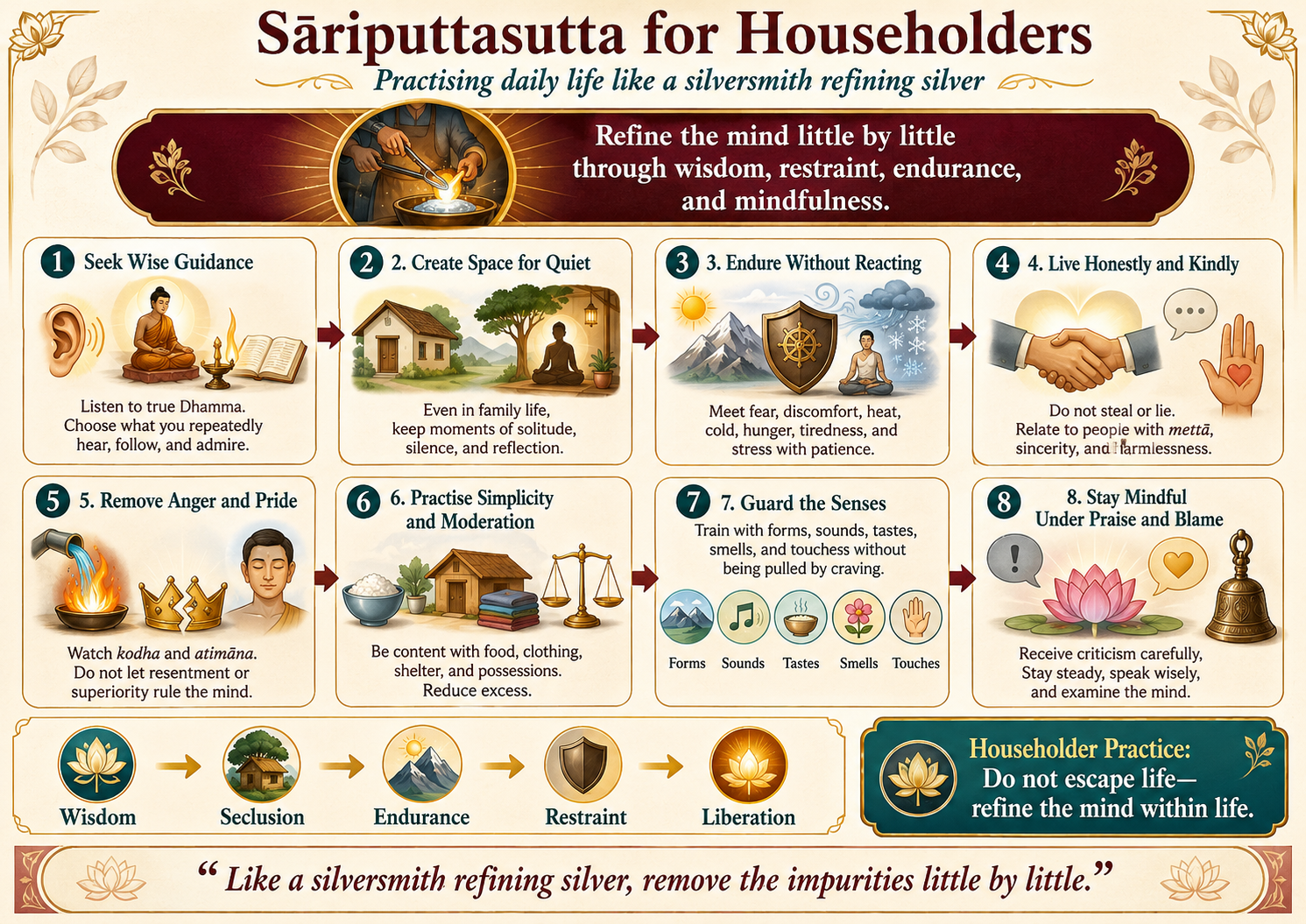 VISUAL SUMMARYSee this study in a pictureOpen the complete infographic for a visual overview before or after reading the full study.View infographic →
Sāriputta does not ask for philosophy; he asks what one should actually train
Snp 4.16 Sāriputtasutta, the final discourse of the Aṭṭhakavagga, begins with Sāriputta’s praise of the Buddha and immediately turns toward practice. He asks on behalf of the many who are bound: what fears must a secluded practitioner overcome? What dangers? What kind of speech, range, conduct, observances, and training will refine the mind like silver?
The Buddha’s answer is unusually integrated: courage without denial of danger, endurance without passivity, honesty, mettā, uprooting anger and conceit, wisdom placed in front, contentment with requisites, restraint under provocation, lowered gaze, wakefulness, explicit dedication to jhāna, equanimity, willingness to receive correction, non-involvement with gossip, and training against passion toward forms, sounds, tastes, smells, and touches.
The closing verse gathers these strands: desire is removed regarding the sensory fields; the practitioner is mindful and well freed in mind; Dhamma is rightly examined; the mind becomes unified; and darkness is dispelled.
All twenty-one Pāḷi verses with direct translation
01Sāriputta recognizes an extraordinary Teacher
Na me diṭṭho ito pubbe,
(iccāyasmā sāriputto)
Na suto uda kassaci;
Evaṁ vagguvado satthā,
Tusitā gaṇimāgato.
Venerable Sāriputta said: “Never before have I seen, nor heard from anyone, a Teacher of such beautiful speech, come from Tusita as leader of a community.”
02The One with Vision has dispelled darkness
Sadevakassa lokassa,
yathā dissati cakkhumā;
Sabbaṁ tamaṁ vinodetvā,
ekova ratimajjhagā.
“The One with Vision is seen by the world together with its devas. Having dispelled all darkness, he alone has attained true delight.”
03Sāriputta asks on behalf of the many who are bound
Taṁ buddhaṁ asitaṁ tādiṁ,
akuhaṁ gaṇimāgataṁ;
Bahūnamidha baddhānaṁ,
atthi pañhena āgamaṁ.
“To that Buddha—unattached, such, without deceit, come with a following—I have come with a question on behalf of the many who are bound here.”
04The practitioner who chooses secluded places
Bhikkhuno vijigucchato,
bhajato rittamāsanaṁ;
Rukkhamūlaṁ susānaṁ vā,
pabbatānaṁ guhāsu vā.
“For a bhikkhu who is disenchanted and resorts to an empty seat, the root of a tree, a charnel ground, or caves in the mountains …”
05What terrors should not make him tremble?
Uccāvacesu sayanesu,
kīvanto tattha bheravā;
Yehi bhikkhu na vedheyya,
nigghose sayanāsane.
“… in the various kinds of lodging there, what terrors are there at which the bhikkhu should not tremble in his silent dwelling?”
06The direction never travelled before
Katī parissayā loke,
gacchato agataṁ disaṁ;
Ye bhikkhu abhisambhave,
pantamhi sayanāsane.
“How many dangers are there in the world that a bhikkhu should overcome as he goes toward a direction not travelled before, living in a secluded dwelling?”
Textual correction: this canonical verse was omitted from the earlier 20-verse article. The rebuilt study restores the complete 21-verse sequence.
07Speech, range, conduct, and observances
Kyāssa byappathayo assu,
kyāssassu idha gocarā;
Kāni sīlabbatānāssu,
pahitattassa bhikkhuno.
“What should be his ways of speech? What should be his proper range here? What virtues and practices should belong to a bhikkhu whose mind is resolutely applied?”
08Like a smith refining silver
Kaṁ so sikkhaṁ samādāya,
ekodi nipako sato;
Kammāro rajatasseva,
niddhame malamattano.
“What training should he undertake—unified, astute, and mindful—so that, like a smith refining silver, he removes the impurities from himself?”
09The Buddha begins the answer
Vijigucchamānassa yadidaṁ phāsu,
(sāriputtāti bhagavā)
Rittāsanaṁ sayanaṁ sevato ce;
Sambodhikāmassa yathānudhammaṁ,
Taṁ te pavakkhāmi yathā pajānaṁ.
The Blessed One said: “Sāriputta, I will tell you, as one who knows, what is suitable for one who is disenchanted, who resorts to an empty lodging, and who desires awakening in accordance with Dhamma.”
10Five concrete fears of secluded life
Pañcannaṁ dhīro bhayānaṁ na bhāye,
Bhikkhu sato sapariyantacārī;
Ḍaṁsādhipātānaṁ sarīsapānaṁ,
Manussaphassānaṁ catuppadānaṁ.
“A wise bhikkhu, mindful and living within proper bounds, should not fear these five fears: biting flies, mosquitoes, reptiles, encounters with people, and four-footed animals.”
11Do not be shaken by those who follow other teachings
Paradhammikānampi na santaseyya,
Disvāpi tesaṁ bahubheravāni;
Athāparāni abhisambhaveyya,
Parissayāni kusalānuesī.
“Nor should he be frightened by followers of other teachings, even on seeing the many threats that may come from them. Seeking what is skillful, he should overcome still other dangers.”
12Illness, hunger, cold, and heat
Ātaṅkaphassena khudāya phuṭṭho,
Sītaṁ athuṇhaṁ adhivāsayeyya;
So tehi phuṭṭho bahudhā anoko,
Viriyaṁ parakkammadaḷhaṁ kareyya.
“Touched by illness and hunger, he should endure cold and excessive heat. Though struck by these in many ways, homeless, he should make his energy and exertion firm.”
13Honesty, mettā, and recognizing a turbid mind
Theyyaṁ na kāre na musā bhaṇeyya,
Mettāya phasse tasathāvarāni;
Yadāvilattaṁ manaso vijaññā,
Kaṇhassa pakkhoti vinodayeyya.
“He should not steal and should not speak falsely. He should touch moving and unmoving beings with mettā. Whenever he recognizes turbidity in the mind, he should dispel it as belonging to the side of the Dark One.”
14Dig up the roots of anger and conceit
Kodhātimānassa vasaṁ na gacche,
Mūlampi tesaṁ palikhañña tiṭṭhe;
Athappiyaṁ vā pana appiyaṁ vā,
Addhā bhavanto abhisambhaveyya.
“He should not come under the power of anger or excessive conceit. Having dug up even their roots, he should stand firm. Then he should truly overcome what is dear and what is not dear.”
15Put paññā in front and endure discontent
Paññaṁ purakkhatvā kalyāṇapīti,
Vikkhambhaye tāni parissayāni;
Aratiṁ sahetha sayanamhi pante,
Caturo sahetha paridevadhamme.
“Putting wisdom in front, delighting in what is wholesome, he should ward off those dangers. He should endure discontent in a secluded lodging and endure the four grounds for lamentation.”
16The four lamenting thoughts
Kiṁsū asissāmi kuva vā asissaṁ,
Dukkhaṁ vata settha kvajja sessaṁ;
Ete vitakke paridevaneyye,
Vinayetha sekho aniketacārī.
“‘What will I eat? Where will I eat? I slept badly! Where will I sleep today?’ The trainee who wanders without a home should subdue these lamenting thoughts.”
17Moderation, contentment, restraint, and non-harsh speech
Annañca laddhā vasanañca kāle,
Mattaṁ so jaññā idha tosanatthaṁ;
So tesu gutto yatacāri gāme,
Rusitopi vācaṁ pharusaṁ na vajjā.
“Having received food and clothing at the proper time, he should know moderation for the sake of contentment. Guarded regarding these things and restrained when going in the village, even when provoked he should not speak harshly.”
18Lowered gaze, jhāna, wakefulness, equanimity, and the ending of restless thought
Okkhittacakkhu na ca pādalolo,
Jhānānuyutto bahujāgarassa;
Upekkhamārabbha samāhitatto,
Takkāsayaṁ kukkucciyūpachinde.
“With eyes lowered, not restless in roaming, devoted to jhāna and much wakefulness, grounding himself in equanimity and composed in mind, he should cut off the tendency to speculative thinking and worry or remorse.”
19Welcome correction; dissolve hardness toward fellow practitioners
Cudito vacībhi satimābhinande,
Sabrahmacārīsu khilaṁ pabhinde;
Vācaṁ pamuñce kusalaṁ nātivelaṁ,
Janavādadhammāya na cetayeyya.
“When reproved with words, being mindful, he should welcome it. He should break up hardness toward his companions in the holy life. He should utter skillful speech, but not at excessive length, and should not set his mind on the talk and gossip of people.”
20Five kinds of dust in the world
Athāparaṁ pañca rajāni loke,
Yesaṁ satīmā vinayāya sikkhe;
Rūpesu saddesu atho rasesu,
Gandhesu phassesu sahetha rāgaṁ.
“And there are these five kinds of dust in the world, for whose removal the mindful one should train: with regard to forms, sounds, tastes, smells, and touches, he should overcome passion.”
21Remove chanda, examine Dhamma, become unified, dispel darkness
Etesu dhammesu vineyya chandaṁ,
Bhikkhu satimā suvimuttacitto;
Kālena so sammā dhammaṁ parivīmaṁsamāno,
Ekodibhūto vihane tamaṁ so”ti.
“Having removed desire regarding these things, the bhikkhu—mindful, with mind well freed—at the proper time rightly examining Dhamma, becoming unified, should shatter the darkness.”
Conduct, endurance, seclusion, jhāna, paññā, and sense restraint as one training
22Sāriputta asks on behalf of those who are bound
The opening praise is immediately converted into a practical question. Sāriputta does not merely admire the Buddha; he asks what training actually frees those who are bound.
This sets the tone of the discourse: speech, seclusion, fear, conduct, endurance, sense restraint, jhāna, correction, and paññā are all treated as parts of one training.
Today’s example: A student who admires a teacher’s calmness should eventually ask: what causes produced that calmness, and which of those causes am I actually developing?
23Agataṁ disaṁ — a direction not travelled before
The restored sixth verse contains the striking phrase gacchato agataṁ disaṁ. Serious renunciation moves against the ordinary flow of sensuality, social reassurance, comfort, and reputation.
The unfamiliarity itself becomes a parissaya. The mind often interprets absence of stimulation as something wrong because it has rarely lived without constant feeding.
Today’s example: A householder who switches off the phone, television, music, and messaging for one evening may discover that the real difficulty is not silence but the mind’s demand to escape silence.
24The silversmith image is repeated refinement
The smith does not declare the silver pure after one heating. Impurity is exposed, removed, and the material is examined again.
So too in practice: gross lying may stop and subtle exaggeration becomes visible; shouting may stop and sarcasm becomes visible; overt sensual pursuit may stop and fantasy becomes visible.
Today’s example: Seeing a finer impurity after months of practice is often evidence of increased sensitivity, not failure.
25Seclusion is a laboratory, not an escape
Tree roots, charnel grounds, caves, and empty lodgings belong to the renunciant setting. Their function is to remove ordinary supports so that fear, arati, craving, and restlessness become visible.
A householder should preserve the principle without pretending ordinary solitude is identical to monastic seclusion.
Today’s example: Thirty minutes without phone, reading, music, work, or conversation can reveal how quickly the mind searches for stimulation.
26The five fears are real dangers
The Buddha names insects, mosquitoes, reptiles, human encounters, and animals. This is not a teaching that ‘fear is imaginary.’
Training means sensible protection without mental trembling taking command.
Today’s example: Lock the door and check safety when travelling; then notice whether the mind continues rehearsing danger for another two hours.
27Paradhammikā is not simply ‘other religions’
The verse concerns people who follow another doctrine or teaching and may present threats. Turning it into a general instruction about ‘other religions’ is too broad.
The practical theme is steadiness when one meets ideological pressure, mockery, or opposition.
Today’s example: If friends mock your decision to stop drinking, you need neither attack them nor abandon the training merely to regain approval.
28Kusalānuesī — keep seeking what is skillful
The practitioner is described as one seeking kusala. Under pressure, the question is not ‘How do I defeat them?’ but ‘Which response reduces greed, hatred, and delusion?’
This single criterion can transform arguments, family disputes, and Dhamma debates.
Today’s example: You can win an online debate while spending the entire evening cultivating irritation and conceit. Winning is not the same as kusala.
29Endurance is not passivity
Illness, hunger, cold, and heat are endured while viriya is strengthened. One may still seek medicine, food, shelter, or practical help.
The training concerns the mind’s multiplication of discomfort through complaint, panic, and abandonment.
Today’s example: A mild headache may require rest, medicine, or simply patience. The practice is to distinguish bodily care from the thought ‘therefore all training must stop.’
30Do not build advanced meditation on dishonesty
After lofty questions about awakening, the Buddha says: do not steal and do not lie.
Integrity is not a preliminary to be discarded later. Concealment and deception agitate the same mind that one hopes to unify.
Today’s example: Discussing jhāna while falsifying business accounts is a contradiction in the training ecology.
31Mettā survives seclusion
Seclusion does not mean social contempt. The practitioner is told to touch beings with mettā.
One can reduce company without reducing goodwill.
Today’s example: You can decline an invitation to protect practice time without secretly thinking that everyone at the gathering is spiritually inferior.
32Recognize āvilattaṁ — the turbid mind
The instruction is to know when the mind becomes muddied. Sati catches the qualitative change before it hardens into speech or action.
Purification begins with accurate recognition, not with pretending difficult states never arise.
Today’s example: While typing a reply you notice tightening in the chest and the desire to humiliate the other person. That recognition is already a crucial practice moment.
33Do not romanticize dark mental states
The Buddha says the turbid state should be dispelled as belonging to the dark side. Modern language often renames anger as authenticity or envy as ambition.
The criterion is not whether the emotion feels powerful, but what it conditions.
Today’s example: ‘My anger proves I care’ may contain some truth about care, but it does not make the anger itself skillful.
34Anger and excessive conceit form a pair
Kodhātimāna is psychologically precise. Anger often intensifies around status: ‘How dare they speak to me like that?’
Root work therefore looks beneath anger for entitlement, comparison, or threatened identity.
Today’s example: A senior employee may be far more upset by correction from a junior than by the same correction from the CEO.
35Dig up the root, not only the expression
Stopping harsh speech is valuable, but the verse asks for the root of anger and conceit to be dug up.
After outward restraint, examine the story that keeps the state alive.
Today’s example: If you stay silent but replay revenge for three hours, the branch was restrained while the root continued receiving nourishment.
36Dear and not-dear are both tests
Practice is destabilized not only by unpleasant things. What is dear can pull the mind just as strongly as what is disliked pushes it.
Steadiness must survive both attraction and aversion.
Today’s example: Noise disrupts one meditation through irritation; a pleasant romantic memory disrupts the next through attraction.
37Paññā in front — sequence matters
Paññaṁ purakkhatvā suggests putting wisdom at the front. Feeling may arise first, but wisdom should lead the response.
Understanding consequence, impermanence, and causality should get a chance to speak before impulse becomes action.
Today’s example: Read a hurtful family message, then wait until you can answer the problem rather than the ten-second desire to wound back.
38Arati is the urge to escape quiet
Arati is discontent, non-delight, inability to settle. It becomes obvious in seclusion.
Modern technology gives arati an instant exit route, so many people never learn what this state actually feels like.
Today’s example: Eight minutes into sitting, the mind says ‘I should quickly check messages.’ Nothing urgent happened; arati found an available door.
39The four lamenting thoughts are ordinary requisites inflated by thought
What will I eat? Where will I eat? I slept badly. Where will I sleep? These are simple needs converted into repetitive self-concern.
The lesson is not lack of planning but proportion.
Today’s example: Choosing lunch can take longer than eating it because the mind turns a basic need into a project of maximizing experience.
40Contentment means knowing the measure
The instruction is to know moderation for the sake of contentment. It is not a command to glorify deprivation.
The question is what amount actually serves life and practice without turning acquisition into endless improvement.
Today’s example: Replacing a broken phone is practical. Replacing a working phone every year because novelty feels necessary reveals a different relationship.
41Provocation is the real test of right speech
The verse says not to speak harshly even when provoked. Politeness under agreement proves little.
Training becomes visible precisely when harsh speech feels justified.
Today’s example: Before replying to an insulting customer, ask whether the next sentence solves the issue or merely transfers pain.
42Okkhittacakkhu — restrained gaze
The old article added instructions about keeping the eyes partly closed in meditation. The Pāḷi simply speaks of a lowered or restrained gaze.
The broader principle is not making visual attention continuously available to whatever seeks to capture it.
Today’s example: On a train, seeing an advertisement is one event; repeatedly scanning it because it stimulates desire is another.
43Na ca pādalolo — not restless in roaming
Restless feet reflect a mind that always needs to go somewhere. Modern roaming may be physical or digital.
Seclusion becomes impossible when every open space in the day must be filled by an outing, café, mall, event, or app.
Today’s example: Try leaving a free afternoon partly unplanned and watch how quickly the mind invents a destination.
44Jhānānuyutto — jhāna is explicit
This discourse explicitly tells the practitioner to be devoted to jhāna. Restraint, seclusion, and wisdom are not presented as substitutes for collected meditative development.
Jhāna appears inside an ecology of ethics, wakefulness, sense restraint, and equanimity.
Today’s example: A practitioner who wants deep jhāna while feeding late-night media, sensuality, gossip, and chronic sleep loss is working against the conditions described here.
45Bahujāgarassa — much wakefulness
Wakefulness in a renunciant context opposes heedlessness and excessive sleep. It should not be distorted into irresponsible sleep deprivation.
For householders, the useful question is whether waking time is alert and purposeful.
Today’s example: Sleeping because the body needs recovery is different from returning to bed because one does not want to face the day.
46Upekkhā and samāhitatta
Equanimity is paired with a composed mind. It is steadiness, not numbness.
When praise and blame lose some power to throw the mind around, collectedness becomes easier.
Today’s example: Use praise as information without building identity from it; use criticism as information without collapsing.
47Takkāsaya and kukkucca — thinking that has outlived its usefulness
The verse points to tendencies toward speculative thought and worry or remorse.
Thinking becomes unskillful when it no longer produces understanding or action yet continues to occupy the mind.
Today’s example: At bedtime ask: is this thought leading to a decision, or is it only looping because the mind cannot put the issue down?
48Welcome correction
Cudito vacībhi satimābhinande may be one of the most demanding instructions in the sutta: the mindful practitioner should welcome reproof.
A smith who refuses to see a blemish cannot refine silver. Correction reveals what self-observation may miss.
Today’s example: When told that you interrupt people, first test the truth of the observation before explaining why the speaker’s tone was unfair.
49Break khila toward fellow practitioners
Spiritual communities are not immune to hardness, resentment, and factional identity.
The Buddha tells the practitioner to break up this hardness toward companions in the holy life.
Today’s example: Two practitioners can disagree about meditation and still refuse to turn the disagreement into months of frozen hostility.
50Skillful speech can still be too much
The verse says to utter skillful speech, but not at excessive length or at the wrong time.
Even correct Dhamma can become self-display, argument, or inability to allow silence.
Today’s example: Answering a question clearly in three minutes can be more skillful than giving a twenty-minute lecture because you enjoy being the expert.
51Do not live inside janavāda
Public talk, gossip, praise, blame, and reputation can occupy the mind long after an event has ended.
The practitioner is not told to ignore every piece of feedback, but not to organize consciousness around what people are saying.
Today’s example: After making a sound decision, repeatedly checking a group chat for approval keeps the mind tied to public opinion.
52The five sensory fields are called dust
Forms, sounds, tastes, smells, and touches are called five kinds of dust because passion toward them clouds the mind.
The senses are not the enemy; rāga is the training problem.
Today’s example: A delicious meal can be enjoyed without spending tomorrow searching for the exact same taste.
53Forms — visual capture
Modern visual systems are engineered to prolong the gaze through beauty, status, sexuality, novelty, and outrage.
Seeing is unavoidable; repeated feeding is trainable.
Today’s example: Notice the difference between an image appearing and intentionally opening the profile to see ten more images.
54Sounds — the inability to tolerate silence
Music, podcasts, news, and voice content can fill every transition in the day.
Silence becomes an important measure of whether sound has become a dependency.
Today’s example: Try one commute without audio and observe whether the mind experiences silence as restful or intolerable.
55Taste, smell, and touch — comfort becomes requirement
Food, coffee, fragrance, temperature, sexuality, bedding, clothing, and bodily ease can all become fields of dependency.
Contentment does not require rejecting comfort; it asks whether comfort has become a condition for mental stability.
Today’s example: A simple meal or unfamiliar mattress can reveal how much peace depends on preferred sensory conditions.
56Vineyya chandaṁ — behavior management is not the end
The final verse moves from external restraint toward the removal of desire regarding these fields.
The mature aim is not a mind obeying rules while secretly mourning the forbidden object.
Today’s example: Removing an app is useful. Deeper freedom is when reinstalling it would no longer make endless scrolling attractive.
57Dhammaṁ parivīmaṁsamāno — investigation continues
The practitioner with a well-freed mind still examines Dhamma at the proper time.
Collectedness without investigation can stagnate; thinking without collectedness scatters.
Today’s example: After a calm sitting, investigate one recurring craving: its conditions, its gratification, its change, and what occurs when it is not fed.
58Ekodibhūto — become unified
The closing verse places unification after an entire life of restraint, jhāna, wakefulness, equanimity, and Dhamma examination.
It is therefore safer to understand ekodibhūto as gathered or unified rather than reducing the whole path to forced one-pointedness.
Today’s example: A mind carrying ten active conversations, resentment, visual stimulation, and unfinished desires cannot be deeply unified simply by squeezing attention harder.
59Vihane tamaṁ — the opening and closing mirror each other
Sāriputta begins by praising the Buddha as one who dispelled darkness. The Buddha ends by describing the training through which the practitioner dispels darkness.
The structure is elegant: recognition of the Teacher becomes a practical map for reproducing the causes of liberation.
Today’s example: Do not chase the final promise while skipping honesty, contentment, correction, restraint, jhāna, and paññā. The middle verses are the path to the final line.
What actually shakes the practitioner?
| Obstacle | Canonical field | What to understand | Daily practice |
|---|---|---|---|
| Fear | Insects, animals, people, unfamiliarity | Risk is real; panic need not rule. | Take sensible precautions, then stop rehearsing catastrophe. |
| Illness / hunger / temperature | Bodily discomfort | Practice should not depend on ideal conditions. | Care for the body without multiplying complaint. |
| Anger + conceit | Correction, insult, status threat | The surface emotion may hide identity-defense. | Ask what status or image is being protected. |
| Arati | Boredom and discontent in seclusion | The mind looks for an exit from quiet. | Remain long enough to know the restlessness. |
| Food / lodging worry | Simple needs become mental occupation | Planning becomes self-concern. | Do what is needed, then drop the repetitive thought. |
| Harsh speech | Provocation | Retaliation feels justified. | Wait until usefulness returns. |
| Speculation / worry | Past-future loops | Thinking persists after practical work ends. | Separate actionable thinking from proliferation. |
| Correction | Reproof | Defensiveness protects self-image. | Test whether the criticism is true before resisting. |
| Public opinion | Gossip, approval, blame | Attention becomes outsourced. | Return to what is actually skillful. |
| Five sensory dusts | Forms, sounds, tastes, smells, touches | Rāga repeatedly captures the mind. | Reduce feeding and know pleasure without converting it into demand. |
Preserve the renunciant context; translate the training principle carefully
The Buddha’s answer is addressed to a bhikkhu living the homeless life. A householder should not pretend that a quiet room is identical to a charnel ground or that family life is monastic seclusion. Yet many training mechanisms apply directly when the context is stated honestly.
| Renunciant instruction | Underlying training | Careful householder application |
|---|---|---|
| Rittāsana / secluded lodging | Reduce stimulation so the mind becomes observable. | A daily media-free period. |
| Endure discomfort | Do not require perfect conditions. | Continue wisely through mild inconvenience. |
| No theft / no lying | Integrity supports a mind without concealment. | Clean finances and truthful communication. |
| Dig up anger and conceit | Investigate the identity under reaction. | After criticism ask what self-image was threatened. |
| Contentment | Know enough. | Reduce compulsive upgrading and luxury-seeking. |
| Jhāna + wakefulness | Protect conditions for collected mind. | Formal meditation, less late-night stimulation. |
| Welcome correction | Use feedback as refining material. | Ask trusted people what recurring fault you do not see. |
| Five sensory dusts | Train where attention is captured. | Curate feeds, moderate food, create silence. |
| Examine Dhamma | Use collectedness for investigation. | After calm, investigate craving and cessation. |
Modern life continuously places the five sensory fields in front of us
The Buddha does not call the senses evil. The training is to overcome rāga in relation to forms, sounds, tastes, smells, and touches, and then remove chanda regarding these things. Today, commercial systems deliberately compete to keep these sensory fields attractive and repeatedly available.
| Field | Today’s objects | How rāga is fed | Practice question |
|---|---|---|---|
| Rūpa — forms | Bodies, screens, products, status images | Repeated looking, comparison, visual shopping | Can the eye know form without turning it into wanting? |
| Sadda — sounds | Music, news, praise, intimate voices | Constant background stimulation | Can silence be tolerated? |
| Rasa — tastes | Food, drinks, novelty | Eating for stimulation beyond need | Where is enough? |
| Gandha — smells | Food aroma, perfume, environments | Mood tied strongly to preferred smells | Can preference remain preference rather than demand? |
| Phassa — touches | Comfort, sexuality, temperature, bedding | Restlessness when tactile conditions are not ideal | Can reasonable discomfort be known without resentment? |

Forms, sounds, tastes, smells, and touches—the five fields where rāga is trained away
Click image to enlarge ↗
From recognizing the Teacher to dispelling darkness
Ask the practical question. What training removes impurity rather than merely increasing knowledge?
Create seclusion. Reduce stimulation enough for fear, arati, craving, and restlessness to become visible.
Establish integrity and mettā. Do not build advanced meditation on dishonesty or hostility.
Dig out anger and conceit at the root. Do not stop at behavioral suppression.
Know enough. Contentment frees energy consumed by food, clothing, comfort, and reputation.
Develop jhāna, wakefulness, upekkhā, and a composed mind.
Welcome correction. Refinement requires seeing impurities one cannot detect alone.
Train against rāga in the five sensory fields.
Examine Dhamma with a unified mind. The arc ends not in restraint alone, but in dispelling darkness.