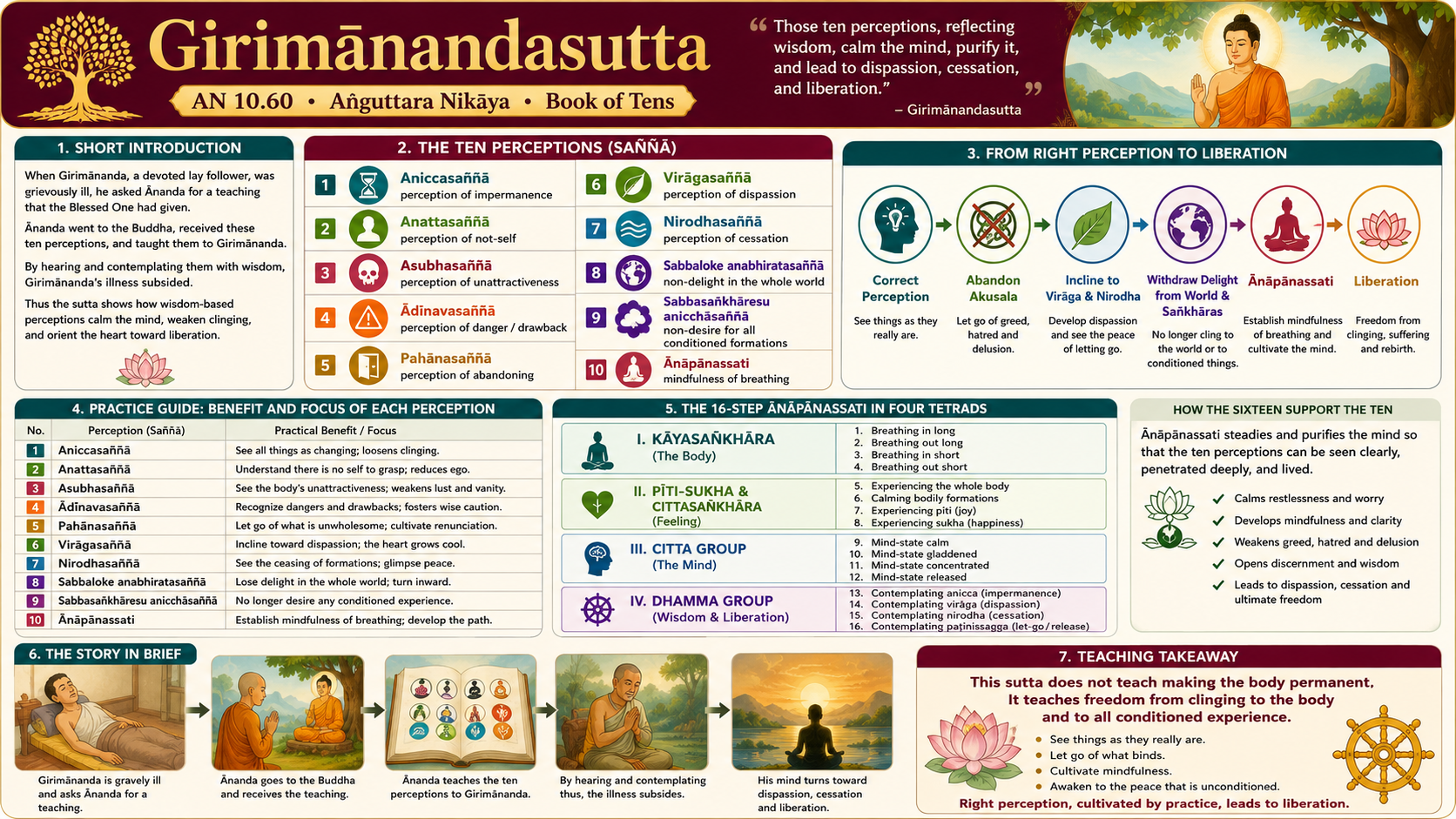
 VISUAL SUMMARYSee this sutta in a pictureOpen the complete infographic for a visual overview before or after reading the full study.View infographic →
AN 10.60, the Girimānandasutta, is a profound discourse in which the Buddha responds to the grave illness of Venerable Girimānanda by teaching ten perceptions that radically transform how a practitioner understands the body, the five aggregates, the six sense bases and the entire field of conditioned existence. Rather than offering reassurance that the body will remain healthy, the Buddha directs Girimānanda toward anicca, anattā, asubha, ādīnava, pahāna, virāga and nirodha.
The ten perceptions form a coherent progression. The first four correct distorted ways of seeing the aggregates and body; the fifth requires the active abandonment of arisen unwholesome states; the sixth and seventh establish virāga and nirodha as the peaceful and sublime direction of Nibbāna; the eighth and ninth remove delight in the world and desire for all conditioned formations. The tenth, ānāpānassati, gathers the training into the complete sixteen-step development, culminating in anicca → virāga → nirodha → paṭinissagga.
The discourse therefore goes far beyond physical healing. It shows how sickness, bodily vulnerability and even the prospect of death can become powerful conditions for wisdom when experience is no longer approached as “I,” “mine,” or something that must remain as I wish.
→
Abandon Akusala
→
Virāga & Nirodha
→
Withdraw Delight
→
Ānāpānassati
→
Paṭinissagga
01
1. Girimānanda Is Gravely Ill
Ekaṁ samayaṁ bhagavā sāvatthiyaṁ viharati jetavane anāthapiṇḍikassa ārāme. Tena kho pana samayena āyasmā girimānando ābādhiko hoti dukkhito bāḷhagilāno. Atha kho āyasmā ānando yena bhagavā tenupasaṅkami; upasaṅkamitvā bhagavantaṁ abhivādetvā ekamantaṁ nisīdi. Ekamantaṁ nisinno kho āyasmā ānando bhagavantaṁ etadavoca:
At one time the Blessed One was staying at Sāvatthī, in Jeta’s Grove, Anāthapiṇḍika’s monastery. At that time Venerable Girimānanda was afflicted, suffering and gravely ill. Then Venerable Ānanda approached the Blessed One, paid homage to him and sat down to one side. Seated to one side, Venerable Ānanda said to the Blessed One:
“Āyasmā, bhante, girimānando ābādhiko hoti dukkhito bāḷhagilāno. Sādhu, bhante, bhagavā yenāyasmā girimānando tenupasaṅkamatu anukampaṁ upādāyā”ti.
“Venerable sir, Venerable Girimānanda is afflicted, suffering and gravely ill. It would be good, venerable sir, if the Blessed One would go to Venerable Girimānanda out of compassion.”
“Sace kho tvaṁ, ānanda, girimānandassa bhikkhuno dasa saññā bhāseyyāsi, ṭhānaṁ kho panetaṁ vijjati yaṁ girimānandassa bhikkhuno dasa saññā sutvā so ābādho ṭhānaso paṭippassambheyya.
“Ānanda, if you were to recite these ten perceptions to the bhikkhu Girimānanda, it is possible that, having heard these ten perceptions, his illness would subside on the spot.”
02
2. The Ten Saññā
Katamā dasa? Aniccasaññā, anattasaññā, asubhasaññā, ādīnavasaññā, pahānasaññā, virāgasaññā, nirodhasaññā, sabbaloke anabhiratasaññā, sabbasaṅkhāresu anicchāsaññā, ānāpānassati.
“What ten? The perception of impermanence, the perception of not-self, the perception of unattractiveness, the perception of danger or drawback, the perception of abandoning, the perception of fading away or dispassion, the perception of cessation, the perception of non-delight in the whole world, the perception of non-desire toward all conditioned formations, and mindfulness of breathing.”
The word saññā is important. These are not ten propositions that Girimānanda merely has to believe. They train the way experience is recognized and marked. The practitioner learns not to perceive the impermanent under the sign of permanence, not-self under the sign of ownership, the unattractive under the sign of sensual beauty, and conditioned existence under the sign of final refuge.
03
3. Aniccasaññā — The Five Upādānakkhandhas
Katamā cānanda, aniccasaññā? Idhānanda, bhikkhu araññagato vā rukkhamūlagato vā suññāgāragato vā iti paṭisañcikkhati: ‘rūpaṁ aniccaṁ, vedanā aniccā, saññā aniccā, saṅkhārā aniccā, viññāṇaṁ aniccan’ti. Iti imesu pañcasu upādānakkhandhesu aniccānupassī viharati. Ayaṁ vuccatānanda, aniccasaññā.
“And what, Ānanda, is the perception of impermanence? Here a bhikkhu, gone to the forest, to the foot of a tree, or to an empty dwelling, reflects: ‘Form is impermanent; feeling is impermanent; perception is impermanent; formations are impermanent; consciousness is impermanent.’ Thus he dwells contemplating impermanence in these five aggregates subject to clinging. This is called the perception of impermanence.”
The Buddha begins precisely with the five aggregates that are appropriated as self and mine. During illness, rūpa changes painfully and visibly, but the contemplation does not stop with the body. Vedanā changes, saññā changes, saṅkhārā change and viññāṇa arises dependent upon conditions. The practice is therefore not to repeat “anicca” as a slogan while continuing to demand stability. It is to allow impermanence to become the mind’s actual recognition of these five appropriated aggregates.
04
4. Anattasaññā — The Six Internal and External Āyatanas
Katamā cānanda, anattasaññā? Idhānanda, bhikkhu araññagato vā rukkhamūlagato vā suññāgāragato vā iti paṭisañcikkhati: ‘cakkhu anattā, rūpā anattā, sotaṁ anattā, saddā anattā, ghānaṁ anattā, gandhā anattā, jivhā anattā, rasā anattā, kāyā anattā, phoṭṭhabbā anattā, mano anattā, dhammā anattā’ti. Iti imesu chasu ajjhattikabāhiresu āyatanesu anattānupassī viharati. Ayaṁ vuccatānanda, anattasaññā.
“And what, Ānanda, is the perception of not-self? Here a bhikkhu, gone to the forest, to the foot of a tree, or to an empty dwelling, reflects: ‘The eye is not-self; forms are not-self; the ear is not-self; sounds are not-self; the nose is not-self; odors are not-self; the tongue is not-self; tastes are not-self; the body is not-self; tangible objects are not-self; the mind is not-self; mental objects are not-self.’ Thus he dwells contemplating not-self in these six internal and external sense bases. This is called the perception of not-self.”
The contemplation removes ownership from both sides of contact. Eye and form, ear and sound, body and tangible object, mind and dhamma are all included. The entire experiential structure through which “my world” is constructed is therefore brought under anattānupassanā.
05
5. Asubhasaññā — The Body Without Sensual Projection
Katamā cānanda, asubhasaññā? Idhānanda, bhikkhu imameva kāyaṁ uddhaṁ pādatalā adho kesamatthakā tacapariyantaṁ pūraṁ nānāppakārassa asucino paccavekkhati: ‘atthi imasmiṁ kāye kesā lomā nakhā dantā taco, maṁsaṁ nhāru aṭṭhi aṭṭhimiñjaṁ vakkaṁ, hadayaṁ yakanaṁ kilomakaṁ pihakaṁ papphāsaṁ, antaṁ antaguṇaṁ udariyaṁ karīsaṁ, pittaṁ semhaṁ pubbo lohitaṁ sedo medo, assu vasā kheḷo siṅghāṇikā lasikā muttan’ti. Iti imasmiṁ kāye asubhānupassī viharati. Ayaṁ vuccatānanda, asubhasaññā.
“And what, Ānanda, is the perception of unattractiveness? Here a bhikkhu reviews this very body, from the soles of the feet upward and from the crown of the head downward, bounded by skin and filled with many kinds of impurity: head-hair, body-hair, nails, teeth, skin; flesh, sinews, bones, marrow, kidneys; heart, liver, diaphragm, spleen, lungs; intestines, mesentery, stomach contents, feces; bile, phlegm, pus, blood, sweat, fat; tears, grease, saliva, nasal mucus, joint fluid and urine. Thus he dwells contemplating unattractiveness in this body. This is called the perception of unattractiveness.”
Asubha is not hatred of the body. It corrects selective perception. Sensual perception highlights skin, shape and appearance while excluding the biological contents beneath the skin. The contemplation restores the complete picture and thereby weakens kāmarāga.
06
6. Ādīnavasaññā — Bodily Vulnerability
Katamā cānanda, ādīnavasaññā? Idhānanda, bhikkhu araññagato vā rukkhamūlagato vā suññāgāragato vā iti paṭisañcikkhati: ‘bahudukkho kho ayaṁ kāyo bahuādīnavo. Iti imasmiṁ kāye vividhā ābādhā uppajjanti, seyyathidaṁ—cakkhurogo sotarogo ghānarogo jivhārogo kāyarogo sīsarogo kaṇṇarogo mukharogo dantarogo oṭṭharogo kāso sāso pināso ḍāho jaro kucchirogo mucchā pakkhandikā sūlā visūcikā kuṭṭhaṁ gaṇḍo kilāso soso apamāro daddu kaṇḍu kacchu nakhasā vitacchikā lohitapittaṁ madhumeho aṁsā piḷakā bhagandalā pittasamuṭṭhānā ābādhā semhasamuṭṭhānā ābādhā vātasamuṭṭhānā ābādhā sannipātikā ābādhā utupariṇāmajā ābādhā visamaparihārajā ābādhā opakkamikā ābādhā kammavipākajā ābādhā sītaṁ uṇhaṁ jighacchā pipāsā uccāro passāvo’ti. Iti imasmiṁ kāye ādīnavānupassī viharati. Ayaṁ vuccatānanda, ādīnavasaññā.
“And what, Ānanda, is the perception of danger or drawback? Here a bhikkhu reflects: ‘This body is subject to much suffering and many dangers. In this body many kinds of affliction arise: diseases of the eye, ear, nose, tongue and body; disorders of the head, ears, mouth, teeth and lips; cough, breathing disorders, nasal illness, fever, stomach illness, fainting, dysentery, colic, intestinal disease; leprosy, boils, skin disorders, wasting illness, epilepsy, itching and various lesions; disorders of blood, diabetes, piles, eruptions and fistulas; illnesses arising from bile, phlegm and wind, from their combination, from climatic change, improper care, external attack and the results of kamma; cold, heat, hunger, thirst, defecation and urination.’ Thus he dwells contemplating the dangers inherent in this body. This is called the perception of danger.”
The Buddha is not presenting sickness as an abnormal violation of bodily existence. He is teaching that vulnerability belongs to embodiment itself. Ādīnava therefore weakens intoxication with health and prepares the mind to encounter sickness without the additional thought: “This should never have happened to me.”
07
7. Pahānasaññā — Active Abandonment
Katamā cānanda, pahānasaññā? Idhānanda, bhikkhu uppannaṁ kāmavitakkaṁ nādhivāseti, pajahati, vinodeti, byantīkaroti, anabhāvaṁ gameti. Uppannaṁ byāpādavitakkaṁ nādhivāseti, pajahati, vinodeti, byantīkaroti, anabhāvaṁ gameti. Uppannaṁ vihiṁsāvitakkaṁ nādhivāseti, pajahati, vinodeti, byantīkaroti, anabhāvaṁ gameti. Uppannuppanne pāpake akusale dhamme nādhivāseti, pajahati, vinodeti, byantīkaroti, anabhāvaṁ gameti. Ayaṁ vuccatānanda, pahānasaññā.
“And what, Ānanda, is the perception of abandoning? Here a bhikkhu does not tolerate an arisen thought of sensuality; he abandons it, dispels it, brings it to an end and causes it to disappear. He does not tolerate an arisen thought of ill will; he abandons it, dispels it, brings it to an end and causes it to disappear. He does not tolerate an arisen thought of harming; he abandons it, dispels it, brings it to an end and causes it to disappear. Whatever bad and unwholesome states arise, he does not tolerate them; he abandons them, dispels them, brings them to an end and causes them to disappear. This is called the perception of abandoning.”
The sequence nādhivāseti → pajahati → vinodeti → byantīkaroti → anabhāvaṁ gameti makes the Buddha’s instruction unmistakably active. Akusala is not merely watched while being allowed to continue. What has arisen is known and abandoned.
08
8. Virāgasaññā — Fading of Passion
Katamā cānanda, virāgasaññā? Idhānanda, bhikkhu araññagato vā rukkhamūlagato vā suññāgāragato vā iti paṭisañcikkhati: ‘etaṁ santaṁ etaṁ paṇītaṁ yadidaṁ sabbasaṅkhārasamatho sabbūpadhippaṭinissaggo taṇhākkhayo virāgo nibbānan’ti. Ayaṁ vuccatānanda, virāgasaññā.
“And what, Ānanda, is the perception of fading away? Here a bhikkhu reflects: ‘This is peaceful, this is sublime: the stilling of all formations, relinquishment of all acquisitions, the ending of craving, fading away, Nibbāna.’ This is called the perception of fading away.”
Virāga gives the preceding contemplations their destination. The practitioner is not being trained merely to dislike the body or endure discomfort. The mind is learning that the fading of craving is itself santa and paṇīta — peaceful and sublime.
09
9. Nirodhasaññā — Cessation
Katamā cānanda, nirodhasaññā? Idhānanda, bhikkhu araññagato vā rukkhamūlagato vā suññāgāragato vā iti paṭisañcikkhati: ‘etaṁ santaṁ etaṁ paṇītaṁ yadidaṁ sabbasaṅkhārasamatho sabbūpadhippaṭinissaggo taṇhākkhayo nirodho nibbānan’ti. Ayaṁ vuccatānanda, nirodhasaññā.
“And what, Ānanda, is the perception of cessation? Here a bhikkhu reflects: ‘This is peaceful, this is sublime: the stilling of all formations, relinquishment of all acquisitions, the ending of craving, cessation, Nibbāna.’ This is called the perception of cessation.”
The almost identical definition of virāga and nirodha shows the trajectory clearly. The fading of passion does not simply produce emotional neutrality; it moves toward cessation of the processes sustained by craving and appropriation.
10
10. Sabbaloke Anabhiratasaññā — Non-Delight in the Whole World
Katamā cānanda, sabbaloke anabhiratasaññā? Idhānanda, bhikkhu ye loke upādānā cetaso adhiṭṭhānābhinivesānusayā, te pajahanto viharati anupādiyanto. Ayaṁ vuccatānanda, sabbaloke anabhiratasaññā.
“And what, Ānanda, is the perception of non-delight in the whole world? Here a bhikkhu dwells abandoning, without taking up, whatever clingings, mental standpoints, entrenched positions and underlying tendencies there are in the world. This is called the perception of non-delight in the whole world.”
Non-delight is not hostility toward the world. The Buddha defines it through anupādiyanto — not taking up. The mind stops constructing identities and footholds within conditioned experience.
11
11. Sabbasaṅkhāresu Anicchāsaññā — Non-Desire Toward All Formations
Katamā cānanda, sabbasaṅkhāresu anicchāsaññā? Idhānanda, bhikkhu sabbasaṅkhāresu aṭṭīyati harāyati jigucchati. Ayaṁ vuccatānanda, sabbasaṅkhāresu anicchāsaññā.
“And what, Ānanda, is the perception of non-desire toward all conditioned formations? Here a bhikkhu becomes wearied by, recoils from and turns away from all conditioned formations. This is called the perception of non-desire toward all conditioned formations.”
This is anicchā, not simply another occurrence of anicca. The practitioner no longer searches among conditioned formations for something that can function as a permanent refuge.
12
12. Ānāpānassati — Steps 1–4
Katamā cānanda, ānāpānassati? Idhānanda, bhikkhu araññagato vā rukkhamūlagato vā suññāgāragato vā nisīdati pallaṅkaṁ ābhujitvā ujuṁ kāyaṁ paṇidhāya parimukhaṁ satiṁ upaṭṭhapetvā. So satova assasati satova passasati.
“And what, Ānanda, is mindfulness of breathing? Here a bhikkhu, gone to the forest, to the foot of a tree, or to an empty dwelling, sits down, folds his legs crosswise, holds the body erect and establishes mindfulness before him. Mindfully he breathes in; mindfully he breathes out.”
Dīghaṁ vā assasanto ‘dīghaṁ assasāmī’ti pajānāti. Dīghaṁ vā passasanto ‘dīghaṁ passasāmī’ti pajānāti. Rassaṁ vā assasanto ‘rassaṁ assasāmī’ti pajānāti. Rassaṁ vā passasanto ‘rassaṁ passasāmī’ti pajānāti.
“Breathing in long, he understands, ‘I breathe in long.’ Breathing out long, he understands, ‘I breathe out long.’ Breathing in short, he understands, ‘I breathe in short.’ Breathing out short, he understands, ‘I breathe out short.’”
‘Sabbakāyapaṭisaṁvedī assasissāmī’ti sikkhati. ‘Sabbakāyapaṭisaṁvedī passasissāmī’ti sikkhati.
“He trains: ‘I shall breathe in experiencing the whole body.’ He trains: ‘I shall breathe out experiencing the whole body.’”
‘Passambhayaṁ kāyasaṅkhāraṁ assasissāmī’ti sikkhati. ‘Passambhayaṁ kāyasaṅkhāraṁ passasissāmī’ti sikkhati.
“He trains: ‘I shall breathe in calming the bodily formation.’ He trains: ‘I shall breathe out calming the bodily formation.’”
13
13. Ānāpānassati — Steps 5–8
‘Pītipaṭisaṁvedī assasissāmī’ti sikkhati. ‘Pītipaṭisaṁvedī passasissāmī’ti sikkhati.
“He trains: ‘I shall breathe in experiencing pīti.’ ‘I shall breathe out experiencing pīti.’”
‘Sukhapaṭisaṁvedī assasissāmī’ti sikkhati. ‘Sukhapaṭisaṁvedī passasissāmī’ti sikkhati.
“He trains: ‘I shall breathe in experiencing sukha.’ ‘I shall breathe out experiencing sukha.’”
‘Cittasaṅkhārapaṭisaṁvedī assasissāmī’ti sikkhati. ‘Cittasaṅkhārapaṭisaṁvedī passasissāmī’ti sikkhati.
“He trains: ‘I shall breathe in experiencing the mental formation.’ ‘I shall breathe out experiencing the mental formation.’”
‘Passambhayaṁ cittasaṅkhāraṁ assasissāmī’ti sikkhati. ‘Passambhayaṁ cittasaṅkhāraṁ passasissāmī’ti sikkhati.
“He trains: ‘I shall breathe in calming the mental formation.’ ‘I shall breathe out calming the mental formation.’”
14
14. Ānāpānassati — Steps 9–12
‘Cittapaṭisaṁvedī assasissāmī’ti sikkhati. ‘Cittapaṭisaṁvedī passasissāmī’ti sikkhati.
“He trains: ‘I shall breathe in experiencing the mind.’ ‘I shall breathe out experiencing the mind.’”
‘Abhippamodayaṁ cittaṁ assasissāmī’ti sikkhati. ‘Abhippamodayaṁ cittaṁ passasissāmī’ti sikkhati.
“He trains: ‘I shall breathe in gladdening the mind.’ ‘I shall breathe out gladdening the mind.’”
‘Samādahaṁ cittaṁ assasissāmī’ti sikkhati. ‘Samādahaṁ cittaṁ passasissāmī’ti sikkhati.
“He trains: ‘I shall breathe in composing the mind in samādhi.’ ‘I shall breathe out composing the mind in samādhi.’”
‘Vimocayaṁ cittaṁ assasissāmī’ti sikkhati. ‘Vimocayaṁ cittaṁ passasissāmī’ti sikkhati.
“He trains: ‘I shall breathe in releasing the mind.’ ‘I shall breathe out releasing the mind.’”
15
15. Ānāpānassati — Steps 13–16
‘Aniccānupassī assasissāmī’ti sikkhati. ‘Aniccānupassī passasissāmī’ti sikkhati.
“He trains: ‘I shall breathe in contemplating impermanence.’ ‘I shall breathe out contemplating impermanence.’”
‘Virāgānupassī assasissāmī’ti sikkhati. ‘Virāgānupassī passasissāmī’ti sikkhati.
“He trains: ‘I shall breathe in contemplating fading away.’ ‘I shall breathe out contemplating fading away.’”
‘Nirodhānupassī assasissāmī’ti sikkhati. ‘Nirodhānupassī passasissāmī’ti sikkhati.
“He trains: ‘I shall breathe in contemplating cessation.’ ‘I shall breathe out contemplating cessation.’”
‘Paṭinissaggānupassī assasissāmī’ti sikkhati. ‘Paṭinissaggānupassī passasissāmī’ti sikkhati. Ayaṁ vuccatānanda, ānāpānassati.
“He trains: ‘I shall breathe in contemplating relinquishment.’ ‘I shall breathe out contemplating relinquishment.’ This is called mindfulness of breathing.”
The final tetrad reveals the architecture of the entire discourse: anicca → virāga → nirodha → paṭinissagga. Ānāpānassati is therefore not an unrelated breathing exercise attached to nine other contemplations. It gathers their liberating direction into a continuous bhāvanā.
16
16. Saññā Is a Trained Way of Recognizing Experience
If Girimānanda merely heard the words “impermanent, not-self, unattractive and dangerous” as concepts, the discourse would amount to little more than a list. But the Buddha repeatedly describes a mode of dwelling: aniccānupassī viharati, anattānupassī viharati, asubhānupassī viharati, ādīnavānupassī viharati. The perceptions are to become habitual ways of recognizing experience.
Ordinary saññā marks a body as “beautiful,” health as “normal,” pleasant feeling as “mine,” pain as “something that should not happen to me,” and the world as “a place where I can establish myself.” The ten saññā progressively replace those marks with perception aligned to Dhamma. When the body changes, anicca becomes available. When ownership is manufactured, anattā becomes available. When sensual projection begins, asubha becomes available. When bodily security is assumed, ādīnava becomes available.
In this way, the practitioner is not merely memorizing teachings. The very manner in which experience is identified begins to change.
17
17. The Architecture of the Ten Perceptions
The ordering is remarkably coherent. Aniccasaññā removes permanence from the five clung-to aggregates. Anattasaññā removes ownership from the sixfold internal-external sense world. Asubhasaññā removes sensual beautification from the body. Ādīnavasaññā removes imagined bodily security.
Once perception has been corrected, pahānasaññā addresses what the practitioner must actively do with arisen akusala. Virāga and nirodha then establish the direction of the path. Sabbaloke anabhiratasaññā removes the wish to establish oneself anywhere in the world, and sabbasaṅkhāresu anicchāsaññā removes the search for final refuge among conditioned formations themselves.
Finally ānāpānassati gives the practitioner a complete field of cultivation in which tranquillity, pīti, sukha, citta, samādhi, release and insight mature continuously until the training reaches relinquishment.
→
Pahāna
→
Virāga
→
Nirodha
→
Anabhirati
→
Anicchā
→
Ānāpānassati
→
Paṭinissagga
18
18. Bring the Appropriate Saññā to the Appropriate Condition
The ten perceptions need not become a mechanical checklist recited in the same order regardless of the present condition of mind. Each perception directly answers a particular distortion. When bodily appearance becomes an object of sensual fascination, asubha is immediately relevant. When health produces complacency or illness produces shock, ādīnava corrects the assumption that the body ever possessed lasting security. When experience is appropriated as “my body,” “my feeling” or “my mind,” anicca and anattā expose the instability and non-ownership of what is being appropriated.
When kāmavitakka, byāpāda or vihiṁsā actually arise, the appropriate response is no longer only contemplation: pahāna is required. The thought is not tolerated, fed or converted into a narrative. It is abandoned.
Virāga and nirodha then function as repeated recollections of the destination. Without them, meditation can quietly become a project to become healthier, calmer or more successful within saṁsāra. The sixth and seventh perceptions repeatedly restore the Buddha’s actual goal: sabbasaṅkhārasamatha, sabbūpadhippaṭinissagga and taṇhākkhaya.
Ānāpānassati can provide the daily backbone through which these perceptions become lived rather than merely remembered.
19
19. Ordinary Conceptual Recognition and Liberating Bhāvanā
The Girimānandasutta itself does not divide these ten perceptions into categories called “anariya” and “ariya,” so that terminology should not be inserted into the text. Nevertheless, there is a decisive difference between merely knowing the teaching conceptually and having perception transformed deeply enough that attachment actually changes.
A person can say, “The body is impermanent,” while becoming devastated whenever aging appears. One can say, “The body is not-self,” while continuously defending it as “me and mine.” One can memorize the thirty-one body parts while continuing to cultivate sensual fantasy. One can praise Nibbāna while still seeking security in reputation, relationships, meditative experiences and becoming.
Bhāvanā becomes liberating when the perception changes the response to experience. Anicca weakens the demand for permanence. Anattā weakens appropriation. Asubha weakens sensual fascination. Ādīnava weakens intoxication. Pahāna weakens akusala. Virāga weakens passion. Nirodha changes the mind’s understanding of what peace actually means.
The final tetrad of ānāpānassati makes this progression explicit: seeing anicca must mature into virāga; virāga into nirodha; and nirodha into paṭinissagga.
20
20. Reversing the Movement from Craving to Becoming
The ten perceptions progressively remove increasingly subtle forms of establishment. First the body is stripped of permanence, ownership, sensual glamour and imagined security. Then arisen akusala is actively abandoned. Then the Buddha turns the mind toward virāga and nirodha. Finally, the practitioner is instructed not to take up mental standpoints anywhere in the world and not to desire any conditioned formation as final refuge.
The causal movement of bondage is familiar: gratification gives rise to craving, craving supports clinging, clinging supports becoming, and becoming provides the condition for renewed birth. The Girimānandasutta attacks this movement before it can continue unchecked.
Its liberating progression can be summarized:
anicca clearly seen → ādīnava understood → non-delight → virāga → nirodha → paṭinissagga.
This is why the Nibbāna formula is so central: sabbasaṅkhārasamatho, sabbūpadhippaṭinissaggo, taṇhākkhayo. The path does not search for the best acquisition. It trains the ending of acquisition.
21
21. The Ten Perceptions at a Glance
| No. | Perception | Field | Distortion Corrected | Practice | Direction |
|---|---|---|---|---|---|
| 1 | Aniccasaññā | Five upādānakkhandhas | Permanence | See every aggregate as changing | Disenchantment |
| 2 | Anattasaññā | Six internal/external āyatanas | Ownership | See both sides of contact as anattā | Non-appropriation |
| 3 | Asubhasaññā | Body | Sensual beautification | Review the body without selective perception | Nekkhamma |
| 4 | Ādīnavasaññā | Body | False security | Recognize bodily vulnerability | Appamāda |
| 5 | Pahānasaññā | Arisen akusala | Passive tolerance | Abandon kāma, byāpāda and vihiṁsā | Sammā-vāyāma |
| 6 | Virāgasaññā | Nibbāna | Passion | Recognize virāga as peaceful and sublime | Dispassion |
| 7 | Nirodhasaññā | Nibbāna | Continuation | Recognize cessation as peace | Nirodha |
| 8 | Sabbaloke anabhiratasaññā | World | Establishment | Abandon upādāna and mental standpoints | Anupādāna |
| 9 | Sabbasaṅkhāresu anicchāsaññā | All saṅkhāras | Desire for conditioned refuge | Stop searching among saṅkhāras for final security | Turning away |
| 10 | Ānāpānassati | Body → feeling → citta → dhamma | Unintegrated cultivation | Develop the complete sixteen steps | Paṭinissagga |
The Four Tetrads of Ānāpānassati
| Steps | Development | Movement |
|---|---|---|
| 1–4 | Long/short breath, whole body, calming kāyasaṅkhāra | Knowing → calming |
| 5–8 | Pīti, sukha, cittasaṅkhāra, calming cittasaṅkhāra | Wholesome pleasure → tranquillity |
| 9–12 | Knowing citta, gladdening, samādahaṁ, vimocayaṁ | Know → gladden → compose → release |
| 13–16 | Anicca, virāga, nirodha, paṭinissagga | Insight → fading → cessation → relinquishment |
Sace kho tvaṁ, ānanda, girimānandassa bhikkhuno imā dasa saññā bhāseyyāsi, ṭhānaṁ kho panetaṁ vijjati yaṁ girimānandassa bhikkhuno imā dasa saññā sutvā so ābādho ṭhānaso paṭippassambheyyā”ti.
“Ānanda, if you were to recite these ten perceptions to the bhikkhu Girimānanda, it is possible that, having heard them, his illness would subside on the spot.”
Atha kho āyasmā ānando bhagavato santike imā dasa saññā uggahetvā yenāyasmā girimānando tenupasaṅkami; upasaṅkamitvā āyasmato girimānandassa imā dasa saññā abhāsi. Atha kho āyasmato girimānandassa dasa saññā sutvā so ābādho ṭhānaso paṭippassambhi. Vuṭṭhahi cāyasmā girimānando tamhā ābādhā. Tathā pahīno ca panāyasmato girimānandassa so ābādho ahosīti.
Then Venerable Ānanda learned these ten perceptions in the Blessed One’s presence and went to Venerable Girimānanda. He recited the ten perceptions to him. Having heard them, Girimānanda’s illness subsided on the spot. He recovered from that illness, and in this way the illness was abandoned.
The physical recovery is remarkable, but the teaching itself is aimed much further than relief of symptoms. Girimānanda is trained to see that the aggregates are impermanent, the sense bases are not-self, the body cannot provide permanent beauty or security, akusala must be abandoned, virāga and nirodha are peaceful and sublime, the world offers no reliable place for appropriation, and no conditioned formation can become final refuge.
Ānāpānassati then carries this entire transformation toward its culmination:
anicca → virāga → nirodha → paṭinissagga.
It teaches us to stop seeking permanence, ownership and final refuge in what can never provide them.
const items=()=>root.querySelectorAll(‘details.dm-deep-module’);
const openBtn=root.querySelector(‘[data-dm=”deep”]’);
const closeBtn=root.querySelector(‘[data-dm=”close”]’);
if(openBtn){
openBtn.addEventListener(‘click’,()=>items().forEach(d=>d.open=true));
}
if(closeBtn){
closeBtn.addEventListener(‘click’,()=>items().forEach(d=>d.open=false));
}
})();