
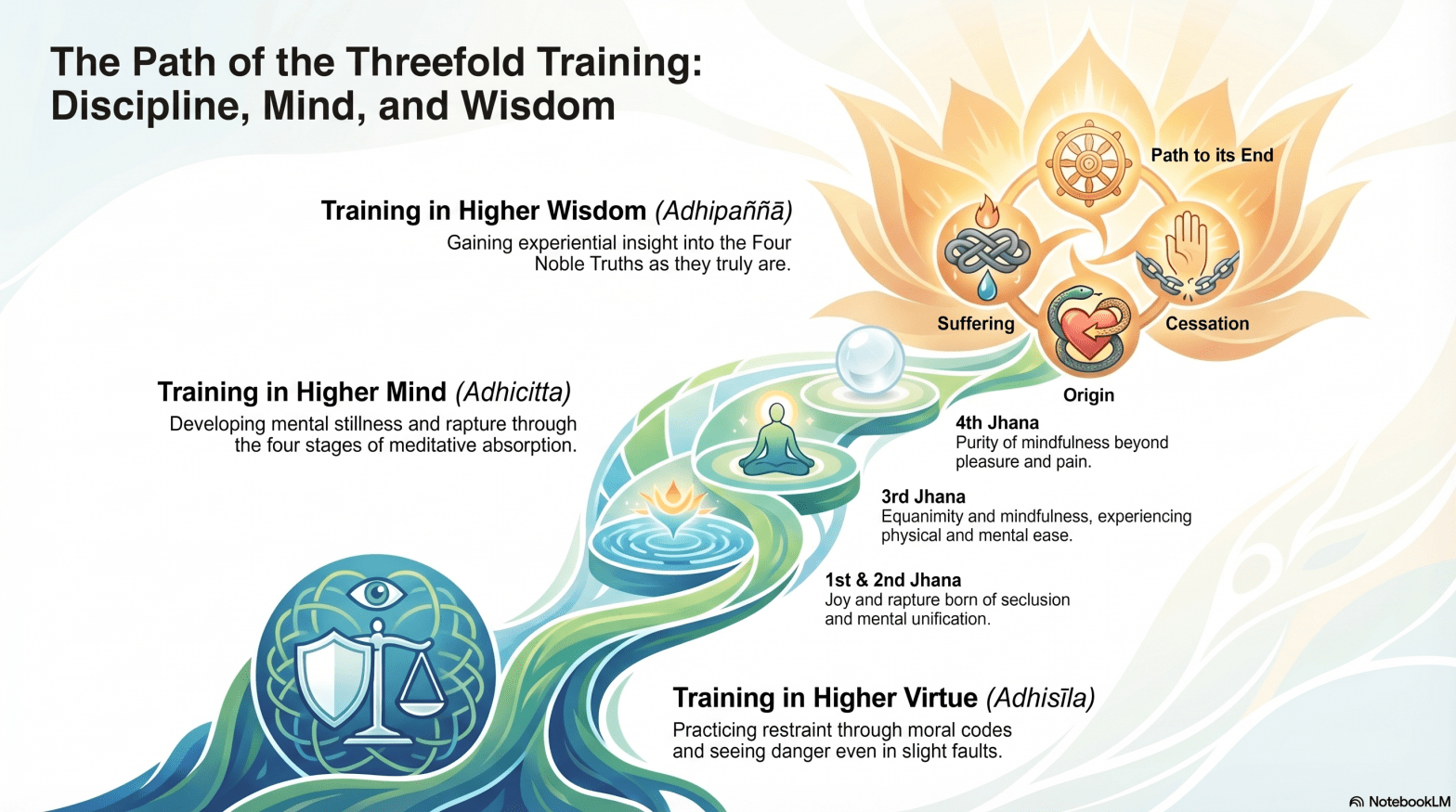
The relationship between discipline, meditation, and wisdom forms the core of the Buddha “Threefold Training” (tisso sikkhā). They act as a sequential, interdependent path: discipline provides the moral foundation necessary to purify one’s actions, which clears the way for the mind to seclude itself and achieve deep meditation, and this concentrated meditative mind ultimately allows the practitioner to perceive the truth and attain liberating wisdom.
Let us go over this sutta in great detail
Training in Higher Discipline (Adhisīlasikkhā)
Discipline acts as the essential groundwork, restraining unwholesome actions so the mind can settle
Katamā ca, bhikkhave, adhisīlasikkhā?
And what, monks, is the training in higher discipline?
Idha, bhikkhave, bhikkhu sīlavā hoti pātimokkhasamvarasaṃvuto viharati ācāragocarasampanno aṇumattesu vajjesu bhayadassāvī, samādāya sikkhati sikkhāpadesu.
Here, monks, a monk is virtuous, dwells restrained by the Pātimokkha (monastic code of rules), is perfect in conduct and resort, sees danger in the slightest faults, and having undertaken them, trains in the training rules
Explanation: This line emphasizes that proper discipline requires strict ethical conduct and restraint. By fearing even the smallest of faults, the practitioner ensures their actions and livelihood do not create future mental agitation.
Ayaṃ vuccati, bhikkhave, adhisīlasikkhā.
This is called, monks, the training in higher discipline.
Training in Higher Mind / Meditation (Adhicittasikkhā)
Built upon the foundation of discipline, meditation allows the practitioner to withdraw from sensory distractions and achieve profound states of mental concentration known as jhanas
Katamā ca, bhikkhave, adhicittasikkhā? And what, monks, is the training in the higher mind?
Idha, bhikkhave, bhikkhu vivicceva kāmehi vivicca akusalehi dhammehi savitakkaṃ savicāraṃ vivekajaṃ pītisukhaṃ paṭhamaṃ jhānaṃ upasampajja viharati.
Here, monks, a monk, quite secluded from sensual pleasures, secluded from unwholesome states, enters and dwells in the first jhana, which is accompanied by applied and sustained thought, and filled with rapture and happiness born of seclusion
Vitakkavicārānaṃ vūpasamā ajjhattaṃ sampasādanaṃ cetaso ekodibhāvaṃ avitakkaṃ avicāraṃ samādhijaṃ pītisukhaṃ dutiyaṃ jhānaṃ upasampajja viharati.
With the stilling of applied and sustained thought, they enter and dwell in the second jhana, which has internal confidence and unification of mind without applied and sustained thought, filled with rapture and happiness born of concentration
Pītiyā ca virāgā upekkhako ca viharati sato ca sampajāno sukhañca kāyena paṭisaṃvedeti yaṃ taṃ ariyā ācikkhanti: ‘upekkhako satimā sukhavihārī’ti tatiyaṃ jhānaṃ upasampajja viharati.
With the fading away of rapture, they dwell equanimous, mindful, and clearly comprehending, and experience happiness with the body; they enter and dwell in the third jhana of which the noble ones declare: ‘Equanimous and mindful, one dwells happily’
Sukhassa ca pahānā dukkhassa ca pahānā pubbeva somanassadomanassānaṃ atthaṅgamā adukkhamasukhaṃ upekkhāsatipārisuddhiṃ catutthaṃ jhānaṃ upasampajja viharati.
With the abandoning of pleasure and pain, and with the previous disappearance of joy and grief, they enter and dwell in the fourth jhana, which has neither-pain-nor-pleasure and has purity of mindfulness due to equanimity
Ayaṃ vuccati, bhikkhave, adhicittasikkhā.
This is called, monks, the training in the higher mind
Explanation: These successive stages of meditation show the mind progressively abandoning sensual desires and turbulent mental states, culminating in perfect equanimity and a purely unified mind.
Training in Higher Wisdom (Adhipaññāsikkhā)
Wisdom is the culmination of the path, where the perfectly concentrated mind attained in meditation is used to see reality as it truly is
Pali: Katamā ca, bhikkhave, adhipaññāsikkhā? And what, monks, is the training in higher wisdom?
Idha, bhikkhave, bhikkhu ‘idaṃ dukkhan’ti yathābhūtaṃ pajānāti, ‘ayaṃ dukkhasamudayo’ti yathābhūtaṃ pajānāti, ‘ayaṃ dukkhanirodho’ti yathābhūtaṃ pajānāti, ‘ayaṃ dukkhanirodhagāminī paṭipadā’ti yathābhūtaṃ pajānāti.
Here, monks, a monk understands as it really is: ‘This is suffering’, understands as it really is: ‘This is the origin of suffering’, understands as it really is: ‘This is the cessation of suffering’, and understands as it really is: ‘This is the path leading to the cessation of suffering’.
Explanation: True wisdom in this context is not intellectual knowledge, but the direct, experiential realization of the Four Noble Truths.
Ayaṃ vuccati, bhikkhave, adhipaññāsikkhā. Imā kho, bhikkhave, tisso sikkhā”ti.
This is called, monks, the training in higher wisdom. These, monks, are the three trainings
Real life examples for all the three higher training
These examples are illustrative applications of the principles found in the text to help enhance your understanding. Here is how the relationship between discipline, meditation (higher mind), and wisdom plays out in real life:
1. Real-Life Example: At Home
Discipline (The Foundation): At home, higher discipline means committing to a peaceful household. It involves restraining the urge to snap at your spouse after a long day, being patient with your children, and keeping your promises to your family. It is the conscious choice to be “restrained” in your actions and words to avoid causing harm.
Meditation / Higher Mind (The Focus): By practicing this discipline, your home becomes a sanctuary rather than a battleground. Because there is no lingering hostility or guilt over harsh words, you can be entirely present with your family. Your mind is free from turbulence, allowing you to achieve a state of internal peace, “equanimity,” and “purity of mindfulness” while reading a book, playing with your kids, or simply sitting in the living room
Wisdom (The Result): This peaceful presence allows you to see your family dynamics with profound clarity. If a child throws a tantrum, instead of reacting with blind frustration, you recognize that reacting in anger only creates more suffering (“This is the origin of suffering”)
Through wisdom, you realize that responding with compassionate boundary-setting will resolve the issue (“This is the path leading to the cessation of suffering”)
You navigate family life not through reactive emotions, but through a deep, experiential understanding of what causes distress and what brings harmony.
In both environments, the progression remains identical to the source text: ethical discipline removes mental obstacles, which allows the mind to achieve deep focus and presence, which in turn unlocks the wisdom to see reality clearly and solve problems at their root.
Real-Life Example: In the Office
Discipline (The Foundation): In the workplace, discipline translates to professional ethics and basic integrity. It means communicating honestly, not taking credit for a colleague’s work, avoiding toxic office gossip, and being reliable. In the context of the sources, this mirrors being “perfect in conduct” and seeing “danger in the slightest faults”
By not engaging in office drama or unethical behavior, you prevent anxiety, guilt, and conflict from taking root in your professional life.
Meditation / Higher Mind (The Focus): Because you have maintained strong workplace discipline, your mind is clear of interpersonal agitation. When you sit down to work on a complex project, your mind can easily become “secluded from unwholesome states” and distractions
This allows you to enter a state of deep work or “flow,” mirroring the jhanas where you experience a “unification of mind” and can concentrate on the task at hand with pure focus and equanimity
Wisdom (The Result): Because you can look at your work with a highly focused, unclouded mind, you develop professional wisdom. When a project fails, you do not panic; instead, you understand the situation “as it really is”
You can clearly identify what went wrong (the origin of the problem), conceptualize the solution (the cessation of the problem), and implement a strategic plan to fix it (the path leading to the cessation), much like understanding the Four Noble Truths
.