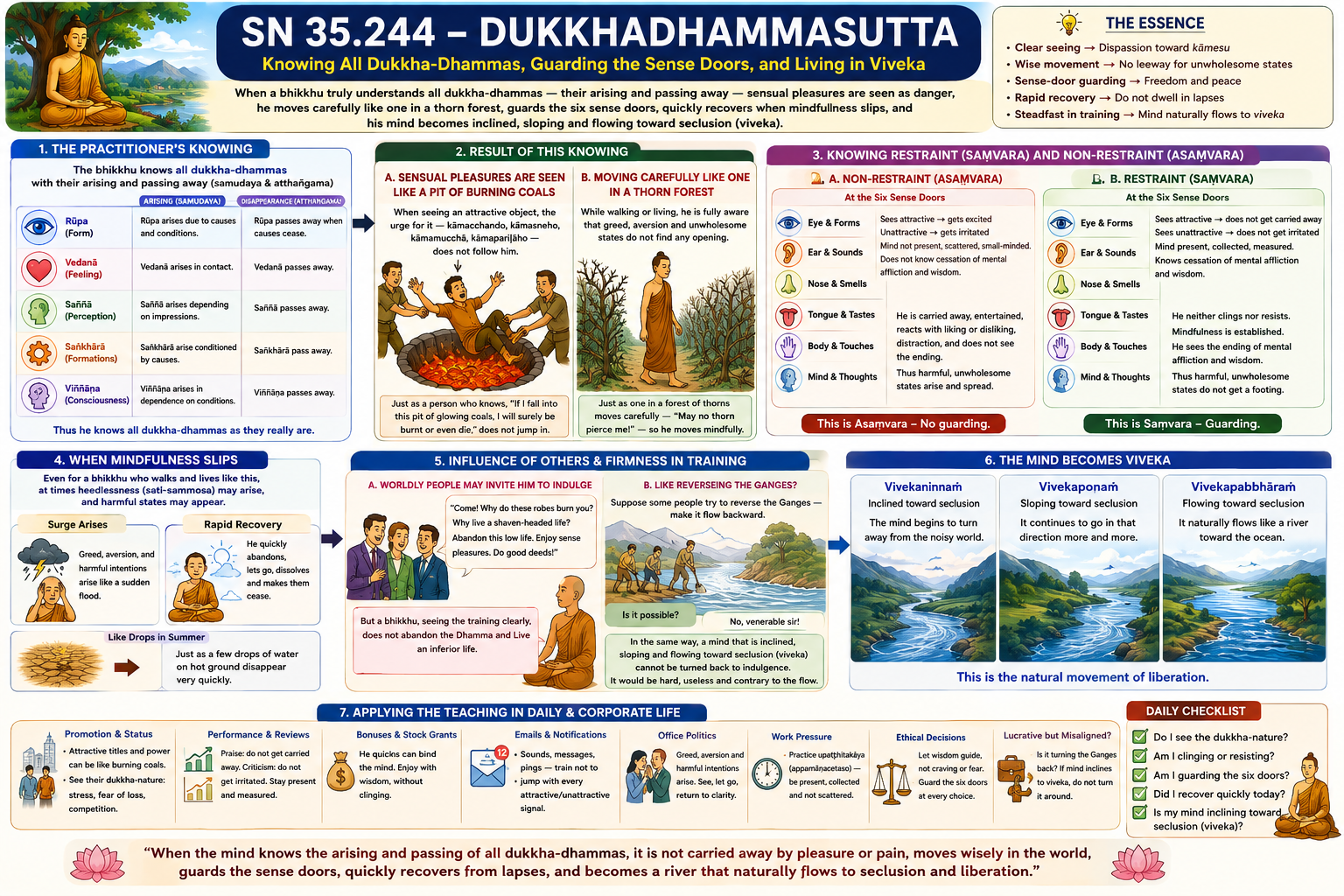
 VISUAL SUMMARYSee this sutta in a pictureOpen the complete infographic for a visual overview before or after reading the full study.View infographic →
adhimuccati → byāpajjati → anupaṭṭhitakāyassati → parittacetasonādhimuccati → na byāpajjati → upaṭṭhitakāyassati → appamāṇacetaso → yathābhūtaṁ pajānāti01Insight that Changes SensualityThree signs of mature practice • aggregates as arising-and-passing • burning-coal simile • thorn-forest simile
01The Three Signs of Mature Practice
“Yato kho, bhikkhave, bhikkhu sabbesaṁyeva dukkhadhammānaṁ samudayañca atthaṅgamañca yathābhūtaṁ pajānāti.
Tathā kho panassa kāmā diṭṭhā honti, yathāssa kāme passato, yo kāmesu kāmacchando kāmasneho kāmamucchā kāmapariḷāho, so nānuseti.
Tathā kho panassa cāro ca vihāro ca anubuddho hoti, yathā carantaṁ viharantaṁ abhijjhādomanassā pāpakā akusalā dhammā nānusenti.”
“Bhikkhus, when a bhikkhu understands as it really is the arising and disappearance of all phenomena subject to suffering;
when sensual pleasures have been seen by him in such a way that, as he sees them, sensual desire, attachment to sensuality, infatuation with sensuality, and the fever of sensuality do not persist in him;
and when his way of going about and dwelling has been understood in such a way that, as he goes about and dwells, evil unwholesome states of covetousness and distress do not flow in upon him—then his practice has reached this mature form.”
The opening gives three interlocking accomplishments.
First, the practitioner knows samudaya and atthaṅgama—the arising and disappearance—of all dukkhadhammā, phenomena subject to suffering.
Second, kāmā are seen so clearly that the usual chain does not continue as kāmacchanda, kāmasneha, kāmamucchā, and kāmapariḷāha: sensual desire, sticky attachment, infatuation, and feverish burning.
Third, one’s cāra and vihāra—how one moves through life and how one dwells—have been understood and trained so that abhijjhā and domanassa do not continually stream in.
This is important: insight, sense restraint, and everyday conduct are not separate projects. Seeing arising-and-passing changes how sensuality is regarded; that changed vision changes how one lives through the six doors.
02Knowing the Five Aggregates through Arising and Disappearance
“Kathañca, bhikkhave, sabbesaṁyeva dukkhadhammānaṁ samudayañca atthaṅgamañca yathābhūtaṁ pajānāti?
‘Iti rūpaṁ, iti rūpassa samudayo, iti rūpassa atthaṅgamo;
iti vedanā, iti vedanāya samudayo, iti vedanāya atthaṅgamo;
iti saññā, iti saññāya samudayo, iti saññāya atthaṅgamo;
iti saṅkhārā, iti saṅkhārānaṁ samudayo, iti saṅkhārānaṁ atthaṅgamo;
iti viññāṇaṁ, iti viññāṇassa samudayo, iti viññāṇassa atthaṅgamo’ti—
evaṁ kho, bhikkhave, bhikkhu sabbesaṁyeva dukkhadhammānaṁ samudayañca atthaṅgamañca yathābhūtaṁ pajānāti.”
“And how does a bhikkhu understand as it really is the arising and disappearance of all phenomena subject to suffering?
‘Such is form; such is the arising of form; such is the disappearance of form.
Such is feeling; such is the arising of feeling; such is the disappearance of feeling.
Such is perception; such is the arising of perception; such is the disappearance of perception.
Such are formations; such is the arising of formations; such is the disappearance of formations.
Such is consciousness; such is the arising of consciousness; such is the disappearance of consciousness.’
It is in this way that a bhikkhu understands as it really is the arising and disappearance of all phenomena subject to suffering.”
The abbreviated aggregate sequence has been written out in full here.
The method is direct and repetitive: know each aggregate, know its samudaya, and know its atthaṅgama.
The emphasis is not merely “the aggregates are impermanent” as a belief. The practitioner is trained to recognize their actual conditioned arising and their actual fading or disappearance.
This changes the relationship to experience. When rūpa, vedanā, saññā, saṅkhārā, and viññāṇa are repeatedly known as arising-and-ceasing processes, they become increasingly difficult to treat as a permanent possession or identity.
03How Sensuality Must Be Seen
“Kathañca, bhikkhave, bhikkhuno kāmā diṭṭhā honti? Yathāssa kāme passato, yo kāmesu kāmacchando kāmasneho kāmamucchā kāmapariḷāho, so nānuseti.”
“And how have sensual pleasures been seen by a bhikkhu so that, as he sees them, sensual desire, attachment to sensual pleasures, infatuation with them, and the fever of sensuality do not persist?”
The Buddha is concerned with the *way sensuality is seen*.
Kāmacchanda is desire for sensual gratification. Kāmasneha is the sticky affection or attachment that makes the mind cling. Kāmamucchā is infatuation or intoxication. Kāmapariḷāha is the fever or burning that follows sensual obsession.
The solution is not mere suppression. The next simile shows that when danger is understood deeply enough, the mind naturally recoils from what would otherwise attract it.
04The Pit of Burning Coals
“Seyyathāpi, bhikkhave, aṅgārakāsu sādhikaporisā puṇṇā aṅgārānaṁ vītaccikānaṁ vītadhūmānaṁ. Atha puriso āgaccheyya jīvitukāmo amaritukāmo sukhakāmo dukkhapaṭikūlo. Tamenaṁ dve balavanto purisā nānābāhāsu gahetvā, taṁ aṅgārakāsuṁ upakaḍḍheyyuṁ. So iticīticeva kāyaṁ sannāmeyya.
Taṁ kissa hetu?
Ñātañhi, bhikkhave, tassa purisassa imañcāhaṁ aṅgārakāsuṁ papatissāmi, tatonidānaṁ maraṇaṁ vā nigacchissāmi maraṇamattaṁ vā dukkhanti.
Evameva kho, bhikkhave, bhikkhuno aṅgārakāsūpamā kāmā diṭṭhā honti, yathāssa kāme passato, yo kāmesu kāmacchando kāmasneho kāmamucchā kāmapariḷāho, so nānuseti.”
“Suppose, bhikkhus, there were a pit deeper than a man’s height, filled with glowing coals without flame or smoke. Then a man came along who wanted to live, did not want to die, desired happiness, and recoiled from suffering.
Two strong men might seize him by both arms and drag him toward that pit of coals. He would twist his body this way and that to get away.
Why is that?
Because he knows: ‘If I fall into this pit of burning coals, because of that I will meet death or suffering close to death.’
In the same way, a bhikkhu has seen sensual pleasures as comparable to a pit of burning coals, so that sensual desire, attachment, infatuation, and fever do not persist in him.”
The simile explains what mature insight does to desire.
The man does not need a rule saying, “Do not fall into the pit.” His understanding of the consequence is already strong enough to change behaviour.
Likewise, sensual restraint becomes natural when the practitioner has understood not only the immediate gratification of kāma but the dependency, agitation, competition, loss, fear, and renewed craving that accompany appropriation.
This does not mean every pleasant sight or sound is literally a burning coal. The simile concerns the danger of *being pulled into sensuality as a basis of happiness and identity*.
When the danger is known rather than merely believed, kāmacchanda loses its persuasive power.
Corporate example: a promotion promises status, money, and influence, but requires repeated ethical compromises, political manipulation, and constant anxiety about losing position. At first only the attractive package is visible. Once the full consequence is seen clearly, saying “no” can become as natural as stepping away from a fire.
05The Thorn-Filled Forest: How to Move through the World
“Kathañca, bhikkhave, bhikkhuno cāro ca vihāro ca anubuddho hoti, yathā carantaṁ viharantaṁ abhijjhādomanassā pāpakā akusalā dhammā nānussavanti?
Seyyathāpi, bhikkhave, puriso bahukaṇṭakaṁ dāyaṁ paviseyya. Tassa puratopi kaṇṭako, pacchatopi kaṇṭako, uttaratopi kaṇṭako, dakkhiṇatopi kaṇṭako, heṭṭhatopi kaṇṭako, uparitopi kaṇṭako. So satova abhikkameyya, satova paṭikkameyya: ‘mā maṁ kaṇṭako’ti.
Evameva kho, bhikkhave, yaṁ loke piyarūpaṁ sātarūpaṁ, ayaṁ vuccati ariyassa vinaye kaṇṭako”ti.
Iti viditvā saṁvaro ca asaṁvaro ca veditabbo.
“And how has a bhikkhu understood his way of moving and dwelling so that, as he moves and dwells, evil unwholesome states of covetousness and distress do not flow in upon him?
Suppose a man entered a forest full of thorns. There would be thorns in front, behind, to the north, south, below, and above. He would move forward mindfully and move backward mindfully, thinking: ‘May no thorn pierce me.’
In the same way, whatever in the world is appealing and agreeable is called a thorn in the training of the Noble One.
Knowing this, restraint and non-restraint should be understood.”
This is one of the strongest sense-restraint images in the Nikāyas.
The man is not afraid of the forest; he is careful within it. He can still move forward and backward, but sati governs movement.
The “thorn” is yaṁ loke piyarūpaṁ sātarūpaṁ—whatever appears attractive and agreeable. The danger is not beauty itself but the mind becoming pierced by attachment.
The simile is especially useful for modern life: screens, advertising, praise, prestige, food, attractive people, luxury, and status are everywhere. The practice is not to abolish the environment but to move through it *satova*—mindfully.
02Asaṁvara and Saṁvara at the Six DoorsThe complete six-door contrast • corporate illustrations of non-restraint and restraint
06Asaṁvara — Non-Restraint at All Six Sense Doors
“Kathañca, bhikkhave, asaṁvaro hoti?
Idha, bhikkhave, bhikkhu cakkhunā rūpaṁ disvā piyarūpe rūpe adhimuccati, appiyarūpe rūpe byāpajjati, anupaṭṭhitakāyassati ca viharati parittacetaso, tañca cetovimuttiṁ paññāvimuttiṁ yathābhūtaṁ nappajānāti, yatthassa te uppannā pāpakā akusalā dhammā aparisesā nirujjhanti.
Sotena saddaṁ sutvā piyarūpe sadde adhimuccati, appiyarūpe sadde byāpajjati, anupaṭṭhitakāyassati ca viharati parittacetaso, tañca cetovimuttiṁ paññāvimuttiṁ yathābhūtaṁ nappajānāti, yatthassa te uppannā pāpakā akusalā dhammā aparisesā nirujjhanti.
Ghānena gandhaṁ ghāyitvā piyarūpe gandhe adhimuccati, appiyarūpe gandhe byāpajjati, anupaṭṭhitakāyassati ca viharati parittacetaso, tañca cetovimuttiṁ paññāvimuttiṁ yathābhūtaṁ nappajānāti, yatthassa te uppannā pāpakā akusalā dhammā aparisesā nirujjhanti.
Jivhāya rasaṁ sāyitvā piyarūpe rase adhimuccati, appiyarūpe rase byāpajjati, anupaṭṭhitakāyassati ca viharati parittacetaso, tañca cetovimuttiṁ paññāvimuttiṁ yathābhūtaṁ nappajānāti, yatthassa te uppannā pāpakā akusalā dhammā aparisesā nirujjhanti.
Kāyena phoṭṭhabbaṁ phusitvā piyarūpe phoṭṭhabbe adhimuccati, appiyarūpe phoṭṭhabbe byāpajjati, anupaṭṭhitakāyassati ca viharati parittacetaso, tañca cetovimuttiṁ paññāvimuttiṁ yathābhūtaṁ nappajānāti, yatthassa te uppannā pāpakā akusalā dhammā aparisesā nirujjhanti.
Manasā dhammaṁ viññāya piyarūpe dhamme adhimuccati, appiyarūpe dhamme byāpajjati, anupaṭṭhitakāyassati ca viharati parittacetaso, tañca cetovimuttiṁ paññāvimuttiṁ yathābhūtaṁ nappajānāti yatthassa te uppannā pāpakā akusalā dhammā aparisesā nirujjhanti.
Evaṁ kho, bhikkhave, asaṁvaro hoti.”
“And how is there non-restraint?
Having seen a form with the eye, a bhikkhu becomes absorbed in an agreeable form and reacts with aversion toward a disagreeable form. He dwells without mindfulness of the body established, with a limited mind, and he does not understand as it really is that liberation of mind and liberation by wisdom in which those arisen evil unwholesome states cease without remainder.
Having heard a sound with the ear, he becomes absorbed in an agreeable sound and reacts with aversion toward a disagreeable sound. He dwells without mindfulness of the body established, with a limited mind, and does not understand that liberation in which those arisen unwholesome states cease without remainder.
Having smelled an odour with the nose, he becomes absorbed in an agreeable odour and reacts with aversion toward a disagreeable odour. He dwells without mindfulness of the body established, with a limited mind, and does not understand that liberation in which those arisen unwholesome states cease without remainder.
Having tasted a flavour with the tongue, he becomes absorbed in an agreeable flavour and reacts with aversion toward a disagreeable flavour. He dwells without mindfulness of the body established, with a limited mind, and does not understand that liberation in which those arisen unwholesome states cease without remainder.
Having touched a tangible object with the body, he becomes absorbed in an agreeable tangible object and reacts with aversion toward a disagreeable tangible object. He dwells without mindfulness of the body established, with a limited mind, and does not understand that liberation in which those arisen unwholesome states cease without remainder.
Having cognized a mental object with the mind, he becomes absorbed in an agreeable mental object and reacts with aversion toward a disagreeable mental object. He dwells without mindfulness of the body established, with a limited mind, and does not understand that liberation in which those arisen unwholesome states cease without remainder.
This is how there is non-restraint.”
The abbreviations have been expanded across all six doors: eye, ear, nose, tongue, body, and mind.
Asaṁvara is defined here very precisely:
piyarūpe adhimuccati — the mind fastens onto, becomes absorbed in, or gives itself over to what is agreeable;
appiyarūpe byāpajjati — it becomes hostile or reactive toward what is disagreeable;
anupaṭṭhitakāyassati — mindfulness of the body is not established;
parittacetaso — the mind becomes constricted or limited;
and the practitioner does not understand the liberation in which these arisen akusala dhammas cease completely.
Notice that non-restraint is not simply “looking at things.” It is the loss of balance after contact.
07Corporate Example of Asaṁvara
Cakkhu → rūpa; sota → sadda; ghāna → gandha; jivhā → rasa; kāya → phoṭṭhabba; mano → dhamma.
Piyarūpe adhimuccati → appiyarūpe byāpajjati → anupaṭṭhitakāyassati → parittacetaso.
Eye → form; ear → sound; nose → smell; tongue → taste; body → touch; mind → mental object.
Fastens onto the agreeable → reacts against the disagreeable → mindfulness of body is absent → the mind becomes narrow and constricted.
In a corporate environment this can happen repeatedly within minutes.
A praise email is read—pleasant eye- and mind-contact—followed by excitement and self-inflation.
Then a critical comment is heard in a meeting—unpleasant ear-contact—followed by irritation and mental defence.
A colleague receives a promotion—mind-contact produces comparison.
A luxury office, business-class travel, company car, bonus announcement, or executive recognition becomes piyarūpaṁ sātarūpaṁ.
The problem is not the email, promotion, office, or salary. Asaṁvara begins when the mind is captured by the agreeable and hostile toward the disagreeable, while sati is absent and the mind contracts around “me” and “mine.”
08Saṁvara — Restraint at All Six Sense Doors
“Kathañca, bhikkhave, saṁvaro hoti?
Idha, bhikkhave, bhikkhu cakkhunā rūpaṁ disvā piyarūpe rūpe nādhimuccati, appiyarūpe rūpe na byāpajjati, upaṭṭhitakāyassati ca viharati appamāṇacetaso, tañca cetovimuttiṁ paññāvimuttiṁ yathābhūtaṁ pajānāti, yatthassa te uppannā pāpakā akusalā dhammā aparisesā nirujjhanti.
Sotena saddaṁ sutvā piyarūpe sadde nādhimuccati, appiyarūpe sadde na byāpajjati, upaṭṭhitakāyassati ca viharati appamāṇacetaso, tañca cetovimuttiṁ paññāvimuttiṁ yathābhūtaṁ pajānāti, yatthassa te uppannā pāpakā akusalā dhammā aparisesā nirujjhanti.
Ghānena gandhaṁ ghāyitvā piyarūpe gandhe nādhimuccati, appiyarūpe gandhe na byāpajjati, upaṭṭhitakāyassati ca viharati appamāṇacetaso, tañca cetovimuttiṁ paññāvimuttiṁ yathābhūtaṁ pajānāti, yatthassa te uppannā pāpakā akusalā dhammā aparisesā nirujjhanti.
Jivhāya rasaṁ sāyitvā piyarūpe rase nādhimuccati, appiyarūpe rase na byāpajjati, upaṭṭhitakāyassati ca viharati appamāṇacetaso, tañca cetovimuttiṁ paññāvimuttiṁ yathābhūtaṁ pajānāti, yatthassa te uppannā pāpakā akusalā dhammā aparisesā nirujjhanti.
Kāyena phoṭṭhabbaṁ phusitvā piyarūpe phoṭṭhabbe nādhimuccati, appiyarūpe phoṭṭhabbe na byāpajjati, upaṭṭhitakāyassati ca viharati appamāṇacetaso, tañca cetovimuttiṁ paññāvimuttiṁ yathābhūtaṁ pajānāti, yatthassa te uppannā pāpakā akusalā dhammā aparisesā nirujjhanti.
Manasā dhammaṁ viññāya piyarūpe dhamme nādhimuccati, appiyarūpe dhamme na byāpajjati, upaṭṭhitakāyassati ca viharati appamāṇacetaso, tañca cetovimuttiṁ paññāvimuttiṁ yathābhūtaṁ pajānāti, yatthassa te uppannā pāpakā akusalā dhammā aparisesā nirujjhanti.
Evaṁ kho, bhikkhave, saṁvaro hoti.”
“And how is there restraint?
Having seen a form with the eye, a bhikkhu does not become absorbed in an agreeable form and does not react with aversion toward a disagreeable form. He dwells with mindfulness of the body established, with an immeasurable or unbounded mind, and understands as it really is that liberation of mind and liberation by wisdom in which those arisen evil unwholesome states cease without remainder.
Having heard a sound with the ear, he does not become absorbed in an agreeable sound and does not react with aversion toward a disagreeable sound. He dwells with mindfulness of the body established, with an immeasurable mind, and understands that liberation in which those arisen unwholesome states cease without remainder.
Having smelled an odour with the nose, he does not become absorbed in an agreeable odour and does not react with aversion toward a disagreeable odour. He dwells with mindfulness of the body established, with an immeasurable mind, and understands that liberation in which those arisen unwholesome states cease without remainder.
Having tasted a flavour with the tongue, he does not become absorbed in an agreeable flavour and does not react with aversion toward a disagreeable flavour. He dwells with mindfulness of the body established, with an immeasurable mind, and understands that liberation in which those arisen unwholesome states cease without remainder.
Having touched a tangible object with the body, he does not become absorbed in an agreeable tangible object and does not react with aversion toward a disagreeable tangible object. He dwells with mindfulness of the body established, with an immeasurable mind, and understands that liberation in which those arisen unwholesome states cease without remainder.
Having cognized a mental object with the mind, he does not become absorbed in an agreeable mental object and does not react with aversion toward a disagreeable mental object. He dwells with mindfulness of the body established, with an immeasurable mind, and understands that liberation in which those arisen unwholesome states cease without remainder.
This is how there is restraint.”
Saṁvara is the exact reversal of asaṁvara.
Nādhimuccati — he does not give himself over to the agreeable.
Na byāpajjati — he does not become hostile toward the disagreeable.
Upaṭṭhitakāyassati — mindfulness of the body is established.
Appamāṇacetaso — the mind is not narrow and contracted but expansive or immeasurable.
And he understands the release in which the arisen unwholesome states cease.
This definition is much richer than “avoid sense objects.” The six doors remain fully functional. Restraint is freedom *within contact*.
09Corporate Example of Saṁvara
Piyarūpe nādhimuccati → appiyarūpe na byāpajjati → upaṭṭhitakāyassati → appamāṇacetaso → yathābhūtaṁ pajānāti.
Do not fasten onto the agreeable → do not react with hostility toward the disagreeable → establish mindfulness of the body → keep the mind expansive → understand the process as it really is.
Imagine receiving two emails on the same morning.
The first says that senior management is impressed with your work. Pleasant feeling arises, but you do not build “I am special” around it.
The second contains sharp criticism. Unpleasant feeling arises, but you do not immediately draft a defensive reply.
Instead, kāyassati is present: bodily tension, breath, posture, heat, and pressure are known. The mind remains larger than the event.
This is saṁvara in an office—not withdrawing from work, but not being internally owned by praise and blame.
03Recovery, Conduct and StabilityMindfulness may lapse • rapid abandonment • hot-iron-pan simile • cāra and vihāra
10Even a Mature Practitioner May Momentarily Lose Mindfulness
“Tassa ce, bhikkhave, bhikkhuno evaṁ carato evaṁ viharato kadāci karahaci satisammosā uppajjanti, pāpakā akusalā sarasaṅkappā saṁyojaniyā, dandho, bhikkhave, satuppādo. Atha kho naṁ khippameva pajahati vinodeti byantīkaroti anabhāvaṁ gameti.”
“Bhikkhus, if, while a bhikkhu is going about and dwelling in this way, on some occasion mindfulness is lost and evil unwholesome spontaneous thoughts connected with the fetters arise, the re-arising of mindfulness may be delayed; but once mindfulness arises, he quickly abandons them, dispels them, brings them to an end, and makes them disappear.”
This is a very realistic description of mature practice.
The Buddha does not define success as “an unwholesome thought never appears again” at every stage of training.
Satisammosa—a lapse or loss of mindfulness—can still occur.
What changes is recovery. Once sati returns, the practitioner does not feed, justify, rehearse, or identify with the unwholesome saṅkappa. He quickly:
pajahati — abandons it; vinodeti — dispels it; byantīkaroti — terminates it; anabhāvaṁ gameti — brings it to non-existence.
This is an excellent practical metric: not merely “Did anything arise?” but “How long did I continue feeding it?”
In a meeting someone takes credit for your work. Anger appears and for thirty seconds the mind plans retaliation. Then sati returns. Instead of replaying the insult for three days, you recognize the anger, settle the body, clarify the facts, and choose a measured response. The lapse happened; the recovery was fast.
11Water Drops on a Red-Hot Iron Pan
“Seyyathāpi, bhikkhave, puriso divasaṁsantatte ayokaṭāhe dve vā tīṇi vā udakaphusitāni nipāteyya. Dandho, bhikkhave, udakaphusitānaṁ nipāto, atha kho naṁ khippameva parikkhayaṁ pariyādānaṁ gaccheyya.
Evameva kho, bhikkhave, tassa ce bhikkhuno evaṁ carato, evaṁ viharato kadāci karahaci satisammosā uppajjanti pāpakā akusalā sarasaṅkappā saṁyojaniyā, dandho, bhikkhave, satuppādo. Atha kho naṁ khippameva pajahati vinodeti byantīkaroti anabhāvaṁ gameti.”
“Suppose a man were to drop two or three drops of water onto an iron pan heated all day. The falling of the drops might take a moment, but they would very quickly be exhausted and consumed.
In the same way, if on some occasion mindfulness is lost and evil unwholesome thoughts connected with the fetters arise, once mindfulness reappears the bhikkhu quickly abandons, dispels, ends, and eliminates them.”
The image is not of never having water touch the pan. The image is of how little time it survives.
A mind long trained in restraint becomes like the heated pan: unwholesome thoughts may make contact, but they find little fuel.
This suggests a practical measure of bhāvanā: recovery time shortens.
At first, one comment may generate hours of anger. Later, perhaps minutes. Later still, the reaction is recognized almost immediately and cannot establish itself.
12Conduct and Dwelling Have Been Fully Understood
“Evaṁ kho, bhikkhave, bhikkhuno cāro ca vihāro ca anubuddho hoti; yathā carantaṁ viharantaṁ abhijjhādomanassā pāpakā akusalā dhammā nānussavanti.”
“It is in this way, bhikkhus, that a bhikkhu’s manner of going about and dwelling has been understood, such that while he goes about and dwells, evil unwholesome states of covetousness and distress do not flow in upon him.”
Practice has now moved from formal meditation into the whole pattern of living.
Cāra is how one moves, acts, and conducts oneself.
Vihāra is how one dwells or abides.
When both are trained, the practitioner no longer needs perfect external conditions to protect the mind. The protection has become embodied in the way one lives.
04The Mind’s Long-Term GradientTemptation by wealth/status • golden handcuffs • Ganges simile • vivekaninna, vivekapoṇa, vivekapabbhāra
13Tempted Back by Wealth, Status, Family, and Social Pressure
“Tañce, bhikkhave, bhikkhuṁ evaṁ carantaṁ evaṁ viharantaṁ rājāno vā rājamahāmattā vā mittā vā amaccā vā ñātī vā sālohitā vā, bhogehi abhihaṭṭhuṁ pavāreyyuṁ: ‘ehi, bho purisa, kiṁ te ime kāsāvā anudahanti,
kiṁ muṇḍo kapālamanucarasi, ehi hīnāyāvattitvā bhoge ca bhuñjassu, puññāni ca karohī’ti.
So vata, bhikkhave, bhikkhu evaṁ caranto evaṁ viharanto sikkhaṁ paccakkhāya hīnāyāvattissatīti netaṁ ṭhānaṁ vijjati.”
“If, while a bhikkhu goes about and dwells in this way, kings, royal ministers, friends, colleagues, relatives, or blood relations were to approach him with wealth and invite him:
‘Come, good man! Why let these ochre robes trouble you? Why go about shaven-headed carrying a bowl? Come, return to the lower life, enjoy wealth, and make merit as well.’
For a bhikkhu who lives and dwells in this way to give up the training and return to the lower life—that is not possible.”
The temptation is not crude. The offer is intelligent: enjoy wealth *and* continue doing merit.
In other words, the mind is offered a respectable justification for returning to sensual and social identity.
The sutta says that when the previous training has become deep enough, such persuasion no longer reverses the direction of the mind.
This is extremely relevant to modern career culture. Temptation often arrives not as “do something evil,” but as “take the bigger role, accept the package, enjoy the benefits—you can still be a good person.” The practitioner must know what direction the mind has actually chosen.
14Corporate Example: The Golden-Handcuff Offer
Bhogehi abhihaṭṭhuṁ pavāreyyuṁ → hīnāyāvattitvā bhoge ca bhuñjassu → netaṁ ṭhānaṁ vijjati.
They invite one with wealth → “return and enjoy the benefits” → but for a mind firmly trained in its direction, reversal is no longer realistic.
Suppose someone has deliberately simplified life to create time for Dhamma, family, health, and practice. A former employer offers double the salary, stock options, business-class travel, title, staff, and prestige—but also constant travel, political pressure, and loss of practice time.
Nothing in the package is inherently evil. The real question is direction.
If the mind has long understood the cost of sensory and status-based living, the offer is evaluated very differently. What once looked irresistible may now look like a return to a form of bondage.
For a lay practitioner this does not imply quitting work. It illustrates the principle: as values become deeply trained, money and prestige progressively lose the power to reverse one’s ethical and contemplative direction.
15The Ganges Cannot Easily Be Made to Flow Backward
“Seyyathāpi, bhikkhave, gaṅgā nadī pācīnaninnā pācīnapoṇā pācīnapabbhārā. Atha mahājanakāyo āgaccheyya kuddālapiṭakaṁ ādāya: ‘mayaṁ imaṁ gaṅgaṁ nadiṁ pacchāninnaṁ karissāma pacchāpoṇaṁ pacchāpabbhāran’ti.
Taṁ kiṁ maññatha, bhikkhave, api nu kho so mahājanakāyo gaṅgaṁ nadiṁ pacchāninnaṁ kareyya pacchāpoṇaṁ pacchāpabbhāran”ti?
“No hetaṁ, bhante”.
“Taṁ kissa hetu”?
“Gaṅgā, bhante, nadī pācīnaninnā pācīnapoṇā pācīnapabbhārā; sā na sukarā pacchāninnā kātuṁ pacchāpoṇā pacchāpabbhārā. Yāvadeva ca pana so mahājanakāyo kilamathassa vighātassa bhāgī assā”ti.”
“Suppose, bhikkhus, the River Ganges slopes, inclines, and flows toward the east. Then a great crowd came carrying baskets and spades, saying:
‘We will make this River Ganges slope, incline, and flow toward the west.’
What do you think, bhikkhus? Could that crowd make the Ganges slope, incline, and flow westward?”
“No, venerable sir.”
“Why not?”
“Because the Ganges naturally slopes, inclines, and flows toward the east. It would not be easy to make it slope and flow westward. That crowd would only end up exhausted and frustrated.””
This is the culmination of the sutta’s training psychology.
Repeated practice creates inclination.
A river does not need to debate each drop of water into flowing east. Its gradient has already been formed.
Likewise, a mind repeatedly trained in viveka eventually develops a directional bias toward seclusion, simplicity, non-entanglement, and release.
This is very different from maintaining practice through constant force. The deepest fruit of repeated bhāvanā is that the mind’s default slope changes.
16A Mind Long Inclined toward Viveka
“Evameva kho, bhikkhave, tañce bhikkhuṁ evaṁ carantaṁ evaṁ viharantaṁ rājāno vā rājamahāmattā vā mittā vā amaccā vā ñātī vā sālohitā vā bhogehi abhihaṭṭhuṁ pavāreyyuṁ: ‘ehi, bho purisa, kiṁ te ime kāsāvā anudahanti, kiṁ muṇḍo kapālamanucarasi, ehi hīnāyāvattitvā bhoge ca bhuñjassu, puññāni ca karohī’ti.
So vata, bhikkhave, bhikkhu evaṁ caranto evaṁ viharanto sikkhaṁ paccakkhāya hīnāyāvattissatīti netaṁ ṭhānaṁ vijjati.
Taṁ kissa hetu?
Yañhi taṁ, bhikkhave, cittaṁ dīgharattaṁ vivekaninnaṁ vivekapoṇaṁ vivekapabbhāraṁ, tathā hīnāyāvattissatīti netaṁ ṭhānaṁ vijjatī”ti.
“In the same way, even if kings, ministers, friends, colleagues, relatives, or family approached such a bhikkhu with wealth and urged him to return to the lower life and enjoy possessions, it is not possible that a bhikkhu living and dwelling in this way would give up the training and return.
Why is that?
Because for a long time his mind has inclined toward seclusion, sloped toward seclusion, and flowed toward seclusion. For such a mind to reverse itself toward the lower life is not possible.”
The threefold phrase is memorable:
vivekaninnaṁ — inclined toward viveka; vivekapoṇaṁ — sloping toward viveka; vivekapabbhāraṁ — flowing or tending toward viveka.
Dīgharattaṁ—“for a long time”—is crucial. This is not a weekend preference. Repeated cultivation has changed the gradient of the mind.
The whole sutta can therefore be read as the process by which that gradient is formed:
see aggregates arise and disappear; see the danger in sensual enthrallment; move mindfully through the thorn-filled world; distinguish asaṁvara from saṁvara; recover quickly when sati slips; repeat until the mind itself slopes toward viveka.
At that point practice is no longer maintained primarily by willpower. The trained mind naturally prefers release over entanglement.
17The Entire Sutta as a Practice Map
Samudayañca atthaṅgamañca yathābhūtaṁ pajānāti → aṅgārakāsūpamā kāmā diṭṭhā → piyarūpaṁ sātarūpaṁ kaṇṭako → asaṁvaro / saṁvaro veditabbo → upaṭṭhitakāyassati → appamāṇacetaso → khippameva pajahati vinodeti byantīkaroti anabhāvaṁ gameti → vivekaninnaṁ vivekapoṇaṁ vivekapabbhāraṁ.
Know arising and disappearance as they really are → see sensual enthrallment like a pit of burning coals → recognize the attractive and agreeable as a potential thorn → understand non-restraint and restraint → establish mindfulness of the body → keep the mind expansive → quickly abandon, dispel, terminate, and eliminate unwholesome states when they arise → train until the mind inclines, slopes, and flows toward seclusion.
SN 35.244 is not merely a warning about sensual pleasure. It is a complete training in how insight changes perception, how perception changes sense-door behaviour, and how repeated restraint changes the long-term direction of the mind.
For daily practice, four questions capture much of the sutta:
1. What is arising and passing right now? 2. Am I fastening onto the agreeable or fighting the disagreeable? 3. Is kāyassati established, or has the mind contracted around the event? 4. If I lost mindfulness, how quickly can the mind recover?
Repeated correctly, these questions gradually change the gradient of the mind.