living the training from 5:00 a.m. to 10:00 p.m.
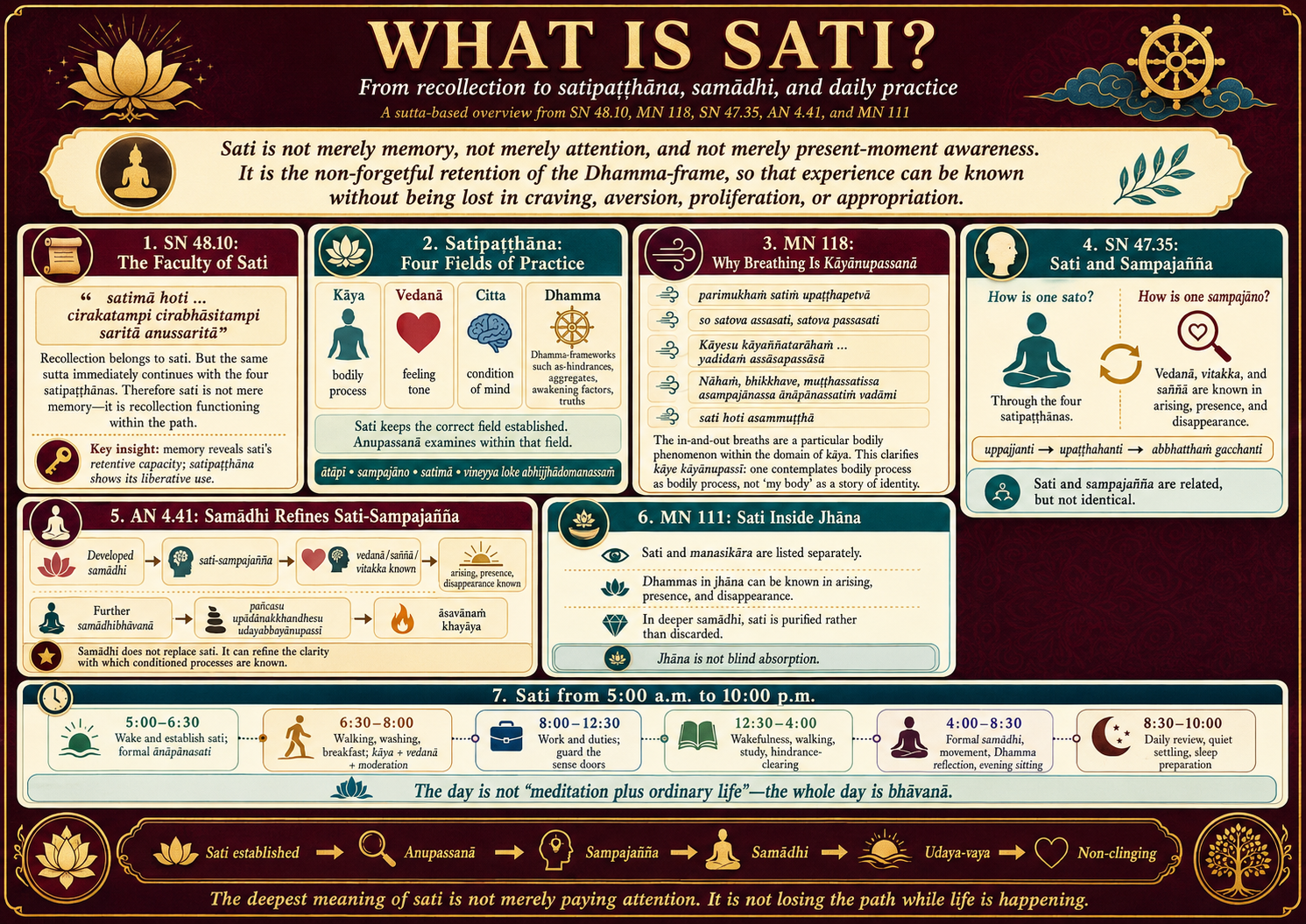 VISUAL SUMMARYSee this study in a pictureOpen the complete infographic for a visual overview before or after reading the full study.View infographic →
Few Pāḷi words have become as familiar in modern meditation language as sati, and few have become so difficult to understand precisely because of that familiarity. It is commonly translated as “mindfulness.” Others prefer “awareness,” “attention,” “memory,” “recollection,” or “presence.” Each word touches one aspect of the teaching, but none of them, used alone, adequately explains what the Buddha is describing.
The problem becomes especially clear when several suttas are read together. In SN 48.10 Dutiyavibhaṅgasutta, the Buddha begins his definition of the faculty of sati by speaking explicitly about remembering and recollecting what was done and spoken long ago. Yet he does not stop there. In the same definition he immediately gives the four satipaṭṭhānas: contemplation of kāya, vedanā, citta, and dhamma.
In SN 47.35 Satisutta, the Buddha then distinguishes being sato from being sampajāno. The four satipaṭṭhānas explain the former, whereas the arising, presence, and disappearance of vedanā, vitakka, and saññā explain the latter. In AN 4.41 Samādhibhāvanāsutta, precisely this arising–presence–disappearance formula appears again, now as the outcome of a particular development of samādhi leading to sati-sampajañña.
MN 118 Ānāpānasatisutta gives an additional piece that is indispensable for understanding the much-repeated expression kāye kāyānupassī. The Buddha does not merely say “body in body” and leave the practitioner to guess what that means. He explicitly explains why breathing belongs to kāyānupassanā: the in-breaths and out-breaths are kāyesu kāyaññatarā—a particular bodily phenomenon within the bodily domain.
Katamañca, bhikkhave, satindriyaṁ?
“And what, bhikkhus, is the faculty of sati?”
Our task, therefore, is not to find one English word and make every passage fit it. The more fruitful question is: what is the mind able to do when sati is genuinely established?
01 Recollection and the Four Satipaṭṭhānas Belong to One Definition
SN 48.10 explains the five faculties: saddhā, vīriya, sati, samādhi, and paññā. When the Buddha arrives at satindriya, he begins with wording that cannot be dismissed:
Katamañca, bhikkhave, satindriyaṁ? Idha, bhikkhave, ariyasāvako satimā hoti paramena satinepakkena samannāgato, cirakatampi cirabhāsitampi saritā anussaritā.
And what is the faculty of sati? Here a noble disciple possesses sati, is endowed with excellent satinepakka, and remembers and recollects even what was done and spoken long ago.
This gives genuine canonical support to the recollective dimension of sati. Any definition which says that sati simply means awareness confined to the present moment cannot adequately account for this passage.
Yet an equally serious mistake occurs if one stops reading at saritā anussaritā and concludes that sati merely means memory. The Buddha immediately continues:
So kāye kāyānupassī viharati ātāpī sampajāno satimā, vineyya loke abhijjhādomanassaṁ; vedanāsu vedanānupassī viharati ātāpī sampajāno satimā, vineyya loke abhijjhādomanassaṁ; citte cittānupassī viharati ātāpī sampajāno satimā, vineyya loke abhijjhādomanassaṁ; dhammesu dhammānupassī viharati ātāpī sampajāno satimā, vineyya loke abhijjhādomanassaṁ—idaṁ vuccati, bhikkhave, satindriyaṁ.
He dwells contemplating kāya in relation to kāya, ardent, clearly knowing, possessing sati, having removed covetousness and distress regarding the world; likewise with vedanā, citta, and dhamma. This is called the faculty of sati.
The entire passage defines satindriya. The recollection statement and the four satipaṭṭhānas therefore have to illuminate one another.
The first part reveals a fundamental capacity: what has been retained need not simply disappear from the mind. The second part reveals how that capacity becomes liberative. The important question is no longer merely, “Can I remember an event?” It becomes: can the Dhamma-frame remain available while experience is actually unfolding?
02 From Memory to Non-Forgetfulness
The English word “memory” usually suggests retrieving something absent: remembering what happened yesterday or what somebody said years ago. That function certainly belongs to the semantic field indicated by SN 48.10.
Bhāvanā, however, reveals another form of remembering: not allowing what should remain operative to be forgotten.
A practitioner sits with the intention to cultivate ānāpānasati. A few breaths are known. A sound occurs. A memory appears. A thought about tomorrow follows. Within seconds the mind is deeply involved in a story. Consciousness has not disappeared. Attention has not disappeared. The person may be intensely attentive to the thought that captured the mind.
What disappeared was the training-frame.
A useful working description therefore emerges: sati is a non-forgetful, retentive capacity by which what is relevant to the training remains established rather than disappearing beneath distraction, craving, aversion, or proliferation.
03 Satipaṭṭhāna Is Not Merely Another Word for Sati
The standard formula itself shows that several different functions are operating together:
kāye kāyānupassī viharati ātāpī sampajāno satimā, vineyya loke abhijjhādomanassaṁ.
This is why reducing the entire formula to the single English word “mindfulness” obscures its architecture. The Buddha is describing an integrated practice in which sati, sampajañña, ardency, restraint, and directed contemplation operate together.
04 Anupassanā Has Direction
The term anupassanā should not be flattened into generic awareness. The satipaṭṭhāna refrains speak of contemplation in relation to arising, disappearance, and both arising and disappearance: samudayadhammānupassī, vayadhammānupassī, and samudayavayadhammānupassī.
MN 118 makes the directional nature of anupassanā even more explicit in its fourth tetrad:
“Aniccānupassī assasissāmī”ti sikkhati, “aniccānupassī passasissāmī”ti sikkhati.
He trains contemplating impermanence while breathing in and while breathing out.
“Virāgānupassī assasissāmī”ti sikkhati, “virāgānupassī passasissāmī”ti sikkhati.
He trains contemplating fading of passion.
“Nirodhānupassī assasissāmī”ti sikkhati, “nirodhānupassī passasissāmī”ti sikkhati.
He trains contemplating cessation.
“Paṭinissaggānupassī assasissāmī”ti sikkhati, “paṭinissaggānupassī passasissāmī”ti sikkhati.
He trains contemplating relinquishment.
The practitioner is therefore not merely registering sensory events. Experience is being contemplated according to a liberative orientation. Sati becomes indispensable because the contemplative orientation must remain available long enough for anupassanā to continue rather than being replaced by ordinary involvement.
05 Sati Is Established Before the Breath Training Unfolds
MN 118 places ānāpānasati inside a complete developmental architecture. Ānāpānasati, when developed and cultivated repeatedly, fulfils the four satipaṭṭhānas; the four satipaṭṭhānas fulfil the seven awakening factors; and the seven awakening factors fulfil vijjā-vimutti.
Before the sixteen steps unfold, the Buddha says:
parimukhaṁ satiṁ upaṭṭhapetvā. So satova assasati, satova passasati.
Having established sati, being sato he breathes in, and being sato he breathes out.
This is important. Breathing itself is not sati. Every living person breathes. The training begins with sati established.
The first tetrad then moves from pajānāti—knowing—to sikkhati—training:
Dīghaṁ vā assasanto “dīghaṁ assasāmī”ti pajānāti; dīghaṁ vā passasanto “dīghaṁ passasāmī”ti pajānāti. Rassaṁ vā assasanto “rassaṁ assasāmī”ti pajānāti; rassaṁ vā passasanto “rassaṁ passasāmī”ti pajānāti. “Sabbakāyapaṭisaṁvedī assasissāmī”ti sikkhati; “sabbakāyapaṭisaṁvedī passasissāmī”ti sikkhati. “Passambhayaṁ kāyasaṅkhāraṁ assasissāmī”ti sikkhati; “passambhayaṁ kāyasaṅkhāraṁ passasissāmī”ti sikkhati.
Long breathing is known as long. Short breathing is known as short. The practitioner then trains in experiencing the whole kāya and calming the kāyasaṅkhāra. Whatever interpretation one adopts for the finer details of sabbakāya, the structure is unmistakable: this is not passive breath-watching. There is knowing, training, experiencing, and calming.
06 The Full “Kāyesu Kāyaññatarā” Explanation
After presenting the first tetrad, the Buddha explains why this practice fulfils kāyānupassanā:
Kāye kāyānupassī, bhikkhave, tasmiṁ samaye bhikkhu viharati ātāpī sampajāno satimā vineyya loke abhijjhādomanassaṁ.
Kāyesu kāyaññatarāhaṁ, bhikkhave, evaṁ vadāmi yadidaṁ—assāsapassāsā.
Tasmātiha, bhikkhave, kāye kāyānupassī tasmiṁ samaye bhikkhu viharati ātāpī sampajāno satimā vineyya loke abhijjhādomanassaṁ.
The crucial expression is kāyesu kāyaññatarā. The in-breaths and out-breaths are being classified as one particular bodily phenomenon, instance, or aspect within the wider domain of kāya. This provides a canonical key for understanding the otherwise opaque English expression “body in body.”
The shift from kāye to kāyesu deserves attention. The standard satipaṭṭhāna formula says kāye kāyānupassī, with kāye in the locative singular. But when the Buddha explains why the first tetrad of ānāpānasati counts as kāyānupassanā, he says kāyesu, the locative plural, and then kāyaññatarā—one particular member, instance, or aspect among those kāyas. The explanation therefore moves from the overall contemplative field of kāya to a particular bodily phenomenon found within that field.
This means the Buddha is not directing the practitioner toward a mysterious second body hidden inside the first. He is explaining why a definite conditioned process—breathing—belongs to kāyānupassanā. A bodily process is contemplated precisely within the bodily domain. Breathing is known as breathing; bodily formation is known and calmed as bodily formation. The contemplation need not immediately escape into the autobiographical world of “my body,” “my appearance,” “my age,” “my health,” “my attractiveness,” “my future,” or “what others think about me.”
MN 44 Cūḷavedallasutta provides an independent canonical confirmation of this bodily classification. Dhammadinnā says:
Assāsapassāsā kho, āvuso visākha, kāyasaṅkhāro.
The in-breaths and out-breaths are the bodily formation.
Assāsapassāsā kho, āvuso visākha, kāyikā ete dhammā kāyappaṭibaddhā, tasmā assāsapassāsā kāyasaṅkhāro.
The in-breaths and out-breaths are bodily phenomena, bound up with the body; therefore the in-breaths and out-breaths are called the bodily formation.
This makes the relationship especially clear. MN 118 calls the breaths kāyaññatarā, a particular kāya within the kāya-domain. MN 44 calls those same breaths kāyikā and kāyappaṭibaddhā—bodily and connected with the body—and on that basis identifies them as kāyasaṅkhāra. These are not unrelated descriptions. Together they show that the breathing process is being treated as a conditioned bodily activity rather than merely as an arbitrary meditation object.
This also clarifies the internal logic of the first tetrad. The practitioner first pajānāti—knows—long breathing as long and short breathing as short. The language then changes to sikkhati—trains—in experiencing sabbakāya and calming the kāyasaṅkhāra. Only after presenting these four steps does the Buddha explain why the tetrad fulfils kāyānupassanā: “Kāyesu kāyaññatarāhaṁ … yadidaṁ—assāsapassāsā.”
This is also why the debate over sabbakāya should be handled carefully. The expression kāyesu kāyaññatarā gives real textual support to understanding the breath itself as a kāya, and therefore some understand sabbakāyapaṭisaṁvedī in relation to the complete breath-process. At the same time, MN 44 emphasizes that breathing is bodily and body-connected. For this study we need not force the phrase into a single disputed interpretation. The secure sutta-based point is already sufficient: the breath is not an isolated abstract object; it is a bodily, body-connected conditioned process within the kāya-domain.
That point changes how kāya should be imagined. In ordinary English, “body” easily suggests a static anatomical object bounded by skin. But breathing is dynamic. It begins, continues, changes in length and subtlety, can become calm, and ceases. By calling breathing a kāyaññatara and a kāyasaṅkhāra, the suttas show that the kāya-field includes conditioned bodily process, not merely anatomical parts or bodily sensations.
This, in turn, clarifies anupassanā. The practitioner is not simply staring at one sensory point connected with breathing. MN 118 moves through pajānāti, sikkhati, paṭisaṁvedī, and passambhayaṁ, and later through aniccānupassī, virāgānupassī, nirodhānupassī, and paṭinissaggānupassī. The breath begins as a clearly knowable bodily process, but the training develops into progressively deeper contemplation.
It also gives a sharper meaning to what sati is retaining. At the beginning of MN 118, parimukhaṁ satiṁ upaṭṭhapetvā is followed by satova assasati, satova passasati. Sati therefore does not merely retain the sensory fact that breathing is occurring. It keeps the practitioner within the Dhamma-context in which breathing is known as a bodily process, its characteristics are known, training is undertaken, and the bodily formation is calmed. Someone can attend intensely to a sensation of breathing while simultaneously constructing “my progress,” “my technique,” or “my attainment.” The sensory object may still be present while the contemplative frame has already been lost.
Important qualification: “contemplating bodily process as bodily process” is an explanatory rendering, not a word-for-word translation of kāye kāyānupassī. The direct textual claim is narrower and very strong: the Buddha himself classifies assāsapassāsā as kāyesu kāyaññatarā—a particular kāya within the kāya-domain. The further point about not losing the phenomenon beneath “I, me, mine” is a practice inference supported by the wider satipaṭṭhāna framework.
This is why the practical rendering “contemplating bodily process as bodily process” can communicate the function better than leaving “body in body” unexplained. MN 118 itself gives the doctrinal basis: assāsapassāsā belong to the kāya-domain; MN 44 strengthens the point by calling them bodily, body-connected, and kāyasaṅkhāra. What begins as breathing is therefore already an investigation of conditioned embodiment.
Read the full sutta: MN 118 — Anāpanāsatisutta
Read the full discourse: MN 118 — Anāpanāsatisutta as a detailed Essay
07 Muṭṭhassati and Asammuṭṭhā: Sati Lost and Sati Not Lost
MN 118 contains another statement that deserves much greater attention in discussions of sati:
Nāhaṁ, bhikkhave, muṭṭhassatissa asampajānassa ānāpānassatiṁ vadāmi.
I do not speak of ānāpānasati for one whose sati is lost and who lacks sampajañña.
This sentence makes it impossible to equate ānāpānasati merely with having the physical breath somewhere in awareness. Breath continues whether or not the Dhamma training remains established. The issue is whether sati has been lost and whether sampajañña is operative.
Later, when MN 118 explains the development of the awakening factors, the sutta gives the complementary expression:
upaṭṭhitāssa tasmiṁ samaye sati hoti asammuṭṭhā.
At that time sati is established and not lost.
And once sati is established and unlost, the dhamma can be investigated with paññā. The movement is therefore not from awareness to more awareness. It is from established, unlost sati into investigation, energy, joy, tranquillity, samādhi, and equanimity through the awakening-factor sequence.
Practical implication: the essential question is not merely “Is the breath present?” but “Has the training been lost?”
08 How Is One Sato? How Is One Sampajāno?
SN 47.35 begins with a concise instruction:
Sato, bhikkhave, bhikkhu vihareyya sampajāno. Ayaṁ vo amhākaṁ anusāsanī.
A bhikkhu should dwell sato and sampajāno. This is our instruction to you.
The Buddha then asks how a bhikkhu is sato. The answer is the four satipaṭṭhānas.
He then asks a different question:
Kathañca, bhikkhave, bhikkhu sampajāno hoti?
The answer is striking:
Viditā vedanā uppajjanti, viditā upaṭṭhahanti, viditā abbhatthaṁ gacchanti.
Viditā vitakkā uppajjanti, viditā upaṭṭhahanti, viditā abbhatthaṁ gacchanti.
Viditā saññā uppajjanti, viditā upaṭṭhahanti, viditā abbhatthaṁ gacchanti.
Vedanā, vitakka, and saññā arise known, remain present known, and disappear known.
The Buddha has therefore not used sati and sampajañña as decorative synonyms. For sato, he points to the four satipaṭṭhānas. For sampajāno, he points to conditioned phenomena being known through their arising, presence, and disappearance.
This should radically alter how the training is understood. A practitioner may initially notice anger only after ten minutes of mental argument. Later, the state “dosa is present” may be recognized. With further cultivation the structure preceding the completed story becomes increasingly visible: unpleasant vedanā, saññā, vitakka, and the changing condition of citta.
Read the full discourse: SN 47.35 — Satisutta
09 Vedanā, Citta, and Dhamma Are Not Personal Stories
The same principle that MN 118 clarifies for kāya can be carried through the remaining satipaṭṭhānas.
This fourth field is particularly important. Dhammānupassanā cannot be adequately described as bare awareness. A practitioner has to know what constitutes a hindrance, whether it is present, what feeds it, how it is abandoned, what constitutes an awakening factor, and how that factor develops toward fulfilment.
The Dhamma-framework must therefore remain available. Sati is not merely holding an object in attention; it is also preventing the purpose and structure of the training from disappearing.
10 AN 4.41: Samādhibhāvanā Leading to Sati-Sampajañña
AN 4.41 describes four developments of samādhi with four different outcomes. The third asks:
Katamā ca, bhikkhave, samādhibhāvanā bhāvitā bahulīkatā satisampajaññāya saṁvattati?
What development of samādhi, when developed and cultivated repeatedly, leads to sati-sampajañña?
The answer is:
Viditā vedanā uppajjanti, viditā upaṭṭhahanti, viditā abbhatthaṁ gacchanti.
Viditā saññā uppajjanti, viditā upaṭṭhahanti, viditā abbhatthaṁ gacchanti.
Viditā vitakkā uppajjanti, viditā upaṭṭhahanti, viditā abbhatthaṁ gacchanti.
The correspondence with SN 47.35 is unmistakable. SN 47.35 uses this pattern when explaining sampajañña. AN 4.41 says that cultivated samādhi can lead to sati-sampajañña characterized by this very form of knowing.
Samādhi is therefore not presented merely as pleasant stillness or as an alternative to insight. A developed, collected mind can support a much finer resolution of knowing, in which vedanā, saññā, and vitakka do not simply arise, condition reaction, and disappear completely unnoticed.
11 The Fourth Samādhibhāvanā: The Five Upādānakkhandhas
The fourth development of samādhi has a different stated result:
āsavānaṁ khayāya
for the destruction of the āsavas.
The practice is:
bhikkhu pañcasu upādānakkhandhesu udayabbayānupassī viharati.
The Buddha then lays out the investigation:
Iti rūpaṁ, iti rūpassa samudayo, iti rūpassa atthaṅgamo.
Iti vedanā, iti vedanāya samudayo, iti vedanāya atthaṅgamo.
Iti saññā, iti saññāya samudayo, iti saññāya atthaṅgamo.
Iti saṅkhārā, iti saṅkhārānaṁ samudayo, iti saṅkhārānaṁ atthaṅgamo.
Iti viññāṇaṁ, iti viññāṇassa samudayo, iti viññāṇassa atthaṅgamo.
The third and fourth developments should not be collapsed into one practice, because AN 4.41 distinguishes their stated outcomes. Yet their placement beside one another is highly instructive. First there is refined knowing of vedanā, saññā, and vitakka in arising, presence, and disappearance. Then the very aggregates around which clinging operates are contemplated in terms of arising and disappearance.
The movement is from events no longer remaining unknown toward penetration of the structures most intimately appropriated as “I,” “me,” and “mine.”
12 MN 111: Sati and Manasikāra Remain Distinct Inside Jhāna
MN 111 Anupadasutta provides another important safeguard. Describing Sāriputta’s discernment of dhammas in the first jhāna, the Buddha lists:
vitakko ca vicāro ca pīti ca sukhañca cittekaggatā ca, phasso vedanā saññā cetanā cittaṁ chando adhimokkho vīriyaṁ sati upekkhā manasikāro.
Sati and manasikāra are listed separately. This cautions against simply translating sati as “attention.”
The discourse then says:
Tyāssa dhammā viditā uppajjanti, viditā upaṭṭhahanti, viditā abbhatthaṁ gacchanti.
Those dhammas arise known, remain present known, and disappear known.
Sāriputta understands:
evaṁ kirame dhammā ahutvā sambhonti, hutvā paṭiventī.
These dhammas, not having been, come into being; having been, they vanish.
This resonates strongly with AN 4.41. Profound samādhi is not portrayed as the extinction of discerning knowing. The third jhāna itself includes sato ca sampajāno, while the fourth culminates in upekkhāsatipārisuddhi—purification of sati through equanimity.
Read the full discourse: MN 111 — Anupadasutta
13 Sati Supports Samādhi, and Samādhi Can Refine Sati-Sampajañña
At first there may appear to be a circularity in the training. In the Noble Eightfold Path, sammāsati is listed before sammāsamādhi. Yet AN 4.41 says that a development of samādhi, when developed and cultivated repeatedly, leads to sati-sampajañña. There is no contradiction if bhāvanā is understood as cultivation rather than as a rigid one-pass sequence.
Sati helps the practitioner not lose the training. A mind that continually forgets its task, abandons the Dhamma-frame, or becomes captured by each new sensory event is difficult to collect. As sati becomes established, sustained cultivation of samādhi becomes possible. As samādhi develops, the mind becomes increasingly capable of remaining with what is occurring without being swept away before it has been known.
AN 4.41 then gives the reciprocal side of this relationship. Developed samādhi can mature into sati-sampajañña in which vedanā, saññā, and vitakka are viditā in their arising, presence, and disappearance. Samādhi is therefore not merely something that comes after sati. Once developed, it can strengthen the very clarity and stability with which sati-sampajañña operates.
MN 118 presents the same mutually supportive architecture in another form. Ānāpānasati fulfils the four satipaṭṭhānas; the satipaṭṭhānas fulfil the awakening factors; and within those awakening factors established sati gives rise to investigation, energy, pīti, passaddhi, samādhi, and upekkhā. This is developmental reciprocity rather than competition between “mindfulness practice” and “concentration practice.”
The practical conclusion is important: one should not ask whether to develop sati or samādhi. The suttas show a training in which sati supports samādhi and developed samādhi can, in turn, refine sati-sampajañña.
14 What Kāye Kāyānupassī Is Protecting Us From: “I, Me, Mine”
The repeated satipaṭṭhāna expressions become especially meaningful when viewed against ordinary experience. The body is rarely encountered simply as bodily process. Almost immediately it becomes my body: attractive or unattractive, healthy or sick, young or old, praised or criticized, desired or feared. Vedanā rarely remains simply vedanā. Pleasantness becomes “I want more.” Pain becomes “I cannot tolerate this.” Citta becomes “I am angry,” “I am peaceful,” or “I am advanced.” Even Dhamma can become “my method,” “my interpretation,” or “my attainment.”
Against this habitual movement, the four satipaṭṭhāna expressions act as a discipline of delimitation. Kāye kāyānupassī keeps contemplation within the kāya-field; vedanāsu vedanānupassī keeps vedanā available as vedanā; citte cittānupassī knows the condition of citta; and dhammesu dhammānupassī investigates dhammas according to Dhamma rather than according to the personal story that quickly forms around them.
Consider receiving a message that appears disrespectful. At the eye-door there is contact with written words. Meaning is recognized. Unpleasant vedanā arises. Saññā classifies the message: “insult,” “dismissal,” or “arrogance.” Vitakka begins moving around it: “Why did he say this? He always does this. He thinks I am weak. I must answer.”
Within seconds the underlying processes disappear beneath a completed personal world:
“He insulted me.”
The mind may now be extraordinarily attentive to the story while being almost completely unaware of the conditioned events that produced it.
With developed sati-sampajañña, the event need not be suppressed. Rather, the appropriate Dhamma-frame remains available long enough for the architecture to become visible. Unpleasant vedanā can be known as vedanā. Saññā can be recognized as perception and designation. Vitakka can be known while it starts constructing the story. The citta accompanied by dosa or agitation can be known. Their disappearance can also become knowable.
The transformation is not intellectual analysis performed afterward. SN 47.35 and AN 4.41 point toward phenomena being viditā while they occur.
This is why the explanation of kāyesu kāyaññatarā in MN 118 is so valuable. It shows that the practitioner can remain with a particular conditioned bodily process within the bodily field instead of immediately replacing the phenomenon with autobiography. The same contemplative discipline can then be understood across vedanā, citta, and dhamma.
15 What Sati Is Not
The canonical evidence considered so far allows several common reductions to be rejected. This is not an attempt to replace one simplistic definition with another. It is a way of preserving the range and function of sati across the suttas.
The purpose of these distinctions is not linguistic argument for its own sake. Each reduction changes how one practises. If sati is merely attention, one may become highly attentive while craving remains intact. If it is merely present awareness, the recollective and Dhamma-retaining functions disappear. If it is merely breath observation, the movement through satipaṭṭhāna, sampajañña, dhammavicaya, and paññā is obscured.
16 A Functional Map of Sati, Anupassanā, Sampajañña, Samādhi and Paññā
These are not isolated mental switches. Sati keeps the training from being forgotten. Anupassanā keeps contemplation moving in the proper domain and direction. Sampajañña prevents crucial events from remaining unknown. Samādhi gives the mind stability. Dhammavicaya investigates. Paññā penetrates deeply enough that clinging begins to lose its foundation.
17 The Special Importance of AN 4.41 for Understanding Sati
Samādhibhāvanāsutta becomes especially powerful when read against the entire framework developed above. Its third samādhibhāvanā says that cultivated samādhi can mature into a quality of mind in which vedanā, saññā, and vitakka no longer pass through experience unrecognized. Their arising is known. Their presence is known. Their disappearance is known.
The fourth samādhibhāvanā then turns to the five upādānakkhandhas and asks that each be known in terms of what it is, its samudaya, and its atthaṅgama, with āsavānaṁ khayāya as the stated result. These two developments should not be collapsed into one practice, because the Buddha gives them distinct outcomes, but their proximity reveals an important trajectory.
This should not be turned into a rigid staircase in which each factor appears only after the previous one has been completed. The suttas show reciprocal development. Yet as a conceptual map, AN 4.41 reveals why sati belongs to the machinery of liberation. The practitioner becomes less likely to lose conditioned process beneath reaction and more capable of knowing the very aggregates around which upādāna is constructed.
The importance of AN 4.41 is therefore larger than the modern debate over whether one should practise “samatha” or “vipassanā.” The sutta shows samādhibhāvanā being cultivated for different purposes, including refined sati-sampajañña and the penetration of rise and fall in the five aggregates subject to clinging.
18 A More Careful Working Definition of Sati
After reading SN 48.10, MN 118, SN 47.35, AN 4.41, and MN 111 together, the following working definition becomes useful:
Sati is the non-forgetful, retentive faculty by which what is relevant to the Buddha’s training remains established and is not lost, allowing the practitioner to sustain the appropriate contemplative field, remember the purpose of the training, and remain available for discerning investigation rather than being carried away by distraction, proliferation, craving, aversion, or appropriation.
This definition does not deny the recollective dimension of sati; SN 48.10 requires us to preserve it. Nor does it reduce sati to memory. It does not deny awareness, but it does not reduce sati to awareness. It does not deny attention, but MN 111 cautions us against identifying sati with manasikāra.
Most importantly, it takes seriously MN 118’s contrast between muṭṭhassati—sati lost—and sati asammuṭṭhā—sati established and not lost.
19 The Deeper Question Is Not “Where Is My Attention?”
Meditation instructions often begin with the question, “Where should I put my attention?” The suttas examined here suggest that an even more fundamental question must accompany it:
What must not be forgotten?
If the breath is present but the training is forgotten, one can simply daydream while breathing. If vedanā is present but the practitioner forgets to know it as vedanā, it can immediately become craving or aversion. If citta is agitated but the condition is not known as a condition of citta, it becomes “my anger,” “my anxiety,” or “my problem,” and the story expands.
If dhammas are not retained according to the Dhamma-framework, even meditation itself can become another field of attachment and identity. One can be attentive to “my meditation,” “my experience,” “my jhāna,” or “my insight” while the deeper purpose of the training has already been displaced.
Sati protects against this loss—not by freezing experience and not by maintaining endless internal commentary, but by preserving enough continuity of the training for anupassanā, sampajañña, samādhi, dhammavicaya, and paññā to do their work.
upaṭṭhitāssa tasmiṁ samaye sati hoti asammuṭṭhā.
At that time sati is established and not lost.
This may be one of the simplest practical tests available in the suttas. The question is not whether one is producing a continuous feeling of “mindfulness.” It is whether the Dhamma-task remains available when pleasure arises, pain arises, perception interprets, thought proliferates, work becomes stressful, praise arrives, criticism arrives, samādhi deepens, or the meditation seat is left behind.
The practical test of sati: when life changes the object, does the Dhamma training disappear with it?
This completes the doctrinal movement of the nineteen-part study. The practical handbook that follows takes precisely this question into an ordinary waking day from 5:00 a.m. to 10:00 p.m.
01 The Day Is Not “Meditation Plus Ordinary Life”
If sati means that the appropriate Dhamma-frame is not forgotten, then the whole waking day becomes the laboratory in which sati is developed. The practitioner should not meditate formally for one hour and then spend the next fifteen hours in unguarded sense-contact, uncontrolled speech, excessive eating, stimulation, irritation, fantasy, and forgetfulness.
The gradual training of MN 107 Gaṇakamoggallānasutta and MN 39 Mahāassapurasutta provides a much more coherent architecture. Conduct is guarded. The sense doors are guarded. Food is taken with measure. Wakefulness is cultivated. Sati-sampajañña accompanies bodily activity. The hindrances are abandoned. Samādhi is developed.
The 5:00 a.m.–10:00 p.m. timetable below is therefore a practical application of the sutta training, not a claim that the Buddha prescribed these modern clock-hours.
The governing question throughout the day is simple: what is the relevant Dhamma-frame now, and has it been lost?
02 The Complete 5:00 a.m.–10:00 p.m. Practice Map
The purpose of the table is not clock-watching. It demonstrates that there should be no large part of the waking day which lies completely outside the training.
03 5:00 a.m.–12:30 p.m.: Establish the Day Before the World Captures the Mind
The first event of the day is already a test of sati. Before leaving bed, citta begins operating. Saññā recognizes place and time. Memories return. Plans arise. Vedanā is present. Vitakka can immediately begin constructing the day’s concerns.
If the first habitual movement is toward a phone, messages, news, or social media, the mind has handed its sense doors to the external world before establishing its own training.
The morning sitting should therefore not be understood as an isolated meditation session. It establishes the citta before sensory bombardment increases. MN 118 gives the appropriate direction: parimukhaṁ satiṁ upaṭṭhapetvā; so satova assasati, satova passasati.
When sitting ends, the next test begins. Can sati survive standing up? Walking, washing, dressing, bending, extending, eating and drinking remain part of the field of sati-sampajañña. One does not need to make every movement artificially slow. The question is whether ordinary bodily activity causes the Dhamma-frame to disappear entirely.
Breakfast and the main meal then become particularly powerful laboratories for vedanā and craving. Pleasant taste arises. The body may reach sufficiency while the mind still wants continuation. Bhojane mattaññutā is not merely calorie control; it trains the practitioner to distinguish bodily support from sensual continuation.
During work and digital activity, indriya-saṁvara becomes central. A message arrives. Vedanā arises. Saññā interprets. Vitakka begins. Can the process be known before it turns into twenty minutes of internal argument?
04 12:30–5:30 p.m.: Wakefulness, Hindrances and Samādhi
The period after food reveals why jāgariyānuyoga cannot be reduced to simply sleeping fewer hours. The practitioner actively manages the conditions of wakefulness. If bodily heaviness develops, walking may restore clarity. If dullness arises, it should be known rather than unconsciously covered by stimulation, unnecessary food, or digital distraction.
The afternoon work period is another opportunity to observe appropriation. Work requires attention, memory, planning, and judgment; none of these contradicts Dhamma practice. The danger begins when the task becomes entangled with “my success,” “my recognition,” “my idea,” “my status,” or “my failure.”
The 3:00–4:00 p.m. period is therefore useful as a deliberate clearing interval before deeper samādhi. One asks which hindrance has been fed during the day. Kāmacchanda? Byāpāda? Thīnamiddha? Uddhaccakukkucca? Vicikicchā? The purpose is not endless analysis but cessation of feeding.
Formal samādhi at 4:00 p.m. then becomes the flowering of the whole day’s preparation. Sīla has reduced remorse. Sense restraint has reduced unnecessary stimulation. Moderation has reduced heaviness. Wakefulness has preserved clarity. Sati-sampajañña has reduced unexamined mental residue.
A new danger now appears: meditative attainment itself can be appropriated. Saññā may classify a state as jhāna and vitakka may immediately construct, “I reached it quickly,” “my samādhi is strong,” or “I have attained.” The state that should support release can thereby become material for identity.
AN 4.41 provides the corrective: developed samādhi should refine the knowing of vedanā, saññā, and vitakka rather than strengthen ownership of meditative experience.
05 5:30–10:00 p.m.: Can Sati Survive After Samādhi?
A practitioner may remain deeply peaceful in meditation and become irritated five minutes later because somebody left an object in the wrong place. That transition is valuable evidence. Formal samādhi has ended, but the Dhamma training has not.
Walking, bathing, exercise, household duties and conversation test whether equanimity can survive renewed sensory contact. This period exposes the practical meaning of sati asammuṭṭhā: can sati remain unlost as the environment becomes active again?
Evening Dhamma study should then correct practice rather than merely increase information. If one studies indriya-saṁvara, the question is how the eye and mind doors behaved today. If one studies vedanā, where did pleasant feeling become craving? If one studies byāpāda, what fed it? If one studies sati, where was the training forgotten?
The evening sitting can use the AN 4.41 framework very directly. Is vedanā known? Is saññā known? Is vitakka known? Can their presence be known without involvement? Can disappearance be known?
Finally, the daily review should not ask, “Was I a good practitioner?” That invites guilt or conceit. It should ask: where was sati established, where was it lost, which door repeatedly captured the mind, what conditions supported samādhi, and what conditions weakened it?
The last hour should not throw away the day through screens, agitation, and uncontrolled thought. One lies down knowing the body, the state of citta, and the intention to wake. The day ends as it began: with the Dhamma-frame remembered.
06 The Six-Door Protocol for the Entire Day
The timetable becomes easier when sense-contact is understood through one diagnostic map. It should not become a rigid verbal checklist repeated every few seconds. With stronger samādhi, many of these processes can become directly discernible without internal narration.
The aim is not seventeen hours of self-commentary. Sati is not maintained by continuously saying, “I am walking, I am eating, I am seeing.” The more mature question is much simpler: has the training disappeared from the mind?
07 How to Measure Progress During an Ordinary Day
These questions are more useful than asking how many hours one was “mindful.” Progress is seen in how rapidly appropriation becomes visible, how little fuel is supplied to hindrances, how readily samādhi develops, and how clearly conditioned events can be known without becoming “I,” “me,” or “mine.”
08 Continuous Sati Does Not Mean 18–20 Hours of Breath-Watching
This clarification is essential. When practitioners hear that sati should remain established throughout the waking day, they can easily conclude that they are expected to keep watching the breath for eighteen or twenty hours. That is not what the satipaṭṭhāna and sati-sampajañña framework requires.
Ānāpānasati is a formal and profound training, but the function of sati is wider than keeping one object continuously in attention. MN 118 begins with sati established and develops breathing through the sixteen steps, but it also says that developed ānāpānasati fulfils the four satipaṭṭhānas. The training therefore opens through kāya, vedanā, citta, and dhamma rather than reducing the whole day to one breath-sensation.
SN 47.35 makes the distinction even clearer. When the Buddha asks how one is sato, he gives the four satipaṭṭhānas. When he asks how one is sampajāno, he explains that vedanā, vitakka, and saññā arise known, remain present known, and disappear known. The practical task is therefore to know what is actually occurring without losing the Dhamma-frame, not to force every ordinary activity back onto the breath.
The central distinction: continuity of sati means continuity of the training, not sameness of meditation object.
During formal ānāpānasati, breathing may be the principal field of cultivation. When the practitioner stands up, however, the relevant field changes with life. Walking brings bodily activity to the foreground. Eating brings taste-contact, vedanā, craving, and moderation to the foreground. Work brings intention, sense restraint, speech, irritation, conceit, and right effort to the foreground. A difficult conversation may bring unpleasant vedanā, saññā, vitakka, dosa, and the intention to speak to the foreground.
It would therefore be a mistake to finish ninety minutes of ānāpānasati, walk to breakfast, continue trying to hold only the breath, and allow pleasant taste, craving, overeating, irritation, or distraction to proceed almost unnoticed. In that case the breath-object may have been retained while the wider training has been lost.
The same applies to anger. Returning to the breath can be a skillful way to steady an agitated mind, but it should not become a means of avoiding the conditioned process that needs to be understood. Sati-sampajañña means that unpleasant vedanā, perception, thought, the condition of citta, intention, and eventual disappearance can increasingly become known.
Thus a practitioner may speak of eighteen or twenty hours of bhāvanā only in this broader sense: the waking day is repeatedly brought under the Buddha’s training. Formal sitting, walking, washing, eating, working, reading, speaking, taking breaks, sense restraint, Dhamma study, samādhi, review, and preparation for sleep can all belong to one continuous cultivation.
Relevant suttas: MN 118 — Ānāpānasatisutta • SN 47.35 — Satisutta • MN 10 — Satipaṭṭhānasutta
09 What Exactly Does “The Training” Mean?
The phrase “do not lose the training” can itself become vague unless training is defined. It does not mean continuously remembering the sentence “I am practising.” It does not mean repeating a list of teachings in the head. It does not mean keeping the breath as the compulsory object in every situation.
The Pāḷi language of sikkhā and sikkhati points to training as cultivation: learning to live, restrain, develop, abandon, know, and understand in accordance with the Dhamma. MN 118 repeatedly moves from pajānāti—“he knows”—to sikkhati—“he trains.” The practitioner is not merely observing experience; wholesome capacities are being cultivated and unwholesome tendencies are no longer being allowed to operate unchecked.
Working definition used in this handbook: “The training” means the relevant Dhamma instruction that should remain operative in the situation that is occurring now. Sati keeps that instruction from being forgotten; sampajañña knows what is actually happening within the situation.
This is why the training is not identical in every moment. At the eye-door, the relevant training may be indriya-saṁvara. At a meal, it is bhojane mattaññutā together with knowing vedanā and craving. When bodily activity is occurring, kāyānupassanā and sampajañña become prominent. When a hindrance appears, right effort and dhammānupassanā become prominent. In formal ānāpānasati, the MN 118 training becomes prominent. When samādhi develops, collectedness must be developed without appropriating the state as “mine.”
Sati therefore does not have to remember every teaching simultaneously. A person washing the face does not need to hold the Four Noble Truths, five aggregates, seven awakening factors, dependent origination, and every other teaching in verbal consciousness at once. That would be cognitive overload, not mature sati.
The relevant instruction is enough. When eating: do not lose moderation. When attraction appears: do not lose sense restraint. When anger appears: do not lose the fact that this is a conditioned state of citta. When sitting formally: do not lose the ānāpānasati training. When dullness dominates: do not lose jāgariyānuyoga.
Relevant suttas: MN 107 — Gaṇakamoggallānasutta • MN 39 — Mahāassapurasutta • MN 118 — Ānāpānasatisutta • SN 47.35 — Satisutta
10 From Washing the Face to Sleep: What Sati and Sampajañña Actually Do
This section makes the preceding principle concrete. MN 10 explicitly applies sampajañña to ordinary bodily actions such as going forward and returning, looking, bending and stretching, wearing robes, eating and drinking, walking, standing, sitting, sleeping, waking, speaking, and remaining silent. Modern activities such as office work, television, news, and digital entertainment are not named in the sutta, but the same training can be applied through the six sense doors, indriya-saṁvara, vedanā, citta, and Dhamma.
Remember the distinction throughout every step below: sati asks, “What must not be forgotten here?” Sampajañña asks, “What is actually happening here?” Neither question requires mechanically watching the breath.
1. Washing the Face
The relevant training: kāya and sati-sampajañña. Sati remembers that leaving the meditation seat has not ended bhāvanā. Sampajañña knows the intention to rise, reaching for the tap, bodily movement, contact with water, temperature, pleasant or unpleasant vedanā, and the condition of citta.
If the mind begins planning the entire day while the hands are washing the face, that mental movement is also what should become known. The task is not to pull attention anxiously back to breathing. It is to avoid becoming so lost in thought that the bodily and mental processes now occurring are completely unknown.
2. Bathing
The relevant training: kāya, sense-contact, vedanā, and restraint where required. The body turns, bends, reaches, touches water, experiences warmth or coolness, and responds to comfort or discomfort. Sampajañña knows these events without the need for artificial slowness.
Bathing also reveals pleasant vedanā very clearly. Warm water may be pleasant; the mind may want to prolong the pleasure. Sati retains the purpose of the activity, while sampajañña knows when simple washing has begun turning into unnecessary sensual prolongation or fantasy.
3. Wearing Clothes
The relevant training: bodily activity, intention, sense restraint, and the purpose of clothing. MN 10 explicitly includes sampajañña in wearing robes and carrying requisites. For a lay practitioner the external details differ, but the principle transfers naturally to dressing.
Sampajañña knows reaching, bending, stretching, touch, visual evaluation, comfort and discomfort. It can also reveal subtler movements of citta: concern with appearance, attraction, embarrassment, comparison, conceit, or irritation because clothes do not look as expected.
4. Eating
The relevant training: bhojane mattaññutā, indriya-saṁvara, and vedanā. Sati remembers why food is being taken and that sufficiency matters. Sampajañña knows hunger, taste-contact, pleasant vedanā, the desire for another mouthful, bodily fullness, and the point at which need has already been satisfied.
The key practical distinction is between the body’s requirement and the mind’s desire to continue pleasant taste. Watching the breath while craving at the tongue-door goes unnoticed would miss the relevant training.
5. Working at the Office or at Home
The relevant training: right intention, right effort, sense restraint, speech, and sati-sampajañña. Sati retains the purpose of the task and the ethical limits within which it should be performed. Sampajañña knows irritation, hurry, attraction, disappointment, praise, blame, comparison, and the arising of conceit.
Competence is not the enemy of Dhamma. The problem begins when work becomes “my status,” “my recognition,” “my success,” “my failure,” or a continuous source of dosa. The practitioner performs the task fully while knowing the citta that performs it.
6. Taking Breaks
The relevant training: jāgariyānuyoga and wise restoration. A break is not automatically heedlessness. The body and mind may genuinely need movement, water, quiet, fresh air, or brief rest.
Sampajañña asks what the state actually is: tired, dull, restless, bored, irritated, overstimulated? Sati prevents a restorative pause from automatically turning into twenty minutes of scrolling, unnecessary food, gossip, news, or other stimulation that leaves the mind more scattered than before.
7. Formal Meditation or Sitting Meditation
The relevant training: this is where ānāpānasati, satipaṭṭhāna, hindrance abandonment, and samādhibhāvanā can be deliberately developed. Here the breath may appropriately become the principal field. Sati retains the meditation instruction; sampajañña knows what is occurring in the process.
Know long and short breathing as taught. Train rather than merely stare. Know hindrances when present. Know calming. Know the changing condition of citta. If samādhi deepens, do not convert the experience immediately into “my jhāna” or “my attainment.” Formal sitting is a concentrated period of training, not a refuge from understanding the rest of the day.
8. Reading and Writing
The relevant training: purpose, attention, right intention, and dhammānupassanā when the material is Dhamma. Reading and writing necessarily use conceptual thought; this does not mean sati has disappeared.
Sampajañña can know whether understanding is developing or whether the mind is wandering, arguing internally, becoming excited, comparing itself with others, or accumulating information for conceit. When writing, intention behind the words, tone, truthfulness, and possible effects on others also belong to the training.
9. Television, News, Social Media, and Entertainment
The relevant training: primarily indriya-saṁvara at the eye, ear, and mind doors. The practitioner is not expected to watch television while simultaneously forcing attention onto the breath. That simply divides attention and leaves the actual sense process poorly understood.
Instead know what the content is doing to vedanā and citta. Is fear being fed? Anger? Sensual desire? Envy? Excitement? Identification? Is the information actually useful, or has stimulation itself become the object of craving? When one episode, video, or news item ends, what is the movement that demands “one more”?
MN 152 Indriyabhāvanāsutta is particularly useful here because it places development directly at the sense faculties rather than asking the practitioner to escape from sense-contact into another object. SN 35.95 Māluṅkyaputtasutta sharpens the same practical point: what is merely seen, heard, sensed, or cognized need not be carried forward into the proliferated world constructed around it. These discourses make modern media a particularly revealing laboratory for indriya-saṁvara.
Modern application: television, smartphones, social media, and online news are not named in the ancient texts. Their inclusion here is an application of the canonical training in indriya-saṁvara to modern eye-, ear-, and mind-door stimulation.
10. Dinner or Evening Food
The relevant training: if evening food is part of one’s lay schedule, the same principles of moderation and sense restraint apply. Sati remembers purpose and measure. Sampajañña knows whether there is genuine bodily need, habitual desire, boredom, taste-seeking, or social eating.
If one is observing a training rule that excludes food at that time, that training rule governs instead. The important point for this handbook is that evening eating should not be treated as a period in which vedanā, craving, and moderation cease to matter.
11. Preparing for Sleep and Sleeping
The relevant training: the day should end without deliberately throwing citta into stimulation. Sati retains the intention to end the day heedfully. Sampajañña knows the body lying down, remaining agitation, planning, memories, desire, aversion, and the gradual settling of citta.
Sleep itself is not a requirement to maintain conscious observation. The training concerns how one approaches lying down and how one resumes on waking. If screens, arguments, entertainment, or fantasy are deliberately fed immediately before sleep, the practitioner has chosen the conditions with which citta enters the night.
Relevant suttas for this activity-by-activity training: MN 10 — Satipaṭṭhānasutta • MN 107 — Gaṇakamoggallānasutta • MN 39 — Mahāassapurasutta • SN 35.239 — Rathopamasutta • MN 152 — Indriyabhāvanāsutta • SN 35.95 — Māluṅkyaputtasutta • AN 4.41 — Samādhibhāvanāsutta • MN 111 — Anupadasutta
The whole point: the object changes throughout the day. The relevant training changes with it. What should not change is that the Dhamma-training is repeatedly remembered and applied rather than disappearing whenever ordinary life begins.
SN 48.10 begins the definition of satindriya with remembering and recollecting what was done and spoken long ago, but immediately continues into the four satipaṭṭhānas. Recollection reveals a retentive capacity; satipaṭṭhāna reveals how that capacity is employed for liberation.
MN 118 deepens the picture. Sati is established before ānāpānasati unfolds. The first tetrad moves from knowing to training. The breath is explicitly classified as kāyesu kāyaññatarā, giving us a canonical explanation for kāyānupassanā. The same sutta says that ānāpānasati is not spoken of where sati has been lost and sampajañña is absent, and later speaks of sati as established and asammuṭṭhā—not lost.
SN 47.35 explains sato through the four satipaṭṭhānas and sampajāno through vedanā, vitakka, and saññā arising known, remaining known, and disappearing known. AN 4.41 then explicitly connects this same pattern with developed samādhi, before turning in its fourth samādhibhāvanā to rise and fall in the five upādānakkhandhas for āsavakkhaya.
MN 111 confirms that profound samādhi does not erase this discerning capacity. Sati remains distinguishable from manasikāra, and dhammas within jhāna can be known in their arising, presence, and disappearance.
The practical consequence is equally important. Sati should not disappear when the meditation session ends. From waking at 5:00 a.m. to lying down at 10:00 p.m., every encounter with kāya, vedanā, citta, dhamma, food, work, speech, sensory contact, fatigue, samādhi, study, and sleep preparation can become part of one continuous training.
This does not mean eighteen or twenty hours of uninterrupted breath-watching. It means that as activities and objects change, the relevant Dhamma training is not abandoned: sati retains the appropriate frame, sampajañña knows what is occurring, and the practitioner learns what should be restrained, developed, abandoned, or understood.