 VISUAL SUMMARYSee this study in a pictureOpen the complete infographic for a visual overview before or after reading the full study.View infographic →
A meditation retreat should not begin with the assumption that one simply sits down, watches the breath, and somehow enters samathā or jhāna. The Buddha’s training is far more systematic. The citta that is expected to become calm, settled and workable during meditation is the same citta that has been speaking, acting, eating, reacting to sense objects, becoming irritated, desiring things, and wandering through thoughts throughout the rest of the day. If that field has not been prepared, meditation easily becomes a struggle against disturbances that we ourselves have been feeding.
For someone coming to a retreat for the first time, therefore, the initial objective is not to chase a meditative experience. It is to prepare the conditions from which samathā can naturally develop. This preparation can be understood through a simple progression:
Purification of conduct → moderation and restraint → wakefulness → sati-sampajañña → weakening of the hindrances → samathā.
The suttas provide a remarkably practical framework for doing this.
011. Begin by Understanding Why Conduct Matters
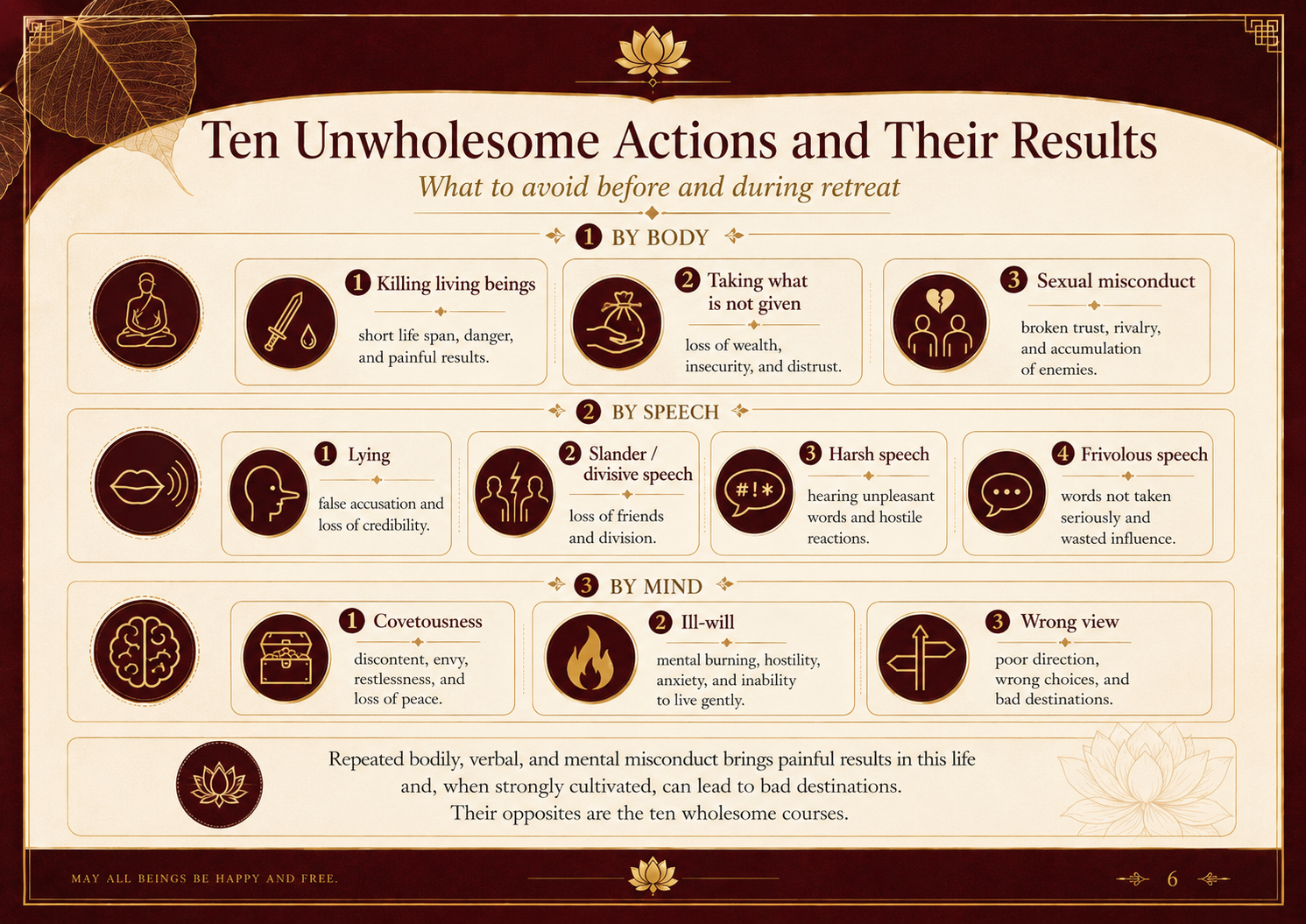
AN 8.40, the Duccaritavipākasutta, makes an important point that should be understood before serious meditation begins: unwholesome conduct is not without consequence. The discourse describes eight forms of misconduct—killing, stealing, sexual misconduct, lying, divisive speech, harsh speech, frivolous speech, and the use of intoxicants leading to negligence. When repeatedly pursued and developed, these are said to lead toward painful destinations; even their lightest human results include such consequences as short life from killing, loss of wealth from stealing, rivalry and enmity from sexual misconduct, false accusations from lying, separation from friends through divisive speech, hearing disagreeable things as a result of harsh speech, and having one’s words disregarded as a result of frivolous speech.
This teaching is useful not because a retreat participant should become frightened about kamma, but because it establishes a fundamental principle:
what we repeatedly do conditions what the mind becomes.
Conduct is therefore directly related to meditation.
A person who repeatedly lies has to maintain different versions of reality. Someone who speaks harshly repeatedly feeds dosa. Someone who continually pursues sensual gratification strengthens the habit of reaching outward toward desirable objects. Someone who injures others strengthens insensitivity and aversion.
Then the same person sits down and asks the mind:
“Why are you not peaceful?”
The answer should not be surprising.
022. Cundasutta: Purification Is a Way of Living
AN 10.176, the Cundasutta, develops this much further. Cunda speaks about purification through the ritual practices of certain brahmins, but the Buddha redirects purification toward conduct itself. The discourse sets out ten unwholesome courses of action: three bodily, four verbal and three mental—covetousness, ill-will and wrong view completing the mental group. Their opposites constitute the ten wholesome courses.
This is extremely important for retreat training.
Purification is not something that begins when one enters the meditation hall.
It begins when one refrains from harming.
It continues when one does not take what is not given.
It continues in responsible sexual conduct.
It continues when one refuses to distort truth, divide people, wound others with speech or waste the mind in meaningless verbal proliferation.
And it continues internally by examining:
What am I wanting?
Whom am I resenting?
From what view am I interpreting this experience?
Thus sīla gradually becomes purification of the environment in which the citta lives.
The three mental courses are particularly important. Unlike AN 8.40, which gives specific “minimum human results” for the eight forms of misconduct it lists, we should not manufacture an equivalent one-to-one result for covetousness, ill-will and wrong view. Their immediate significance for practice is clear enough: covetousness keeps the mind dissatisfied and reaching outward; ill-will burns the mind it inhabits; wrong view misdirects the entire way one understands action and consequence. AN 10.176 explicitly places these three within the unwholesome courses themselves.
For retreat purposes, therefore, the first question is not:
“Can I concentrate?”
It is:
“What am I repeatedly cultivating through body, speech and mind?”
033. Moderation in Eating: Supporting Practice Rather Than Feeding Craving
Food is one of the clearest places where craving can be studied practically.
Bhojane mattaññutā does not require hostility toward food. It means knowing the proper measure and purpose of eating. The standard gradual-training formula explicitly places moderation in eating alongside guarding the sense doors and dedication to wakefulness.
MN 77, the Mahāsakuludāyisutta, adds an important safeguard. Sakuludāyin initially suggests that the Buddha’s disciples respect him because he eats little and lives austerely. The Buddha points out that some of his disciples actually practise greater austerity than he does, yet they still honor him as teacher. Thus eating little by itself is not the essence of the path.
That is exactly the attitude required during retreat.
One does not eat moderately in order to punish the body.
One eats sufficiently to sustain the body without creating unnecessary heaviness, sensual preoccupation and dullness.
Before eating, one can remember the purpose.
During eating, taste is known as taste.
Pleasant vedanā is known.
Wanting another serving is known.
Fullness is known.
The impulse to continue because something tastes good is known.
In this way lunch itself becomes meditation.
The practical result is very direct: a lighter body, less post-meal torpor, more wakefulness, and better conditions for the afternoon meditation period.
044. Jāgariyānuyoga: Learning Not to Live in Dullness
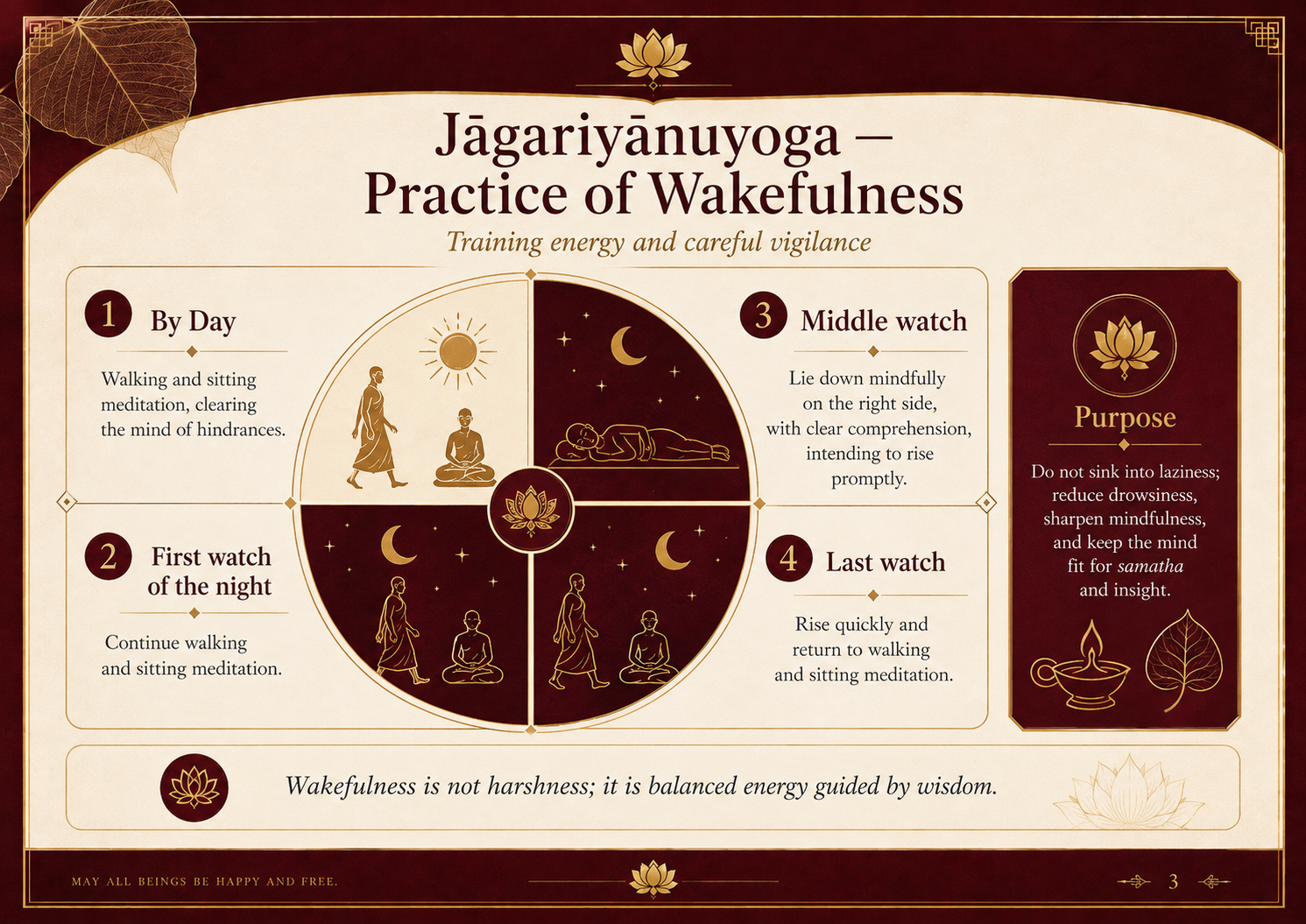
The next condition is jāgariyānuyoga—dedication to wakefulness.
Iti 47 gives a concise and powerful instruction: one should live wakeful, mindful and clearly aware, and at appropriate times discern wholesome qualities in that state.
Wakefulness therefore means much more than simply reducing sleep.
A person can remain physically awake for sixteen hours while mentally drifting through memories, fantasies, mobile phones, conversations and habitual reactions.
That is not the wakefulness being cultivated.
Retreat wakefulness means maintaining sufficient energy that the citta can know what is occurring.
Walking meditation becomes important here.
Sitting and walking alternate.
When dullness develops, one walks.
When energy becomes excessive, one settles.
When one lies down, one does so knowingly rather than collapsing into heedlessness.
When one rises, practice resumes.
The objective is not harshness toward the body. It is the removal of the habitual tendency to disappear into dullness whenever effort is required.
Gradually the practitioner discovers something important:
energy itself can be trained.
055. Sati and Sampajañña: Knowing What Is Happening While It Happens
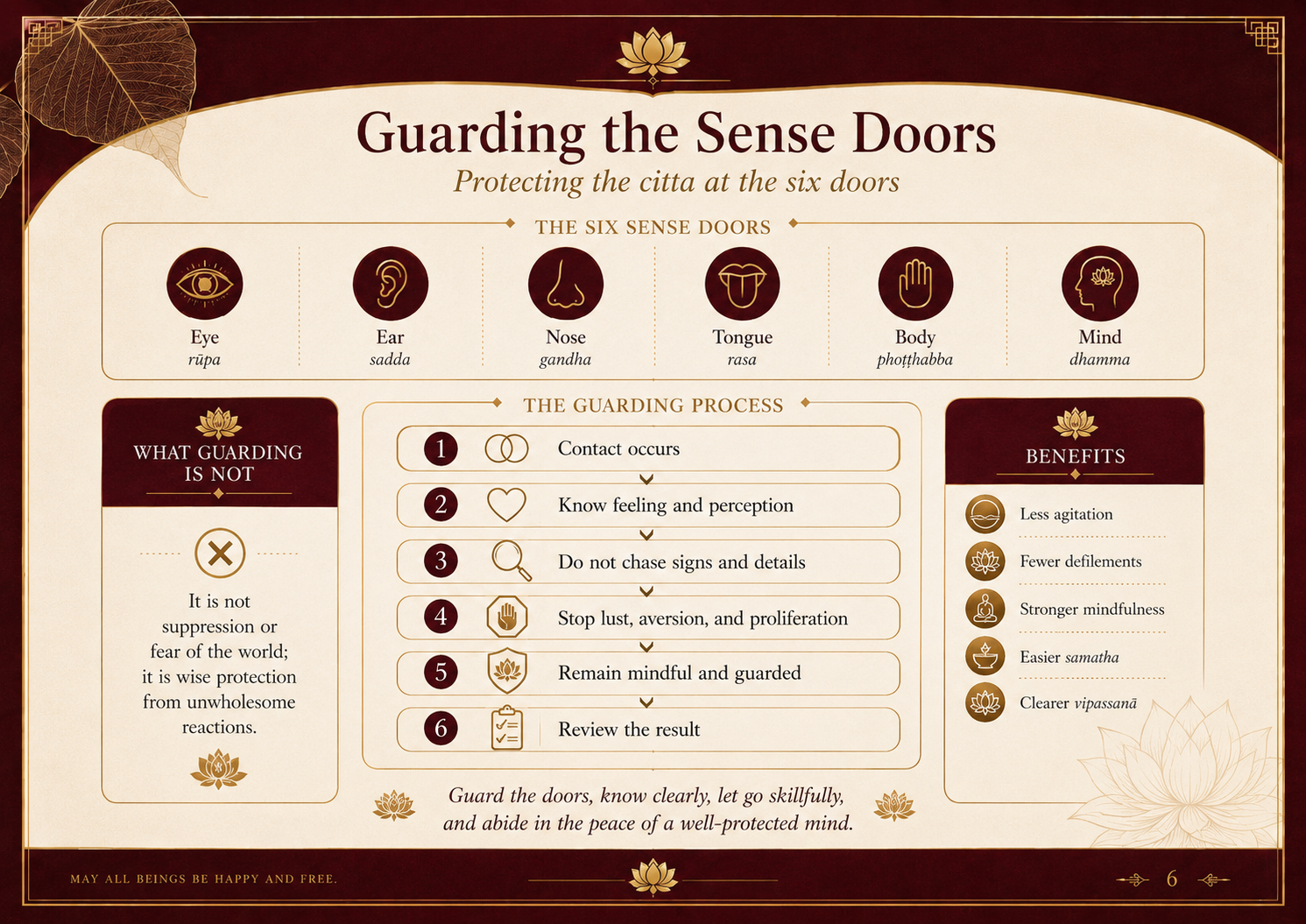
Once bodily and verbal conduct is becoming cleaner, eating is regulated and wakefulness is maintained, a much more subtle training becomes possible: sati-sampajañña.
SN 47.35, the Satisutta, gives an especially useful explanation.
Sati is established through the four satipaṭṭhānas. Sampajañña is then described in an immediately observable way: feelings, thoughts and perceptions are known as they arise, known while they remain, and known as they disappear.
This takes retreat practice far beyond merely remembering to “be mindful.”
Suppose somebody says something unpleasant.
Can I know:
unpleasant vedanā has arisen?
Can I know:
a particular saññā is interpreting the words?
Can I know:
an angry vitakka is forming?
Can I remain present long enough to observe:
it arose → it persisted → it ceased?
If that becomes possible, the practitioner has already achieved something very important.
There is now a space between experience and automatic reaction.
This is why sati-sampajañña should continue while walking, washing, preparing food, eating, looking around, speaking, sitting and lying down. Formal meditation is only one part of its field.
066. The Fourfold Sampajañña: A Useful Commentarial Lens
Here it is valuable to distinguish the canonical teaching from a later explanatory framework.
The fourfold division of sampajañña into sātthaka, sappāya, gocara and asammoha is commentarial rather than a fourfold formula stated in SN 47.35 itself. Theravāda commentarial literature traditionally associated with Buddhaghosa elaborates clear comprehension in these four ways.
Used carefully, this can be a very practical aid.
Sātthaka-sampajañña asks:
Is what I am about to do purposeful? Does it actually support the path?
Before speaking, moving, opening the phone, engaging in a conversation or changing the meditation object, there is a pause to understand purpose.
Sappāya-sampajañña asks:
Even if something is useful in principle, is it suitable here and now?
Something may be wholesome but inappropriate to this particular time, place, body condition or stage of practice.
Gocara-sampajañña concerns remaining within the proper domain or field of practice.
During retreat the mind repeatedly tries to leave its field—to memories, plans, arguments, sensual imagination and unnecessary concerns. Gocara brings it back.
Asammoha-sampajañña goes deeper:
Am I understanding this without delusion?
Am I seeing an event simply as a conditioned event, or have I already converted it into:
“my pain,” “my achievement,” “my meditation,” “my opinion,” “what he did to me”?
Used in this manner, the fourfold commentarial framework can support rather than replace the direct canonical instruction of SN 47.35: know what is arising, remaining and ceasing.
077. All of This Leads Toward Samathā
Only now does the relationship with samathā become fully visible.
A practitioner who reduces unwholesome bodily and verbal conduct carries less remorse and agitation.
A practitioner who guards mental conduct feeds less covetousness and ill-will.
Moderation in eating reduces heaviness and sensory indulgence.
Wakefulness reduces dullness.
Sati-sampajañña allows disturbances to be recognized before they grow.
The sense doors become less capable of dragging the citta behind every attractive or irritating object.
What happens next?
The five hindrances begin to lose some of their nourishment.
And when their nourishment is repeatedly removed, the mind does not have to be violently forced into calm.
It begins to settle.
This is the point at which samathā should be understood.
What Is Samathā? — The Ānāpānassatikathā Explanation
Samathā should not be reduced merely to “concentration,” nor should it mean simply forcing attention to remain on one object. The Ānāpānassatikathā of the Paṭisambhidāmagga gives a much more useful practical explanation. In explaining samatthañca paṭivijjhati, the expression is understood through sama and attha.
Sama — what becomes established in practice
- ārammaṇassa upaṭṭhānaṁ samaṁ — the object becomes steadily established.
- cittassa avikkhepo samaṁ — the citta is non-distracted / non-scattered.
- cittassa adhiṭṭhānaṁ samaṁ — the citta becomes firmly established.
- cittassa vodānaṁ samaṁ — the citta becomes purified / cleansed.
This gives a practical way of recognizing the development of samathā. At the beginning, the breath or other chosen field may repeatedly disappear from attention because sounds, memories, plans, sensual desire, irritation, agitation or dullness continually pull the citta away. As the preceding training is cultivated, the relationship between the citta and its field begins to change.
Attha — the purpose or significance of this development
- anavajjaṭṭha — blamelessness.
- nikkilesaṭṭha — freedom from defilement.
- vodānaṭṭha — purification.
- paramaṭṭha — the highest / ultimate purpose.
Thus samathā is not adequately measured by saying, “I concentrated on the breath for thirty minutes.” A more useful question is whether the meditation object is increasingly stable in experience, whether scattering has diminished, whether the citta can remain established without continual forcing, and whether the states that obscure and disturb it are progressively being purified.
Practical recognition of samathā
less feeding of akusala → fewer hindrances → less vikkhepa → ārammaṇa steadily established → citta firmly established → citta purified → samathā
This is why the preparation described earlier in this article is inseparable from samathā. Sīla, moderation, wakefulness and sati-sampajañña are not merely preliminaries to be left behind when meditation begins. They progressively remove the conditions that scatter, obscure and agitate the citta, allowing calm and collectedness to develop through causes and conditions.
Working definition for this article: Samathā is the settling, non-scattering, firm establishment and progressive purification of the citta in relation to its proper field—not merely the act of concentrating on an object.
Samathā is not merely forcing attention onto a breath.
It is the progressive calming and unification of a citta whose causes of disturbance are being understood and reduced.
The breath can then become a stable field.
One knows the breathing.
When the mind wanders, one returns.
When kāmacchanda appears, it is recognized.
When byāpāda appears, it is recognized.
When thīna-middha appears, energy is adjusted.
When uddhacca-kukkucca appears, agitation is calmed.
When vicikicchā appears, it is understood and resolved through Dhamma and direct practice.
Gradually:
less disturbance → greater continuity → greater ease → greater collectedness → samathā.
And from a properly established samathā, the conditions for deeper jhāna and meaningful vipassanā become much stronger.
For a first-time retreat participant, this is perhaps the most important understanding.
The retreat is not ten days spent trying to manufacture a special state of mind.
It is ten days of learning how the citta is conditioned.
AN 8.40 teaches us to understand the consequences of misconduct. AN 10.176 turns purification into bodily, verbal and mental conduct. MN 77 reminds us not to confuse austerity with liberation. Iti 47 establishes wakefulness. SN 47.35 makes sati-sampajañña something directly observable in the arising and ceasing of experience. The later fourfold explanation of sampajañña can then provide a useful practical lens for purpose, suitability, proper domain and freedom from delusion.
Together they produce a coherent training:
Do not feed what agitates the mind.
Learn to recognize what is happening within it.
Live in such a way that the hindrances receive less nourishment.
Then sit with the breath and allow calm to be cultivated repeatedly.
This is how the practitioner arrives at samathā not by accident, but through causes and conditions.
And that is an excellent level at which to enter the deeper work of a retreat.
01Purification of Conduct — Why Sīla Matters
02Ten Wholesome and Unwholesome Courses of Action
03Moderation in Eating — Bhojane Mattaññutā

04Jāgariyānuyoga — Dedication to Wakefulness
05Sati-Sampajañña — Knowing What Happens While It Happens

06Fourfold Sampajañña — Practical Commentarial Lens
07From Hindrances Toward Samathā

08Preparing the Practitioner for Samathā — Complete Training

Deepen the Development of Samathā
These Dhamma Essence studies develop the practical conditions by which agitation, unwholesome thought and the five hindrances are weakened, allowing the citta to become progressively less scattered, more settled and more firmly established.
01 MN 20 — Vitakkasaṇṭhānasutta
MN 20 gives five progressively stronger methods for dealing with unwholesome trains of thought. It is especially practical when repeated thinking prevents the citta from settling and continually feeds a hindrance.
02 MN 19 — Dvedhāvitakkasutta
MN 19 shows how the Buddha divided thought according to its consequences and repeatedly cultivated thoughts of renunciation, non-ill-will and harmlessness while abandoning thoughts rooted in sensuality, ill-will and harming.
03 SN 46.51 — Āhārasutta
This discourse explains what nourishes the five hindrances and what deprives them of nourishment. Samathā becomes much easier to understand when the practitioner learns not merely to fight a hindrance after it appears, but to stop feeding the conditions from which it grows.
04 MN 118 — Ānāpānasatisutta
MN 118 provides the structured breathing development through which bodily activity is tranquillised, pīti and sukha are experienced, the citta is known and steadied, and the practice matures beyond merely keeping attention on the breath.
05 AN 4.41 — Samādhibhāvanāsutta
AN 4.41 shows that samādhi is developed for different purposes, including pleasant abiding here and now, knowledge and vision, sati-sampajañña, and the ending of the āsavas. It therefore prevents samathā and samādhi from being understood as mere concentration exercises.