The Gradual Training — From Sīla to Jhāna
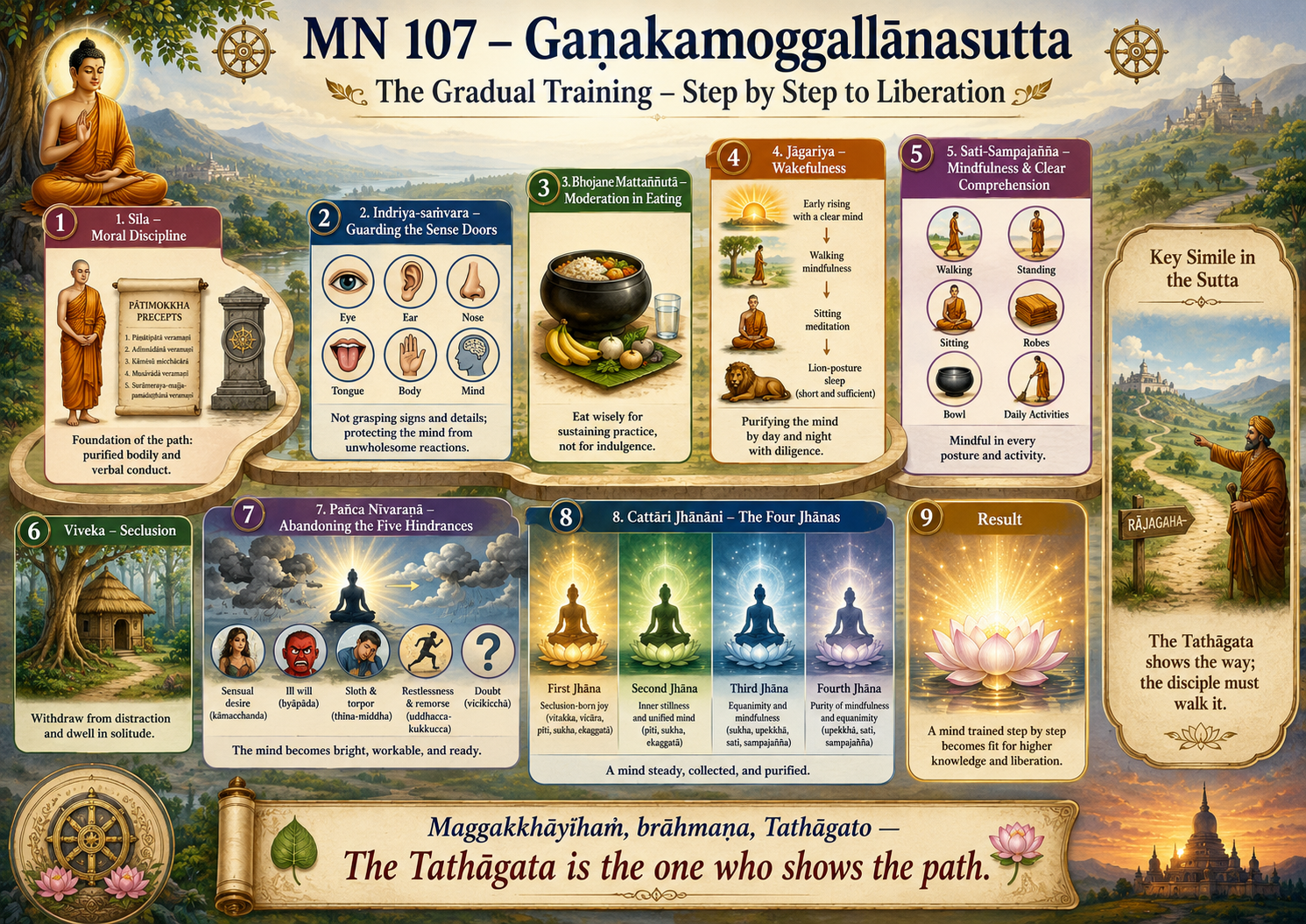 VISUAL SUMMARYSee this sutta in a pictureOpen the complete infographic for a visual overview before or after reading the full study.View infographic →
Later capacities rest on earlier training
Why MN 107 is foundational. Gaṇakamoggallāna asks whether the Buddha’s Dhamma has a gradual training comparable to learning arithmetic or ascending a staircase. The Buddha answers with one of the clearest practical sequences in the Nikāyas: establish virtue, guard the six sense doors, moderate food, cultivate wakefulness, maintain sati-sampajañña throughout daily life, resort to seclusion, abandon the five hindrances, and then develop the four jhānas. The discourse finally clarifies the responsibility of teacher and practitioner through the road-to-Rājagaha simile.
Sīla → Indriya-saṁvara → Bhojane mattaññutā → Jāgariyānuyoga → Sati-sampajañña → Vivitta senāsana → Pañca nīvaraṇā pahāna → Cattāri jhānāni
Central principle: MN 107 does not present the path as “receive instruction and automatically attain.” The destination can be real, the road can be correct, and the guide can be accurate—yet the traveler must actually follow the road. The Buddha’s formulation is Maggakkhāyīhaṁ, brāhmaṇa, Tathāgato — “The Tathāgata is one who shows the way.”
Eight-stage practical training map
| Stage | Training | What is being established |
|---|---|---|
| 1 | Sīla | Pātimokkha restraint; conduct and resort; seeing danger in small faults. |
| 2 | Indriya-saṁvara | Guard all six doors; do not grasp signs and details that feed covetousness or sadness. |
| 3 | Bhojane mattaññutā | Eat for maintenance of the body and support of brahmacariya—not indulgence. |
| 4 | Jāgariyānuyoga | Use day and night deliberately to purify citta from obstructive states. |
| 5 | Sati-sampajañña | Carry mindfulness and clear comprehension into every posture and activity. |
| 6 | Vivitta senāsana | Choose seclusion so the mind is not continually fed by stimulation. |
| 7 | Pañca nīvaraṇā pahāna | Actively abandon sensual desire, ill will, sloth-torpor, restlessness-remorse, and doubt. |
| 8 | Cattāri jhānāni | Enter the four jhānas progressively, with coarser factors ceasing stage by stage. |
Complete Sutta
01The Question and the Gradual TrainingStaircase, arithmetic and horse-training similes • sīla as the first training
Evaṁ me sutaṁ— ekaṁ samayaṁ bhagavā sāvatthiyaṁ viharati pubbārāme migāramātupāsāde. Atha kho gaṇakamoggallāno brāhmaṇo yena bhagavā tenupasaṅkami; upasaṅkamitvā bhagavatā saddhiṁ sammodi. Sammodanīyaṁ kathaṁ sāraṇīyaṁ vītisāretvā ekamantaṁ nisīdi. Ekamantaṁ nisinno kho gaṇakamoggallāno brāhmaṇo bhagavantaṁ etadavoca:
Thus have I heard. On one occasion the Blessed One was staying at Sāvatthī in the Eastern Park, in the mansion of Migāra’s mother. Then the brahmin Gaṇakamoggallāna approached the Blessed One, exchanged greetings and courteous conversation with him, and sat to one side. Seated there, he said to the Blessed One:
“Seyyathāpi, bho gotama, imassa migāramātupāsādassa dissati anupubbasikkhā anupubbakiriyā anupubbapaṭipadā yadidaṁ— yāva pacchimasopānakaḷevarā; imesampi hi, bho gotama, brāhmaṇānaṁ dissati anupubbasikkhā anupubbakiriyā anupubbapaṭipadā yadidaṁ— ajjhene; imesampi hi, bho gotama, issāsānaṁ dissati anupubbasikkhā anupubbakiriyā anupubbapaṭipadā yadidaṁ— issatthe.
Variant: issatthe → issatte (mr)
Amhākampi hi, bho gotama, gaṇakānaṁ gaṇanājīvānaṁ dissati anupubbasikkhā anupubbakiriyā anupubbapaṭipadā yadidaṁ— saṅkhāne. Mayañhi, bho gotama, antevāsiṁ labhitvā paṭhamaṁ evaṁ gaṇāpema: ‘ekaṁ ekakaṁ, dve dukā, tīṇi tikā, cattāri catukkā, pañca pañcakā, cha chakkā, satta sattakā, aṭṭha aṭṭhakā, nava navakā, dasa dasakā’ti; satampi mayaṁ, bho gotama, gaṇāpema, bhiyyopi gaṇāpema. Sakkā nu kho, bho gotama, imasmimpi dhammavinaye evameva anupubbasikkhā anupubbakiriyā anupubbapaṭipadā paññapetun”ti?
“Master Gotama, just as in this mansion of Migāra’s mother there can be seen a gradual training, gradual activity, and gradual course of practice, right up to the final step of the staircase; and just as among brahmins there is gradual training in recitation and study; and among archers gradual training in archery; so too among us accountants who live by calculation there is gradual training in arithmetic. When we obtain a pupil, we first teach him to count: ‘one one, two twos, three threes, four fours, five fives, six sixes, seven sevens, eight eights, nine nines, ten tens.’ We teach him to count to a hundred and beyond. Is it possible, Master Gotama, to describe in this Dhamma and discipline a similar gradual training, gradual activity, and gradual course of practice?”
“Sakkā, brāhmaṇa, imasmimpi dhammavinaye anupubbasikkhā anupubbakiriyā anupubbapaṭipadā paññapetuṁ. Seyyathāpi, brāhmaṇa, dakkho assadammako bhaddaṁ assājānīyaṁ labhitvā paṭhameneva mukhādhāne kāraṇaṁ kāreti, atha uttariṁ kāraṇaṁ kāreti; evameva kho, brāhmaṇa, tathāgato purisadammaṁ labhitvā paṭhamaṁ evaṁ vineti: ‘ehi tvaṁ, bhikkhu, sīlavā hohi, pātimokkhasaṁvarasaṁvuto viharāhi ācāragocarasampanno aṇumattesu vajjesu bhayadassāvī, samādāya sikkhassu sikkhāpadesū’ti.
“It is possible, brahmin, to describe a gradual training, gradual activity, and gradual course of practice in this Dhamma and discipline. Just as a skilled horse trainer, having obtained a fine thoroughbred horse, first trains it in wearing the bit and then proceeds to further training, so too, when the Tathāgata obtains a person to be trained, he first trains him thus: ‘Come, bhikkhu, be virtuous. Dwell restrained by the Pātimokkha, accomplished in conduct and resort, seeing danger in the slightest faults. Having undertaken the training rules, train in them.’”
02The Eight-Stage AnupubbasikkhāIndriya-saṁvara • food moderation • wakefulness • sati-sampajañña • seclusion • hindrances • four jhānas • sekha/arahant
Yato kho, brāhmaṇa, bhikkhu sīlavā hoti, pātimokkhasaṁvarasaṁvuto viharati ācāragocarasampanno aṇumattesu vajjesu bhayadassāvī, samādāya sikkhati sikkhāpadesu, tamenaṁ tathāgato uttariṁ vineti: ‘ehi tvaṁ, bhikkhu, indriyesu guttadvāro hohi, cakkhunā rūpaṁ disvā mā nimittaggāhī hohi mānubyañjanaggāhī. Yatvādhikaraṇamenaṁ cakkhundriyaṁ asaṁvutaṁ viharantaṁ abhijjhādomanassā pāpakā akusalā dhammā anvāssaveyyuṁ tassa saṁvarāya paṭipajjāhi; rakkhāhi cakkhundriyaṁ, cakkhundriye saṁvaraṁ āpajjāhi. Sotena saddaṁ sutvā mā nimittaggāhī hohi mānubyañjanaggāhī. Yatvādhikaraṇamenaṁ sotindriyaṁ asaṁvutaṁ viharantaṁ abhijjhādomanassā pāpakā akusalā dhammā anvāssaveyyuṁ tassa saṁvarāya paṭipajjāhi; rakkhāhi sotindriyaṁ, sotindriye saṁvaraṁ āpajjāhi. Ghānena gandhaṁ ghāyitvā mā nimittaggāhī hohi mānubyañjanaggāhī. Yatvādhikaraṇamenaṁ ghānindriyaṁ asaṁvutaṁ viharantaṁ abhijjhādomanassā pāpakā akusalā dhammā anvāssaveyyuṁ tassa saṁvarāya paṭipajjāhi; rakkhāhi ghānindriyaṁ, ghānindriye saṁvaraṁ āpajjāhi. Jivhāya rasaṁ sāyitvā mā nimittaggāhī hohi mānubyañjanaggāhī. Yatvādhikaraṇamenaṁ jivhindriyaṁ asaṁvutaṁ viharantaṁ abhijjhādomanassā pāpakā akusalā dhammā anvāssaveyyuṁ tassa saṁvarāya paṭipajjāhi; rakkhāhi jivhindriyaṁ, jivhindriye saṁvaraṁ āpajjāhi. Kāyena phoṭṭhabbaṁ phusitvā mā nimittaggāhī hohi mānubyañjanaggāhī. Yatvādhikaraṇamenaṁ kāyindriyaṁ asaṁvutaṁ viharantaṁ abhijjhādomanassā pāpakā akusalā dhammā anvāssaveyyuṁ tassa saṁvarāya paṭipajjāhi; rakkhāhi kāyindriyaṁ, kāyindriye saṁvaraṁ āpajjāhi. Manasā dhammaṁ viññāya mā nimittaggāhī hohi mānubyañjanaggāhī. Yatvādhikaraṇamenaṁ manindriyaṁ asaṁvutaṁ viharantaṁ abhijjhādomanassā pāpakā akusalā dhammā anvāssaveyyuṁ tassa saṁvarāya paṭipajjāhi; rakkhāhi manindriyaṁ, manindriye saṁvaraṁ āpajjāhī’ti.
“When the bhikkhu is virtuous, restrained by the Pātimokkha, accomplished in conduct and resort, seeing danger in the slightest faults and training in the training rules, the Tathāgata trains him further: ‘Come, bhikkhu, guard the doors of the sense faculties. Having seen a form with the eye, do not grasp its sign or its details and features. Since, if the eye faculty were left unrestrained, bad unwholesome qualities of covetousness and sadness could invade, practice for its restraint; protect the eye faculty and undertake restraint of the eye faculty. In the same way, having heard a sound with the ear, smelled an odor with the nose, tasted a flavor with the tongue, touched a tangible object with the body, or cognized a mental object with the mind, do not grasp its sign or details and features. Practice restraint, protect each faculty, and undertake restraint of each sense door.’”
Yato kho, brāhmaṇa, bhikkhu indriyesu guttadvāro hoti, tamenaṁ tathāgato uttariṁ vineti: ‘ehi tvaṁ, bhikkhu, bhojane mattaññū hohi. Paṭisaṅkhā yoniso āhāraṁ āhāreyyāsi— neva davāya na madāya na maṇḍanāya na vibhūsanāya, yāvadeva imassa kāyassa ṭhitiyā yāpanāya vihiṁsūparatiyā brahmacariyānuggahāya—iti purāṇañca vedanaṁ paṭihaṅkhāmi, navañca vedanaṁ na uppādessāmi, yātrā ca me bhavissati anavajjatā ca phāsuvihāro cā’ti.
“When the bhikkhu is guarded at the sense doors, the Tathāgata trains him further: ‘Come, bhikkhu, know moderation in eating. Reflect wisely when taking food: not for amusement, intoxication, beautification, or adornment, but only for the maintenance and continuation of this body, for ending discomfort, and for supporting the holy life, thinking: “Thus I will end old feelings of hunger without producing new painful feelings through overeating; I will sustain myself, remain blameless, and live at ease.”’”
Yato kho, brāhmaṇa, bhikkhu bhojane mattaññū hoti, tamenaṁ tathāgato uttariṁ vineti: ‘ehi tvaṁ, bhikkhu, jāgariyaṁ anuyutto viharāhi, divasaṁ caṅkamena nisajjāya āvaraṇīyehi dhammehi cittaṁ parisodhehi, rattiyā paṭhamaṁ yāmaṁ caṅkamena nisajjāya āvaraṇīyehi dhammehi cittaṁ parisodhehi, rattiyā majjhimaṁ yāmaṁ dakkhiṇena passena sīhaseyyaṁ kappeyyāsi pāde pādaṁ accādhāya sato sampajāno uṭṭhānasaññaṁ manasikaritvā, rattiyā pacchimaṁ yāmaṁ paccuṭṭhāya caṅkamena nisajjāya āvaraṇīyehi dhammehi cittaṁ parisodhehī’ti.
“When the bhikkhu knows moderation in eating, the Tathāgata trains him further: ‘Come, bhikkhu, be devoted to wakefulness. During the day, while walking and sitting, purify the mind from obstructive states. During the first watch of the night, while walking and sitting, purify the mind from obstructive states. During the middle watch, lie down on the right side in the lion’s posture, placing one foot upon the other, mindful and clearly comprehending, having attended to the perception of rising. In the last watch, rise and again purify the mind from obstructive states while walking and sitting.’”
Yato kho, brāhmaṇa, bhikkhu jāgariyaṁ anuyutto hoti, tamenaṁ tathāgato uttariṁ vineti: ‘ehi tvaṁ, bhikkhu, satisampajaññena samannāgato hohi, abhikkante paṭikkante sampajānakārī, ālokite vilokite sampajānakārī, samiñjite pasārite sampajānakārī, saṅghāṭipattacīvaradhāraṇe sampajānakārī, asite pīte khāyite sāyite sampajānakārī, uccārapassāvakamme sampajānakārī, gate ṭhite nisinne sutte jāgarite bhāsite tuṇhībhāve sampajānakārī’ti.
“When the bhikkhu is devoted to wakefulness, the Tathāgata trains him further: ‘Come, bhikkhu, be endowed with mindfulness and clear comprehension. Act with clear comprehension when going forward and returning, looking ahead and looking aside, bending and stretching the limbs, carrying the outer robe, bowl and robes, eating, drinking, chewing and tasting, urinating and defecating, walking, standing, sitting, sleeping, waking, speaking and remaining silent.’”
Yato kho, brāhmaṇa, bhikkhu satisampajaññena samannāgato hoti, tamenaṁ tathāgato uttariṁ vineti: ‘ehi tvaṁ, bhikkhu, vivittaṁ senāsanaṁ bhajāhi araññaṁ rukkhamūlaṁ pabbataṁ kandaraṁ giriguhaṁ susānaṁ vanapatthaṁ abbhokāsaṁ palālapuñjan’ti. So vivittaṁ senāsanaṁ bhajati araññaṁ rukkhamūlaṁ pabbataṁ kandaraṁ giriguhaṁ susānaṁ vanapatthaṁ abbhokāsaṁ palālapuñjaṁ.
“When the bhikkhu is endowed with mindfulness and clear comprehension, the Tathāgata trains him further: ‘Come, bhikkhu, resort to a secluded lodging—a forest, the foot of a tree, a mountain, a ravine, a mountain cave, a charnel ground, a woodland thicket, the open air, or a heap of straw.’ He then resorts to such a secluded lodging.”
So pacchābhattaṁ piṇḍapātapaṭikkanto nisīdati pallaṅkaṁ ābhujitvā, ujuṁ kāyaṁ paṇidhāya, parimukhaṁ satiṁ upaṭṭhapetvā. So abhijjhaṁ loke pahāya vigatābhijjhena cetasā viharati, abhijjhāya cittaṁ parisodheti; byāpādapadosaṁ pahāya abyāpannacitto viharati sabbapāṇabhūtahitānukampī, byāpādapadosā cittaṁ parisodheti; thinamiddhaṁ pahāya vigatathinamiddho viharati ālokasaññī sato sampajāno, thinamiddhā cittaṁ parisodheti;
Variant: thinamiddhaṁ → thīnamiddhaṁ (bj, sya-all, km, pts1ed)
uddhaccakukkuccaṁ pahāya anuddhato viharati ajjhattaṁ vūpasantacitto, uddhaccakukkuccā cittaṁ parisodheti; vicikicchaṁ pahāya tiṇṇavicikiccho viharati akathaṅkathī kusalesu dhammesu, vicikicchāya cittaṁ parisodheti.
“After the meal, returning from the almsround, he sits down cross-legged, holds the body erect, and establishes mindfulness to the fore. Abandoning covetousness regarding the world, he dwells with a mind free from covetousness and purifies the mind from covetousness. Abandoning ill will and hatred, he dwells with a mind free from ill will, compassionate for the welfare of all living beings, and purifies the mind from ill will and hatred. Abandoning sloth and torpor, he dwells free from sloth and torpor, percipient of light, mindful and clearly comprehending, and purifies the mind from sloth and torpor. Abandoning restlessness and remorse, he dwells unagitated, with the mind inwardly peaceful, and purifies the mind from restlessness and remorse. Abandoning doubt, he dwells having crossed beyond doubt, no longer perplexed about wholesome qualities, and purifies the mind from doubt.”
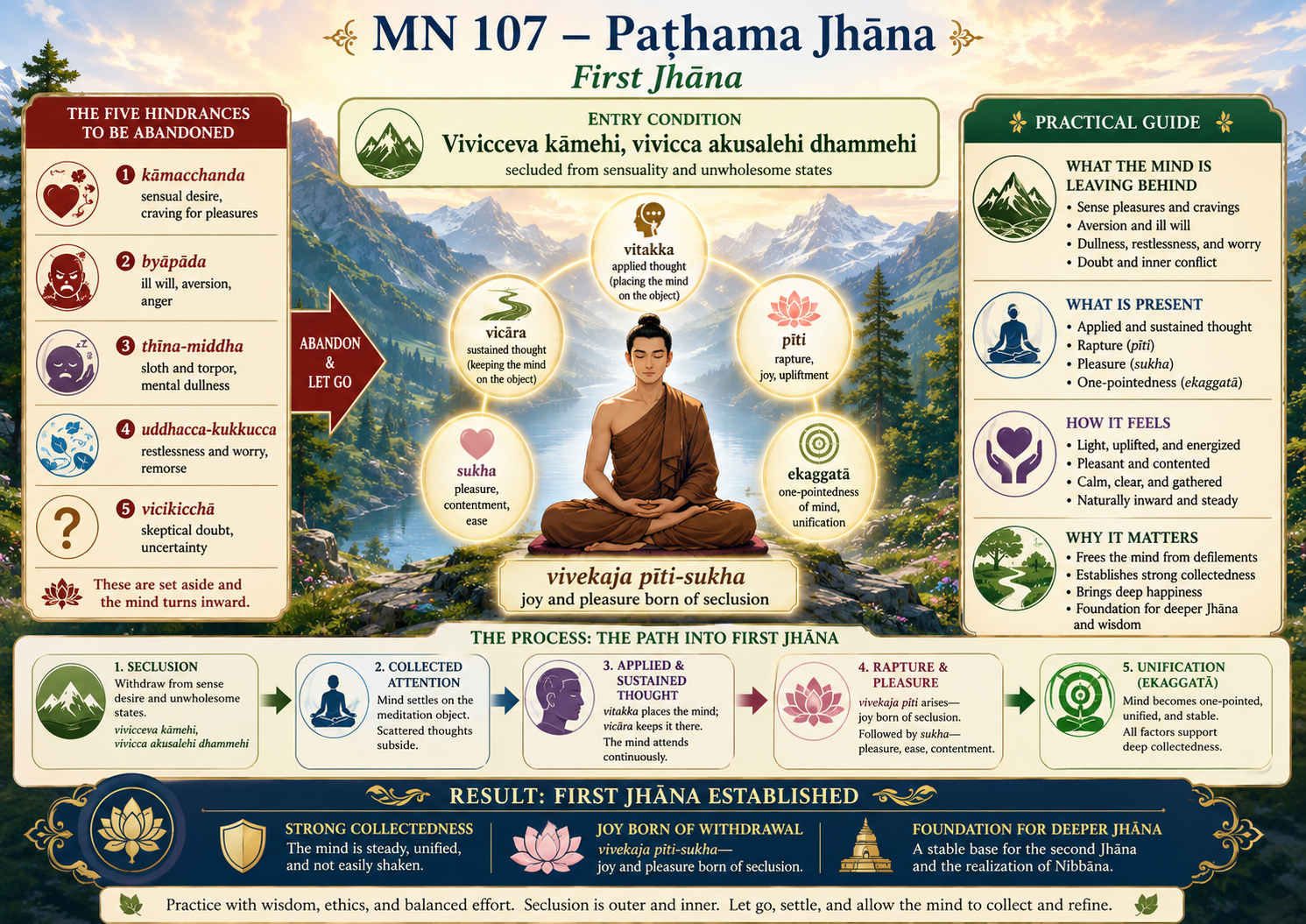
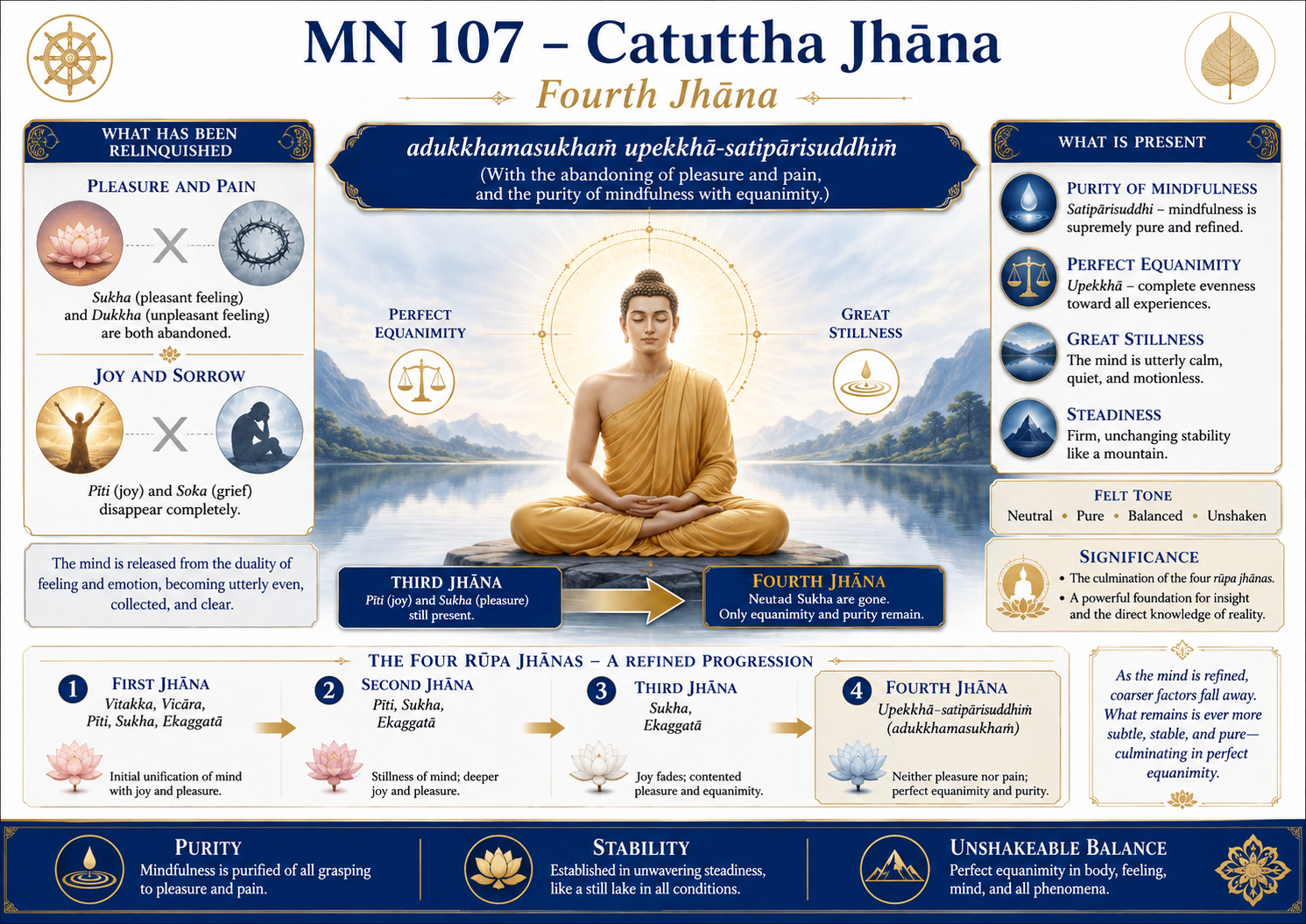
So ime pañca nīvaraṇe pahāya cetaso upakkilese paññāya dubbalīkaraṇe vivicceva kāmehi vivicca akusalehi dhammehi savitakkaṁ savicāraṁ vivekajaṁ pītisukhaṁ paṭhamaṁ jhānaṁ upasampajja viharati. Vitakkavicārānaṁ vūpasamā ajjhattaṁ sampasādanaṁ cetaso ekodibhāvaṁ avitakkaṁ avicāraṁ samādhijaṁ pītisukhaṁ dutiyaṁ jhānaṁ upasampajja viharati. Pītiyā ca virāgā upekkhako ca viharati sato ca sampajāno, sukhañca kāyena paṭisaṁvedeti, yaṁ taṁ ariyā ācikkhanti ‘upekkhako satimā sukhavihārī’ti tatiyaṁ jhānaṁ upasampajja viharati. Sukhassa ca pahānā dukkhassa ca pahānā pubbeva somanassadomanassānaṁ atthaṅgamā adukkhamasukhaṁ upekkhāsatipārisuddhiṁ catutthaṁ jhānaṁ upasampajja viharati.
“Having abandoned these five hindrances—defilements of the mind that weaken wisdom—secluded from sensual pleasures and unwholesome qualities, he enters and dwells in the first jhāna, with thought and examination, and with rapture and pleasure born of seclusion. With the subsiding of thought and examination, he enters and dwells in the second jhāna, with inner confidence and unification of mind, without thought and examination, with rapture and pleasure born of samādhi. With the fading of rapture, he dwells equanimous, mindful and clearly comprehending, experiencing pleasure with the body, and enters and dwells in the third jhāna, of which the noble ones say: ‘Equanimous and mindful, one dwells happily.’ With the abandoning of pleasure and pain and the previous disappearance of gladness and sadness, he enters and dwells in the fourth jhāna, neither painful nor pleasant, with purification of mindfulness by equanimity.”
Ye kho te, brāhmaṇa, bhikkhū sekkhā apattamānasā anuttaraṁ yogakkhemaṁ patthayamānā viharanti tesu me ayaṁ evarūpī anusāsanī hoti.
Variant: sekkhā → sekhā (sabbattha)
Ye pana te bhikkhū arahanto khīṇāsavā vusitavanto katakaraṇīyā ohitabhārā anuppattasadatthā parikkhīṇabhavasaṁyojanā sammadaññāvimuttā tesaṁ ime dhammā diṭṭhadhammasukhavihārāya ceva saṁvattanti, satisampajaññāya cā”ti.
“For those bhikkhus who are trainees, who have not yet attained their goal and dwell aspiring to the unsurpassed security from bondage, this is the kind of instruction I give. But for those bhikkhus who are arahants—with the āsavas destroyed, who have lived the holy life, done what had to be done, laid down the burden, reached their own true goal, utterly destroyed the fetters of becoming, and been rightly liberated through final knowledge—these qualities conduce both to pleasant abiding here and now and to mindfulness and clear comprehension.”
03Why Some Reach Nibbāna and Others Do NotRoad-to-Rājagaha • destination, path, guide and traveler • Maggakkhāyī Tathāgato
Evaṁ vutte, gaṇakamoggallāno brāhmaṇo bhagavantaṁ etadavoca: “kiṁ nu kho bhoto gotamassa sāvakā bhotā gotamena evaṁ ovadīyamānā evaṁ anusāsīyamānā sabbe accantaṁ niṭṭhaṁ nibbānaṁ ārādhenti udāhu ekacce nārādhentī”ti?
When this was said, the brahmin Gaṇakamoggallāna asked the Blessed One: “When Master Gotama’s disciples are advised and instructed in this way, do all of them attain Nibbāna, the ultimate conclusion, or do some not attain it?”
“Appekacce kho, brāhmaṇa, mama sāvakā mayā evaṁ ovadīyamānā evaṁ anusāsīyamānā accantaṁ niṭṭhaṁ nibbānaṁ ārādhenti, ekacce nārādhentī”ti.
“Brahmin, some of my disciples, when advised and instructed by me in this way, attain Nibbāna, the ultimate conclusion, while some do not.”
“Ko nu kho, bho gotama, hetu ko paccayo yaṁ tiṭṭhateva nibbānaṁ, tiṭṭhati nibbānagāmī maggo, tiṭṭhati bhavaṁ gotamo samādapetā; atha ca pana bhoto gotamassa sāvakā bhotā gotamena evaṁ ovadīyamānā evaṁ anusāsīyamānā appekacce accantaṁ niṭṭhaṁ nibbānaṁ ārādhenti, ekacce nārādhentī”ti?
“Master Gotama, what is the reason and cause? Nibbāna remains; the path leading to Nibbāna remains; and Master Gotama remains as the one who encourages and instructs them. Yet among the disciples instructed in this way, some attain Nibbāna, the ultimate conclusion, and some do not. Why is that?”
“Tena hi, brāhmaṇa, taṁyevettha paṭipucchissāmi. Yathā te khameyya tathā naṁ byākareyyāsi. Taṁ kiṁ maññasi, brāhmaṇa, kusalo tvaṁ rājagahagāmissa maggassā”ti?
“Then, brahmin, I will question you in return about this. Answer as you think fit. What do you think, brahmin: are you skilled in the road leading to Rājagaha?”
“Evaṁ, bho, kusalo ahaṁ rājagahagāmissa maggassā”ti.
“Yes, Master Gotama, I am skilled in the road leading to Rājagaha.”
“Taṁ kiṁ maññasi, brāhmaṇa, idha puriso āgaccheyya rājagahaṁ gantukāmo. So taṁ upasaṅkamitvā evaṁ vadeyya: ‘icchāmahaṁ, bhante, rājagahaṁ gantuṁ; tassa me rājagahassa maggaṁ upadisā’ti. Tamenaṁ tvaṁ evaṁ vadeyyāsi: ‘ehambho purisa, ayaṁ maggo rājagahaṁ gacchati. Tena muhuttaṁ gaccha, tena muhuttaṁ gantvā dakkhissasi amukaṁ nāma gāmaṁ, tena muhuttaṁ gaccha, tena muhuttaṁ gantvā dakkhissasi amukaṁ nāma nigamaṁ; tena muhuttaṁ gaccha, tena muhuttaṁ gantvā dakkhissasi rājagahassa ārāmarāmaṇeyyakaṁ vanarāmaṇeyyakaṁ bhūmirāmaṇeyyakaṁ pokkharaṇīrāmaṇeyyakan’ti. So tayā evaṁ ovadīyamāno evaṁ anusāsīyamāno ummaggaṁ gahetvā pacchāmukho gaccheyya. Atha dutiyo puriso āgaccheyya rājagahaṁ gantukāmo. So taṁ upasaṅkamitvā evaṁ vadeyya: ‘icchāmahaṁ, bhante, rājagahaṁ gantuṁ; tassa me rājagahassa maggaṁ upadisā’ti. Tamenaṁ tvaṁ evaṁ vadeyyāsi: ‘ehambho purisa, ayaṁ maggo rājagahaṁ gacchati. Tena muhuttaṁ gaccha, tena muhuttaṁ gantvā dakkhissasi amukaṁ nāma gāmaṁ; tena muhuttaṁ gaccha, tena muhuttaṁ gantvā dakkhissasi amukaṁ nāma nigamaṁ; tena muhuttaṁ gaccha, tena muhuttaṁ gantvā dakkhissasi rājagahassa ārāmarāmaṇeyyakaṁ vanarāmaṇeyyakaṁ bhūmirāmaṇeyyakaṁ pokkharaṇīrāmaṇeyyakan’ti. So tayā evaṁ ovadīyamāno evaṁ anusāsīyamāno sotthinā rājagahaṁ gaccheyya. Ko nu kho, brāhmaṇa, hetu ko paccayo yaṁ tiṭṭhateva rājagahaṁ, tiṭṭhati rājagahagāmī maggo, tiṭṭhasi tvaṁ samādapetā; atha ca pana tayā evaṁ ovadīyamāno evaṁ anusāsīyamāno eko puriso ummaggaṁ gahetvā pacchāmukho gaccheyya, eko sotthinā rājagahaṁ gaccheyyā”ti?
“What do you think, brahmin? Suppose a man came wishing to go to Rājagaha and asked you to show him the road. You would explain: ‘Good man, this road goes to Rājagaha. Follow it for a while and you will see such-and-such a village; continue and you will see such-and-such a town; continue and you will eventually see the delightful parks, forests, grounds and lotus ponds of Rājagaha.’ Though instructed by you in this way, that man might take a wrong road and go in the opposite direction. Then a second man might come wishing to go to Rājagaha, ask you for directions, receive exactly the same instructions, follow them, and safely reach Rājagaha. What is the reason that, while Rājagaha remains, the road remains, and you remain as the guide, one man goes astray and another reaches Rājagaha safely?”
“Ettha kyāhaṁ, bho gotama, karomi? Maggakkhāyīhaṁ, bho gotamā”ti.
“What can I do about that, Master Gotama? I am only one who shows the road.”
“Evameva kho, brāhmaṇa, tiṭṭhateva nibbānaṁ, tiṭṭhati nibbānagāmī maggo, tiṭṭhāmahaṁ samādapetā; atha ca pana mama sāvakā mayā evaṁ ovadīyamānā evaṁ anusāsīyamānā appekacce accantaṁ niṭṭhaṁ nibbānaṁ ārādhenti, ekacce nārādhenti. Ettha kyāhaṁ, brāhmaṇa, karomi? Maggakkhāyīhaṁ, brāhmaṇa, tathāgato”ti.
“In the same way, brahmin, Nibbāna remains, the path leading to Nibbāna remains, and I remain as the one who encourages and instructs. Yet some of my disciples, though advised and instructed by me, attain Nibbāna, the ultimate conclusion, and some do not. What can I do about that, brahmin? The Tathāgata is one who shows the way.”
04Who Is Fit for the Training?Negative and positive practitioner profiles • praise • refuge • conclusion
Evaṁ vutte, gaṇakamoggallāno brāhmaṇo bhagavantaṁ etadavoca: “yeme, bho gotama, puggalā assaddhā jīvikatthā na saddhā agārasmā anagāriyaṁ pabbajitā saṭhā māyāvino ketabino uddhatā unnaḷā capalā mukharā vikiṇṇavācā indriyesu aguttadvārā bhojane amattaññuno jāgariyaṁ ananuyuttā sāmaññe anapekkhavanto sikkhāya na tibbagāravā bāhulikā sāthalikā okkamane pubbaṅgamā paviveke nikkhittadhurā kusītā hīnavīriyā muṭṭhassatino asampajānā asamāhitā vibbhantacittā duppaññā eḷamūgā, na tehi bhavaṁ gotamo saddhiṁ saṁvasati.
Variant: ketabino → keṭubhino (bj, sya-all, km, pts1ed) | bāhulikā → bāhullikā (sya-all, km)
When this was said, Gaṇakamoggallāna said: “Those persons who have gone forth not out of faith but merely for a livelihood; who are fraudulent, deceitful, scheming, restless, arrogant, fickle, talkative and loose in speech; whose sense doors are unguarded; who are immoderate in eating; not devoted to wakefulness; unconcerned with the ascetic life; lacking strong respect for the training; luxurious and lax; leaders in backsliding; who have abandoned the burden of seclusion; are lazy and weak in energy; forgetful and without clear comprehension; unconcentrated, with wandering minds; devoid of wisdom and foolish—Master Gotama does not live in fellowship with such people.”
Ye pana te kulaputtā saddhā agārasmā anagāriyaṁ pabbajitā asaṭhā amāyāvino aketabino anuddhatā anunnaḷā acapalā amukharā avikiṇṇavācā indriyesu guttadvārā bhojane mattaññuno jāgariyaṁ anuyuttā sāmaññe apekkhavanto sikkhāya tibbagāravā nabāhulikā nasāthalikā okkamane nikkhittadhurā paviveke pubbaṅgamā āraddhavīriyā pahitattā upaṭṭhitassatino sampajānā samāhitā ekaggacittā paññavanto aneḷamūgā, tehi bhavaṁ gotamo saddhiṁ saṁvasati.
“But those sons of good family who have gone forth out of faith; who are not fraudulent, deceitful or scheming; who are not restless, arrogant, fickle, talkative or loose in speech; whose sense doors are guarded; who are moderate in eating; devoted to wakefulness; concerned with the ascetic life; deeply respectful of the training; not luxurious or lax; who have laid aside backsliding and put seclusion foremost; who have aroused energy and are resolute; whose mindfulness is established; who clearly comprehend; are collected and unified in mind; wise and intelligent—Master Gotama lives in fellowship with them.”
Seyyathāpi, bho gotama, ye keci mūlagandhā, kālānusāri tesaṁ aggamakkhāyati; ye keci sāragandhā, lohitacandanaṁ tesaṁ aggamakkhāyati; ye keci pupphagandhā, vassikaṁ tesaṁ aggamakkhāyati; evameva bhoto gotamassa ovādo paramajjadhammesu.
“Master Gotama, just as among root fragrances black orris is regarded as foremost; among heartwood fragrances red sandalwood is regarded as foremost; and among flower fragrances jasmine is regarded as foremost, so too Master Gotama’s instruction is supreme among teachings today.”
Abhikkantaṁ, bho gotama, abhikkantaṁ, bho gotama. Seyyathāpi, bho gotama, nikkujjitaṁ vā ukkujjeyya, paṭicchannaṁ vā vivareyya, mūḷhassa vā maggaṁ ācikkheyya, andhakāre vā telapajjotaṁ dhāreyya: ‘cakkhumanto rūpāni dakkhantī’ti; evamevaṁ bhotā gotamena anekapariyāyena dhammo pakāsito. Esāhaṁ bhavantaṁ gotamaṁ saraṇaṁ gacchāmi dhammañca bhikkhusaṅghañca. Upāsakaṁ maṁ bhavaṁ gotamo dhāretu ajjatagge pāṇupetaṁ saraṇaṁ gatan”ti.
“Excellent, Master Gotama! Excellent! Just as one might set upright what had been overturned, reveal what was hidden, show the way to one who was lost, or hold up an oil lamp in the darkness so that those with eyes could see forms, so in many ways Master Gotama has made the Dhamma clear. I go for refuge to Master Gotama, to the Dhamma, and to the Saṅgha of bhikkhus. Let Master Gotama remember me as a lay follower who has gone for refuge from this day forward for life.”
Gaṇakamoggallānasuttaṁ niṭṭhitaṁ sattamaṁ.
The Gaṇakamoggallānasutta, the seventh discourse, is finished.
Teaching Infographics
Visual teaching aids connected with the gradual training are collected here so the Complete Sutta can be read without interruption.
13View teaching infographics13 visual teaching aids — click any card to open full size
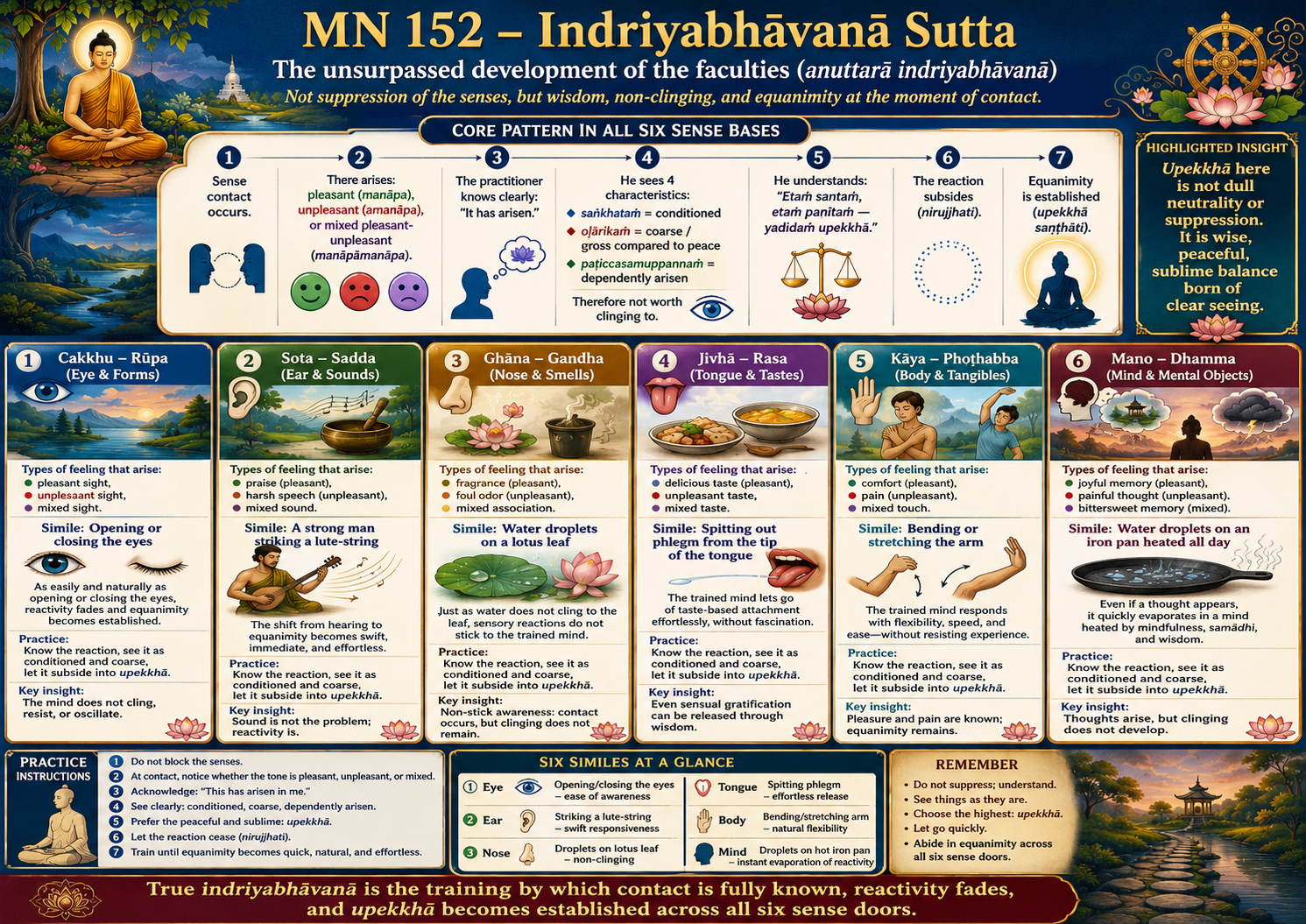
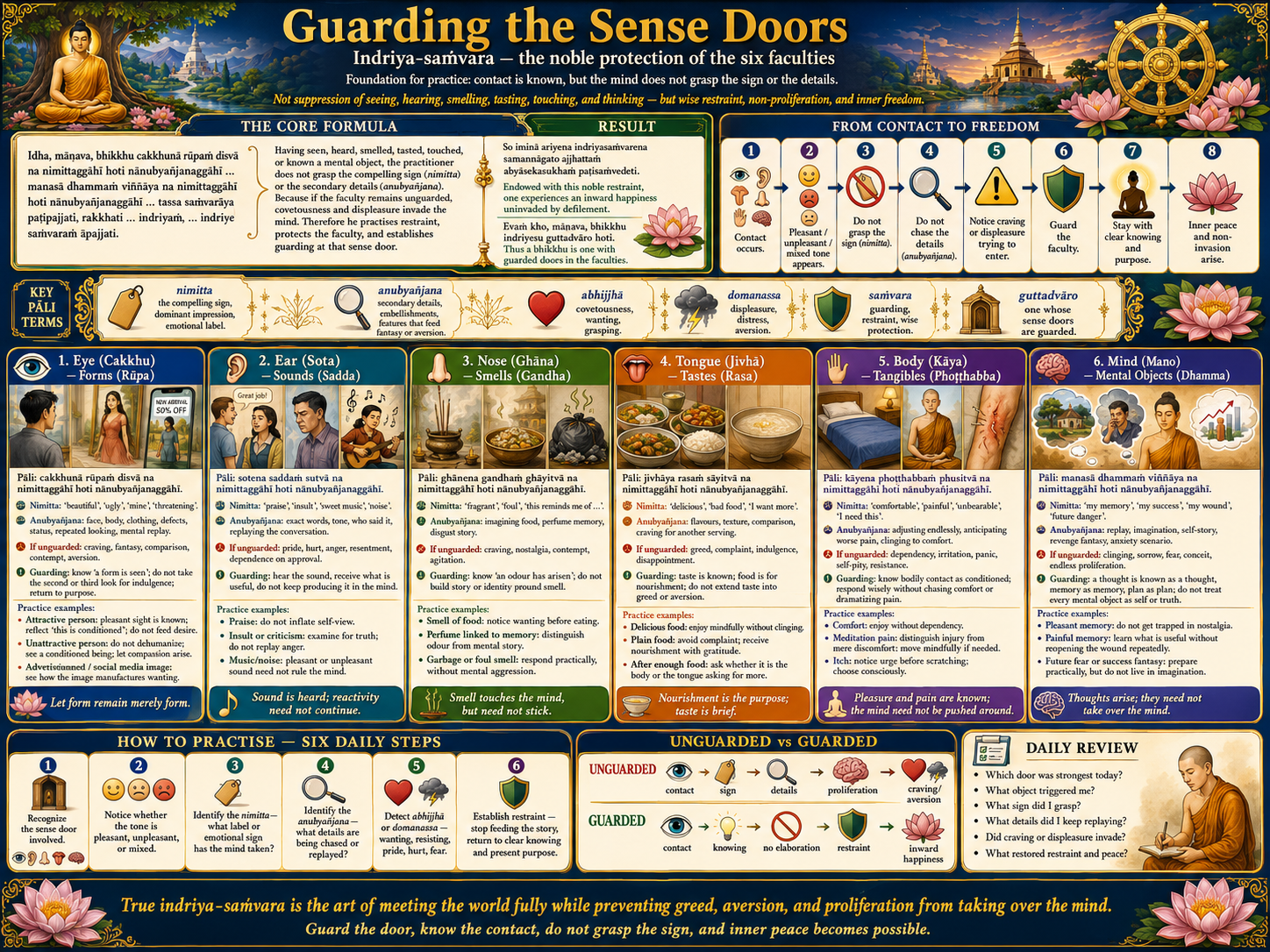
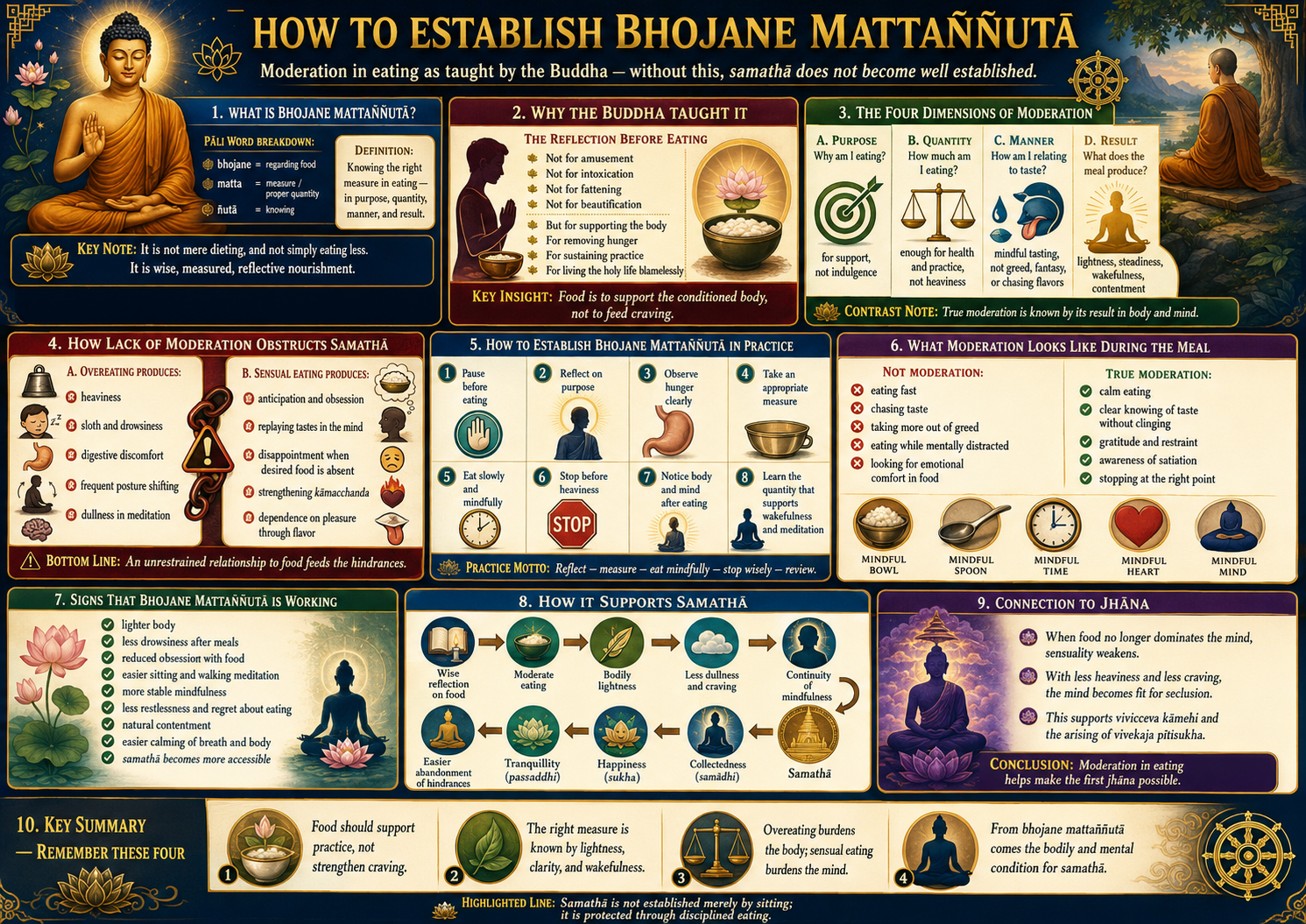
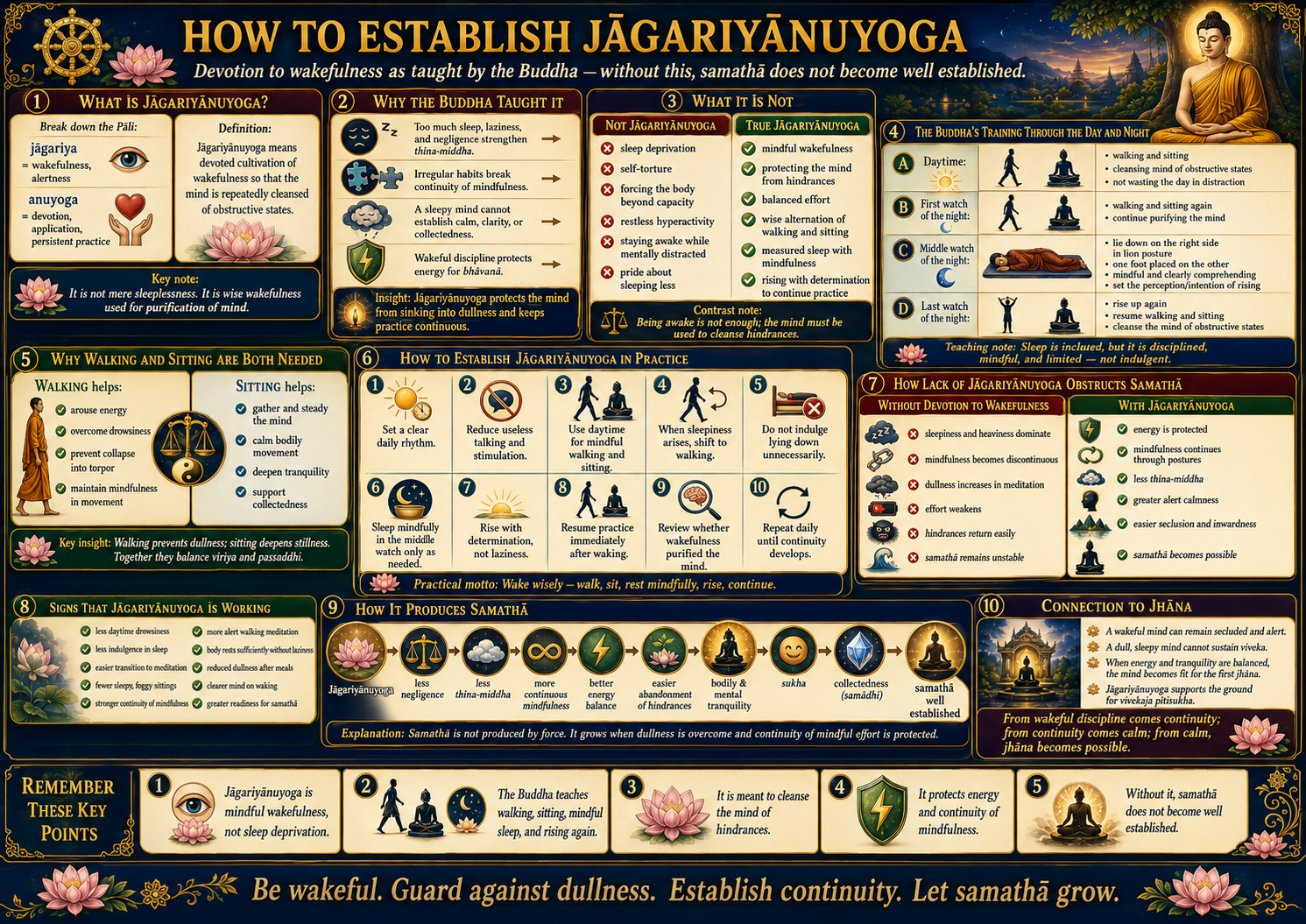

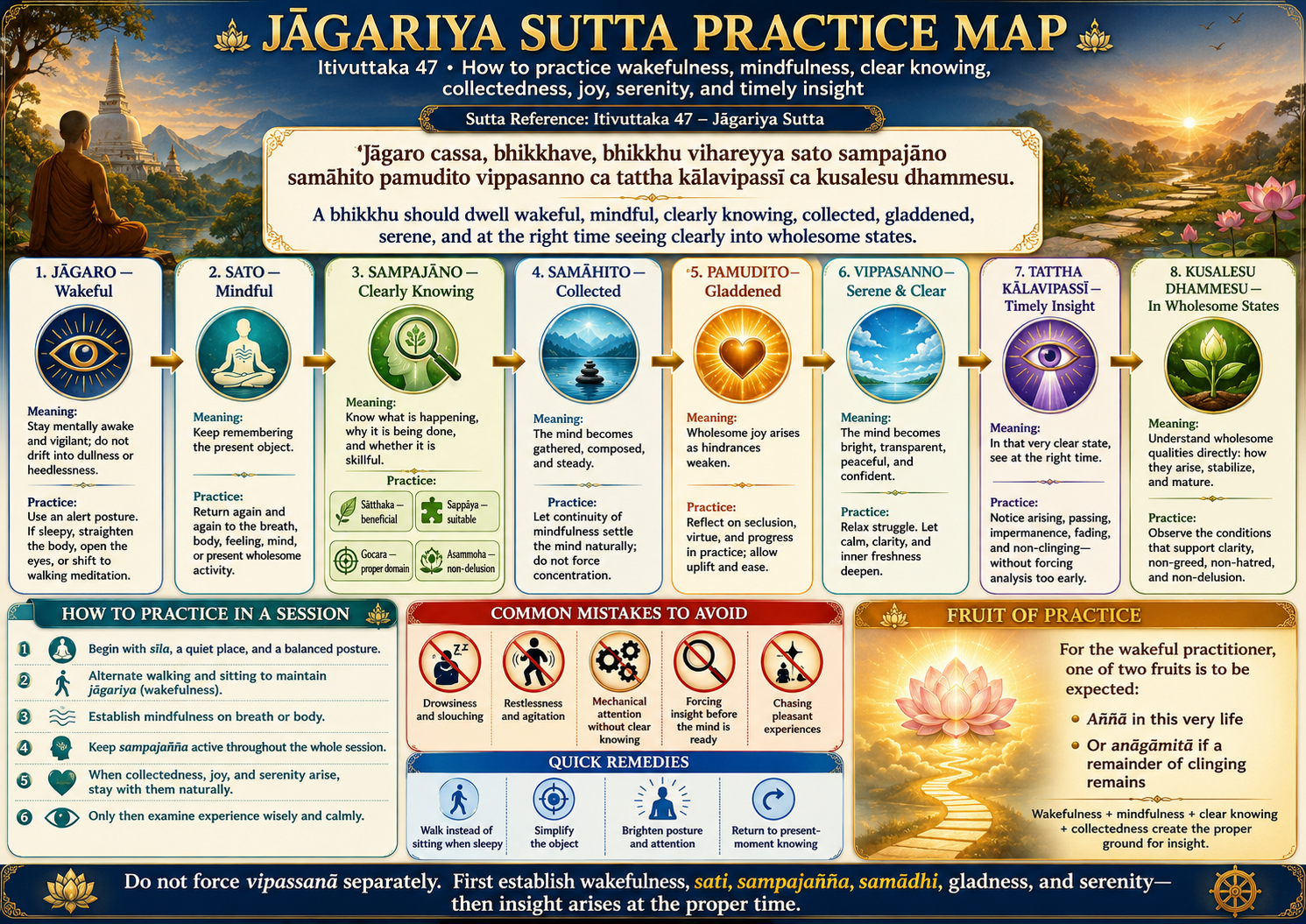
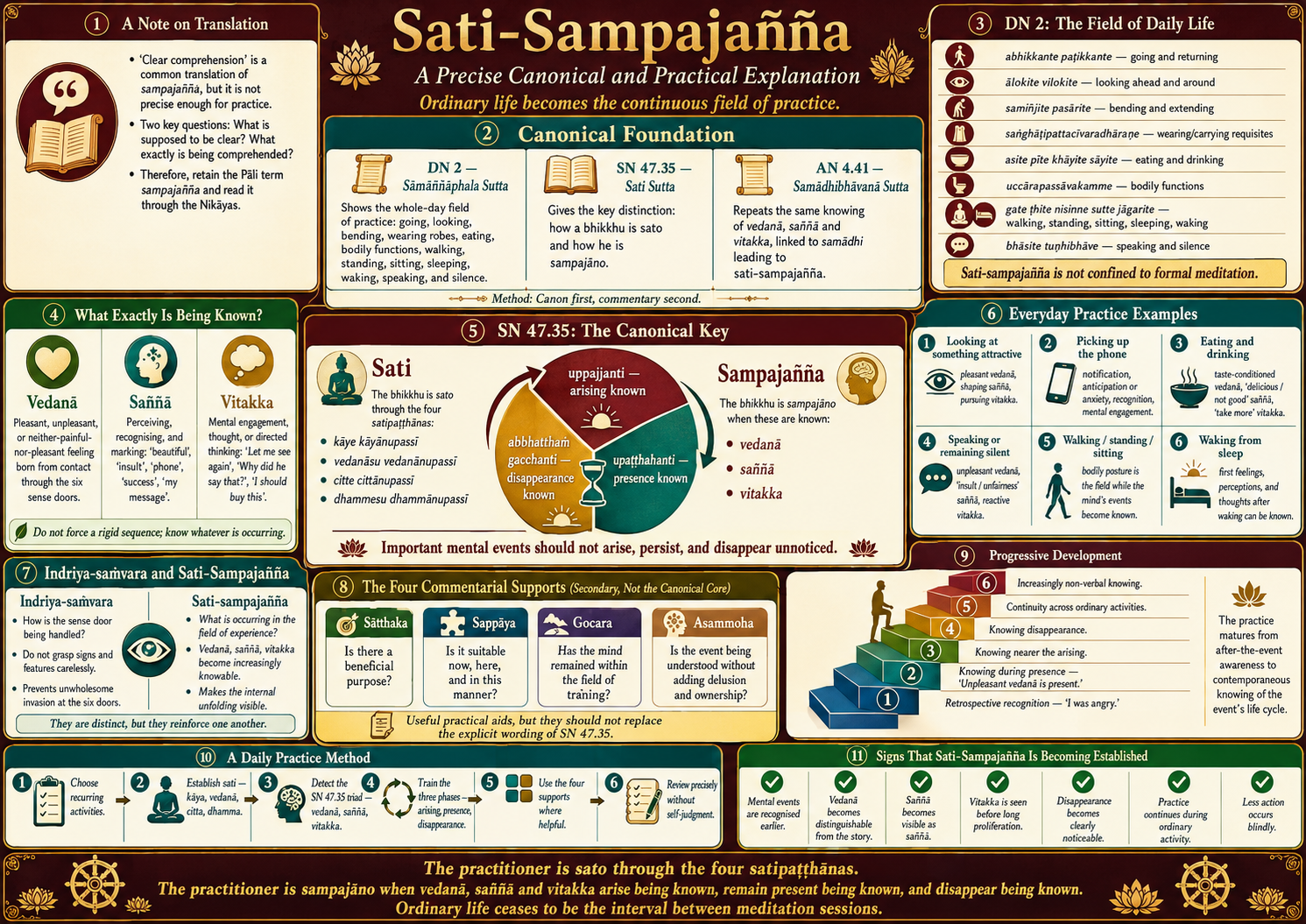

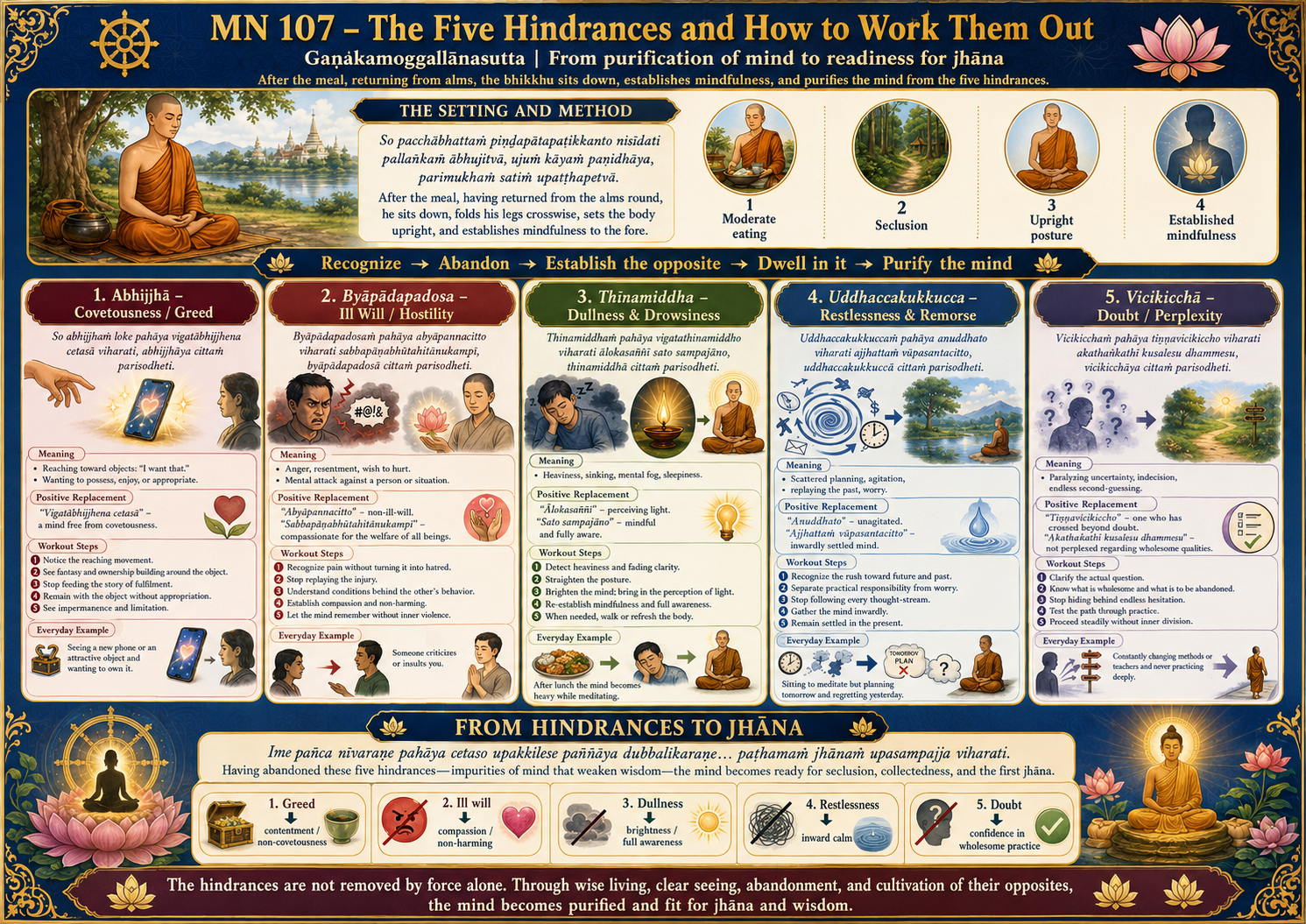


The gradual training in practice
01Anupubbasikkhā — The Path Is a Gradual Training
Gaṇakamoggallāna begins with three practical comparisons: a staircase is climbed step by step, brahmin students learn recitation progressively, and accountants teach numbers in sequence. The Buddha accepts this framework.
Three expressions are used together: anupubbasikkhā — gradual training, anupubbakiriyā — gradual activity or work, anupubbapaṭipadā — gradual course of practice.
This is more than a teaching style. It means later capacities depend upon earlier ones becoming sufficiently established. The Buddha’s horse-training simile reinforces this. A skilled trainer does not demand the final performance before the animal is prepared for the first restraint.
For practice, the discourse challenges the desire to jump directly to jhāna or vipassanā while everyday conduct, sense restraint, eating, wakefulness and clear comprehension remain unstable.
Practical examples
- Example 1
A person asks for advanced jhāna instruction while spending the day feeding sensual stimulation through the phone.
- Example 2
A practitioner wants continuous mindfulness but has not trained ordinary activities such as eating, walking and speaking with sampajañña.
- Example 3
A retreat participant treats the formal sitting as ‘real practice’ and the remaining sixteen hours as unrelated life.
Training aid
- Assess the earliest unstable step rather than chasing the latest stage.
- Train each foundation throughout the day, not only during meditation.
- Advance according to demonstrated capacity rather than calendar time.
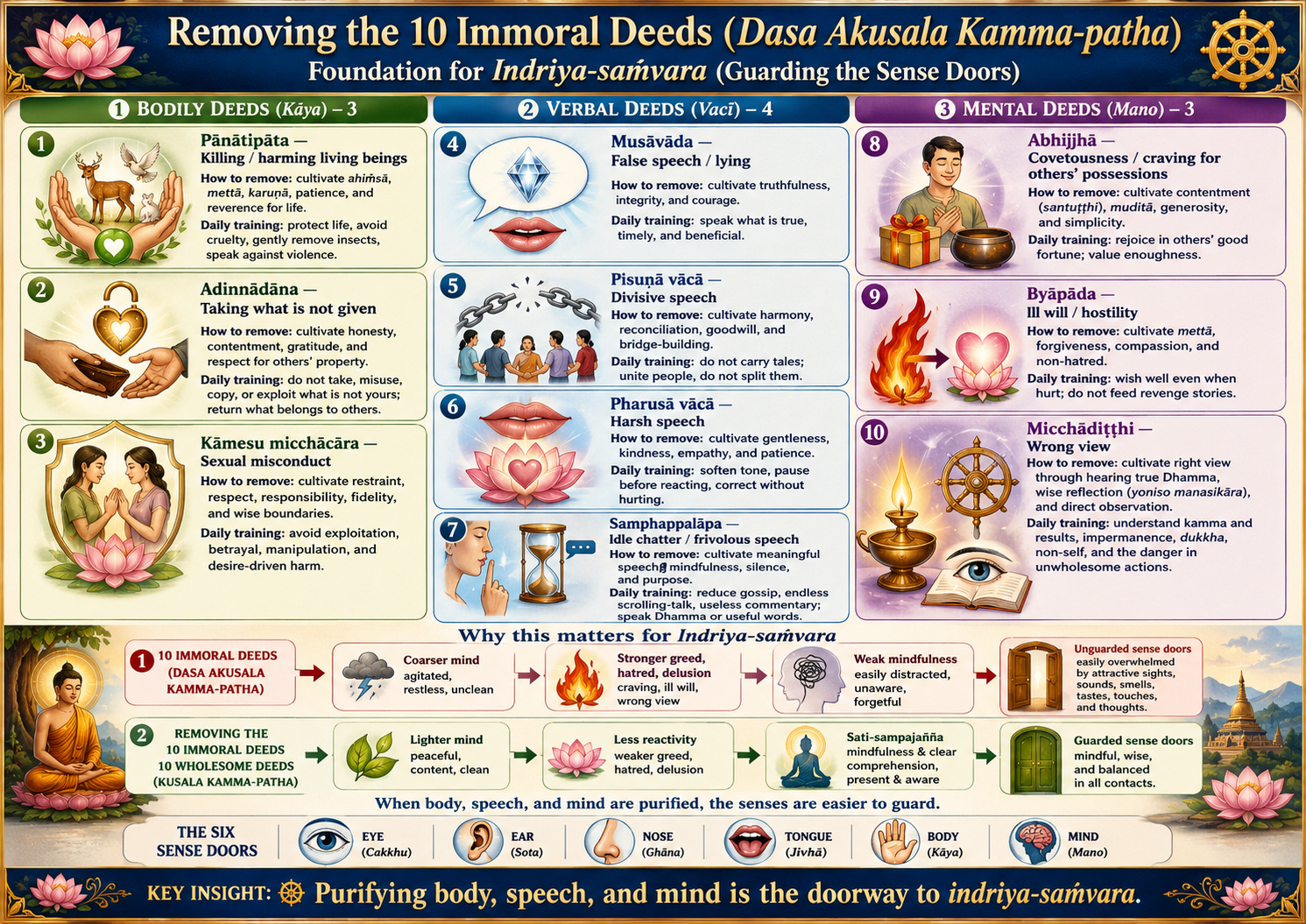
02Sīla Comes First — Why the Buddha Begins With Restraint
The first instruction is not a meditation object. It is sīla: restraint by the Pātimokkha, good conduct and appropriate resort, seeing danger even in small faults, and undertaking the training rules.
Why first? Because actions of body and speech do not end when the action ends. They leave consequences in citta: remorse, concealment, fear, defensiveness, agitation and repeated craving. A mind repeatedly disturbed by its own conduct is harder to settle and harder to see clearly.
Aṇumattesu vajjesu bhayadassāvī does not mean neurotic fear. It indicates sensitivity to how small breaches can nourish larger patterns.
The training begins by making one’s life compatible with samādhi.
Click image to enlarge in a new tab.
Practical examples
- Example 1
Harsh speech in the afternoon becomes replayed remorse during evening meditation.
- Example 2
Dishonesty requires mental maintenance—remembering stories, protecting self-image and fearing exposure.
- Example 3
Minor sensual indulgences repeatedly defended as harmless can accumulate into a strong baseline of kāmacchanda.
Training aid
- Before increasing meditation hours, remove recurring sources of remorse.
- Review bodily and verbal conduct daily.
- Treat small faults as training information, not as identity or shame.
03Indriya-saṁvara — Guarding All Six Doors
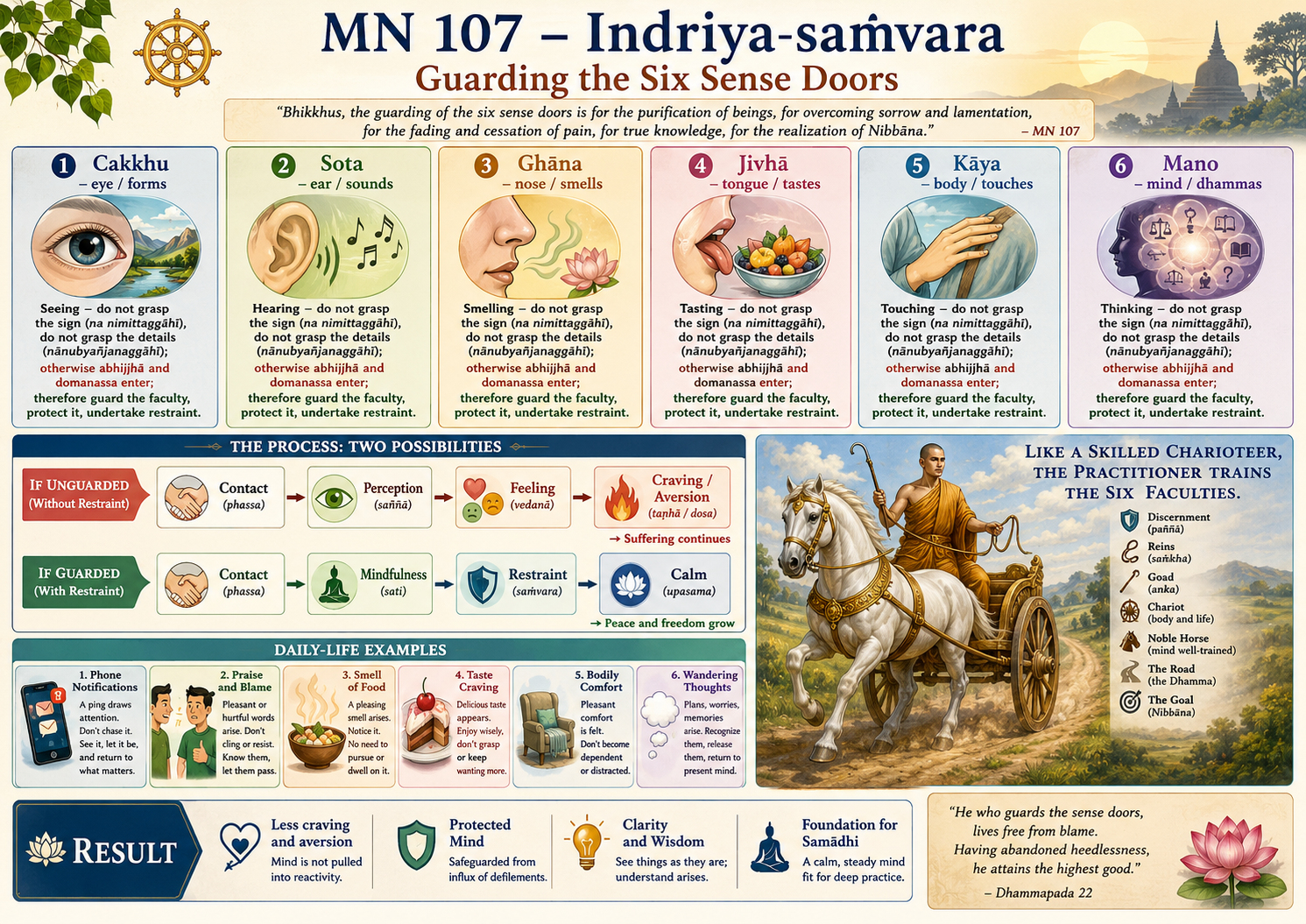
Only after sīla is established does the Buddha move to indriyesu guttadvāro—being guarded at the sense doors.
The instruction is repeated for eye, ear, nose, tongue, body and mind. The critical phrases are:
mā nimittaggāhī hohi — do not grasp the sign,
mānubyañjanaggāhī — do not grasp the details and features.
Sense restraint does not mean not seeing or not hearing. Contact occurs. The training concerns what the mind does after contact: does it seize the overall sign and then elaborate attractive or irritating details until covetousness and sadness invade?
The mind door is explicitly included. Memory, imagination, planning and internal images need restraint just as visual or auditory contact does.
Click image to enlarge in a new tab.
Practical examples
- Example 1
You see a new phone: seeing is not the problem. Repeatedly zooming into features, imagining ownership and comparing your present device feeds the sign.
- Example 2
Someone criticizes you: the sound is heard once; the mind door may replay the sentence fifty times.
- Example 3
A meditation memory becomes attractive and the mind keeps revisiting it, turning a past state into craving.
Training aid
- At each strong contact distinguish: object → sign → detail → reaction.
- Interrupt elaboration before craving becomes strong.
- Include the mind door in sense restraint; do not guard five doors and leave thought unrestricted.
04Bhojane Mattaññutā — Food as Support for Brahmacariya
Moderation in eating is placed directly after sense restraint because food is both a sense experience and a major regulator of bodily energy.
The reflection is precise: food is not taken for amusement, intoxication, beautification or adornment, but for sustaining the body, ending old hunger, avoiding new discomfort, and supporting brahmacariya.
This is neither indulgence nor self-mortification. The practitioner must eat enough for yātrā—continuance—and phāsuvihāra—easeful abiding—without creating heaviness and fresh painful feeling through excess.
The criterion is functional: Does eating support the training?
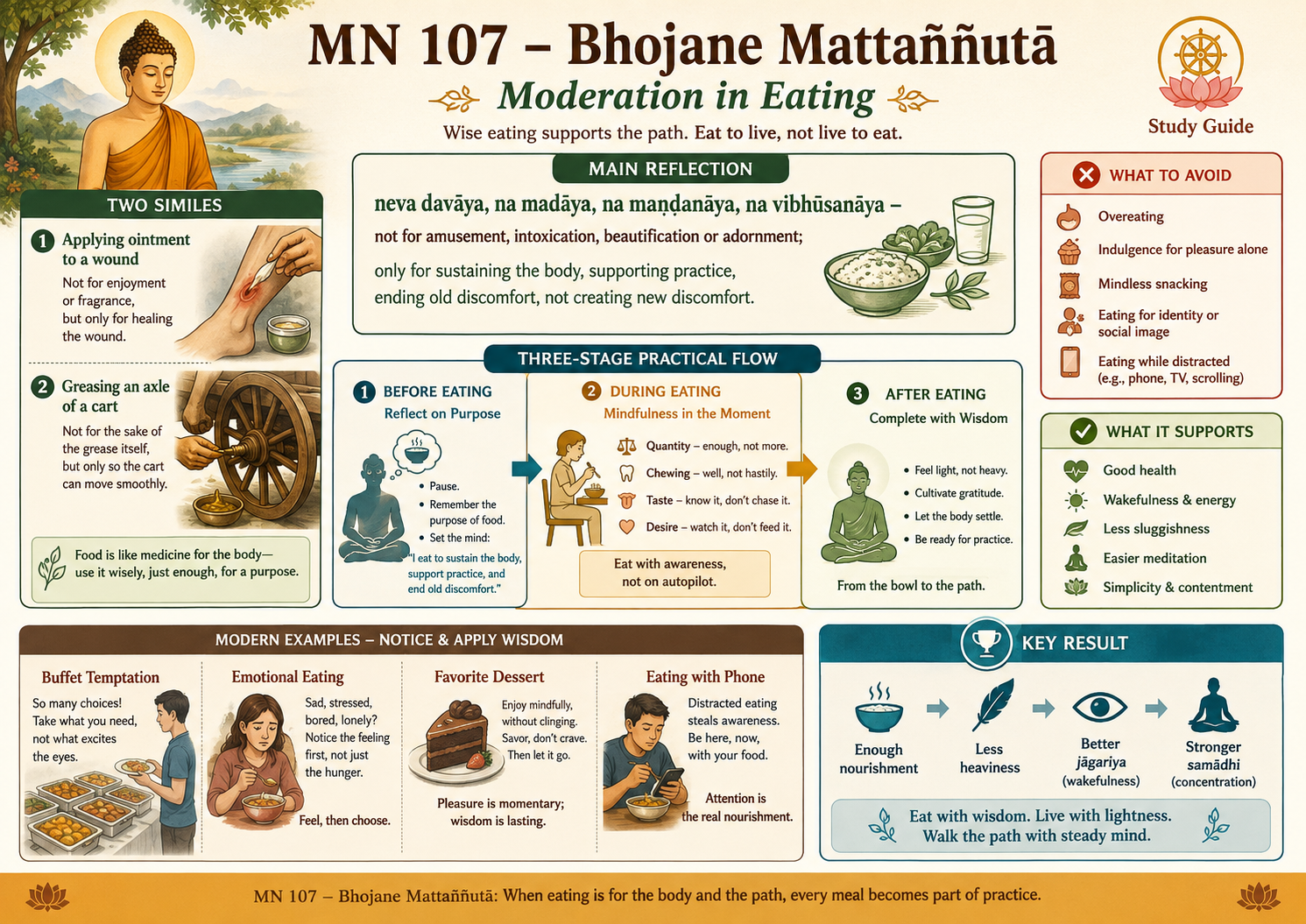
Click image to enlarge in a new tab.
Practical examples
- Example 1
Eating because food tastes good even after adequate nourishment turns maintenance into entertainment.
- Example 2
Extreme fasting that weakens wakefulness and meditation also misses the purpose.
- Example 3
Choosing a lighter quantity before a long meditation period may support alertness without turning food into an enemy.
Training aid
- Pause before eating and recollect the purpose.
- Learn the quantity that supports wakefulness and physical stability.
- Observe both craving before food and heaviness after food as feedback.
05Jāgariyānuyoga — Wakefulness Is an Active Training
The Buddha next regulates the daily rhythm.
During the day and first watch of the night, walking and sitting are used to purify citta from obstructive states. During the middle watch one sleeps in the lion posture, mindful and clearly comprehending, having established the perception of rising. In the last watch practice resumes.
The emphasis is not on heroic sleep deprivation. Sleep itself is included in the discipline. The issue is heedlessness versus deliberate wakefulness.
A practitioner learns not to surrender the entire day to distraction and then expect a short evening sitting to reverse it.

Click image to enlarge in a new tab.
Practical examples
- Example 1
Three hours of distracted entertainment before bed can dominate the first part of meditation the next morning.
- Example 2
Walking meditation is specifically useful when sitting becomes dull.
- Example 3
Sleeping with the intention to rise supports continuity; collapsing into unconsciousness without mindfulness does not train the same habit.
Training aid
- Use walking and sitting strategically rather than sitting through heavy dullness.
- Reduce unnecessary late-night stimulation.
- Make going to sleep and rising part of sati-sampajañña.
06Sati-Sampajañña — Practice Must Enter Every Ordinary Action
Next comes one of the most important bridges in the discourse: sati-sampajañña.
Clear comprehension is applied to moving forward and back, looking, bending, stretching, carrying belongings, eating, drinking, toileting, walking, standing, sitting, sleeping, waking, speaking and silence.
This removes the artificial border between ‘meditation’ and ‘life.’
If mindfulness exists only while sitting with closed eyes, then the mind spends most of the day training the opposite habit. MN 107 requires continuity across postures and ordinary activities.
Sampajañña adds intelligent knowing: not merely ‘I am walking,’ but clarity about what one is doing, why, and whether the action accords with training.
Click image to enlarge in a new tab.
Practical examples
- Example 1
Picking up the phone automatically reveals absence of sampajañña before the screen is even opened.
- Example 2
During eating, knowing taste while forgetting quantity is partial mindfulness without the wider purpose.
- Example 3
Speaking while knowing that speech is being produced, yet failing to recognize that it is divisive, is not complete clear comprehension.
Training aid
- Choose several daily actions as mandatory mindfulness checkpoints.
- Before speaking, know purpose and likely consequence.
- Practice transitions—standing up, entering rooms, reaching for objects—because habit often takes over there.
Essential study: Sati-Sampajañña — Please go through this without fail, so you understand what “clear comprehension” means as presented in the suttas.
6ASati-Sampajañña Expanded — Fourfold Sampajañña as a Practice Framework
Textual distinction: MN 107 itself instructs the bhikkhu to be satisampajaññena samannāgato and to act as sampajānakārī while going, returning, looking, bending, stretching, carrying robe and bowl, eating, drinking, toileting, walking, standing, sitting, sleeping, waking, speaking and remaining silent. The fourfold analysis below—sātthaka, sappāya, gocara, asammoha—is a traditional Aṭṭhakathā explanation of sampajañña. It is extremely useful for practice, but these four labels are not stated in this MN 107 paragraph itself.
1. Sātthaka-sampajañña
Clear comprehension of purpose / meaningful benefit
Core question: “Why am I doing this, and does it serve the purpose of the training?”
Sātthaka asks whether an intended action has a meaningful purpose rather than arising from habit, boredom, display, sensuality, irritation, or aimless movement.
For a bhāvanā practitioner, the highest reference point is whether the activity supports the path out of dukkha. Ordinary activities such as eating, working, exercising, travelling, resting, or caring for others can all be purposeful when their function is clearly understood.
Before acting:
Is this necessary? What wholesome purpose does it serve? Does it support sīla, samādhi, paññā—or merely feed drifting?
2. Sappāya-sampajañña
Clear comprehension of suitability / conduciveness
Core question: “Even if the purpose is good, is this suitable now?”
An action may be meaningful yet unsuitable because of time, place, bodily condition, mental condition, company, quantity, intensity, or likely consequence.
Sātthaka establishes the purpose; sappāya tests the conditions. A good objective pursued at the wrong time or in the wrong way can disturb citta rather than support practice.
Before proceeding:
Is this the right time, place, amount, method and duration for my present condition and for the path?
3. Gocara-sampajañña
Clear comprehension of the proper domain / pasture
Core question: “Where is citta grazing while I do this?”
Gocara carries the sense of range or pasture. In the traditional meditation explanation, the practitioner does not abandon the proper meditation domain while moving through ordinary activities.
This connects strongly with the preceding MN 107 training in indriya-saṁvara. One may be walking, working, eating or speaking, yet citta remains within the Dhamma domain instead of roaming after signs, details, kāma, byāpāda, comparison, fantasy or papañca.
During the activity:
Has the mind left its proper domain? Am I still with the training, or has citta begun grazing in unguarded sense-fields?
4. Asammoha-sampajañña
Clear comprehension without delusion
Core question: “Am I seeing what is occurring without constructing ‘I’, ‘me’ and ‘mine’ around it?”
Asammoha means non-delusion. Activity is understood as conditioned process: body moves, intention occurs, contact occurs, vedanā occurs, citta changes, dhammas arise and cease according to conditions.
This keeps sampajañña connected to paññā. Instead of merely knowing “I am angry,” the practitioner can know more precisely: unpleasant vedanā is present, byāpāda has arisen dependent on conditions, and this conditioned state is not to be appropriated.
While knowing:
Am I seeing the process yathābhūta, or has ownership, permanence, control or identity been superimposed on it?
The Four Questions in One Real-Time Sequence
Sātthaka → Should this be done? → Sappāya → Is it suitable now? → Gocara → Where is the mind while doing it? → Asammoha → How is the process being understood?
Practical Example 1 — Opening YouTube
| Dimension | Real-time investigation |
|---|---|
| Sātthaka | Why am I opening it—to hear a particular Dhamma talk or obtain needed information, or simply to escape boredom? |
| Sappāya | Even if the content is useful, is this the right time? Will another 45 minutes weaken sleep, wakefulness or meditation? |
| Gocara | After the intended content ends, does citta remain with the purpose, or start following thumbnails, controversy and attractive signs? |
| Asammoha | Know vedanā, wanting and restlessness as conditioned events—not as “I need this.” |
Practical Example 2 — A Difficult Conversation
| Dimension | Real-time investigation |
|---|---|
| Sātthaka | Does speaking serve clarification, reconciliation or a necessary decision—or am I trying to win? |
| Sappāya | Is either person presently too angry, tired or agitated for the discussion to be beneficial? |
| Gocara | While listening, is attention still grounded in Dhamma, or is it collecting insulting details and rehearsing an attack? |
| Asammoha | Know hurt vedanā, defensive saṅkhārā and byāpāda as conditioned; do not immediately construct “he insulted me.” |
Practical Example 3 — Eating
| Dimension | Real-time investigation |
|---|---|
| Sātthaka | The purpose is maintenance of the body and support of brahmacariya, exactly as the preceding MN 107 step states. |
| Sappāya | What food, amount and timing support alertness rather than heaviness, craving or weakness? |
| Gocara | Can taste be known without citta leaving the training to chase preferred flavors and reject disliked ones? |
| Asammoha | Know taste-contact, vedanā, wanting, chewing and nourishment as conditioned processes rather than “my pleasure.” |
Training Aid — Before, During and After an Important Activity
- Before: Sātthaka — establish the purpose.
- Before: Sappāya — test suitability of time, place, amount and method.
- During: Gocara — keep citta within the proper pasture of the training.
- During and after: Asammoha — know the conditioned process without self-making.
- Review: Did the activity leave less rāga, dosa and moha—or more?
Sati-Sampajañña Through the Entire Day — From Waking to Sleeping
The purpose of this table is not to create more internal commentary. At first, the four questions may be used deliberately. With repeated bhāvanā they become a trained way of functioning: purpose is known, suitability is assessed, citta remains in its proper domain, and experience is understood without delusion. This is where everyday activity begins to become a basis for paññā rather than merely routine behavior.
Ordinary activity → Sati remembers the training → Sampajañña understands the activity → Indriya-saṁvara protects citta → Less rāga / dosa / moha → Clearer conditionality → Paññā
| Activity / posture | Sātthaka Purpose |
Sappāya Suitability |
Gocara Where citta remains |
Asammoha Wisdom / non-delusion |
|---|---|---|---|---|
| Waking up | Rise because the body needs to begin the day and the training is to continue. | Rise at the intended time, neither indulging sleep nor forcing an exhausted body. | Before reaching for the phone, establish sati: body lying, intention to rise, movement beginning. | Know ‘waking’, intention, bodily movement and changing vedanā as conditioned processes—not ‘I am beginning my day.’ |
| Brushing the teeth | Clean the mouth and maintain bodily health so the body remains a suitable vehicle for practice. | Use what is needed, for an appropriate duration; avoid turning grooming into indulgence or hurry. | Feel hand movement, pressure, taste, contact and intention without drifting into planning or fantasy. | See brushing as intention → movement → contact → taste/vedanā → knowing; no permanent controller is required. |
| Washing the face | Cleanliness and wakefulness, especially after sleep. | Use an appropriate water temperature and amount; do not seek sensual stimulation. | Know cool/warm contact, hand movement and visual impressions without chasing pleasantness. | Know temperature, touch and pleasant/unpleasant vedanā as arising from conditions and ceasing. |
| Bathing | Maintain hygiene and bodily ease supportive of practice. | Use a suitable duration, water temperature and method; neither indulgent lingering nor harsh self-mortification. | Remain with bodily contact, movements, reaching, bending and standing rather than entering stories. | See ‘body being washed’ as elements, contact and movement; beauty/ugliness stories are added constructions. |
| Dressing / putting on robes | Protect the body, maintain modesty and meet the practical conditions of the day. | Choose what is appropriate to weather, activity and discipline rather than vanity. | Know lifting, inserting arms, pulling, fastening and tactile contact while guarding visual self-evaluation. | Clothing, body and ‘appearance’ are conditioned perceptions; do not manufacture self-worth from them. |
| Picking up bowl, bag, phone or belongings | Carry what is actually required for the intended activity. | Take only what is suitable; avoid unnecessary accumulation and distraction. | Know reaching, grasping, lifting and carrying; notice whether an object immediately triggers attachment. | Know hand, object, contact, intention and ownership-thought separately; ‘mine’ is a mental appropriation. |
| Walking forward — abhikkante | Go to a meaningful destination or carry out a necessary task. | Choose suitable pace, route and posture for body and circumstances. | Stay with walking while also guarding eye, ear and mind from roaming after signs and details. | Know intention → lifting → moving → placing; ‘I walk’ can be understood as a shorthand for conditioned processes. |
| Returning / walking back — paṭikkante | Return because the purpose of the outward movement is complete. | Do not linger merely to seek stimulation; return by a suitable route and pace. | Notice the tendency of mind to replay what was seen/heard; return citta to its proper domain. | Past contact is gone; current memory is a new mental event. Know memory as conditioned, not as a continuing self. |
| Looking ahead — ālokite | Look because visual information is needed for safety or the task. | Look only as much as required; do not turn necessary seeing into searching for attractive or irritating objects. | Know seeing while not grasping nimitta and anubyañjana; keep citta from following the object. | Eye + form + eye-consciousness condition contact; vedanā and perception follow. ‘I see’ is not an independent seer. |
| Looking to the side — vilokite | Turn attention aside when genuinely needed. | Check whether the glance is necessary or merely curiosity, attraction, comparison or vigilance born of fear. | Know the intention to turn, head movement, seeing and mental reaction. | The object did not ‘make me’ react; contact, perception, vedanā and tendencies condition the response. |
| Looking back | Look back for a valid purpose—safety, checking a person, object or direction. | If no useful purpose exists, do not feed curiosity or attachment by repeated checking. | Know the urge to look back before obeying it; distinguish purpose from craving. | See craving-to-see as a conditioned dhamma: it arises, can be known, and need not become action or identity. |
| Bending — samiñjite | Bend the limbs because the action requires it. | Use a posture suitable to the body; avoid careless strain. | Know intention, contraction, pressure and balance rather than moving automatically. | ‘Arm bending’ and ‘body bending’ are rūpa processes conditioned by intention; no owner can be found inside the movement. |
| Stretching — pasārite | Stretch or extend to perform a useful action or relieve the body appropriately. | Use an amount suitable to the body; do not turn stretching into display or excessive pleasure-seeking. | Know extension, tension, release and associated vedanā. | Pleasant relief is vedanā: conditioned, changing and not ‘my happiness.’ |
| Standing — ṭhite | Stand because it serves the current task or balances sitting. | Choose a stable posture and suitable duration. | Know pressure through feet, balance, micro-adjustments and intention. | Standing is continuously maintained through changing conditions; there is no static ‘standing self.’ |
| Sitting — nisinne | Sit for work, rest, eating or bhāvanā with a clear purpose. | Choose a posture and duration suitable for alertness and bodily condition. | Know contact points, posture, breath and citta; notice slouching, restlessness or comfort-seeking. | ‘Sitting’ is a changing configuration of rūpa known by changing consciousness; it is not a fixed state. |
| Beginning formal meditation | Undertake bhāvanā for purification, samādhi and paññā—not to collect experiences. | Choose a suitable time, posture, object and duration based on current conditions. | Keep citta in its meditation gocara; recognize hindrances rather than following them. | Know each arising state as conditioned; even calm, pīti or samādhi is not to be appropriated as ‘my attainment.’ |
| Eating — asite / khāyite / sāyite | Maintain and support the body and brahmacariya. | Choose suitable quantity, food, timing and pace, as MN 107 has just taught under bhojane mattaññutā. | Know seeing, smell, taste, chewing, swallowing and desire without chasing preferred flavors. | Taste contact conditions vedanā; craving may arise afterward. Know the sequence rather than ‘I enjoy this food.’ |
| Drinking — pīte | Relieve thirst and support bodily functioning. | Drink the amount and type suitable to health and training. | Know reaching, touching, temperature, taste and swallowing. | Thirst, contact, relief and pleasant vedanā are conditioned and transient; none is self. |
| Using the toilet — uccārapassāvakamme | Respond to a bodily need and maintain hygiene. | Go at a suitable time and in a suitable place; do not ignore the body unnecessarily. | Know intention, posture, pressure, release, smell and aversion without losing mindfulness. | A powerful contemplation of non-beauty and non-ownership: what leaves the body is not regarded as ‘me’ or ‘mine.’ |
| Working with hands / household tasks | Complete a necessary duty or service. | Use an efficient, safe method appropriate to body and context. | Keep attention with the task; notice irritation, haste and distraction as they arise. | Action unfolds through intention, learned patterns, contact and feedback; the story ‘I am the doer’ can be examined. |
| Driving / travelling | Reach a necessary destination safely. | Travel only when fit to do so; choose safe speed, route and timing. | Keep visual and auditory attention with driving; do not use the mind door for unrelated proliferation. | Seeing, judging distance, moving hands and feet all arise dependently; alertness is a conditioned process. |
| Speaking — bhāsite | Speak only when there is a useful purpose: truth, instruction, clarification, kindness or necessary coordination. | Check timing, person, tone and amount; even true speech can be unsuitable. | Stay with intention and the listener’s response; do not let citta graze in winning, self-display or retaliation. | Words arise from intention and conditions; praise and blame after speaking are also conditioned—not a self to defend. |
| Listening while another speaks | Receive information or understand the other person. | Listen when it is appropriate; if the situation is unwholesome, disengage skillfully. | Know sound contact, vedanā and mental interpretation before preparing a reply. | The ‘insult’ is not identical with the sound; perception, memory and self-view construct additional meaning. |
| Remaining silent — tuṇhībhāve | Remain silent when speech would be unnecessary, harmful or obstructive. | Silence is suitable when it supports clarity; it is unsuitable if used to punish, manipulate or avoid responsibility. | Know urges to speak without obeying them; remain with citta and vedanā. | The urge ‘I must say this’ is only an arisen condition; when unfed it can cease. |
| Using a phone / computer | Use technology for a defined task, communication, work or useful learning. | Set a suitable duration and content boundary before opening it. | Stay with the intended task; notice when thumbnails, notifications or novelty pull citta away. | Contact → vedanā → wanting can be seen in real time. The device does not contain craving; craving arises dependently. |
| Lying down — sutte | Rest the body so wakefulness and practice can continue. | Sleep when needed, in an amount suitable to health and training; neither indulgence nor deprivation. | Know the intention to lie down, contact with bed, relaxation and fading wakefulness. | The transition into sleep shows loss of control clearly; body and consciousness operate according to conditions. |
| Falling asleep | Allow necessary sleep after establishing the intention to rise. | End stimulation beforehand; adopt a posture supportive of rest and wakefulness afterward. | Keep mindfulness gently with the fading process without forcing awareness to remain. | Wakefulness itself is conditioned; it cannot be commanded as a permanent possession. |
| Waking during the night | Respond appropriately—return to sleep, attend to the body, or practice if genuinely wakeful. | Do not automatically reach for stimulation. | Know citta’s first movement: worry, planning, dullness, clarity or craving. | The newly arisen mental world is conditioned; thoughts appearing on waking are not commands or self. |
| End-of-day review | Learn from the day and strengthen tomorrow’s training. | Review briefly and honestly without turning it into self-criticism or rumination. | Recall where sati was present, where gocara was lost, and what fed kusala or akusala. | See the entire day as conditioned sequences. Wisdom grows by seeing patterns, not by manufacturing a fixed identity. |
How to Train This Without Creating Excess Thinking
- Stage 1 — Deliberate reflection
Choose 3–5 activities, for example brushing, bathing, walking, eating and speaking. Ask the four questions consciously.
- Stage 2 — Short recognition
Reduce the questions to four cues: Purpose? Suitable? Gocara? Delusion?
- Stage 3 — Continuous sampajañña
The assessment becomes rapid and mostly non-verbal. One knows the activity and whether citta remains aligned with training.
- Stage 4 — Paññā emphasis
Asammoha deepens: intention, contact, vedanā, movement and citta are seen as conditioned, changing and not fit to be appropriated as self.
Micro-Practice: Looking Around and Looking Back
This is especially useful because MN 107 explicitly includes ālokite vilokite sampajānakārī. Before turning the head, know the intention to look. While turning, know movement. At seeing, guard against grasping the sign and details. Immediately afterward, know vedanā and any urge to look again. If the second look has no sātthaka purpose, the practitioner can simply not feed it. This turns an ordinary glance into direct training in intention → contact → vedanā → craving or non-craving.
Micro-Practice: Walking
Do not reduce walking to mentally repeating “lifting, moving, placing.” Know the wider training: Why am I walking? Is the pace suitable? Where is citta grazing? Can the movement be known as conditioned rūpa and intention without constructing a walker-self? At the same time the eyes and ears remain guarded. In this way sati-sampajañña and indriya-saṁvara work together.
Micro-Practice: Brushing the Teeth
Brushing is ideal for training because it is repetitive and usually automatic. Establish purpose, choose a suitable amount of time and pressure, keep citta with hand movement, contact and taste, and then see the process without ownership. If planning, irritation or fantasy appears, it is known as a new conditioned mental event. Thus even two minutes of brushing becomes training in gocara and asammoha.
Important: wisdom is not produced merely by adding the thought “this is not-self” to every action. The training is to observe conditions accurately. Intention arises; movement follows; contact occurs; vedanā appears; perception recognizes; citta inclines; craving may or may not be fed. When this is seen repeatedly and directly, the tendency to construct “I am doing, I am experiencing, this is mine” can weaken naturally.
How this fits MN 107:
The Buddha first trains indriya-saṁvara, then moderation in eating, wakefulness, and only then instructs the practitioner to be satisampajaññena samannāgato in every ordinary activity. Functionally: sense restraint protects the doors; sati keeps the training present; the fourfold sampajañña framework helps evaluate purpose, suitability, mental domain and non-deluded understanding. Together they prepare the practitioner for vivitta senāsana → nīvaraṇa-pahāna → jhāna.
07Seclusion Comes After Daily-Life Training
Only after sīla, sense restraint, food moderation, wakefulness and sati-sampajañña are established does the Buddha say: resort to a secluded lodging.
This sequencing is important. Seclusion is not a substitute for training. If the mind arrives in the forest full of unrestrained imagery, unresolved misconduct, overeating, sleepiness and absent mindfulness, external quiet alone cannot complete the work.
But once earlier conditions are established, seclusion removes unnecessary input and allows the accumulated training to deepen.
Thus vivittaṁ senāsanaṁ is a powerful support, but it functions within a prepared system.
Practical examples
- Example 1
Moving to a retreat center does not automatically remove the phone-created mind one brings with oneself.
- Example 2
A quiet room becomes productive only when one stops generating internal conversation.
- Example 3
Forest seclusion can expose rather than instantly remove hindrances.
Training aid
- Prepare for seclusion before entering it.
- Reduce external input and then observe what internal input continues.
- Use solitude for purification, not fantasy or escape.
08The Five Hindrances Must Be Abandoned Before Jhāna
After the meal the bhikkhu sits upright and establishes mindfulness. The Buddha then describes active purification from each of the five hindrances.
The verbs matter: pahāya—having abandoned; cittaṁ parisodheti—he purifies the mind.
The hindrances are called:
cetaso upakkilese paññāya dubbalīkaraṇe —
defilements of the mind and weakeners of wisdom.
So they are not minor annoyances one carries unchanged into jhāna. The transition to the first jhāna is stated only after abandoning these five.
Each hindrance also has a positive counterpart in the paragraph: covetousness → non-covetous mind, ill will → benevolence and compassion, sloth-torpor → perception of light, sati, sampajañña, restlessness-remorse → inwardly peaceful citta, doubt → having crossed doubt regarding wholesome dhammas.
Practical examples
- Example 1
Kāmacchanda: the mind keeps designing tomorrow’s pleasures instead of settling.
- Example 2
Byāpāda: meditation becomes an argument with someone who is not physically present.
- Example 3
Thina-middha: posture collapses and awareness becomes foggy.
- Example 4
Uddhacca-kukkucca: the mind alternates between future planning and past regret.
- Example 5
Vicikicchā: every few minutes the practitioner questions the technique and never develops continuity.
Training aid
- Identify which hindrance is present instead of saying only ‘meditation is bad’.
- Apply the positive state named by the sutta.
- Do not label suppression as abandonment; verify whether the hindrance has actually stopped dominating.
Related Sutta • Practical Deep Dive
SN 46.51 Āhārasutta — What Feeds and Starves the Five Hindrances
MN 107 requires the practitioner to abandon the five hindrances and purify citta from them before entering the four jhānas. SN 46.51 Āhārasutta complements this training by explaining the āhāra (nutriment) and anāhāra (non-nutriment) of the hindrances—what repeatedly feeds them and what deprives them of nourishment.
Recognize the hindrance → Know what feeds it → Stop supplying its nutriment → Apply yoniso manasikāra → Cultivate the wholesome condition
Why this connection matters: MN 107 states the requirement—pañca nīvaraṇe pahāya, having abandoned the five hindrances. SN 46.51 provides the practical diagnostic for understanding what is nourishing each hindrance and what should instead be developed.Study SN 46.51 Āhārasutta →
09The Four Jhānas Are the Culmination of the Gradual Training Section
Only now does the discourse give the four jhānas.
The progression is one of successive refinement: 1. seclusion from kāma and akusala, with vitakka-vicāra and vivekaja pīti-sukha; 2. vitakka-vicāra cease; inner confidence and unification; pīti-sukha is samādhija; 3. pīti fades; upekkhā, sati and sampajañña remain with sukha; 4. sukha and dukkha are abandoned, gladness and sadness have ended, and there is adukkhamasukha with upekkhā-sati-pārisuddhi.
This sequence makes jhāna inseparable from the preceding life-training. Jhāna is not presented as an isolated concentration trick.
It also shows why calling samādhi merely ‘concentration’ is inadequate. The formulas describe purification, seclusion, unification, equanimity and progressive cessation of coarser factors.
The Four Jhānas — Four Visual Teaching Aids
Each infographic corresponds to one stage in the progressive refinement described in the MN 107 jhāna formula. Open any image for the full-size version.
Practical examples
- Example 1
A person can focus intensely on a video game, but the mind is not secluded from sensuality and akusala; this is not the first-jhāna formula.
- Example 2
A calm state in which internal commentary continues strongly does not match the second-jhāna cessation of vitakka-vicāra.
- Example 3
Pleasant equanimity with subtle excitement should not automatically be called fourth jhāna.
Training aid
- Use the full formula as the assessment standard.
- Verify both what is present and what has ceased.
- Do not skip hindrance-abandonment when evaluating jhāna.
10Sekha and Arahant — The Same Training Has Different Functions
The Buddha distinguishes two groups.
For sekkhā—trainees who have not yet reached the goal and aspire to unsurpassed security from bondage—the instructions are part of the path toward completion.
For arahants, who have destroyed the āsavas and completed the task, these same qualities conduce to diṭṭhadhammasukhavihāra—pleasant abiding here and now—and to sati-sampajañña.
This prevents the mistake of thinking every practice is discarded after liberation. A training factor may function as a cause of development for the trainee and as a wholesome mode of abiding for one already liberated.
Practical examples
- Example 1
Sense restraint for a trainee prevents defilements from gaining strength; an arahant’s restraint no longer serves to eradicate a fetter that is already gone.
- Example 2
Jhāna can function as training toward liberation and later as a pleasant abiding.
- Example 3
Mindfulness remains meaningful even when the task of destroying the āsavas is complete.
Training aid
- Always ask: is this being used as path-training or as liberated abiding?
- Do not infer non-attainment merely because an arahant continues practicing jhāna or mindfulness.
- Keep the sekha’s goal—anuttara yogakkhema—in view.
11Why Do Some Disciples Reach Nibbāna and Others Do Not?
Gaṇakamoggallāna asks the obvious question: if the path is so clearly laid out, why do not all disciples reach Nibbāna?
The Buddha does not blame the path, hide the distinction, or claim that mere association with a teacher guarantees realization.
Instead, he asks about the road to Rājagaha. A guide can give accurate directions. One traveler follows them and arrives; another takes the wrong road and goes backward.
The analogy separates three facts: the destination exists, the path exists, and the guide can correctly show it. What varies is whether the traveler actually follows the route.
This is one of the clearest canonical statements against equating teaching exposure, attendance, devotion, or duration with attainment.
Practical examples
- Example 1
Two retreatants receive the same sense-restraint instruction; one practices it all day, another only during the lecture.
- Example 2
Two students know the same jhāna formula; one patiently builds the foundations, another repeatedly chases dramatic experiences.
- Example 3
A person can praise the Buddha and still take the opposite road in daily conduct.
Training aid
- Assess what is actually practiced, not what has been heard.
- When results are absent, compare behavior with the given path before changing the destination or blaming the teaching.
- Distinguish knowing directions from walking them.
12Maggakkhāyīhaṁ … Tathāgato — The Buddha Shows the Way
The accountant answers the road simile: “What can I do? I am one who shows the road.”
The Buddha then applies the statement directly:
Maggakkhāyīhaṁ, brāhmaṇa, tathāgato —
“The Tathāgata is one who shows the way.”
This does not reduce the Buddha to a casual advisor. The entire sutta has just shown the precision of his training. Rather, it identifies the boundary of the teacher’s function: the Buddha can reveal the path, train, instruct and correct; he cannot make another person’s choices, restraint, effort, mindfulness or realization occur by proxy.
This is a foundational principle for both teacher and student.
Practical examples
- Example 1
A meditation teacher can identify a student’s unguarded sense doors but cannot guard them for the student after the interview ends.
- Example 2
A map can be perfectly accurate and still not move the traveler’s feet.
- Example 3
Devotion to a teacher cannot substitute for observing one’s own speech, eating, wakefulness and citta.
Training aid
- Teachers: assess and guide without claiming ownership of another’s realization.
- Students: translate instruction into observable daily behavior.
- When confused, return to the map; when clear, walk it.
13The Final Contrast: Who Is Fit to Live in This Training?
Gaṇakamoggallāna himself summarizes two radically different practitioner profiles.
The unfit profile includes lack of faith, livelihood-motivation, fraud, deceit, restlessness, conceit, uncontrolled speech, unguarded senses, immoderate food, lack of wakefulness, little respect for training, luxury, laxity, avoidance of seclusion, laziness, weak effort, forgetfulness, lack of clear comprehension, lack of samādhi and lack of wisdom.
The positive profile mirrors it: faith, honesty, humility, restrained speech, guarded faculties, moderation, wakefulness, deep respect for training, simplicity, priority for seclusion, aroused energy, established mindfulness, sampajañña, samādhi, unification and wisdom.
This closing summary shows that the gradual training is not merely a sequence of meditation topics. It becomes a whole-person transformation.
Practical examples
- Example 1
Someone may have excellent meditation vocabulary but remain loose in speech and immoderate in food—the sutta would not call the training complete.
- Example 2
Established mindfulness is observable in conduct, not only in self-report.
- Example 3
Respect for sikkhā is shown by willingness to change behavior when a weakness is seen.
Training aid
- Use the final positive/negative lists as a monthly self-audit.
- Do not hide lifestyle weaknesses behind advanced meditation language.
- Train the whole pattern, not one preferred technique.
14A Complete Daily Training Map From MN 107
MN 107 can be converted into a daily diagnostic:
Morning / all day: sīla, guarded doors, moderation, wakefulness, sati-sampajañña. Formal seclusion: choose a quiet place. Before jhāna: identify and abandon the five hindrances. Samādhi: develop the four jhānas progressively. Evaluation: are you actually walking the path, or only knowing its description?
The sequence also provides a troubleshooting method. If jhāna does not mature, look backward: Are hindrances abandoned? If not, how are sense doors functioning? Is mindfulness present during ordinary activities? Is food producing heaviness? Is wakefulness weak? Is there remorse from sīla?
This prevents endless technique-switching when the real missing condition lies upstream.
Practical examples
- Example 1
Repeated sloth in meditation may be traced to eating quantity and sleep rhythm rather than a defective meditation object.
- Example 2
Repeated sensual thought may be traced to daytime sign-grasping.
- Example 3
Repeated restlessness may be traced to speech, digital input and unresolved remorse.
Training aid
- When a later step fails, diagnose backward through the sequence.
- Strengthen the earliest weak condition first.
- Use the map continuously until the path becomes lived rather than remembered.
Knowing the map is not the same as walking it
Knowing the map is not the same as walking it.
do not ask first, “Why is jhāna not happening?” Move backward through the training. Are the five hindrances actually abandoned? If not, are the six doors guarded? Is sati-sampajañña present through the day? Is eating moderate? Is wakefulness disciplined? Is sīla free from recurring remorse? MN 107 shows that the later stage rests upon the earlier stages—and that knowing the map is not the same as walking it.
Return to the Training Path
MN 107 itself shows why the training is progressive. Continue with the stage that is presently being developed rather than skipping the foundations.