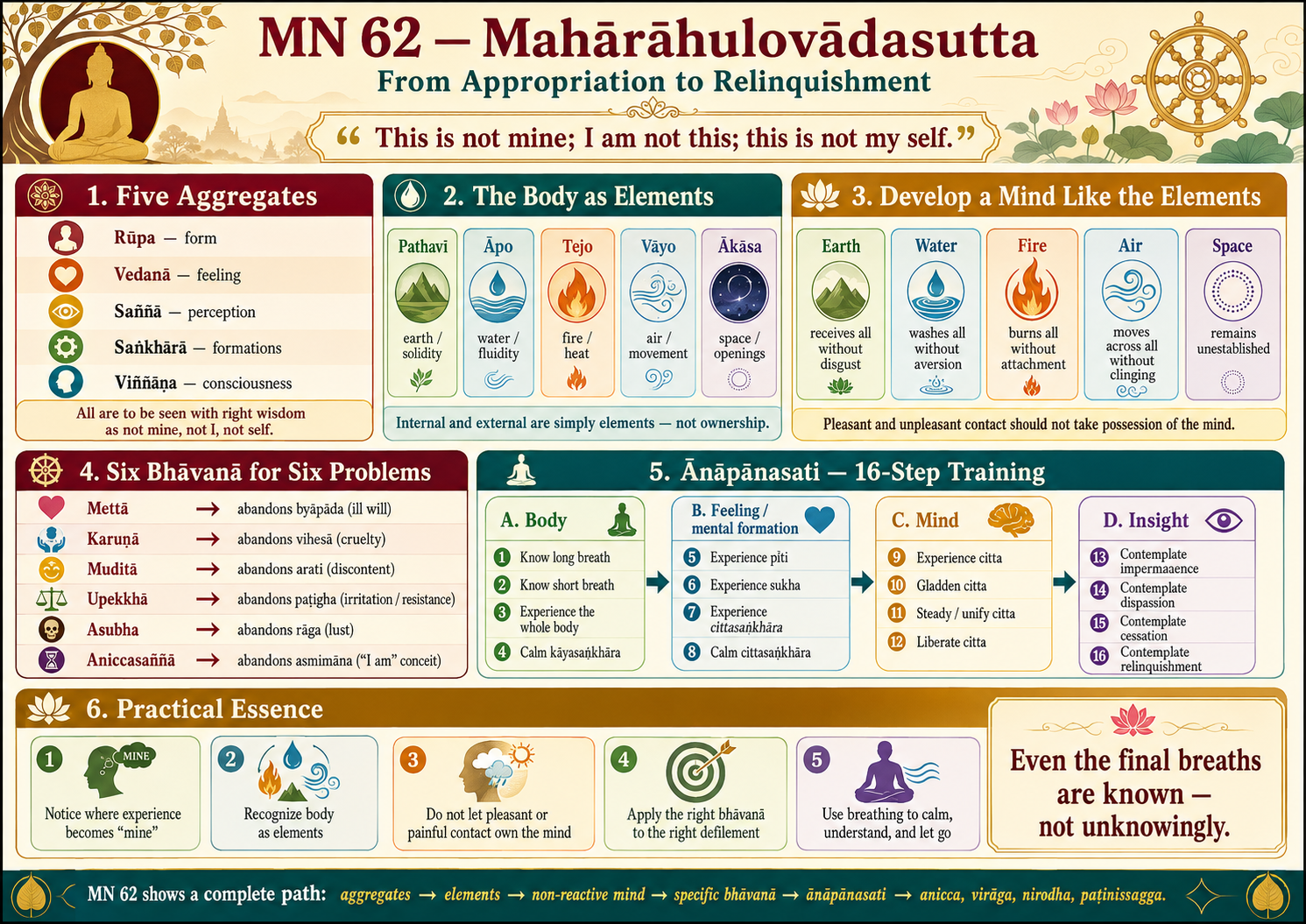
 VISUAL SUMMARYSee this sutta in a pictureOpen the complete infographic for a visual overview before or after reading the full study.View infographic →
MN 62 Mahārāhulovādasutta is much more than a discourse teaching Rāhula how to observe breathing. Although its latter portion contains the complete sixteen-step ānāpānasati training, the Buddha first establishes an extensive foundation: the five aggregates are to be seen as not mine, not what I am and not my self; the body is examined as elements; the mind is trained to become like earth, water, fire, air and space so that pleasant and unpleasant contact cannot take possession of it; and six specific developments are prescribed for six specific defilements.
Only after this does the Buddha unfold ānāpānasati. The breathing process moves from simple knowing to deliberate training, from bodily calming to pīti and sukha, from cittasaṅkhāra to the direct development of citta, and finally into contemplation of impermanence, dispassion, cessation and relinquishment. The discourse therefore forms one connected training rather than several unrelated meditation instructions.
The opening and closing movements illuminate each other. At the beginning the practitioner learns to see conditioned experience with right wisdom as netaṁ mama, nesohamasmi, na meso attā. At the culmination the practitioner trains as paṭinissaggānupassī, contemplating relinquishment. MN 62 can therefore be understood as a practical map showing how appropriation is gradually understood, weakened and finally relinquished.
01 1. The setting at Jetavana
Evaṁ me sutaṁ—ekaṁ samayaṁ bhagavā sāvatthiyaṁ viharati jetavane anāthapiṇḍikassa ārāme.
Thus have I heard. On one occasion the Blessed One was staying at Sāvatthī, in Jeta’s Grove, Anāthapiṇḍika’s monastery.
Atha kho bhagavā pubbaṇhasamayaṁ nivāsetvā pattacīvaramādāya sāvatthiṁ piṇḍāya pāvisi. Āyasmāpi kho rāhulo pubbaṇhasamayaṁ nivāsetvā pattacīvaramādāya bhagavantaṁ piṭṭhito piṭṭhito anubandhi.
Then, in the morning, the Blessed One dressed, took his bowl and robe, and entered Sāvatthī for alms. Venerable Rāhula also dressed in the morning, took his bowl and robe, and followed closely behind the Blessed One.
02 2. Whatever form there is
Atha kho bhagavā apaloketvā āyasmantaṁ rāhulaṁ āmantesi: “yaṁ kiñci, rāhula, rūpaṁ—atītānāgatapaccuppannaṁ ajjhattaṁ vā bahiddhā vā oḷārikaṁ vā sukhumaṁ vā hīnaṁ vā paṇītaṁ vā yaṁ dūre santike vā—sabbaṁ rūpaṁ ‘netaṁ mama, nesohamasmi, na meso attā’ti evametaṁ yathābhūtaṁ sammappaññāya daṭṭhabban”ti.
Then the Blessed One looked back and addressed Venerable Rāhula: “Rāhula, whatever form there is—past, future or present; internal or external; gross or subtle; inferior or superior; far or near—all form should be seen as it actually is with right wisdom: ‘This is not mine; I am not this; this is not my self.’”
“Rūpameva nu kho, bhagavā, rūpameva nu kho, sugatā”ti?
“Only form, Blessed One? Only form, Well-Gone One?”
“Rūpampi, rāhula, vedanāpi, rāhula, saññāpi, rāhula, saṅkhārāpi, rāhula, viññāṇampi, rāhulā”ti.
“Form also, Rāhula; feeling also; perception also; formations also; and consciousness also.”
03 3. Rāhula immediately turns toward practice
Atha kho āyasmā rāhulo “ko najja bhagavatā sammukhā ovādena ovadito gāmaṁ piṇḍāya pavisissatī”ti tato paṭinivattitvā aññatarasmiṁ rukkhamūle nisīdi pallaṅkaṁ ābhujitvā ujuṁ kāyaṁ paṇidhāya parimukhaṁ satiṁ upaṭṭhapetvā.
Venerable Rāhula reflected: “Who, after having been instructed face-to-face by the Blessed One today, would still enter the village for alms?” So he turned back, sat down at the foot of a tree, crossed his legs, held his body upright and established mindfulness before him.
04 4. Sāriputta instructs Rāhula to develop ānāpānasati
Addasā kho āyasmā sāriputto āyasmantaṁ rāhulaṁ aññatarasmiṁ rukkhamūle nisinnaṁ pallaṅkaṁ ābhujitvā ujuṁ kāyaṁ paṇidhāya parimukhaṁ satiṁ upaṭṭhapetvā. Disvāna āyasmantaṁ rāhulaṁ āmantesi: “ānāpānassatiṁ, rāhula, bhāvanaṁ bhāvehi. Ānāpānassati, rāhula, bhāvanā bhāvitā bahulīkatā mahapphalā hoti mahānisaṁsā”ti.
Venerable Sāriputta saw Venerable Rāhula sitting at the foot of a tree, cross-legged, holding his body upright and having established mindfulness before him. Seeing him, he said: “Rāhula, develop mindfulness of breathing. When mindfulness of breathing is developed and repeatedly cultivated, it is of great fruit and great benefit.”
05 5. Rāhula asks how ānāpānasati becomes fruitful
Atha kho āyasmā rāhulo sāyanhasamayaṁ paṭisallānā vuṭṭhito yena bhagavā tenupasaṅkami; upasaṅkamitvā bhagavantaṁ abhivādetvā ekamantaṁ nisīdi. Ekamantaṁ nisinno kho āyasmā rāhulo bhagavantaṁ etadavoca:
Then, in the evening, Venerable Rāhula emerged from seclusion and approached the Blessed One. Having approached, he paid homage to him and sat to one side. Sitting to one side, he said:
“Kathaṁ bhāvitā nu kho, bhante, ānāpānassati, kathaṁ bahulīkatā mahapphalā hoti mahānisaṁsā”ti?
“Venerable sir, how is mindfulness of breathing developed, and how is it repeatedly cultivated so that it becomes of great fruit and great benefit?”
06 6. The earth element — pathavīdhātu
Yaṁ kiñci, rāhula, ajjhattaṁ paccattaṁ kakkhaḷaṁ kharigataṁ upādinnaṁ, seyyathidaṁ—kesā lomā nakhā dantā taco maṁsaṁ nhāru aṭṭhi aṭṭhimiñjaṁ vakkaṁ hadayaṁ yakanaṁ kilomakaṁ pihakaṁ papphāsaṁ antaṁ antaguṇaṁ udariyaṁ karīsaṁ, yaṁ vā panaññampi kiñci ajjhattaṁ paccattaṁ kakkhaḷaṁ kharigataṁ upādinnaṁ—ayaṁ vuccati, rāhula, ajjhattikā pathavīdhātu.
“Rāhula, whatever internally and individually is hard, solid and taken up as part of this body—head hair, body hair, nails, teeth, skin, flesh, sinews, bones, bone marrow, kidneys, heart, liver, diaphragm, spleen, lungs, intestines, mesentery, stomach contents, feces, or anything else internally that has the nature of hardness and solidity—is called the internal earth element.”
Yā ceva kho pana ajjhattikā pathavīdhātu yā ca bāhirā pathavīdhātu, pathavīdhāturevesā. Taṁ ‘netaṁ mama, nesohamasmi, na meso attā’ti—evametaṁ yathābhūtaṁ sammappaññāya daṭṭhabbaṁ. Evametaṁ yathābhūtaṁ sammappaññāya disvā pathavīdhātuyā nibbindati, pathavīdhātuyā cittaṁ virājeti.
“The internal earth element and the external earth element are simply the earth element. It should be seen as it actually is with right wisdom: ‘This is not mine; I am not this; this is not my self.’ Seeing it as it actually is with right wisdom, one becomes disenchanted with the earth element and the mind becomes dispassionate toward it.”
07 7. The water element — āpodhātu
Katamā ca, rāhula, āpodhātu? Āpodhātu siyā ajjhattikā, siyā bāhirā. Katamā ca, rāhula, ajjhattikā āpodhātu? Yaṁ ajjhattaṁ paccattaṁ āpo āpogataṁ upādinnaṁ, seyyathidaṁ—pittaṁ semhaṁ pubbo lohitaṁ sedo medo assu vasā kheḷo siṅghāṇikā lasikā muttaṁ, yaṁ vā panaññampi kiñci ajjhattaṁ paccattaṁ āpo āpogataṁ upādinnaṁ—ayaṁ vuccati, rāhula, ajjhattikā āpodhātu.
“And what, Rāhula, is the water element? The water element may be internal or external. Whatever internally has the nature of liquidity and has been taken up as part of the body—bile, phlegm, pus, blood, sweat, fat, tears, grease, saliva, nasal mucus, joint fluid, urine, or anything else internally having the nature of liquidity—is called the internal water element.”
Yā ceva kho pana ajjhattikā āpodhātu yā ca bāhirā āpodhātu āpodhāturevesā. Taṁ ‘netaṁ mama, nesohamasmi, na meso attā’ti—evametaṁ yathābhūtaṁ sammappaññāya daṭṭhabbaṁ. Evametaṁ yathābhūtaṁ sammappaññāya disvā āpodhātuyā nibbindati, āpodhātuyā cittaṁ virājeti.
“The internal water element and the external water element are simply the water element. It should be seen as it actually is with right wisdom: ‘This is not mine; I am not this; this is not my self.’ Seeing it in this way, one becomes disenchanted with the water element and the mind becomes dispassionate toward it.”
08 8. The fire element — tejodhātu
Katamā ca, rāhula, tejodhātu? Tejodhātu siyā ajjhattikā, siyā bāhirā. Katamā ca, rāhula, ajjhattikā tejodhātu? Yaṁ ajjhattaṁ paccattaṁ tejo tejogataṁ upādinnaṁ, seyyathidaṁ—yena ca santappati yena ca jīrīyati yena ca pariḍayhati yena ca asitapītakhāyitasāyitaṁ sammā pariṇāmaṁ gacchati, yaṁ vā panaññampi kiñci ajjhattaṁ paccattaṁ tejo tejogataṁ upādinnaṁ—ayaṁ vuccati, rāhula, ajjhattikā tejodhātu.
“And what, Rāhula, is the fire element? The fire element may be internal or external. Internally it is that by which one is warmed, by which one ages, by which one burns with fever, and by which what has been eaten, drunk, chewed and tasted is properly digested. Whatever else internally has the nature of heat is called the internal fire element.”
Yā ceva kho pana ajjhattikā tejodhātu yā ca bāhirā tejodhātu tejodhāturevesā. Taṁ ‘netaṁ mama, nesohamasmi, na meso attā’ti—evametaṁ yathābhūtaṁ sammappaññāya daṭṭhabbaṁ. Evametaṁ yathābhūtaṁ sammappaññāya disvā tejodhātuyā nibbindati, tejodhātuyā cittaṁ virājeti.
“The internal fire element and the external fire element are simply the fire element. It should be seen with right wisdom as: ‘This is not mine; I am not this; this is not my self.’ Seeing it as it actually is, one becomes disenchanted with the fire element and the mind becomes dispassionate toward it.”
09 9. The air element — vāyodhātu
Katamā ca, rāhula, vāyodhātu? Vāyodhātu siyā ajjhattikā, siyā bāhirā. Katamā ca, rāhula, ajjhattikā vāyodhātu? Yaṁ ajjhattaṁ paccattaṁ vāyo vāyogataṁ upādinnaṁ, seyyathidaṁ—uddhaṅgamā vātā, adhogamā vātā, kucchisayā vātā, koṭṭhāsayā vātā, aṅgamaṅgānusārino vātā, assāso passāso iti, yaṁ vā panaññampi kiñci ajjhattaṁ paccattaṁ vāyo vāyogataṁ upādinnaṁ—ayaṁ vuccati, rāhula, ajjhattikā vāyodhātu.
“And what, Rāhula, is the air element? The air element may be internal or external. Internally it includes upward-moving winds, downward-moving winds, winds in the abdomen, winds in the intestines, movements throughout the limbs, inhalation and exhalation, and anything else internally having the nature of air or movement.”
Yā ceva kho pana ajjhattikā vāyodhātu yā ca bāhirā vāyodhātu vāyodhāturevesā. Taṁ ‘netaṁ mama, nesohamasmi, na meso attā’ti—evametaṁ yathābhūtaṁ sammappaññāya daṭṭhabbaṁ. Evametaṁ yathābhūtaṁ sammappaññāya disvā vāyodhātuyā nibbindati, vāyodhātuyā cittaṁ virājeti.
“The internal air element and the external air element are simply the air element. It should be seen as it actually is with right wisdom: ‘This is not mine; I am not this; this is not my self.’ Seeing it in this way, one becomes disenchanted with the air element and the mind becomes dispassionate toward it.”
10 10. The space element — ākāsadhātu
Katamā ca, rāhula, ākāsadhātu? Ākāsadhātu siyā ajjhattikā, siyā bāhirā. Katamā ca, rāhula, ajjhattikā ākāsadhātu? Yaṁ ajjhattaṁ paccattaṁ ākāsaṁ ākāsagataṁ upādinnaṁ, seyyathidaṁ—kaṇṇacchiddaṁ nāsacchiddaṁ mukhadvāraṁ, yena ca asitapītakhāyitasāyitaṁ ajjhoharati, yattha ca asitapītakhāyitasāyitaṁ santiṭṭhati, yena ca asitapītakhāyitasāyitaṁ adhobhāgaṁ nikkhamati, yaṁ vā panaññampi kiñci ajjhattaṁ paccattaṁ ākāsaṁ ākāsagataṁ, aghaṁ aghagataṁ, vivaraṁ vivaragataṁ, asamphuṭṭhaṁ, maṁsalohitehi upādinnaṁ—ayaṁ vuccati, rāhula, ajjhattikā ākāsadhātu.
“And what, Rāhula, is the space element? The space element may be internal or external. Internally it consists of the openings and spaces within the body: the ear openings, nostrils, mouth, the passage through which food and drink are swallowed, where they remain, the passage through which they leave from below, and whatever other cavity, opening or space exists internally.”
Yā ceva kho pana ajjhattikā ākāsadhātu yā ca bāhirā ākāsadhātu ākāsadhāturevesā. Taṁ ‘netaṁ mama, nesohamasmi, na meso attā’ti—evametaṁ yathābhūtaṁ sammappaññāya daṭṭhabbaṁ. Evametaṁ yathābhūtaṁ sammappaññāya disvā ākāsadhātuyā cittaṁ nibbindati, ākāsadhātuyā cittaṁ virājeti.
“The internal space element and the external space element are simply the space element. It should be seen with right wisdom as: ‘This is not mine; I am not this; this is not my self.’ Seeing this correctly, the mind becomes disenchanted and dispassionate toward the space element.”
11 11. Develop a mind like earth
Pathavīsamaṁ, rāhula, bhāvanaṁ bhāvehi. Pathavīsamañhi te, rāhula, bhāvanaṁ bhāvayato uppannā manāpāmanāpā phassā cittaṁ na pariyādāya ṭhassanti.
“Rāhula, develop a mind like the earth. When you develop a mind like the earth, arisen pleasant and unpleasant contacts will not remain taking possession of your mind.”
Seyyathāpi, rāhula, pathaviyā sucimpi nikkhipanti, asucimpi nikkhipanti, gūthagatampi nikkhipanti, muttagatampi nikkhipanti, kheḷagatampi nikkhipanti, pubbagatampi nikkhipanti, lohitagatampi nikkhipanti, na ca tena pathavī aṭṭīyati vā harāyati vā jigucchati vā; evameva kho tvaṁ, rāhula, pathavīsamaṁ bhāvanaṁ bhāvehi. Pathavīsamañhi te, rāhula, bhāvanaṁ bhāvayato uppannā manāpāmanāpā phassā cittaṁ na pariyādāya ṭhassanti.
“Just as people throw clean things and unclean things onto the earth—feces, urine, saliva, pus and blood—yet the earth is not distressed, ashamed or disgusted because of that, so too, Rāhula, develop a mind like the earth. Then pleasant and unpleasant contacts that arise will not remain taking possession of your mind.”
12 12. Develop a mind like water
Āposamaṁ, rāhula, bhāvanaṁ bhāvehi. Āposamañhi te, rāhula, bhāvanaṁ bhāvayato uppannā manāpāmanāpā phassā cittaṁ na pariyādāya ṭhassanti. Seyyathāpi, rāhula, āpasmiṁ sucimpi dhovanti, asucimpi dhovanti, gūthagatampi dhovanti, muttagatampi dhovanti, kheḷagatampi dhovanti, pubbagatampi dhovanti, lohitagatampi dhovanti, na ca tena āpo aṭṭīyati vā harāyati vā jigucchati vā; evameva kho tvaṁ, rāhula, āposamaṁ bhāvanaṁ bhāvehi. Āposamañhi te, rāhula, bhāvanaṁ bhāvayato uppannā manāpāmanāpā phassā cittaṁ na pariyādāya ṭhassanti.
“Rāhula, develop a mind like water. Just as people wash clean and unclean things in water—even feces, urine, saliva, pus and blood—and the water is not distressed, ashamed or disgusted, so too develop a mind like water. Then arisen pleasant and unpleasant contacts will not remain taking possession of your mind.”
13 13. Develop a mind like fire
Tejosamaṁ, rāhula, bhāvanaṁ bhāvehi. Tejosamañhi te, rāhula, bhāvanaṁ bhāvayato uppannā manāpāmanāpā phassā cittaṁ na pariyādāya ṭhassanti. Seyyathāpi, rāhula, tejo sucimpi dahati, asucimpi dahati, gūthagatampi dahati, muttagatampi dahati, kheḷagatampi dahati, pubbagatampi dahati, lohitagatampi dahati, na ca tena tejo aṭṭīyati vā harāyati vā jigucchati vā; evameva kho tvaṁ, rāhula, tejosamaṁ bhāvanaṁ bhāvehi. Tejosamañhi te, rāhula, bhāvanaṁ bhāvayato uppannā manāpāmanāpā phassā cittaṁ na pariyādāya ṭhassanti.
“Rāhula, develop a mind like fire. Just as fire burns clean and unclean things alike without becoming distressed, ashamed or disgusted by them, so develop a mind like fire. Pleasant and unpleasant contacts may arise, but they will not remain taking possession of the mind.”
14 14. Develop a mind like air
Vāyosamaṁ, rāhula, bhāvanaṁ bhāvehi. Vāyosamañhi te, rāhula, bhāvanaṁ bhāvayato uppannā manāpāmanāpā phassā cittaṁ na pariyādāya ṭhassanti. Seyyathāpi, rāhula, vāyo sucimpi upavāyati, asucimpi upavāyati, gūthagatampi upavāyati, muttagatampi upavāyati, kheḷagatampi upavāyati, pubbagatampi upavāyati, lohitagatampi upavāyati, na ca tena vāyo aṭṭīyati vā harāyati vā jigucchati vā; evameva kho tvaṁ, rāhula, vāyosamaṁ bhāvanaṁ bhāvehi. Vāyosamañhi te, rāhula, bhāvanaṁ bhāvayato uppannā manāpāmanāpā phassā cittaṁ na pariyādāya ṭhassanti.
“Rāhula, develop a mind like air. Just as the wind blows over clean and unclean things alike without becoming distressed, ashamed or disgusted by them, so develop a mind like air. Pleasant and unpleasant contacts may arise, but they will not remain taking possession of the mind.”
15 15. Develop a mind like space
Ākāsasamaṁ, rāhula, bhāvanaṁ bhāvehi. Ākāsasamañhi te, rāhula, bhāvanaṁ bhāvayato uppannā manāpāmanāpā phassā cittaṁ na pariyādāya ṭhassanti. Seyyathāpi, rāhula, ākāso na katthaci patiṭṭhito; evameva kho tvaṁ, rāhula, ākāsasamaṁ bhāvanaṁ bhāvehi. Ākāsasamañhi te, rāhula, bhāvanaṁ bhāvayato uppannā manāpāmanāpā phassā cittaṁ na pariyādāya ṭhassanti.
“Rāhula, develop a mind like space. When you develop a mind like space, arisen pleasant and unpleasant contacts will not remain taking possession of it. Just as space is not established anywhere, so too develop a mind like space.”
16 16. Six specific developments for six conditions
Mettaṁ, rāhula, bhāvanaṁ bhāvehi. Mettañhi te, rāhula, bhāvanaṁ bhāvayato yo byāpādo so pahīyissati.
“Rāhula, develop mettā. When mettā is developed, whatever ill will there is will be abandoned.”
Karuṇaṁ, rāhula, bhāvanaṁ bhāvehi. Karuṇañhi te, rāhula, bhāvanaṁ bhāvayato yā vihesā sā pahīyissati.
“Develop compassion. When compassion is developed, cruelty and the inclination to harm will be abandoned.”
Muditaṁ, rāhula, bhāvanaṁ bhāvehi. Muditañhi te, rāhula, bhāvanaṁ bhāvayato yā arati sā pahīyissati.
“Develop appreciative joy. When appreciative joy is developed, discontent and non-delight will be abandoned.”
Upekkhaṁ, rāhula, bhāvanaṁ bhāvehi. Upekkhañhi te, rāhula, bhāvanaṁ bhāvayato yo paṭigho so pahīyissati.
“Develop equanimity. When equanimity is developed, resistance and irritation will be abandoned.”
Asubhaṁ, rāhula, bhāvanaṁ bhāvehi. Asubhañhi te, rāhula, bhāvanaṁ bhāvayato yo rāgo so pahīyissati.
“Develop contemplation of unattractiveness. When it is developed, lust will be abandoned.”
Aniccasaññaṁ, rāhula, bhāvanaṁ bhāvehi. Aniccasaññañhi te, rāhula, bhāvanaṁ bhāvayato yo asmimāno so pahīyissati.
“Develop perception of impermanence. When perception of impermanence is developed, the conceit ‘I am’ will be abandoned.”
17 17. The Buddha returns to ānāpānasati
Ānāpānassatiṁ, rāhula, bhāvanaṁ bhāvehi. Ānāpānassati hi te, rāhula, bhāvitā bahulīkatā mahapphalā hoti mahānisaṁsā. Kathaṁ bhāvitā ca, rāhula, ānāpānassati, kathaṁ bahulīkatā mahapphalā hoti mahānisaṁsā?
“Rāhula, develop mindfulness of breathing. When mindfulness of breathing is developed and repeatedly cultivated, it is of great fruit and great benefit. And how is mindfulness of breathing developed and repeatedly cultivated so that it becomes of great fruit and great benefit?”
18 18. Establishing mindfulness
Idha, rāhula, bhikkhu araññagato vā rukkhamūlagato vā suññāgāragato vā nisīdati pallaṅkaṁ ābhujitvā ujuṁ kāyaṁ paṇidhāya parimukhaṁ satiṁ upaṭṭhapetvā. So satova assasati satova passasati.
“Here, Rāhula, a bhikkhu goes to the forest, to the foot of a tree, or to an empty dwelling. He sits down cross-legged, holds the body upright and establishes mindfulness before him. Mindfully he breathes in; mindfully he breathes out.”
19 19. First tetrad — kāya and kāyasaṅkhāra
Dīghaṁ vā assasanto ‘dīghaṁ assasāmī’ti pajānāti, dīghaṁ vā passasanto ‘dīghaṁ passasāmī’ti pajānāti; rassaṁ vā assasanto ‘rassaṁ assasāmī’ti pajānāti, rassaṁ vā passasanto ‘rassaṁ passasāmī’ti pajānāti.
“Breathing in long, he knows: ‘I breathe in long.’ Breathing out long, he knows: ‘I breathe out long.’ Breathing in short, he knows: ‘I breathe in short.’ Breathing out short, he knows: ‘I breathe out short.’”
‘Sabbakāyappaṭisaṁvedī assasissāmī’ti sikkhati; ‘sabbakāyappaṭisaṁvedī passasissāmī’ti sikkhati.
“He trains: ‘Experiencing the whole body, I will breathe in.’ He trains: ‘Experiencing the whole body, I will breathe out.’”
‘Passambhayaṁ kāyasaṅkhāraṁ assasissāmī’ti sikkhati; ‘passambhayaṁ kāyasaṅkhāraṁ passasissāmī’ti sikkhati.
“He trains: ‘Calming the bodily formation, I will breathe in.’ He trains: ‘Calming the bodily formation, I will breathe out.’”
20 20. Second tetrad — pīti, sukha and cittasaṅkhāra
‘Pītippaṭisaṁvedī assasissāmī’ti sikkhati; ‘pītippaṭisaṁvedī passasissāmī’ti sikkhati;
“He trains: ‘Experiencing pīti, I will breathe in’; ‘Experiencing pīti, I will breathe out.’”
‘Sukhappaṭisaṁvedī assasissāmī’ti sikkhati; ‘sukhappaṭisaṁvedī passasissāmī’ti sikkhati;
“He trains: ‘Experiencing sukha, I will breathe in’; ‘Experiencing sukha, I will breathe out.’”
‘Cittasaṅkhārappaṭisaṁvedī assasissāmī’ti sikkhati; ‘cittasaṅkhārappaṭisaṁvedī passasissāmī’ti sikkhati;
“He trains: ‘Experiencing the mental formation, I will breathe in’; ‘Experiencing the mental formation, I will breathe out.’”
‘Passambhayaṁ cittasaṅkhāraṁ assasissāmī’ti sikkhati; ‘passambhayaṁ cittasaṅkhāraṁ passasissāmī’ti sikkhati.
“He trains: ‘Calming the mental formation, I will breathe in’; ‘Calming the mental formation, I will breathe out.’”
21 21. Third tetrad — citta itself becomes the field of training
‘Cittappaṭisaṁvedī assasissāmī’ti sikkhati; ‘cittappaṭisaṁvedī passasissāmī’ti sikkhati;
“He trains: ‘Experiencing the mind, I will breathe in’; ‘Experiencing the mind, I will breathe out.’”
‘Abhippamodayaṁ cittaṁ assasissāmī’ti sikkhati; ‘abhippamodayaṁ cittaṁ passasissāmī’ti sikkhati;
“He trains: ‘Gladdening the mind, I will breathe in’; ‘Gladdening the mind, I will breathe out.’”
‘Samādahaṁ cittaṁ assasissāmī’ti sikkhati; ‘samādahaṁ cittaṁ passasissāmī’ti sikkhati;
“He trains: ‘Steadying and unifying the mind, I will breathe in’; ‘Steadying and unifying the mind, I will breathe out.’”
‘Vimocayaṁ cittaṁ assasissāmī’ti sikkhati; ‘vimocayaṁ cittaṁ passasissāmī’ti sikkhati.
“He trains: ‘Liberating the mind, I will breathe in’; ‘Liberating the mind, I will breathe out.’”
22 22. Fourth tetrad — anicca, virāga, nirodha and paṭinissagga
‘Aniccānupassī assasissāmī’ti sikkhati; ‘aniccānupassī passasissāmī’ti sikkhati;
“He trains: ‘Contemplating impermanence, I will breathe in’; ‘Contemplating impermanence, I will breathe out.’”
‘Virāgānupassī assasissāmī’ti sikkhati; ‘virāgānupassī passasissāmī’ti sikkhati;
“He trains: ‘Contemplating fading of passion and dispassion, I will breathe in’; ‘Contemplating fading of passion and dispassion, I will breathe out.’”
‘Nirodhānupassī assasissāmī’ti sikkhati; ‘nirodhānupassī passasissāmī’ti sikkhati;
“He trains: ‘Contemplating cessation, I will breathe in’; ‘Contemplating cessation, I will breathe out.’”
‘Paṭinissaggānupassī assasissāmī’ti sikkhati; ‘paṭinissaggānupassī passasissāmī’ti sikkhati.
“He trains: ‘Contemplating relinquishment, I will breathe in’; ‘Contemplating relinquishment, I will breathe out.’”
23 23. Even the final breaths are known
Evaṁ bhāvitā kho, rāhula, ānāpānassati, evaṁ bahulīkatā mahapphalā hoti mahānisaṁsā. Evaṁ bhāvitāya, rāhula, ānāpānassatiyā, evaṁ bahulīkatāya yepi te carimakā assāsā tepi viditāva nirujjhanti no aviditā”ti.
“Rāhula, mindfulness of breathing developed and repeatedly cultivated in this way is of great fruit and great benefit. When mindfulness of breathing has been developed and repeatedly cultivated in this way, even the final breaths cease knowingly, not unknowingly.”
Idamavoca bhagavā. Attamano āyasmā rāhulo bhagavato bhāsitaṁ abhinandīti.
That is what the Blessed One said. Delighted, Venerable Rāhula rejoiced in the Blessed One’s words.
Mahārāhulovādasuttaṁ niṭṭhitaṁ dutiyaṁ.
The Mahārāhulovādasutta, the second discourse, is finished.
Key Points
Six distinctions that unlock MN 62
These short points reveal why the discourse should not be reduced to breath observation alone.
1
The discourse begins with the five aggregates, not with breathing. Rūpa, vedanā, saññā, saṅkhārā and viññāṇa are first brought under “not mine, not I, not self.”
2
The breath has already been de-personalized. Assāsa and passāsa are included under vāyodhātu before formal ānāpānasati begins.
3
Pleasant and unpleasant contact are not themselves the bondage. The training is that they should not remain taking possession of citta.
4
Different defilements require different developments. Mettā, karuṇā, muditā, upekkhā, asubha and aniccasaññā each have a specific task.
5
Ānāpānasati moves from pajānāti to sikkhati. First the condition is known; then body, mental formation and citta are deliberately trained.
6
The destination is relinquishment. The final tetrad leads from anicca through virāga and nirodha to paṭinissagga.
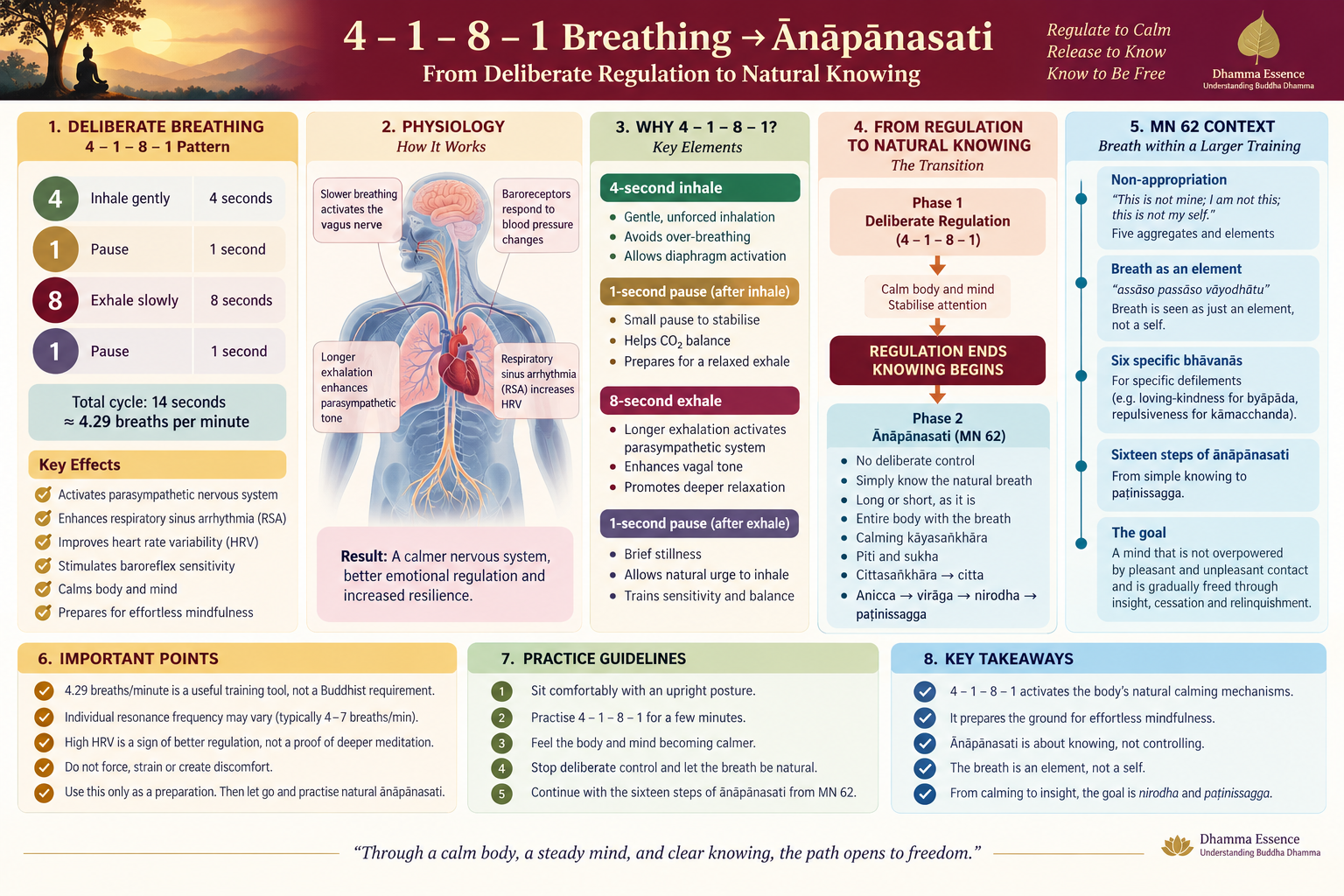
Why slow the breath?
Breathing occupies an unusual place in human physiology. Heartbeat, vascular tone and digestion are largely autonomic, yet breathing can proceed automatically or be deliberately altered. This makes respiration a practical doorway through which voluntary behaviour can influence cardiorespiratory rhythms.
At 4–1–8–1 the complete respiratory cycle is 14 seconds, corresponding to about 4.29 breaths per minute or approximately 0.071 Hz. This is slower than the frequency commonly used in resonance-frequency HRV training, which for many adults lies closer to roughly 4.5–6.5 breaths per minute and often near 0.1 Hz. Therefore 4–1–8–1 should not be advertised as a universal “optimal resonance frequency.” It is better understood as a very-slow-breathing exercise whose effects depend on the individual, posture, depth of breathing and comfort.
RSA — the heart follows respiration
Heart rate is not mechanically constant from beat to beat. With normal respiratory sinus arrhythmia (RSA), heart rate generally rises during inhalation and falls during exhalation. Slow breathing can make this oscillation more visible. As the respiratory cycle lengthens, the intervals between heartbeats may show broad waves synchronized with breathing, contributing substantially to measured heart-rate variability (HRV).
This is why a high HRV value recorded during deliberately slow breathing should be interpreted carefully. It may reflect strong respiratory modulation of heart rhythm during that session; it does not by itself prove that resting vagal tone has permanently increased or that one meditation state is “deeper” than another.
The baroreflex — blood pressure and heart rate in dialogue
The baroreflex is a rapid feedback system that helps stabilize arterial pressure. Pressure-sensitive receptors, especially around the carotid sinus and aortic arch, continually signal changes in arterial stretch to brainstem cardiovascular centres. When pressure rises, reflex adjustments tend to restrain cardiac output and heart rate; when pressure falls, compensatory adjustments move in the opposite direction.
Slow respiration changes intrathoracic pressure, venous return, stroke volume and arterial-pressure oscillations. These respiratory changes interact with baroreflex control and cardiac autonomic modulation. Around an individual’s resonance frequency these oscillations can reinforce one another and produce particularly large HRV waves. At approximately 4.3 breaths per minute, however, 4–1–8–1 may lie below that resonance point for many people. Slower is therefore not automatically better.
Why is the exhalation longer?
The 4–1–8–1 pattern gives twice as much time to exhalation as inhalation. During inhalation, cardiac vagal influence is typically reduced and heart rate tends to rise; during exhalation, heart rate tends to fall. A long, unforced exhalation can therefore make the respiratory-linked slowing of the heart especially apparent.
It is better not to reduce this to the popular slogan that “a long exhalation switches on the vagus nerve.” The physiology is a coupled process involving respiration, intrathoracic pressure, venous return, arterial pressure, baroreflex activity and autonomic cardiac control.
The pauses are transitions, not breath-holding achievements
The one-second pauses make the rhythm easy to follow and prevent an abrupt reversal between inhalation and exhalation. They should remain relaxed transitions. The purpose is not to create strain, accumulate carbon dioxide deliberately or demonstrate how long the breath can be held. If there is air hunger, dizziness, tingling, chest discomfort or a strong urge to gasp, the breathing has ceased to be a useful preparation and should return to a comfortable natural rhythm.
What can 4–1–8–1 actually help with?
Used comfortably for a short preparatory period, the technique can reduce respiratory irregularity, provide a simple repetitive object for attention and make the relationship between breathing and heart rhythm easier to observe. For some practitioners this settling of bodily activity can make sustained attention easier. Its proper role here is therefore preparation: it can help establish conditions for practice, but it is not itself the liberating training described in MN 62.
1. Modern physiological preparation
2. The essential transition
Stop counting. Stop imposing 4–1–8–1. Let breathing occur naturally.
The practice now changes from producing a predetermined respiratory pattern to knowing the breathing process that is actually present.
3. MN 62 — the training unfolds
Mindfully breathing in and out
Know long and short breathing
Experience the whole body
Calm bodily formation
Experience and refine
Experience and calm
Know, gladden, steady, liberate
impermanence
fading / dispassion
cessation
relinquishment
The crucial transition: stop controlling the breath
If 4–1–8–1 is used, its most important moment is the moment it is abandoned. The practitioner stops counting seconds and stops demanding that inhalation or exhalation conform to a predetermined length. Breathing is allowed to proceed according to present conditions. What remains is mindfulness and clear knowing.
Mindfully he breathes in; mindfully he breathes out.
MN 62 then says:
Breathing in long, he knows that he breathes in long; breathing out long, he knows that he breathes out long. Breathing in short, he knows that he breathes in short; breathing out short, he knows that he breathes out short.
The operative word is pajānāti—he knows, understands or clearly discerns. The instruction does not say that every breath must be deliberately made long. Long breathing is known as long; short breathing is known as short. The relationship to breathing has changed from manufacturing to knowing.
From pajānāti to sikkhati
The discourse then moves beyond simply recognizing long and short respiration. The recurring verb becomes sikkhati—“he trains.” The practitioner trains to experience the whole body and to calm the bodily formation:
This is a deeper training than merely slowing respiration. In 4–1–8–1, tranquillity is approached by imposing a rhythm from outside: four seconds, one second, eight seconds, one second. In ānāpānasati, the practitioner develops the conditions in which bodily formation itself becomes tranquil while remaining clearly known.
MN 62 does not end with relaxation
The next movements make the difference unmistakable. The practitioner trains with pīti and sukha, experiences and calms cittasaṅkhāra, then turns directly toward citta: experiencing it, gladdening it, steadying and unifying it, and liberating it. The final tetrad moves into aniccānupassanā, virāgānupassanā, nirodhānupassanā and paṭinissaggānupassanā.
Therefore relaxation, a lower pulse, increased HRV or a visually impressive RSA wave cannot be taken as the goal of MN 62. They are physiological observations. The Dhamma training proceeds into understanding conditioned experience, dispassion, cessation and relinquishment.
The deeper connection within MN 62 itself
There is an especially important reason not to turn the breath into “my controlled breathing.” Earlier in the same discourse, inhalation and exhalation—assāso passāso—have already been included within vāyodhātu, the air element. Internal air and external air are simply air element and are to be seen with right wisdom as netaṁ mama, nesohamasmi, na meso attā: “This is not mine; I am not this; this is not my self.”
Thus the practitioner arrives at ānāpānasati after the breath has already been de-personalized. This is very different from using breath control to construct a new achievement around identity: “I can breathe at four breaths per minute,” “my HRV is very high,” or “I can make my breath extremely subtle.” Such measurements may be interesting, but MN 62 points in the opposite direction—from appropriation toward relinquishment.
Practical sequence
Use 4–1–8–1 briefly and comfortably.
Drop counting and deliberate timing.
Long as long; short as short.
Whole body with breathing.
Kāyasaṅkhāra and cittasaṅkhāra.
Gladden, steady, liberate.
Anicca → virāga → nirodha → paṭinissagga.
01 The real starting point is appropriation, not attention to breathing
The first instruction given to Rāhula provides the key for understanding everything that follows. The Buddha does not initially address inability to concentrate, wandering attention or the mechanics of breathing. He addresses the more fundamental activity through which suffering is constructed: conditioned experience is being appropriated as “mine,” “I” and “self.” Whatever rūpa exists, whether past, future or present, internal or external, gross or subtle, inferior or superior, far or near, is to be seen with right wisdom as netaṁ mama, nesohamasmi, na meso attā.
Rāhula immediately recognizes that the instruction may have implications beyond the body and therefore asks whether it applies only to rūpa. The Buddha answers by extending it to vedanā, saññā, saṅkhārā and viññāṇa. The entire experiential structure is therefore included. Bodily form becomes “my body”; pleasant feeling becomes “my pleasure”; unpleasant feeling becomes “my suffering”; perception becomes “what I know”; mental formations become “my thoughts, intentions and opinions”; consciousness itself may become the assumed inner observer who supposedly owns all experience.
The Buddha is not asking Rāhula simply to repeat three sentences. The decisive expression is yathābhūtaṁ sammappaññāya daṭṭhabbaṁ: these phenomena are to be seen as they actually are with right wisdom. When their conditioned, changing and dependent nature becomes directly apparent, the mind gradually sees why they cannot provide a secure basis for “This is mine,” “This is what I am,” or “This is my enduring self.”
This is why the entire ānāpānasati training later in the discourse should be read within the context of non-appropriation. The aim cannot simply be to create a new refined possession called “my meditation” or “my samādhi.” The practice is already directed toward seeing conditioned phenomena without ownership.
02 Eleven Ways of Seeing: leaving no refuge for “mine, I and self”
The Buddha’s opening instruction to Rāhula is often compressed into the statement that the five aggregates should be seen as not-self. But the actual instruction is much more exacting. Rāhula is not merely told to apply netaṁ mama, nesohamasmi, na meso attā to a general idea called “rūpa.” The Buddha first stretches the field of examination across eleven perspectives so that selective seeing becomes increasingly difficult:
Yaṁ kiñci, rāhula, rūpaṁ—atītānāgatapaccuppannaṁ ajjhattaṁ vā bahiddhā vā oḷārikaṁ vā sukhumaṁ vā hīnaṁ vā paṇītaṁ vā yaṁ dūre santike vā—sabbaṁ rūpaṁ ‘netaṁ mama, nesohamasmi, na meso attā’ti evametaṁ yathābhūtaṁ sammappaññāya daṭṭhabbaṁ.
Whatever rūpa there is—past, future or present; internal or external; gross or subtle; inferior or superior; far or near—all of it is to be seen as it actually is with right wisdom: “This is not mine; I am not this; this is not my self.” Rāhula immediately asks whether this applies only to rūpa. The Buddha answers by extending the same principle to vedanā, saññā, saṅkhārā and viññāṇa. The instruction therefore has a much wider scope than a reflection on the physical body.
The eleven expressions are best understood as an exhaustive set of perspectives rather than as eleven unrelated meditation objects. There is a threefold temporal examination—past, future and present—and then four paired contrasts: internal/external, gross/subtle, inferior/superior and far/near. Their function is to stop the mind from quietly preserving one exceptional category in which identification is still allowed. The practitioner may accept that ordinary bodily form is not-self while secretly preserving a refined mental state as “what I really am”; may detach from an unpleasant condition while appropriating an exalted one; may understand the present as conditioned while constructing identity out of memory or expectation. The eleven perspectives close these escape routes.
The architecture of the eleven perspectives
The Buddha does not give a random list. The field is opened across five dimensions so that no corner of experience can be protected as “mine,” “I” or “self.”
| Dimension | Perspectives | What the investigation prevents |
|---|---|---|
| TIME | atīta · anāgata · paccuppanna past · future · present |
Identity cannot be preserved in “what I was,” “what I will become,” or “what I am now.” |
| LOCATION / PERSPECTIVE | ajjhatta ↔ bahiddhā internal ↔ external |
What occurs internally is not made self merely because it feels intimate; what is external is not made into a basis for “me versus them.” |
| DEGREE OF MANIFESTATION | oḷārika ↔ sukhuma gross ↔ subtle |
Identification cannot simply migrate from coarse experience into refined or subtle states. |
| VALUATION | hīna ↔ paṇīta inferior ↔ superior / refined |
Neither what is rejected as low nor what is admired as excellent becomes a valid foundation for identity. |
| PROXIMITY | dūre ↔ santike far ↔ near |
Distance does not remove conditionality, and intimacy does not convert a phenomenon into an inner essence. |
| Pāḷi | Perspective | Everyday example | Practice example |
|---|---|---|---|
| atīta | Past | “I used to be healthy, successful, attractive, hurt or respected.” | A previous meditation experience becomes “the state I had and must recover.” |
| anāgata | Future | “What will happen to me when I age, lose status or become ill?” | Identity is projected into “what I will attain” or “the practitioner I will become.” |
| paccuppanna | Present | Current pain, pleasure, appearance, opinion or mood becomes “me now.” | The immediately present breath, pīti, sukha or clarity is appropriated as “my experience.” |
| ajjhatta | Internal | What occurs on the internal side is assumed to be more truly “mine.” | Bodily feeling, thought, intention or consciousness is taken as an inner owner. |
| bahiddhā | External | Comparison with another person’s body, behaviour, success or failure constructs “me versus them.” | External conditions become the basis for attraction, aversion, comparison or identity. |
| oḷārika | Gross / coarse | Strong pain, obvious anger, intense sensual desire or visible bodily change. | A coarse hindrance or strongly agitated state is clearly recognizable. |
| sukhuma | Subtle / refined | Quiet pride, subtle preference, faint irritation or a refined self-image. | Subtle tranquility, equanimity, pīti, sukha or refined samādhi becomes a possible object of appropriation. |
| hīna | Inferior / regarded as low | “I should not be like this; this weakness makes me a lesser person.” | An unwholesome or coarse state becomes the basis for shame and a new identity as a “bad practitioner.” |
| paṇīta | Superior / refined / excellent | Beauty, intelligence, status or virtue becomes “what makes me special.” | Jhāna, insight, calm or clarity is turned into “my attainment.” |
| dūre | Far | A remote person, event, body or remembered condition is still used to construct identity. | Something not immediately present is mentally retrieved and appropriated. |
| santike | Near | What is intimate and immediate feels especially convincing as “me.” | The present body, feeling, thought or consciousness seems so close that it is mistaken for an owner or self. |
These examples are illustrations, not additional definitions supplied by MN 62. The discourse itself gives the eleven perspectives and the instruction to see all such experience with right wisdom. The examples show how the same structure can expose appropriation in contemporary life and in meditation without replacing the wording of the sutta.
Atīta, anāgata, paccuppanna — identity across time. The first three perspectives prevent self-making from hiding in time. A person may intellectually understand that the present body changes and yet remain deeply attached to the body that existed twenty years ago. Photographs, memories and stories can sustain the thought, “That was the real me.” An old injury may be carried as “what happened to me”; an old success as “who I was”; an old humiliation as “the wound that defines me.” Past vedanā can be revived through memory: a pleasure becomes an object of longing, and an old painful event can repeatedly produce fresh resentment. Past saññā and saṅkhārā become biography—“I have always been this kind of person.” The past no longer exists as a presently existing aggregate, yet appropriation reconstructs it now.
The future works in the opposite direction. Anāgata shows how identity is projected into what has not yet occurred. Fear of aging, illness, loss of status or death can be driven by an image of a future “me.” Craving does the same with pleasant expectation: “When I obtain this, become this, reach this place or enter this state, then I will be complete.” Even Dhamma practice can be appropriated prospectively: “I will become an advanced practitioner; I will attain such-and-such a state; people will recognize what I have realized.” Wholesome aspiration need not be abandoned, but the imagined future aggregate cannot be made into a self before it has even arisen.
Paccuppanna, the present, may appear to be the most convincing refuge. Pain is here now, so it becomes “my pain.” Pleasure is here now, so the mind says, “I am happy.” A thought arises now and becomes “what I think.” A clear state of consciousness appears and can be silently converted into “the one who knows.” The instruction is not to deny present experience. It is to know it so accurately that immediacy is not confused with ownership. Past, future and present together leave no privileged moment in which an aggregate suddenly acquires the status of self.
Ajjhatta and bahiddhā — the inside/outside boundary is useful, but it does not establish ownership. The internal side of experience feels especially personal. Bodily sensations occur here; feelings are felt here; memories and intentions appear here. Because a phenomenon is encountered internally, the mind easily makes the additional leap: “therefore it is mine” or “therefore this is what I am.” MN 62 later dismantles precisely this reflex through the element analysis. Internal earth and external earth are simply earth element; internal water and external water are water element; the same principle is applied to fire, air and space. The conventional distinction between internal and external remains useful, but it does not prove possession.
External experience can also sustain self-making. One sees another person’s appearance and immediately comparison begins: “better than me,” “worse than me,” “more successful than me,” “someone I desire,” “someone I dislike.” A colleague’s promotion, another practitioner’s composure, somebody else’s body, reputation or knowledge can all become raw material for constructing “me” through comparison. Thus bahiddhā is not irrelevant merely because liberation concerns one’s own mind. The external field repeatedly becomes the condition through which internal craving, aversion, conceit and identity are built.
Oḷārika and sukhuma — the coarse is easier to see; the subtle is easier to mistake for freedom. Strong anger announces itself. Acute bodily pain is difficult to overlook. Intense sensual desire, agitation and fear can be recognized as coarse conditions. These are important because their arising exposes the causal structure of suffering clearly. But practice cannot end with the reduction of coarse disturbance.
A subtle condition may be far more attractive as a place of identity. Quiet satisfaction in being regarded as knowledgeable, almost invisible irritation when contradicted, refined preference for particular conditions, or a subtle sense of superiority can persist when gross defilements are absent. Meditation makes this distinction even more important. Tranquility, pīti, sukha, equanimity and collected citta may be profoundly refined compared with ordinary sensual experience. Their refinement does not convert them into an owner. Sukhuma closes the door through which spiritual identity can replace ordinary identity.
Consider a practitioner who has become much less interested in possessions, entertainment and praise but begins to think, “My samādhi is deep,” “I can enter this state,” or “My experience is beyond that of others.” The object of appropriation has become subtler, but the grammar of appropriation has not changed. There is still “mine,” “I” and “what I am.” The elevenfold examination prevents the path itself from becoming material for a more refined self.
Hīna and paṇīta — rejection and admiration can both preserve identity. We readily see attachment in wanting what is considered excellent, but aversion toward what is considered inferior can bind just as strongly. If anger arises and the mind responds, “A serious practitioner should never have anger; I am failing,” the anger has become the basis for a self-judgment. The practitioner is no longer merely knowing an arisen condition; a new identity has been constructed around being deficient.
The opposite danger appears with paṇīta. What is considered refined, noble, beautiful, successful or spiritually elevated is precisely what the mind is most reluctant to release. In daily life it may be intelligence, virtue, reputation or a role as teacher, parent, professional or benefactor. In meditation it may be unusual stillness, jhāna, luminous clarity, pīti, sukha, equanimity or an important insight. The instruction includes paṇīta so that excellence itself does not become evidence for selfhood. A wholesome or refined state may be developed and valued for its function while still being seen as conditioned and therefore unsuitable for appropriation.
Dūre and santike — distance does not free a phenomenon from the same principle, and nearness does not make it self. What is far away can continue to govern the mind. A person in another country, an event decades ago, an anticipated future circumstance, or a remembered object can be mentally brought close and used to generate craving, grief, resentment or pride. Physical or temporal distance therefore does not prevent appropriation.
Santike exposes the opposite error: what is nearest seems most convincingly “me.” The body is near. Vedanā is intimate. Thought appears within immediate awareness. Consciousness itself can seem so close that one assumes it must be the final observer standing behind experience. Yet proximity proves only proximity. It does not establish permanence, mastery or ownership. This is one reason the extension of the instruction from rūpa to viññāṇa is so consequential: even what seems closest to an inner knower is included in the field to be seen with right wisdom.
Eleven perspectives across five aggregates: a practical 55-field matrix. Rāhula is not instructed to perform a mechanical checklist of fifty-five verbal repetitions, but once the Buddha extends the principle from rūpa to all five aggregates, the scope becomes clear. Each aggregate can be examined through all eleven perspectives. This creates a useful practice matrix: 11 perspectives × 5 aggregates = 55 possible places in which appropriation can be investigated.
Take vedanā as an example. Past pleasant feeling can produce nostalgia; anticipated future pleasant feeling can drive craving; present unpleasant feeling can become “my suffering.” An internally experienced feeling may seem especially personal, while an external situation becomes the condition for comparison and reactivity. A gross painful feeling is obvious, whereas a subtle pleasant or neutral tone can escape notice. A feeling judged inferior may be rejected; a refined meditative sukha may be cherished as superior. A remembered feeling may be far, while the feeling occurring with the current breath is near. In every case the feeling is known, but the additional movement “mine, I, self” is examined rather than assumed.
The same can be done with saññā. A past perception becomes “what I remember”; a future projection becomes “what I expect”; a present interpretation becomes “what is really happening.” A coarse misperception may be easy to detect, but a subtle conceptual frame can govern behaviour invisibly. A perception considered sophisticated or spiritually refined may receive more protection than an obviously mistaken one. Yet perception remains conditioned recognition and designation; its usefulness does not make it an enduring self.
With saṅkhārā, the field includes intentions, constructions, tendencies and active shaping. One may identify with an old habit—“this is just who I am”—or with a future intention—“this is the person I am going to become.” Gross anger is easy to identify as conditioned formation; subtle preference, spiritual ambition or the wish to be recognized as wise can be much harder to see. Inferior formations may be hated and superior formations admired, but both remain formations.
With viññāṇa, the examination reaches the most easily protected refuge. Seeing consciousness, hearing consciousness and the other modes of consciousness arise dependent on conditions. Yet because consciousness is involved in knowing experience, the mind may treat it as the hidden possessor of everything else. MN 62 does not permit that exception. Rāhula asks whether the instruction concerns only rūpa, and the Buddha explicitly includes viññāṇa. The knowing of an object is not thereby transformed into an independent knower-self.
“Sabbaṁ” is the decisive word. After giving these perspectives the Buddha says sabbaṁ rūpaṁ—all rūpa. The force of the instruction lies in completeness. Insight that excludes the object one most values remains vulnerable to appropriation. It is relatively easy to say that an aging body is not-self while protecting a refined consciousness; easy to release an unpleasant mental state while clinging to a beautiful one; easy to see another person’s body as elements while experiencing one’s own body as uniquely “mine.” Sabbaṁ refuses selective liberation.
This is why the threefold formula must not become a mantra used to suppress experience. Netaṁ mama is not an order to pretend that nothing matters. Nesohamasmi is not an instruction to dissociate from responsibility. Na meso attā is not a philosophical slogan to be believed without examination. The governing phrase is evametaṁ yathābhūtaṁ sammappaññāya daṭṭhabbaṁ: it is to be seen in this way as it actually is, with right wisdom. The transformation comes from seeing the conditioned phenomenon accurately enough that appropriation loses its justification.
Consider an ordinary example. Someone criticizes a practitioner publicly. Present unpleasant vedanā arises. Saññā recognizes the words as insulting. Saṅkhārā begin constructing responses, memories and counterarguments. Consciousness knows the sights, sounds and thoughts involved. The mind may then travel into atīta—“He has always treated me this way”—or anāgata—“People will now think badly of me.” It may create an internal/external opposition—“I am right; he is the problem.” It may judge the reaction hīna—“I should not feel this”—and create shame, or preserve a paṇīta identity—“I am a senior practitioner; he should respect me.” One event can activate several of the eleven perspectives within seconds. The training is to see how the aggregates are being appropriated at each point.
Now take a meditation example. A period of deep calm arises. The breathing becomes subtle, the body feels light, pīti and sukha are present and the citta is unusually steady. Nothing about MN 62 requires rejecting such development. In fact, the later ānāpānasati instructions deliberately cultivate calming, pīti, sukha and samādhi. But the opening instruction has already established how these states must ultimately be related to. If the calm is paccuppanna, it is still not a self because it is present. If it is sukhuma, refinement does not make it permanent. If it is paṇīta, excellence does not make it ownable. If it is santike, intimacy does not make it an inner essence. Thus the beginning of MN 62 protects the later meditation training from becoming a new basis for asmimāna.
The later analysis of the elements then gives this opening instruction a bodily demonstration. Internal and external earth are simply earth; internal and external water are water; internal and external air are air. Most importantly for the later breathing practice, assāso passāso—inhalation and exhalation—are already included within vāyodhātu. By the time Rāhula reaches formal ānāpānasati, the breath has already been removed from the unquestioned category “my breath.” It can now be known as a conditioned process: sometimes long, sometimes short, capable of calming, arising and ceasing according to conditions.
This also explains the deep continuity between the opening formula and the final tetrad of ānāpānasati. At the beginning, all five aggregates across every perspective are to be seen without appropriation. Later the practitioner trains in aniccānupassanā, virāgānupassanā, nirodhānupassanā and paṭinissaggānupassanā. These are not unrelated teachings placed at opposite ends of the discourse. The opening asks: can experience be seen without making it mine, me or self? The culmination trains the citta in seeing impermanence so deeply that passion fades, cessation is understood and the taking-up itself is relinquished.
A useful way to bring the eleven perspectives into daily practice is therefore not to repeat them mechanically but to use them diagnostically. When a strong identification appears, ask: Which aggregate is being appropriated? From which perspective is it being protected? Is the mind living in a past identity? Projecting a future self? Mistaking present immediacy for ownership? Treating an internal event as inherently mine? Comparing itself with what is external? Protecting a subtle or exalted state? Rejecting an inferior state? Clinging because something feels very near? These questions turn the opening instruction to Rāhula into a living method of investigation.
The eleven ways of seeing therefore perform a precise function in MN 62: they make non-identification comprehensive. Nothing becomes self because it belongs to a particular time, appears internally, is especially coarse or subtle, is judged low or sublime, or feels distant or intimately near. Across all these perspectives, and across rūpa, vedanā, saññā, saṅkhārā and viññāṇa, the task remains the same: see what has arisen according to conditions as it actually is, and do not add the appropriation that turns conditioned experience into “mine, I and self.”
03 Rāhula shows what sikkhā means: understanding must become training
Rāhula’s behaviour after the Buddha’s initial instruction deserves attention. He had been following the Buddha into Sāvatthī for alms. Once he receives the teaching concerning the aggregates, he turns back, sits under a tree and establishes mindfulness. He does not collect the teaching for later discussion or postpone implementation until a more convenient time.
This narrative detail illuminates the meaning of training throughout the discourse. Dhamma knowledge is not completed when an explanation has been intellectually understood. An instruction must alter what is actually seen, abandoned or developed. The later repeated verb sikkhati in the ānāpānasati section should therefore be heard against this background. Rāhula is not being taught how to accumulate meditation concepts; he is being trained to develop capacities until the citta itself changes.
This becomes an important diagnostic principle for any practitioner. One may know the Pāḷi terminology for byāpāda, paṭigha, rāga and anicca, yet still react in precisely the same way when criticized, attracted, disappointed or praised. MN 62 challenges this gap between knowing a teaching and becoming trained by it. The practical question is not merely “Do I understand this?” but “What has changed because I understood it?”
04 The five elements dismantle the apparent solidity of “my body”
When Rāhula asks how mindfulness of breathing should be developed, the Buddha does not immediately direct him toward respiration. Instead, the body is examined as pathavī, āpo, tejo, vāyo and ākāsa. What might look like a digression is actually a foundational deconstruction of bodily ownership.
The ordinary mind encounters hair, teeth, skin, bones, blood, heat, bodily movement and respiration through an already established perception of “my body.” The Buddha changes the level at which the body is understood. Hardness and solidity are pathavī. Liquidity is āpo. Heat and temperature are tejo. Movement, expansion, contraction and currents are vāyo. Cavities and openings are ākāsa. Once the body is understood through these qualities, the apparent unity of a permanent personal body begins to loosen.
The crucial move is the equation of internal and external elements. Internal earth and external earth are simply earth element. Internal water and external water are simply water element. The practical distinction between inside and outside remains, but the extra conclusion “because this occurs inside, therefore it is fundamentally mine” is no longer justified.
Each contemplation concludes with nibbidā and virāga. This does not require disgust for the body. Hatred of the body would merely replace attachment with another unwholesome reaction. Nibbidā means that fascination and identification weaken because the body is being seen with increasing accuracy. It can be cared for without becoming the foundation of selfhood.
05 The breath is already vāyodhātu before it becomes ānāpānasati
One of the most illuminating details in MN 62 appears within the explanation of vāyodhātu. The Buddha explicitly includes assāso passāso—inhalation and exhalation—among the manifestations of the internal air element. This means that before Rāhula is taught the sixteen steps of ānāpānasati, breathing has already been placed within an impersonal elemental framework.
This changes the practitioner’s relationship with the breath. Instead of beginning from the hidden assumption “I am breathing and I must control my breath,” breathing can be known as a conditioned bodily process. Expansion occurs, contraction occurs, movement appears, rhythms alter, one breath becomes long and another short. None of these processes requires an additional owner in order to occur or to be known.
This also makes breathing an especially suitable field for insight. Every breath displays conditioned arising and ending. Impermanence therefore does not need to be imported artificially into the practice at a later stage. Each breath already demonstrates it. The final tetrad does not create impermanence; it trains the practitioner to contemplate with increasing penetration what has always been occurring.
06 Seeing the elements and becoming like the elements are two different trainings
A particularly sophisticated feature of MN 62 is that the elements are used twice, but for different purposes. First, the body is understood as earth, water, fire, air and space. That training undermines identification with rūpa. Immediately afterwards Rāhula is told to develop a mind like earth, water, fire, air and space. The focus has shifted from what the body is to how the citta relates to phassa.
The repeated statement is crucial: uppannā manāpāmanāpā phassā cittaṁ na pariyādāya ṭhassanti. Pleasant and unpleasant contacts may arise, but they should no longer remain taking possession of the mind. The Buddha therefore does not promise that unpleasant contact will disappear. The body can still hurt, people can still criticize, plans can fail and disturbing sounds can still arise. Nor does he condemn pleasant contact. Praise, comfort and agreeable experience continue to occur.
The transformation lies in the citta. Freedom no longer depends entirely upon manipulating the world so that only pleasant contact occurs. The practitioner learns to receive both pleasant and unpleasant experience without allowing either to occupy the whole mind. This is a much deeper freedom than temporary peace obtained by arranging favourable circumstances.
07 Earth, water, fire, air and space reveal five dimensions of non-entanglement
The earth receives flowers as well as feces, urine, saliva, pus and blood. Its significance is not emotional numbness but capacity. A mind like earth no longer demands that all experience first become agreeable before peace is possible. Praise may arrive and blame may arrive; neither needs to define the citta.
Water adds the quality of receiving without psychological contamination. Something unpleasant can be encountered without the event becoming a permanent wound around which identity is constructed. Fire adds transformation without identification: it burns what enters its sphere without becoming what it burns. Air suggests passage. Countless sights, sounds, thoughts and conversations can move through experience without every one of them being grabbed and carried forward through proliferation.
Space provides the most radical image. The Buddha says, ākāso na katthaci patiṭṭhito—space is not established anywhere. The ordinary mind repeatedly establishes itself upon experience: “I am the one who was insulted,” “I am the successful one,” “I am the meditator,” “I am the person who understands,” or even “I am the person who has attained.” A space-like citta need not make every experience into a platform for identity.
The element-like mind is therefore not indifferent or unresponsive. It is capable of knowing what happens without becoming possessed by what happens. This directly extends the opening teaching of non-appropriation into the sphere of daily contact.
08 MN 62 gives targeted medicine rather than one technique for every defilement
After establishing this broad resilience toward pleasant and unpleasant contact, the Buddha presents six concise but highly systematic instructions. Mettā is prescribed for byāpāda, karuṇā for vihesā, muditā for arati, upekkhā for paṭigha, asubha for rāga and aniccasaññā for asmimāna.
The practical significance is enormous. The Buddha does not say that whenever any difficulty arises one should simply return to the breath. A citta dominated by hostility requires a different development from one overwhelmed by lust. A wish to harm another being is not identical to ordinary irritation. Non-delight in wholesome training is not the same problem as sensual attraction. The subtle conceit “I am” requires still another treatment.
Practice therefore becomes diagnostic rather than mechanical. The question is no longer only “What meditation technique do I normally perform?” but “What condition is present now, and what development directly weakens that condition?” This makes bhāvanā responsive, intelligent and measurable by transformation.
09 The four brahmavihāra instructions are understood through what they abandon
Mettā is explicitly connected with the abandonment of byāpāda. Its success therefore should not be measured merely by whether a meditation period produces warmth or pleasant emotion. If resentment toward an actual difficult person remains untouched, the function described in the discourse has not yet matured. Mettā develops when one can reject harmful behaviour, establish boundaries and act firmly without requiring hatred toward the person.
Karuṇā is directed toward vihesā, the wish to injure, torment or cause suffering. This distinction from byāpāda matters. One may dislike somebody without yet wanting that person to suffer. When anger develops into pleasure at another’s humiliation or misfortune, karuṇā directly counters that movement by restoring awareness of the other being’s vulnerability to pain, fear, aging, loss and death.
Muditā is paired with arati, a neglected but important obstacle. Arati can appear as boredom, dissatisfaction and inability to delight in wholesome development. This is especially relevant in long-term practice when initial enthusiasm has faded and the mind starts demanding constant novelty. Muditā cultivates the capacity to appreciate genuine goodness, progress and wholesome qualities rather than perpetually searching for something more stimulating.
Upekkhā is paired with paṭigha. Paṭigha is the mind striking against reality—“This should not be happening.” A delay, bodily pain, irritating sound or change of plan may be relatively small, but resistance multiplies the disturbance. Upekkhā does not prevent appropriate action. It allows the condition to be known clearly without first creating an emotional war against the fact that it exists.
10 Asubha corrects selective perception; aniccasaññā attacks asmimāna
Asubha is prescribed so that rāga will be abandoned. This should not be interpreted as learning to hate the body. Hatred would merely replace rāga with dosa. The purpose is to correct the selective perception through which lust highlights attractive features while excluding everything that would weaken the construction of desirability.
The element analysis earlier in the discourse has already prepared this correction. A body that is perceived under rāga as a highly attractive whole is also hair, skin, flesh, blood, mucus, organs, heat, air, fluid and waste. Asubha does not invent unpleasant facts. It restores dimensions that desire has filtered out. The desired result is a reduction of exaggeration and compulsion, not disgust.
The final pairing is deeper still: aniccasaññā is to be developed so that asmimāna, the conceit “I am,” is abandoned. The Buddha therefore does not use impermanence merely to establish an intellectual doctrine that things change. Anicca is applied precisely to the material from which identity is being constructed. Rūpa changes, vedanā changes, saññā changes, saṅkhārā change and viññāṇa changes according to conditions.
Repeated perception of arising, alteration and ceasing makes this “I am” construction progressively more difficult to sustain. This is why aniccasaññā appears before the formal ānāpānasati sequence and aniccānupassanā returns in the final tetrad. Impermanence penetrates the entire problem of appropriation.
11 Pajānāti first, sikkhati afterwards: knowing and training are not the same
The opening instructions of ānāpānasati use pajānāti. Breathing long, the practitioner knows long breathing. Breathing short, the practitioner knows short breathing. The Buddha does not begin by commanding the practitioner to manufacture a particular respiratory rhythm. Accurate knowing comes first.
The language then changes to sikkhati—“he trains.” Experiencing the whole body is trained. Calming kāyasaṅkhāra is trained. Pīti and sukha are experienced. Cittasaṅkhāra is experienced and calmed. Citta itself is experienced, gladdened, steadied and liberated. Finally impermanence, dispassion, cessation and relinquishment are contemplated.
This distinction protects practice from two opposite errors. The first is forcing an experience before accurately knowing what is present. The second is remaining indefinitely in passive observation and never developing the capacities explicitly described in the subsequent steps. MN 62 presents a movement: first know correctly, then train skilfully.
12 The first and second tetrads move from bodily calming into pīti, sukha and cittasaṅkhāra
The first tetrad begins with knowing long and short breathing, expands into experiencing the whole body and culminates in passambhayaṁ kāyasaṅkhāraṁ—calming the bodily formation. The direction is clear. The bodily process becomes increasingly tranquil. A meditation period should therefore not be judged only by its duration. More important is whether bodily agitation, unnecessary tension and coarse respiration are actually settling.
The second tetrad shows why ānāpānasati cannot remain confined to the mechanics of air entering and leaving the body. The practitioner is explicitly instructed to experience pīti and sukha, then to experience and calm cittasaṅkhāra. The field has broadened into the affective and mental dimension of experience.
This means pīti and sukha are not automatically distractions to be ignored in order to return to a narrow sensation. They belong to the training. At the same time they are not new possessions to grasp. They are known, experienced and integrated into the further pacification of the mental process. The practice continues rather than stopping at pleasurable meditative experience.
13 The third tetrad trains citta; the fourth reveals the liberating destination
In the third tetrad citta itself becomes the explicit field of development. The practitioner experiences citta, gladdens it, steadies or unifies it and liberates it. This is not bare observation. The wording assumes sensitivity to the actual condition of the mind. A dull or discouraged citta may require gladdening; a scattered citta requires gathering and steadiness; a citta constrained by an obstruction may be ready for release.
Samādhi therefore appears as a developed condition of citta rather than as a narrow act of forcing attention onto an object. The citta becomes stable, workable and suitable for insight. Yet MN 62 does not allow refined samādhi to become the endpoint. The fourth tetrad immediately turns the developed mind toward anicca, virāga, nirodha and paṭinissagga.
Whatever tranquillity, pīti, sukha or samādhi has arisen is itself conditioned. It too must be contemplated as impermanent. When its impermanence becomes clear, fascination can fade. This is virāga. As passion fades, cessation can be directly understood. Finally comes paṭinissagga: relinquishment of the taking-up itself.
The structural unity of the discourse is now complete. At the beginning wisdom recognizes, “This is not mine.” At the culmination the citta trains in relinquishing the very movement that makes conditioned experience into a possession.
14 Related discourses confirm rather than replace the architecture of MN 62
The opening contemplation closely resonates with SN 22.59, where the same threefold formula—“not mine, not what I am, not my self”—is applied across the five aggregates and leads toward disenchantment, dispassion and liberation. MN 140 likewise employs analysis of the elements as a way of seeing bodily processes without appropriation.
SN 22.89 is especially useful for understanding the significance of asmimāna because it distinguishes the abandonment of explicit self-identification with the aggregates from the subtler residual sense “I am.” This makes MN 62’s direct pairing of aniccasaññā with the abandonment of asmimāna particularly significant.
MN 118 presents the same sixteen steps of ānāpānasati within an even broader development involving the four satipaṭṭhānas, the seven awakening factors and knowledge and liberation. AN 10.60 similarly places ānāpānasati alongside perceptions of impermanence, not-self, unattractiveness, dispassion and cessation. These connections reinforce what MN 62 itself already demonstrates: ānāpānasati belongs within an integrated liberating training rather than functioning as an isolated breath technique.
15 Even the final breaths cease knowingly: what bahulīkatā is meant to become
The concluding statement is remarkable: when ānāpānasati has been developed and repeatedly cultivated in this way, even the final breaths cease knowingly rather than unknowingly. The significance lies in the maturity suggested by bhāvitā bahulīkatā. Mindfulness has not remained an occasional exercise used during formal sitting.
The practitioner has repeatedly learned to know breathing, calm bodily formation, experience pīti and sukha, calm mental formation, know and develop citta, contemplate impermanence and become familiar with cessation and relinquishment. The ending of respiration therefore belongs to a pattern that has been investigated throughout the training: conditioned processes arise, change and cease.
The Buddha’s objective is consequently much larger than teaching Rāhula how to become calm during meditation. The practice matures until even the ending of bodily life is met within established knowing rather than bewilderment.
01 Catch the exact moment experience becomes “mine”
Begin with ordinary events. Bodily discomfort arises and the mind rapidly turns it into “my pain.” Pleasant vedanā appears and becomes “I want this to continue.” Someone criticizes us and within moments an unpleasant experience becomes “How could he say that to me?” The event has already been appropriated.
Examine which aggregate is being taken up. Has rūpa become “me”? Has vedanā become “my happiness” or “my suffering”? Has saññā converted one interpretation into unquestionable truth? Are saṅkhārā building arguments, memories and intentions around a personal story? Is viññāṇa itself silently being treated as the inner owner?
The practical use of netaṁ mama, nesohamasmi, na meso attā is investigative. Ask whether the phenomenon being claimed is stable, autonomous or under mastery. The aim is not to chant “not mine” but to see the point at which the mind adds ownership to what is actually a conditioned event.
02 Use the elements to weaken automatic bodily identity
During sitting, walking, bathing, eating and ordinary movement, learn to recognize physical qualities before immediately converting them into personal labels. Hardness, pressure and weight can be known as pathavī. Moisture and fluidity are āpo. Warmth and temperature are tejo. Expansion, contraction, movement and respiration are vāyo. Cavities and openings illustrate ākāsa.
Suppose pressure develops in the knee. Before “my knee is hurting” becomes the dominant interpretation, know pressure, hardness and changing sensation. When the abdomen moves with breathing, know movement. When warmth develops, know heat. This does not abolish ordinary language; it changes the deeper perception that every internal event must therefore constitute an enduring “me.”
03 Train at the moment of manāpa and amanāpa phassa
This may be one of the most important daily-life applications of MN 62. Praise is pleasant contact. Criticism is unpleasant contact. Pleasant food, a successful plan, delay in traffic, bodily discomfort, irritating sounds, agreeable sights and disappointing messages all provide opportunities to examine what happens after phassa.
Ask whether the contact has simply occurred or whether it has begun taking possession of citta. A harsh sentence may last five seconds externally but continue for five hours through remembering, arguing, imagining and preparing replies. In that case the original contact is over, but the mind is keeping it alive through saṅkhārā.
Earth, water, fire, air and space provide the training image. The objective is not to stop experiencing pleasant and unpleasant feeling. The objective is that neither should become capable of possessing the whole mind.
| Element | What happens in the simile | What the mind learns |
|---|---|---|
| Earth — paṭhavī | Receives clean and unclean | Do not be shaken |
| Water — āpo | Washes clean and unclean | Do not resist |
| Fire — tejo | Burns clean and unclean | Do not preferentially react |
| Air — vāyo | Blows over clean and unclean | Do not retain |
| Space — ākāsa | Establishes nowhere | Do not appropriate |
04 Diagnose the defilement before choosing the bhāvanā
If resentment and hostility are present, develop mettā. If the mind actually wants another person to suffer, develop karuṇā. If wholesome training has become boring and the mind is restless for novelty, examine arati and develop muditā. If the mind repeatedly strikes against what has happened, develop upekkhā.
If sensual attraction is exaggerating desirability, employ asubha to restore a more complete perception. When identity-making and the subtle movement “I am” become visible, develop aniccasaññā exactly there.
The result should be observable. Mettā should weaken byāpāda. Karuṇā should weaken vihesā. Muditā should reduce arati. Upekkhā should reduce paṭigha. Asubha should weaken rāga. Aniccasaññā should progressively undermine asmimāna. This is what makes bhāvanā training rather than ritual repetition.
05 Begin ānāpānasati by knowing the breath, not by forcing it
Establish sati and allow breathing to reveal its actual condition. If breathing is long, know long. If short, know short. There is no need to manufacture a long breath simply because the sutta mentions long breathing or force short breathing because short breathing is also mentioned.
Once the present condition is clearly known, sikkhati begins. Awareness becomes comprehensive through experiencing the whole body and the bodily formation is progressively calmed. The measure is not merely whether attention remained fixed on respiration but whether bodily agitation and unnecessary tension are genuinely diminishing.
06 When pīti and sukha arise, experience them without grasping
Pīti and sukha are explicitly included in the training. When pīti arises in a well-settled practice, know pīti. When sukha is present, know sukha. They need not automatically be treated as distractions and suppressed merely to return to a narrow breath sensation.
Yet they are also conditioned. The practitioner does not stop with them or transform them into “my attainment.” Their effect upon the mental process is known, and practice continues toward experiencing and calming cittasaṅkhāra.
07 Learn what the citta requires at this moment
The third tetrad requires sufficient sensitivity to citta to know what development is appropriate. A dull or discouraged mind may require gladdening. A scattered mind needs steadiness and unification. A mind constrained by an obstruction may be ready to experience release from that condition.
This transforms meditation from mechanical repetition into intelligent training. The practitioner is not randomly manipulating mental states; the actual condition of citta is first known, and then the development explicitly described by the Buddha is undertaken.
08 Turn even successful samādhi toward anicca
A subtle danger appears when meditation becomes peaceful and refined. The mind can appropriate its own success: “I have reached this state,” “This is my samādhi,” or “I can remain here.” MN 62 prevents that refined identity from becoming the final destination.
Whatever has arisen through conditions is contemplated as anicca. As impermanence becomes clear, fascination can fade. This is virāga. What ceases is known as cessation rather than immediately reconstructed. Finally the very movement of holding and taking up is relinquished through paṭinissagga.
The practice therefore joins the beginning and end of the discourse: from seeing “This is not mine” to no longer needing to grasp it as mine at all.
09 Carry MN 62 through the entire day
While washing the face or bathing, recognize the body through physical qualities rather than merely through appearance. While dressing, notice how quickly rūpa becomes “how I look” and therefore part of identity. While eating, observe taste as pleasant contact without automatically allowing it to become craving, and understand the body as elements being sustained by elements.
During office work or household activity, conversations, emails, messages and unexpected changes become training in phassa. Praise reveals whether pleasant contact occupies the citta; criticism reveals whether unpleasant contact is being carried forward. During breaks, notice whether arati appears and the mind compulsively seeks stimulation.
During reading and writing, observe whether views and knowledge are becoming identity. During news, television and entertainment, notice how sights and sounds stimulate rāga, paṭigha and proliferation. Before sleep, briefly review the day: which contact possessed the mind, what defilement became prominent, and which development would have been appropriate?
In this way formal sitting and daily life cease to be two separate practices. MN 62 becomes a continuous training in knowing what arises, not appropriating it, treating defilements appropriately and allowing conditioned experience to cease without being carried forward unnecessarily.
10 Measure training by transformation, not attendance or duration
Training does not mean repeatedly performing the same exercise while remaining psychologically unchanged. If mettā has genuinely been developed, byāpāda should become weaker. If upekkhā has been developed, paṭigha should become less dominant. If aniccasaññā has been repeatedly cultivated, the construction of fixed identity should become less convincing.
The same applies to ānāpānasati. Kāyasaṅkhāra should become more tranquil. Pīti and sukha can be experienced without confusion or grasping. Cittasaṅkhāra becomes calmer. Citta becomes more workable, steady and capable of release. Insight into anicca moves naturally toward virāga, nirodha and paṭinissagga.
Duration, attendance and repetition may support this transformation, but they are not substitutes for it. The word sikkhati contains an expectation of development.
| Condition or Field | Training in MN 62 | What Should Change |
|---|---|---|
| Five aggregates | Netaṁ mama, nesohamasmi, na meso attā | Identification and appropriation weaken |
| Physical body | Pathavī, āpo, tejo, vāyo, ākāsa | The apparent solidity of “my body” is deconstructed |
| Manāpa and amanāpa phassa | Mind like earth, water, fire, air and space | Contact no longer takes possession of citta |
| Byāpāda | Mettā | Ill will is weakened and abandoned |
| Vihesā | Karuṇā | The wish to harm is weakened and abandoned |
| Arati | Muditā | Non-delight and dissatisfaction weaken |
| Paṭigha | Upekkhā | Resistance and irritation weaken |
| Rāga | Asubha | Exaggerated sensual attraction weakens |
| Asmimāna | Aniccasaññā | The conceit “I am” is progressively undermined |
| Breathing and body | First tetrad | Kāyasaṅkhāra becomes tranquil |
| Pīti, sukha and mental formation | Second tetrad | Cittasaṅkhāra is experienced and calmed |
| Citta | Third tetrad | Citta is known, gladdened, steadied and liberated |
| Conditioned experience | Aniccānupassanā | Impermanence becomes directly evident |
| Attachment and fascination | Virāgānupassanā | Passion and fascination fade |
| Conditioned arising | Nirodhānupassanā | Cessation becomes directly understood |
| Taking up and holding | Paṭinissaggānupassanā | Appropriation is relinquished |
| What Is Present? | Development Prescribed | Purpose |
|---|---|---|
| Byāpāda — ill will | Mettā | Abandonment of ill will |
| Vihesā — cruelty or wish to harm | Karuṇā | Abandonment of harmful intention |
| Arati — non-delight or dissatisfaction | Muditā | Abandonment of non-delight |
| Paṭigha — resistance and irritation | Upekkhā | Abandonment of resistance |
| Rāga — lust and sensual fascination | Asubha | Abandonment of lust |
| Asmimāna — conceit “I am” | Aniccasaññā | Abandonment of the “I am” conceit |
The greatness of Mahārāhulovādasutta lies in the fact that the Buddha does not isolate one meditation technique from the larger problem he is attempting to solve. The deepest difficulty is not simply that attention wanders from the breath. The deeper difficulty is that the mind appropriates the five aggregates, identifies with the body, is conquered by pleasant and unpleasant contact, reacts through byāpāda, vihesā, arati, paṭigha and rāga, and continually reconstructs the subtle orientation of asmimāna—“I am.”
The Buddha therefore trains Rāhula comprehensively. First he teaches him to see rūpa, vedanā, saññā, saṅkhārā and viññāṇa without ownership. He then dismantles the apparent unity of the body into earth, water, fire, air and space. Next he develops a citta sufficiently vast and stable that pleasant and unpleasant contacts cannot occupy it. Specific bhāvanā are then given for specific defilements rather than one meditation method being applied mechanically to every condition.
Only after this preparation does the discourse unfold complete ānāpānasati. Breathing is known before it is trained. Kāyasaṅkhāra is calmed. Pīti and sukha are experienced. Cittasaṅkhāra is known and pacified. Citta itself is experienced, gladdened, steadied and liberated. The entire refined process is then contemplated through anicca, virāga, nirodha and paṭinissagga.
The beginning and culmination illuminate each other. At the beginning: netaṁ mama, nesohamasmi, na meso attā—“This is not mine; I am not this; this is not my self.” At the culmination: paṭinissaggānupassī—contemplating relinquishment. The first is wisdom recognizing that conditioned phenomena are unsuitable for appropriation; the second is the mature citta relinquishing the very movement that appropriates them.
MN 62 is therefore not merely a discourse about mindfulness of breathing. It is a remarkably compact map from identification to understanding, from contact to non-entanglement, from defilement to appropriate development, from bodily tranquillity to a developed citta, and finally from anicca through virāga and nirodha to paṭinissagga.