Directing Rebirth—or Ending Rebirth Entirely
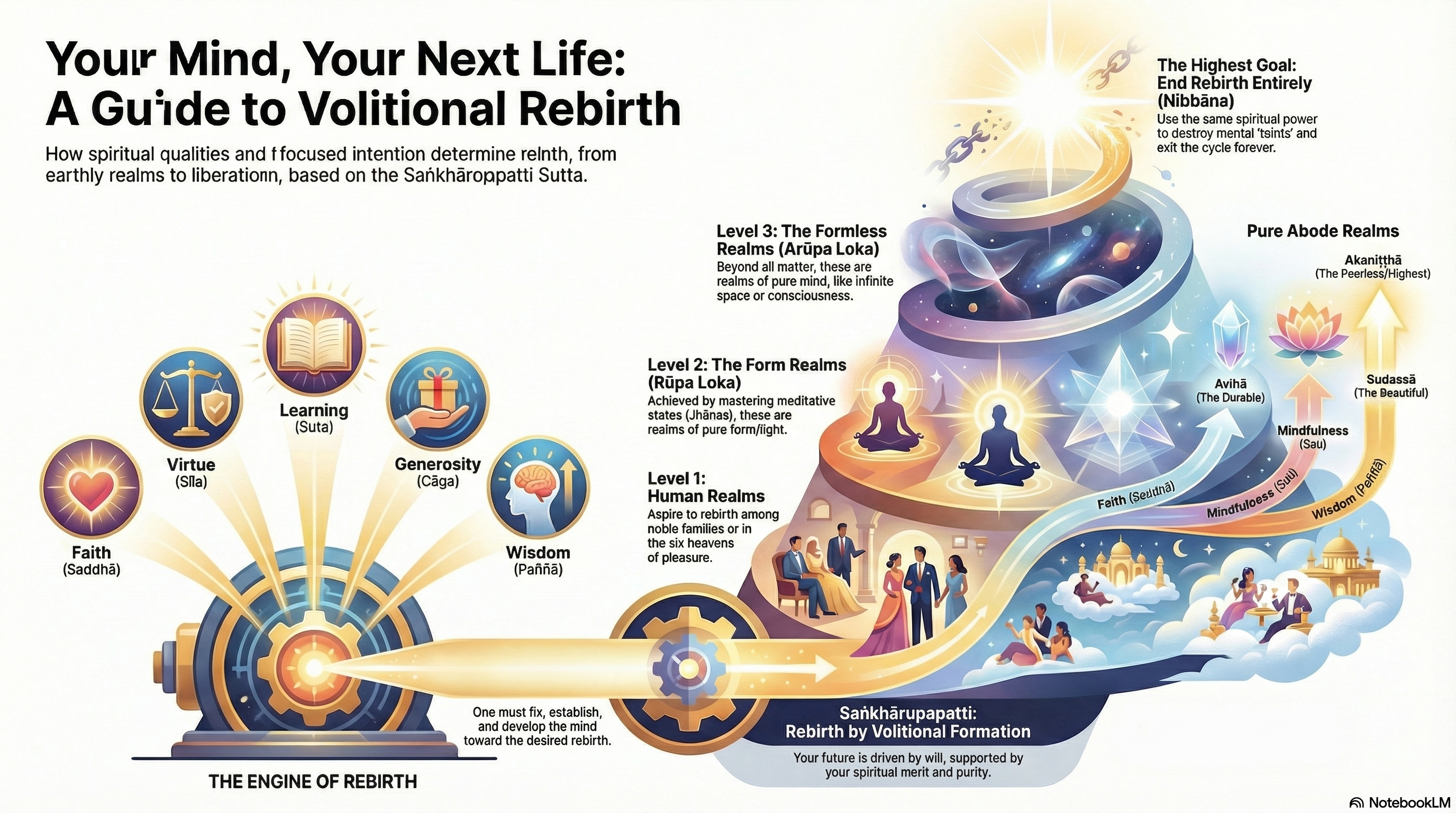 VISUAL SUMMARYSee this sutta in a pictureOpen the complete infographic for a visual overview before or after reading the full study.View infographic →
Do Not Read MN 120 as “Wish Hard and Choose a Rebirth”
Directing Rebirth—or Ending Rebirth Entirely
A structured study of how saddhā, sīla, suta, cāga, paññā, concentrated aspiration, and repeated mental development can support rebirth in chosen realms—while the highest use of these qualities is the destruction of the āsavas and freedom from all further arising.
The repeated structure is more disciplined than simple wishing: the practitioner is described as possessing saddhā, sīla, suta, cāga and paññā, then setting, establishing and developing the mind toward a destination. The discourse finally uses the same developed life not for another destination, but for the ending of the āsavas.
| Topic | Relation to MN 120 | Layer |
|---|---|---|
| Five qualities | Explicitly repeated in MN 120 | Core |
| Set / establish / develop the mind toward a destination | Explicit repeated formula | Core |
| Human, deva, Brahmā, higher-form and formless destinations | Explicitly listed | Core |
| Specific jhāna-to-realm mechanics | Added explanatory framework in the source; not spelled out in MN 120’s repeated formula | Interpretive / cross-textual |
| Five Pure Abodes mapped one-to-one to five faculties | Source itself attributes this to commentators | Commentarial |
| Detailed kasiṇa method for the four formless attainments | Practice explanation added beyond MN 120 | Later/practice framework |
| Maintain purity until cuti-citta | Abhidhamma-style explanatory language, not MN 120 wording | Later framework |
| Use jhāna for vipassanā rather than rebirth | A reasonable liberation-oriented synthesis, but the worded instruction is not the final formula of MN 120 itself | Editorial synthesis |
Introduction and Setting
This sutta explains how a practitioner, possessing specific spiritual qualities, can direct their mind to determine their future rebirth. However, it culminates in the highest aspiration: the ending of all rebirth.
1. Introduction (Nidāna)
Evaṁ me sutaṁ— ekaṁ samayaṁ bhagavā sāvatthiyaṁ viharati jetavane anāthapiṇḍikassa ārāme. Tatra kho bhagavā bhikkhū āmantesi: “bhikkhavo”ti. “Bhadante”ti te bhikkhū bhagavato paccassosuṁ. Bhagavā etadavoca:
This is the standard opening of a Sutta. It sets the scene in Sāvatthī, at Jeta’s Grove. The Buddha addresses the monks to initiate the teaching.
Etymology of Key Words:
Bhagavā: Often translated as “The Blessed One” or “Lord.” It comes from bhaga (fortune, luck, or portion) + vant (possessor of). It implies one who possesses good fortune and spiritual majesty.
Viharati: From vi (separation/intensifier) + harati (to carry/walk). It means “dwells” or “lives,” implying a specific mode of lifestyle (in this case, the monastic lifestyle).
Sāvatthiyaṁ: Locative case of Sāvatthī, the capital of the Kosala Kingdom, the Buddha’s primary base of operations.
The Proposition: Saṅkhārupapatti
“saṅkhārupapattiṁ vo, bhikkhave, desessāmi, taṁ suṇātha, sādhukaṁ manasi karotha, bhāsissāmī”ti. “Evaṁ, bhante”ti kho te bhikkhū bhagavato paccassosuṁ. Bhagavā etadavoca:
The Buddha announces the topic: Saṅkhārupapatti. He asks them to listen closely (suṇātha) and attend carefully (sādhukaṁ manasi karotha).
Etymology of Key Words:
Saṅkhārupapatti: This is a compound of Saṅkhāra + Upapatti.
Saṅkhāra (Sam + √kṛ): “To put together,” “prepare,” or “form.” In this context, it refers to Volitional Formations or mental aspirations supported by karma.
Upapatti (Upa + √pad): “Stepping onto,” “arising,” or “rebirth.”
Meaning: “Rebirth according to one’s aspirations/will.”
Manasi karotha: Manasi (in the mind) + karotha (do/make). Literally “do it in the mind,” meaning to pay attention or reflect.
Five Qualities + Repeated Mental Development
| Quality | Working translation | Role in the discourse |
|---|---|---|
| Saddhā | Faith / confidence | One of the five qualities explicitly repeated throughout MN 120. |
| Sīla | Ethical conduct | One of the five qualities explicitly repeated throughout MN 120. |
| Suta | Learning / what has been heard | One of the five qualities explicitly repeated throughout MN 120. |
| Cāga | Generosity / relinquishment | One of the five qualities explicitly repeated throughout MN 120. |
| Paññā | Wisdom / discernment | One of the five qualities explicitly repeated throughout MN 120. |
Possess the five qualities — Saddhā, sīla, suta, cāga and paññā form the repeated basis.
A destination is taken up — The practitioner forms an aspiration toward a particular rebirth.
The mind is settled, established and developed — The repeated formula is: taṁ cittaṁ dahati, taṁ cittaṁ adhiṭṭhāti, taṁ cittaṁ bhāveti.
The mental formation is repeatedly cultivated — The sutta says the saṅkhārā and vihārā, developed and cultivated in this way, lead to rebirth there.
The final use is different — The same developed practitioner turns toward destruction of the āsavas and is not reborn anywhere.
Aspiration is not presented in isolation. The discourse repeatedly couples it with already-developed wholesome qualities and with a mind that is intentionally developed and cultivated.
The Five Foundational Qualities
“Idha, bhikkhave, bhikkhu saddhāya samannāgato hoti, sīlena samannāgato hoti, sutena samannāgato hoti, cāgena samannāgato hoti, paññāya samannāgato hoti.
Here, the Buddha lays out the prerequisites. One cannot simply wish for a high rebirth; one must have the spiritual “capital” to pay for it. The monk must possess five specific qualities.
Etymology of Key Words:
Saddhā (Faith): From sam + dhā (to place/put). To “place one’s heart on.” It implies confidence, trust, and conviction in the Dhamma.
Sīla (Virtue): From root sī (to bind/compose) or associated with sītala (coolness). It refers to ethical conduct that binds one to goodness and cools the fires of regret.
Suta (Learning): From root su (to hear). In an oral culture, a learned person was “one who has heard much.”
Cāga (Generosity): From root caj (to abandon/give up). It is the letting go of stinginess and attachment to material things.
Paññā (Wisdom): Pa (intensive prefix) + ñā (to know). Deep, penetrative understanding of reality.
Aspiration for Human Rebirth
Tassa evaṁ hoti: ‘aho vatāhaṁ kāyassa bhedā paraṁ maraṇā khattiyamahāsālānaṁ sahabyataṁ upapajjeyyan’ti. So taṁ cittaṁ dahati, taṁ cittaṁ adhiṭṭhāti, taṁ cittaṁ bhāveti. Tassa te saṅkhārā ca vihārā ca evaṁ bhāvitā evaṁ bahulīkatā tatrupapattiyā saṁvattanti. Ayaṁ, bhikkhave, maggo ayaṁ paṭipadā tatrupapattiyā saṁvattati.
Explanation:
Possessing the five qualities, the monk forms a wish: “Oh, that after death, I might be reborn in the company of wealthy nobles (khattiyamahāsālā).”
He fixes his mind (adhiṭṭhāti) and develops it (bhāveti). Because his mind is pure (due to the five qualities) and focused, this aspiration leads to rebirth there.
Etymology of Key Words:
Khattiyamahāsāla: Khattiya: Warrior/Noble caste (Sanskrit: Kshatriya).
Mahā (Great) + Sāla (Sal tree). The Sal tree is a symbol of majesty. “Like a great Sal tree.” This idiom denotes a wealthy, established family.
Sahabyataṁ: Saha (together) + bhāva (being/state). “In the company of” or “status of.”
Adhiṭṭhāti: Adhi (over/on) + sthā (stand). To “stand upon” a decision; to determine or resolve.
(Note: The Sutta repeats this formula for Brāhmaṇamahāsālānaṁ (Wealthy Brahmins) and Gahapatimahāsālānaṁ (Wealthy Householders). The mechanism is identical.)
Human → Deva → Brahmā → Higher Form → Formless → No Rebirth
| Destination band | Examples | Status |
|---|---|---|
| Human rebirth | Well-to-do aristocrat, brahmin or householder families | Directly in MN 120 |
| Sensual heavens | The six kāma-deva realms | Directly in MN 120 |
| Brahmā world-systems | Thousandfold through hundred-thousandfold Brahmā systems | Directly in MN 120 |
| Higher form realms | Radiance / beauty realms, Vehapphala and the Pure Abodes | Directly listed in MN 120 |
| Formless realms | Infinite space, infinite consciousness, nothingness, neither-perception-nor-non-perception | Directly listed in MN 120 |
| No further rebirth | Destruction of the āsavas; liberation here and now | The discourse’s culminating alternative |
The old page separated every realm band into another accordion but did not make the overall movement obvious. The V3 structure first shows the complete arc, then preserves the detailed source treatment below.
The Six Sensual Heavens
Puna caparaṁ… Tassa sutaṁ hoti: ‘cātumahārājikā devā… tāvatiṁsā… yāmā… tusitā… nimmānaratī… paranimmitavasavattī devā dīghāyukā vaṇṇavanto sukhabahulā’ti… So taṁ cittaṁ dahati…
Explanation:
The monk hears (sutaṁ hoti) that the Devas of the various heavens are long-lived, beautiful, and happy. He aspires to join them. This covers the six heavens of the Sense Sphere.
Etymology of Key Words (The 6 Heavens):
Cātumahārājikā: “Belonging to the Four (catu) Great (mahā) Kings (rāja).” Guardians of the four directions.
Tāvatiṁsā: “The Thirty-Three.” (Vedic Trayastriṃśa). The realm presided over by Sakka (Indra).
Yāmā: “Those who have gone to bliss” or “The Watchers.” They are removed from earthly time.
Tusitā: From tus (to be satisfied/pleased). The “Contented Ones.” The Bodhisatta dwells here before his final birth.
Nimmānaratī: Nimmāna (Creation) + rati (delight). “Those who delight in their own creations.” They manifest whatever they desire.
Paranimmitavasavattī: Para (other) + nimmita (created) + vasa (power/control) + vattī (wielder). “Those who wield power over what is created by others.” The highest sensual heaven.
The Brahma Realms and Vast World Systems
Tassa sutaṁ hoti: ‘sahasso brahmā dīghāyuko vaṇṇavā sukhabahulo’ti. Sahasso, bhikkhave, brahmā sahassilokadhātuṁ pharitvā adhimuccitvā viharati… Seyyathāpi, bhikkhave, cakkhumā puriso ekaṁ āmaṇḍaṁ hatthe karitvā paccavekkheyya…
Explanation:
Here the sutta shifts from sensual heavens to the Brahma worlds (Form Realm).
The Buddha describes a “Thousandfold Brahma” (Sahasso brahmā) who pervades a system of 1,000 worlds (sahassilokadhātu).
The Buddha uses a simile: Just as a man might hold a castor oil nut (āmaṇḍa) in his hand and inspect it, this Brahma inspects 1,000 world systems.
Etymology of Key Words:
Lokadhātu: Loka (world) + dhātu (element/constituent part). A “World System” (solar system/galaxy).
Pharitvā: From pharati (to pervade/spread/suffuse). This refers to the mental power of the Brahma to spread his consciousness across vast distances.
Adhimuccitvā: Adhi + muc (to release/resolve). To focus intent upon.
(The text proceeds to scale this up:)
2,000 – 5,000 Worlds: Simile of holding five nuts.
10,000 Worlds: Simile of a Beryl gem (maṇi veḷuriyo) on a red rug (paṇḍukambale), glowing and shining.
100,000 Worlds: Simile of a gold ornament (nikkha) on a red rug.
Higher Form Realms and the Pure Abodes
…ābhā devā… ābhassarā… subhakiṇhā… vehapphalā… avihā… atappā… sudassā… sudassī… akaniṭṭhā…
Explanation:
The monk aspires to higher states of Jhanic existence. These correspond to the Second, Third, and Fourth Jhanas.
Etymology of Key Words:
Ābhassarā: Ābhā (radiance) + sara (flowing/streaming). “Streaming Radiance.” (Corresponds to 2nd Jhana).
Subhakiṇhā: Subha (glory/beauty) + kiṇṇa (scattered/pervaded). “Refulgent Glory.” (Corresponds to 3rd Jhana).
Vehapphalā: Veha (great/vast) + phala (fruit). “Great Reward.” (4th Jhana).
The Pure Abodes (Suddhāvāsa): Accessible only to Non-Returners (Anagamis).
Avihā: Not falling / Durable.
Atappā: Untroubled / Serene (literally “not tormented”).
Sudassā: Beautiful / Clear-sighted.
Akaniṭṭhā: A (not) + kaniṭṭha (younger/lesser). “Peerless” or “Highest.”
The Four Formless Realms
…ākāsānañcāyatanūpagā devā… viññāṇañcāyatanūpagā… ākiñcaññāyatanūpagā… nevasaññānāsaññāyatanūpagā…
Explanation:
The monk aspires to the four Formless (Arūpa) realms.
Etymology of Key Words:
Ākāsānañcāyatana: Ākāsa (Space) + ananta (endless) + āyatana (base). “The Base of Infinite Space.”
Viññāṇañcāyatana: Viññāṇa (Consciousness) + ananta + āyatana. “The Base of Infinite Consciousness.”
Ākiñcaññāyatana: Akiñcana (nothing/not anything) + āyatana. “The Base of Nothingness.”
Nevasaññānāsaññā: Neva (neither) + saññā (perception) + na (nor) + asaññā (non-perception). The limit of mental existence.
Based on the Saṅkhārupapatti Sutta (MN 120) and the broader context of cosmology and meditation practice, entering the Rūpa (Form) and Arūpa (Formless) realms is not merely a matter of traveling to a place. It is a matter of tuning the frequency of the mind.
The fundamental principle is: To be reborn as a Brahma (divine being), one must cultivate the mind of a Brahma in this life.
Here is the detailed explanation of how to enter these realms:
The Five Pure Abodes Need Their Own Boundary
MN 120 lists the Pure Abodes within its graduated destination sequence. The wider early-Buddhist framework treats these realms as the destination of non-returners. The source then adds a detailed one-to-one mapping of the five Pure Abodes to the five spiritual faculties and explicitly identifies that mapping as commentarial.
| Pure Abode | Dominant faculty in source | Editorial status |
|---|---|---|
| Avihā | Saddhā | The source assigns a dominant faculty; this mapping is presented there as commentarial. |
| Atappā | Viriya | The source assigns a dominant faculty; this mapping is presented there as commentarial. |
| Sudassā | Sati | The source assigns a dominant faculty; this mapping is presented there as commentarial. |
| Sudassī | Samādhi | The source assigns a dominant faculty; this mapping is presented there as commentarial. |
| Akaniṭṭhā | Paññā | The source assigns a dominant faculty; this mapping is presented there as commentarial. |
The detailed characteristics such as “entry-level,” “highest wisdom,” fixed lifespan, and the dominant-faculty assignments are retained as the source’s expanded interpretation. They should not be visually confused with the short MN 120 realm list itself.
The Five Pure Abodes in Detail
This entire detailed Pure-Abode treatment is an expansion beyond the wording of MN 120. The source itself explicitly invokes commentarial explanation for its five-faculty mapping.
These five realms are arranged hierarchically. Commentators (like in the Visuddhimagga) explain that rebirth into a specific level depends on which of the Five Spiritual Faculties (Indriya) was dominant in the meditator’s practice.
Avihā (The Durable / The Non-Falling)
Dominant Faculty: Saddhā (Faith/Confidence).
Characteristics: In other realms, beings might die before their full lifespan is exhausted (due to karma cutting it short). In Avihā, beings are so fixed in their destiny that they live the complete, fixed lifespan without “falling” away early. They are “fixed” in their determination to attain Nibbāna.
Nature of Existence: This is the entry-level of the Pure Abodes. Even here, the refinement of matter is incredibly subtle.
Atappā (The Untroubled / The Serene)
Dominant Faculty: Viriya (Energy/Effort).
Characteristics: Why is “Energy” associated with “No Torment”? Because their effort is not a struggle. It is a purified, cool energy that does not burn. They are not tormented by the “heat” of creative anxiety or the desire for becoming. Their mental peace is profound.
Sudassā (The Beautiful / The Clearly Visible)
Dominant Faculty: Sati (Mindfulness).
Characteristics: Because their mindfulness (sati) is strong, their clarity of presence manifests as extreme radiance and beauty. “Beautiful” here refers not just to “visual” beauty (though they are described as radiant), but to the beauty of their visible manifestation or “presence.” They are the “object” of clear sight.
Sudassī (The Clear-Sighted / The Visionaries)
Dominant Faculty: Samādhi (Concentration).
Characteristics: With Samādhi as their dominant faculty, their vision is unobstructed. They can see the Dhamma with immense clarity.
They possess a penetrative insight into the nature of phenomena.
Akaniṭṭhā (The Peerless / The Highest)
Dominant Faculty: Paññā (Wisdom).
Characteristics:
This is the ceiling of the universe of Form (Rūpa Loka). Beyond this lie only the Formless (Arūpa) realms.
It is the abode of the highest wisdom.
This is the final destination for the type of Non-Returner known as Uddhaṁsota Akaniṭṭhagāmi (“One whose stream flows upward to Akaniṭṭha”). They may be born in lower Pure Abodes and evolve upward until they reach Akaniṭṭha, where they attain Arahantship and pass into Parinibbāna (Final Extinguishment).
Summary of the Path through the Pure Abodes
In the Saṅkhārupapatti Sutta, the Buddha mentions aspiring to these realms. However, unlike the lower heavens where one simply needs merit and generic Jhana, aspiring to the Pure Abodes requires the Magga-Phala (Path and Fruit) of the Non-Returner.
Preparation: The bhikkhu develops the Five Faculties (Faith, Energy, Mindfulness, Concentration, Wisdom).
Attainment: He eradicates the five lower fetters.
Rebirth: Upon death, he bypasses the sensory world.
Finality: In the Pure Abodes, there is no falling back. The only movement is “up” toward Nibbāna. It is the waiting room for total liberation.
What the Essay Adds About Jhāna and the Formless Attainments
MN 120 explicitly repeats the five qualities and the development of the mind toward a destination, but it does not give the essay’s full technical sequence of “first jhāna → this realm,” “second jhāna → that realm,” kasiṇa expansion, emerging from fourth jhāna, or maintaining purity until cuti-citta. Those explanations may be studied from the broader tradition, but they belong to a different layer from the direct wording of MN 120.
The four formless destinations
| Pāḷi | Realm / attainment |
|---|---|
| Ākāsānañcāyatana | Base of Infinite Space |
| Viññāṇañcāyatana | Base of Infinite Consciousness |
| Ākiñcaññāyatana | Base of Nothingness |
| Nevasaññānāsaññāyatana | Base of Neither-Perception-Nor-Non-Perception |
The source contains many pedagogical word derivations—for example for sīla, jhāna, Bhagavā, realm names and compounds. They are preserved in the source modules, but should not be treated as established historical linguistics unless separately verified.
Foundation for Rūpa and Arūpa Attainments
The detailed jhāna-to-realm method is a cross-textual practice explanation supplied by the essay, not a step-by-step instruction stated in MN 120.
As stated in MN 120, before one can aspire to these high realms, one must possess the “Five Spiritual Assets”:
Saddhā (Faith/Confidence)
Sīla (Moral Purity)
Suta (Learning/Knowledge of Dhamma)
Cāga (Generosity/Letting go)
Paññā (Wisdom)
Without Sīla (virtue), the mind remains agitated by remorse (vippaṭisāra) and cannot achieve the deep concentration required for these realms.
Entering the Rūpa Loka (The Fine-Material Realm)
The Rūpa Loka is the realm of pure spiritual form/light, free from coarse sensual desire (kāma). To be reborn here, one must master the Rūpa Jhānas (Absorptions of Form).
Etymology:
Jhāna: From the root jhe (to meditate/think closely) or jhā (to burn up). It implies burning up the “hindrances” (lust, anger, sloth, worry, doubt) and looking closely at a meditation object.
The Method: Samatha (Tranquility Meditation)
To reach these levels, a meditator focuses on a conceptual object (like the breath, a kasina disk of earth or light, or the Divine Abidings like Loving-kindness).
A. The First Jhana -> Rebirth in the Realm of Brahma’s Retinue
Practice: Withdrawing from sensual desires (kāma) and unwholesome states (akusala).
Mental Factors: The mind still has Vitakka (applied thought) and Vicāra (sustained thought), but is filled with Pīti (rapture) and Sukha (bliss) born of seclusion.
Result: Rebirth in the Brahma Parisajja (Retinue of Brahma) or Mahā Brahma realms.
B. The Second Jhana -> Rebirth in the Ābhassarā (Radiant) Realm
Practice: Quieting the thinking process (subsiding of vitakka and vicāra).
Mental Factors: Pure internal confidence (sampasādana) and unification of mind (ekodibhāva). The rapture (pīti) is intense.
Result: Rebirth in the Ābhassarā world (World of Streaming Radiance).
C. The Third Jhana -> Rebirth in the Subhakiṇhā (Glory) Realm
Practice: Letting go of the excitement of rapture (pīti).
Mental Factors: One dwells in equanimity (upekkhā), mindful (sato) and clearly comprehending (sampajāno), experiencing a more subtle, spiritual pleasure (sukha).
Result: Rebirth in the Subhakiṇhā world (World of Refulgent Glory).
D. The Fourth Jhana -> Rebirth in the Vehapphalā (Great Fruit) Realm
Practice: Abandoning pleasure and pain, joy and grief.
Mental Factors: Purity of mindfulness due to equanimity (upekkhā-sati-pārisuddhi). The breath becomes so subtle it appears to stop.
Result: Rebirth in the Vehapphalā world.
Alternative Method: The Brahma-Vihāras
One can also enter the Rūpa realms by cultivating the Four Divine Abidings to a boundless degree:
Mettā (Loving-kindness)
Karuṇā (Compassion)
Muditā (Sympathetic Joy)
Upekkhā (Equanimity)
Entering the Arūpa Loka
The detailed kasiṇa sequence for the four formless attainments is preserved as supplied, but it should be read as a later practice explanation rather than the wording of MN 120.
The Arūpa Loka is entirely devoid of matter. There is no body, no shape, only pure mind. To enter here, one must master the Arūpa Jhānas. This requires taking the Fourth Rūpa Jhana as a base and then removing the “concept of form/matter” entirely.
Etymology:
Arūpa: A (not/without) + Rūpa (form/matter).
Āyatana: Base, sphere, or dimension.
The Method: Transcending the Image
A. The Base of Infinite Space (Ākāsānañcāyatana)
How: The meditator emerges from the 4th Jhana. If they were focusing on a visual object (like a colored disk), they mentally expand that image until it loses its edges, then remove the image entirely, focusing only on the “space” occupied by it. They think: “Space is infinite” (ananto ākāso).
Result: Rebirth in the Realm of Infinite Space.
B. The Base of Infinite Consciousness (Viññāṇañcāyatana)
∫The meditator realizes that for “infinite space” to exist, there must be a consciousness aware of it. They turn their attention from the object (space) to the subject (awareness). They think: “Consciousness is infinite” (anantaṁ viññāṇaṁ).
Result: Rebirth in the Realm of Infinite Consciousness.
C. The Base of Nothingness (Ākiñcaññāyatana)
How: The meditator lets go of the active consciousness. They focus on the absence or void left behind. They focus on the thought: “There is nothing” (natthi kiñci).
Etymology: Akiñcana (nothingness) comes from a (no) + kiñcana (something/possession/attachment).
Result: Rebirth in the Realm of Nothingness.
D. The Base of Neither-Perception-Nor-Non-Perception (Nevasaññānāsaññāyatana)
How: This is the highest limit of samsara. The state is so subtle that one cannot say perception exists (because it is too gross), nor that it doesn’t exist (because there is still a residual sensitivity). The mind becomes incredibly refined.
Result: Rebirth in the Realm of Neither-Perception-Nor-Non-Perception.
Directing the Mind through Saṅkhāra
The source’s references to a specific jhāna prerequisite, adhiṭṭhāna after emerging from jhāna, and maintenance until cuti-citta are explanatory additions. The repeated MN 120 formula itself emphasizes developed qualities and repeated development of the mind.
As MN 120 explains, merely having the Jhana is not enough; one must direct the mind.
So taṁ cittaṁ dahati, taṁ cittaṁ adhiṭṭhāti, taṁ cittaṁ bhāveti. He fixes that mind, establishes that mind, develops that mind.
The Process Summary:
Sīla: Establish moral purity to prevent regret.
Samādhi: Attain the specific Jhana level corresponding to the realm you wish to enter.
Adhiṭṭhāna (Resolve): Emerging from that Jhana, one must make a determination: “May I be reborn in the company of the [Specific] Devas.”
Maintenance: One must maintain this level of mental purity until the moment of death (Cuti-citta).
Important Warning from the Sutta
While the Buddha explains how to do this, he ends the Sutta with the “highest” aspiration: Nibbāna.
Entering Rūpa or Arūpa realms provides massive lifespans (aeons long), but they are impermanent (anicca). Eventually, the karma is exhausted, and the being falls back to lower realms. The Buddha advises using the concentrated mind of the Jhanas not to be reborn, but to practice Vipassanā (Insight) to end rebirth entirely.
The Final Destination Is the Ending of Destination-Making
“Āsavānaṁ khayā … diṭṭheva dhamme …” — the practitioner turns toward the destruction of the āsavas and realizes liberation in this very life.
“Na katthaci upapajjati.” — the discourse closes by saying that such a mendicant is not reborn anywhere.
The source sometimes speaks as if MN 120 merely teaches a technology for choosing realms and then recommends switching to “Vipassanā.” The actual final passage is stronger and simpler: it culminates in destruction of the āsavas, undefiled freedom of mind and freedom by wisdom, realized here and now.
The Highest Aspiration: Ending Rebirth
The Pāḷi climax is the strongest canonical endpoint of the article: destruction of the āsavas, realization here and now, and ‘na katthaci upapajjati‘—not reborn anywhere. The source’s final summary adds broader explanatory claims that are retained but not treated as quotations from MN 120.
Tassa evaṁ hoti: ‘aho vatāhaṁ āsavānaṁ khayā anāsavaṁ cetovimuttiṁ paññāvimuttiṁ diṭṭheva dhamme sayaṁ abhiññā sacchikatvā upasampajja vihareyyan’ti. So āsavānaṁ khayā anāsavaṁ… viharati. Ayaṁ, bhikkhave, bhikkhu na katthaci upapajjatī”ti.
This is the climax of the Sutta. The monk uses his five qualities (faith, virtue, learning, generosity, wisdom) not to wish for a new existence, but to destroy the “Taints.”
Because he resolves to end the taints, he realizes liberation here and now (diṭṭheva dhamme).
The text concludes: “This monk, bhikkhus, does not arise anywhere” (na katthaci upapajjatī).
Etymology of Key Words:
Āsava (Taints): From ā (towards/in) + sru (to flow). Literally “influxes.” These are deep-seated mental corruptions that “flow” into the mind and keep one bound to samsara (sensuality, becoming, ignorance).
Khayā: Destruction/Ending.
Cetovimutti: Ceto (mind/heart) + vimutti (liberation). Liberation of the mind (usually from concentration/samadhi).
Paññāvimutti: Liberation by Wisdom (insight into impermanence, suffering, and non-self).
Sacchikatvā: Sacchi (with one’s own eyes/real) + katvā (having made). “Having realized.”
Summary
This Sutta teaches that rebirth is not random nor by will by God nor by just karma or deeds ; it is driven by volition (saṅkhāra) supported by merit (faith, sila, etc.). While one can use this power to choose a happy heaven, the Buddha implies that the same energy and qualities are best used to destroy the taints entirely and end the cycle of rebirth.