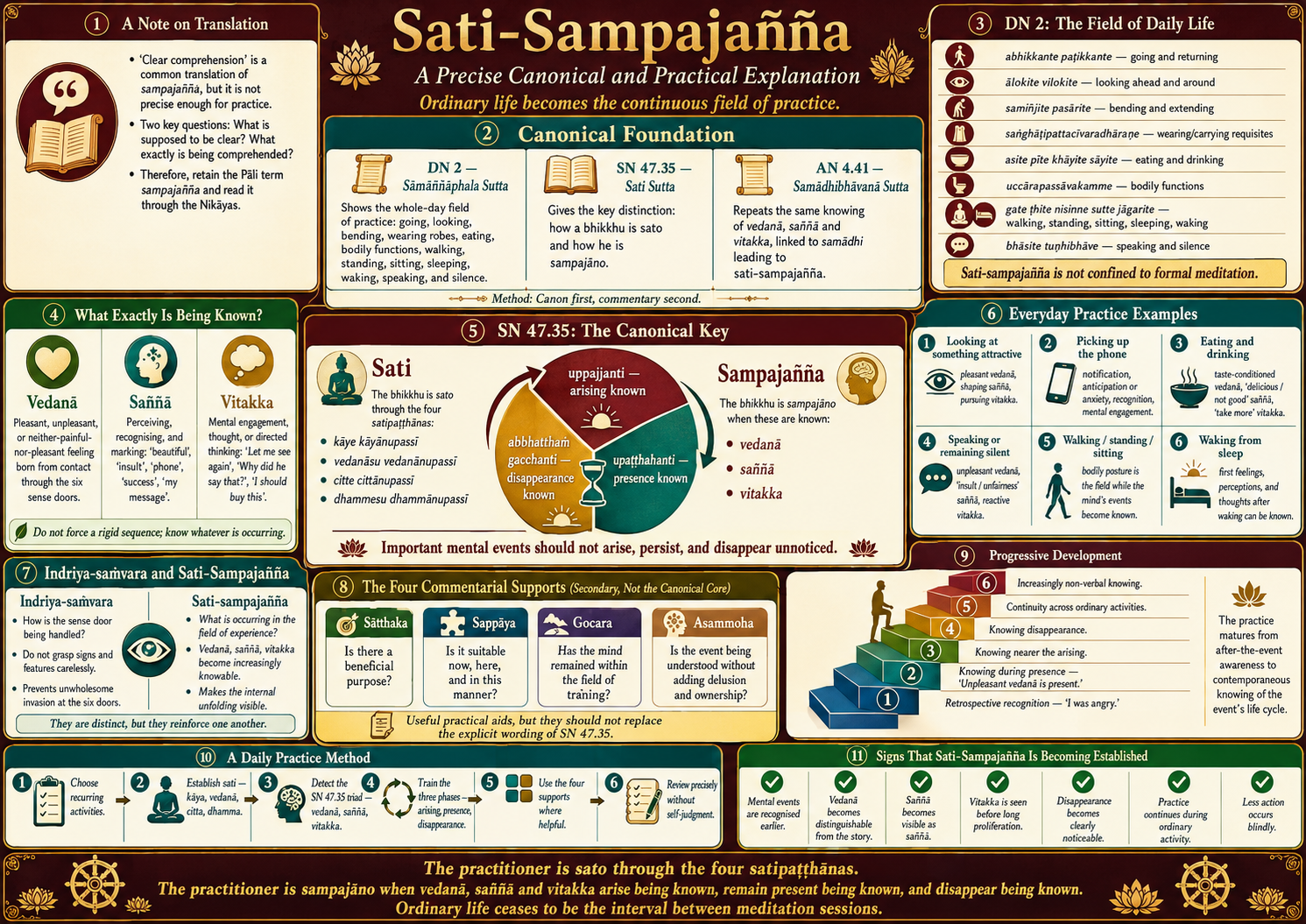
 VISUAL SUMMARYSee this study in a pictureOpen the complete infographic for a visual overview before or after reading the full study.View infographic →
SN 47.35 — sato & sampajāno→
AN 4.41 — samādhi confirmation→
Four commentarial supports→
Continuous ordinary-life training
A note on translation
The English expression “clear comprehension” is commonly used for sampajañña, but it is not sufficiently precise for practice. It sounds explanatory while leaving two essential questions unanswered:
- What is supposed to be “clear”?
- What exactly is being “comprehended”?
For that reason, this essay will normally retain the Pāli term sampajañña rather than treating “clear comprehension” as its definition.
The method used here is deliberately text-based:
- DN 2 Sāmaññaphala Sutta gives the range of ordinary activities in which a bhikkhu is sampajānakārī—one acting with sampajañña.
- SN 47.35 Sati Sutta explicitly asks how a bhikkhu is sato and how he is sampajāno, and therefore gives us an unusually important canonical key for understanding the two terms.
- AN 4.41 Samādhibhāvanā Sutta repeats the same knowing of vedanā, saññā and vitakka in connection with the development of samādhi that leads to sati-sampajañña.
- The later commentarial analysis of sātthaka, sappāya, gocara and asammoha is used only after this canonical foundation has been established.
The aim is therefore not to force an English definition onto the Pāli, but to ask:
What does the Buddha actually say a person who is sato and sampajāno does?
01
The DN 2 field of practice: sampajañña during the whole day
The starting passage is:
Kathañca, mahārāja, bhikkhu satisampajaññena samannāgato hoti?
The Buddha then says that the bhikkhu acts with sampajañña while:
- going forward and returning,
- looking ahead and looking around,
- bending and extending,
- wearing and carrying robes and bowl,
- eating, drinking, chewing and tasting,
- urinating and defecating,
- walking,
- standing,
- sitting,
- sleeping,
- waking,
- speaking,
- and remaining silent.
The important point is immediately visible:
Sati-sampajañña is not confined to a formal meditation period.
The body is moving through ordinary life, the sense doors are functioning, speech is taking place, food is being eaten, decisions are being made, and mental events are occurring continuously.
The entire waking life becomes the field of training.
However, the DN 2 formula by itself still leaves a question:
When one is “sampajānakārī” while walking, looking, eating or speaking, what exactly is to be known?
For that, SN 47.35 becomes extremely important.
02
SN 47.35 gives the canonical interpretive key
In SN 47.35 Sati Sutta, the Buddha says that a bhikkhu should dwell sato sampajāno.
He then asks two separate questions:
How is a bhikkhu sato?
and:
How is a bhikkhu sampajāno?
This distinction is invaluable because it prevents us from collapsing sati and sampajañña into one vague idea such as “present-moment awareness.”
For sato, the Buddha gives the four satipaṭṭhānas:
- kāye kāyānupassī — contemplating body as body,
- vedanāsu vedanānupassī — contemplating vedanā as vedanā,
- citte cittānupassī — contemplating citta as citta,
- dhammesu dhammānupassī — contemplating dhammas as dhammas,
with ardency, sampajañña and sati, having removed covetousness and displeasure regarding the world.
Thus, in this sutta, we should not reduce sati merely to “remembering the practice.” The Buddha operationally describes the sato bhikkhu through the four satipaṭṭhānas.
Then comes the decisive question:
Kathañca, bhikkhave, bhikkhu sampajāno hoti?
The Buddha describes three kinds of phenomena as being viditā—known:
- vedanā,
- vitakkā,
- saññā.
For each, the same threefold pattern is given:
viditā … uppajjanti — they arise being known,
viditā … upaṭṭhahanti — they are present being known,
viditā … abbhatthaṁ gacchanti — they go to disappearance being known.
This is the crucial canonical clarification.
Sampajañña is therefore not adequately explained by saying:
“I clearly comprehend that I am walking.”
SN 47.35 directs attention to a much more penetrating accomplishment:
While experience is unfolding, vedanā, vitakka and saññā are not occurring unnoticed. Their arising is known, their presence is known, and their disappearance is known.
03
AN 4.41 confirms that this is not an incidental formula
The importance of the SN 47.35 description becomes even stronger when we compare AN 4.41 Samādhibhāvanā Sutta.
There the Buddha describes a development of samādhi which, when developed and cultivated, leads to sati-sampajañña.
Again the same three kinds of phenomena are specified:
- vedanā,
- saññā,
- vitakka,
and again they are known in their:
arising → presence → disappearance.
The order of saññā and vitakka differs from SN 47.35, but the same triad is present.
This comparison is important for two reasons.
First, it confirms that knowing these phenomena in this threefold manner is directly connected in the Nikāyas with sati-sampajañña.
Second, AN 4.41 connects this capacity with developed samādhi. Therefore, the mature ability to know these events as they arise, remain present and disappear should not be mistaken for casual mental commentary about what one is doing.
It is a cultivated capacity of the mind.
04
What exactly is being known?
SN 47.35 names three phenomena. Each deserves careful attention.
4.1 Vedanā
Vedanā should not be reduced to bodily “sensation.”
Vedanā occurs in dependence on contact through the six sense doors and is experienced as:
- pleasant,
- unpleasant,
- or neither-painful-nor-pleasant.
Therefore, when seeing something attractive, hearing criticism, remembering an event, tasting food, or thinking about the future, vedanā may arise.
The training is not merely:
“There is a sensation in the body.”
It is:
Was a pleasant, unpleasant or neither-painful-nor-pleasant vedanā born from this contact, and was its arising actually known?
Then:
While it remained present, was it known as present?
And:
When it disappeared, was its disappearance known?
This is already much more demanding than general present-moment awareness.
4.2 Saññā
Saññā performs the work of perceiving, recognising and marking characteristics so that an object is apprehended in a particular way.
Seeing colour and shape may very quickly become:
“phone,”
“my message,”
“that person,”
“expensive watch,”
“insult,”
“success,”
“failure.”
The practical point is not to theorise about saññā while the event is occurring.
The point is that saññā itself becomes knowable as an arising conditioned event.
One can begin to detect that the mind has recognised, classified or interpreted something in a certain way rather than simply living inside that interpretation as though it were unquestionable reality.
Again:
arising known → presence known → disappearance known.
4.3 Vitakka
Vitakka is often translated as “thought,” “thinking,” “directed thought,” or mental application. No single English word captures every usage, so retaining the Pāli is useful.
In practical life, after an object has become significant, the mind may begin engaging it:
“Let me look again.”
“Why did he say that?”
“I should buy this.”
“Tomorrow I will answer him.”
“What if this happens?”
The crucial question is not whether vitakka is permitted to arise.
The training is:
Did vitakka arise known, remain known, and disappear known?
This changes the relationship with thought profoundly.
Instead of vitakka automatically becoming the world in which one lives, vitakka itself becomes a known event.
05
Do not impose a fixed sequence on vedanā, saññā and vitakka
For teaching convenience, it is tempting to construct a rigid sequence such as:
saññā → vedanā → vitakka
or:
vedanā → saññā → vitakka.
SN 47.35 does not do this.
It names vedanā, vitakka and saññā and requires each to be known in its arising, presence and disappearance.
Therefore the practitioner should not force experience into an artificial order merely because a diagram is easier to remember.
Different conditions may make one aspect more obvious than another.
The essential requirement is:
Whatever of these phenomena is occurring should cease to occur unrecognised.
That is a much safer and more precise practical principle.
06
What does “viditā” change in practice?
The repeated word viditā—known is the heart of the SN 47.35 instruction.
The training is not merely to reconstruct an event afterwards.
For example:
“Ten minutes ago I became angry.”
That retrospective recognition is useful, but it is not yet the full accomplishment described in the sutta.
The development becomes progressively sharper:
Late knowing
“I was angry.”
Earlier knowing
“Anger is present.”
Finer knowing
“An unpleasant vedanā is present.”
“A particular saññā has formed around what was heard.”
“Vitakka is repeatedly returning to it.”
Mature direction of practice
The arising itself is known.
The phenomenon remains present without being lost from knowing.
Its disappearance is also known.
The practice is therefore moving from after-the-event awareness toward contemporaneous knowing of the event’s life cycle.
07
Arising, presence and disappearance: the complete practical unit
Many practitioners notice only the middle phase.
For example:
“Pleasant feeling is present.”
But SN 47.35 gives three phases.
Uppajjanti — arising
Can one detect that something which was previously absent has now appeared?
Upaṭṭhahanti — presence
While it is occurring, is it actually known rather than unconsciously inhabited?
Abbhatthaṁ gacchanti — disappearance
Can one know that the phenomenon which seemed compelling a moment ago is no longer there?
This third phase is especially powerful.
When disappearance is repeatedly known, the mind receives direct evidence that:
- vedanā does not remain,
- saññā does not remain,
- vitakka does not remain.
One does not have to manufacture the thought:
“Everything is impermanent.”
The arising and disappearance are themselves being known.
08
Sati and sampajañña: how they work together in SN 47.35
SN 47.35 prevents two common simplifications.
The first is:
sati = merely remembering.
Within this sutta, the Buddha answers “How is a bhikkhu sato?” through the four satipaṭṭhānas.
The second is:
sampajañña = simply knowing what bodily action I am performing.
The Buddha answers “How is a bhikkhu sampajāno?” through vedanā, vitakka and saññā being known as they arise, are present and disappear.
Therefore, for this practical essay we can formulate the relationship as follows:
Sati
The practitioner remains established in the satipaṭṭhāna framework:
kāya — vedanā — citta — dhamma.
Sampajañña
Within unfolding experience, important mental events—explicitly vedanā, vitakka and saññā in SN 47.35—are not allowed to arise, persist and disappear entirely unnoticed.
Together:
The field of observation is maintained, and what is occurring within experience is increasingly known in its arising, presence and disappearance.
09
How should SN 47.35 be used to read the DN 2 activity formula?
We should be precise here.
DN 2 itself does not say:
“While walking, observe vedanā, vitakka and saññā in exactly these words.”
Nor does SN 47.35 explicitly say:
“This is a commentary on the DN 2 formula.”
Therefore we should not pretend that the two passages are one sentence.
But SN 47.35 gives an explicit canonical description of sampajāno, while DN 2 describes a bhikkhu repeatedly acting as sampajānakārī throughout ordinary activities.
It is therefore a strong canonical interpretive key.
Read together, the practical implication becomes:
Walking, looking, bending, eating, waking, speaking and remaining silent are the situations in which the practitioner maintains sati and develops the capacity for vedanā, saññā and vitakka to be known rather than to pass through the mind unnoticed.
The activity is therefore not merely something to label.
It is the living environment in which the mind is studied.
10
Example: looking at something attractive
DN 2 says:
ālokite vilokite sampajānakārī hoti
— while looking ahead and looking around, one acts with sampajañña.
Suppose an attractive object appears at the eye-door.
A shallow practice might stop at:
“Looking is happening.”
A deeper SN 47.35-based practice asks:
Vedanā
Did pleasant vedanā arise?
Was its arising known?
While it remained, was it known?
When it faded, was that fading known?
Saññā
How was the object recognised or marked?
“Beautiful.”
“Expensive.”
“Desirable.”
“Something I want.”
Was that perceptual construction itself known as it appeared?
Vitakka
Did mental engagement begin?
“Let me see it again.”
“How can I get it?”
“Why don’t I have one?”
Was the beginning of that vitakka known, its continuation known, and its ending known?
Now sampajañña has actual content.
The practitioner is no longer merely “aware of looking.”
The mental consequences of contact are becoming visible before they automatically develop into a longer chain of grasping and proliferation.
11
Example: picking up the phone
A notification appears.
Normally the entire process may occur almost without observation:
notification → reach → unlock → read → scroll → more scrolling.
With developed sati-sampajañña, the same event becomes a field of study.
Kāya
The reaching, holding and looking are known within the bodily field.
Vedanā
Perhaps pleasant anticipation arises.
Perhaps anxiety arises.
Perhaps neither-painful-nor-pleasant feeling is present.
Is its arising known?
Saññā
The mind recognises:
“message,”
“this person,”
“work,”
“something important.”
That recognition may immediately give the object enormous psychological weight.
Is that process known?
Vitakka
Then mental engagement may begin:
“I must check.”
“What did they say?”
“Let me answer now.”
“I will just look for one minute.”
Again the question is:
Did the vitakka arise known, remain known and disappear known?
The phone has become a practical laboratory for SN 47.35.
12
Example: eating and drinking
DN 2 includes:
asite pīte khāyite sāyite sampajānakārī hoti
Eating provides an exceptionally clear field because taste-contact readily conditions vedanā and further mental engagement.
During eating:
Sati
The body, vedanā, citta and relevant dhammas remain within the field of observation.
Vedanā
Pleasantness from taste is known.
Its appearance, persistence and disappearance are known.
Saññā
The food may be marked as:
“delicious,”
“my favourite,”
“not good,”
“I need more.”
These perceptions are themselves known events.
Vitakka
Thinking may arise:
“Take another serving.”
“I should have more of this.”
“Why did they cook it this way?”
The practice is not to pretend that such events do not occur.
The practice is to prevent them from occurring without being known.
This is a major difference.
13
Example: speaking and remaining silent
DN 2 includes both:
bhāsite — speaking,
and:
tuṇhībhāve — remaining silent.
Suppose another person says something disagreeable.
Vedanā
An unpleasant vedanā may arise.
Can its arising be known before speech begins?
Saññā
The words may be perceived as:
“insult,”
“disrespect,”
“attack,”
“unfairness.”
Can that recognition itself become known rather than immediately becoming “what really happened to me”?
Vitakka
Vitakka may begin:
“I will answer him.”
“He always does this.”
“I must prove my point.”
If those vitakkā remain unknown, speech can be produced almost automatically.
If they are known early enough, a different possibility appears.
One may speak, or one may remain silent, but the action need not be generated blindly by an unnoticed mental process.
This is where sati-sampajañña becomes directly relevant to sīla.
14
Example: walking, standing, sitting and lying down
The postures are not important merely because they are easy bodily objects.
They are continuous daily environments in which mental phenomena arise.
While walking:
- planning may arise,
- memories may arise,
- pleasant or unpleasant vedanā may arise,
- saññā may repeatedly classify what is seen and heard,
- vitakka may carry the mind far away from the actual situation.
Therefore “knowing walking” should not become a narrow physical exercise.
The body provides a stable satipaṭṭhāna field while the practitioner learns to detect what the mind is doing during the posture.
The same applies while:
- standing,
- sitting,
- lying down,
- waking from sleep.
The real test is whether the training remains alive between formal meditation sessions.
15
Sati-sampajañña and indriya-saṁvara
The gradual training places indriya-saṁvara and sati-sampajañña in close relationship, but they should not be treated as identical.
Indriya-saṁvara trains the practitioner at the six doors so that, on seeing a form, hearing a sound and so forth, one does not grasp the signs and features in a way that allows abhijjhā and domanassa, unwholesome states, to invade the mind.
Sati-sampajañña then makes the internal unfolding increasingly knowable.
A useful practical distinction is:
Indriya-saṁvara: how is the sense door being handled?
Sati-sampajañña: what is occurring in the field of experience while the door and mind are functioning?
For example, at the eye-door:
rūpa is seen.
Indriya-saṁvara prevents careless pursuit of the object.
Sati-sampajañña allows vedanā, saññā, vitakka and the wider state of citta to become known rather than remaining hidden beneath the reaction.
These practices therefore reinforce one another.
16
Why “present-moment awareness” is still too broad
Sati-sampajañña cannot safely be reduced to:
“Just be in the present moment.”
A person may be intensely attentive to the present while:
- gambling,
- arguing,
- hunting,
- pursuing sensual pleasure,
- manipulating another person.
Mere immediacy is not yet the Buddha’s training.
SN 47.35 gives a much more exact structure:
sato — established through the four satipaṭṭhānas;
sampajāno — vedanā, vitakka and saññā arise known, are present known and disappear known.
This gives the practitioner something that can actually be trained and assessed.
17
The four commentarial sampajañña: useful, but secondary
The Aṭṭhakathā tradition later analyses sampajañña into four practical aspects:
- Sātthaka-sampajañña — purpose or benefit,
- Sappāya-sampajañña — suitability,
- Gocara-sampajañña — proper domain or resort,
- Asammoha-sampajañña — non-delusion.
This analysis is useful, but the textual hierarchy must remain clear:
These four are a commentarial analysis. They are not the wording of SN 47.35 and should not replace its canonical description of sampajāno.
Therefore we should not define sampajañña merely as:
“knowing the purpose, suitability, domain and non-delusion of an action.”
Instead, these four can be used as an additional practical framework around the canonical core.
18
Sātthaka: is there a beneficial purpose?
Before an activity, the practitioner may ask:
Why am I doing this?
This is particularly useful for actions that are repeatedly initiated by habit:
- opening the phone,
- entering a conversation,
- looking again at an attractive object,
- taking more food,
- browsing the internet,
- interrupting someone,
- going somewhere unnecessarily.
Sātthaka helps prevent the body and speech from automatically following every mental impulse.
But sātthaka alone is not sampajañña in the SN 47.35 sense.
Even after a purposeful action has begun, vedanā, saññā and vitakka still need to be known as experience unfolds.
19
Sappāya: is the action suitable?
An action may have a legitimate purpose and still be unsuitable in:
- timing,
- place,
- quantity,
- manner,
- bodily condition,
- or mental condition.
For example, teaching Dhamma may be a beneficial purpose, but speaking at that particular moment may be unsuitable.
Eating is necessary, but a particular quantity may be unsuitable.
Rest is necessary, but excessive rest may be unsuitable.
Again this is a valuable decision-making framework, but the SN 47.35 work continues during the chosen action:
What vedanā is arising? What saññā is shaping the event? What vitakka is engaging it? Are they known while present and when they disappear?
20
Gocara: does the mind remain within the field of training?
The commentarial idea of gocara is especially useful for the DN 2 daily-activity formula.
A person can be physically walking on a road while mentally living in:
- yesterday’s argument,
- tomorrow’s plan,
- sensual imagination,
- resentment,
- fear,
- self-construction.
The body is walking, but the meditation domain has been abandoned.
Gocara-sampajañña therefore helps preserve continuity of practice.
In the framework developed here, that means one does not merely keep a bodily object in mind mechanically. One remains available to know what is happening within experience.
When vedanā arises, it can be known.
When saññā becomes prominent, it can be known.
When vitakka begins carrying the mind away, it can be known.
Thus gocara supports the canonical viditā requirement.
21
Asammoha: do not add delusion to the process
Asammoha points toward non-delusion regarding what is occurring.
This should not become an intellectual exercise in repeating:
“There is no self.”
Instead, repeated direct knowing of arising and disappearance begins to undermine the assumption that these phenomena are stable possessions or a permanent identity.
A pleasant vedanā arises and disappears.
An unpleasant vedanā arises and disappears.
A saññā appears, dominates experience for a time, and disappears.
A vitakka arises, repeats, weakens and disappears.
The practitioner learns from the events themselves.
Therefore the movement toward asammoha is not produced by imposing a philosophical conclusion on experience.
It is supported by seeing the conditioned events more accurately.
22
A careful synthesis of canon and commentary
The following sequence is a practical teaching synthesis, not a claim that the Nikāyas present these steps in this exact order.
Before an activity
Use the commentarial questions where helpful:
Sātthaka
Is there a beneficial purpose?
Sappāya
Is this action suitable now, here and in this manner?
During the activity
Sati
Remain established in the relevant satipaṭṭhāna field.
Gocara
Do not abandon the field of training and disappear into the object or story.
Sampajañña according to SN 47.35
Know, as applicable:
- vedanā arising, present and disappearing,
- saññā arising, present and disappearing,
- vitakka arising, present and disappearing.
As understanding matures
Asammoha
The event is increasingly understood as a conditioned, changing process rather than immediately appropriated as:
“me,”
“mine,”
“what is happening to me,”
“what I must possess,”
“what I must defend.”
This ordering keeps the canonical and commentarial material distinct while allowing them to work together practically.
23
How the accomplishment develops progressively
The mature state described in SN 47.35 should not be confused with merely knowing something occasionally.
Development can be understood progressively.
Stage 1 — Retrospective recognition
After an event:
“There was unpleasant vedanā.”
“The mind had formed a particular saññā.”
“Vitakka kept repeating the event.”
This is late, but useful.
Stage 2 — Knowing during presence
The phenomenon is recognised while it is still occurring.
“Unpleasant vedanā is present.”
“This vitakka is continuing.”
Stage 3 — Knowing nearer the arising
The practitioner begins catching the event close to its appearance.
“Pleasant vedanā has just arisen.”
“That perception has just formed.”
“Vitakka has just turned toward the object.”
Stage 4 — Knowing the disappearance
The end of the event becomes as important as the beginning.
The practitioner notices:
“That vedanā is no longer present.”
“The vitakka ended.”
“The perception that seemed so compelling has changed or disappeared.”
Stage 5 — Continuity across ordinary activities
The capacity is no longer restricted to sitting practice.
It begins operating while:
- walking,
- looking,
- eating,
- using technology,
- speaking,
- listening,
- working,
- resting.
Stage 6 — Increasingly non-verbal knowing
At first one may require internal questions and deliberate recollection.
With cultivation, the knowing need not depend upon constant verbal labelling.
Vedanā is known directly as it appears.
Vitakka is known without first constructing a sentence about it.
Saññā is recognised as a process rather than only after a long chain of reaction has occurred.
This is a major sign of maturation.
24
What should not be mistaken for sampajañña
Several practices can be useful, but none should automatically be equated with the accomplishment described in SN 47.35.
24.1 Slow movement
Moving slowly may make events easier to detect during training.
But moving slowly is not itself sampajañña.
The practice must eventually survive natural movement.
24.2 Verbal noting
Words such as:
“walking,” “thinking,” “hearing,” “feeling”
may sometimes assist recollection.
But repeating a label is not the same as knowing arising, presence and disappearance.
24.3 Bodily sensation alone
Sampajañña should not be reduced to continuous scanning of physical sensations.
SN 47.35 explicitly names vedanā, vitakka and saññā.
24.4 Knowing only the external action
“I know that I am eating.”
“I know that I am walking.”
This may be a beginning, but the canonical material takes the practice deeper into the mental events occurring during those actions.
24.5 Intellectual analysis
Thinking:
“This is impermanent, this is not-self”
is not automatically the same as directly knowing arising and disappearance.
Conceptual understanding has value, but it should not substitute for observation.
24.6 Suppression
The goal is not:
“No vedanā should arise.”
“No vitakka should arise.”
“No saññā should arise.”
SN 47.35 describes them arising and being known.
The crucial change is from unnoticed occurrence to known occurrence.
25
Relationship with samādhi
AN 4.41 makes an important contribution to this discussion.
The Buddha describes a development of samādhi which leads to sati-sampajañña, and then gives the same pattern of vedanā, saññā and vitakka being known in arising, presence and disappearance.
This indicates that the refinement of sampajañña is connected with development of the mind, not merely with intellectual understanding.
As mental scattering reduces, subtle events can be detected earlier and followed more continuously.
Therefore formal samādhi practice and daily-life sati-sampajañña should not be treated as unrelated compartments.
Formal practice can sharpen the capacity required in daily activity, while daily sati-sampajañña reduces the amount of careless mental proliferation carried back into formal practice.
26
Relationship with vipassanā
We should also avoid saying simply:
“Sampajañña is vipassanā.”
That is too broad.
But the SN 47.35 pattern clearly provides powerful material for insight.
When a practitioner repeatedly knows:
arising → presence → disappearance,
the changing nature of experience is no longer merely a doctrine.
Vedanā demonstrates change.
Saññā demonstrates change.
Vitakka demonstrates change.
The four satipaṭṭhānas further develop observation of arising and passing in body, vedanā, citta and dhammas.
Thus sati-sampajañña provides a practical environment in which impermanence and conditionality can become directly evident.
Insight then grows from observed process rather than from repeating conclusions.
27
A daily practice method
The following is a practical training structure rather than a quotation from a single sutta.
Step 1 — Choose recurring activities
Begin with five or six activities that happen every day:
- getting up from a chair,
- walking through a doorway,
- picking up the phone,
- eating,
- beginning a conversation,
- lying down to sleep.
Step 2 — Establish sati
Do not merely ask:
“Am I present?”
Bring the event into the satipaṭṭhāna framework:
What is occurring in kāya?
What vedanā is present?
What is the condition of citta?
What relevant dhamma is operating?
Step 3 — Detect the SN 47.35 triad
As applicable, notice:
Vedanā
pleasant / unpleasant / neither-painful-nor-pleasant.
Saññā
how the event is being recognised, marked or interpreted.
Vitakka
how mental engagement or thinking begins to work on the event.
Step 4 — Train the three phases
Do not be satisfied with merely knowing that something is present.
Train toward:
arising known
presence known
disappearance known
Step 5 — Use the commentarial filters where helpful
Before acting:
Is this beneficial? — sātthaka
Is it suitable? — sappāya
During acting:
Has the mind left its Dhamma domain? — gocara
As understanding matures:
Is the process being seen without adding delusion and ownership? — asammoha
Step 6 — Review without self-judgment
At the end of the day, do not ask only:
“Was I mindful or unmindful?”
Ask more precisely:
- Which vedanā did I recognise only afterwards?
- Which vitakkā carried me away before being known?
- Which saññā shaped an event so strongly that I treated the interpretation as fact?
- Did I know any of these close to their arising?
- Did I know any of them disappearing?
This makes the review operational rather than moralistic.
28
The practical signs that sati-sampajañña is becoming established
Progress should not be measured simply by how many hours one spent “being mindful.”
More meaningful signs include:
1. Mental events are recognised earlier
One no longer discovers every reaction only after speech or action has occurred.
2. Vedanā becomes distinguishable from the story built around it
Unpleasant feeling can be known before it becomes:
“He has harmed me.”
3. Saññā becomes visible as saññā
The way an object is recognised or interpreted is no longer automatically taken as the complete truth of the situation.
4. Vitakka becomes visible before long proliferation
The mind’s repeated engagement with an object is caught earlier.
5. Disappearance becomes clearly noticeable
The practitioner increasingly sees that mental events which appeared powerful do not remain.
6. Practice continues during ordinary activity
Walking, eating, speaking and using technology no longer completely erase the meditation framework.
7. Less action occurs blindly
Because mental events are known earlier, there is more opportunity for restraint, appropriate speech and wise action.
These are practical signs of development—not claims of attainment, but indications that the instructions are becoming embodied.
29
Consolidated table: DN 2 activities read through SN 47.35
| DN 2 activity | Field maintained by sati | What sampajañña particularly investigates through SN 47.35 | Commentarial support | Practical question |
|---|---|---|---|---|
| Abhikkante paṭikkante — going forward and returning | Kāya; citta; dhamma as relevant | Vedanā, saññā and vitakka arising while going, arriving and returning | Sātthaka, sappāya, gocara | Why am I going, and what is the mind doing while I go? |
| Ālokite vilokite — looking ahead and around | Kāya and the functioning sense door; citta | Pleasant/unpleasant vedanā; recognition of what is seen; vitakka that engages the object | Gocara, asammoha | After seeing, what immediately became significant to the mind? |
| Samiñjite pasārite — bending and extending | Kāya | Mental events associated with reaching, taking, rejecting or manipulating an object | Gocara | Is bodily action occurring while the mind remains knowable? |
| Saṅghāṭipattacīvaradhāraṇe — wearing/carrying requisites | Kāya; citta | Vedanā and perceptions connected with possessions, convenience, appearance and ownership | Sātthaka, sappāya, asammoha | Is a functional object being turned into identity or attachment? |
| Asite pīte khāyite sāyite — eating and drinking | Kāya; vedanā; citta | Taste-conditioned vedanā; saññā such as “delicious”; vitakka seeking more or rejecting | Sātthaka, sappāya | Is nourishment being known, or has pleasant vedanā taken over the process? |
| Uccārapassāvakamme — toilet activities | Kāya | Ordinary bodily processes and any vedanā, perception or thought associated with them | Asammoha | Can even mundane bodily activity remain within the field of Dhamma? |
| Gate — walking | Kāya; citta | Mental wandering, planning, remembering, pleasant/unpleasant responses to objects encountered | Gocara | Is the body here while the mind is living somewhere else? |
| Ṭhite — standing | Kāya | Vedanā and mental engagement arising while waiting or pausing | Gocara | What appears in the mind when there is nothing else to do? |
| Nisinne — sitting | Kāya; vedanā; citta; dhamma | The full triad can be studied with greater stability | Gocara, asammoha | Can arising, presence and disappearance be followed without interference? |
| Sutte — lying down/sleeping | Kāya and citta before sleep | Vedanā, saññā and vitakka active in the transition toward sleep | Sappāya, gocara | What is the final condition of mind before sleep? |
| Jāgarite — waking | Kāya; citta | First perceptions, feelings and thoughts appearing after waking | Gocara | How quickly does the mind become captured after waking? |
| Bhāsite — speaking | Citta; vedanā; dhamma | Vedanā before speech; perceptions of the other person; vitakka constructing the response | Sātthaka, sappāya | Was speech preceded by known or unknown mental activity? |
| Tuṇhībhāve — remaining silent | Citta; vedanā; dhamma | Whether silence contains calm, fear, resentment, conceit or wisdom; associated saññā and vitakka | Sātthaka, sappāya, asammoha | Is silence chosen wisely or produced by an unnoticed reaction? |
30
Consolidated table: the canonical core of sampajañña
| Phenomenon named in SN 47.35 | What it means for practice | Arising known | Presence known | Disappearance known | Main danger when unknown |
|---|---|---|---|---|---|
| Vedanā | Pleasant, unpleasant or neither-painful-nor-pleasant feeling associated with contact | Recognise that a feeling tone has newly appeared | Do not lose knowing while it colours experience | Know when that feeling tone is no longer present | Craving, resistance or indifference can develop before the practitioner realises what happened |
| Saññā | Perceiving, recognising and marking an object in a particular way | Notice when the mind has identified or framed something | Know the interpretation while it is shaping experience | Notice when the perception changes, weakens or disappears | The interpretation is mistaken for the total reality of the object or event |
| Vitakka | Mental application, engagement or thinking directed toward an object | Detect the beginning of mental engagement | Know when the mind continues returning to the object | Know when that line of thought ends | Vitakka can develop into extended proliferation, reaction and speech before being noticed |
The table should not be read as a fixed causal sequence from one row to the next.
The practice is to know each phenomenon as it actually occurs.
31
The entire practice in one practical model
The whole addendum can now be condensed without losing precision.
1. Establish sati
Remain within the four satipaṭṭhānas:
kāya — vedanā — citta — dhamma.
2. Live the DN 2 field
Do not abandon the practice when formal sitting ends.
Carry it through:
walking — looking — bending — eating — sitting — waking — speaking — silence.
3. Develop sampajañña according to SN 47.35
Train so that:
vedanā
saññā
vitakka
increasingly occur as:
arising known → presence known → disappearance known.
4. Use the commentarial four as supporting disciplines
Sātthaka — is the activity beneficial?
Sappāya — is it suitable?
Gocara — has the mind remained within its proper field of practice?
Asammoha — is the event being understood without adding delusion and ownership?
5. Allow the practice to become continuous and increasingly non-verbal
The aim is not endless internal narration.
The aim is that important mental phenomena no longer have to complete an entire chain of reaction before they become known.
32
Final essence
The phrase satisampajaññena samannāgato should therefore not be reduced to:
“one who is mindful and clearly comprehending.”
That translation can remain as a conventional gloss, but by itself it does not tell the practitioner what must actually be developed.
SN 47.35 gives us a much more useful canonical explanation.
The practitioner is sato through the four satipaṭṭhānas.
The practitioner is sampajāno when vedanā, vitakka and saññā arise being known, remain present being known, and disappear being known.
DN 2 then shows the breadth of the field in which this capacity must function:
not only in meditation posture, but while going, looking, moving, eating, attending to bodily needs, walking, standing, sitting, sleeping, waking, speaking and remaining silent.
The later fourfold commentarial analysis adds useful questions about purpose, suitability, domain and non-delusion, but it should remain an aid to practice rather than replacing the canonical core.
The practical transformation is therefore not merely:
“I know that I am walking.”
It is increasingly:
while walking, what arises in experience is known.
Not merely:
“I know that I am looking.”
but:
after seeing, vedanā is known, saññā is known, vitakka is known, and their changing course is known.
Not merely:
“I know that I am speaking.”
but:
the mental events from which speech is being generated are becoming known before, during and after the speech.
As this develops, ordinary life ceases to be the interval between meditation sessions.
It becomes the continuous field in which conditioned experience is known more and more accurately.
That is the practical depth we should understand when reading:
satisampajaññena samannāgato
— endowed with sati-sampajañña.
Primary textual anchors
- SN 47.35 Sati Sutta — canonical explanation of sato and sampajāno.
- AN 4.41 Samādhibhāvanā Sutta — the same knowing of vedanā, saññā and vitakka in arising, presence and disappearance, connected with a development of samādhi leading to sati-sampajañña.
- DN 2 Sāmaññaphala Sutta — the gradual-training formula applying sampajānakārī to ordinary bodily and daily activities.
- MN 10 Satipaṭṭhāna Sutta / DN 22 Mahāsatipaṭṭhāna Sutta — the broader satipaṭṭhāna framework in which sampajañña also appears.
Secondary interpretive framework
- Aṭṭhakathā analysis: sātthaka-sampajañña, sappāya-sampajañña, gocara-sampajañña and asammoha-sampajañña. These are retained as useful practical elaborations while remaining clearly distinguished from the explicit wording of SN 47.35.
Deepen the Development of Sati-Sampajañña
These Dhamma Essence studies develop the specific functions of sati, sampajañña, satipaṭṭhāna and samādhi that support continuous knowing throughout formal practice and ordinary life.
01 SN 47.35 — Satisutta
This is the principal canonical study for distinguishing sato and sampajāno. It shows sati through the four satipaṭṭhānas and sampajañña through vedanā, vitakka and saññā arising known, remaining known and disappearing known.
02 AN 4.41 — Samādhibhāvanāsutta
This discourse connects the development of samādhi directly with sati-sampajañña and repeats the crucial training in knowing vedanā, saññā and vitakka as they arise, remain and disappear.
03 MN 118 — Ānāpānasatisutta
MN 118 shows how sustained mindfulness of breathing develops through kāya, vedanā, citta and dhamma, linking continuous sati with tranquillisation, samādhi and the factors that mature toward awakening.
04 DN 2 — Sāmaññaphalasutta
DN 2 demonstrates the field in which sampajañña must operate: going and returning, looking, bending, eating, walking, standing, sitting, sleeping, waking, speaking and remaining silent. The whole day becomes part of the training.
05 What Is Sati?
This thematic Dhamma Essence study examines what sati means in actual practice and helps prevent it from being reduced merely to remembering, present-moment attention or continuous verbal noting.
Endowed with sati-sampajañña: ordinary life becomes the continuous field in which conditioned experience is known more and more accurately.