Cundasutta
Purity is not produced by ritual cleansing. It is cultivated through the pathways of body, speech and mind.
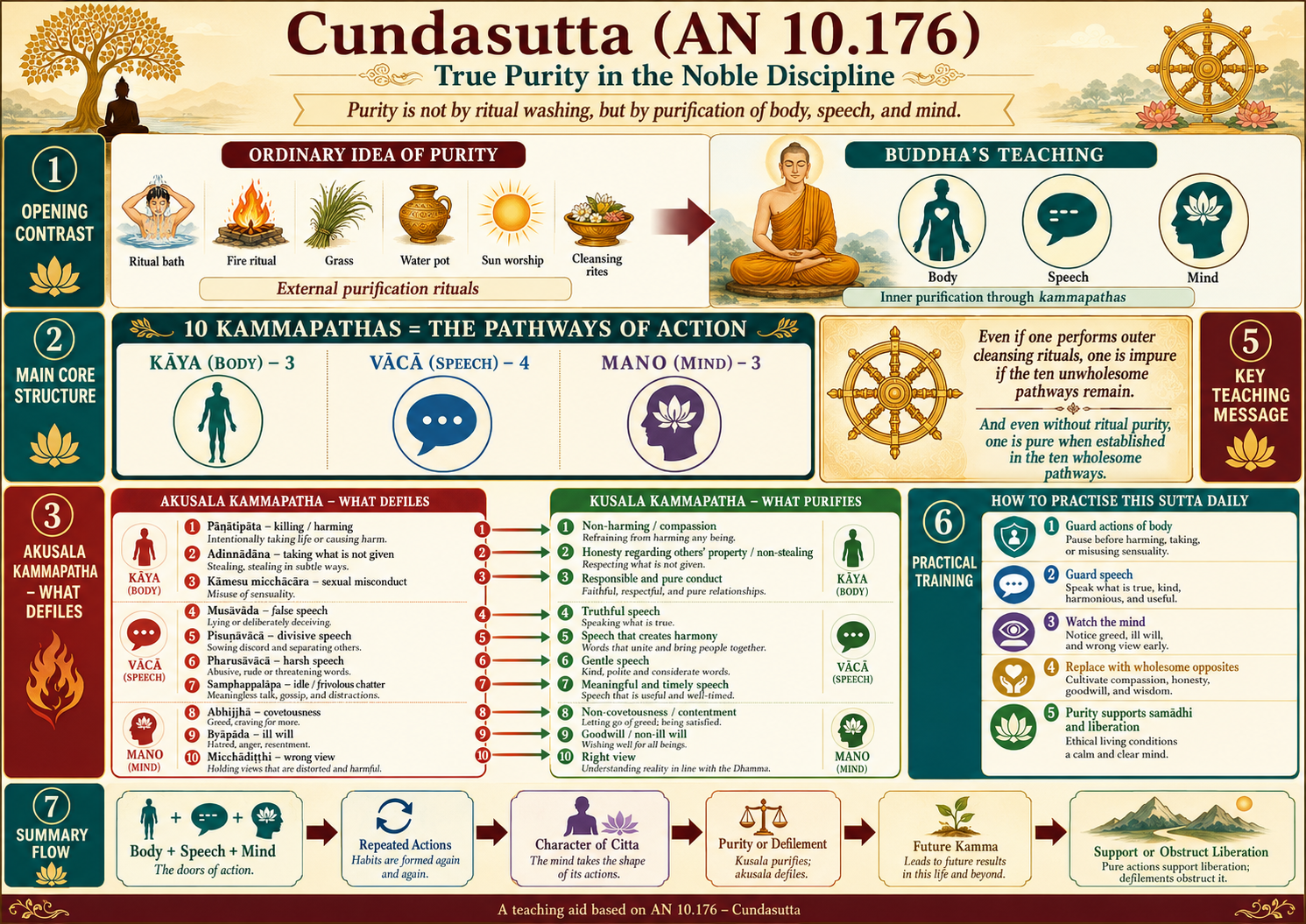 VISUAL SUMMARYSee this sutta in a pictureOpen the complete infographic for a visual overview before or after reading the full study.View infographic →
Purity is relocated from ritual to kammapatha
True purity, the Buddha explains, is determined by the pathways through which kamma is generated: Kāya — body: 3; Vācā — speech: 4; Mano — mind: 3. Together these form the ten kammapathas.
On the unwholesome side they are killing, taking what is not given, sexual misconduct, false speech, divisive speech, harsh speech, pointless chatter, covetousness, ill will and wrong view. On the wholesome side these same pathways are purified through non-harming, honesty, responsible sensual conduct, truthful and harmonious speech, gentle and meaningful speech, non-covetousness, goodwill and right view.
The central message is simple but profound: ritual cannot purify a mind that continues to cultivate unwholesome kammapathas. A person established in the ten unwholesome pathways remains impure regardless of external purification rituals, whereas one established in the ten wholesome pathways remains pure whether those rituals are performed or not.
For a bhāvanā practitioner this is especially important. Sīla is not separate from meditation; it conditions the very citta that later attempts samādhi. What is repeatedly cultivated through body, speech and mind during the day becomes the mind encountered when one sits to practise.
Canonical reference: AN 10.176 in the SuttaCentral/PTS-aligned numbering. The supplied study notes that some modern collections number the same discourse AN 10.165.
Ten unwholesome pathways → ten wholesome pathways
| # | Akusala / Asoceyya | Training movement | Kusala / Soceyya |
|---|---|---|---|
| 1 | Pāṇātipāta — killing | abandon + abstain + lay down violence | Pāṇātipātā paṭivirata + dayā / hitānukampā |
| 2 | Adinnādāna — taking what is not given | respect what has not been given | Adinnādānā paṭivirata |
| 3 | Kāmesumicchācāra | abandon harmful / improper sensual conduct | Kāmesumicchācārā paṭivirata |
| 4 | Musāvāda | align speech with what is actually known / seen | Musāvādā paṭivirata |
| 5 | Pisuṇā vācā | stop carrying speech for division | Samaggakaraṇiṁ vācaṁ — speech that makes harmony |
| 6 | Pharusā vācā | abandon anger-near speech destructive of samādhi | Nelā, kaṇṇasukhā, pemanīyā… |
| 7 | Samphappalāpa | restore timing, truth, purpose, Dhamma, discipline and limits | Kālavādī, bhūtavādī, atthavādī… |
| 8 | Abhijjhā | allow another’s possession to remain another’s | Anabhijjhā |
| 9 | Byāpāda | remove wish for harm | Abyāpāda — goodwill |
| 10 | Micchādiṭṭhi | restore causal / moral orientation | Sammādiṭṭhi |
External purification: touching earth, wet cow dung or grass, tending fire, worshipping the sun, or descending into water.
Ariyassa vinaya: purity through abandoning unwholesome kammapatha and cultivating wholesome kammapatha.
Cundasutta — source first, commentary afterwards
01From ritual purification to the 3–4–3 framework
Cunda approaches the Buddha
Evaṁ me sutaṁ—ekaṁ samayaṁ bhagavā pāvāyaṁ viharati cundassa kammāraputtassa ambavane. Atha kho cundo kammāraputto yena bhagavā tenupasaṅkami; upasaṅkamitvā bhagavantaṁ abhivādetvā ekamantaṁ nisīdi.
Thus have I heard.
On one occasion the Blessed One was dwelling at Pāvā, in the mango grove belonging to Cunda the smith’s son.
Then Cunda the smith’s son approached the Blessed One. Having approached, he paid homage to the Blessed One and sat down to one side.
The Buddha asks Cunda what he considers purification
Ekamantaṁ nisinnaṁ kho cundaṁ kammāraputtaṁ bhagavā etadavoca:
“Kassa no tvaṁ, cunda, soceyyāni rocesī”ti?
When Cunda was seated to one side, the Blessed One said to him:
“Cunda, whose teachings concerning purification do you approve of?”
Cunda describes the Brahmin system of purification
“Brāhmaṇā, bhante, pacchābhūmakā kamaṇḍalukā sevālamālikā aggiparicārikā udakorohakā soceyyāni paññapenti; tesāhaṁ soceyyāni rocemī”ti.
“Bhante, the western-region Brahmins who carry water pots, wear garlands of aquatic plants, tend the sacred fire, and descend into water prescribe practices of purification.
I approve of the purification taught by them.”
“Yathā kathaṁ pana, cunda, brāhmaṇā pacchābhūmakā kamaṇḍalukā sevālamālikā aggiparicārikā udakorohakā soceyyāni paññapentī”ti?
“But Cunda, in what way do those Brahmins prescribe purification?”
External rituals of purification
“Idha, bhante, brāhmaṇā pacchābhūmakā kamaṇḍalukā sevālamālikā aggiparicārikā udakorohakā. Te sāvakaṁ evaṁ samādapenti:
‘Ehi tvaṁ, ambho purisa, kālasseva uṭṭhahantova sayanamhā pathaviṁ āmaseyyāsi; no ce pathaviṁ āmaseyyāsi, allāni gomayāni āmaseyyāsi; no ce allāni gomayāni āmaseyyāsi, haritāni tiṇāni āmaseyyāsi; no ce haritāni tiṇāni āmaseyyāsi, aggiṁ paricareyyāsi; no ce aggiṁ paricareyyāsi, pañjaliko ādiccaṁ namasseyyāsi; no ce pañjaliko ādiccaṁ namasseyyāsi, sāyatatiyakaṁ udakaṁ oroheyyāsī’ti.
Evaṁ kho, bhante, brāhmaṇā … soceyyāni paññapenti; tesāhaṁ soceyyāni rocemī”ti.
Cunda replied:
“Bhante, those Brahmins instruct their disciple in this way:
‘Come, good man. When you get up from bed early in the morning, you should touch the earth.
If you do not touch the earth, you should touch wet cow dung.
If you do not touch wet cow dung, you should touch green grass.
If you do not touch green grass, you should tend the sacred fire.
If you do not tend the fire, you should worship the sun with your palms joined.
If you do not worship the sun with joined palms, you should go down into the water three times by evening.’
This, Bhante, is how those Brahmins prescribe purification, and I approve of that purification.”
The Buddha introduces an entirely different purification
“Aññathā kho, cunda, brāhmaṇā pacchābhūmakā kamaṇḍalukā sevālamālikā aggiparicārikā udakorohakā soceyyāni paññapenti, aññathā ca pana ariyassa vinaye soceyyaṁ hotī”ti.
“Cunda, the purification prescribed by those Brahmins is one thing.
But purification in the discipline of the Noble One is quite another.”
“Yathā kathaṁ pana, bhante, ariyassa vinaye soceyyaṁ hoti? Sādhu me, bhante, bhagavā tathā dhammaṁ desetu yathā ariyassa vinaye soceyyaṁ hotī”ti.
“In what way, Bhante, is there purification in the Noble One’s discipline?
It would be good, Bhante, if the Blessed One would teach me the Dhamma so that I may understand purification in the Noble One’s discipline.”
“Tena hi, cunda, suṇāhi, sādhukaṁ manasi karohi; bhāsissāmī”ti.
“Evaṁ, bhante”ti kho cundo kammāraputto bhagavato paccassosi. Bhagavā etadavoca:
“In that case, Cunda, listen and attend carefully. I will speak.”
“Yes, Bhante,” Cunda replied.
The Blessed One said:
The entire framework
“Tividhaṁ kho, cunda, kāyena asoceyyaṁ hoti; catubbidhaṁ vācāya asoceyyaṁ hoti; tividhaṁ manasā asoceyyaṁ hoti.”
“Cunda, bodily impurity is threefold.
Verbal impurity is fourfold.
Mental impurity is threefold.”
02Three impurities of body
Pāṇātipāta — taking life
Kathañca, cunda, tividhaṁ kāyena asoceyyaṁ hoti?
Idha, cunda, ekacco pāṇātipātī hoti luddo lohitapāṇi hatapahate niviṭṭho adayāpanno sabbapāṇabhūtesu.
“And how, Cunda, is bodily impurity threefold?
Here someone destroys living beings.
They are cruel, bloody-handed, given to killing and violence, and without compassion for living beings.”
Adinnādāna — taking what has not been given
Adinnādāyī hoti. Yaṁ taṁ parassa paravittūpakaraṇaṁ gāmagataṁ vā araññagataṁ vā taṁ adinnaṁ theyyasaṅkhātaṁ ādātā hoti.
“One takes what has not been given.
Whatever property or possessions belong to another, whether in a village or in the wilderness, one takes what has not been given, with the intention of stealing.”
Kāmesumicchācāra — sexual misconduct
Kāmesumicchācārī hoti. Yā tā māturakkhitā piturakkhitā mātāpiturakkhitā bhāturakkhitā bhaginirakkhitā ñātirakkhitā gottarakkhitā dhammarakkhitā sasāmikā saparidaṇḍā antamaso mālāguḷaparikkhittāpi, tathārūpāsu cārittaṁ āpajjitā hoti.
“One engages in sexual misconduct with those who are under the protection of mother, father, both parents, brother, sister, relatives, clan or lawful protection; with those who have a spouse, are protected by law, or are otherwise committed.”
Evaṁ kho, cunda, tividhaṁ kāyena asoceyyaṁ hoti.
“In this way, Cunda, bodily impurity is threefold.”
03Four impurities of speech
Musāvāda — false speech
Kathañca, cunda, catubbidhaṁ vācāya asoceyyaṁ hoti?
Idha, cunda, ekacco musāvādī hoti. Sabhaggato vā parisaggato vā ñātimajjhagato vā pūgamajjhagato vā rājakulamajjhagato vā abhinīto sakkhipuṭṭho:
‘Ehambho purisa, yaṁ jānāsi taṁ vadehī’ti, so ajānaṁ vā āha: ‘jānāmī’ti, jānaṁ vā āha: ‘na jānāmī’ti; apassaṁ vā āha: ‘passāmī’ti, passaṁ vā āha: ‘na passāmī’ti.
Iti attahetu vā parahetu vā āmisakiñcikkhahetu vā sampajānamusā bhāsitā hoti.
“One speaks falsely.
When summoned before an assembly, a gathering, relatives, a guild, or even the royal court and questioned as a witness:
‘Good man, tell what you know,’
not knowing, one says, ‘I know’;
knowing, one says, ‘I do not know’;
not having seen, one says, ‘I saw’;
having seen, one says, ‘I did not see.’
Thus one deliberately speaks falsehood for one’s own sake, for another’s sake, or for some material advantage.”
Pisuṇā vācā — divisive speech
Pisuṇavāco hoti. Ito sutvā amutra akkhātā imesaṁ bhedāya, amutra vā sutvā imesaṁ akkhātā amūsaṁ bhedāya.
Iti samaggānaṁ vā bhettā, bhinnānaṁ vā anuppadātā, vaggārāmo vaggarato vagganandī vaggakaraṇiṁ vācaṁ bhāsitā hoti.
“One speaks divisively.
Having heard something here, one reports it elsewhere in order to divide these people.
Or having heard something elsewhere, one reports it here in order to divide those people.
Thus one divides those who are united, perpetuates division among those already divided, delights in factions, enjoys factions, rejoices in factions, and speaks words that create factions.”
Pharusā vācā — harsh speech
Pharusavāco hoti. Yā sā vācā aṇḍakā kakkasā parakaṭukā parābhisajjanī kodhasāmantā asamādhisaṁvattanikā, tathārūpiṁ vācaṁ bhāsitā hoti.
“One speaks harshly.
One uses speech that is rough, hard, hurtful to others, offensive to others, bordering on anger, and not conducive to samādhi.”
Samphappalāpa — meaningless, uncontrolled or purposeless chatter
Samphappalāpī hoti akālavādī abhūtavādī anatthavādī adhammavādī avinayavādī; anidhānavatiṁ vācaṁ bhāsitā hoti akālena anapadesaṁ apariyantavatiṁ anatthasaṁhitaṁ.
“One engages in pointless chatter.
One speaks at the wrong time, speaks what is untrue, speaks what is without benefit, speaks contrary to Dhamma and contrary to discipline.
One speaks words not worth preserving—at the wrong time, without good reason, without restraint or proper limit, and unconnected with benefit.”
Evaṁ kho, cunda, catubbidhaṁ vācāya asoceyyaṁ hoti.
“In this way, Cunda, verbal impurity is fourfold.”
04Three impurities of mind and the ten unwholesome pathways
Abhijjhā — covetousness
Kathañca, cunda, tividhaṁ manasā asoceyyaṁ hoti?
Idha, cunda, ekacco abhijjhālu hoti. Yaṁ taṁ parassa paravittūpakaraṇaṁ taṁ abhijjhātā hoti:
‘Aho vata yaṁ parassa taṁ mamassā’ti.
“And how, Cunda, is mental impurity threefold?
Here someone is covetous.
Regarding the possessions and property of another, one thinks:
‘Oh, if only what belongs to that person were mine!’”
Byāpāda — ill will
Byāpannacitto hoti paduṭṭhamanasaṅkappo:
‘Ime sattā haññantu vā bajjhantu vā ucchijjantu vā vinassantu vā mā vā ahesun’ti.
“One has a mind of ill will and corrupted intentions, thinking:
‘May these beings be killed, imprisoned, destroyed, ruined, or cease to exist.’”
Micchādiṭṭhi — wrong view
Micchādiṭṭhiko hoti viparītadassano:
‘Natthi dinnaṁ, natthi yiṭṭhaṁ, natthi hutaṁ, natthi sukaṭadukkaṭānaṁ kammānaṁ phalaṁ vipāko, natthi ayaṁ loko, natthi paro loko, natthi mātā, natthi pitā, natthi sattā opapātikā, natthi loke samaṇabrāhmaṇā sammaggatā sammāpaṭipannā ye imañca lokaṁ parañca lokaṁ sayaṁ abhiññā sacchikatvā pavedentī’ti.
“One holds wrong view and distorted vision:
‘There is no value or result in giving.
There is no value in sacrifice or offering.
There is no fruit or result of good and bad actions.
There is no this world and no other world.
There is no mother and no father [in the sense of no special moral significance or consequence concerning them].
There are no spontaneously arisen beings.
There are no rightly practising contemplatives and Brahmins in the world who, having directly known and realized this world and the other world for themselves, make it known to others.’”
Evaṁ kho, cunda, manasā tividhaṁ asoceyyaṁ hoti.
“In this way, Cunda, mental impurity is threefold.”
These are the ten unwholesome pathways of kamma
Ime kho, cunda, dasa akusalakammapathā.
“These, Cunda, are the ten unwholesome pathways of kamma.”
05Why ritual cannot purify unwholesome kammapatha
External ritual cannot purify an unwholesome kammapatha
Imehi kho, cunda, dasahi akusalehi kammapathehi samannāgato kālasseva uṭṭhahantova sayanamhā pathaviñcepi āmasati, asuciyeva hoti; no cepi pathaviṁ āmasati, asuciyeva hoti.
“Cunda, one endowed with these ten unwholesome pathways of kamma remains impure whether, after getting up early from bed, one touches the earth or does not touch the earth.”
Allāni cepi gomayāni āmasati, asuciyeva hoti; no cepi allāni gomayāni āmasati, asuciyeva hoti.
“Whether one touches wet cow dung or does not touch wet cow dung, one remains impure.”
Haritāni cepi tiṇāni āmasati, asuciyeva hoti; no cepi haritāni tiṇāni āmasati, asuciyeva hoti.
“Whether one touches green grass or does not touch green grass, one remains impure.”
Aggiñcepi paricarati, asuciyeva hoti, no cepi aggiṁ paricarati, asuciyeva hoti.
“Whether one tends the sacred fire or does not tend the sacred fire, one remains impure.”
Pañjaliko cepi ādiccaṁ namassati, asuciyeva hoti; no cepi pañjaliko ādiccaṁ namassati, asuciyeva hoti.
“Whether one worships the sun with joined palms or does not worship the sun, one remains impure.”
Sāyatatiyakañcepi udakaṁ orohati, asuciyeva hoti; no cepi sāyatatiyakaṁ udakaṁ orohati, asuciyeva hoti.
“Whether one goes down into the water three times by evening or does not do so, one remains impure.”
Taṁ kissa hetu?
Ime, cunda, dasa akusalakammapathā asucīyeva honti asucikaraṇā ca.
“Why is that?
Because these ten unwholesome pathways of kamma are themselves impure and productive of impurity.”
Consequences of the ten unwholesome pathways
Imesaṁ pana, cunda, dasannaṁ akusalānaṁ kammapathānaṁ samannāgamanahetu nirayo paññāyati, tiracchānayoni paññāyati, pettivisayo paññāyati, yā vā panaññāpi kāci duggatiyo.
“Because of possessing these ten unwholesome pathways of kamma, hell is discerned, the animal realm is discerned, the realm of afflicted spirits is discerned, or whatever other unfortunate destination there may be.”
06Three wholesome pathways of body
The Ten Wholesome Pathways
Tividhaṁ kho, cunda, kāyena soceyyaṁ hoti; catubbidhaṁ vācāya soceyyaṁ hoti; tividhaṁ manasā soceyyaṁ hoti.
“Cunda, bodily purity is threefold.
Verbal purity is fourfold.
Mental purity is threefold.”
First wholesome pathway — abandoning killing
Kathaṁ, cunda, tividhaṁ kāyena soceyyaṁ hoti?
Idha, cunda, ekacco pāṇātipātaṁ pahāya pāṇātipātā paṭivirato hoti nihitadaṇḍo nihitasattho, lajjī dayāpanno, sabbapāṇabhūtahitānukampī viharati.
“And how, Cunda, is bodily purity threefold?
Having abandoned the destruction of living beings, one abstains from destroying life.
One has laid down the rod and weapon.
One is conscientious, compassionate, and dwells concerned for the welfare of all living beings.”
Second wholesome pathway — abandoning taking what is not given
Adinnādānaṁ pahāya, adinnādānā paṭivirato hoti. Yaṁ taṁ parassa paravittūpakaraṇaṁ gāmagataṁ vā araññagataṁ vā, na taṁ adinnaṁ theyyasaṅkhātaṁ ādātā hoti.
“Having abandoned taking what has not been given, one abstains from taking what is not given.
Whatever property or possessions belong to another, whether in a village or in the wilderness, one does not take what has not been given with the intention of stealing.”
Third wholesome pathway — abandoning sexual misconduct
Kāmesumicchācāraṁ pahāya, kāmesumicchācārā paṭivirato hoti. Yā tā māturakkhitā piturakkhitā mātāpiturakkhitā bhāturakkhitā bhaginirakkhitā ñātirakkhitā gottarakkhitā dhammarakkhitā sasāmikā saparidaṇḍā antamaso mālāguḷaparikkhittāpi, tathārūpāsu na cārittaṁ āpajjitā hoti.
“Having abandoned sexual misconduct, one abstains from sexual misconduct and does not engage sexually where such conduct would violate the relevant protection, commitment or boundary.”
Evaṁ kho, cunda, tividhaṁ kāyena soceyyaṁ hoti.
“In this way, Cunda, bodily purity is threefold.”
07Four forms of pure speech
Truthful speech
Kathañca, cunda, catubbidhaṁ vācāya soceyyaṁ hoti?
Idha, cunda, ekacco musāvādaṁ pahāya musāvādā paṭivirato hoti.
Sabhaggato vā parisaggato vā ñātimajjhagato vā pūgamajjhagato vā rājakulamajjhagato vā abhinīto sakkhipuṭṭho:
‘Ehambho purisa, yaṁ jānāsi taṁ vadehī’ti, so ajānaṁ vā āha: ‘na jānāmī’ti, jānaṁ vā āha: ‘jānāmī’ti, apassaṁ vā āha: ‘na passāmī’ti, passaṁ vā āha: ‘passāmī’ti.
Iti attahetu vā parahetu vā āmisakiñcikkhahetu vā na sampajānamusā bhāsitā hoti.
“Having abandoned false speech, one abstains from false speech.
When questioned as a witness:
if one does not know, one says, ‘I do not know.’
If one knows, one says, ‘I know.’
If one did not see, one says, ‘I did not see.’
If one saw, one says, ‘I saw.’
Thus one does not knowingly speak falsehood for one’s own sake, another’s sake, or for some material advantage.”
Speech that creates harmony
Pisuṇaṁ vācaṁ pahāya, pisuṇāya vācāya paṭivirato hoti—na ito sutvā amutra akkhātā imesaṁ bhedāya, na amutra vā sutvā imesaṁ akkhātā amūsaṁ bhedāya.
Iti bhinnānaṁ vā sandhātā sahitānaṁ vā anuppadātā samaggārāmo samaggarato samagganandī samaggakaraṇiṁ vācaṁ bhāsitā hoti.
“Having abandoned divisive speech, one abstains from divisive speech.
One does not repeat here what was heard elsewhere in order to divide people, nor repeat elsewhere what was heard here in order to divide people.
Instead:
one reconciles those who are divided,
supports those who are united,
delights in harmony,
enjoys harmony,
rejoices in harmony,
and speaks words that create harmony.”
Gentle speech
Pharusaṁ vācaṁ pahāya, pharusāya vācāya paṭivirato hoti.
Yā sā vācā nelā kaṇṇasukhā pemanīyā hadayaṅgamā porī bahujanakantā bahujanamanāpā, tathārūpiṁ vācaṁ bhāsitā hoti.
“Having abandoned harsh speech, one abstains from harsh speech.
One speaks words that are gentle, pleasing to the ear, lovable, touching the heart, courteous, agreeable to many and pleasing to many.”
Timely and meaningful speech
Samphappalāpaṁ pahāya, samphappalāpā paṭivirato hoti kālavādī bhūtavādī atthavādī dhammavādī vinayavādī; nidhānavatiṁ vācaṁ bhāsitā hoti kālena sāpadesaṁ pariyantavatiṁ atthasaṁhitaṁ.
“Having abandoned pointless chatter, one abstains from pointless chatter.
One speaks:
kālavādī — at the proper time,
bhūtavādī — what is true,
atthavādī — what is beneficial and meaningful,
dhammavādī — in accordance with Dhamma,
vinayavādī — in accordance with discipline.
One speaks words worth preserving:
at the proper time,
with reason,
within appropriate limits,
and connected with benefit.”
Evaṁ kho, cunda, catubbidhaṁ vācāya soceyyaṁ hoti.
“In this way, Cunda, verbal purity is fourfold.”
08Three forms of mental purity and the ten wholesome pathways
Anabhijjhā — non-covetousness
Kathañca, cunda, tividhaṁ manasā soceyyaṁ hoti?
Idha, cunda, ekacco anabhijjhālu hoti. Yaṁ taṁ parassa paravittūpakaraṇaṁ taṁ anabhijjhitā hoti:
‘Aho vata yaṁ parassa taṁ mamassā’ti.
“And how, Cunda, is mental purity threefold?
Here someone is not covetous.
Regarding another person’s possessions, one does not covet them thinking:
‘Oh, if only what belongs to that person were mine.’”
Abyāpāda — goodwill
Abyāpannacitto hoti appaduṭṭhamanasaṅkappo:
‘Ime sattā averā hontu abyāpajjā, anīghā sukhī attānaṁ pariharantū’ti.
“One has a mind free from ill will and intentions free from corruption, thinking:
‘May these beings be free from enmity,
free from affliction,
free from distress,
and may they live happily and care for themselves.’”
Sammādiṭṭhi — right view
Sammādiṭṭhiko hoti aviparītadassano:
‘Atthi dinnaṁ, atthi yiṭṭhaṁ, atthi hutaṁ, atthi sukaṭadukkaṭānaṁ kammānaṁ phalaṁ vipāko, atthi ayaṁ loko, atthi paro loko, atthi mātā, atthi pitā, atthi sattā opapātikā, atthi loke samaṇabrāhmaṇā sammaggatā sammāpaṭipannā ye imañca lokaṁ parañca lokaṁ sayaṁ abhiññā sacchikatvā pavedentī’ti.
“One possesses right view and undistorted vision:
‘There is giving.
There is sacrifice.
There is offering.
There is fruit and result of well-done and badly done actions.
There is this world.
There is another world.
There is mother.
There is father.
There are spontaneously arisen beings.
There are contemplatives and Brahmins in the world who have gone rightly and practised rightly, and who, having directly known and realized this world and the other world for themselves, make them known to others.’”
Evaṁ kho, cunda, tividhaṁ manasā soceyyaṁ hoti.
“In this way, Cunda, mental purity is threefold.”
The ten wholesome pathways of kamma
Ime kho, cunda, dasa kusalakammapathā.
“These, Cunda, are the ten wholesome pathways of kamma.”
09Wholesome purity, fortunate destinations and Cunda’s refuge
A wholesome person does not depend upon ritual purification
Imehi kho, cunda, dasahi kusalehi kammapathehi samannāgato kālasseva uṭṭhahantova sayanamhā pathaviñcepi āmasati, suciyeva hoti; no cepi pathaviṁ āmasati, suciyeva hoti.
“One endowed with these ten wholesome pathways of kamma remains pure whether one touches the earth after getting up in the morning or does not touch the earth.”
Allāni cepi gomayāni āmasati, suciyeva hoti; no cepi allāni gomayāni āmasati, suciyeva hoti.
“Whether one touches wet cow dung or does not, one remains pure.”
Haritāni cepi tiṇāni āmasati, suciyeva hoti; no cepi haritāni tiṇāni āmasati, suciyeva hoti.
“Whether one touches green grass or does not, one remains pure.”
Aggiñcepi paricarati, suciyeva hoti; no cepi aggiṁ paricarati, suciyeva hoti.
“Whether one tends the sacred fire or does not, one remains pure.”
Pañjaliko cepi ādiccaṁ namassati, suciyeva hoti; no cepi pañjaliko ādiccaṁ namassati, suciyeva hoti.
“Whether one worships the sun with joined palms or does not, one remains pure.”
Sāyatatiyakañcepi udakaṁ orohati, suciyeva hoti; no cepi sāyatatiyakaṁ udakaṁ orohati, suciyeva hoti.
“Whether one goes down into the water three times by evening or does not, one remains pure.”
Taṁ kissa hetu?
Ime, cunda, dasa kusalakammapathā sucīyeva honti sucikaraṇā ca.
“Why is that?
Because these ten wholesome pathways of kamma are themselves pure and productive of purity.”
Consequences of the ten wholesome kammapathas
Imesaṁ pana, cunda, dasannaṁ kusalānaṁ kammapathānaṁ samannāgamanahetu devā paññāyanti, manussā paññāyanti, yā vā panaññāpi kāci sugatiyo”ti.
“Because of possessing these ten wholesome pathways of kamma, heavenly beings are discerned, human beings are discerned, and whatever other fortunate destinations there may be.”
Cunda goes for refuge
Evaṁ vutte, cundo kammāraputto bhagavantaṁ etadavoca:
“Abhikkantaṁ, bhante, abhikkantaṁ, bhante! Seyyathāpi, bhante, nikkujjitaṁ vā ukkujjeyya, paṭicchannaṁ vā vivareyya, mūḷhassa vā maggaṁ ācikkheyya, andhakāre vā telapajjotaṁ dhāreyya, cakkhumanto rūpāni dakkhantīti; evamevaṁ kho, bhante, bhagavatā anekapariyāyena dhammo pakāsito. Esāhaṁ, bhante, bhagavantaṁ saraṇaṁ gacchāmi dhammañca bhikkhusaṅghañca. Upāsakaṁ maṁ, bhante, bhagavā dhāretu ajjatagge pāṇupetaṁ saraṇaṁ gatan”ti.
When this was said, Cunda the smith’s son said to the Blessed One:
“Excellent, Bhante! Excellent!
Just as one might set upright what had been overturned, reveal what had been hidden, show the way to one who was lost, or hold up an oil lamp in the darkness so that those with eyes could see forms, so too has the Blessed One made the Dhamma clear in many ways.
I go for refuge to the Blessed One, to the Dhamma, and to the Bhikkhu Saṅgha.
May the Blessed One remember me as a lay follower who, from this day onward, for as long as life lasts, has gone for refuge.”
From ritual cleansing to the cultivation of body, speech and mind
01Purity redefined — from external cleansing to kammapatha
1. Cunda approaches the Buddha
2. The Buddha asks Cunda what he considers purification
Key Term
Soceyya comes from the idea of purity or cleanliness.
But the question of the sutta is:
What actually makes a human being pure?
Is purity something performed externally?
Or is purity a quality of one’s conduct and mind?
3. Cunda describes the Brahmin system of purification
The Buddha then asks Cunda exactly what these practices are.
4. External rituals of purification
5. The Buddha introduces an entirely different purification
This is the turning point of the sutta.
The Buddha does not merely replace one purification ceremony with another ceremony.
He changes the entire meaning of purification.
6. The entire framework
So:
Kāya — 3
Vācā — 4
Mano — 3
These are not simply “ten commandments.”
They are called:
dasa akusala-kammapathā
—ten unwholesome pathways of action.
They reveal the pathways through which the mind repeatedly constructs its tendencies.
02Body — three impurities and their practical conditioning
7. Pāṇātipāta — taking life
The important contrast later is:
adayāpanno — without compassion
versus
dayāpanno — endowed with compassion.
Practical example 1 — Home
A mosquito irritates you while you are resting. Without reflection, anger arises:
“Kill it.”
The hand acts immediately.
The significant event is not merely that an insect died. The mind rehearsed:
irritation → aversion → intention to destroy → action.
Repeated enough, the mind learns that unpleasant contact should be answered through aggression.
Connection to samādhi
The same mind later encounters unpleasant bodily pressure, sound, heat, itching or discomfort during practice.
Its conditioned response is:
“Remove this. Get rid of this.”
Thus aversion follows the practitioner onto the meditation seat.
Practical example 2 — Office
An employee cannot literally kill someone, but a culture of deliberate cruelty can express the same underlying mental direction—enjoying another person’s suffering, deliberately crushing someone because one has power, or wishing severe harm upon a colleague.
The bodily act may differ, but the practitioner should study the mental movement toward hiṁsā—harm.
Connection to samādhi
The mind becomes habituated to hostility.
When sitting quietly, conversations with the colleague reappear. Arguments are recreated. Imaginary confrontations occur.
This feeds byāpāda, one of the five hindrances.
Practical example 3 — Interacting with people
Someone insults you while driving or standing in a queue.
The immediate thought may be:
“I wish something terrible would happen to him.”
Even when it does not become bodily killing, this reveals the continuum leading toward violence.
A practitioner observes the intention before it matures.
Connection to samādhi
A mind repeatedly rehearsing hostility cannot simply become peaceful because the eyes have been closed.
Samādhi depends upon what has been cultivated before the sitting.
8. Adinnādāna — taking what has not been given
The operative principle is beautifully simple:
adinna — not given.
The question is not merely:
“Can I obtain this?”
It is:
“Has this been given to me?”
Practical example 1 — Home
Money belonging to another family member is lying somewhere.
You take it without asking, intending either not to mention it or to explain only if questioned.
The amount may be insignificant.
But mentally there is:
wanting → appropriation → concealment.
Connection to samādhi
Concealment produces subtle vigilance:
“Will they notice?”
“Should I explain?”
“Did anyone see?”
That mental guarding of a secret produces restlessness and can contribute to kukkucca—agitated concern and remorse.
Practical example 2 — Office
You submit another colleague’s idea as your own.
Or you knowingly claim hours, expenses, resources or benefits to which you are not entitled.
Although no physical object may have been stolen, something that was not given has been appropriated.
Connection to samādhi
Now the mind has to maintain a constructed narrative.
Truth must be edited to protect self-interest.
This fragmentation works directly against collectedness.
Samādhi gathers the mind; dishonesty makes the mind maintain multiple versions of reality.
Practical example 3 — Interacting with people
You borrow something and deliberately avoid returning it although the owner expects it back.
Eventually you rationalize:
“They probably don’t need it.”
The mind converts desire into justification.
Connection to samādhi
Such rationalization strengthens craving followed by conceptual defence.
During practice, the same mind is likely to negotiate endlessly with desires rather than knowing them simply as arisen conditions.
9. Kāmesumicchācāra — sexual misconduct
The passage reflects the social and legal categories of ancient India.
Practice application — interpretive, not a literal replacement of the ancient social categories:
For present-day reflection, useful questions include:
Does this violate another person’s existing commitment?
Does it involve deception, exploitation, coercion, betrayal or abuse of responsibility?
Does my conduct cause suffering through sensual desire?
Practical example 1 — Home
A married person secretly maintains a sexual relationship outside the agreed boundaries of the marriage.
Now ordinary domestic life requires passwords, deleted messages, excuses and concealment.
Connection to samādhi
The problem for meditation is not simply sexuality.
It is the enormous mental structure accompanying misconduct:
kāmacchanda + concealment + fear + guilt + fantasy + planning.
Close the eyes and the mind does not become empty.
The concealed relationship becomes a powerful meditation object.
Practical example 2 — Office
A manager uses authority or influence to pursue a subordinate sexually, particularly where the subordinate may fear professional consequences.
Even when outwardly disguised as attraction, power and craving are interacting.
Connection to samādhi
The mind repeatedly anticipates encounters, messages, possibilities and sensual gratification.
This strongly nourishes kāmacchanda, the first hindrance.
Practical example 3 — Interacting with people
Someone knowingly develops an intimate relationship with a person already committed elsewhere and thinks:
“It is their responsibility, not mine.”
The practitioner instead investigates:
“What mental quality in me wants pleasure despite foreseeable suffering?”
Connection to samādhi
Samādhi requires increasing relinquishment of sensual preoccupation.
Repeatedly feeding intense sensual narratives during the day and attempting to suppress them during meditation are contradictory trainings.
03Speech — four impurities and their effect on the citta
10. Musāvāda — false speech
The crucial word is:
sampajāna-musā
—knowingly false.
Practical example 1 — Home
Someone asks:
“Did you do this?”
You did it, but immediately answer:
“No.”
Now the event has occurred once in reality and a second version has been manufactured in speech.
Connection to samādhi
Mindfulness requires accurately knowing what occurred.
Lying trains precisely the opposite:
knowing X while deliberately presenting not-X.
Repeated falsehood therefore damages internal integrity.
Practical example 2 — Office
A project has failed because you missed an important action.
In the review meeting you knowingly shift responsibility onto another team.
Connection to samādhi
Afterwards the mind rehearses:
“What exactly did I say?”
“What if they check?”
“What will I say next?”
This creates uddhacca, anxiety and defensive proliferation.
A mind defending a lie finds quietness difficult.
Practical example 3 — Interacting with people
To make yourself appear accomplished, you exaggerate your experiences, wealth, spiritual practice or achievements.
Nobody may discover it.
Yet you know.
Connection to samādhi
The external audience may be deceived, but the citta has still been trained in deliberate fabrication.
Meditation removes external distraction and leaves the practitioner directly with the mental patterns that were cultivated.
Hence truthfulness creates a powerful basis for inward ease.
11. Pisuṇā vācā — divisive speech
Notice how deep the Buddha goes.
The problem is not merely transferring information.
It is:
bhedāya — for the purpose of division.
Practical example 1 — Home
One family member tells you something privately about another.
You deliberately carry the statement to the other person, adding emotional colouring because you want them to quarrel.
Connection to samādhi
Now you become mentally involved in both sides.
You watch reactions, anticipate consequences and replay conversations.
The mind becomes socially entangled.
Practical example 2 — Office
You tell colleague A:
“Do you know what B said about you?”
Then tell B:
“You should hear what A thinks of you.”
You become the carrier through which division grows.
Connection to samādhi
Factional speech generates comparison, fear, resentment and strategic thinking.
These conditions nourish both byāpāda and uddhacca.
Practical example 3 — Interacting with people
Two friends have resolved a disagreement.
You repeatedly remind each of what the other once said, keeping the wound alive.
Connection to samādhi
A mind that delights in social drama requires stimulation.
When meditation becomes quiet, it produces internal drama to replace external drama.
Thus gossip and divisive speech can become fuel for papañca.
12. Pharusā vācā — harsh speech
This passage is particularly important for your question because the Pāli itself says:
asamādhisaṁvattanikā
“not leading to samādhi.”
The connection is explicit.
Practical example 1 — Home
Someone makes an ordinary mistake.
Instead of addressing the mistake, you attack the person:
“You are useless.”
“You never do anything properly.”
Connection to samādhi
Angry speech does not finish when the sound finishes.
The nervous system remains activated.
The mind then continues the argument internally.
When one later sits, the body is still carrying the momentum of anger.
Practical example 2 — Office
An employee makes an error and the manager humiliates them publicly.
The intention is not correction but domination.
Connection to samādhi
The speaker may replay the confrontation with self-justification.
The recipient may replay it with hurt.
Harsh speech therefore generates agitation on both sides.
The Buddha specifically describes such speech as:
asamādhisaṁvattanikā.
Practical example 3 — Interacting with people
Someone disagrees with your interpretation of Dhamma.
Instead of examining the Dhamma, the conversation becomes:
“You understand nothing.”
“You are ignorant.”
“You are foolish.”
Connection to samādhi
Now diṭṭhi has joined dosa.
The mind becomes committed not merely to understanding truth but to defeating another person.
That mental posture is fundamentally opposed to inward stillness.
13. Samphappalāpa — meaningless, uncontrolled or purposeless chatter
Samphappalāpa therefore should not be reduced simply to “talking.”
The issue is speech that has lost:
kāla — proper timing
bhūta — truth
attha — benefit/purpose
Dhamma
Vinaya
pariyanta — appropriate limits
Practical example 1 — Home
You intended to practise for an hour.
Instead, an unnecessary conversation about other people’s affairs continues for ninety minutes.
Nothing useful emerges.
The mind becomes increasingly stimulated.
Connection to samādhi
When sitting begins, the mouth stops but the conversation continues internally.
The speech has become mano-vitakka.
Practical example 2 — Office
Throughout the day you constantly move from chat message to chat message, speculation to speculation, office gossip to unnecessary commentary.
Connection to samādhi
The mind is being trained every few seconds to seek another object.
Later you ask that same mind:
“Remain with one field quietly.”
Why should it obey?
All day it was trained in object-switching.
Practical example 3 — Interacting with people
Every silence feels uncomfortable, so you immediately fill it with talking.
Connection to samādhi
This is highly relevant to bhāvanā.
A person unable to remain comfortably with external silence often discovers that the mind similarly fills internal silence with thought.
Restraint of speech can therefore become powerful preparation for samādhi.
04Mind — covetousness, ill will and wrong view
14. Abhijjhā — covetousness
This is more than noticing an attractive object.
The mind appropriates it imaginatively:
“That should be mine.”
Practical example 1 — Home
A relative buys a new house, car or device.
Instead of simply knowing it, the mind repeatedly thinks:
“Why do they have that?”
“I should have it.”
“I want what they have.”
Connection to samādhi
The mind has manufactured an object of sensual pursuit.
When the eyes close, the desired object remains available in imagination.
This directly feeds kāmacchanda.
Practical example 2 — Office
Another person gets the promotion, role or recognition that you wanted.
The mind thinks:
“That position should have been mine.”
Connection to samādhi
Now craving and comparison combine.
Meditation becomes occupied by hypothetical histories:
“What if I had received it?”
“Why him?”
“What should I do next?”
Collectedness is displaced by acquisition-thinking.
Practical example 3 — Interacting with people
Someone shows you their expensive phone, watch or vehicle.
For the next several days you keep researching the same object even though you had no previous need for it.
Connection to samādhi
The sense contact has ended.
Abhijjhā keeps the object alive after contact.
This is exactly why sense restraint and non-covetousness are so important before attempting deeper samādhi.
15. Byāpāda — ill will
This is not merely disliking something.
It is the mind moving toward the suffering or destruction of another being.
Practical example 1 — Home
During a family dispute the mind thinks:
“I don’t want to see this person again.”
“Let something happen to them.”
Connection to samādhi
Byāpāda is itself one of the five hindrances.
No complicated theory is required.
If ill will is being cultivated, one of the principal obstructions to samādhi is simultaneously being cultivated.
Practical example 2 — Office
A colleague competes with you.
You begin hoping their project fails so that they will be embarrassed.
Connection to samādhi
The colleague may not even be present, yet the mind repeatedly manufactures them.
Thus your “enemy” becomes an internally generated meditation object.
Practical example 3 — Interacting with people
Someone posts something offensive online.
For the next hour you read comments, formulate responses and become increasingly angry.
Connection to samādhi
The physical person may be thousands of kilometres away.
Yet your own mind is burning.
This shows that byāpāda primarily damages the person cultivating it.
16. Micchādiṭṭhi — wrong view
A central issue here is the denial of moral efficacy and consequence, but the formula is broader than that alone. It also rejects giving and offering, good and bad kamma and their results, this world and another world, the significance of mother and father within the moral order, spontaneously arisen beings, and the possibility of genuine direct realization by rightly practising contemplatives.
For practical training, one especially examines the assumption:
If that assumption governs conduct, the foundation for purification is undermined.
Practical example 1 — Home
A person behaves badly toward family members and thinks:
“It does not matter what state of mind I cultivate as long as I meditate every morning.”
That is a subtle practical form of denying kamma.
Connection to samādhi
Meditation becomes compartmentalized.
The person expects wholesome results from meditation while continually feeding unwholesome causes outside meditation.
Practical example 2 — Office
One thinks:
“Business is business. Ethics and Dhamma have nothing to do with it.”
Therefore lying, manipulation and exploitation are regarded as acceptable from 9 a.m. to 6 p.m.
Connection to samādhi
The Noble Eightfold Path does not contain “right meditation” isolated from everything else.
Sammādiṭṭhi → sammāsaṅkappa → sammāvācā → sammākammanta → sammāājīva → sammāvāyāma → sammāsati → sammāsamādhi.
Wrong view therefore damages the orientation of the entire path.
Practical example 3 — Interacting with people
Someone believes that hatred is justified whenever the opponent is “wrong.”
Therefore they deliberately cultivate anger while simultaneously expecting peaceful meditation.
Connection to samādhi
Wrong view can legitimize unwholesome states.
Once dosa is called “righteous,” one stops abandoning it.
That makes purification substantially more difficult.
17. These are the ten unwholesome pathways of kamma
This term deserves attention:
akusala + kamma + patha
They are paths along which unwholesome kamma proceeds.
Repeatedly walking a path makes that path easier to walk again.
The same principle operates mentally.
Repeated greed makes greed readily available.
Repeated anger makes anger readily available.
Repeated deception makes deception readily available.
Repeated restraint makes restraint readily available.
This is why daily conduct and bhāvanā cannot truly be separated.
18. External ritual cannot purify an unwholesome kammapatha
This is the heart of the teaching.
The Buddha is effectively saying:
Water does not wash kamma.
Fire does not burn away kamma.
A ritual does not undo a cultivated mental pathway.
Purification requires abandoning the causes of impurity.
19. Consequences of the ten unwholesome pathways
The Buddha therefore takes these actions far beyond the question of whether meditation feels peaceful tonight.
They participate in the direction of existence itself.
05Wholesome body — restraint, compassion and responsible conduct
Notice that wholesomeness is not merely “not doing bad things.”
The positive descriptions often go considerably further.
20. First wholesome pathway — abandoning killing
Notice the progression:
pahāya — having abandoned
paṭivirato — abstaining
nihitadaṇḍo nihitasattho — laying down instruments of violence
dayāpanno — compassionate
sabbapāṇabhūtahitānukampī — sympathetic toward the welfare of all living beings.
This is far richer than simply:
“Don’t kill.”
Practical example 1 — Home
Instead of automatically killing an insect, you remove it where reasonably possible.
The training is not worshipping insects.
It is observing whether unpleasant contact immediately produces destructive intention.
Connection to samādhi
Each non-hostile response weakens the reflex:
unpleasant → destroy.
That supports the ability to remain peacefully with unpleasant vedanā during meditation.
Practical example 2 — Office
Someone makes an error that inconveniences you.
Instead of trying to destroy their reputation, you correct the problem without hatred.
Connection to samādhi
The event can finish when it finishes.
There is less material for the mind to replay later.
This supports passaddhi—settling and tranquillity.
Practical example 3 — Interacting with people
A difficult person appears.
You recognise:
“This person too wishes for happiness and does not want suffering.”
That does not require approving their behaviour.
Connection to samādhi
Goodwill removes fuel from byāpāda.
When ill will diminishes, one major hindrance to samādhi diminishes with it.
21. Second wholesome pathway — abandoning taking what is not given
Practical example 1 — Home
Something belongs to another family member.
Even if access is easy, you ask before taking it.
Connection to samādhi
There is nothing to hide afterwards.
The mind does not need to maintain defensive narratives.
Practical example 2 — Office
You give appropriate credit for another person’s work.
You do not appropriate ideas, expenses, time or resources to which you are not entitled.
Connection to samādhi
Ethical simplicity produces mental simplicity.
There is less fear of discovery and less remorse.
Practical example 3 — Interacting with people
When given too much change by mistake, you return it.
Nobody else may have noticed.
But the practice concerns what your own mind is becoming.
Connection to samādhi
Such conduct strengthens honesty even when unobserved.
When sitting alone in meditation, being unobserved no longer becomes permission for carelessness.
22. Third wholesome pathway — abandoning sexual misconduct
Practical example 1 — Home
One protects the trust of one’s committed relationship rather than maintaining secret parallel relationships.
Connection to samādhi
There is less concealment, fantasy, fear and remorse.
This significantly reduces mental complexity.
Practical example 2 — Office
Attraction arises toward a colleague.
One knows:
“Attraction has arisen.”
But one does not automatically convert attraction into pursuit—especially where commitments or power relationships make such conduct harmful.
Connection to samādhi
This is genuine training in relation to kāmacchanda.
The practitioner learns:
arising desire ≠ required action.
That lesson transfers directly into meditation.
Practical example 3 — Interacting with people
One meets an attractive person and notices the mind beginning to manufacture scenarios.
Instead of feeding the storyline, one knows the arising and passes on.
Connection to samādhi
Every time sensual proliferation is not fed, the mind becomes less dependent on sensual imagination for gratification.
That is highly supportive of deeper samādhi.
06Wholesome speech — truth, harmony, gentleness and meaningful speech
23. Truthful speech
This is an extraordinary mindfulness practice:
Know exactly what you know.
Know exactly what you do not know.
Do not manufacture certainty.
Practical example 1 — Home
Someone asks a difficult question.
Instead of inventing an answer to protect yourself, you say:
“Yes, I did it.”
Connection to samādhi
The event may be uncomfortable for five minutes.
A lie may occupy the mind for five days.
Truth shortens mental proliferation.
Practical example 2 — Office
In a meeting you genuinely do not know an answer.
Instead of bluffing:
“I don’t know; I will need to check.”
Connection to samādhi
The mind is trained to remain aligned with what is actually known.
This strengthens clarity and reduces image-management.
Practical example 3 — Interacting with people
Someone asks about your meditation attainment or experience.
You neither exaggerate nor diminish.
You state only what you actually know.
Connection to samādhi
This is particularly important in spiritual practice.
Once identity becomes attached to an attainment claim, meditation can subtly turn into an effort to protect the identity rather than investigate phenomena.
Truthfulness protects bhāvanā from this trap.
24. Speech that creates harmony
This is not merely refraining from gossip.
The positive training is:
samaggakaraṇiṁ vācaṁ
—speech that makes harmony.
Practical example 1 — Home
Two relatives misunderstand one another.
Instead of carrying accusations between them, you clarify each person’s intention accurately and help them speak directly.
Connection to samādhi
Your mind does not need to manage multiple conflicts.
Harmony outside reduces conflict inside.
Practical example 2 — Office
Two colleagues disagree.
You refuse the temptation to gain influence by taking gossip from one side to the other.
Instead you help establish the factual issue.
Connection to samādhi
The mind learns to move toward resolution rather than excitement.
This reduces social proliferation.
Practical example 3 — Interacting with people
Someone criticizes a mutual friend.
You neither automatically defend nor amplify the criticism.
You ask:
“Would it be better to discuss this directly with them?”
Connection to samādhi
This interrupts the cycle through which one person’s dosa enters another person’s mind and is multiplied.
25. Gentle speech
Gentle speech does not mean refusing to say difficult things.
A necessary correction can be firm without hatred.
The question is:
What quality of mind is speaking?
Practical example 1 — Home
Instead of:
“You never listen!”
you say:
“When this happens repeatedly, it creates difficulty. Can we work out another way?”
Connection to samādhi
The factual issue is addressed without first generating a storm of dosa.
Practical example 2 — Office
Someone’s performance genuinely needs correction.
The manager communicates the problem clearly without humiliation.
Connection to samādhi
Firmness without anger prevents unnecessary internal agitation.
Practical example 3 — Interacting with people
During Dhamma discussion someone holds an interpretation you consider mistaken.
You examine the relevant Pāli and reasoning without attacking the person.
Connection to samādhi
The mind remains oriented toward Dhamma rather than victory.
That distinction becomes increasingly important as practice deepens.
26. Timely and meaningful speech
This is an excellent checklist before speaking.
Practical example 1 — Home
You realize that a serious discussion is necessary, but the other person is exhausted and angry.
You wait for an appropriate time.
Connection to samādhi
Kālavādī requires awareness before speech.
Thus ordinary conversation itself becomes sati training.
Practical example 2 — Office
A meeting is scheduled for thirty minutes.
Instead of giving a fifteen-minute unrelated story, you communicate what is relevant and stop.
Connection to samādhi
Speech develops pariyanta—appropriate boundary.
The same ability to know “enough” is valuable in relation to thought.
Practical example 3 — Interacting with people
There is a silence in a group.
You do not automatically fill it.
You allow silence unless something worthwhile needs to be said.
Connection to samādhi
This may be one of the simplest everyday trainings for a bhāvanā practitioner:
become comfortable with not producing another verbal object.
That same capacity supports inner silence.
07Wholesome mind — non-covetousness, goodwill and right view
27. Anabhijjhā — non-covetousness
This does not mean being unable to purchase or use things.
The problem is the mind leaning into another person’s possession with appropriation.
Practical example 1 — Home
A relative buys something beautiful.
You can appreciate it without immediately converting appreciation into:
“I need one.”
Connection to samādhi
Sense contact is allowed to end.
That is extremely important.
Otherwise a five-second visual contact can become five days of mental occupation.
Practical example 2 — Office
A colleague receives a promotion.
You recognise their success without mentally appropriating it:
“That should have been mine.”
Connection to samādhi
Comparison loses fuel.
The mind becomes lighter and less fragmented by becoming-versus-not-becoming narratives.
Practical example 3 — Interacting with people
Someone has a better phone, car, house or social position.
You know:
“That belongs to them.”
No further story is required.
Connection to samādhi
This directly starves kāmacchanda and craving-based proliferation.
28. Abyāpāda — goodwill
The Buddha does not merely teach:
“Don’t hate.”
The positive direction of mind is:
averā hontu — may they be free from hostility
abyāpajjā — free from affliction
anīghā — free from distress
sukhī attānaṁ pariharantū — may they live happily and care for themselves.
Practical example 1 — Home
A family member repeatedly irritates you.
You establish:
“I do not need to approve of this behaviour, but I do not wish suffering upon this person.”
Connection to samādhi
This distinction removes enormous amounts of unnecessary dosa.
Practical example 2 — Office
Someone receives the role you wanted.
Instead of hoping they fail:
“May they perform the responsibility well.”
Connection to samādhi
The external event remains unchanged.
But the internal poison is removed.
Practical example 3 — Interacting with people
Someone insults you.
You protect yourself where necessary but do not continue mentally attacking them for the next three hours.
Connection to samādhi
The insult lasts perhaps ten seconds.
Byāpāda can extend it to three hours.
Abyāpāda allows the event to cease.
That capacity to allow cessation is central to bhāvanā.
29. Sammādiṭṭhi — right view
At this level sammādiṭṭhi establishes the basic principle:
Actions matter.
Intentions matter.
What I repeatedly cultivate produces consequences.
This changes the whole approach to practice.
Practical example 1 — Home
You understand:
“How I speak to my family is part of my bhāvanā.”
Therefore you do not define practice as merely the period when you sit with your eyes closed.
Connection to samādhi
The entire day begins preparing the mind for samādhi.
Practical example 2 — Office
You recognize:
“I cannot spend eight hours cultivating greed, deception and hostility and then expect forty-five minutes of meditation to erase their momentum.”
Connection to samādhi
Sammādiṭṭhi brings coherence to the path.
Workplace behaviour becomes part of Dhamma practice.
Practical example 3 — Interacting with people
When anger arises, instead of saying:
“They made me angry,”
you investigate:
“What am I cultivating now, and what will be the consequence if I continue cultivating it?”
Connection to samādhi
This changes one from a victim of circumstances into an observer of causal processes.
That is a profound transition toward bhāvanā.
30. The ten wholesome pathways of kamma
Notice again:
They are not merely ten things one “believes in.”
They are paths.
Walk them repeatedly and they become increasingly natural.
31. A wholesome person does not depend upon ritual purification
This statement is extremely important:
sucīyeva honti they themselves are pure
and
sucikaraṇā ca they are productive of purity.
Purity is therefore being generated in the very act of wholesome living.
32. Consequences of the ten wholesome kammapathas
Thus the Buddha connects everyday conduct with a much larger causal framework.
33. Cunda goes for refuge
08Kammapatha to samādhi — daily practice
THE DEEP PRACTICAL CONNECTION WITH SAMĀDHI
The Cundasutta becomes particularly powerful when one stops treating the ten kammapathas merely as morality and examines them as conditions of mind.
Consider what the ten unwholesome pathways produce.
Pāṇātipāta conditions aggression and aversion.
Adinnādāna conditions craving, concealment and fear.
Kāmesumicchācāra conditions sensual proliferation, secrecy and agitation.
Musāvāda conditions cognitive conflict and fear of discovery.
Pisuṇā vācā conditions social conflict and mental replay.
Pharusā vācā conditions anger—and the sutta itself calls such speech asamādhisaṁvattanikā, not conducive to samādhi.
Samphappalāpa conditions uncontrolled object-switching and proliferation.
Abhijjhā feeds kāmacchanda.
Byāpāda is itself one of the five hindrances.
Micchādiṭṭhi gives intellectual permission for the whole process to continue.
Now compare the wholesome pathways.
Non-harming supports compassion.
Not taking what is not given supports contentment and absence of concealment.
Sexual responsibility reduces sensual complication.
Truthfulness produces internal coherence.
Harmonious speech reduces interpersonal conflict.
Gentle speech reduces anger.
Meaningful, timely speech reduces proliferation.
Non-covetousness weakens kāmacchanda.
Goodwill directly opposes byāpāda.
Right view correctly orients the entire path toward liberation.
Therefore the movement toward samādhi begins long before one sits down.
SĪLA → AVIPPAṬISĀRA → SAMĀDHI
Broader Nikāya connection: The following causal sequence is not stated in this wording inside the Cundasutta itself. It is explicitly developed in AN 11.1 (Kimatthiyasutta) and AN 11.2 (Cetanāsutta) and is used here to show why the ten wholesome kammapathas are directly relevant to samādhi.
This is where the Cundasutta can be connected practically with the broader Nikāya training.
When conduct is purified, the practitioner increasingly experiences:
sīla / wholesome conduct
→ avippaṭisāra — freedom from remorse
→ pāmojja — gladness
→ pīti — rapture
→ passaddhi — tranquillity
→ sukha — ease / pleasure
→ samādhi — collectedness
The broader sequence then continues:
samādhi → yathābhūtañāṇadassana → nibbidā → virāga → vimuttiñāṇadassana
For the present study, the immediate emphasis is how purified conduct supports the arising of samādhi.
Therefore sīla is not something completed at the beginning of a retreat so that one can move on to “real meditation.”
It continues every moment.
Suppose a person meditates from 8:00–9:00 p.m.
What happened between 6:00 a.m. and 8:00 p.m.?
What did the eyes pursue?
What did the ears pursue?
What did the mind covet?
Whom did one resent?
What did one say?
What did one conceal?
What conflicts were deliberately generated?
What sensual images were repeatedly fed?
What conversations were unnecessarily prolonged?
All of these are conditions inherited by the 8:00 p.m. mind.
Therefore:
You do not receive a new citta merely because you sit on a meditation cushion.
The sitting mind is conditioned by the pathways repeatedly travelled during the day.
A PRACTICAL DAILY REVIEW OF THE TEN KAMMAPATHAS
At the end of the day, instead of asking only:
“How many minutes did I meditate?”
a practitioner could investigate:
Kāya
Did I deliberately harm?
Did I take anything not given?
Did sensual desire lead me into inappropriate conduct?
Vācā
Did I knowingly say what was false?
Did I carry speech from one person to another to create division?
Did I speak from anger in a way that was asamādhisaṁvattanikā?
Did I spend large portions of the day in meaningless speech that stimulated the mind?
Mano
What did I covet?
Toward whom did I maintain ill will?
Did I live today as though my actions had no consequences?
Then investigate the positive side:
Did I protect life?
Did I respect what belonged to others?
Did I maintain responsible sensual conduct?
Was I truthful?
Did my speech reconcile?
Was my speech gentle?
Was my speech timely and meaningful?
Was I able to see another person’s possessions without appropriating them mentally?
Could I wish well even to difficult people?
Did I remember throughout the day that wholesome and unwholesome cultivation have consequences?
This makes the Cundasutta a daily bhāvanā framework, not merely an ethical discourse.
THE MOST IMPORTANT TEACHING OF THE SUTTA
The Brahmins described purification as something one does to oneself externally:
touch earth,
touch cow dung,
touch grass,
tend fire,
worship the sun,
go down into water three times by evening.
The Buddha describes purification as something one stops producing internally and behaviourally:
stop killing,
stop stealing,
stop sexual misconduct,
stop lying,
stop divisive speech,
stop harsh speech,
stop meaningless speech,
stop coveting,
stop ill will,
stop wrong view.
And then cultivate their wholesome opposites.
Thus the movement is:
External ritual → internal causality
Ceremonial purity → behavioural purity
Washing the body → purifying kammapatha
Appeasing an external power → transforming one’s own conduct
And ultimately:
akusala → pahāna
kusala → bhāvanā and bahulīkaraṇa
The significance for samādhi is therefore profound.
One should not ask only:
“How can I make my mind concentrated?”
The deeper question is:
“What kind of mind have I been constructing throughout the entire day?”
When the ten wholesome kammapathas increasingly become the mind’s natural pathways, samādhi is no longer something that has to be violently imposed upon a conflicted mind.
The conditions supporting collectedness have already been established.
Purification begins before the eyes are closed.
Samādhi begins before the meditation session begins.
Review what was actually cultivated today
Instead of asking only, “How many minutes did I meditate?”, review the ten pathways across the whole day.
| Domain | Questions for review |
|---|---|
| Kāya | Did I deliberately harm? Did I take anything not given? Did sensual desire lead into inappropriate conduct? |
| Vācā | Did I knowingly speak falsely? Did I divide people? Did I speak harshly? Did I spend the day in purposeless speech that stimulated the mind? |
| Mano | What did I covet? Toward whom did I maintain ill will? Did I live as though my actions had no consequences? |
Then investigate the positive side: did I protect life, respect what belonged to others, maintain responsible sensual conduct, speak truthfully and harmoniously, use gentle and meaningful speech, remain non-covetous, cultivate goodwill, and remember that wholesome and unwholesome cultivation have consequences?