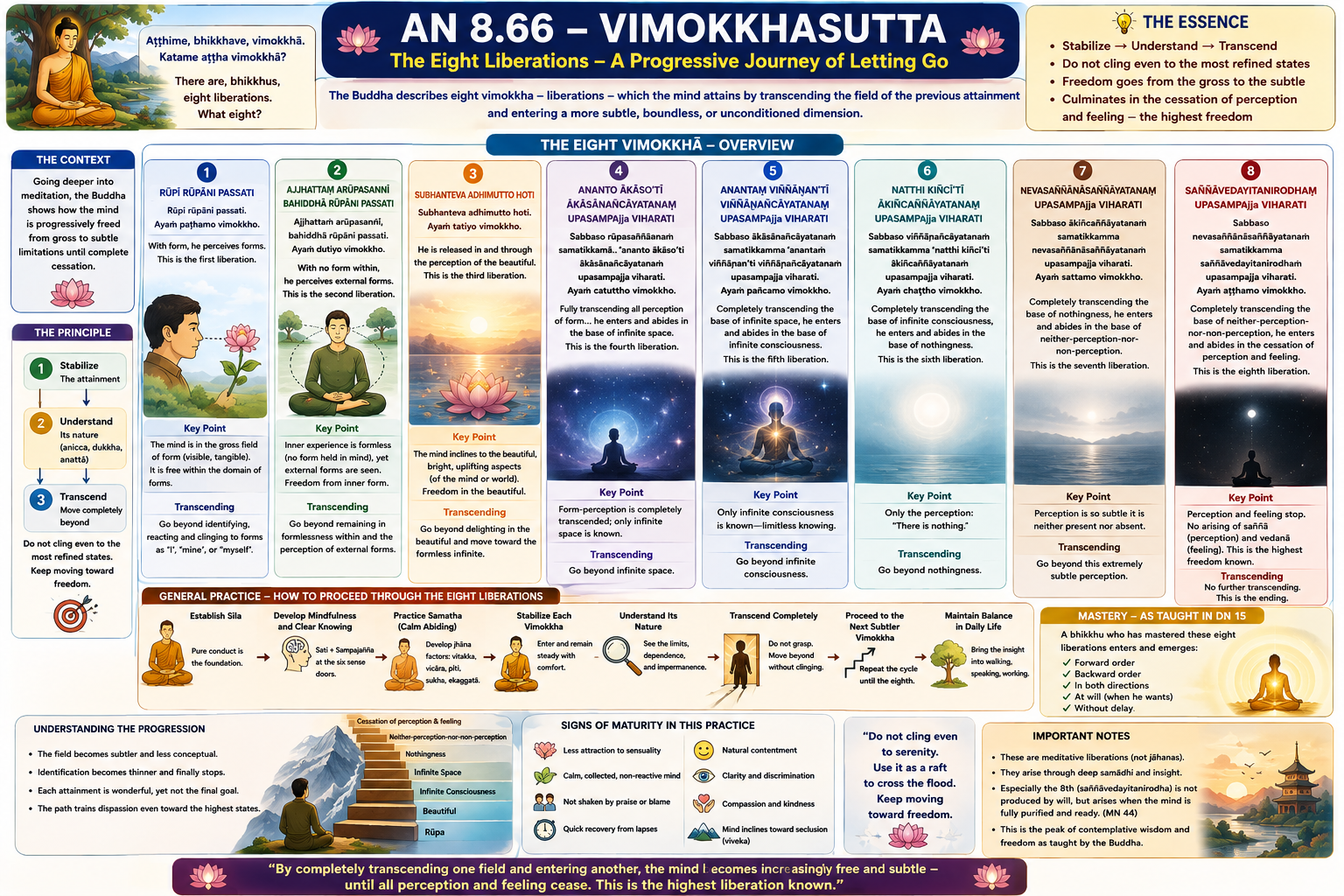
 VISUAL SUMMARYSee this sutta in a pictureOpen the complete infographic for a visual overview before or after reading the full study.View infographic →
“Aṭṭhime, bhikkhave, vimokkhā. Katame aṭṭha?”
“Bhikkhus, there are these eight liberations. What eight?”
Vimokkha means liberation, release, or emancipation. In this context the term refers to meditative liberations—modes in which the mind is progressively freed from a previous limitation of perception.
The sequence is not random. The first three remain related to form (rūpa); the fourth to seventh successively transcend increasingly subtle meditative perceptions; the eighth goes beyond even the extremely refined sphere of neither-perception-nor-non-perception into the cessation of perception and feeling.
1Paṭhamo Vimokkho
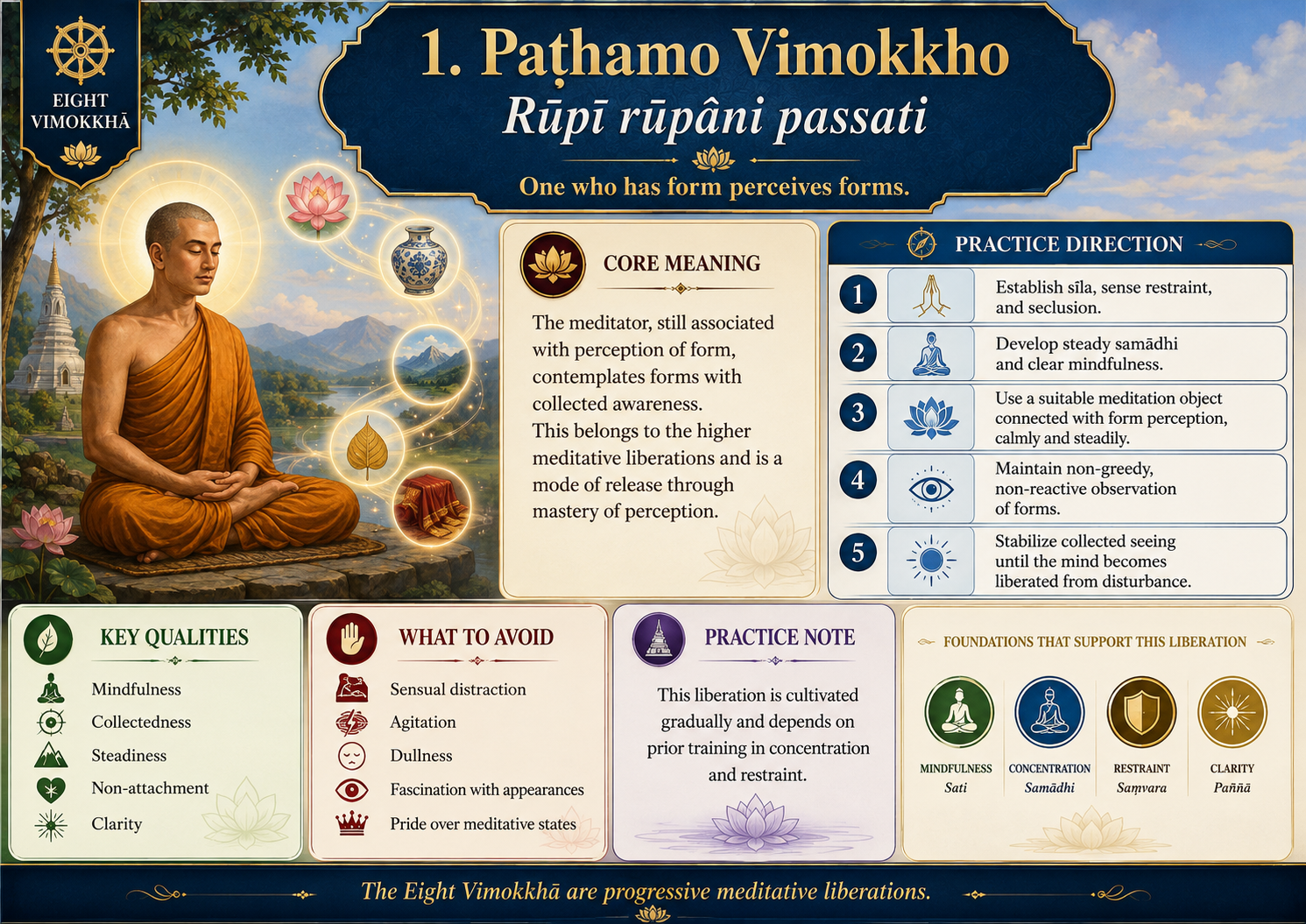
“Rūpī rūpāni passati. Ayaṁ paṭhamo vimokkho.”
“Being associated with form, one sees forms. This is the first liberation.”
The phrase is deliberately compact. Rūpī literally means “one having form” or “one associated with form,” while rūpāni passati means “one sees forms.”
AN 8.66 does not define in this passage exactly which form-object is used, how it is selected, or how the attainment is induced. Therefore it is safer to retain the canonical breadth of the statement rather than reduce it to one later technical method.
What is clear is that this first liberation still operates with form-perception present. The practitioner is not yet transcending rūpa. Instead, form is experienced within a collected meditative mode in which the mind is not simply reacting to forms through ordinary sensual grasping.
The liberative aspect lies in mastery of perception: form is present, yet the mind is not functioning in the ordinary scattered and appropriative manner.
Practice direction
2Dutiyo Vimokkho
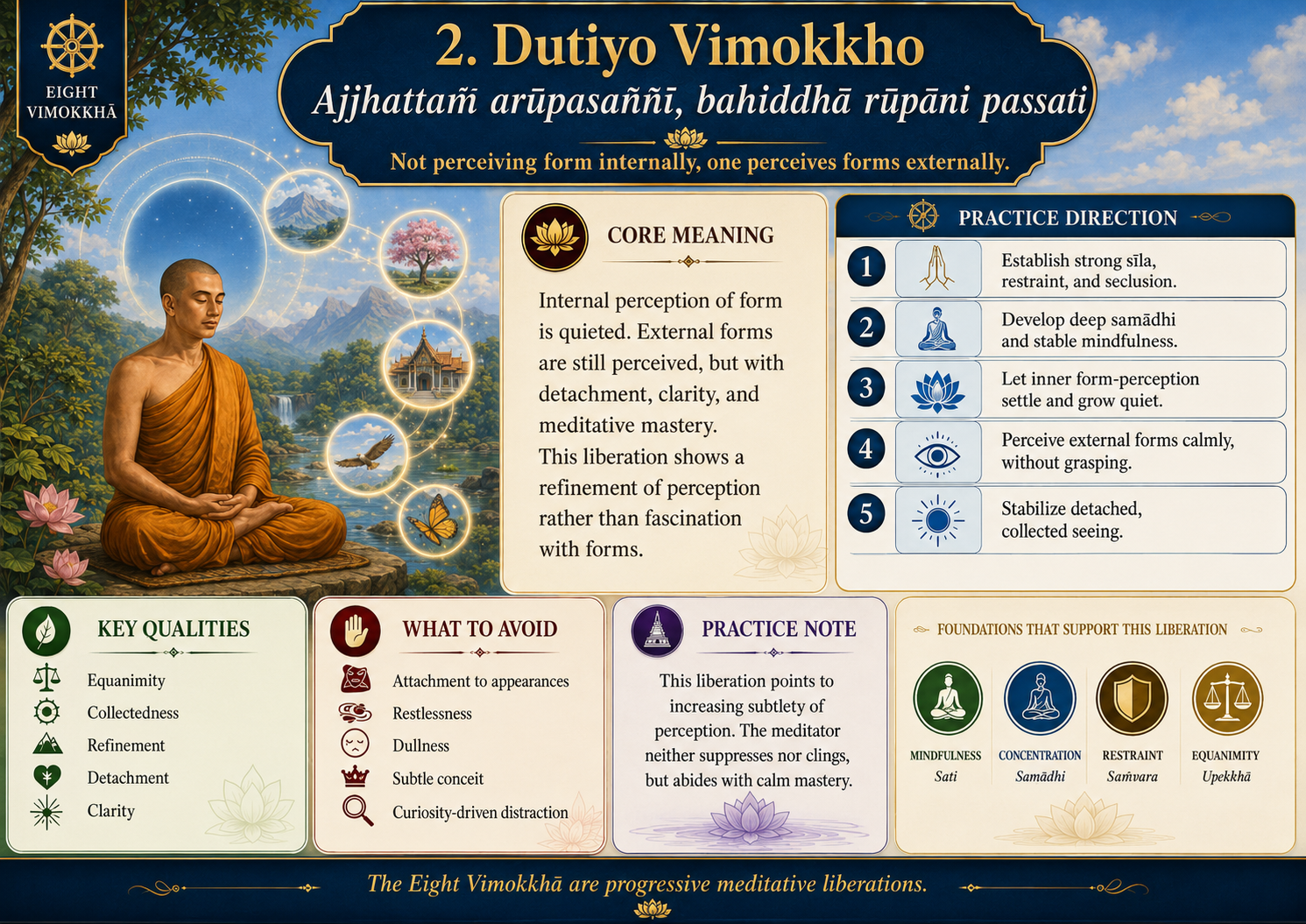
“Ajjhattaṁ arūpasaññī, bahiddhā rūpāni passati.
Ayaṁ dutiyo vimokkho.”
“Not perceiving form internally, one sees forms externally. This is the second liberation.”
The crucial contrast is between ajjhattaṁ—internally—and bahiddhā—externally.
Ajjhattaṁ arūpasaññī means that internally the practitioner is not operating with perception of form. Yet bahiddhā rūpāni passati—forms are still perceived externally.
The movement from the first to the second vimokkha is therefore a refinement in how form-perception is structured. Internal form-perception has quieted or is absent, while external form remains the field of meditative seeing.
Again, the short formula does not specify one mandatory meditation object. The essential point is the altered relation between internal and external form-perception.
The practitioner is learning that perception can be selectively refined: the mind need not be bound to the ordinary sense of an internally perceived body while forms are known externally.
Practice direction
3Tatiyo Vimokkho
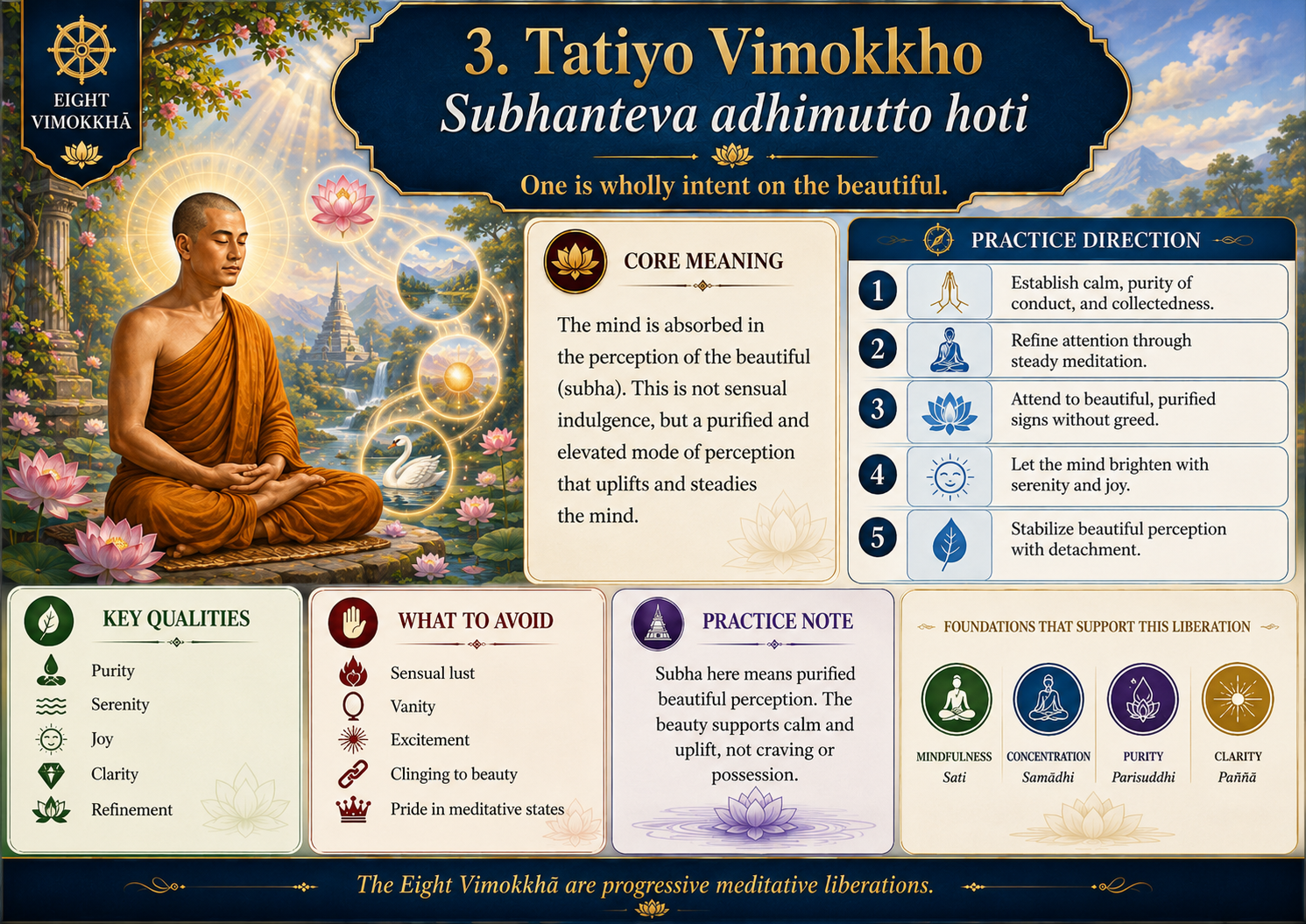
“Subhanteva adhimutto hoti. Ayaṁ tatiyo vimokkho.”
“One is fully resolved upon the beautiful. This is the third liberation.”
Subha means beautiful, pure, lovely, or aesthetically bright; adhimutta means resolved upon, intent upon, strongly inclined toward, or liberated toward.
The phrase should not be reduced to ordinary attraction to sensual beauty. If that were the meaning, it would contradict the liberative context of the sequence. Here subha is a meditative mode of perception in which the mind is fully and steadily resolved upon the beautiful without being driven by sensual craving.
The formula is again very short. AN 8.66 does not state exactly how subha is to be generated or what single object must be used. The important point is mastery of a purified “beautiful” perception that uplifts and steadies rather than intoxicates.
This liberation demonstrates that beauty itself need not become rāga. Under training, perception of beauty can be present while clinging and sensual fever are absent.
Practice direction
4Catuttho Vimokkho
“Sabbaso rūpasaññānaṁ samatikkamā paṭighasaññānaṁ atthaṅgamā nānattasaññānaṁ amanasikārā ‘ananto ākāso’ti ākāsānañcāyatanaṁ upasampajja viharati. Ayaṁ catuttho vimokkho.”
“With the complete transcending of perceptions of form, with the disappearance of perceptions of impingement, and by not attending to perceptions of diversity, aware that ‘space is infinite,’ one enters and dwells in the base of infinite space. This is the fourth liberation.”
This is the first vimokkha whose formula gives a clear internal sequence.
Sabbaso rūpasaññānaṁ samatikkamā — perceptions of form are completely transcended. This is not merely closing the eyes or ignoring visible objects; the meditative mode based on form-perception has itself been surpassed.
Paṭighasaññānaṁ atthaṅgamā — perceptions connected with sensory impingement or resistance have faded away.
Nānattasaññānaṁ amanasikārā — the mind does not attend to perceptions of multiplicity and diversity.
Then comes the new meditative perception: ananto ākāso—“space is infinite.”
The movement is therefore from bounded form to boundless spatiality. The mind no longer organizes experience around discrete form and multiplicity but abides in the perception of limitless space.
Practice direction

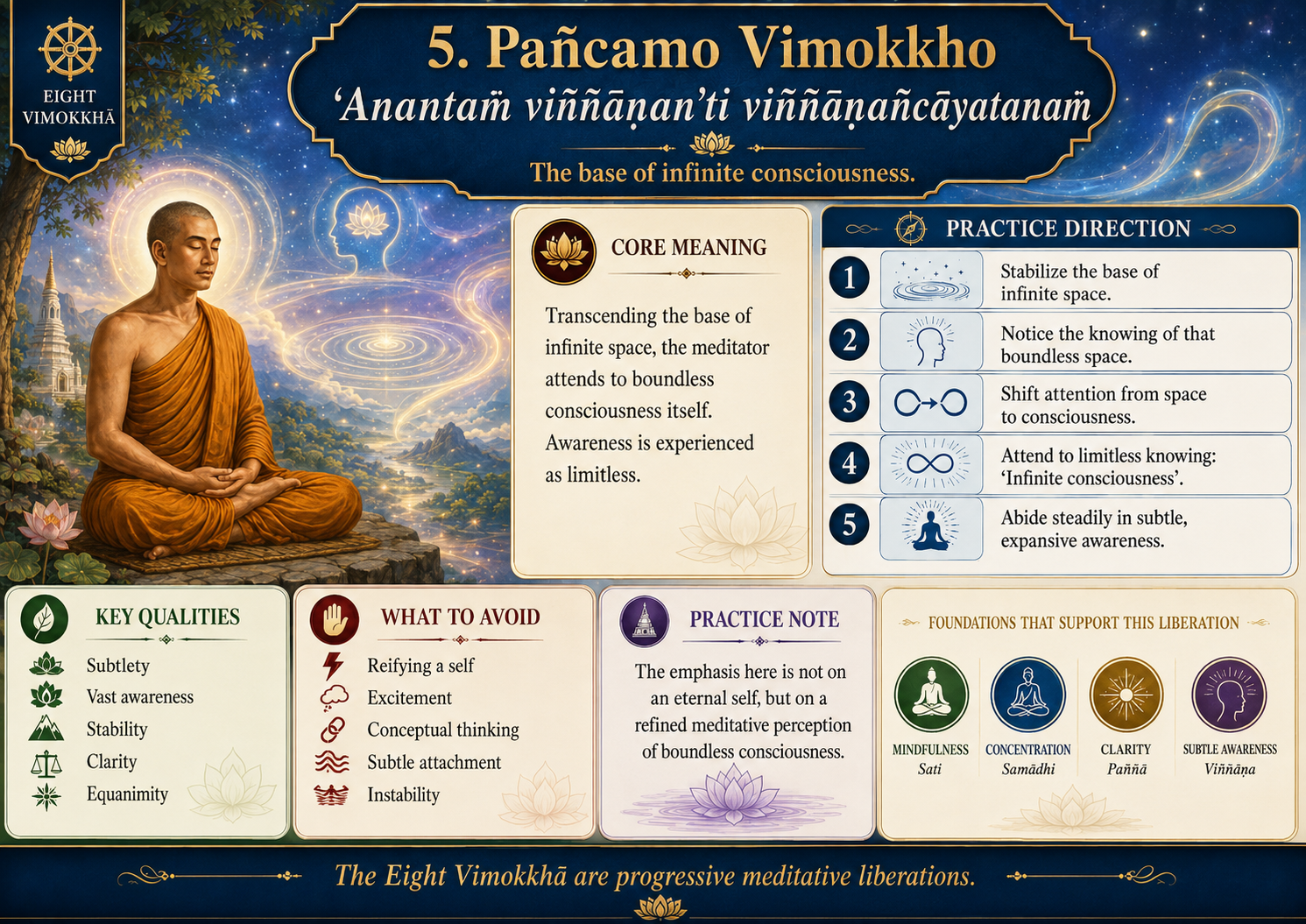
5Pañcamo Vimokkho
“Sabbaso ākāsānañcāyatanaṁ samatikkamma ‘anantaṁ viññāṇan’ti viññāṇañcāyatanaṁ upasampajja viharati. Ayaṁ pañcamo vimokkho.”
“Having completely transcended the base of infinite space, aware that ‘consciousness is infinite,’ one enters and dwells in the base of infinite consciousness. This is the fifth liberation.”
The fifth liberation does not add another object beside infinite space. It transcends the previous attainment itself.
Sabbaso ākāsānañcāyatanaṁ samatikkamma—one completely goes beyond the base of infinite space.
The new perception is anantaṁ viññāṇaṁ—“consciousness is infinite.”
The attention shifts from the boundlessness of space to the boundlessness of the knowing of that space. This is an even subtler meditative perception.
A crucial safeguard is needed: this does not establish an eternal cosmic Self or permanent consciousness. It is a conditioned meditative attainment, and the sutta’s own next step is to transcend it. Whatever can be entered and then surpassed should not be appropriated as an eternal essence.
Practice direction
6Chaṭṭho Vimokkho
“Sabbaso viññāṇañcāyatanaṁ samatikkamma ‘natthi kiñcī’ti ākiñcaññāyatanaṁ upasampajja viharati. Ayaṁ chaṭṭho vimokkho.”
“Having completely transcended the base of infinite consciousness, aware that ‘there is nothing,’ one enters and dwells in the base of nothingness. This is the sixth liberation.”
The perception of infinite consciousness is now itself seen as something to be left behind.
The key phrase is natthi kiñci—“there is nothing” or “there is nothing at all.”
This should not be read as a philosophical assertion that reality does not exist. It is the defining perception of a meditative attainment: ākiñcaññāyatana, the base of nothingness.
The movement is toward radical simplification. Even the subtle perception of limitless consciousness is relinquished. What remains salient is the absence of “somethingness.”
This state is subtler than infinite consciousness, but the sequence again warns against appropriation: the seventh vimokkha transcends even nothingness.
Practice direction

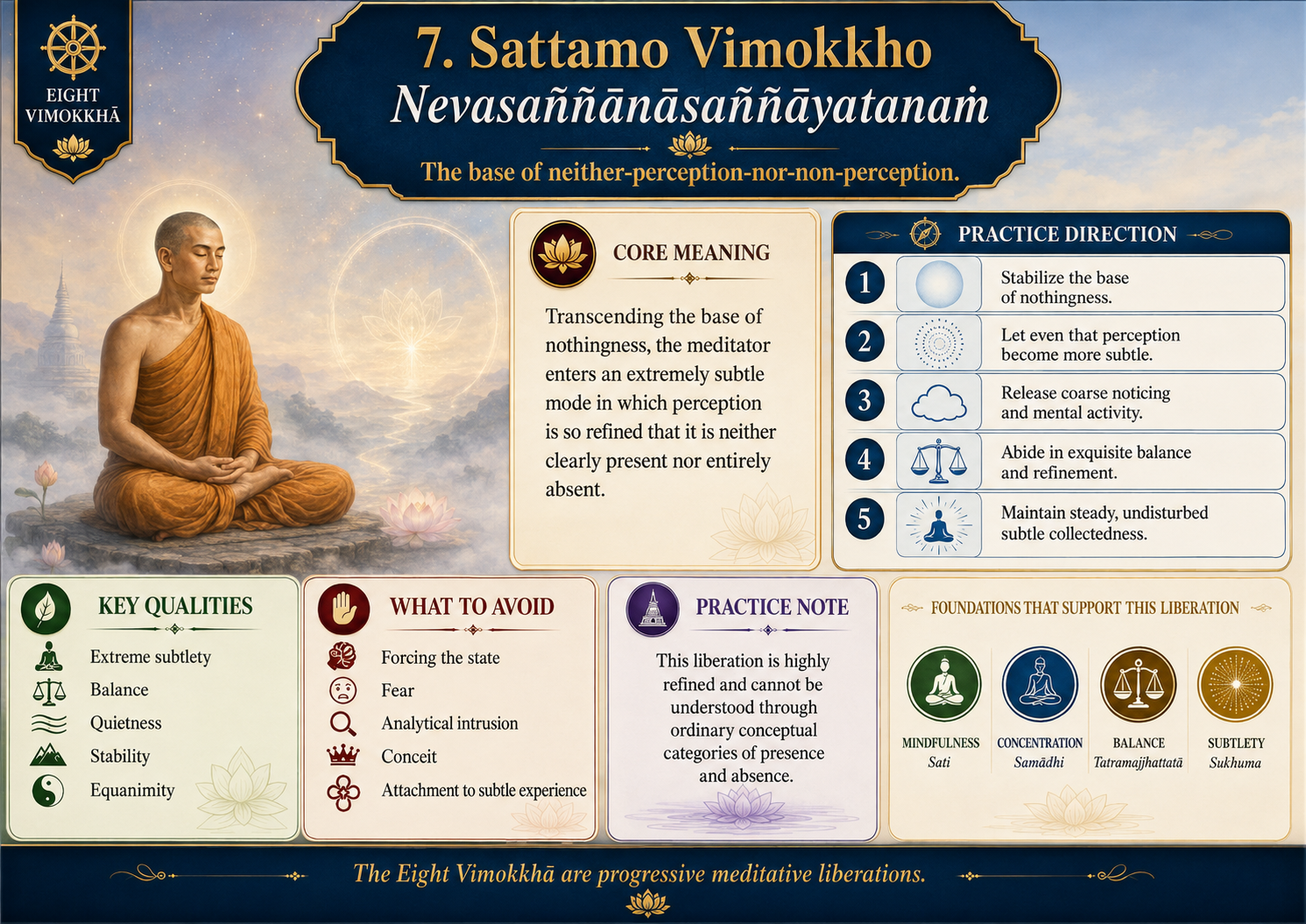
7Sattamo Vimokkho
“Sabbaso ākiñcaññāyatanaṁ samatikkamma nevasaññānāsaññāyatanaṁ upasampajja viharati. Ayaṁ sattamo vimokkho.”
“Having completely transcended the base of nothingness, one enters and dwells in the base of neither-perception-nor-non-perception. This is the seventh liberation.”
The base of nothingness is now completely transcended.
Nevasaññānāsaññā means neither-perception-nor-non-perception. Perception has become so subtle that it cannot properly be called ordinary perception, yet it has not completely ceased.
This is not unconsciousness. Nor is it ordinary clear perception. The formula deliberately avoids both extremes.
The state therefore represents an extraordinary refinement of saññā. Coarse noticing, analysis, and conceptual categorization are no longer appropriate descriptions.
AN 9.31 helps clarify the progressive logic: at this attainment, the perception of the base of nothingness has ceased. The mind abides in a condition subtler than the previous perception.
Practice direction
8Aṭṭhamo Vimokkho
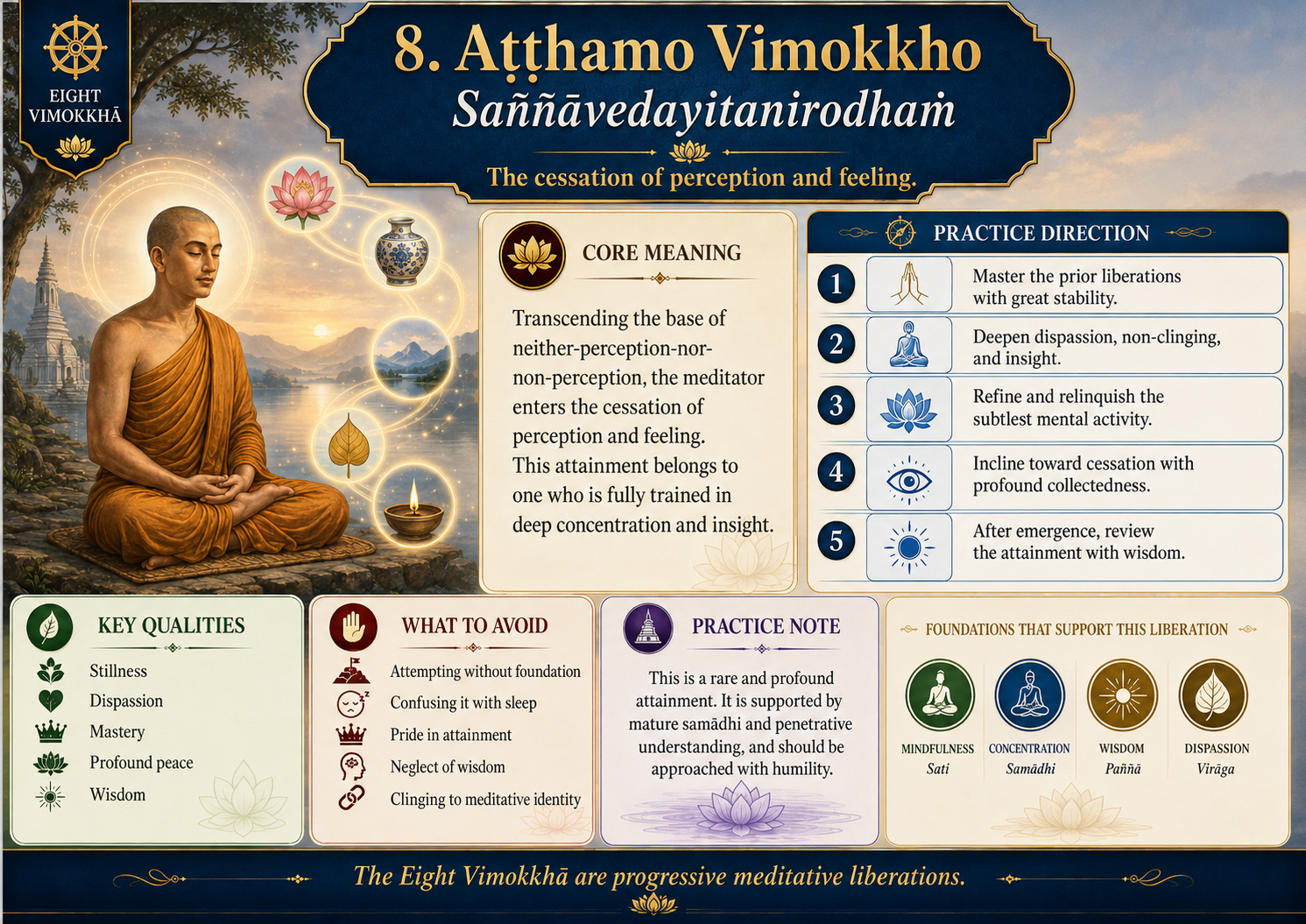
“Sabbaso nevasaññānāsaññāyatanaṁ samatikkamma saññāvedayitanirodhaṁ upasampajja viharati. Ayaṁ aṭṭhamo vimokkho.”
“Having completely transcended the base of neither-perception-nor-non-perception, one enters and dwells in the cessation of perception and feeling. This is the eighth liberation.”
The final vimokkha goes beyond even the seventh’s extraordinarily subtle perception.
Saññāvedayitanirodha literally means the cessation of perception and what is felt—commonly rendered “cessation of perception and feeling.”
AN 9.31 places this as the culmination of a sequence of progressive cessations: in this attainment, saññā and vedanā have ceased.
MN 44 adds an especially important clarification: one entering this attainment does not manufacture it through the thought ‘I will now enter cessation.’ Rather, the mind has been developed beforehand in such a way that it leads to the attainment. This guards against treating nirodha as an act of force, suppression, breath-holding, sleep, or blanking out.
The eighth vimokkha should therefore be approached as the culmination of profound prior development, not as an isolated technique.
After emergence, MN 44 says the practitioner is touched by emptiness, signlessness, and desirelessness, and the mind inclines toward seclusion. These are useful canonical markers for understanding the direction of the attainment.
Practice direction
“Ime kho, bhikkhave, aṭṭha vimokkhā”ti.
“These, bhikkhus, are the eight liberations.”
The sequence should be understood progressively. DN 15 states that full mastery involves entering the eight liberations in forward order, reverse order, and both forward and reverse, and emerging from them at will.
This means the teaching is not merely a checklist of eight extraordinary experiences. Mastery requires flexibility, stability, and non-confusion regarding entry and emergence.
The deeper lesson is progressive relinquishment. Each stage releases the limitation that structured the preceding stage:
form → form beyond internal form-perception → purified beautiful perception → infinite space → infinite consciousness → nothingness → neither-perception-nor-non-perception → cessation of perception and feeling.
The sequence therefore demonstrates a recurring principle of the Buddha’s training: even refined meditative experience is not to be grasped. What has been attained becomes the very thing that must later be transcended.
Canonical context used for the explanations
- AN 8.66 Vimokkhasutta — the base text and eight definitions.
- DN 15 Mahānidānasutta — repeats the eight liberations and describes mastery forward, reverse, and at will.
- AN 9.31 Anupubbanirodhasutta — clarifies the logic of progressive cessation through the jhānas and immaterial bases.
- MN 44 Cūḷavedallasutta — additional canonical detail on entering and emerging from saññāvedayitanirodha.