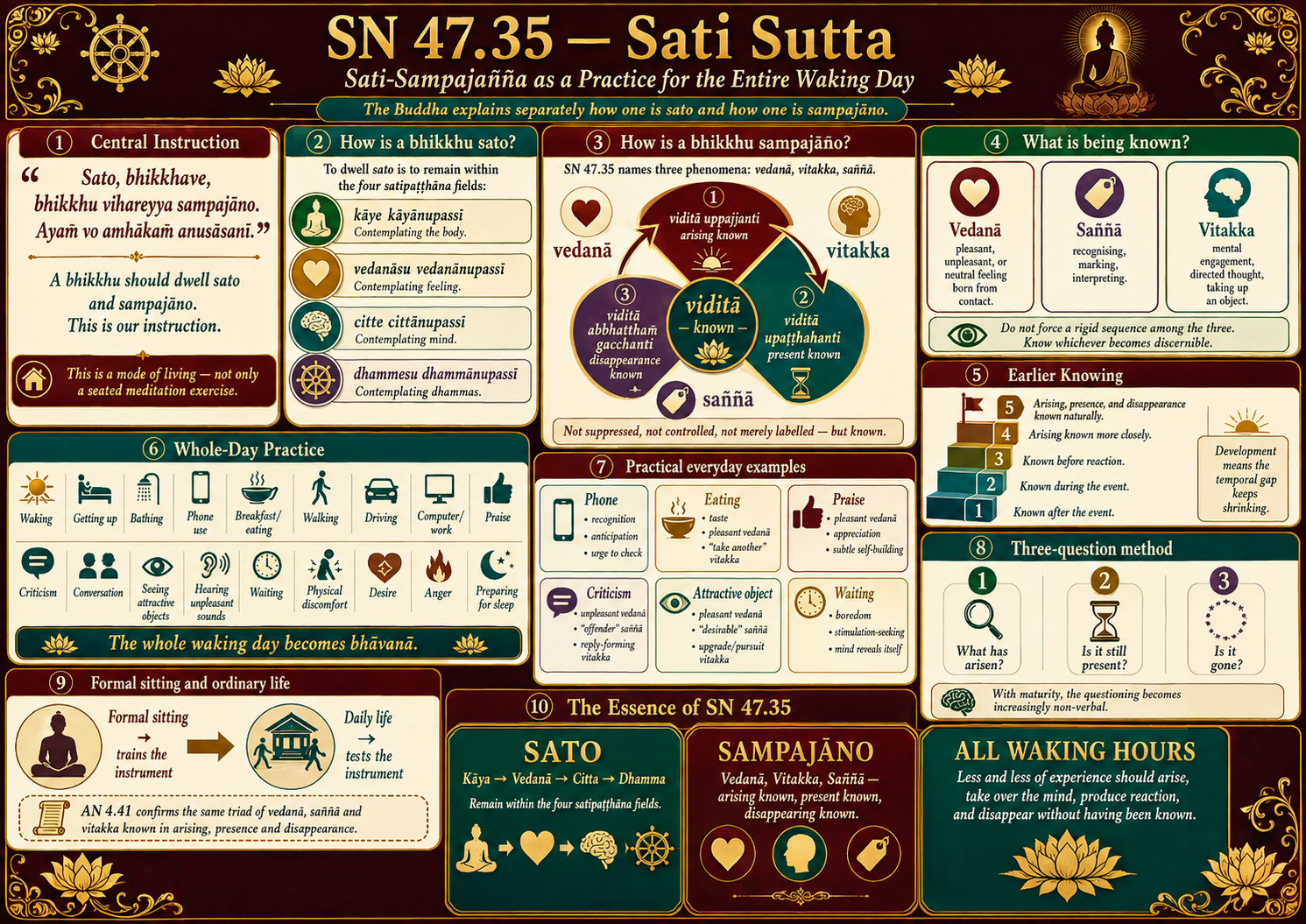
 VISUAL SUMMARYSee this sutta in a pictureOpen the complete infographic for a visual overview before or after reading the full study.View infographic →
Kāya • Vedanā • Citta • Dhamma→
Sampajāno→
Vedanā • Vitakka • Saññā→
Arising • Presence • Disappearance known
This short sutta is exceptionally important because the Buddha does something unusual: he does not leave sato and sampajāno as undefined meditation terminology. He asks separately, “How is a bhikkhu sato?” and “How is a bhikkhu sampajāno?”, and then gives an operational description of each.
That makes SN 47.35 one of the strongest canonical passages for understanding how sati-sampajañña can be lived, not merely translated.
01
Setting
Pāli
Sāvatthinidānaṁ.
Translation
At Sāvatthī.
The discourse is set at Sāvatthī. The teaching that follows is remarkably compact: the Buddha presents sati-sampajañña not merely as one exercise among many, but as his anusāsanī — instruction/admonition to the bhikkhus.
02
The central instruction
Pāli
“Sato, bhikkhave, bhikkhu vihareyya sampajāno. Ayaṁ vo amhākaṁ anusāsanī.”
Translation
“Bhikkhus, a bhikkhu should dwell sato, sampajāno. This is our instruction to you.”
I would deliberately not translate this as:
“A monk should dwell mindful and clearly comprehending.”
That sounds smooth but risks hiding the teaching.
Instead, retain:
A bhikkhu should dwell sato and sampajāno.
Then allow the Buddha himself to tell us what those terms mean.
Notice also vihareyya — “should dwell/live/remain.”
This is not restricted to:
“While he is sitting cross-legged, he should be sato sampajāno.”
It describes a mode of living.
That becomes crucial when we bring this teaching into the whole waking day.
03
What does the Buddha mean by **sato**?
Pāli
Kathañca, bhikkhave, bhikkhu sato hoti?
Idha, bhikkhave, bhikkhu kāye kāyānupassī viharati ātāpī sampajāno satimā, vineyya loke abhijjhādomanassaṁ;
vedanāsu vedanānupassī viharati ātāpī sampajāno satimā, vineyya loke abhijjhādomanassaṁ;
citte cittānupassī viharati ātāpī sampajāno satimā, vineyya loke abhijjhādomanassaṁ;
dhammesu dhammānupassī viharati ātāpī sampajāno satimā, vineyya loke abhijjhādomanassaṁ.
Evaṁ kho, bhikkhave, bhikkhu sato hoti.
Translation
“And how, bhikkhus, is a bhikkhu sato?
Here, bhikkhus, a bhikkhu dwells contemplating body as body, ardent, sampajāno and satimā, having removed covetousness and displeasure regarding the world.
He dwells contemplating vedanā as vedanā, ardent, sampajāno and satimā, having removed covetousness and displeasure regarding the world.
He dwells contemplating citta as citta, ardent, sampajāno and satimā, having removed covetousness and displeasure regarding the world.
He dwells contemplating dhammas as dhammas, ardent, sampajāno and satimā, having removed covetousness and displeasure regarding the world.
That is how a bhikkhu is sato.”
04
This immediately corrects a common oversimplification of sati
We often hear:
sati = remembering
or:
sati = present-moment awareness.
Both may point toward aspects of the word, but SN 47.35 gives us something much more concrete.
When the Buddha asks:
Kathañca bhikkhu sato hoti?
“How is a bhikkhu sato?”
he responds with:
kāya → vedanā → citta → dhamma.
Therefore, in the practical framework of this sutta:
To dwell sato is to remain within the four satipaṭṭhāna fields.
The practitioner does not merely try to create a generalized state called “mindfulness.”
There is something to be observed:
- kāya — body,
- vedanā — feeling,
- citta — mind,
- dhamma — relevant phenomena/patterns of Dhamma.
05
But notice something even more subtle
The description of sato itself contains:
ātāpī sampajāno satimā
So sati and sampajañña should not be imagined as two completely separate boxes.
The Buddha analytically answers:
“How is one sato?”
and then:
“How is one sampajāno?”
But within actual satipaṭṭhāna practice, sampajāno is already functioning alongside sati.
They are distinguishable for explanation, but intertwined in practice.
That distinction is important.
06
What does **sampajāno** mean?
Now comes the decisive portion.
Pāli
Kathañca, bhikkhave, bhikkhu sampajāno hoti?
Idha, bhikkhave, bhikkhuno viditā vedanā uppajjanti, viditā upaṭṭhahanti, viditā abbhatthaṁ gacchanti.
Viditā vitakkā uppajjanti, viditā upaṭṭhahanti, viditā abbhatthaṁ gacchanti.
Viditā saññā uppajjanti, viditā upaṭṭhahanti, viditā abbhatthaṁ gacchanti.
Evaṁ kho, bhikkhave, bhikkhu sampajāno hoti.
Translation
“And how, bhikkhus, is a bhikkhu sampajāno?
Here, for a bhikkhu, vedanā arise being known; they remain present being known; they go to disappearance being known.
Vitakkā arise being known; they remain present being known; they go to disappearance being known.
Saññā arise being known; they remain present being known; they go to disappearance being known.
That is how, bhikkhus, a bhikkhu is sampajāno.”
This is the heart of the sutta.
07
The key word is **viditā**
Notice how often the Buddha repeats:
viditā
— known.
Not:
controlled.
Not:
suppressed.
Not:
replaced.
Not:
thought about.
Not even:
labelled.
But:
known.
And what is known?
Three things are explicitly named:
vedanā
vitakka
saññā
And each must be known through three phases:
uppajjanti
arising
upaṭṭhahanti
standing present / remaining present
abbhatthaṁ gacchanti
going to disappearance / coming to an end.
So we have a remarkably precise structure:
| Phenomenon | Beginning | Middle | End |
|---|---|---|---|
| Vedanā | arising known | presence known | disappearance known |
| Vitakka | arising known | presence known | disappearance known |
| Saññā | arising known | presence known | disappearance known |
This gives considerably more precision than the English expression “clear comprehension.”
08
What is actually being accomplished?
At the beginning of practice, most mental events are known after they have already done their work.
Someone says something unpleasant.
Ten minutes later:
“I became angry.”
That is knowing after the event.
With development:
“Anger is present.”
Better.
Deeper still:
“Unpleasant vedanā is present.”
Then still deeper:
the arising of unpleasant vedanā itself becomes known.
And perhaps:
the saññā “insult” is known as it forms;
vitakka beginning to formulate the reply is known;
vitakka continuing to replay the remark is known;
its disappearance is known.
The temporal gap is shrinking.
That is an important way to understand development.
09
First object: **vedanā**
This requires particular care.
Vedanā is not simply bodily sensation.
It is the affective quality associated with experience:
- pleasant,
- unpleasant,
- neither-painful-nor-pleasant,
arising dependent upon contact through the six sense doors.
Therefore vedanā may be associated with:
- seeing,
- hearing,
- smelling,
- tasting,
- bodily contact,
- mental contact.
MN 10 likewise treats pleasant, painful, and neutral feeling as the field of vedanānupassanā.
Example: someone praises you
Sound occurs.
Words are understood.
Perhaps:
pleasant vedanā arises.
The important question according to SN 47.35 is:
Was its arising known?
Not thirty seconds later.
At arising.
Then:
Is pleasantness continuing?
Then:
Has it disappeared?
10
Why knowing vedanā early matters enormously
If pleasant vedanā is not known, the practitioner may only notice:
“I really like this person.”
But much has already happened.
If unpleasant vedanā is not known, one may only notice:
“That person is terrible.”
The feeling tone has already merged with perception, thinking, identity and reaction.
Therefore one enormous practical movement is:
Learn to distinguish vedanā from the story constructed after vedanā.
Someone criticises you.
Instead of immediately:
“He insulted me.”
there may first be the capacity to know:
unpleasant vedanā has arisen.
That creates a completely different field for practice.
11
Second object: **saññā**
Saññā is often translated simply as “perception.”
But practically we need to recognize what it does.
The mind recognizes, marks and interprets.
A pattern of visual colour becomes:
“car.”
Another becomes:
“my car.”
A series of sounds becomes:
“criticism.”
Another becomes:
“praise.”
Someone’s facial expression becomes:
“He doesn’t respect me.”
Saññā is indispensable for ordinary functioning.
The problem is not that saññā occurs.
The important change is:
saññā itself becomes known as an arising event.
12
A very powerful example of saññā
Suppose someone does not respond to your WhatsApp message.
The raw event is very small.
But saññā may form:
“He is ignoring me.”
Now notice what normally happens.
We do not experience:
“A saññā has arisen interpreting this absence of response as intentional disregard.”
We experience:
“He is ignoring me.”
The interpretation has become reality.
Sampajañña begins opening a gap:
“This perception has arisen.”
And later:
“That interpretation is no longer present.”
This is extremely important because saññā can determine the world in which the next vedanā and vitakka operate.
That last statement is a practical inference from the sutta, not a fixed causal sequence taught in SN 47.35.
13
Third object: **vitakka**
Vitakka should also not be reduced simply to random verbal thought.
In different canonical contexts it has nuances of thought, mental application and directed engagement.
For practical purposes here, watch what happens when the mind takes up an object and begins working upon it.
Someone criticises you.
Vitakka begins:
“Why did he say that?”
then:
“I should have replied…”
then:
“Next time I will tell him…”
then:
“He always behaves this way…”
Five minutes later the external sound has ceased.
But the mind is still producing the event.
What does SN 47.35 ask?
Was the arising of that vitakka known?
Was its continuation known?
Was its ending known?
That is a very different relationship to thought.
14
The sutta does NOT tell us to stop vedanā, saññā or vitakka from arising
This is crucial.
The formula is:
viditā … uppajjanti
They arise being known.
Therefore the goal is not:
“No vedanā should arise.”
Impossible in ordinary sensory life.
Nor:
“No saññā should occur.”
We could barely function.
Nor:
“No vitakka whatsoever may arise.”
Rather:
these things cease operating in darkness.
They become viditā.
That is the transformation.
15
Do not force a sequence among the three
SN 47.35 says:
- vedanā,
- vitakka,
- saññā.
AN 4.41 gives the same set while speaking of a development of samādhi that leads to sati-sampajañña, though its presentation orders saññā and vitakka differently.
Therefore we should not teach:
first vedanā, then saññā, then vitakka,
as though SN 47.35 had established a rigid psychological sequence.
Nor should we reverse it.
Instead:
whichever becomes discernible is known according to its arising, presence, and disappearance.
That is both textually safer and practically more useful.
16
Now combine the two halves of the sutta
We can now see the genius of SN 47.35.
Sato
The practitioner lives within:
kāya
vedanā
citta
dhamma
Sampajāno
Within this living field:
vedanā
vitakka
saññā
increasingly occur:
arising known
→ present known
→ disappearing known.
Therefore sati-sampajañña is not simply:
“Be aware of what you’re doing.”
It is a continuous investigation of experience.
17
How to practise during ALL waking hours
This does not mean staring inward tensely for sixteen hours trying to catch every microscopic event.
That would quickly become artificial.
The development should progressively make ordinary life itself the laboratory.
A useful model is:
Body provides continuity.
Sense contact provides events.
Vedanā, saññā and vitakka reveal the mind’s response.
Citta shows the condition produced.
Dhamma provides the framework for understanding it.
Now let us follow an entire ordinary day.
18
The first moments after waking
Before opening the phone, before thinking about today’s schedule:
know:
kāya — lying down.
Then see whether mental events are already arising.
Perhaps:
saññā
“Today is Thursday.”
vitakka
“I have to finish that work.”
vedanā
perhaps neutral, pleasant, or unpleasant depending upon what has been remembered.
Do not analyse heavily.
Simply start seeing:
this has arisen.
Then:
this remains.
Then:
this is gone.
Practice
For the first few minutes after waking:
do not immediately feed the mind another object.
This makes it much easier to observe its spontaneous activity.
19
Getting out of bed
The body moves:
kāya.
Standing occurs.
Walking occurs.
But the practice should not stop at:
“walking… walking…”
What is happening mentally?
Perhaps:
“I need coffee.”
Notice:
saññā: coffee recognised/imagined.
vedanā: pleasant anticipation.
vitakka: “I’ll make it now.”
The whole mental process may become visible while the body continues walking naturally.
This is waking-life sampajañña.
20
Brushing teeth and bathing
These are excellent training situations because they are repetitive and require little conceptual work.
Instead of daydreaming through the entire activity, observe:
- body movement,
- contact,
- temperature,
- vedanā,
- thoughts arising.
Suppose water feels too cold.
Immediately:
unpleasant vedanā.
Then:
saññā
“too cold.”
Then perhaps:
vitakka
“Why didn’t the water heat properly?”
Again, do not turn this into an intellectual diagram.
The purpose is progressively to see what actually becomes prominent.
21
Using the phone
This may be one of the best modern exercises for SN 47.35.
Before touching the phone, simply notice:
What caused the hand to move?
Often vitakka has already arisen.
“Let me check WhatsApp.”
Then the screen lights up.
A message from someone significant appears.
Perhaps:
Saññā
“That person.”
Vedanā
pleasant anticipation.
Vitakka
“What did they write?”
Then you open it.
Now perhaps a different vedanā appears.
The practitioner watches the entire changing event.
What is particularly useful here is to notice:
the feeling after opening the notification may not be the same as the feeling before opening it.
Directly visible impermanence.
22
Breakfast
Eating gives repeated opportunities within minutes.
See food.
Saññā:
“idli.”
Perhaps:
“I like this.”
Pleasant vedanā.
Taste.
Another pleasant vedanā.
Vitakka:
“Take another.”
Do not suppress enjoyment mechanically.
Instead know:
arising.
presence.
disappearance.
One remarkable observation becomes possible:
The pleasure of one mouthful has already ended, yet the mind may seek the next mouthful as though the previous pleasure could somehow be continued.
That is a powerful place for insight.
23
Walking
Walking is excellent because the body supplies a continuous stable reference.
Let the walking be natural.
Then observe mental excursions.
A thought about tomorrow appears.
When did it begin?
It remains for twenty seconds.
Then suddenly you are thinking about something entirely different.
Most people only know the contents:
“tomorrow’s meeting…”
“someone I spoke to yesterday…”
The practitioner begins knowing something different:
vitakka arose.
vitakka remained.
vitakka disappeared.
The object may be secondary.
The process becomes primary.
24
Driving
Driving requires appropriate attention to the road, so one should never compromise safety by trying to perform elaborate inward monitoring.
But sampajañña can still operate naturally.
Someone cuts in front.
Immediately:
unpleasant vedanā.
Saññā:
“careless driver.”
Vitakka:
“People have no discipline!”
This whole chain may occur within two seconds.
As practice matures, unpleasant vedanā can become known before the story has fully developed.
That is an important sign of development.
25
Working on a computer
You are writing.
An email arrives.
Attention shifts.
Saññā identifies sender.
Vedanā appears.
Vitakka begins planning a response.
Then another thought arises:
“Before replying I’ll look at something online.”
Fifteen minutes disappear.
Sampajañña asks:
At what point did the original activity disappear from knowing?
This is where sati and sampajañña cooperate beautifully.
Sati maintains the field.
Sampajañña reveals the mental events pulling the mind away.
26
Praise
Someone says:
“Your teaching was excellent.”
Listen carefully internally.
Perhaps:
pleasant vedanā.
Then saññā:
“They appreciate me.”
Vitakka:
“Yes, yesterday’s session really was good.”
Then:
“Many people are benefiting.”
Then perhaps subtle self-construction.
The purpose is not to become frightened of pleasant vedanā.
It is to know it.
Because what is known does not have the same opportunity to operate invisibly.
27
Criticism
This is probably an even more powerful laboratory.
Someone says:
“I don’t agree with your explanation.”
Watch carefully.
Perhaps immediately:
unpleasant vedanā.
Then saññā:
“He is challenging me.”
Vitakka:
“He doesn’t understand.”
Then:
“I’ll explain why he is wrong.”
What usually feels like one event—
“I was offended”
—can begin revealing multiple conditioned phenomena.
And most importantly:
they change.
The unpleasant vedanā disappears.
The interpretation changes.
The vitakka ends.
What seemed like an enormous solid event at 10:00 AM may be entirely absent at 10:05.
Viditā abbhatthaṁ gacchanti.
Known as they disappear.
28
Conversation
Conversation is a very advanced area of practice because events move quickly.
While another person speaks:
- sound is heard;
- meaning is perceived;
- vedanā changes;
- saññā interprets;
- vitakka formulates responses.
Most people are already preparing their answer while the other person is still speaking.
A useful exercise is:
Can I know the intention/thought to answer before I actually speak?
Not to create delay artificially.
But simply to catch mental activity earlier.
Then speech becomes less automatic.
29
Seeing an attractive object
Suppose you enter a shop and see a device you like.
The practitioner need not avert the eyes fearfully.
Instead investigate.
Saññā:
“new model.”
Vedanā:
pleasant.
Vitakka:
“That looks much better than mine.”
Then:
“Maybe I should upgrade.”
Then imagination.
Then comparison.
The entire commercial world can operate through these processes.
From the standpoint of SN 47.35, the important breakthrough is:
seeing the mind being captured rather than only discovering later that it has been captured.
30
Hearing something unpleasant
Perhaps construction noise.
Dog barking.
Someone talking loudly.
First:
sound.
Then unpleasant vedanā.
Then saññā:
“disturbance.”
Then vitakka:
“Why can’t they keep quiet?”
Within seconds a neutral sound event has become:
“They are disturbing my peace.”
If sampajañña is strong, the practitioner may catch the unpleasant vedanā before “my peace” has been manufactured around it.
That is a very practical transformation.
31
Waiting
Queues, traffic lights, elevators, airport security, delayed meetings—these are outstanding practice conditions.
Why?
Because the mind often seeks stimulation when there is nothing immediately to do.
Watch.
Vitakka arises.
Memory arises.
Planning arises.
Phone-reaching intention arises.
Boredom may involve unpleasant vedanā.
Instead of filling every empty second:
allow some gaps to remain unfilled.
Then the mind reveals itself.
32
Physical discomfort
You are sitting and the knee becomes uncomfortable.
Know:
unpleasant vedanā.
Then observe whether saññā adds:
“pain.”
Then:
“my bad knee.”
Then vitakka:
“I must change posture immediately.”
Perhaps changing posture is appropriate.
Sampajañña does not require foolish endurance.
But before moving, there may be an opportunity to discover:
vedanā and the desire to remove vedanā are distinguishable.
That distinction is very valuable.
33
Strong desire
A strong desire to eat, buy, check a message, speak, or obtain something appears.
Do not begin with:
“I must eliminate craving.”
First study what is actually observable.
What is the vedanā?
What saññā makes the object attractive?
What vitakka repeatedly returns to it?
Does the desire remain identical?
Or does it pulse, weaken, return, disappear?
Now craving is no longer one solid entity called:
“my desire.”
It becomes a conditioned process that can be studied.
34
Anger
Anger is particularly useful because it reveals how late our usual awareness is.
Normally:
someone speaks
→ we reply sharply
→ later we realise anger was present.
With practice:
sharp speech begins
→ anger recognised.
Later:
anger recognised before speech.
Deeper:
unpleasant vedanā recognised.
Deeper still:
the arising of unpleasant vedanā recognised.
And:
saññā identifying an “offender” becomes known.
vitakka constructing prosecution arguments becomes known.
This is how waking-life practice becomes progressively earlier.
35
The most important movement: **earlier knowing**
This may be the simplest way to assess development.
Level 1
Known after action.
Level 2
Known during action.
Level 3
Known before bodily/verbal reaction.
Level 4
Known close to the arising of vedanā, saññā or vitakka.
Level 5
Arising, presence and disappearance are naturally discerned without needing constant verbal commentary.
This moves increasingly closer to the formula:
viditā uppajjanti
viditā upaṭṭhahanti
viditā abbhatthaṁ gacchanti.
36
Do not neglect **disappearance**
Practitioners often become obsessed with noticing arising.
But the Buddha repeats the disappearance formula three times.
This deserves equal emphasis.
Suppose anger arises.
Instead of merely analysing anger, notice:
at some moment it is no longer there.
Where did it go?
The very thing that seemed:
“This is what I feel.”
is gone.
A new event is present.
This repeated observation can weaken the assumption that vedanā, saññā, and vitakka are stable possessions.
37
A highly practical three-question method
During ordinary life, you do not need a complicated internal questionnaire.
When something becomes prominent, three questions are enough:
1. What has arisen?
Vedanā?
Saññā?
Vitakka?
A condition of citta?
2. Is it still present?
Do not assume continuity.
Actually know.
3. Is it gone?
Recognize disappearance.
With repeated training these questions themselves should eventually disappear.
The knowing becomes non-verbal.
38
Do not narrate the entire day
There is a danger of turning practice into:
“Now I am walking.”
“Now I am opening the door.”
“Now I am drinking.”
“Now I am sitting.”
That can produce continuous mental commentary rather than greater penetration.
SN 47.35 does not say:
“Narrate every activity.”
It says:
viditā — known.
As practice develops, knowing becomes increasingly direct and less dependent on language.
39
Formal sitting is still extremely important
If one cannot recognize vedanā, saññā and vitakka when sitting quietly, it will be much more difficult during heated conversation or rapid activity.
Formal practice gives favourable conditions for learning their signatures.
For example, sitting quietly:
a memory arises.
Know it.
Pleasant vedanā appears.
Know it.
Vitakka engages the memory.
Know it.
It remains.
Know it.
It disappears.
Know disappearance.
Then another event comes.
Formal practice therefore trains the instrument.
Daily life tests whether the instrument works outside the laboratory.
AN 4.41 is particularly relevant here because it explicitly identifies a development of samādhi leading to sati-sampajañña and again describes vedanā, saññā and vitakka as known in arising, presence and disappearance.
40
Practising continuously without exhaustion
“All waking hours” should mean:
there is no part of ordinary life declared outside the training.
It should not mean:
“Maintain forceful microscopic observation every second.”
A more sustainable progression is:
formal sitting → transitions → repetitive activities → sense contacts → conversations → emotional situations → continuous ordinary life.
Gradually the gaps shrink.
Eventually the practitioner does not consciously decide:
“Now I will practise.”
Contact itself reminds the trained mind.
41
A waking-day training structure
| Period | Main training | What to observe |
|---|---|---|
| First waking moments | Establish sati before stimulation | first vedanā, first saññā, first vitakka |
| Bathing/dressing | Kāya as stable field | movements plus emerging mental activity |
| Breakfast | Vedanā | pleasantness, wanting another bite, disappearance of each taste |
| Phone use | Saññā + vitakka | recognition of notification, anticipation, urge to check |
| Walking | Kāya + citta | when mind leaves bodily field and enters planning/memory |
| Work | Vitakka | beginning, continuation and ending of mental engagement |
| Seeing/hearing | Vedanā + saññā | attractive/unattractive marking and immediate feeling tone |
| Conversation | Vedanā + vitakka | reaction before speech |
| Criticism | Unpleasant vedanā | how quickly “me” and “against me” are constructed |
| Praise | Pleasant vedanā | delight, identification, conceit-building thoughts |
| Eating later in day | Vedanā + craving tendencies | whether desire continues after taste itself has ended |
| Waiting | Citta | automatic need for stimulation |
| Before sleep | Review disappearance | what mental events that dominated the day are completely absent now |
42
A second table: what exactly should be known?
| Phenomenon | Ordinary example | What usually happens | SN 47.35 training |
|---|---|---|---|
| Vedanā | criticism feels unpleasant | “He hurt me” | unpleasantness arises known → remains known → ends known |
| Vedanā | praise feels pleasant | delight becomes identification | pleasantness itself is known before appropriation |
| Saññā | unread message | “He is ignoring me” | interpretation itself becomes a known event |
| Saññā | attractive product | “This is desirable” | marking/recognition is known rather than treated automatically as truth |
| Vitakka | replaying argument | endless internal dialogue | beginning, continuation and ending of mental engagement are known |
| Vitakka | planning purchase | repeated consideration | vitakka is known as vitakka rather than becoming “what I must do” |
43
What happens when this becomes strong?
There is a profound shift from:
living inside mental events
to:
mental events occurring while being known.
Before:
unpleasant vedanā = my suffering.
Later:
unpleasant vedanā is present.
Before:
saññā = reality.
Later:
a perception/interpretation has arisen.
Before:
vitakka = my thinking.
Later:
vitakka is operating.
And ultimately:
it has disappeared.
This does not require manufacturing philosophical thoughts such as:
“This is not-self.”
The changing nature of the process begins presenting the evidence itself.
44
The relationship with Satipaṭṭhāna becomes beautiful here
SN 47.35 begins with:
kāya
vedanā
citta
dhamma.
And then explains sampajāno using:
vedanā
vitakka
saññā.
So the bhāvanā practitioner can live the day with two simultaneous dimensions:
The broad field
Where am I observing?
Kāya?
Vedanā?
Citta?
Dhamma?
The dynamic process
What is appearing and disappearing within experience?
Vedanā?
Vitakka?
Saññā?
The practice is therefore both:
field-oriented
and
process-oriented.
45
Eventually, the waking day itself becomes Satipaṭṭhāna
At first:
“I practise satipaṭṭhāna for one hour.”
Then:
“I try to remember it while walking.”
Then:
“I recognise reactions during conversations.”
Then:
“Vedanā is increasingly known before reaction.”
Then:
“Saññā is caught while shaping the object.”
Then:
“Vitakka is known as soon as it begins engaging.”
Then:
“Their disappearance is also obvious.”
At that stage the distinction between:
meditation time
and:
ordinary time
becomes less meaningful.
The whole waking day becomes bhāvanā.
46
The final instruction
Pāli
“Sato, bhikkhave, bhikkhu vihareyya sampajāno. Ayaṁ vo amhākaṁ anusāsanī”ti.
Translation
“Bhikkhus, a bhikkhu should dwell sato and sampajāno. This is our instruction to you.”
Notice that the sutta ends exactly where it began.
The structure is almost:
Here is my instruction:
dwell sato, sampajāno.
What is sato?
four satipaṭṭhānas.
What is sampajāno?
vedanā, vitakka and saññā known in arising, presence and disappearance.
Therefore:
dwell sato, sampajāno.
Nothing vague remains.
SATO
Live within:
Kāya → Vedanā → Citta → Dhamma
SAMPAJĀNO
Train so that:
Vedanā
→ arising known
→ present known
→ disappearing known
Vitakka
→ arising known
→ present known
→ disappearing known
Saññā
→ arising known
→ present known
→ disappearing known
ALL WAKING HOURS
Apply this while:
waking → washing → eating → walking → looking → hearing → working → speaking → being praised → being criticised → using the phone → wanting → resisting → waiting → resting → preparing for sleep.
The aim is not:
“I must constantly tell myself what I am doing.”
The aim is:
less and less of experience should arise, take over the mind, produce reaction, and disappear without having been known.
That, I think, is the most precise practical rendering of SN 47.35.
And the deepest measure of progress may be stated very simply:
How early do I know what has arisen?
Can I remain knowing it while it is present?
Do I also know when it has disappeared?
When those three become increasingly continuous through the waking day, sati-sampajañña is no longer merely something one understands—it is becoming the way one lives.
Less and less of experience should arise, take over the mind, produce reaction, and disappear without having been known.