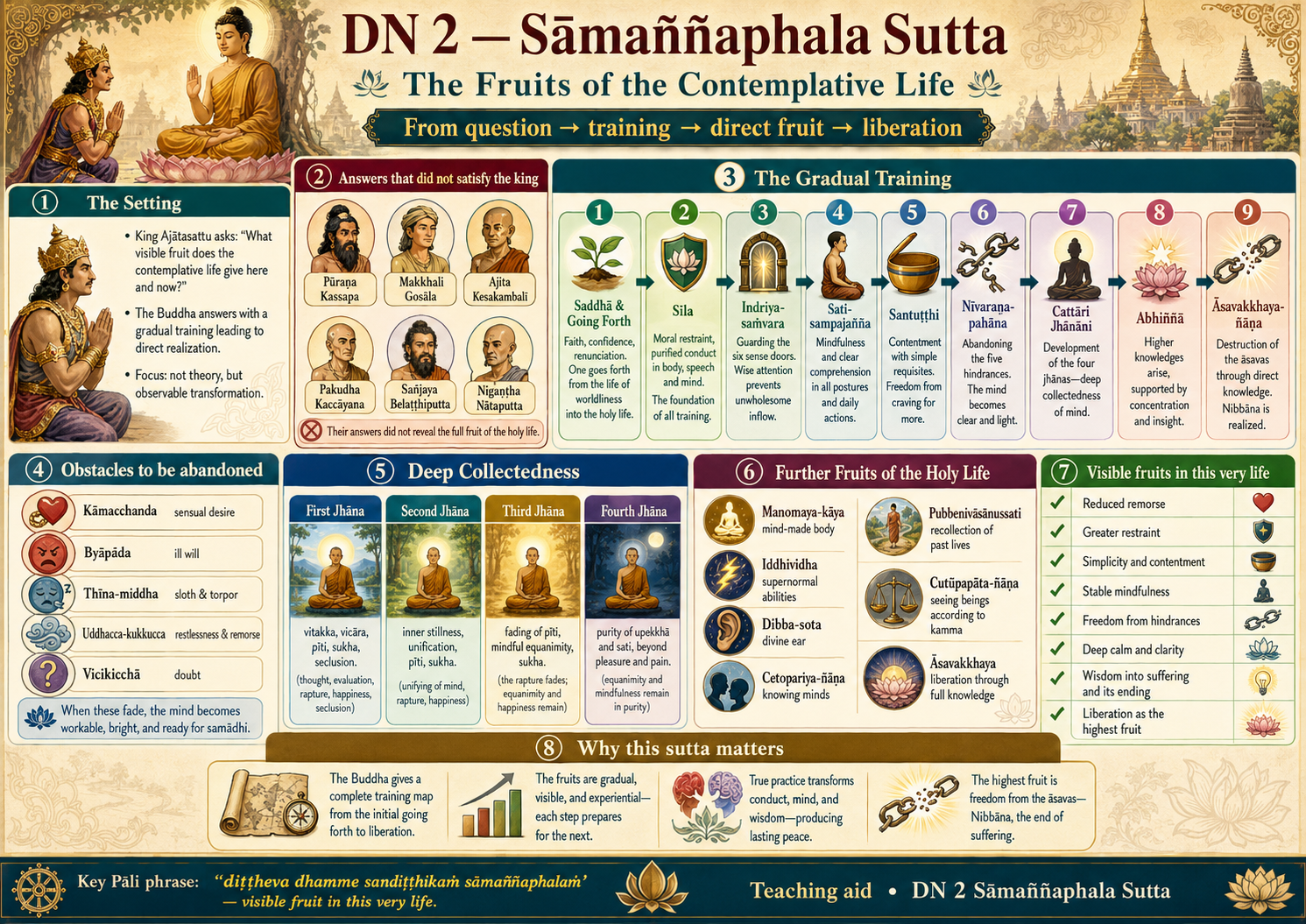
 VISUAL SUMMARYSee this sutta in a pictureOpen the complete infographic for a visual overview before or after reading the full study.View infographic →
The king does not initially ask, “Which doctrine is metaphysically correct?” He asks for a sandiṭṭhika sāmaññaphala —a fruit of contemplative life that can be pointed out and recognized here and now , just as a craft or profession yields an observable result.
DN 2 is therefore structured around demonstrable development: changed conduct → freedom and respect → blamelessness → guarded senses → sati-sampajañña → contentment → hindrance-free citta → jhāna → higher knowledges → destruction of the āsavas.
The Buddha repeatedly calls each later fruit abhikkantatarañca paṇītatarañca —more excellent and more refined than the preceding ones.
Ajātasattu repeatedly says that asking these teachers about the visible fruit of contemplative life was like asking about a mango and being told about a jackfruit . The issue is not merely that their doctrines differ from the Buddha’s. The immediate issue in the narrative is that they do not answer the empirical/practical question being asked.
The six rival teachers on this page are presented as DN 2 portrays them . These passages are Buddhist textual representations within the narrative and should not automatically be treated as neutral historical biographies of Pūraṇa Kassapa, Makkhali Gosāla, Ajita Kesakambala, Pakudha Kaccāyana, Nigaṇṭha Nāṭaputta, or Sañcaya Belaṭṭhaputta.
The immediate narrative contrast is practical: Ajātasattu asks for a sandiṭṭhika sāmaññaphala —a fruit demonstrable here and now—and repeatedly judges the answers by whether they actually address that question.
01 The King and His Ministers
Evaṁ me sutaṁ— ekaṁ samayaṁ bhagavā rājagahe viharati jīvakassa komārabhaccassa ambavane mahatā bhikkhusaṅghena saddhiṁ aḍḍhateḷasehi bhikkhusatehi.
Thus have I heard. On one occasion the Blessed One was staying at Rājagaha, in Jīvaka Komārabhacca’s mango grove, together with a large Saṅgha of about twelve hundred and fifty bhikkhus.
Tena kho pana samayena rājā māgadho ajātasattu vedehiputto tadahuposathe pannarase komudiyā cātumāsiniyā puṇṇāya puṇṇamāya rattiyā rājāmaccaparivuto uparipāsādavaragato nisinno hoti.
At that time King Ajātasattu of Magadha, son of the Vedehī queen, was seated on the upper terrace of his palace surrounded by his ministers. It was the fifteenth-day Uposatha, the full-moon night of the Komudī season at the end of the four-month rains period.
Atha kho rājā māgadho ajātasattu vedehiputto tadahuposathe udānaṁ udānesi: “ramaṇīyā vata bho dosinā ratti, abhirūpā vata bho dosinā ratti, dassanīyā vata bho dosinā ratti, pāsādikā vata bho dosinā ratti, lakkhaññā vata bho dosinā ratti. Kaṁ nu khvajja samaṇaṁ vā brāhmaṇaṁ vā payirupāseyyāma, yaṁ no payirupāsato cittaṁ pasīdeyyā”ti?
On that full-moon Uposatha night King Ajātasattu exclaimed: ‘How delightful, beautiful, lovely, serene and auspicious this moonlit night is! Which ascetic or brahmin might we visit tonight so that, by visiting him, our citta might become serene and confident?’
Evaṁ vutte, aññataro rājāmacco rājānaṁ māgadhaṁ ajātasattuṁ vedehiputtaṁ etadavoca: “ayaṁ, deva, pūraṇo kassapo saṅghī ceva gaṇī ca gaṇācariyo ca ñāto yasassī titthakaro sādhusammato bahujanassa rattaññū cirapabbajito addhagato vayoanuppatto. Taṁ devo pūraṇaṁ kassapaṁ payirupāsatu. Appeva nāma devassa pūraṇaṁ kassapaṁ payirupāsato cittaṁ pasīdeyyā”ti. Evaṁ vutte, rājā māgadho ajātasattu vedehiputto tuṇhī ahosi.
One minister recommended Pūraṇa Kassapa, praising him as the leader of a community, a well-known and famous teacher, honored by many, long gone forth and advanced in age. He suggested that visiting Pūraṇa might bring clarity to the king’s citta. The king remained silent.
Aññataropi kho rājāmacco rājānaṁ māgadhaṁ ajātasattuṁ vedehiputtaṁ etadavoca: “ayaṁ, deva, makkhali gosālo saṅghī ceva gaṇī ca gaṇācariyo ca ñāto yasassī titthakaro sādhusammato bahujanassa rattaññū cirapabbajito addhagato vayoanuppatto. Taṁ devo makkhaliṁ gosālaṁ payirupāsatu. Appeva nāma devassa makkhaliṁ gosālaṁ payirupāsato cittaṁ pasīdeyyā”ti. Evaṁ vutte, rājā māgadho ajātasattu vedehiputto tuṇhī ahosi.
Another minister recommended Makkhali Gosāla in the same terms—as a famous leader and long-established teacher whose company might bring serenity to the king’s citta. The king remained silent.
Aññataropi kho rājāmacco rājānaṁ māgadhaṁ ajātasattuṁ vedehiputtaṁ etadavoca: “ayaṁ, deva, ajito kesakambalo saṅghī ceva gaṇī ca gaṇācariyo ca ñāto yasassī titthakaro sādhusammato bahujanassa rattaññū cirapabbajito addhagato vayoanuppatto. Taṁ devo ajitaṁ kesakambalaṁ payirupāsatu. Appeva nāma devassa ajitaṁ kesakambalaṁ payirupāsato cittaṁ pasīdeyyā”ti. Evaṁ vutte, rājā māgadho ajātasattu vedehiputto tuṇhī ahosi.
Another minister recommended Ajita Kesakambala, likewise praising his fame, leadership, reputation and seniority. The king remained silent.
Aññataropi kho rājāmacco rājānaṁ māgadhaṁ ajātasattuṁ vedehiputtaṁ etadavoca: “ayaṁ, deva, pakudho kaccāyano saṅghī ceva gaṇī ca gaṇācariyo ca ñāto yasassī titthakaro sādhusammato bahujanassa rattaññū cirapabbajito addhagato vayoanuppatto. Taṁ devo pakudhaṁ kaccāyanaṁ payirupāsatu. Appeva nāma devassa pakudhaṁ kaccāyanaṁ payirupāsato cittaṁ pasīdeyyā”ti. Evaṁ vutte, rājā māgadho ajātasattu vedehiputto tuṇhī ahosi.
Another minister recommended Pakudha Kaccāyana, again describing him as a renowned leader and respected teacher of long standing. The king remained silent.
Aññataropi kho rājāmacco rājānaṁ māgadhaṁ ajātasattuṁ vedehiputtaṁ etadavoca: “ayaṁ, deva, sañcayo belaṭṭhaputto saṅghī ceva gaṇī ca gaṇācariyo ca ñāto yasassī titthakaro sādhusammato bahujanassa rattaññū cirapabbajito addhagato vayoanuppatto.
Variant readings: sañcayo → sañjayo (bj, sya-all, pts1ed) | belaṭṭhaputto → velaṭṭhaputto (sya-all); bellaṭṭhiputto (pts1ed) Taṁ devo sañcayaṁ belaṭṭhaputtaṁ payirupāsatu. Appeva nāma devassa sañcayaṁ belaṭṭhaputtaṁ payirupāsato cittaṁ pasīdeyyā”ti. Evaṁ vutte, rājā māgadho ajātasattu vedehiputto tuṇhī ahosi.
Another minister recommended Sañcaya Belaṭṭhaputta, praising him as a famous teacher and leader, honored by many and long gone forth. The king remained silent.
Aññataropi kho rājāmacco rājānaṁ māgadhaṁ ajātasattuṁ vedehiputtaṁ etadavoca: “ayaṁ, deva, nigaṇṭho nāṭaputto saṅghī ceva gaṇī ca gaṇācariyo ca ñāto yasassī titthakaro sādhusammato bahujanassa rattaññū cirapabbajito addhagato vayoanuppatto.
Variant readings: nāṭaputto → nātaputto (bj, pts1ed) Taṁ devo nigaṇṭhaṁ nāṭaputtaṁ payirupāsatu. Appeva nāma devassa nigaṇṭhaṁ nāṭaputtaṁ payirupāsato cittaṁ pasīdeyyā”ti. Evaṁ vutte, rājā māgadho ajātasattu vedehiputto tuṇhī ahosi.
Another minister recommended Nigaṇṭha Nāṭaputta in the same way. The king again remained silent.
02 Jīvaka Leads the King to the Buddha
Tena kho pana samayena jīvako komārabhacco rañño māgadhassa ajātasattussa vedehiputtassa avidūre tuṇhībhūto nisinno hoti. Atha kho rājā māgadho ajātasattu vedehiputto jīvakaṁ komārabhaccaṁ etadavoca: “tvaṁ pana, samma jīvaka, kiṁ tuṇhī”ti?
Jīvaka Komārabhacca was sitting silently not far from the king. Ajātasattu asked him, ‘Friend Jīvaka, why are you silent?’
“Ayaṁ, deva, bhagavā arahaṁ sammāsambuddho amhākaṁ ambavane viharati mahatā bhikkhusaṅghena saddhiṁ aḍḍhateḷasehi bhikkhusatehi. Taṁ kho pana bhagavantaṁ evaṁ kalyāṇo kittisaddo abbhuggato:
Variant readings: bhagavantaṁ → bhagavantaṁ gotamaṁ (bj, pts1ed, mr) ‘itipi so bhagavā arahaṁ sammāsambuddho vijjācaraṇasampanno sugato lokavidū anuttaro purisadammasārathi satthā devamanussānaṁ buddho bhagavā’ti. Taṁ devo bhagavantaṁ payirupāsatu. Appeva nāma devassa bhagavantaṁ payirupāsato cittaṁ pasīdeyyā”ti.
Jīvaka replied: ‘Sire, the Blessed One—the Arahant, the Perfectly Awakened Buddha—is staying in our mango grove with about twelve hundred and fifty bhikkhus. A fine reputation has spread concerning him: “The Blessed One is an arahant, perfectly awakened, accomplished in knowledge and conduct, well-gone, knower of worlds, unsurpassed trainer of persons to be tamed, teacher of devas and humans, Buddha, Blessed One.” Let Your Majesty visit him. Perhaps your citta will become serene by seeing him.’
“Tena hi, samma jīvaka, hatthiyānāni kappāpehī”ti.
The king said, ‘Then, friend Jīvaka, have the elephant vehicles prepared.’
“Evaṁ, devā”ti kho jīvako komārabhacco rañño māgadhassa ajātasattussa vedehiputtassa paṭissuṇitvā pañcamattāni hatthinikāsatāni kappāpetvā rañño ca ārohaṇīyaṁ nāgaṁ, rañño māgadhassa ajātasattussa vedehiputtassa paṭivedesi: “kappitāni kho te, deva, hatthiyānāni, yassadāni kālaṁ maññasī”ti.
Jīvaka agreed. He had about five hundred female elephants prepared, as well as the king’s riding elephant, and informed Ajātasattu that the vehicles were ready whenever he wished to depart.
Atha kho rājā māgadho ajātasattu vedehiputto pañcasu hatthinikāsatesu paccekā itthiyo āropetvā ārohaṇīyaṁ nāgaṁ abhiruhitvā ukkāsu dhāriyamānāsu rājagahamhā niyyāsi mahaccarājānubhāvena, yena jīvakassa komārabhaccassa ambavanaṁ tena pāyāsi.
The king placed a woman on each of the five hundred female elephants, mounted his own elephant, and left Rājagaha in great royal splendor by torchlight, heading for Jīvaka’s mango grove.
Atha kho rañño māgadhassa ajātasattussa vedehiputtassa avidūre ambavanassa ahudeva bhayaṁ, ahu chambhitattaṁ, ahu lomahaṁso. Atha kho rājā māgadho ajātasattu vedehiputto bhīto saṁviggo lomahaṭṭhajāto jīvakaṁ komārabhaccaṁ etadavoca: “kacci maṁ, samma jīvaka, na vañcesi? Kacci maṁ, samma jīvaka, na palambhesi? Kacci maṁ, samma jīvaka, na paccatthikānaṁ desi? Kathañhi nāma tāva mahato bhikkhusaṅghassa aḍḍhateḷasānaṁ bhikkhusatānaṁ neva khipitasaddo bhavissati, na ukkāsitasaddo na nigghoso”ti.
As the king drew near the mango grove, fear, trembling and horripilation arose in him. Alarmed, he asked Jīvaka whether he was deceiving him, leading him into a trap, or handing him over to enemies. ‘How can such a huge Saṅgha of twelve hundred and fifty bhikkhus make no sound of sneezing, coughing or conversation?’
“Mā bhāyi, mahārāja, mā bhāyi, mahārāja. Na taṁ, deva, vañcemi; na taṁ, deva, palambhāmi; na taṁ, deva, paccatthikānaṁ demi. Abhikkama, mahārāja, abhikkama, mahārāja, ete maṇḍalamāḷe dīpā jhāyantī”ti.
Variant readings: dīpā → padīpā (sya-all)
Jīvaka reassured him: ‘Do not be afraid, great king. I am not deceiving you, entrapping you or giving you to enemies. Go forward. There—lamps are burning in the assembly pavilion.’
03 Meeting the Buddha and the Question of a Visible Fruit
Atha kho rājā māgadho ajātasattu vedehiputto yāvatikā nāgassa bhūmi nāgena gantvā, nāgā paccorohitvā, pattikova yena maṇḍalamāḷassa dvāraṁ tenupasaṅkami; upasaṅkamitvā jīvakaṁ komārabhaccaṁ etadavoca:
Variant readings: pattikova → padikova (cck); padiko va (sya1ed, sya2ed) “kahaṁ pana, samma jīvaka, bhagavā”ti?
The king rode as far as the ground allowed, dismounted, and approached the pavilion on foot. At the doorway he asked Jīvaka, ‘Where is the Blessed One?’
“Eso, mahārāja, bhagavā; eso, mahārāja, bhagavā majjhimaṁ thambhaṁ nissāya puratthābhimukho nisinno purakkhato bhikkhusaṅghassā”ti.
Jīvaka pointed him out: ‘That is the Blessed One, great king, seated facing east beside the central pillar, with the Saṅgha of bhikkhus before him.’
Atha kho rājā māgadho ajātasattu vedehiputto yena bhagavā tenupasaṅkami; upasaṅkamitvā ekamantaṁ aṭṭhāsi. Ekamantaṁ ṭhito kho rājā māgadho ajātasattu vedehiputto tuṇhībhūtaṁ tuṇhībhūtaṁ bhikkhusaṅghaṁ anuviloketvā rahadamiva vippasannaṁ udānaṁ udānesi: “iminā me upasamena udayabhaddo kumāro samannāgato hotu, yenetarahi upasamena bhikkhusaṅgho samannāgato”ti.
Variant readings: udayabhaddo → udāyibhaddo (bj, pts1ed)
Ajātasattu approached and stood to one side. Looking over the utterly silent Saṅgha, serene like a clear lake, he exclaimed: ‘May my son Prince Udayabhadda possess the same peace that this Saṅgha now possesses.’
“Agamā kho tvaṁ, mahārāja, yathāpeman”ti.
The Buddha said, ‘Your mind has gone to the one you love, great king.’
“Piyo me, bhante, udayabhaddo kumāro. Iminā me, bhante, upasamena udayabhaddo kumāro samannāgato hotu yenetarahi upasamena bhikkhusaṅgho samannāgato”ti.
The king replied: ‘Bhante, Prince Udayabhadda is dear to me. May he possess this same peace that the Saṅgha now possesses.’
Atha kho rājā māgadho ajātasattu vedehiputto bhagavantaṁ abhivādetvā, bhikkhusaṅghassa añjaliṁ paṇāmetvā, ekamantaṁ nisīdi. Ekamantaṁ nisinno kho rājā māgadho ajātasattu vedehiputto bhagavantaṁ etadavoca: “puccheyyāmahaṁ, bhante, bhagavantaṁ kañcideva desaṁ;
Variant readings: kañcideva desaṁ → kiñcideva desaṁ lesamattaṁ (sya-all, km, mr) sace me bhagavā okāsaṁ karoti pañhassa veyyākaraṇāyā”ti.
The king paid homage to the Buddha, saluted the Saṅgha with joined palms, sat to one side and asked permission to put a question to the Blessed One.
“Puccha, mahārāja, yadākaṅkhasī”ti.
The Buddha said, ‘Ask whatever you wish, great king.’
“Yathā nu kho imāni, bhante, puthusippāyatanāni, seyyathidaṁ—hatthārohā assārohā rathikā dhanuggahā celakā calakā piṇḍadāyakā uggā rājaputtā pakkhandino mahānāgā sūrā cammayodhino dāsikaputtā āḷārikā kappakā nhāpakā sūdā mālakārā rajakā pesakārā naḷakārā kumbhakārā gaṇakā muddikā, yāni vā panaññānipi evaṅgatāni puthusippāyatanāni, te diṭṭheva dhamme sandiṭṭhikaṁ sippaphalaṁ upajīvanti;
Variant readings: nhāpakā → nagāpakā (bj); nhāpikā (sya-all); nahāpakā (pts1ed) te tena attānaṁ sukhenti pīṇenti, mātāpitaro sukhenti pīṇenti, puttadāraṁ sukhenti pīṇenti, mittāmacce sukhenti pīṇenti, samaṇabrāhmaṇesu uddhaggikaṁ dakkhiṇaṁ patiṭṭhapenti sovaggikaṁ sukhavipākaṁ saggasaṁvattanikaṁ. Variant: pīṇenti → pīnenti (bj) Sakkā nu kho, bhante, evameva diṭṭheva dhamme sandiṭṭhikaṁ sāmaññaphalaṁ paññapetun”ti?
Ajātasattu asked: ‘There are many occupations—elephant riders, cavalrymen, charioteers, archers, soldiers and royal retainers, cooks, barbers, bath attendants, garland makers, washermen, weavers, basket makers, potters, accountants, scribes and many others. Their skills yield an observable fruit here and now: they support and please themselves, parents, spouses and children, friends and colleagues, and they can make offerings that lead to welfare and happiness. In the same way, can an observable fruit of the contemplative life be pointed out here and now?’
“Abhijānāsi no tvaṁ, mahārāja, imaṁ pañhaṁ aññe samaṇabrāhmaṇe pucchitā”ti?
Variant readings: ti → cāti (mr)
The Buddha asked whether the king remembered putting this same question to other ascetics and brahmins.
“Abhijānāmahaṁ, bhante, imaṁ pañhaṁ aññe samaṇabrāhmaṇe pucchitā”ti.
The king said that he did.
“Yathā kathaṁ pana te, mahārāja, byākariṁsu, sace te agaru bhāsassū”ti.
The Buddha invited him to explain how they had answered, if he did not mind recounting it.
“Na kho me, bhante, garu, yatthassa bhagavā nisinno, bhagavantarūpo vā”ti.
Ajātasattu replied that he had no hesitation in speaking in the presence of the Blessed One or someone like him.
“Tena hi, mahārāja, bhāsassū”ti.
The Buddha said, ‘Then speak, great king.’
04 Pūraṇa Kassapa — Akiriyavāda
“Ekamidāhaṁ, bhante, samayaṁ yena pūraṇo kassapo tenupasaṅkamiṁ; upasaṅkamitvā pūraṇena kassapena saddhiṁ sammodiṁ. Sammodanīyaṁ kathaṁ sāraṇīyaṁ vītisāretvā ekamantaṁ nisīdiṁ. Ekamantaṁ nisinno kho ahaṁ, bhante, pūraṇaṁ kassapaṁ etadavocaṁ: ‘yathā nu kho imāni, bho kassapa, puthusippāyatanāni, seyyathidaṁ—hatthārohā assārohā rathikā dhanuggahā celakā calakā piṇḍadāyakā uggā rājaputtā pakkhandino mahānāgā sūrā cammayodhino dāsikaputtā āḷārikā kappakā nhāpakā sūdā mālakārā rajakā pesakārā naḷakārā kumbhakārā gaṇakā muddikā, yāni vā panaññānipi evaṅgatāni puthusippāyatanāni, te diṭṭheva dhamme sandiṭṭhikaṁ sippaphalaṁ upajīvanti; te tena attānaṁ sukhenti pīṇenti, mātāpitaro sukhenti pīṇenti, puttadāraṁ sukhenti pīṇenti, mittāmacce sukhenti pīṇenti, samaṇabrāhmaṇesu uddhaggikaṁ dakkhiṇaṁ patiṭṭhapenti sovaggikaṁ sukhavipākaṁ saggasaṁvattanikaṁ. Sakkā nu kho, bho kassapa, evameva diṭṭheva dhamme sandiṭṭhikaṁ sāmaññaphalaṁ paññapetun’ti?
Ajātasattu said that on one occasion he visited Pūraṇa Kassapa, exchanged courteous greetings, sat down, and asked him the same question: just as ordinary occupations have a visible benefit in this very life, can a visible fruit of the contemplative life be shown?
Evaṁ vutte, bhante, pūraṇo kassapo maṁ etadavoca: ‘karoto kho, mahārāja, kārayato, chindato chedāpayato, pacato pācāpayato socayato, socāpayato, kilamato kilamāpayato, phandato phandāpayato, pāṇamatipātāpayato, adinnaṁ ādiyato, sandhiṁ chindato, nillopaṁ harato, ekāgārikaṁ karoto, paripanthe tiṭṭhato, paradāraṁ gacchato, musā bhaṇato, karoto na karīyati pāpaṁ. Khurapariyantena cepi cakkena yo imissā pathaviyā pāṇe ekaṁ maṁsakhalaṁ ekaṁ maṁsapuñjaṁ kareyya, natthi tatonidānaṁ pāpaṁ, natthi pāpassa āgamo. Dakkhiṇañcepi gaṅgāya tīraṁ gaccheyya hananto ghātento chindanto chedāpento pacanto pācāpento, natthi tatonidānaṁ pāpaṁ, natthi pāpassa āgamo. Uttarañcepi gaṅgāya tīraṁ gaccheyya dadanto dāpento yajanto yajāpento, natthi tatonidānaṁ puññaṁ, natthi puññassa āgamo. Dānena damena saṁyamena saccavajjena natthi puññaṁ, natthi puññassa āgamo’ti.
Pūraṇa Kassapa answered with a doctrine of non-action (akiriyavāda): according to him, killing, causing killing, mutilating, tormenting, stealing, robbery, adultery and lying do not create evil; even wholesale slaughter produces no evil. Conversely, giving, sacrifice, restraint and truthfulness create no merit. Moral action, in this account, has no morally effective result.
Itthaṁ kho me, bhante, pūraṇo kassapo sandiṭṭhikaṁ sāmaññaphalaṁ puṭṭho samāno akiriyaṁ byākāsi. Seyyathāpi, bhante, ambaṁ vā puṭṭho labujaṁ byākareyya, labujaṁ vā puṭṭho ambaṁ byākareyya; evameva kho me, bhante, pūraṇo kassapo sandiṭṭhikaṁ sāmaññaphalaṁ puṭṭho samāno akiriyaṁ byākāsi. Tassa mayhaṁ, bhante, etadahosi: ‘kathañhi nāma mādiso samaṇaṁ vā brāhmaṇaṁ vā vijite vasantaṁ apasādetabbaṁ maññeyyā’ti. So kho ahaṁ, bhante, pūraṇassa kassapassa bhāsitaṁ neva abhinandiṁ nappaṭikkosiṁ. Anabhinanditvā appaṭikkositvā anattamano, anattamanavācaṁ anicchāretvā, tameva vācaṁ anuggaṇhanto anikkujjanto uṭṭhāyāsanā pakkamiṁ.
Variant readings: pakkamiṁ → pakkāmiṁ (bj, sya-all, km, pts1ed) | anikkujjanto → anikkujjento (sya-all, km, mr)
The king said that when asked about the visible fruit of the contemplative life, Pūraṇa answered instead with non-action—like answering ‘jackfruit’ when asked about a mango. Out of respect for an ascetic living in his realm, the king neither applauded nor openly rejected the answer; dissatisfied, he rose and left.
05 Makkhali Gosāla — Niyati / Fatalism
Ekamidāhaṁ, bhante, samayaṁ yena makkhali gosālo tenupasaṅkamiṁ; upasaṅkamitvā makkhalinā gosālena saddhiṁ sammodiṁ. Sammodanīyaṁ kathaṁ sāraṇīyaṁ vītisāretvā ekamantaṁ nisīdiṁ. Ekamantaṁ nisinno kho ahaṁ, bhante, makkhaliṁ gosālaṁ etadavocaṁ: ‘yathā nu kho imāni, bho gosāla, puthusippāyatanāni …pe… sakkā nu kho, bho gosāla, evameva diṭṭheva dhamme sandiṭṭhikaṁ sāmaññaphalaṁ paññapetun’ti?
Peyyāla: the supplied canonical text abbreviates a repeated formula here. The Pāli is retained exactly as supplied; the English below supplies the repeated sense where secure.
Ajātasattu then recounted visiting Makkhali Gosāla and putting to him the same question about a visible fruit of the contemplative life.
Evaṁ vutte, bhante, makkhali gosālo maṁ etadavoca: ‘natthi, mahārāja, hetu natthi paccayo sattānaṁ saṅkilesāya, ahetū apaccayā sattā saṅkilissanti.
Variant readings: ahetū → ahetu (pts1ed) Natthi hetu, natthi paccayo sattānaṁ visuddhiyā, ahetū apaccayā sattā visujjhanti. Natthi attakāre, natthi parakāre, natthi purisakāre, natthi balaṁ, natthi vīriyaṁ, natthi purisathāmo, natthi purisaparakkamo. Sabbe sattā sabbe pāṇā sabbe bhūtā sabbe jīvā avasā abalā avīriyā niyatisaṅgatibhāvapariṇatā chasvevābhijātīsu sukhadukkhaṁ paṭisaṁvedenti. Variant: sukhadukkhaṁ → sukhañca dukkhañca (sya-all) Cuddasa kho panimāni yonipamukhasatasahassāni saṭṭhi ca satāni cha ca satāni pañca ca kammuno satāni pañca ca kammāni tīṇi ca kammāni kamme ca aḍḍhakamme ca dvaṭṭhipaṭipadā dvaṭṭhantarakappā chaḷābhijātiyo aṭṭha purisabhūmiyo ekūnapaññāsa ājīvakasate ekūnapaññāsa paribbājakasate ekūnapaññāsa nāgāvāsasate vīse indriyasate tiṁse nirayasate chattiṁsa rajodhātuyo satta saññīgabbhā satta asaññīgabbhā satta nigaṇṭhigabbhā satta devā satta mānusā satta pisācā satta sarā satta pavuṭā satta pavuṭasatāni satta papātā satta papātasatāni satta supinā satta supinasatāni cullāsīti mahākappino satasahassāni, yāni bāle ca paṇḍite ca sandhāvitvā saṁsaritvā dukkhassantaṁ karissanti. Variant: mahākappino → mahākappuno (si, pts1ed) | pavuṭā → paṭuvā (pts1ed); sapuṭā (mr) Tattha natthi “imināhaṁ sīlena vā vatena vā tapena vā brahmacariyena vā aparipakkaṁ vā kammaṁ paripācessāmi, paripakkaṁ vā kammaṁ phussa phussa byantiṁ karissāmī”ti hevaṁ natthi. Doṇamite sukhadukkhe pariyantakate saṁsāre, natthi hāyanavaḍḍhane, natthi ukkaṁsāvakaṁse. Seyyathāpi nāma suttaguḷe khitte nibbeṭhiyamānameva paleti; evameva bāle ca paṇḍite ca sandhāvitvā saṁsaritvā dukkhassantaṁ karissantī’ti.
Makkhali answered that there is no cause or condition for the defilement or purification of beings; beings become defiled or purified without cause. There is no self-directed action, effort, strength, energy or human striving capable of changing the course. All beings are powerless and move through fixed destiny, classes of existence and an immense predetermined saṁsāra, like a ball of thread unwinding until its length is exhausted. Neither sīla, observances, austerity nor brahmacariya can hasten purification or alter the fixed measure of pleasure and pain.
Itthaṁ kho me, bhante, makkhali gosālo sandiṭṭhikaṁ sāmaññaphalaṁ puṭṭho samāno saṁsārasuddhiṁ byākāsi. Seyyathāpi, bhante, ambaṁ vā puṭṭho labujaṁ byākareyya, labujaṁ vā puṭṭho ambaṁ byākareyya; evameva kho me, bhante, makkhali gosālo sandiṭṭhikaṁ sāmaññaphalaṁ puṭṭho samāno saṁsārasuddhiṁ byākāsi. Tassa mayhaṁ, bhante, etadahosi: ‘kathañhi nāma mādiso samaṇaṁ vā brāhmaṇaṁ vā vijite vasantaṁ apasādetabbaṁ maññeyyā’ti. So kho ahaṁ, bhante, makkhalissa gosālassa bhāsitaṁ neva abhinandiṁ nappaṭikkosiṁ. Anabhinanditvā appaṭikkositvā anattamano, anattamanavācaṁ anicchāretvā, tameva vācaṁ anuggaṇhanto anikkujjanto uṭṭhāyāsanā pakkamiṁ.
The king said that Makkhali, when asked for a visible fruit of contemplative life, answered instead with purification through the mere course of saṁsāra. Again the answer missed the question; the king neither approved nor attacked him, and left dissatisfied.
06 Ajita Kesakambala — Ucchedavāda
Ekamidāhaṁ, bhante, samayaṁ yena ajito kesakambalo tenupasaṅkamiṁ; upasaṅkamitvā ajitena kesakambalena saddhiṁ sammodiṁ. Sammodanīyaṁ kathaṁ sāraṇīyaṁ vītisāretvā ekamantaṁ nisīdiṁ. Ekamantaṁ nisinno kho ahaṁ, bhante, ajitaṁ kesakambalaṁ etadavocaṁ: ‘yathā nu kho imāni, bho ajita, puthusippāyatanāni …pe… sakkā nu kho, bho ajita, evameva diṭṭheva dhamme sandiṭṭhikaṁ sāmaññaphalaṁ paññapetun’ti?
Peyyāla: the supplied canonical text abbreviates a repeated formula here. The Pāli is retained exactly as supplied; the English below supplies the repeated sense where secure.
Ajātasattu next recounted visiting Ajita Kesakambala and asking the same question.
Evaṁ vutte, bhante, ajito kesakambalo maṁ etadavoca: ‘natthi, mahārāja, dinnaṁ, natthi yiṭṭhaṁ, natthi hutaṁ, natthi sukatadukkaṭānaṁ kammānaṁ phalaṁ vipāko, natthi ayaṁ loko, natthi paro loko, natthi mātā, natthi pitā, natthi sattā opapātikā, natthi loke samaṇabrāhmaṇā sammaggatā sammāpaṭipannā, ye imañca lokaṁ parañca lokaṁ sayaṁ abhiññā sacchikatvā pavedenti.
Variant readings: paro loko → paraloko (sya-all) | sammaggatā → samaggagatā (sya-all); samaggatā (mr) Cātumahābhūtiko ayaṁ puriso, yadā kālaṁ karoti, pathavī pathavikāyaṁ anupeti anupagacchati, āpo āpokāyaṁ anupeti anupagacchati, tejo tejokāyaṁ anupeti anupagacchati, vāyo vāyokāyaṁ anupeti anupagacchati, ākāsaṁ indriyāni saṅkamanti. Āsandipañcamā purisā mataṁ ādāya gacchanti. Yāvāḷāhanā padāni paññāyanti. Kāpotakāni aṭṭhīni bhavanti, bhassantā āhutiyo. Dattupaññattaṁ yadidaṁ dānaṁ. Tesaṁ tucchaṁ musā vilāpo ye keci atthikavādaṁ vadanti. Bāle ca paṇḍite ca kāyassa bhedā ucchijjanti vinassanti, na honti paraṁ maraṇā’ti.
Ajita answered that there is no giving, sacrifice or offering, no fruit or result of good and bad actions, no this world or other world in the morally significant sense, no special debt to mother or father, no spontaneously arisen beings, and no contemplatives who directly know and declare this world and the next. A person is only the four great elements; at death the elements return to their respective masses, the faculties disperse, the body is carried to the charnel ground and becomes bones and ash. Giving is merely a convention; all who speak of survival are empty talkers. Fool and wise alike are annihilated at death and do not exist afterward.
Itthaṁ kho me, bhante, ajito kesakambalo sandiṭṭhikaṁ sāmaññaphalaṁ puṭṭho samāno ucchedaṁ byākāsi. Seyyathāpi, bhante, ambaṁ vā puṭṭho labujaṁ byākareyya, labujaṁ vā puṭṭho ambaṁ byākareyya; evameva kho me, bhante, ajito kesakambalo sandiṭṭhikaṁ sāmaññaphalaṁ puṭṭho samāno ucchedaṁ byākāsi. Tassa mayhaṁ, bhante, etadahosi: ‘kathañhi nāma mādiso samaṇaṁ vā brāhmaṇaṁ vā vijite vasantaṁ apasādetabbaṁ maññeyyā’ti. So kho ahaṁ, bhante, ajitassa kesakambalassa bhāsitaṁ neva abhinandiṁ nappaṭikkosiṁ. Anabhinanditvā appaṭikkositvā anattamano anattamanavācaṁ anicchāretvā tameva vācaṁ anuggaṇhanto anikkujjanto uṭṭhāyāsanā pakkamiṁ.
Ajātasattu said that Ajita, when asked about a visible contemplative fruit, answered with annihilationism. Once again the answer did not address the question; the king neither endorsed nor challenged him and left dissatisfied.
07 Pakudha Kaccāyana — Seven Immutable Principles
Ekamidāhaṁ, bhante, samayaṁ yena pakudho kaccāyano tenupasaṅkamiṁ; upasaṅkamitvā pakudhena kaccāyanena saddhiṁ sammodiṁ. Sammodanīyaṁ kathaṁ sāraṇīyaṁ vītisāretvā ekamantaṁ nisīdiṁ. Ekamantaṁ nisinno kho ahaṁ, bhante, pakudhaṁ kaccāyanaṁ etadavocaṁ: ‘yathā nu kho imāni, bho kaccāyana, puthusippāyatanāni …pe… sakkā nu kho, bho kaccāyana, evameva diṭṭheva dhamme sandiṭṭhikaṁ sāmaññaphalaṁ paññapetun’ti?
Peyyāla: the supplied canonical text abbreviates a repeated formula here. The Pāli is retained exactly as supplied; the English below supplies the repeated sense where secure.
The king then recounted visiting Pakudha Kaccāyana and asking the same question.
Evaṁ vutte, bhante, pakudho kaccāyano maṁ etadavoca: ‘sattime, mahārāja, kāyā akaṭā akaṭavidhā animmitā animmātā vañjhā kūṭaṭṭhā esikaṭṭhāyiṭṭhitā. Te na iñjanti, na vipariṇamanti, na aññamaññaṁ byābādhenti, nālaṁ aññamaññassa sukhāya vā dukkhāya vā sukhadukkhāya vā.
Variant readings: vipariṇamanti → vipariṇāmenti (csp1ed) Katame satta? Pathavikāyo, āpokāyo, tejokāyo, vāyokāyo, sukhe, dukkhe, jīve sattame— ime satta kāyā akaṭā akaṭavidhā animmitā animmātā vañjhā kūṭaṭṭhā esikaṭṭhāyiṭṭhitā. Te na iñjanti, na vipariṇamanti, na aññamaññaṁ byābādhenti, nālaṁ aññamaññassa sukhāya vā dukkhāya vā sukhadukkhāya vā. Tattha natthi hantā vā ghātetā vā, sotā vā sāvetā vā, viññātā vā viññāpetā vā. Yopi tiṇhena satthena sīsaṁ chindati, na koci kiñci jīvitā voropeti; Variant: kiñci → kañci (sya-all, km) sattannaṁ tveva kāyānamantarena satthaṁ vivaramanupatatī’ti. Variant: sattannaṁ tveva → sattannaṁyeva (bj, sya-all, km, pts1ed)
Pakudha taught seven eternal, unmade and unalterable ‘bodies’ or principles: earth, water, fire, air, pleasure, pain, and life as the seventh. These do not act on one another and cannot cause one another pleasure or pain. On this view there is no real killer or killed, hearer or speaker, knower or informant; even when a sharp sword cuts off a head, no one truly deprives anyone of life—the blade merely passes between the seven principles.
Itthaṁ kho me, bhante, pakudho kaccāyano sandiṭṭhikaṁ sāmaññaphalaṁ puṭṭho samāno aññena aññaṁ byākāsi. Seyyathāpi, bhante, ambaṁ vā puṭṭho labujaṁ byākareyya, labujaṁ vā puṭṭho ambaṁ byākareyya; evameva kho me, bhante, pakudho kaccāyano sandiṭṭhikaṁ sāmaññaphalaṁ puṭṭho samāno aññena aññaṁ byākāsi. Tassa mayhaṁ, bhante, etadahosi: ‘kathañhi nāma mādiso samaṇaṁ vā brāhmaṇaṁ vā vijite vasantaṁ apasādetabbaṁ maññeyyā’ti. So kho ahaṁ, bhante, pakudhassa kaccāyanassa bhāsitaṁ neva abhinandiṁ nappaṭikkosiṁ, anabhinanditvā appaṭikkositvā anattamano, anattamanavācaṁ anicchāretvā tameva vācaṁ anuggaṇhanto anikkujjanto uṭṭhāyāsanā pakkamiṁ.
Ajātasattu said that Pakudha answered one thing when asked another. The king again refrained from insulting a respected ascetic in his realm, but left dissatisfied.
08 Nigaṇṭha Nāṭaputta — Fourfold Restraint
Ekamidāhaṁ, bhante, samayaṁ yena nigaṇṭho nāṭaputto tenupasaṅkamiṁ; upasaṅkamitvā nigaṇṭhena nāṭaputtena saddhiṁ sammodiṁ. Sammodanīyaṁ kathaṁ sāraṇīyaṁ vītisāretvā ekamantaṁ nisīdiṁ. Ekamantaṁ nisinno kho ahaṁ, bhante, nigaṇṭhaṁ nāṭaputtaṁ etadavocaṁ: ‘yathā nu kho imāni, bho aggivessana, puthusippāyatanāni …pe… sakkā nu kho, bho aggivessana, evameva diṭṭheva dhamme sandiṭṭhikaṁ sāmaññaphalaṁ paññapetun’ti?
Peyyāla: the supplied canonical text abbreviates a repeated formula here. The Pāli is retained exactly as supplied; the English below supplies the repeated sense where secure.
Ajātasattu then recounted visiting Nigaṇṭha Nāṭaputta and asking the same question.
Evaṁ vutte, bhante, nigaṇṭho nāṭaputto maṁ etadavoca:
Variant readings: nigaṇṭho → nigaṇṭho nāṭaputto (sya-all, mr) ‘idha, mahārāja, nigaṇṭho cātuyāmasaṁvarasaṁvuto hoti. Kathañca, mahārāja, nigaṇṭho cātuyāmasaṁvarasaṁvuto hoti? Idha, mahārāja, nigaṇṭho sabbavārivārito ca hoti, sabbavāriyutto ca, sabbavāridhuto ca, sabbavāriphuṭo ca. Evaṁ kho, mahārāja, nigaṇṭho cātuyāmasaṁvarasaṁvuto hoti. Yato kho, mahārāja, nigaṇṭho evaṁ cātuyāmasaṁvarasaṁvuto hoti; ayaṁ vuccati, mahārāja, nigaṇṭho gatatto ca yatatto ca ṭhitatto cā’ti.
Nigaṇṭha Nāṭaputta answered by describing a nigaṇṭha restrained by a fourfold restraint—fully checked, controlled, cleansed and encompassed by that restraint—and called such a person self-mastered, controlled and established.
Itthaṁ kho me, bhante, nigaṇṭho nāṭaputto sandiṭṭhikaṁ sāmaññaphalaṁ puṭṭho samāno cātuyāmasaṁvaraṁ byākāsi. Seyyathāpi, bhante, ambaṁ vā puṭṭho labujaṁ byākareyya, labujaṁ vā puṭṭho ambaṁ byākareyya; evameva kho me, bhante, nigaṇṭho nāṭaputto sandiṭṭhikaṁ sāmaññaphalaṁ puṭṭho samāno cātuyāmasaṁvaraṁ byākāsi. Tassa mayhaṁ, bhante, etadahosi: ‘kathañhi nāma mādiso samaṇaṁ vā brāhmaṇaṁ vā vijite vasantaṁ apasādetabbaṁ maññeyyā’ti. So kho ahaṁ, bhante, nigaṇṭhassa nāṭaputtassa bhāsitaṁ neva abhinandiṁ nappaṭikkosiṁ. Anabhinanditvā appaṭikkositvā anattamano anattamanavācaṁ anicchāretvā tameva vācaṁ anuggaṇhanto anikkujjanto uṭṭhāyāsanā pakkamiṁ.
The king said that when asked about the visible fruit of the contemplative life, Nigaṇṭha Nāṭaputta answered with fourfold restraint rather than the fruit itself. As before, the king neither praised nor attacked him and departed dissatisfied.
09 Sañcaya Belaṭṭhaputta — Vikkhepa / Evasion
Ekamidāhaṁ, bhante, samayaṁ yena sañcayo belaṭṭhaputto tenupasaṅkamiṁ; upasaṅkamitvā sañcayena belaṭṭhaputtena saddhiṁ sammodiṁ. Sammodanīyaṁ kathaṁ sāraṇīyaṁ vītisāretvā ekamantaṁ nisīdiṁ. Ekamantaṁ nisinno kho ahaṁ, bhante, sañcayaṁ belaṭṭhaputtaṁ etadavocaṁ: ‘yathā nu kho imāni, bho sañcaya, puthusippāyatanāni …pe… sakkā nu kho, bho sañcaya, evameva diṭṭheva dhamme sandiṭṭhikaṁ sāmaññaphalaṁ paññapetun’ti?
Peyyāla: the supplied canonical text abbreviates a repeated formula here. The Pāli is retained exactly as supplied; the English below supplies the repeated sense where secure.
Finally Ajātasattu recounted visiting Sañcaya Belaṭṭhaputta and asking the same question.
Evaṁ vutte, bhante, sañcayo belaṭṭhaputto maṁ etadavoca: ‘atthi paro lokoti iti ce maṁ pucchasi, atthi paro lokoti iti ce me assa, atthi paro lokoti iti te naṁ byākareyyaṁ. Evantipi me no, tathātipi me no, aññathātipi me no, notipi me no, no notipi me no. Natthi paro loko …pe… atthi ca natthi ca paro loko …pe… nevatthi na natthi paro loko …pe… atthi sattā opapātikā …pe… natthi sattā opapātikā …pe… atthi ca natthi ca sattā opapātikā …pe… nevatthi na natthi sattā opapātikā …pe… atthi sukatadukkaṭānaṁ kammānaṁ phalaṁ vipāko …pe… natthi sukatadukkaṭānaṁ kammānaṁ phalaṁ vipāko …pe… atthi ca natthi ca sukatadukkaṭānaṁ kammānaṁ phalaṁ vipāko …pe… nevatthi na natthi sukatadukkaṭānaṁ kammānaṁ phalaṁ vipāko …pe… hoti tathāgato paraṁ maraṇā …pe… na hoti tathāgato paraṁ maraṇā …pe… hoti ca na ca hoti tathāgato paraṁ maraṇā …pe… neva hoti na na hoti tathāgato paraṁ maraṇāti iti ce maṁ pucchasi, neva hoti na na hoti tathāgato paraṁ maraṇāti iti ce me assa, neva hoti na na hoti tathāgato paraṁ maraṇāti iti te naṁ byākareyyaṁ. Evantipi me no, tathātipi me no, aññathātipi me no, notipi me no, no notipi me no’ti.
Peyyāla: the supplied canonical text abbreviates a repeated formula here. The Pāli is retained exactly as supplied; the English below supplies the repeated sense where secure.
Sañcaya responded with systematic evasion. Asked whether there is another world, whether there is not, both is and is not, or neither is nor is not; whether spontaneously arisen beings exist; whether good and bad kamma bear fruit; and what becomes of a Tathāgata after death—he would not affirm ‘yes,’ ‘so,’ ‘otherwise,’ ‘no,’ or ‘not-no.’ He repeatedly refused to take a position.
Itthaṁ kho me, bhante, sañcayo belaṭṭhaputto sandiṭṭhikaṁ sāmaññaphalaṁ puṭṭho samāno vikkhepaṁ byākāsi. Seyyathāpi, bhante, ambaṁ vā puṭṭho labujaṁ byākareyya, labujaṁ vā puṭṭho ambaṁ byākareyya; evameva kho me, bhante, sañcayo belaṭṭhaputto sandiṭṭhikaṁ sāmaññaphalaṁ puṭṭho samāno vikkhepaṁ byākāsi. Tassa mayhaṁ, bhante, etadahosi: ‘ayañca imesaṁ samaṇabrāhmaṇānaṁ sabbabālo sabbamūḷho. Kathañhi nāma sandiṭṭhikaṁ sāmaññaphalaṁ puṭṭho samāno vikkhepaṁ byākarissatī’ti. Tassa mayhaṁ, bhante, etadahosi: ‘kathañhi nāma mādiso samaṇaṁ vā brāhmaṇaṁ vā vijite vasantaṁ apasādetabbaṁ maññeyyā’ti. So kho ahaṁ, bhante, sañcayassa belaṭṭhaputtassa bhāsitaṁ neva abhinandiṁ nappaṭikkosiṁ. Anabhinanditvā appaṭikkositvā anattamano anattamanavācaṁ anicchāretvā tameva vācaṁ anuggaṇhanto anikkujjanto uṭṭhāyāsanā pakkamiṁ.
Ajātasattu judged Sañcaya the most confused of the teachers because, when asked a direct question about an observable fruit, he answered with evasion. Yet the king still did not insult him; he left dissatisfied.
10 The Buddha’s First and Second Directly Visible Fruits
First Directly Visible Fruit
Sohaṁ, bhante, bhagavantampi pucchāmi: ‘yathā nu kho imāni, bhante, puthusippāyatanāni seyyathidaṁ—hatthārohā assārohā rathikā dhanuggahā celakā calakā piṇḍadāyakā uggā rājaputtā pakkhandino mahānāgā sūrā cammayodhino dāsikaputtā āḷārikā kappakā nhāpakā sūdā mālakārā rajakā pesakārā naḷakārā kumbhakārā gaṇakā muddikā, yāni vā panaññānipi evaṅgatāni puthusippāyatanāni, te diṭṭheva dhamme sandiṭṭhikaṁ sippaphalaṁ upajīvanti, te tena attānaṁ sukhenti pīṇenti, mātāpitaro sukhenti pīṇenti, puttadāraṁ sukhenti pīṇenti, mittāmacce sukhenti pīṇenti, samaṇabrāhmaṇesu uddhaggikaṁ dakkhiṇaṁ patiṭṭhapenti sovaggikaṁ sukhavipākaṁ saggasaṁvattanikaṁ. Sakkā nu kho, bhante, evameva diṭṭheva dhamme sandiṭṭhikaṁ sāmaññaphalaṁ paññapetun’”ti?
Ajātasattu then put the same question directly to the Buddha: ordinary skills have visible fruits here and now, benefiting oneself and others. Can a directly observable fruit of the contemplative life likewise be shown in this very life?
“Sakkā, mahārāja. Tena hi, mahārāja, taññevettha paṭipucchissāmi. Yathā te khameyya, tathā naṁ byākareyyāsi. Taṁ kiṁ maññasi, mahārāja, idha te assa puriso dāso kammakāro pubbuṭṭhāyī pacchānipātī kiṅkārapaṭissāvī manāpacārī piyavādī mukhullokako.
Variant readings: mukhullokako → mukhullokiko (sya-all, km, mr) Tassa evamassa: ‘acchariyaṁ, vata bho, abbhutaṁ, vata bho, puññānaṁ gati, puññānaṁ vipāko. Ayañhi rājā māgadho ajātasattu vedehiputto manusso; ahampi manusso. Ayañhi rājā māgadho ajātasattu vedehiputto pañcahi kāmaguṇehi samappito samaṅgībhūto paricāreti, devo maññe. Ahaṁ panamhissa dāso kammakāro pubbuṭṭhāyī pacchānipātī kiṅkārapaṭissāvī manāpacārī piyavādī mukhullokako. So vatassāhaṁ puññāni kareyyaṁ. Yannūnāhaṁ kesamassuṁ ohāretvā kāsāyāni vatthāni acchādetvā agārasmā anagāriyaṁ pabbajeyyan’ti.
The Buddha said yes and offered a counter-question. Suppose the king had a slave and worker who rose before him, slept after him, obeyed orders, tried to please him, spoke politely and watched his face for instructions. That slave might reflect: ‘The working of merit is remarkable. The king is human, and so am I, yet he enjoys the five strands of sensual pleasure like a deva while I serve him. Let me make merit: I will shave hair and beard, put on ochre robes and go forth from home into homelessness.’
So aparena samayena kesamassuṁ ohāretvā kāsāyāni vatthāni acchādetvā agārasmā anagāriyaṁ pabbajeyya. So evaṁ pabbajito samāno kāyena saṁvuto vihareyya, vācāya saṁvuto vihareyya, manasā saṁvuto vihareyya, ghāsacchādanaparamatāya santuṭṭho, abhirato paviveke. Tañce te purisā evamāroceyyuṁ: ‘yagghe, deva, jāneyyāsi, yo te so puriso dāso kammakāro pubbuṭṭhāyī pacchānipātī kiṅkārapaṭissāvī manāpacārī piyavādī mukhullokako;
Variant readings: deva, jāneyyāsi, yo te so puriso → yo te puriso (bj, pts1ed, mr) so, deva, kesamassuṁ ohāretvā kāsāyāni vatthāni acchādetvā agārasmā anagāriyaṁ pabbajito. So evaṁ pabbajito samāno kāyena saṁvuto viharati, vācāya saṁvuto viharati, manasā saṁvuto viharati, ghāsacchādanaparamatāya santuṭṭho, abhirato paviveke’ti. Api nu tvaṁ evaṁ vadeyyāsi: ‘etu me, bho, so puriso, punadeva hotu dāso kammakāro pubbuṭṭhāyī pacchānipātī kiṅkārapaṭissāvī manāpacārī piyavādī mukhullokako’”ti?
Suppose that later the slave actually went forth. Restrained in body, speech and mind, content with food and clothing, delighting in seclusion, he would now live as a renunciant. If the king were informed of this, would he order the man to return to slavery—to rise before him, sleep after him, obey and serve as before?
“No hetaṁ, bhante. Atha kho naṁ mayameva abhivādeyyāmapi, paccuṭṭheyyāmapi, āsanenapi nimanteyyāma, abhinimanteyyāmapi naṁ cīvarapiṇḍapātasenāsanagilānappaccayabhesajjaparikkhārehi, dhammikampissa rakkhāvaraṇaguttiṁ saṁvidaheyyāmā”ti.
The king replied: ‘Certainly not, Bhante. Rather, we would pay homage to him, rise for him, offer him a seat, invite him to accept robes, almsfood, lodging and medicines, and arrange lawful protection and security for him.’
“Taṁ kiṁ maññasi, mahārāja, yadi evaṁ sante hoti vā sandiṭṭhikaṁ sāmaññaphalaṁ no vā”ti?
The Buddha asked: ‘In that case, is there or is there not an observable fruit of the contemplative life here and now?’
“Addhā kho, bhante, evaṁ sante hoti sandiṭṭhikaṁ sāmaññaphalan”ti.
Ajātasattu replied: ‘Certainly, Bhante, in that case there is a visible fruit of the contemplative life.’
“Idaṁ kho te, mahārāja, mayā paṭhamaṁ diṭṭheva dhamme sandiṭṭhikaṁ sāmaññaphalaṁ paññattan”ti.
The Buddha said: ‘This is the first directly visible fruit of the contemplative life that I point out to you here and now.’
Second Directly Visible Fruit
“Sakkā pana, bhante, aññampi evameva diṭṭheva dhamme sandiṭṭhikaṁ sāmaññaphalaṁ paññapetun”ti?
The king asked whether another visible fruit could be shown.
“Sakkā, mahārāja. Tena hi, mahārāja, taññevettha paṭipucchissāmi. Yathā te khameyya, tathā naṁ byākareyyāsi. Taṁ kiṁ maññasi, mahārāja, idha te assa puriso kassako gahapatiko karakārako rāsivaḍḍhako. Tassa evamassa: ‘acchariyaṁ vata bho, abbhutaṁ vata bho, puññānaṁ gati, puññānaṁ vipāko. Ayañhi rājā māgadho ajātasattu vedehiputto manusso, ahampi manusso. Ayañhi rājā māgadho ajātasattu vedehiputto pañcahi kāmaguṇehi samappito samaṅgībhūto paricāreti, devo maññe. Ahaṁ panamhissa kassako gahapatiko karakārako rāsivaḍḍhako. So vatassāhaṁ puññāni kareyyaṁ. Yannūnāhaṁ kesamassuṁ ohāretvā kāsāyāni vatthāni acchādetvā agārasmā anagāriyaṁ pabbajeyyan’ti.
The Buddha said yes. Suppose one of the king’s farmers or householders—a taxpayer who increased the royal stores—reflected on the king’s sensual prosperity and his own condition and decided to make merit by shaving hair and beard, wearing ochre robes and going forth.
So aparena samayena appaṁ vā bhogakkhandhaṁ pahāya mahantaṁ vā bhogakkhandhaṁ pahāya, appaṁ vā ñātiparivaṭṭaṁ pahāya mahantaṁ vā ñātiparivaṭṭaṁ pahāya kesamassuṁ ohāretvā kāsāyāni vatthāni acchādetvā agārasmā anagāriyaṁ pabbajeyya. So evaṁ pabbajito samāno kāyena saṁvuto vihareyya, vācāya saṁvuto vihareyya, manasā saṁvuto vihareyya, ghāsacchādanaparamatāya santuṭṭho, abhirato paviveke. Tañce te purisā evamāroceyyuṁ: ‘yagghe, deva, jāneyyāsi, yo te so puriso kassako gahapatiko karakārako rāsivaḍḍhako;
Variant readings: deva, jāneyyāsi, yo te so puriso → yo te puriso (bj, pts1ed) so deva kesamassuṁ ohāretvā kāsāyāni vatthāni acchādetvā agārasmā anagāriyaṁ pabbajito. So evaṁ pabbajito samāno kāyena saṁvuto viharati, vācāya saṁvuto viharati, manasā saṁvuto viharati, ghāsacchādanaparamatāya santuṭṭho, abhirato paviveke’ti. Api nu tvaṁ evaṁ vadeyyāsi: ‘etu me, bho, so puriso, punadeva hotu kassako gahapatiko karakārako rāsivaḍḍhako’”ti?
Later he leaves a small or large mass of wealth and a small or large circle of relatives, goes forth, and lives restrained in body, speech and mind, content with simple food and clothing and delighting in seclusion. If the king were informed, would he order the man to return to farming and household service?
“No hetaṁ, bhante. Atha kho naṁ mayameva abhivādeyyāmapi, paccuṭṭheyyāmapi, āsanenapi nimanteyyāma, abhinimanteyyāmapi naṁ cīvarapiṇḍapātasenāsanagilānappaccayabhesajjaparikkhārehi, dhammikampissa rakkhāvaraṇaguttiṁ saṁvidaheyyāmā”ti.
The king replied that he would not. Rather, he would honor the renunciant, rise for him, offer a seat and requisites, and arrange lawful protection and security.
“Taṁ kiṁ maññasi, mahārāja? Yadi evaṁ sante hoti vā sandiṭṭhikaṁ sāmaññaphalaṁ no vā”ti?
The Buddha asked whether this too is an observable fruit of the contemplative life.
“Addhā kho, bhante, evaṁ sante hoti sandiṭṭhikaṁ sāmaññaphalan”ti.
Ajātasattu agreed that it certainly is.
“Idaṁ kho te, mahārāja, mayā dutiyaṁ diṭṭheva dhamme sandiṭṭhikaṁ sāmaññaphalaṁ paññattan”ti.
The Buddha said: ‘This is the second visible fruit of the contemplative life that I point out here and now.’
11 The Gradual Training — Sīla
Fruits More Excellent and Refined
“Sakkā pana, bhante, aññampi diṭṭheva dhamme sandiṭṭhikaṁ sāmaññaphalaṁ paññapetuṁ imehi sandiṭṭhikehi sāmaññaphalehi abhikkantatarañca paṇītatarañcā”ti?
Ajātasattu then asked whether there are fruits more excellent and refined than these first two.
“Sakkā, mahārāja. Tena hi, mahārāja, suṇohi, sādhukaṁ manasi karohi, bhāsissāmī”ti.
The Buddha said: ‘There are. Listen carefully and attend well; I will speak.’
“Evaṁ, bhante”ti kho rājā māgadho ajātasattu vedehiputto bhagavato paccassosi.
The king replied, ‘Yes, Bhante.’
Bhagavā etadavoca:
The Blessed One said:
“idha, mahārāja, tathāgato loke uppajjati arahaṁ sammāsambuddho vijjācaraṇasampanno sugato lokavidū anuttaro purisadammasārathi satthā devamanussānaṁ buddho bhagavā. So imaṁ lokaṁ sadevakaṁ samārakaṁ sabrahmakaṁ sassamaṇabrāhmaṇiṁ pajaṁ sadevamanussaṁ sayaṁ abhiññā sacchikatvā pavedeti. So dhammaṁ deseti ādikalyāṇaṁ majjhekalyāṇaṁ pariyosānakalyāṇaṁ sātthaṁ sabyañjanaṁ, kevalaparipuṇṇaṁ parisuddhaṁ brahmacariyaṁ pakāseti.
‘Here, great king, a Tathāgata arises in the world: an arahant, perfectly awakened, accomplished in knowledge and conduct, well-gone, knower of worlds, unsurpassed trainer of persons to be tamed, teacher of devas and humans, Buddha, Blessed One. Having directly known and realized this world with its devas, Māra, Brahmā, ascetics, brahmins, devas and humans, he makes it known. He teaches Dhamma good in the beginning, good in the middle and good in the end, complete in meaning and expression, and proclaims a wholly complete and purified brahmacariya.’
Taṁ dhammaṁ suṇāti gahapati vā gahapatiputto vā aññatarasmiṁ vā kule paccājāto. So taṁ dhammaṁ sutvā tathāgate saddhaṁ paṭilabhati. So tena saddhāpaṭilābhena samannāgato iti paṭisañcikkhati: ‘sambādho gharāvāso rajopatho, abbhokāso pabbajjā. Nayidaṁ sukaraṁ agāraṁ ajjhāvasatā ekantaparipuṇṇaṁ ekantaparisuddhaṁ saṅkhalikhitaṁ brahmacariyaṁ carituṁ. Yannūnāhaṁ kesamassuṁ ohāretvā kāsāyāni vatthāni acchādetvā agārasmā anagāriyaṁ pabbajeyyan’ti.
A householder, householder’s child, or someone born in another family hears that Dhamma and gains confidence in the Tathāgata. With that confidence he reflects: ‘Household life is crowded and dusty; going forth is open. It is not easy while living at home to live the utterly complete, utterly pure, polished-shell-like brahmacariya. What if I shave hair and beard, put on ochre robes and go forth from home into homelessness?’
So aparena samayena appaṁ vā bhogakkhandhaṁ pahāya mahantaṁ vā bhogakkhandhaṁ pahāya appaṁ vā ñātiparivaṭṭaṁ pahāya mahantaṁ vā ñātiparivaṭṭaṁ pahāya kesamassuṁ ohāretvā kāsāyāni vatthāni acchādetvā agārasmā anagāriyaṁ pabbajati.
Later, leaving behind little or much wealth and a small or large circle of relatives, he shaves hair and beard, puts on ochre robes and goes forth from home into homelessness.
So evaṁ pabbajito samāno pātimokkhasaṁvarasaṁvuto viharati ācāragocarasampanno, aṇumattesu vajjesu bhayadassāvī, samādāya sikkhati sikkhāpadesu, kāyakammavacīkammena samannāgato kusalena, parisuddhājīvo sīlasampanno, indriyesu guttadvāro, satisampajaññena samannāgato, santuṭṭho.
Variant readings: sīlasampanno, indriyesu guttadvāro → bhojane mattaññū (bj, mr)
Having gone forth, he lives restrained by the Pātimokkha, accomplished in conduct and proper resort, seeing danger in the slightest faults and training in the training rules. He is endowed with wholesome bodily and verbal action, pure livelihood, sīla, guarded sense doors, sati and sampajañña, and contentment.
Cūḷasīla — Lesser Section on Sīla
Kathañca, mahārāja, bhikkhu sīlasampanno hoti? Idha, mahārāja, bhikkhu pāṇātipātaṁ pahāya pāṇātipātā paṭivirato hoti. Nihitadaṇḍo nihitasattho lajjī dayāpanno sabbapāṇabhūtahitānukampī viharati. Idampissa hoti sīlasmiṁ.
How is a bhikkhu accomplished in sīla? Having abandoned killing, he abstains from taking life. He has laid aside rod and weapon, is conscientious and compassionate, and dwells concerned for the welfare of all living beings. This is part of his sīla.
Adinnādānaṁ pahāya adinnādānā paṭivirato hoti dinnādāyī dinnapāṭikaṅkhī, athenena sucibhūtena attanā viharati. Idampissa hoti sīlasmiṁ.
Having abandoned taking what is not given, he abstains from stealing. He takes only what is given, expects only what is given, and lives honestly with a purified self. This is part of his sīla.
Abrahmacariyaṁ pahāya brahmacārī hoti ārācārī virato methunā gāmadhammā. Idampissa hoti sīlasmiṁ.
Having abandoned sexual activity, he lives the brahmacariya, aloof and abstaining from the sexual act, the village practice. This is part of his sīla.
Musāvādaṁ pahāya musāvādā paṭivirato hoti saccavādī saccasandho theto paccayiko avisaṁvādako lokassa. Idampissa hoti sīlasmiṁ.
Having abandoned false speech, he abstains from lying. He speaks truth, is devoted to truth, reliable, trustworthy and does not deceive the world. This is part of his sīla.
Pisuṇaṁ vācaṁ pahāya pisuṇāya vācāya paṭivirato hoti; ito sutvā na amutra akkhātā imesaṁ bhedāya; amutra vā sutvā na imesaṁ akkhātā, amūsaṁ bhedāya. Iti bhinnānaṁ vā sandhātā, sahitānaṁ vā anuppadātā, samaggārāmo samaggarato samagganandī samaggakaraṇiṁ vācaṁ bhāsitā hoti.
Variant readings: Pisuṇaṁ vācaṁ → pisuṇāvācaṁ (pts1ed) | samaggarato → samaggarāmo (bj) | anuppadātā → anuppādātā (pts1ed) Idampissa hoti sīlasmiṁ.
Having abandoned divisive speech, he does not repeat here what he heard there in order to divide people, nor repeat there what he heard here to divide them. Instead he reconciles those divided, supports those united, delights in concord and speaks words that create harmony. This is part of his sīla.
Pharusaṁ vācaṁ pahāya pharusāya vācāya paṭivirato hoti; yā sā vācā nelā kaṇṇasukhā pemanīyā hadayaṅgamā porī bahujanakantā bahujanamanāpā tathārūpiṁ vācaṁ bhāsitā hoti.
Variant readings: Pharusaṁ vācaṁ → pharusāvācaṁ (pts1ed) | tathārūpiṁ → evarūpiṁ (si) Idampissa hoti sīlasmiṁ.
Having abandoned harsh speech, he abstains from harsh speech and speaks words that are gentle, pleasing to the ear, affectionate, going to the heart, courteous, desired and agreeable to many. This is part of his sīla.
Samphappalāpaṁ pahāya samphappalāpā paṭivirato hoti kālavādī bhūtavādī atthavādī dhammavādī vinayavādī, nidhānavatiṁ vācaṁ bhāsitā hoti kālena sāpadesaṁ pariyantavatiṁ atthasaṁhitaṁ. Idampissa hoti sīlasmiṁ.
Having abandoned pointless chatter, he abstains from it. He speaks at the right time, speaks what is factual, beneficial, in accordance with Dhamma and Vinaya; his speech is worth treasuring, timely, reasoned, measured and connected with the goal. This is part of his sīla.
Bījagāmabhūtagāmasamārambhā paṭivirato hoti …pe… ekabhattiko hoti rattūparato virato vikālabhojanā. Naccagītavāditavisūkadassanā paṭivirato hoti. Mālāgandhavilepanadhāraṇamaṇḍanavibhūsanaṭṭhānā paṭivirato hoti. Uccāsayanamahāsayanā paṭivirato hoti. Jātarūparajatapaṭiggahaṇā paṭivirato hoti. Āmakadhaññapaṭiggahaṇā paṭivirato hoti. Āmakamaṁsapaṭiggahaṇā paṭivirato hoti. Itthikumārikapaṭiggahaṇā paṭivirato hoti. Dāsidāsapaṭiggahaṇā paṭivirato hoti. Ajeḷakapaṭiggahaṇā paṭivirato hoti. Kukkuṭasūkarapaṭiggahaṇā paṭivirato hoti. Hatthigavassavaḷavapaṭiggahaṇā paṭivirato hoti. Khettavatthupaṭiggahaṇā paṭivirato hoti. Dūteyyapahiṇagamanānuyogā paṭivirato hoti. Kayavikkayā paṭivirato hoti. Tulākūṭakaṁsakūṭamānakūṭā paṭivirato hoti. Ukkoṭanavañcananikatisāciyogā paṭivirato hoti. Chedanavadhabandhanaviparāmosaālopasahasākārā paṭivirato hoti. Idampissa hoti sīlasmiṁ.
Peyyāla: the supplied canonical text abbreviates a repeated formula here. The Pāli is retained exactly as supplied; the English below supplies the repeated sense where secure.
He abstains from damaging seeds and plants; eats one meal a day, refrains from eating at night and at the wrong time; abstains from dancing, singing, music and shows; from garlands, perfumes, cosmetics and adornment; from high and luxurious beds; from accepting gold and silver, raw grain and raw meat; from accepting women and girls, male and female slaves, goats and sheep, fowl and pigs, elephants, cattle, horses and mares, fields and property; from acting as a messenger or courier, buying and selling, fraudulent weights and measures, bribery, deception, fraud and crooked dealing; and from mutilation, killing, binding, robbery, plunder and violence. This too is part of his sīla.
*Cūḷasīlaṁ niṭṭhitaṁ.*
End of the section on the lesser sīla (Cūḷasīla).
Majjhimasīla — Middle Section on Sīla
Yathā vā paneke bhonto samaṇabrāhmaṇā saddhādeyyāni bhojanāni bhuñjitvā te evarūpaṁ bījagāmabhūtagāmasamārambhaṁ anuyuttā viharanti. Seyyathidaṁ—mūlabījaṁ khandhabījaṁ phaḷubījaṁ aggabījaṁ bījabījameva pañcamaṁ, iti evarūpā bījagāmabhūtagāmasamārambhā paṭivirato hoti. Idampissa hoti sīlasmiṁ.
Unlike some ascetics and brahmins who live on food given in faith yet engage in damaging plant life—roots, stems, joints, cuttings and seeds—he abstains from injuring such plant life. This is part of his sīla.
Yathā vā paneke bhonto samaṇabrāhmaṇā saddhādeyyāni bhojanāni bhuñjitvā te evarūpaṁ sannidhikāraparibhogaṁ anuyuttā viharanti. Seyyathidaṁ—annasannidhiṁ pānasannidhiṁ vatthasannidhiṁ yānasannidhiṁ sayanasannidhiṁ gandhasannidhiṁ āmisasannidhiṁ, iti vā iti evarūpā sannidhikāraparibhogā paṭivirato hoti. Idampissa hoti sīlasmiṁ.
Unlike some ascetics and brahmins who store up food, drink, cloth, vehicles, bedding, perfumes and material goods, he abstains from such accumulation and stored consumption. This is part of his sīla.
Yathā vā paneke bhonto samaṇabrāhmaṇā saddhādeyyāni bhojanāni bhuñjitvā te evarūpaṁ visūkadassanaṁ anuyuttā viharanti. Seyyathidaṁ—naccaṁ gītaṁ vāditaṁ pekkhaṁ akkhānaṁ pāṇissaraṁ vetāḷaṁ kumbhathūṇaṁ sobhanakaṁ caṇḍālaṁ vaṁsaṁ dhovanaṁ hatthiyuddhaṁ assayuddhaṁ mahiṁsayuddhaṁ usabhayuddhaṁ ajayuddhaṁ meṇḍayuddhaṁ kukkuṭayuddhaṁ vaṭṭakayuddhaṁ daṇḍayuddhaṁ muṭṭhiyuddhaṁ nibbuddhaṁ uyyodhikaṁ balaggaṁ senābyūhaṁ anīkadassanaṁ iti vā iti evarūpā visūkadassanā paṭivirato hoti. Idampissa hoti sīlasmiṁ.
Unlike some ascetics and brahmins who attend entertainments and spectacles—dancing, singing, music, dramas, performances, acrobatics, animal fights, combat displays, military reviews and similar shows—he abstains from such spectacles. This is part of his sīla.
Yathā vā paneke bhonto samaṇabrāhmaṇā saddhādeyyāni bhojanāni bhuñjitvā te evarūpaṁ jūtappamādaṭṭhānānuyogaṁ anuyuttā viharanti. Seyyathidaṁ—aṭṭhapadaṁ dasapadaṁ ākāsaṁ parihārapathaṁ santikaṁ khalikaṁ ghaṭikaṁ salākahatthaṁ akkhaṁ paṅgacīraṁ vaṅkakaṁ mokkhacikaṁ ciṅgulikaṁ pattāḷhakaṁ rathakaṁ dhanukaṁ akkharikaṁ manesikaṁ yathāvajjaṁ iti vā iti evarūpā jūtappamādaṭṭhānānuyogā paṭivirato hoti. Idampissa hoti sīlasmiṁ.
Unlike some ascetics and brahmins who engage in games and heedless amusements—various board games, dice games, games of skill, imitation games, toy carts and bows, guessing and similar diversions—he abstains from such games and heedless entertainments. This is part of his sīla.
Yathā vā paneke bhonto samaṇabrāhmaṇā saddhādeyyāni bhojanāni bhuñjitvā te evarūpaṁ uccāsayanamahāsayanaṁ anuyuttā viharanti. Seyyathidaṁ—āsandiṁ pallaṅkaṁ gonakaṁ cittakaṁ paṭikaṁ paṭalikaṁ tūlikaṁ vikatikaṁ uddalomiṁ ekantalomiṁ kaṭṭissaṁ koseyyaṁ kuttakaṁ hatthattharaṁ assattharaṁ rathattharaṁ ajinappaveṇiṁ kadalimigapavarapaccattharaṇaṁ sauttaracchadaṁ ubhatolohitakūpadhānaṁ iti vā iti evarūpā uccāsayanamahāsayanā paṭivirato hoti. Idampissa hoti sīlasmiṁ.
Unlike some ascetics and brahmins who use high, luxurious furnishings—ornate couches, rugs, coverlets, cushions, silk and costly spreads—he abstains from such high and luxurious beds and seats. This is part of his sīla.
Yathā vā paneke bhonto samaṇabrāhmaṇā saddhādeyyāni bhojanāni bhuñjitvā te evarūpaṁ maṇḍanavibhūsanaṭṭhānānuyogaṁ anuyuttā viharanti. Seyyathidaṁ—ucchādanaṁ parimaddanaṁ nhāpanaṁ sambāhanaṁ ādāsaṁ añjanaṁ mālāgandhavilepanaṁ mukhacuṇṇaṁ mukhalepanaṁ hatthabandhaṁ sikhābandhaṁ daṇḍaṁ nāḷikaṁ asiṁ chattaṁ citrupāhanaṁ uṇhīsaṁ maṇiṁ vālabījaniṁ odātāni vatthāni dīghadasāni
Variant readings: nāḷikaṁ asiṁ → khaggaṁ (bj, pts1ed); asiṁ khaggaṁ (sya-all, km); khaggaṁ asiṁ (mr) iti vā iti evarūpā maṇḍanavibhūsanaṭṭhānānuyogā paṭivirato hoti. Idampissa hoti sīlasmiṁ.
Unlike some ascetics and brahmins who engage in beautification and adornment—oiling, massage, bathing for luxury, mirrors, eye cosmetics, garlands, scents, facial preparations, bracelets, hair ornaments, fine staffs, weapons, parasols, decorated footwear, turbans, jewels, fans and fine clothing—he abstains from such adornment. This is part of his sīla.
Yathā vā paneke bhonto samaṇabrāhmaṇā saddhādeyyāni bhojanāni bhuñjitvā te evarūpaṁ tiracchānakathaṁ anuyuttā viharanti. Seyyathidaṁ—rājakathaṁ corakathaṁ mahāmattakathaṁ senākathaṁ bhayakathaṁ yuddhakathaṁ annakathaṁ pānakathaṁ vatthakathaṁ sayanakathaṁ mālākathaṁ gandhakathaṁ ñātikathaṁ yānakathaṁ gāmakathaṁ nigamakathaṁ nagarakathaṁ janapadakathaṁ itthikathaṁ sūrakathaṁ visikhākathaṁ kumbhaṭṭhānakathaṁ pubbapetakathaṁ nānattakathaṁ lokakkhāyikaṁ samuddakkhāyikaṁ itibhavābhavakathaṁ
Variant readings: janapadakathaṁ itthikathaṁ → itthikathaṁ purisakathaṁ (bj, cck, sya1ed, pts1ed); itthīkathaṁ purisakathaṁ (sya2ed); itthikathaṁ purisakathaṁ kumārakathaṁ kumārikathaṁ (mr) iti vā iti evarūpāya tiracchānakathāya paṭivirato hoti. Idampissa hoti sīlasmiṁ.
Unlike some ascetics and brahmins who indulge in ‘animal talk’—talk about kings, thieves, ministers, armies, dangers, wars, food and drink, clothing and beds, garlands and perfumes, relatives, vehicles, villages, towns, cities and countries, women and men, heroes, streets, gossip, the dead, miscellaneous topics, theories of the world and sea, and talk of becoming and non-becoming—he abstains from such unprofitable talk. This is part of his sīla.
Yathā vā paneke bhonto samaṇabrāhmaṇā saddhādeyyāni bhojanāni bhuñjitvā te evarūpaṁ viggāhikakathaṁ anuyuttā viharanti. Seyyathidaṁ—na tvaṁ imaṁ dhammavinayaṁ ājānāsi, ahaṁ imaṁ dhammavinayaṁ ājānāmi, kiṁ tvaṁ imaṁ dhammavinayaṁ ājānissasi, micchā paṭipanno tvamasi, ahamasmi sammā paṭipanno, sahitaṁ me, asahitaṁ te, pure vacanīyaṁ pacchā avaca, pacchā vacanīyaṁ pure avaca, adhiciṇṇaṁ te viparāvattaṁ, āropito te vādo, niggahito tvamasi, cara vādappamokkhāya, nibbeṭhehi vā sace pahosīti iti vā iti evarūpāya viggāhikakathāya paṭivirato hoti. Idampissa hoti sīlasmiṁ.
Unlike some ascetics and brahmins who engage in contentious debate—‘You do not understand this Dhamma-Vinaya; I do. You practice wrongly; I practice rightly. My statement is coherent, yours is not. You said later what should have been said first… Your argument is refuted; escape if you can’—he abstains from such quarrelsome disputation. This is part of his sīla.
Yathā vā paneke bhonto samaṇabrāhmaṇā saddhādeyyāni bhojanāni bhuñjitvā te evarūpaṁ dūteyyapahiṇagamanānuyogaṁ anuyuttā viharanti. Seyyathidaṁ—raññaṁ, rājamahāmattānaṁ, khattiyānaṁ, brāhmaṇānaṁ, gahapatikānaṁ, kumārānaṁ—idha gaccha, amutrāgaccha, idaṁ hara, amutra idaṁ āharā’ti iti vā iti evarūpā dūteyyapahiṇagamanānuyogā paṭivirato hoti. Idampissa hoti sīlasmiṁ.
Unlike some ascetics and brahmins who run messages and errands for kings, ministers, nobles, brahmins, householders and princes—‘go here, go there, take this, bring that’—he abstains from such courier work. This is part of his sīla.
Yathā vā paneke bhonto samaṇabrāhmaṇā saddhādeyyāni bhojanāni bhuñjitvā te kuhakā ca honti lapakā ca nemittikā ca nippesikā ca lābhena lābhaṁ nijigīsitāro ca. Iti evarūpā kuhanalapanā paṭivirato hoti. Idampissa hoti sīlasmiṁ.
Unlike some ascetics and brahmins who use deception, flattery, hints, pressure and the pursuit of gain with gain, he abstains from such scheming and persuasive manipulation for material benefit. This is part of his sīla.
*Majjhimasīlaṁ niṭṭhitaṁ.*
End of the section on the middle sīla (Majjhimasīla).
Mahāsīla — Great Section on Sīla
Yathā vā paneke bhonto samaṇabrāhmaṇā saddhādeyyāni bhojanāni bhuñjitvā te evarūpāya tiracchānavijjāya micchājīvena jīvitaṁ kappenti. Seyyathidaṁ—aṅgaṁ nimittaṁ uppātaṁ supinaṁ lakkhaṇaṁ mūsikacchinnaṁ aggihomaṁ dabbihomaṁ thusahomaṁ kaṇahomaṁ taṇḍulahomaṁ sappihomaṁ telahomaṁ mukhahomaṁ lohitahomaṁ aṅgavijjā vatthuvijjā khattavijjā sivavijjā bhūtavijjā bhūrivijjā ahivijjā visavijjā vicchikavijjā mūsikavijjā sakuṇavijjā vāyasavijjā pakkajjhānaṁ saraparittāṇaṁ migacakkaṁ iti vā iti evarūpāya tiracchānavijjāya micchājīvā paṭivirato hoti. Idampissa hoti sīlasmiṁ.
Unlike some ascetics and brahmins who make a living by ‘animal arts’ and occult practices—interpreting bodily marks, omens, portents, dreams, marks made by animals, various fire offerings, divination, arts concerning spirits, snakes, poisons, scorpions, birds and crows, protective charms and other ancient prognostic practices—he abstains from such wrong livelihood. This is part of his sīla.
Yathā vā paneke bhonto samaṇabrāhmaṇā saddhādeyyāni bhojanāni bhuñjitvā te evarūpāya tiracchānavijjāya micchājīvena jīvitaṁ kappenti. Seyyathidaṁ—maṇilakkhaṇaṁ vatthalakkhaṇaṁ daṇḍalakkhaṇaṁ satthalakkhaṇaṁ asilakkhaṇaṁ usulakkhaṇaṁ dhanulakkhaṇaṁ āvudhalakkhaṇaṁ itthilakkhaṇaṁ purisalakkhaṇaṁ kumāralakkhaṇaṁ kumārilakkhaṇaṁ dāsalakkhaṇaṁ dāsilakkhaṇaṁ hatthilakkhaṇaṁ assalakkhaṇaṁ mahiṁsalakkhaṇaṁ usabhalakkhaṇaṁ golakkhaṇaṁ ajalakkhaṇaṁ meṇḍalakkhaṇaṁ kukkuṭalakkhaṇaṁ vaṭṭakalakkhaṇaṁ godhālakkhaṇaṁ kaṇṇikalakkhaṇaṁ kacchapalakkhaṇaṁ migalakkhaṇaṁ iti vā iti evarūpāya tiracchānavijjāya micchājīvā paṭivirato hoti. Idampissa hoti sīlasmiṁ.
He likewise abstains from making a livelihood by reading marks and signs in gems, clothing, staffs, weapons, swords, arrows, bows, other arms, women, men, boys, girls, servants, elephants, horses, cattle and many kinds of animals. This is part of his sīla.
Yathā vā paneke bhonto samaṇabrāhmaṇā saddhādeyyāni bhojanāni bhuñjitvā te evarūpāya tiracchānavijjāya micchājīvena jīvitaṁ kappenti. Seyyathidaṁ—raññaṁ niyyānaṁ bhavissati, raññaṁ aniyyānaṁ bhavissati, abbhantarānaṁ raññaṁ upayānaṁ bhavissati, bāhirānaṁ raññaṁ apayānaṁ bhavissati, bāhirānaṁ raññaṁ upayānaṁ bhavissati, abbhantarānaṁ raññaṁ apayānaṁ bhavissati, abbhantarānaṁ raññaṁ jayo bhavissati, bāhirānaṁ raññaṁ parājayo bhavissati, bāhirānaṁ raññaṁ jayo bhavissati, abbhantarānaṁ raññaṁ parājayo bhavissati, iti imassa jayo bhavissati, imassa parājayo bhavissati iti vā iti evarūpāya tiracchānavijjāya micchājīvā paṭivirato hoti. Idampissa hoti sīlasmiṁ.
He abstains from livelihood based on political and military prediction: forecasting whether kings will march or retreat, whether internal or external rulers will advance, who will win and who will be defeated. This is part of his sīla.
Yathā vā paneke bhonto samaṇabrāhmaṇā saddhādeyyāni bhojanāni bhuñjitvā te evarūpāya tiracchānavijjāya micchājīvena jīvitaṁ kappenti. Seyyathidaṁ—candaggāho bhavissati, sūriyaggāho bhavissati, nakkhattaggāho bhavissati, candimasūriyānaṁ pathagamanaṁ bhavissati, candimasūriyānaṁ uppathagamanaṁ bhavissati, nakkhattānaṁ pathagamanaṁ bhavissati, nakkhattānaṁ uppathagamanaṁ bhavissati, ukkāpāto bhavissati, disāḍāho bhavissati, bhūmicālo bhavissati, devadudrabhi bhavissati, candimasūriyanakkhattānaṁ uggamanaṁ ogamanaṁ saṅkilesaṁ vodānaṁ bhavissati, evaṁvipāko candaggāho bhavissati, evaṁvipāko sūriyaggāho bhavissati, evaṁvipāko nakkhattaggāho bhavissati, evaṁvipākaṁ candimasūriyānaṁ pathagamanaṁ bhavissati, evaṁvipākaṁ candimasūriyānaṁ uppathagamanaṁ bhavissati, evaṁvipākaṁ nakkhattānaṁ pathagamanaṁ bhavissati, evaṁvipākaṁ nakkhattānaṁ uppathagamanaṁ bhavissati, evaṁvipāko ukkāpāto bhavissati, evaṁvipāko disāḍāho bhavissati, evaṁvipāko bhūmicālo bhavissati, evaṁvipāko devadudrabhi bhavissati, evaṁvipākaṁ candimasūriyanakkhattānaṁ uggamanaṁ ogamanaṁ saṅkilesaṁ vodānaṁ bhavissati iti vā iti evarūpāya tiracchānavijjāya micchājīvā paṭivirato hoti. Idampissa hoti sīlasmiṁ.
He abstains from livelihood based on predicting eclipses, planetary or stellar movements, meteors, fires in the sky, earthquakes, thunder and other celestial signs, together with claims about the consequences of such events. This is part of his sīla.
Yathā vā paneke bhonto samaṇabrāhmaṇā saddhādeyyāni bhojanāni bhuñjitvā te evarūpāya tiracchānavijjāya micchājīvena jīvitaṁ kappenti. Seyyathidaṁ—suvuṭṭhikā bhavissati, dubbuṭṭhikā bhavissati, subhikkhaṁ bhavissati, dubbhikkhaṁ bhavissati, khemaṁ bhavissati, bhayaṁ bhavissati, rogo bhavissati, ārogyaṁ bhavissati, muddā, gaṇanā, saṅkhānaṁ, kāveyyaṁ, lokāyataṁ iti vā iti evarūpāya tiracchānavijjāya micchājīvā paṭivirato hoti. Idampissa hoti sīlasmiṁ.
He abstains from livelihood based on forecasting rain or drought, abundance or famine, safety or danger, disease or health, and from professional use of certain predictive/calculative arts, poetry and speculative ‘worldly’ systems for gain. This is part of his sīla.
Yathā vā paneke bhonto samaṇabrāhmaṇā saddhādeyyāni bhojanāni bhuñjitvā te evarūpāya tiracchānavijjāya micchājīvena jīvitaṁ kappenti. Seyyathidaṁ—āvāhanaṁ vivāhanaṁ saṁvaraṇaṁ vivaraṇaṁ saṅkiraṇaṁ vikiraṇaṁ subhagakaraṇaṁ dubbhagakaraṇaṁ viruddhagabbhakaraṇaṁ jivhānibandhanaṁ hanusaṁhananaṁ hatthābhijappanaṁ hanujappanaṁ kaṇṇajappanaṁ ādāsapañhaṁ kumārikapañhaṁ devapañhaṁ ādiccupaṭṭhānaṁ mahatupaṭṭhānaṁ abbhujjalanaṁ sirivhāyanaṁ iti vā iti evarūpāya tiracchānavijjāya micchājīvā paṭivirato hoti. Idampissa hoti sīlasmiṁ.
He abstains from livelihood through spells and rites concerning marriages, binding or separating people, attraction and repulsion, pregnancy, speech or bodily control, oracles using mirrors, girls or devas, worship of the sun, invocations and related magical practices. This is part of his sīla.
Yathā vā paneke bhonto samaṇabrāhmaṇā saddhādeyyāni bhojanāni bhuñjitvā te evarūpāya tiracchānavijjāya micchājīvena jīvitaṁ kappenti. Seyyathidaṁ—santikammaṁ paṇidhikammaṁ bhūtakammaṁ bhūrikammaṁ vassakammaṁ vossakammaṁ vatthukammaṁ vatthuparikammaṁ ācamanaṁ nhāpanaṁ juhanaṁ vamanaṁ virecanaṁ uddhaṁvirecanaṁ adhovirecanaṁ sīsavirecanaṁ kaṇṇatelaṁ nettatappanaṁ natthukammaṁ añjanaṁ paccañjanaṁ sālākiyaṁ sallakattiyaṁ dārakatikicchā, mūlabhesajjānaṁ anuppadānaṁ, osadhīnaṁ paṭimokkho iti vā iti evarūpāya tiracchānavijjāya micchājīvā paṭivirato hoti. Idampissa hoti sīlasmiṁ.
He abstains from livelihood through ritual and occult procedures for pacification, fulfillment, spirits, fertility, weather and property, together with ritual washing and offerings, as well as using bodily treatments, emetics, purgatives, oils, eye and nasal procedures, surgery, pediatrics and medicines as a means of such monastic livelihood. This is part of his sīla. The point in this monastic context is livelihood and role, not a general condemnation of legitimate medicine.
Sa kho so, mahārāja, bhikkhu evaṁ sīlasampanno na kutoci bhayaṁ samanupassati, yadidaṁ sīlasaṁvarato. Seyyathāpi, mahārāja, rājā khattiyo muddhābhisitto nihatapaccāmitto na kutoci bhayaṁ samanupassati, yadidaṁ paccatthikato; evameva kho, mahārāja, bhikkhu evaṁ sīlasampanno na kutoci bhayaṁ samanupassati, yadidaṁ sīlasaṁvarato. So iminā ariyena sīlakkhandhena samannāgato ajjhattaṁ anavajjasukhaṁ paṭisaṁvedeti. Evaṁ kho, mahārāja, bhikkhu sīlasampanno hoti.
A bhikkhu accomplished in this sīla sees no fear arising from his restraint, just as a properly anointed warrior-king whose enemies are defeated sees no danger from them. Endowed with this noble mass of sīla, the bhikkhu experiences inwardly the happiness of blamelessness. In this way he is accomplished in sīla.
*Mahāsīlaṁ niṭṭhitaṁ.*
End of the section on the great sīla (Mahāsīla).
12 Sense Restraint, Sati-Sampajañña and Contentment
Indriya-saṁvara — Guarding the Sense Doors
Kathañca, mahārāja, bhikkhu indriyesu guttadvāro hoti? Idha, mahārāja, bhikkhu cakkhunā rūpaṁ disvā na nimittaggāhī hoti nānubyañjanaggāhī. Yatvādhikaraṇamenaṁ cakkhundriyaṁ asaṁvutaṁ viharantaṁ abhijjhā domanassā pāpakā akusalā dhammā anvāssaveyyuṁ, tassa saṁvarāya paṭipajjati, rakkhati cakkhundriyaṁ, cakkhundriye saṁvaraṁ āpajjati. Sotena saddaṁ sutvā …pe… ghānena gandhaṁ ghāyitvā …pe… jivhāya rasaṁ sāyitvā …pe… kāyena phoṭṭhabbaṁ phusitvā …pe… manasā dhammaṁ viññāya na nimittaggāhī hoti nānubyañjanaggāhī. Yatvādhikaraṇamenaṁ manindriyaṁ asaṁvutaṁ viharantaṁ abhijjhā domanassā pāpakā akusalā dhammā anvāssaveyyuṁ, tassa saṁvarāya paṭipajjati, rakkhati manindriyaṁ, manindriye saṁvaraṁ āpajjati. So iminā ariyena indriyasaṁvarena samannāgato ajjhattaṁ abyāsekasukhaṁ paṭisaṁvedeti. Evaṁ kho, mahārāja, bhikkhu indriyesu guttadvāro hoti.
Peyyāla: the supplied canonical text abbreviates a repeated formula here. The Pāli is retained exactly as supplied; the English below supplies the repeated sense where secure.
How is the bhikkhu guarded at the sense doors? Seeing a form with the eye, he does not grasp its general sign or secondary features in a way that would allow covetousness, sadness and other bad unwholesome dhammas to flood in. He practices for restraint, guards the eye faculty and establishes restraint there. The same principle applies to hearing sounds, smelling odors, tasting flavors, touching tangibles, and knowing mental objects with the mind. Endowed with this noble sense-restraint, he experiences an inward happiness that is unspoiled and unmixed. This is guarding the sense doors.
Sati-sampajañña — Mindfulness and Clear Comprehension
Kathañca, mahārāja, bhikkhu satisampajaññena samannāgato hoti? Idha, mahārāja, bhikkhu abhikkante paṭikkante sampajānakārī hoti, ālokite vilokite sampajānakārī hoti, samiñjite pasārite sampajānakārī hoti, saṅghāṭipattacīvaradhāraṇe sampajānakārī hoti, asite pīte khāyite sāyite sampajānakārī hoti, uccārapassāvakamme sampajānakārī hoti, gate ṭhite nisinne sutte jāgarite bhāsite tuṇhībhāve sampajānakārī hoti. Evaṁ kho, mahārāja, bhikkhu satisampajaññena samannāgato hoti.
How is he endowed with sati and sampajañña? He acts with clear comprehension when going forward and returning, looking ahead and looking around, bending and stretching, carrying robe and bowl, eating, drinking, chewing and tasting, urinating and defecating, walking, standing, sitting, falling asleep, waking, speaking and remaining silent. In this way he is endowed with sati-sampajañña.
Santuṭṭhi — Contentment
Kathañca, mahārāja, bhikkhu santuṭṭho hoti? Idha, mahārāja, bhikkhu santuṭṭho hoti kāyaparihārikena cīvarena, kucchiparihārikena piṇḍapātena. So yena yeneva pakkamati, samādāyeva pakkamati. Seyyathāpi, mahārāja, pakkhī sakuṇo yena yeneva ḍeti, sapattabhārova ḍeti; evameva kho, mahārāja, bhikkhu santuṭṭho hoti kāyaparihārikena cīvarena kucchiparihārikena piṇḍapātena. So yena yeneva pakkamati, samādāyeva pakkamati. Evaṁ kho, mahārāja, bhikkhu santuṭṭho hoti.
How is he content? He is content with a robe sufficient to protect the body and almsfood sufficient to sustain the belly. Wherever he goes he takes only these necessities with him, like a bird that flies carrying only its wings. In this way he is content.
13 Abandoning the Five Hindrances
Abandoning the Five Hindrances
So iminā ca ariyena sīlakkhandhena samannāgato, iminā ca ariyena indriyasaṁvarena samannāgato, iminā ca ariyena satisampajaññena samannāgato, imāya ca ariyāya santuṭṭhiyā samannāgato, vivittaṁ senāsanaṁ bhajati araññaṁ rukkhamūlaṁ pabbataṁ kandaraṁ giriguhaṁ susānaṁ vanapatthaṁ abbhokāsaṁ palālapuñjaṁ. So pacchābhattaṁ piṇḍapātapaṭikkanto nisīdati pallaṅkaṁ ābhujitvā ujuṁ kāyaṁ paṇidhāya parimukhaṁ satiṁ upaṭṭhapetvā.
Endowed with the noble mass of sīla, noble sense restraint, sati-sampajañña and noble contentment, he resorts to a secluded dwelling—a forest, root of a tree, mountain, ravine, cave, charnel ground, woodland, open air or heap of straw. After the meal and almsround he sits cross-legged, holds the body upright and establishes sati in front of him.
So abhijjhaṁ loke pahāya vigatābhijjhena cetasā viharati, abhijjhāya cittaṁ parisodheti. Byāpādapadosaṁ pahāya abyāpannacitto viharati sabbapāṇabhūtahitānukampī, byāpādapadosā cittaṁ parisodheti. Thinamiddhaṁ pahāya vigatathinamiddho viharati ālokasaññī, sato sampajāno, thinamiddhā cittaṁ parisodheti. Uddhaccakukkuccaṁ pahāya anuddhato viharati, ajjhattaṁ vūpasantacitto, uddhaccakukkuccā cittaṁ parisodheti. Vicikicchaṁ pahāya tiṇṇavicikiccho viharati, akathaṅkathī kusalesu dhammesu, vicikicchāya cittaṁ parisodheti.
He abandons covetousness for the world and dwells with a mind free of covetousness, purifying citta from it. He abandons ill will and dwells without hostility, compassionate for the welfare of all living beings, purifying citta from ill will. He abandons sloth and torpor, dwelling free of them, perceiving light, mindful and clearly comprehending. He abandons restlessness and remorse, dwelling unagitated with inwardly peaceful citta. He abandons doubt, having crossed beyond uncertainty and no longer wavering concerning wholesome dhammas. Thus he purifies citta from the five hindrances.
Seyyathāpi, mahārāja, puriso iṇaṁ ādāya kammante payojeyya. Tassa te kammantā samijjheyyuṁ. So yāni ca porāṇāni iṇamūlāni, tāni ca byantiṁ kareyya, siyā cassa uttariṁ avasiṭṭhaṁ dārabharaṇāya.
Variant readings: byantiṁ kareyya → byantīkareyya (bj, sya-all, km); vyantikareyya (pts1ed) Tassa evamassa: ‘ahaṁ kho pubbe iṇaṁ ādāya kammante payojesiṁ. Tassa me te kammantā samijjhiṁsu. Sohaṁ yāni ca porāṇāni iṇamūlāni, tāni ca byantiṁ akāsiṁ, atthi ca me uttariṁ avasiṭṭhaṁ dārabharaṇāyā’ti. So tatonidānaṁ labhetha pāmojjaṁ, adhigaccheyya somanassaṁ.
The Buddha compares freedom from the hindrances to a debtor whose business succeeds: he repays his old debts and still has enough left to support his family. Remembering his former debt and present freedom, he gains gladness and joy.
Seyyathāpi, mahārāja, puriso ābādhiko assa dukkhito bāḷhagilāno; bhattañcassa nacchādeyya, na cassa kāye balamattā. So aparena samayena tamhā ābādhā mucceyya; bhattaṁ cassa chādeyya, siyā cassa kāye balamattā. Tassa evamassa: ‘ahaṁ kho pubbe ābādhiko ahosiṁ dukkhito bāḷhagilāno; bhattañca me nacchādesi, na ca me āsi kāye balamattā.
Variant readings: na ca me → nacassa me (bj, mr) Somhi etarahi tamhā ābādhā mutto; bhattañca me chādeti, atthi ca me kāye balamattā’ti. So tatonidānaṁ labhetha pāmojjaṁ, adhigaccheyya somanassaṁ.
It is also like a person severely ill, unable to enjoy food and without bodily strength, who later recovers, regains appetite and strength, and rejoices at being healthy again.
Seyyathāpi, mahārāja, puriso bandhanāgāre baddho assa. So aparena samayena tamhā bandhanāgārā mucceyya sotthinā abbhayena, na cassa kiñci bhogānaṁ vayo.
Variant readings: abbhayena → abbayena (bj, mr); avyayena (pts1ed) Tassa evamassa: ‘ahaṁ kho pubbe bandhanāgāre baddho ahosiṁ, somhi etarahi tamhā bandhanāgārā mutto sotthinā abbhayena. Natthi ca me kiñci bhogānaṁ vayo’ti. So tatonidānaṁ labhetha pāmojjaṁ, adhigaccheyya somanassaṁ.
It is like a prisoner later released safely from prison without loss of property, who rejoices in freedom.
Seyyathāpi, mahārāja, puriso dāso assa anattādhīno parādhīno na yenakāmaṅgamo. So aparena samayena tamhā dāsabyā mucceyya attādhīno aparādhīno bhujisso yenakāmaṅgamo. Tassa evamassa: ‘ahaṁ kho pubbe dāso ahosiṁ anattādhīno parādhīno na yenakāmaṅgamo. Somhi etarahi tamhā dāsabyā mutto attādhīno aparādhīno bhujisso yenakāmaṅgamo’ti. So tatonidānaṁ labhetha pāmojjaṁ, adhigaccheyya somanassaṁ.
It is like a slave dependent on another and unable to go where he wishes, who is later freed, self-dependent, no longer subject to another, and able to go where he wishes; he rejoices in liberty.
Seyyathāpi, mahārāja, puriso sadhano sabhogo kantāraddhānamaggaṁ paṭipajjeyya dubbhikkhaṁ sappaṭibhayaṁ. So aparena samayena taṁ kantāraṁ nitthareyya sotthinā, gāmantaṁ anupāpuṇeyya khemaṁ appaṭibhayaṁ. Tassa evamassa: ‘ahaṁ kho pubbe sadhano sabhogo kantāraddhānamaggaṁ paṭipajjiṁ dubbhikkhaṁ sappaṭibhayaṁ. Somhi etarahi taṁ kantāraṁ nitthiṇṇo sotthinā, gāmantaṁ anuppatto khemaṁ appaṭibhayan’ti. So tatonidānaṁ labhetha pāmojjaṁ, adhigaccheyya somanassaṁ.
It is like a person with wealth and possessions travelling through a dangerous, famine-stricken wilderness who later crosses it safely and reaches a secure village free from danger; he rejoices at reaching safety.
Evameva kho, mahārāja, bhikkhu yathā iṇaṁ yathā rogaṁ yathā bandhanāgāraṁ yathā dāsabyaṁ yathā kantāraddhānamaggaṁ, evaṁ ime pañca nīvaraṇe appahīne attani samanupassati.
In the same way, while the five hindrances remain unabandoned, the bhikkhu regards them as debt, disease, prison, slavery and a dangerous wilderness.
Seyyathāpi, mahārāja, yathā āṇaṇyaṁ yathā ārogyaṁ yathā bandhanāmokkhaṁ yathā bhujissaṁ yathā khemantabhūmiṁ; evameva kho, mahārāja, bhikkhu ime pañca nīvaraṇe pahīne attani samanupassati.
When the five hindrances have been abandoned, he regards that condition as freedom from debt, health, release from prison, emancipation and arrival on safe ground.
Tassime pañca nīvaraṇe pahīne attani samanupassato pāmojjaṁ jāyati, pamuditassa pīti jāyati, pītimanassa kāyo passambhati, passaddhakāyo sukhaṁ vedeti, sukhino cittaṁ samādhiyati.
Seeing the hindrances abandoned, gladness arises; from gladness comes pīti; with pīti, the body becomes tranquil; with bodily tranquillity he experiences sukha; for one who is happy, citta becomes samāhita—settled, unified and steady.
14 The Four Jhānas
First Jhāna
So vivicceva kāmehi, vivicca akusalehi dhammehi savitakkaṁ savicāraṁ vivekajaṁ pītisukhaṁ paṭhamaṁ jhānaṁ upasampajja viharati. So imameva kāyaṁ vivekajena pītisukhena abhisandeti parisandeti paripūreti parippharati, nāssa kiñci sabbāvato kāyassa vivekajena pītisukhena apphuṭaṁ hoti.
Quite secluded from sensual pleasures and secluded from unwholesome dhammas, he enters and dwells in the first jhāna, with vitakka and vicāra and with pīti and sukha born of seclusion. He drenches, saturates, fills and pervades this very body with that seclusion-born pīti and sukha so that no part remains untouched.
Seyyathāpi, mahārāja, dakkho nhāpako vā nhāpakantevāsī vā kaṁsathāle nhānīyacuṇṇāni ākiritvā udakena paripphosakaṁ paripphosakaṁ sanneyya, sāyaṁ nhānīyapiṇḍi snehānugatā snehaparetā santarabāhirā phuṭā snehena, na ca paggharaṇī; evameva kho, mahārāja, bhikkhu imameva kāyaṁ vivekajena pītisukhena abhisandeti parisandeti paripūreti parippharati, nāssa kiñci sabbāvato kāyassa vivekajena pītisukhena apphuṭaṁ hoti. Idampi kho, mahārāja, sandiṭṭhikaṁ sāmaññaphalaṁ purimehi sandiṭṭhikehi sāmaññaphalehi abhikkantatarañca paṇītatarañca.
The simile is a skilled bath attendant mixing bath powder with water until the whole ball is thoroughly moistened inside and out without dripping. In the same way the whole body is pervaded by seclusion-born pīti and sukha. This is a visible fruit more excellent and refined than those before it.
Second Jhāna
Puna caparaṁ, mahārāja, bhikkhu vitakkavicārānaṁ vūpasamā ajjhattaṁ sampasādanaṁ cetaso ekodibhāvaṁ avitakkaṁ avicāraṁ samādhijaṁ pītisukhaṁ dutiyaṁ jhānaṁ upasampajja viharati. So imameva kāyaṁ samādhijena pītisukhena abhisandeti parisandeti paripūreti parippharati, nāssa kiñci sabbāvato kāyassa samādhijena pītisukhena apphuṭaṁ hoti.
With the subsiding of vitakka and vicāra, he enters and dwells in the second jhāna: inner confidence and unification of citta, without vitakka and vicāra, with pīti and sukha born of samādhi. He drenches, fills and pervades the whole body with that samādhi-born pīti and sukha.
Seyyathāpi, mahārāja, udakarahado gambhīro ubbhidodako tassa nevassa puratthimāya disāya udakassa āyamukhaṁ, na dakkhiṇāya disāya udakassa āyamukhaṁ, na pacchimāya disāya udakassa āyamukhaṁ, na uttarāya disāya udakassa āyamukhaṁ, devo ca na kālena kālaṁ sammādhāraṁ anuppaveccheyya.
Variant readings: ubbhidodako → ubbhitodako (sya-all, km, mr) Atha kho tamhāva udakarahadā sītā vāridhārā ubbhijjitvā tameva udakarahadaṁ sītena vārinā abhisandeyya parisandeyya paripūreyya paripphareyya, nāssa kiñci sabbāvato udakarahadassa sītena vārinā apphuṭaṁ assa.
The simile is a deep lake fed by an internal spring, with no inflow from the four directions and no timely rainfall. Cool water wells up from within and saturates the whole lake so that no part remains untouched.
Evameva kho, mahārāja, bhikkhu imameva kāyaṁ samādhijena pītisukhena abhisandeti parisandeti paripūreti parippharati, nāssa kiñci sabbāvato kāyassa samādhijena pītisukhena apphuṭaṁ hoti. Idampi kho, mahārāja, sandiṭṭhikaṁ sāmaññaphalaṁ purimehi sandiṭṭhikehi sāmaññaphalehi abhikkantatarañca paṇītatarañca.
So too the bhikkhu pervades the whole body with samādhi-born pīti and sukha. This is a visible contemplative fruit more excellent and refined than those before it.
Third Jhāna
Puna caparaṁ, mahārāja, bhikkhu pītiyā ca virāgā upekkhako ca viharati sato sampajāno, sukhañca kāyena paṭisaṁvedeti, yaṁ taṁ ariyā ācikkhanti: ‘upekkhako satimā sukhavihārī’ti, tatiyaṁ jhānaṁ upasampajja viharati. So imameva kāyaṁ nippītikena sukhena abhisandeti parisandeti paripūreti parippharati, nāssa kiñci sabbāvato kāyassa nippītikena sukhena apphuṭaṁ hoti.
With the fading of pīti, he dwells equanimous, mindful and clearly comprehending, experiencing sukha with the body—the state the noble ones describe as ‘equanimous, mindful, dwelling happily.’ He enters and dwells in the third jhāna, pervading the whole body with sukha free from pīti.
Seyyathāpi, mahārāja, uppaliniyaṁ vā paduminiyaṁ vā puṇḍarīkiniyaṁ vā appekaccāni uppalāni vā padumāni vā puṇḍarīkāni vā udake jātāni udake saṁvaḍḍhāni udakānuggatāni antonimuggaposīni, tāni yāva caggā yāva ca mūlā sītena vārinā abhisannāni parisannāni paripūrāni paripphuṭāni, nāssa kiñci sabbāvataṁ uppalānaṁ vā padumānaṁ vā puṇḍarīkānaṁ vā sītena vārinā apphuṭaṁ assa;
Variant readings: paripphuṭāni → paripphaṭāni (sya-all); paripphuṭṭhāni (pts1ed) | nāssa → nassā (bj) | parisannāni → abhisannāni (sya1ed, sya2ed); abhisandāni parisandāni (mr) evameva kho, mahārāja, bhikkhu imameva kāyaṁ nippītikena sukhena abhisandeti parisandeti paripūreti parippharati, nāssa kiñci sabbāvato kāyassa nippītikena sukhena apphuṭaṁ hoti. Idampi kho, mahārāja, sandiṭṭhikaṁ sāmaññaphalaṁ purimehi sandiṭṭhikehi sāmaññaphalehi abhikkantatarañca paṇītatarañca.
The simile is lotuses, water lilies or white lotuses born and grown in water, nourished while immersed; they are soaked and saturated with cool water from roots to tips. Likewise the whole body is pervaded with sukha free of pīti. This is a more excellent and refined visible fruit.
Fourth Jhāna
Puna caparaṁ, mahārāja, bhikkhu sukhassa ca pahānā dukkhassa ca pahānā, pubbeva somanassadomanassānaṁ atthaṅgamā adukkhamasukhaṁ upekkhāsatipārisuddhiṁ catutthaṁ jhānaṁ upasampajja viharati. So imameva kāyaṁ parisuddhena cetasā pariyodātena pharitvā nisinno hoti, nāssa kiñci sabbāvato kāyassa parisuddhena cetasā pariyodātena apphuṭaṁ hoti.
With the abandoning of pleasure and pain, and the prior disappearance of joy and sadness, he enters and dwells in the fourth jhāna: neither painful nor pleasant, with purification of sati by upekkhā. He sits pervading this very body with a purified, bright citta so that no part remains untouched.
Seyyathāpi, mahārāja, puriso odātena vatthena sasīsaṁ pārupitvā nisinno assa, nāssa kiñci sabbāvato kāyassa odātena vatthena apphuṭaṁ assa; evameva kho, mahārāja, bhikkhu imameva kāyaṁ parisuddhena cetasā pariyodātena pharitvā nisinno hoti, nāssa kiñci sabbāvato kāyassa parisuddhena cetasā pariyodātena apphuṭaṁ hoti. Idampi kho, mahārāja, sandiṭṭhikaṁ sāmaññaphalaṁ purimehi sandiṭṭhikehi sāmaññaphalehi abhikkantatarañca paṇītatarañca.
The simile is a person sitting wrapped from head to foot in a white cloth, with no part of the body left uncovered. Likewise the body is pervaded by the purified, bright citta. This too is a visible fruit more excellent and refined than the preceding ones.
15 Vipassanāñāṇa and the Mind-Made Body
Vipassanāñāṇa — Knowledge and Vision
So evaṁ samāhite citte parisuddhe pariyodāte anaṅgaṇe vigatūpakkilese mudubhūte kammaniye ṭhite āneñjappatte ñāṇadassanāya cittaṁ abhinīharati abhininnāmeti.
Variant readings: So → puna caparaṁ mahārāja bhikkhu so (bj, mr) So evaṁ pajānāti: ‘ayaṁ kho me kāyo rūpī cātumahābhūtiko mātāpettikasambhavo odanakummāsūpacayo aniccucchādanaparimaddanabhedanaviddhaṁsanadhammo; idañca pana me viññāṇaṁ ettha sitaṁ ettha paṭibaddhan’ti.
With citta thus samāhita—purified, bright, unblemished, free from defilement, pliant, workable, steady and attained to imperturbability—he directs and inclines it to knowledge and vision. He understands: ‘This body of mine is material, made of the four great elements, born of mother and father, sustained by rice and porridge, subject to impermanence, rubbing, pressing, breaking and dispersal; and this consciousness of mine is supported here and bound up here.’
Seyyathāpi, mahārāja, maṇi veḷuriyo subho jātimā aṭṭhaṁso suparikammakato accho vippasanno anāvilo sabbākārasampanno. Tatrāssa suttaṁ āvutaṁ nīlaṁ vā pītaṁ vā lohitaṁ vā odātaṁ vā paṇḍusuttaṁ vā.
Variant readings: pītaṁ vā lohitaṁ vā → pītakaṁ vā lohitakaṁ vā (mr) Tamenaṁ cakkhumā puriso hatthe karitvā paccavekkheyya: ‘ayaṁ kho maṇi veḷuriyo subho jātimā aṭṭhaṁso suparikammakato accho vippasanno anāvilo sabbākārasampanno; tatridaṁ suttaṁ āvutaṁ nīlaṁ vā pītaṁ vā lohitaṁ vā odātaṁ vā paṇḍusuttaṁ vā’ti.
The simile is a beautiful, well-cut, clear beryl gem threaded with blue, yellow, red, white or pale thread. A person with good sight could see both the gem and the thread and know exactly what each is.
Evameva kho, mahārāja, bhikkhu evaṁ samāhite citte parisuddhe pariyodāte anaṅgaṇe vigatūpakkilese mudubhūte kammaniye ṭhite āneñjappatte ñāṇadassanāya cittaṁ abhinīharati abhininnāmeti. So evaṁ pajānāti: ‘ayaṁ kho me kāyo rūpī cātumahābhūtiko mātāpettikasambhavo odanakummāsūpacayo aniccucchādanaparimaddanabhedanaviddhaṁsanadhammo; idañca pana me viññāṇaṁ ettha sitaṁ ettha paṭibaddhan’ti. Idampi kho, mahārāja, sandiṭṭhikaṁ sāmaññaphalaṁ purimehi sandiṭṭhikehi sāmaññaphalehi abhikkantatarañca paṇītatarañca.
In the same way, with the purified and workable citta he directs it to knowledge and vision and directly discerns the conditioned material body and the consciousness dependent on it. This too is a visible contemplative fruit more excellent and refined than those before it.
Manomayiddhiñāṇa — Mind-Made Body
So evaṁ samāhite citte parisuddhe pariyodāte anaṅgaṇe vigatūpakkilese mudubhūte kammaniye ṭhite āneñjappatte manomayaṁ kāyaṁ abhinimmānāya cittaṁ abhinīharati abhininnāmeti. So imamhā kāyā aññaṁ kāyaṁ abhinimmināti rūpiṁ manomayaṁ sabbaṅgapaccaṅgiṁ ahīnindriyaṁ.
With the same purified, pliant and imperturbable citta, he directs it to creating a mind-made body. He draws out from this body another body, material, mind-made, complete in all limbs and faculties.
Seyyathāpi, mahārāja, puriso muñjamhā īsikaṁ pavāheyya.
Variant readings: īsikaṁ → isikaṁ (bj, sya-all); isīkaṁ (pts1ed) | Seyyathā → seyyathāpi (bj, pts1ed) | pavāheyya → pabbāheyya (sya-all, mr) Tassa evamassa: ‘ayaṁ muñjo, ayaṁ īsikā, añño muñjo, aññā īsikā, muñjamhā tveva īsikā pavāḷhā’ti. Variant: pavāḷhā’ti → pavālhāti (bj); pabbāḷhāti (cck, sya1ed, mr); pabāḷhāti (sya2ed) Seyyathā vā pana, mahārāja, puriso asiṁ kosiyā pavāheyya. Tassa evamassa: ‘ayaṁ asi, ayaṁ kosi, añño asi, aññā kosi, kosiyā tveva asi pavāḷho’ti. Seyyathā vā pana, mahārāja, puriso ahiṁ karaṇḍā uddhareyya. Tassa evamassa: ‘ayaṁ ahi, ayaṁ karaṇḍo. Añño ahi, añño karaṇḍo, karaṇḍā tveva ahi ubbhato’ti. Variant: ubbhato’ti → uddharito (sya-all, km)
The simile is drawing a reed from its sheath, a sword from its scabbard, or a snake from its slough: one knows that the two are distinct, though one has been drawn from the other.
Evameva kho, mahārāja, bhikkhu evaṁ samāhite citte parisuddhe pariyodāte anaṅgaṇe vigatūpakkilese mudubhūte kammaniye ṭhite āneñjappatte manomayaṁ kāyaṁ abhinimmānāya cittaṁ abhinīharati abhininnāmeti. So imamhā kāyā aññaṁ kāyaṁ abhinimmināti rūpiṁ manomayaṁ sabbaṅgapaccaṅgiṁ ahīnindriyaṁ. Idampi kho, mahārāja, sandiṭṭhikaṁ sāmaññaphalaṁ purimehi sandiṭṭhikehi sāmaññaphalehi abhikkantatarañca paṇītatarañca.
Likewise he creates from this body another mind-made body, complete in limbs and faculties. This is a visible fruit more excellent and refined than those before it.
16 Higher Knowledges — Iddhi to Dibbacakkhu
Iddhividhañāṇa — Varieties of Iddhi
So evaṁ samāhite citte parisuddhe pariyodāte anaṅgaṇe vigatūpakkilese mudubhūte kammaniye ṭhite āneñjappatte iddhividhāya cittaṁ abhinīharati abhininnāmeti. So anekavihitaṁ iddhividhaṁ paccanubhoti—ekopi hutvā bahudhā hoti, bahudhāpi hutvā eko hoti; āvibhāvaṁ tirobhāvaṁ tirokuṭṭaṁ tiropākāraṁ tiropabbataṁ asajjamāno gacchati seyyathāpi ākāse; pathaviyāpi ummujjanimujjaṁ karoti seyyathāpi udake; udakepi abhijjamāne gacchati seyyathāpi pathaviyā; ākāsepi pallaṅkena kamati seyyathāpi pakkhī sakuṇo; imepi candimasūriye evaṁmahiddhike evaṁmahānubhāve pāṇinā parāmasati parimajjati; yāva brahmalokāpi kāyena vasaṁ vatteti.
Variant readings: abhijjamāne → abhijjamāno (pts1ed, mr)
With the purified, workable citta he directs it to the varieties of iddhi: having been one he becomes many and having been many becomes one; he appears and disappears; passes through walls, enclosures and mountains as through space; dives into and emerges from the earth as if it were water; walks on water without sinking as if on earth; travels cross-legged through the sky like a bird; touches and strokes the sun and moon with the hand; and exercises mastery with the body as far as the Brahmā world.
Seyyathāpi, mahārāja, dakkho kumbhakāro vā kumbhakārantevāsī vā suparikammakatāya mattikāya yaṁ yadeva bhājanavikatiṁ ākaṅkheyya, taṁ tadeva kareyya abhinipphādeyya. Seyyathā vā pana, mahārāja, dakkho dantakāro vā dantakārantevāsī vā suparikammakatasmiṁ dantasmiṁ yaṁ yadeva dantavikatiṁ ākaṅkheyya, taṁ tadeva kareyya abhinipphādeyya. Seyyathā vā pana, mahārāja, dakkho suvaṇṇakāro vā suvaṇṇakārantevāsī vā suparikammakatasmiṁ suvaṇṇasmiṁ yaṁ yadeva suvaṇṇavikatiṁ ākaṅkheyya, taṁ tadeva kareyya abhinipphādeyya.
The similes are skilled craftsmen—a potter shaping well-prepared clay, an ivory worker shaping ivory, or a goldsmith shaping gold—able to produce whatever form they intend from a workable material.
Evameva kho, mahārāja, bhikkhu evaṁ samāhite citte parisuddhe pariyodāte anaṅgaṇe vigatūpakkilese mudubhūte kammaniye ṭhite āneñjappatte iddhividhāya cittaṁ abhinīharati abhininnāmeti. So anekavihitaṁ iddhividhaṁ paccanubhoti—ekopi hutvā bahudhā hoti, bahudhāpi hutvā eko hoti; āvibhāvaṁ tirobhāvaṁ tirokuṭṭaṁ tiropākāraṁ tiropabbataṁ asajjamāno gacchati seyyathāpi ākāse; pathaviyāpi ummujjanimujjaṁ karoti seyyathāpi udake; udakepi abhijjamāne gacchati seyyathāpi pathaviyā; ākāsepi pallaṅkena kamati seyyathāpi pakkhī sakuṇo; imepi candimasūriye evaṁmahiddhike evaṁmahānubhāve pāṇinā parāmasati parimajjati; yāva brahmalokāpi kāyena vasaṁ vatteti. Idampi kho, mahārāja, sandiṭṭhikaṁ sāmaññaphalaṁ purimehi sandiṭṭhikehi sāmaññaphalehi abhikkantatarañca paṇītatarañca.
So too, with the citta made pliant and workable, he exercises the various iddhis described. This is a visible fruit more excellent and refined than those before it.
Dibbasotañāṇa — Divine Ear
So evaṁ samāhite citte parisuddhe pariyodāte anaṅgaṇe vigatūpakkilese mudubhūte kammaniye ṭhite āneñjappatte dibbāya sotadhātuyā cittaṁ abhinīharati abhininnāmeti. So dibbāya sotadhātuyā visuddhāya atikkantamānusikāya ubho sadde suṇāti dibbe ca mānuse ca ye dūre santike ca.
He directs the purified, workable citta to the divine ear element, purified and surpassing the human. With it he hears both kinds of sounds—divine and human, far and near.
Seyyathāpi, mahārāja, puriso addhānamaggappaṭipanno. So suṇeyya bherisaddampi mudiṅgasaddampi saṅkhapaṇavadindimasaddampi. Tassa evamassa: ‘bherisaddo’ itipi, ‘mudiṅgasaddo’ itipi, ‘saṅkhapaṇavadindimasaddo’ itipi.
The simile is a traveler who hears drums, kettledrums, conches and other instruments and can distinguish: ‘That is the sound of a drum; that is a kettledrum; that is a conch and percussion.’
Evameva kho, mahārāja, bhikkhu evaṁ samāhite citte parisuddhe pariyodāte anaṅgaṇe vigatūpakkilese mudubhūte kammaniye ṭhite āneñjappatte dibbāya sotadhātuyā cittaṁ abhinīharati abhininnāmeti. So dibbāya sotadhātuyā visuddhāya atikkantamānusikāya ubho sadde suṇāti dibbe ca mānuse ca ye dūre santike ca. Idampi kho, mahārāja, sandiṭṭhikaṁ sāmaññaphalaṁ purimehi sandiṭṭhikehi sāmaññaphalehi abhikkantatarañca paṇītatarañca.
Likewise he hears divine and human sounds, far and near, with the purified divine ear. This is a visible fruit more excellent and refined than those before it.
Cetopariyañāṇa — Knowledge of Other Minds
So evaṁ samāhite citte parisuddhe pariyodāte anaṅgaṇe vigatūpakkilese mudubhūte kammaniye ṭhite āneñjappatte cetopariyañāṇāya cittaṁ abhinīharati abhininnāmeti. So parasattānaṁ parapuggalānaṁ cetasā ceto paricca pajānāti— sarāgaṁ vā cittaṁ ‘sarāgaṁ cittan’ti pajānāti, vītarāgaṁ vā cittaṁ ‘vītarāgaṁ cittan’ti pajānāti, sadosaṁ vā cittaṁ ‘sadosaṁ cittan’ti pajānāti, vītadosaṁ vā cittaṁ ‘vītadosaṁ cittan’ti pajānāti, samohaṁ vā cittaṁ ‘samohaṁ cittan’ti pajānāti, vītamohaṁ vā cittaṁ ‘vītamohaṁ cittan’ti pajānāti, saṅkhittaṁ vā cittaṁ ‘saṅkhittaṁ cittan’ti pajānāti, vikkhittaṁ vā cittaṁ ‘vikkhittaṁ cittan’ti pajānāti, mahaggataṁ vā cittaṁ ‘mahaggataṁ cittan’ti pajānāti, amahaggataṁ vā cittaṁ ‘amahaggataṁ cittan’ti pajānāti, sauttaraṁ vā cittaṁ ‘sauttaraṁ cittan’ti pajānāti, anuttaraṁ vā cittaṁ ‘anuttaraṁ cittan’ti pajānāti, samāhitaṁ vā cittaṁ ‘samāhitaṁ cittan’ti pajānāti, asamāhitaṁ vā cittaṁ ‘asamāhitaṁ cittan’ti pajānāti, vimuttaṁ vā cittaṁ ‘vimuttaṁ cittan’ti pajānāti, avimuttaṁ vā cittaṁ ‘avimuttaṁ cittan’ti pajānāti.
He directs citta to knowledge of the minds of others. Encompassing another’s citta with his own, he understands a mind with rāga as with rāga and one free from rāga as free; with dosa or free from dosa; with moha or free from moha; contracted or distracted; exalted or unexalted; surpassable or unsurpassed; samāhita or not samāhita; liberated or not liberated.
Seyyathāpi, mahārāja, itthī vā puriso vā daharo yuvā maṇḍanajātiko ādāse vā parisuddhe pariyodāte acche vā udakapatte sakaṁ mukhanimittaṁ paccavekkhamāno sakaṇikaṁ vā ‘sakaṇikan’ti jāneyya, akaṇikaṁ vā ‘akaṇikan’ti jāneyya; evameva kho, mahārāja, bhikkhu evaṁ samāhite citte parisuddhe pariyodāte anaṅgaṇe vigatūpakkilese mudubhūte kammaniye ṭhite āneñjappatte cetopariyañāṇāya cittaṁ abhinīharati abhininnāmeti. So parasattānaṁ parapuggalānaṁ cetasā ceto paricca pajānāti— sarāgaṁ vā cittaṁ ‘sarāgaṁ cittan’ti pajānāti, vītarāgaṁ vā cittaṁ ‘vītarāgaṁ cittan’ti pajānāti, sadosaṁ vā cittaṁ ‘sadosaṁ cittan’ti pajānāti, vītadosaṁ vā cittaṁ ‘vītadosaṁ cittan’ti pajānāti, samohaṁ vā cittaṁ ‘samohaṁ cittan’ti pajānāti, vītamohaṁ vā cittaṁ ‘vītamohaṁ cittan’ti pajānāti, saṅkhittaṁ vā cittaṁ ‘saṅkhittaṁ cittan’ti pajānāti, vikkhittaṁ vā cittaṁ ‘vikkhittaṁ cittan’ti pajānāti, mahaggataṁ vā cittaṁ ‘mahaggataṁ cittan’ti pajānāti, amahaggataṁ vā cittaṁ ‘amahaggataṁ cittan’ti pajānāti, sauttaraṁ vā cittaṁ ‘sauttaraṁ cittan’ti pajānāti, anuttaraṁ vā cittaṁ ‘anuttaraṁ cittan’ti pajānāti, samāhitaṁ vā cittaṁ ‘samāhitaṁ cittan’ti pajānāti, asamāhitaṁ vā cittaṁ ‘asamāhitaṁ cittan’ti pajānāti, vimuttaṁ vā cittaṁ ‘vimuttaṁ cittan’ti pajānāti, avimuttaṁ vā cittaṁ ‘avimuttaṁ cittan’ti pajānāti. Idampi kho, mahārāja, sandiṭṭhikaṁ sāmaññaphalaṁ purimehi sandiṭṭhikehi sāmaññaphalehi abhikkantatarañca paṇītatarañca.
The simile is a young person fond of adornment examining their face in a clean mirror or clear bowl of water and knowing whether there is a blemish or no blemish. Likewise the states of another’s citta are directly known. This is a more excellent and refined visible fruit.
Pubbenivāsānussatiñāṇa — Recollection of Past Lives
So evaṁ samāhite citte parisuddhe pariyodāte anaṅgaṇe vigatūpakkilese mudubhūte kammaniye ṭhite āneñjappatte pubbenivāsānussatiñāṇāya cittaṁ abhinīharati abhininnāmeti. So anekavihitaṁ pubbenivāsaṁ anussarati, seyyathidaṁ—ekampi jātiṁ dvepi jātiyo tissopi jātiyo catassopi jātiyo pañcapi jātiyo dasapi jātiyo vīsampi jātiyo tiṁsampi jātiyo cattālīsampi jātiyo paññāsampi jātiyo jātisatampi jātisahassampi jātisatasahassampi anekepi saṁvaṭṭakappe anekepi vivaṭṭakappe anekepi saṁvaṭṭavivaṭṭakappe, ‘amutrāsiṁ evaṁnāmo evaṅgotto evaṁvaṇṇo evamāhāro evaṁsukhadukkhappaṭisaṁvedī evamāyupariyanto, so tato cuto amutra udapādiṁ; tatrāpāsiṁ evaṁnāmo evaṅgotto evaṁvaṇṇo evamāhāro evaṁsukhadukkhappaṭisaṁvedī evamāyupariyanto, so tato cuto idhūpapanno’ti. Iti sākāraṁ sauddesaṁ anekavihitaṁ pubbenivāsaṁ anussarati.
He directs citta to recollection of past lives and remembers many kinds of former existence: one birth, two, three, four, five, ten, twenty, thirty, forty, fifty, a hundred, a thousand, a hundred thousand, and many aeons of world contraction and expansion. He remembers name, clan, appearance, food, experiences of pleasure and pain, lifespan, death from there and arising elsewhere, and finally arising here—with details and characteristics.
Seyyathāpi, mahārāja, puriso sakamhā gāmā aññaṁ gāmaṁ gaccheyya, tamhāpi gāmā aññaṁ gāmaṁ gaccheyya. So tamhā gāmā sakaṁyeva gāmaṁ paccāgaccheyya. Tassa evamassa: ‘ahaṁ kho sakamhā gāmā amuṁ gāmaṁ agacchiṁ, tatra evaṁ aṭṭhāsiṁ, evaṁ nisīdiṁ, evaṁ abhāsiṁ, evaṁ tuṇhī ahosiṁ, tamhāpi gāmā amuṁ gāmaṁ agacchiṁ, tatrāpi evaṁ aṭṭhāsiṁ, evaṁ nisīdiṁ, evaṁ abhāsiṁ, evaṁ tuṇhī ahosiṁ, somhi tamhā gāmā sakaṁyeva gāmaṁ paccāgato’ti.
Variant readings: agacchiṁ → agañchiṁ (sya-all, km); agañciṁ (pts1ed)
The simile is a person who travels from his own village to another, then to another, and later returns home. He can remember where he stood, sat, spoke and remained silent in each place.
Evameva kho, mahārāja, bhikkhu evaṁ samāhite citte parisuddhe pariyodāte anaṅgaṇe vigatūpakkilese mudubhūte kammaniye ṭhite āneñjappatte pubbenivāsānussatiñāṇāya cittaṁ abhinīharati abhininnāmeti. So anekavihitaṁ pubbenivāsaṁ anussarati, seyyathidaṁ—ekampi jātiṁ dvepi jātiyo tissopi jātiyo catassopi jātiyo pañcapi jātiyo dasapi jātiyo vīsampi jātiyo tiṁsampi jātiyo cattālīsampi jātiyo paññāsampi jātiyo jātisatampi jātisahassampi jātisatasahassampi anekepi saṁvaṭṭakappe anekepi vivaṭṭakappe anekepi saṁvaṭṭavivaṭṭakappe, ‘amutrāsiṁ evaṁnāmo evaṅgotto evaṁvaṇṇo evamāhāro evaṁsukhadukkhappaṭisaṁvedī evamāyupariyanto, so tato cuto amutra udapādiṁ; tatrāpāsiṁ evaṁnāmo evaṅgotto evaṁvaṇṇo evamāhāro evaṁsukhadukkhappaṭisaṁvedī evamāyupariyanto, so tato cuto idhūpapanno’ti. Iti sākāraṁ sauddesaṁ anekavihitaṁ pubbenivāsaṁ anussarati. Idampi kho, mahārāja, sandiṭṭhikaṁ sāmaññaphalaṁ purimehi sandiṭṭhikehi sāmaññaphalehi abhikkantatarañca paṇītatarañca.
Likewise he recollects many former lives in detail and context. This is a visible fruit more excellent and refined than those before it.
Dibbacakkhuñāṇa — Passing Away and Reappearance of Beings
So evaṁ samāhite citte parisuddhe pariyodāte anaṅgaṇe vigatūpakkilese mudubhūte kammaniye ṭhite āneñjappatte sattānaṁ cutūpapātañāṇāya cittaṁ abhinīharati abhininnāmeti. So dibbena cakkhunā visuddhena atikkantamānusakena satte passati cavamāne upapajjamāne hīne paṇīte suvaṇṇe dubbaṇṇe sugate duggate, yathākammūpage satte pajānāti: ‘ime vata bhonto sattā kāyaduccaritena samannāgatā vacīduccaritena samannāgatā manoduccaritena samannāgatā ariyānaṁ upavādakā micchādiṭṭhikā micchādiṭṭhikammasamādānā. Te kāyassa bhedā paraṁ maraṇā apāyaṁ duggatiṁ vinipātaṁ nirayaṁ upapannā. Ime vā pana bhonto sattā kāyasucaritena samannāgatā vacīsucaritena samannāgatā manosucaritena samannāgatā ariyānaṁ anupavādakā sammādiṭṭhikā sammādiṭṭhikammasamādānā, te kāyassa bhedā paraṁ maraṇā sugatiṁ saggaṁ lokaṁ upapannā’ti. Iti dibbena cakkhunā visuddhena atikkantamānusakena satte passati cavamāne upapajjamāne hīne paṇīte suvaṇṇe dubbaṇṇe sugate duggate, yathākammūpage satte pajānāti.
He directs citta to knowledge of the passing away and reappearance of beings. With the purified divine eye surpassing the human, he sees beings passing away and reappearing, inferior and superior, beautiful and ugly, fortunate and unfortunate, and understands beings according to their kamma: those endowed with bodily, verbal and mental misconduct, who revile noble ones, hold wrong view and act on it, arise after death in deprivation and bad destinations; those endowed with good conduct, not reviling noble ones, with right view and actions based on it, arise in a good destination, a heavenly world.
Seyyathāpi, mahārāja, majjhe siṅghāṭake pāsādo. Tattha cakkhumā puriso ṭhito passeyya manusse gehaṁ pavisantepi nikkhamantepi rathikāyapi vīthiṁ sañcarante majjhe siṅghāṭake nisinnepi. Tassa evamassa: ‘ete manussā gehaṁ pavisanti, ete nikkhamanti, ete rathikāya vīthiṁ sañcaranti, ete majjhe siṅghāṭake nisinnā’ti.
Variant readings: rathikāyapi vīthiṁ sañcarante → rathiyā vītisañcarantenapi (bj); rathiyāya vithiṁ sañcarantepi (sya-all); rathiyā vīthi sañcarantepi (pts1ed)
The simile is a person with good eyesight standing in a palace at a crossroads, seeing people enter and leave houses, move along streets and sit at the junction, and knowing where each is going or staying.
Evameva kho, mahārāja, bhikkhu evaṁ samāhite citte parisuddhe pariyodāte anaṅgaṇe vigatūpakkilese mudubhūte kammaniye ṭhite āneñjappatte sattānaṁ cutūpapātañāṇāya cittaṁ abhinīharati abhininnāmeti. So dibbena cakkhunā visuddhena atikkantamānusakena satte passati cavamāne upapajjamāne hīne paṇīte suvaṇṇe dubbaṇṇe sugate duggate, yathākammūpage satte pajānāti: ‘ime vata bhonto sattā kāyaduccaritena samannāgatā vacīduccaritena samannāgatā manoduccaritena samannāgatā ariyānaṁ upavādakā micchādiṭṭhikā micchādiṭṭhikammasamādānā, te kāyassa bhedā paraṁ maraṇā apāyaṁ duggatiṁ vinipātaṁ nirayaṁ upapannā. Ime vā pana bhonto sattā kāyasucaritena samannāgatā vacīsucaritena samannāgatā manosucaritena samannāgatā ariyānaṁ anupavādakā sammādiṭṭhikā sammādiṭṭhikammasamādānā. Te kāyassa bhedā paraṁ maraṇā sugatiṁ saggaṁ lokaṁ upapannā’ti. Iti dibbena cakkhunā visuddhena atikkantamānusakena satte passati cavamāne upapajjamāne hīne paṇīte suvaṇṇe dubbaṇṇe sugate duggate; yathākammūpage satte pajānāti. Idampi kho, mahārāja, sandiṭṭhikaṁ sāmaññaphalaṁ purimehi sandiṭṭhikehi sāmaññaphalehi abhikkantatarañca paṇītatarañca.
Likewise, with the divine eye, he sees beings passing away and reappearing and understands how their destinations accord with their kamma. This is a visible fruit more excellent and refined than those before it.
17 Āsavakkhayañāṇa — Knowledge of the Destruction of the Āsavas
Āsavakkhayañāṇa — Knowledge of the Destruction of the Āsavas
So evaṁ samāhite citte parisuddhe pariyodāte anaṅgaṇe vigatūpakkilese mudubhūte kammaniye ṭhite āneñjappatte āsavānaṁ khayañāṇāya cittaṁ abhinīharati abhininnāmeti. So idaṁ dukkhanti yathābhūtaṁ pajānāti, ayaṁ dukkhasamudayoti yathābhūtaṁ pajānāti, ayaṁ dukkhanirodhoti yathābhūtaṁ pajānāti, ayaṁ dukkhanirodhagāminī paṭipadāti yathābhūtaṁ pajānāti. Ime āsavāti yathābhūtaṁ pajānāti, ayaṁ āsavasamudayoti yathābhūtaṁ pajānāti, ayaṁ āsavanirodhoti yathābhūtaṁ pajānāti, ayaṁ āsavanirodhagāminī paṭipadāti yathābhūtaṁ pajānāti. Tassa evaṁ jānato evaṁ passato kāmāsavāpi cittaṁ vimuccati, bhavāsavāpi cittaṁ vimuccati, avijjāsavāpi cittaṁ vimuccati, vimuttasmiṁ ‘vimuttam’iti ñāṇaṁ hoti, ‘khīṇā jāti, vusitaṁ brahmacariyaṁ, kataṁ karaṇīyaṁ, nāparaṁ itthattāyā’ti pajānāti.
He directs the purified, workable and imperturbable citta to knowledge of the destruction of the āsavas. He understands as it really is: ‘This is dukkha; this is its arising; this is its cessation; this is the path leading to cessation.’ He likewise knows the āsavas, their arising, cessation and the path to cessation. Knowing and seeing in this way, citta is liberated from kāmāsava, bhavāsava and avijjāsava. When liberated, there is the knowledge ‘liberated.’ He understands: ‘Birth is destroyed; the brahmacariya has been lived; what had to be done has been done; there is no further coming to this state of being.’
Seyyathāpi, mahārāja, pabbatasaṅkhepe udakarahado accho vippasanno anāvilo. Tattha cakkhumā puriso tīre ṭhito passeyya sippisambukampi sakkharakathalampi macchagumbampi carantampi tiṭṭhantampi. Tassa evamassa: ‘ayaṁ kho udakarahado accho vippasanno anāvilo. Tatrime sippisambukāpi sakkharakathalāpi macchagumbāpi carantipi tiṭṭhantipī’ti.
The simile is a clear, limpid, undisturbed mountain lake. A person with good sight standing on the bank can see shells, gravel and pebbles, and schools of fish moving and resting, knowing clearly what is there.
Evameva kho, mahārāja, bhikkhu evaṁ samāhite citte parisuddhe pariyodāte anaṅgaṇe vigatūpakkilese mudubhūte kammaniye ṭhite āneñjappatte āsavānaṁ khayañāṇāya cittaṁ abhinīharati abhininnāmeti. ‘So idaṁ dukkhan’ti yathābhūtaṁ pajānāti, ‘ayaṁ dukkhasamudayo’ti yathābhūtaṁ pajānāti, ‘ayaṁ dukkhanirodho’ti yathābhūtaṁ pajānāti, ‘ayaṁ dukkhanirodhagāminī paṭipadā’ti yathābhūtaṁ pajānāti. ‘Ime āsavā’ti yathābhūtaṁ pajānāti, ‘ayaṁ āsavasamudayo’ti yathābhūtaṁ pajānāti, ‘ayaṁ āsavanirodho’ti yathābhūtaṁ pajānāti, ‘ayaṁ āsavanirodhagāminī paṭipadā’ti yathābhūtaṁ pajānāti. Tassa evaṁ jānato evaṁ passato kāmāsavāpi cittaṁ vimuccati, bhavāsavāpi cittaṁ vimuccati, avijjāsavāpi cittaṁ vimuccati, vimuttasmiṁ ‘vimuttam’iti ñāṇaṁ hoti, ‘khīṇā jāti, vusitaṁ brahmacariyaṁ, kataṁ karaṇīyaṁ, nāparaṁ itthattāyā’ti pajānāti. Idaṁ kho, mahārāja, sandiṭṭhikaṁ sāmaññaphalaṁ purimehi sandiṭṭhikehi sāmaññaphalehi abhikkantatarañca paṇītatarañca. Imasmā ca pana, mahārāja, sandiṭṭhikā sāmaññaphalā aññaṁ sandiṭṭhikaṁ sāmaññaphalaṁ uttaritaraṁ vā paṇītataraṁ vā natthī”ti.
Likewise the bhikkhu knows dukkha, its arising, cessation and path; knows the āsavas, their arising, cessation and path; and through this knowing and seeing citta is liberated from sensuality-āsava, becoming-āsava and ignorance-āsava. He knows liberation and the ending of birth. This, great king, is the visible fruit of the contemplative life more excellent and refined than all the preceding fruits. There is no further visible fruit of the contemplative life higher or more refined than this.
18 Ajātasattu Takes Refuge and Confesses His Transgression
Evaṁ vutte, rājā māgadho ajātasattu vedehiputto bhagavantaṁ etadavoca: “abhikkantaṁ, bhante, abhikkantaṁ, bhante. Seyyathāpi, bhante, nikkujjitaṁ vā ukkujjeyya, paṭicchannaṁ vā vivareyya, mūḷhassa vā maggaṁ ācikkheyya, andhakāre vā telapajjotaṁ dhāreyya: ‘cakkhumanto rūpāni dakkhantī’ti; evamevaṁ, bhante, bhagavatā anekapariyāyena dhammo pakāsito. Esāhaṁ, bhante, bhagavantaṁ saraṇaṁ gacchāmi dhammañca bhikkhusaṅghañca. Upāsakaṁ maṁ bhagavā dhāretu ajjatagge pāṇupetaṁ saraṇaṁ gataṁ.
Hearing this, King Ajātasattu exclaimed: ‘Excellent, Bhante! Excellent! It is as though what was overturned were set upright, what was hidden revealed, the way shown to one lost, or a lamp held in darkness so that those with eyes could see forms. In many ways the Blessed One has made Dhamma clear. I go for refuge to the Blessed One, the Dhamma and the Saṅgha of bhikkhus. Let the Blessed One remember me as a lay follower who has gone for refuge from today for life.’
Accayo maṁ, bhante, accagamā yathābālaṁ yathāmūḷhaṁ yathāakusalaṁ, yohaṁ pitaraṁ dhammikaṁ dhammarājānaṁ issariyakāraṇā jīvitā voropesiṁ. Tassa me, bhante bhagavā, accayaṁ accayato paṭiggaṇhātu āyatiṁ saṁvarāyā”ti.
The king then confessed: ‘A transgression overcame me, Bhante—foolish, deluded and unwholesome as I was—in that for the sake of sovereignty I deprived my father, a righteous Dhamma-king, of life. May the Blessed One accept my transgression as a transgression for the sake of restraint in the future.’
“Taggha tvaṁ, mahārāja, accayo accagamā yathābālaṁ yathāmūḷhaṁ yathāakusalaṁ, yaṁ tvaṁ pitaraṁ dhammikaṁ dhammarājānaṁ jīvitā voropesi. Yato ca kho tvaṁ, mahārāja, accayaṁ accayato disvā yathādhammaṁ paṭikarosi, taṁ te mayaṁ paṭiggaṇhāma. Vuddhihesā, mahārāja, ariyassa vinaye, yo accayaṁ accayato disvā yathādhammaṁ paṭikaroti, āyatiṁ saṁvaraṁ āpajjatī”ti.
The Buddha replied: ‘Indeed, great king, a transgression overcame you when, foolish, deluded and unwholesome, you deprived your righteous father of life. But since you see the transgression as a transgression and make amends in accordance with Dhamma, we accept it. This is growth in the discipline of the noble ones: one sees a transgression as a transgression, makes amends in accordance with Dhamma, and undertakes restraint for the future.’
Evaṁ vutte, rājā māgadho ajātasattu vedehiputto bhagavantaṁ etadavoca: “handa ca dāni mayaṁ, bhante, gacchāma bahukiccā mayaṁ bahukaraṇīyā”ti.
The king said: ‘Bhante, we must now go; we have many duties and much to do.’
“Yassadāni tvaṁ, mahārāja, kālaṁ maññasī”ti.
The Buddha said: ‘Go, great king, when you think it is time.’
Atha kho rājā māgadho ajātasattu vedehiputto bhagavato bhāsitaṁ abhinanditvā anumoditvā uṭṭhāyāsanā bhagavantaṁ abhivādetvā padakkhiṇaṁ katvā pakkāmi.
Ajātasattu delighted in and approved the Buddha’s words, rose from his seat, paid homage, circumambulated the Blessed One keeping him to his right, and departed.
Atha kho bhagavā acirapakkantassa rañño māgadhassa ajātasattussa vedehiputtassa bhikkhū āmantesi: “khatāyaṁ, bhikkhave, rājā. Upahatāyaṁ, bhikkhave, rājā. Sacāyaṁ, bhikkhave, rājā pitaraṁ dhammikaṁ dhammarājānaṁ jīvitā na voropessatha, imasmiññeva āsane virajaṁ vītamalaṁ dhammacakkhuṁ uppajjissathā”ti.
Not long after the king had left, the Buddha told the bhikkhus: ‘This king is ruined; this king is deeply harmed. If he had not deprived his father, the righteous Dhamma-king, of life, the stainless, dust-free Dhamma-eye would have arisen for him on this very seat.’
Idamavoca bhagavā. Attamanā te bhikkhū bhagavato bhāsitaṁ abhinandunti.
That is what the Blessed One said. The bhikkhus were satisfied and delighted in his words.
**Sāmaññaphalasuttaṁ niṭṭhitaṁ dutiyaṁ.**
The Sāmaññaphala Sutta—the second discourse—is finished.
Key Points
The architecture of DN 2 at a glance
These short statements preserve the main logic of the discourse before the detailed Deep Dive.
1
The king asks for a visible fruit. DN 2 is organized around sandiṭṭhika sāmaññaphala — development that can be recognized here and now.
2
The Buddha answers with a causal training path. Sīla, sense restraint, sati-sampajañña, contentment, abandonment of the hindrances, jhāna and higher knowledge are not disconnected topics.
3
Sense restraint is upstream protection of citta. The training acts before signs and secondary elaboration grow into dominant rāga, dosa and distraction.
4
Abandoning the hindrances changes the whole mental field. Pāmojja → pīti → passaddhi → sukha → samādhi follows the actual release from obstruction.
5
Jhāna is described through whole-body similes. The canonical similes show embodied suffusion and refinement, not merely possession of a meditation label.
6
The unsurpassed fruit is āsavakkhaya. Psychic abilities and extraordinary knowledges are not the endpoint; liberation of citta through destruction of the āsavas is.
01 1. Sīla is not merely “being a good person”
DN 2 gives an unusually extensive account of sīla. It covers killing, stealing, celibacy, truthful/harmonious/gentle/meaningful speech, material simplicity, entertainment, commerce, deception, political errands, showmanship, divination and forms of livelihood inappropriate for one living on gifts of faith.
The practice connection is crucial: the culmination of the sīla section is ajjhattaṁ anavajjasukhaṁ paṭisaṁvedeti—the practitioner experiences inwardly the happiness of blamelessness. Sīla is therefore already a directly observable sāmaññaphala and a condition that removes fear, concealment and remorse from citta.
02 2. Indriya-saṁvara protects citta before the hindrances become dominant
The formula does not tell the bhikkhu to become blind, deaf or insensitive. He sees, hears, smells, tastes, touches and knows. The training point is na nimittaggāhī hoti nānubyañjanaggāhī: do not grasp the sign and its secondary features in the way that allows abhijjhā-domanassa and other akusala dhammas to flood in.
For practice, this is upstream prevention. Once an attractive image has become repeated fantasy, or an irritating sentence has become a story about an enemy, the practitioner is already working much farther downstream.
03 3. Sati-sampajañña is continuous daily-life training
DN 2 places clear comprehension in ordinary movement: going and returning, looking, bending, carrying, eating, drinking, toileting, walking, standing, sitting, sleeping, waking, speaking and silence. This prevents “meditation” from being reduced to a seated technique. The citta that later enters seclusion and jhāna has been trained throughout the day.
Essential study: Sati-SampajaññaPlease go through this without fail, so you understand what “clear comprehension” means as presented in the suttas.→
04 4. Why the jhāna similes matter
All four jhāna descriptions are embodied. The first is like thoroughly moistened bath powder; the second like a spring-fed lake; the third like water-saturated lotuses; the fourth like a clean white cloth covering the whole body. The repeated language abhisandeti, parisandeti, paripūreti, parippharati emphasizes suffusion and pervasion rather than a narrow visualized point.
05 5. Vipassanāñāṇa in DN 2 must be read from DN 2 itself
The Pāli heading in the supplied text is Vipassanāñāṇa, and the passage directs the purified citta to knowledge and vision of the body as material, four-element, conditioned, sustained by food, subject to break-up, with viññāṇa supported and bound here. This should not automatically be replaced by a later list of named “vipassanā-ñāṇas.” The safest method is to let the canonical passage define its own content.
06 6. The final fruit is not psychic power but freedom from the āsavas
The sequence does not end with iddhi, divine hearing, mind-reading, past-life memory or the divine eye. The final and unsurpassed fruit is āsavānaṁ khayañāṇa. The bhikkhu knows dukkha, its arising, cessation and path, and likewise knows the āsavas, their arising, cessation and path. Citta is then freed from kāmāsava, bhavāsava and avijjāsava.
DN 2’s own endpoint: `khīṇā jāti, vusitaṁ brahmacariyaṁ, kataṁ karaṇīyaṁ, nāparaṁ itthattāya` — birth is destroyed; the brahmacariya has been lived; what had to be done has been done; there is no further coming to this state of being.
07 7. Ajātasattu: confession, restraint, and the weight of kamma
The king’s confession is important because the Buddha neither excuses him nor permanently rejects him. He states plainly that patricide was a grave foolish, deluded and unwholesome transgression. Yet he also says that seeing a transgression as a transgression, making amends in accordance with Dhamma, and undertaking future restraint is growth in the noble discipline.
At the same time, the final comment is sobering: had Ajātasattu not killed his righteous father, the dust-free Dhamma-eye would have arisen for him during that very teaching. Recognition matters, but recognition does not make past kamma nonexistent.
01Today’s examples and practice use
Profession versus Dhamma fruit
A salaried professional can point to salary, skills and material benefit. DN 2 asks: what can a year of bhāvanā point to? Less lying? Better sense restraint? Fewer hindrances? Stable jhāna? Clearer paññā?
Practice: Measure practice by developed qualities, not attendance or affiliation.Phone / social media
Seeing a product, person or political post, the untrained mind grasps nimitta and secondary features, keeps revisiting them, and lets covetousness or irritation flood in.
Practice: Indriya-saṁvara means interrupting this appropriation at the sense door.Workplace speech
A colleague shares a grievance. Repeating it to another team to create camps is pisuṇā vācā; humiliating the person is pharusā vācā; endless speculative chatter is samphappalāpa.
Practice: DN 2 treats speech hygiene as part of the foundation for samādhi.Possessions
Retreat practice continues while the mind remains preoccupied with devices, clothes, upgrades, investments and comparison.
Practice: Santuṭṭhi reduces the number of objects around which citta must continually organize craving and protection.Meditation hindrance
A practitioner sits but mentally owes dozens of unfinished desires, is ill with ill will, imprisoned by dullness, enslaved by agitation, and lost in doubt.
Practice: The five similes show why jhāna is not built by forcing attention while the hindrances are being fed.Study versus realization
One can memorize jhāna terminology and debate its definition while never developing the conditions DN 2 places before it.
Practice: The page distinguishes conceptual knowledge from demonstrated sāmaññaphala.Confession and restraint
Ajātasattu’s confession does not erase the kamma of patricide, but the Buddha accepts honest recognition, proper making-amends and future restraint as growth in the noble discipline.
Practice: Acknowledging akusala means seeing it as akusala and changing future conduct—not self-justification.02Use the discourse as a practice diagnostic
DN 2 repeatedly answers Ajātasattu by pointing to fruits that can be recognized. The same principle can be used in practice: do not assess training only by attendance, reading, terminology or duration. Ask what has become visibly different in conduct, restraint, simplicity, the handling of sense contact, the presence of sati-sampajañña, the weakening of the hindrances, the development of samādhi, and finally the loosening of the āsavas.
The purpose of the diagnostic is not self-congratulation. It is to identify where the causal sequence is working and where it is breaking down. If citta is repeatedly seized through the senses, return to indriya-saṁvara. If the whole day is lived forgetfully, strengthen sati-sampajañña. If the hindrances remain strong, investigate the supporting conditions before expecting stable samādhi. DN 2 presents later fruits as dependent upon earlier development.
The six rival teachers as DN 2 portrays them
The narrative contrast is practical: Ajātasattu asks for a visible fruit of contemplative life and judges each answer by whether it actually answers that question.
| Teacher | Doctrine | What is asserted | Why it misses Ajātasattu’s question |
|---|---|---|---|
| Pūraṇa Kassapa | Akiriyavāda | Moral acts have no merit/demerit-producing efficacy. | The king asks for a visible fruit; receives a metaphysical denial of moral efficacy. |
| Makkhali Gosāla | Niyati / determinism | No effective human effort; beings pass through a fixed course. | The requested practice-result is replaced by fatalism. |
| Ajita Kesakambala | Ucchedavāda | No kamma-result or post-mortem continuity; person ends at death. | The question about contemplative fruit is replaced by annihilationism. |
| Pakudha Kaccāyana | Seven immutable principles | Earth, water, fire, air, pleasure, pain and life do not truly interact. | Agency and killing are conceptually dissolved rather than answering the practice question. |
| Nigaṇṭha Nāṭaputta | Cātuyāmasaṁvara | Defines a fourfold restraint. | Describes restraint, but the king says the asked-for visible fruit was not actually explained. |
| Sañcaya Belaṭṭhaputta | Vikkhepa | Refuses to affirm or deny the major speculative alternatives. | The king receives evasion rather than a demonstrable result. |
The full gradual training
| # | Training stage | Function |
|---|---|---|
| 1 | Saddhā after hearing Dhamma | The training begins because the Dhamma is heard and confidence is established. |
| 2 | Pabbajjā / renunciation | The practitioner leaves conditions that obstruct a fully purified brahmacariya. |
| 3 | Pātimokkha + sīla | Body, speech and livelihood are made blameless and trustworthy. |
| 4 | Indriya-saṁvara | Sense contact is not allowed to become grasping at nimitta/anubyañjana and flooding by abhijjhā-domanassa. |
| 5 | Sati-sampajañña | Clear comprehension extends through ordinary activities, postures, eating, speaking and silence. |
| 6 | Santuṭṭhi | Life is simplified so citta does not continually organize itself around acquisition. |
| 7 | Vivitta senāsana | The practitioner deliberately enters conditions supportive of inner work. |
| 8 | Pañca nīvaraṇā pahāna | Citta is purified from sensual coveting, ill will, sloth-torpor, restlessness-remorse and doubt. |
| 9 | Pāmojja → pīti → passaddhi → sukha → samādhi | The sutta explicitly shows how removal of obstruction conditions composure and unification. |
| 10 | Four jhānas | Progressively refined dwelling: seclusion-born pīti-sukha → samādhi-born pīti-sukha → sukha with upekkhā → upekkhā-sati-pārisuddhi. |
| 11 | Aṭṭha ñāṇāni | The workable citta is directed to knowledge and vision, mind-made body, iddhis, divine ear, knowledge of minds, past lives, beings according to kamma, and finally āsavakkhaya. |
| 12 | Āsavakkhaya | The highest visible fruit: yathābhūta knowledge of dukkha and āsavas, liberation from kāmāsava, bhavāsava and avijjāsava. |
The five hindrances and their similes
| Hindrance | Simile | Practice insight |
|---|---|---|
| Kāmacchanda / abhijjhā | Debt | Citta is already committed elsewhere; freedom and surplus are lost. |
| Byāpāda | Disease | Hostility sickens the mental field and prevents ease. |
| Thīna-middha | Prison | Energy and clarity are confined; the practitioner cannot move freely. |
| Uddhacca-kukkucca | Slavery | Citta is dragged by agitation, regret and what it cannot control. |
| Vicikicchā | Dangerous wilderness | Uncertainty prevents confident movement in kusala. |
After abandoning them: pāmojja → pīti → passaddhi → sukha → cittaṁ samādhiyati. Samādhi here is the settling/unification of citta that emerges when obstruction has actually been removed—not merely an act of forcing attention onto one object.
The four jhānas
| Jhāna | Transition | Key qualities | Simile | Teaching point |
|---|---|---|---|---|
| First jhāna | vivicceva kāmehi; vivicca akusalehi dhammehi | vitakka-vicāra; vivekaja pīti-sukha | Bath powder uniformly moistened | Seclusion must already be real; jhāna is presented as a whole-body suffusion. |
| Second jhāna | vitakkavicārānaṁ vūpasamā | ajjhattaṁ sampasādana; cetaso ekodibhāva; samādhija pīti-sukha | Spring-fed lake | The source of pīti-sukha is now samādhi itself, not discursive activity. |
| Third jhāna | pītiyā virāgā | upekkhā; sati-sampajañña; nippītika sukha | Lotuses saturated in cool water | Pīti fades; sukha remains with equanimity and clear knowing. |
| Fourth jhāna | sukha-dukkha pahāna; somanassa-domanassa atthaṅgama | adukkhamasukha; upekkhā-sati-pārisuddhi | Body covered in white cloth | The culmination is purity of sati through upekkhā, not intensified excitement. |
The eight knowledges after the four jhānas
| # | Knowledge | What DN 2 says | Study safeguard |
|---|---|---|---|
| 1 | Vipassanāñāṇa / ñāṇadassana | Body as four-element, conditioned, breakable; consciousness supported and bound here. | Do not automatically equate this with later commentarial “insight-knowledge stages.” |
| 2 | Manomayiddhiñāṇa | Creation of a mind-made body. | One of the refined fruits after jhāna in this discourse. |
| 3 | Iddhividhañāṇa | Various iddhis. | Presented as mastery of a purified, workable citta. |
| 4 | Dibbasotañāṇa | Divine ear: distant/near, divine/human sounds. | Not the goal; still described as a fruit more refined than the preceding one. |
| 5 | Cetopariyañāṇa | Direct knowing of another’s citta states. | Uses the same citta categories familiar from cittānupassanā. |
| 6 | Pubbenivāsānussatiñāṇa | Recollection of many past lives in detail. | Direct experiential knowledge, not philosophical speculation. |
| 7 | Cutūpapāta / dibbacakkhu | Seeing beings pass and reappear according to kamma. | Directly counters views denying ethical consequence. |
| 8 | Āsavakkhayañāṇa | Four Truths + āsavas known as they are; citta released. | The sutta explicitly says there is no higher or more refined visible fruit. |
What should actually be measured?
| Question | DN 2 measurement |
|---|---|
| Has the Dhamma changed my life? | Can I point to a visible reduction in akusala and increase in restraint, blamelessness and simplicity? |
| Am I guarding the senses? | Do forms, sounds and thoughts still seize citta through nimitta and secondary elaboration? |
| Is sati-sampajañña established? | Does clear comprehension continue in movement, eating, speech, silence and ordinary postures? |
| Are the hindrances actually weakening? | Less debt-like craving, disease-like ill will, prison-like dullness, slavery-like agitation and wilderness-like doubt? |
| Is samādhi developing? | Does the sequence pāmojja → pīti → passaddhi → sukha → samādhi become experiential? |
| Is jhāna only terminology? | Or are the canonical qualities and whole-body suffusion described in DN 2 actually developed? |
| What is the highest fruit? | Not status, philosophy or extraordinary ability: āsavakkhaya and liberation of citta. |
Ajātasattu asks for a fruit that can be seen. The Buddha answers by building an entire causal path of development. Sāmaññaphala begins visibly—with freedom, restraint, respect and blamelessness—but does not stop there. Sīla protects citta; sense restraint prevents influx; sati-sampajañña makes the whole day part of training; contentment simplifies conditions; abandonment of the hindrances releases gladness, pīti, passaddhi and sukha; citta becomes samāhita; the four jhānas refine it; the eight knowledges become possible; and the unsurpassed fruit is the destruction of the āsavas. The question for practice is therefore not merely, “What do I believe?” but “What fruit is this training actually producing in citta?”
DN 2 therefore asks the practitioner to measure Dhamma by transformation rather than by belief alone. The visible fruit begins with conduct, restraint, freedom and blamelessness, but the discourse refuses to stop at social respectability or even refined samādhi. Each stage prepares the next until citta is capable of knowledge and vision, higher knowledges and, finally, the destruction of the āsavas.