Master the Chariot: Guard the Senses, Regulate Food, Use the Day and Night for Practice
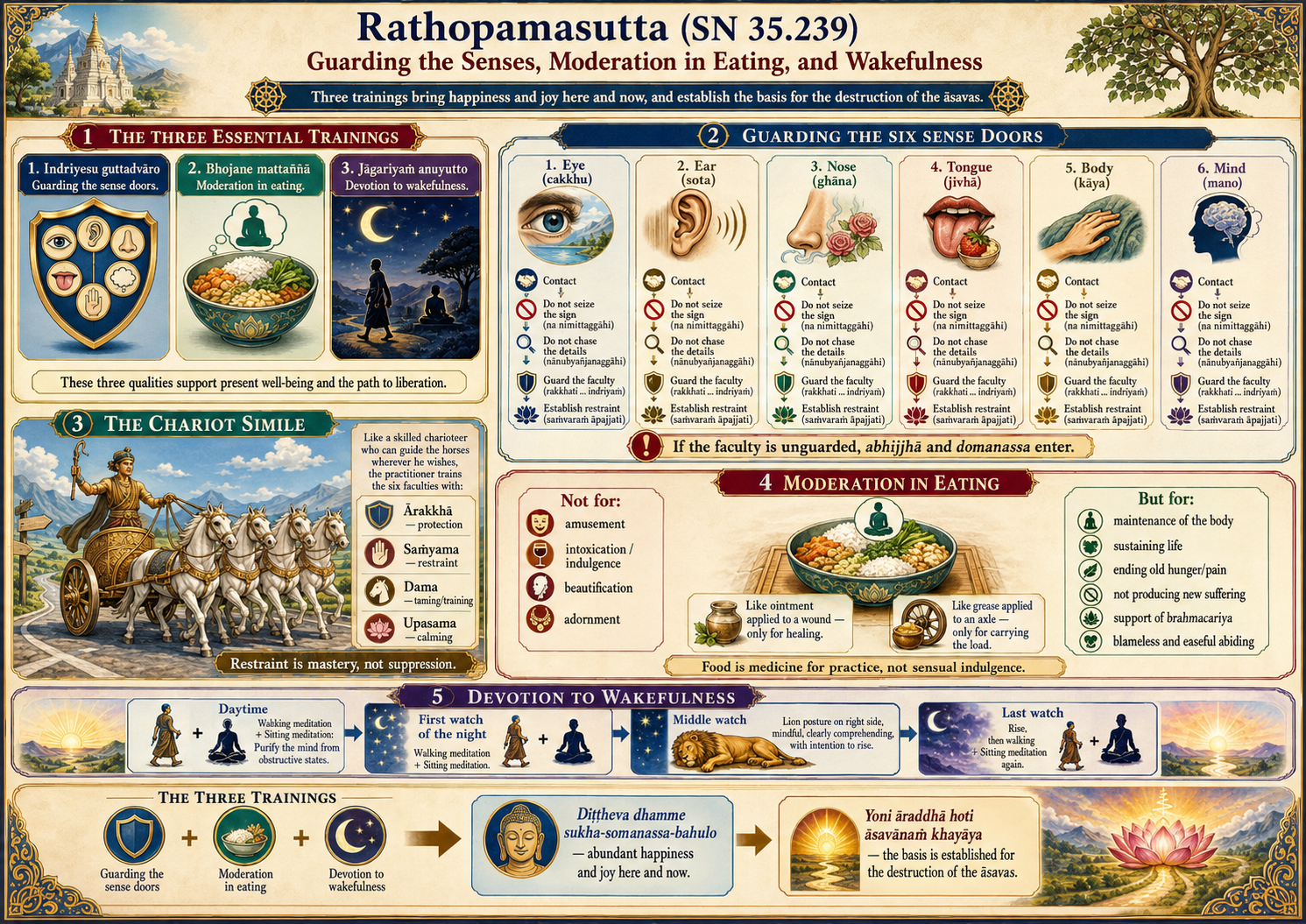 VISUAL SUMMARYSee this sutta in a pictureOpen the complete infographic for a visual overview before or after reading the full study.View infographic →
Guard what enters, regulate what sustains, discipline how time is used
Rathopamasutta brings together three trainings that protect practice continuously: guarding all six sense doors, knowing moderation in eating, and structuring wakefulness. The chariot simile shows the spirit of the training: not disabling the faculties, but developing enough mastery that the mind can be guided rather than dragged.
Indriyesu guttadvāro → bhojane mattaññū → jāgariyaṁ anuyutto → sukhasomanassabahulo → yoni āraddhā → āsavānaṁ khaya.
Result stated by the sutta: with these three qualities established, the bhikkhu lives with abundant happiness and gladness here and now, while the basis is established for āsavānaṁ khaya—the destruction of the āsavas.
The Threefold Training Container
Three qualities that protect practice continuously
1
Indriyesu guttadvāro — guard the doors of the faculties. Protect all six doors so sensory contact does not become an entry point for abhijjhā, domanassa and other akusala states.
2
Bhojane mattaññū — know the proper measure in eating. Use food for maintaining the body and supporting brahmacariya—not amusement, intoxication, beautification or adornment.
3
Jāgariyaṁ anuyutto — be devoted to wakefulness. Use day and night deliberately for walking, sitting, purification, measured rest and renewed practice.
Restraint means mastery—not suppression
01Untrained senses
Like powerful horses without mastery, the faculties can carry the mind toward attraction, aversion, replay, proliferation and distraction.
02Skilled charioteer
The senses are not destroyed. They remain fully functional, but the practitioner can guide them rather than being dragged by them.
Yenicchakaṁ yadicchakaṁ: the skilled charioteer can drive where and how intended. The source uses this to explain genuine freedom at the sense doors: faculties remain active, but attraction, aversion and proliferation no longer determine the direction.
Four Dimensions of Sense Training
Ārakkhā → Saṁyama → Dama → Upasama
1
Ārakkhā — protection. Guard the faculty so it does not become an entry point for akusala.
2
Saṁyama — restraint. Bound the response rather than allowing it to run unchecked.
3
Dama — taming or training. Repeated practice changes habitual behaviour around sensory contact.
4
Upasama — calming or settling. The aim is pacification, not continuous inner warfare.
The training is complete only when all six doors are guarded
| Faculty | Object |
|---|---|
| Cakkhu | Eye • rūpa |
| Sota | Ear • sadda |
| Ghāna | Nose • gandha |
| Jivhā | Tongue • rasa |
| Kāya | Body • phoṭṭhabba |
| Mano | Mind • dhamma |
Mano is essential: closing the eyes or entering silence does not complete sense restraint. Memories, plans, images, views and imagined conversations can keep the mind-door entirely unguarded.
Eat to maintain the vehicle of practice—not to turn maintenance into the purpose of life
| Food is not for | Food is for |
|---|---|
| Neva davāya — not for amusement | Kāyassa ṭhitiyā • yāpanāya — maintenance and continuation of the body |
| Na madāya — not for intoxication / pride | Vihiṁsūparatiyā — ending bodily affliction |
| Na maṇḍanāya — not for beautification | Brahmacariyānuggahāya — supporting the holy life |
| Na vibhūsanāya — not for adornment | Use nourishment as support for practice, not as its purpose. |
The wound and axle similes: medicine is put on a wound so it can heal; grease is put on an axle so the load can be carried. In the same way, food serves the body, and the body serves brahmacariya.
Jāgariyānuyoga
Wakefulness is disciplined use of the twenty-four-hour cycle
1
Daytime. Walking and sitting → cittaṁ parisodheti: purify the mind from obstructive states.
2
First watch. Walking and sitting → continue purification rather than drifting into heedlessness.
3
Middle watch. Sīhaseyya • sato sampajāno • uṭṭhānasaññā — measured, mindful rest with intention to rise.
4
Last watch. Rise → walking and sitting → return immediately to purification of mind.
Not sleep deprivation: the middle watch explicitly includes mindful rest. The discipline lies in measured sleep, clear intention to rise, and returning to walking and sitting rather than allowing rest to expand according to mood.
All 17 sections — Pāḷi with English immediately underneath
01Three Qualities That Establish the Ground for the Ending of the Āsavas
“Tīhi, bhikkhave, dhammehi samannāgato bhikkhu diṭṭheva dhamme sukhasomanassabahulo viharati, yoni cassa āraddhā hoti āsavānaṁ khayāya. Katamehi tīhi?
Indriyesu guttadvāro hoti, bhojane mattaññū, jāgariyaṁ anuyutto.”
“Bhikkhus, when a bhikkhu possesses three qualities, he dwells in this very life abundant in happiness and joy, and the foundation is established for the destruction of the āsavas. What three?
He guards the doors of the sense faculties, knows moderation in eating, and is devoted to wakefulness.”
02Guarding the Sense Doors — The Eye
“Kathañca, bhikkhave, bhikkhu indriyesu guttadvāro hoti?
Idha, bhikkhave, bhikkhu cakkhunā rūpaṁ disvā na nimittaggāhī hoti, nānubyañjanaggāhī; yatvādhikaraṇamenaṁ cakkhundriyaṁ asaṁvutaṁ viharantaṁ abhijjhādomanassā pāpakā akusalā dhammā anvāssaveyyuṁ. Tassa saṁvarāya paṭipajjati; rakkhati cakkhundriyaṁ; cakkhundriye saṁvaraṁ āpajjati.”
“And how, bhikkhus, does a bhikkhu guard the doors of the sense faculties?
Here, having seen a form with the eye, a bhikkhu does not grasp its general sign and does not grasp its details. Since, if he were to dwell with the eye faculty unrestrained, evil unwholesome states of covetousness and distress could flow in upon him, he practises for its restraint; he protects the eye faculty and undertakes restraint of the eye faculty.”
03Guarding the Sense Doors — The Ear
“Sotena saddaṁ sutvā na nimittaggāhī hoti, nānubyañjanaggāhī; yatvādhikaraṇamenaṁ sotindriyaṁ asaṁvutaṁ viharantaṁ abhijjhādomanassā pāpakā akusalā dhammā anvāssaveyyuṁ. Tassa saṁvarāya paṭipajjati; rakkhati sotindriyaṁ; sotindriye saṁvaraṁ āpajjati.”
“Having heard a sound with the ear, he does not grasp its general sign and does not grasp its details. Since, if he were to dwell with the ear faculty unrestrained, evil unwholesome states of covetousness and distress could flow in upon him, he practises for its restraint; he protects the ear faculty and undertakes restraint of the ear faculty.”
04Guarding the Sense Doors — The Nose
“Ghānena gandhaṁ ghāyitvā na nimittaggāhī hoti, nānubyañjanaggāhī; yatvādhikaraṇamenaṁ ghānindriyaṁ asaṁvutaṁ viharantaṁ abhijjhādomanassā pāpakā akusalā dhammā anvāssaveyyuṁ. Tassa saṁvarāya paṭipajjati; rakkhati ghānindriyaṁ; ghānindriye saṁvaraṁ āpajjati.”
“Having smelled an odour with the nose, he does not grasp its general sign and does not grasp its details. Since, if he were to dwell with the nose faculty unrestrained, evil unwholesome states of covetousness and distress could flow in upon him, he practises for its restraint; he protects the nose faculty and undertakes restraint of the nose faculty.”
05Guarding the Sense Doors — The Tongue
“Jivhāya rasaṁ sāyitvā na nimittaggāhī hoti, nānubyañjanaggāhī; yatvādhikaraṇamenaṁ jivhindriyaṁ asaṁvutaṁ viharantaṁ abhijjhādomanassā pāpakā akusalā dhammā anvāssaveyyuṁ. Tassa saṁvarāya paṭipajjati; rakkhati jivhindriyaṁ; jivhindriye saṁvaraṁ āpajjati.”
“Having tasted a flavour with the tongue, he does not grasp its general sign and does not grasp its details. Since, if he were to dwell with the tongue faculty unrestrained, evil unwholesome states of covetousness and distress could flow in upon him, he practises for its restraint; he protects the tongue faculty and undertakes restraint of the tongue faculty.”
06Guarding the Sense Doors — The Body
“Kāyena phoṭṭhabbaṁ phusitvā na nimittaggāhī hoti, nānubyañjanaggāhī; yatvādhikaraṇamenaṁ kāyindriyaṁ asaṁvutaṁ viharantaṁ abhijjhādomanassā pāpakā akusalā dhammā anvāssaveyyuṁ. Tassa saṁvarāya paṭipajjati; rakkhati kāyindriyaṁ; kāyindriye saṁvaraṁ āpajjati.”
“Having touched a tangible object with the body, he does not grasp its general sign and does not grasp its details. Since, if he were to dwell with the body faculty unrestrained, evil unwholesome states of covetousness and distress could flow in upon him, he practises for its restraint; he protects the body faculty and undertakes restraint of the body faculty.”
07Guarding the Sense Doors — The Mind
“Manasā dhammaṁ viññāya na nimittaggāhī hoti nānubyañjanaggāhī; yatvādhikaraṇamenaṁ manindriyaṁ asaṁvutaṁ viharantaṁ abhijjhādomanassā pāpakā akusalā dhammā anvāssaveyyuṁ, tassa saṁvarāya paṭipajjati; rakkhati manindriyaṁ; manindriye saṁvaraṁ āpajjati.”
“Having cognized a dhamma with the mind, he does not grasp its general sign and does not grasp its details. Since, if he were to dwell with the mind faculty unrestrained, evil unwholesome states of covetousness and distress could flow in upon him, he practises for its restraint; he protects the mind faculty and undertakes restraint of the mind faculty.”
08The Chariot Simile — Restraint Means Mastery
“Seyyathāpi, bhikkhave, subhūmiyaṁ cātumahāpathe ājaññaratho yutto assa ṭhito odhastapatodo. Tamenaṁ dakkho yoggācariyo assadammasārathi abhiruhitvā vāmena hatthena rasmiyo gahetvā, dakkhiṇena hatthena patodaṁ gahetvā, yenicchakaṁ yadicchakaṁ sāreyyapi paccāsāreyyapi.
Variant: odhastapatodo → odhatapatodo (sya-all, km); odhasatapatodo (pts1ed)
“Suppose, bhikkhus, that on level ground at a crossroads there stood a chariot harnessed to thoroughbred horses, with the goad ready. A skilled trainer and charioteer would mount it, take the reins in his left hand and the goad in his right, and drive forward or back wherever he wished, in whatever way he wished.”
09Four Dimensions of Training the Six Faculties
“Evameva kho, bhikkhave, bhikkhu imesaṁ channaṁ indriyānaṁ ārakkhāya sikkhati, saṁyamāya sikkhati, damāya sikkhati, upasamāya sikkhati.
Evaṁ kho, bhikkhave, bhikkhu indriyesu guttadvāro hoti.”
“In the same way, bhikkhus, a bhikkhu trains for the protection of these six faculties, trains for their restraint, trains for their taming, and trains for their calming.
It is in this way that a bhikkhu guards the doors of the sense faculties.”
10Moderation in Eating — Wise Reflection
“Kathañca, bhikkhave, bhikkhu bhojane mattaññū hoti?
Idha, bhikkhave, bhikkhu paṭisaṅkhā yoniso āhāraṁ āhāreti: ‘neva davāya, na madāya, na maṇḍanāya, na vibhūsanāya, yāvadeva imassa kāyassa ṭhitiyā, yāpanāya, vihiṁsūparatiyā, brahmacariyānuggahāya, iti purāṇañca vedanaṁ paṭihaṅkhāmi, navañca vedanaṁ na uppādessāmi, yātrā ca me bhavissati, anavajjatā ca phāsuvihāro cā’ti.”
“And how, bhikkhus, does a bhikkhu know moderation in eating?
Here, a bhikkhu takes food after reflecting wisely: ‘Not for amusement, not for intoxication, not for beautification, and not for adornment, but only for the maintenance and continuation of this body, for ending affliction, and for supporting the holy life. Thus I will put an end to the old feeling and will not produce a new feeling; I will sustain myself, remain blameless, and dwell at ease.’”
11The Wound and Axle Similes
“Seyyathāpi, bhikkhave, puriso vaṇaṁ ālimpeyya yāvadeva rohanatthāya, seyyathā vā pana akkhaṁ abbhañjeyya yāvadeva bhārassa nittharaṇatthāya;
Variant: rohanatthāya → ropanatthāya (bj, pts1ed); sevanatthāya (sya-all, km); gopanatthāya (mr)”
“Suppose, bhikkhus, a person were to apply ointment to a wound only so that it may heal; or suppose one were to grease an axle only so that a load may be carried across.”
12Eating Only for Maintenance of the Practice
“Evaṁ kho, bhikkhave, bhikkhu paṭisaṅkhā yoniso āhāraṁ āhāreti: ‘neva davāya, na madāya, na maṇḍanāya, na vibhūsanāya, yāvadeva imassa kāyassa ṭhitiyā, yāpanāya, vihiṁsūparatiyā, brahmacariyānuggahāya, iti purāṇañca vedanaṁ paṭihaṅkhāmi, navañca vedanaṁ na uppādessāmi, yātrā ca me bhavissati, anavajjatā ca phāsuvihāro cā’ti.
Evaṁ kho, bhikkhave, bhikkhu bhojane mattaññū hoti.”
“In the same way, bhikkhus, a bhikkhu takes food after reflecting wisely: ‘Not for amusement, not for intoxication, not for beautification, and not for adornment, but only for the maintenance and continuation of this body, for ending affliction, and for supporting the holy life. Thus I will end the old feeling and will not produce a new feeling; I will sustain myself, remain blameless, and dwell at ease.’
It is in this way that a bhikkhu knows moderation in eating.”
13Devotion to Wakefulness
“Kathañca, bhikkhave, bhikkhu jāgariyaṁ anuyutto hoti?
Idha, bhikkhave, bhikkhu divasaṁ caṅkamena nisajjāya āvaraṇīyehi dhammehi cittaṁ parisodheti. Rattiyā paṭhamaṁ yāmaṁ caṅkamena nisajjāya āvaraṇīyehi dhammehi cittaṁ parisodheti.”
“And how, bhikkhus, is a bhikkhu devoted to wakefulness?
During the day, by walking meditation and sitting, he purifies the mind from obstructive states. During the first watch of the night, by walking meditation and sitting, he purifies the mind from obstructive states.”
14The Middle Watch — Mindful Rest
“Rattiyā majjhimaṁ yāmaṁ dakkhiṇena passena sīhaseyyaṁ kappeti pāde pādaṁ accādhāya sato sampajāno uṭṭhānasaññaṁ manasi karitvā.”
“During the middle watch of the night, he lies down in the lion’s posture on his right side, placing one foot over the other, mindful and clearly comprehending, having attended to the perception of rising.”
15The Last Watch — Return to Purification
“Rattiyā pacchimaṁ yāmaṁ paccuṭṭhāya caṅkamena nisajjāya āvaraṇīyehi dhammehi cittaṁ parisodheti.
Evaṁ kho, bhikkhave, bhikkhu jāgariyaṁ anuyutto hoti.”
“During the last watch of the night, having risen, by walking meditation and sitting he purifies the mind from obstructive states.
It is in this way that a bhikkhu is devoted to wakefulness.”
16The Three Trainings Together
“Imehi kho, bhikkhave, tīhi dhammehi samannāgato bhikkhu diṭṭheva dhamme sukhasomanassabahulo viharati, yoni cassa āraddhā hoti āsavānaṁ khayāyā”ti.
“Bhikkhus, when a bhikkhu possesses these three qualities, he dwells in this very life abundant in happiness and joy, and the foundation is established for the destruction of the āsavas.”
17The Entire Practice in One View
Indriyesu guttadvāro → bhojane mattaññū → jāgariyaṁ anuyutto.
Cakkhu · sota · ghāna · jivhā · kāya · mano:
na nimittaggāhī → nānubyañjanaggāhī → saṁvarāya paṭipajjati → rakkhati → saṁvaraṁ āpajjati.
Ārakkhā → saṁyama → dama → upasama.
Paṭisaṅkhā yoniso āhāraṁ āhāreti:
neva davāya · na madāya · na maṇḍanāya · na vibhūsanāya → brahmacariyānuggahāya.
Divasaṁ → paṭhamaṁ yāmaṁ → majjhimaṁ yāmaṁ → pacchimaṁ yāmaṁ.
Sukhasomanassabahulo → yoni āraddhā → āsavānaṁ khaya.
Guard the sense doors → know moderation in eating → devote oneself to wakefulness.
At eye, ear, nose, tongue, body, and mind:
do not seize the sign → do not chase the details → practise restraint → protect the faculty → establish restraint.
Protection → restraint → taming → calming.
Reflect wisely on food:
not for amusement, intoxication, beautification, or adornment → but to support the holy life.
Daytime → first watch → middle watch → last watch.
Abundant happiness and joy → the foundation established → destruction of the āsavas.
All 17 explanations, separated from the translation
01Three Qualities That Establish the Ground for the Ending of the Āsavas
The discourse begins by giving the result before explaining the practice. These three qualities are not presented as minor disciplinary supports. Together they produce two major consequences.
First, diṭṭheva dhamme sukhasomanassabahulo viharati: the practitioner lives here and now with abundant sukha and somanassa—well-being and gladness. Restraint is therefore not meant to create a tense, joyless life. Correct restraint reduces the agitation produced by uncontrolled sensory engagement, excess in food, and dullness.
Second, yoni cassa āraddhā hoti āsavānaṁ khayāya: the ground, basis, or productive condition is established for the destruction of the āsavas. The three trainings create the practical environment in which deeper bhāvanā can succeed.
The structure is extremely important: indriya-saṁvara regulates what enters and develops through the six doors; bhojane mattaññutā regulates bodily nourishment and sensual indulgence; jāgariyānuyoga regulates the use of time, energy, posture, and sleep. Together they protect practice continuously.
02Guarding the Sense Doors — The Eye
Indriya-saṁvara begins at the moment of seeing.
Na nimittaggāhī means not seizing the nimitta—the overall sign, theme, or impression in a way that becomes a basis for craving, aversion, or identification. Nānubyañjanaggāhī means not chasing the secondary details that feed the first reaction.
This does not mean becoming visually blind or refusing to recognize objects. The bhikkhu sees the rūpa. The training concerns what the mind subsequently does with what is seen.
The danger is expressed as abhijjhādomanassā pāpakā akusalā dhammā anvāssaveyyuṁ—covetousness, displeasure, and other unwholesome states may flow in and take over when the faculty is unguarded.
The response is threefold: saṁvarāya paṭipajjati—he practises for restraint; rakkhati—he protects the faculty; saṁvaraṁ āpajjati—he actually establishes restraint. This is an active training in preventing sensory contact from becoming a chain of proliferation.
03Guarding the Sense Doors — The Ear
The same principle is applied to sound.
A word, tone of voice, music, praise, criticism, or disturbing noise may be heard. The danger begins when the mind seizes the event and elaborates it: “I need more of this,” “How dare they say that,” “This proves what I thought,” “I cannot tolerate this.”
Guarding the ear does not require eliminating sound. It requires learning not to hand the mind over to sound.
This is particularly relevant to speech from other people. The first auditory contact may last only seconds, but an unguarded mind can replay it for hours. Indriya-saṁvara interrupts the process close to the door.
04Guarding the Sense Doors — The Nose
Smell can rapidly activate memory, attraction, aversion, appetite, and emotional association. The Buddha includes this door because the same mechanism of appropriation operates regardless of which faculty is contacted.
The practitioner knows smell as smell but watches the tendency to convert it into desire, disgust, story, or identity.
The training is therefore not about ranking some doors as spiritually important and others as insignificant. All six must be guarded because craving and aversion can enter through any one of them.
05Guarding the Sense Doors — The Tongue
This passage connects directly with the next major training, moderation in eating.
Taste is known, but the mind is not permitted to turn food into an endless project of sensual pursuit. The general sign might be “delicious food”; the details might involve texture, seasoning, comparison, memory, anticipation, and the desire to repeat the experience.
Guarding the tongue does not mean food must be tasteless. It means taste does not become the ruler of eating.
The transition into bhojane mattaññutā is therefore natural: restraint at the tongue door and wise reflection on the purpose of food support each other.
06Guarding the Sense Doors — The Body
The body door covers pressure, warmth, cold, softness, hardness, pain, comfort, and other tangible experience.
The same contact can easily become desire for comfort, rejection of discomfort, or identification with bodily pleasure and pain.
Body restraint is not the suppression of all comfort. It is training the mind not to be dominated by tactile preference.
This becomes important in sitting, walking, sleeping, weather, clothing, and physical conditions of retreat practice. If every bodily discomfort is immediately obeyed, samādhi becomes difficult to establish.
07Guarding the Sense Doors — The Mind
The sixth door prevents indriya-saṁvara from being reduced to management of the five physical senses.
Dhamma here means objects known by the mind: memories, plans, ideas, images, concepts, emotional representations, and other mental contents.
A person may close the eyes and sit in a quiet room while remaining completely unrestrained at the mind door. Memory can produce desire; imagined conversations can produce anger; future plans can produce restlessness; views can produce conceit.
Therefore guarding mano is indispensable. Sense restraint reaches completion only when internal mental objects are treated with the same discipline as external sensory objects.
08The Chariot Simile — Restraint Means Mastery
The chariot simile is the key to understanding indriya-saṁvara correctly.
The trained charioteer does not destroy the horses. He does not blindfold them permanently. He possesses mastery.
Likewise, the practitioner does not attempt to abolish seeing, hearing, smelling, tasting, touching, or thinking. The six faculties remain functional, but they are trained.
Yenicchakaṁ yadicchakaṁ—wherever and however he wishes—expresses freedom from being dragged by the faculties. Without restraint, the senses behave like untrained horses and carry the mind toward attraction, aversion, and proliferation. With restraint, the practitioner retains direction.
This is dama in its practical sense: training or taming. Genuine restraint therefore increases freedom rather than reducing it.
09Four Dimensions of Training the Six Faculties
The Buddha summarizes sense restraint through four training terms.
Ārakkhāya — protection or guarding. The faculty is protected from becoming an entry point for akusala.
Saṁyamāya — restraint. The response is bounded rather than allowed to run unchecked.
Damāya — taming or training. Repeated practice changes the habitual behaviour of the mind around sensory contact.
Upasamāya — calming or settling. The result is not continuous inner warfare but pacification.
The sequence shows why indriya-saṁvara supports samatha and jhāna. A mind repeatedly agitated through the six doors must first spend its meditation period processing what it has accumulated. A guarded mind arrives with much less unfinished sensory momentum.
10Moderation in Eating — Wise Reflection
Bhojane mattaññutā is not simply eating a small quantity. The Buddha begins with paṭisaṅkhā yoniso—wise reflection.
Four motives are excluded:
Neva davāya — not for amusement, indulgent play, or entertainment.
Na madāya — not for intoxication, pride, or sensual excitement.
Na maṇḍanāya — not for beautification.
Na vibhūsanāya — not for adornment or enhancement of appearance.
The positive purpose is yāvadeva imassa kāyassa ṭhitiyā yāpanāya—only for maintaining and carrying on the body.
Vihiṁsūparatiyā means for the ending of bodily affliction associated with insufficient nourishment.
Brahmacariyānuggahāya is decisive: food should support the holy life. The body is maintained because it is the present vehicle for practice.
Purāṇañca vedanaṁ paṭihaṅkhāmi means ending the old painful feeling of hunger. Navañca vedanaṁ na uppādessāmi means not creating a new painful feeling through excess eating.
The correct measure therefore lies between deprivation and indulgence. The result is yātrā—sustenance; anavajjatā—blamelessness; and phāsuvihāra—comfortable or easeful dwelling.
11The Wound and Axle Similes
These two similes remove sensual romance from eating.
Medicine is applied to a wound for healing, not entertainment. Axle grease is applied so the vehicle can carry its load, not because grease itself is the purpose of the journey.
In the same way, food services the body. The body services brahmacariya.
The axle simile is particularly practical: if too little grease is used, the axle fails; if attention becomes obsessed with grease, the journey is forgotten. Moderation means applying what is needed for function without converting maintenance into the central project of life.
12Eating Only for Maintenance of the Practice
The repetition after the two similes is deliberate. The purpose of food should become a remembered framework, not an idea heard once.
Moderation therefore involves both quantity and relationship. One can eat a modest amount while mentally obsessed with food; conversely, one can eat adequately while remaining free from sensual preoccupation.
The central question becomes: does this meal support the body for brahmacariya, or is the mind using the body as a justification for sensual pursuit?
This connects directly with indriya-saṁvara at the tongue and mind doors.
13Devotion to Wakefulness
Jāgariyānuyoga means active devotion to wakefulness, not simply sleeping fewer hours.
The task during the day and first watch of the night is cittaṁ parisodheti—purifying the mind—from āvaraṇīyā dhammā, states that obstruct or cover the mind.
Walking and sitting are deliberately paired. Wakefulness is maintained through posture and energy management rather than by forcing the body to remain motionless.
The objective is not endurance for its own sake. The objective is a mind progressively cleared of obstruction and made suitable for samādhi and paññā.
14The Middle Watch — Mindful Rest
This sentence prevents jāgariya from being misunderstood as total sleep deprivation.
The Buddha explicitly provides a period for rest during the middle watch.
The posture is sīhaseyya—the lion’s posture—lying on the right side with one foot placed upon the other.
Even sleep is framed by practice: sato sampajāno—mindful and clearly comprehending; uṭṭhānasaññaṁ manasi karitvā—having established the intention or perception of getting up.
Thus sleep is neither indulgence nor enemy. It is measured, intentional bodily restoration embedded within a larger schedule of wakeful practice.
15The Last Watch — Return to Purification
The pattern resumes after measured sleep.
The night is therefore structured as:
first watch — walking and sitting practice;
middle watch — mindful sleep;
last watch — rise and return to walking and sitting practice.
Jāgariya is disciplined use of the twenty-four-hour cycle.
The phrase paccuṭṭhāya—having risen—is essential. The practitioner does not allow the rest period to expand according to mood. Uṭṭhānasaññā established before sleep is now fulfilled by actually getting up.
This transforms wakefulness from aspiration into routine.
16The Three Trainings Together
The sutta closes exactly where it began, but the reader now understands what the three qualities require in practice.
Indriyesu guttadvāro is continuous protection across eye, ear, nose, tongue, body, and mind.
Bhojane mattaññū is wise use of nourishment for maintaining the body and supporting brahmacariya.
Jāgariyaṁ anuyutto is a disciplined cycle of walking, sitting, mindful sleep, and renewed purification.
These three form a practical container around the entire day. They reduce sensory leakage, bodily heaviness, and dullness—the very conditions that repeatedly undermine samādhi.
That is why the result is both immediate and ultimate: more sukha and somanassa now, and the ground established for āsavānaṁ khaya—the destruction of the āsavas.
17The Entire Practice in One View
SN 35.239 gives a highly practical pre-samādhi architecture.
Sense restraint prevents the mind from collecting unnecessary agitation.
Moderation in food prevents sensual indulgence, heaviness, and bodily disturbance from dominating practice.
Wakefulness ensures that the protected and nourished body is actually used for bhāvanā rather than for sleep and distraction.
The order is therefore significant. Guard what enters. Regulate what sustains the body. Use the available time for purification.
This is why these three are not merely monastic etiquette. They constitute a direct preparation for liberation.