The Four Fruits of the Noble Path — Accomplishment, Gradation and Verification
A sutta-based study of how stream-entry, once-returning, non-returning and arahantship are accomplished; the different grades within noble development; what remains at each stage; and how progress can be examined without confusing temporary suppression with irreversible abandonment.
Do not ask only what disappeared during meditation. Ask what has been uprooted so completely that it cannot return.
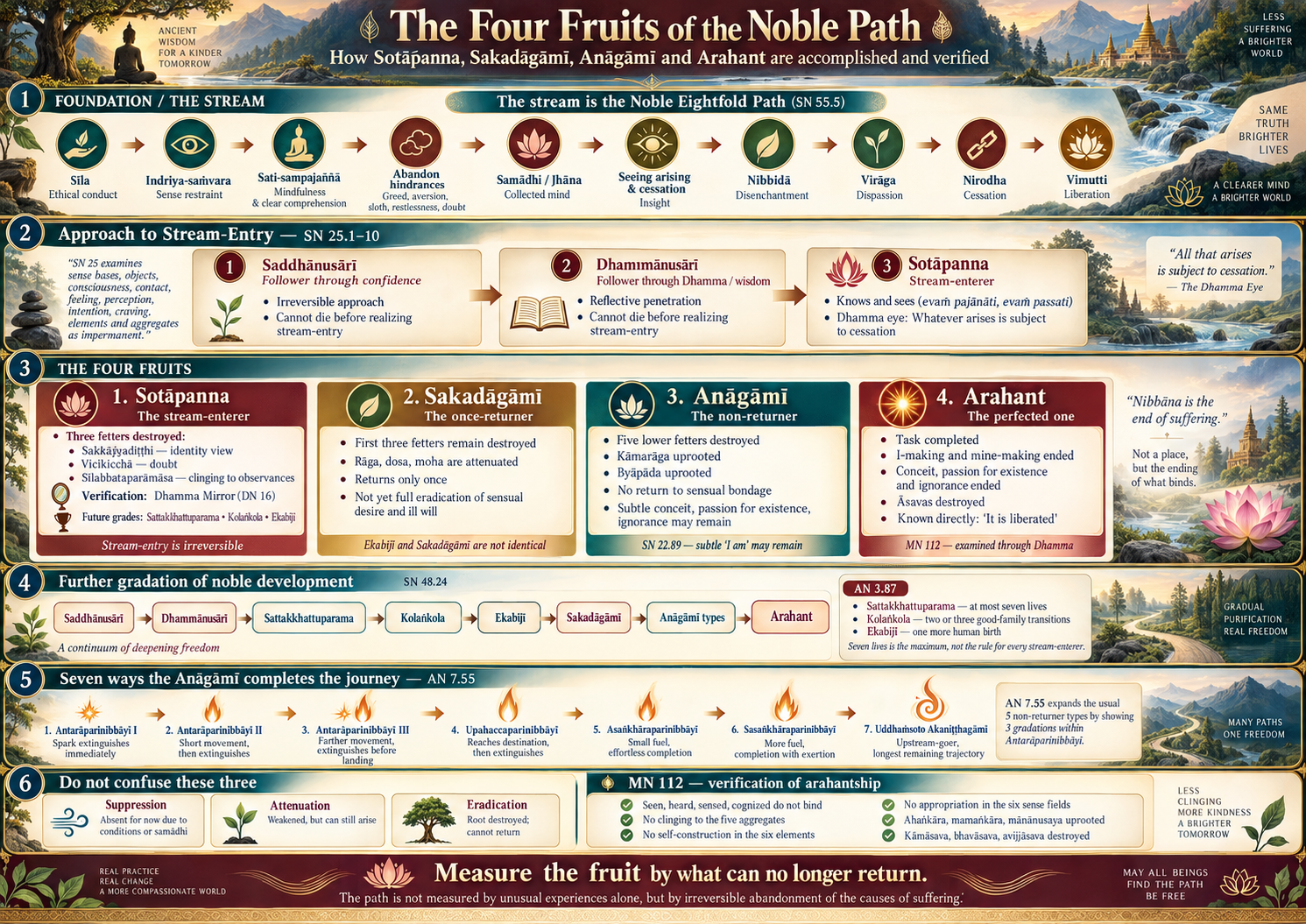 VISUAL SUMMARYSee this study in a pictureOpen the complete infographic for a visual overview before or after reading the full study.View infographic →
The four fruits describe irreversible changes in the causes of suffering and renewed existence
The Buddha’s teaching on the four fruits should not be understood merely as four labels attached to meditators. They describe four progressively deeper and irreversible transformations:
Sotāpanna — stream-enterer.
Sakadāgāmī — once-returner.
Anāgāmī — non-returner.
Arahant — one whose task is complete.
The decisive difference is not primarily how long someone can meditate, whether one can enter jhāna, whether bodily perception becomes subtle, whether lights or visions occur, or whether extraordinary tranquillity is experienced. Such experiences may be important within practice, but the noble fruits are defined by what has been abandoned and what can no longer bind the mind.
Central diagnostic principle: temporary absence is not necessarily abandonment. A hindrance may disappear in samādhi and return afterward. Noble attainment concerns increasingly irreversible removal of the conditions from which bondage arises.
| Fruit | What has irreversibly changed | What may still remain |
|---|---|---|
| Sotāpanna | Identity view, fundamental doubt and grasping at observances as sufficient for purification are destroyed. | Sensual desire, ill will, subtler conceit and ignorance may remain. |
| Sakadāgāmī | The first three fetters remain destroyed; greed, hatred and delusion are substantially attenuated. | Sensual desire and ill will are not yet described as completely uprooted. |
| Anāgāmī | All five lower fetters are destroyed, including sensual desire and ill will. | Subtle conceit, passion for refined existence and ignorance may remain. |
| Arahant | The remaining fetters and āsavas are destroyed; I-making, mine-making and the underlying tendency to conceit are uprooted. | No further work remains for liberation. |
The stream is the Noble Eightfold Path itself
SN 55.5 identifies the stream as the Noble Eightfold Path: right view, right intention, right speech, right action, right livelihood, right effort, right mindfulness and right samādhi. A stream-enterer is one who possesses this noble path.
The higher fruits therefore do not require abandoning one path and finding another. The same training matures and penetrates more deeply.
A broad practical sequence is:
Sīla → indriya-saṁvara → moderation → wakefulness → sati-sampajaññā → abandonment of the hindrances → samādhi and jhāna → seeing arising and cessation → nibbidā → virāga → nirodha → vimutti.
Before the fruit: confidence, reflective penetration, then knowing and seeing
SN 25 is indispensable for understanding the movement into stream-entry. Across ten discourses the Buddha applies the same principle of impermanence and change to almost the entire machinery of experience.
| Sutta | Field examined | What must be understood |
|---|---|---|
| SN 25.1 | Six internal sense bases | Eye, ear, nose, tongue, body and mind are impermanent and liable to become otherwise. |
| SN 25.2 | Six external sense objects | Forms, sounds, smells, tastes, touches and mental phenomena are impermanent. |
| SN 25.3 | Six consciousnesses | Consciousness at each door is conditioned and changing. |
| SN 25.4 | Six contacts | Contact is conditioned and cannot provide a permanent refuge. |
| SN 25.5 | Six feelings | Feeling arising through contact is impermanent and changing. |
| SN 25.6 | Six perceptions | Perception too is conditioned and alterable. |
| SN 25.7 | Six intentions | Intentional formations at the six doors are impermanent. |
| SN 25.8 | Six cravings | Craving itself arises dependently and is subject to change and cessation. |
| SN 25.9 | Six elements | Earth, water, fire, air, space and consciousness element are impermanent. |
| SN 25.10 | Five aggregates | Form, feeling, perception, formations and consciousness are impermanent and changing. |
01Saddhānusārī — follower through confidence
SN 25 describes one who places confidence in and resolves upon the impermanent, changing nature of these dhammas as a saddhānusārī. This is not ordinary devotional belief. The person has entered the fixed course of rightness, passed beyond the ordinary worldling’s plane, and cannot die before realizing the fruit of stream-entry.
Important: SN 25 nevertheless does not yet call this person a sotāpanna. The distinction between irreversible approach and realized fruit must remain clear.
02Dhammānusārī — follower through Dhamma
The second person has accepted the same truths after sufficient examination with wisdom. This person too has crossed beyond the ordinary worldling’s plane and cannot die before realizing sotāpattiphala.
The development has moved from confidence toward contemplative and rational penetration, but the sutta still distinguishes this from the direct knowing and seeing of the stream-enterer.
03Sotāpanna — “evaṁ pajānāti evaṁ passati”
The decisive wording of SN 25 is: one who knows these dhammas in this way and sees them in this way is called a sotāpanna.
This is the movement from doctrine to direct seeing. The practitioner does not merely repeat “everything is impermanent”; impermanence is understood across the functioning of the sense bases, consciousness, contact, feeling, perception, intention, craving, elements and aggregates.
04The Dhamma eye — whatever arises is subject to cessation
The realization associated with the arising of the Dhamma eye is expressed as:
Yaṁ kiñci samudayadhammaṁ sabbaṁ taṁ nirodhadhammaṁ.
Whatever is subject to arising is subject to cessation.
This goes beyond the general observation that “things change.” It penetrates conditionality: phenomena arise because supporting conditions are present; with cessation of those conditions, what depended upon them cannot continue.
Stream-entry changes view at its foundations
01Sakkāyadiṭṭhi — identity view
MN 44 provides a useful diagnostic map. For each of the five aggregates, an uninstructed person may regard the aggregate as self, self as possessing the aggregate, the aggregate as contained within self, or self as contained within the aggregate. Across five aggregates this gives twenty modes of identity view.
Therefore sakkāyadiṭṭhi is much deeper than merely believing in a soul. A person may reject the word “self” philosophically while still building identity around body, feeling, memory, consciousness, knowledge, meditation or attainment.
Distinction: destroying identity view at stream-entry is not yet the same as eradicating the subtle conceit “I am.” SN 22.89 shows that this residue may remain even after the five lower fetters have been abandoned.
02Vicikicchā — fundamental doubt
This does not mean that a stream-enterer has answers to every doctrinal or cosmological question. The relevant uncertainty about the Buddha’s discovery and the path has been broken because something has been personally verified.
Confidence becomes qualitatively different from ordinary belief. One has seen enough of the relation between conditioned arising, craving, suffering and cessation that the direction of the path is no longer speculative.
03Sīlabbataparāmāsa — grasping at observances as purification
This fetter does not mean abandoning sīla or disciplined training. Noble conduct becomes more reliable, not less.
What collapses is the assumption that a ritual, ceremony, austerity, lineage, robe, chant, religious identity, retreat count or meditation technique is liberating merely because it is performed.
Sīla, sense restraint, samādhi, jhāna and vipassanā all have causal functions. Liberation occurs through knowledge, dispassion, cessation and abandonment of craving and ignorance—not by clinging to the external form of practice.
Three grades of stream-enterer — and why ekabījī is not the same as sakadāgāmī
| Grade | Key Pāḷi wording | What the sutta actually says | Do not flatten it into |
|---|---|---|---|
| Sattakkhattuparama | sattakkhattuparamaṁ deve ca manusse ca sandhāvitvā saṁsaritvā | Having wandered/transmigrated among devas and humans at most seven times, one makes an end of suffering. | “Every sotāpanna has seven lives left.” The Pāḷi says at most seven times; it does not say satta jātiyo. |
| Kolaṅkola | dve vā tīṇi vā kulāni sandhāvitvā saṁsaritvā | Having wandered/transmigrated through two or three kula, one makes an end of suffering. | “Two or three lives.” The text itself says kula, not jāti. |
| Ekabījī | ekaṁyeva mānusakaṁ bhavaṁ nibbattetvā | Having produced/arisen in just one human bhava, one makes an end of suffering. | “One more birth” as though bhava and jāti were interchangeable. The sutta explicitly says bhava. |
Textual correction: the popular phrase “a sotāpanna has seven lives remaining” is too loose. Sattakkhattuparama means an upper limit of seven times in the stated deva/human wandering; kolaṅkola is expressed through two or three kula; and ekabījī explicitly uses ekaṁyeva mānusakaṁ bhavaṁ — one human bhava. The sutta does not reduce all three classifications to a simple count of “births.”
01Bhava is not jāti — why “seven lives” and “one more birth” need correction
The wording of the sutta matters. For the ekabījī it says:
So tiṇṇaṁ saṁyojanānaṁ parikkhayā ekabījī hoti, ekaṁyeva mānusakaṁ bhavaṁ nibbattetvā dukkhassantaṁ karoti.
The crucial expression is ekaṁyeva mānusakaṁ bhavaṁ — just one human bhava. It does not say ekaṁ jātiṁ.
This distinction is already explicit in dependent arising:
Upādānapaccayā bhavo; bhavapaccayā jāti.
With clinging as condition, bhava; with bhava as condition, jāti.
SN 12.2 further distinguishes the terms by defining bhava as the three modes of existence/becoming — sensual, form and formless — whereas jāti is the birth or manifestation of beings in a class of beings. The two terms are connected, but they are not synonyms.
Therefore the ekabījī formula is better retained as “one human bhava” or carefully rendered as “one further human existence/becoming”, with the Pāḷi visible. Translating it simply as “one more birth” hides a distinction that the dependent-origination formula itself preserves.
The same caution applies to the other grades: sattakkhattuparama speaks of wandering/transmigrating among devas and humans at most seven times; kolaṅkola speaks of two or three kula. Neither phrase literally says “seven births” or “two or three births.”
02Ekabījī and sakadāgāmī — similar shorthand about return, different realization
The training discourse, numbered AN 3.87 or AN 3.88 depending on the edition, distinguishes these categories rather than treating them as synonyms.
For the ekabījī, the defining attainment is destruction of the first three fetters, followed by the statement ekaṁyeva mānusakaṁ bhavaṁ nibbattetvā.
For the sakadāgāmī, the first three fetters are destroyed and rāga, dosa and moha are additionally attenuated; the formula then says sakideva imaṁ lokaṁ āgantvā — coming to this world only once.
Thus the categories should not be equated merely because English summaries make both sound like “one more life.” Their defining internal purification is different, and even their Pāḷi descriptions are different.
03SN 48.24 — one continuum of noble development
SN 48.24 grades practitioners according to the strength and fulfilment of five faculties:
saddhā — confidence
viriya — energy
sati — mindfulness
samādhi — collectedness
paññā — wisdom.
The discourse places, in progressive order, the saddhānusārī, dhammānusārī, the three stream-enterer grades, sakadāgāmī, the different non-returner types and arahant.
This prevents the four fruits from becoming four isolated boxes. Noble development is a continuum in which the faculties mature, penetration deepens and the remaining trajectory of becoming becomes shorter.
Scroll horizontally to read all columns when needed →
| Progression | Development |
|---|---|
| Saddhānusārī | Irreversible approach through confidence. |
| Dhammānusārī | Irreversible approach through wisdom-based acceptance. |
| Sattakkhattuparama | Stream-enterer described as wandering/transmigrating among devas and humans at most seven times; not a blanket statement that every sotāpanna has “seven lives.” |
| Kolaṅkola | Stream-enterer whose remaining course is expressed as wandering/transmigrating through two or three kula. |
| Ekabījī | Stream-enterer whose formula explicitly states ekaṁyeva mānusakaṁ bhavaṁ — just one human bhava. |
| Sakadāgāmī | Greed, hatred and delusion additionally attenuated. |
| Non-returner types | Five lower fetters destroyed; different degrees of remaining subtle work. |
| Arahant | Five faculties fulfilled; liberation complete. |
Sakadāgāmī — the first three fetters are gone and rāga, dosa and moha are thinned
The once-returner retains the irreversible breakthrough of stream-entry. A further transformation has occurred: rāga, dosa and moha have become tanutta — attenuated, thinned out.
This is not yet the language of eradication. Sensual attraction may still arise. Aversion may still arise. Delusion is not yet completely destroyed. But these forces have lost much of their former strength and authority.
01What attenuation may look like in ordinary life
Suppose somebody criticizes the practitioner. Previously, painful feeling might lead to identity defence, anger, repeated mental replay and resentment lasting for days. With deeper development the unpleasant reaction may still begin, but it is recognized earlier, fed less and released more quickly.
Similarly, an attractive sight may be recognized as attractive and pleasant feeling may arise, yet the movement of wanting has much less capacity to occupy and direct the mind.
The transformation concerns the mind itself, not merely outward restraint. Silence while internally burning with hatred is not attenuation of hatred; celibacy while constantly nourishing sexual fantasy is not attenuation of craving.
02Why sakadāgāmī is difficult to self-diagnose
“Destroyed” is an absolute criterion; “attenuated” is relative. This makes the second fruit especially vulnerable to premature diagnosis.
Age, illness, lack of opportunity, seclusion, retreat conditions or strong samādhi can all reduce the outward appearance of greed or anger. Therefore the first test remains decisive: have the three stream-entry fetters genuinely been destroyed?
Only then does a durable and structural attenuation of rāga, dosa and moha become relevant to the second fruit.
Anāgāmī — the five lower fetters are destroyed
At non-returning the language becomes much sharper. The first three fetters remain destroyed, and now kāmarāga — sensual passion and byāpāda — ill will are also uprooted.
The defining issue is no longer whether they are weaker. The question becomes whether they can arise at all.
| # | Lower fetter | Status at anāgāmi |
|---|---|---|
| 1 | Sakkāyadiṭṭhi — identity view | Destroyed |
| 2 | Vicikicchā — fundamental doubt | Destroyed |
| 3 | Sīlabbataparāmāsa — grasping at observances | Destroyed |
| 4 | Kāmarāga — sensual passion | Destroyed |
| 5 | Byāpāda — ill will | Destroyed |
01Kāmarāga is wider than sexual desire
Sexual desire is one powerful expression of kāmarāga, but sensual passion extends throughout the field of sights, sounds, smells, tastes and touch.
Food, music, physical beauty, comfort, luxury, possessions, pleasant touch, sensory novelty and the repeated wish to reproduce pleasurable experience all belong to the field that must be examined.
The nervous system may still register pleasant feeling. Recognition of beauty does not need to disappear. The decisive question is whether pleasant contact can still become compelling sensual appropriation.
Example: a pleasant taste arises. The relevant question is not whether it is recognized as pleasant, but whether the mind moves into “I need more; I must repeat this; my happiness depends upon obtaining it.”
02Byāpāda is deeper than visible anger
One may never shout and still carry byāpāda. It includes resentment, hostility, wanting another person humiliated, taking pleasure in their misfortune, wishing harm and mentally punishing someone.
An anāgāmī may experience physical pain or recognize harmful behaviour. Firm speech or protective action may still be appropriate. What has disappeared is the underlying movement of malevolence.
03SN 22.89 — the subtle “I am” may still remain
SN 22.89 is crucial because Khemaka explains that one may no longer regard any of the five aggregates as self or belonging to self while a subtle residual “I am” remains.
The discourse explicitly places this subtle residue beyond the destruction of the five lower fetters. Therefore anāgāmi should not be confused with complete destruction of conceit.
Sakkāyadiṭṭhi is destroyed at stream-entry. Asmimāna, the subtle conceit “I am,” is only fully destroyed with arahantship.
The spark similes show different amounts of remaining subtle fuel
AN 7.55 gives an especially rich description of the non-returner. The practitioner has gone beyond delight in sensual becoming and inclines toward relinquishment. Yet the peaceful state beyond has not been completely realized.
The discourse identifies three subtle tendencies that are not yet completely abandoned:
mānānusaya — underlying tendency to conceit
bhavarāgānusaya — underlying tendency to passion for existence
avijjānusaya — underlying tendency to ignorance.
The seven remaining trajectories are illustrated with sparks and fuel. The point is not to calculate literal distance travelled by a spark, but to understand differing amounts of work remaining after the five lower fetters have already been destroyed.
01First antarāparinibbāyī — spark extinguishes almost immediately
Spark → extinguished
The remaining work is extremely slight. Final extinguishment follows very rapidly.
02Second antarāparinibbāyī — spark travels a short distance
Spark → short movement → extinguished
The same basic category is retained, but AN 7.55 gives a slightly longer remaining trajectory.
03Third antarāparinibbāyī — spark travels farther but extinguishes before landing
Spark → farther movement → extinguished before ground
AN 7.55 thus unfolds three gradations within the single antarāparinibbāyī category that appears in the shorter fivefold classification elsewhere.
04Upahaccaparinibbāyī — extinguishment after reaching the destination
Spark → reaches ground → extinguished
Final liberation occurs later than in the first three illustrations, while the five lower fetters remain completely destroyed throughout.
05Asaṅkhāraparinibbāyī — a small amount of fuel
Spark → small fuel heap → burns → fuel exhausted → extinguished
The small quantity of remaining fuel is consumed. This illustrates final extinguishment without additional strenuous exertion.
06Sasaṅkhāraparinibbāyī — a larger amount of fuel
Spark → large fuel heap → longer burning → fuel exhausted → extinguished
More remaining fuel requires greater continuation of cultivation. The practitioner completes final liberation with further exertion.
07Uddhaṁsoto Akaniṭṭhagāmī — upstream-goer bound for Akaniṭṭha
Spark → extensive fuel → fire spreads → reaches boundary without fuel → extinguished
This is the longest of the seven remaining trajectories described in AN 7.55. Yet the direction is still irreversible because the five lower fetters have already been destroyed.
Why some suttas give five and AN 7.55 gives seven: the common fivefold classification has one category called antarāparinibbāyī. AN 7.55 analyzes that first category into three gradations. Three antarāparinibbāyī variants plus the other four categories gives seven.
| # | Type | Spark / fuel image | What it communicates |
|---|---|---|---|
| 1 | Antarāparinibbāyī I | Immediate extinguishing | Extremely little remaining work. |
| 2 | Antarāparinibbāyī II | Short travel before extinguishing | Slightly more remaining development. |
| 3 | Antarāparinibbāyī III | Farther travel, extinguishes before ground | Third gradation within the same broad type. |
| 4 | Upahaccaparinibbāyī | Reaches ground, then extinguishes | Completion after arising in the destination. |
| 5 | Asaṅkhāraparinibbāyī | Small fuel heap | Completion without additional strenuous exertion. |
| 6 | Sasaṅkhāraparinibbāyī | Larger fuel heap | Completion with further exertion. |
| 7 | Uddhaṁsoto Akaniṭṭhagāmī | Extensive fuel until boundary | Longest remaining trajectory among these seven. |
Arahantship — nothing remains from which another becoming can be constructed
The first three noble fruits remain stages of training. With arahantship the task is complete. The issue is no longer merely sensuality, ill will or identity view. The final question is whether anything remains around which appropriation, conceit or becoming can organize itself.
MN 112 is therefore extraordinarily important because the Buddha gives a method for examining a monk who declares final knowledge:
Khīṇā jāti.
Vusitaṁ brahmacariyaṁ.
Kataṁ karaṇīyaṁ.
Nāparaṁ itthattāyā.
Birth is exhausted. The holy life has been lived. What had to be done has been done. There is no further becoming of this kind.
The Buddha instructs the bhikkhus to neither immediately approve nor reject such a declaration. The claimant should be examined according to Dhamma.
01Seen, heard, sensed and cognized
The first examination concerns diṭṭha, suta, muta and viññāta — what is seen, heard, sensed and cognized.
The question is not whether sensory experience has disappeared. It is whether experience can still establish attraction, repulsion, dependence or grasping.
A beautiful object can appear. A painful sound can occur. A memory can arise. The diagnostic question is: can the mind bind itself to what has appeared?
02The five aggregates affected by clinging
Form, feeling, perception, formations and consciousness are then examined. It is not enough to have once perceived their impermanence. The attractions, graspings, mental standpoints, fixations and underlying tendencies connected with them must have ended.
The decisive knowledge is liberation through anupādā — non-clinging.
03The six elements — including consciousness
Earth, water, fire, air, space and consciousness are examined. None is taken as self or used as a basis for self-construction.
The inclusion of viññāṇadhātu — consciousness element is particularly important. Liberation cannot be reduced to abandoning bodily identity while relocating an eternal self into “pure consciousness.”
04The six internal and external sense fields
Eye and forms, ear and sounds, nose and smells, tongue and tastes, body and tactile objects, mind and mental phenomena are examined.
MN 112 makes arahant verification practical: liberation must remain independent of whether the current contact is pleasant, painful, attractive, offensive, praised, blamed, remembered or imagined.
05Ahaṅkāra, mamaṅkāra and mānānusaya
The deepest examination asks whether, regarding this conscious body and all external signs:
ahaṅkāra — I-making
mamaṅkāra — mine-making
mānānusaya — the underlying tendency to conceit
have been completely uprooted.
This is the point at which the residual “I am” described in SN 22.89 is finally exhausted.
06The gradual training and destruction of the āsavas
MN 112 reconstructs the gradual training: hearing Dhamma, confidence, virtue, sense restraint, mindfulness and clear comprehension, abandonment of the hindrances, the four jhānas, and then knowledge of the destruction of the āsavas.
The collected mind becomes purified, bright, unblemished, malleable, workable, steady and imperturbable. It directly understands suffering, origin, cessation and path; and likewise the āsavas, their origin, cessation and the path leading to their cessation.
The mind is liberated from kāmāsava, bhavāsava and avijjāsava.
Vimuttasmiṁ vimuttamiti ñāṇaṁ hoti.
When liberated, there is the knowledge: “It is liberated.”
Suppression, attenuation and eradication must never be confused
| Condition | What it means | Typical example | Relevant to |
|---|---|---|---|
| Suppression | The defilement is presently absent because supporting conditions are unavailable or a stronger wholesome state is operating. | Hindrances absent in jhāna; sensual desire quiet during seclusion; anger absent while no difficult person is present. | Valuable practice condition, but not by itself proof of a noble fruit. |
| Attenuation | The defilement can still arise but has become markedly weaker and less capable of dominating citta. | Greed, hatred and delusion arise with less force and duration. | Characteristic language of sakadāgāmī. |
| Eradication | The root supporting that fetter has been destroyed; it cannot re-establish itself. | First three fetters at stream-entry; five lower fetters at non-returning; remaining fetters and āsavas at arahantship. | Irreversible noble attainment. |
The better question is not: “Is this defilement absent now?”
Ask: “Can it arise again when the appropriate conditions are present?”
MN 112 — arahant verification at a glance
| Area examined | What must no longer bind |
|---|---|
| Seen, heard, sensed, cognized | Attraction, repulsion, dependence and grasping. |
| Five aggregates | Upādāna, fixation and underlying attachment. |
| Six elements | Self-construction, including identification with consciousness. |
| Six sense fields | Desire, delight, craving and appropriation. |
| Conscious body and external signs | I-making and mine-making. |
| Conceit | Mānānusaya / residual “I am.” |
| Āsavas | Kāmāsava, bhavāsava and avijjāsava destroyed. |
| Liberation | Directly known as liberated. |
How the four noble persons interact with ordinary life
The four noble persons do not inhabit four different physical worlds. They can encounter the same family members, food, possessions, praise, criticism, illness, attractive forms, difficult people, work, responsibility and loss. What changes progressively is the mind’s relationship to contact.
This is an important source of learning because liberation becomes visible as a change in the sequence that follows contact. The eye may still see; the ear may still hear; pleasant and painful feelings may still occur. The relevant question is whether those experiences can still become identity, craving, hostility, conceit and renewed appropriation.
Important boundary: this section describes practical implications of the fetters the suttas say are abandoned or still present. It should not be used as an external checklist for declaring that another person is a sotāpanna, sakadāgāmī, anāgāmī or arahant. Outward temperament is not identical with inner liberation.
| Worldly contact | Sotāpanna | Sakadāgāmī | Anāgāmī | Arahant |
|---|---|---|---|---|
| Praise | May still enjoy praise and feel uplifted, but no longer builds a permanent self-view from it. | Enjoyment and self-reference can still arise, but greed and conceit-linked reactions have less force. | No sensual gratification is sought from praise; subtle māna may still remain. | Praise is known without I-making, mine-making or the need to become somebody through it. |
| Blame / criticism | May still feel hurt, anger or defensiveness because byāpāda has not yet been uprooted. | Aversion may arise but is substantially attenuated and less able to dominate citta. | Unpleasant feeling may occur, but byāpāda cannot arise. Firm response need not contain hostility. | Criticism is known without appropriation, hatred or conceit; necessary action can be taken without self-defence. |
| Attractive person or object | Can still experience sensual desire. What is irreversible is right view, not complete freedom from kāmarāga. | Sensual desire may still arise, but its power is markedly weakened. | Beauty and pleasant feeling can be recognized, but kāmarāga does not arise. | No sensual craving and no appropriation arise around the experience. |
| Food, comfort and possessions | Can still enjoy and prefer them; does not regard rituals, possessions or lifestyle identity as the means of liberation. | Enjoyment remains possible, but acquisitive and possessive momentum is weaker. | Uses what is appropriate without seeking fulfilment through sensual gratification. | Uses requisites and conditions without mine-making or craving for continuation. |
| Conflict | May still become angry or resentful, though the path and ethical framework are no longer fundamentally doubted. | Conflict produces less hatred and less prolonged mental occupation. | Can disagree, correct, refuse or set a boundary without ill will. | Responds according to what is appropriate without hatred, identity-defence or personal score-keeping. |
| Loss | Pain and grief may still occur. The event is not interpreted through a permanent-self view. | Attachment remains but is weaker; mental recovery is less governed by greed, hatred and delusion. | Loss does not threaten sensual fulfilment because sensual passion has been uprooted, though subtle attachment to existence may remain. | Loss is known as conditioned change without appropriation as “what has happened to me or mine.” |
| Status / recognition | May still care about reputation or position because māna is not yet destroyed. | Status concerns can remain but carry less emotional force. | Sensual-social gratification no longer binds, yet subtle comparison or “I am” conceit may remain. | No superiority, inferiority or equality conceit needs to be constructed around status. |
| Meditative attainment | May still become attached to refined experience or think in terms of “my meditation.” | Attachment is weakened but can remain. | May still have rūparāga, arūparāga, māna and subtle desire for refined existence. | No refined meditative state becomes a basis for “I,” “mine” or future becoming. |
| Pain / illness | Bodily pain can produce mental resistance because ill will has not yet been eradicated. | Mental resistance is substantially weaker. | Pain may occur, but hostility toward the experience cannot establish itself as byāpāda. | Pain is known without clinging, mine-making or aversion-driven identity. |
| Relationships | Can live fully within family and social relationships; affection, sensuality and attachment can still occur. | Relationships continue, but possessiveness, resentment and emotional dependency have less force. | Goodwill and care can remain fully present without sensual possession or ill will. | Care and compassionate action occur without needing another person to complete, confirm or protect a self. |
01Sotāpanna — still participating in the sensual world, but no longer seeing it in the old way
A sotāpanna should not be imagined as someone who no longer feels desire, irritation, sadness or pleasure. Kāmarāga and byāpāda are not yet destroyed. The person can marry, work, own things, enjoy food, feel attraction, become irritated and experience painful emotion.
What has changed irreversibly is the foundation of view. SN 48.26 describes a stream-enterer as one who truly understands the six sense faculties in terms of their origin, disappearance, gratification, drawback and escape. SN 48.32 gives the same pattern for pleasure, pain, happiness, sadness and equanimity. Thus the world is increasingly understood as conditioned experience rather than as a permanent self moving among permanent possessions.
The stream-enterer’s ethical conduct is also described as conduct loved by the noble ones, unbroken and conducive to samādhi. The person may still make ordinary mistakes, but the path itself is no longer fundamentally negotiable.
Learning example: someone insults the sotāpanna. Painful feeling and anger may arise. The difference is not “nothing happened.” The deeper difference is that the event cannot restore the abandoned identity view or fundamental doubt about the path. Anger remains work to be done; wrong view no longer provides its old foundation.
02Sakadāgāmī — the world still touches the mind, but it pulls and pushes much less
The sakadāgāmī continues to live amid sights, sounds, relationships, choices and responsibilities. Yet the Buddha’s defining phrase tells us what has changed: rāga, dosa and moha have become attenuated.
The practical implication is not emotional numbness. Rather, worldly events have less power to occupy the mind. Attraction does not burn as strongly. Anger does not acquire the same momentum. Possessiveness weakens. A criticism that once dominated the day may now lose its force quickly. A pleasurable object that once produced repeated fantasy may no longer hold attention for long.
This person is still not an anāgāmī. Therefore one must not convert “attenuated” into “absent.” Sensual passion and ill will can still arise.
Learning example: two people receive the same harsh criticism. Both feel the contact. The once-returner’s reaction may arise, but the fire has much less fuel. It is weaker, shorter and less capable of directing speech, thought and behaviour.
03Anāgāmī — living among sense objects without being bound by sensuality or ill will
The anāgāmī interacts with the same sensory world, but two major engines of ordinary social life have been uprooted: kāmarāga and byāpāda.
An attractive person can be recognized as attractive without a movement toward sensual acquisition. Pleasant food can be tasted without the mind needing fulfilment through taste. Another person can behave badly without hatred being generated. A boundary can be established without wishing the other person harm.
This does not make the non-returner cold, incapable of care or socially passive. The absence of sensual passion is not the absence of goodwill, concern or compassion. Likewise, the absence of ill will does not prevent saying “no,” correcting misconduct, leaving a harmful situation or speaking firmly.
Yet the work is not finished. AN 10.13 lists among the higher fetters rūparāga, arūparāga, māna, uddhacca and avijjā. Thus the anāgāmī may be completely beyond sensual bondage while subtle attachment to refined existence, meditative being, comparison or “I am” remains.
Learning example: a person behaves unfairly toward the anāgāmī. The conduct can be clearly recognized as wrong and addressed firmly. What cannot arise is the inward wish: “May this person suffer because of what they did to me.”
04Arahant — full contact with the world without appropriation
The arahant does not need a different world. MN 112 examines liberation precisely in relation to what is seen, heard, sensed and cognized, the five aggregates, the six elements and the six sense fields. Liberation must remain true while ordinary contact occurs.
The decisive difference is that experience no longer produces ahaṅkāra — I-making, mamaṅkāra — mine-making, or mānānusaya — the underlying tendency to conceit. The mind is freed from kāmāsava, bhavāsava and avijjāsava, and knows that liberation directly.
This does not mean that the arahant becomes inert. Seeing continues. Hearing continues. Appropriate speech and action continue. Teaching, walking, eating, caring for the body and responding to circumstances continue. What has ceased is the construction of a sufferer, possessor or future becoming around those activities.
An arahant therefore need not fit a stereotype of being soft-spoken, smiling or socially passive. The defining issue is not surface style but the absence of greed, hatred, delusion, appropriation and conceit.
Learning example: praise arrives. It is heard. Criticism arrives. It is heard. Neither event needs to become “this proves who I am” or “this threatens who I am.” The practical activity required by the situation can occur without constructing a self around the contact.
05The same contact, four progressively different relationships
Attractive form:
Sotāpanna: attraction and sensual desire may arise, but the person cannot return to identity view or regard sensual acquisition as the path to liberation.
Sakadāgāmī: attraction may arise, but the pull is substantially weaker.
Anāgāmī: attractiveness and pleasant feeling may be recognized, but kāmarāga does not arise.
Arahant: the experience is known without sensual craving and without the subtler construction of “I am the one experiencing this.”
Insult:
Sotāpanna: hurt and ill will may still arise.
Sakadāgāmī: aversion may arise, but with greatly reduced force.
Anāgāmī: unpleasant feeling can occur, but byāpāda cannot arise.
Arahant: the experience neither produces ill will nor becomes a basis for I-making, mine-making or conceit.
This is perhaps the clearest practical way to understand the four fruits: the world may present the same contact; the amount of bondage that can be built from that contact becomes progressively smaller.
Instead of beginning with “What fruit am I?”, investigate what still happens
The fruits are safest to study as diagnostic maps, not identities. Daily life reveals the mind more reliably than favourable meditation conditions alone.
| Situation | What to investigate | What it may expose |
|---|---|---|
| Seeing something attractive | Does pleasant contact become wanting, fantasy, pursuit or possessiveness? | Kāmarāga and the feeding of sensual craving. |
| Hearing criticism | Does painful feeling become identity defence, hostility or resentment? | Byāpāda, māna and appropriation. |
| Receiving praise | Does the mind expand around “me,” “my achievement” or superiority? | Māna and subtle I-making. |
| Being ignored | Does lack of recognition create pain because identity expects confirmation? | Residual identification and conceit. |
| Food or comfort | Can pleasure be experienced without the mind demanding repetition? | Kāmarāga beyond sexuality. |
| Sexual attraction | Does recognition of attractiveness become passion and acquisition? | A direct manifestation of sensual passion. |
| Jhāna or refined samādhi | Does the mind construct “my attainment” or desire refined existence? | Bhavarāga and māna. |
| Someone questions one’s spiritual attainment | Does defensiveness, irritation or the need to prove oneself arise? | Ahaṅkāra, mamaṅkāra and māna. |
| Pain and illness | Can unpleasant vedanā be known without hostility or identity construction? | Byāpāda and clinging. |
| Mental thought or memory | Does a mental event become “my view,” “my history,” “my problem,” “my realization”? | Upādāna and subtle identity-building. |
Practice orientation: the purpose of this examination is not to manufacture a spiritual status. It is to reveal exactly which conditions of bondage are still operating so that practice can continue where work remains.
The four fruits, their gradations, remaining fetters and safest verification emphasis
Scroll horizontally to read all columns when needed →
| Stage | Defining change | Internal grades / trajectories | What may still remain | Strongest verification emphasis |
|---|---|---|---|---|
| Saddhānusārī / Dhammānusārī | Irreversible approach to stream-entry through confidence or wisdom-based acceptance. | Two modes approaching sotāpattiphala. | Fruit not yet described as realized. | SN 25: has the teaching become irreversible enough that stream-entry must occur before death? |
| Sotāpanna | First three fetters destroyed; knows and sees the conditioned field in the required way. | Sattakkhattuparama, kolaṅkola, ekabījī — expressed respectively through “at most seven times,” two or three kula, and one human bhava. | Kāmarāga, byāpāda, māna, bhavarāga and avijjā can remain. | SN 25 + Dhamma Mirror + destruction of the first three fetters. |
| Sakadāgāmī | First three fetters destroyed; rāga, dosa and moha attenuated. | Once-returning. | Sensual desire and ill will not yet described as eradicated. | Durable attenuation across ordinary life, not merely favourable conditions. |
| Anāgāmī | Five lower fetters destroyed. | Seven trajectories in AN 7.55; compressed to five in other classifications. | Māna, bhavarāga and avijjā may remain. | Can kāmarāga or byāpāda arise at all? What subtle “I am” and passion for existence remain? |
| Arahant | Āsavas and remaining fetters destroyed; liberation complete. | No further noble stage to attain. | No remaining work for liberation. | MN 112: non-clinging across experience, aggregates, elements, sense fields, and eradication of I-making, mine-making and conceit. |
The discourses that organize this study
SNSN 25.1–10 — Okkantasaṁyutta: followers by confidence and Dhamma, and the stream-enterer who knows and sees
Open SN 25.1 in Depth of Dhamma
Read the entire SN 25 sequence from the sense bases through the five aggregates. The ten suttas give the crucial distinction between saddhānusārī, dhammānusārī and sotāpanna.
SNSN 55.5 — the stream is the Noble Eightfold Path
SNSN 55.55 — four factors leading to the fruit of stream-entry
DNDN 16 — Dhammādāsa, the Mirror of Dhamma
MNMN 44 — twenty modes of identity view through the five aggregates
ANAN 3.87 / AN 3.88 — sattakkhattuparama, kolaṅkola, ekabījī and sakadāgāmī
Numbering note: the corresponding training discourse is numbered AN 3.87 in some editions and AN 3.88 in others. The relevant Pāḷi formulas include sattakkhattuparamaṁ deve ca manusse ca sandhāvitvā saṁsaritvā, dve vā tīṇi vā kulāni sandhāvitvā saṁsaritvā, and ekaṁyeva mānusakaṁ bhavaṁ nibbattetvā.
Open AN 3.87 in Depth of Dhamma
Open AN 3.88 in Depth of Dhamma
SNSN 12.2 — bhava and jāti are distinct links in dependent arising
Upādānapaccayā bhavo; bhavapaccayā jāti. SN 12.2 separately defines bhava as sensual, form and formless becoming/existence, and jāti as birth/manifestation in an order of beings. This is why the ekabījī phrase mānusakaṁ bhavaṁ should not be silently rewritten as though it said jāti.
Open SN 12.2 in Depth of Dhamma
ANAN 6.92 — a stream-enterer cannot produce an eighth bhava
AN 6.92 provides a useful parallel formulation: for one consummate in view, production of an eighth bhava is said to be impossible. This again supports keeping the language of bhava visible rather than reducing the teaching to an undifferentiated slogan about “seven lives.”
Open AN 6.92 in Depth of Dhamma
SNSN 48.24 — noble disciples graded through the five faculties
SNSN 22.89 Khemakasutta — identity view versus the subtle “I am” residue
ANAN 7.55 — seven ways the non-returner completes the journey
MNMN 112 Chabbisodhanasutta — examination of a claim to arahantship
Open MN 112 in Depth of Dhamma
MN 112 is especially valuable because it does not ask listeners to accept a declaration of final knowledge merely on authority. The claimant is examined through the seen, heard, sensed and cognized; the aggregates; the elements; the sense fields; I-making, mine-making and conceit; and the destruction of the āsavas.
SNSN 48.26 — stream-entry and understanding the six sense faculties
SNSN 48.32 — stream-entry and the five feeling faculties
ANAN 10.13 — the five lower and five higher fetters
Measure the fruit by what can no longer return
Khīṇā jāti. Vusitaṁ brahmacariyaṁ. Kataṁ karaṇīyaṁ. Nāparaṁ itthattāyā.
Birth is exhausted. The holy life has been lived. What had to be done has been done. There is no further becoming of this kind.