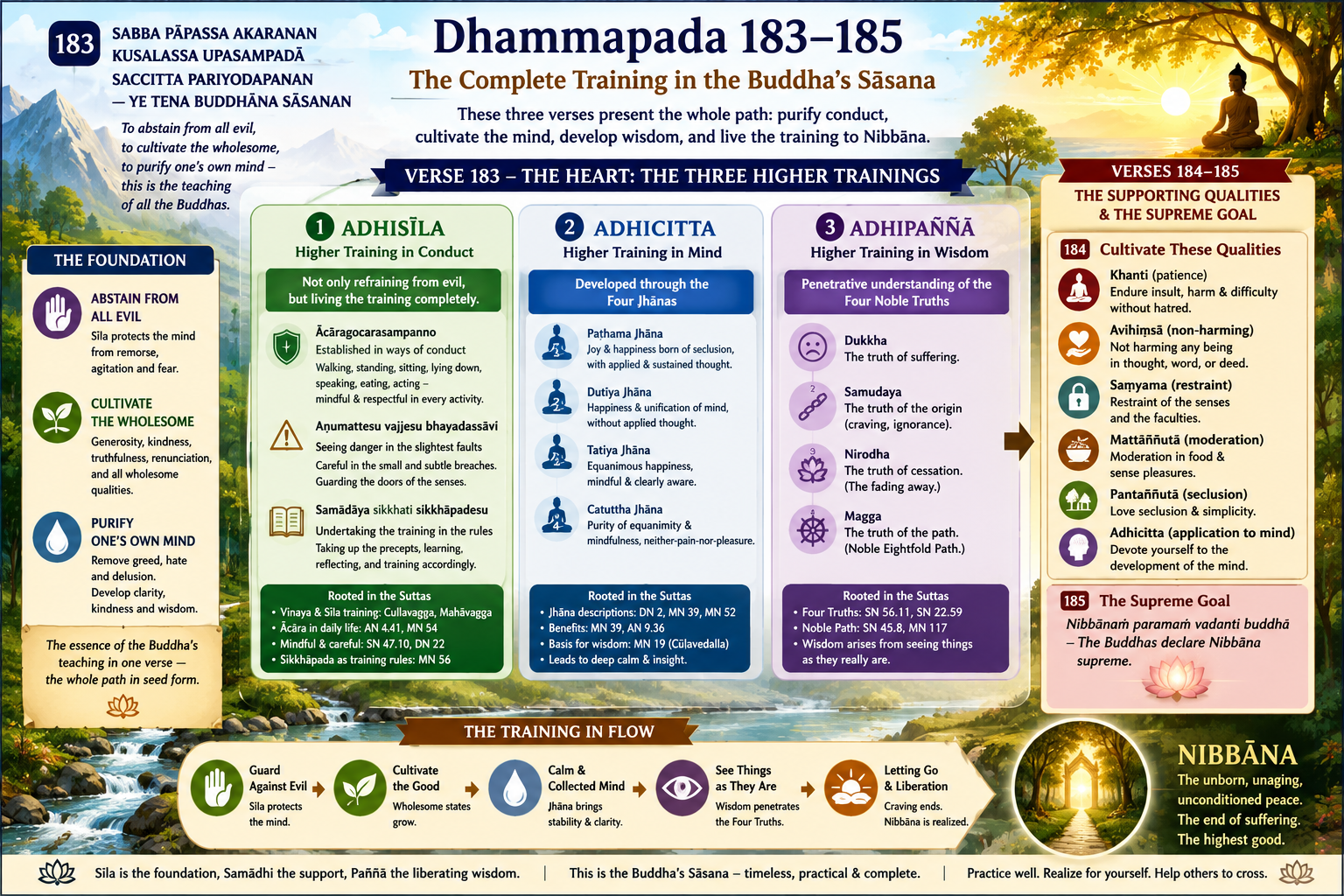
 VISUAL SUMMARYSee this study in a pictureOpen the complete infographic for a visual overview before or after reading the full study.View infographic →
Adhisīla, Adhicitta and Adhipaññā — the Buddha’s Entire Training Compressed into One Verse
Sabbapāpassa akaraṇaṁ,
kusalassa upasampadā;
sacittapariyodapanaṁ—
etaṁ buddhāna sāsanaṁ.The non-doing of all evil,
the undertaking and fulfilment of what is wholesome,
the purification of one’s own citta—
this is the instruction of the Buddhas.
Dhammapada 183 is among the best-known verses in the Buddhist world. It is frequently translated as “Do no evil, do good, purify the mind.” There is nothing fundamentally wrong with that translation, but when it is left at that level the verse can sound like a general moral maxim that almost any ethical or religious tradition could endorse.
The Buddha’s training is considerably more precise.
When Dhammapada 183 is placed beside the Buddha’s explicit description of the three higher trainings—adhisīlasikkhā, adhicittasikkhā and adhipaññāsikkhā—the verse opens into a remarkably compact representation of the entire path.
AN 3.89 is especially important because the Buddha does not leave these three expressions undefined. He tells us what each higher training actually consists of. Adhisīla is described through virtue, restraint, proper conduct and resort, sensitivity even to minute faults, and continuous training in the training principles. Adhicitta is explicitly defined through the four jhānas. Adhipaññā is explicitly defined as knowing the Four Noble Truths yathābhūtaṁ—as they actually are.
There is an important methodological qualification. Dhammapada 183 itself does not say, “the first line means adhisīla, the second adhicitta and the third adhipaññā.” That correspondence is therefore a doctrinal synthesis rather than a literal gloss on the verse. But once Dhp 183 is read through the explicit three-training framework of AN 3.89, the correspondence becomes extraordinarily fruitful:
The verse can therefore be read not merely as a morality statement, but as a movement from restraint to cultivation, from cultivation to penetrative knowledge, and from penetrative knowledge toward release.
Adhicitta→
Adhipaññā→
Khanti & Harmlessness→
Daily Restraint & Seclusion→
Nibbāna
01
The Three Higher Trainings Are Trainings, Not Subjects of Study
AN 3.89 begins:
Read the full discourse:
AN 3.89 — The Three Higher Trainings
Tisso imā, bhikkhave, sikkhā. Katamā tisso?
Adhisīlasikkhā, adhicittasikkhā, adhipaññāsikkhā.
“There are these three trainings: the training in higher virtue, the training in the higher mind, and the training in higher wisdom.”
The word that should arrest our attention is sikkhā.
The Buddha does not present three bodies of information to be mastered intellectually. He presents three fields in which one must train.
One may know every precept and remain unrestrained. One may know the terminology of every jhāna without possessing a developed citta. One may explain the Four Noble Truths flawlessly while craving, clinging and becoming continue untouched.
Knowledge about the training and accomplishment of the training are therefore entirely different things.
The progression is practical.
This sequence is also reflected in the broader gradual-training pattern found throughout the Nikāyas: ethical restraint and careful living prepare the practitioner for the abandoning of the hindrances and jhāna; the developed citta then becomes capable of knowledge leading to liberation.
The three trainings should therefore never be treated as rival approaches. Sīla does not compete with meditation. Jhāna does not compete with vipassanā. Paññā does not make disciplined conduct obsolete. They are different dimensions of one training whose final purpose is the ending of dukkha.
02
Sabbapāpassa Akaraṇaṁ — More Than Merely Keeping Precepts
AN 3.89 defines adhisīlasikkhā with a formula that deserves much closer examination than it usually receives:
Idha, bhikkhave, bhikkhu sīlavā hoti, pātimokkhasaṁvarasaṁvuto viharati, ācāragocarasampanno, aṇumattesu vajjesu bhayadassāvī, samādāya sikkhati sikkhāpadesu.
A practitioner is virtuous, restrained by the restraint of the Pātimokkha, accomplished in conduct and resort, sees danger in even the slightest fault, and, having undertaken the training principles, trains in them.
This already shows why adhisīla cannot be reduced to “I observe five precepts,” or in the monastic context, “I have not technically committed a rule violation.”
The Buddha’s formula has several dimensions, and together they describe a whole way of living.
Sīlavā hoti — becoming a person of sīla
The expression sīlavā hoti is stronger than temporary compliance.
The practitioner increasingly becomes someone whose behaviour is governed by Dhamma rather than by immediate impulse.
Ordinarily the sequence is simple:
Sīla inserts training between impulse and action.
The practitioner learns that the mere presence of an intention does not grant that intention authority.
Thus sabbapāpassa akaraṇaṁ begins by denying akusala unrestricted access to body and speech.
But higher virtue goes further still.
03
Pātimokkhasaṁvarasaṁvuto — Restraint Is a Deliberate Structure
The next expression is:
pātimokkhasaṁvarasaṁvuto viharati
The practitioner dwells restrained by restraint.
The repetition of the restraint vocabulary is significant. Virtue is not left to spontaneous goodness.
A person may behave beautifully while circumstances are favourable yet abandon those principles as soon as desire becomes sufficiently strong. The function of saṁvara is precisely to establish a boundary before the crisis arrives.
One has already decided:
“This kind of action will not be permitted.”
That is why undertaking sīla beforehand matters.
Suppose someone offers a large financial advantage that requires a small deception. If truthfulness is merely a preference, the mind immediately begins negotiation:
But when one has deliberately undertaken training, the question changes. The mind is no longer deciding whether honesty is convenient. The training has already established the direction.
This is how sīla reduces inner bargaining.
In the exact formula of AN 3.89 the reference is monastic and therefore specifically to the Pātimokkha. For a lay practitioner, one should not erase that context. Yet the underlying principle remains highly relevant: a training undertaken in advance protects the practitioner when the defilement is strongest.
This is higher virtue because it is not dependent upon whether one feels virtuous today.
03A
The Ten Akusala-kammapatha and Their Dominant Roots
The ten unwholesome courses of action are not mechanically produced by only one root. Lobha, dosa and moha can cooperate, but in many cases one root gives the action its most characteristic movement. The “dominant root” column below therefore identifies the most natural driving tendency, while the next column shows how the other unwholesome roots may participate.
How to read the table: “Dominant root” does not mean that the action can arise only from that root. It identifies the root that most naturally characterizes the action, while the other roots can reinforce, rationalize or redirect it.
04
Sabbapāpassa — Why “All” Matters
Dhammapada 183 says:
sabba-pāpassa
not some pāpa, but all pāpa.
This does not mean that every fault has identical karmic gravity. Clearly they do not. Rather, the word sabba prevents the practitioner from creating protected areas where akusala is allowed to continue unexamined.
AN 10.176 gives a useful framework through the ten unwholesome courses of conduct: bodily misconduct through killing, stealing and sexual misconduct; verbal misconduct through false, divisive, harsh and frivolous speech; and mental misconduct through covetousness, ill will and wrong view.
Read the full discourse:
AN 10.176 — Cundasutta
This broadens the question enormously.
The practitioner no longer asks merely:
Sīla progressively becomes subtler because the practitioner begins recognizing the roots before they become gross actions.
05
Ācāragocarasampanno — Conduct and the Field in Which One Lives
One of the most neglected expressions in the definition of adhisīla is:
ācāragocarasampanno
accomplished in ācāra and gocara.
Ācāra concerns conduct, behaviour and how one carries oneself. Gocara has the basic sense of a range, domain or field in which one moves.
In its immediate monastic setting, the phrase concerns appropriate conduct and proper resort. We should preserve that canonical context. But as a principle of training, it points toward something enormously important:
Where does this citta repeatedly go?
A person may technically avoid major misconduct while deliberately spending hours every day in an environment saturated with sensual stimulation, hostility, gossip, comparison, competition or acquisitiveness.
Read the full discourse:
MN137 — Saḷāyatanavibhaṅgasutta
Nothing dramatic may happen.
No precept may appear to be broken.
Yet the citta is being educated continuously.
This is why gocara matters.
The practitioner therefore has to examine not merely isolated actions but the ecosystem in which actions arise.
This is where adhisīla begins naturally to approach indriya-saṁvara.
The sense doors do not exist in a vacuum. We repeatedly carry them into particular fields. If we continually choose a gocara that feeds kāmacchanda and byāpāda, we cannot be surprised when those same hindrances dominate formal meditation.
Therefore the bhāvanā practitioner should understand something fundamental:
Meditation is happening all day.
The only question is what one is cultivating.
06
Aṇumattesu Vajjesu Bhayadassāvī — Seeing Danger in the Smallest Fault
The next phrase is even more demanding:
aṇumattesu vajjesu bhayadassāvī
seeing danger even in faults as small as an atom.
This is not a teaching of anxiety, scrupulosity or self-condemnation. It is a teaching of moral sensitivity.
The ordinary mind tends to assess faults by visible consequences:
The trained practitioner asks a different question:
What did this action train the citta to become?
These may appear insignificant when considered as isolated events. But behaviour works cumulatively.
Therefore a practitioner sees danger while the fault is still small.
This is similar to noticing a small crack in a dam before the crack becomes structural failure.
Higher virtue does not wait for gross misconduct before becoming interested.
07
Seeing Danger Does Not Mean Demanding Perfection
The surrounding discourses on the three trainings also prevent a mistaken interpretation.
The Buddha acknowledges that trainees may commit lesser faults and then emerge from them. Thus aṇumattesu vajjesu bhayadassāvī does not mean that the slightest error proves the training has failed.
The critical distinction is between making a mistake and making peace with the mistake.
A practitioner may fall.
What matters is whether the fault is:
The dangerous thought is not simply:
Seeing danger in small faults protects the practitioner from exactly that decline.
08
Samādāya Sikkhati Sikkhāpadesu — The Heart of Adhisīla Is Training
The final phrase is perhaps the most important:
samādāya sikkhati sikkhāpadesu
having undertaken the training principles, one trains in them.
The verb is sikkhati.
The Buddha does not say merely:
The practitioner trains.
A sikkhāpada is therefore better understood as a training principle than merely as a commandment.
Consider truthful speech.
Suppose I notice that I exaggerate whenever I fear looking incompetent.
Merely repeating “I undertake the precept to abstain from false speech” is useful but incomplete.
Training asks:
Now the precept has become a laboratory.
The same is true for irritation.
Rather than simply congratulating myself because I did not shout, I can examine what preceded the impulse.
This is sikkhati.
Sīla begins at action but can educate attention all the way back toward intention and condition.
09
Why Adhisīla Must Precede Adhicitta
This deeper understanding of adhisīla reveals why jhāna cannot simply be bolted onto an otherwise unchanged life.
The first jhāna begins:
vivicceva kāmehi vivicca akusalehi dhammehi
secluded from sensuality, secluded from unwholesome dhammas.
But how is a mind that has spent the whole day deliberately feeding sensuality expected suddenly to become secluded from sensuality?
Adhisīla prepares the terrain.
By the time the practitioner sits for bhāvanā, the citta has been trained in the direction of renunciation throughout the day.
This is why sabbapāpassa akaraṇaṁ is not an elementary prelude that advanced meditators leave behind.
It is the living foundation upon which higher citta becomes possible.
Yet sīla alone does not uproot everything.
Restraint prevents these states from freely governing conduct.
The next training has to address the citta itself.
This brings us to:
kusalassa upasampadā.
10
Kusalassa Upasampadā — Not Merely “Doing Good”
The usual English translation “do good” scarcely captures the depth of:
kusalassa upasampadā
Kusala concerns what is wholesome, skilful and conducive to the path. Upasampadā conveys taking up, entering upon, acquiring or coming into the full possession of something.
The movement therefore is active:
What is unwholesome is not merely restrained; what is wholesome must be developed.
A garden illustrates the difference.
Likewise adhisīla restricts the nourishment of akusala, but adhicitta actively develops the mind in another direction.
AN 3.89 then removes all ambiguity about what the higher mind means at its canonical core:
the first jhāna,
the second jhāna,
the third jhāna,
the fourth jhāna.
The four jhānas constitute the Buddha’s definition of adhicittasikkhā in this discourse.
Read the full discourse:
AN 3.89 — The Three Higher Trainings
Therefore jhāna is not an optional ornament attached to the Buddha’s threefold training.
It is how AN 3.89 defines the higher training of citta.
11
Jhāna Is Better Understood as Progressive Relinquishment
The four jhānas are often imagined as four increasingly spectacular meditative states.
But the actual formulas reveal another pattern.
The direction is therefore not accumulation but simplification.
The higher the citta develops, the fewer supports it requires.
This makes jhāna deeply consistent with the movement of renunciation.
Ordinary sensual consciousness continually says:
Jhāna gradually teaches:
less is sufficient.
Eventually even highly refined forms of meditative enjoyment are relinquished.
This is why adhicitta is a training in letting go, not merely in “concentration.”
12
First Jhāna — Discovering a Happiness Not Dependent on Sensuality
The first jhāna formula begins:
Vivicceva kāmehi vivicca akusalehi dhammehi savitakkaṁ savicāraṁ vivekajaṁ pītisukhaṁ paṭhamaṁ jhānaṁ upasampajja viharati.
Secluded from sensuality and secluded from unwholesome dhammas, the practitioner enters and dwells in first jhāna, with vitakka and vicāra and with pīti and sukha born of seclusion.
Read the full discourse:
AN 3.89 — The Three Higher Trainings
The revolutionary expression is:
vivekajaṁ pītisukhaṁ
pīti and sukha born of seclusion.
Ordinary sensual life assumes that pleasure requires successful contact with desirable objects.
Pleasure therefore depends on the world cooperating with craving.
First jhāna introduces an entirely different economy of happiness.
Pleasure arises precisely because the citta is secluded from the domain it previously believed necessary for pleasure.
This has tremendous psychological significance.
The citta learns directly:
“Sensual gratification is not the only available basis for well-being.”
That is far more transformative than intellectually declaring sensuality to be dangerous.
The mind has discovered an alternative.
And because the alternative is vivekaja, born of seclusion, renunciation is no longer experienced merely as deprivation.
This is one reason jhāna can profoundly support the abandoning of sensual dependence.
13
Why Adhisīla and First Jhāna Fit Together
The connection with the preceding training now becomes obvious.
Then first jhāna demonstrates directly what this direction of life makes possible.
Thus higher virtue and higher citta are not separate modules.
The first prepares the possibility of the second.
The practitioner who has learned to say “no” to certain impulses through sīla now discovers a citta that no longer needs those impulses in order to experience profound well-being.
That is a much deeper transformation than behavioural restraint alone.
14
Second Jhāna — Even the Activity of the First Jhāna Is Relinquished
The Buddha continues:
Vitakkavicārānaṁ vūpasamā ajjhattaṁ sampasādanaṁ cetaso ekodibhāvaṁ avitakkaṁ avicāraṁ samādhijaṁ pītisukhaṁ dutiyaṁ jhānaṁ upasampajja viharati.
With the subsiding of vitakka and vicāra, there is inner confidence, cetaso ekodibhāva, unification of citta, and pīti-sukha born of samādhi.
Notice what has happened.
The first jhāna was already extraordinarily wholesome and refined.
Yet the practitioner does not freeze there and declare:
“This is perfect; nothing more should be relinquished.”
Even the mental activity associated with the first jhāna is understood as comparatively coarse.
It subsides.
The source of pīti and sukha also changes.
In first jhāna:
vivekajaṁ
born of seclusion.
In second jhāna:
samādhijaṁ
born of samādhi.
The citta has become more self-sustaining.
The well-being no longer depends upon the same degree of mental activity.
This is cetaso ekodibhāva—the citta becoming unified.
15
What Second Jhāna Teaches About Letting Go
This transition contains a major Dhamma lesson.
Something can be wholesome and still be relinquished when it has served its purpose.
This matters because spiritual practitioners can easily become attached to what once helped them.
A technique worked.
A particular experience was beautiful.
A certain mental quality felt profound.
Then attachment forms around the very instrument of practice.
The movement from first to second jhāna teaches another principle:
Do not confuse usefulness with ultimacy.
Vitakka-vicāra were not enemies in first jhāna.
They belonged to the first jhāna.
Yet when their work is complete, they are relinquished.
This principle will become even more important when paññā examines jhāna itself.
16
Third Jhāna — Relinquishing Pīti
The Buddha then says:
Pītiyā ca virāgā upekkhako ca viharati, sato ca sampajāno, sukhañca kāyena paṭisaṁvedeti… tatiyaṁ jhānaṁ upasampajja viharati.
With the fading of pīti the practitioner dwells equanimous, mindful and sampajāna, experiencing sukha, and enters the third jhāna.
Now even pīti is relinquished.
Again, this is not because pīti was unwholesome.
Pīti was an integral part of the preceding jhānas.
But compared with the quiet refinement now possible, its uplifting or energizing quality has become relatively coarse.
The practitioner no longer needs excitement in order to know happiness.
This has enormous relevance beyond formal meditation.
Ordinary life frequently confuses stimulation with happiness.
Third jhāna points in the opposite direction.
As pīti fades, upekkhā becomes prominent.
The citta is learning that deep well-being need not depend on excitation.
And the formula emphasizes:
sato ca sampajāno
mindful and clearly knowing.
The citta is not dull.
It has become quieter without becoming unconscious.
This is refinement through relinquishment.
17
Fourth Jhāna — Even Sukha Is No Longer Required
Then comes the fourth jhāna:
Sukhassa ca pahānā dukkhassa ca pahānā, pubbeva somanassadomanassānaṁ atthaṅgamā, adukkhamasukhaṁ upekkhāsatipārisuddhiṁ catutthaṁ jhānaṁ upasampajja viharati.
With the abandoning of sukha and dukkha, and the earlier disappearance of gladness and sadness, the practitioner enters the fourth jhāna, neither painful nor pleasant, with upekkhā-sati-pārisuddhi—purity of mindfulness through equanimity.
This culmination is particularly important.
The progression does not end with maximizing pleasure.
Even refined sukha is relinquished.
What remains is an extraordinarily purified equanimity and mindfulness.
Thus the trajectory of adhicitta can be seen as:
sensual dependence
→ seclusion-born pīti-sukha
→ samādhi-born pīti-sukha
→ sukha with upekkhā
→ adukkhamasukha with upekkhā-sati-pārisuddhi.
The training continually moves toward less dependence, less disturbance and less appropriation.
This is why “concentration” is an inadequate word if it gives the impression that the goal is simply intense focus.
Adhicitta is a re-education of the citta.
18
Fourth Jhāna Is Sublime — But It Is Still Not the End of the Training
At this point a practitioner may encounter a danger more subtle than ordinary sensuality.
It is easy to think:
“What more could liberation possibly mean?”
AN 3.89 gives a simple answer by its structure.
After defining four jhānas as adhicitta, the Buddha continues:
Katamā ca, bhikkhave, adhipaññāsikkhā?
“And what is the training in higher wisdom?”
If jhāna had completed the path by itself, the third training would be unnecessary.
But there is another problem still to be penetrated.
This is why adhicitta must lead into adhipaññā.
19
AN 4.123 — The Difference Between Refining Bhava and Ending Bhava
AN 4.123 makes this issue particularly sharp.
The discourse describes practitioners who attain the four jhānas, savour them, long for them, and find satisfaction in them. Corresponding rūpa-world rebirth follows. The uninstructed worldling can enjoy the result of that refined development and yet, after that lifespan is exhausted, return again to lower destinations. The instructed noble disciple has a fundamentally different outcome.
Read the full discourse:
AN 4.123 — Paṭhamanānākaraṇasutta
This reveals something crucial:
Jhāna can transform the quality of existence without necessarily ending the machinery of existence.
This is not a criticism of jhāna.
Quite the opposite.
It demonstrates its extraordinary kammic and mental power.
But it also draws a clear boundary.
A refined citta and final liberation are not identical.
The problem appears in the verbs used in AN 4.123: the person can savour, long for, and find satisfaction in the jhāna.
The quality of the desire has become subtler.
But bhava remains bhava.
That is exactly where adhipaññā becomes indispensable.
20
Sacittapariyodapanaṁ — What Does It Mean to Purify One’s Own Citta?
The third phrase of Dhammapada 183 is:
sacittapariyodapanaṁ
the purification, cleansing or thorough clarification of one’s own citta.
Again, when the verse is read through AN 3.89, the higher-wisdom dimension becomes extremely precise.
The Buddha defines adhipaññā:
“Idaṁ dukkhan”ti yathābhūtaṁ pajānāti.
“Ayaṁ dukkhasamudayo”ti yathābhūtaṁ pajānāti.
“Ayaṁ dukkhanirodho”ti yathābhūtaṁ pajānāti.
“Ayaṁ dukkhanirodhagāminī paṭipadā”ti yathābhūtaṁ pajānāti.
One understands as it actually is:
The decisive expression is:
yathābhūtaṁ pajānāti
understands according to actuality.
This immediately separates adhipaññā from intellectual familiarity.
21
The Four Noble Truths Are Four Truths and Four Tasks
SN 56.11 reveals their practical structure with extraordinary precision.
Dukkha is not merely to be acknowledged. It is:
pariññeyyaṁ
to be fully understood.
Samudaya is:
pahātabbaṁ
to be abandoned.
Nirodha is:
sacchikātabbaṁ
to be directly realized.
The path is:
bhāvetabbaṁ
to be developed.
The Buddha then says that he did not claim full awakening until his knowledge and vision regarding the Four Noble Truths in their three rounds and twelve aspects was purified.
Read the full discourse:
SN 56.11 — Dhammacakkappavattanasutta
This gives adhipaññā an exact structure.
For each truth there is:
This distinction is essential.
Therefore Buddhist knowledge cannot be measured merely by accuracy of explanation.
22
The First Noble Truth — Dukkha Must Be Fully Understood
MN 141 expands the first Noble Truth:
Jātipi dukkhā, jarāpi dukkhā, maraṇampi dukkhaṁ… saṅkhittena pañcupādānakkhandhā dukkhā.
Birth is dukkha, aging is dukkha, death is dukkha, sorrow and distress are dukkha, not getting what one wants is dukkha, and in brief:
pañcupādānakkhandhā dukkhā
the five clinging-aggregates are dukkha.
That final statement takes the teaching far beyond ordinary unhappiness.
If dukkha merely meant painful events, the solution might be to arrange life more successfully.
But the Buddha identifies the problem at the level of upādāna in relation to the five aggregates:
rūpa,
vedanā,
saññā,
saṅkhārā,
viññāṇa.
The problem is therefore not simply that painful experiences occasionally appear.
The structure through which experience is appropriated as:
“mine,”
“I,”
“myself”
has to be understood.
This is why the task is pariññā—full comprehension.
23
Dukkha Must Be Understood Even Where There Is Sukha
This is where adhipaññā must be brought directly into relation with jhāna.
It is easy to investigate pain.
A painful vedanā arises and the practitioner says:
“anicca.”
Sadness arises:
“dukkha.”
Illness arises:
“not under my control.”
But when extraordinary sukha appears, the response changes:
“This is wonderful.”
“May this remain.”
“I want to enter this again.”
“May I exist in this state.”
Now the exact same investigation is often abandoned.
Yet if adhipaññā means knowing reality yathābhūtaṁ, conditioned pleasure cannot be exempted because it is spiritually refined.
The question is not:
“Is jhāna good or bad?”
Jhāna is explicitly part of the higher training and part of right samādhi. MN 141 defines sammāsamādhi through the four jhānas.
The question is:
What is the nature of this conditioned state?
Paññā is capable of appreciating the value of jhāna without turning jhāna into an identity or final destination.
24
The Second Noble Truth — Discovering the Machinery of Samudaya
The second Noble Truth concerns the arising of dukkha.
SN 56.11 identifies the origin in craving that leads to renewed becoming, accompanied by delight and relishing:
Read the full discourse:
SN 56.11 — Dhammacakkapavattanasutta
Its task is not:
“understand craving academically.”
The task is:
pahātabbaṁ
it must be abandoned.
This changes the entire standard by which understanding is judged.
Suppose someone can deliver a brilliant lecture on taṇhā yet is continually driven by sensuality, identity, recognition, becoming and aversion.
The information may be correct.
But the task assigned to the second truth is incomplete.
Adhipaññā therefore measures itself against abandoning, not merely explaining.
25
Craving Can Become Spiritual
AN 4.123 helps uncover an especially subtle form of samudaya.
A practitioner may have left gross sensuality far behind.
The citta may possess jhāna.
Yet one can still:
Read the full discourse:
AN 4.123 — Paṭhamanānākaraṇasutta
This should radically refine our understanding of craving.
Taṇhā does not disappear merely because its object has become noble-looking.
The mind may crave:
continuation of a sublime state,
or even an identity constructed around “one who has attained.”
Thus adhipaññā must be sharper than ordinary morality and subtler than meditative attainment.
It has to recognize appropriation itself.
The citta must learn to detect not merely:
“I want sensual pleasure,”
but also:
“I want this refined becoming.”
26
Adhicitta Temporarily Removes; Adhipaññā Penetrates
This brings us to a vital distinction.
In jhāna the five hindrances are absent.
But absence during an attainment is not automatically equivalent to final uprooting.
A simple analogy is muddy water.
When the mud settles, the water becomes beautifully clear.
Nothing is wrong with that clarity.
It is real clarity.
But if the mud remains available to be stirred up, the conditions for cloudiness remain.
Likewise adhicitta creates extraordinary freedom from hindrances and extraordinary purity of citta.
Adhipaññā investigates whether the underlying mechanisms of craving, appropriation and ignorance have been penetrated.
The two trainings therefore have different jobs.
Adhicitta makes the citta powerful, steady, unified and purified.
Adhipaññā directs that developed citta toward understanding what must actually be understood and abandoned.
This is why samatha and vipassanā should not be turned into competing systems.
The Buddha’s threefold training gives each its place.
27
The Third Noble Truth — Nirodha Is Not Something to Believe In
The third Noble Truth is cessation.
Its task is:
sacchikātabbaṁ
to be realized, witnessed or directly made evident.
SN 56.11 describes cessation as the remainderless fading and cessation of that very craving—its relinquishment, release and letting go.
Read the full discourse:
SN 56.11 — Dhammacakkapavattanasutta
This places a severe limit on purely intellectual Buddhism.
None of those activities is identical with:
sacchikātabbaṁ.
The third truth is not fulfilled when one has become convinced that cessation exists.
It is fulfilled through realization.
This is why the Buddha-sāsana is not ultimately a belief system.
It is a training directed toward something that must be known for oneself.
28
The Fourth Noble Truth — The Path Must Be Developed
The fourth Noble Truth is the Noble Eightfold Path.
Its task is:
bhāvetabbaṁ
to be developed.
This word is central.
The path is not something merely possessed as doctrine.
MN 141 describes the Noble Eightfold Path in detail and defines sammāsamādhi through the four jhānas.
Read the full discourse:
MN 141 — Saccavibhangasutta
This creates a beautiful circular integration of the three trainings.
Adhisīla appears within the path as right speech, right action and right livelihood.
Adhicitta appears through right effort, right mindfulness and especially right samādhi.
Adhipaññā includes right view and the penetrative knowledge of the Four Noble Truths.
Thus the Noble Eightfold Path and the three higher trainings are not rival maps.
They are different ways of organizing the same liberating development.
29
Sacca, Kicca and Kata — The Test of Real Understanding
The Buddha’s three-round structure in SN 56.11 provides perhaps the clearest practical test for what “knowing the Dhamma” means.
For dukkha:
For nirodha:
“This is cessation.”
“This must be realized.”
“This has been realized.”
For magga:
“This is the path.”
“This must be developed.”
“This has been developed.”
This is radically different from ordinary education.
In ordinary education, knowing the correct answer may complete the task.
In Dhamma, knowing the correct answer tells you what work remains.
One may know:
“Craving is to be abandoned.”
That knowledge may be perfectly correct.
But the next question is:
Has it been abandoned?
One may know:
“The path must be developed.”
Then:
Has it been developed?
One may know:
“Cessation must be realized.”
Then:
Has it been realized?
Adhipaññā therefore moves inexorably from theory toward transformation.
30
Sacittapariyodapanaṁ — Why the Verse Says One’s Own Citta
There is also great significance in:
sa-citta
one’s own citta.
Dhamma practice can easily become the examination of other people.
But the verse directs the work inward:
sacittapariyodapanaṁ
purification of one’s own citta.
This does not prohibit discernment concerning behaviour or doctrine.
It establishes the primary field of liberating work.
If anger arises in this citta, the immediate Dhamma question is not:
“Why is that person so irritating?”
It is:
“What arose here dependent upon contact?”
If sensual desire arises:
If humiliation hurts:
Now daily life becomes an extension of the Four Noble Truths.
31
A Single Insult Can Contain the Entire Training
Suppose someone insults us publicly.
At the level of adhisīla, anger may arise, but we do not allow it to become harsh speech, false accusation or retaliation.
That is:
sabbapāpassa akaraṇaṁ.
But merely suppressing the reply while internally boiling is not the complete training.
At the level of adhicitta, the practitioner develops the wholesome. Sati is established. Byāpāda is not deliberately fed. Patience, equanimity and collectedness are cultivated. Through sustained practice the citta learns not to be dragged helplessly by every contact.
That is the direction of:
kusalassa upasampadā.
Then adhipaññā asks what actually occurred.
There was:
Then interpretation:
“He insulted me.”
Memory entered.
Comparison entered.
Identity entered.
Resistance entered.
Anger developed.
Now the event is no longer merely a social problem.
It is an opportunity to understand dukkha and samudaya.
The other person may have spoken only one sentence.
The mind may construct an hour of suffering around it.
Adhipaññā studies that construction.
32
Sexual Attraction Can Also Reveal the Entire Training
Consider another example.
An attractive form appears.
At the level of adhisīla, the practitioner does not allow attraction to become sexual misconduct. For one living brahmacariya, restraint goes further and sexual activity itself has been relinquished.
But absence of the act is not necessarily absence of kāmacchanda.
Adhicitta addresses the citta more deeply.
The senses are guarded.
Sensual feeding is reduced.
The hindrance of sensual desire is abandoned for jhāna.
Then first jhāna provides a direct discovery:
vivekajaṁ pītisukhaṁ
there is pīti and sukha born not of sexual or sensory gratification, but of seclusion.
This changes the perceived necessity of sensuality.
Yet adhipaññā must still examine what happens when an attractive form is encountered.
Then where does:
“pleasant”
become:
“I want”?
Where does perception become possession?
Where does vedanā become taṇhā?
Where does taṇhā become upādāna?
Where does upādāna support bhava?
Now the same experience that once produced blind pursuit becomes material for knowing the Four Noble Truths.
33
From Vedanā to Bhava — Purification Is Not Merely “Thinking Pure Thoughts”
The phrase “purify your mind” can otherwise become dangerously vague.
It may be interpreted as:
“think positively,”
“avoid negative thoughts,”
or
“remain peaceful.”
But adhipaññā goes much deeper.
It examines conditionality:
phassa
conditions
vedanā,
which can condition
taṇhā,
which conditions
upādāna,
which supports
bhava,
which supports
jāti,
with aging, death, sorrow, lamentation, pain, distress and despair.
The purification required by the liberating path therefore concerns the roots by which experience becomes craving, clinging and becoming.
The objective is not simply to possess a pleasant citta.
A pleasant citta can still cling.
A peaceful citta can still become an identity.
A jhānic citta can still become an object of delight.
The final issue is not merely:
“How pure does the citta feel?”
but:
“What conditions of appropriation remain?”
34
Why the Three Trainings Must Remain Together
We can now see the problem with separating the path.
If one develops adhisīla without adhicitta, one may become extremely disciplined while the deeper currents of sensuality, hostility and restlessness remain largely untrained.
If one develops adhicitta without adhipaññā, one may reach extraordinary refinement while still delighting in conditioned becoming.
If one talks about adhipaññā without genuine training in conduct and citta, “vipassanā” can become conceptual analysis performed by the same unrestrained and scattered mind.
The Buddha’s architecture avoids all three distortions.
Each protects the others.
35
Good Rebirth, Brahmā Rebirth and Liberation Are Not the Same Goal
This distinction becomes particularly important when considering kamma and rebirth.
AN 4.123 makes the jhāna–Brahmā connection explicit.
But the Buddha’s final objective is not simply:
upgrade the destination within saṁsāra.
The decisive question becomes:
What brings the conditions for renewed bhava to cessation?
That question belongs to adhipaññā.
Thus the threefold training can be summarized in another way:
Without the third, the first two can still remain within the architecture of becoming.
36
The Deeper Meaning of Etaṁ Buddhāna Sāsanaṁ
The verse ends:
etaṁ buddhāna sāsanaṁ
“This is the instruction of the Buddhas.”
The plural buddhānaṁ is significant.
The verse presents this movement not merely as one incidental teaching given by Gotama, but as characteristic of the dispensation of Buddhas.
Dhammapada 185 strengthens this broader reading by including restraint, moderation, seclusion and:
adhicitte ca āyogo
application to the higher mind,
before again concluding:
etaṁ buddhāna sāsanaṁ.
Thus even within the Dhammapada context, Buddha-sāsana cannot be reduced to ethical decency. The training explicitly moves into the development of higher citta.
And AN 3.89 tells us what follows higher citta:
higher paññā through the Four Noble Truths.
37
The Verse as a Compressed Gradual Training
Read in this light, Dhammapada 183 becomes almost like a seed from which the gradual training unfolds.
Sabbapāpassa akaraṇaṁ
becomes the disciplined life of adhisīla:
virtue,
restraint,
proper conduct and resort,
seeing danger in even small faults,
continuously training in the training principles.
That way of life naturally supports:
indriya-saṁvara,
moderation,
wakefulness,
sati-sampajañña,
and reduced nourishment for the hindrances.
Then:
Kusalassa upasampadā
opens into adhicitta.
The five hindrances are abandoned.
The practitioner enters first jhāna and discovers pīti-sukha born of seclusion.
Vitakka-vicāra are relinquished in second jhāna.
Pīti is relinquished in third jhāna.
Sukha is relinquished in fourth jhāna.
The citta arrives at:
upekkhāsatipārisuddhi
purity of mindfulness through equanimity.
But the Buddha does not permit the practitioner to stop there.
Then:
Sacittapariyodapanaṁ
opens into adhipaññā.
“This is dukkha”—know it.
“This is samudaya”—know it.
“This is nirodha”—know it.
“This is the way leading to nirodha”—know it.
Then complete their tasks:
dukkha → pariññeyyaṁ
samudaya → pahātabbaṁ
nirodha → sacchikātabbaṁ
magga → bhāvetabbaṁ.
Only when the work is carried from knowledge to task to completion does the Buddha describe the knowledge and vision concerning the truths as purified.
38
The Entire Buddha-Sāsana in Four Lines
We may therefore finally read the verse at its fullest practical depth.
Sabbapāpassa akaraṇaṁ
Train in adhisīla.
Do not merely avoid spectacular wrongdoing. Become sīlavā. Establish restraint. Examine ācāra and gocara. Learn to see danger while faults are still tiny. Undertake the sikkhāpadas and actually sikkhati—train in them until body and speech cease to be easy instruments of lobha, dosa and moha.
Kusalassa upasampadā
Train in adhicitta.
Do not merely suppress what is unwholesome. Develop what is wholesome. Abandon the hindrances. Discover through first jhāna a happiness born of seclusion rather than sensuality. Relinquish vitakka-vicāra in the second, pīti in the third, and even sukha in the fourth. Bring the citta to upekkhā-sati-pārisuddhi.
Sacittapariyodapanaṁ
Train in adhipaññā.
Do not mistake even the most refined conditioned citta for the final goal. Know the Four Noble Truths yathābhūtaṁ. Fully understand dukkha. Abandon its origin. Realize cessation. Develop the path. Examine even sublime states for craving, delight, appropriation and bhava.
Etaṁ buddhāna sāsanaṁ
1Do not stop with being morally respectable.2Do not stop with meritorious kamma.3Do not stop with good rebirth.4Do not stop with heavenly rebirth.5Do not stop with Brahmā existence.6Do not stop with profound jhāna.7Carry the training through until the very conditions by which dukkha, upādāna, bhava and renewed birth continue are understood and brought to cessation.
That is why this short verse can carry such enormous weight.
It begins with what one must no longer do.
It proceeds to what one must develop and make abundant.
It culminates in what one must directly know, abandon, realize and develop.
Thus the movement is:
ADHISĪLA
conduct transformed
↓
ADHICITTA
citta transformed
↓
ADHIPAÑÑĀ
reality known yathābhūtaṁ
↓
VIRĀGA — NIRODHA — VIMUTTI
And then the concluding words no longer sound like a devotional flourish.
They become an extraordinarily precise summation:
Etaṁ buddhāna sāsanaṁ.
This is the instruction of the Buddhas.
39
Dhammapada 184 — What Kind of Practitioner Can Carry Out This Training?
Having given the extraordinary compression of the training in verse 183, the Dhammapada does not immediately move away from the subject. Verse 184 continues:
Khantī paramaṁ tapo titikkhā,
nibbānaṁ paramaṁ vadanti buddhā;
na hi pabbajito parūpaghātī,
na samaṇo hoti paraṁ viheṭhayanto.Patient endurance is the supreme austerity.
Nibbāna is supreme, say the Buddhas.
One who harms another is not truly gone forth;
one who oppresses another is not a samaṇa.
This verse is not an unrelated collection of moral statements placed after Dhammapada 183. It supplies something indispensable to the three higher trainings described there.
Verse 183 tells us what must be trained:
Verse 184 now tells us something about the quality required to endure that training, the direction toward which it must lead, and the behavioural test by which authentic renunciation can be recognized.
The three ideas are therefore deeply connected:
khantī / titikkhā — the capacity to endure without reacting;
Nibbāna — the unsurpassed goal;
non-harming and non-oppression — the outward expression of genuine renunciation.
The verse prevents the threefold training from becoming merely technical.
One may know precepts.
One may attain powerful samādhi.
One may possess extensive doctrinal knowledge.
But what happens when discomfort appears?
What happens when somebody insults us?
What happens when desire is frustrated?
What happens when another person disagrees with us?
What happens when the body becomes painful?
What happens when the conditions we prefer disappear?
That is where khanti reveals how deeply the training has entered the citta.
40
Khantī Paramaṁ Tapo Titikkhā — The Highest Austerity Is Patient Endurance
The opening words are striking:
Khantī paramaṁ tapo titikkhā
Patient endurance is the supreme austerity.
The word tapo can evoke austerity, ascetic exertion, hardship or burning discipline.
The Buddha had personally explored extreme physical austerities before awakening. Yet here the highest tapas is not identified with tormenting the body.
It is:
khantī
patient endurance,
and:
titikkhā
forbearance, endurance, the capacity to bear what is difficult without being conquered by reaction.
This completely changes the meaning of austerity.
Physical deprivation in itself does not purify citta.
The more difficult austerity may be something much closer to everyday experience:
A pleasant experience ends—and we do not desperately try to reconstruct it.
This is titikkhā.
The practitioner learns to remain in contact with experience without immediately converting every pleasant experience into grasping and every unpleasant experience into resistance.
That is a tremendous training.
41
Why Khanti Is Essential to Adhisīla
Khanti is inseparable from the adhisīla described earlier.
It is relatively easy to maintain sīla when nothing challenges us.
But the training becomes visible when the opposite conditions appear.
Suppose anger arises.
Adhisīla says:
sabbapāpassa akaraṇaṁ
do not enact the unwholesome.
But what allows the practitioner not to enact it while the internal pressure is strong?
Khanti.
Suppose sensual desire arises.
The practitioner has undertaken brahmacariya.
But the attraction is powerful.
What allows one to remain with that state without immediately following it?
Khanti.
Suppose somebody criticizes us unfairly.
The impulse to defend the self-image becomes strong.
What allows the practitioner to refrain from exaggeration, retaliation or harsh speech?
Again:
khanti.
Therefore khanti is not a decorative virtue added to sīla.
It is one of the capacities that makes restraint possible under pressure.
Without khanti, sīla remains dependent upon favourable circumstances.
With khanti, training begins to survive adversity.
42
Khanti Is Also Essential to Adhicitta
The connection becomes even deeper when the practitioner develops the higher citta.
The hindrances do not necessarily disappear merely because one wishes them away.
The untrained response is:
“I don’t like this meditation.”
“This should not be happening.”
“I need to get rid of this immediately.”
“Why can’t I enter the state I had yesterday?”
Now a second layer of craving and aversion has been added to the original difficulty.
Khanti gives another possibility.
The practitioner learns:
This too can be known.
There is no need immediately to react.
There is no need to manufacture frustration around the presence of a hindrance.
One continues the training intelligently and persistently.
The development of jhāna itself is therefore supported by titikkhā.
This does not mean passive resignation.
It means that effort is no longer driven by impatience.
One continues to abandon what must be abandoned and develop what must be developed without turning every temporary difficulty into personal failure.
43
Khanti and Adhipaññā — Remaining Long Enough to Understand
Khanti is equally important for paññā.
Consider unpleasant vedanā.
Without endurance, the mind moves almost immediately:
vedanā → paṭigha → resistance → proliferation.
The practitioner is so occupied with escaping the experience that there is little opportunity to understand it.
But if there is khanti, something extraordinary becomes possible.
The construction:
“I cannot tolerate this”
can be observed.
Now the experience becomes material for paññā.
The same applies to pleasant experience.
Without khanti, pleasant vedanā produces immediate pursuit:
“More.”
“Again.”
“Keep this.”
But patient stability allows the pleasant to be experienced without immediately turning it into acquisition.
Thus khanti supports the investigation of both:
taṇhā
and
upādāna.
In this sense, patient endurance helps create the space in which the Four Noble Truths can actually be seen operating.
44
Nibbānaṁ Paramaṁ Vadanti Buddhā — Do Not Lose Sight of the Goal
The next statement is decisive:
Nibbānaṁ paramaṁ vadanti buddhā.
“The Buddhas declare Nibbāna supreme.”
Why place this immediately after declaring khanti the supreme austerity?
Because endurance without direction can become meaningless suffering.
Khanti becomes part of Buddha-sāsana because the training is oriented toward:
Nibbāna.
This also gives us the proper perspective on everything developed in verse 183.
The trajectory is:
Nibbānaṁ paramaṁ.
Nibbāna is supreme.
This one phrase protects the entire path from being redirected toward lesser goals.
45
Nibbāna Is Higher Than Good Rebirth
This becomes particularly important when considering puñña and kusala.
These are significant results.
But verse 184 immediately reminds us:
Nibbānaṁ paramaṁ.
Not:
“heaven is supreme.”
Not:
“Brahmā existence is supreme.”
Not:
“the fourth jhāna is supreme.”
Not even:
“the most sublime conditioned state is supreme.”
The Buddhas say:
Nibbāna is supreme.
This is exactly why AN 4.123 becomes so useful in interpreting the earlier discussion.
The uninstructed worldling may cultivate jhāna and attain very refined existence.
But refined existence remains existence.
The Buddha’s ultimate discovery concerns the ending of the conditions that perpetuate birth and death.
Thus verse 184 prevents:
kusalassa upasampadā
from being interpreted merely as the accumulation of better saṁsāric destinations.
The higher mind is developed because it forms part of a path whose final orientation is beyond renewed bhava.
46
Nibbāna Is Also Higher Than Jhāna
This point is equally important.
Jhāna is part of adhicittasikkhā.
The four jhānas are part of sammāsamādhi.
They are not something to be belittled or bypassed.
But they remain conditioned attainments.
The Buddha therefore distinguishes the development of higher citta from the final goal.
Verse 184 makes the hierarchy unmistakable:
Nibbānaṁ paramaṁ.
This is the difference between:
Hence verse 184 strengthens the entire interpretation of verse 183:
and the goal toward which the whole training moves is:
Nibbāna.
47
Na Hi Pabbajito Parūpaghātī — Renunciation Cannot Coexist With Deliberate Harming
Verse 184 then abruptly becomes practical again:
Na hi pabbajito parūpaghātī.
“One who harms another is not truly gone forth.”
And:
Na samaṇo hoti paraṁ viheṭhayanto.
“One who oppresses, troubles or afflicts another is not a samaṇa.”
This is an extraordinarily powerful corrective.
Spiritual identity means nothing if behaviour contradicts the training.
But the Buddha places a behavioural test beside the spiritual title.
If one deliberately harms:
the label pabbajita does not establish genuine renunciation.
If one deliberately oppresses or harasses:
the label samaṇa does not establish genuine samaṇaship.
The Dhamma is measured through transformation, not costume or status.
48
Upaghāta and Viheṭhanā — Two Dimensions of Harm
The two expressions deserve distinction.
Parūpaghātī concerns harming or injuring another.
Paraṁ viheṭhayanto concerns afflicting, troubling, harassing or oppressing another.
Thus the standard is broader than merely:
“I did not physically injure anyone.”
Verse 184 therefore returns us directly to the depth of adhisīla.
The practitioner is not merely avoiding technically prohibited acts.
The deeper question is:
What does my presence do to other beings?
The answer tells us more than spiritual vocabulary ever could.
49
Verse 184 Completes the Inner Orientation of Verse 183
We can therefore understand verse 184 as supplying three essential dimensions to verse 183:
Verse 183 therefore tells us:
Train.
Verse 184 tells us:
Endure the training, know where it is leading, and make sure it manifests as harmlessness.
Then verse 185 answers the next practical question:
How should one organize one’s life so that this training can actually mature?
50
Dhammapada 185 — The Lifestyle That Makes the Three Trainings Possible
Verse 185 says:
Anūpavādo anūpaghāto,
pātimokkhe ca saṁvaro;
mattaññutā ca bhattasmiṁ,
pantañca sayanāsanaṁ;
adhicitte ca āyogo—
etaṁ buddhāna sāsanaṁ.Not reviling, not harming,
restraint according to the Pātimokkha,
knowing moderation in food,
a secluded dwelling,
and application to the higher mind—
this is the instruction of the Buddhas.
This verse is particularly important because it converts the lofty structure of verse 183 into daily living.
Notice its order.
The Buddha does not begin:
“Find a meditation object.”
and only then explicitly says:
adhicitte ca āyogo.
Application to the higher mind.
This sequence should not be overlooked.
The higher mind is cultivated within a way of life designed to support it.
51
Anūpavādo — Not Reviling
The first expression is:
anūpavādo
non-reviling, non-abuse, refraining from disparaging speech.
This returns us immediately to speech as part of adhisīla.
Reviling speech is particularly dangerous because it often disguises itself as righteousness:
“I am merely correcting him.”
“I am protecting the Dhamma.”
“Someone has to tell the truth.”
But one must examine the citta.
If so, the speech itself has become a field in which dosa and māna are being cultivated.
Therefore anūpavādo is not silence out of weakness.
It is disciplined speech arising from a citta that is no longer eager to injure through words.
52
Anūpaghāto — Not Harming
Next:
anūpaghāto
non-harming.
Verse 184 already said:
one who harms another is not truly gone forth.
Verse 185 now places non-harming directly inside the practical summary of Buddha-sāsana.
The repetition is significant.
Non-harming is not a minor ethical ornament.
It is foundational.
Why?
Because deliberate harming necessarily trains the citta in directions incompatible with liberation.
To harm intentionally requires some combination of:
dosa,
cruelty,
fear,
greed,
conceit,
or delusion.
The very act reinforces what adhipaññā must ultimately uproot.
Thus one cannot build a path toward cessation while deliberately strengthening the roots of bondage.
53
Pātimokkhe Ca Saṁvaro — The Return to Structured Restraint
Then comes:
pātimokkhe ca saṁvaro
restraint according to the Pātimokkha.
This directly echoes the definition of adhisīla in AN 3.89:
pātimokkhasaṁvarasaṁvuto viharati.
This parallel is important.
Verse 183 says:
sabbapāpassa akaraṇaṁ.
AN 3.89 explains adhisīla through restraint.
Verse 185 explicitly brings restraint into the Dhammapada’s own description of:
etaṁ buddhāna sāsanaṁ.
The canonical pieces therefore reinforce one another.
Higher meditation does not supersede restraint.
The more deeply one trains, the more important the foundation becomes.
54
Mattaññutā Ca Bhattasmiṁ — Knowing the Proper Measure in Food
Then the Buddha turns to something apparently mundane:
mattaññutā ca bhattasmiṁ
knowing moderation in food.
Why should eating appear beside Nibbāna, restraint and adhicitta?
Because Buddha-Dhamma deals with the actual conditions that shape citta.
Food is necessary.
But eating is also a field in which craving can become powerful.
The issue is not simply:
“How much food is allowed?”
The deeper training is:
mattaññutā
knowing the measure.
This requires understanding purpose.
The same physical act can have very different mental structures around it.
Moderation teaches the practitioner to distinguish:
need
from
craving.
That distinction has enormous relevance to the whole path.
55
Bhojane Mattaññutā Is Adhicitta Preparation
Overeating affects more than health.
It affects the mind.
Therefore moderation in eating is directly relevant to bhāvanā.
The Buddha’s sequence is practical:
Therefore mattaññutā ca bhattasmiṁ belongs naturally immediately before:
adhicitte ca āyogo.
This is not a random list.
It is an ecosystem of practice.
56
Pantañca Sayanāsanaṁ — The Importance of Seclusion
Next:
pantañca sayanāsanaṁ
a secluded lodging, a remote or quiet dwelling place.
Again the principle is profound.
The citta is shaped by environment.
This directly connects with the gocara discussed under adhisīla.
A mind continually surrounded by noise, social interaction, entertainment, conversation and stimulation receives very little opportunity to discover what remains when those inputs cease.
Seclusion exposes the citta.
In ordinary life we can continually regulate mood through external stimulation.
Want validation?
Seek interaction.
Seclusion removes many of these escape routes.
Then the practitioner begins to see the citta more directly.
57
Seclusion Is Not Merely Geographical
A person can sit alone in a forest while mentally replaying:
Therefore physical seclusion is valuable, but its purpose is deeper.
The first jhāna says:
vivicceva kāmehi vivicca akusalehi dhammehi.
There has to be seclusion from sensuality and unwholesome dhammas.
Thus pantaṁ sayanāsanaṁ provides supportive external conditions for a more important internal seclusion.
The practitioner gradually moves:
This is why environment cannot be separated from meditation practice.
58
Adhicitte Ca Āyogo — Verse 185 Names the Higher Mind Explicitly
Then comes perhaps the most important expression for our whole reading of verses 183–185:
adhicitte ca āyogo
application, devotion, exertion or engagement in the higher mind.
The Dhammapada itself uses the term:
adhicitta.
This is extremely significant.
Verse 183 says:
kusalassa upasampadā.
AN 3.89 defines adhicittasikkhā through the four jhānas.
Verse 185 then explicitly says that application to adhicitta is part of:
etaṁ buddhāna sāsanaṁ.
Thus higher citta is not something later meditation traditions inserted into a primarily ethical teaching.
It stands inside the Dhammapada’s own summary of the instruction of the Buddhas.
59
Āyoga — Not Casual Meditation
The word āyoga deserves attention.
It conveys application, engagement, devotion or sustained effort.
The verse does not say:
“Meditate occasionally.”
It points toward sustained engagement with the higher mind.
This is completely consistent with the broader Nikāya vocabulary:
bhāveti
develops,
and:
bahulīkaroti
makes much of, develops repeatedly.
The higher citta is not produced accidentally.
It is cultivated.
Then:
adhicitte ca āyogo.
The life and the meditation are finally moving in the same direction.
60
Verse 185 Is Almost a Miniature Gradual Training
Read sequentially, verse 185 contains a remarkable practical progression:
This is strikingly close in spirit to the larger gradual-training sequences elsewhere in the Nikāyas.
The point is always the same:
The meditation cannot be detached from the life that produces the meditator.
61
Dhammapada 183, 184 and 185 Should Therefore Be Read Together
We can now see why these three verses become far more powerful when kept together.
Verse 183 — The Architecture
Sabbapāpassa akaraṇaṁ
Kusalassa upasampadā
Sacittapariyodapanaṁ
This gives us the broad movement that can be illuminated through:
adhisīla → adhicitta → adhipaññā.
It answers:
What is the training?
Verse 184 — The Spirit and Goal
Khantī paramaṁ tapo titikkhā
Train with patient endurance.
Nibbānaṁ paramaṁ vadanti buddhā
Do not lose sight of the supreme goal.
Na hi pabbajito parūpaghātī
Renunciation cannot be genuine while one harms.
Na samaṇo hoti paraṁ viheṭhayanto
Spiritual identity is hollow when one oppresses others.
It answers:
What quality sustains the training, and where is it ultimately going?
Verse 185 — The Lifestyle
Anūpavādo
Do not revile.
Anūpaghāto
Do not harm.
Pātimokkhe ca saṁvaro
Live restrained.
Mattaññutā ca bhattasmiṁ
Know the measure in food.
Pantañca sayanāsanaṁ
Value seclusion.
Adhicitte ca āyogo
Apply yourself to the higher citta.
It answers:
How must daily life be arranged so that the training becomes possible?
62
The Three Verses Form One Complete Teaching
The relationship can be summarized as follows:
This makes verses 183–185 something much greater than three inspirational quotations.
Together they describe:
63
From Sīla to Seclusion — From Seclusion to Jhāna
When verses 183–185 are read together with AN 3.89, an elegant sequence appears.
First:
Sabbapāpassa akaraṇaṁ
Stop feeding gross akusala.
Then:
anūpavādo, anūpaghāto, pātimokkhe ca saṁvaro
speech and conduct become restrained.
Then:
mattaññutā ca bhattasmiṁ
consumption comes under training.
Then:
pantañca sayanāsanaṁ
seclusion is cultivated.
Then:
adhicitte ca āyogo
one applies oneself to the higher citta.
AN 3.89 tells us what that means:
the four jhānas.
The first begins:
vivicceva kāmehi vivicca akusalehi dhammehi.
Thus the Dhammapada’s practical lifestyle culminates naturally in the very seclusion required for jhāna.
64
From Jhāna to Paññā — And From Paññā Toward Nibbāna
But verse 184 prevents us from stopping with:
adhicitte ca āyogo.
It has already declared:
Nibbānaṁ paramaṁ vadanti buddhā.
Therefore higher citta is not the terminus.
AN 3.89 continues from adhicitta to:
adhipaññāsikkhā.
And adhipaññā is:
“idaṁ dukkhan”ti yathābhūtaṁ pajānāti
knowing dukkha as it actually is,
“ayaṁ dukkhasamudayo”ti yathābhūtaṁ pajānāti
knowing its origin,
“ayaṁ dukkhanirodho”ti yathābhūtaṁ pajānāti
knowing its cessation,
and:
“ayaṁ dukkhanirodhagāminī paṭipadā”ti yathābhūtaṁ pajānāti
knowing the way leading to cessation.
Now the relationship becomes complete:
This is an extraordinarily coherent architecture.
65
The Complete Movement
The whole training can therefore be represented as:
↓
NIBBĀNAṀ PARAMAṀ VADANTI BUDDHĀ.
Nibbāna is supreme, say the Buddhas.
66
A More Complete Ready-Reckoner
67
Why Verses 183–185 Together Are Much More Powerful Than Verse 183 Alone
Verse 183 by itself can easily be reduced to:
“Don’t do bad things, do good things and keep a pure mind.”
But verse 184 immediately prevents such a shallow reading.
The goal is:
Nibbāna.
The austerity is:
khanti.
The test of renunciation is:
non-harming.
Then verse 185 prevents us from converting the teaching into abstract philosophy.
How does one live?
Thus verses 184 and 185 function almost like safeguards around verse 183.
Verse 184 prevents us from forgetting the goal.
Verse 185 prevents us from forgetting the daily training.
68
The Buddha Is Not Teaching Three Separate Lives
There is not:
Everything either feeds:
lobha, dosa and moha
or contributes to their weakening.
That is why seemingly ordinary instructions such as:
mattaññutā ca bhattasmiṁ
belong beside:
Nibbānaṁ paramaṁ.
The path from the dining bowl to Nibbāna is not two different teachings.
And eventually paññā examines the very citta that has been trained.
69
The Three Verses as One Great Statement of Buddha-Sāsana
We can therefore read Dhammapada 183–185 almost as a single discourse.
First the Buddhas say:
Do not do evil.
Develop the wholesome.
Purify your own citta.
Then they tell us what kind of strength this requires:
patient endurance is the highest austerity.
They tell us not to mistake a conditioned attainment for the destination:
Nibbāna is supreme.
They tell us how spiritual development must become visible:
do not harm;
do not oppress.
Then they bring us into ordinary daily living:
do not revile;
do not harm;
live restrained;
know moderation in food;
value seclusion.
And finally they say explicitly:
adhicitte ca āyogo
apply yourself to the higher citta.
Then once more:
Etaṁ buddhāna sāsanaṁ.
This is the instruction of the Buddhas.
70
The Complete Buddha-Sāsana in Three Verses
Dhammapada 183 gives the architecture:
Adhisīla → Adhicitta → Adhipaññā.
Dhammapada 184 gives the inner strength and final compass:
Khanti → Harmlessness → Nibbāna.
Dhammapada 185 gives the daily operating conditions:
speech → non-harming → restraint → moderation → seclusion → adhicitta.
AN 3.89 supplies the canonical technical definition:
Adhisīla — the disciplined life of sīla, saṁvara, ācāra-gocara, sensitivity to faults and continuous training;
Adhicitta — the four jhānas;
Adhipaññā — knowing the Four Noble Truths yathābhūtaṁ.
SN 56.11 then gives the work to be completed:
dukkhaṁ pariññeyyaṁ
dukkha must be fully understood;
samudayo pahātabbo
its origin must be abandoned;
nirodho sacchikātabbo
cessation must be realized;
maggo bhāvetabbo
the path must be developed.
And Dhammapada 184 gives the final orientation:
Nibbānaṁ paramaṁ vadanti buddhā.
The Buddhas declare Nibbāna supreme.
Thus the complete movement is not:
be moral → meditate → become peaceful.
It is:
restructure conduct through adhisīla;
restructure citta through adhicitta;
penetrate dukkha through adhipaññā;
endure the training through khanti;
manifest it through harmlessness;
support it through moderation and seclusion;
and carry the whole path toward Nibbāna.
Only then do the repeated concluding words acquire their full significance:
ETAṀ BUDDHĀNA SĀSANAṀ.
THIS IS THE INSTRUCTION OF THE BUDDHAS.
Dhammapada 183 gives the architecture: abandon evil, develop the wholesome, and purify one’s own citta.
Dhammapada 184 gives the strength and compass: patient endurance, non-harming, and Nibbāna as supreme.
Dhammapada 185 gives the operating conditions of daily life: non-reviling, non-harming, restraint, moderation in food, seclusion, and sustained application to the higher citta.
Kusalassa Upasampadā→
Sacittapariyodapanaṁ→
Khanti→
Adhicitte Āyogo→
Nibbānaṁ Paramaṁ
Restrain what is unwholesome, develop the higher citta, penetrate the Four Noble Truths, endure without harming, arrange daily life to support the training, and keep Nibbāna as the supreme goal.