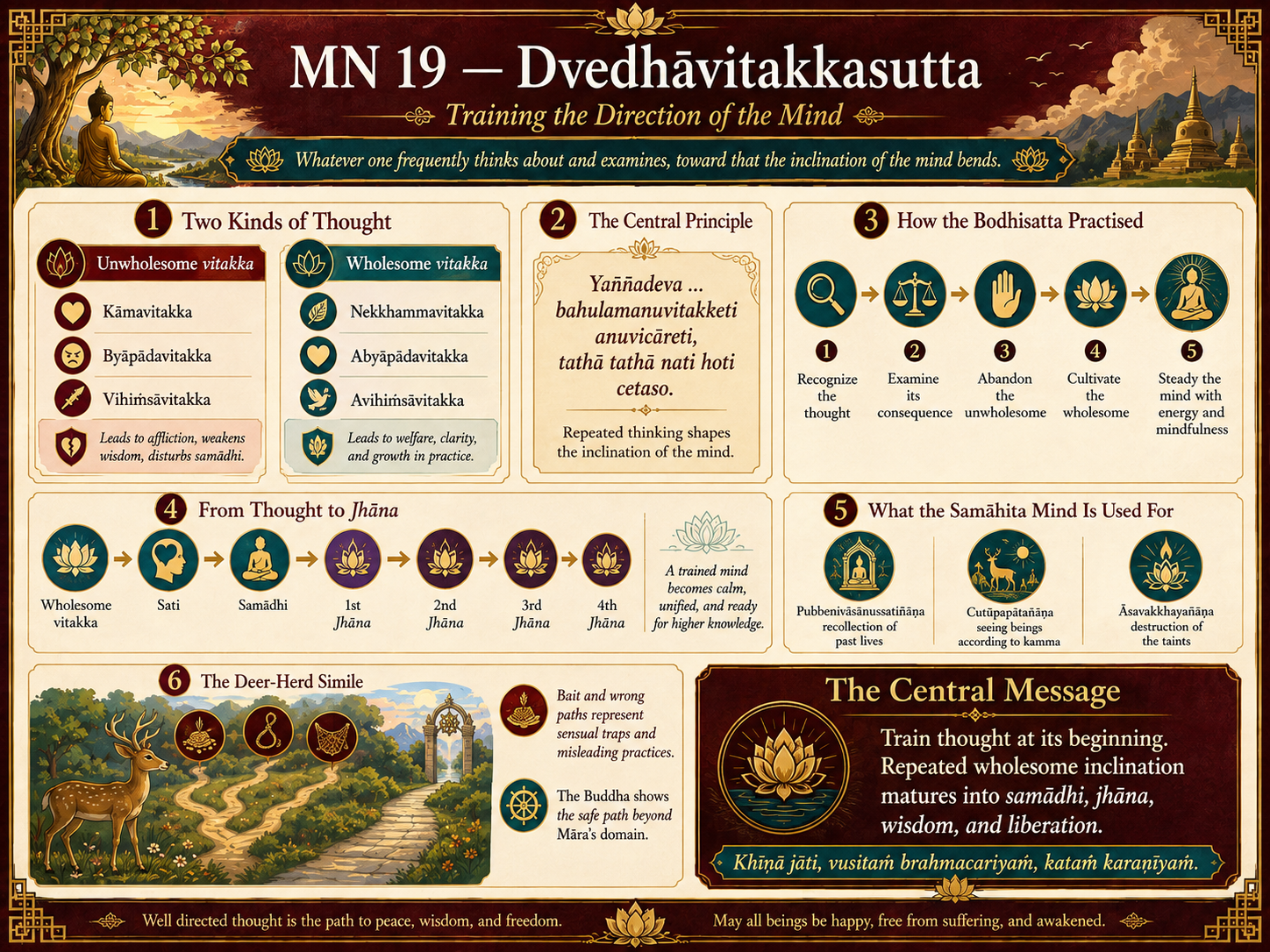
 VISUAL SUMMARYSee this sutta in a pictureOpen the complete infographic for a visual overview before or after reading the full study.View infographic →
Training the Direction of the Mind: From Vitakka to Jhāna and Liberation
The Dvedhāvitakkasutta is an unusually practical discourse because the Buddha describes an experiment he conducted upon his own mind while still a Bodhisatta. Rather than beginning with an abstract theory of thought, he begins with observation: thoughts arise, thoughts have tendencies, and what the mind repeatedly entertains gradually becomes the direction in which the mind naturally inclines.
The discourse therefore provides a bridge between sīla, guarding the mind, sammā-saṅkappa, sammā-vāyāma, sati, samādhi, jhāna and paññā. Its significance is much greater than a simple instruction to suppress unwanted thinking. It explains how the entire orientation of the mind can be trained.
From sensual demand toward renunciation.
From ill will toward non-ill-will.
From harming toward harmlessness.
011. The Setting
Evaṁ me sutaṁ—ekaṁ samayaṁ bhagavā sāvatthiyaṁ viharati jetavane anāthapiṇḍikassa ārāme. Tatra kho bhagavā bhikkhū āmantesi: “bhikkhavo”ti.
Thus have I heard. On one occasion the Blessed One was staying at Sāvatthī, in Jeta’s Grove, Anāthapiṇḍika’s monastery. There the Blessed One addressed the bhikkhus:
“Bhikkhus.”
“Bhadante”ti te bhikkhū bhagavato paccassosuṁ. Bhagavā etadavoca:
“Venerable sir,” those bhikkhus replied to the Blessed One.
The Blessed One said this:
022. The Bodhisatta Divides Thought into Two
“Pubbeva me, bhikkhave, sambodhā anabhisambuddhassa bodhisattasseva sato etadahosi: ‘yannūnāhaṁ dvidhā katvā dvidhā katvā vitakke vihareyyan’ti. So kho ahaṁ, bhikkhave, yo cāyaṁ kāmavitakko yo ca byāpādavitakko yo ca vihiṁsāvitakko—imaṁ ekaṁ bhāgamakāsiṁ; yo cāyaṁ nekkhammavitakko yo ca abyāpādavitakko yo ca avihiṁsāvitakko—imaṁ dutiyaṁ bhāgamakāsiṁ.”
“Bhikkhus, before my awakening, while I was still an unawakened Bodhisatta, it occurred to me:
‘What if I were to divide my thoughts into two classes?’
So I placed thoughts of sensuality, thoughts of ill will, and thoughts of harming in one category; and I placed thoughts of renunciation, non-ill-will, and harmlessness in the other category.”
The first decisive insight
This is where the training begins. The Bodhisatta does not initially attempt to make the mind completely silent, nor does he begin by demanding uninterrupted samādhi. He first learns to recognize the direction in which a thought is taking the mind. This is important because a thought is not treated merely as an isolated mental event; it is understood as something capable of inclining the mind toward a particular mode of living, speaking, acting and experiencing.
The two groups are:
This division is not arbitrary. Each member on one side has a practical counter-direction on the other. Kāma says, in effect, “I want to obtain, experience or continue this,” whereas nekkhamma discovers that the mind does not have to be possessed by that demand. Byāpāda moves toward rejection, hostility or the wish that another person or situation be removed, punished or made to suffer, while abyāpāda relinquishes that hostility. Vihiṁsā moves toward hurting, humiliating, exploiting or treating another without compassion, while avihiṁsā refuses to sustain that direction. The crucial issue, therefore, is not whether a thought merely appears, but what happens after it appears: whether the mind feeds it, repeatedly returns to it, constructs narratives around it and gradually begins to enjoy thinking in that manner. That distinction becomes one of the central themes of the discourse.
033. How the Bodhisatta Dealt with Sensual Thought
Tassa mayhaṁ, bhikkhave, evaṁ appamattassa ātāpino pahitattassa viharato uppajjati kāmavitakko. So evaṁ pajānāmi: ‘uppanno kho me ayaṁ kāmavitakko. So ca kho attabyābādhāyapi saṁvattati, parabyābādhāyapi saṁvattati, ubhayabyābādhāyapi saṁvattati, paññānirodhiko vighātapakkhiko anibbānasaṁvattaniko’.
“While I was dwelling heedful, ardent and resolute, a thought of sensuality arose in me.
I understood:
‘This thought of sensuality has arisen in me. It leads to my own affliction, to the affliction of others, and to the affliction of both. It obstructs wisdom, belongs to the side of distress, and does not lead toward Nibbāna.’”
‘Attabyābādhāya saṁvattatī’tipi me, bhikkhave, paṭisañcikkhato abbhatthaṁ gacchati; ‘parabyābādhāya saṁvattatī’tipi me, bhikkhave, paṭisañcikkhato abbhatthaṁ gacchati; ‘ubhayabyābādhāya saṁvattatī’tipi me, bhikkhave, paṭisañcikkhato abbhatthaṁ gacchati; ‘paññānirodhiko vighātapakkhiko anibbānasaṁvattaniko’tipi me, bhikkhave, paṭisañcikkhato abbhatthaṁ gacchati.
“As I reflected:
‘This leads to my own affliction,’ it subsided.
As I reflected:
‘This leads to the affliction of others,’ it subsided.
As I reflected:
‘This leads to the affliction of both,’ it subsided.
And as I reflected:
‘This obstructs wisdom, belongs to the side of distress, and does not lead toward Nibbāna,’ it subsided.”
So kho ahaṁ, bhikkhave, uppannuppannaṁ kāmavitakkaṁ pajahameva vinodameva byantameva naṁ akāsiṁ.
“Whatever thought of sensuality arose, I abandoned it, dispelled it and brought it to an end.”
Notice what the Bodhisatta actually does
The procedure is extremely precise. A kāmavitakka arises, and the Bodhisatta knows: “uppanno kho me ayaṁ kāmavitakko” — “This sensual thought has arisen in me.” Recognition comes before reaction. He does not immediately identify with the event by thinking, “I am sensual,” nor does he condemn himself with thoughts such as, “I should not have this thought,” or “I have failed.” He also does not turn the occurrence into an abstract philosophical problem. Instead, he examines its consequence: where will this thought lead if it is continued, repeated and nourished? This is the practical force of paṭisañcikkhana—careful consideration or reflection. The thought loses its attraction because the mind begins to see the cost of continuing it. This is therefore very different from simply commanding oneself, “Do not think about this.” The Bodhisatta exposes the thought to paññā, and once its direction is understood, the desire to sustain it weakens.
044. A Very Ordinary Example: Sensual Thought
Suppose someone sees an expensive phone. Seeing it and experiencing a pleasant response—“That looks beautiful”—is not yet the whole problem. The decisive development occurs when the mind begins to elaborate: “My present phone is actually fine, but imagine owning this one.” Soon the person is watching reviews, comparing models, checking prices, imagining ownership and becoming dissatisfied with a perfectly usable phone already possessed. The external object may have been in view for only thirty seconds, yet kāmavitakka continues internally for hours. The practical question arising from this sutta is therefore not merely, “Is buying a phone immoral?” That would miss the depth of the Buddha’s analysis. The more important question is: What is the mind repeatedly doing with this experience? Is craving being strengthened? Is dissatisfaction becoming more familiar? Is the mind becoming easier or harder to settle? Is paññā becoming clearer or more obscured? The same mechanism can operate around food, clothing, entertainment, sexual attraction, recognition, money, travel, social status or even pleasant meditation experiences. Kāma does not need to arrive dramatically; often it works through the quiet and repeated suggestion, “Just a little more.”
055. Ill Will and Harmfulness
Tassa mayhaṁ, bhikkhave, evaṁ appamattassa ātāpino pahitattassa viharato uppajjati byāpādavitakko …pe… uppajjati vihiṁsāvitakko. So evaṁ pajānāmi: ‘uppanno kho me ayaṁ vihiṁsāvitakko. So ca kho attabyābādhāyapi saṁvattati, parabyābādhāyapi saṁvattati, ubhayabyābādhāyapi saṁvattati, paññānirodhiko vighātapakkhiko anibbānasaṁvattaniko’.
“While I was dwelling heedful, ardent and resolute, a thought of ill will arose in me … and a thought of harming arose in me.
I understood:
‘This thought of harming has arisen in me. It leads to my own affliction, to the affliction of others, and to the affliction of both. It obstructs wisdom, belongs to the side of distress, and does not lead toward Nibbāna.’”
‘Attabyābādhāya saṁvattatī’tipi me, bhikkhave, paṭisañcikkhato abbhatthaṁ gacchati; ‘parabyābādhāya saṁvattatī’tipi me, bhikkhave, paṭisañcikkhato abbhatthaṁ gacchati; ‘ubhayabyābādhāya saṁvattatī’tipi me, bhikkhave, paṭisañcikkhato abbhatthaṁ gacchati; ‘paññānirodhiko vighātapakkhiko anibbānasaṁvattaniko’tipi me, bhikkhave, paṭisañcikkhato abbhatthaṁ gacchati.
“As I reflected that it leads to my own affliction, it subsided.
As I reflected that it leads to the affliction of others, it subsided.
As I reflected that it leads to the affliction of both, it subsided.
As I reflected that it obstructs wisdom, belongs to the side of distress and does not lead toward Nibbāna, it subsided.”
So kho ahaṁ, bhikkhave, uppannuppannaṁ vihiṁsāvitakkaṁ pajahameva vinodameva byantameva naṁ akāsiṁ.
“Whatever thought of harming arose, I abandoned it, dispelled it and brought it to an end.”
066. Why Anger Harms the Angry Person First
Imagine that someone speaks harshly to us during a meeting. The event itself may last only ten seconds, yet afterward the mind can recreate it for hours: “How could he speak to me like that? Next time I will tell him exactly what I think. He needs to be taught a lesson.” The other person may already be peacefully eating dinner, while internally we continue the encounter by recreating the person, recreating ourselves, rewriting the argument, imagining victory and perhaps imagining the other person humiliated. In this way byāpādavitakka becomes, in practical terms, something repeatedly entertained and reinforced.
The Buddha’s analysis is direct because he looks at the causal effect rather than merely the moral label. Attabyābādhāya means that the thought afflicts oneself; even before another person is harmed, one’s own mind has already become disturbed. Parabyābādhāya means that the same hostility can later pass into speech or action and afflict another. Ubhayabyābādhāya shows how easily both sides then become involved in a chain of harm: quarrels develop, relationships deteriorate, families divide and workplaces become poisonous. The original event may have been small, but repeated vitakka enlarges it. Most importantly for a practitioner, such a state is paññānirodhiko—it obstructs wisdom. A mind that enjoys resentment does not see clearly, and therefore ill will is not merely a problem of social etiquette; it directly opposes the development of paññā and samādhi.
077. “Whatever One Frequently Thinks About…”
Yaññadeva, bhikkhave, bhikkhu bahulamanuvitakketi anuvicāreti, tathā tathā nati hoti cetaso.
“Bhikkhus, whatever a bhikkhu frequently thinks about and repeatedly examines, toward that the inclination of his mind bends.”
Kāmavitakkañce, bhikkhave, bhikkhu bahulamanuvitakketi anuvicāreti, pahāsi nekkhammavitakkaṁ, kāmavitakkaṁ bahulamakāsi, tassa taṁ kāmavitakkāya cittaṁ namati.
“If a bhikkhu frequently thinks about and examines sensual thoughts, he has abandoned thoughts of renunciation and has frequently cultivated sensual thought; his mind therefore inclines toward sensual thought.”
Byāpādavitakkañce, bhikkhave …pe… vihiṁsāvitakkañce, bhikkhave, bhikkhu bahulamanuvitakketi anuvicāreti, pahāsi avihiṁsāvitakkaṁ, vihiṁsāvitakkaṁ bahulamakāsi, tassa taṁ vihiṁsāvitakkāya cittaṁ namati.
“If he frequently thinks about thoughts of ill will … or frequently thinks about and examines thoughts of harming, he abandons harmless thoughts and frequently cultivates thoughts of harming; his mind therefore inclines toward harming.”
This may be one of the most important passages in the discourse:
tathā tathā nati hoti cetaso
The mind begins to incline in that direction.
The Buddha is describing far more than individual thoughts.
He is describing the formation of a mental tendency.
A thought entertained once is one event.
A thought repeatedly entertained becomes familiar.
What becomes familiar becomes easier to return to.
What the mind repeatedly returns to gradually becomes its preferred direction.
Eventually one may say:
“That is simply how I am.”
But the sutta reveals something more useful:
Much of what appears to be “how I am” has been repeatedly cultivated.
And therefore the inclination can also be cultivated differently.
088. How an Ordinary Habit Becomes the Mind’s Direction
Suppose every morning someone opens the phone immediately after waking. A notification appears, then another, then news, messages and social media. After several months something revealing may happen: there may be no notification at all, yet the hand automatically reaches for the phone. The external stimulus is no longer necessary because the inclination has been cultivated. Something similar happens mentally. If every unpleasant encounter is followed by twenty minutes of resentment, resentment becomes an easily available mental road. If every attractive sight is followed by fantasy, fantasy becomes an available road. If every problem is followed by anxious proliferation, anxiety itself becomes the familiar direction of the mind. Conversely, when irritation is repeatedly met with non-hostility, non-hostility gradually becomes easier; when sensual desire is repeatedly understood and relinquished, relinquishment becomes easier. This is why the Buddha is not merely describing isolated akusala thoughts. He is training nati cetaso — the inclination of the mind.
099. The First Cowherd Simile — When Strong Guarding Is Necessary
Seyyathāpi, bhikkhave, vassānaṁ pacchime māse saradasamaye kiṭṭhasambādhe gopālako gāvo rakkheyya. So tā gāvo tato tato daṇḍena ākoṭeyya paṭikoṭeyya sannirundheyya sannivāreyya. Taṁ kissa hetu? Passati hi so, bhikkhave, gopālako tatonidānaṁ vadhaṁ vā bandhanaṁ vā jāniṁ vā garahaṁ vā.
“Suppose, bhikkhus, during the last month of the rainy season, in autumn, when the crops stand thick in the fields, a cowherd were guarding his cattle.
He would strike and drive them back from one place and another with his stick, restraining and preventing them.
Why?
Because the cowherd sees that if the cattle entered the crops, this could result in punishment, confinement, loss or blame.”
Evameva kho ahaṁ, bhikkhave, addasaṁ akusalānaṁ dhammānaṁ ādīnavaṁ okāraṁ saṅkilesaṁ, kusalānaṁ dhammānaṁ nekkhamme ānisaṁsaṁ vodānapakkhaṁ.
“In the same way, I saw the danger, degradation and defilement in unwholesome states, and I saw the benefit and cleansing side of wholesome states associated with renunciation.”
The crops are vulnerable. The crops are vulnerable, and therefore the cowherd cannot simply remain passive and allow the cattle to go wherever they wish; that would destroy the crop. At this stage active restraint is necessary. This has enormous practical importance because, when an unwholesome tendency is strong, repeatedly indulged and familiar, merely observing it while continuing to feed it is insufficient. One has to intervene. The Buddha uses deliberately active language: pajahameva — I abandoned it; vinodameva — I dispelled it; byantameva akāsiṁ — I brought it to an end. The image is therefore not one of passive observation but of intelligent restraint applied because the danger is already clearly understood.
1010. A Practical Example of the Cowherd’s Stick
Suppose someone is trying to weaken compulsive sensual media consumption and knows from experience that once a particular application is opened, one image leads to another until forty minutes disappear. At this stage, wisdom may require very practical restraint: not opening the application, stopping the scroll, putting the device elsewhere, standing up, walking or redirecting attention toward a wholesome activity. This corresponds to the cowherd guarding cattle while crops are nearby. Later, when the tendency has weakened, such strong intervention may no longer be necessary. The brilliance of the sutta is that both stages are taught. It does not absolutize forceful restraint, but neither does it absolutize effortless observation. The appropriate degree of effort changes as the mind itself changes.
1111. The Wholesome Side: Nekkhammavitakka
Tassa mayhaṁ, bhikkhave, evaṁ appamattassa ātāpino pahitattassa viharato uppajjati nekkhammavitakko. So evaṁ pajānāmi: ‘uppanno kho me ayaṁ nekkhammavitakko. So ca kho nevattabyābādhāya saṁvattati, na parabyābādhāya saṁvattati, na ubhayabyābādhāya saṁvattati, paññāvuddhiko avighātapakkhiko nibbānasaṁvattaniko’.
“While I was dwelling heedful, ardent and resolute, a thought of renunciation arose.
I understood:
‘This thought of renunciation does not lead to my own affliction, to the affliction of another, or to the affliction of both. It increases wisdom, belongs to the side of non-distress, and leads toward Nibbāna.’”
This is the mirror image of the earlier examination. Akusala was evaluated by asking, “Where does this lead?” and kusala is evaluated by the same standard. The Buddha does not ask us merely to decide whether a thought feels pleasant or reassuring. The deeper criterion is whether it increases paññā, reduces affliction and moves in the direction of Nibbāna. That provides a radically different standard for evaluating the mind, because something can feel pleasant and yet strengthen bondage, while something involving relinquishment may not initially feel gratifying and yet move decisively toward freedom.
1212. What Is Renunciation in Daily Life?
Nekkhamma need not initially mean giving away everything and entering homelessness. Its principle can be observed in very ordinary situations whenever an urge says, “I want this,” and the mind discovers, “I do not have to obey this wanting.” Someone may be offered another portion of food even though the body has had enough; kāma says, “It tastes good, take more,” while nekkhamma is content with enough. Praise may be received, and kāma may want more recognition, whereas nekkhamma does not build identity around being admired. Even a pleasant meditation can become an object of grasping when the mind says, “I want that state again.” In such a case nekkhamma is the willingness to see the grasping and release it. Renunciation is therefore not primarily about manufacturing deprivation; it is the growing freedom of the mind from having to satisfy every demand arising from craving.
1313. Even Wholesome Thinking Must Eventually Become Quiet
Rattiñcepi naṁ, bhikkhave, anuvitakkeyyaṁ anuvicāreyyaṁ, neva tatonidānaṁ bhayaṁ samanupassāmi. Divasañcepi naṁ, bhikkhave, anuvitakkeyyaṁ anuvicāreyyaṁ, neva tatonidānaṁ bhayaṁ samanupassāmi. Rattindivañcepi naṁ, bhikkhave, anuvitakkeyyaṁ anuvicāreyyaṁ, neva tatonidānaṁ bhayaṁ samanupassāmi.
“Even if I were to think about and examine this throughout the night, I saw no danger arising from it.
Even if I were to think about and examine it throughout the day, I saw no danger arising from it.
Even if I were to think about and examine it day and night, I saw no danger arising from it.”
Then comes an extraordinarily important qualification.
Api ca kho me aticiraṁ anuvitakkayato anuvicārayato kāyo kilameyya. Kāye kilante cittaṁ ūhaññeyya. Ūhate citte ārā cittaṁ samādhimhāti.
“Nevertheless, if I were to continue thinking and examining for too long, my body would become fatigued. When the body became fatigued, the mind would become disturbed. When the mind became disturbed, it would become far from samādhi.”
So kho ahaṁ, bhikkhave, ajjhattameva cittaṁ saṇṭhapemi sannisādemi ekodiṁ karomi samādahāmi. Taṁ kissa hetu? ‘Mā me cittaṁ ūhaññī’ti.
“So I established the mind internally, settled it, brought it to unification and composed it in samādhi.
Why?
So that my mind would not become disturbed.”
This passage prevents a major misunderstanding of Dhamma practice. Wholesome thinking is wholesome, but endless thinking is not samādhi. A practitioner may spend hours reflecting on dependent origination, jhāna, anicca, suttas, renunciation and Nibbāna, and nothing in those themes is intrinsically unwholesome. Nevertheless, if the mind continuously thinks, compares, analyses and constructs, eventually the activity of thinking itself can prevent deeper settling. There therefore comes a point when even Dhamma reflection has completed its immediate function and must be put down. The progression is to understand, reflect, cultivate the correct direction, and then settle the mind. This transition from wholesome reflection to inward composure is one of the most important movements in the entire sutta.
1414. Non-Ill-Will and Harmlessness
Tassa mayhaṁ, bhikkhave, evaṁ appamattassa ātāpino pahitattassa viharato uppajjati abyāpādavitakko …pe… uppajjati avihiṁsāvitakko. So evaṁ pajānāmi: ‘uppanno kho me ayaṁ avihiṁsāvitakko. So ca kho nevattabyābādhāya saṁvattati, na parabyābādhāya saṁvattati, na ubhayabyābādhāya saṁvattati, paññāvuddhiko avighātapakkhiko nibbānasaṁvattaniko’.
“While I was dwelling heedful, ardent and resolute, a thought of non-ill-will arose … and a thought of harmlessness arose.
I understood:
‘This thought of harmlessness does not lead to my own affliction, the affliction of another, or the affliction of both. It increases wisdom, belongs to the side of non-distress, and leads toward Nibbāna.’”
Rattiñcepi naṁ, bhikkhave, anuvitakkeyyaṁ anuvicāreyyaṁ, neva tatonidānaṁ bhayaṁ samanupassāmi. Divasañcepi naṁ, bhikkhave, anuvitakkeyyaṁ anuvicāreyyaṁ, neva tatonidānaṁ bhayaṁ samanupassāmi. Rattindivañcepi naṁ, bhikkhave, anuvitakkeyyaṁ anuvicāreyyaṁ, neva tatonidānaṁ bhayaṁ samanupassāmi.
“Even if I thought about and examined it throughout the night, throughout the day, or throughout both day and night, I saw no danger arising from it.”
Api ca kho me aticiraṁ anuvitakkayato anuvicārayato kāyo kilameyya. Kāye kilante cittaṁ ūhaññeyya. Ūhate citte ārā cittaṁ samādhimhāti. So kho ahaṁ, bhikkhave, ajjhattameva cittaṁ saṇṭhapemi, sannisādemi, ekodiṁ karomi samādahāmi. Taṁ kissa hetu? ‘Mā me cittaṁ ūhaññī’ti.
“But if I continued thinking and examining for too long, the body could become fatigued. With the body fatigued, the mind could become disturbed; and when disturbed, the mind would be far from samādhi.
Therefore I established the mind internally, settled it, unified it and composed it in samādhi, so that the mind would not become disturbed.”
1515. Cultivating the Opposite Inclination
Yaññadeva, bhikkhave, bhikkhu bahulamanuvitakketi anuvicāreti, tathā tathā nati hoti cetaso.
“Whatever a bhikkhu frequently thinks about and examines, toward that the inclination of his mind bends.”
Nekkhammavitakkañce, bhikkhave, bhikkhu bahulamanuvitakketi anuvicāreti, pahāsi kāmavitakkaṁ, nekkhammavitakkaṁ bahulamakāsi, tassaṁ taṁ nekkhammavitakkāya cittaṁ namati.
“If a bhikkhu frequently thinks about and examines renunciation, having abandoned sensual thought and frequently cultivated renunciation, his mind inclines toward renunciation.”
Abyāpādavitakkañce, bhikkhave …pe… avihiṁsāvitakkañce, bhikkhave, bhikkhu bahulamanuvitakketi anuvicāreti, pahāsi vihiṁsāvitakkaṁ, avihiṁsāvitakkaṁ bahulamakāsi, tassa taṁ avihiṁsāvitakkāya cittaṁ namati.
“If he frequently thinks about non-ill-will … and frequently thinks about and examines harmlessness, having abandoned thoughts of harming and frequently cultivated harmlessness, his mind inclines toward harmlessness.”
This establishes something profoundly hopeful: the mind is trainable. The same principle that explains the strengthening of akusala also explains the strengthening of kusala, which means that one is not condemned to one’s present tendencies. A person inclined toward anger can cultivate non-ill-will; a person strongly inclined toward sensuality can cultivate renunciation; a person inclined toward harshness can cultivate harmlessness. The important point is not merely knowing what is wholesome but repeatedly making much of it. The force of bahula is precisely this repeated cultivation, and transformation occurs because what is repeatedly cultivated gradually becomes the easier and more natural inclination of the mind.
1616. The Second Cowherd Simile — When the Mind Has Been Trained
The next simile is easy to overlook, but it reveals a remarkable change in the quality of practice.
Seyyathāpi, bhikkhave, gimhānaṁ pacchime māse sabbasassesu gāmantasambhatesu gopālako gāvo rakkheyya, tassa rukkhamūlagatassa vā abbhokāsagatassa vā satikaraṇīyameva hoti: ‘etā gāvo’ti.
“Suppose, bhikkhus, during the last month of the hot season, when all the crops had been gathered into the village, a cowherd were guarding the cattle.
Whether sitting at the foot of a tree or in the open, he would merely need to maintain mindfulness:
‘There are the cattle.’”
Evamevaṁ kho, bhikkhave, satikaraṇīyameva ahosi: ‘ete dhammā’ti.
“In the same way, I merely needed to maintain mindfulness:
‘These are the states.’”
Earlier the cowherd had to move around carrying a stick; now he can sit beneath a tree while simply remaining aware of the cattle. The cattle still exist and the cowherd still knows where they are, but the danger has diminished. This is an extraordinarily refined description of training because it shows that the form of effort should change as the mind becomes trained. In the beginning strong guarding may be necessary, but later simple mindfulness can be sufficient. A practitioner who continually has to wrestle violently with the mind should therefore not assume that perpetual struggle is the final condition of practice. The purpose of repeated training is that eventually the same degree of force is no longer required. Sati remains, but the struggle diminishes.
1717. A Daily-Life Example of the Two Cowherds
Consider anger. In the beginning, a particular person may trigger intense resentment, and whenever that person’s name appears one may have to work carefully: recognize the thought, remember its danger, refuse to replay past events, avoid retaliatory speech and deliberately establish non-ill-will. This is the cowherd with the stick. Months later, however, the same person’s name may appear and only a small mental movement occurs. It is immediately known, but there is no storyline, no internal argument and no urge to retaliate; the movement passes without needing to be fed. At that stage the practice comes closer to “ete dhammā” — “these are the states.” The mind has been trained, and a major sign of that development is that less management becomes necessary because the underlying inclination has changed.
1818. The Condition Immediately Before Jhāna
Āraddhaṁ kho pana me, bhikkhave, vīriyaṁ ahosi asallīnaṁ, upaṭṭhitā sati asammuṭṭhā, passaddho kāyo asāraddho, samāhitaṁ cittaṁ ekaggaṁ.
“My energy was aroused and unflagging; mindfulness was established and not confused; the body was tranquil and untroubled; the mind was samāhita and unified.”
This statement should be read slowly because it tells us what the preceding training has produced. Vīriya is established and unflagging, sati is present and undisturbed, the body has become passaddha, tranquil and untroubled, and the mind has become samāhita and ekagga, composed and unified. Only then does the sutta move into jhāna. The sequence matters because jhāna is not presented as an isolated breathing technique detached from the way the mind has been living throughout the day. The entire preceding training has prepared its conditions: sensual thought, ill will and harmfulness have been weakened; renunciation, non-ill-will and harmlessness have been developed; the habitual inclination of the mind has changed; effortful guarding has progressively become simpler mindfulness; the body has settled and the mind has become samāhita. Jhāna follows as the maturation of this preparation rather than as an unrelated technique introduced at the end.
1919. First Jhāna
So kho ahaṁ, bhikkhave, vivicceva kāmehi vivicca akusalehi dhammehi savitakkaṁ savicāraṁ vivekajaṁ pītisukhaṁ paṭhamaṁ jhānaṁ upasampajja vihāsiṁ.
“Quite secluded from sensuality, secluded from unwholesome states, I entered and dwelt in the first jhāna, accompanied by vitakka and vicāra, with pīti and sukha born of seclusion.”
Notice how naturally vivicceva kāmehi follows everything that came before.
The Bodhisatta has spent the earlier part of the discourse understanding precisely how the mind inclines toward kāma.
He has not simply waited until sitting meditation and then attempted to make sensuality disappear.
The training has already been occurring throughout mental life.
Thus seclusion from kāma is not merely spatial seclusion.
It involves a mind that is no longer continuously leaning toward sensual engagement.
2020. Second Jhāna
Vitakkavicārānaṁ vūpasamā ajjhattaṁ sampasādanaṁ cetaso ekodibhāvaṁ avitakkaṁ avicāraṁ samādhijaṁ pītisukhaṁ dutiyaṁ jhānaṁ upasampajja vihāsiṁ.
“With the subsiding of vitakka and vicāra, having internal confidence and unification of mind, without vitakka and vicāra, with pīti and sukha born of samādhi, I entered and dwelt in the second jhāna.”
The earlier passage already prepared us for this transition.
Even wholesome thinking cannot continue indefinitely if the mind is to become deeply unified.
Now vitakka and vicāra themselves subside.
There is greater internal unification.
2121. Third Jhāna
Pītiyā ca virāgā upekkhako ca vihāsiṁ sato ca sampajāno, sukhañca kāyena paṭisaṁvedesiṁ, yaṁ taṁ ariyā ācikkhanti ‘upekkhako satimā sukhavihārī’ti, tatiyaṁ jhānaṁ upasampajja vihāsiṁ.
“With the fading of pīti, I dwelt equanimous, mindful and sampajāna, experiencing sukha with the body. I entered and dwelt in the third jhāna, concerning which the noble ones say:
‘Equanimous and mindful, one dwells happily.’”
Here the energetic uplift of pīti fades.
Upekkhā becomes prominent.
Sati and sampajañña remain.
The mind does not lose clarity as it becomes increasingly still.
2222. Fourth Jhāna
Sukhassa ca pahānā dukkhassa ca pahānā pubbeva somanassadomanassānaṁ atthaṅgamā adukkhamasukhaṁ upekkhāsatipārisuddhiṁ catutthaṁ jhānaṁ upasampajja vihāsiṁ.
“With the abandoning of sukha and dukkha, and with the earlier disappearance of somanassa and domanassa, I entered and dwelt in the fourth jhāna, which is neither painful nor pleasant and has purity of mindfulness through equanimity.”
The sequence has now moved extraordinarily far from the opening condition.
At first:
sensual thoughts arise,
hostile thoughts arise,
harmful thoughts arise.
They have to be examined and repeatedly abandoned.
Eventually:
the mind becomes unified,
enters jhāna,
and reaches upekkhāsatipārisuddhi — purification of mindfulness by equanimity.
The discourse therefore describes the transformation of the same mind, not two unrelated practices.
2323. What the Buddha Does with the Samāhita Mind
The discourse does not end with fourth jhāna.
This is crucial.
So evaṁ samāhite citte parisuddhe pariyodāte anaṅgaṇe vigatūpakkilese mudubhūte kammaniye ṭhite āneñjappatte pubbenivāsānussatiñāṇāya cittaṁ abhininnāmesiṁ.
“With the mind thus samāhita, purified, bright, spotless, free from defilements, malleable, workable, steady and imperturbable, I directed the mind toward the knowledge of recollecting past lives.”
So anekavihitaṁ pubbenivāsaṁ anussarāmi. Seyyathidaṁ—ekampi jātiṁ …pe… iti sākāraṁ sauddesaṁ anekavihitaṁ pubbenivāsaṁ anussarāmi.
“I recollected many kinds of past lives: one birth … and so on … recollecting many kinds of past lives with their features and particulars.”
2424. The First Knowledge
Ayaṁ kho me, bhikkhave, rattiyā paṭhame yāme paṭhamā vijjā adhigatā; avijjā vihatā vijjā uppannā; tamo vihato āloko uppanno; yathā taṁ appamattassa ātāpino pahitattassa viharato.
“This was the first knowledge attained by me during the first watch of the night.
Ignorance was destroyed and knowledge arose.
Darkness was destroyed and light arose,
as happens in one who dwells heedful, ardent and resolute.”
2525. The Passing Away and Reappearance of Beings
So evaṁ samāhite citte parisuddhe pariyodāte anaṅgaṇe vigatūpakkilese mudubhūte kammaniye ṭhite āneñjappatte sattānaṁ cutūpapātañāṇāya cittaṁ abhininnāmesiṁ.
“With the mind thus samāhita, purified, bright, spotless, free from defilements, malleable, workable, steady and imperturbable, I directed it toward knowledge of the passing away and reappearance of beings.”
So dibbena cakkhunā visuddhena atikkantamānusakena satte passāmi cavamāne upapajjamāne …pe… ime vata bhonto sattā kāyaduccaritena samannāgatā …pe… iti dibbena cakkhunā visuddhena atikkantamānusakena satte passāmi cavamāne upapajjamāne hīne paṇīte suvaṇṇe dubbaṇṇe sugate duggate, yathākammūpage satte pajānāmi.
“With the divine eye, purified and surpassing the human, I saw beings passing away and reappearing … I understood beings to fare according to their kamma: inferior and superior, beautiful and unattractive, fortunate and unfortunate.”
2626. The Second Knowledge
Ayaṁ kho me, bhikkhave, rattiyā majjhime yāme dutiyā vijjā adhigatā; avijjā vihatā vijjā uppannā; tamo vihato āloko uppanno; yathā taṁ appamattassa ātāpino pahitattassa viharato.
“This was the second knowledge attained by me during the middle watch of the night.
Ignorance was destroyed and knowledge arose.
Darkness was destroyed and light arose,
as happens in one who dwells heedful, ardent and resolute.”
2727. Knowledge of the Destruction of the Āsavas
So evaṁ samāhite citte parisuddhe pariyodāte anaṅgaṇe vigatūpakkilese mudubhūte kammaniye ṭhite āneñjappatte āsavānaṁ khayañāṇāya cittaṁ abhininnāmesiṁ.
“With the mind thus samāhita, purified, bright, spotless, free from defilements, malleable, workable, steady and imperturbable, I directed it toward knowledge of the destruction of the āsavas.”
So ‘idaṁ dukkhan’ti yathābhūtaṁ abbhaññāsiṁ, ‘ayaṁ dukkhasamudayo’ti yathābhūtaṁ abbhaññāsiṁ, ‘ayaṁ dukkhanirodho’ti yathābhūtaṁ abbhaññāsiṁ, ‘ayaṁ dukkhanirodhagāminī paṭipadā’ti yathābhūtaṁ abbhaññāsiṁ.
“I directly understood as it actually is:
‘This is dukkha.’
‘This is the arising of dukkha.’
‘This is the cessation of dukkha.’
‘This is the path leading to the cessation of dukkha.’”
This is where the trajectory of the discourse becomes unmistakable.
The objective was never simply:
“I want fewer disturbing thoughts.”
The objective is knowledge of dukkha, its arising, its cessation and the way leading to cessation.
Mental training serves liberation.
2828. The Āsavas Are Known and Ended
‘Ime āsavā’ti yathābhūtaṁ abbhaññāsiṁ, ‘ayaṁ āsavasamudayo’ti yathābhūtaṁ abbhaññāsiṁ, ‘ayaṁ āsavanirodho’ti yathābhūtaṁ abbhaññāsiṁ, ‘ayaṁ āsavanirodhagāminī paṭipadā’ti yathābhūtaṁ abbhaññāsiṁ.
“I directly understood as it actually is:
‘These are the āsavas.’
‘This is the arising of the āsavas.’
‘This is the cessation of the āsavas.’
‘This is the way leading to the cessation of the āsavas.’”
Tassa me evaṁ jānato evaṁ passato kāmāsavāpi cittaṁ vimuccittha, bhavāsavāpi cittaṁ vimuccittha, avijjāsavāpi cittaṁ vimuccittha.
“When I knew and saw in this way, the mind was liberated from the āsava of sensuality, liberated from the āsava of existence, and liberated from the āsava of ignorance.”
Vimuttasmiṁ vimuttamiti ñāṇaṁ ahosi: ‘khīṇā jāti, vusitaṁ brahmacariyaṁ, kataṁ karaṇīyaṁ, nāparaṁ itthattāyā’ti abbhaññāsiṁ.
“When liberated, there arose the knowledge:
‘It is liberated.’
I directly understood:
‘Birth is ended.
The brahmacariya has been lived.
What had to be done has been done.
There is no further coming to this state of existence.’”
2929. The Third Knowledge
Ayaṁ kho me, bhikkhave, rattiyā pacchime yāme tatiyā vijjā adhigatā; avijjā vihatā vijjā uppannā; tamo vihato āloko uppanno; yathā taṁ appamattassa ātāpino pahitattassa viharato.
“This was the third knowledge attained by me during the last watch of the night.
Ignorance was destroyed and knowledge arose.
Darkness was destroyed and light arose,
as happens in one who dwells heedful, ardent and resolute.”
The sequence beginning with ordinary thought has now reached the destruction of the āsavas.
That is why the first half of this discourse should never be reduced to modern “thought management.”
The Buddha is explaining the cultivation of the mind for awakening.
3030. The Great Deer-Herd Simile
The Buddha concludes with another powerful image.
Seyyathāpi, bhikkhave, araññe pavane mahantaṁ ninnaṁ pallalaṁ. Tamenaṁ mahāmigasaṅgho upanissāya vihareyya.
“Suppose, bhikkhus, there were a great low-lying marsh in a forest wilderness, and a large herd of deer lived depending upon it.”
Tassa kocideva puriso uppajjeyya anatthakāmo ahitakāmo ayogakkhemakāmo.
“Then there might appear a man who desired their harm, their misfortune and their lack of security.”
So yvāssa maggo khemo sovatthiko pītigamanīyo taṁ maggaṁ pidaheyya, vivareyya kummaggaṁ, odaheyya okacaraṁ, ṭhapeyya okacārikaṁ.
“He would close the safe and secure path that led to happiness, open a false path, set out bait and place a baited decoy.”
Evañhi so, bhikkhave, mahāmigasaṅgho aparena samayena anayabyasanaṁ āpajjeyya.
“In this way that great herd of deer would eventually come to ruin and disaster.”
Then another person appears.
Tasseva kho pana, bhikkhave, mahato migasaṅghassa kocideva puriso uppajjeyya atthakāmo hitakāmo yogakkhemakāmo.
“But there might appear another man who desired their welfare, their benefit and their security from bondage.”
So yvāssa maggo khemo sovatthiko pītigamanīyo taṁ maggaṁ vivareyya, pidaheyya kummaggaṁ, ūhaneyya okacaraṁ, nāseyya okacārikaṁ.
“He would open the safe and secure path leading to happiness, close the false path, remove the bait and destroy the baited decoy.”
Evañhi so, bhikkhave, mahāmigasaṅgho aparena samayena vuddhiṁ virūḷhiṁ vepullaṁ āpajjeyya.
“In this way the great herd of deer would eventually come to growth, flourishing and abundance.”
3131. The Buddha Explains Every Part of the Simile
Upamā kho me ayaṁ, bhikkhave, katā atthassa viññāpanāya. Ayaṁ cevettha attho—
“Bhikkhus, I have made this simile in order to convey the meaning. And this is its meaning.”
Mahantaṁ ninnaṁ pallalanti kho, bhikkhave, kāmānametaṁ adhivacanaṁ.
“The great low-lying marsh is a designation for sensual pleasures.”
Mahāmigasaṅghoti kho, bhikkhave, sattānametaṁ adhivacanaṁ.
“The great herd of deer is a designation for beings.”
Puriso anatthakāmo ahitakāmo ayogakkhemakāmoti kho, bhikkhave, mārassetaṁ pāpimato adhivacanaṁ.
“The man who desires harm, misfortune and insecurity is a designation for Māra the Evil One.”
Kummaggoti kho, bhikkhave, aṭṭhaṅgikassetaṁ micchāmaggassa adhivacanaṁ, seyyathidaṁ—micchādiṭṭhiyā micchāsaṅkappassa micchāvācāya micchākammantassa micchāājīvassa micchāvāyāmassa micchāsatiyā micchāsamādhissa.
“The false path is a designation for the wrong eightfold path:
wrong view,
wrong intention,
wrong speech,
wrong action,
wrong livelihood,
wrong effort,
wrong mindfulness,
and wrong samādhi.”
Okacaroti kho, bhikkhave, nandīrāgassetaṁ adhivacanaṁ.
“The bait is a designation for delight and lust.”
Okacārikāti kho, bhikkhave, avijjāyetaṁ adhivacanaṁ.
“The baited decoy is a designation for ignorance.”
Puriso atthakāmo hitakāmo yogakkhemakāmoti kho, bhikkhave, tathāgatassetaṁ adhivacanaṁ arahato sammāsambuddhassa.
“The man who desires welfare, benefit and security from bondage is a designation for the Tathāgata, the Arahant, the perfectly awakened Buddha.”
Khemo maggo sovatthiko pītigamanīyoti kho, bhikkhave, ariyassetaṁ aṭṭhaṅgikassa maggassa adhivacanaṁ, seyyathidaṁ—sammādiṭṭhiyā sammāsaṅkappassa sammāvācāya sammākammantassa sammāājīvassa sammāvāyāmassa sammāsatiyā sammāsamādhissa.
“The safe and secure path leading to happiness is a designation for the Noble Eightfold Path:
right view,
right intention,
right speech,
right action,
right livelihood,
right effort,
right mindfulness,
and right samādhi.”
This final explanation reveals where the earlier division of thought belongs.
Kāmavitakka, byāpādavitakka and vihiṁsāvitakka correspond to the wrong direction.
Nekkhammavitakka, abyāpādavitakka and avihiṁsāvitakka correspond directly to the territory of sammā-saṅkappa.
Thus the Bodhisatta’s apparently simple experiment with thought is actually training the mind toward the Noble Eightfold Path.
3232. A Modern Example of the Bait
Imagine opening an online platform.
Nothing forces us to remain there.
But carefully designed prompts appear:
another video,
another recommendation,
another attractive image,
another controversy,
another notification,
another piece of news.
The mechanism repeatedly says:
“Look at this too.”
The problem is not the technology itself.
The Dhamma question is:
What does nandīrāga do when contact occurs?
Delight becomes attraction.
Attraction becomes returning.
Returning becomes repetition.
Repetition inclines the mind.
The deer sees the bait.
It does not understand the mechanism behind the bait.
Likewise, when avijjā is operating, beings see only:
“This is pleasant.”
“This is unpleasant.”
“I want this.”
“I hate that.”
They do not see the path being created through repeated reaction.
That is why the Buddha joins:
okacara — bait — with nandīrāga, and
okacārikā — the baited decoy — with avijjā.
Ignorance prevents us from seeing what the bait is doing.
3333. The Path Has Been Opened — But the Disciple Must Walk
Iti kho, bhikkhave, vivaṭo mayā khemo maggo sovatthiko pītigamanīyo, pihito kummaggo, ūhato okacaro, nāsitā okacārikā.
“Thus, bhikkhus, I have opened the safe and secure path leading to happiness.
The wrong path has been closed.
The bait has been removed.
The baited decoy has been destroyed.”
Then comes the Buddha’s final instruction.
Yaṁ, bhikkhave, satthārā karaṇīyaṁ sāvakānaṁ hitesinā anukampakena anukampaṁ upādāya, kataṁ vo taṁ mayā.
“Bhikkhus, what should be done by a compassionate Teacher who seeks the welfare of his disciples, out of compassion for them, I have done for you.”
Etāni, bhikkhave, rukkhamūlāni, etāni suññāgārāni; jhāyatha, bhikkhave, mā pamādattha; mā pacchā vippaṭisārino ahuvattha. Ayaṁ vo amhākaṁ anusāsanī”ti.
“Here are these roots of trees.
Here are these empty dwellings.
Jhāyatha, bhikkhus.
Do not be negligent.
Do not later have cause for regret.
This is our instruction to you.”
Idamavoca bhagavā. Attamanā te bhikkhū bhagavato bhāsitaṁ abhinandunti.
That is what the Blessed One said.
Satisfied, the bhikkhus delighted in the Blessed One’s words.
Dvedhāvitakkasuttaṁ niṭṭhitaṁ navamaṁ.
The Dvedhāvitakkasutta is finished.
D01Deep Dive — What the Entire Sutta Is Actually Teaching
The Dvedhāvitakkasutta can easily be misunderstood if its famous statement—“Whatever one frequently thinks about, toward that the mind inclines”—is isolated from the rest of the discourse. Taken by itself, it may sound like a teaching about positive thinking or mental suggestion, but the sutta is describing something much more radical: a complete transformation of the mind from bondage to liberation. The starting point is recognition. A practitioner must become sufficiently attentive to know what direction is developing in the mind. Kāma must be known as kāma, byāpāda as byāpāda and vihiṁsā as vihiṁsā. Without that recognition, the mind may already have travelled a considerable distance before the practitioner notices where it is going.
Recognition, however, is not the end of the training. The next stage is evaluation through paññā. The Bodhisatta does not suppress a thought merely because a rule says it is bad; he understands its consequence. He sees that certain thoughts afflict oneself, can afflict others, can afflict both, obstruct wisdom, belong to distress and do not lead toward Nibbāna. This matters because genuine abandonment becomes possible when the mind clearly sees why something should be abandoned. The practitioner then repeatedly pajahati — abandons that unwholesome direction. Repetition is necessary because one successful abandonment does not erase a tendency that may have been travelled thousands of times. An old road loses strength only when one repeatedly stops taking it.
At the same time, the opposite direction is developed through nekkhamma, abyāpāda and avihiṁsā. This is where the pivotal phrase tathā tathā nati hoti cetaso becomes central: the mind inclines according to what it repeatedly cultivates. The practitioner is therefore not merely dealing with individual mental events; he is changing the gradient of the mind. At first the gradient may lead toward sensuality, but through repeated renunciation another direction becomes easier. At first irritation may naturally become hostility, but through repeated non-ill-will the mind gradually ceases to sustain hostility. At first guarding requires substantial effort; later the same mind may need only simple mindfulness. The two cowherd similes are therefore not incidental illustrations but descriptions of two stages of mental development. The first cowherd, surrounded by vulnerable crops, needs a stick and active restraint. The second, after the harvest, simply remains mindful of the cattle. Effortful restraint and light, effortless awareness are not competing doctrines; they correspond to different stages of training.
This gradual change culminates in the condition described immediately before jhāna: āraddhaṁ vīriyaṁ, energy aroused; upaṭṭhitā sati, mindfulness established; passaddho kāyo, the body tranquil; samāhitaṁ cittaṁ, the mind composed; and ekaggaṁ, unified. Only after this does the Bodhisatta describe entering the four jhānas. The sutta therefore makes a crucial point for anyone attempting samathā: one cannot spend the entire day cultivating kāmavitakka, irritation, quarrelling, comparison, entertainment, resentment and proliferation, then sit down for a short period and expect the mind to behave as though none of those inclinations had been cultivated. The sitting mind is not a different mind from the walking mind, and the evening mind is not disconnected from the morning mind. What has been bahulīkata — repeatedly made much of — throughout the day inevitably shapes what appears when one sits quietly. This is why daily conduct, sense restraint and the repeated direction of thought are integral to the development of samādhi rather than preliminary matters that can be ignored once formal meditation begins.
D02From Sīla to Samādhi
Suppose a person lies during the day. The event does not end when the words stop, because the mind may subsequently have to remember what was said, fear being exposed, modify the story or rehearse how to maintain it. One unwholesome act therefore creates additional mental work. The same principle is visible after a serious quarrel: later the body may be sitting in meditation, but internally the argument continues. If sensual stimulation has been deliberately pursued for hours, then when the eyes are finally closed the external object may be absent while the mind remains trained to recreate it internally. This is why sīla and sense restraint are not preliminary moral decorations attached to meditation. They determine the quality of the material the mind must work with when it later attempts to settle. The Dvedhāvitakkasutta shows this process from the inside by revealing how repeated choices in thought condition the later possibility of tranquillity and samādhi.
D03The Sutta Is Not Teaching Fear of Thought
Another misunderstanding should also be avoided. The Bodhisatta says, “uppanno kho me ayaṁ kāmavitakko” — “This sensual thought has arisen in me.” The thought has already arisen, and the training begins by knowing that fact. A practitioner therefore need not become frightened whenever an unwanted thought appears. The important distinction is between arising and cultivating. A thought can arise because supporting conditions exist, but what happens next is decisive: will it be repeatedly entertained, elaborated and enjoyed? This is where the expression anuvitakketi anuvicāreti becomes important, because it points to repeatedly thinking about and continuing to examine or elaborate a theme. One mental image arising is one thing; spending twenty minutes constructing a fantasy around it is another. A flash of irritation is one thing; rehearsing the offence for three days is another. The sutta is therefore less concerned with the mere appearance of mental events than with what the mind repeatedly makes much of after they have appeared.
D04The Difference Between Suppression and Abandonment
The Buddha’s method should also not be confused with psychological repression. He does not tell the practitioner to pretend that an unwanted thought does not exist or to hide it beneath a moral self-image. The sequence is the opposite: first the thought is known, then examined, then understood through its consequence, and only then abandoned. This is abandonment supported by paññā. Suppression wants the thought gone because its presence is uncomfortable or threatening to one’s self-concept; paññā abandons the thought because its causal direction has been understood. The distinction is important because one method produces inner conflict, while the other weakens attachment to the thought by making its danger intelligible.
D05Why Even Kusala Vitakka Is Eventually Put Down
Another profound feature of the sutta is that it does not make wholesome thought itself the final destination. The Bodhisatta explicitly says that he could think thoughts of renunciation, non-ill-will and harmlessness throughout the day and night without seeing danger in their ethical direction, yet he notices another issue: continuous thinking can fatigue the body, fatigue can disturb the mind, and a disturbed mind moves away from samādhi. He therefore says, ajjhattameva cittaṁ saṇṭhapemi, sannisādemi, ekodiṁ karomi, samādahāmi—he establishes the mind internally, settles it, brings it to unification and composes it in samādhi. This is the movement from correct thinking to stillness. Sammā-saṅkappa is indispensable, but the mind cannot remain forever in discursive thought if deeper samādhi is to mature. Wholesome reflection performs its function by orienting the mind correctly; once that orientation has been established, the mind must learn to become still.
The entire discourse can now be seen as one uninterrupted development.
The sutta therefore begins with something as ordinary as noticing a thought and ends with:
“khīṇā jāti” — birth is ended.
That is its extraordinary scope.
When an important thought arises during ordinary life, the practitioner can use the sutta as a practical diagnostic framework. The first question is simply, “What is this?” Is the mind moving toward kāmavitakka, byāpādavitakka or vihiṁsāvitakka, or does the movement belong to nekkhamma, abyāpāda or avihiṁsā? Once the direction is recognized, the next question is, “Where will this lead if I continue feeding it?” Will it afflict me, another person or both? Will it increase paññā or obstruct paññā? Will it move toward agitation and bondage or toward release? Finally, the practitioner can ask, “Am I merely noticing this thought, or am I repeatedly cultivating it?” That final question exposes many activities normally dismissed as “just thinking.” Repeated fantasizing is cultivation; repeated worrying is cultivation; repeated resentment and comparison are cultivation; repeatedly imagining sensual gratification is cultivation. But the same law works in the wholesome direction: repeatedly contemplating renunciation, refusing hostility and establishing harmlessness are also forms of cultivation. Every repetition teaches the mind where to return.
Kāma, byāpāda, vihiṁsā — or nekkhamma, abyāpāda, avihiṁsā?
Affliction or non-affliction? Paññā-obstruction or paññā-growth?
Repetition is what bends the inclination of the mind.
The Dvedhāvitakkasutta teaches that liberation begins much earlier than the meditation cushion. Every time the mind repeatedly follows kāma, byāpāda or vihiṁsā, it strengthens a road leading away from wisdom and samādhi; every time those directions are understood and relinquished, while nekkhamma, abyāpāda and avihiṁsā are developed, another road becomes stronger. Eventually the wholesome road becomes the natural inclination of the mind. Guarding then becomes easier, sati becomes sufficient without constant struggle, the body settles, the mind becomes samāhita and jhāna becomes possible. From there, the purified, bright, malleable and imperturbable mind can be directed toward seeing reality as it actually is.
The extraordinary scope of the discourse becomes visible when we compare its beginning and its end. It begins with the Bodhisatta reflecting, “Let me divide my thoughts into two,” and it culminates in the declaration, “Khīṇā jāti, vusitaṁ brahmacariyaṁ, kataṁ karaṇīyaṁ” — “Birth is ended. The brahmacariya has been lived. What had to be done has been done.” The distance between these two points is the true depth of the sutta. What begins as careful attention to a single vitakka becomes the retraining of the mind’s inclination, the establishment of samādhi, the development of jhāna and finally the ending of the conditions that sustain renewed existence.