from hiri-ottappa to the destruction of the āsavas.
Do not let the ascetic goal decline while something further remains to be done.
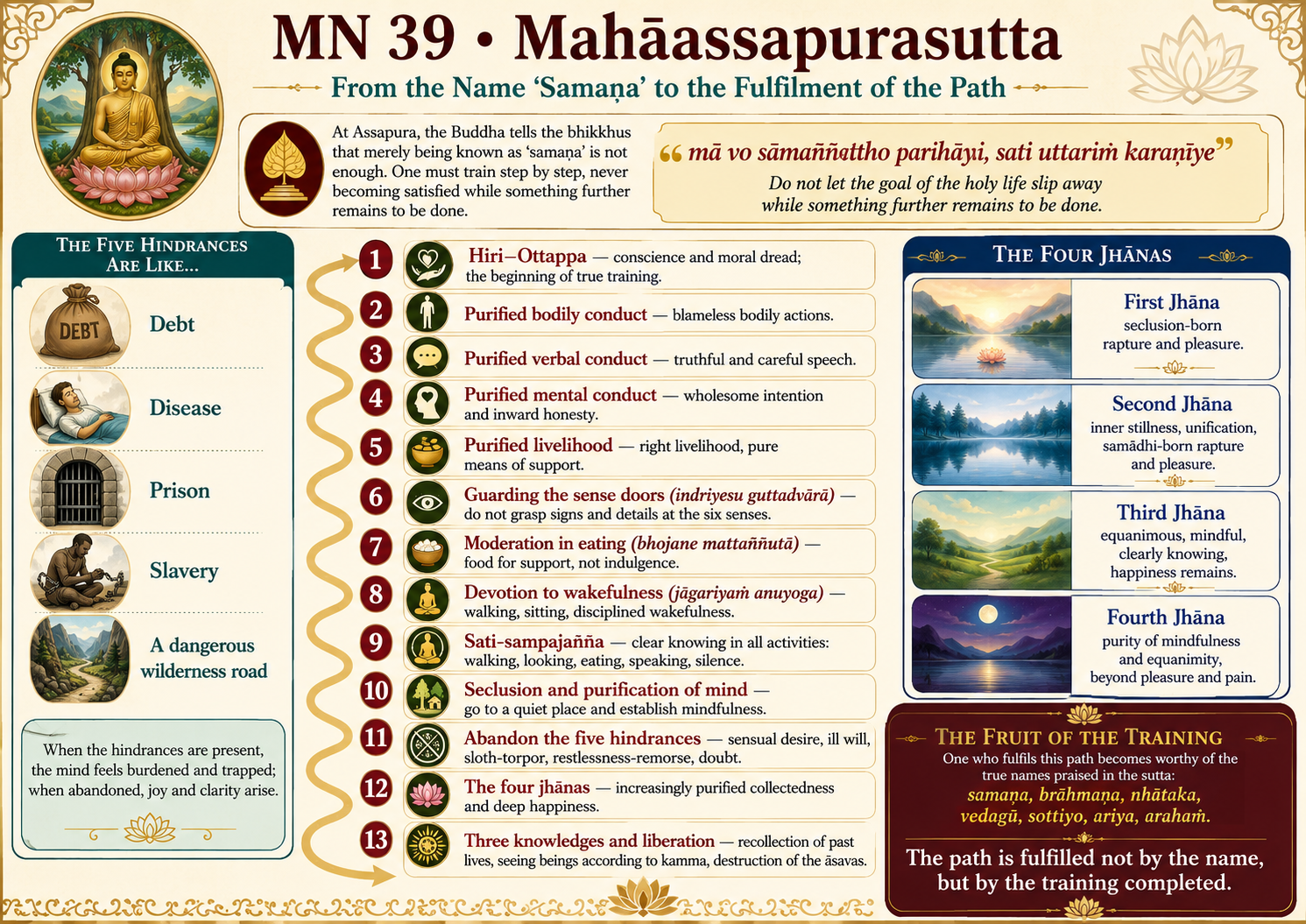 VISUAL SUMMARYSee this sutta in a pictureOpen the complete infographic for a visual overview before or after reading the full study.View infographic →
MN 39 Mahāassapurasutta is one of the clearest discourses for understanding that the Buddha’s training is sequential, cumulative, and relentlessly practical. The discourse begins with a question of authenticity: people call the bhikkhus samaṇas, and the bhikkhus themselves accept that name. The Buddha then asks what qualities would make that designation true.
The answer is not one technique and not one attainment. The sutta moves through hiri-ottappa, purified bodily conduct, purified speech, purified mental conduct, purified livelihood, guarding the sense doors, moderation in eating, devotion to wakefulness, sati-sampajañña in ordinary activity, seclusion, abandonment of the five hindrances, the four jhānas, and finally the knowledges culminating in destruction of the āsavas.
A refrain runs through the training: do not become satisfied while something further remains to be done. This is why MN 39 is especially valuable for practice. It protects the practitioner from stopping at morality, stopping at restraint, stopping at daily-life mindfulness, stopping at samādhi, or even stopping at a powerful meditative attainment. Each stage is important, but each stage must do its work within the larger path.
The translation below retains every running Pāḷi paragraph supplied in the source. The source’s editorial “Variant:” markers have been removed from the running text because they are not part of the discourse itself; the actual variant readings supplied in the file are preserved later in a textual note. The source’s own …pe… abbreviations are retained rather than silently expanded.
Purified Conduct→
Sense Restraint→
Daily Training→
Jhāna→
Āsavakkhaya
Read the sutta: MN 39 — Mahāassapurasutta
01
Setting and the Claim to Be a Samaṇa
Evaṁ me sutaṁ— ekaṁ samayaṁ bhagavā aṅgesu viharati assapuraṁ nāma aṅgānaṁ nigamo. Tatra kho bhagavā bhikkhū āmantesi: “bhikkhavo”ti.
Thus have I heard. On one occasion the Blessed One was living among the Aṅgans, at a town of the Aṅgans named Assapura. There the Blessed One addressed the bhikkhus: “Bhikkhus.”
“Bhadante”ti te bhikkhū bhagavato paccassosuṁ. Bhagavā etadavoca:
“Venerable sir,” those bhikkhus replied to the Blessed One. The Blessed One said this:
“Samaṇā samaṇāti vo, bhikkhave, jano sañjānāti. Tumhe ca pana ‘ke tumhe’ti puṭṭhā samānā ‘samaṇāmhā’ti paṭijānātha;
“People recognize you as ascetics—‘samaṇas,’ bhikkhus. And when you are asked, ‘What are you?’ you yourselves declare, ‘We are ascetics.’
tesaṁ vo, bhikkhave, evaṁsamaññānaṁ sataṁ evaṁpaṭiññānaṁ sataṁ ‘ye dhammā samaṇakaraṇā ca brāhmaṇakaraṇā ca te dhamme samādāya vattissāma, evaṁ no ayaṁ amhākaṁ samaññā ca saccā bhavissati paṭiññā ca bhūtā. Yesañca mayaṁ cīvarapiṇḍapātasenāsanagilānappaccayabhesajjaparikkhāraṁ paribhuñjāma, tesaṁ te kārā amhesu mahapphalā bhavissanti mahānisaṁsā, amhākañcevāyaṁ pabbajjā avañjhā bhavissati saphalā saudrayā’ti. Evañhi vo, bhikkhave, sikkhitabbaṁ.
“Since you bear such a designation and make such a claim, you should undertake and live by those qualities that make one an ascetic and make one a brahmin. In that way our designation will be true and our claim factual. And the gifts of those whose robes, almsfood, lodgings, medicines, and requisites for the sick we use will bring them great fruit and benefit, while our going-forth will not be barren but fruitful and productive. This is how you should train.”
02
Hiri-Ottappa and Purified Bodily Conduct
Katame ca, bhikkhave, dhammā samaṇakaraṇā ca brāhmaṇakaraṇā ca? ‘Hirottappena samannāgatā bhavissāmā’ti evañhi vo, bhikkhave, sikkhitabbaṁ. Siyā kho pana, bhikkhave, tumhākaṁ evamassa: ‘hirottappenamha samannāgatā, alamettāvatā katamettāvatā, anuppatto no sāmaññattho, natthi no kiñci uttariṁ karaṇīyan’ti tāvatakeneva tuṭṭhiṁ āpajjeyyātha. Ārocayāmi vo, bhikkhave, paṭivedayāmi vo, bhikkhave: ‘mā vo sāmaññatthikānaṁ sataṁ sāmaññattho parihāyi, sati uttariṁ karaṇīye’.
“And what, bhikkhus, are the qualities that make one an ascetic and make one a brahmin? You should train thus: ‘We will be endowed with moral shame and moral concern—hiri and ottappa.’ But you might think: ‘We are endowed with hiri and ottappa. That is enough; so much has been done. We have reached the goal of asceticism; there is nothing further for us to do,’ and you might become satisfied with just that. I tell you, bhikkhus, I make it known to you: while there is something further to be done, do not let the goal of asceticism decline for those of you who seek that goal.”
Kiñca, bhikkhave, uttariṁ karaṇīyaṁ? ‘Parisuddho no kāyasamācāro bhavissati uttāno vivaṭo na ca chiddavā saṁvuto ca. Tāya ca pana parisuddhakāyasamācāratāya nevattānukkaṁsessāma na paraṁ vambhessāmā’ti evañhi vo, bhikkhave, sikkhitabbaṁ. Siyā kho pana, bhikkhave, tumhākaṁ evamassa: ‘hirottappenamha samannāgatā, parisuddho no kāyasamācāro; alamettāvatā katamettāvatā, anuppatto no sāmaññattho, natthi no kiñci uttariṁ karaṇīyan’ti tāvatakeneva tuṭṭhiṁ āpajjeyyātha. Ārocayāmi vo, bhikkhave, paṭivedayāmi vo, bhikkhave: ‘mā vo sāmaññatthikānaṁ sataṁ sāmaññattho parihāyi, sati uttariṁ karaṇīye’.
“And what further is to be done, bhikkhus? You should train thus: ‘Our bodily conduct will be purified—plain, open, unbroken, and restrained. And because of that purified bodily conduct we will neither exalt ourselves nor disparage others.’ But you might think: ‘We are endowed with hiri and ottappa, and our bodily conduct is purified. That is enough; so much has been done. We have reached the goal of asceticism; there is nothing further for us to do,’ and you might become satisfied with just that. I tell you and make it known to you: while there is something further to be done, do not let the goal of asceticism decline.”
03
Purified Speech, Mind, and Livelihood
Kiñca, bhikkhave, uttariṁ karaṇīyaṁ? ‘Parisuddho no vacīsamācāro bhavissati uttāno vivaṭo na ca chiddavā saṁvuto ca. Tāya ca pana parisuddhavacīsamācāratāya nevattānukkaṁsessāma na paraṁ vambhessāmā’ti evañhi vo, bhikkhave, sikkhitabbaṁ. Siyā kho pana, bhikkhave, tumhākaṁ evamassa: ‘hirottappenamha samannāgatā, parisuddho no kāyasamācāro, parisuddho vacīsamācāro; alamettāvatā katamettāvatā, anuppatto no sāmaññattho, natthi no kiñci uttariṁ karaṇīyan’ti tāvatakeneva tuṭṭhiṁ āpajjeyyātha. Ārocayāmi vo, bhikkhave, paṭivedayāmi vo, bhikkhave: ‘mā vo sāmaññatthikānaṁ sataṁ sāmaññattho parihāyi, sati uttariṁ karaṇīye’. Kiñca, bhikkhave, uttariṁ karaṇīyaṁ? ‘Parisuddho no manosamācāro bhavissati uttāno vivaṭo na ca chiddavā saṁvuto ca. Tāya ca pana parisuddhamanosamācāratāya nevattānukkaṁsessāma na paraṁ vambhessāmā’ti evañhi vo, bhikkhave, sikkhitabbaṁ. Siyā kho pana, bhikkhave, tumhākaṁ evamassa: ‘hirottappenamha samannāgatā, parisuddho no kāyasamācāro, parisuddho vacīsamācāro, parisuddho manosamācāro; alamettāvatā katamettāvatā, anuppatto no sāmaññattho, natthi no kiñci uttariṁ karaṇīyan’ti tāvatakeneva tuṭṭhiṁ āpajjeyyātha. Ārocayāmi vo, bhikkhave, paṭivedayāmi vo, bhikkhave: ‘mā vo sāmaññatthikānaṁ sataṁ sāmaññattho parihāyi, sati uttariṁ karaṇīye’. Kiñca, bhikkhave, uttariṁ karaṇīyaṁ? ‘Parisuddho no ājīvo bhavissati uttāno vivaṭo na ca chiddavā saṁvuto ca. Tāya ca pana parisuddhājīvatāya nevattānukkaṁsessāma na paraṁ vambhessāmā’ti evañhi vo, bhikkhave, sikkhitabbaṁ. Siyā kho pana, bhikkhave, tumhākaṁ evamassa: ‘hirottappenamha samannāgatā, parisuddho no kāyasamācāro, parisuddho vacīsamācāro, parisuddho manosamācāro, parisuddho ājīvo; alamettāvatā katamettāvatā, anuppatto no sāmaññattho, natthi no kiñci uttariṁ karaṇīyan’ti tāvatakeneva tuṭṭhiṁ āpajjeyyātha. Ārocayāmi vo, bhikkhave, paṭivedayāmi vo, bhikkhave: ‘mā vo sāmaññatthikānaṁ sataṁ sāmaññattho parihāyi, sati uttariṁ karaṇīye’.
“And what further is to be done? You should train thus: ‘Our verbal conduct will be purified—plain, open, unbroken, and restrained. Because of that purified verbal conduct we will neither exalt ourselves nor disparage others.’ Yet you should not become satisfied merely because hiri and ottappa, bodily conduct, and verbal conduct are purified while something further remains. Again, you should train: ‘Our mental conduct will be purified—plain, open, unbroken, and restrained; and because of that we will neither exalt ourselves nor disparage others.’ Still you should not stop there. Again, you should train: ‘Our livelihood will be purified—plain, open, unbroken, and restrained; and because of that purified livelihood we will neither exalt ourselves nor disparage others.’ Even with hiri and ottappa, bodily conduct, verbal conduct, mental conduct, and livelihood purified, you should not conclude that nothing further remains. While there is something further to be done, do not let the goal of asceticism decline.”
04
Sense Restraint, Food, Wakefulness, and Sati-Sampajañña
Kiñca, bhikkhave, uttariṁ karaṇīyaṁ? ‘Indriyesu guttadvārā bhavissāma; cakkhunā rūpaṁ disvā na nimittaggāhī nānubyañjanaggāhī. Yatvādhikaraṇamenaṁ cakkhundriyaṁ asaṁvutaṁ viharantaṁ abhijjhādomanassā pāpakā akusalā dhammā anvāssaveyyuṁ, tassa saṁvarāya paṭipajjissāma, rakkhissāma cakkhundriyaṁ, cakkhundriye saṁvaraṁ āpajjissāma. Sotena saddaṁ sutvā …pe… ghānena gandhaṁ ghāyitvā …pe… jivhāya rasaṁ sāyitvā …pe… kāyena phoṭṭhabbaṁ phusitvā …pe… manasā dhammaṁ viññāya na nimittaggāhī nānubyañjanaggāhī. Yatvādhikaraṇamenaṁ manindriyaṁ asaṁvutaṁ viharantaṁ abhijjhādomanassā pāpakā akusalā dhammā anvāssaveyyuṁ, tassa saṁvarāya paṭipajjissāma, rakkhissāma manindriyaṁ, manindriye saṁvaraṁ āpajjissāmā’ti evañhi vo, bhikkhave, sikkhitabbaṁ. Siyā kho pana, bhikkhave, tumhākaṁ evamassa: ‘hirottappenamha samannāgatā, parisuddho no kāyasamācāro, parisuddho vacīsamācāro, parisuddho manosamācāro, parisuddho ājīvo, indriyesumha guttadvārā; alamettāvatā katamettāvatā, anuppatto no sāmaññattho, natthi no kiñci uttariṁ karaṇīyan’ti tāvatakeneva tuṭṭhiṁ āpajjeyyātha. Ārocayāmi vo, bhikkhave, paṭivedayāmi vo, bhikkhave: ‘mā vo sāmaññatthikānaṁ sataṁ sāmaññattho parihāyi, sati uttariṁ karaṇīye’.
“And what further is to be done? You should train thus: ‘We will guard the doors of the sense faculties. Having seen a form with the eye, we will not grasp its signs and features. Since evil unwholesome states of covetousness and distress could invade one who dwells with the eye faculty unrestrained, we will practise for its restraint; we will protect the eye faculty and undertake restraint of the eye faculty. Having heard a sound with the ear … having smelled an odor with the nose … having tasted a flavor with the tongue … having touched a tangible with the body … having cognized a dhamma with the mind, we will not grasp its signs and features. Since evil unwholesome states of covetousness and distress could invade one who dwells with the mind faculty unrestrained, we will practise for its restraint; we will protect the mind faculty and undertake restraint of the mind faculty.’ This is how you should train. Yet even when all the earlier qualities are present and the sense doors are guarded, do not become satisfied while something further remains.”
Kiñca, bhikkhave, uttariṁ karaṇīyaṁ? ‘Bhojane mattaññuno bhavissāma, paṭisaṅkhā yoniso āhāraṁ āharissāma, neva davāya na madāya na maṇḍanāya na vibhūsanāya yāvadeva imassa kāyassa ṭhitiyā yāpanāya, vihiṁsūparatiyā, brahmacariyānuggahāya, iti purāṇañca vedanaṁ paṭihaṅkhāma navañca vedanaṁ na uppādessāma, yātrā ca no bhavissati, anavajjatā ca, phāsu vihāro cā’ti evañhi vo, bhikkhave, sikkhitabbaṁ. Siyā kho pana, bhikkhave, tumhākaṁ evamassa: ‘hirottappenamha samannāgatā, parisuddho no kāyasamācāro, parisuddho vacīsamācāro, parisuddho manosamācāro, parisuddho ājīvo, indriyesumha guttadvārā, bhojane mattaññuno; alamettāvatā katamettāvatā, anuppatto no sāmaññattho, natthi no kiñci uttariṁ karaṇīyan’ti tāvatakeneva tuṭṭhiṁ āpajjeyyātha. Ārocayāmi vo, bhikkhave, paṭivedayāmi vo, bhikkhave: ‘mā vo, sāmaññatthikānaṁ sataṁ sāmaññattho parihāyi sati uttariṁ karaṇīye’.
“And what further is to be done? You should train thus: ‘We will know moderation in eating. Reflecting wisely, we will take food not for amusement, intoxication, adornment, or beautification, but only for the continuance and maintenance of this body, for ending discomfort, and for supporting the holy life, considering: “Thus I shall allay old feeling without giving rise to new feeling; I shall maintain myself, be blameless, and live in comfort.”’ This is how you should train. Yet even when the earlier qualities have been developed and you are moderate in eating, do not become satisfied while something further remains.”
Kiñca, bhikkhave, uttariṁ karaṇīyaṁ? ‘Jāgariyaṁ anuyuttā bhavissāma, divasaṁ caṅkamena nisajjāya āvaraṇīyehi dhammehi cittaṁ parisodhessāma. Rattiyā paṭhamaṁ yāmaṁ caṅkamena nisajjāya āvaraṇīyehi dhammehi cittaṁ parisodhessāma. Rattiyā majjhimaṁ yāmaṁ dakkhiṇena passena sīhaseyyaṁ kappessāma pāde pādaṁ accādhāya, sato sampajāno uṭṭhānasaññaṁ manasi karitvā. Rattiyā pacchimaṁ yāmaṁ paccuṭṭhāya caṅkamena nisajjāya āvaraṇīyehi dhammehi cittaṁ parisodhessāmā’ti, evañhi vo, bhikkhave, sikkhitabbaṁ. Siyā kho pana, bhikkhave, tumhākaṁ evamassa: ‘hirottappenamha samannāgatā, parisuddho no kāyasamācāro, parisuddho vacīsamācāro, parisuddho manosamācāro, parisuddho ājīvo, indriyesumha guttadvārā, bhojane mattaññuno, jāgariyaṁ anuyuttā; alamettāvatā katamettāvatā, anuppatto no sāmaññattho, natthi no kiñci uttariṁ karaṇīyan’ti, tāvatakeneva tuṭṭhiṁ āpajjeyyātha. Ārocayāmi vo, bhikkhave, paṭivedayāmi vo, bhikkhave: ‘mā vo, sāmaññatthikānaṁ sataṁ sāmaññattho parihāyi sati uttariṁ karaṇīye’.
“And what further is to be done? You should train thus: ‘We will be devoted to wakefulness. During the day, by walking and sitting, we will purify the mind from obstructive states. During the first watch of the night, by walking and sitting, we will purify the mind from obstructive states. During the middle watch, lying down on the right side in the lion’s posture, one foot resting on the other, we will be mindful and clearly knowing, having attended to the perception of rising. In the last watch of the night, after rising, by walking and sitting we will purify the mind from obstructive states.’ This is how you should train. Yet even with the earlier qualities and devotion to wakefulness, do not be satisfied while something further remains.”
Kiñca, bhikkhave, uttariṁ karaṇīyaṁ? ‘Satisampajaññena samannāgatā bhavissāma, abhikkante paṭikkante sampajānakārī, ālokite vilokite sampajānakārī, samiñjite pasārite sampajānakārī, saṅghāṭipattacīvaradhāraṇe sampajānakārī, asite pīte khāyite sāyite sampajānakārī, uccārapassāvakamme sampajānakārī, gate ṭhite nisinne sutte jāgarite bhāsite tuṇhībhāve sampajānakārī’ti, evañhi vo, bhikkhave, sikkhitabbaṁ. Siyā kho pana, bhikkhave, tumhākaṁ evamassa: ‘hirottappenamha samannāgatā, parisuddho no kāyasamācāro, parisuddho vacīsamācāro, parisuddho manosamācāro, parisuddho ājīvo, indriyesumha guttadvārā, bhojane mattaññuno, jāgariyaṁ anuyuttā, satisampajaññena samannāgatā; alamettāvatā katamettāvatā, anuppatto no sāmaññattho, natthi no kiñci uttariṁ karaṇīyan’ti tāvatakeneva tuṭṭhiṁ āpajjeyyātha. Ārocayāmi vo, bhikkhave, paṭivedayāmi vo, bhikkhave: ‘mā vo, sāmaññatthikānaṁ sataṁ sāmaññattho parihāyi sati uttariṁ karaṇīye’.
“And what further is to be done? You should train thus: ‘We will be endowed with sati and sampajañña. When going forward and returning we will act with clear knowing; when looking ahead and looking away, with clear knowing; when bending and stretching, with clear knowing; when wearing the outer robe and carrying the bowl and robes, with clear knowing; when eating, drinking, chewing, and tasting, with clear knowing; when urinating and defecating, with clear knowing; when walking, standing, sitting, sleeping, waking, speaking, and remaining silent, we will act with clear knowing.’ This is how you should train. Yet even when all the earlier qualities are present and you are endowed with sati-sampajañña, do not become satisfied while something further remains.”
05
Seclusion, the Five Hindrances, and the Five Similes
Kiñca, bhikkhave, uttariṁ karaṇīyaṁ? Idha, bhikkhave, bhikkhu vivittaṁ senāsanaṁ bhajati—araññaṁ rukkhamūlaṁ pabbataṁ kandaraṁ giriguhaṁ susānaṁ vanappatthaṁ abbhokāsaṁ palālapuñjaṁ.
“And what further is to be done? Here a bhikkhu resorts to a secluded lodging: a forest, the foot of a tree, a mountain, a ravine, a mountain cave, a charnel ground, a woodland thicket, the open air, or a heap of straw.”
So pacchābhattaṁ piṇḍapātapaṭikkanto nisīdati pallaṅkaṁ ābhujitvā, ujuṁ kāyaṁ paṇidhāya parimukhaṁ satiṁ upaṭṭhapetvā. So abhijjhaṁ loke pahāya vigatābhijjhena cetasā viharati, abhijjhāya cittaṁ parisodheti; byāpādapadosaṁ pahāya abyāpannacitto viharati, sabbapāṇabhūtahitānukampī, byāpādapadosā cittaṁ parisodheti; thinamiddhaṁ pahāya vigatathinamiddho viharati, ālokasaññī sato sampajāno, thinamiddhā cittaṁ parisodheti; uddhaccakukkuccaṁ pahāya anuddhato viharati, ajjhattaṁ vūpasantacitto, uddhaccakukkuccā cittaṁ parisodheti; vicikicchaṁ pahāya tiṇṇavicikiccho viharati, akathaṅkathī kusalesu dhammesu, vicikicchāya cittaṁ parisodheti.
After returning from the almsround, after the meal, he sits down, folds his legs crosswise, sets his body upright, and establishes sati before him. Abandoning covetousness for the world, he dwells with a mind free of covetousness and purifies the mind of covetousness. Abandoning ill will and hatred, he dwells with a mind free of ill will, compassionate for the welfare of all living beings, and purifies the mind of ill will and hatred. Abandoning sloth and torpor, he dwells free of sloth and torpor, perceiving light, mindful and clearly knowing, and purifies the mind of sloth and torpor. Abandoning restlessness and remorse, he dwells unagitated, inwardly peaceful, and purifies the mind of restlessness and remorse. Abandoning doubt, he dwells having crossed beyond doubt, without perplexity regarding wholesome qualities, and purifies the mind of doubt.
Seyyathāpi, bhikkhave, puriso iṇaṁ ādāya kammante payojeyya. Tassa te kammantā samijjheyyuṁ. So yāni ca porāṇāni iṇamūlāni tāni ca byantī kareyya, siyā cassa uttariṁ avasiṭṭhaṁ dārabharaṇāya. Tassa evamassa: ‘ahaṁ kho pubbe iṇaṁ ādāya kammante payojesiṁ, tassa me te kammantā samijjhiṁsu. Sohaṁ yāni ca porāṇāni iṇamūlāni tāni ca byantī akāsiṁ, atthi ca me uttariṁ avasiṭṭhaṁ dārabharaṇāyā’ti. So tatonidānaṁ labhetha pāmojjaṁ, adhigaccheyya somanassaṁ.
“Suppose, bhikkhus, a man took a loan and invested it in business. His business succeeded. He paid off his old debts and had something left over to support his family. He would reflect: ‘Formerly I borrowed money and put it into business. That business succeeded; I paid off my old debts, and I still have something left for supporting my family.’ Because of that he would gain gladness and experience joy.”
Seyyathāpi, bhikkhave, puriso ābādhiko assa dukkhito bāḷhagilāno, bhattañcassa nacchādeyya, na cassa kāye balamattā. So aparena samayena tamhā ābādhā mucceyya, bhattañcassa chādeyya, siyā cassa kāye balamattā. Tassa evamassa: ‘ahaṁ kho pubbe ābādhiko ahosiṁ dukkhito bāḷhagilāno, bhattañca me nacchādesi, na ca me āsi kāye balamattā, somhi etarahi tamhā ābādhā mutto, bhattañca me chādeti, atthi ca me kāye balamattā’ti. So tatonidānaṁ labhetha pāmojjaṁ, adhigaccheyya somanassaṁ.
“Suppose a man were sick, suffering, seriously ill, with no appetite for food and no strength in his body. Later he recovered from that illness, his appetite returned, and strength returned to his body. He would reflect: ‘Formerly I was sick, suffering, and gravely ill; food did not appeal to me and there was no strength in my body. Now I am freed from that illness; food appeals to me and strength has returned.’ Because of that he would gain gladness and experience joy.”
Seyyathāpi, bhikkhave, puriso bandhanāgāre baddho assa. So aparena samayena tamhā bandhanā mucceyya sotthinā abbhayena, na cassa kiñci bhogānaṁ vayo. Tassa evamassa: ‘ahaṁ kho pubbe bandhanāgāre baddho ahosiṁ, somhi etarahi tamhā bandhanā mutto, sotthinā abbhayena, natthi ca me kiñci bhogānaṁ vayo’ti. So tatonidānaṁ labhetha pāmojjaṁ, adhigaccheyya somanassaṁ.
“Suppose a man were imprisoned. Later he was released safely from that imprisonment, without loss of his property. He would reflect: ‘Formerly I was confined in prison. Now I have been released safely, and none of my property has been lost.’ Because of that he would gain gladness and experience joy.”
Seyyathāpi, bhikkhave, puriso dāso assa anattādhīno parādhīno na yenakāmaṅgamo. So aparena samayena tamhā dāsabyā mucceyya attādhīno aparādhīno bhujisso yenakāmaṅgamo. Tassa evamassa: ‘ahaṁ kho pubbe dāso ahosiṁ anattādhīno parādhīno na yenakāmaṅgamo, somhi etarahi tamhā dāsabyā mutto attādhīno aparādhīno bhujisso yenakāmaṅgamo’ti. So tatonidānaṁ labhetha pāmojjaṁ, adhigaccheyya somanassaṁ.
“Suppose a man were a slave, not his own master, dependent on another, unable to go where he wished. Later he was freed from slavery, his own master, independent, a free man able to go where he wished. He would reflect: ‘Formerly I was a slave, not my own master, dependent on another, unable to go where I wished. Now I am freed from slavery, my own master, independent, a free man able to go where I wish.’ Because of that he would gain gladness and experience joy.”
Seyyathāpi, bhikkhave, puriso sadhano sabhogo kantāraddhānamaggaṁ paṭipajjeyya. So aparena samayena tamhā kantārā nitthareyya sotthinā abbhayena, na cassa kiñci bhogānaṁ vayo. Tassa evamassa: ‘ahaṁ kho pubbe sadhano sabhogo kantāraddhānamaggaṁ paṭipajjiṁ. Somhi etarahi tamhā kantārā nitthiṇṇo sotthinā abbhayena, natthi ca me kiñci bhogānaṁ vayo’ti. So tatonidānaṁ labhetha pāmojjaṁ, adhigaccheyya somanassaṁ.
“Suppose a wealthy man with possessions were travelling on a dangerous desert road. Later he crossed that wilderness safely, without loss of his property. He would reflect: ‘Formerly I was travelling on a dangerous wilderness road with my wealth and possessions. Now I have crossed that wilderness safely and none of my property has been lost.’ Because of that he would gain gladness and experience joy.”
Evameva kho, bhikkhave, bhikkhu yathā iṇaṁ yathā rogaṁ yathā bandhanāgāraṁ yathā dāsabyaṁ yathā kantāraddhānamaggaṁ, ime pañca nīvaraṇe appahīne attani samanupassati. Seyyathāpi, bhikkhave, āṇaṇyaṁ yathā ārogyaṁ yathā bandhanāmokkhaṁ yathā bhujissaṁ yathā khemantabhūmiṁ; evameva bhikkhu ime pañca nīvaraṇe pahīne attani samanupassati.
“In the same way, bhikkhus, so long as these five hindrances are not abandoned within himself, a bhikkhu regards them as a debt, an illness, a prison, slavery, and a dangerous wilderness road. But when the five hindrances have been abandoned within himself, he regards that as freedom from debt, good health, release from prison, freedom from slavery, and arrival on safe ground.”
06
The First and Second Jhānas
So ime pañca nīvaraṇe pahāya cetaso upakkilese paññāya dubbalīkaraṇe, vivicceva kāmehi vivicca akusalehi dhammehi, savitakkaṁ savicāraṁ vivekajaṁ pītisukhaṁ paṭhamaṁ jhānaṁ upasampajja viharati. So imameva kāyaṁ vivekajena pītisukhena abhisandeti parisandeti paripūreti parippharati, nāssa kiñci sabbāvato kāyassa vivekajena pītisukhena apphuṭaṁ hoti. Seyyathāpi, bhikkhave, dakkho nhāpako vā nhāpakantevāsī vā kaṁsathāle nhānīyacuṇṇāni ākiritvā udakena paripphosakaṁ paripphosakaṁ sanneyya. Sāyaṁ nhānīyapiṇḍi snehānugatā snehaparetā santarabāhirā, phuṭā snehena na ca pagghariṇī.
Having abandoned these five hindrances—defilements of the mind that weaken wisdom—quite secluded from sensual pleasures and secluded from unwholesome states, he enters and dwells in the first jhāna, with vitakka and vicāra, with pīti and sukha born of seclusion. He drenches, saturates, fills, and pervades this very body with the pīti and sukha born of seclusion, so that no part of the whole body is untouched by that pīti and sukha. It is as though a skilled bath attendant or apprentice poured bath powder into a metal basin and kneaded it while sprinkling it gradually with water, until the ball of bath powder was permeated and saturated with moisture inside and out, yet did not drip.
Evameva kho, bhikkhave, bhikkhu imameva kāyaṁ vivekajena pītisukhena abhisandeti parisandeti paripūreti parippharati, nāssa kiñci sabbāvato kāyassa vivekajena pītisukhena apphuṭaṁ hoti.
“In just the same way, the bhikkhu drenches, saturates, fills, and pervades this very body with the pīti and sukha born of seclusion, so that no part of the whole body is untouched by that pīti and sukha.”
Puna caparaṁ, bhikkhave, bhikkhu vitakkavicārānaṁ vūpasamā ajjhattaṁ sampasādanaṁ cetaso ekodibhāvaṁ avitakkaṁ avicāraṁ samādhijaṁ pītisukhaṁ dutiyaṁ jhānaṁ upasampajja viharati. So imameva kāyaṁ samādhijena pītisukhena abhisandeti parisandeti paripūreti parippharati, nāssa kiñci sabbāvato kāyassa samādhijena pītisukhena apphuṭaṁ hoti. Seyyathāpi, bhikkhave, udakarahado ubbhidodako. Tassa nevassa puratthimāya disāya udakassa āyamukhaṁ, na pacchimāya disāya udakassa āyamukhaṁ, na uttarāya disāya udakassa āyamukhaṁ, na dakkhiṇāya disāya udakassa āyamukhaṁ, devo ca na kālena kālaṁ sammādhāraṁ anuppaveccheyya. Atha kho tamhāva udakarahadā sītā vāridhārā ubbhijjitvā tameva udakarahadaṁ sītena vārinā abhisandeyya parisandeyya paripūreyya paripphareyya, nāssa kiñci sabbāvato udakarahadassa sītena vārinā apphuṭaṁ assa.
“Again, with the subsiding of vitakka and vicāra, he enters and dwells in the second jhāna, with inner confidence and unification of mind, without vitakka and vicāra, with pīti and sukha born of samādhi. He drenches, saturates, fills, and pervades this very body with the pīti and sukha born of samādhi, so that no part of the whole body is untouched by it. It is as though there were a lake fed by an underground spring, with no inflow from east, west, north, or south, and no periodic rain entering it; yet a cool stream of water welling up from within the lake would drench, saturate, fill, and pervade the entire lake with cool water, so that no part of the whole lake was untouched.”
Evameva kho, bhikkhave, bhikkhu imameva kāyaṁ samādhijena pītisukhena abhisandeti parisandeti paripūreti parippharati, nāssa kiñci sabbāvato kāyassa samādhijena pītisukhena apphuṭaṁ hoti.
“In just the same way, the bhikkhu drenches, saturates, fills, and pervades this very body with the pīti and sukha born of samādhi, so that no part of the whole body is untouched by it.”
07
The Third and Fourth Jhānas
Puna caparaṁ, bhikkhave, bhikkhu pītiyā ca virāgā upekkhako ca viharati, sato ca sampajāno, sukhañca kāyena paṭisaṁvedeti, yaṁ taṁ ariyā ācikkhanti: ‘upekkhako satimā sukhavihārī’ti tatiyaṁ jhānaṁ upasampajja viharati. So imameva kāyaṁ nippītikena sukhena abhisandeti parisandeti paripūreti parippharati, nāssa kiñci sabbāvato kāyassa nippītikena sukhena apphuṭaṁ hoti. Seyyathāpi, bhikkhave, uppaliniyaṁ vā paduminiyaṁ vā puṇḍarīkiniyaṁ vā appekaccāni uppalāni vā padumāni vā puṇḍarīkāni vā udake jātāni udake saṁvaḍḍhāni udakānuggatāni antonimuggaposīni, tāni yāva caggā yāva ca mūlā sītena vārinā abhisannāni parisannāni paripūrāni paripphuṭāni, nāssa kiñci sabbāvataṁ uppalānaṁ vā padumānaṁ vā puṇḍarīkānaṁ vā sītena vārinā apphuṭaṁ assa.
“Again, with the fading of pīti, he dwells in equanimity, mindful and clearly knowing, and experiences sukha with the body. He enters and dwells in the third jhāna, of which the noble ones declare: ‘Equanimous and mindful, one dwells happily.’ He drenches, saturates, fills, and pervades this very body with sukha free from pīti, so that no part of the whole body is untouched by it. It is as though in a pond of blue, red, or white lotuses, some lotuses born and grown in the water remained submerged and nourished within the water; from their tips to their roots they would be drenched, saturated, filled, and pervaded with cool water, with no part left untouched.”
Evameva kho, bhikkhave, bhikkhu imameva kāyaṁ nippītikena sukhena abhisandeti parisandeti paripūreti parippharati, nāssa kiñci sabbāvato kāyassa nippītikena sukhena apphuṭaṁ hoti.
“In just the same way, the bhikkhu drenches, saturates, fills, and pervades this very body with sukha free from pīti, so that no part of the whole body is untouched by it.”
Puna caparaṁ, bhikkhave, bhikkhu sukhassa ca pahānā dukkhassa ca pahānā, pubbeva somanassadomanassānaṁ atthaṅgamā, adukkhamasukhaṁ upekkhāsatipārisuddhiṁ catutthaṁ jhānaṁ upasampajja viharati. So imameva kāyaṁ parisuddhena cetasā pariyodātena pharitvā nisinno hoti, nāssa kiñci sabbāvato kāyassa parisuddhena cetasā pariyodātena apphuṭaṁ hoti. Seyyathāpi, bhikkhave, puriso odātena vatthena sasīsaṁ pārupetvā nisinno assa, nāssa kiñci sabbāvato kāyassa odātena vatthena apphuṭaṁ assa.
“Again, with the abandoning of sukha and dukkha, and with the earlier disappearance of somanassa and domanassa, he enters and dwells in the fourth jhāna, which is neither painful nor pleasant and has purification of sati through equanimity. He sits pervading this very body with a purified, bright mind, so that no part of the whole body is untouched by that purified, bright mind. It is as though a man were seated covered from head downward with a white cloth, with no part of the whole body left uncovered by it.”
Evameva kho, bhikkhave, bhikkhu imameva kāyaṁ parisuddhena cetasā pariyodātena pharitvā nisinno hoti, nāssa kiñci sabbāvato kāyassa parisuddhena cetasā pariyodātena apphuṭaṁ hoti.
“In just the same way, the bhikkhu sits pervading this very body with a purified, bright mind, so that no part of the whole body is untouched by that purified, bright mind.”
08
Recollection of Past Lives and the Passing of Beings
So evaṁ samāhite citte parisuddhe pariyodāte anaṅgaṇe vigatūpakkilese mudubhūte kammaniye ṭhite āneñjappatte pubbenivāsānussatiñāṇāya cittaṁ abhininnāmeti. So anekavihitaṁ pubbenivāsaṁ anussarati, seyyathidaṁ—ekampi jātiṁ, dvepi jātiyo …pe… iti sākāraṁ sauddesaṁ anekavihitaṁ pubbenivāsaṁ anussarati. Seyyathāpi, bhikkhave, puriso sakamhā gāmā aññaṁ gāmaṁ gaccheyya, tamhāpi gāmā aññaṁ gāmaṁ gaccheyya, so tamhā gāmā sakaṁyeva gāmaṁ paccāgaccheyya. Tassa evamassa: ‘ahaṁ kho sakamhā gāmā amuṁ gāmaṁ agacchiṁ, tatrapi evaṁ aṭṭhāsiṁ evaṁ nisīdiṁ evaṁ abhāsiṁ evaṁ tuṇhī ahosiṁ; tamhāpi gāmā amuṁ gāmaṁ agacchiṁ, tatrapi evaṁ aṭṭhāsiṁ evaṁ nisīdiṁ evaṁ abhāsiṁ evaṁ tuṇhī ahosiṁ; somhi tamhā gāmā sakaṁyeva gāmaṁ paccāgato’ti.
With the mind thus collected, purified, bright, spotless, free from defilement, malleable, workable, steady, and attained to imperturbability, he directs the mind to knowledge of recollecting past lives. He recollects many kinds of past lives—one birth, two births … and so on … with their aspects and particulars. It is as though a man went from his own village to another village, from there to yet another village, and then returned to his own village. He would remember: ‘I went from my own village to that village; there I stood in such a way, sat in such a way, spoke in such a way, and remained silent in such a way. From there I went to another village, where I stood, sat, spoke, and remained silent in such a way; and then I returned to my own village.’
Evameva kho, bhikkhave, bhikkhu anekavihitaṁ pubbenivāsaṁ anussarati, seyyathidaṁ—ekampi jātiṁ dvepi jātiyo …pe… iti sākāraṁ sauddesaṁ anekavihitaṁ pubbenivāsaṁ anussarati.
“In just the same way, the bhikkhu recollects many kinds of past lives—one birth, two births … and so on … with their aspects and particulars.”
So evaṁ samāhite citte parisuddhe pariyodāte anaṅgaṇe vigatūpakkilese mudubhūte kammaniye ṭhite āneñjappatte sattānaṁ cutūpapātañāṇāya cittaṁ abhininnāmeti. So dibbena cakkhunā visuddhena atikkantamānusakena satte passati cavamāne upapajjamāne hīne paṇīte suvaṇṇe dubbaṇṇe, sugate duggate, yathākammūpage satte pajānāti …pe… seyyathāpi, bhikkhave, dve agārā sadvārā. Tattha cakkhumā puriso majjhe ṭhito passeyya manusse gehaṁ pavisantepi nikkhamantepi, anucaṅkamantepi anuvicarantepi.
With the mind thus collected, purified, bright, spotless, free from defilement, malleable, workable, steady, and attained to imperturbability, he directs the mind to knowledge of the passing away and reappearance of beings. With the purified divine eye surpassing the human, he sees beings passing away and reappearing, inferior and superior, beautiful and ugly, fortunate and unfortunate, and understands beings as faring according to their kamma … and so on. It is as though there were two houses with doors, and a person with good eyesight standing between them could see people entering and leaving the houses, walking about and moving around.
Evameva kho, bhikkhave, bhikkhu dibbena cakkhunā visuddhena atikkantamānusakena satte passati cavamāne upapajjamāne hīne paṇīte suvaṇṇe dubbaṇṇe, sugate duggate yathākammūpage satte pajānāti …pe….
“In just the same way, with the purified divine eye surpassing the human, the bhikkhu sees beings passing away and reappearing, inferior and superior, beautiful and ugly, fortunate and unfortunate, and understands beings as faring according to their kamma … and so on.”
09
Knowledge of the Destruction of the Āsavas
So evaṁ samāhite citte parisuddhe pariyodāte anaṅgaṇe vigatūpakkilese mudubhūte kammaniye ṭhite āneñjappatte āsavānaṁ khayañāṇāya cittaṁ abhininnāmeti. So ‘idaṁ dukkhan’ti yathābhūtaṁ pajānāti, ‘ayaṁ dukkhasamudayo’ti yathābhūtaṁ pajānāti, ‘ayaṁ dukkhanirodho’ti yathābhūtaṁ pajānāti, ‘ayaṁ dukkhanirodhagāminī paṭipadā’ti yathābhūtaṁ pajānāti. ‘Ime āsavā’ti yathābhūtaṁ pajānāti, ‘ayaṁ āsavasamudayo’ti yathābhūtaṁ pajānāti, ‘ayaṁ āsavanirodho’ti yathābhūtaṁ pajānāti, ‘ayaṁ āsavanirodhagāminī paṭipadā’ti yathābhūtaṁ pajānāti. Tassa evaṁ jānato evaṁ passato kāmāsavāpi cittaṁ vimuccati, bhavāsavāpi cittaṁ vimuccati, avijjāsavāpi cittaṁ vimuccati. Vimuttasmiṁ vimuttamiti ñāṇaṁ hoti: ‘khīṇā jāti, vusitaṁ brahmacariyaṁ, kataṁ karaṇīyaṁ, nāparaṁ itthattāyā’ti pajānāti.
With the mind thus collected, purified, bright, spotless, free from defilement, malleable, workable, steady, and attained to imperturbability, he directs the mind to knowledge of the destruction of the āsavas. He knows as it really is: ‘This is dukkha’; ‘This is the origin of dukkha’; ‘This is the cessation of dukkha’; ‘This is the path leading to the cessation of dukkha.’ He knows as it really is: ‘These are the āsavas’; ‘This is the origin of the āsavas’; ‘This is the cessation of the āsavas’; ‘This is the path leading to the cessation of the āsavas.’ For one who knows and sees in this way, the mind is liberated from the āsava of sensuality, from the āsava of becoming, and from the āsava of ignorance. When liberated, there is the knowledge, ‘Liberated.’ He understands: ‘Birth is exhausted; the holy life has been lived; what had to be done has been done; there is no further coming to any state of being.’
Seyyathāpi, bhikkhave, pabbatasaṅkhepe udakarahado accho vippasanno anāvilo. Tattha cakkhumā puriso tīre ṭhito passeyya sippisambukampi sakkharakathalampi macchagumbampi, carantampi tiṭṭhantampi. Tassa evamassa: ‘ayaṁ kho udakarahado accho vippasanno anāvilo. Tatrime sippisambukāpi sakkharakathalāpi macchagumbāpi carantipi tiṭṭhantipī’ti’.
“It is as though there were a clear, limpid, unclouded lake in a mountain hollow. A person with good eyesight standing on the bank would see shells and gravel, pebbles and shoals of fish, moving and standing still. He would know: ‘This lake is clear, limpid, and unclouded; here are shells, gravel, pebbles, and shoals of fish, moving and standing still.’”
Evameva kho, bhikkhave, bhikkhu ‘idaṁ dukkhan’ti yathābhūtaṁ pajānāti …pe… nāparaṁ itthattāyāti pajānāti.
“In just the same way, the bhikkhu knows as it really is, ‘This is dukkha’ … and so on … and understands, ‘There is no further coming to any state of being.’”
10
When the Religious Titles Become True
Ayaṁ vuccati, bhikkhave, bhikkhu ‘samaṇo’ itipi ‘brāhmaṇo’itipi ‘nhātako’itipi ‘vedagū’itipi ‘sottiyo’itipi ‘ariyo’itipi ‘arahaṁ’itipi.
“This bhikkhu is called an ‘ascetic’—samaṇa—and also a ‘brahmin,’ a ‘bathed one,’ a ‘knower,’ a ‘learned one,’ a ‘noble one,’ and an ‘arahant.’”
Kathañca, bhikkhave, bhikkhu samaṇo hoti? Samitāssa honti pāpakā akusalā dhammā, saṅkilesikā, ponobbhavikā, sadarā, dukkhavipākā, āyatiṁ, jātijarāmaraṇiyā. Evaṁ kho, bhikkhave, bhikkhu samaṇo hoti.
“And how is a bhikkhu an ascetic? In him evil unwholesome qualities—defiling, productive of renewed existence, troublesome, resulting in suffering, and leading in the future to birth, aging, and death—have been pacified. In this way a bhikkhu is an ascetic.”
Kathañca, bhikkhave, bhikkhu brāhmaṇo hoti? Bāhitāssa honti pāpakā akusalā dhammā, saṅkilesikā, ponobbhavikā, sadarā, dukkhavipākā, āyatiṁ, jātijarāmaraṇiyā. Evaṁ kho, bhikkhave, bhikkhu brāhmaṇo hoti.
“And how is a bhikkhu a brahmin? In him evil unwholesome qualities—defiling, productive of renewed existence, troublesome, resulting in suffering, and leading in the future to birth, aging, and death—have been removed. In this way a bhikkhu is a brahmin.”
Kathañca, bhikkhave, bhikkhu nhātako hoti? Nhātāssa honti pāpakā akusalā dhammā, saṅkilesikā, ponobbhavikā, sadarā, dukkhavipākā, āyatiṁ, jātijarāmaraṇiyā. Evaṁ kho, bhikkhave, bhikkhu nhātako hoti.
“And how is a bhikkhu a ‘bathed one’—nhātaka? In him evil unwholesome qualities—defiling, productive of renewed existence, troublesome, resulting in suffering, and leading in the future to birth, aging, and death—have been washed away. In this way a bhikkhu is a bathed one.”
Kathañca, bhikkhave, bhikkhu vedagū hoti? Viditāssa honti pāpakā akusalā dhammā, saṅkilesikā, ponobbhavikā, sadarā, dukkhavipākā, āyatiṁ, jātijarāmaraṇiyā. Evaṁ kho, bhikkhave, bhikkhu vedagū hoti.
“And how is a bhikkhu a vedagū, a knower? In him evil unwholesome qualities—defiling, productive of renewed existence, troublesome, resulting in suffering, and leading in the future to birth, aging, and death—have been known. In this way a bhikkhu is a vedagū.”
Kathañca, bhikkhave, bhikkhu sottiyo hoti? Nissutāssa honti pāpakā akusalā dhammā, saṅkilesikā, ponobbhavikā, sadarā, dukkhavipākā, āyatiṁ, jātijarāmaraṇiyā. Evaṁ kho, bhikkhave, bhikkhu sottiyo hoti.
“And how is a bhikkhu a sottiya? In him evil unwholesome qualities—defiling, productive of renewed existence, troublesome, resulting in suffering, and leading in the future to birth, aging, and death—have flowed out and been discharged. In this way a bhikkhu is a sottiya.”
Kathañca, bhikkhave, bhikkhu ariyo hoti? Ārakāssa honti pāpakā akusalā dhammā, saṅkilesikā, ponobbhavikā, sadarā, dukkhavipākā, āyatiṁ, jātijarāmaraṇiyā. Evaṁ kho, bhikkhave, bhikkhu ariyo hoti.
“And how is a bhikkhu noble—ariya? Evil unwholesome qualities—defiling, productive of renewed existence, troublesome, resulting in suffering, and leading in the future to birth, aging, and death—are far from him. In this way a bhikkhu is noble.”
Kathañca, bhikkhave, bhikkhu arahaṁ hoti? Ārakāssa honti pāpakā akusalā dhammā, saṅkilesikā, ponobbhavikā, sadarā, dukkhavipākā, āyatiṁ, jātijarāmaraṇiyā. Evaṁ kho, bhikkhave, bhikkhu arahaṁ hotī”ti.
“And how is a bhikkhu an arahant? Evil unwholesome qualities—defiling, productive of renewed existence, troublesome, resulting in suffering, and leading in the future to birth, aging, and death—are far from him. In this way a bhikkhu is an arahant.”
Idamavoca bhagavā. Attamanā te bhikkhū bhagavato bhāsitaṁ abhinandunti.
This is what the Blessed One said. Satisfied, the bhikkhus delighted in the Blessed One’s words.
**Mahāassapurasuttaṁ niṭṭhitaṁ navamaṁ. **
The Mahāassapurasutta, the ninth discourse, is finished.
Textual variants retained from the supplied source: samijjheyyuṁ → sampajjeyyuṁ (sya-all, km, mr); byantī → byanti (cck, pts1ed), byantiṁ (mr); abbhayena → abyayena (bj, pts1ed), abhayena (sya-all); nhānīyacuṇṇāni → nahānīyacuṇṇāni (bj), nahāniyacuṇṇāni (pts1ed); nhāpako → nahāpako (bj, pts1ed); ubbhidodako → ubbhitodako (mr); nāssa → na nesaṁ (bj); agacchiṁ → agañchiṁ (bj, sya-all, km), āgañchiṁ (si, pts1ed); agārā sadvārā → sannadvārā (mr); nhātako → nahātako (bj, km, pts1ed).
The running translation follows the base reading in the supplied text. The source’s own …pe… abbreviations have been preserved rather than silently expanded.
01
The Refrain That Governs the Whole Sutta: Do Not Stop Too Early
The central pulse of MN 39 is not a meditation technique but a repeated warning against premature satisfaction. Again and again the Buddha allows a genuine attainment in training to stand—hiri-ottappa, purified bodily conduct, purified speech, purified mind, purified livelihood, guarded sense doors, moderation in eating, wakefulness, sati-sampajañña—and then asks, “What further is to be done?” The refrain is sati uttariṁ karaṇīye: while there is something further to be done. This is the structural key to the entire discourse.
The point is subtle. The Buddha is not dismissing the earlier stage once a later one appears. Hiri and ottappa are not abandoned when bodily conduct is purified; bodily purity is not abandoned when sense restraint begins; sense restraint is not discarded when jhāna develops. Each earlier training becomes a condition carried into the next. The path is cumulative. What the Buddha rejects is the mind’s tendency to convert partial improvement into a final identity: “I am disciplined now,” “I have good sīla,” “I can meditate,” “I have jhāna,” “I understand the Dhamma.”
For practice this means that every genuine development should produce gratitude and steadiness, but not complacency. A person may have stopped coarse misconduct yet still be repeatedly captured at the eye-door. Another may guard the senses but eat for stimulation. Another may be moderate in food yet live in dullness and heedlessness. Another may sit for long periods but carry unexamined anger throughout the day. MN 39 refuses to allow one good area of practice to hide the unfinished work in another.
The refrain is therefore not pressure to become neurotically dissatisfied. It is a protection against false completion. One learns to ask quietly: “What has actually been trained? What remains untrained? What still produces greed, aversion, confusion, clinging, and renewed becoming?” The answer determines the next work.
02
Hiri and Ottappa: The Moral Intelligence That Makes Training Possible
MN 39 begins the qualities that make one truly worthy of the name samaṇa with hiri-ottappa. Hiri is the inward reluctance to do what is ignoble; ottappa is the recognition of the danger, consequence, and blameworthiness of unwholesome action. Together they create a mind that is trainable because it no longer asks only, “Can I get away with this?” It asks, “What kind of action is this, what does it do to the mind, and where does it lead?”
This is why hiri-ottappa comes before the detailed purification of body, speech, mind, and livelihood. Rules can restrain a person externally, but hiri-ottappa begins to make restraint inwardly intelligent. If a person avoids lying only because another person might discover it, the restraint is fragile. If the mind itself recognizes false speech as degrading and dangerous, a deeper basis for purity has appeared.
Yet the Buddha immediately refuses to let even hiri-ottappa become a badge. The practitioner is told not to think, “This is enough; the ascetic goal has been reached.” Moral sensitivity is the beginning of the architecture, not its completion. It must mature into actual conduct, actual restraint at the senses, actual moderation, actual wakefulness, and actual purification of the mind.
In worldly life this can be tested without ceremony. Before sending a harsh message, exaggerating a story, manipulating a colleague, hiding a financial fact, or consuming something one knows repeatedly inflames the mind, hiri-ottappa can appear as a moment of intelligent restraint. The important question is whether that moment is respected or overridden.
03
Purity of Body, Speech, Mind, and Livelihood—and the Trap of Conceit
The next stages are striking because the Buddha couples purification with an explicit warning: do not exalt yourself and do not disparage others. Purified bodily conduct can become fuel for conceit: “I keep more precepts than they do.” Purified speech can become another identity: “I never speak like those people.” Even a clean livelihood can become a platform from which others are judged.
MN 39 therefore guards the training from a common corruption. A wholesome quality can be appropriated by māna. The act itself may be good, yet the mind builds “I am better” around it. This is especially easy in spiritual communities, where visible discipline, diet, clothing, silence, retreat history, doctrinal knowledge, or meditation ability can become status markers.
The sutta’s order also matters. Bodily conduct, verbal conduct, mental conduct, and livelihood are not side issues before the “real meditation” begins. They condition the texture of the mind that later sits in seclusion. If a person has lied all day, acted aggressively, manipulated others, or earned a living through conduct he knows is harmful, the meditation seat receives that residue. Remorse, self-justification, fear, and agitation do not disappear because the eyes are closed.
The practical training is therefore double: purify the conduct, and refuse to turn purity into superiority. One can be firm about standards without converting those standards into self-celebration or contempt.
04
Indriya-Saṁvara: Training at the Point Where the World Enters
Sense restraint is one of the most practical stages in MN 39. The Buddha does not say that forms, sounds, odors, tastes, touches, and mental objects must cease. He trains the practitioner in what happens after contact. Having seen a form, one does not grasp its sign and details in a way that allows covetousness and distress, evil unwholesome states, to flood the mind.
This is not sensory blindness. A person can see accurately while refusing to feed the extra movement that turns seeing into acquisition, fantasy, resentment, comparison, or identity. The distinction becomes vivid in modern digital life. A single image can be seen in a fraction of a second. The problem is often not the first visual contact but what the mind deliberately does next: zooming in, replaying, searching for more, comparing bodies, constructing desire, or generating aversion.
The inclusion of the mind faculty is especially important. Even after the phone is put down and the room is silent, remembered images, plans, arguments, and fantasies can be taken up as mental objects. Sense restraint therefore cannot be reduced to avoiding external stimulation. The mind-door itself must be guarded.
This stage explains why MN 39 places sense restraint before seclusion and jhāna. If the six doors are continuously feeding the hindrances, formal meditation begins with a mind already saturated by the very material it must later abandon. Indriya-saṁvara is preventive meditation in daily life.
05
Food, Wakefulness, and Sati-Sampajañña: The Bridge Between Sīla and Samādhi
The movement from sense restraint to moderation in eating, wakefulness, and sati-sampajañña shows how concrete the Buddha’s training is. These are not ornamental lifestyle recommendations. They determine whether the mind becomes light, guarded, clear, and available for seclusion.
Moderation in eating trains the difference between bodily requirement and sensual continuation. The formula is not anti-food; it gives food a purpose. One eats for the maintenance of the body, for ending discomfort, for supporting the holy life, and for blameless ease. This is a profound training in vedanā because pleasant taste can continue to solicit another bite long after bodily need has been met.
Jāgariyānuyoga is equally practical. It is not a contest in sleep deprivation. The sutta presents active management of wakefulness: walking and sitting to purify the mind from obstructive states, lying down mindfully in the middle watch, and rising with an intention to wake. The training concerns clarity and the deliberate handling of dullness, not self-punishment.
Then comes sati-sampajañña in ordinary activity. Going forward, returning, looking, bending, stretching, eating, drinking, using the toilet, walking, standing, sitting, sleeping, waking, speaking, and silence all belong to the training. This makes an important point: the mind does not become ready for samādhi only during formal sitting. The whole day conditions the mind that later enters seclusion.
06
The Five Hindrances Are Not Minor Distractions
MN 39’s five similes deserve to be felt rather than merely memorized. Unabandoned hindrances are compared to debt, illness, imprisonment, slavery, and a dangerous wilderness journey. These are not images for mild inconvenience. They convey loss of freedom.
Sensual desire resembles debt because the mind keeps owing satisfaction to the next object. Ill will resembles illness because it distorts the whole field of experience and makes nourishment itself difficult to receive. Sloth and torpor resemble confinement because vitality and choice shrink. Restlessness and remorse resemble slavery because the mind is driven by impulses and unfinished concerns. Doubt resembles a dangerous road because one cannot settle on the direction of travel. The exact one-to-one mapping of each simile to each hindrance is less important than the sutta’s collective force: an obstructed mind is not free.
When the hindrances are abandoned, the corresponding images are freedom from debt, health, release from prison, emancipation, and arrival on safe ground. This explains the gladness that precedes jhāna. The joy is not manufactured by positive thinking. It is the relief of a mind no longer being continuously commandeered by obstruction.
In practice, therefore, a hindrance should not be treated as a personal failure—“I am a bad meditator”—but as a condition to be understood and abandoned. What fed it? What keeps it present? What happens when the fuel is removed? This diagnostic attitude is much closer to the sutta than self-condemnation.
07
Jhāna in MN 39: Whole-Body Transformation After the Hindrances Are Abandoned
The four jhānas in MN 39 arrive only after the gradual training and the explicit abandonment of the five hindrances. This order protects jhāna from being reduced to a technique isolated from conduct and daily life. The mind entering jhāna has been prepared by hiri-ottappa, purified conduct, restraint, moderation, wakefulness, sati-sampajañña, seclusion, and hindrance abandonment.
The similes then emphasize pervasion. In the first jhāna, pīti-sukha born of seclusion saturates the body like water kneaded evenly through bath powder. In the second, pīti-sukha born of samādhi fills the body like cool spring water welling up through a lake. In the third, sukha without pīti saturates the body like lotuses immersed and nourished in cool water. In the fourth, the purified bright mind pervades the body like a white cloth covering a person from head downward.
These images should caution against imagining jhāna merely as narrow fixation. The text repeatedly describes the whole body as pervaded. The qualities also develop in sequence: seclusion-born pīti-sukha; then internal unification and samādhi-born pīti-sukha as vitakka-vicāra settle; then equanimity, sati, sampajañña, and sukha after pīti fades; then neither-pain-nor-pleasure with upekkhāsatipārisuddhi.
Most importantly, the sutta does not stop at jhāna. The repeated warning of the earlier stages still governs the discourse. Jhāna prepares a mind described as purified, bright, spotless, malleable, workable, steady, and imperturbable. That mind is then directed to knowledge. A beautiful state is therefore not the final purpose; it is a powerful condition for seeing.
08
The Three Knowledges: Samādhi Must Mature Into Yathābhūta Knowing
After the fourth jhāna the sutta changes emphasis. The mind that has become collected, purified, bright, malleable, workable, steady, and imperturbable is directed first to recollection of past lives, then to knowledge of beings passing away and reappearing according to kamma, and finally to knowledge of the destruction of the āsavas.
The first two knowledges enlarge the temporal and karmic horizon. Existence is no longer viewed as one isolated biography. The third knowledge, however, is the decisive liberating knowledge. The practitioner knows dukkha, its origin, its cessation, and the path leading to cessation; and likewise knows the āsavas, their origin, their cessation, and the path to their cessation.
This is where the whole training reveals its purpose. The mind is not purified merely to become calm, pleasant, unusual, or powerful. It is purified so that things can be known yathābhūtaṁ—as they really are. The clear-lake simile expresses this: when water is clear and unclouded, what is present can be seen directly.
Liberation is then stated in uncompromising terms: release from the āsava of sensuality, becoming, and ignorance; knowledge of release; birth exhausted; the holy life lived; what had to be done done. This is the point at which the repeated “there is something further to do” finally reaches its natural end.
09
What Makes a Samaṇa, Brāhmaṇa, Ariya, or Arahant?
The closing wordplay is not decorative. The Buddha takes socially and religiously powerful titles—samaṇa, brāhmaṇa, nhātaka, vedagū, sottiya, ariya, arahant—and roots their meaning in what has happened to unwholesome states. The true title is not secured by costume, birth, institutional identity, reputation, or self-description.
At the beginning of the discourse people call the bhikkhus samaṇas, and the bhikkhus themselves make that claim. At the end the Buddha shows what would make such a designation true. Evil unwholesome qualities that are defiling, productive of renewed existence, troublesome, suffering in result, and productive of future birth-aging-death have been pacified, removed, washed away, known, discharged, and made far.
This creates a powerful frame around the whole sutta. It begins with a name and ends with the reality that can justify the name. Everything in between is the training required so that religious identity becomes truth rather than costume.
For any practitioner this is sobering. The question is not primarily, “What do I call myself?” but “What has actually been abandoned? What no longer governs conduct? What has been penetrated? What still produces renewed becoming?” The Buddha’s criterion is transformation, not self-description.
Useful cross-references:
MN 107 — Gaṇakamoggallānasutta
•
MN 10 — Satipaṭṭhānasutta
•
AN 4.41 — Samādhibhāvanāsutta
01
The Job Title and the Actual Person
A useful worldly parallel to the opening of MN 39 is professional identity. Imagine someone whose email signature says “Head of Ethics and Compliance.” Colleagues recognize that title and the person introduces himself by it. Yet the truth of the title is tested not by the signature but by what happens when a profitable shortcut, a conflict of interest, or an uncomfortable disclosure appears. If he hides facts, pressures subordinates, or manipulates a report, the name remains while the quality that should justify it has disappeared.
MN 39 begins in precisely this diagnostic spirit. People call the bhikkhus samaṇas; they themselves make the same claim. The Buddha does not argue about vocabulary. He asks whether the qualities that make a samaṇa are actually being lived. For a lay practitioner, the lesson generalizes: “Buddhist,” “meditator,” “teacher,” “ethical person,” or “serious practitioner” are useful descriptions only to the extent that conduct, restraint, and understanding support them.
The practical benefit of seeing this is humility. One can stop defending an identity and return to training. Instead of asking, “How could I behave like this when I am a meditator?” one asks, “Which part of the training was absent here? Was hiri-ottappa overridden? Was the sense door unguarded? Was speech driven by dosa? Is there something further to be done?” That question restores movement.
02
The Smartphone as a Six-Door Training Ground
A smartphone compresses many of the conditions of sense restraint into one small device. The eye sees images, the ear hears voices and music, the mind receives messages, memories, plans, praise, blame, political anger, sensual material, commercial desire, and social comparison. It is therefore possible to sit in formal meditation for an hour and then feed the hindrances aggressively for the next three hours without recognizing the contradiction.
Suppose a person opens a news app intending to check one necessary item. A provocative headline appears. Unpleasant vedanā follows. Saññā classifies a public figure as foolish or dangerous. Vitakka begins. The thumb moves to another article, then comments, then a video. Twenty minutes later the body is still in the chair, but the mind has travelled through irritation, fear, superiority, and restlessness. Nothing dramatic happened externally. The sense door was simply left unguarded.
Indriya-saṁvara does not require throwing away all technology. It requires noticing where useful contact becomes deliberate feeding. One can read what is needed, know the effect on citta, and stop before the mind starts extracting repeated stimulation from the object. The training becomes especially clear at the moment of “one more”: one more clip, one more photograph, one more comment, one more argument. That moment shows whether the eye-door and mind-door are being protected.
03
Eating Until the Body Is Satisfied—or Until Desire Is Satisfied?
MN 39’s food reflection becomes very concrete at an ordinary meal. Hunger before eating may be a genuine bodily discomfort. As food is taken, that discomfort diminishes. But pleasant taste can become stronger precisely when the original bodily need is disappearing. This is the point where bodily requirement and sensual continuation separate.
Imagine a meal in which the body is already comfortable after one serving. A favorite dessert appears. Nothing is wrong with recognizing pleasant taste. The question is what follows. Does the mind silently redefine “need” so that desire can continue? Does it eat because the body requires support or because the tongue has discovered a pleasant object? The training in mattaññutā allows that difference to become visible without turning food into guilt.
The same principle applies to very refined diets. A person can eat simple vegetarian food and still be intensely preoccupied with taste, timing, purity, identity, and superiority. Moderation is not secured by a menu label. It is tested in the relationship between body, vedanā, craving, purpose, and measure.
04
Criticism at Work: From Vedanā to Speech
Suppose a colleague writes, “This report is incomplete and cannot be used.” The first reading produces unpleasant vedanā. Saññā may immediately interpret the sentence not as feedback about a report but as disrespect toward “me.” Vitakka begins: “He always undermines me. I should copy his manager. I will show him what incomplete work looks like.” The fingers move toward the keyboard.
This single episode can activate several stages of MN 39 at once. Hiri-ottappa asks whether the intended reply is worthy. Purified verbal conduct asks whether the words are truthful, useful, timely, and free from the desire to injure. Purified mental conduct asks what dosa is doing. Sense restraint asks whether the mind is grasping the phrase “cannot be used” and replaying it. Sati-sampajañña asks whether the bodily tension, unpleasant feeling, interpretation, and impulse to speak are known.
A skillful response does not mean passivity. The report may genuinely require correction; the colleague may genuinely have communicated poorly; a firm reply may be appropriate. The training changes the source from which the response comes. Instead of retaliating to relieve unpleasant vedanā, one can answer the actual issue. This is how moral training and clear knowing improve worldly effectiveness rather than weaken it.
05
Afternoon Dullness and the Misunderstanding of Wakefulness
A common modern response to post-lunch dullness is stimulation: coffee, sugar, social media, chatter, or an entertaining video. Sometimes the body truly needs rest, but often the mind has learned that every dip in energy should be covered immediately by a more exciting object. MN 39’s jāgariyānuyoga offers a different intelligence.
The practitioner first knows the condition accurately. Is the body exhausted because sleep was insufficient? Is the stomach heavy because food was excessive? Is the mind dull because it has been staring at a screen for hours? Would walking restore clarity? Would washing the face, standing, opening the posture, or a short period of quiet sitting help? Wakefulness here means managing causes and conditions, not forcing the body through exhaustion.
This is also why the sequence matters. Moderation in eating comes before devotion to wakefulness. If one overeats and then tries to defeat the resulting heaviness by willpower, one is fighting downstream. The gradual training repeatedly works upstream: change the conditions that feed the problem.
06
The Meditator Who Stops at a Pleasant State
A practitioner may have a powerful retreat. The mind becomes quiet, pīti spreads through the body, thought subsides, and a degree of samādhi appears that was previously unknown. The experience is important. The danger begins when the mind converts it into completion: “Now I understand meditation. I have attained. I no longer need these basic instructions about restraint, food, speech, or daily-life awareness.”
MN 39 is almost designed to prevent this error. Every earlier stage contains the warning not to become satisfied while further work remains, and the sutta itself continues beyond the four jhānas. Even a deeply purified and imperturbable mind is directed onward to knowledge, culminating in yathābhūta understanding of the Four Noble Truths and the āsavas.
The worldly sign of correct development is therefore not the story one tells about an attainment. It is whether greed, aversion, confusion, conceit, heedlessness, and appropriation are actually weakening. A pleasant state can be a powerful condition for liberation, but only if it is not recruited into “me” and “mine.”
MN 39 should not be read as though each stage disappears once the next one begins. The training accumulates. Earlier qualities become the conditions that make the later ones possible. This table is therefore a diagnostic map rather than a checklist for spiritual status.
Restrain→
Purify→
Abandon Hindrances→
Collect the Mind→
Know as It Really Is
For householders: some external forms in MN 39 are monastic, such as robes, almsround, and secluded lodgings. The underlying trainings—hiri-ottappa, clean conduct, sense restraint, moderation, wakefulness, sati-sampajañña, hindrance abandonment, samādhi, and paññā—can still be understood and cultivated according to one’s circumstances without pretending that lay life and monastic life are identical.
MN 39 begins with a name—samaṇa—and asks what would make that name true. It ends by returning to names such as samaṇa, brāhmaṇa, ariya, and arahant, but by then the criterion has changed completely. A title is true only when the qualities that justify it have actually been developed and the defiling states productive of renewed existence have been pacified, removed, known, discharged, and made far.
The middle of the discourse is the path between those two points. Hiri-ottappa becomes purified conduct. Purified conduct is protected by sense restraint. Sense restraint is supported by moderation in food and wakefulness. Sati-sampajañña carries the training into ordinary activities. Seclusion allows the five hindrances to be abandoned. Their disappearance produces the relief compared to freedom from debt, health after illness, release from prison, emancipation from slavery, and safety after a dangerous journey. Jhāna then develops in a mind that has been prepared rather than mechanically forced.
But even jhāna is not the endpoint. The purified, bright, malleable, workable, steady mind is directed to knowledge, and the liberating culmination is explicit: dukkha is known, its origin is known, cessation is known, and the path is known; the āsavas are known in the same fourfold structure; the mind is liberated; birth is exhausted.
For practice, the most important refrain may therefore be the simplest: sati uttariṁ karaṇīye—while something further remains to be done. The phrase does not demand restless striving. It demands honesty. Do not mistake a useful stage for the finished task. Do not use morality to hide sense-indulgence, samādhi to hide conceit, learning to hide aversion, or religious identity to hide what has not yet been abandoned.
The sutta’s final measure is transformation. What has become blameless? What is guarded? What no longer floods the mind? What hindrance has lost its fuel? What can now be known because the mind is collected? And finally: what has been ended so completely that there is nothing further to be done?
While something further remains to be done, the task is not to defend an identity or an attainment. It is to continue the training until the qualities that produce renewed becoming are understood and ended.