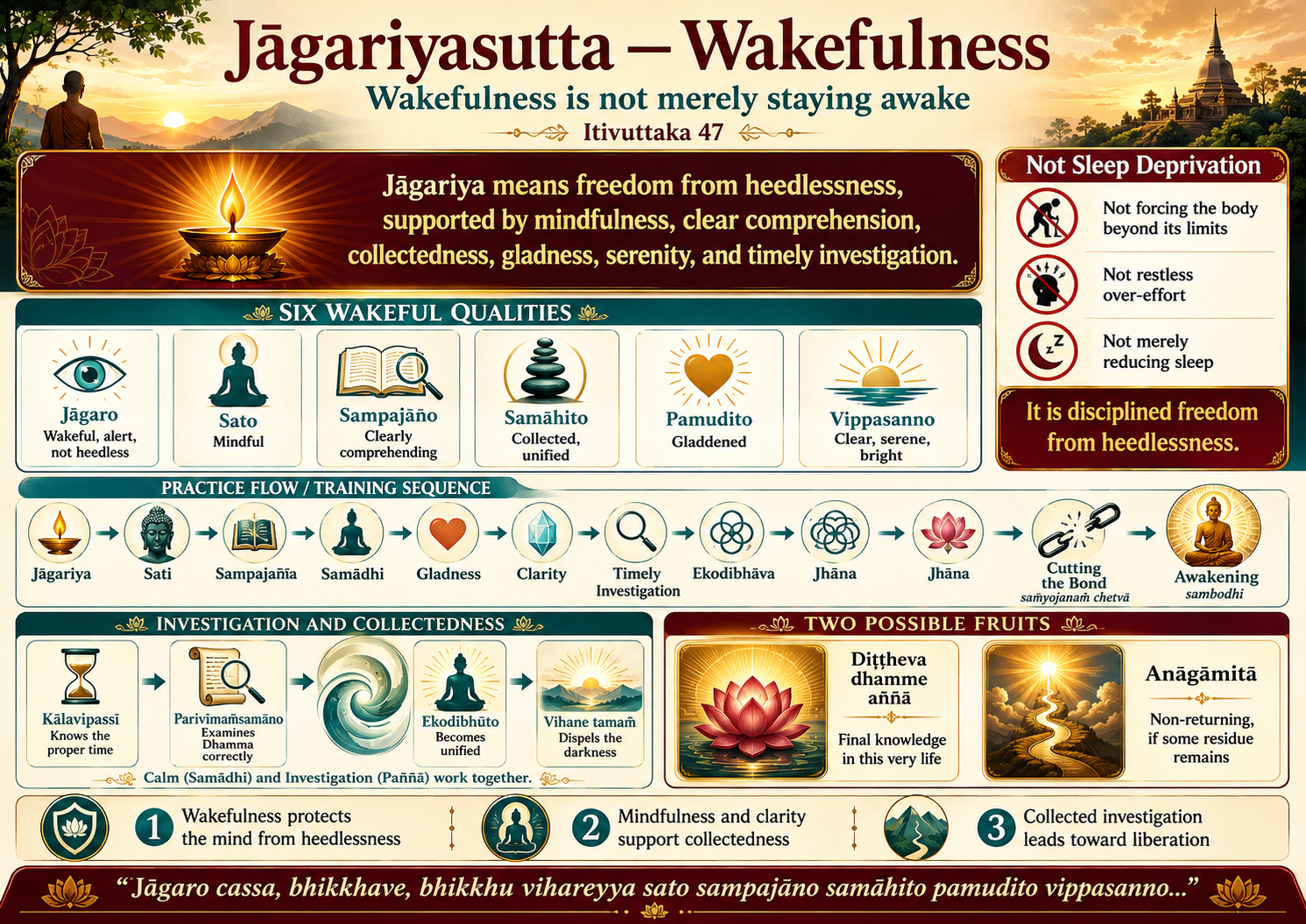
 VISUAL SUMMARYSee this study in a pictureOpen the complete infographic for a visual overview before or after reading the full study.View infographic →
0101 The Buddha’s Teaching on WakefulnessThe teaching begins with jāgaro—wakeful. But the Buddha immediately shows that wakefulness is not merely remaining physically awake. A person may be awake …
Vuttañhetaṁ bhagavatā vuttamarahatāti me sutaṁ:
“Jāgaro cassa, bhikkhave, bhikkhu vihareyya sato sampajāno samāhito pamudito vippasanno ca tattha kālavipassī ca kusalesu dhammesu.”
This was said by the Blessed One, said by the Arahant; thus I have heard:
“Bhikkhus, a bhikkhu should dwell wakeful, mindful, clearly comprehending, composed, joyful, and serene; and in regard to wholesome qualities he should discern the appropriate time for insight and examination.”
The teaching begins with jāgaro—wakeful. But the Buddha immediately shows that wakefulness is not merely remaining physically awake. A person may be awake while distracted, agitated, dull, or absorbed in sensuality. Here jāgariya is a trained state supported by a complete group of qualities.
Sato means that sati is established: the practitioner remembers the training and does not lose the frame of practice.
Sampajāno means clearly comprehending what is occurring and what one is doing. Wakefulness without sampajañña can become mere restlessness; sati and sampajañña make wakefulness purposeful.
Samāhito indicates a collected, settled mind. Thus jāgariya is not associated with strain or nervous activation. It functions together with samādhi.
Pamudito means gladdened or joyful. Practice is not meant to become grim, forced, or emotionally contracted.
Vippasanno means clear, serene, bright, or purified in disposition. The mind is not only collected but lucid.
Kālavipassī kusalesu dhammesu is especially important. The practitioner understands the proper time in relation to wholesome dhammas. Practice requires discernment: there is a time to arouse energy, a time to settle, a time to investigate, a time to cultivate serenity, and a time to look deeply into the dhammas that have arisen.
The Buddha therefore defines wakefulness as an intelligent, balanced mode of living and practice rather than simply reducing sleep.
0202 The Two Possible FruitsThe Buddha now gives the result of this mode of practice. It is not presented as a minor lifestyle improvement. Properly developed, this training is direct…
Jāgarassa, bhikkhave, bhikkhuno viharato satassa sampajānassa samāhitassa pamuditassa vippasannassa tattha kālavipassino kusalesu dhammesu dvinnaṁ phalānaṁ aññataraṁ phalaṁ pāṭikaṅkhaṁ—diṭṭheva dhamme aññā, sati vā upādisese anāgāmitā”ti.
“Bhikkhus, when a bhikkhu dwells wakeful, mindful, clearly comprehending, composed, joyful, serene, and discerning the appropriate time regarding wholesome qualities, one of two fruits may be expected: final knowledge in this very life, or, if some residue remains, non-returning.”
The Buddha now gives the result of this mode of practice. It is not presented as a minor lifestyle improvement. Properly developed, this training is directed toward liberation.
Diṭṭheva dhamme aññā means the breakthrough of final knowledge here and now—in this very life. Aññā is not ordinary conceptual knowledge; in this context it points to the liberating knowledge of one who has completed the task.
The second possibility is sati vā upādisese anāgāmitā—if some residue remains, non-returning. The practitioner may not yet have brought every remaining condition to complete exhaustion, but the five lower fetters have been cut such that there is no return to the sensual realm.
This is a striking statement because the causal sequence begins with something that may initially appear ordinary—jāgariya, wakefulness—but the Buddha links it all the way to arahantship or anāgāmitā. The reason is that the wakefulness being described is inseparable from sati, sampajañña, samādhi, clarity, joy, wise timing, and investigation of wholesome dhammas.
0303 The Teaching Is Restated in VerseAs is characteristic of the Itivuttaka, the prose teaching is followed by verses that compress the same principle into memorable practice instructions. The…
Etamatthaṁ bhagavā avoca. Tatthetaṁ iti vuccati:
The Blessed One spoke this meaning. Concerning this it is said:
As is characteristic of the Itivuttaka, the prose teaching is followed by verses that compress the same principle into memorable practice instructions. The verses do more than repeat the prose: they sharpen the contrast between heedless sleep and spiritual wakefulness, then connect wakefulness directly with investigation, jhāna, the destruction of darkness, and unsurpassed awakening.
0404 Awaken — Wakefulness Is Better Than SleepThe verse operates on two levels.
“Jāgarantā suṇāthetaṁ,
ye suttā te pabujjhatha;
Suttā jāgaritaṁ seyyo,
natthi jāgarato bhayaṁ.”
“Those who are awake, listen to this;
those who are asleep, wake up.
Wakefulness is better than sleep;
for one who is wakeful there is no fear.”
The verse operates on two levels.
At the ordinary level, it is a call to become physically awake and attentive. A practitioner who continually gives way to sleep, dullness, and negligence loses the conditions needed for cultivation.
At the deeper level, “sleep” represents pamāda—heedlessness, unawareness, and living under the influence of habitual tendencies without seeing them. “Wake up” therefore means: recognize what the mind is doing before rāga, dosa, moha, taṇhā, upādāna, and becoming are allowed to proceed unnoticed.
Suttā jāgaritaṁ seyyo—wakefulness is better than sleep—should not be turned into a doctrine that sleep itself is unwholesome. Elsewhere the Buddha explicitly allows a measured period of rest in the middle watch of the night. The issue is not attacking the biological need for sleep; the issue is refusing to live in mental sleep.
Natthi jāgarato bhayaṁ—“there is no fear for one who is wakeful”—points to the security that comes when the practitioner is no longer continually surprised by his or her own mind. Sati and sampajañña allow arising states to be known rather than unconsciously acted out.
0505 Wakefulness Supported by the Whole TrainingThis verse gives a compact practice map.
“Yo jāgaro ca satimā sampajāno,
Samāhito mudito vippasanno ca;
Kālena so sammā dhammaṁ parivīmaṁsamāno,
Ekodibhūto vihane tamaṁ so.”
“One who is wakeful and mindful, clearly comprehending,
composed, joyful, and serene,
who at the proper time rightly examines the Dhamma,
becoming unified, would dispel the darkness.”
This verse gives a compact practice map.
Jāgaro — awake and vigilant.
Satimā — possessing sati rather than repeatedly forgetting the practice.
Sampajāno — clearly comprehending the situation, intention, suitability, field of practice, and what is actually occurring.
Samāhito — collected and settled rather than scattered.
Mudito — gladdened. The verse uses mudito where the prose used pamudito; the practical point remains a mind supported by gladness.
Vippasanno — serene, clear, bright, and free from murkiness.
Kālena sammā dhammaṁ parivīmaṁsamāno — at the right time, thoroughly and correctly examining Dhamma. Parivīmaṁsati carries the sense of examining, investigating, testing, and scrutinizing. The practitioner does not merely sit passively; wisdom examines experience according to Dhamma.
Ekodibhūto — become unified or brought to singleness. The investigation is not performed by a fragmented, proliferating mind. Collectedness and examination cooperate.
Vihane tamaṁ so — “he would destroy/dispel the darkness.” Tamaṁ is darkness: ignorance, obscuration, not seeing things as they are. Thus wakefulness culminates not simply in being alert but in the destruction of avijjā.
This verse is especially useful for avoiding a false opposition between samatha and investigation. Samāhito, ekodibhūto, and parivīmaṁsamāno appear within the same trajectory. A settled mind investigates at the proper time.
0606 Therefore Cultivate WakefulnessTasmā—“therefore”—draws the conclusion from everything preceding it: jāgariyaṁ bhajetha, one should cultivate, associate with, devote oneself to wakefulnes…
“Tasmā have jāgariyaṁ bhajetha,
Ātāpī bhikkhu nipako jhānalābhī;
Saṁyojanaṁ jātijarāya chetvā,
Idheva sambodhimanuttaraṁ phuse”ti.
“Therefore one should indeed cultivate wakefulness:
a bhikkhu ardent, discerning, and one who has attained jhāna.
Having cut the fetter that leads to birth and ageing,
right here he may touch unsurpassed awakening.”
Tasmā—“therefore”—draws the conclusion from everything preceding it: jāgariyaṁ bhajetha, one should cultivate, associate with, devote oneself to wakefulness.
The verse then gives three crucial qualifications.
Ātāpī — ardent, possessing the heat and energy of practice. Wakefulness requires active effort against the tendencies toward negligence, sensual drifting, ill will, dullness, restlessness, and confusion.
Nipako — discerning, judicious, practically wise. Energy alone is insufficient. The practitioner must know how to apply the training intelligently.
Jhānalābhī — one who gains jhāna. This is extremely significant. The culmination of jāgariya is not continuous mental busyness. Proper wakefulness supports the settling and unification that makes jhāna available.
Saṁyojanaṁ jātijarāya chetvā—having cut the fetter connected with birth and ageing—takes the teaching directly into dependent existence. Birth and ageing are not solved by improving circumstances within saṁsāra; the bondage that produces renewed birth is to be cut.
Idheva sambodhimanuttaraṁ phuse—“right here, one may touch unsurpassed awakening.” Idheva emphasizes immediacy: not merely in some imagined future existence, but through the cultivation undertaken here.
The verse therefore presents a complete movement: wakefulness → ardency and discernment → jhāna → cutting the fetter of renewed birth → unsurpassed awakening.
0707 Closing FormulaThe discourse closes with the standard Itivuttaka formula. Its central message is concise but demanding: do not confuse wakefulness with simply being awake…
Ayampi attho vutto bhagavatā, iti me sutanti.
This too is a meaning spoken by the Blessed One; thus I have heard.
The discourse closes with the standard Itivuttaka formula. Its central message is concise but demanding: do not confuse wakefulness with simply being awake for more hours. The Buddha’s jāgariya is an integrated training in which the practitioner remains alert, mindful, clearly comprehending, composed, joyful, serene, appropriately investigative, ardent, discerning, and capable of jhāna.
When these qualities mature together, wakefulness becomes a direct condition for penetrating darkness rather than merely managing daily life.
0808 The Practice Sequence in One ViewSeen as a sequence, the sutta corrects several common misunderstandings.
Jāgaro → sato → sampajāno → samāhito → pamudito → vippasanno → kālavipassī kusalesu dhammesu → parivīmaṁsamāno → ekodibhūto → jhānalābhī → saṁyojanaṁ chetvā → sambodhimanuttaraṁ.
Wakeful → mindful → clearly comprehending → collected → gladdened → serene and clear → discerning the appropriate time regarding wholesome qualities → thoroughly examining Dhamma → unified → attaining jhāna → cutting the fetter → unsurpassed awakening.
Seen as a sequence, the sutta corrects several common misunderstandings.
Wakefulness is not sleep deprivation. It is freedom from heedlessness.
Sati is not isolated observation. It operates with sampajañña.
Samādhi is not a tense act of concentration. In this discourse it coexists with joy, clarity, appropriate investigation, and unification.
Investigation is not endless conceptual thinking. It occurs kālena—at the proper time—and from a mind capable of becoming ekodibhūta, unified.
Jhāna is not an optional ornament added after the real practice. The verse explicitly describes the ardent and discerning practitioner as jhānalābhī.
And the final purpose is not to become a permanently alert or peaceful person within saṁsāra. It is to cut the saṁyojana connected with birth and ageing and touch unsurpassed awakening here itself.
Jāgariya is disciplined freedom from heedlessness.
The wakeful practitioner is not simply awake for more hours. The training remembers, comprehends, settles, gladdens, clarifies, investigates at the proper time, becomes unified, develops jhāna, and moves toward the cutting of the bondage of renewed birth.