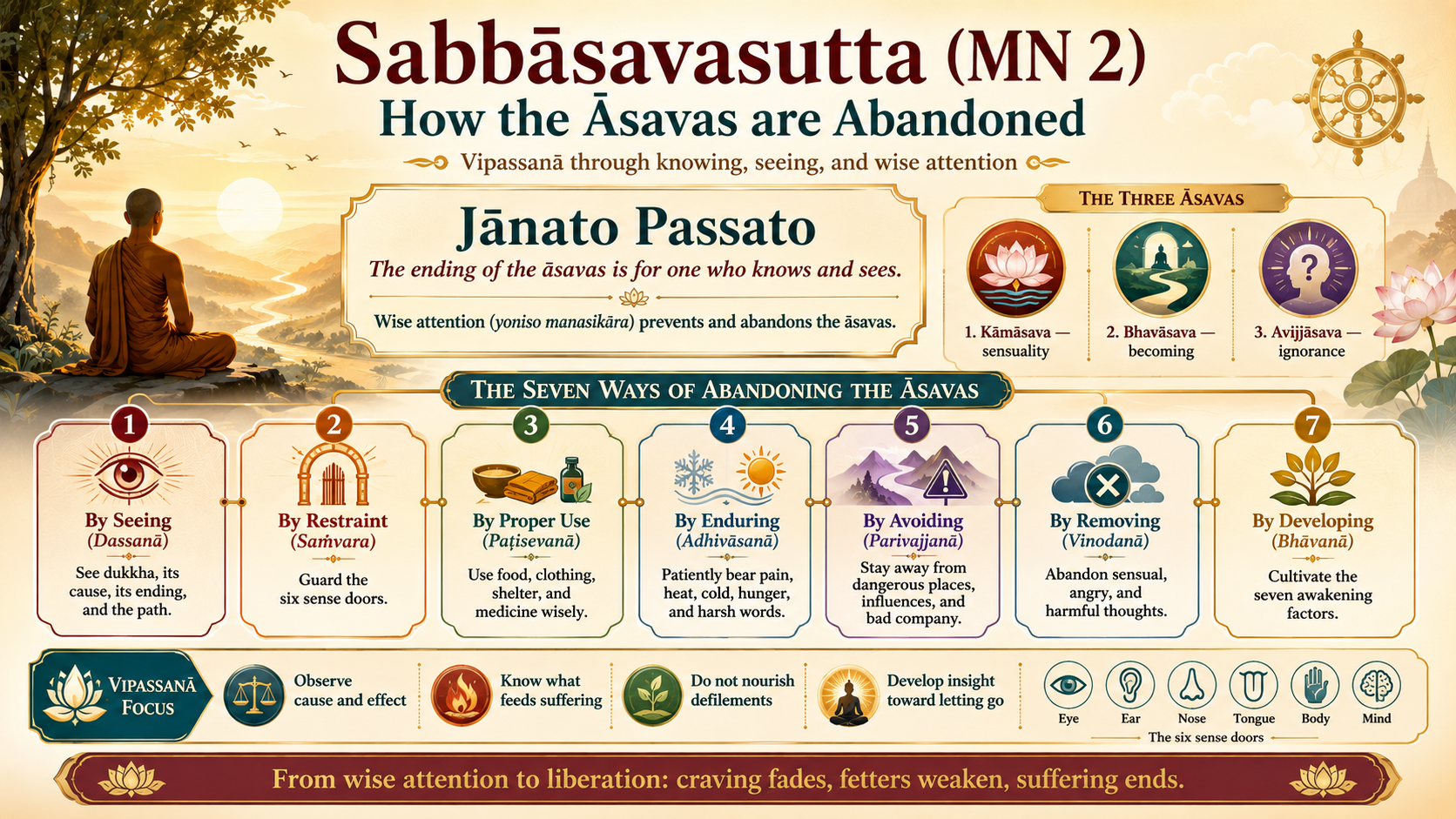
 VISUAL SUMMARYSee this sutta in a pictureOpen the complete infographic for a visual overview before or after reading the full study.View infographic →
MN 2 is one of the clearest discourses for understanding that liberation is not achieved by applying one meditation response to every mental event. The Buddha begins with the decisive expression jānato passato: the ending of the āsavas is for one who knows and sees. He then explains that the direction of attention itself determines whether latent currents of sensuality, becoming and ignorance arise, increase, fail to arise, or are abandoned.
For Vipassanā practice this is foundational. One does not merely observe “whatever is there” and remain indifferent to causality. One learns to see what condition has arisen, how attention is shaping it, whether the process is moving toward proliferation or fading, and which training is appropriate. Some āsavas are abandoned by seeing the Four Noble Truths correctly. Others require sense restraint, wise use of material supports, patient endurance, deliberate avoidance, active removal of arisen unwholesome thought, or development of the seven awakening factors.
The discourse therefore expands Vipassanā from a formal sitting technique into an all-day investigation. Seeing a form, hearing criticism, eating a meal, using a phone, enduring bodily discomfort, choosing companions, entering or avoiding an environment, and responding to a thought that has already arisen are all places where conditionality can be seen directly. The central question becomes practical: what am I doing now that causes the āsavas to arise, grow, weaken or cease?
Translation has been done considering aspects that would help the reader. The Deep Dive is intentionally separate and written as connected essays so that the discourse can be understood as one integrated training rather than as isolated one-line observations.
01Setting at Jetavana
Evaṁ me sutaṁ—ekaṁ samayaṁ bhagavā sāvatthiyaṁ viharati jetavane anāthapiṇḍikassa ārāme. Tatra kho bhagavā bhikkhū āmantesi: “bhikkhavo”ti.
Thus have I heard. On one occasion the Blessed One was staying at Sāvatthī, in Jeta’s Grove, Anāthapiṇḍika’s monastery. There the Blessed One addressed the bhikkhus: “Bhikkhus.”
02The bhikkhus respond
“Bhadante”ti te bhikkhū bhagavato paccassosuṁ. Bhagavā etadavoca:
“Venerable sir,” those bhikkhus replied to the Blessed One. The Blessed One said this:
03The teaching to be given
“Sabbāsavasaṁvarapariyāyaṁ vo, bhikkhave, desessāmi. Taṁ suṇātha, sādhukaṁ manasi karotha, bhāsissāmī”ti.
“Bhikkhus, I shall teach you the method for the restraint of all the āsavas. Listen and attend carefully; I will speak.”
04Invitation accepted
“Evaṁ, bhante”ti kho te bhikkhū bhagavato paccassosuṁ. Bhagavā etadavoca:
“Yes, venerable sir,” the bhikkhus replied to the Blessed One. The Blessed One said this:
05Āsavas end for one who knows and sees
“Jānato ahaṁ, bhikkhave, passato āsavānaṁ khayaṁ vadāmi, no ajānato no apassato. Kiñca, bhikkhave, jānato kiñca passato āsavānaṁ khayaṁ vadāmi? Yoniso ca manasikāraṁ ayoniso ca manasikāraṁ. Ayoniso, bhikkhave, manasikaroto anuppannā ceva āsavā uppajjanti, uppannā ca āsavā pavaḍḍhanti; yoniso ca kho, bhikkhave, manasikaroto anuppannā ceva āsavā na uppajjanti, uppannā ca āsavā pahīyanti.
Bhikkhus, I say that the ending of the āsavas is for one who knows and sees, not for one who does not know and does not see. For one who knows and sees what do I declare the ending of the āsavas? There is wise attention and unwise attention. When one attends unwisely, āsavas that have not yet arisen arise, and āsavas that have already arisen increase. But when one attends wisely, āsavas that have not yet arisen do not arise, and those that have already arisen are abandoned.
06Seven different ways of abandoning
Atthi, bhikkhave, āsavā dassanā pahātabbā, atthi āsavā saṁvarā pahātabbā, atthi āsavā paṭisevanā pahātabbā, atthi āsavā adhivāsanā pahātabbā, atthi āsavā parivajjanā pahātabbā, atthi āsavā vinodanā pahātabbā, atthi āsavā bhāvanā pahātabbā.
Bhikkhus, there are āsavas to be abandoned by seeing; there are āsavas to be abandoned by restraint; there are āsavas to be abandoned by proper use; there are āsavas to be abandoned by enduring; there are āsavas to be abandoned by avoiding; there are āsavas to be abandoned by removing; and there are āsavas to be abandoned by developing.
07What the uninstructed person attends to
Katame ca, bhikkhave, āsavā dassanā pahātabbā? Idha, bhikkhave, assutavā puthujjano ariyānaṁ adassāvī ariyadhammassa akovido ariyadhamme avinīto, sappurisānaṁ adassāvī sappurisadhammassa akovido sappurisadhamme avinīto—manasikaraṇīye dhamme nappajānāti, amanasikaraṇīye dhamme nappajānāti. So manasikaraṇīye dhamme appajānanto amanasikaraṇīye dhamme appajānanto, ye dhammā na manasikaraṇīyā, te dhamme manasi karoti, ye dhammā manasikaraṇīyā te dhamme na manasi karoti.
And what, bhikkhus, are the āsavas to be abandoned by seeing? Here an uninstructed ordinary person, who has not seen the noble ones, is unskilled and untrained in their Dhamma, and who has not seen true persons, is unskilled and untrained in their Dhamma, does not understand what is fit for attention and what is not fit for attention. Because he does not understand this distinction, he attends to what should not be attended to and fails to attend to what should be attended to.
08Attention that feeds the āsavas
Katame ca, bhikkhave, dhammā na manasikaraṇīyā ye dhamme manasi karoti? Yassa, bhikkhave, dhamme manasikaroto anuppanno vā kāmāsavo uppajjati, uppanno vā kāmāsavo pavaḍḍhati; anuppanno vā bhavāsavo uppajjati, uppanno vā bhavāsavo pavaḍḍhati; anuppanno vā avijjāsavo uppajjati, uppanno vā avijjāsavo pavaḍḍhati—ime dhammā na manasikaraṇīyā ye dhamme manasi karoti.
What are the things not fit for attention that he nevertheless attends to? They are those things which, when attended to, cause an unarisen influx of sensuality to arise or an arisen influx of sensuality to increase; cause an unarisen influx of becoming to arise or an arisen influx of becoming to increase; and cause an unarisen influx of ignorance to arise or an arisen influx of ignorance to increase. These are the things not fit for attention that he attends to.
09Attention that weakens the āsavas
Katame ca, bhikkhave, dhammā manasikaraṇīyā ye dhamme na manasi karoti? Yassa, bhikkhave, dhamme manasikaroto anuppanno vā kāmāsavo na uppajjati, uppanno vā kāmāsavo pahīyati; anuppanno vā bhavāsavo na uppajjati, uppanno vā bhavāsavo pahīyati; anuppanno vā avijjāsavo na uppajjati, uppanno vā avijjāsavo pahīyati—ime dhammā manasikaraṇīyā ye dhamme na manasi karoti.
And what are the things fit for attention that he fails to attend to? They are those things which, when attended to, do not allow an unarisen influx of sensuality to arise and lead an arisen one to be abandoned; do not allow an unarisen influx of becoming to arise and lead an arisen one to be abandoned; and do not allow an unarisen influx of ignorance to arise and lead an arisen one to be abandoned. These are the things fit for attention that he fails to attend to.
10The consequence of misdirected attention
Tassa amanasikaraṇīyānaṁ dhammānaṁ manasikārā manasikaraṇīyānaṁ dhammānaṁ amanasikārā anuppannā ceva āsavā uppajjanti uppannā ca āsavā pavaḍḍhanti.
Because he attends to what should not be attended to and neglects what should be attended to, unarisen āsavas arise in him and arisen āsavas increase.
11Speculation about self across past, future and present
So evaṁ ayoniso manasi karoti: ‘ahosiṁ nu kho ahaṁ atītamaddhānaṁ? Na nu kho ahosiṁ atītamaddhānaṁ? Kiṁ nu kho ahosiṁ atītamaddhānaṁ? Kathaṁ nu kho ahosiṁ atītamaddhānaṁ? Kiṁ hutvā kiṁ ahosiṁ nu kho ahaṁ atītamaddhānaṁ? Bhavissāmi nu kho ahaṁ anāgatamaddhānaṁ? Na nu kho bhavissāmi anāgatamaddhānaṁ? Kiṁ nu kho bhavissāmi anāgatamaddhānaṁ? Kathaṁ nu kho bhavissāmi anāgatamaddhānaṁ? Kiṁ hutvā kiṁ bhavissāmi nu kho ahaṁ anāgatamaddhānan’ti? Etarahi vā paccuppannamaddhānaṁ ajjhattaṁ kathaṅkathī hoti: ‘ahaṁ nu khosmi? No nu khosmi? Kiṁ nu khosmi? Kathaṁ nu khosmi? Ayaṁ nu kho satto kuto āgato? So kuhiṁ gāmī bhavissatī’ti?
Attending unwisely, he thinks in this way: “Did I exist in the past? Did I not exist in the past? What was I in the past? How was I in the past? Having been what, what did I become in the past? Will I exist in the future? Will I not exist in the future? What will I be in the future? How will I be in the future? Having been what, what will I become in the future?” Or he is inwardly perplexed about the present: “Am I? Am I not? What am I? How am I? Where has this being come from, and where will it go?”
12Six identity views and the thicket of views
Tassa evaṁ ayoniso manasikaroto channaṁ diṭṭhīnaṁ aññatarā diṭṭhi uppajjati. ‘Atthi me attā’ti vā assa saccato thetato diṭṭhi uppajjati; ‘natthi me attā’ti vā assa saccato thetato diṭṭhi uppajjati; ‘attanāva attānaṁ sañjānāmī’ti vā assa saccato thetato diṭṭhi uppajjati; ‘attanāva anattānaṁ sañjānāmī’ti vā assa saccato thetato diṭṭhi uppajjati; ‘anattanāva attānaṁ sañjānāmī’ti vā assa saccato thetato diṭṭhi uppajjati; atha vā panassa evaṁ diṭṭhi hoti: ‘yo me ayaṁ attā vado vedeyyo tatra tatra kalyāṇapāpakānaṁ kammānaṁ vipākaṁ paṭisaṁvedeti so kho pana me ayaṁ attā nicco dhuvo sassato avipariṇāmadhammo sassatisamaṁ tatheva ṭhassatī’ti. Idaṁ vuccati, bhikkhave, diṭṭhigataṁ diṭṭhigahanaṁ diṭṭhikantāraṁ diṭṭhivisūkaṁ diṭṭhivipphanditaṁ diṭṭhisaṁyojanaṁ. Diṭṭhisaṁyojanasaṁyutto, bhikkhave, assutavā puthujjano na parimuccati jātiyā jarāya maraṇena sokehi paridevehi dukkhehi domanassehi upāyāsehi; ‘na parimuccati dukkhasmā’ti vadāmi.
When he attends unwisely in this way, one of six views arises in him. As a fixed and settled truth the view may arise: “I have a self”; or “I have no self”; or “I perceive self by means of self”; or “I perceive what is not self by means of self”; or “I perceive self by means of what is not self.” Or he comes to hold the view: “This self of mine, which speaks and feels and experiences here and there the results of good and bad actions, is permanent, stable, eternal, not subject to change, and will remain the same forever.” This, bhikkhus, is called getting caught in views: a thicket of views, a wilderness of views, a distortion of views, a writhing of views, a fetter of views. Bound by the fetter of views, the uninstructed ordinary person is not freed from birth, aging and death, from sorrow, lamentation, pain, displeasure and anguish. I say that he is not freed from suffering.
13The instructed disciple knows what deserves attention
Sutavā ca kho, bhikkhave, ariyasāvako—ariyānaṁ dassāvī ariyadhammassa kovido ariyadhamme suvinīto, sappurisānaṁ dassāvī sappurisadhammassa kovido sappurisadhamme suvinīto—manasikaraṇīye dhamme pajānāti amanasikaraṇīye dhamme pajānāti. So manasikaraṇīye dhamme pajānanto amanasikaraṇīye dhamme pajānanto ye dhammā na manasikaraṇīyā te dhamme na manasi karoti, ye dhammā manasikaraṇīyā te dhamme manasi karoti.
But an instructed noble disciple, who has seen the noble ones, is skilled and well trained in their Dhamma, and who has seen true persons, is skilled and well trained in their Dhamma, understands what is fit for attention and what is not fit for attention. Understanding this distinction, he does not attend to what should not be attended to and he attends to what should be attended to.
14The instructed disciple does not feed the āsavas
Katame ca, bhikkhave, dhammā na manasikaraṇīyā ye dhamme na manasi karoti? Yassa, bhikkhave, dhamme manasikaroto anuppanno vā kāmāsavo uppajjati, uppanno vā kāmāsavo pavaḍḍhati; anuppanno vā bhavāsavo uppajjati, uppanno vā bhavāsavo pavaḍḍhati; anuppanno vā avijjāsavo uppajjati, uppanno vā avijjāsavo pavaḍḍhati—ime dhammā na manasikaraṇīyā, ye dhamme na manasi karoti.
What are the things not fit for attention that he does not attend to? They are those things which, when attended to, cause an unarisen influx of sensuality to arise or an arisen one to increase; cause an unarisen influx of becoming to arise or an arisen one to increase; and cause an unarisen influx of ignorance to arise or an arisen one to increase. These are the things not fit for attention that he does not attend to.
15The instructed disciple attends in the direction of abandoning
Katame ca, bhikkhave, dhammā manasikaraṇīyā ye dhamme manasi karoti? Yassa, bhikkhave, dhamme manasikaroto anuppanno vā kāmāsavo na uppajjati, uppanno vā kāmāsavo pahīyati; anuppanno vā bhavāsavo na uppajjati, uppanno vā bhavāsavo pahīyati; anuppanno vā avijjāsavo na uppajjati, uppanno vā avijjāsavo pahīyati—ime dhammā manasikaraṇīyā ye dhamme manasi karoti.
And what are the things fit for attention that he attends to? They are those things which, when attended to, do not allow an unarisen influx of sensuality to arise and lead an arisen one to be abandoned; do not allow an unarisen influx of becoming to arise and lead an arisen one to be abandoned; and do not allow an unarisen influx of ignorance to arise and lead an arisen one to be abandoned. These are the things fit for attention that he attends to.
16Wise attention changes the direction of the mind
Tassa amanasikaraṇīyānaṁ dhammānaṁ amanasikārā manasikaraṇīyānaṁ dhammānaṁ manasikārā anuppannā ceva āsavā na uppajjanti, uppannā ca āsavā pahīyanti.
Because he does not attend to what is unfit for attention and does attend to what is fit for attention, unarisen āsavas do not arise in him and arisen āsavas are abandoned.
17Wise attention to the Four Noble Truths
So ‘idaṁ dukkhan’ti yoniso manasi karoti, ‘ayaṁ dukkhasamudayo’ti yoniso manasi karoti, ‘ayaṁ dukkhanirodho’ti yoniso manasi karoti, ‘ayaṁ dukkhanirodhagāminī paṭipadā’ti yoniso manasi karoti. Tassa evaṁ yoniso manasikaroto tīṇi saṁyojanāni pahīyanti—sakkāyadiṭṭhi, vicikicchā, sīlabbataparāmāso. Ime vuccanti, bhikkhave, āsavā dassanā pahātabbā.
He attends wisely: “This is suffering”; he attends wisely: “This is the origin of suffering”; he attends wisely: “This is the cessation of suffering”; he attends wisely: “This is the way leading to the cessation of suffering.” When he attends wisely in this way, three fetters are abandoned: identity view, doubt, and clinging to rites and observances. These are called the āsavas to be abandoned by seeing.
18Restraint at all six sense faculties
Katame ca, bhikkhave, āsavā saṁvarā pahātabbā? Idha, bhikkhave, bhikkhu paṭisaṅkhā yoniso cakkhundriyasaṁvarasaṁvuto viharati. Yañhissa, bhikkhave, cakkhundriyasaṁvaraṁ asaṁvutassa viharato uppajjeyyuṁ āsavā vighātapariḷāhā, cakkhundriyasaṁvaraṁ saṁvutassa viharato evaṁsa te āsavā vighātapariḷāhā na honti. Paṭisaṅkhā yoniso sotindriyasaṁvarasaṁvuto viharati …pe… ghānindriyasaṁvarasaṁvuto viharati …pe… jivhindriyasaṁvarasaṁvuto viharati …pe… kāyindriyasaṁvarasaṁvuto viharati …pe… manindriyasaṁvarasaṁvuto viharati. Yañhissa, bhikkhave, manindriyasaṁvaraṁ asaṁvutassa viharato uppajjeyyuṁ āsavā vighātapariḷāhā, manindriyasaṁvaraṁ saṁvutassa viharato evaṁsa te āsavā vighātapariḷāhā na honti.
And what, bhikkhus, are the āsavas to be abandoned by restraint? Here a bhikkhu, reflecting wisely, lives restrained in the eye faculty. If he were to live without restraint of the eye faculty, āsavas, distress and burning could arise in him; when he lives restrained in the eye faculty, those āsavas, distress and burning do not occur. Reflecting wisely, he lives restrained in the ear faculty, the nose faculty, the tongue faculty, the body faculty and the mind faculty. If he were to live without restraint of the mind faculty, āsavas, distress and burning could arise in him; when he lives restrained in the mind faculty, those āsavas, distress and burning do not occur.
19Restraint prevents the burning
Yañhissa, bhikkhave, saṁvaraṁ asaṁvutassa viharato uppajjeyyuṁ āsavā vighātapariḷāhā, saṁvaraṁ saṁvutassa viharato evaṁsa te āsavā vighātapariḷāhā na honti. Ime vuccanti, bhikkhave, āsavā saṁvarā pahātabbā.
Those āsavas, distress and burning that could arise in one living unrestrained do not occur in one living restrained. These are called the āsavas to be abandoned by restraint.
20Using robes only for their purpose
Katame ca, bhikkhave, āsavā paṭisevanā pahātabbā? Idha, bhikkhave, bhikkhu paṭisaṅkhā yoniso cīvaraṁ paṭisevati: ‘yāvadeva sītassa paṭighātāya, uṇhassa paṭighātāya, ḍaṁsamakasavātātapasarīsapasamphassānaṁ paṭighātāya, yāvadeva hirikopīnappaṭicchādanatthaṁ’.
And what are the āsavas to be abandoned by proper use? Here a bhikkhu, reflecting wisely, uses a robe only for protection from cold and heat, from contact with flies, mosquitoes, wind, sun and creeping things, and simply for covering what should be covered.
21Using food without turning it into sensuality
Paṭisaṅkhā yoniso piṇḍapātaṁ paṭisevati: ‘neva davāya, na madāya, na maṇḍanāya, na vibhūsanāya, yāvadeva imassa kāyassa ṭhitiyā yāpanāya, vihiṁsūparatiyā, brahmacariyānuggahāya, iti purāṇañca vedanaṁ paṭihaṅkhāmi navañca vedanaṁ na uppādessāmi, yātrā ca me bhavissati anavajjatā ca phāsuvihāro ca’.
Reflecting wisely, he uses almsfood not for amusement, intoxication, beautification or adornment, but only for the continuance and maintenance of this body, for ending discomfort and for supporting the holy life, considering: “Thus I shall end the old feeling without producing a new feeling; I shall sustain myself, remain blameless and live at ease.”
22Using lodging for protection and seclusion
Paṭisaṅkhā yoniso senāsanaṁ paṭisevati: ‘yāvadeva sītassa paṭighātāya, uṇhassa paṭighātāya, ḍaṁsamakasavātātapasarīsapasamphassānaṁ paṭighātāya, yāvadeva utuparissayavinodanapaṭisallānārāmatthaṁ’.
Reflecting wisely, he uses lodging only for protection from cold and heat, from contact with flies, mosquitoes, wind, sun and creeping things, for removing the hazards of the seasons, and for the enjoyment of seclusion.
23Using medicine to address illness
Paṭisaṅkhā yoniso gilānappaccayabhesajjaparikkhāraṁ paṭisevati: ‘yāvadeva uppannānaṁ veyyābādhikānaṁ vedanānaṁ paṭighātāya, abyābajjhaparamatāya’.
Reflecting wisely, he uses medicinal requisites for illness only to counter painful feelings that have arisen because of sickness and for the highest possible freedom from affliction.
24Proper use removes a class of āsavas
Yañhissa, bhikkhave, appaṭisevato uppajjeyyuṁ āsavā vighātapariḷāhā, paṭisevato evaṁsa te āsavā vighātapariḷāhā na honti. Ime vuccanti, bhikkhave, āsavā paṭisevanā pahātabbā.
Those āsavas, distress and burning that could arise from not making proper use do not occur when things are used properly. These are called the āsavas to be abandoned by proper use.
25Enduring unavoidable discomfort
Katame ca, bhikkhave, āsavā adhivāsanā pahātabbā? Idha, bhikkhave, bhikkhu paṭisaṅkhā yoniso khamo hoti sītassa uṇhassa, jighacchāya pipāsāya. Ḍaṁsamakasavātātapasarīsapasamphassānaṁ, duruttānaṁ durāgatānaṁ vacanapathānaṁ, uppannānaṁ sārīrikānaṁ vedanānaṁ dukkhānaṁ tibbānaṁ kharānaṁ kaṭukānaṁ asātānaṁ amanāpānaṁ pāṇaharānaṁ adhivāsakajātiko hoti.
And what are the āsavas to be abandoned by enduring? Here a bhikkhu, reflecting wisely, patiently endures cold and heat, hunger and thirst, contact with flies, mosquitoes, wind, sun and creeping things; he endures badly spoken and unwelcome words; and he is of a nature that endures bodily feelings that are painful, severe, sharp, piercing, disagreeable, unpleasant and even life-threatening.
26Endurance prevents secondary suffering
Yañhissa, bhikkhave, anadhivāsayato uppajjeyyuṁ āsavā vighātapariḷāhā, adhivāsayato evaṁsa te āsavā vighātapariḷāhā na honti. Ime vuccanti, bhikkhave, āsavā adhivāsanā pahātabbā.
Those āsavas, distress and burning that could arise in one who does not endure do not occur in one who endures. These are called the āsavas to be abandoned by enduring.
27Avoiding conditions that predictably lead to harm
Katame ca, bhikkhave, āsavā parivajjanā pahātabbā? Idha, bhikkhave, bhikkhu paṭisaṅkhā yoniso caṇḍaṁ hatthiṁ parivajjeti, caṇḍaṁ assaṁ parivajjeti, caṇḍaṁ goṇaṁ parivajjeti, caṇḍaṁ kukkuraṁ parivajjeti, ahiṁ khāṇuṁ kaṇṭakaṭṭhānaṁ sobbhaṁ papātaṁ candanikaṁ oḷigallaṁ. Yathārūpe anāsane nisinnaṁ yathārūpe agocare carantaṁ yathārūpe pāpake mitte bhajantaṁ viññū sabrahmacārī pāpakesu ṭhānesu okappeyyuṁ, so tañca anāsanaṁ tañca agocaraṁ te ca pāpake mitte paṭisaṅkhā yoniso parivajjeti.
And what are the āsavas to be abandoned by avoiding? Here a bhikkhu, reflecting wisely, avoids a fierce elephant, a fierce horse, a fierce bull, a fierce dog, snakes, stumps, thorny places, pits, precipices, cesspools and sewers. Reflecting wisely, he also avoids unsuitable seats, unsuitable places to go, and bad friends of such a kind that wise companions in the holy life might reasonably suspect him of involvement in what is unwholesome.
28Avoidance is itself part of wisdom
Yañhissa, bhikkhave, aparivajjayato uppajjeyyuṁ āsavā vighātapariḷāhā, parivajjayato evaṁsa te āsavā vighātapariḷāhā na honti. Ime vuccanti, bhikkhave, āsavā parivajjanā pahātabbā.
Those āsavas, distress and burning that could arise in one who does not avoid such things do not occur in one who avoids them. These are called the āsavas to be abandoned by avoiding.
29Removing arisen unwholesome thoughts
Katame ca, bhikkhave, āsavā vinodanā pahātabbā? Idha, bhikkhave, bhikkhu paṭisaṅkhā yoniso uppannaṁ kāmavitakkaṁ nādhivāseti pajahati vinodeti byantīkaroti anabhāvaṁ gameti, uppannaṁ byāpādavitakkaṁ …pe… uppannaṁ vihiṁsāvitakkaṁ …pe… uppannuppanne pāpake akusale dhamme nādhivāseti pajahati vinodeti byantīkaroti anabhāvaṁ gameti.
And what are the āsavas to be abandoned by removing? Here a bhikkhu, reflecting wisely, does not tolerate an arisen thought of sensuality; he abandons it, removes it, brings it to an end and causes it to disappear. He does the same with an arisen thought of ill will, an arisen thought of harming, and with any other evil and unwholesome states that arise: he does not tolerate them; he abandons them, removes them, brings them to an end and causes them to disappear.
30Removal prevents further burning
Yañhissa, bhikkhave, avinodayato uppajjeyyuṁ āsavā vighātapariḷāhā, vinodayato evaṁsa te āsavā vighātapariḷāhā na honti. Ime vuccanti, bhikkhave, āsavā vinodanā pahātabbā.
Those āsavas, distress and burning that could arise in one who does not remove such states do not occur in one who removes them. These are called the āsavas to be abandoned by removing.
31Developing the seven awakening factors
Katame ca, bhikkhave, āsavā bhāvanā pahātabbā? Idha, bhikkhave, bhikkhu paṭisaṅkhā yoniso satisambojjhaṅgaṁ bhāveti vivekanissitaṁ virāganissitaṁ nirodhanissitaṁ vossaggapariṇāmiṁ; paṭisaṅkhā yoniso dhammavicayasambojjhaṅgaṁ bhāveti …pe… vīriyasambojjhaṅgaṁ bhāveti … pītisambojjhaṅgaṁ bhāveti … passaddhisambojjhaṅgaṁ bhāveti … samādhisambojjhaṅgaṁ bhāveti … upekkhāsambojjhaṅgaṁ bhāveti vivekanissitaṁ virāganissitaṁ nirodhanissitaṁ vossaggapariṇāmiṁ.
And what are the āsavas to be abandoned by development? Here a bhikkhu, reflecting wisely, develops the awakening factor of mindfulness dependent on seclusion, dependent on fading of passion, dependent on cessation, and maturing in relinquishment. Reflecting wisely, he develops the awakening factor of investigation of Dhamma, the awakening factor of energy, the awakening factor of rapture, the awakening factor of tranquility, the awakening factor of samādhi, and the awakening factor of equanimity—each dependent on seclusion, fading of passion and cessation, and maturing in relinquishment.
32Development completes what mere restraint cannot
Yañhissa, bhikkhave, abhāvayato uppajjeyyuṁ āsavā vighātapariḷāhā, bhāvayato evaṁsa te āsavā vighātapariḷāhā na honti. Ime vuccanti, bhikkhave, āsavā bhāvanā pahātabbā.
Those āsavas, distress and burning that could arise in one who does not develop these factors do not occur in one who develops them. These are called the āsavas to be abandoned by development.
33The sevenfold training reaches its culmination
Yato kho, bhikkhave, bhikkhuno ye āsavā dassanā pahātabbā te dassanā pahīnā honti, ye āsavā saṁvarā pahātabbā te saṁvarā pahīnā honti, ye āsavā paṭisevanā pahātabbā te paṭisevanā pahīnā honti, ye āsavā adhivāsanā pahātabbā te adhivāsanā pahīnā honti, ye āsavā parivajjanā pahātabbā te parivajjanā pahīnā honti, ye āsavā vinodanā pahātabbā te vinodanā pahīnā honti, ye āsavā bhāvanā pahātabbā te bhāvanā pahīnā honti; ayaṁ vuccati, bhikkhave: ‘bhikkhu sabbāsavasaṁvarasaṁvuto viharati, acchecchi taṇhaṁ, vivattayi saṁyojanaṁ, sammā mānābhisamayā antamakāsi dukkhassā’”ti.
When a bhikkhu has abandoned by seeing the āsavas that should be abandoned by seeing; by restraint those that should be abandoned by restraint; by proper use those that should be abandoned by proper use; by enduring those that should be abandoned by enduring; by avoiding those that should be abandoned by avoiding; by removing those that should be abandoned by removing; and by development those that should be abandoned by development, then he is called a bhikkhu who lives restrained with regard to all the āsavas. He has cut off craving, turned away the fetter, and by fully understanding conceit has made an end of suffering.
34Conclusion
Idamavoca bhagavā. Attamanā te bhikkhū bhagavato bhāsitaṁ abhinandunti. Sabbāsavasuttaṁ niṭṭhitaṁ dutiyaṁ.
That is what the Blessed One said. The bhikkhus were satisfied and delighted in the Blessed One’s words. The Sabbāsavasutta, the second discourse, is finished.
Key Points
Seven things to retain before the Deep Dive
These are short orientation points only. The detailed reasoning and examples are kept in the essay-style Deep Dive below.
1
Know and see. The ending of the āsavas is declared for one who knows and sees, not merely for one who believes or repeats.
2
Judge attention by its result. Unwise attention gives rise to or increases the āsavas; wise attention prevents or abandons them.
3
Do not turn anattā into another view. The sutta redirects self-speculation toward direct seeing of the Four Noble Truths.
4
Guard all six doors. Eye, ear, nose, tongue, body and mind are all fields in which burning can either be produced or prevented.
5
Use the right response for the right condition. Seeing, restraint, wise use, endurance, avoidance, removal and development are distinct tools.
6
Vipassanā extends through the entire day. Eating, using possessions, hearing criticism, browsing media and meeting discomfort all become fields of conditional investigation.
7
Development points toward relinquishment. The seven awakening factors are cultivated dependent on seclusion, dispassion and cessation, maturing in letting go.
01The sutta begins with Vipassanā’s decisive requirement: know and see
The opening statement determines how the whole discourse should be read. The Buddha does not say that the āsavas disappear because one belongs to a tradition, has accumulated information, has performed a ritual, or has merely spent many hours meditating. He says that their ending is for one who knows and sees—jānato passato. This is the point at which MN 2 becomes exceptionally important for Vipassanā. Vipassanā is not useful here as a label for a meditation style; it is useful as a description of penetrative seeing. The practitioner must know what is happening, see what condition is feeding it, see what happens when that condition is continued, and see what happens when the condition is no longer supplied. The next sentence makes this operational. The Buddha immediately places yoniso manasikāra and ayoniso manasikāra at the center. The question is therefore not simply, “What object am I observing?” The more important question is, “How am I attending to what is being experienced?” Two people can see the same form, hear the same words, remember the same event, or feel the same bodily sensation. In one, the encounter becomes fuel for sensuality, becoming or ignorance. In another, the same encounter becomes material for understanding, dispassion and release. The difference is not hidden inside the object. It lies in the mode of attending. Consider a current example. A practitioner sees a social-media post showing a luxury holiday. One mode of attention begins constructing: “That life is better than mine. I should have that. Why has that person succeeded more than me?” The visible form has already become a platform for comparison, self-making, desire and future becoming. Another practitioner notices the same movement as it begins: seeing has occurred; pleasant feeling and attraction are present; the mind is beginning to construct possession and identity. The practitioner does not need to hate the image or suppress vision. The work is to see the process correctly. This is precisely why “knowing and seeing” must precede freedom: what is not seen as a conditioned process is automatically lived as “me” and “mine.” This also prevents a common mistake in Vipassanā: equating observation with liberation. One can observe an unwholesome process while continuing to feed it. One can repeatedly “watch craving” while deliberately returning to the very images, fantasies, conversations or environments that strengthen craving. MN 2 refuses that passivity. Wise attention must have an abandoning function. If a way of attending causes an unarisen āsava to arise or an arisen one to grow, the sutta classifies it by its result. If attention prevents arising or leads to abandonment, that too is known by its result. Vipassanā therefore becomes experimentally verifiable: observe the condition, observe the consequence, and train in the direction that leads to fading rather than accumulation.
02The seven methods show that insight must become intelligent action
The sevenfold classification is one of the great practical strengths of MN 2. The Buddha does not reduce every defilement to a single response. Some āsavas are abandoned by seeing. Others are prevented by guarding the sense faculties. Some arise because requisites are used without wisdom. Some are intensified because unavoidable discomfort is not endured. Some can be prevented simply by not entering a dangerous situation. Some have already arisen and must be actively removed. Others require cultivation of the awakening factors. The teaching is therefore a diagnostic system. This matters greatly in present-day meditation culture because “just observe” can become an answer to everything. MN 2 says otherwise. If a person is repeatedly entering an environment that predictably triggers intoxication, gambling, sexual misconduct, rage or compulsive consumption, the relevant method may not be to stand inside the trigger and admire the arising of craving. It may be parivajjanā: avoidance. If a painful sensation in the knee arises during sitting and is medically harmless, the appropriate training may be adhivāsanā: endurance without mental proliferation. If a sexual fantasy has already taken hold, the relevant response may be vinodanā: do not tolerate it; abandon and remove it. If the problem is that every meal is being converted into entertainment and sensual planning, then paṭisevanā—wise use—must be trained. Vipassanā in this framework is not indecision. It is the clarity that recognizes which causal situation is actually present. A mechanic does not use the same tool for every fault. In the same way, a practitioner who has begun to see conditionality does not answer every āsava with the same technique. Seeing tells one what is operating; wisdom selects the appropriate training; repeated application reveals whether the āsava weakens. This sevenfold structure also protects against spiritual pride. A practitioner may have strong samādhi yet remain careless about sense restraint. Another may have austere discipline yet continue to entertain identity views. Another may be intellectually clear about anattā yet deliberately associate with environments that continually inflame greed and hostility. MN 2 does not permit one strength to compensate for an untreated cause. “All the āsavas” requires a comprehensive training because their supporting conditions are diverse.
03Dassanā: insight begins by abandoning the wrong question
The first method, abandonment by seeing, is the doctrinal heart of the sutta. The uninstructed person asks questions centered on an assumed entity: Was I in the past? What was I? Will I exist? What will I become? What am I now? Where did this being come from and where will it go? The Buddha does not praise these questions merely because they sound philosophical. He classifies them as unwise attention when they feed the āsavas. This is extremely significant. The problem is not curiosity by itself; the problem is the structure of attention that keeps reinstalling an entity at the center of experience. Modern versions of the same movement are everywhere. “What is my true self?” “Who was I in my previous birth?” “What will happen to me after death?” “Am I an old soul?” “Which permanent consciousness travels?” Even a Buddhist practitioner can convert Dhamma into the same project: “What stage am I? What will I become next? Is there an eternal observer behind the aggregates?” The vocabulary changes, but the mind may still be building a metaphysical owner. The sutta then shows the alternative. The noble disciple does not replace “I have a self” with the dogma “I have no self.” Indeed, “I have no self” appears within the six views that arise from unwise attention. This is a crucial safeguard. The Buddha’s method is not to adopt a philosophical slogan called no-self. The method is to turn attention toward the Four Noble Truths: this is dukkha; this is its arising; this is its cessation; this is the way leading to cessation. For Vipassanā, this is a change from identity-questioning to conditional investigation. Suppose anger arises after criticism. Unwise attention asks: “Why does he always disrespect me? What kind of person am I if I allow this? Why is my family like this?” The story thickens the owner. Wise attention examines the actual event: unpleasant contact has occurred; painful feeling is present; resistance, perception and thought are amplifying it; craving for being respected is involved; clinging is making the event personal. What is dukkha here? What is feeding it now? Can the feeding cease? What mode of conduct and attention leads out of it? The Four Noble Truths are no longer a doctrine remembered from a book. They become a lens for seeing the birth and ending of suffering in real time. This is why the sutta links such wise attention with the abandonment of identity view, doubt and clinging to rites and observances. One begins to verify causality rather than believe in external guarantees. Identity view weakens because experience is seen as conditioned rather than owned. Doubt weakens because the Dhamma is being tested in direct experience. Reliance on rites and observances weakens because one sees that suffering ends through removing its causes, not through mechanical acts disconnected from those causes.
04Saṁvara: sense restraint is Vipassanā before the fire spreads
The second method takes insight into the six sense doors. Eye, ear, nose, tongue, body and mind are all explicitly included. This is important because many practitioners limit “practice” to a cushion and allow the other sixteen waking hours to remain governed by habit. MN 2 makes that impossible. What enters through the six faculties is part of the field in which āsavas are either fed or not fed. Sense restraint does not require blindness, deafness or fear of the world. It means that when contact occurs, the mind is not allowed to run without understanding. A form can be seen without converting it into acquisition. A sound can be heard without converting it into hatred. A memory can arise at the mind door without turning into an hour of fantasy. The restraint is intelligent because the text repeats paṭisaṅkhā yoniso—reflecting wisely. Take a smartphone. It is an almost perfect modern laboratory for MN 2. A single device can deliver attractive forms, provocative speech, outrage, sexual imagery, status comparison, shopping impulses and endless mental stimulation. If each contact is followed automatically, the practitioner may spend the entire day manufacturing “burning” while still claiming to meditate morning and evening. Sense restraint means detecting the point at which seeing becomes looking for more, hearing becomes replaying, reading becomes outrage, or a thought becomes a narrative. The practitioner does not wait until craving has become overwhelming. The mind faculty must receive equal emphasis. One can close every external door and still be unrestrained internally. Memories, imagined conversations, sexual images, fears, rehearsed arguments and spiritual fantasies can all function as mind-objects. A person sitting motionless may therefore be completely unrestrained at the mind door. Vipassanā makes this visible. The question is not whether the eyes are closed, but whether contact is being known before proliferation commandeers it. In practice, saṁvara and sati-sampajañña work together. While walking in a mall, browsing news, speaking with a colleague or sitting with family, one knows what has been contacted and knows the direction the mind is taking. If attraction is beginning, it is known as attraction; if irritation is beginning, it is known as irritation; if identity construction is beginning, it is known as construction. The training is successful not because nothing pleasant or unpleasant is experienced, but because contact no longer automatically becomes fuel.
05Paṭisevanā: use without appropriation
The third method concerns robes, food, lodging and medicine. For a lay practitioner the exact requisites differ, but the principle is immediately applicable: use what supports life and practice without converting use into intoxication, display, identity and craving. The Buddha asks the practitioner to interrogate purpose. Food is the clearest example because the sutta gives an unusually precise reflection. Food is not to be used for amusement, intoxication, beautification or adornment, but for maintaining the body, ending old discomfort and supporting the holy life. This does not mean food must be tasteless or eaten with hostility toward the body. It means the practitioner sees the distinction between nourishment and sensual project. A modern meal can easily become much more than nourishment. Before eating, one may scroll through restaurant reviews, imagine a desired taste, compare dishes, photograph the plate for approval, overeat because pleasure is available, and then continue thinking about the next meal. The physical requirement may have been modest, while the mental construction became enormous. Vipassanā here is seeing the difference between bodily need and the craving that attaches itself to the need. The same applies to clothing. Clothing protects the body and meets social requirements. Yet it can become a vehicle for status, sexual display, belonging, comparison or insecurity. Housing can support safety and seclusion, or it can become a permanent project of “mine,” prestige and endless improvement. Medicine can be used intelligently for illness, or health itself can become obsessive identity construction. The practical insight is not “own nothing.” It is “know what function this is serving in the mind.” A house may be large or small; a meal may be simple or elaborate. The decisive question in MN 2 is causal: what happens to the āsavas when this is used in this manner? Wise use makes everyday consumption part of Vipassanā because intention, feeling, craving and appropriation are being observed at the very point where they normally hide beneath socially accepted activity.
06Adhivāsanā: distinguish pain from the mind’s additional burning
The fourth method trains endurance. Some unpleasant experiences cannot and need not be immediately removed. Heat, cold, hunger, thirst, harsh speech and painful bodily feeling are listed. The practitioner reflects wisely and endures them. This is a direct laboratory for Vipassanā because unpleasant feeling reveals the difference between the first event and what the mind constructs around it. A bodily ache is one event. “This should not be happening, I cannot bear it, my meditation is ruined, something is wrong with me” is another layer. Harsh words are one event. Replaying them for three days, constructing the speaker as an enemy and rehearsing revenge is another. The second layer is where much of the āsava-driven burning develops. Endurance does not mean foolishly ignoring danger or refusing medical care. The fact that MN 2 has separate categories for medicine and avoidance already prevents that interpretation. Wisdom decides whether an experience is to be treated, avoided or endured. If a snake is present, one does not practice endurance by standing on it. If there is genuine injury, one does not prove spirituality by refusing treatment. But when discomfort is unavoidable and harmless, the impulse to escape can itself be examined. A practical sitting example makes the distinction clear. After forty minutes, pressure in the leg arises. First one knows the physical sensation. Then one notices the mental demand: “Move now.” If there are no signs of injury, one can remain long enough to study the changing texture of sensation, the urge to move, the aversion to feeling, and the stories attached to it. Often the “unbearable” quality changes before the physical sensation disappears. That is valuable insight: dukkha was not identical with raw sensation. The same applies to insult. When someone speaks harshly, Vipassanā does not require pretending the words were pleasant. It requires seeing hearing as hearing, unpleasant feeling as unpleasant feeling, perception as perception, and the rapidly emerging “me who has been attacked” as a conditioned construction. Endurance gives enough space for this seeing to occur without immediate retaliation.
07Parivajjanā: avoiding a cause is not weakness
The fifth method is perhaps the best correction to the idea that a serious practitioner should deliberately expose oneself to every temptation in order to “test equanimity.” The Buddha explicitly teaches avoidance. Fierce animals, dangerous terrain, unsuitable places and bad companions are to be avoided after wise reflection. In contemporary life the dangerous elephant may be a known addictive environment. The thorny place may be a digital platform that repeatedly triggers lust or rage. The bad companion may be a social circle where intoxication, cruelty or sexual misconduct is normalized. If the causal pattern is already known, repeatedly entering the same condition and expecting a different mental outcome is not courage; it may simply be unwise attention. For someone recovering from compulsive pornography, for example, the wise response may include device restrictions, removing private access at vulnerable times, avoiding accounts that feed sexual imagery, and refusing conversations that deliberately stimulate fantasy. Vipassanā remains essential because the practitioner must understand craving, but insight does not forbid environmental intelligence. One sees a cause and ceases supplying it. The same applies to anger. If a particular online forum predictably produces agitation, contempt and hours of internal argument, leaving that forum can be Dhamma practice. The practitioner can still investigate the desire to return, the fear of missing out, the identity invested in being right, and the relief when contact is no longer being fed. Avoidance does not mean ignorance of the mind; it creates conditions in which the mind can actually be trained. A mature practitioner therefore learns a subtle distinction: some things are abandoned by penetrating them; some by not feeding them; some by leaving the field entirely. MN 2 prevents the ego from turning exposure into a badge of strength.
08Vinodanā: once an unwholesome state has arisen, do not give it residence
The sixth method addresses what has already entered the mind. Sensual thought, ill will, harmful thought and other unwholesome states are not to be tolerated. The verbs are forceful: abandon, remove, terminate, cause to disappear. This is not the language of passive fascination. Vipassanā here must avoid two extremes. The first is suppression based on fear or self-hatred. The second is indulgence disguised as observation. The practitioner first knows clearly: sensual thought has arisen. That knowing is indispensable. But after knowing, one does not continue supplying images, memories, arguments and fantasy while saying, “I am just watching it.” If it is being fed, it is not being abandoned. Suppose resentment arises after an email. One sees the first thought. Then the mind wants to reread the offending line, imagine the sender’s motives, compose increasingly aggressive replies and recruit old grievances. Vinodanā begins by refusing those additions. Attention can be moved to a wholesome theme, the body can be relaxed, the factual issue can be separated from the hostile narrative, and a response can be delayed until byāpāda has weakened. The important point is that the practitioner does not make the arisen state a home. The same is true for sensual fantasy. Once the mind begins constructing a sexual scenario, there is a difference between knowing “sensual thought has arisen” and willingly completing the movie. The first is sati; the second is participation. MN 2 asks the practitioner to see that difference without ambiguity. This is also where prior sense restraint proves its value. Saṁvara prevents many states from gaining momentum. Vinodanā deals with the ones that nevertheless arise. A practitioner who neglects sense restraint will spend enormous energy repeatedly removing what could have been prevented earlier. The seven methods therefore form a coordinated system rather than isolated techniques.
09Bhāvanā: Vipassanā matures through the seven awakening factors
The seventh method is development: bhāvanā. The Buddha names the seven awakening factors—sati, investigation of Dhamma, energy, rapture, tranquility, samādhi and equanimity. Each is to be developed dependent on seclusion, fading of passion and cessation, maturing in relinquishment. This final orientation is critical. Sati is not being developed to make experience more vivid for its own sake. Dhammavicaya is not endless intellectual analysis. Energy is not restless striving. Pīti is not an experience to collect. Samādhi is not an identity. Upekkhā is not emotional indifference. The entire set is oriented toward virāga, nirodha and vossagga—fading, cessation and relinquishment. For Vipassanā practice, dhammavicaya is especially important. Investigation asks: what is this? Under what condition did it arise? What happens when the condition is maintained? What happens when it is removed? Is this stable? Is it governable? Does grasping it bring peace or burden? Such investigation prevents mindfulness from becoming bare registration without wisdom. At the same time, investigation must be balanced by tranquility and samādhi. A mind that is constantly conceptually dissecting experience can become agitated. The awakening factors show a more complete cultivation: clear mindfulness enables investigation; investigation arouses appropriate energy; skillful energy can bring pīti; pīti settles into tranquility; tranquility supports samādhi; a collected mind can remain balanced in upekkhā. When these mature toward relinquishment, insight is no longer merely intellectual. A real-time example is the arising of anxiety before an important meeting. Sati knows tightening, thought and anticipation. Dhammavicaya distinguishes present bodily sensation from imagined future scenarios. Vīriya sustains non-participation in the fear narrative. When the mind stops feeding the story, relief or lightness may arise. Passaddhi allows bodily and mental settling. Samādhi stabilizes the mind so that each new thought does not capture it. Upekkhā knows the remaining sensations without demand. The goal is not to manufacture seven sequential experiences mechanically, but to see how a rightly developed mind becomes capable of relinquishment.
10The seven methods form one Vipassanā map from contact to liberation
When the sutta is viewed as one connected teaching, a striking map appears. First, the practitioner corrects view through seeing the Four Noble Truths. Then the six sense doors are guarded so that the mind is not continually flooded. Material supports are used for their actual purpose. Unavoidable discomfort is endured without creating secondary suffering. Predictably dangerous conditions are avoided. Unwholesome states that nevertheless arise are removed. Finally, awakening factors are cultivated until the mind inclines toward fading, cessation and relinquishment. This sequence explains why Vipassanā cannot be isolated from conduct and daily-life training. If a practitioner spends the day pursuing sense stimulation, using food for intoxication, seeking status through possessions, avoiding every discomfort, entering dangerous environments and entertaining unwholesome thought, then an hour of evening observation is being asked to reverse an entire day of conditioning. MN 2 instead makes the whole day part of the path. A useful daily diagnostic is therefore not merely “How long did I meditate?” but “Which āsavas were fed today, and at what stage could the process have been interrupted?” Perhaps the problem began at the eye door. Perhaps the eye contact was harmless but mental replay later became the problem. Perhaps the trigger should have been avoided. Perhaps discomfort should have been endured rather than escaped through food or entertainment. Perhaps an arisen thought needed active removal. Perhaps the mind lacked samādhi and the awakening factors required development. This diagnostic approach is profoundly Vipassanā because it turns life into direct investigation of conditionality. Over time, the practitioner sees recurring patterns with increasing precision. Craving is no longer mysterious. Anger is no longer “who I am.” Restlessness is no longer an inexplicable mood. Each has supporting causes, and those causes can be known. The culmination of the sutta is correspondingly exact: craving is cut, the fetter is turned away, conceit is fully understood, and suffering is brought to an end. That ending is not presented as the reward for perfecting a single meditation technique. It is the result of learning, in every relevant domain, how not to feed what binds the mind.
01At the six doors: catch the process before it becomes a story
During ordinary activity, repeatedly ask: What has just contacted which door? What feeling tone is present? What is the mind beginning to do with it? The aim is not to name every micro-event mechanically. The aim is to become early enough that attraction, resistance and identity-making are seen before they mature into speech or action. When browsing, conversing, driving, eating or remembering, notice the transition from simple contact to “I want,” “I hate,” “I am,” “I deserve,” or “I must become.”
02With pleasant experience: distinguish enjoyment from appropriation
Pleasant feeling need not be denied. Observe the exact moment when pleasant becomes “more,” “again,” “mine,” or “this will make me happy.” That transition is a powerful Vipassanā object because it reveals how kāmāsava is built. Apply restraint if the sense door is still being fed; apply removal if fantasy has already arisen; apply wise use if the issue concerns food, clothing, devices or other requisites.
03With unpleasant experience: decide whether to endure, avoid or treat
Do not react automatically. Ask whether the condition is dangerous, medically relevant, avoidable or simply unpleasant. A genuine hazard may require avoidance. Illness may require medicine. Harmless discomfort may be suitable for endurance. This distinction prevents both indulgence and needless asceticism. Then observe whether the mind adds resentment, fear or self-pity to the original sensation.
04With recurring triggers: map the chain instead of blaming the final thought
If the same unwholesome state repeatedly appears, trace backward. What contact preceded it? What environment made that contact likely? What time of day, device, person, conversation or bodily condition was present? Which step could be changed earliest? Vipassanā becomes much sharper when one sees not only the final craving or anger but the chain of conditions that reliably manufactures it.
05With self-related thought: return from identity to the Four Noble Truths
When the mind becomes occupied with “What am I?”, “Why am I like this?”, “What will happen to me?”, or “What status have I attained?”, test whether the question is clarifying dukkha or strengthening identity construction. Return to the operational questions: What is the suffering now? What is its present support? What happens if the support ceases? What training leads to that cessation?
06In formal sitting: develop the awakening factors toward relinquishment
Let sati know the field clearly. Let dhammavicaya investigate without compulsive analysis. Apply energy where dullness or drift appears. Allow pīti and passaddhi when the mind is free from hindrances. Let samādhi stabilize knowing. Let upekkhā prevent grasping even at refined states. Repeatedly remember the orientation named in the sutta: seclusion, fading of passion, cessation and relinquishment.
07End-of-day review: which of the seven methods was actually needed?
Review one or two significant moments rather than judging the whole day. Was the problem wrong view, unrestrained contact, misuse of a requisite, inability to endure, failure to avoid, failure to remove, or lack of development? Then choose one correction for the next day. This converts MN 2 into a living training map and prevents vague resolutions such as “I must be more mindful.”
| Method | When it applies | Present-day example | Vipassanā question |
|---|---|---|---|
| Dassanā By seeing | Wrong attention and identity-producing views | Turning criticism, rebirth questions or attainment questions into a story about a permanent “me” | What is dukkha here, what is feeding it, what is cessation, and what leads to cessation? |
| Saṁvarā By restraint | Contact at eye, ear, nose, tongue, body or mind is beginning to generate burning | Scrolling images that intensify lust; consuming outrage that intensifies anger | At what point did simple contact become grasping or resistance? |
| Paṭisevanā By proper use | Food, clothing, lodging, medicine or possessions are being converted into sensuality or identity | Eating for entertainment rather than nourishment; buying for status | What function is this serving: need, support, display, intoxication or craving? |
| Adhivāsanā By enduring | The condition is unpleasant but harmless and unavoidable | Heat, hunger, bodily ache, harsh words | What is the raw unpleasant feeling, and what suffering is being added by resistance? |
| Parivajjanā By avoiding | The causal environment is predictably harmful | Addictive sites, intoxicating company, situations that repeatedly lead to misconduct | If I already know the cause, why am I continuing to enter it? |
| Vinodanā By removing | An unwholesome thought has already arisen | Sexual fantasy, revenge rehearsal, harmful planning | Am I knowing this state, or am I continuing to feed it? |
| Bhāvanā By developing | The mind needs positive cultivation toward awakening | Developing sati, investigation, energy, pīti, tranquility, samādhi and upekkhā | Is this development inclining toward seclusion, fading, cessation and relinquishment? |
MN 2 makes Vipassanā uncompromisingly practical. Freedom begins with knowing and seeing, but seeing is not complete until causality becomes clear. The practitioner learns which forms of attention feed sensuality, becoming and ignorance, and which forms of attention prevent or abandon them. The Four Noble Truths replace identity speculation with direct investigation of suffering and its conditions.
The seven methods then carry that insight through the whole of life. The senses are restrained before contact becomes burning. Requisites are used for their purpose rather than appropriated into identity. Unavoidable discomfort is endured without adding mental suffering. Predictable danger is avoided. Arisen unwholesome thought is removed rather than entertained. The awakening factors are developed toward seclusion, dispassion, cessation and relinquishment.
The decisive lesson is therefore not “observe everything and do nothing.” It is: know what is happening, see what is feeding it, and respond in the way that leads to non-arising, abandonment and cessation. When this becomes the mode of living, Vipassanā is no longer confined to a meditation period. Seeing, eating, speaking, remembering, enduring, choosing and relinquishing all become parts of one training directed toward the ending of suffering.