Dīghanakhasutta — From Views and Appropriation to Direct Seeing and Release
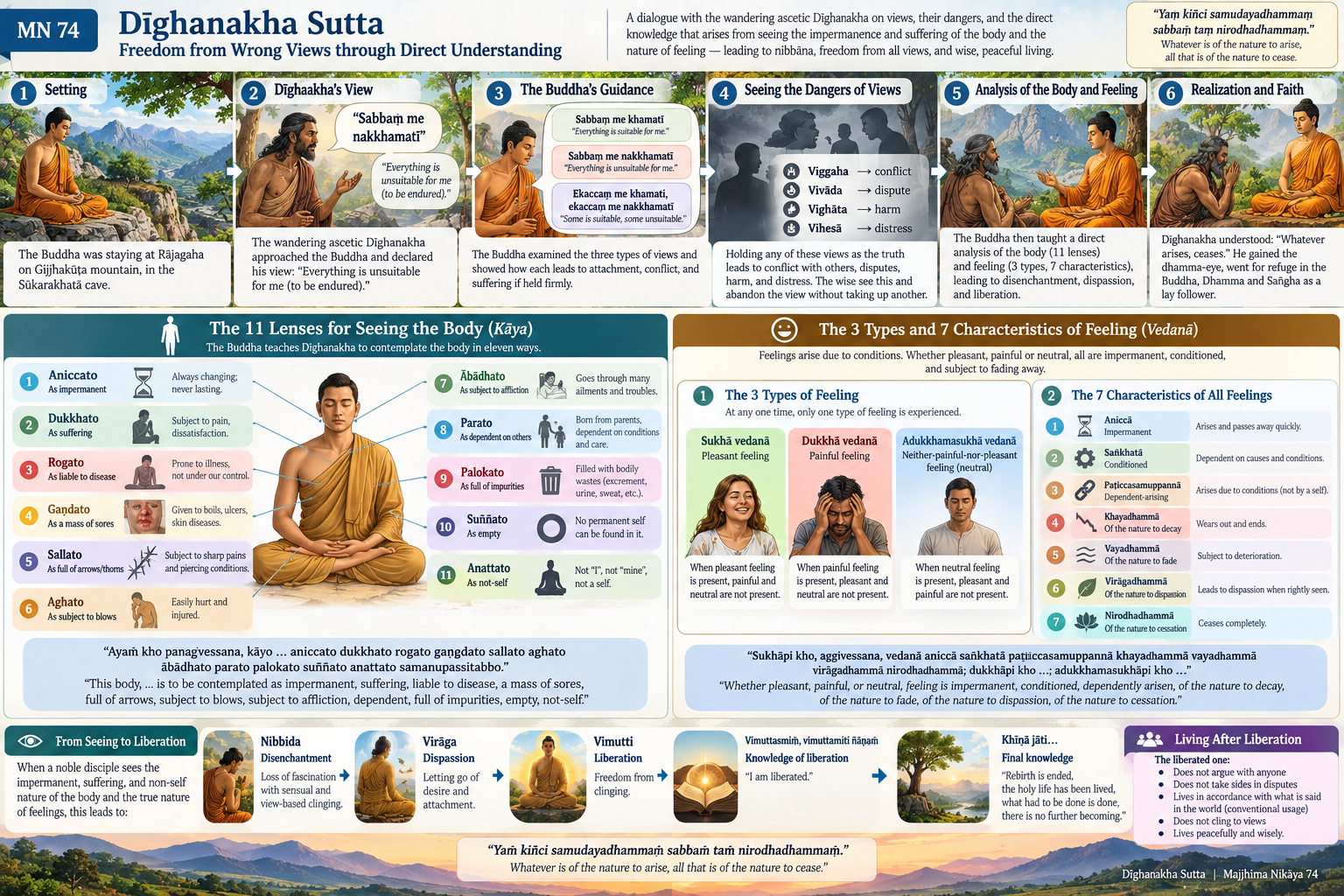 VISUAL SUMMARYSee this sutta in a pictureOpen the complete infographic for a visual overview before or after reading the full study.View infographic →
A progressive dismantling of appropriation
MN 74 Dīghanakhasutta can initially appear to be a philosophical discussion about views. Read carefully, however, the discourse reveals a much deeper architecture.
The Buddha progressively investigates three increasingly intimate levels at which the mind appropriates experience:
“my view” → “my body” → “my feeling”
Dīghanakha begins with a position:
sabbaṁ me nakkhamati
“Nothing is acceptable to me.”
The Buddha first reveals that even a doctrine apparently expressing detachment can itself become an object of attachment. A person may reject everything and yet cling strongly to the identity: “I am one who rejects everything.”
The Buddha therefore does not merely replace Dīghanakha’s philosophy with another philosophical position. He shows the danger inherent in grasping a view and insisting:
idameva saccaṁ moghamaññaṁ
“This alone is true; everything else is futile.”
Such appropriation produces:
viggaha → vivāda → vighāta → vihesā
opposition → dispute → disturbance → affliction.
The wise response is striking:
tañceva diṭṭhiṁ pajahati aññañca diṭṭhiṁ na upādiyati
One abandons that very view without taking up another view as a new object of clinging.
Then comes the decisive turn in the discourse. The Buddha moves from abstract views to directly observable experience: this body.
The body is examined according to its origin, composition, dependence upon nourishment, continual need for maintenance, vulnerability to breaking and eventual destruction. It is then contemplated through eleven powerful perspectives: aniccato, dukkhato, rogato, gaṇḍato, sallato, aghato, ābādhato, parato, palokato, suññato, anattato.
From body the Buddha goes still deeper into immediate experience: vedanā — pleasant, painful and neither-painful-nor-pleasant feeling.
Each is seen as: anicca, saṅkhata, paṭiccasamuppanna, khayadhamma, vayadhamma, virāgadhamma, nirodhadhamma.
Seeing in this way produces the liberating sequence:
nibbidā → virāga → vimutti.
Thus MN 74 moves from opinion to observation, observation to direct knowledge, direct knowledge to relinquishment, and relinquishment to freedom.
MN 74 Dīghanakhasutta — Paragraph by Paragraph
1 At the Boar’s Cave
Evaṁ me sutaṁ— ekaṁ samayaṁ bhagavā rājagahe viharati gijjhakūṭe pabbate sūkarakhatāyaṁ.
Thus have I heard. On one occasion the Blessed One was staying at Rājagaha, on Vulture Peak, at the Boar’s Cave.
Atha kho dīghanakho paribbājako yena bhagavā tenupasaṅkami; upasaṅkamitvā bhagavatā saddhiṁ sammodi. Sammodanīyaṁ kathaṁ sāraṇīyaṁ vītisāretvā ekamantaṁ aṭṭhāsi. Ekamantaṁ ṭhito kho dīghanakho paribbājako bhagavantaṁ etadavoca: “ahañhi, bho gotama, evaṁvādī evaṁdiṭṭhi: ‘sabbaṁ me nakkhamatī’”ti.
Then the wanderer Dīghanakha approached the Blessed One and exchanged greetings with him. When their courteous and cordial conversation was finished, he stood to one side and said: “Master Gotama, I am one who speaks thus and holds this view: ‘Nothing is acceptable to me.’”
2 The view turns upon itself
“Yāpi kho te esā, aggivessana, diṭṭhi: ‘sabbaṁ me nakkhamatī’ti, esāpi te diṭṭhi nakkhamatī”ti?
“But, Aggivessana, as for this view of yours, ‘Nothing is acceptable to me’ — is that very view itself also unacceptable to you?”
“Esā ce me, bho gotama, diṭṭhi khameyya, taṁpassa tādisameva, taṁpassa tādisamevā”ti.
“Master Gotama, even if this view were acceptable to me, it would still be just the same in that respect; it would still be just the same.”
3 Few abandon a view without adopting another
“Ato kho te, aggivessana, bahū hi bahutarā lokasmiṁ ye evamāhaṁsu: ‘taṁpassa tādisameva, taṁpassa tādisamevā’ti. Te tañceva diṭṭhiṁ nappajahanti aññañca diṭṭhiṁ upādiyanti. Ato kho te, aggivessana, tanū hi tanutarā lokasmiṁ ye evamāhaṁsu: ‘taṁpassa tādisameva, taṁpassa tādisamevā’ti. Te tañceva diṭṭhiṁ pajahanti aññañca diṭṭhiṁ na upādiyanti.
“Aggivessana, among those in the world who say, ‘It would still be just the same in that respect,’ the great majority do not abandon that view and additionally take up another view.
But very few among them abandon that very view without taking up another view.”
4 Three broad positions
Santaggivessana, eke samaṇabrāhmaṇā evaṁvādino evaṁdiṭṭhino: ‘sabbaṁ me khamatī’ti; santaggivessana, eke samaṇabrāhmaṇā evaṁvādino evaṁdiṭṭhino: ‘sabbaṁ me nakkhamatī’ti; santaggivessana, eke samaṇabrāhmaṇā evaṁvādino evaṁdiṭṭhino: ‘ekaccaṁ me khamati, ekaccaṁ me nakkhamatī’ti.
“Aggivessana, there are some ascetics and brahmins who hold the doctrine and view: ‘Everything is acceptable to me.’
There are some who hold: ‘Nothing is acceptable to me.’
And there are some who hold: ‘Some things are acceptable to me and some are not.’
Tatraggivessana, ye te samaṇabrāhmaṇā evaṁvādino evaṁdiṭṭhino: ‘sabbaṁ me khamatī’ti tesamayaṁ diṭṭhi sārāgāya santike, saññogāya santike, abhinandanāya santike, ajjhosānāya santike, upādānāya santike; tatraggivessana ye te samaṇabrāhmaṇā evaṁvādino evaṁdiṭṭhino: ‘sabbaṁ me nakkhamatī’ti tesamayaṁ diṭṭhi asārāgāya santike, asaññogāya santike, anabhinandanāya santike, anajjhosānāya santike, anupādānāya santike”ti.
“Of these, the view of those who say, ‘Everything is acceptable to me,’ is close to passion, close to bondage, close to delighting, close to holding fast and close to clinging.
The view of those who say, ‘Nothing is acceptable to me,’ is close to dispassion, close to non-bondage, close to non-delighting, close to not holding fast and close to non-clinging.”
5 Dīghanakha mistakes proximity for endorsement
Evaṁ vutte, dīghanakho paribbājako bhagavantaṁ etadavoca: “ukkaṁseti me bhavaṁ gotamo diṭṭhigataṁ, samukkaṁseti me bhavaṁ gotamo diṭṭhigatan”ti.
When this was said, the wanderer Dīghanakha said: “Master Gotama praises my standpoint! Master Gotama highly praises my standpoint!”
But the Buddha has not endorsed the view as something to cling to. He has only explained that its tendency lies nearer to non-clinging than the opposite position. The next teaching makes this distinction explicit.
6 The mixed position contains both tendencies
“Tatraggivessana, ye te samaṇabrāhmaṇā evaṁvādino evaṁdiṭṭhino: ‘ekaccaṁ me khamati, ekaccaṁ me nakkhamatī’ti. Yā hi tesaṁ khamati sāyaṁ diṭṭhi sārāgāya santike, saññogāya santike, abhinandanāya santike, ajjhosānāya santike, upādānāya santike; yā hi tesaṁ nakkhamati sāyaṁ diṭṭhi asārāgāya santike, asaññogāya santike, anabhinandanāya santike, anajjhosānāya santike, anupādānāya santike.
“As for those who hold the view, ‘Some things are acceptable to me and some are not’: what they accept is close to passion, bondage, delighting, holding fast and clinging; while what they reject is close to dispassion, non-bondage, non-delighting, not holding fast and non-clinging.”
7 Grasping “everything is acceptable”
Tatraggivessana, ye te samaṇabrāhmaṇā evaṁvādino evaṁdiṭṭhino: ‘sabbaṁ me khamatī’ti tattha viññū puriso iti paṭisañcikkhati: ‘yā kho me ayaṁ diṭṭhi— sabbaṁ me khamatīti, imañce ahaṁ diṭṭhiṁ thāmasā parāmāsā abhinivissa vohareyyaṁ— idameva saccaṁ moghamaññanti; dvīhi me assa viggaho— yo cāyaṁ samaṇo vā brāhmaṇo vā evaṁvādī evaṁdiṭṭhi— sabbaṁ me nakkhamatīti, yo cāyaṁ samaṇo vā brāhmaṇo vā evaṁvādī evaṁdiṭṭhi—ekaccaṁ me khamati, ekaccaṁ me nakkhamatīti— imehi assa dvīhi viggaho. Iti viggahe sati vivādo, vivāde sati vighāto, vighāte sati vihesā’.
“Regarding those who say, ‘Everything is acceptable to me,’ a wise person reflects:
‘If I were to hold firmly to this view of mine, grasp it, become entrenched in it and declare: “This alone is true; everything else is futile,” I would come into conflict with two kinds of people: those who say nothing is acceptable and those who say some things are acceptable and some are not.
When there is opposition there is dispute; when there is dispute there is disturbance; when there is disturbance there is affliction.’
Iti so viggahañca vivādañca vighātañca vihesañca attani sampassamāno tañceva diṭṭhiṁ pajahati aññañca diṭṭhiṁ na upādiyati. Evametāsaṁ diṭṭhīnaṁ pahānaṁ hoti, evametāsaṁ diṭṭhīnaṁ paṭinissaggo hoti.
Seeing in himself the danger of opposition, dispute, disturbance and affliction, he abandons that very view and does not take up another.
Thus these views are abandoned. Thus these views are relinquished.
8 Grasping “nothing is acceptable”
Tatraggivessana, ye te samaṇabrāhmaṇā evaṁvādino evaṁdiṭṭhino: ‘sabbaṁ me nakkhamatī’ti tattha viññū puriso iti paṭisañcikkhati: ‘yā kho me ayaṁ diṭṭhi— sabbaṁ me nakkhamatīti, imañce ahaṁ diṭṭhiṁ thāmasā parāmāsā abhinivissa vohareyyaṁ— idameva saccaṁ moghamaññanti; dvīhi me assa viggaho— yo cāyaṁ samaṇo vā brāhmaṇo vā evaṁvādī evaṁdiṭṭhi— sabbaṁ me khamatīti, yo cāyaṁ samaṇo vā brāhmaṇo vā evaṁvādī evaṁdiṭṭhi—ekaccaṁ me khamati ekaccaṁ me nakkhamatīti— imehi assa dvīhi viggaho. Iti viggahe sati vivādo, vivāde sati vighāto, vighāte sati vihesā’.
“Regarding those who say, ‘Nothing is acceptable to me,’ a wise person reflects:
‘If I were to hold firmly to this view, grasp it, become entrenched in it and declare, “This alone is true; everything else is futile,” I would come into conflict with those who say everything is acceptable and those who say some things are acceptable and some are not.
When there is opposition there is dispute; when there is dispute there is disturbance; when there is disturbance there is affliction.’
Iti so viggahañca vivādañca vighātañca vihesañca attani sampassamāno tañceva diṭṭhiṁ pajahati aññañca diṭṭhiṁ na upādiyati. Evametāsaṁ diṭṭhīnaṁ pahānaṁ hoti, evametāsaṁ diṭṭhīnaṁ paṭinissaggo hoti.
Seeing this danger, he abandons that very view and does not take up another. Thus these views are abandoned; thus they are relinquished.
9 Grasping the selective position
Tatraggivessana, ye te samaṇabrāhmaṇā evaṁvādino evaṁdiṭṭhino: ‘ekaccaṁ me khamati, ekaccaṁ me nakkhamatī’ti tattha viññū puriso iti paṭisañcikkhati: ‘yā kho me ayaṁ diṭṭhi— ekaccaṁ me khamati, ekaccaṁ me nakkhamatīti, imañce ahaṁ diṭṭhiṁ thāmasā parāmāsā abhinivissa vohareyyaṁ— idameva saccaṁ moghamaññanti; dvīhi me assa viggaho— yo cāyaṁ samaṇo vā brāhmaṇo vā evaṁvādī evaṁdiṭṭhi— sabbaṁ me khamatīti, yo cāyaṁ samaṇo vā brāhmaṇo vā evaṁvādī evaṁdiṭṭhi—sabbaṁ me nakkhamatīti— imehi assa dvīhi viggaho. Iti viggahe sati vivādo, vivāde sati vighāto, vighāte sati vihesā’.
“Regarding those who say, ‘Some things are acceptable to me and some are not,’ a wise person reflects:
‘If I were to hold firmly to this view, grasp it, become entrenched in it and declare, “This alone is true; everything else is futile,” I would come into conflict with those who say everything is acceptable and those who say nothing is acceptable.
When there is opposition there is dispute; when there is dispute there is disturbance; when there is disturbance there is affliction.’
Iti so viggahañca vivādañca vighātañca vihesañca attani sampassamāno tañceva diṭṭhiṁ pajahati aññañca diṭṭhiṁ na upādiyati. Evametāsaṁ diṭṭhīnaṁ pahānaṁ hoti, evametāsaṁ diṭṭhīnaṁ paṭinissaggo hoti.
Seeing this danger, he abandons that very view and does not take up another. Thus these views are abandoned; thus these views are relinquished.
10 The Buddha turns to the body
Ayaṁ kho panaggivessana, kāyo rūpī cātumahābhūtiko mātāpettikasambhavo odanakummāsūpacayo aniccucchādanaparimaddanabhedanaviddhaṁsanadhammo, aniccato dukkhato rogato gaṇḍato sallato aghato ābādhato parato palokato suññato anattato samanupassitabbo.
“Now, Aggivessana, this body is material, composed of the four great elements, born of mother and father, built up and sustained by rice and other food, impermanent, requiring anointing and rubbing, and subject to breaking apart and destruction.
It should be contemplated as impermanent, as unsatisfactory, as a disease, as a boil, as a dart, as a calamity, as an affliction, as alien, as disintegrating, as empty and as not-self.
Tassimaṁ kāyaṁ aniccato dukkhato rogato gaṇḍato sallato aghato ābādhato parato palokato suññato anattato samanupassato yo kāyasmiṁ kāyachando kāyasneho kāyanvayatā sā pahīyati.
“For one who contemplates this body in this way — as impermanent, unsatisfactory, disease, boil, dart, calamity, affliction, alien, disintegrating, empty and not-self — whatever desire for the body, affection for the body, and tendency to follow after the body exists is abandoned.”
11 The three kinds of vedanā
Tisso kho imā, aggivessana, vedanā— sukhā vedanā, dukkhā vedanā, adukkhamasukhā vedanā.
“Aggivessana, there are these three kinds of feeling: pleasant feeling, painful feeling, and neither-painful-nor-pleasant feeling.
Yasmiṁ, aggivessana, samaye sukhaṁ vedanaṁ vedeti, neva tasmiṁ samaye dukkhaṁ vedanaṁ vedeti, na adukkhamasukhaṁ vedanaṁ vedeti; sukhaṁyeva tasmiṁ samaye vedanaṁ vedeti.
“When one experiences pleasant feeling, at that time one does not experience painful feeling or neither-painful-nor-pleasant feeling; at that time one experiences pleasant feeling.
Yasmiṁ, aggivessana, samaye dukkhaṁ vedanaṁ vedeti, neva tasmiṁ samaye sukhaṁ vedanaṁ vedeti, na adukkhamasukhaṁ vedanaṁ vedeti; dukkhaṁyeva tasmiṁ samaye vedanaṁ vedeti.
“When one experiences painful feeling, at that time one does not experience pleasant feeling or neither-painful-nor-pleasant feeling; at that time one experiences painful feeling.
Yasmiṁ, aggivessana, samaye adukkhamasukhaṁ vedanaṁ vedeti, neva tasmiṁ samaye sukhaṁ vedanaṁ vedeti, na dukkhaṁ vedanaṁ vedeti; adukkhamasukhaṁyeva tasmiṁ samaye vedanaṁ vedeti.
“When one experiences neither-painful-nor-pleasant feeling, at that time one does not experience pleasant feeling or painful feeling; at that time one experiences neither-painful-nor-pleasant feeling.”
12 The conditioned nature of all vedanā
Sukhāpi kho, aggivessana, vedanā aniccā saṅkhatā paṭiccasamuppannā khayadhammā vayadhammā virāgadhammā nirodhadhammā; dukkhāpi kho, aggivessana, vedanā aniccā saṅkhatā paṭiccasamuppannā khayadhammā vayadhammā virāgadhammā nirodhadhammā; adukkhamasukhāpi kho, aggivessana, vedanā aniccā saṅkhatā paṭiccasamuppannā khayadhammā vayadhammā virāgadhammā nirodhadhammā.
“Aggivessana, pleasant feeling too is impermanent, conditioned, dependently arisen, subject to exhaustion, subject to passing away, subject to fading of passion and subject to cessation.
Painful feeling too is impermanent, conditioned, dependently arisen, subject to exhaustion, subject to passing away, subject to fading of passion and subject to cessation.
Neither-painful-nor-pleasant feeling too is impermanent, conditioned, dependently arisen, subject to exhaustion, subject to passing away, subject to fading of passion and subject to cessation.”
13 Nibbidā → virāga → vimutti
Evaṁ passaṁ, aggivessana, sutavā ariyasāvako sukhāyapi vedanāya nibbindati, dukkhāyapi vedanāya nibbindati, adukkhamasukhāyapi vedanāya nibbindati; nibbindaṁ virajjati, virāgā vimuccati. Vimuttasmiṁ, vimuttamiti ñāṇaṁ hoti.
“Seeing in this way, Aggivessana, the instructed noble disciple becomes disenchanted with pleasant feeling, disenchanted with painful feeling, and disenchanted with neither-painful-nor-pleasant feeling.
Being disenchanted, passion fades. Through fading of passion, one is liberated. When liberated, there is the knowledge: ‘Liberated.’
‘Khīṇā jāti, vusitaṁ brahmacariyaṁ, kataṁ karaṇīyaṁ, nāparaṁ itthattāyā’ti pajānāti.
One understands: ‘Birth is exhausted; the holy life has been lived; what had to be done has been done; there is no further coming to this state of being.’
14 Conventional language without grasping
Evaṁ vimuttacitto kho, aggivessana, bhikkhu na kenaci saṁvadati, na kenaci vivadati, yañca loke vuttaṁ tena voharati, aparāmasan”ti.
“Aggivessana, a bhikkhu whose mind is liberated in this way does not align himself contentiously with anyone and does not dispute with anyone.
He uses whatever expressions are used in the world, but without grasping them. ”
15 Sāriputta penetrates the principle
Tena kho pana samayena āyasmā sāriputto bhagavato piṭṭhito ṭhito hoti bhagavantaṁ bījayamāno.
At that time Venerable Sāriputta was standing behind the Blessed One, fanning him.
Atha kho āyasmato sāriputtassa etadahosi: “tesaṁ tesaṁ kira no bhagavā dhammānaṁ abhiññā pahānamāha, tesaṁ tesaṁ kira no sugato dhammānaṁ abhiññā paṭinissaggamāhā”ti.
Then Venerable Sāriputta thought: “It seems that the Blessed One teaches us the abandoning of various dhammas through direct knowledge; it seems that the Fortunate One teaches us the relinquishment of various dhammas through direct knowledge.”
Iti hidaṁ āyasmato sāriputtassa paṭisañcikkhato anupādāya āsavehi cittaṁ vimucci.
As Venerable Sāriputta reflected in this way, his mind was liberated from the āsavas through non-clinging.
16 The Dhamma-eye arises in Dīghanakha
Dīghanakhassa pana paribbājakassa virajaṁ vītamalaṁ dhammacakkhuṁ udapādi: “yaṁ kiñci samudayadhammaṁ sabbaṁ taṁ nirodhadhamman”ti.
And in the wanderer Dīghanakha there arose the stainless, immaculate vision of the Dhamma:
“Whatever is subject to arising, all of it is subject to cessation.”
Atha kho dīghanakho paribbājako diṭṭhadhammo pattadhammo viditadhammo pariyogāḷhadhammo tiṇṇavicikiccho vigatakathaṅkatho vesārajjappatto aparappaccayo satthusāsane bhagavantaṁ etadavoca:
Then Dīghanakha had seen the Dhamma, reached the Dhamma, understood the Dhamma and penetrated the Dhamma. He had crossed beyond doubt, become free from uncertainty, gained confidence, and become independent of others regarding the Teacher’s instruction.
17 Dīghanakha goes for refuge
“abhikkantaṁ, bho gotama, abhikkantaṁ, bho gotama. Seyyathāpi, bho gotama, nikkujjitaṁ vā ukkujjeyya, paṭicchannaṁ vā vivareyya, mūḷhassa vā maggaṁ ācikkheyya, andhakāre vā telapajjotaṁ dhāreyya: ‘cakkhumanto rūpāni dakkhantī’ti; evameva kho bhotā gotamena anekapariyāyena dhammo pakāsito.
“Excellent, Master Gotama! Excellent, Master Gotama! It is as though one were to turn upright what had been overturned, reveal what had been hidden, show the way to one who was lost, or hold up an oil lamp in the darkness so that those with eyes could see forms.
In the same way Master Gotama has made the Dhamma clear in many ways.
Esāhaṁ bhavantaṁ gotamaṁ saraṇaṁ gacchāmi dhammañca bhikkhusaṅghañca. Upāsakaṁ maṁ bhavaṁ gotamo dhāretu ajjatagge pāṇupetaṁ saraṇaṁ gatan”ti.
“I go for refuge to Master Gotama, to the Dhamma and to the Bhikkhu Saṅgha. May Master Gotama remember me as a lay follower who has gone for refuge from today onward for as long as life lasts.”
Dīghanakhasuttaṁ niṭṭhitaṁ catutthaṁ.
The Dīghanakhasutta, the fourth discourse, is finished.
The complete progression of MN 74
The discourse can be read as one continuous movement:
Diṭṭhi → Parāmāsa → Abhinivesa → Viggaha → Vivāda → Vighāta → Vihesā
The Buddha then reverses that movement:
Pahāna → Paṭinissagga → direct examination of Kāya → eleven contemplations of Kāya → weakening of Kāyachanda, Kāyasneha and Kāyanvayatā → observation of the three Vedanā → seeing their seven conditioned characteristics → Nibbidā → Virāga → Vimutti → Aparāmasa.
Thus the teaching progressively removes appropriation from views, body, feeling and finally language itself.
| Stage | What is appropriated? | Buddha’s investigation | Result |
|---|---|---|---|
| 1 | View | What happens when “my view” is grasped? | Conflict is exposed |
| 2 | Position | Can it be relinquished without adopting another? | Paṭinissagga |
| 3 | Body | What actually constitutes and sustains this body? | Ownership weakens |
| 4 | Body-identification | Eleven contemplative perspectives | Kāyachanda, kāyasneha, kāyanvayatā weaken |
| 5 | Feeling | How do pleasant, painful and neutral vedanā actually exist? | They are seen as conditioned |
| 6 | Experience | Anicca, saṅkhata, paṭiccasamuppanna, khaya, vaya, virāga, nirodha | Nibbidā |
| 7 | Passion | What happens when fascination ends? | Virāga |
| 8 | Clinging | What remains without appropriation? | Vimutti |
| 9 | Conventional language | Can ordinary language continue? | Yes — aparāmasaṁ |
From “my body” to conditioned materiality
1 Ayaṁ kāyo — “this body”
After dismantling attachment to views, the Buddha does not introduce another philosophical theory.
He turns directly toward:
ayaṁ … kāyo
“this body.”
The movement is deliberate:
from thinking about reality → to observing present reality.
Dīghanakha’s first appropriation was: “my view.”
The Buddha now approaches a much deeper appropriation: “my body.”
2 Rūpī — material
The body is rūpī — material.
Before the concepts “I,” “mine,” “beautiful,” “ugly,” “young,” “old,” “male,” “female,” “strong” or “weak” are added, there is materiality functioning according to conditions.
The Buddha begins by shifting attention away from identity toward the nature of the phenomenon itself.
3 Cātumahābhūtiko — constituted by four great elements
The body is cātumahābhūtiko — constituted by the four great elements.
Hardness, softness, pressure and resistance are understood through the earth-element characteristic.
Cohesion and liquidity through the water-element.
Temperature through the fire-element.
Movement, tension and expansion through the air-element.
The point is experiential: the body can be observed as elemental processes rather than immediately appropriated as “me.”
4 Mātāpettikasambhavo — arisen from mother and father
The body did not independently produce itself.
Mātāpettikasambhavo points directly to dependent origin: it arose through mother and father.
The organism later called “my body” therefore arose through conditions that existed before any later psychological claim of ownership.
5 Odanakummāsūpacayo — built up through nourishment
The body is odanakummāsūpacayo — built up and sustained by food.
This is an extraordinarily practical contemplation.
What today is called “my body” contains material that yesterday was food and water outside the body.
The organism continually exchanges matter with the environment.
It cannot say:
“Because I am mine, I shall continue without nourishment.”
Its continuation depends upon conditions.
6 Anicca — continually changing
Impermanence does not begin at death.
Hair changes. Skin changes. Muscle changes. Bones change. Vision changes. Digestion changes. Strength changes. Healing capacity changes.
A photograph from decades earlier simply makes visible what has been occurring every day.
The body persists through change, not by escaping change.
7 Ucchādana — requiring anointing and bodily care
Ucchādana refers to anointing, rubbing or applying substances to the body.
The point is not that bodily care is wrong.
The point is that this body requires continual maintenance.
It becomes dirty. Skin dries. It produces odour. It needs washing. It requires protection. It may need oils, creams or medicines.
Every act of care can therefore remind the practitioner:
“This is a conditioned organism requiring maintenance.”
8 Parimaddana — rubbing, massaging and tending
Parimaddana conveys rubbing or massaging.
The body becomes tired. Muscles tighten. Joints become stiff. Pressure causes discomfort. Rest becomes necessary.
The Buddha is not condemning massage or physical care.
He is exposing dependence.
That which we instinctively call “my permanent bodily foundation” requires continual intervention simply to remain functional.
9 Bhedana — breaking apart
Bhedana is breaking or splitting.
A bone fractures. A ligament tears. A tooth cracks. A blood vessel ruptures. An organ becomes impaired.
The body’s apparent unity depends upon countless conditions continuing to cooperate.
Its integrity is conditional rather than absolute.
10 Viddhaṁsana — destruction and dissolution
Viddhaṁsana carries the contemplation to its inevitable conclusion: destruction, dissolution and collapse.
Whatever has been assembled through conditions cannot remain assembled indefinitely.
The ordinary mind asks the body:
“Remain young.
Remain healthy.
Remain attractive.
Remain strong.
Remain alive.”
Dhamma asks something entirely different:
“See the body according to its actual nature.”
Aniccato → Dukkhato → Rogato → Gaṇḍato → Sallato → Aghato → Ābādhato → Parato → Palokato → Suññato → Anattato
1 Aniccato — as impermanent
aniccato samanupassitabbo
The body should be contemplated as impermanent.
This removes the expectation: “Let this remain as it is.”
We intellectually know that ageing occurs, yet emotionally react when it becomes visible in our own body.
Aniccato asks:
“What else could a conditioned body do except change?”
2 Dukkhato — as unsatisfactory and insecure
dukkhato samanupassitabbo
Dukkha here should not be reduced to: “the body is always painful.”
The deeper problem is that something impermanent, dependent and vulnerable cannot provide permanent security when appropriated as self.
If peace depends upon:
“May this body never age,
may it never hurt,
may it never become sick,
may it never die,”
dukkha has already been built into the relationship.
3 Rogato — as disease
rogato samanupassitabbo
Roga means disease or illness.
The contemplation does not require that one presently be ill.
The body is intrinsically vulnerable to imbalance. Health itself depends upon countless biological conditions remaining within workable ranges.
Thus health is not proof of permanence. It is a temporarily maintained configuration of conditions.
4 Gaṇḍato — as a boil or swelling
gaṇḍato samanupassitabbo
Gaṇḍa evokes a boil, swelling or vulnerable mass.
The image counters fascination with the body’s polished external appearance.
Beneath appearance is an organic system requiring protection, nourishment, cleaning, regulation and healing.
Like a swelling that becomes painful when disturbed, the body is vulnerable to pressure and changing conditions.
5 Sallato — as a dart
sallato samanupassitabbo
Salla means a dart or piercing object.
The body repeatedly provides conditions for painful experience: injury, hunger, heat, cold, fatigue, disease and ageing.
But another dart appears when the mind adds:
“Why is this happening to me?”
The physical event then becomes psychologically appropriated.
6 Aghato — as trouble or calamity
aghato samanupassitabbo
Agha carries the sense of trouble, misery, calamity or distress.
Something regarded as the basis of security can itself become the source of insecurity.
One medical diagnosis can suddenly reorganise one’s plans, relationships and priorities.
The contemplation asks:
“Can something itself vulnerable provide ultimate refuge?”
7 Ābādhato — as an affliction
ābādhato samanupassitabbo
Ābādha means affliction or ailment.
The body continually imposes requirements:
feed me;
give me water;
let me sleep;
warm me;
cool me;
move me;
rest me;
clean me;
treat me.
The lesson is not neglect.
The lesson is: dependence.
8 Parato — as alien, as other
parato samanupassitabbo
Para means other or alien.
This contemplation directly challenges ownership.
If the body were “mine” in the sense of sovereign control, one should be able to command:
“Do not age.
Do not become sick.
Do not hurt.
Do not deteriorate.
Do not die.”
Yet the body follows conditions rather than ownership.
Thus parato does not require rejection of the body. It exposes the limits of the claim: “This belongs to me and therefore should obey me.”
9 Palokato — as disintegrating
palokato samanupassitabbo
Paloka points toward crumbling, breaking down and disintegration.
Anicca tells us: the body does not remain the same.
Paloka takes the contemplation further: the apparent integrity of the body itself eventually breaks down.
What has been assembled moves toward disassembly.
10 Suññato — as empty
suññato samanupassitabbo
The body is contemplated as empty.
Not empty of organs, flesh, bones or processes.
Rather, empty of an independent permanent owner standing behind those processes.
There are elements. There is nourishment. There are inherited conditions. There is metabolism. There is ageing. There is repair. There is deterioration.
But within this conditioned activity, where is an independent controller?
11 Anattato — as not-self
anattato samanupassitabbo
The sequence culminates in anattā.
This is especially important in MN 74 because the discourse began with the danger of grasping philosophical positions.
If one merely converts anattā into another proposition:
“My doctrine is that there is no self,”
one may simply have constructed another view to defend.
Here anattā is reached through observation.
The body is seen as:
material,
elemental,
dependently originated,
dependent upon nourishment,
requiring maintenance,
impermanent,
vulnerable,
not fully controllable,
and subject to dissolution.
The insight therefore concerns appropriation:
“This is not appropriately regarded as mine.
This is not what I am.
This is not my self.”
Kāyachanda • Kāyasneha • Kāyanvayatā
Tassimaṁ kāyaṁ aniccato dukkhato rogato gaṇḍato sallato aghato ābādhato parato palokato suññato anattato samanupassato yo kāyasmiṁ kāyachando kāyasneho kāyanvayatā sā pahīyati.
The Buddha explicitly states what this contemplation accomplishes.
It is not contemplation merely for intellectual understanding. Three forms of bodily attachment are abandoned.
Kāyachanda — desire directed toward the body
The mind wants the body to produce satisfaction: beauty, attractiveness, comfort, youth, sensual pleasure, strength or social approval.
The Buddha does not merely command: “Stop desiring the body.”
He changes how the body is understood.
When its actual conditioned nature is repeatedly seen, fascination loses its foundation.
Kāyasneha — affection and sticky attachment
Sneha carries the sense of affection and attachment.
This is subtler than gross sensual desire.
The body can be emotionally appropriated:
“This body is me.”
Therefore deterioration of the body can be experienced as deterioration of identity itself.
The eleven contemplations progressively loosen that equation.
Kāyanvayatā — following after the body
The mind may organise enormous portions of life around the body’s comfort, appearance, preservation, comparison, sensual possibilities and social presentation.
It effectively lives in the wake of the body.
When bodily appropriation weakens, the body can still be washed, nourished, exercised, rested and medically treated.
But the mind no longer needs to follow every bodily desire, fear and demand.
This is not neglect.
It is: care without appropriation.
The Buddha now goes deeper than the body
Having investigated attachment to views and attachment to the body, the Buddha turns to an even more immediate field: vedanā.
This is crucial because our moment-to-moment relationship with the world is continually coloured by:
sukhā vedanā — pleasant feeling
dukkhā vedanā — painful feeling
adukkhamasukhā vedanā — neither-painful-nor-pleasant feeling.
These are not merely bodily sensations. Vedanā is the affective tone of experience associated with contact: pleasant, painful or neither.
1 Sukhā vedanā — pleasant feeling
Someone praises us.
A beautiful sight is seen.
A desired result arrives.
The body feels comfortable.
Pleasant vedanā arises.
The feeling itself is not yet clinging.
The danger appears when:
pleasant → delight → “I want more” → appropriation.
MN 74 asks us to know the pleasant feeling according to its nature before this chain develops.
2 Dukkhā vedanā — painful feeling
Criticism arrives.
The body hurts.
A plan fails.
Someone behaves contrary to expectation.
Painful vedanā arises.
The ordinary sequence can become:
painful → resistance → anger → mental proliferation → suffering.
The Buddha directs attention back to the vedanā itself.
What has arisen through conditions does not need to become “my suffering.”
3 Adukkhamasukhā vedanā — neutral feeling
Neutral feeling is easily overlooked.
Yet the Buddha gives it the same analysis as pleasant and painful feeling.
When neutrality is not understood, the mind may interpret it as boredom and begin seeking stimulation.
Thus moha can operate precisely where experience appears uneventful.
Why does the Buddha emphasise that only one is present at that time?
When pleasant feeling is being experienced, painful and neutral feeling are not the feeling presently being experienced.
When painful feeling is present, pleasant and neutral are not the present feeling.
When neutral feeling is present, pleasant and painful are not the present feeling.
The point becomes profound when observed experientially.
A feeling can dominate consciousness so strongly that the mind assumes:
“This is reality.”
But its replacement by another affective tone exposes its instability.
How every feeling is to be understood
1 Aniccā — impermanent
No pleasant, painful or neutral feeling remains permanently.
The very fact that one type of vedanā gives way to another reveals its impermanent nature.
2 Saṅkhatā — conditioned
Vedanā is saṅkhata — formed and conditioned.
It is not an independent entity existing by itself.
When the relevant conditions change, the feeling changes.
3 Paṭiccasamuppannā — dependently arisen
This term is central.
The feeling has arisen dependent upon conditions.
Instead of:
“I am happy,”
one learns to recognise:
“Pleasant vedanā has arisen dependent upon conditions.”
Instead of:
“I am miserable,”
one can know:
“Painful vedanā has arisen dependent upon conditions.”
This is not merely a change of vocabulary. It changes the relationship between experience and ownership.
4 Khayadhammā — subject to exhaustion
Whatever arises through conditions cannot sustain itself independently.
Its nature includes khaya — exhaustion.
Even an intense emotional feeling exhausts itself when the conditions supporting it are no longer maintained.
5 Vayadhammā — subject to passing away
Vaya emphasises decline and passing away.
The practitioner does not merely remember intellectually that the feeling will eventually disappear.
One learns to observe its alteration and disappearance.
6 Virāgadhammā — subject to fading of passion
When vedanā is no longer misperceived as permanent, independent or “mine,” fascination can fade.
Virāga is not emotional suppression.
It is the cooling that becomes possible when the basis for passion is understood.
7 Nirodhadhammā — subject to cessation
Every one of the three feelings is nirodhadhamma — of a nature to cease.
This anticipates Dīghanakha’s final breakthrough:
yaṁ kiñci samudayadhammaṁ sabbaṁ taṁ nirodhadhammaṁ.
Whatever is subject to arising is subject to cessation.
From “This is my view” to “Whatever arises ceases”
1. MN 74 is not primarily about winning an argument
The opening exchange is intellectually elegant. Dīghanakha says:
sabbaṁ me nakkhamati
“Nothing is acceptable to me.”
The Buddha immediately asks whether that very view is itself unacceptable to him.
This exposes a logical tension, but treating the passage merely as clever debate misses its purpose.
The Buddha is revealing the mind’s ability to convert even rejection into something possessed.
A person can become attached to:
“I believe everything.”
“I believe nothing.”
“I accept only what I personally approve.”
All three can become identity.
2. The real danger begins with appropriation
The key words are:
thāmasā parāmāsā abhinivissa
The view is held firmly, grasped, entered into and entrenched in.
At that point the mind no longer says:
“This is a proposition I am examining.”
It effectively says:
“This is my position.”
Then contradiction of the view is experienced almost as contradiction of the person.
3. “Idameva saccaṁ” is the turning point
The mind then declares:
idameva saccaṁ moghamaññaṁ
“This alone is true; everything else is futile.”
The Buddha traces the consequence:
Viggaha → Vivāda → Vighāta → Vihesā
Opposition develops.
Opposition becomes dispute.
Dispute becomes mental disturbance.
Mental disturbance becomes affliction.
The profound observation is that suffering is now occurring inside the person who is defending the view.
4. Modern example — disagreement about meditation
A practitioner experiences benefit from a meditation method.
Initially:
“This practice has helped me.”
Nothing problematic is implied.
Then:
“This is the correct practice.”
Then:
“Only this is the Buddha’s authentic practice.”
Then somebody questions the interpretation.
Painful vedanā arises. The body tightens. The mind prepares arguments.
The conversation ends, but the debate continues mentally for hours.
The other person may now be kilometres away.
Yet vighāta continues in one’s own mind.
MN 74 therefore asks a deeper question than:
“Who had the stronger argument?”
It asks:
“What happened to the mind when the view became ‘mine’?”
5. Relinquishment does not mean replacing A with B
The Buddha repeatedly gives the same remarkable instruction:
tañceva diṭṭhiṁ pajahati aññañca diṭṭhiṁ na upādiyati.
One abandons that view and does not take up another.
Suppose a person once held:
“A is absolutely true.”
After discovering a problem, the mind may simply move to:
“B is absolutely true, and everyone believing A is foolish.”
The content changed.
The structure of clinging did not.
MN 74 addresses the structure.
6. This does not mean that truth and falsity become meaningless
The discourse is not saying that a practitioner should lose discernment or treat every proposition as equally valid.
The Buddha himself teaches, distinguishes, corrects and explains.
The issue is whether discernment becomes appropriation.
One can say:
“This statement does not correspond to the teaching in this passage,”
without the additional mental construction:
“Therefore I must defeat the person saying it.”
7. Why does the Buddha suddenly introduce the body?
This is one of the most important structural questions in MN 74.
If the discourse were merely about philosophical tolerance, the body passage would appear unrelated.
But the body passage reveals what the discourse is really doing.
The Buddha has first loosened:
“my view.”
Now he investigates:
“my body.”
The movement is from a comparatively obvious form of appropriation to a far deeper one.
8. The body existed through conditions before “mine” was added
The Buddha analyses the body:
rūpī
cātumahābhūtiko
mātāpettikasambhavo
odanakummāsūpacayo.
Material.
Constituted by elements.
Arisen through mother and father.
Sustained through food.
Every phrase removes some of the imagined independence of the body.
It was not self-created.
It cannot self-sustain.
It depends upon matter coming from outside itself.
It functions through impersonal processes.
9. Ucchādana and parimaddana reveal something ordinary but profound
We spend considerable portions of life maintaining the body:
washing,
cleaning,
brushing teeth,
cutting nails,
applying creams,
resting,
stretching,
massaging,
exercising,
feeding,
treating injuries.
Ordinarily these activities reinforce:
“I am caring for my body.”
The same activities can become paññā:
“This conditioned body cannot maintain itself without continual care.”
Nothing needs to change externally.
Understanding changes.
10. Bhedana and viddhaṁsana destroy the fantasy of bodily permanence
The body is not merely changing aesthetically.
Its structural integrity is conditional.
It can break.
And ultimately it dissolves.
The mind nevertheless quietly demands:
“Let this remain mine forever.”
Dukkha emerges because desire asks conditioned materiality to violate its own nature.
11. The eleven contemplations are a systematic dismantling
The Buddha now gives eleven perspectives.
They form a remarkably comprehensive investigation.
Aniccato — it cannot provide permanence.
Dukkhato — therefore it cannot provide unconditional security.
Rogato — it is vulnerable to illness.
Gaṇḍato — its organic constitution is fragile and requires protection.
Sallato — it becomes a recurring basis for painful impact.
Aghato — it can become trouble and distress.
Ābādhato — it imposes continual conditions and can become afflicted.
Parato — it behaves according to conditions rather than ownership.
Palokato — its apparent integrity disintegrates.
Suññato — it is empty of an independent permanent controller.
Anattato — it cannot appropriately be taken as self.
12. The Buddha is not teaching hatred of the body
This point is essential.
If the practitioner turns these contemplations into:
“The body is disgusting; I hate it,”
attachment has merely changed into aversion.
That is not the movement of MN 74.
The body can be cared for carefully while being understood correctly.
The transformation is:
attachment → understanding,
not attachment → hatred.
13. Care without ownership
Suppose the body becomes ill.
Medicine is taken. A doctor is consulted. Rest is given. Nutrition is adjusted.
None of this contradicts anattā.
The difference lies in whether the mind adds:
“This must not happen to me.”
The body can be cared for precisely because conditions matter.
Anattā does not abolish causality.
It removes imagined ownership from causality.
14. Why vedanā comes immediately after the body
Once bodily appropriation has been investigated, the Buddha goes deeper.
Even if one intellectually understands:
“This body is not-self,”
the mind can still be driven every moment by:
“I like this.”
“I dislike this.”
“I am bored with this.”
This is the world of vedanā.
Pleasant feeling pulls.
Painful feeling pushes.
Neutral feeling disappears beneath ignorance.
Thus the Buddha enters the immediate affective machinery through which attachment operates.
15. Vedanā across life
Someone smiles at us.
Pleasant vedanā.
Someone ignores us.
Painful vedanā.
We wait in an ordinary room with nothing particularly interesting happening.
Neutral vedanā.
A meal tastes good.
Pleasant vedanā.
The knee hurts while sitting.
Painful vedanā.
Ordinary breathing proceeds without particular pleasure or pain.
Neutral vedanā.
The entire day is continuously coloured by these three.
16. The problem is not vedanā itself
The Buddha does not instruct:
“Never experience pleasant feeling.”
Nor:
“Painful feeling should disappear.”
The teaching concerns how feeling is known.
When pleasant feeling is misperceived:
“This will make me happy.”
Craving can follow.
When painful feeling is misperceived:
“This must not exist.”
Aversion can follow.
When neutral feeling is not understood, ignorance can remain.
17. Paṭiccasamuppannā changes everything
The Buddha does not merely say that feelings are temporary.
He calls them:
paṭiccasamuppannā
dependently arisen.
This changes the perspective from:
entity → process.
Not:
“my permanent happiness.”
But:
“pleasant vedanā arisen through conditions.”
Not:
“my permanent suffering.”
But:
“painful vedanā arisen through conditions.”
18. Khaya and vaya can be directly observed
A person receives criticism.
Painful feeling arises strongly.
Five minutes later its intensity changes.
An hour later it may be different again.
But mental proliferation can repeatedly reconstruct the conditions:
“What did he mean?”
“Why did she say that?”
“I should have replied…”
“Next time I will tell them…”
The original contact has ended.
Yet thought repeatedly feeds conditions supporting renewed vedanā.
Observing khaya and vaya shows what happens when that feeding stops.
19. Nibbidā is not disgust
The sutta says:
Evaṁ passaṁ… nibbindati.
Seeing thus, one becomes disenchanted.
Nibbidā is not depression.
It is not bitterness.
It is not:
“Nothing matters.”
It is the fading of fascination that occurs when something is understood according to reality.
The child who learns that a magician’s illusion is a trick does not need to hate the magician.
The spell simply loses its former power.
20. Virāga follows understanding
The sequence is:
nibbindaṁ virajjati
Being disenchanted, passion fades.
Virāga is therefore not produced through force.
When the basis for fascination is removed, passion loses fuel.
21. Vimutti is not manufactured
Then:
virāgā vimuccati
Through dispassion, one is liberated.
The progression is extremely important:
seeing → nibbidā → virāga → vimutti.
The Buddha does not say:
“Force yourself to become liberated.”
He teaches the seeing that removes the conditions sustaining bondage.
22. The liberated person can still say “I”
Then comes one of the most important statements in the sutta:
yañca loke vuttaṁ tena voharati, aparāmasaṁ.
The liberated person uses the expressions used in the world without grasping them.
This means ordinary communication does not have to disappear.
One can say:
“I am going.”
“My robe.”
“My bowl.”
“You are sitting there.”
The grammatical convention is not the problem.
The problem is parāmāsa — appropriation.
23. The opening and ending now become mirror images
Dīghanakha begins:
sabbaṁ me nakkhamati.
“Nothing is acceptable to me.”
Notice:
me — to me.
The world is being interpreted in relation to a position belonging to Dīghanakha.
He ends with:
yaṁ kiñci samudayadhammaṁ sabbaṁ taṁ nirodhadhammaṁ.
“Whatever is subject to arising, all of it is subject to cessation.”
The first statement tells us:
what I think about reality.
The second reveals:
the nature of conditioned reality itself.
24. Sāriputta hears the principle behind the entire discourse
Sāriputta’s reflection gives us the interpretive key:
abhiññā pahāna
abandoning through direct knowledge,
abhiññā paṭinissagga
relinquishing through direct knowledge.
This connects every section.
Views are not abandoned through another dogma.
Body attachment is not abandoned through hatred.
Vedanā is not overcome through suppression.
The dhammas are known.
Their conditioned nature is penetrated.
Through understanding, appropriation loses its basis.
25. Two listeners, two depths of penetration
The Buddha gives one discourse.
Sāriputta hears it while standing behind him.
Dīghanakha hears it as the direct recipient.
For Sāriputta:
anupādāya āsavehi cittaṁ vimucci.
The mind is liberated from the āsavas through non-clinging.
For Dīghanakha:
virajaṁ vītamalaṁ dhammacakkhuṁ udapādi.
The stainless, immaculate Dhamma-eye arises.
The same words therefore do not mechanically produce identical results.
Penetration depends upon the development of the person hearing them.
26. The entire discourse in one movement
MN 74 begins with a man who has a philosophy.
The Buddha reveals attachment hidden within the philosophy.
He shows how attachment to views generates conflict.
He teaches relinquishment without replacing one attachment with another.
He then turns from abstract thought to the body.
The body is exposed as conditioned, dependent, maintained, vulnerable and disintegrating.
Eleven contemplations dismantle bodily appropriation.
The Buddha then enters the subtler world of vedanā.
Pleasant, painful and neutral feeling are shown to be impermanent, conditioned, dependently arisen, subject to exhaustion, passing away, fading and cessation.
Seeing this produces nibbidā.
Nibbidā produces virāga.
Through virāga comes vimutti.
And the liberated person continues to live and speak within the conventional world — without grasping it.
Watching MN 74 unfold in ordinary life
1 A disagreement in the family
Two people have different ideas about what should be done.
Initially there are simply two proposals.
Then:
“My way is right.”
Then:
“Why don’t you ever listen to me?”
The issue has moved from proposal → view → identity.
MN 74 asks the practitioner to recognise the transition before vivāda becomes vighāta.
2 Praise after teaching
Someone says: “That was an excellent teaching.”
Pleasant vedanā arises.
Then:
“They understand me.”
Then:
“I hope everyone appreciates me this way.”
Pleasant vedanā has become material for identity.
MN 74 returns to:
aniccā • saṅkhatā • paṭiccasamuppannā • nirodhadhammā.
The praise can be heard. The pleasant feeling can be known. Neither needs to become “me.”
3 Criticism
Someone criticises something we have done.
Painful vedanā arises.
The conversation lasts two minutes.
The mind continues the conversation for six hours.
The external event has ceased.
But mental proliferation repeatedly recreates conditions for painful vedanā.
MN 74 asks:
Can the vedanā be known as vedanā before it becomes a story about “me”?
4 Ageing
A person notices a physical change associated with age.
The physical change is one event.
Then the mind says:
“I am losing what I used to be.”
MN 74 directs attention differently:
The body was anicca twenty years ago.
It was anicca ten years ago.
It was anicca yesterday.
It is anicca today.
Ageing did not suddenly violate the body’s nature.
It revealed it.
5 Illness
Illness can be approached on two levels.
First:
the body requires treatment.
Second:
the mind does not need to construct ownership-based resistance.
Medicine and anattā are not opposites.
Because the body is conditioned, appropriate conditions for recovery should be provided.
The Dhamma concerns the additional appropriation:
“This should never have happened to me.”
6 Social media disagreement
A comment contradicts a strongly held opinion.
Painful vedanā.
Then:
“They are wrong.”
Then:
“I must show them they are wrong.”
Then:
viggaha → vivāda → vighāta.
Hours later the phone is no longer being used, but the debate continues mentally.
The question of MN 74 is not:
“Who won?”
It is:
“What did grasping the position do to the mind?”
Applying MN 74 in real time
1 Recognise the view
When disagreement occurs, first recognise:
“A view is present.”
Do not immediately turn:
“There is a view”
into:
“This is my view and I must defend it.”
2 Recognise parāmāsa
Ask:
Am I investigating this position, or am I psychologically defending myself through it?
What happens in the body when someone disagrees?
What happens to breathing?
What happens to speech?
What happens to vedanā?
3 Return to the body
Observe this body as conditioned materiality.
Remember:
rūpī
cātumahābhūtiko
mātāpettikasambhavo
odanakummāsūpacayo.
The body itself can become the ground for returning from conceptual proliferation to direct observation.
4 Use the eleven contemplations appropriately
When bodily attachment, fear, vanity or identification becomes strong, examine:
aniccato
dukkhato
rogato
gaṇḍato
sallato
aghato
ābādhato
parato
palokato
suññato
anattato.
Do not mechanically chant the words.
Find how each perspective applies to what is actually being experienced.
5 Identify vedanā before reaction
At the moment of contact ask:
Sukhā?
Dukkhā?
Adukkhamasukhā?
Know the affective tone before immediately turning it into:
“I want,”
“I don’t want,”
or “I need something more interesting.”
6 See the seven characteristics
For whatever vedanā is present, investigate:
aniccā
saṅkhatā
paṭiccasamuppannā
khayadhammā
vayadhammā
virāgadhammā
nirodhadhammā.
The question is not:
“Can I make this feeling disappear?”
but:
“Can I see accurately what this feeling already is?”
7 Do not manufacture nibbidā
Nibbidā is not:
“I must become disenchanted.”
The sutta says:
evaṁ passaṁ
seeing in this way.
Correct seeing is the condition.
Nibbidā is the consequence.
8 Allow virāga rather than forcing detachment
When the object is understood, its power to fascinate weakens.
That cooling is virāga.
It is not emotional numbness.
It is freedom from the demand:
“This must satisfy me.”
9 Use conventional language without appropriation
There is no need to avoid ordinary words such as:
“I,” “you,” “mine,” “body,” “person.”
The practice is:
aparāmasaṁ
without grasping.
This allows full participation in ordinary life without converting conventional designations into permanent identities.
MN 74 — the whole training at a glance
| Stage | Pāḷi | Meaning | What is being dismantled? |
|---|---|---|---|
| 1 | Diṭṭhi | View | Conceptual position |
| 2 | Thāmasā | Holding firmly | Rigidity |
| 3 | Parāmāsa | Grasping | Appropriation |
| 4 | Abhinivesa | Entrenchment | Identification with the view |
| 5 | Viggaha | Opposition | Us-versus-them structure |
| 6 | Vivāda | Dispute | Contention |
| 7 | Vighāta | Disturbance | Mental agitation |
| 8 | Vihesā | Affliction | Suffering generated by clinging |
| 9 | Pahāna | Abandoning | The grasped position |
| 10 | Paṭinissagga | Relinquishment | Need to replace one attachment with another |
| 11 | Rūpī | Material | Personalised view of body |
| 12 | Cātumahābhūtiko | Four-element constitution | Assumption of bodily unity as self |
| 13 | Mātāpettikasambhavo | Arisen from parents | Self-origin assumption |
| 14 | Odanakummāsūpacayo | Sustained by food | Self-sufficiency |
| 15 | Ucchādana / Parimaddana | Anointing / rubbing / maintenance | Fantasy of autonomous body |
| 16 | Bhedana / Viddhaṁsana | Breaking / destruction | Fantasy of bodily permanence |
| 17 | 11 Kāya contemplations | Anicca through Anattā | Bodily appropriation |
| 18 | Kāyachanda | Desire for body | Fascination |
| 19 | Kāyasneha | Affection/attachment to body | Emotional ownership |
| 20 | Kāyanvayatā | Following after body | Life organised around bodily identity |
| 21 | Sukhā vedanā | Pleasant feeling | Basis for attraction |
| 22 | Dukkhā vedanā | Painful feeling | Basis for aversion |
| 23 | Adukkhamasukhā vedanā | Neutral feeling | Basis for unnoticed ignorance |
| 24 | Aniccā | Impermanent | Permanence assumption |
| 25 | Saṅkhatā | Conditioned | Independent-existence assumption |
| 26 | Paṭiccasamuppannā | Dependently arisen | Ownership |
| 27 | Khaya | Exhaustion | Expectation of continuation |
| 28 | Vaya | Passing away | Expectation of stability |
| 29 | Virāga | Fading of passion | Fascination |
| 30 | Nirodha | Cessation | Expectation that feeling must remain |
| 31 | Nibbidā | Disenchantment | Spell of conditioned experience |
| 32 | Vimutti | Liberation | Clinging |
| 33 | Aparāmasa | Without grasping | Appropriation of conventional language |
The Buddha moves Dīghanakha from position to process
MN 74 begins with:
sabbaṁ me nakkhamati
“Nothing is acceptable to me.”
It begins, therefore, with:
“my view.”
The Buddha first exposes what happens when a view is appropriated:
Diṭṭhi → Parāmāsa → Abhinivesa → Viggaha → Vivāda → Vighāta → Vihesā.
He then teaches:
Pahāna → Paṭinissagga.
Abandon the grasped view without immediately manufacturing another identity from its opposite.
Then the Buddha moves deeper:
from “my view” to “my body.”
The body is revealed as:
rūpī,
cātumahābhūtiko,
mātāpettikasambhavo,
odanakummāsūpacayo,
requiring ucchādana and parimaddana,
subject to bhedana and viddhaṁsana.
It is then seen through eleven perspectives:
aniccato
dukkhato
rogato
gaṇḍato
sallato
aghato
ābādhato
parato
palokato
suññato
anattato.
The result is not hatred of the body.
It is the fading of:
kāyachanda,
kāyasneha,
kāyanvayatā.
Then the Buddha goes deeper still:
from “my body” to the immediate arising of vedanā.
Pleasant.
Painful.
Neither-painful-nor-pleasant.
Every one is:
aniccā
saṅkhatā
paṭiccasamuppannā
khayadhammā
vayadhammā
virāgadhammā
nirodhadhammā.
When this is actually seen:
Evaṁ passaṁ…
the movement becomes:
Nibbidā → Virāga → Vimutti.
Sāriputta recognises the principle governing the whole discourse:
Abhiññā pahāna — abandoning through direct knowledge.
Abhiññā paṭinissagga — relinquishing through direct knowledge.
And Dīghanakha’s opening philosophical declaration finally gives way to the Dhamma-eye:
Yaṁ kiñci samudayadhammaṁ sabbaṁ taṁ nirodhadhammaṁ.
Whatever is subject to arising, all of it is subject to cessation.
This is the transformation of MN 74:
from “what I believe”
to “what is directly seen”;
from “my view”
to relinquishment of views;
from “my body”
to conditioned materiality;
from “my feeling”
to dependently arisen vedanā;
from appropriation
to aparāmasa;
from clinging
to freedom.
And yet the liberated person can still live, speak and function within the conventional world:
yañca loke vuttaṁ tena voharati, aparāmasaṁ.
One uses the expressions of the world without grasping them.
That may be the most practical expression of liberation in the entire discourse:
nothing needs to disappear from conventional life; what disappears is appropriation.