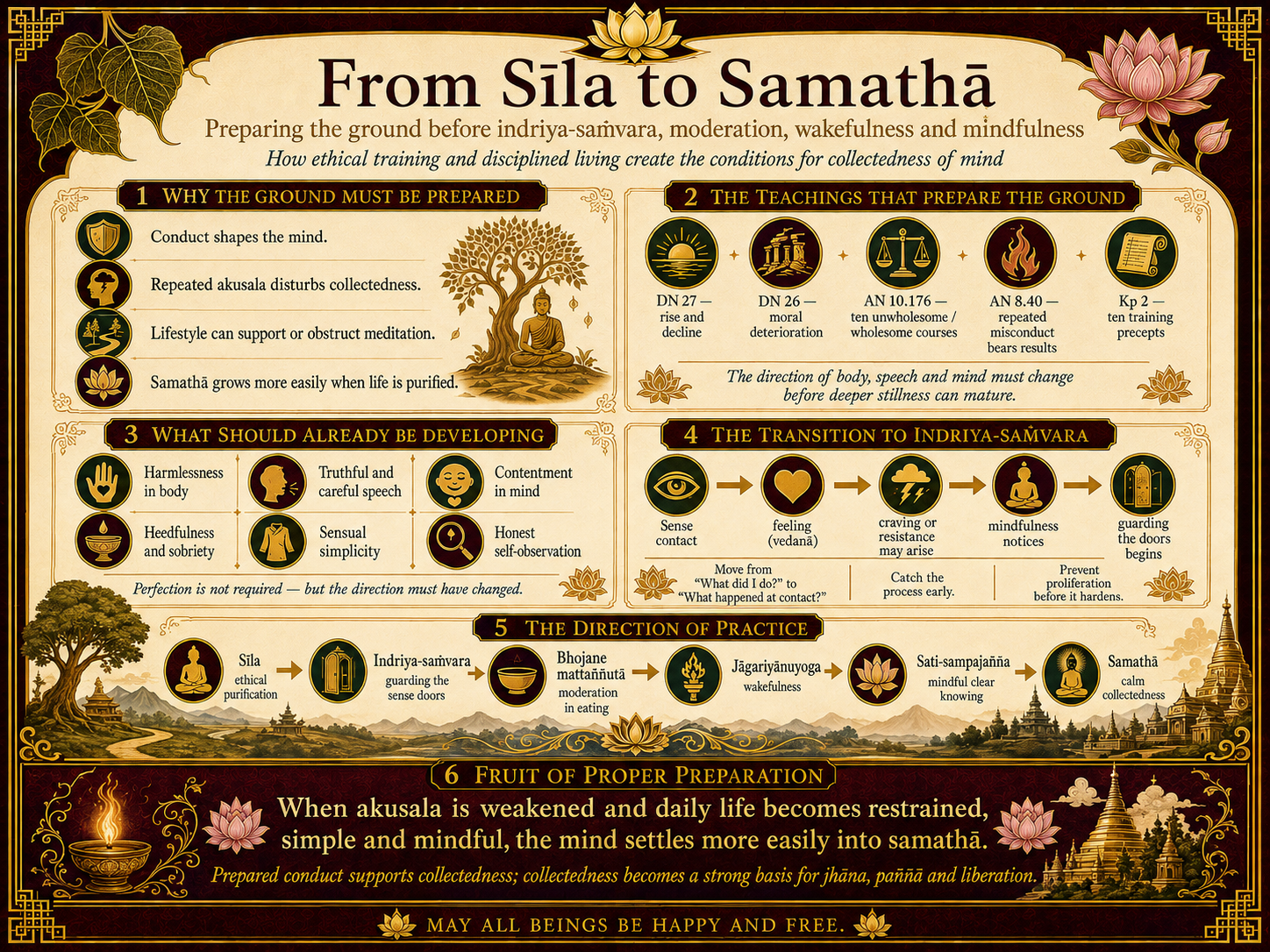
 VISUAL SUMMARYSee this study in a pictureOpen the complete infographic for a visual overview before or after reading the full study.View infographic →
Establishing the Ground Before Indriya-saṁvara, Bhojane Mattaññutā, Jāgariyānuyoga and Sati-sampajañña
The Buddha’s training is progressive. It does not begin with a meditation technique detached from the rest of one’s life. It begins by changing the direction in which one lives. Before attempting indriya-saṁvara, the guarding of the sense faculties, there must already be a serious examination of how one acts, speaks, thinks, eats, consumes, seeks pleasure, responds to discomfort and spends the waking day.
This is important for both the lay practitioner and the recluse. Their outward disciplines are not identical, but the moral direction that has to be developed is the same: harmlessness rather than violence, honesty rather than taking what is not given, responsibility rather than sexual misconduct, truthful and beneficial speech rather than corrupt speech, non-covetousness rather than grasping, goodwill rather than ill will, and right view rather than wrong view. A recluse carries renunciation further, but a lay practitioner cannot bypass purification of body, speech and mind merely because he or she lives a household life.
The purpose of this essay is therefore not to assemble several unrelated lists of precepts. It is to show how the teachings fit together as one architecture of training. DN 27 and DN 26 provide the larger picture of coarsening and decline. AN 10.176 identifies the bodily, verbal and mental pathways through which impurity develops. AN 8.40 makes the consequences of repeated misconduct unmistakable. Kp 2 shows how lifestyle itself can be reorganized so that heedlessness and sensual stimulation are no longer continuously fed. From that prepared ground the gradual training proceeds naturally into indriya-saṁvara → bhojane mattaññutā → jāgariyānuyoga → sati-sampajañña → samathā.
Three teachings are especially useful for establishing this foundation:
AN 10.176 — Cundasutta explains the ten courses of unwholesome and wholesome conduct and therefore gives us the broad moral framework.
Kp 2 — Dasasikkhāpada gives ten practical training rules which discipline everyday life and reduce the conditions that support heedlessness and sensuality.
AN 8.40 — Duccaritavipākasutta shows that repeatedly cultivating misconduct has consequences; actions become patterns, and patterns bear results.
But these three teachings become still more meaningful when placed against the larger picture given in DN 26, Cakkavattisīhanāda Sutta, and DN 27, Aggañña Sutta.
The question then ceases to be merely:
“Which precepts am I keeping?”
A much more serious question arises:
“In which direction is this mind developing?”
That is the central question. A person may call himself Buddhist, observe ceremonies, meditate every day or even spend long hours sitting, but if the direction of body, speech and mind remains toward greed, conflict, sensual proliferation and heedlessness, the foundation has not yet been established.
The teachings at a glance
The texts therefore need not be forced into a single identical list. Their strength lies precisely in their different functions.
The broad moral framework: ten courses of unwholesome and wholesome conduct.
A practical lifestyle discipline reducing heedlessness, sensuality and unnecessary stimulation.
Repeated misconduct becomes training, and repeatedly cultivated conduct bears consequences.
11. The Larger Perspective: Rise and Decline
DN 26 gives an extraordinary account of moral deterioration.
The decline of human beings does not occur randomly. One condition gives rise to another. When appropriate social and ethical conditions disappear, stealing appears. When stealing becomes established, lying follows. Violence follows. Killing follows. Other forms of misconduct proliferate. Human relationships deteriorate, and eventually even the recognition of what is wholesome and unwholesome becomes obscured.
The sutta therefore presents morality as something much larger than private rule-following.
The condition of the world reflects the qualities being cultivated in human minds.
DN 27 supplies another part of the larger cosmological picture. It describes beings associated with the Ābhassara realm who, after the world evolves again, appear in this world. Initially they are described as mind-made, feeding on rapture, self-luminous and moving through the sky.
Then something changes.
As the newly manifested earth develops, a being tastes it.
Craving arises.
Others follow.
What begins as tasting becomes enjoyment; enjoyment becomes attachment. Gradually the earlier luminosity disappears. Differences of appearance emerge. Conceit develops around those differences. Sexual differentiation and sexuality become prominent. Possession develops. Hoarding develops. Theft develops. Accusation and punishment develop.
Whether one is examining DN 27 cosmologically or primarily for its Dhamma structure, its practical lesson is profound:
decline proceeds through craving, appropriation, comparison, conceit and increasingly coarse forms of conduct.
DN 26 then shows where collective moral decline can eventually lead.
Placed together, the two suttas give us an important background for practice.
The practitioner is not merely trying to “be a good person.”
He or she is learning to recognize and reverse the very tendencies through which beings become increasingly bound to sensuality, possession, conflict and suffering.
22. AN 10.176: Finding the Mechanism of Downfall Within Oneself
Against that background, AN 10.176 becomes exceptionally important.
The Buddha identifies ten courses of unwholesome conduct:
These should not merely be memorized as ten prohibited behaviours.
They should be understood as ten directions in which the mind can deteriorate.
That changes the practice completely.
Pāṇātipāta — killing
One begins much earlier than the physical act of killing.
Look for irritation toward living beings, delight in another’s suffering, indifference toward life, cruelty, aggression and the wish that another being should disappear.
The practitioner asks:
Is ahiṁsā increasing in me, or is aggression being strengthened?
Adinnādāna — taking what is not given
Again, theft is only its gross manifestation.
Watch the underlying movement:
“I want what belongs to another.”
Entitlement, exploitation, dishonesty in transactions and taking advantage of another person’s ignorance all deserve examination.
Kāmesumicchācāra — sexual misconduct
Here one learns responsibility concerning sensual desire and sexual conduct: not causing betrayal, exploitation, deception or harm through sexuality.
But this also prepares the practitioner for what comes later.
Sīla initially regulates what one does under the influence of sensual desire.
Indriya-saṁvara will eventually investigate what happens when the attractive object first meets the sense faculty.
That distinction is crucial.
33. The Four Forms of Speech Require Much More Attention
Many people who consider themselves morally disciplined would never kill or steal.
Yet their speech remains almost completely untrained.
AN 10.176 therefore expands morality beyond musāvāda.
Musāvāda
Do I knowingly distort what is true?
Pisuṇā vācā
Do I carry information from one person to another in ways that divide them?
Even if what I say is factually correct, what is my intention?
Am I producing reconciliation or separation?
Pharusā vācā
Do my words wound unnecessarily?
A practitioner should begin noticing not merely vocabulary but tone, irritation, impatience and the intention behind speaking.
Samphappalāpa
How much speech has no beneficial purpose?
This becomes especially relevant for someone preparing for serious meditation.
A mind accustomed throughout the day to unnecessary talking, messaging, entertainment, commentary and argument cannot reasonably be expected to become silent simply because the body has sat down for meditation.
Thus restraint of speech is already preparation for samathā.
44. AN 10.176 Then Enters the Mind
Here the teaching becomes deeper still.
The final three are not external acts.
They are mental.
Abhijjhā — covetousness
One sees something belonging to another and the mind moves toward possession:
“May that become mine.”
This movement has to be recognized.
Byāpāda — ill will
The mind wishes harm, misfortune or destruction upon another.
Even if nothing is spoken and nothing is physically done, the direction of mind itself has become unwholesome.
Micchādiṭṭhi — wrong view
This is particularly serious because view determines direction.
If one does not understand action and consequence, wholesome and unwholesome, responsibility and the possibility of purification, there is little reason to restrain oneself when desire becomes strong.
Therefore AN 10.176 reaches something that a simple list of external precepts cannot reach:
the purification of the three doors—body, speech and mind.
This is why it can serve as our principal map of moral development.
55. DN 26 Shows What Happens When This Direction Is Reversed
Now return to DN 26.
Its account becomes much more personal.
Do not read it merely as a story about civilizations declining sometime in the distant past.
Look for its mechanism here and now.
When desire overrides restraint, taking what is not given becomes possible.
Once misconduct has occurred, lying may be used to conceal it.
Conflict develops.
Violence becomes easier.
As wholesome standards weaken, what previously produced shame eventually becomes normal.
This is how decline works both socially and individually:
akusala tolerated → akusala repeated → akusala normalized → akusala strengthened.
And the reverse is equally important:
akusala recognized → restrained → abandoned → kusala cultivated → kusala made abundant.
Therefore the ten courses in AN 10.176 become a practical means of reversing the direction portrayed in DN 26.
The practitioner begins with himself.
66. AN 8.40: What You Repeatedly Cultivate Matters
AN 8.40 adds another essential dimension.
The sutta discusses eight forms of misconduct and their consequences:
killing, stealing, sexual misconduct, lying, divisive speech, harsh speech, frivolous speech and drinking intoxicants.
Its recurring emphasis is especially important:
This language should make a meditator attentive.
Kamma is not merely about dramatic isolated events.
What am I repeatedly cultivating?
This connects morality directly with bhāvanā.
One is always cultivating something.
The only question is what.
AN 8.40 adds urgency because it does not speak merely of social inconvenience. For each of its eight forms of misconduct, repeated cultivation is said to conduce to hell, the animal realm or the realm of afflicted spirits. The discourse then gives what it calls the lightest or minimum result when one again becomes human. These should be distinguished from the ordinary present-life effects that can already be observed.
AN 8.40 — misconduct and consequence
The second column is a practical observation about the direction in which conduct trains the mind and one’s relationships; it is not presented as the formal vipāka formula of AN 8.40. The final two columns are what give the sutta its particular force. The Buddha is saying that what is repeatedly pursued, developed and made much of is not ethically neutral.
This is why a practitioner should not ask only, “Did I commit a major offence today?” A better question is:
“What did I rehearse today until it became a little easier to repeat tomorrow?”
Every repetition is training.
77. Why Intoxication Appears Here but Not Among the Ten Kammapathas
This apparent discrepancy is useful rather than problematic.
AN 10.176 gives the ten courses of wholesome and unwholesome action through body, speech and mind.
AN 8.40 includes intoxication because its particular concern is misconduct and its consequences.
Kp 2 also includes:
Surāmerayamajjapamādaṭṭhānā veramaṇī
refraining from intoxicating drink and substances that are a basis for heedlessness.
The crucial word is pamāda.
A practitioner preparing for indriya-saṁvara requires increasing appamāda, heedfulness.
Anything deliberately cultivated that weakens mindfulness, judgment and restraint moves in precisely the opposite direction.
So intoxicants need not be made an artificial “eleventh kammapatha.”
Their place in the training is already clear.
88. Kp 2: Constructing a Life Suitable for Bhāvanā
Kp 2 now becomes easier to understand.
Its ten training rules are:
Why does this list look so different from AN 10.176?
Because its function is different.
It is not trying to enumerate every form of akusala.
It is creating a mode of living conducive to renunciation and mental development.
Notice especially what happens after the first five.
Food becomes regulated.
Entertainment becomes regulated.
Adornment becomes regulated.
Comfort becomes regulated.
Possession becomes regulated.
This is enormously important before indriya-saṁvara.
The practitioner is progressively reducing the mind’s habitual movement:
toward gratification.
But Kp 2 must be applied intelligently. Its ten rules are the ten training rules of renunciant discipline, not a statement that every lay Buddhist must immediately live exactly like a novice. At the same time, a lay practitioner preparing seriously for meditation should understand the principle behind each rule rather than dismiss the final five as “only for monastics.”
What is universal, and what becomes stricter in renunciation?
This distinction prevents two opposite errors. The first is to impose the complete outward lifestyle of a recluse upon every householder. The second is to conclude that household life excuses a practitioner from renunciation of greed, ill will, heedlessness and sensual excess. It does not.
8A8A. Where Should One Begin?
The best starting point is not the sixth, seventh or tenth rule of Kp 2. Nor is it trying to force the mind into samādhi while the basic courses of conduct remain unstable.
Begin with what applies irrespective of whether one is a layperson or a recluse:
First: establish the ten wholesome courses of AN 10.176
This is the universal core.
By body:
By speech:
By mind:
AN 10.176 itself gives the larger destination of these two directions: the ten unwholesome courses are associated with hell, the animal realm, the ghost realm and other bad destinations, whereas the ten wholesome courses are associated with human, deva and other good destinations. This is the first reason the practitioner should take morality seriously: one’s habitual direction is consequential beyond a single meditation session or a single lifetime.
Second: make intoxicant restraint non-negotiable
Intoxication is not listed as an eleventh kammapatha in AN 10.176, but both Kp 2 and AN 8.40 show why it matters. The issue is pamāda. A substance or habit deliberately used to produce heedlessness undermines precisely what the later training requires: restraint, recollection, discernment and wakefulness.
For serious bhāvanā, cultivating heedlessness while simultaneously attempting to cultivate sati is internally contradictory.
Third: progressively simplify the conditions of life
This is where the remaining principles of Kp 2 become valuable even for a lay practitioner. One need not pretend to be a monastic, but one should begin asking:
The purpose is not austerity for its own sake. The purpose is to stop feeding a mind that is then expected, an hour later, to abandon the five hindrances.
A practical readiness table before indriya-saṁvara
Perfection is not being demanded before the next training can begin. The gradual path develops cumulatively. But the direction must have changed. One should be sincerely abandoning what is unwholesome and repeatedly cultivating its opposite.
99. From Sīla to Indriya-saṁvara
Now the sequence becomes natural.
Suppose someone continues throughout the day to seek attractive sights, stimulating sounds, pleasant tastes, bodily comfort, entertainment, conversation and sensory novelty.
Then at meditation time he closes his eyes and tries to calm the mind.
The difficulty should not be surprising.
The mind has been trained all day in one direction and is suddenly being commanded to move in another.
Kp 2 begins changing the environment of gratification.
AN 10.176 changes the ethical direction of body, speech and mind.
AN 8.40 teaches the practitioner to understand the seriousness of repeated cultivation and its consequences.
DN 26 demonstrates what happens when unwholesome tendencies proliferate and become normalized.
DN 27 gives an even larger perspective in which craving, appropriation and differentiation accompany progressive coarsening.
Only now does indriya-saṁvara become the natural next training.
1010. The Transition: From “What Did I Do?” to “What Happened at Contact?”
Sīla initially trains us to notice:
Indriya-saṁvara moves the investigation closer to the source.
Now the practitioner observes:
This is a major transition in practice.
Previously:
object → attraction → proliferation → intention → action
was noticed mainly toward its later stages.
With indriya-saṁvara, the practitioner begins catching the process much earlier:
sense contact → recognition of signs/features → attraction or aversion beginning to develop.
Therefore indriya-saṁvara should not be treated as an isolated meditation technique.
It rests upon established sīla.
1111. A Practical Preparation Before Beginning Indriya-saṁvara
For several days, the practitioner should examine life through these three frameworks.
Through AN 10.176
At the end of each day ask:
Body: Did I harm, take what was not given, or act wrongly through sexuality?
Speech: Did I lie, divide people, speak harshly or engage excessively in purposeless speech?
Mind: Did I cultivate covetousness, ill will or wrong view?
Do not merely count violations.
Look for the mental tendency underneath them.
Through AN 8.40
Ask:
What did I repeatedly cultivate today?
Or did I repeatedly cultivate generosity, harmlessness, truthful speech, mettā and restraint?
The word bahulīkaroti should become practically meaningful:
What am I making much of?
Through Kp 2
Examine the conditions surrounding the mind.
The purpose is not self-punishment.
It is to discover how much of daily life has quietly been organized around kāma.
1212. Full Explanation
The whole progression can therefore be remembered very simply:
DN 27 Craving and appropriation accompany progressive coarsening.
DN 26 Moral deterioration produces further deterioration in individuals and society.
AN 10.176 Identify the ten pathways through which bodily, verbal and mental deterioration occurs—and cultivate their opposites.
AN 8.40 Understand that what is repeatedly practiced, developed and made much of bears consequences.
Kp 2 Construct a disciplined way of life that reduces heedlessness, sensual indulgence and unnecessary stimulation.
INDRIYA-SAṀVARA
Now the training moves closer to the source. When a form is seen, a sound heard, an odour smelled, a taste tasted, a tangible contacted or a mental object cognized, do not allow grasping at signs and features to open the floodgates to covetousness and distress. Sīla has trained the later expression of greed and aversion; indriya-saṁvara begins catching them at the doors.
BHOJANE MATTAÑÑUTĀ
Food is then taken with wise reflection: not primarily for amusement, intoxication, beautification or display, but for sustaining the body and supporting the holy life or serious practice. This attacks a particularly powerful daily form of sensual seeking. One learns the experiential difference between nourishing the body and feeding craving.
JĀGARIYĀNUYOGA
The practitioner next becomes devoted to wakefulness. During the day and appropriate portions of the night, walking and sitting are used to purify the mind of obstructive states. Practice is no longer restricted to the formal meditation seat; the whole waking day starts being reorganized around purification.
SATI-SAMPAJAÑÑA
With the gross sources of heedlessness reduced, sati and sampajañña can function continuously in going forward and returning, looking ahead and around, bending and stretching, wearing robes or clothing, eating and drinking, walking, standing, sitting, lying down, waking, speaking and remaining silent. One stops living large parts of the day automatically.
SAMATHĀ
Only now should one appreciate the full significance of samathā. The practitioner is not trying to manufacture calm for forty minutes while spending the remaining waking hours cultivating its opposite. Body, speech, consumption, sensory engagement and daily activity have all begun moving in the same direction.
This progression is explicitly recognizable in the Buddha’s gradual-training discourses such as MN 107: ethical training is followed by guarding the sense doors, moderation in eating, devotion to wakefulness, mindfulness and clear awareness, seclusion, abandoning the hindrances and the development of jhāna.
The architecture can therefore be summarized as follows:
The stages should therefore not be treated as independent techniques. Each one prepares the conditions required by the next.
✓Conclusion: Reverse the Direction Before Asking the Mind to Become Still
Seen in this way, sīla is much more than obeying commandments. It is the deliberate reversal of a direction.
DN 26 warns us what happens when wholesome qualities disappear and unwholesome conduct becomes progressively established.
DN 27 gives an extraordinary larger picture in which, during the evolution of a world system, beings associated with the radiant Ābhassara realm appear in this world and increasing craving, appropriation, comparison and attachment accompany increasing coarseness. This can provide powerful motivation, but Ābhassara should not be mistaken for the final goal of the Buddha’s path: even a sublime Brahmā realm remains within conditioned existence. The final purpose of the training is liberation from the round of rebirth, not merely return to a refined realm.
AN 10.176 brings that enormous process directly into one’s own body, speech and mind.
AN 8.40 reminds us that repeated cultivation matters and that misconduct bears consequences.
Kp 2 then reorganizes everyday life so that the practitioner stops continuously feeding the very tendencies he intends to abandon in meditation.
For the present purpose, however, that cosmological perspective is valuable because it makes the direction visible. The path of craving is toward increasing dependence, appropriation and coarseness. The training begins moving in the opposite direction: harmlessness, truthfulness, contentment, non-ill-will, simplicity, restraint and relinquishment.
The practitioner therefore begins to understand:
I cannot spend the day cultivating kāma, irritation, proliferation and heedlessness and expect meditation alone to produce liberation.
The direction of the whole life has to change.
This is why sīla comes before indriya-saṁvara—not as a ceremonial prerequisite, but because one cannot successfully guard the doors while continuing to celebrate what enters through them.
And indriya-saṁvara then takes the training deeper. Instead of waiting until greed, aversion or misconduct has fully developed, one begins guarding the very doors through which attraction, aversion and proliferation find their nourishment.
Then bhojane mattaññutā takes one of the strongest daily sensual activities and places wisdom around it. Jāgariyānuyoga prevents practice from collapsing into a short sitting period surrounded by hours of heedlessness. Sati-sampajañña carries awareness through the ordinary movements of life. When these begin supporting one another, samathā ceases to be an isolated exercise and becomes the natural settling of a life that has stopped continuously disturbing the mind.
Thus the progression is not a collection of disconnected practices.
It is one continuous movement:
from akusala to kusala, from heedlessness to restraint, from restraint to guarding the doors, from indulgence to moderation, from laziness to wakefulness, from automatic living to sati-sampajañña, from agitation to samathā, and from a properly developed mind toward jhāna, paññā and liberation.
This gives both the householder and the recluse a clear place to begin. Their external circumstances may differ, but neither can bypass the purification of body, speech and mind. Establish the wholesome direction first. Remove deliberate heedlessness. Simplify the conditions that nourish sensuality. Then guard the senses, regulate food, cultivate wakefulness and carry sati-sampajañña through the day.
Samathā is then not something one tries to obtain in spite of one’s way of life. The way of life itself has begun to lead toward samathā.