From Indriya to Āyatana to Viññāṇa
 VISUAL SUMMARYSee this study in a pictureOpen the complete infographic for a visual overview before or after reading the full study.View infographic →
Three Foundational Distinctions
Do not collapse indriya, āyatana and viññāṇa into one thing
The essay becomes much clearer when the same six doors are viewed from three functional perspectives: experiential field, governing faculty, and conditioned knowing.
1
Āyatana is the field. Internal and external sense domains provide the conditioned field of experience.
2
Indriya is the gate. The same faculty is viewed as a governing capacity that must be guarded.
3
Viññāṇa is conditioned knowing. A door-specific consciousness arises dependent upon the relevant base and object.
Six Conditioned Classes of Consciousness
No permanent mind moving unchanged from one door to another
Each occurrence of consciousness is named according to the conditions upon which it arises. One occurrence arises and ceases; another arises and ceases.
1
Cakkhu + Rūpa → Cakkhuviññāṇa. Eye + visible form → seeing-consciousness.
2
Sota + Sadda → Sotaviññāṇa. Ear + sound → hearing-consciousness.
3
Ghāna + Gandha → Ghānaviññāṇa. Nose + odour → smelling-consciousness.
4
Jivhā + Rasa → Jivhāviññāṇa. Tongue + flavour → tasting-consciousness.
5
Kāya + Phoṭṭhabba → Kāyaviññāṇa. Body + tangible object → touch-consciousness.
6
Mano + Dhammā → Manoviññāṇa. Mind-base + mental phenomena → mental consciousness.
Where ordinary experience can become a feeding process
The first stages are not themselves bondage. The eye may see, the ear may hear, contact may occur and feeling may arise. The critical issue is whether the mind takes hold, elaborates, craves and appropriates.
Where Indriya-saṁvara Enters
Restraint prevents feeding—not experience
1
The āyatana-field appears. The sense base and object are present; this field does not need to be eliminated.
2
Viññāṇa and phassa arise. Know the conditioned occurrence rather than inserting a permanent owner or witness.
3
Vedanā and saññā arise. Feeling and recognition can occur without immediately becoming bondage.
4
Guard the indriya. Do not seize the nimitta—the compelling sign or theme.
5
Do not pursue anubyañjana. Do not inspect, replay and elaborate the secondary details.
6
Taṇhā is not nourished. Craving and appropriation do not consolidate into a role-world.
7
Citta remains protected. A calm, responsible response can occur without rāga, dosa and moha taking over.
Na nimittaggāhī hoti nānubyañjanaggāhī: basic recognition need not disappear. The training concerns mental seizure—taking hold of the compelling sign and then feeding its secondary details.
Guarding Mano in Daily Life
The external event may end while mano continues the person-world
1
All six indriyas must be guarded. Sense restraint is not limited to the eye or ear.
2
Manindriya is especially decisive. Mano can replay words, images, identities and arguments long after the external event has ended.
3
Cittānupassanā diagnoses the result. Know whether citta has become irritated, scattered, contracted, collected or released.
4
Ānāpānassati can stabilize mano. Breathing gives sati a present bodily support so the previous sign and story are not continuously fed.
5
Wise action still follows. Breath awareness is not escape: responsibility, communication and appropriate boundaries remain.
Ānāpānassati as Practical Support
Stabilize manindriya without escaping responsibility
Breathing can give sati a present bodily support so mano does not keep replaying the former sign, story and identity. But breath awareness remains one support within the wider path.
1
When rāga dominates. Cultivate asubha.
2
When byāpāda dominates. Cultivate mettā.
3
When proliferating thought dominates. Cultivate ānāpānassati.
4
When asmimāna dominates. Cultivate aniccasaññā.
Not an escape: the purpose is to stop proliferation, settle citta and then respond wisely—not to avoid the child, spouse, work or other responsibility that actually requires a response.
All eight source sections preserved
01 Six Consciousnesses: No Permanent Mind
SN 12.61 • MN 148 • MN 38
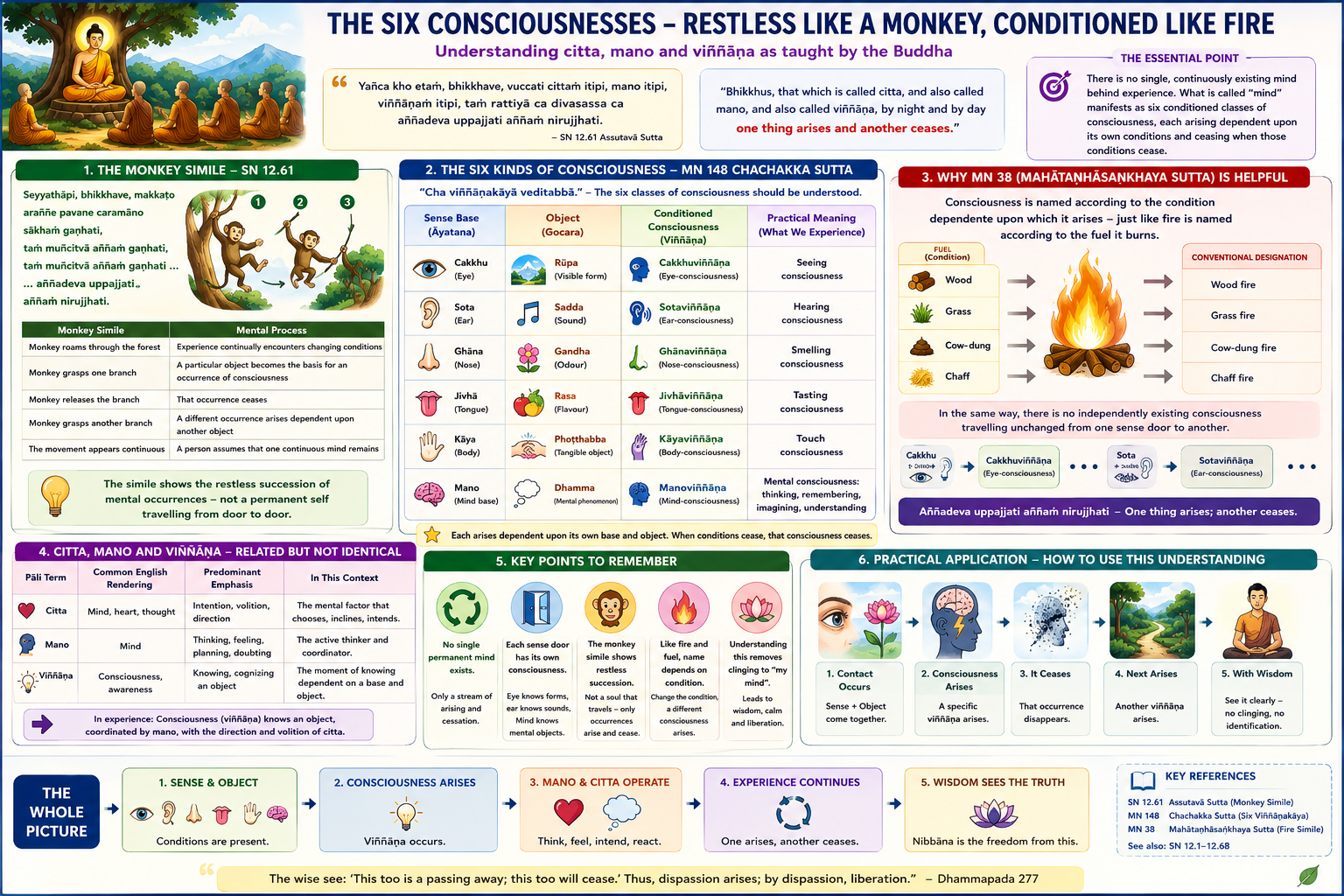
There are 6 consciousness depending upon the type of the senses. The Buddha does not present a single permanent “mind” that remains unchanged while merely looking through six different windows. What we ordinarily call the mind is a conditioned and rapidly changing process. Depending upon the sense door and the object, a corresponding kind of consciousness arises.
A precise formulation would be:
There is no single, continuously existing mind behind experience. What is conventionally called “mind” manifests as six conditioned classes of consciousness: eye-consciousness, ear-consciousness, nose-consciousness, tongue-consciousness, body-consciousness, and mind-consciousness. Each arises dependent upon its own conditions and ceases when those conditions cease.
The important statement in the Assutavā Sutta – In SN 12.61, Assutavā Sutta, the Buddha says:
Yañca kho etaṁ, bhikkhave, vuccati cittaṁ itipi, mano itipi, viññāṇaṁ itipi, taṁ rattiyā ca divasassa ca aññadeva uppajjati aññaṁ nirujjhati.
A literal rendering is: “Bhikkhus, that which is called citta, and also called mano, and also called viññāṇa, by night and by day one thing arises and another ceases.” The Buddha then gives the simile of a monkey moving through a forest:
Seyyathāpi, bhikkhave, makkaṭo araññe pavane caramāno sākhaṁ gaṇhati, taṁ muñcitvā aññaṁ gaṇhati, taṁ muñcitvā aññaṁ gaṇhati …
“Just as a monkey roaming through a forest grabs one branch, releases it and grabs another, then releases that and grabs another …”
In the same way: … aññadeva uppajjati aññaṁ nirujjhati.
“One thing arises and another ceases.”
The point is not merely that the mind is restless. The deeper point is that there is no single unchanging mind that persists from one experience to the next. The process continues through repeated arising and cessation.
What does the monkey mind represent in SN12.61? The monkey mind is not a hidden soul. It is not an inner witness travelling from door to door. The simile is limited: it illustrates the restless succession of mental occurrences.
| Monkey simile | Mental process |
|---|---|
| Monkey roams through the forest | Experience continually encounters changing conditions |
| Monkey grasps one branch | A particular object becomes the basis for an occurrence of consciousness |
| Monkey releases the branch | That occurrence ceases |
| Monkey grasps another branch | A different occurrence arises dependent upon another object |
| The movement appears continuous | A person assumes that one continuous mind remains present |
What are the six kinds of consciousness?
In MN 148, Chachakka Sutta, the Buddha identifies six classes of consciousness:
Cha viññāṇakāyā veditabbā.
“The six classes of consciousness should be understood.” He then explains:
Cakkhuñca paṭicca rūpe ca uppajjati cakkhuviññāṇaṁ. – Dependent upon the eye and visible forms, eye-consciousness arises.
Sotañca paṭicca sadde ca uppajjati sotaviññāṇaṁ. – Dependent upon the ear and sounds, ear-consciousness arises.
Ghānañca paṭicca gandhe ca uppajjati ghānaviññāṇaṁ. – Dependent upon the nose and odours, nose-consciousness arises.
Jivhañca paṭicca rase ca uppajjati jivhāviññāṇaṁ. – Dependent upon the tongue and flavours, tongue-consciousness arises.
Kāyañca paṭicca phoṭṭhabbe ca uppajjati kāyaviññāṇaṁ. – Dependent upon the body and tangible objects, body-consciousness arises.
Manañca paṭicca dhamme ca uppajjati manoviññāṇaṁ. – Dependent upon mano and mental phenomena, mind-consciousness arises.
This may be represented as follows:
| Sense base | Object | Conditioned consciousness | Practical meaning |
|---|---|---|---|
| Cakkhu — eye | Rūpa — visible form | Cakkhuviññāṇa | Seeing-consciousness |
| Sota — ear | Sadda — sound | Sotaviññāṇa | Hearing-consciousness |
| Ghāna — nose | Gandha — odour | Ghānaviññāṇa | Smelling-consciousness |
| Jivhā — tongue | Rasa — flavour | Jivhāviññāṇa | Tasting-consciousness |
| Kāya — body | Phoṭṭhabba — tangible object | Kāyaviññāṇa | Touch-consciousness |
| Mano — mind base | Dhamma — mental phenomenon | Manoviññāṇa | Mental consciousness: thinking, remembering, imagining and cognizing mental objects |
From the above we can infer that the branches may be visible forms, sounds, bodily sensations, smells, tastes, memories, opinions, worries, plans, or imagined conversations. The sutta does not explicitly equate the word sākha—branch—with a particular technical category such as āyatana or upādāna. Nevertheless, applying the simile to the six sense bases is entirely consistent with the Buddha’s detailed explanation elsewhere: each type of consciousness arises dependent upon its appropriate base and object
Why MN 38 is especially helpful?
The Mahātaṇhāsaṅkhaya Sutta, MN 38, gives an important clarification. Consciousness is named according to the condition dependent upon which it arises. When consciousness arises dependent upon the eye and forms, it is designated eye-consciousness. When it arises dependent upon the ear and sounds, it is designated ear-consciousness, and so forth. The Buddha compares this to fire. A fire is named according to the fuel dependent upon which it burns:
| Fuel | Conventional designation |
|---|---|
| Wood | Wood fire |
| Grass | Grass fire |
| Cow dung | Cow-dung fire |
| Chaff | Chaff fire |
There is no independently existing “fire” travelling from one fuel source to another. In the same way, there is no independently existing consciousness travelling unchanged from the eye to the ear and then to the mind.
There is conditioned arising: Cakkhu + rūpa → cakkhuviññāṇa Eye + visible form → eye-consciousness
Then there is another conditioned arising: Sota + sadda → sotaviññāṇa Ear + sound → ear-consciousness.
The phrase from SN 12.61 becomes extremely significant: Aññadeva uppajjati aññaṁ nirujjhati.
One thing arises; another ceases. Citta, mano and viññāṇa: related but not identical in every context. English translations often use the single word mind for several Pāli words. This can conceal important distinctions.
| Pāli term | Common English rendering | Predominant emphasis |
|---|---|---|
| Citta | Mind, heart, mental state | The qualitative condition of the mind: contracted, scattered, concentrated, liberated, affected by rāga or free from rāga |
| Mano | Mind, mental faculty | The internal sense base that encounters dhammā, mental phenomena |
| Viññāṇa | Consciousness, cognition | Conditioned knowing classified according to the six sense doors |
A practical example – Suppose Vilas is sitting quietly and hears a bird:
A sound contacts the ear. Dependent upon the ear and sound, sotaviññāṇa arises.
The meeting of ear, sound and ear-consciousness is phassa.
Dependent upon contact, vedanā arises. A moment later, a memory appears: “This sounds like the bird I heard yesterday.” That memory is a dhamma, a mental object.
Dependent upon mano and that dhamma, manoviññāṇa arises.
Hearing-consciousness and mental consciousness are not the same occurrence. One arises and ceases; another arises and ceases. If delight appears, the mind may continue grasping branches:
sound → pleasant feeling → memory → story → longing → self-reference.
This is comparable to the monkey in SN 12.61: one branch is grasped, released and replaced by another.
02 Indriya, Āyatana and Viññāṇa
Two perspectives on the same six doors
The deeper significance for bhāvanā
The ordinary person assumes:
“I am seeing.”
“I am hearing.”
“I am thinking.”
“My mind is continuing.”
But careful observation reveals conditioned processes: Eye and form being present, eye-consciousness arises. Ear and sound being present, ear-consciousness arises. Mano and dhamma being present, mind-consciousness arises. There is no need to insert an additional permanent owner, controller or witness behind the process. The understanding may be summarized in one sentence:
The six consciousnesses are not six independent minds and are not the activities of one permanent mind; they are six conditioned modes of cognizing, arising and ceasing according to the respective sense doors.
This insight directly supports the understanding of anattā: what is ordinarily grasped as “my mind” is actually a dependently arisen stream — aññadeva uppajjati aññaṁ nirujjhati.
Let us further look into the relationships
The eye, ear, nose, tongue, body and mano are not first entirely unrelated faculties that later literally transform into different entities called āyatanas. Rather, the Buddha examines the same six sensory capacities from different functional perspectives.
When the emphasis is on the faculty that must be guarded, the term is indriya.
When the emphasis is on the domain in which experience occurs through engagement with an object, the term is āyatana.
When an internal āyatana and its corresponding external āyatana come together, the relevant class of viññāṇa arises. When there is no wise understanding, this experiential field can become a feeding ground for craving, appropriation and bondage. From indriya to āyatana: two perspectives on the same six doors.
| Perspective | Pāli term | Primary emphasis | Example using the eye |
|---|---|---|---|
| Faculty or governing capacity | indriya | The functioning sensory faculty that must be protected and governed | cakkhundriya — eye faculty |
| Internal field or base of experience | ajjhattika āyatana | The internal domain upon which an object-dependent experience can arise | cakkhāyatana — eye-base |
| External field or object-domain | bāhira āyatana | The corresponding object that becomes available to experience | rūpāyatana — visible-form domain |
| Conditioned cognition | viññāṇa | The specific consciousness arising dependent upon the pair | cakkhuviññāṇa — eye-consciousness |
| Meeting | phassa | The convergence of internal base, external object and consciousness | Eye-contact |
| Affective result | vedanā | Pleasant, unpleasant or neither-painful-nor-pleasant feeling | Feeling born of eye-contact |
| Possible feeding process | taṇhā | Delight, resistance or craving when feeling is not wisely understood | Craving for visible forms |
| Internal āyatana | External āyatana | Consciousness arising dependently |
|---|---|---|
| Cakkhāyatana — eye-base | Rūpāyatana — visible forms | Cakkhuviññāṇa — eye-consciousness |
| Sotāyatana — ear-base | Saddāyatana — sounds | Sotaviññāṇa — ear-consciousness |
| Ghānāyatana — nose-base | Gandhāyatana — odours | Ghānaviññāṇa — nose-consciousness |
| Jivhāyatana — tongue-base | Rasāyatana — flavours | Jivhāviññāṇa — tongue-consciousness |
| Kāyāyatana — body-base | Phoṭṭhabbāyatana — tangible objects | Kāyaviññāṇa — body-consciousness |
| Manāyatana — mind-base | Dhammāyatana — mental phenomena | Manoviññāṇa — mind-consciousness |
This explains how the point made in the Assutavā Sutta can be carried into the analysis of the āyatanas. There is no single permanent consciousness sitting behind the doors. A particular consciousness arises dependent upon a particular internal-external pair, ceases, and is replaced by another conditioned occurrence.
In SN35.93Dutiyadvayasutta, the Buddha states this principle compactly:
Dvayaṁ, bhikkhave, paṭicca viññāṇaṁ sambhoti. “Dependent upon a pair, consciousness comes into being.” The “pair” is the relevant internal base and external object: eye and form, ear and sound, and so forth.
The complete sequence: how a field of experience can become a feeding ground The precise sequence is:
03 How Experience Becomes a Feeding Ground
From contact and feeling to craving, clinging and becoming
| Stage | Pāli | What occurs |
|---|---|---|
| 1 | Indriya | A functioning faculty is present: eye, ear, nose, tongue, body or mind |
| 2 | Ajjhattika āyatana | That faculty is considered as an internal experiential base |
| 3 | Bāhira āyatana | A corresponding object enters its range |
| 4 | Viññāṇa | The relevant conditioned consciousness arises |
| 5 | Phassa | The three meet: faculty, object and consciousness |
| 6 | Vedanā | A feeling-tone arises dependent upon contact |
| 7 | Taṇhā | The uninstructed mind delights in, resists or seeks continuation of the feeling |
| 8 | Upādāna | Craving develops into grasping and appropriation |
| 9 | Bhava | The mind constructs and inhabits a mode of becoming |
The first six stages are not inherently bondage. They are the structure of ordinary experience. Bondage begins when the conditioned experience is appropriated:
“I am seeing.”
“I like what I am seeing.”
“I need this.”
“This makes me happy.”
“Why was this taken away from me?”
At that point, the āyatana has become a feeding ground for rāga, dosa and moha.
Why the term indriya is important before āyatana becomes a feeding ground?
The term indriya emphasizes governing power or faculty. This is why the Buddha repeatedly teaches indriyasaṁvara: restraint or protection of the faculties.
The standard instruction says that after seeing a form with the eye, one does not grasp its general sign or become absorbed in its details: Cakkhunā rūpaṁ disvā na nimittaggāhī hoti nānubyañjanaggāhī.
The person protects the eye faculty: Rakkhati cakkhundriyaṁ; cakkhundriye saṁvaraṁ āpajjati.
This does not mean closing the eyes and avoiding the world. It means preventing the sensory event from turning into a stream of mental consumption. The eye and the visible form are not themselves the fetter.
This distinction is essential. In the Koṭṭhika Sutta, Sāriputta explains that the eye is not the fetter binding one to visible forms, and visible forms are not the fetter binding one to the eye. The fetter is the desire and lust that arises dependent upon the two. The same applies to the remaining sense doors.
This means that the problem is not: “There are visible forms in the world.” Nor is it:
“The eye is functioning.” The actual problem is: Cakkhu + rūpa → cakkhuviññāṇa → phassa → vedanā → chandarāga
The chain becomes a feeding process when the mind repeatedly consumes the experience through delight, resistance, fantasy, identification and appropriation.
Sāriputta uses the simile of two oxen tied together by a yoke. The black ox is not the bondage of the white ox, and the white ox is not the bondage of the black ox. The yoke binding them together is the bondage. In the same way, the sensory faculty and its object are not inherently the problem. The arising of desire and lust is the yoke.
| Without indriyasaṁvara | With indriyasaṁvara |
|---|---|
| A form is seen | A form is seen |
| The mind seizes the sign: “attractive person,” “beautiful object,” “insulting expression” | The form is known as a form |
| Attention moves into details | Unnecessary elaboration is not encouraged |
| Feeling is consumed through delight or aversion | Feeling is recognized without appropriation |
| Thought proliferation develops | The sequence is understood and restrained |
| The āyatana feeds craving | The āyatana becomes an occasion for paññā |
Satipaṭṭhāna directly examines this feeding process
In the contemplation of dhammas in MN 10, the Buddha instructs one to know the eye and visible forms, and also to know the fetter that arises dependent upon both:
Cakkhuñca pajānāti, rūpe ca pajānāti, yañca tadubhayaṁ paṭicca uppajjati saṁyojanaṁ tañca pajānāti.
One also understands:
how an unarisen fetter arise, how an arisen fetter is abandoned and how an abandoned fetter does not arise again in the future. The same investigation is applied to the ear and sounds, the nose and odours, the tongue and flavours, the body and tangible objects, and mano and dhammā.
This is a complete bhāvanā framework. It is not merely passive observation of sensory events. One learns to identify the exact point at which a neutral cognitive process becomes nutriment for bondage.
Āyatana as an empty village
My expression “feeding ground” also aligns with the force of the simile in SN 35.238, Āsīvisopama Sutta. The Buddha compares the six internal sense fields to an empty village. When carefully investigated, none of them contains a stable self, owner or controller. The external sense objects are compared to village-plundering bandits that repeatedly strike the empty village.
This image is powerful:
| Simile | Doctrinal meaning |
|---|---|
| Empty village | Six internal āyatanas: no permanent owner is found within them |
| Bandits attacking the village | External objects continually impinge upon the senses |
| Mistaken resident | The assumption: “I am seeing, hearing, thinking and controlling” |
| Repeated plundering | Pleasant and unpleasant objects repeatedly disturb the unguarded mind |
| Escape | Understanding the āyatanas as impermanent, conditioned and anattā |
The eye is empty of self. The form is empty of self. Eye-consciousness is empty of self. Contact is empty of self. Feeling is empty of self. Yet when ignorance remains, this empty process becomes appropriated as:
“I saw it.”
“I want it.”
“I dislike it.”
“It belongs to me.”
“It defines me.”
How the six “minds” fit into this framework can now be expressed more precisely:
04 No Hidden Witness: Mano, Citta and Self-Making
How a person-world is constructed and how vitakka is redirected
| Door | Faculty as indriya | Domain as āyatana | Conditioned “mind” or consciousness |
|---|---|---|---|
| Seeing | Cakkhundriya | Cakkhāyatana + rūpāyatana | Cakkhuviññāṇa |
| Hearing | Sotindriya | Sotāyatana + saddāyatana | Sotaviññāṇa |
| Smelling | Ghānindriya | Ghānāyatana + gandhāyatana | Ghānaviññāṇa |
| Tasting | Jivhindriya | Jivhāyatana + rasāyatana | Jivhāviññāṇa |
| Touching | Kāyindriya | Kāyāyatana + phoṭṭhabbāyatana | Kāyaviññāṇa |
| Cognizing a mental phenomenon | Manindriya | Manāyatana + dhammāyatana | Manoviññāṇa |
There is no seventh hidden consciousness standing behind these six and witnessing them. The “witness” itself, when examined, is another conditioned mental construction arising within manāyatana dependent upon dhammāyatana.
The most accurate way to state an insight
My observation can be formulated as follows: The six senses are called indriyāni when viewed as faculties whose activity must be governed through indriyasaṁvara. They are called the six internal āyatanāni when viewed as the internal experiential domains corresponding to six external object-domains. Dependent upon the meeting of an internal base and its object, a specific class of viññāṇa arises. When feeling born of that contact is appropriated through craving, the āyatana becomes a feeding ground for bondage. When the same process is known with paññā and not appropriated, the āyatana becomes a field for liberation.
Relationship to MN 19
This also fits naturally with MN 19, Dvedhāvitakka Sutta.
Indriyasaṁvara works at an earlier stage: it prevents the sensory input from being grasped through signs and details. Contemplation of the āyatanas reveals the middle stage: it identifies how a fetter arises dependent upon a faculty-object pair. MN 19 addresses the developed thought-stream: once a thought has arisen, one recognizes whether it belongs to:
| Unwholesome direction | Wholesome direction |
|---|---|
| Kāmavitakka — sensual thought | Nekkhamma-vitakka — thought of renunciation |
| Byāpādavitakka — thought of ill will | Abyāpādavitakka — thought of non-ill-will |
| Vihiṁsāvitakka — thought of harming | Avihiṁsāvitakka — thought of non-harming |
Thus, the complete practical sequence is:
Guard the indriya → understand the āyatana → recognize contact and feeling → prevent feeding through taṇhā → redirect vitakka → incline the mind toward liberation.
Where does āyatana become a feeding ground?
The eye and visible forms are not themselves bondage. The ear and sounds are not themselves bondage. The Buddha’s analysis in SN 35.232, Koṭṭhika Sutta is very precise:
Na kho, āvuso koṭṭhika, cakkhu rūpānaṁ saṁyojanaṁ, na rūpā cakkhussa saṁyojanaṁ. Yañca tattha tadubhayaṁ paṭicca uppajjati chandarāgo taṁ tattha saṁyojanaṁ.
“The eye is not the fetter of visible forms, and visible forms are not the fetter of the eye. The desire and lust that arise dependent upon both: that is the fetter there.” The same applies to all six sense domains.
A more precise reformulation from above
Vilas is conventionally described as an individual engaging with his wife and children. At the level of direct experience. However, there are six internal āyatanas: eye, ear, nose, tongue, body and mano. His wife and children are encountered through six external āyatanas: visible forms, sounds, odours, flavours, tangible objects and mental phenomena. Dependent upon each corresponding pair, a particular consciousness arises.
When there is no indriyasaṁvara, the mind seizes a nimitta, pursues its details, attaches descriptions and generates a personal story. The sensory field then becomes a feeding ground for craving, aversion, identity and becoming.
When there is indriyasaṁvara, the sense doors remain functional, but they are guarded. The mind does not grasp signs and details in a manner that feeds defilement. Functional recognition remains, but the appropriated internal world of “I,” “me” and “mine” is not constructed.
The āyatana remains; the appropriation does not arise.
The sense door remains open to knowledge but closed to feeding.
Relationship remains; self-making around the relationship is relinquished.
Maññanā is broader than possession alone
Appropriation is not limited to the explicit thought:“This belongs to me.”
Maññanā is subtler. It includes the entire process through which the mind positions a supposed self in relation to an experience.
| MN 1 pattern | Practical meaning | Family example |
|---|---|---|
| X maññati | Conceives the object as something fixed and substantial | “She is an inconsiderate person” |
| X-smiṁ maññati | Conceives a self located in relation to the object | “My happiness depends upon my family behaving properly” |
| X-to maññati | Conceives a self apart from, derived from or positioned against the object | “I am the calm person; they are disturbing me” |
| X me ti maññati | Conceives the object as “mine” | “My wife,” “my child,” “my reputation” |
| X abhinandati | Delights in and welcomes the constructed experience | Replaying pleasant praise or feeding resentment |
The designation “my wife” may be used conventionally without attachment. The issue is whether the designation becomes a basis for ownership, expectation, identity and emotional feeding.
05 Saṁvara Prevents Feeding, Not Experience
The āyatana remains; appropriation need not arise
Saṁvara prevents feeding, not experience
The standard formula for guarding the sense faculties is:
Cakkhunā rūpaṁ disvā na nimittaggāhī hoti nānubyañjanaggāhī.
Having seen a form with the eye, one does not grasp its sign and does not grasp its details.
This does not mean: “A visible form was not seen.”
It means: “The visible form was not converted into nutriment for rāga, dosa and moha.”
The sense door remains open for appropriate knowledge and responsible action. It is closed to unnecessary feeding.
Is āyatana already included when viññana is said to be?
Cakkhuñca paṭicca rūpe ca uppajjati cakkhuviññāṇaṁ.
“Dependent on the eye and visible forms, eye-consciousness arises.” the āyatana-framework is already present. More precisely: cakkhu is functioning as the internal āyatana: cakkhāyatana and rūpā are functioning as the external āyatana: rūpāyatana; dependent on that internal–external āyatana pair, cakkhuviññāṇa arises.
The sutta does not say that a neutral eye first exists and then becomes an āyatana only after defilement enters. Nor does it say that cakkhu is transformed into āyatana by craving. The eye, when spoken of as the experiential base for seeing, is already the internal āyatana.
MN 148 makes the sequence explicit – MN 148 Chachakkasutta is particularly important because the Buddha lays out six sets of six in a precise order:
Cha ajjhattikāni āyatanāni veditabbāni. – “The six internal āyatanas should be understood.”
Cha bāhirāni āyatanāni veditabbāni. – “The six external āyatanas should be understood.”
Cha viññāṇakāyā veditabbā. – “The six classes of consciousness should be understood.”
Cha phassakāyā veditabbā. – “The six classes of contact should be understood.”
Cha vedanākāyā veditabbā. – “The six classes of feeling should be understood.”
Cha taṇhākāyā veditabbā. – “The six classes of craving should be understood.”
Only after identifying these internal and external āyatanas does the Buddha explain the six classes of consciousness: Cakkhuñca paṭicca rūpe ca uppajjati cakkhuviññāṇaṁ. – “Dependent on the eye and visible forms, eye-consciousness arises.” The same formula is then repeated for the other five doors.
MN 148 therefore explicitly establishes that the consciousness formula presupposes the internal and external āyatana pair. The complete structure is:
| Stage | Pāli | Meaning |
|---|---|---|
| 1 | ajjhattika āyatana | internal base: eye |
| 2 | bāhira āyatana | external base: visible form |
| 3 | viññāṇa | eye-consciousness arises dependent on both |
| 4 | phassa | meeting of the three |
| 5 | vedanā | feeling dependent on contact |
| 6 | taṇhā | craving may arise when the process is not understood and guarded |
| 7 | upādāna | grasping and appropriation |
| 8 | bhava | a role-world and self-position become established |
Thus, āyatana is not produced by taṇhā. The āyatana-pair is already the field within which the subsequent process can unfold. The same applies to all six doors
| Internal āyatana | External āyatana | Consciousness arising dependent on both |
|---|---|---|
| cakkhu / cakkhāyatana — eye-base | rūpā / rūpāyatana — visible forms | cakkhuviññāṇa |
| sota / sotāyatana — ear-base | saddā / saddāyatana — sounds | sotaviññāṇa |
| ghāna / ghānāyatana — nose-base | gandhā / gandhāyatana — smells | ghānaviññāṇa |
| jivhā / jivhāyatana — tongue-base | rasā / rasāyatana — tastes | jivhāviññāṇa |
| kāya / kāyāyatana — body-base | phoṭṭhabbā / phoṭṭhabbāyatana — tangible objects | kāyaviññāṇa |
| mano / manāyatana — mind-base | dhammā / dhammāyatana — mental phenomena | manoviññāṇa |
This is why mano must be understood carefully. Mano is not something outside the āyatana-framework. It is the sixth internal āyatana.
Where does the apparent person enter? The āyatana-pair itself does not contain an independently existing wife-person or husband-person.
At the eye-door there are visible forms.
At the ear-door there are sounds.
At the mind-door there are mental objects, including relational designations. The apparent solid person emerges when designation is grasped, elaborated, and appropriated.
Thus, Āyatana provides the experiential field.
Defilement causes the field to be appropriated and solidified into a person-world.
Confusion: Is āyatana already a defiled consciousness as listed by puredhamma.net?
Āyatana is not synonymous with defilement. Sāriputta makes this explicit in SN 35.232.
He says: Na kho, āvuso koṭṭhika, cakkhu rūpānaṁ saṁyojanaṁ, na rūpā cakkhussa saṁyojanaṁ. Yañca tattha tadubhayaṁ paṭicca uppajjati chandarāgo, taṁ tattha saṁyojanaṁ.
“Friend Koṭṭhika, the eye is not the fetter of visible forms, nor are visible forms the fetter of the eye. Whatever desire and lust arise dependent on the two: that is the fetter there.”
The same principle is repeated for the remaining sense-pairs, including mano and dhammā and this is decisive.
Why SN 35.23 is important?
In SN 35.23 Sabbasutta, the Buddha defines “the all”: Cakkhuñceva rūpā ca, sotañca saddā ca, ghānañca gandhā ca, jivhā ca rasā ca, kāyo ca phoṭṭhabbā ca, mano ca dhammā ca — idaṁ vuccati, bhikkhave, sabbaṁ. “The eye and visible forms, the ear and sounds, the nose and smells, the tongue and tastes, the body and tangible objects, the mind and mental phenomena: this is called the all.”
The entire experiential world is already described through the six internal–external āyatana pairs. The Buddha does not introduce a separate, independently existing person behind the process. Nor does he say that āyatana appears only after defilement.
Where citta fits after āyatana? Now the framework can be stated more accurately:
| Term | Place in the process | Example |
|---|---|---|
| āyatana | the internal and external experiential field | eye and wife’s visible appearance; ear and her words; mano and thoughts |
| viññāṇa | door-specific consciousness arising dependent on the corresponding āyatana pair | seeing, hearing, cognizing a memory |
| phassa | meeting of internal base, external object, and consciousness | sound-contact |
| vedanā | pleasant, unpleasant, or neither-painful-nor-pleasant feeling | unpleasant feeling due to interruption |
| mano | sixth internal āyatana taking dhammā as its external field | “wife,” “husband,” “my work,” “my respect” |
| manoviññāṇa | consciousness of those mental objects | the personal narrative becomes consciously present |
| citta | presently conditioned quality of mind | sadosa, samoha, vikkhitta, asamāhita, avimutta |
| citta-bhāvanā | purification of the coloured mind | knowing, guarding, steadying, and releasing citta |
Citta is not an additional āyatana. Mano is the mental āyatana. Citta describes the quality of the mind as the process unfolds.
How āyatana and indriya-saṁvara fit together? The integrated table is:
| Stage | Function | Example | Training |
|---|---|---|---|
| 1 | āyatana-field appears | eye and wife’s visible form | cannot and need not be eliminated |
| 2 | viññāṇa arises | seeing occurs | understand its conditional arising |
| 3 | phassa occurs | eye-contact | remain wakefully attentive |
| 4 | vedanā arises | pleasant or unpleasant feeling | know the feeling without appropriation |
| 5 | saññā recognizes | “wife,” “request,” “expression” | allow functional recognition |
| 6 | indriya-saṁvara is required | eye faculty must be guarded | do not seize the sign |
| 7 | nimitta may become compelling | “disapproval directed at me” | do not mentally take hold |
| 8 | anubyañjana may proliferate | expression, tone, earlier incidents | do not inspect, replay, and elaborate |
| 9 | citta remains protected | no reactive story develops | continue wise action |
| 10 | response is given | listen, answer, help, or set a calm boundary | act without rāga, dosa, and moha |
So āyatana is indeed the starting field, but indriya-saṁvara governs the mind’s engagement with that field.
Āyatana Is the Field; Indriya Is the gate to be guarded.
How nimitta and anubyañjana are not grasped at the starting point?
The correct Pāli expression is:na nimittaggāhī hoti nānubyañjanaggāhī
The second word is anubyañjana, not nanabyañjana. Because the negative particle na joins the word, it appears in the passage as: na + anubyañjanaggāhī → nānubyañjanaggāhī
The Buddha does not instruct a person to physically remove visible forms, sounds, or mental objects. Nor does he say that nimitta and anubyañjana must somehow be erased from the eye, ear, or mind.
He says:
Do not become one who grasps the nimitta.
Do not become one who grasps the anubyañjana.
The central issue is gāha — taking hold, seizing, or grasping.
06 Where Restraint Enters: Nimitta and Anubyañjana
Guard the faculty before sign and detail colour citta
The apparent difficulty
We have already established that the immediate analysis begins with the āyatana-pair:
cakkhuñca paṭicca rūpe ca uppajjati cakkhuviññāṇaṁ
“Dependent on the eye and visible forms, eye-consciousness arises.”
MN 148 first identifies six internal āyatanas and six external āyatanas, and then explains the arising of the corresponding six classes of consciousness. Therefore, in the seeing formula, cakkhu is already functioning as cakkhāyatana, the internal eye-base, while rūpā function as the external visible-form base.
The question then arises:
If āyatana is already present at the starting point, where does indriya-saṁvara enter?
How can one avoid grasping nimitta and anubyañjana?
The answer is:Āyatana and indriya are not two successive stages.
The same eye is described from two different functional perspectives.
Āyatana and indriya: two perspectives on the same sense faculty
| Perspective | Pāli term | What is being emphasized? | Question answered |
|---|---|---|---|
| sense base or experiential sphere | cakkhāyatana | the eye as the internal base dependent on which seeing can arise | Where does visual experience occur? |
| governing faculty or gate | cakkhundriya | the eye faculty as something to be guarded | How should visual engagement be regulated? |
Where does restraint occur in the sequence? The immediate sensory event can be mapped as follows:
| Stage | Pāli | What happens? |
|---|---|---|
| 1 | cakkhāyatana | internal eye-base is present |
| 2 | rūpāyatana | visible form is present |
| 3 | cakkhuviññāṇa | eye-consciousness arises dependent on the pair |
| 4 | cakkhusamphassa | eye, visible form, and eye-consciousness meet |
| 5 | vedanā | pleasant, unpleasant, or neutral feeling arises |
| 6 | saññā | the form is recognized or designated |
| 7 | nimittaggāha | the mind may seize a compelling sign or theme |
| 8 | anubyañjanaggāha | the mind may pursue the associated details |
| 9 | abhijjhā-domanassa | covetousness and distress enter |
| 10 | citta | citta becomes coloured by rāga, dosa, or moha |
| 11 | mano-dhammā | memories, interpretations, roles, and stories appear |
| 12 | papañca | proliferation expands the constructed world |
The practical point is simpler: Once the sensory field has appeared, the faculty must be guarded immediately so that the mind does not seize a sign, elaborate its details, and allow unwholesome states to invade citta.
What are nimitta and anubyañjana? The indriya-saṁvara formula does not provide a separate dictionary-style definition of these two words. Their meaning must be understood from the context. A useful practical distinction is:
| Term | Basic meaning | Practical meaning |
|---|---|---|
| nimitta | sign, mark, theme, characteristic, or salient appearance | the compelling feature by which the mind takes hold of an object |
| anubyañjana | accompanying features, secondary marks, details, or elaborations | the details that the mind continues to inspect, replay, compare, or develop after seizing the sign |
| nimittaggāhī | one who grasps the sign | one who mentally takes hold of the attractive, repulsive, or identity-producing theme |
| anubyañjanaggāhī | one who grasps the details | one who follows and feeds the secondary features that strengthen attachment or aversion |
The instruction is not that basic recognition must disappear.
Vilas may still recognize:
“My wife has entered the room.”
“My child is calling me.”
“My mother is asking for help.”
“My brother has sent a message.”
That is functional recognition.
The difficulty begins when functional recognition becomes emotional seizure:
“She has come to criticize me again.”
“My child always disturbs me.”
“My mother is making me guilty.”
“My brother never respects me.”
How Vilas guards the eye faculty?
The instruction is not:“Do not look at your wife.”
The instruction is: “Do not seize and feed the appearance in a way that permits rāga, dosa, and moha to enter citta.”
| Unguarded eye faculty | Guarded eye faculty |
|---|---|
| “Her expression proves that she is angry with me.” | “A facial expression has been seen.” |
| inspects every facial detail | does not continue scanning for evidence |
| immediately anticipates criticism | waits for actual words |
| activates old memories | does not summon earlier disputes |
| constructs wife-person versus husband-person | remains available for a fresh response |
| citta becomes irritated | citta remains more stable |
07 Guarding Mano in Daily Life
From family contact to wise response
Is minding the business alone is sufficient?
Mind is the forerunner since mano is both an indirya and an āyatana and mano is the central consolidating door. Even if an initial sign has been grasped at the eye or ear, guarding mano can prevent further proliferation.
A precise statement is:
All six indriyas must be guarded but manindriya is especially decisive because it receives and continues the impressions arising from the other five doors, and it can also generate its own dhamma-objects after the external event has ceased. How the two teachings fit together?
| Teaching | Function |
|---|---|
| saḷāyatana through paṭiccasamuppāda | shows how the experiential field is conditionally arisen |
| indriya-saṁvara | prevents unwholesome states from entering through the six gates |
| manindriya-saṁvara | prevents replay, interpretation, identity-construction, and proliferation |
| cittānupassanā | identifies whether citta has become coloured |
| ānāpānasati | experiences, gladdens, collects, and releases citta |
| paññā | sees arising, cessation, and non-appropriation |
| vimutti | suffering ends when craving and clinging cease |
In conclusion, Paṭiccasamuppāda explains: saḷāyatana → phassa → vedanā → taṇhā → upādāna → bhava → jāti → dukkha
Indriya-saṁvara intervenes practically so that the process is not fed: āyatana remains; contact occurs; feeling arises but nimitta is not grasped and anubyañjana is not pursued which then makes craving not nourished; clinging does not consolidate; the role-person is not born and citta remains protected.
Relation to the cessation of suffering
Sense restraint is indispensable, but the Buddha presents it as part of a developmental sequence rather than as an isolated technique. AN 6.50Indriyasaṁvarasutta states that without sense restraint, a vital condition for ethical conduct is destroyed; with sense restraint present, the supporting conditions for further development are established.
So the careful conclusion is: Guarding manindriya is a decisive point in ending suffering because it prevents sensory experience from being converted into proliferating self-construction.
But complete cessation of suffering requires the full cultivation through which taṇhā, upādāna, and ignorance cease. Mano is the gateway where the constructed world can be fed or released.
Final integrated understanding
| Stage | When mano is unguarded | When mano is guarded |
|---|---|---|
| wife speaks | sound is heard | sound is heard |
| feeling arises | unpleasant feeling | unpleasant feeling |
| designation appears | “wife” | “wife” |
| role appears | “I am husband” | conventional responsibility |
| nimitta | “disrespect” | recognized but not seized |
| anubyañjana | tone, words, memories, motives | not pursued |
| mano | replays and elaborates | does not feed the story |
| citta | irritated, scattered, unreleased | protected, steadier, releasable |
| speech | harsh or defensive | calm and appropriate |
| consequence | suffering increases | suffering is not nourished |
The insight can therefore be expressed in a refined way:
Āyatana must be understood through paṭiccasamuppāda. All six indriyas must be guarded through indriya-saṁvara. Manindriya is especially central because it gathers, interprets, replays, and solidifies sensory experience into a person-world. When mano is corrupted, speech and action produce suffering. When mano is clarified, speech and action lead toward well-being.
Therefore the Buddha says: manopubbaṅgamā dhammā, manoseṭṭhā manomayā.
Indriya-samvara – How to succeed in this?
Now let us focus on indriya-samvara which is very important. To establish it, one of the best method is breath awareness or anāpanāsati and Buddha stresses a lot in Asubhānupassīsutta-Iti85, Meghiyasutta-AN9.3, Paṭisambhidāmagga and offcourse, MN118-Anāpanāsatisutta. We are using breath awareness to remove the “nimitta” or the sign that would be grasped by the mind without any object for contemplation.
Two different uses of the word nimitta
A very important distinction must be made. The word nimitta is being used in two related but different ways.
Nimitta in indriya-saṁvara – In the restraint formula:
na nimittaggāhī hoti nānubyañjanaggāhī
nimitta is the sign, theme, mark, or salient characteristic grasped from the sense-object.
For example:
Vilas hears his wife’s words.
Mano grasps: “criticism.” and that is the nimitta.
Then it pursues: tone; facial expression; exact sentence and earlier arguments.
These are the anubyañjana that reinforce the sign.
Nimitta in ānāpānassati
In the Paṭisambhidāmagga passage, the breathing-contact sign is used as a stabilizing support and not a defiling sign and an upanibandhana-nimitta: a sign that tethers or anchors sati.
The mind relinquishes the unwholesome nimitta: “disrespect.”
It establishes itself on the wholesome stabilizing nimitta: the directly experienced breathing contact.
Thus, one nimitta is not grasped; another nimitta is used skilfully to prevent scattering.
This does not mean that every occurrence of the word nimitta has an identical meaning.
08 Ānāpānassati as a Practical Support
Stabilizing manindriya without escaping responsibility
Conclusion – When a sensory nimitta has been grasped, mano continues to feed it through anubyañjana, memory, and vitakka. Ānāpānassati establishes sati on a stable internal support. This deprives the former nimitta of nutriment, quietens vitakka, prevents citta from scattering, and strengthens indriya-saṁvara.
The Paṭisambhidāmagga makes the practical mechanism clear: sati is anchored and the mind does not chase the movement of the breath while citta does not go into vikkhepa and upakkilesas are abandoned; vitakkas become quiet.
Thus: āyatana remains. the faculties remain. the family remains. responsibilities remain.
But mano no longer feeds the defiled nimitta and Citta becomes progressively purified.
Breath awareness is not an escape from the family situation
Suppose Vilas’s child asks for help while he is working. An unpleasant feeling arises because Vilas’s work is interrupted. If he simply walks away, watches the breath, and avoids his responsibilities, that is not purification. The proper use of ānāpānassati is: stop the proliferating internal reaction;
allow citta to settle; prevent harsh speech and respond wisely.
The sequence is: The child calls. sound is heard. unpleasant feeling arises. mano begins to take up “interruption.” Vilas notices that the sign is being grasped and he immediately establishes sati on breathing and does not continue the inner commentary which makes the citta settles.
He answers calmly: – “I need five minutes to complete this task. Then I will help you.”
Breath awareness does not eliminate responsibility but removes the defiled person-world that obstructs a wise response.
Why breath awareness is exceptionally powerful for manindriya?
The first five faculties operate when an external object is present.
But mano can continue producing mental objects after the external event has ended.
The wife’s words cease and yet mano remembers them.
The facial expression disappears and yet mano recreates it.
The child leaves the room. and yet mano continues arguing internally.
The brother is not physically present and yet mano constructs the brother-person and speaks to him inwardly.
Ānāpānassati gives mano a present, non-conceptual, bodily process upon which sati can remain established which prevents mano from repeatedly taking the former role-world as its object.
This is why it is particularly powerful for:
vitakkupaccheda — cutting off vitakka;
vikkhepa-nirodha — preventing scattering;
citta-kammaññatā — making citta workable;
citta-samādhāna — collecting citta;
citta-vimocana — releasing citta.
Relationship to indriya-saṁvara
Indriya-saṁvara and ānāpānassati should not be treated as unrelated practices.
Indriya-saṁvara gives the governing principle: Do not grasp the sign. details and protect the faculty not allow unwholesome states to invade citta.
Ānāpānassati gives a highly effective practical method to establish sati firmly on the breathing process; in order not to chase external signs, not follow internal stories and allow vitakka to quieten;
prevent citta from scattering. Thus, ānāpānassati strengthens indriya-saṁvara by stabilizing manindriya.
Relationship to paṭiccasamuppāda
Breath awareness does not remove the āyatana-field.
The eye still sees.
The ear still hears.
The body still experiences contact.
Mano still cognizes dhammā.
But the process is not allowed to continue unchecked:
saḷāyatana → phassa → vedanā → taṇhā → upādāna → bhava → jāti
A feeling may arise, but when mano is guarded through sati, the feeling does not need to become craving and sign is not fed and details are not elaborated. The role-person is not consolidated.
The “I am” position is not born.
For example: “I am the husband who has been insulted.”
That constructed identity is prevented from becoming established.
Relationship to manopubbaṅgamā dhammā
This also clarifies the opening of the Dhammapada:
Manopubbaṅgamā dhammā,
manoseṭṭhā manomayā.
Dhammā are preceded by mano, governed by mano, and shaped through mano.
The verse itself does not mention breathing.
But ānāpānassati is one of the most effective ways of guarding mano before a corrupted mental direction becomes speech or bodily action.
When mano is unguarded:
sign is grasped; details are pursued; citta becomes irritated; harsh speech follows and suffering follows.
When mano is stabilized through breathing: the sign loses its hold; vitakka quietens; citta does not scatter; speech arises from a clearer condition and suffering is not nourished.
Is breath watching the only practice required?
Ānāpānassati is an exceptionally effective central practice, especially for cutting off proliferating vitakka and settling citta.
However, the Meghiya Sutta itself indicates that different defilements may require complementary cultivation:
when rāga is dominant, cultivate asubha;
when byāpāda is dominant, cultivate mettā;
when proliferating thought is dominant, cultivate ānāpānassati;
when asmimāna is dominant, cultivate aniccasaññā.
Therefore, it is safest to state:
Ānāpānassati is a principal practical support for indriya-saṁvara because it stabilizes manindriya, cuts off the continuation of vitakka, prevents outward distress-producing thought-patterns, and keeps citta from scattering. It is not the only aspect of the path, but it occupies a central place