Four Herds, Four Spiritual Strategies, and Freedom from Māra
The decisive breakthrough is not merely using the bait more carefully. It is establishing the mind where Māra and Māra’s retinue have no access.
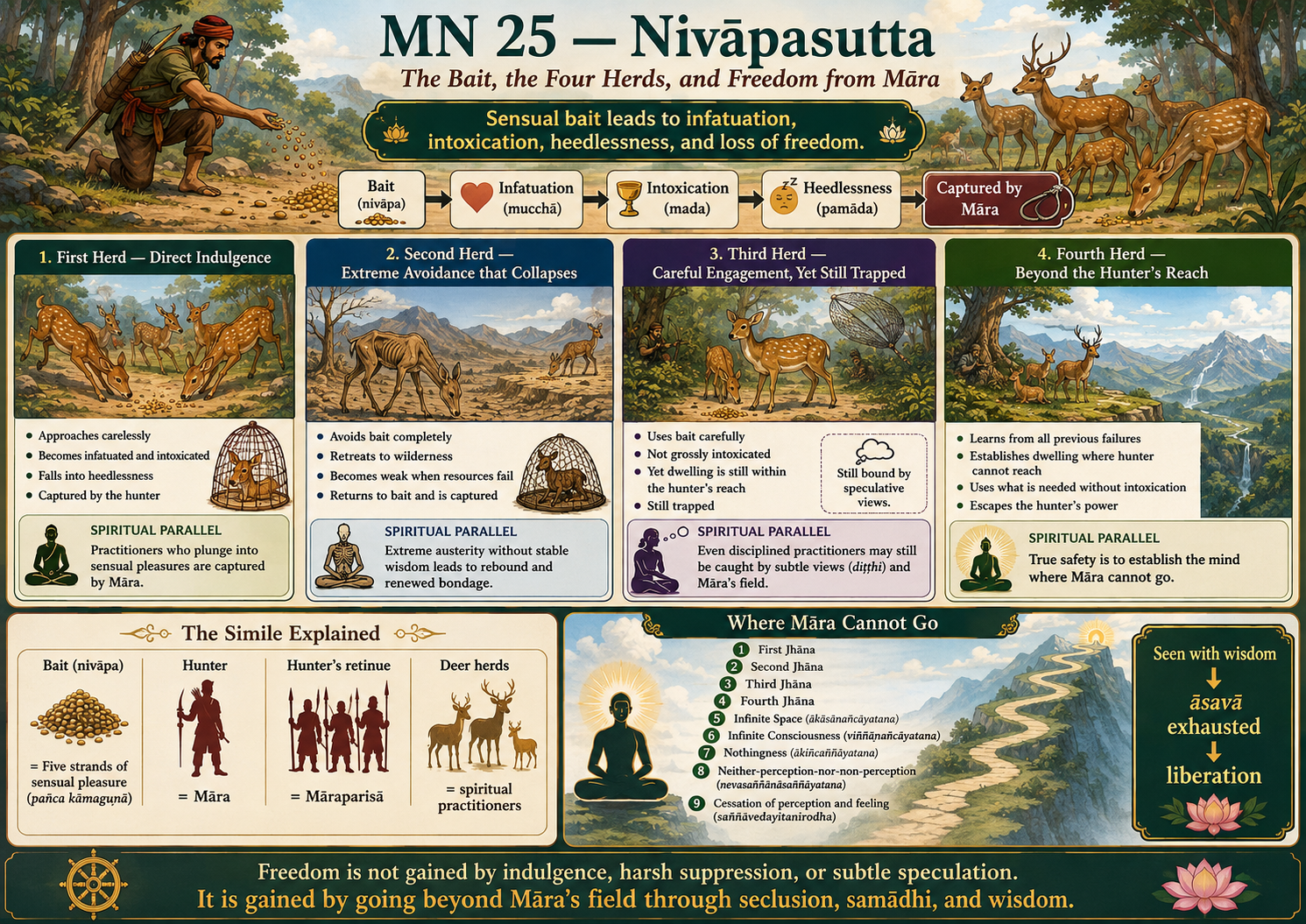 VISUAL SUMMARYSee this sutta in a pictureOpen the complete infographic for a visual overview before or after reading the full study.View infographic →
The bait is dangerous because heedlessness turns contact into capture
Through four herds of deer, the Buddha reveals four different responses to sensuality: direct indulgence, extreme avoidance that eventually collapses, controlled engagement that is still caught in subtle views, and finally the wise strategy of establishing oneself where the hunter cannot reach. He then explains the simile explicitly: the bait represents the five kāmaguṇā, the hunter is Māra, the hunter’s followers are Māra’s retinue, and the deer represent spiritual practitioners. The discourse culminates in a profound message: true freedom is not merely avoiding sensual objects, but developing the mind beyond Māra’s range through jhāna and the higher attainments, until wisdom leads to the complete exhaustion of the āsavas.
How bait becomes bondage — and how the mind moves beyond the hunter’s reach
| Strategy | What happens |
|---|---|
| 1 · Direct indulgence | The bait is consumed with infatuation, intoxication and heedlessness. The herd is captured. |
| 2 · Total avoidance | Harsh withdrawal weakens the body and energy; the strategy collapses and returns to the bait. |
| 3 · Careful engagement | Gross sensual intoxication is reduced, but a dwelling remains within the hunter’s range—later identified with speculative views. |
| 4 · Inaccessible dwelling | The mind establishes its basis where Māra has no access—beginning with jhāna and culminating in wisdom and exhaustion of the āsavas. |
All 15 sections with full Pāḷi, translation, explanation and examples
The Four Deer Herds
Hunter’s bait • direct indulgence • total avoidance • careful engagement • inaccessible dwelling
01 The Hunter’s Purpose — Why the Bait Is Sown
Evaṁ me sutaṁ— ekaṁ samayaṁ bhagavā sāvatthiyaṁ viharati jetavane anāthapiṇḍikassa ārāme. Tatra kho bhagavā bhikkhū āmantesi: “bhikkhavo”ti.
“Bhadante”ti te bhikkhū bhagavato paccassosuṁ. Bhagavā etadavoca:
“Na, bhikkhave, nevāpiko nivāpaṁ nivapati migajātānaṁ: ‘imaṁ me nivāpaṁ nivuttaṁ migajātā paribhuñjantā dīghāyukā vaṇṇavanto ciraṁ dīghamaddhānaṁ yāpentū’ti. Evañca kho, bhikkhave, nevāpiko nivāpaṁ nivapati migajātānaṁ: ‘imaṁ me nivāpaṁ nivuttaṁ migajātā anupakhajja mucchitā bhojanāni bhuñjissanti, anupakhajja mucchitā bhojanāni bhuñjamānā madaṁ āpajjissanti, mattā samānā pamādaṁ āpajjissanti, pamattā samānā yathākāmakaraṇīyā bhavissanti imasmiṁ nivāpe’ti.
Thus have I heard. On one occasion the Blessed One was staying at Sāvatthī in Jeta’s Grove, Anāthapiṇḍika’s monastery.
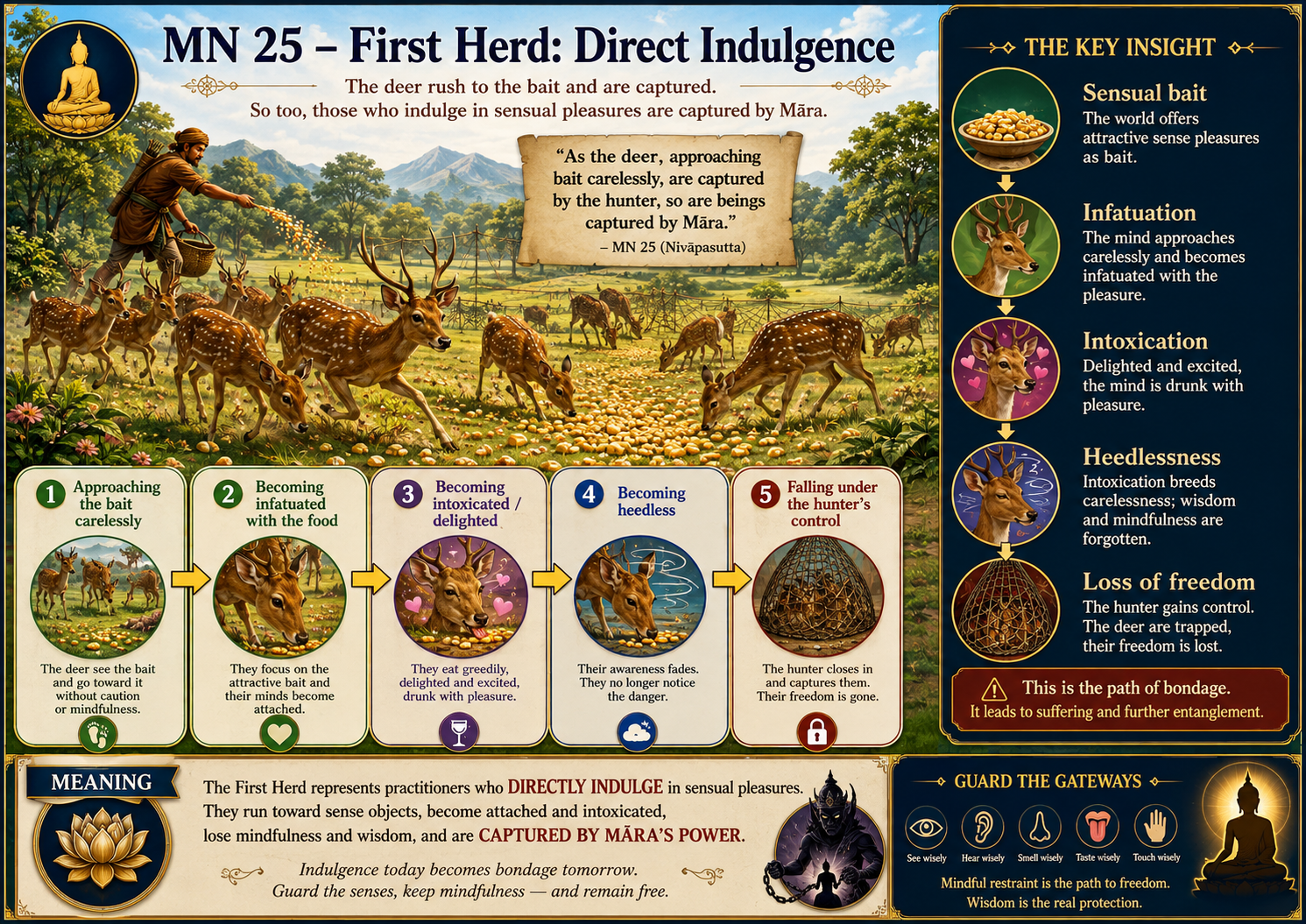
The Buddha explains that a hunter does not sow bait for deer out of kindness, wishing them long life and beauty. He sows it so that the deer will approach carelessly, become infatuated with the food, become intoxicated, fall into heedlessness, and then become subject to his will.
Deep Dive
The causal sequence is central: anupakhajja → mucchita → mada → pamāda → yathākāmakaraṇīya. Careless approach becomes infatuation; infatuation becomes intoxication; intoxication becomes heedlessness; heedlessness becomes loss of freedom.
The bait is effective not because food is intrinsically evil, but because it is consumed without discernment and with infatuation.
Practice / Teaching Example
Modern example: a digital platform, luxury product, praise, food, money, or status can function as bait when one approaches it unguarded, becomes absorbed in it, then loses the ability to choose freely.
02 First Herd — Direct Indulgence
Tatra, bhikkhave, paṭhamā migajātā amuṁ nivāpaṁ nivuttaṁ nevāpikassa anupakhajja mucchitā bhojanāni bhuñjiṁsu, te tattha anupakhajja mucchitā bhojanāni bhuñjamānā madaṁ āpajjiṁsu, mattā samānā pamādaṁ āpajjiṁsu, pamattā samānā yathākāmakaraṇīyā ahesuṁ nevāpikassa amusmiṁ nivāpe. Evañhi te, bhikkhave, paṭhamā migajātā na parimucciṁsu nevāpikassa iddhānubhāvā.
The first herd enters the baited area, becomes infatuated with the food, intoxicated, heedless, and therefore subject to the hunter’s will. They do not escape his power.
Deep Dive
This is the most obvious failure: direct surrender to sensual bait. There is no attempt to see danger, regulate contact, or develop an escape.
The problem is not merely “enjoyment”; the text emphasizes a progressive loss of autonomy until the hunter can do with the deer as he wishes.
03 Second Herd — Total Avoidance That Collapses
Tatra, bhikkhave, dutiyā migajātā evaṁ samacintesuṁ: ‘ye kho te paṭhamā migajātā amuṁ nivāpaṁ nivuttaṁ nevāpikassa anupakhajja mucchitā bhojanāni bhuñjiṁsu. Te tattha anupakhajja mucchitā bhojanāni bhuñjamānā madaṁ āpajjiṁsu, mattā samānā pamādaṁ āpajjiṁsu, pamattā samānā yathākāmakaraṇīyā ahesuṁ nevāpikassa amusmiṁ nivāpe. Evañhi te paṭhamā migajātā na parimucciṁsu nevāpikassa iddhānubhāvā. Yannūna mayaṁ sabbaso nivāpabhojanā paṭivirameyyāma, bhayabhogā paṭiviratā araññāyatanāni ajjhogāhetvā vihareyyāmā’ti. Te sabbaso nivāpabhojanā paṭiviramiṁsu, bhayabhogā paṭiviratā araññāyatanāni ajjhogāhetvā vihariṁsu. Tesaṁ gimhānaṁ pacchime māse, tiṇodakasaṅkhaye, adhimattakasimānaṁ patto kāyo hoti. Tesaṁ adhimattakasimānaṁ pattakāyānaṁ balavīriyaṁ parihāyi. Balavīriye parihīne tameva nivāpaṁ nivuttaṁ nevāpikassa paccāgamiṁsu. Te tattha anupakhajja mucchitā bhojanāni bhuñjiṁsu. Te tattha anupakhajja mucchitā bhojanāni bhuñjamānā madaṁ āpajjiṁsu, mattā samānā pamādaṁ āpajjiṁsu, pamattā samānā yathākāmakaraṇīyā ahesuṁ nevāpikassa amusmiṁ nivāpe. Evañhi te, bhikkhave, dutiyāpi migajātā na parimucciṁsu nevāpikassa iddhānubhāvā.
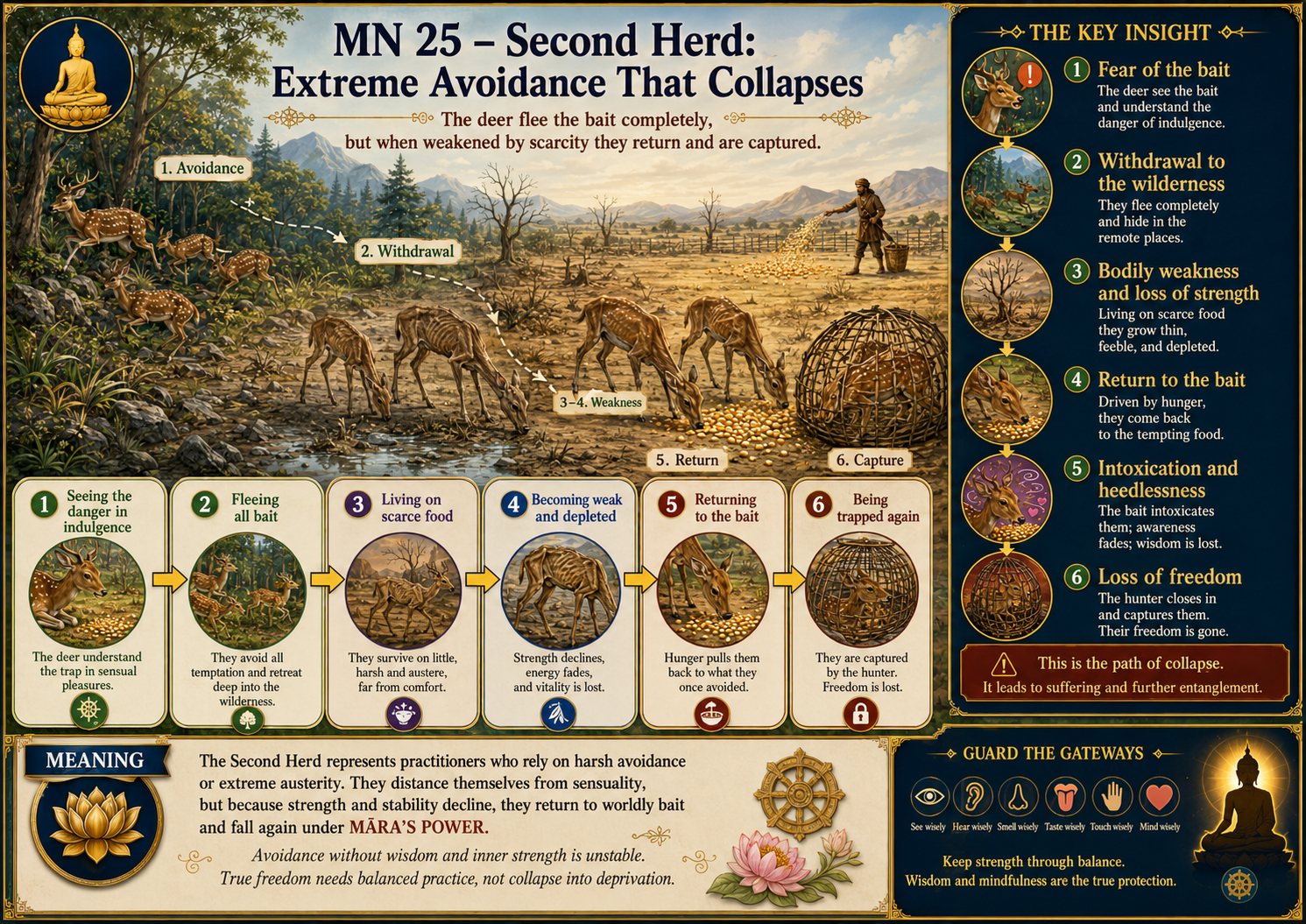
The second herd sees what happened to the first and decides to avoid the bait entirely, retreating deep into the wilderness.
But in the last hot month, when grass and water are exhausted, their bodies become extremely thin and their strength and energy decline. They return to the bait, approach it carelessly, become intoxicated and heedless, and again fall under the hunter’s power.
Deep Dive
This is a critique of a strategy based only on harsh avoidance without sufficient strength and stability.
In the later human parallel, this herd corresponds to ascetics who embrace extreme austerity. Their physical strength declines; then ceto-vimutti declines; they return to worldly bait and become captured again.
Thus MN 25 does not present bodily deprivation as liberation. A method that cannot be sustained under pressure is not yet escape.
Practice / Teaching Example
Practice example: someone tries to solve attachment by eliminating every comfortable object, social contact, device, or pleasant food, but without developing wisdom and stable samādhi. When pressure rises, the mind rebounds toward the very objects it tried to flee.
04 Third Herd — Careful Engagement, Yet Still Detectable
Tatra, bhikkhave, tatiyā migajātā evaṁ samacintesuṁ: ‘ye kho te paṭhamā migajātā amuṁ nivāpaṁ nivuttaṁ nevāpikassa anupakhajja mucchitā bhojanāni bhuñjiṁsu. Te tattha anupakhajja mucchitā bhojanāni bhuñjamānā madaṁ āpajjiṁsu, mattā samānā pamādaṁ āpajjiṁsu, pamattā samānā yathākāmakaraṇīyā ahesuṁ nevāpikassa amusmiṁ nivāpe. Evañhi te paṭhamā migajātā na parimucciṁsu nevāpikassa iddhānubhāvā. yepi te dutiyā migajātā evaṁ samacintesuṁ: ‘ye kho te paṭhamā migajātā amuṁ nivāpaṁ nivuttaṁ nevāpikassa anupakhajja mucchitā bhojanāni bhuñjiṁsu. Te tattha anupakhajja mucchitā bhojanāni bhuñjamānā madaṁ āpajjiṁsu, mattā samānā pamādaṁ āpajjiṁsu, pamattā samānā yathākāmakaraṇīyā ahesuṁ nevāpikassa amusmiṁ nivāpe. Evañhi te paṭhamā migajātā na parimucciṁsu nevāpikassa iddhānubhāvā. Yannūna mayaṁ sabbaso nivāpabhojanā paṭivirameyyāma, bhayabhogā paṭiviratā araññāyatanāni ajjhogāhetvā vihareyyāmā’ti. Te sabbaso nivāpabhojanā paṭiviramiṁsu, bhayabhogā paṭiviratā araññāyatanāni ajjhogāhetvā vihariṁsu. Tesaṁ gimhānaṁ pacchime māse, tiṇodakasaṅkhaye, adhimattakasimānaṁ patto kāyo hoti. Tesaṁ adhimattakasimānaṁ pattakāyānaṁ balavīriyaṁ parihāyi. Balavīriye parihīne tameva nivāpaṁ nivuttaṁ nevāpikassa paccāgamiṁsu. Te tattha anupakhajja mucchitā bhojanāni bhuñjiṁsu. Te tattha anupakhajja mucchitā bhojanāni bhuñjamānā madaṁ āpajjiṁsu, mattā samānā pamādaṁ āpajjiṁsu, pamattā samānā yathākāmakaraṇīyā ahesuṁ nevāpikassa amusmiṁ nivāpe. Evañhi te dutiyāpi migajātā na parimucciṁsu nevāpikassa iddhānubhāvā. Yannūna mayaṁ amuṁ nivāpaṁ nivuttaṁ nevāpikassa upanissāya āsayaṁ kappeyyāma. Tatrāsayaṁ kappetvā amuṁ nivāpaṁ nivuttaṁ nevāpikassa ananupakhajja amucchitā bhojanāni bhuñjissāma, ananupakhajja amucchitā bhojanāni bhuñjamānā na madaṁ āpajjissāma, amattā samānā na pamādaṁ āpajjissāma, appamattā samānā na yathākāmakaraṇīyā bhavissāma nevāpikassa amusmiṁ nivāpe’ti. Te amuṁ nivāpaṁ nivuttaṁ nevāpikassa upanissāya āsayaṁ kappayiṁsu. Tatrāsayaṁ kappetvā amuṁ nivāpaṁ nivuttaṁ nevāpikassa ananupakhajja amucchitā bhojanāni bhuñjiṁsu, te tattha ananupakhajja amucchitā bhojanāni bhuñjamānā na madaṁ āpajjiṁsu, amattā samānā na pamādaṁ āpajjiṁsu, appamattā samānā na yathākāmakaraṇīyā ahesuṁ nevāpikassa amusmiṁ nivāpe.
Tatra, bhikkhave, nevāpikassa ca nevāpikaparisāya ca etadahosi: ‘saṭhāssunāmime tatiyā migajātā ketabino, iddhimantāssunāmime tatiyā migajātā parajanā; imañca nāma nivāpaṁ nivuttaṁ paribhuñjanti, na ca nesaṁ jānāma āgatiṁ vā gatiṁ vā. Yannūna mayaṁ imaṁ nivāpaṁ nivuttaṁ mahatīhi daṇḍavākarāhi samantā sappadesaṁ anuparivāreyyāma, appeva nāma tatiyānaṁ migajātānaṁ āsayaṁ passeyyāma, yattha te gāhaṁ gaccheyyun’ti.
Textual variant: daṇḍavākarāhi → daṇḍavāgurāhi (sya-all)
Te amuṁ nivāpaṁ nivuttaṁ mahatīhi daṇḍavākarāhi samantā sappadesaṁ anuparivāresuṁ. Addasaṁsu kho, bhikkhave, nevāpiko ca nevāpikaparisā ca tatiyānaṁ migajātānaṁ āsayaṁ, yattha te gāhaṁ agamaṁsu. Evañhi te, bhikkhave, tatiyāpi migajātā na parimucciṁsu nevāpikassa iddhānubhāvā.
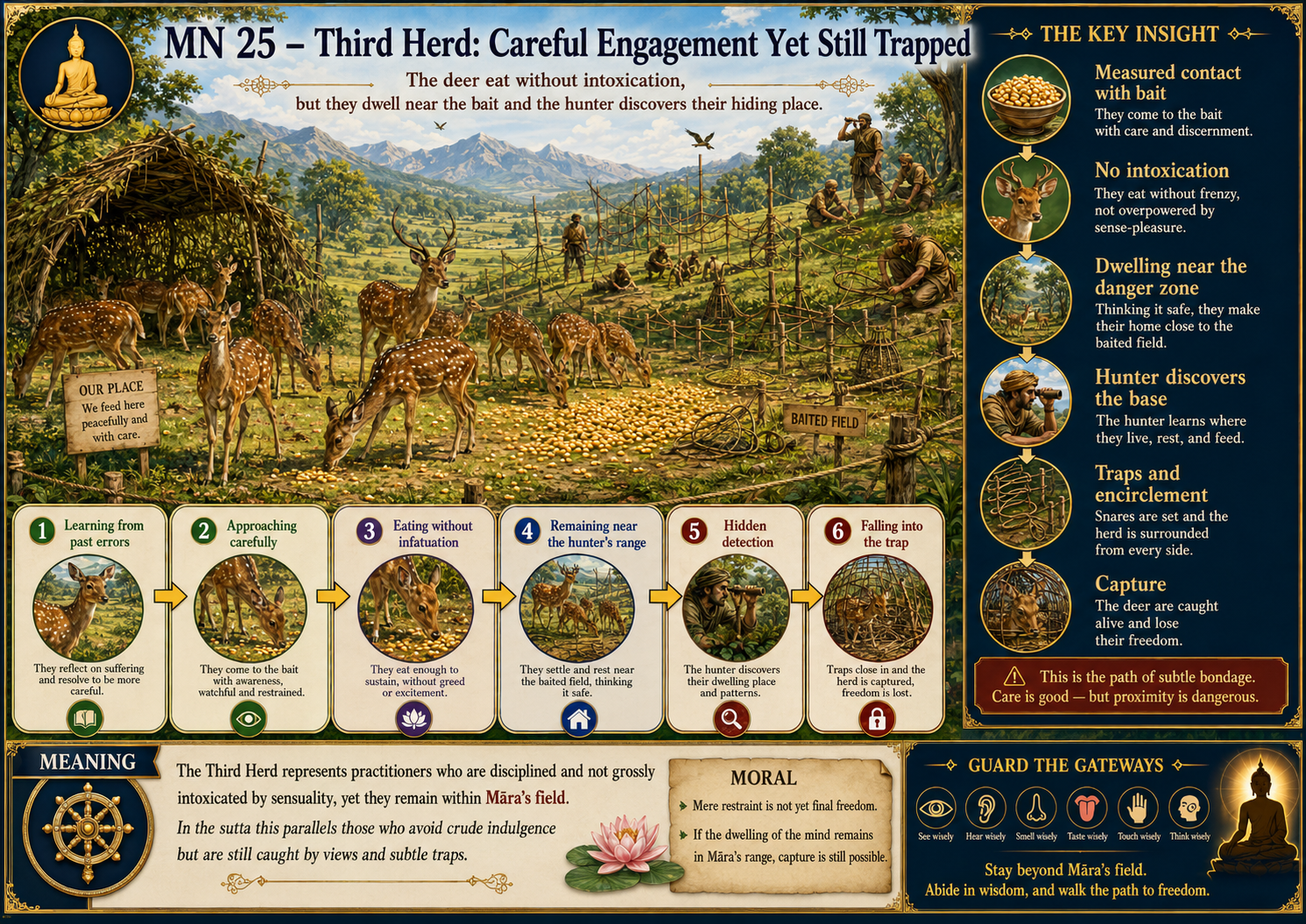
The third herd learns from both earlier failures. They establish a dwelling near the bait and eat without rushing in carelessly or becoming infatuated. They do not become intoxicated or heedless.
But the hunter and his followers surround the area with traps, discover where the herd is living, and capture them. The third herd therefore also fails to escape the hunter’s power.
Deep Dive
This is much subtler. The third herd has solved the gross problem of sensual intoxication. It can use the bait without becoming drunk on it.
Yet it has established its base within the hunter’s accessible range. Its “position” can still be detected and trapped.
The human parallel reveals what this means: speculative diṭṭhi. Even when sensual craving is better managed, fixation on views can remain a place where Māra can find the practitioner.
05 Fourth Herd — Living Where the Hunter Cannot Go
Tatra, bhikkhave, catutthā migajātā evaṁ samacintesuṁ: ‘ye kho te paṭhamā migajātā amuṁ nivāpaṁ nivuttaṁ nevāpikassa anupakhajja mucchitā bhojanāni bhuñjiṁsu. Te tattha anupakhajja mucchitā bhojanāni bhuñjamānā madaṁ āpajjiṁsu, mattā samānā pamādaṁ āpajjiṁsu, pamattā samānā yathākāmakaraṇīyā ahesuṁ nevāpikassa amusmiṁ nivāpe. Evañhi te paṭhamā migajātā na parimucciṁsu nevāpikassa iddhānubhāvā. yepi te dutiyā migajātā evaṁ samacintesuṁ: ‘ye kho te paṭhamā migajātā amuṁ nivāpaṁ nivuttaṁ nevāpikassa anupakhajja mucchitā bhojanāni bhuñjiṁsu. Te tattha anupakhajja mucchitā bhojanāni bhuñjamānā madaṁ āpajjiṁsu, mattā samānā pamādaṁ āpajjiṁsu, pamattā samānā yathākāmakaraṇīyā ahesuṁ nevāpikassa amusmiṁ nivāpe. Evañhi te paṭhamā migajātā na parimucciṁsu nevāpikassa iddhānubhāvā. Yannūna mayaṁ sabbaso nivāpabhojanā paṭivirameyyāma, bhayabhogā paṭiviratā araññāyatanāni ajjhogāhetvā vihareyyāmā’ti. Te sabbaso nivāpabhojanā paṭiviramiṁsu, bhayabhogā paṭiviratā araññāyatanāni ajjhogāhetvā vihariṁsu. Tesaṁ gimhānaṁ pacchime māse, tiṇodakasaṅkhaye, adhimattakasimānaṁ patto kāyo hoti. Tesaṁ adhimattakasimānaṁ pattakāyānaṁ balavīriyaṁ parihāyi. Balavīriye parihīne tameva nivāpaṁ nivuttaṁ nevāpikassa paccāgamiṁsu. Te tattha anupakhajja mucchitā bhojanāni bhuñjiṁsu. Te tattha anupakhajja mucchitā bhojanāni bhuñjamānā madaṁ āpajjiṁsu, mattā samānā pamādaṁ āpajjiṁsu, pamattā samānā yathākāmakaraṇīyā ahesuṁ nevāpikassa amusmiṁ nivāpe. Evañhi te dutiyāpi migajātā na parimucciṁsu nevāpikassa iddhānubhāvā. yepi te tatiyā migajātā evaṁ samacintesuṁ: ‘ye kho te paṭhamā migajātā amuṁ nivāpaṁ nivuttaṁ nevāpikassa anupakhajja mucchitā bhojanāni bhuñjiṁsu. Te tattha anupakhajja mucchitā bhojanāni bhuñjamānā madaṁ āpajjiṁsu, mattā samānā pamādaṁ āpajjiṁsu, pamattā samānā yathākāmakaraṇīyā ahesuṁ nevāpikassa amusmiṁ nivāpe. Evañhi te paṭhamā migajātā na parimucciṁsu nevāpikassa iddhānubhāvā. yepi te dutiyā migajātā evaṁ samacintesuṁ: ‘ye kho te paṭhamā migajātā amuṁ nivāpaṁ nivuttaṁ nevāpikassa anupakhajja mucchitā bhojanāni bhuñjiṁsu. Te tattha anupakhajja mucchitā bhojanāni bhuñjamānā madaṁ āpajjiṁsu, mattā samānā pamādaṁ āpajjiṁsu, pamattā samānā yathākāmakaraṇīyā ahesuṁ nevāpikassa amusmiṁ nivāpe. Evañhi te paṭhamā migajātā na parimucciṁsu nevāpikassa iddhānubhāvā. Yannūna mayaṁ sabbaso nivāpabhojanā paṭivirameyyāma, bhayabhogā paṭiviratā araññāyatanāni ajjhogāhetvā vihareyyāmā’ti. Te sabbaso nivāpabhojanā paṭiviramiṁsu, bhayabhogā paṭiviratā araññāyatanāni ajjhogāhetvā vihariṁsu. Tesaṁ gimhānaṁ pacchime māse, tiṇodakasaṅkhaye, adhimattakasimānaṁ patto kāyo hoti. Tesaṁ adhimattakasimānaṁ pattakāyānaṁ balavīriyaṁ parihāyi. Balavīriye parihīne tameva nivāpaṁ nivuttaṁ nevāpikassa paccāgamiṁsu. Te tattha anupakhajja mucchitā bhojanāni bhuñjiṁsu. Te tattha anupakhajja mucchitā bhojanāni bhuñjamānā madaṁ āpajjiṁsu, mattā samānā pamādaṁ āpajjiṁsu, pamattā samānā yathākāmakaraṇīyā ahesuṁ nevāpikassa amusmiṁ nivāpe. Evañhi te dutiyāpi migajātā na parimucciṁsu nevāpikassa iddhānubhāvā. Yannūna mayaṁ amuṁ nivāpaṁ nivuttaṁ nevāpikassa upanissāya āsayaṁ kappeyyāma. Tatrāsayaṁ kappetvā amuṁ nivāpaṁ nivuttaṁ nevāpikassa ananupakhajja amucchitā bhojanāni bhuñjissāma, ananupakhajja amucchitā bhojanāni bhuñjamānā na madaṁ āpajjissāma, amattā samānā na pamādaṁ āpajjissāma, appamattā samānā na yathākāmakaraṇīyā bhavissāma nevāpikassa amusmiṁ nivāpe’ti. Te amuṁ nivāpaṁ nivuttaṁ nevāpikassa upanissāya āsayaṁ kappayiṁsu. Tatrāsayaṁ kappetvā amuṁ nivāpaṁ nivuttaṁ nevāpikassa ananupakhajja amucchitā bhojanāni bhuñjiṁsu. Te tattha ananupakhajja amucchitā bhojanāni bhuñjamānā na madaṁ āpajjiṁsu, amattā samānā na pamādaṁ āpajjiṁsu, appamattā samānā na yathākāmakaraṇīyā ahesuṁ nevāpikassa amusmiṁ nivāpe. Tatra nevāpikassa ca nevāpikaparisāya ca etadahosi: ‘saṭhāssunāmime tatiyā migajātā ketabino, iddhimantāssunāmime tatiyā migajātā parajanā; imañca nāma nivāpaṁ nivuttaṁ paribhuñjanti, na ca nesaṁ jānāma āgatiṁ vā gatiṁ vā. Yannūna mayaṁ imaṁ nivāpaṁ nivuttaṁ mahatīhi daṇḍavākarāhi samantā sappadesaṁ anuparivāreyyāma, appeva nāma tatiyānaṁ migajātānaṁ āsayaṁ passeyyāma, yattha te gāhaṁ gaccheyyun’ti. Te amuṁ nivāpaṁ nivuttaṁ mahatīhi daṇḍavākarāhi samantā sappadesaṁ anuparivāresuṁ. Addasaṁsu kho nevāpiko ca nevāpikaparisā ca tatiyānaṁ migajātānaṁ āsayaṁ, yattha te gāhaṁ agamaṁsu. Evañhi te tatiyāpi migajātā na parimucciṁsu nevāpikassa iddhānubhāvā. Yannūna mayaṁ yattha agati nevāpikassa ca nevāpikaparisāya ca tatrāsayaṁ kappeyyāma. Tatrāsayaṁ kappetvā amuṁ nivāpaṁ nivuttaṁ nevāpikassa ananupakhajja amucchitā bhojanāni bhuñjissāma, ananupakhajja amucchitā bhojanāni bhuñjamānā na madaṁ āpajjissāma, amattā samānā na pamādaṁ āpajjissāma, appamattā samānā na yathākāmakaraṇīyā bhavissāma nevāpikassa amusmiṁ nivāpe’ti. Te yattha agati nevāpikassa ca nevāpikaparisāya ca tatrāsayaṁ kappayiṁsu. Tatrāsayaṁ kappetvā amuṁ nivāpaṁ nivuttaṁ nevāpikassa ananupakhajja amucchitā bhojanāni bhuñjiṁsu, te tattha ananupakhajja amucchitā bhojanāni bhuñjamānā na madaṁ āpajjiṁsu, amattā samānā na pamādaṁ āpajjiṁsu, appamattā samānā na yathākāmakaraṇīyā ahesuṁ nevāpikassa amusmiṁ nivāpe.
Tatra, bhikkhave, nevāpikassa ca nevāpikaparisāya ca etadahosi: ‘saṭhāssunāmime catutthā migajātā ketabino, iddhimantāssunāmime catutthā migajātā parajanā. Imañca nāma nivāpaṁ nivuttaṁ paribhuñjanti, na ca nesaṁ jānāma āgatiṁ vā gatiṁ vā. Yannūna mayaṁ imaṁ nivāpaṁ nivuttaṁ mahatīhi daṇḍavākarāhi samantā sappadesaṁ anuparivāreyyāma, appeva nāma catutthānaṁ migajātānaṁ āsayaṁ passeyyāma yattha te gāhaṁ gaccheyyun’ti. Te amuṁ nivāpaṁ nivuttaṁ mahatīhi daṇḍavākarāhi samantā sappadesaṁ anuparivāresuṁ. Neva kho, bhikkhave, addasaṁsu nevāpiko ca nevāpikaparisā ca catutthānaṁ migajātānaṁ āsayaṁ, yattha te gāhaṁ gaccheyyuṁ. Tatra, bhikkhave, nevāpikassa ca nevāpikaparisāya ca etadahosi: ‘sace kho mayaṁ catutthe migajāte ghaṭṭessāma, te ghaṭṭitā aññe ghaṭṭissanti te ghaṭṭitā aññe ghaṭṭissanti. Evaṁ imaṁ nivāpaṁ nivuttaṁ sabbaso migajātā parimuñcissanti. Yannūna mayaṁ catutthe migajāte ajjhupekkheyyāmā’ti. Ajjhupekkhiṁsu kho, bhikkhave, nevāpiko ca nevāpikaparisā ca catutthe migajāte. Evañhi te, bhikkhave, catutthā migajātā parimucciṁsu nevāpikassa iddhānubhāvā.
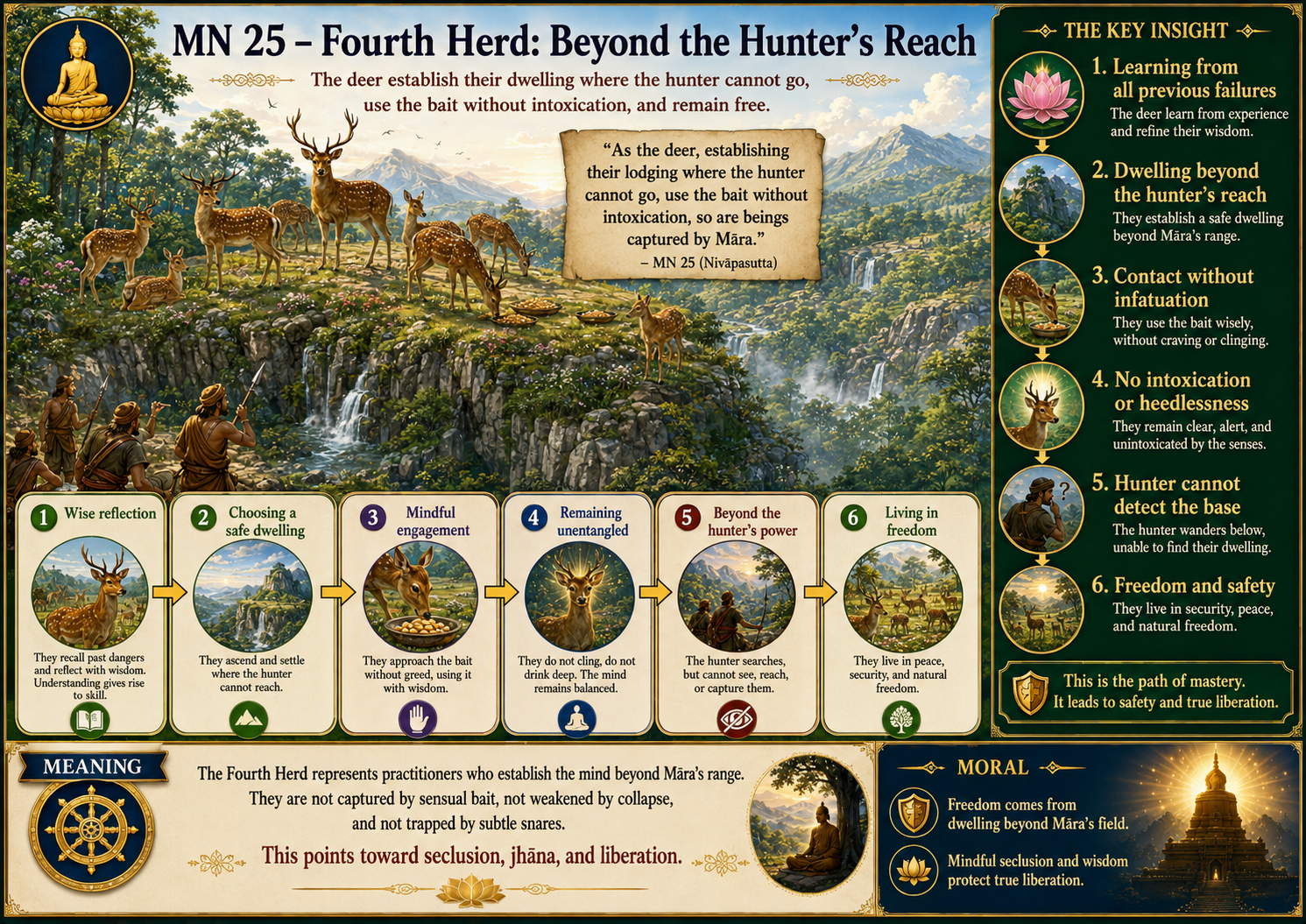
The fourth herd reviews all three failures and decides to establish its dwelling where neither the hunter nor his followers can reach.
From there they can make use of the bait without rushing in, infatuation, intoxication, or heedlessness. The hunter attempts to discover their dwelling but cannot.
He then decides not to disturb them, fearing that driving them away might cause all the other deer to abandon the bait. Thus the fourth herd escapes the hunter’s power.
Deep Dive
The decisive difference is not merely moderation around bait. The fourth herd establishes its āsaya—its dwelling or basis—where the hunter has no access.
The Buddha later defines this “where Māra cannot go” through meditative attainments beginning with first jhāna.
This makes the fourth strategy qualitatively different from simple self-control: it is based on a mind that has moved beyond Māra’s field.
The Buddha Decodes the Simile
Kāmaguṇā • Māra • four kinds of practitioners • sensual capture • austerity • views • escape
06 The Buddha Decodes the Simile
Upamā kho me ayaṁ, bhikkhave, katā atthassa viññāpanāya. Ayaṁ cevettha attho—
nivāpoti kho, bhikkhave, pañcannetaṁ kāmaguṇānaṁ adhivacanaṁ.
Nevāpikoti kho, bhikkhave, mārassetaṁ pāpimato adhivacanaṁ.
Nevāpikaparisāti kho, bhikkhave, māraparisāyetaṁ adhivacanaṁ.
Migajātāti kho, bhikkhave, samaṇabrāhmaṇānametaṁ adhivacanaṁ.
The Buddha says the simile was given to communicate a meaning.
The bait (nivāpa) stands for the five strands of sensual pleasure. The hunter stands for Māra the Evil One. The hunter’s retinue stands for Māra’s retinue. The herds of deer stand for samaṇas and brāhmaṇas—religious practitioners.
Deep Dive
The allegory is explicit; there is no need to guess the correspondences.
The key question is therefore: what does a practitioner do in relation to the five kāmaguṇā, and where has the mind established its dwelling?
07 First Practitioners — Captured by Worldly Bait
Tatra, bhikkhave, paṭhamā samaṇabrāhmaṇā amuṁ nivāpaṁ nivuttaṁ mārassa amūni ca lokāmisāni anupakhajja mucchitā bhojanāni bhuñjiṁsu. Te tattha anupakhajja mucchitā bhojanāni bhuñjamānā madaṁ āpajjiṁsu, mattā samānā pamādaṁ āpajjiṁsu, pamattā samānā yathākāmakaraṇīyā ahesuṁ mārassa amusmiṁ nivāpe amusmiñca lokāmise. Evañhi te, bhikkhave, paṭhamā samaṇabrāhmaṇā na parimucciṁsu mārassa iddhānubhāvā. Seyyathāpi te, bhikkhave, paṭhamā migajātā tathūpame ahaṁ ime paṭhame samaṇabrāhmaṇe vadāmi.
The first contemplatives and brahmins plunge into Māra’s bait and the world’s lures, become infatuated, intoxicated, and heedless, and therefore fall under Māra’s power—just like the first herd.
Deep Dive
This represents spiritual practitioners who may have a religious identity but remain governed by sensual attraction, acquisition, praise, status, and worldly bait.
Religious appearance does not itself establish escape from Māra.
08 Second Practitioners — Extreme Austerity and Rebound
Tatra, bhikkhave, dutiyā samaṇabrāhmaṇā evaṁ samacintesuṁ: ‘ye kho te paṭhamā samaṇabrāhmaṇā amuṁ nivāpaṁ nivuttaṁ mārassa amūni ca lokāmisāni anupakhajja mucchitā bhojanāni bhuñjiṁsu. Te tattha anupakhajja mucchitā bhojanāni bhuñjamānā madaṁ āpajjiṁsu, mattā samānā pamādaṁ āpajjiṁsu, pamattā samānā yathākāmakaraṇīyā ahesuṁ mārassa amusmiṁ nivāpe amusmiñca lokāmise. Evañhi te paṭhamā samaṇabrāhmaṇā na parimucciṁsu mārassa iddhānubhāvā. Yannūna mayaṁ sabbaso nivāpabhojanā lokāmisā paṭivirameyyāma, bhayabhogā paṭiviratā araññāyatanāni ajjhogāhetvā vihareyyāmā’ti. Te sabbaso nivāpabhojanā lokāmisā paṭiviramiṁsu, bhayabhogā paṭiviratā araññāyatanāni ajjhogāhetvā vihareyyāmāti. Te sabbaso nivāpabhojanā lokāmisā paṭiviramiṁsu, bhayabhogā paṭiviratā araññāyatanāni ajjhogāhetvā vihariṁsu. Te tattha sākabhakkhāpi ahesuṁ, sāmākabhakkhāpi ahesuṁ, nīvārabhakkhāpi ahesuṁ, daddulabhakkhāpi ahesuṁ, haṭabhakkhāpi ahesuṁ, kaṇabhakkhāpi ahesuṁ, ācāmabhakkhāpi ahesuṁ, piññākabhakkhāpi ahesuṁ, tiṇabhakkhāpi ahesuṁ, gomayabhakkhāpi ahesuṁ, vanamūlaphalāhārā yāpesuṁ pavattaphalabhojī.
Tesaṁ gimhānaṁ pacchime māse, tiṇodakasaṅkhaye, adhimattakasimānaṁ patto kāyo hoti. Tesaṁ adhimattakasimānaṁ pattakāyānaṁ balavīriyaṁ parihāyi. Balavīriye parihīne cetovimutti parihāyi. Cetovimuttiyā parihīnāya tameva nivāpaṁ nivuttaṁ mārassa paccāgamiṁsu tāni ca lokāmisāni. Te tattha anupakhajja mucchitā bhojanāni bhuñjiṁsu. Te tattha anupakhajja mucchitā bhojanāni bhuñjamānā madaṁ āpajjiṁsu, mattā samānā pamādaṁ āpajjiṁsu, pamattā samānā yathākāmakaraṇīyā ahesuṁ mārassa amusmiṁ nivāpe amusmiñca lokāmise. Evañhi te, bhikkhave, dutiyāpi samaṇabrāhmaṇā na parimucciṁsu mārassa iddhānubhāvā. Seyyathāpi te, bhikkhave, dutiyā migajātā tathūpame ahaṁ ime dutiye samaṇabrāhmaṇe vadāmi.
The second group avoids sensual bait and worldly lures completely and retreats into wilderness areas. They live on extremely austere foods: greens, millet, wild rice, scraps, rice bran, scum, sesame flour, grass, cow dung, roots, fruits, and fallen fruit.
As their bodies become extremely thin, strength and energy decline. With the decline of strength and energy, ceto-vimutti declines. They then return to Māra’s bait and worldly lures, become intoxicated and heedless, and are again subject to Māra.
Deep Dive
This is one of the sutta’s strongest warnings against confusing deprivation with freedom.
The Buddha’s criticism is functional: the austerity weakens the body, then the mental release declines, and the practitioner rebounds.
It is therefore not enough to “stay away from sensuality.” One must develop a stable basis from which sensuality no longer governs the mind.
09 Third Practitioners — Not Sensually Intoxicated, But Caught in Views
Tatra, bhikkhave, tatiyā samaṇabrāhmaṇā evaṁ samacintesuṁ: ‘ye kho te paṭhamā samaṇabrāhmaṇā amuṁ nivāpaṁ nivuttaṁ mārassa amūni ca lokāmisāni anupakhajja mucchitā bhojanāni bhuñjiṁsu. Te tattha anupakhajja mucchitā bhojanāni bhuñjamānā madaṁ āpajjiṁsu, mattā samānā pamādaṁ āpajjiṁsu, pamattā samānā yathākāmakaraṇīyā ahesuṁ mārassa amusmiṁ nivāpe amusmiñca lokāmise. Evañhi te paṭhamā samaṇabrāhmaṇā na parimucciṁsu mārassa iddhānubhāvā. yepi te dutiyā samaṇabrāhmaṇā evaṁ samacintesuṁ: ‘ye kho te paṭhamā samaṇabrāhmaṇā amuṁ nivāpaṁ nivuttaṁ mārassa amūni ca lokāmisāni anupakhajja mucchitā bhojanāni bhuñjiṁsu. Te tattha anupakhajja mucchitā bhojanāni bhuñjamānā madaṁ āpajjiṁsu, mattā samānā pamādaṁ āpajjiṁsu, pamattā samānā yathākāmakaraṇīyā ahesuṁ mārassa amusmiṁ nivāpe amusmiñca lokāmise. Evañhi te paṭhamā samaṇabrāhmaṇā na parimucciṁsu mārassa iddhānubhāvā. Yannūna mayaṁ sabbaso nivāpabhojanā lokāmisā paṭivirameyyāma, bhayabhogā paṭiviratā araññāyatanāni ajjhogāhetvā vihareyyāmā’ti. Te sabbaso nivāpabhojanā lokāmisā paṭiviramiṁsu, bhayabhogā paṭiviratā araññāyatanāni ajjhogāhetvā vihariṁsu. Te tattha sākabhakkhāpi ahesuṁ, sāmākabhakkhāpi ahesuṁ, nīvārabhakkhāpi ahesuṁ, daddulabhakkhāpi ahesuṁ, haṭabhakkhāpi ahesuṁ, kaṇabhakkhāpi ahesuṁ, ācāmabhakkhāpi ahesuṁ, piññākabhakkhāpi ahesuṁ, tiṇabhakkhāpi ahesuṁ, gomayabhakkhāpi ahesuṁ, vanamūlaphalāhārā yāpesuṁ pavattaphalabhojī. Tesaṁ gimhānaṁ pacchime māse, tiṇodakasaṅkhaye, adhimattakasimānaṁ patto kāyo hoti. Tesaṁ adhimattakasimānaṁ pattakāyānaṁ balavīriyaṁ parihāyi. Balavīriye parihīne cetovimutti parihāyi. Cetovimuttiyā parihīnāya tameva nivāpaṁ nivuttaṁ mārassa paccāgamiṁsu tāni ca lokāmisāni. Te tattha anupakhajja mucchitā bhojanāni bhuñjiṁsu. Te tattha anupakhajja mucchitā bhojanāni bhuñjamānā madaṁ āpajjiṁsu, mattā samānā pamādaṁ āpajjiṁsu, pamattā samānā yathākāmakaraṇīyā ahesuṁ mārassa amusmiṁ nivāpe amusmiñca lokāmise. Evañhi te dutiyāpi samaṇabrāhmaṇā na parimucciṁsu mārassa iddhānubhāvā. Yannūna mayaṁ amuṁ nivāpaṁ nivuttaṁ mārassa amūni ca lokāmisāni upanissāya āsayaṁ kappeyyāma, tatrāsayaṁ kappetvā amuṁ nivāpaṁ nivuttaṁ mārassa amūni ca lokāmisāni ananupakhajja amucchitā bhojanāni bhuñjissāma, ananupakhajja amucchitā bhojanāni bhuñjamānā na madaṁ āpajjissāma, amattā samānā na pamādaṁ āpajjissāma, appamattā samānā na yathākāmakaraṇīyā bhavissāma mārassa amusmiṁ nivāpe amusmiñca lokāmise’ti. Te amuṁ nivāpaṁ nivuttaṁ mārassa amūni ca lokāmisāni upanissāya āsayaṁ kappayiṁsu. Tatrāsayaṁ kappetvā amuṁ nivāpaṁ nivuttaṁ mārassa amūni ca lokāmisāni ananupakhajja amucchitā bhojanāni bhuñjiṁsu. Te tattha ananupakhajja amucchitā bhojanāni bhuñjamānā na madaṁ āpajjiṁsu, amattā samānā na pamādaṁ āpajjiṁsu, appamattā samānā na yathākāmakaraṇīyā ahesuṁ mārassa amusmiṁ nivāpe amusmiñca lokāmise. Api ca kho evaṁdiṭṭhikā ahesuṁ— sassato loko itipi, asassato loko itipi; antavā loko itipi, anantavā loko itipi; taṁ jīvaṁ taṁ sarīraṁ itipi, aññaṁ jīvaṁ aññaṁ sarīraṁ itipi; hoti tathāgato paraṁ maraṇā itipi, na hoti tathāgato paraṁ maraṇā itipi, hoti ca na ca hoti tathāgato paraṁ maraṇā itipi, neva hoti na na hoti tathāgato paraṁ maraṇā itipi. Evañhi te, bhikkhave, tatiyāpi samaṇabrāhmaṇā na parimucciṁsu mārassa iddhānubhāvā.
The third group learns to engage the world’s bait without becoming intoxicated or heedless.
Yet they become attached to speculative positions: whether the world is eternal or not eternal, finite or infinite; whether the life-principle and body are the same or different; and whether a Tathāgata exists, does not exist, both exists and does not exist, or neither exists nor does not exist after death.
Because of these views, they still do not escape Māra’s power.
Deep Dive
This is the subtle center of MN 25.
Freedom from crude sensual intoxication is not the same as full liberation. A mind can become disciplined around sense pleasures yet still build a new dwelling in speculative metaphysics.
Diṭṭhi itself can become a snare. The practitioner must go beyond both sensual capture and conceptual capture.
Practice / Teaching Example
Teaching example: a practitioner may live simply and restrain the senses well, yet spend enormous energy defending metaphysical claims about consciousness, self, rebirth mechanics, or the status of an awakened one. MN 25 warns that this too can become a place where the mind is caught.
10 Fourth Practitioners — Beyond Māra’s Reach
Tatra, bhikkhave, catutthā samaṇabrāhmaṇā evaṁ samacintesuṁ: ‘ye kho te paṭhamā samaṇabrāhmaṇā amuṁ nivāpaṁ nivuttaṁ mārassa amūni ca lokāmisāni anupakhajja mucchitā bhojanāni bhuñjiṁsu. Te tattha anupakhajja mucchitā bhojanāni bhuñjamānā madaṁ āpajjiṁsu, mattā samānā pamādaṁ āpajjiṁsu, pamattā samānā yathākāmakaraṇīyā ahesuṁ mārassa amusmiṁ nivāpe amusmiñca lokāmise. Evañhi te paṭhamā samaṇabrāhmaṇā na parimucciṁsu mārassa iddhānubhāvā. yepi te dutiyā samaṇabrāhmaṇā evaṁ samacintesuṁ: ‘ye kho te paṭhamā samaṇabrāhmaṇā amuṁ nivāpaṁ nivuttaṁ mārassa amūni ca lokāmisāni anupakhajja mucchitā bhojanāni bhuñjiṁsu. Te tattha anupakhajja mucchitā bhojanāni bhuñjamānā madaṁ āpajjiṁsu, mattā samānā pamādaṁ āpajjiṁsu, pamattā samānā yathākāmakaraṇīyā ahesuṁ mārassa amusmiṁ nivāpe amusmiñca lokāmise. Evañhi te paṭhamā samaṇabrāhmaṇā na parimucciṁsu mārassa iddhānubhāvā. Yannūna mayaṁ sabbaso nivāpabhojanā lokāmisā paṭivirameyyāma, bhayabhogā paṭiviratā araññāyatanāni ajjhogāhetvā vihareyyāmā’ti. Te sabbaso nivāpabhojanā lokāmisā paṭiviramiṁsu, bhayabhogā paṭiviratā araññāyatanāni ajjhogāhetvā vihariṁsu. Te tattha sākabhakkhāpi ahesuṁ, sāmākabhakkhāpi ahesuṁ, nīvārabhakkhāpi ahesuṁ, daddulabhakkhāpi ahesuṁ, haṭabhakkhāpi ahesuṁ, kaṇabhakkhāpi ahesuṁ, ācāmabhakkhāpi ahesuṁ, piññākabhakkhāpi ahesuṁ, tiṇabhakkhāpi ahesuṁ, gomayabhakkhāpi ahesuṁ, vanamūlaphalāhārā yāpesuṁ pavattaphalabhojī. Tesaṁ gimhānaṁ pacchime māse, tiṇodakasaṅkhaye, adhimattakasimānaṁ patto kāyo hoti. Tesaṁ adhimattakasimānaṁ pattakāyānaṁ balavīriyaṁ parihāyi. Balavīriye parihīne cetovimutti parihāyi. Cetovimuttiyā parihīnāya tameva nivāpaṁ nivuttaṁ mārassa paccāgamiṁsu tāni ca lokāmisāni. Te tattha anupakhajja mucchitā bhojanāni bhuñjiṁsu. Te tattha anupakhajja mucchitā bhojanāni bhuñjamānā madaṁ āpajjiṁsu, mattā samānā pamādaṁ āpajjiṁsu, pamattā samānā yathākāmakaraṇīyā ahesuṁ mārassa amusmiṁ nivāpe amusmiñca lokāmise. Evañhi te dutiyāpi samaṇabrāhmaṇā na parimucciṁsu mārassa iddhānubhāvā. Tatra, bhikkhave, tatiyā samaṇabrāhmaṇā evaṁ samacintesuṁ: ‘ye kho te paṭhamā samaṇabrāhmaṇā amuṁ nivāpaṁ nivuttaṁ mārassa amūni ca lokāmisāni anupakhajja mucchitā bhojanāni bhuñjiṁsu. Te tattha anupakhajja mucchitā bhojanāni bhuñjamānā madaṁ āpajjiṁsu, mattā samānā pamādaṁ āpajjiṁsu, pamattā samānā yathākāmakaraṇīyā ahesuṁ mārassa amusmiṁ nivāpe amusmiñca lokāmise. Evañhi te paṭhamā samaṇabrāhmaṇā na parimucciṁsu mārassa iddhānubhāvā. yepi te dutiyā samaṇabrāhmaṇā evaṁ samacintesuṁ: ‘ye kho te paṭhamā samaṇabrāhmaṇā amuṁ nivāpaṁ nivuttaṁ mārassa amūni ca lokāmisāni anupakhajja mucchitā bhojanāni bhuñjiṁsu. Te tattha anupakhajja mucchitā bhojanāni bhuñjamānā madaṁ āpajjiṁsu, mattā samānā pamādaṁ āpajjiṁsu, pamattā samānā yathākāmakaraṇīyā ahesuṁ mārassa amusmiṁ nivāpe amusmiñca lokāmise. Evañhi te paṭhamā samaṇabrāhmaṇā na parimucciṁsu mārassa iddhānubhāvā. Yannūna mayaṁ sabbaso nivāpabhojanā lokāmisā paṭivirameyyāma, bhayabhogā paṭiviratā araññāyatanāni ajjhogāhetvā vihareyyāmā’ti. Te sabbaso nivāpabhojanā lokāmisā paṭiviramiṁsu, bhayabhogā paṭiviratā araññāyatanāni ajjhogāhetvā vihariṁsu. Te tattha sākabhakkhāpi ahesuṁ, sāmākabhakkhāpi ahesuṁ, nīvārabhakkhāpi ahesuṁ, daddulabhakkhāpi ahesuṁ, haṭabhakkhāpi ahesuṁ, kaṇabhakkhāpi ahesuṁ, ācāmabhakkhāpi ahesuṁ, piññākabhakkhāpi ahesuṁ, tiṇabhakkhāpi ahesuṁ, gomayabhakkhāpi ahesuṁ, vanamūlaphalāhārā yāpesuṁ pavattaphalabhojī. Tesaṁ gimhānaṁ pacchime māse, tiṇodakasaṅkhaye, adhimattakasimānaṁ patto kāyo hoti. Tesaṁ adhimattakasimānaṁ pattakāyānaṁ balavīriyaṁ parihāyi. Balavīriye parihīne cetovimutti parihāyi. Cetovimuttiyā parihīnāya tameva nivāpaṁ nivuttaṁ mārassa paccāgamiṁsu tāni ca lokāmisāni. Te tattha anupakhajja mucchitā bhojanāni bhuñjiṁsu. Te tattha anupakhajja mucchitā bhojanāni bhuñjamānā madaṁ āpajjiṁsu, mattā samānā pamādaṁ āpajjiṁsu, pamattā samānā yathākāmakaraṇīyā ahesuṁ mārassa amusmiṁ nivāpe amusmiñca lokāmise. Evañhi te dutiyāpi samaṇabrāhmaṇā na parimucciṁsu mārassa iddhānubhāvā. Yannūna mayaṁ amuṁ nivāpaṁ nivuttaṁ mārassa amūni ca lokāmisāni upanissāya āsayaṁ kappeyyāma, tatrāsayaṁ kappetvā amuṁ nivāpaṁ nivuttaṁ mārassa amūni ca lokāmisāni ananupakhajja amucchitā bhojanāni bhuñjissāma, ananupakhajja amucchitā bhojanāni bhuñjamānā na madaṁ āpajjissāma, amattā samānā na pamādaṁ āpajjissāma, appamattā samānā na yathākāmakaraṇīyā bhavissāma mārassa amusmiṁ nivāpe amusmiñca lokāmise’ti. Te amuṁ nivāpaṁ nivuttaṁ mārassa amūni ca lokāmisāni upanissāya āsayaṁ kappayiṁsu. Tatrāsayaṁ kappetvā amuṁ nivāpaṁ nivuttaṁ mārassa amūni ca lokāmisāni ananupakhajja amucchitā bhojanāni bhuñjiṁsu. Te tattha ananupakhajja amucchitā bhojanāni bhuñjamānā na madaṁ āpajjiṁsu, amattā samānā na pamādaṁ āpajjiṁsu, appamattā samānā na yathākāmakaraṇīyā ahesuṁ mārassa amusmiṁ nivāpe amusmiñca lokāmise. Api ca kho evaṁdiṭṭhikā ahesuṁ— sassato loko itipi, asassato loko itipi; antavā loko itipi, anantavā loko itipi; taṁ jīvaṁ taṁ sarīraṁ itipi, aññaṁ jīvaṁ aññaṁ sarīraṁ itipi; hoti tathāgato paraṁ maraṇā itipi, na hoti tathāgato paraṁ maraṇā itipi, hoti ca na ca hoti tathāgato paraṁ maraṇā itipi, neva hoti na na hoti tathāgato paraṁ maraṇā itipi. Evañhi te, bhikkhave, tatiyāpi samaṇabrāhmaṇā na parimucciṁsu mārassa iddhānubhāvā. Yannūna mayaṁ yattha agati mārassa ca māraparisāya ca tatrāsayaṁ kappeyyāma. Tatrāsayaṁ kappetvā amuṁ nivāpaṁ nivuttaṁ mārassa amūni ca lokāmisāni ananupakhajja amucchitā bhojanāni bhuñjissāma, ananupakhajja amucchitā bhojanāni bhuñjamānā na madaṁ āpajjissāma, amattā samānā na pamādaṁ āpajjissāma, appamattā samānā na yathākāmakaraṇīyā bhavissāma mārassa amusmiṁ nivāpe amusmiñca lokāmise’ti. Te yattha agati mārassa ca māraparisāya ca tatrāsayaṁ kappayiṁsu. Tatrāsayaṁ kappetvā amuṁ nivāpaṁ nivuttaṁ mārassa amūni ca lokāmisāni ananupakhajja amucchitā bhojanāni bhuñjiṁsu, te tattha ananupakhajja amucchitā bhojanāni bhuñjamānā na madaṁ āpajjiṁsu, amattā samānā na pamādaṁ āpajjiṁsu, appamattā samānā na yathākāmakaraṇīyā ahesuṁ mārassa amusmiṁ nivāpe amusmiñca lokāmise. Evañhi te, bhikkhave, catutthā samaṇabrāhmaṇā parimucciṁsu mārassa iddhānubhāvā.
The fourth group establishes its dwelling where Māra and Māra’s retinue cannot go. From there they engage what must be engaged without infatuation, intoxication, or heedlessness.
The Buddha says these practitioners escape Māra’s power, just as the fourth herd escapes the hunter.
Deep Dive
The phrase yattha agati mārassa ca māraparisāya ca—“where Māra and Māra’s retinue have no access”—is the hinge of the discourse.
The next section answers exactly what this means in practice: first jhāna and the successive higher attainments.
Where Māra Cannot Go
First to fourth jhāna • four immaterial attainments • cessation • exhaustion of the āsavas
11 Where Māra Cannot Go — First Jhāna
Kathañca, bhikkhave, agati mārassa ca māraparisāya ca? Idha, bhikkhave, bhikkhu vivicceva kāmehi vivicca akusalehi dhammehi savitakkaṁ savicāraṁ vivekajaṁ pītisukhaṁ paṭhamaṁ jhānaṁ upasampajja viharati. Ayaṁ vuccati, bhikkhave, bhikkhu andhamakāsi māraṁ, apadaṁ vadhitvā māracakkhuṁ adassanaṁ gato pāpimato.
The Buddha asks: “And how is there a place where Māra and Māra’s retinue cannot go?”
A bhikkhu, secluded from sensuality and secluded from unwholesome qualities, enters and dwells in the first jhāna, with thought and examination, and rapture and pleasure born of seclusion.
Such a bhikkhu is said to have blinded Māra, destroyed the track of Māra’s eye, and gone beyond the Evil One’s sight.
Deep Dive
The definition is strikingly concrete: “out of Māra’s range” begins with vivicceva kāmehi—seclusion from sensuality.
Jhāna is therefore not presented here as a relaxation technique. It is a radical change of domain: the mind is no longer operating from the sensual field in which Māra’s bait functions.
12 Second to Fourth Jhāna — Deepening Freedom
Puna caparaṁ, bhikkhave, bhikkhu vitakkavicārānaṁ vūpasamā ajjhattaṁ sampasādanaṁ cetaso ekodibhāvaṁ avitakkaṁ avicāraṁ samādhijaṁ pītisukhaṁ dutiyaṁ jhānaṁ upasampajja viharati. Ayaṁ vuccati, bhikkhave, bhikkhu andhamakāsi māraṁ, apadaṁ vadhitvā māracakkhuṁ adassanaṁ gato pāpimato.
Puna caparaṁ, bhikkhave, bhikkhu pītiyā ca virāgā upekkhako ca viharati sato ca sampajāno, sukhañca kāyena paṭisaṁvedeti yaṁ taṁ ariyā ācikkhanti ‘upekkhako satimā sukhavihārī’ti tatiyaṁ jhānaṁ upasampajja viharati. Ayaṁ vuccati, bhikkhave, bhikkhu andhamakāsi māraṁ, apadaṁ vadhitvā māracakkhuṁ adassanaṁ gato pāpimato.
Puna caparaṁ, bhikkhave, bhikkhu sukhassa ca pahānā dukkhassa ca pahānā, pubbeva somanassadomanassānaṁ atthaṅgamā, adukkhamasukhaṁ upekkhāsatipārisuddhiṁ catutthaṁ jhānaṁ upasampajja viharati. Ayaṁ vuccati, bhikkhave, bhikkhu andhamakāsi māraṁ, apadaṁ vadhitvā māracakkhuṁ adassanaṁ gato pāpimato.
The practitioner enters second jhāna with the calming of thought and examination, inner confidence, unification of mind, and rapture and pleasure born of samādhi.
With the fading of rapture, the practitioner enters third jhāna, dwelling equanimous, mindful, clearly comprehending, and experiencing bodily pleasure.
With the abandoning of pleasure and pain and the disappearance of gladness and distress, the practitioner enters fourth jhāna, with neither-painful-nor-pleasant feeling and purification of mindfulness by equanimity.
At each stage the Buddha repeats that the practitioner has gone beyond Māra’s sight.
Deep Dive
The sequence progressively removes coarser mental activities and affective movements.
What matters in MN 25 is not only the phenomenology of each jhāna, but their role in establishing a mind outside Māra’s sensual domain.
13 The Four Immaterial Attainments
Puna caparaṁ, bhikkhave, bhikkhu sabbaso rūpasaññānaṁ samatikkamā paṭighasaññānaṁ atthaṅgamā nānattasaññānaṁ amanasikārā ‘ananto ākāso’ti ākāsānañcāyatanaṁ upasampajja viharati. Ayaṁ vuccati, bhikkhave, bhikkhu andhamakāsi māraṁ, apadaṁ vadhitvā māracakkhuṁ adassanaṁ gato pāpimato.
Puna caparaṁ, bhikkhave, bhikkhu sabbaso ākāsānañcāyatanaṁ samatikkamma ‘anantaṁ viññāṇan’ti viññāṇañcāyatanaṁ upasampajja viharati. Ayaṁ vuccati, bhikkhave, bhikkhu andhamakāsi māraṁ, apadaṁ vadhitvā māracakkhuṁ adassanaṁ gato pāpimato.
Puna caparaṁ, bhikkhave, bhikkhu sabbaso viññāṇañcāyatanaṁ samatikkamma ‘natthi kiñcī’ti ākiñcaññāyatanaṁ upasampajja viharati. Ayaṁ vuccati, bhikkhave, bhikkhu andhamakāsi māraṁ, apadaṁ vadhitvā māracakkhuṁ adassanaṁ gato pāpimato.
Puna caparaṁ, bhikkhave, bhikkhu sabbaso ākiñcaññāyatanaṁ samatikkamma nevasaññānāsaññāyatanaṁ upasampajja viharati. Ayaṁ vuccati, bhikkhave, bhikkhu andhamakāsi māraṁ, apadaṁ vadhitvā māracakkhuṁ adassanaṁ gato pāpimato.
The practitioner successively enters the base of infinite space, infinite consciousness, nothingness, and neither-perception-nor-non-perception.
For each attainment the same refrain is given: the practitioner has blinded Māra and gone beyond the Evil One’s sight.
Deep Dive
MN 25 therefore extends the “out of range” principle through the arūpa attainments.
However, the next and final stage is crucial: the sutta does not equate these refined states with exhaustion of the āsavas.
14 Cessation of Perception and Feeling — Āsavas Exhausted
Puna caparaṁ, bhikkhave, bhikkhu sabbaso nevasaññānāsaññāyatanaṁ samatikkamma saññāvedayitanirodhaṁ upasampajja viharati. Paññāya cassa disvā āsavā parikkhīṇā honti. Ayaṁ vuccati, bhikkhave, bhikkhu andhamakāsi māraṁ, apadaṁ vadhitvā māracakkhuṁ adassanaṁ gato pāpimato tiṇṇo loke visattikan”ti.
Completely transcending the base of neither-perception-nor-non-perception, the bhikkhu enters and dwells in the cessation of perception and feeling.
Having seen with wisdom, the āsavas are exhausted.
The Buddha says that such a bhikkhu has blinded Māra, destroyed the path of Māra’s eye, gone beyond the Evil One’s sight, and crossed beyond the world’s entanglement.
Deep Dive
This is the culminating distinction.
For the earlier attainments, the refrain says the practitioner is beyond Māra’s sight. Here the text adds the decisive phrase: paññāya cassa disvā āsavā parikkhīṇā honti—“having seen with wisdom, the āsavas are exhausted.”
The final criterion is therefore not merely depth of samādhi but liberation through wisdom and the ending of the āsavas.
Conclusion
The complete movement from bait and bondage to wisdom and release
15 Conclusion
Idamavoca bhagavā. Attamanā te bhikkhū bhagavato bhāsitaṁ abhinandunti.
That is what the Blessed One said. The bhikkhus were satisfied and delighted in his words.
Deep Dive
The whole discourse moves from bait to freedom: indulgence fails, extreme suppression fails, cautious worldly engagement still fails when views remain, and genuine escape is established only where Māra has no access—culminating in wisdom and the exhaustion of the āsavas.
The whole simile at a glance
| Group | Strategy | Failure / breakthrough | Result |
|---|---|---|---|
| 1st herd / practitioners | Indulge bait directly | Mada → pamāda | Captured |
| 2nd herd / practitioners | Total avoidance / austerity | Strength declines → return to bait | Captured |
| 3rd herd / practitioners | Careful, non-intoxicated engagement | Still located within hunter’s range; trapped by diṭṭhi | Captured |
| 4th herd / practitioners | Dwelling where hunter/Māra cannot go | Jhāna → higher attainments | Escapes Māra |