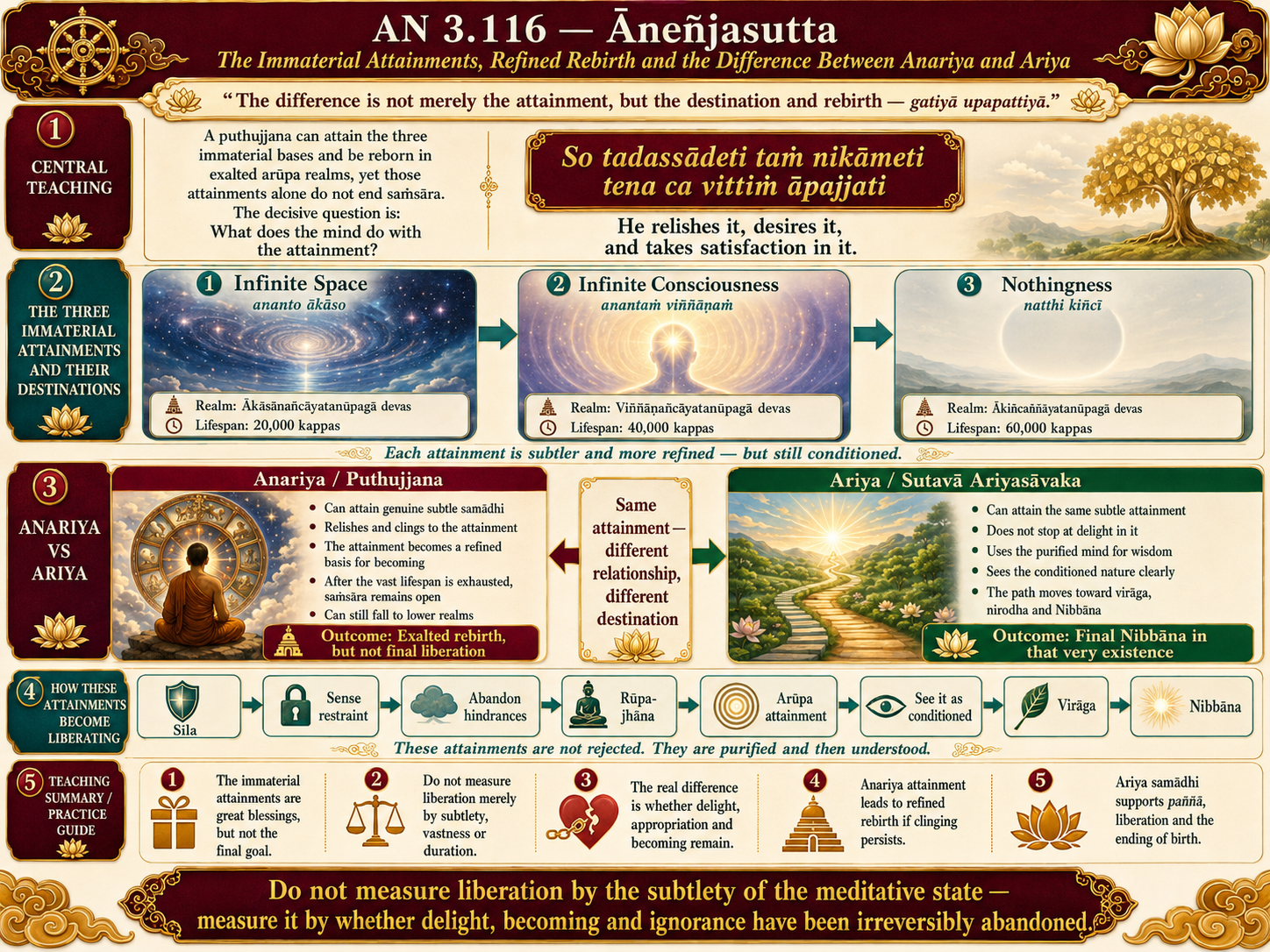
 VISUAL SUMMARYSee this sutta in a pictureOpen the complete infographic for a visual overview before or after reading the full study.View infographic →
AN 3.116 is a compact discourse with an enormous implication. It shows that a practitioner may move beyond ordinary sensory experience and beyond the field of form into three exceedingly subtle immaterial attainments—the base of infinite space, the base of infinite consciousness and the base of nothingness—and yet the work of liberation may remain incomplete. The states are genuine. Their refinement is genuine. Their karmic potency is genuine. But none of those facts, by themselves, establishes the ending of saṁsāra.
The Buddha places the decisive emphasis elsewhere. After each attainment he repeats that the practitioner relishes it, desires it and finds satisfaction in it. Then, instead of distinguishing the ordinary person and noble disciple by saying that one entered the attainment correctly and the other incorrectly, he explicitly states that the difference concerns gati and upapatti—destination and rebirth. The puthujjana remains within an open-ended saṁsāric trajectory. The noble disciple described in the discourse reaches final Nibbāna in that very existence after the lifespan of that realm is completed.
This makes the sutta a vital teaching for advanced meditation. The more subtle the attainment becomes, the easier it is to mistake refinement for finality. AN 3.116 refuses that confusion. It teaches that vastness is not Nibbāna, subtle consciousness is not Nibbāna, nothingness is not Nibbāna, and even an extraordinarily long existence in an immaterial realm is still existence.
011. Three Kinds of Persons
“Tayome, bhikkhave, puggalā santo saṁvijjamānā lokasmiṁ. Katame tayo?
“Bhikkhus, these three kinds of persons are found existing in the world. What three?”
The discourse is arranged numerically around three meditative attainments, but the repeated comparison inside each case reveals a second and more decisive classification: assutavā puthujjana and sutavā ariyasāvaka. The Buddha therefore asks us to look at meditation at two levels at once. At the first level, what has the mind become capable of entering? At the second, what has happened to the practitioner’s existential trajectory? AN 3.116 makes clear that the second question is ultimately the more important one.
022. The Base of Infinite Space
Idha, bhikkhave, ekacco puggalo sabbaso rūpasaññānaṁ samatikkamā paṭighasaññānaṁ atthaṅgamā nānattasaññānaṁ amanasikārā ‘ananto ākāso’ti ākāsānañcāyatanaṁ upasampajja viharati.
“Here, bhikkhus, a certain person, by completely transcending perceptions of form, with the disappearance of perceptions of sensory impingement, and by not attending to perceptions of diversity, perceiving ‘Space is infinite,’ enters and dwells in the base of infinite space.”
So tadassādeti taṁ nikāmeti tena ca vittiṁ āpajjati, tatra ṭhito tadadhimutto tabbahulavihārī aparihīno kālaṁ kurumāno ākāsānañcāyatanūpagānaṁ devānaṁ sahabyataṁ upapajjati.
“He relishes it, desires it, and finds satisfaction in it. Established there, devoted to it, frequently dwelling in it, and not having fallen away from it, when he dies he is reborn in companionship with the devas who have attained the base of infinite space.”
Ākāsānañcāyatanūpagānaṁ, bhikkhave, devānaṁ vīsati kappasahassāni āyuppamāṇaṁ.
“The lifespan of the devas who have attained the base of infinite space is twenty thousand kappas.”
Tattha puthujjano yāvatāyukaṁ ṭhatvā yāvatakaṁ tesaṁ devānaṁ āyuppamāṇaṁ taṁ sabbaṁ khepetvā nirayampi gacchati tiracchānayonimpi gacchati pettivisayampi gacchati.
“There the ordinary person remains for the full lifespan. Having exhausted the entire lifespan of those devas, he can still go to hell, to the animal realm, or to the realm of departed spirits.”
Bhagavato pana sāvako tattha yāvatāyukaṁ ṭhatvā yāvatakaṁ tesaṁ devānaṁ āyuppamāṇaṁ taṁ sabbaṁ khepetvā tasmiṁyeva bhave parinibbāyati.
“But a disciple of the Blessed One remains there for the full lifespan and, having exhausted the lifespan of those devas, attains final Nibbāna in that very existence.”
Ayaṁ kho, bhikkhave, viseso ayaṁ adhippayāso idaṁ nānākaraṇaṁ sutavato ariyasāvakassa assutavatā puthujjanena, yadidaṁ gatiyā upapattiyā.
“This, bhikkhus, is the difference, this is the distinction, this is the distinguishing factor between the well-taught noble disciple and the uninstructed ordinary person, namely, with regard to destination and rebirth.”
The first immaterial attainment takes the meditator beyond the field in which form is the organizing basis of experience. Rūpasaññānaṁ samatikkamā is not merely closing the eyes or ignoring visible objects; the field of form-perception is transcended as the basis of the meditative dwelling. Paṭighasaññānaṁ atthaṅgamā here should not be read as “the ending of anger.” In this formula, paṭigha concerns sensory impingement or resistance. Nānattasaññānaṁ amanasikārā indicates non-attention to multiplicity or diversity. The mind no longer organizes experience through the usual manifold field, and the perception “Infinite is space” becomes dominant.
Yet immediately after describing this extraordinary transcendence, the Buddha introduces the danger: the mind can delight in the attainment. This is the first great lesson of the sutta. A state can be far beyond sensuality and still become an object of attachment.
033. The Base of Infinite Consciousness
Puna caparaṁ, bhikkhave, idhekacco puggalo sabbaso ākāsānañcāyatanaṁ samatikkamma ‘anantaṁ viññāṇan’ti viññāṇañcāyatanaṁ upasampajja viharati.
“Furthermore, bhikkhus, a certain person, by completely transcending the base of infinite space, perceiving ‘Consciousness is infinite,’ enters and dwells in the base of infinite consciousness.”
So tadassādeti taṁ nikāmeti tena ca vittiṁ āpajjati, tatra ṭhito tadadhimutto tabbahulavihārī aparihīno kālaṁ kurumāno viññāṇañcāyatanūpagānaṁ devānaṁ sahabyataṁ upapajjati.
“He relishes it, desires it, and finds satisfaction in it. Established there, devoted to it, frequently dwelling in it, and not having fallen away from it, when he dies he is reborn in companionship with the devas who have attained the base of infinite consciousness.”
Viññāṇañcāyatanūpagānaṁ, bhikkhave, devānaṁ cattārīsaṁ kappasahassāni āyuppamāṇaṁ.
“The lifespan of the devas who have attained the base of infinite consciousness is forty thousand kappas.”
Tattha puthujjano yāvatāyukaṁ ṭhatvā yāvatakaṁ tesaṁ devānaṁ āyuppamāṇaṁ taṁ sabbaṁ khepetvā nirayampi gacchati tiracchānayonimpi gacchati pettivisayampi gacchati.
“There the ordinary person remains for the full lifespan. Having exhausted the entire lifespan of those devas, he can still go to hell, to the animal realm, or to the realm of departed spirits.”
Bhagavato pana sāvako tattha yāvatāyukaṁ ṭhatvā yāvatakaṁ tesaṁ devānaṁ āyuppamāṇaṁ taṁ sabbaṁ khepetvā tasmiṁyeva bhave parinibbāyati.
“But a disciple of the Blessed One remains there for the full lifespan and, having exhausted the lifespan of those devas, attains final Nibbāna in that very existence.”
Ayaṁ kho, bhikkhave, viseso ayaṁ adhippayāso idaṁ nānākaraṇaṁ sutavato ariyasāvakassa assutavatā puthujjanena, yadidaṁ gatiyā upapattiyā.
“This, bhikkhus, is the difference, this is the distinction, this is the distinguishing factor between the well-taught noble disciple and the uninstructed ordinary person, namely, with regard to destination and rebirth.”
The second attainment refines the field further. Infinite space itself is now transcended, and what becomes prominent is the boundlessness of consciousness. The practitioner is not engaged in a philosophical assertion that consciousness is metaphysically eternal. The formula describes a meditative attainment: “anantaṁ viññāṇaṁ” is the operative perception through which this sphere is entered and dwelt in.
The associated lifespan of forty thousand kappas makes the Buddha’s teaching even more striking. The state can be unimaginably refined and its result unimaginably long, yet if the practitioner remains a puthujjana, the security is not irreversible. Duration is not liberation. Subtlety is not liberation. The transcendence of form is not yet the transcendence of bhava.
044. The Base of Nothingness
Puna caparaṁ, bhikkhave, idhekacco puggalo sabbaso viññāṇañcāyatanaṁ samatikkamma ‘natthi kiñcī’ti ākiñcaññāyatanaṁ upasampajja viharati.
“Furthermore, bhikkhus, a certain person, by completely transcending the base of infinite consciousness, perceiving ‘There is nothing,’ enters and dwells in the base of nothingness.”
So tadassādeti taṁ nikāmeti tena ca vittiṁ āpajjati, tatra ṭhito tadadhimutto tabbahulavihārī aparihīno kālaṁ kurumāno ākiñcaññāyatanūpagānaṁ devānaṁ sahabyataṁ upapajjati.
“He relishes it, desires it, and finds satisfaction in it. Established there, devoted to it, frequently dwelling in it, and not having fallen away from it, when he dies he is reborn in companionship with the devas who have attained the base of nothingness.”
Ākiñcaññāyatanūpagānaṁ, bhikkhave, devānaṁ saṭṭhi kappasahassāni āyuppamāṇaṁ.
“The lifespan of the devas who have attained the base of nothingness is sixty thousand kappas.”
Tattha puthujjano yāvatāyukaṁ ṭhatvā yāvatakaṁ tesaṁ devānaṁ āyuppamāṇaṁ taṁ sabbaṁ khepetvā nirayampi gacchati tiracchānayonimpi gacchati pettivisayampi gacchati.
“There the ordinary person remains for the full lifespan. Having exhausted the entire lifespan of those devas, he can still go to hell, to the animal realm, or to the realm of departed spirits.”
Bhagavato pana sāvako tattha yāvatāyukaṁ ṭhatvā yāvatakaṁ tesaṁ devānaṁ āyuppamāṇaṁ taṁ sabbaṁ khepetvā tasmiṁyeva bhave parinibbāyati.
“But a disciple of the Blessed One remains there for the full lifespan and, having exhausted the lifespan of those devas, attains final Nibbāna in that very existence.”
Ayaṁ kho, bhikkhave, viseso, ayaṁ adhippayāso idaṁ nānākaraṇaṁ sutavato ariyasāvakassa assutavatā puthujjanena, yadidaṁ gatiyā upapattiyā.
“This, bhikkhus, is the difference, this is the distinction, this is the distinguishing factor between the well-taught noble disciple and the uninstructed ordinary person, namely, with regard to destination and rebirth.”
The third attainment moves beyond the boundlessness of consciousness itself. “Natthi kiñcī”—“There is nothing”—is not a doctrine that nothing exists. It is the perception by which the base of nothingness is entered. This distinction is essential. The Buddha is describing a meditative mode of dwelling, not endorsing metaphysical nihilism.
Its corresponding lifespan is sixty thousand kappas. If one were measuring spiritual attainment by duration, this would look almost incomprehensibly secure. Yet the Buddha uses precisely such vast numbers to expose the inadequacy of that measure. Even sixty thousand kappas eventually come to an end. What is conditioned cannot become unconditioned merely by lasting a very long time.
055. The Sutta’s Conclusion
Ime kho, bhikkhave, tayo puggalā santo saṁvijjamānā lokasmin”ti.
“These, bhikkhus, are the three kinds of persons found existing in the world.”
The final sentence is short because the repeated structure has already done the teaching. At each level, there is a sublime attainment, delight in that attainment, a corresponding rebirth, and then the decisive distinction between puthujjana and ariyasāvaka. The repetition forces the reader to stop equating meditative refinement with liberation. Each attainment can be real; each can be powerful; each can remain within saṁsāra.
066. The Necessary Foundation
AN 3.116 begins at the level of attainment and therefore does not repeat the whole gradual training. That omission should not be mistaken for saying that one simply conceptualizes “infinite space” and thereby enters an immaterial attainment. In the broader Nikāya framework, the mind has already been trained through sīla, restraint, wakefulness, mindfulness, abandonment of the hindrances and the development of the rūpa-jhānas. Only a mind that has become deeply samāhita can make the transition into these subtler bases.
This is important practically. The phrases “ananto ākāso,” “anantaṁ viññāṇaṁ,” and “natthi kiñcī” are not mantras to be repeated by an otherwise distracted mind. They name the defining perceptions of already highly refined meditative dwellings. The preparation is the gradual quieting of what is coarse until the mind is capable of abandoning an entire perceptual field and taking up a subtler one.
077. Infinite Space — Transcending the Field of Form
The formula for infinite space contains three movements before the perception of infinity becomes prominent: the complete transcendence of perceptions of form, the disappearance of perceptions of sensory impingement, and non-attention to perceptions of diversity. The important practical point is that the mind is not trying to make a finite visual object appear infinitely large. Rather, the organizing dependence on form is relinquished as the operative basis of the attainment.
MN 121 helps illuminate the logic of this refinement. It repeatedly describes the meditator as no longer attending to a coarser perception and instead attending to a subtler one, noticing that the disturbances dependent on the former are absent while whatever remains dependent on the latter is still present. This provides a very useful way to understand the arūpa progression: each stage is quieter because a previous field has been left behind, but each new stage still contains a residual basis that must be known accurately. The path is therefore not simply “more and more empty” in an absolute sense; it is a disciplined recognition of what has ceased and what still remains.
088. Infinite Consciousness — Transcending Infinite Space
Having become established in the base of infinite space, the practitioner sees even that attainment as something that can be surpassed. The next step is not a return to ordinary sensory consciousness but a subtler reorientation: the boundless field of consciousness becomes prominent. In the sutta’s compact formula, infinite space is completely transcended and the practitioner abides with the perception “Infinite is consciousness.”
This is a good example of why refinement itself must not become identity. If the practitioner had concluded at the previous stage, “Infinite space is the ultimate,” the next attainment would have been impossible. The movement to infinite consciousness already requires non-attachment to the previous attainment at least to the degree necessary to transcend it. Yet AN 3.116 then shows that the new attainment can itself become a basis for delight. The path repeatedly exposes the same pattern at subtler levels.
099. Nothingness — Transcending Infinite Consciousness
The base of nothingness is entered by completely transcending infinite consciousness and taking up the perception “natthi kiñcī”—“there is nothing.” This should not be converted into a philosophical claim such as “nothing exists.” It is a meditative perception associated with a particular attainment. The practical movement is one of further relinquishment: even the extraordinarily refined field of boundless consciousness is no longer taken as the basis of dwelling.
MN 106 is especially useful here because it presents the base of nothingness as a peaceful and superior goal relative to coarser perceptions, yet it continues beyond it. This protects the practitioner from absolutizing the state. A stage can genuinely be more peaceful than what preceded it without therefore being the final peace of Nibbāna.
1010. Why AN 3.116 Stops at Nothingness
Students naturally notice that the familiar sequence of four immaterial attainments also includes the base of neither-perception-nor-non-perception, yet AN 3.116 lists only three. The safest sutta-based response is simple: this discourse itself does not explain the omission. We should therefore resist inventing a doctrinal reason that the text does not supply.
There is no doubt that the fourth immaterial attainment belongs to the early-discourse framework. MN 106 explicitly treats the base of neither-perception-nor-non-perception, and MN 121 likewise continues the progressive refinement through that sphere. AN 3.116 is a discourse in the Book of the Threes and chooses these three cases for its present teaching. The omission should not be turned into a denial of the fourth attainment or a claim that it is unimportant.
1111. “He Relishes It, Desires It, and Finds Satisfaction in It”
So tadassādeti taṁ nikāmeti tena ca vittiṁ āpajjati.
“He relishes it, desires it, and finds satisfaction in it.”
This sentence is the key to the discourse. The practitioner has not fallen back into coarse sensuality. Quite the opposite: he has transcended the field of form and entered a state so subtle that ordinary sensory experience is no longer the organizing basis. Yet the mind can still perform a familiar operation—it can enjoy, prefer, appropriate and settle into the attainment. The form of craving has become refined, but the possibility of craving has not vanished merely because its object is spiritual.
That is why advanced meditation requires a more refined honesty than ordinary renunciation. It is easy to recognize attachment to food, sex, possessions or praise. It is much more difficult to recognize attachment to peace, purity, boundlessness and extraordinary stillness. Because these qualities are wholesome and cultivated within the path, the mind can easily assume that delight in them must also be liberating. AN 3.116 shows that this assumption is unsafe.
1212. From Delight to Becoming
Why does delight matter so much? Because a state that is enjoyed, desired and repeatedly inhabited can become a basis for continued existence. The sutta makes this concrete rather than abstract. The practitioner who is established in the attainment, devoted to it, frequently dwelling in it and not falling away from it is reborn in the corresponding realm. In other words, the mind’s cultivated direction and the object in which it repeatedly settles are not psychologically neutral; they help shape the field of future becoming.
MN 106 makes the mechanism even more explicit. In that discourse, Ānanda asks whether a practitioner who has obtained highly refined equanimity necessarily reaches Nibbāna. The Buddha answers that one may and another may not. The decisive reason is that if the equanimity is relished, welcomed and clung to, consciousness becomes dependent on it; with clinging, Nibbāna is not reached. This is almost a commentary in sutta form on the danger signaled by AN 3.116. The problem is not equanimity. The problem is dependence through clinging.
Thus the sequence can be understood as: attainment → gratification → preference → repeated dwelling → dependence → becoming. The path to liberation must interrupt that sequence not by destroying samādhi but by knowing its conditioned nature and refusing to turn it into a final refuge.
1313. Why the Puthujjana Can Still Fall After 60,000 Kappas
The vast lifespans in this sutta are doctrinally important. Twenty thousand, forty thousand and sixty thousand kappas are so far beyond ordinary human imagination that the corresponding existence can appear virtually permanent. The Buddha’s point is precisely that “virtually permanent” is not permanent. A conditioned lifespan may be unimaginably long and still end.
The puthujjana has therefore achieved a magnificent karmic result without obtaining irreversible security. When the conditions supporting that existence are exhausted, the ordinary person’s saṁsāric trajectory remains open. The sutta deliberately mentions hell, animal birth and the realm of departed spirits to make the contrast sharp. It is not predicting an immediate fall for every such meditator; it is showing that the doors have not been permanently closed by jhāna or arūpa attainment alone.
This is one of the clearest reasons not to equate meditative mastery with noble attainment. The former can take one astonishingly high within saṁsāra. The latter changes the trajectory of saṁsāra itself.
1414. “Anariya” Is Useful Shorthand, but Not the Sutta’s Exact Pair of Terms
For teaching purposes it is convenient to speak of “anariya” and “ariya” attainment, but AN 3.116 itself uses the more precise contrast assutavā puthujjana and sutavā ariyasāvaka. That distinction matters. The sutta does not present a fake or defective version of infinite space for the puthujjana and a genuine version for the ariyasāvaka. Both can enter the meditative attainment described by the same formula.
The difference therefore cannot be reduced to phenomenology. One cannot look at the brightness, stillness, duration or subtlety of an experience and infer from those features alone that the practitioner is noble. The canonical distinction concerns what has happened to the fetters and to the future course of existence.
1515. A Crucial Nuance: The Delight Phrase Comes Before the Split
There is an important grammatical and doctrinal nuance that should not be missed. In each of the three cases, the discourse first describes the practitioner entering the attainment and then says: “so tadassādeti taṁ nikāmeti tena ca vittiṁ āpajjati”. Only after that does it distinguish what happens if that practitioner is a puthujjana or a disciple of the Blessed One.
Therefore AN 3.116 itself does not make its explicit distinction by saying, “the puthujjana delights in the attainment but the ariyasāvaka does not.” The explicit distinction is stated afterward: gatiyā upapattiyā—destination and rebirth. A noble disciple can still have work remaining; noble attainment does not mean every subtle attachment has already vanished unless arahantship has been reached.
For that reason, a careful teaching formulation is: the puthujjana and ariyasāvaka may share the same attainment, and even the general description of taking satisfaction in it can apply before the split; what is irreversible is the noble disciple’s trajectory toward final release. Companion discourses then show how clinging to refined states is progressively abandoned as paññā matures.
1616. Why the Noble Disciple’s Destination Is Different
The noble disciple has undergone a transformation that cannot be reduced to having learned a better meditation technique. Noble right view has arisen; the path has become irreversible. The discourse therefore says that after the lifespan of the corresponding realm is exhausted, the disciple described there attains final Nibbāna in that very existence.
We should keep the wording precise and avoid overgeneralizing beyond the text. AN 3.116 is describing the noble disciple in this particular trajectory. Its purpose is not to provide a complete taxonomy of which noble stage is reborn in which immaterial realm. Its purpose is to contrast the open-ended wandering of the puthujjana with the ultimately terminating trajectory of the disciple of the Buddha.
The practical criterion is therefore stronger than “I can enter an arūpa state.” The deeper question is whether the path has become irreversible and whether the fetters sustaining saṁsāra are actually being brought to an end.
1717. MN 106 — Even the Finest Clinging Is Still Clinging
MN 106, the Āneñjasappāyasutta, is one of the best texts for understanding the warning implicit in AN 3.116. It develops pathways toward the imperturbable and the immaterial attainments, but then introduces a decisive question: if a practitioner develops profound equanimity, does that automatically amount to Nibbāna? The answer is no.
The Buddha explains that if the practitioner relishes, welcomes and holds to that equanimity, consciousness depends on it and clings to it. With clinging, Nibbāna is not attained. This is extraordinarily important because the object of clinging is not coarse pleasure but refined equanimity. The teaching therefore confirms that liberation cannot be defined merely by the purity of the object. Even the finest available “fuel” remains fuel if upādāna continues.
MN 106 also extends the sequence to the base of neither-perception-nor-non-perception, confirming that AN 3.116’s list of three should not be taken as a complete denial of the fourth arūpa attainment.
1818. MN 121 — “What Is Absent, and What Still Remains?”
MN 121 offers another powerful lens. Its progressive cultivation of emptiness repeatedly compares a coarser perception with a subtler one. The meditator understands which disturbances dependent on the previous field are absent, but also recognizes accurately the disturbance—or simply the conditioned basis—that still remains dependent on the present field. This approach is especially useful for advanced practice because it prevents “emptier” from being mistaken for “absolutely empty.”
Infinite space is empty of the coarser perceptions that have been left behind, but the perception of infinite space remains. Infinite consciousness leaves infinite space behind, but its own field remains. Nothingness leaves the previous field behind, but the base of nothingness remains. Later in MN 121 even very refined samādhi is understood as conditioned and mentally produced; what is conditioned is impermanent and liable to cessation. This is exactly the sort of paññā that prevents refined samādhi from becoming a final identity or refuge.
The practical lesson is therefore not “reject every state.” It is: know exactly what has ceased, know exactly what remains, and do not mistake the remaining conditioned basis for the unconditioned.
1919. The Three Attainments at a Glance
2020. Anariya and Ariya — Teaching Comparison
2121. Complete Practice Sequence and Central Message
AN 3.116 therefore gives a particularly demanding standard for advanced practice. The practitioner is not asked to reject samādhi, nor to pretend that sublime states have no value. They have enormous value. But their value lies in how they serve the ending of bondage. If infinite space becomes “my refuge,” if infinite consciousness becomes “my ultimate,” or if nothingness becomes “my final realization,” the mind has converted refinement into appropriation. The work of paññā is to prevent that conversion.
The central message can be stated simply: Do not measure liberation by how subtle the meditative state becomes. Measure it by whether the causes of renewed existence have been irreversibly abandoned.
AN 3.116, the Āneñjasutta, is an important discourse for understanding the difference between sublime meditative attainment and final liberation. The Buddha shows that a practitioner may attain the bases of infinite space, infinite consciousness and nothingness, and may be reborn in corresponding immaterial realms for vast periods, yet these attainments alone do not end saṁsāra.
The crucial issue is the mind’s relationship to the attainment: “So tadassādeti taṁ nikāmeti tena ca vittiṁ āpajjati”—one may relish it, desire it and find satisfaction in it. The sutta then identifies the decisive difference between the uninstructed puthujjana and the well-taught ariyasāvaka as gati and upapatti—destination and rebirth.
Its practical message is therefore profound: develop samādhi fully, but do not mistake vastness, subtlety or long duration for Nibbāna. Even the most refined conditioned state must ultimately be known without clinging and used in the service of paññā, virāga and liberation.