From Cultivated Intention to Rebirth — and Beyond Every Rebirth
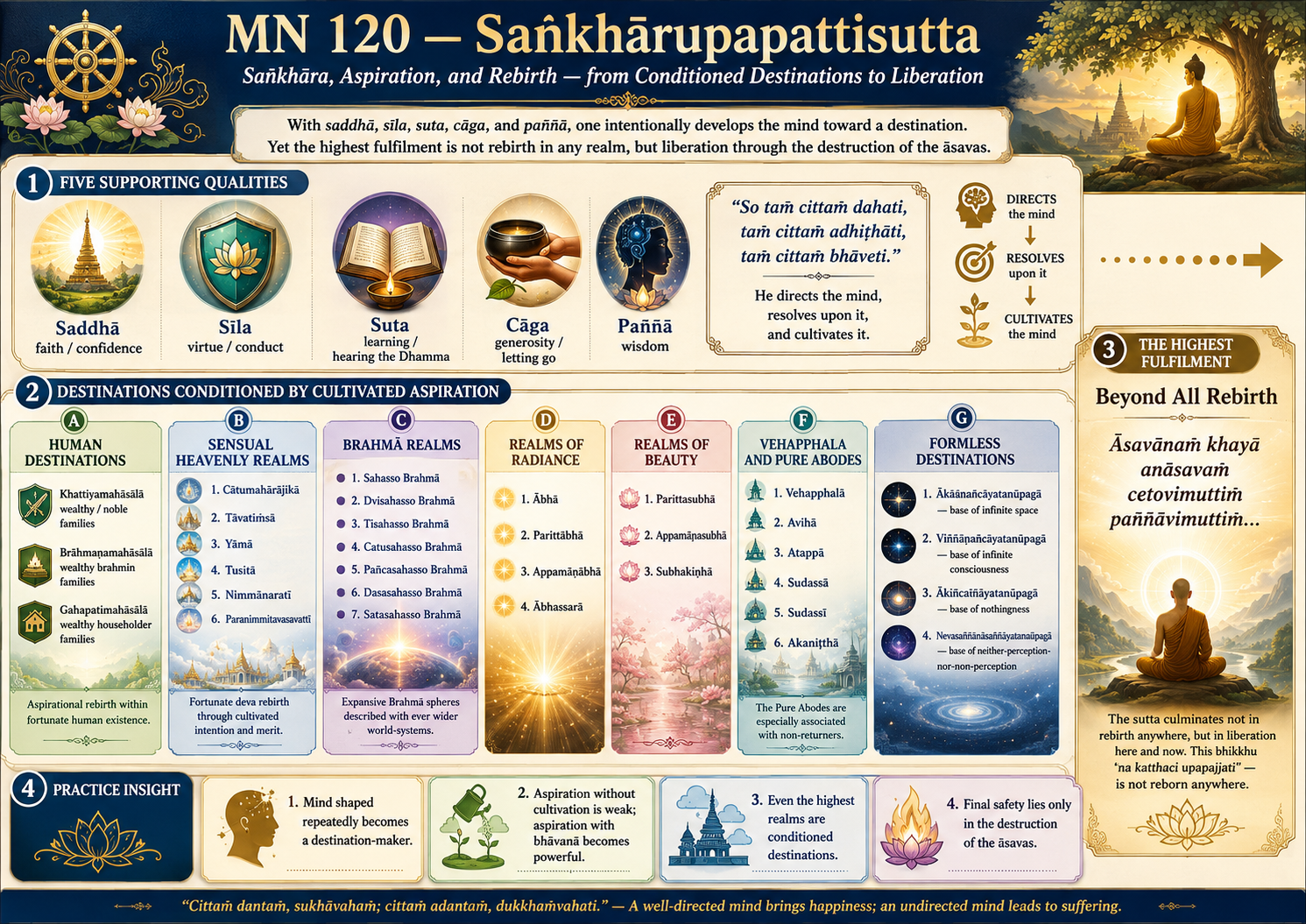 VISUAL SUMMARYSee this sutta in a pictureOpen the complete infographic for a visual overview before or after reading the full study.View infographic →
From cultivated intention to rebirth—and beyond every rebirth
MN 120 shows with unusual precision how a mind grounded in saddhā, sīla, suta, cāga and paññā can be deliberately directed, established and repeatedly developed toward a chosen mode of existence. The discourse then repeats this causal architecture through increasingly refined destinations—until the final passage abandons destination-making altogether through the destruction of the āsavas.
So taṁ cittaṁ dahati → taṁ cittaṁ adhiṭṭhāti → taṁ cittaṁ bhāveti → bhāvitā bahulīkatā → tatrupapattiyā saṁvattanti.
Central distinction: MN 120 repeatedly shows how sustained cultivation can conduce to a chosen conditioned destination. Its structural climax is different: the destruction of the āsavas ends destination-making rather than refining it further.
The Foundation Never Changes
Five qualities precede every destination-making aspiration
1
Saddhā — confidence / faith. The repeated destination-making formula begins on a foundation of confidence.
2
Sīla — ethical conduct. Cultivation is not detached from conduct; the ethical base remains constant across all destinations.
3
Suta — learning / what has been heard. The practitioner has heard and understood the relevant teaching and destination.
4
Cāga — generosity / relinquishment. A mind trained in giving and letting go is part of the repeated foundation.
5
Paññā — wisdom. Wisdom accompanies the entire process, even though the chosen outcome may still be conditioned rebirth.
This is not mere wishing. The recurring aspirational formula is placed on a foundation of saddhā, sīla, suta, cāga and paññā. The mind is then deliberately directed and repeatedly developed.
The Repeated Causal Grammar
A destination becomes a sustained orientation of mind
1
Taṁ cittaṁ dahati. Directs or places the mind toward the chosen destination.
2
Taṁ cittaṁ adhiṭṭhāti. Establishes or resolves the mind there.
3
Taṁ cittaṁ bhāveti. Develops that orientation of mind.
4
Bhāvitā • Bahulīkatā. The formations and modes of dwelling are developed and repeatedly cultivated.
5
Tatrupapattiyā saṁvattanti. That cultivated orientation conduces to rebirth there.
Bhāveti and bahulīkatā are crucial: the text repeatedly stresses development and repeated cultivation. A passing preference is not what the formula describes; the mind is being shaped into a habitual mode of dwelling.
The Spectrum of Upapatti
From favourable human circumstances to the subtlest formless destinations
1
Human destinations. Khattiyamahāsāla • Brāhmaṇamahāsāla • Gahapatimahāsāla — favourable human rebirths.
2
Kāma deva realms. Cātumahārājika through Paranimmitavasavattī — refined sensual heavenly existence.
3
Brahmā realms. Sahasso through Satasahasso Brahmā — increasingly vast Brahmā-world aspirations.
4
Realms of radiance. Ābhā • Parittābhā • Appamāṇābhā • Ābhassara — luminous conditioned existence.
5
Realms of beauty. Parittasubhā • Appamāṇasubhā • Subhakiṇha — subtle beautiful form realms.
6
Vehapphala and Pure Abodes. Vehapphala • Aviha • Atappa • Sudassa • Sudassī • Akaniṭṭha — higher rūpa destinations.
7
Formless destinations. Ākāsānañcāyatana through Nevasaññānāsaññāyatana — the four arūpa destinations.
The recurring limitation: however long-lived, luminous, vast, subtle or blissful a destination may be, the formula still ends with tatrupapatti—rebirth there. Refinement of existence is not yet freedom from existence.
The highest fulfilment is not the highest destination
| Destination-making | Liberation |
|---|---|
| Tatrupapatti — “rebirth there” The mind is directed toward a conditioned destination. Cultivated saṅkhārā and vihārā conduce toward a corresponding upapatti. |
Āsavānaṁ khayā — the pattern is broken Anāsavaṁ cetovimuttiṁ paññāvimuttiṁ • diṭṭheva dhamme • sayaṁ abhiññā sacchikatvā. The culmination is not another realm: na katthaci upapajjati — not reborn anywhere. |
The final paragraph changes the grammar of the entire sutta. Instead of “after death, may I be reborn in the company of…,” the aspiration becomes realization of taintless cetovimutti and paññāvimutti diṭṭheva dhamme—here and now.
All 39 sections — Pāḷi with English immediately underneath
01Setting at Sāvatthī
Thus have I heard. On one occasion the Blessed One was dwelling at Sāvatthī, in Jeta’s Grove, Anāthapiṇḍika’s Park. There the Blessed One addressed the bhikkhus: “Bhikkhus.”
02The Bhikkhus Respond
“Venerable sir,” those bhikkhus replied to the Blessed One. The Blessed One then said:
03The Subject: Saṅkhārupapatti
“Bhikkhus, I will teach you about rebirth according to formations. Listen and attend carefully; I will speak.”
04Listen Carefully
“Yes, venerable sir,” those bhikkhus replied to the Blessed One. The Blessed One said:
05Wealthy Khattiya Families
“Furthermore, bhikkhus, a bhikkhu is endowed with faith, virtue, learning, generosity, and wisdom. He thinks: ‘Oh, that after the breakup of the body, after death, I might be reborn in the company of wealthy or eminent khattiya families.’
He directs his mind toward that, resolves his mind upon that, and develops his mind toward that. Those formations and modes of dwelling of his, developed and repeatedly cultivated in this way, conduce to rebirth there. This is the path, this is the way of practice that conduces to rebirth there.”
06Wealthy Brahmin Families
“Furthermore, bhikkhus, a bhikkhu is endowed with faith, virtue, learning, generosity, and wisdom. He thinks: ‘Oh, that after the breakup of the body, after death, I might be reborn in the company of wealthy or eminent brahmin families.’
He directs his mind toward that, resolves his mind upon that, and develops his mind toward that. Those formations and modes of dwelling of his, developed and repeatedly cultivated in this way, conduce to rebirth there. This is the path, this is the way of practice that conduces to rebirth there.”
07Wealthy Householder Families
“Furthermore, bhikkhus, a bhikkhu is endowed with faith, virtue, learning, generosity, and wisdom. He thinks: ‘Oh, that after the breakup of the body, after death, I might be reborn in the company of wealthy or eminent householder families.’
He directs his mind toward that, resolves his mind upon that, and develops his mind toward that. Those formations and modes of dwelling of his, developed and repeatedly cultivated in this way, conduce to rebirth there. This is the path, this is the way of practice that conduces to rebirth there.”
08Cātumahārājika Devas
“Furthermore, bhikkhus, a bhikkhu is endowed with faith, virtue, learning, generosity, and wisdom. He has heard: ‘The devas of the four great kings are long-lived, beautiful, and very happy.’ He thinks: ‘Oh, that after the breakup of the body, after death, I might be reborn in the company of the devas of the Four Great Kings.’
He directs his mind toward that, establishes his mind upon that, and develops his mind toward that. Those formations and modes of dwelling of his, developed and repeatedly cultivated in this way, conduce to rebirth there. This is the path, this is the way of practice that conduces to rebirth there.”
09Tāvatiṁsa Devas
“Furthermore, bhikkhus, a bhikkhu is endowed with faith, virtue, learning, generosity, and wisdom. He has heard: ‘The tāvatiṁsa devas are long-lived, beautiful, and very happy.’ He thinks: ‘Oh, that after the breakup of the body, after death, I might be reborn in the company of the Tāvatiṁsa devas.’
He directs his mind toward that, resolves his mind upon that, and develops his mind toward that. Those formations and modes of dwelling of his, developed and repeatedly cultivated in this way, conduce to rebirth there. This is the path, this is the way of practice that conduces to rebirth there.”
10Yāma Devas
“Furthermore, bhikkhus, a bhikkhu is endowed with faith, virtue, learning, generosity, and wisdom. He has heard: ‘The yāma devas are long-lived, beautiful, and very happy.’ He thinks: ‘Oh, that after the breakup of the body, after death, I might be reborn in the company of the Yāma devas.’
He directs his mind toward that, resolves his mind upon that, and develops his mind toward that. Those formations and modes of dwelling of his, developed and repeatedly cultivated in this way, conduce to rebirth there. This is the path, this is the way of practice that conduces to rebirth there.”
11Tusita Devas
“Furthermore, bhikkhus, a bhikkhu is endowed with faith, virtue, learning, generosity, and wisdom. He has heard: ‘The tusita devas are long-lived, beautiful, and very happy.’ He thinks: ‘Oh, that after the breakup of the body, after death, I might be reborn in the company of the Tusita devas.’
He directs his mind toward that, resolves his mind upon that, and develops his mind toward that. Those formations and modes of dwelling of his, developed and repeatedly cultivated in this way, conduce to rebirth there. This is the path, this is the way of practice that conduces to rebirth there.”
12Nimmānaratī Devas
“Furthermore, bhikkhus, a bhikkhu is endowed with faith, virtue, learning, generosity, and wisdom. He has heard: ‘The devas who delight in creating are long-lived, beautiful, and very happy.’ He thinks: ‘Oh, that after the breakup of the body, after death, I might be reborn in the company of the devas who delight in creating.’
He directs his mind toward that, resolves his mind upon that, and develops his mind toward that. Those formations and modes of dwelling of his, developed and repeatedly cultivated in this way, conduce to rebirth there. This is the path, this is the way of practice that conduces to rebirth there.”
13Paranimmitavasavattī Devas
“Furthermore, bhikkhus, a bhikkhu is endowed with faith, virtue, learning, generosity, and wisdom. He has heard: ‘The devas who wield power over others’ creations are long-lived, beautiful, and very happy.’ He thinks: ‘Oh, that after the breakup of the body, after death, I might be reborn in the company of the devas who wield power over others’ creations.’
He directs his mind toward that, resolves his mind upon that, and develops his mind toward that. Those formations and modes of dwelling of his, developed and repeatedly cultivated in this way, conduce to rebirth there. This is the path, this is the way of practice that conduces to rebirth there.”
14Sahasso Brahmā
Sahasso, bhikkhave, brahmā sahassilokadhātuṁ pharitvā adhimuccitvā viharati. Variant: adhimuccitvā → adhimuñcitvā (mr) Yepi tattha sattā upapannā tepi pharitvā adhimuccitvā viharati. Seyyathāpi, bhikkhave, cakkhumā puriso ekaṁ āmaṇḍaṁ hatthe karitvā paccavekkheyya; evameva kho, bhikkhave, sahasso brahmā sahassilokadhātuṁ pharitvā adhimuccitvā viharati. Yepi tattha sattā upapannā tepi pharitvā adhimuccitvā viharati. Tassa evaṁ hoti: ‘aho vatāhaṁ kāyassa bhedā paraṁ maraṇā sahassassa brahmuno sahabyataṁ upapajjeyyan’ti. So taṁ cittaṁ dahati, taṁ cittaṁ adhiṭṭhāti, taṁ cittaṁ bhāveti. Tassa te saṅkhārā ca vihārā ca evaṁ bhāvitā evaṁ bahulīkatā tatrupapattiyā saṁvattanti. Ayaṁ, bhikkhave, maggo ayaṁ paṭipadā tatrupapattiyā saṁvattati.
“Furthermore, bhikkhus, a bhikkhu is endowed with faith, virtue, learning, generosity, and wisdom. He has heard: ‘Sahasso Brahmā is long-lived, radiant, and very happy.’
Sahasso Brahmā pervades and encompasses sahassilokadhātu and also the beings reborn there. Just as a person with good eyesight might hold a single āmaṇḍa fruit in the hand and examine it, so too Sahasso Brahmā pervades and encompasses that world-system and the beings reborn there.
The bhikkhu thinks: ‘Oh, that after the breakup of the body, after death, I might be reborn in the company of Sahasso Brahmā.’ He directs his mind toward that, resolves his mind upon that, and develops his mind toward that. Those formations and modes of dwelling of his, developed and repeatedly cultivated in this way, conduce to rebirth there. This is the path, this is the way of practice that conduces to rebirth there.”
15Dvisahasso Brahmā
“Furthermore, bhikkhus, a bhikkhu is endowed with faith, virtue, learning, generosity, and wisdom. He has heard: ‘Dvisahasso Brahmā is long-lived, radiant, and very happy.’
Dvisahasso Brahmā pervades and encompasses a two-thousandfold world-system, and also the beings reborn there. Just as a person with good eyesight holding five āmaṇḍa fruits in the hand and examining them, so too Dvisahasso Brahmā pervades and encompasses that world-system and the beings reborn there.
The bhikkhu thinks: ‘Oh, that after the breakup of the body, after death, I might be reborn in the company of Dvisahasso Brahmā.’ He directs his mind toward that, establishes his mind upon that, and develops it. Those formations and modes of dwelling of his, developed and repeatedly cultivated in this way, conduce to rebirth there. This is the path, this is the way of practice that conduces to rebirth there.”
16Tisahasso Brahmā
“Furthermore, bhikkhus, a bhikkhu is endowed with faith, virtue, learning, generosity, and wisdom. He has heard: ‘Tisahasso Brahmā is long-lived, radiant, and very happy.’
Tisahasso Brahmā pervades and encompasses a three-thousandfold world-system, and also the beings reborn there. Just as a person with good eyesight holding five āmaṇḍa fruits in the hand and examining them, so too Tisahasso Brahmā pervades and encompasses that world-system and the beings reborn there.
The bhikkhu thinks: ‘Oh, that after the breakup of the body, after death, I might be reborn in the company of Tisahasso Brahmā.’ He directs his mind toward that, establishes his mind upon that, and develops it. Those formations and modes of dwelling of his, developed and repeatedly cultivated in this way, conduce to rebirth there. This is the path, this is the way of practice that conduces to rebirth there.”
17Catusahasso Brahmā
“Furthermore, bhikkhus, a bhikkhu is endowed with faith, virtue, learning, generosity, and wisdom. He has heard: ‘Catusahasso Brahmā is long-lived, radiant, and very happy.’
Catusahasso Brahmā pervades and encompasses a four-thousandfold world-system, and also the beings reborn there. Just as a person with good eyesight holding five āmaṇḍa fruits in the hand and examining them, so too Catusahasso Brahmā pervades and encompasses that world-system and the beings reborn there.
The bhikkhu thinks: ‘Oh, that after the breakup of the body, after death, I might be reborn in the company of Catusahasso Brahmā.’ He directs his mind toward that, establishes his mind upon that, and develops it. Those formations and modes of dwelling of his, developed and repeatedly cultivated in this way, conduce to rebirth there. This is the path, this is the way of practice that conduces to rebirth there.”
18Pañcasahasso Brahmā
“Furthermore, bhikkhus, a bhikkhu is endowed with faith, virtue, learning, generosity, and wisdom. He has heard: ‘Pañcasahasso Brahmā is long-lived, radiant, and very happy.’
Pañcasahasso Brahmā pervades and encompasses a five-thousandfold world-system, and also the beings reborn there. Just as a person with good eyesight holding five āmaṇḍa fruits in the hand and examining them, so too Pañcasahasso Brahmā pervades and encompasses that world-system and the beings reborn there.
The bhikkhu thinks: ‘Oh, that after the breakup of the body, after death, I might be reborn in the company of Pañcasahasso Brahmā.’ He directs his mind toward that, establishes his mind upon that, and develops it. Those formations and modes of dwelling of his, developed and repeatedly cultivated in this way, conduce to rebirth there. This is the path, this is the way of practice that conduces to rebirth there.”
19Dasasahasso Brahmā
Dasasahasso, bhikkhave, brahmā dasasahassilokadhātuṁ pharitvā adhimuccitvā viharati. Yepi tattha sattā upapannā tepi pharitvā adhimuccitvā viharati. Seyyathāpi, bhikkhave, maṇi veḷuriyo subho jātimā aṭṭhaṁso suparikammakato paṇḍukambale nikkhitto bhāsate ca tapate ca virocati ca; Variant: bhāsate ca tapate ca → bhāsati ca tapati ca (sya-all, km); bhāsati ca (pts1ed) evameva kho, bhikkhave, dasasahasso brahmā dasasahassilokadhātuṁ pharitvā adhimuccitvā viharati. Yepi tattha sattā upapannā tepi pharitvā adhimuccitvā viharati. Tassa evaṁ hoti: ‘aho vatāhaṁ kāyassa bhedā paraṁ maraṇā dasasahassassa brahmuno sahabyataṁ upapajjeyyan’ti. So taṁ cittaṁ dahati, taṁ cittaṁ adhiṭṭhāti, taṁ cittaṁ bhāveti. Tassa te saṅkhārā ca vihārā ca evaṁ bhāvitā evaṁ bahulīkatā tatrupapattiyā saṁvattanti. Ayaṁ, bhikkhave, maggo ayaṁ paṭipadā tatrupapattiyā saṁvattati.
“Furthermore, bhikkhus, a bhikkhu is endowed with faith, virtue, learning, generosity, and wisdom. He has heard: ‘Dasasahasso Brahmā is long-lived, radiant, and very happy.’
Dasasahasso Brahmā pervades and encompasses a ten-thousandfold world-system, and also the beings reborn there. Just as a beautiful, well-worked, eight-faceted beryl gem placed on a pale cloth, shining, glowing, and radiating, so too Dasasahasso Brahmā pervades and encompasses that world-system and the beings reborn there.
The bhikkhu thinks: ‘Oh, that after the breakup of the body, after death, I might be reborn in the company of Dasasahasso Brahmā.’ He directs his mind toward that, establishes his mind upon that, and develops it. Those formations and modes of dwelling of his, developed and repeatedly cultivated in this way, conduce to rebirth there. This is the path, this is the way of practice that conduces to rebirth there.”
20Satasahasso Brahmā
Satasahasso, bhikkhave, brahmā satasahassilokadhātuṁ pharitvā adhimuccitvā viharati. Yepi tattha sattā upapannā tepi pharitvā adhimuccitvā viharati. Seyyathāpi, bhikkhave, nikkhaṁ jambonadaṁ dakkhakammāraputtaukkāmukhasukusalasampahaṭṭhaṁ paṇḍukambale nikkhittaṁ Variant: nikkhaṁ → nekkhaṁ (bj, sya-all, km, pts1ed) bhāsate ca tapate ca virocati ca; evameva kho, bhikkhave, satasahasso brahmā satasahassilokadhātuṁ pharitvā adhimuccitvā viharati. Yepi tattha sattā upapannā tepi pharitvā adhimuccitvā viharati. Tassa evaṁ hoti: ‘aho vatāhaṁ kāyassa bhedā paraṁ maraṇā satasahassassa brahmuno sahabyataṁ upapajjeyyan’ti. So taṁ cittaṁ dahati, taṁ cittaṁ adhiṭṭhāti, taṁ cittaṁ bhāveti. Tassa te saṅkhārā ca vihārā ca evaṁ bhāvitā evaṁ bahulīkatā tatrupapattiyā saṁvattanti. Ayaṁ, bhikkhave, maggo ayaṁ paṭipadā tatrupapattiyā saṁvattati.
“Furthermore, bhikkhus, a bhikkhu is endowed with faith, virtue, learning, generosity, and wisdom. He has heard: ‘Satasahasso Brahmā is long-lived, radiant, and very happy.’
Satasahasso Brahmā pervades and encompasses a hundred-thousandfold world-system, and also the beings reborn there. Just as refined Jambu-river gold, expertly worked by a skilled goldsmith and placed on a pale cloth, shining, glowing, and radiating, so too Satasahasso Brahmā pervades and encompasses that world-system and the beings reborn there.
The bhikkhu thinks: ‘Oh, that after the breakup of the body, after death, I might be reborn in the company of Satasahasso Brahmā.’ He directs his mind toward that, establishes his mind upon that, and develops it. Those formations and modes of dwelling of his, developed and repeatedly cultivated in this way, conduce to rebirth there. This is the path, this is the way of practice that conduces to rebirth there.”
21Ābhā Devas
“Furthermore, bhikkhus, a bhikkhu is endowed with faith, virtue, learning, generosity, and wisdom. He has heard: ‘The devas of radiance are long-lived, beautiful, and very happy.’ He thinks: ‘Oh, that after the breakup of the body, after death, I might be reborn in the company of the devas of radiance.’
He directs his mind toward that, resolves his mind upon that, and develops his mind toward that. Those formations and modes of dwelling of his, developed and repeatedly cultivated in this way, conduce to rebirth there. This is the path, this is the way of practice that conduces to rebirth there.”
22Parittābhā Devas
“Furthermore, bhikkhus, a bhikkhu is endowed with faith, virtue, learning, generosity, and wisdom. He has heard: ‘The devas of limited radiance are long-lived, beautiful, and very happy.’ He thinks: ‘Oh, that after the breakup of the body, after death, I might be reborn in the company of the devas of limited radiance.’
He directs his mind toward that, establishes his mind upon that, and develops his mind toward that. Those formations and modes of dwelling of his, developed and repeatedly cultivated in this way, conduce to rebirth there. This is the path, this is the way of practice that conduces to rebirth there.”
23Appamāṇābhā Devas
“Furthermore, bhikkhus, a bhikkhu is endowed with faith, virtue, learning, generosity, and wisdom. He has heard: ‘The devas of measureless radiance are long-lived, beautiful, and very happy.’ He thinks: ‘Oh, that after the breakup of the body, after death, I might be reborn in the company of the devas of measureless radiance.’
He directs his mind toward that, establishes his mind upon that, and develops his mind toward that. Those formations and modes of dwelling of his, developed and repeatedly cultivated in this way, conduce to rebirth there. This is the path, this is the way of practice that conduces to rebirth there.”
24Ābhassara Devas
“Furthermore, bhikkhus, a bhikkhu is endowed with faith, virtue, learning, generosity, and wisdom. He has heard: ‘The radiant devas are long-lived, beautiful, and very happy.’ He thinks: ‘Oh, that after the breakup of the body, after death, I might be reborn in the company of the radiant devas.’
He directs his mind toward that, resolves his mind upon that, and develops his mind toward that. Those formations and modes of dwelling of his, developed and repeatedly cultivated in this way, conduce to rebirth there. This is the path, this is the way of practice that conduces to rebirth there.”
25Parittasubhā Devas
“Furthermore, bhikkhus, a bhikkhu is endowed with faith, virtue, learning, generosity, and wisdom. He has heard: ‘The devas of limited beauty are long-lived, beautiful, and very happy.’ He thinks: ‘Oh, that after the breakup of the body, after death, I might be reborn in the company of the devas of limited beauty.’
He directs his mind toward that, resolves his mind upon that, and develops his mind toward that. Those formations and modes of dwelling of his, developed and repeatedly cultivated in this way, conduce to rebirth there. This is the path, this is the way of practice that conduces to rebirth there.”
26Appamāṇasubhā Devas
“Furthermore, bhikkhus, a bhikkhu is endowed with faith, virtue, learning, generosity, and wisdom. He has heard: ‘The devas of measureless beauty are long-lived, beautiful, and very happy.’ He thinks: ‘Oh, that after the breakup of the body, after death, I might be reborn in the company of the devas of measureless beauty.’
He directs his mind toward that, resolves his mind upon that, and develops his mind toward that. Those formations and modes of dwelling of his, developed and repeatedly cultivated in this way, conduce to rebirth there. This is the path, this is the way of practice that conduces to rebirth there.”
27Subhakiṇha Devas
“Furthermore, bhikkhus, a bhikkhu is endowed with faith, virtue, learning, generosity, and wisdom. He has heard: ‘The devas replete with beauty are long-lived, beautiful, and very happy.’ He thinks: ‘Oh, that after the breakup of the body, after death, I might be reborn in the company of the devas replete with beauty.’
He directs his mind toward that, resolves his mind upon that, and develops his mind toward that. Those formations and modes of dwelling of his, developed and repeatedly cultivated in this way, conduce to rebirth there. This is the path, this is the way of practice that conduces to rebirth there.”
28Vehapphala Devas
“Furthermore, bhikkhus, a bhikkhu is endowed with faith, virtue, learning, generosity, and wisdom. He has heard: ‘The devas of great fruit are long-lived, beautiful, and very happy.’ He thinks: ‘Oh, that after the breakup of the body, after death, I might be reborn in the company of the devas of great fruit.’
He directs his mind toward that, resolves his mind upon that, and develops his mind toward that. Those formations and modes of dwelling of his, developed and repeatedly cultivated in this way, conduce to rebirth there. This is the path, this is the way of practice that conduces to rebirth there.”
29Avihā Devas
“Furthermore, bhikkhus, a bhikkhu is endowed with faith, virtue, learning, generosity, and wisdom. He has heard: ‘The avihā devas are long-lived, beautiful, and very happy.’ He thinks: ‘Oh, that after the breakup of the body, after death, I might be reborn in the company of the Avihā devas.’
He directs his mind toward that, resolves his mind upon that, and develops his mind toward that. Those formations and modes of dwelling of his, developed and repeatedly cultivated in this way, conduce to rebirth there. This is the path, this is the way of practice that conduces to rebirth there.”
30Atappā Devas
“Furthermore, bhikkhus, a bhikkhu is endowed with faith, virtue, learning, generosity, and wisdom. He has heard: ‘The atappā devas are long-lived, beautiful, and very happy.’ He thinks: ‘Oh, that after the breakup of the body, after death, I might be reborn in the company of the Atappā devas.’
He directs his mind toward that, resolves his mind upon that, and develops his mind toward that. Those formations and modes of dwelling of his, developed and repeatedly cultivated in this way, conduce to rebirth there. This is the path, this is the way of practice that conduces to rebirth there.”
31Sudassā Devas
“Furthermore, bhikkhus, a bhikkhu is endowed with faith, virtue, learning, generosity, and wisdom. He has heard: ‘The sudassā devas are long-lived, beautiful, and very happy.’ He thinks: ‘Oh, that after the breakup of the body, after death, I might be reborn in the company of the Sudassā devas.’
He directs his mind toward that, resolves his mind upon that, and develops his mind toward that. Those formations and modes of dwelling of his, developed and repeatedly cultivated in this way, conduce to rebirth there. This is the path, this is the way of practice that conduces to rebirth there.”
32Sudassī Devas
“Furthermore, bhikkhus, a bhikkhu is endowed with faith, virtue, learning, generosity, and wisdom. He has heard: ‘The sudassī devas are long-lived, beautiful, and very happy.’ He thinks: ‘Oh, that after the breakup of the body, after death, I might be reborn in the company of the Sudassī devas.’
He directs his mind toward that, resolves his mind upon that, and develops his mind toward that. Those formations and modes of dwelling of his, developed and repeatedly cultivated in this way, conduce to rebirth there. This is the path, this is the way of practice that conduces to rebirth there.”
33Akaniṭṭha Devas
“Furthermore, bhikkhus, a bhikkhu is endowed with faith, virtue, learning, generosity, and wisdom. He has heard: ‘The akaniṭṭha devas are long-lived, beautiful, and very happy.’ He thinks: ‘Oh, that after the breakup of the body, after death, I might be reborn in the company of the Akaniṭṭha devas.’
He directs his mind toward that, resolves his mind upon that, and develops his mind toward that. Those formations and modes of dwelling of his, developed and repeatedly cultivated in this way, conduce to rebirth there. This is the path, this is the way of practice that conduces to rebirth there.”
34Base of Infinite Space
“Furthermore, bhikkhus, a bhikkhu is endowed with faith, virtue, learning, generosity, and wisdom. He has heard: ‘The devas who have reached the base of infinite space are long-lived, long-lasting, and very happy.’ He thinks: ‘Oh, that after the breakup of the body, after death, I might be reborn in the company of the devas who have reached the base of infinite space.’
He directs his mind toward that, resolves his mind upon that, and develops his mind toward that. Those formations and modes of dwelling of his, developed and repeatedly cultivated in this way, conduce to rebirth there. This is the path, this is the way of practice that conduces to rebirth there.”
35Base of Infinite Consciousness
“Furthermore, bhikkhus, a bhikkhu is endowed with faith, virtue, learning, generosity, and wisdom. He has heard: ‘The devas who have reached the base of infinite consciousness are long-lived, long-lasting, and very happy.’ He thinks: ‘Oh, that after the breakup of the body, after death, I might be reborn in the company of the devas who have reached the base of infinite consciousness.’
He directs his mind toward that, resolves his mind upon that, and develops his mind toward that. Those formations and modes of dwelling of his, developed and repeatedly cultivated in this way, conduce to rebirth there. This is the path, this is the way of practice that conduces to rebirth there.”
36Base of Nothingness
“Furthermore, bhikkhus, a bhikkhu is endowed with faith, virtue, learning, generosity, and wisdom. He has heard: ‘The devas who have reached the base of nothingness are long-lived, long-lasting, and very happy.’ He thinks: ‘Oh, that after the breakup of the body, after death, I might be reborn in the company of the devas who have reached the base of nothingness.’
He directs his mind toward that, resolves his mind upon that, and develops his mind toward that. Those formations and modes of dwelling of his, developed and repeatedly cultivated in this way, conduce to rebirth there. This is the path, this is the way of practice that conduces to rebirth there.”
37Base of Neither-Perception-nor-Non-Perception
“Furthermore, bhikkhus, a bhikkhu is endowed with faith, virtue, learning, generosity, and wisdom. He has heard: ‘The devas who have reached the base of neither-perception-nor-non-perception are long-lived, long-lasting, and very happy.’ He thinks: ‘Oh, that after the breakup of the body, after death, I might be reborn in the company of the devas who have reached the base of neither-perception-nor-non-perception.’
He directs his mind toward that, resolves his mind upon that, and develops his mind toward that. Those formations and modes of dwelling of his, developed and repeatedly cultivated in this way, conduce to rebirth there. This is the path, this is the way of practice that conduces to rebirth there.”
38The Highest Fulfilment — Destruction of the Āsavas
“Furthermore, bhikkhus, a bhikkhu is endowed with faith, virtue, learning, generosity, and wisdom. He thinks: ‘Oh, that with the destruction of the taints I might, in this very life, directly know and realize for myself the taintless liberation of mind and liberation by wisdom, and enter and dwell in it.’
With the destruction of the taints, he directly knows and realizes for himself, in this very life, the taintless liberation of mind and liberation by wisdom, and he enters and dwells in it. This bhikkhu, bhikkhus, is not reborn anywhere.”
39Conclusion
That is what the Blessed One said. Delighted, those bhikkhus rejoiced in the Blessed One’s words.
All 39 deeper explanations, separated from the translation
01Setting at Sāvatthī
The discourse begins at Jeta’s Grove with the standard setting. What follows is addressed directly to bhikkhus and concerns saṅkhārupapatti—how cultivated formations, dispositions, and ways of dwelling can conduce to a particular mode of rebirth.
The sutta is therefore not merely a catalogue of cosmological destinations. It is a teaching on how the mind is repeatedly shaped, established, and developed toward an object or destination, and how that sustained orientation can become causally significant.
02The Bhikkhus Respond
The brief exchange marks the beginning of a formal teaching. The bhikkhus have placed themselves in the position of listeners who are ready to receive the instruction.
This matters because the next formula begins with suṇātha and sādhukaṁ manasi karotha—listen and attend carefully. MN 120 requires close attention because the repeated wording is part of the teaching: the same five supporting qualities and the same threefold cultivation of mind recur across destination after destination.
03The Subject: Saṅkhārupapatti
Saṅkhārupapatti combines saṅkhāra and upapatti. Here the discourse concerns the way cultivated mental formations and modes of dwelling can conduce to rebirth in a corresponding destination.
The title should not be reduced to “wishful thinking produces rebirth.” The Buddha repeatedly requires a foundation of saddhā, sīla, suta, cāga, and paññā, followed by deliberate establishment and cultivation of the mind. The operative process is sustained bhāvanā, not a passing preference.
04Listen Carefully
The stage is now set for the repeated training formula. From the first human destination through the highest formless destination, the same internal architecture appears again and again.
That repetition allows the reader to see the principle clearly: supporting qualities provide the ethical and wisdom base; the mind is then directed, resolved, and developed; cultivated saṅkhārā and vihārā become conducive to a corresponding upapatti.
05Wealthy Khattiya Families
The five qualities remain unchanged: saddhā (confidence), sīla (virtue), suta (learning), cāga (generosity or relinquishment), and paññā (wisdom). The destination changes, but the ethical and wisdom foundation does not.
The pivotal formula is: so taṁ cittaṁ dahati, taṁ cittaṁ adhiṭṭhāti, taṁ cittaṁ bhāveti—he places/directs the mind there, resolves or establishes it there, and develops it. This is sustained intentional cultivation.
Tassa te saṅkhārā ca vihārā ca evaṁ bhāvitā evaṁ bahulīkatā means that those formations and modes of dwelling, when developed and repeatedly cultivated in this way, conduce to rebirth there. Bahulīkatā is crucial: the teaching concerns repeated cultivation, not a momentary wish.
The first destinations are not heavenly at all but fortunate human rebirths. This is important: saṅkhārupapatti operates across a spectrum, from favourable human circumstances to increasingly refined heavenly and meditative destinations.
For Wealthy Khattiya Families, the sutta emphasizes that intentional cultivation can orient future existence even within the human world. Yet this remains conditioned becoming. The final purpose of the discourse is not to rank human families as ultimate goals, but to establish the principle before extending it to subtler realms.
06Wealthy Brahmin Families
The five qualities remain unchanged: saddhā (confidence), sīla (virtue), suta (learning), cāga (generosity or relinquishment), and paññā (wisdom). The destination changes, but the ethical and wisdom foundation does not.
The pivotal formula is: so taṁ cittaṁ dahati, taṁ cittaṁ adhiṭṭhāti, taṁ cittaṁ bhāveti—he places/directs the mind there, resolves or establishes it there, and develops it. This is sustained intentional cultivation.
Tassa te saṅkhārā ca vihārā ca evaṁ bhāvitā evaṁ bahulīkatā means that those formations and modes of dwelling, when developed and repeatedly cultivated in this way, conduce to rebirth there. Bahulīkatā is crucial: the teaching concerns repeated cultivation, not a momentary wish.
The first destinations are not heavenly at all but fortunate human rebirths. This is important: saṅkhārupapatti operates across a spectrum, from favourable human circumstances to increasingly refined heavenly and meditative destinations.
For Wealthy Brahmin Families, the sutta emphasizes that intentional cultivation can orient future existence even within the human world. Yet this remains conditioned becoming. The final purpose of the discourse is not to rank human families as ultimate goals, but to establish the principle before extending it to subtler realms.
07Wealthy Householder Families
The five qualities remain unchanged: saddhā (confidence), sīla (virtue), suta (learning), cāga (generosity or relinquishment), and paññā (wisdom). The destination changes, but the ethical and wisdom foundation does not.
The pivotal formula is: so taṁ cittaṁ dahati, taṁ cittaṁ adhiṭṭhāti, taṁ cittaṁ bhāveti—he places/directs the mind there, resolves or establishes it there, and develops it. This is sustained intentional cultivation.
Tassa te saṅkhārā ca vihārā ca evaṁ bhāvitā evaṁ bahulīkatā means that those formations and modes of dwelling, when developed and repeatedly cultivated in this way, conduce to rebirth there. Bahulīkatā is crucial: the teaching concerns repeated cultivation, not a momentary wish.
The first destinations are not heavenly at all but fortunate human rebirths. This is important: saṅkhārupapatti operates across a spectrum, from favourable human circumstances to increasingly refined heavenly and meditative destinations.
For Wealthy Householder Families, the sutta emphasizes that intentional cultivation can orient future existence even within the human world. Yet this remains conditioned becoming. The final purpose of the discourse is not to rank human families as ultimate goals, but to establish the principle before extending it to subtler realms.
08Cātumahārājika Devas
The five supporting qualities remain unchanged throughout MN 120: saddhā (confidence), sīla (virtue), suta (learning), cāga (generosity or relinquishment), and paññā (wisdom). The pivotal formula is: so taṁ cittaṁ dahati, taṁ cittaṁ adhiṭṭhāti, taṁ cittaṁ bhāveti—he directs the mind there, establishes or resolves it there, and develops it. Tassa te saṅkhārā ca vihārā ca evaṁ bhāvitā evaṁ bahulīkatā means that those formations and modes of dwelling, when developed and repeatedly cultivated, conduce to rebirth there. Bahulīkatā is especially important. The Buddha is not describing a passing wish; he is describing a mind repeatedly shaped around a destination.
This passage concerns the Cātumahārājika devas. It belongs to the sensual heavenly sphere. The destination changes, but the causal grammar of the sutta does not: wholesome supporting qualities plus sustained cultivation orient the stream of becoming toward a corresponding upapatti.
The important limitation is that this is still tatrupapatti—rebirth there. However fortunate or refined the destination may be, it remains conditioned existence rather than the ending of existence.
09Tāvatiṁsa Devas
The five qualities remain unchanged: saddhā (confidence), sīla (virtue), suta (learning), cāga (generosity or relinquishment), and paññā (wisdom). The destination changes, but the ethical and wisdom foundation does not.
The pivotal formula is: so taṁ cittaṁ dahati, taṁ cittaṁ adhiṭṭhāti, taṁ cittaṁ bhāveti—he places/directs the mind there, resolves or establishes it there, and develops it. This is sustained intentional cultivation.
Tassa te saṅkhārā ca vihārā ca evaṁ bhāvitā evaṁ bahulīkatā means that those formations and modes of dwelling, when developed and repeatedly cultivated in this way, conduce to rebirth there. Bahulīkatā is crucial: the teaching concerns repeated cultivation, not a momentary wish.
This destination is still within kāma-loka, the sensual sphere. Its refined pleasure and longevity do not make it unconditioned. MN 120 therefore shows that wholesome cultivation can be directed toward very fortunate existence while still remaining within saṁsāra.
The practical teaching in this paragraph is therefore not to romanticize Tāvatiṁsa Devas; it is to understand how repeated mental orientation, supported by wholesome qualities, can become a destination-making force.
10Yāma Devas
The five qualities remain unchanged: saddhā (confidence), sīla (virtue), suta (learning), cāga (generosity or relinquishment), and paññā (wisdom). The destination changes, but the ethical and wisdom foundation does not.
The pivotal formula is: so taṁ cittaṁ dahati, taṁ cittaṁ adhiṭṭhāti, taṁ cittaṁ bhāveti—he places/directs the mind there, resolves or establishes it there, and develops it. This is sustained intentional cultivation.
Tassa te saṅkhārā ca vihārā ca evaṁ bhāvitā evaṁ bahulīkatā means that those formations and modes of dwelling, when developed and repeatedly cultivated in this way, conduce to rebirth there. Bahulīkatā is crucial: the teaching concerns repeated cultivation, not a momentary wish.
This destination is still within kāma-loka, the sensual sphere. Its refined pleasure and longevity do not make it unconditioned. MN 120 therefore shows that wholesome cultivation can be directed toward very fortunate existence while still remaining within saṁsāra.
The practical teaching in this paragraph is therefore not to romanticize Yāma Devas; it is to understand how repeated mental orientation, supported by wholesome qualities, can become a destination-making force.
11Tusita Devas
The five qualities remain unchanged: saddhā (confidence), sīla (virtue), suta (learning), cāga (generosity or relinquishment), and paññā (wisdom). The destination changes, but the ethical and wisdom foundation does not.
The pivotal formula is: so taṁ cittaṁ dahati, taṁ cittaṁ adhiṭṭhāti, taṁ cittaṁ bhāveti—he places/directs the mind there, resolves or establishes it there, and develops it. This is sustained intentional cultivation.
Tassa te saṅkhārā ca vihārā ca evaṁ bhāvitā evaṁ bahulīkatā means that those formations and modes of dwelling, when developed and repeatedly cultivated in this way, conduce to rebirth there. Bahulīkatā is crucial: the teaching concerns repeated cultivation, not a momentary wish.
This destination is still within kāma-loka, the sensual sphere. Its refined pleasure and longevity do not make it unconditioned. MN 120 therefore shows that wholesome cultivation can be directed toward very fortunate existence while still remaining within saṁsāra.
The practical teaching in this paragraph is therefore not to romanticize Tusita Devas; it is to understand how repeated mental orientation, supported by wholesome qualities, can become a destination-making force.
12Nimmānaratī Devas
The five qualities remain unchanged: saddhā (confidence), sīla (virtue), suta (learning), cāga (generosity or relinquishment), and paññā (wisdom). The destination changes, but the ethical and wisdom foundation does not.
The pivotal formula is: so taṁ cittaṁ dahati, taṁ cittaṁ adhiṭṭhāti, taṁ cittaṁ bhāveti—he places/directs the mind there, resolves or establishes it there, and develops it. This is sustained intentional cultivation.
Tassa te saṅkhārā ca vihārā ca evaṁ bhāvitā evaṁ bahulīkatā means that those formations and modes of dwelling, when developed and repeatedly cultivated in this way, conduce to rebirth there. Bahulīkatā is crucial: the teaching concerns repeated cultivation, not a momentary wish.
This destination is still within kāma-loka, the sensual sphere. Its refined pleasure and longevity do not make it unconditioned. MN 120 therefore shows that wholesome cultivation can be directed toward very fortunate existence while still remaining within saṁsāra.
The practical teaching in this paragraph is therefore not to romanticize Nimmānaratī Devas; it is to understand how repeated mental orientation, supported by wholesome qualities, can become a destination-making force.
13Paranimmitavasavattī Devas
The five qualities remain unchanged: saddhā (confidence), sīla (virtue), suta (learning), cāga (generosity or relinquishment), and paññā (wisdom). The destination changes, but the ethical and wisdom foundation does not.
The pivotal formula is: so taṁ cittaṁ dahati, taṁ cittaṁ adhiṭṭhāti, taṁ cittaṁ bhāveti—he places/directs the mind there, resolves or establishes it there, and develops it. This is sustained intentional cultivation.
Tassa te saṅkhārā ca vihārā ca evaṁ bhāvitā evaṁ bahulīkatā means that those formations and modes of dwelling, when developed and repeatedly cultivated in this way, conduce to rebirth there. Bahulīkatā is crucial: the teaching concerns repeated cultivation, not a momentary wish.
This destination is still within kāma-loka, the sensual sphere. Its refined pleasure and longevity do not make it unconditioned. MN 120 therefore shows that wholesome cultivation can be directed toward very fortunate existence while still remaining within saṁsāra.
The practical teaching in this paragraph is therefore not to romanticize Paranimmitavasavattī Devas; it is to understand how repeated mental orientation, supported by wholesome qualities, can become a destination-making force.
14Sahasso Brahmā
The five qualities remain unchanged: saddhā (confidence), sīla (virtue), suta (learning), cāga (generosity or relinquishment), and paññā (wisdom). The destination changes, but the ethical and wisdom foundation does not.
The pivotal formula is: so taṁ cittaṁ dahati, taṁ cittaṁ adhiṭṭhāti, taṁ cittaṁ bhāveti—he places/directs the mind there, resolves or establishes it there, and develops it. This is sustained intentional cultivation.
Tassa te saṅkhārā ca vihārā ca evaṁ bhāvitā evaṁ bahulīkatā means that those formations and modes of dwelling, when developed and repeatedly cultivated in this way, conduce to rebirth there. Bahulīkatā is crucial: the teaching concerns repeated cultivation, not a momentary wish.
The Brahmā passages add a second theme: range or pervasion. A brahmā whose range extends through a thousandfold world-system. The simile is intended to make the extent and luminosity of that mode of existence imaginable.
Yet the Buddha does not change the causal grammar. Even this expansive Brahmā existence is reached through cultivated saṅkhārā and vihārā and is described as tatrupapatti—rebirth there.
This is important for practitioners attracted to exalted samādhi or cosmic experience. Magnitude, luminosity, subtlety, or vast range do not by themselves equal liberation. They can still become the basis for bhava if the mind is oriented toward renewed existence.
15Dvisahasso Brahmā
The five supporting qualities remain unchanged throughout MN 120: saddhā (confidence), sīla (virtue), suta (learning), cāga (generosity or relinquishment), and paññā (wisdom). The pivotal formula is: so taṁ cittaṁ dahati, taṁ cittaṁ adhiṭṭhāti, taṁ cittaṁ bhāveti—he directs the mind there, establishes or resolves it there, and develops it. Tassa te saṅkhārā ca vihārā ca evaṁ bhāvitā evaṁ bahulīkatā means that those formations and modes of dwelling, when developed and repeatedly cultivated, conduce to rebirth there. Bahulīkatā is especially important. The Buddha is not describing a passing wish; he is describing a mind repeatedly shaped around a destination.
The Brahmā passages add the theme of vast pervasion. Dvisahasso Brahmā is described in relation to a two-thousandfold world-system. The accompanying simile makes the scale or luminosity of that existence imaginable.
Yet the Buddha deliberately keeps the same expression tatrupapattiyā saṁvattanti: these cultivated formations conduce to rebirth there. Vastness, luminosity, and refined samādhi are still not equivalent to liberation.
For practice, this is a safeguard against turning exalted meditative experience into a new identity or final goal. Even a highly refined Brahmā destination remains within conditioned becoming.
16Tisahasso Brahmā
The five supporting qualities remain unchanged throughout MN 120: saddhā (confidence), sīla (virtue), suta (learning), cāga (generosity or relinquishment), and paññā (wisdom). The pivotal formula is: so taṁ cittaṁ dahati, taṁ cittaṁ adhiṭṭhāti, taṁ cittaṁ bhāveti—he directs the mind there, establishes or resolves it there, and develops it. Tassa te saṅkhārā ca vihārā ca evaṁ bhāvitā evaṁ bahulīkatā means that those formations and modes of dwelling, when developed and repeatedly cultivated, conduce to rebirth there. Bahulīkatā is especially important. The Buddha is not describing a passing wish; he is describing a mind repeatedly shaped around a destination.
The Brahmā passages add the theme of vast pervasion. Tisahasso Brahmā is described in relation to a three-thousandfold world-system. The accompanying simile makes the scale or luminosity of that existence imaginable.
Yet the Buddha deliberately keeps the same expression tatrupapattiyā saṁvattanti: these cultivated formations conduce to rebirth there. Vastness, luminosity, and refined samādhi are still not equivalent to liberation.
For practice, this is a safeguard against turning exalted meditative experience into a new identity or final goal. Even a highly refined Brahmā destination remains within conditioned becoming.
17Catusahasso Brahmā
The five supporting qualities remain unchanged throughout MN 120: saddhā (confidence), sīla (virtue), suta (learning), cāga (generosity or relinquishment), and paññā (wisdom). The pivotal formula is: so taṁ cittaṁ dahati, taṁ cittaṁ adhiṭṭhāti, taṁ cittaṁ bhāveti—he directs the mind there, establishes or resolves it there, and develops it. Tassa te saṅkhārā ca vihārā ca evaṁ bhāvitā evaṁ bahulīkatā means that those formations and modes of dwelling, when developed and repeatedly cultivated, conduce to rebirth there. Bahulīkatā is especially important. The Buddha is not describing a passing wish; he is describing a mind repeatedly shaped around a destination.
The Brahmā passages add the theme of vast pervasion. Catusahasso Brahmā is described in relation to a four-thousandfold world-system. The accompanying simile makes the scale or luminosity of that existence imaginable.
Yet the Buddha deliberately keeps the same expression tatrupapattiyā saṁvattanti: these cultivated formations conduce to rebirth there. Vastness, luminosity, and refined samādhi are still not equivalent to liberation.
For practice, this is a safeguard against turning exalted meditative experience into a new identity or final goal. Even a highly refined Brahmā destination remains within conditioned becoming.
18Pañcasahasso Brahmā
The five supporting qualities remain unchanged throughout MN 120: saddhā (confidence), sīla (virtue), suta (learning), cāga (generosity or relinquishment), and paññā (wisdom). The pivotal formula is: so taṁ cittaṁ dahati, taṁ cittaṁ adhiṭṭhāti, taṁ cittaṁ bhāveti—he directs the mind there, establishes or resolves it there, and develops it. Tassa te saṅkhārā ca vihārā ca evaṁ bhāvitā evaṁ bahulīkatā means that those formations and modes of dwelling, when developed and repeatedly cultivated, conduce to rebirth there. Bahulīkatā is especially important. The Buddha is not describing a passing wish; he is describing a mind repeatedly shaped around a destination.
The Brahmā passages add the theme of vast pervasion. Pañcasahasso Brahmā is described in relation to a five-thousandfold world-system. The accompanying simile makes the scale or luminosity of that existence imaginable.
Yet the Buddha deliberately keeps the same expression tatrupapattiyā saṁvattanti: these cultivated formations conduce to rebirth there. Vastness, luminosity, and refined samādhi are still not equivalent to liberation.
For practice, this is a safeguard against turning exalted meditative experience into a new identity or final goal. Even a highly refined Brahmā destination remains within conditioned becoming.
19Dasasahasso Brahmā
The five supporting qualities remain unchanged throughout MN 120: saddhā (confidence), sīla (virtue), suta (learning), cāga (generosity or relinquishment), and paññā (wisdom). The pivotal formula is: so taṁ cittaṁ dahati, taṁ cittaṁ adhiṭṭhāti, taṁ cittaṁ bhāveti—he directs the mind there, establishes or resolves it there, and develops it. Tassa te saṅkhārā ca vihārā ca evaṁ bhāvitā evaṁ bahulīkatā means that those formations and modes of dwelling, when developed and repeatedly cultivated, conduce to rebirth there. Bahulīkatā is especially important. The Buddha is not describing a passing wish; he is describing a mind repeatedly shaped around a destination.
The Brahmā passages add the theme of vast pervasion. Dasasahasso Brahmā is described in relation to a ten-thousandfold world-system. The accompanying simile makes the scale or luminosity of that existence imaginable.
Yet the Buddha deliberately keeps the same expression tatrupapattiyā saṁvattanti: these cultivated formations conduce to rebirth there. Vastness, luminosity, and refined samādhi are still not equivalent to liberation.
For practice, this is a safeguard against turning exalted meditative experience into a new identity or final goal. Even a highly refined Brahmā destination remains within conditioned becoming.
20Satasahasso Brahmā
The five supporting qualities remain unchanged throughout MN 120: saddhā (confidence), sīla (virtue), suta (learning), cāga (generosity or relinquishment), and paññā (wisdom). The pivotal formula is: so taṁ cittaṁ dahati, taṁ cittaṁ adhiṭṭhāti, taṁ cittaṁ bhāveti—he directs the mind there, establishes or resolves it there, and develops it. Tassa te saṅkhārā ca vihārā ca evaṁ bhāvitā evaṁ bahulīkatā means that those formations and modes of dwelling, when developed and repeatedly cultivated, conduce to rebirth there. Bahulīkatā is especially important. The Buddha is not describing a passing wish; he is describing a mind repeatedly shaped around a destination.
The Brahmā passages add the theme of vast pervasion. Satasahasso Brahmā is described in relation to a hundred-thousandfold world-system. The accompanying simile makes the scale or luminosity of that existence imaginable.
Yet the Buddha deliberately keeps the same expression tatrupapattiyā saṁvattanti: these cultivated formations conduce to rebirth there. Vastness, luminosity, and refined samādhi are still not equivalent to liberation.
For practice, this is a safeguard against turning exalted meditative experience into a new identity or final goal. Even a highly refined Brahmā destination remains within conditioned becoming.
21Ābhā Devas
The five qualities remain unchanged: saddhā (confidence), sīla (virtue), suta (learning), cāga (generosity or relinquishment), and paññā (wisdom). The destination changes, but the ethical and wisdom foundation does not.
The pivotal formula is: so taṁ cittaṁ dahati, taṁ cittaṁ adhiṭṭhāti, taṁ cittaṁ bhāveti—he places/directs the mind there, resolves or establishes it there, and develops it. This is sustained intentional cultivation.
Tassa te saṅkhārā ca vihārā ca evaṁ bhāvitā evaṁ bahulīkatā means that those formations and modes of dwelling, when developed and repeatedly cultivated in this way, conduce to rebirth there. Bahulīkatā is crucial: the teaching concerns repeated cultivation, not a momentary wish.
Here the imagery shifts from sensual heavens to increasingly luminous form-sphere existence. Radiance and long life represent refinement, but the same causal formula still applies: it is an upapatti, a conditioned rebirth, not release.
The practical teaching in this paragraph is therefore not to romanticize Ābhā Devas; it is to understand how repeated mental orientation, supported by wholesome qualities, can become a destination-making force.
22Parittābhā Devas
The five supporting qualities remain unchanged throughout MN 120: saddhā (confidence), sīla (virtue), suta (learning), cāga (generosity or relinquishment), and paññā (wisdom). The pivotal formula is: so taṁ cittaṁ dahati, taṁ cittaṁ adhiṭṭhāti, taṁ cittaṁ bhāveti—he directs the mind there, establishes or resolves it there, and develops it. Tassa te saṅkhārā ca vihārā ca evaṁ bhāvitā evaṁ bahulīkatā means that those formations and modes of dwelling, when developed and repeatedly cultivated, conduce to rebirth there. Bahulīkatā is especially important. The Buddha is not describing a passing wish; he is describing a mind repeatedly shaped around a destination.
This passage concerns Parittābhā Devas, within the luminous form-sphere sequence. The terminology of radiance points to increasingly refined existence, but the sutta continues to present it as conditioned upapatti.
The teaching is therefore two-sided: repeated cultivation can become extraordinarily powerful in shaping future becoming, yet no luminous destination should be mistaken for the ending of becoming.
23Appamāṇābhā Devas
The five supporting qualities remain unchanged throughout MN 120: saddhā (confidence), sīla (virtue), suta (learning), cāga (generosity or relinquishment), and paññā (wisdom). The pivotal formula is: so taṁ cittaṁ dahati, taṁ cittaṁ adhiṭṭhāti, taṁ cittaṁ bhāveti—he directs the mind there, establishes or resolves it there, and develops it. Tassa te saṅkhārā ca vihārā ca evaṁ bhāvitā evaṁ bahulīkatā means that those formations and modes of dwelling, when developed and repeatedly cultivated, conduce to rebirth there. Bahulīkatā is especially important. The Buddha is not describing a passing wish; he is describing a mind repeatedly shaped around a destination.
This passage concerns Appamāṇābhā Devas, within the luminous form-sphere sequence. The terminology of radiance points to increasingly refined existence, but the sutta continues to present it as conditioned upapatti.
The teaching is therefore two-sided: repeated cultivation can become extraordinarily powerful in shaping future becoming, yet no luminous destination should be mistaken for the ending of becoming.
24Ābhassara Devas
The five qualities remain unchanged: saddhā (confidence), sīla (virtue), suta (learning), cāga (generosity or relinquishment), and paññā (wisdom). The destination changes, but the ethical and wisdom foundation does not.
The pivotal formula is: so taṁ cittaṁ dahati, taṁ cittaṁ adhiṭṭhāti, taṁ cittaṁ bhāveti—he places/directs the mind there, resolves or establishes it there, and develops it. This is sustained intentional cultivation.
Tassa te saṅkhārā ca vihārā ca evaṁ bhāvitā evaṁ bahulīkatā means that those formations and modes of dwelling, when developed and repeatedly cultivated in this way, conduce to rebirth there. Bahulīkatā is crucial: the teaching concerns repeated cultivation, not a momentary wish.
Here the imagery shifts from sensual heavens to increasingly luminous form-sphere existence. Radiance and long life represent refinement, but the same causal formula still applies: it is an upapatti, a conditioned rebirth, not release.
The practical teaching in this paragraph is therefore not to romanticize Ābhassara Devas; it is to understand how repeated mental orientation, supported by wholesome qualities, can become a destination-making force.
25Parittasubhā Devas
The five qualities remain unchanged: saddhā (confidence), sīla (virtue), suta (learning), cāga (generosity or relinquishment), and paññā (wisdom). The destination changes, but the ethical and wisdom foundation does not.
The pivotal formula is: so taṁ cittaṁ dahati, taṁ cittaṁ adhiṭṭhāti, taṁ cittaṁ bhāveti—he places/directs the mind there, resolves or establishes it there, and develops it. This is sustained intentional cultivation.
Tassa te saṅkhārā ca vihārā ca evaṁ bhāvitā evaṁ bahulīkatā means that those formations and modes of dwelling, when developed and repeatedly cultivated in this way, conduce to rebirth there. Bahulīkatā is crucial: the teaching concerns repeated cultivation, not a momentary wish.
The emphasis here is on increasingly refined beauty and purity of form-sphere existence. Yet the Buddha deliberately retains the same formula of directed cultivation, reminding us that even very exalted states remain conditioned destinations.
The practical teaching in this paragraph is therefore not to romanticize Parittasubhā Devas; it is to understand how repeated mental orientation, supported by wholesome qualities, can become a destination-making force.
26Appamāṇasubhā Devas
The five qualities remain unchanged: saddhā (confidence), sīla (virtue), suta (learning), cāga (generosity or relinquishment), and paññā (wisdom). The destination changes, but the ethical and wisdom foundation does not.
The pivotal formula is: so taṁ cittaṁ dahati, taṁ cittaṁ adhiṭṭhāti, taṁ cittaṁ bhāveti—he places/directs the mind there, resolves or establishes it there, and develops it. This is sustained intentional cultivation.
Tassa te saṅkhārā ca vihārā ca evaṁ bhāvitā evaṁ bahulīkatā means that those formations and modes of dwelling, when developed and repeatedly cultivated in this way, conduce to rebirth there. Bahulīkatā is crucial: the teaching concerns repeated cultivation, not a momentary wish.
The emphasis here is on increasingly refined beauty and purity of form-sphere existence. Yet the Buddha deliberately retains the same formula of directed cultivation, reminding us that even very exalted states remain conditioned destinations.
The practical teaching in this paragraph is therefore not to romanticize Appamāṇasubhā Devas; it is to understand how repeated mental orientation, supported by wholesome qualities, can become a destination-making force.
27Subhakiṇha Devas
The five qualities remain unchanged: saddhā (confidence), sīla (virtue), suta (learning), cāga (generosity or relinquishment), and paññā (wisdom). The destination changes, but the ethical and wisdom foundation does not.
The pivotal formula is: so taṁ cittaṁ dahati, taṁ cittaṁ adhiṭṭhāti, taṁ cittaṁ bhāveti—he places/directs the mind there, resolves or establishes it there, and develops it. This is sustained intentional cultivation.
Tassa te saṅkhārā ca vihārā ca evaṁ bhāvitā evaṁ bahulīkatā means that those formations and modes of dwelling, when developed and repeatedly cultivated in this way, conduce to rebirth there. Bahulīkatā is crucial: the teaching concerns repeated cultivation, not a momentary wish.
The emphasis here is on increasingly refined beauty and purity of form-sphere existence. Yet the Buddha deliberately retains the same formula of directed cultivation, reminding us that even very exalted states remain conditioned destinations.
The practical teaching in this paragraph is therefore not to romanticize Subhakiṇha Devas; it is to understand how repeated mental orientation, supported by wholesome qualities, can become a destination-making force.
28Vehapphala Devas
The five qualities remain unchanged: saddhā (confidence), sīla (virtue), suta (learning), cāga (generosity or relinquishment), and paññā (wisdom). The destination changes, but the ethical and wisdom foundation does not.
The pivotal formula is: so taṁ cittaṁ dahati, taṁ cittaṁ adhiṭṭhāti, taṁ cittaṁ bhāveti—he places/directs the mind there, resolves or establishes it there, and develops it. This is sustained intentional cultivation.
Tassa te saṅkhārā ca vihārā ca evaṁ bhāvitā evaṁ bahulīkatā means that those formations and modes of dwelling, when developed and repeatedly cultivated in this way, conduce to rebirth there. Bahulīkatā is crucial: the teaching concerns repeated cultivation, not a momentary wish.
Vehapphala belongs to a high form-sphere destination. Its exalted status does not alter the central point: a conditioned realm, however elevated, is still produced through causes and therefore is not the final safety.
The practical teaching in this paragraph is therefore not to romanticize Vehapphala Devas; it is to understand how repeated mental orientation, supported by wholesome qualities, can become a destination-making force.
29Avihā Devas
The five qualities remain unchanged: saddhā (confidence), sīla (virtue), suta (learning), cāga (generosity or relinquishment), and paññā (wisdom). The destination changes, but the ethical and wisdom foundation does not.
The pivotal formula is: so taṁ cittaṁ dahati, taṁ cittaṁ adhiṭṭhāti, taṁ cittaṁ bhāveti—he places/directs the mind there, resolves or establishes it there, and develops it. This is sustained intentional cultivation.
Tassa te saṅkhārā ca vihārā ca evaṁ bhāvitā evaṁ bahulīkatā means that those formations and modes of dwelling, when developed and repeatedly cultivated in this way, conduce to rebirth there. Bahulīkatā is crucial: the teaching concerns repeated cultivation, not a momentary wish.
This belongs to the Pure Abodes (suddhāvāsa), destinations especially associated in the Nikāyas with non-returners. Its appearance in the ascending sequence shows how far cultivated becoming can extend without yet being the final ending of becoming.
The practical teaching in this paragraph is therefore not to romanticize Avihā Devas; it is to understand how repeated mental orientation, supported by wholesome qualities, can become a destination-making force.
30Atappā Devas
The five qualities remain unchanged: saddhā (confidence), sīla (virtue), suta (learning), cāga (generosity or relinquishment), and paññā (wisdom). The destination changes, but the ethical and wisdom foundation does not.
The pivotal formula is: so taṁ cittaṁ dahati, taṁ cittaṁ adhiṭṭhāti, taṁ cittaṁ bhāveti—he places/directs the mind there, resolves or establishes it there, and develops it. This is sustained intentional cultivation.
Tassa te saṅkhārā ca vihārā ca evaṁ bhāvitā evaṁ bahulīkatā means that those formations and modes of dwelling, when developed and repeatedly cultivated in this way, conduce to rebirth there. Bahulīkatā is crucial: the teaching concerns repeated cultivation, not a momentary wish.
This belongs to the Pure Abodes (suddhāvāsa), destinations especially associated in the Nikāyas with non-returners. Its appearance in the ascending sequence shows how far cultivated becoming can extend without yet being the final ending of becoming.
The practical teaching in this paragraph is therefore not to romanticize Atappā Devas; it is to understand how repeated mental orientation, supported by wholesome qualities, can become a destination-making force.
31Sudassā Devas
The five qualities remain unchanged: saddhā (confidence), sīla (virtue), suta (learning), cāga (generosity or relinquishment), and paññā (wisdom). The destination changes, but the ethical and wisdom foundation does not.
The pivotal formula is: so taṁ cittaṁ dahati, taṁ cittaṁ adhiṭṭhāti, taṁ cittaṁ bhāveti—he places/directs the mind there, resolves or establishes it there, and develops it. This is sustained intentional cultivation.
Tassa te saṅkhārā ca vihārā ca evaṁ bhāvitā evaṁ bahulīkatā means that those formations and modes of dwelling, when developed and repeatedly cultivated in this way, conduce to rebirth there. Bahulīkatā is crucial: the teaching concerns repeated cultivation, not a momentary wish.
This belongs to the Pure Abodes (suddhāvāsa), destinations especially associated in the Nikāyas with non-returners. Its appearance in the ascending sequence shows how far cultivated becoming can extend without yet being the final ending of becoming.
The practical teaching in this paragraph is therefore not to romanticize Sudassā Devas; it is to understand how repeated mental orientation, supported by wholesome qualities, can become a destination-making force.
32Sudassī Devas
The five qualities remain unchanged: saddhā (confidence), sīla (virtue), suta (learning), cāga (generosity or relinquishment), and paññā (wisdom). The destination changes, but the ethical and wisdom foundation does not.
The pivotal formula is: so taṁ cittaṁ dahati, taṁ cittaṁ adhiṭṭhāti, taṁ cittaṁ bhāveti—he places/directs the mind there, resolves or establishes it there, and develops it. This is sustained intentional cultivation.
Tassa te saṅkhārā ca vihārā ca evaṁ bhāvitā evaṁ bahulīkatā means that those formations and modes of dwelling, when developed and repeatedly cultivated in this way, conduce to rebirth there. Bahulīkatā is crucial: the teaching concerns repeated cultivation, not a momentary wish.
This belongs to the Pure Abodes (suddhāvāsa), destinations especially associated in the Nikāyas with non-returners. Its appearance in the ascending sequence shows how far cultivated becoming can extend without yet being the final ending of becoming.
The practical teaching in this paragraph is therefore not to romanticize Sudassī Devas; it is to understand how repeated mental orientation, supported by wholesome qualities, can become a destination-making force.
33Akaniṭṭha Devas
The five qualities remain unchanged: saddhā (confidence), sīla (virtue), suta (learning), cāga (generosity or relinquishment), and paññā (wisdom). The destination changes, but the ethical and wisdom foundation does not.
The pivotal formula is: so taṁ cittaṁ dahati, taṁ cittaṁ adhiṭṭhāti, taṁ cittaṁ bhāveti—he places/directs the mind there, resolves or establishes it there, and develops it. This is sustained intentional cultivation.
Tassa te saṅkhārā ca vihārā ca evaṁ bhāvitā evaṁ bahulīkatā means that those formations and modes of dwelling, when developed and repeatedly cultivated in this way, conduce to rebirth there. Bahulīkatā is crucial: the teaching concerns repeated cultivation, not a momentary wish.
This belongs to the Pure Abodes (suddhāvāsa), destinations especially associated in the Nikāyas with non-returners. Its appearance in the ascending sequence shows how far cultivated becoming can extend without yet being the final ending of becoming.
Akaniṭṭha is presented as the highest of the Pure Abodes in this sequence, but even here the Buddha still uses the language of rebirth. Height within conditioned existence is not identical with liberation.
The practical teaching in this paragraph is therefore not to romanticize Akaniṭṭha Devas; it is to understand how repeated mental orientation, supported by wholesome qualities, can become a destination-making force.
34Base of Infinite Space
The five qualities remain unchanged: saddhā (confidence), sīla (virtue), suta (learning), cāga (generosity or relinquishment), and paññā (wisdom). The destination changes, but the ethical and wisdom foundation does not.
The pivotal formula is: so taṁ cittaṁ dahati, taṁ cittaṁ adhiṭṭhāti, taṁ cittaṁ bhāveti—he places/directs the mind there, resolves or establishes it there, and develops it. This is sustained intentional cultivation.
Tassa te saṅkhārā ca vihārā ca evaṁ bhāvitā evaṁ bahulīkatā means that those formations and modes of dwelling, when developed and repeatedly cultivated in this way, conduce to rebirth there. Bahulīkatā is crucial: the teaching concerns repeated cultivation, not a momentary wish.
The wording now changes from vaṇṇavanto—“beautiful in appearance”—to ciraṭṭhitikā—“long-lasting.” This is appropriate because these are arūpa destinations, not realms defined by material form.
The sequence also reveals an important limit. Even Base of Infinite Space is described as an upapatti, a rebirth. The refinement of the object does not by itself end saṁsāra. The final paragraph will therefore move beyond every possible destination to the destruction of the āsavas.
35Base of Infinite Consciousness
The five qualities remain unchanged: saddhā (confidence), sīla (virtue), suta (learning), cāga (generosity or relinquishment), and paññā (wisdom). The destination changes, but the ethical and wisdom foundation does not.
The pivotal formula is: so taṁ cittaṁ dahati, taṁ cittaṁ adhiṭṭhāti, taṁ cittaṁ bhāveti—he places/directs the mind there, resolves or establishes it there, and develops it. This is sustained intentional cultivation.
Tassa te saṅkhārā ca vihārā ca evaṁ bhāvitā evaṁ bahulīkatā means that those formations and modes of dwelling, when developed and repeatedly cultivated in this way, conduce to rebirth there. Bahulīkatā is crucial: the teaching concerns repeated cultivation, not a momentary wish.
The wording now changes from vaṇṇavanto—“beautiful in appearance”—to ciraṭṭhitikā—“long-lasting.” This is appropriate because these are arūpa destinations, not realms defined by material form.
The sequence also reveals an important limit. Even Base of Infinite Consciousness is described as an upapatti, a rebirth. The refinement of the object does not by itself end saṁsāra. The final paragraph will therefore move beyond every possible destination to the destruction of the āsavas.
36Base of Nothingness
The five qualities remain unchanged: saddhā (confidence), sīla (virtue), suta (learning), cāga (generosity or relinquishment), and paññā (wisdom). The destination changes, but the ethical and wisdom foundation does not.
The pivotal formula is: so taṁ cittaṁ dahati, taṁ cittaṁ adhiṭṭhāti, taṁ cittaṁ bhāveti—he places/directs the mind there, resolves or establishes it there, and develops it. This is sustained intentional cultivation.
Tassa te saṅkhārā ca vihārā ca evaṁ bhāvitā evaṁ bahulīkatā means that those formations and modes of dwelling, when developed and repeatedly cultivated in this way, conduce to rebirth there. Bahulīkatā is crucial: the teaching concerns repeated cultivation, not a momentary wish.
The wording now changes from vaṇṇavanto—“beautiful in appearance”—to ciraṭṭhitikā—“long-lasting.” This is appropriate because these are arūpa destinations, not realms defined by material form.
The sequence also reveals an important limit. Even Base of Nothingness is described as an upapatti, a rebirth. The refinement of the object does not by itself end saṁsāra. The final paragraph will therefore move beyond every possible destination to the destruction of the āsavas.
37Base of Neither-Perception-nor-Non-Perception
The five qualities remain unchanged: saddhā (confidence), sīla (virtue), suta (learning), cāga (generosity or relinquishment), and paññā (wisdom). The destination changes, but the ethical and wisdom foundation does not.
The pivotal formula is: so taṁ cittaṁ dahati, taṁ cittaṁ adhiṭṭhāti, taṁ cittaṁ bhāveti—he places/directs the mind there, resolves or establishes it there, and develops it. This is sustained intentional cultivation.
Tassa te saṅkhārā ca vihārā ca evaṁ bhāvitā evaṁ bahulīkatā means that those formations and modes of dwelling, when developed and repeatedly cultivated in this way, conduce to rebirth there. Bahulīkatā is crucial: the teaching concerns repeated cultivation, not a momentary wish.
The wording now changes from vaṇṇavanto—“beautiful in appearance”—to ciraṭṭhitikā—“long-lasting.” This is appropriate because these are arūpa destinations, not realms defined by material form.
The sequence also reveals an important limit. Even Base of Neither-Perception-nor-Non-Perception is described as an upapatti, a rebirth. The refinement of the object does not by itself end saṁsāra. The final paragraph will therefore move beyond every possible destination to the destruction of the āsavas.
38The Highest Fulfilment — Destruction of the Āsavas
This final paragraph changes the entire direction of the sutta.
Up to this point the recurring aspiration has been: “After the breakup of the body, after death, may I be reborn in the company of…” The goal has always been another upapatti.
Here the aspiration is different: āsavānaṁ khayā—the destruction of the āsavas; anāsavaṁ cetovimuttiṁ paññāvimuttiṁ—the taintless liberation of mind and liberation by wisdom; diṭṭheva dhamme—here and now, in this very life.
There is no longer a destination to which the mind is projected after death. The practice culminates in direct realization.
The final sentence is therefore decisive: na katthaci upapajjati—this bhikkhu is not reborn anywhere. MN 120 does not culminate in the highest heaven or the subtlest formless attainment. It culminates in the ending of the machinery of rebirth itself.
This also clarifies how to read all the preceding passages. The Buddha is showing the potency of cultivated intention and saṅkhāra, but also their limitation. As long as cultivation is organized around becoming somewhere, it remains within bhava. Liberation is not the most refined becoming; it is freedom from the need for any further upapatti.
39Conclusion
The discourse ends with the bhikkhus rejoicing in the teaching.
The architecture of MN 120 is now complete. It begins with conditioned aspiration toward a destination, repeats the same five supporting qualities and the same cultivation formula across an ascending range of rebirths, and finally breaks the entire pattern by presenting liberation through the destruction of the āsavas.
The deepest contrast is therefore not between a lower and a higher rebirth. It is between tatrupapatti—rebirth there—and na katthaci upapajjati—not being reborn anywhere.