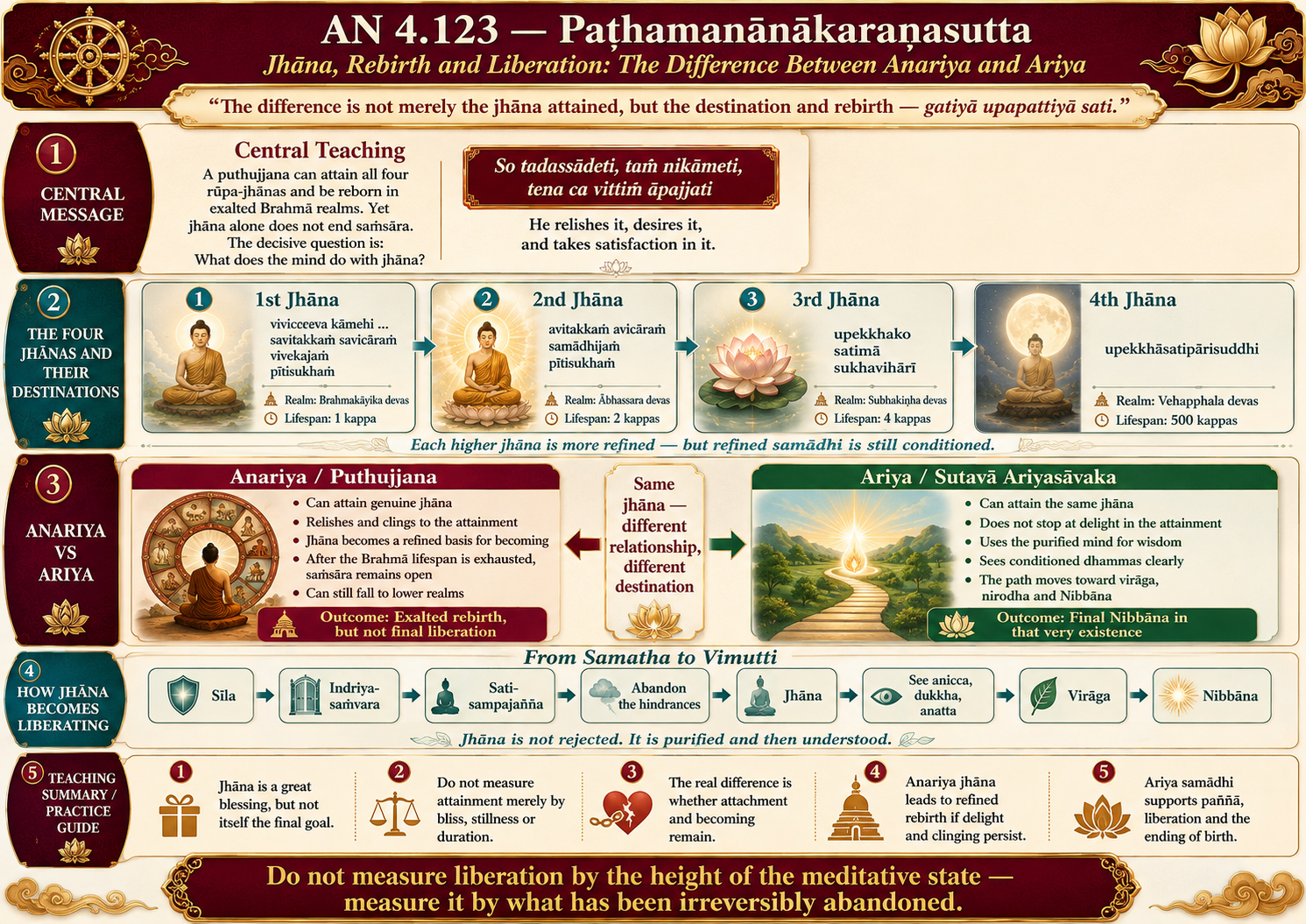
 VISUAL SUMMARYSee this sutta in a pictureOpen the complete infographic for a visual overview before or after reading the full study.View infographic →
Why AN 4.123 Is Such an Important Teaching
AN 4.123 is not merely a catalogue matching four jhānas with four Brahmā destinations. Its deeper purpose is to show that an ordinary person can become highly accomplished in genuine jhāna and can receive an extraordinarily refined result from that attainment, yet still remain within the field of renewed existence. The decisive issue is therefore not simply whether jhāna has occurred, but whether the practitioner has crossed from the condition of the puthujjana into the irreversible trajectory of the ariyasāvaka.
The discourse repeatedly places the same four jhānas beside two very different long-term outcomes. The puthujjana may dwell in a Brahmā realm for an inconceivably long time and yet, after that lifespan is exhausted, remain vulnerable to renewed wandering through saṁsāra. The noble disciple described by the Buddha, by contrast, reaches final Nibbāna from that existence. The Buddha therefore locates the decisive difference not in the surface appearance of the meditative attainment, but in gati and upapatti — destination and rebirth.
011. Four Kinds of Persons
Cattārome, bhikkhave, puggalā santo saṁvijjamānā lokasmiṁ. Katame cattāro?
“Bhikkhus, these four kinds of persons are found existing in the world. What four?”
The opening sounds simple, but the discourse will actually operate with two layers of classification. First, the four persons are presented according to the four rūpa-jhānas. Within every one of those four cases, however, the Buddha makes a more decisive distinction between the assutavā puthujjana, the uninstructed ordinary person, and the sutavā ariyasāvaka, the well-taught noble disciple. The meditative state can therefore be extremely refined in both cases, while the existential trajectory is radically different.
022. First Jhāna — Brahmakāyika Rebirth
Idha, bhikkhave, ekacco puggalo vivicceva kāmehi vivicca akusalehi dhammehi savitakkaṁ savicāraṁ vivekajaṁ pītisukhaṁ paṭhamaṁ jhānaṁ upasampajja viharati. So tadassādeti, taṁ nikāmeti, tena ca vittiṁ āpajjati. Tattha ṭhito tadadhimutto tabbahulavihārī aparihīno kālaṁ kurumāno brahmakāyikānaṁ devānaṁ sahabyataṁ upapajjati. Brahmakāyikānaṁ, bhikkhave, devānaṁ kappo āyuppamāṇaṁ.
“Here, bhikkhus, a certain person, quite secluded from sensual pleasures and secluded from unwholesome states, enters and dwells in the first jhāna, which is accompanied by vitakka and vicāra, with pīti and sukha born of seclusion. He relishes that state, desires it, and finds satisfaction in it. Remaining established in it, devoted to it, frequently dwelling in it, and not having fallen away from it, when he dies he is reborn in companionship with the devas of the Brahmā host. The lifespan of the devas of the Brahmā host is one kappa.”
Tattha puthujjano yāvatāyukaṁ ṭhatvā yāvatakaṁ tesaṁ devānaṁ āyuppamāṇaṁ taṁ sabbaṁ khepetvā nirayampi gacchati tiracchānayonimpi gacchati pettivisayampi gacchati.
“There an ordinary person remains for the full duration of that lifespan. Having exhausted the entire lifespan of those devas, he can still go to hell, to the animal realm, or to the realm of departed spirits.”
Bhagavato pana sāvako tattha yāvatāyukaṁ ṭhatvā yāvatakaṁ tesaṁ devānaṁ āyuppamāṇaṁ taṁ sabbaṁ khepetvā tasmiṁyeva bhave parinibbāyati.
“But a disciple of the Blessed One remains there for the full duration of that lifespan and, having completed the lifespan of those devas, attains final Nibbāna in that very existence.”
Ayaṁ kho, bhikkhave, viseso ayaṁ adhippayāso idaṁ nānākaraṇaṁ sutavato ariyasāvakassa assutavatā puthujjanena, yadidaṁ gatiyā upapattiyā sati.
“This, bhikkhus, is the difference, this is the distinction, this is the distinguishing factor between the well-taught noble disciple and the uninstructed ordinary person, namely, with regard to destination and rebirth.”
The first decisive lesson
The puthujjana in this passage is not a person with weak meditation. He has entered first jhāna, repeatedly dwells in it, remains devoted to it, does not fall away from it and develops a result strong enough to support Brahmā rebirth. Yet the Buddha still says that, after the lifespan supported by that attainment is exhausted, the ordinary person remains within the uncertainty of saṁsāra. This single passage already demonstrates that jhāna attainment and noble attainment are not identical.
033. Second Jhāna — Ābhassara Rebirth
Puna caparaṁ, bhikkhave, idhekacco puggalo vitakkavicārānaṁ vūpasamā ajjhattaṁ sampasādanaṁ cetaso ekodibhāvaṁ avitakkaṁ avicāraṁ samādhijaṁ pītisukhaṁ dutiyaṁ jhānaṁ upasampajja viharati. So tadassādeti, taṁ nikāmeti, tena ca vittiṁ āpajjati. Tattha ṭhito tadadhimutto tabbahulavihārī aparihīno kālaṁ kurumāno ābhassarānaṁ devānaṁ sahabyataṁ upapajjati. Ābhassarānaṁ, bhikkhave, devānaṁ dve kappā āyuppamāṇaṁ.
“Furthermore, bhikkhus, with the subsiding of vitakka and vicāra, a certain person enters and dwells in the second jhāna, which has inner confidence and unification of mind, is without vitakka and vicāra, and has pīti and sukha born of samādhi. He relishes it, desires it, and finds satisfaction in it. Established in it, devoted to it, frequently dwelling in it, and not having fallen away from it, when he dies he is reborn in companionship with the Ābhassara devas. The lifespan of the Ābhassara devas is two kappas.”
Tattha puthujjano yāvatāyukaṁ ṭhatvā yāvatakaṁ tesaṁ devānaṁ āyuppamāṇaṁ taṁ sabbaṁ khepetvā nirayampi gacchati tiracchānayonimpi gacchati pettivisayampi gacchati.
“There an ordinary person remains for their full lifespan. Having exhausted that entire lifespan, he can still go to hell, to the animal realm, or to the realm of departed spirits.”
Bhagavato pana sāvako tattha yāvatāyukaṁ ṭhatvā yāvatakaṁ tesaṁ devānaṁ āyuppamāṇaṁ taṁ sabbaṁ khepetvā tasmiṁyeva bhave parinibbāyati.
“But a disciple of the Blessed One remains there for their full lifespan and, after completing that lifespan, attains final Nibbāna in that very existence.”
Ayaṁ kho, bhikkhave, viseso ayaṁ adhippayāso idaṁ nānākaraṇaṁ sutavato ariyasāvakassa assutavatā puthujjanena, yadidaṁ gatiyā upapattiyā sati.
“This, bhikkhus, is the difference, the distinction, the distinguishing factor between the well-taught noble disciple and the uninstructed ordinary person, namely, with regard to destination and rebirth.”
The movement from first to second jhāna is itself a movement of relinquishment. Vitakkavicārānaṁ vūpasamā means that vitakka and vicāra have subsided. What becomes prominent is ajjhattaṁ sampasādanaṁ, inner confidence or clarity, and cetaso ekodibhāvaṁ, the unification of mind. Yet the Buddha again repeats the same warning concerning the practitioner’s relationship to the attainment: tadassādeti, taṁ nikāmeti, tena ca vittiṁ āpajjati. Refinement of the state does not by itself guarantee release from attachment to the state.
044. Third Jhāna — Subhakiṇha Rebirth
Puna caparaṁ, bhikkhave, idhekacco puggalo pītiyā ca virāgā upekkhako ca viharati sato ca sampajāno sukhañca kāyena paṭisaṁvedeti yaṁ taṁ ariyā ācikkhanti: ‘upekkhako satimā sukhavihārī’ti tatiyaṁ jhānaṁ upasampajja viharati. So tadassādeti, taṁ nikāmeti, tena ca vittiṁ āpajjati. Tattha ṭhito tadadhimutto tabbahulavihārī aparihīno, kālaṁ kurumāno subhakiṇhānaṁ devānaṁ sahabyataṁ upapajjati. Subhakiṇhānaṁ, bhikkhave, devānaṁ cattāro kappā āyuppamāṇaṁ.
“Furthermore, bhikkhus, with the fading away of pīti, a certain person dwells equanimously, mindful and fully aware, and personally experiences sukha through the body. He enters and dwells in the third jhāna, concerning which the noble ones declare: ‘Equanimous, mindful, one dwells pleasantly.’ He relishes it, desires it, and finds satisfaction in it. Established in it, devoted to it, frequently dwelling in it, and not having fallen away from it, when he dies he is reborn in companionship with the Subhakiṇha devas. The lifespan of the Subhakiṇha devas is four kappas.”
Tattha puthujjano yāvatāyukaṁ ṭhatvā yāvatakaṁ tesaṁ devānaṁ āyuppamāṇaṁ taṁ sabbaṁ khepetvā nirayampi gacchati tiracchānayonimpi gacchati pettivisayampi gacchati.
“There an ordinary person remains for their complete lifespan. Having exhausted that lifespan, he can still go to hell, to the animal realm, or to the realm of departed spirits.”
Bhagavato pana sāvako tattha yāvatāyukaṁ ṭhatvā yāvatakaṁ tesaṁ devānaṁ āyuppamāṇaṁ taṁ sabbaṁ khepetvā tasmiṁyeva bhave parinibbāyati.
“But a disciple of the Blessed One remains there for the complete lifespan and, having exhausted that lifespan, attains final Nibbāna in that very existence.”
Ayaṁ kho, bhikkhave, viseso ayaṁ adhippayāso idaṁ nānākaraṇaṁ sutavato ariyasāvakassa assutavatā puthujjanena, yadidaṁ gatiyā upapattiyā sati.
“This, bhikkhus, is the difference, the distinction, the distinguishing factor between the well-taught noble disciple and the uninstructed ordinary person, namely, with regard to destination and rebirth.”
Here the energetic uplift of pīti itself has faded: pītiyā ca virāgā. What becomes prominent is upekkhā, together with sati and sampajañña. Sukha remains, but the mind has become quieter than the state characterized by pīti. Once again, however, even this refined mode of dwelling can become something the mind relishes and wants to preserve. The Buddha therefore keeps the existential question in view: what happens when the lifespan supported by this refined attainment comes to an end?
055. Fourth Jhāna — Vehapphala Rebirth
Puna caparaṁ, bhikkhave, idhekacco puggalo sukhassa ca pahānā dukkhassa ca pahānā pubbeva somanassadomanassānaṁ atthaṅgamā adukkhamasukhaṁ upekkhāsatipārisuddhiṁ catutthaṁ jhānaṁ upasampajja viharati. So tadassādeti, taṁ nikāmeti, tena ca vittiṁ āpajjati. Tattha ṭhito tadadhimutto tabbahulavihārī aparihīno kālaṁ kurumāno vehapphalānaṁ devānaṁ sahabyataṁ upapajjati. Vehapphalānaṁ, bhikkhave, devānaṁ pañca kappasatāni āyuppamāṇaṁ.
“Furthermore, bhikkhus, with the abandoning of sukha and dukkha, and with the previous disappearance of mental joy and mental distress, a certain person enters and dwells in the fourth jhāna, which is neither painful nor pleasant and has purity of mindfulness through equanimity. He relishes it, desires it, and finds satisfaction in it. Established in it, devoted to it, frequently dwelling in it, and not having fallen away from it, when he dies he is reborn in companionship with the Vehapphala devas. The lifespan of the Vehapphala devas is five hundred kappas.”
Tattha puthujjano yāvatāyukaṁ ṭhatvā yāvatakaṁ tesaṁ devānaṁ āyuppamāṇaṁ taṁ sabbaṁ khepetvā nirayampi gacchati tiracchānayonimpi gacchati pettivisayampi gacchati.
“There an ordinary person remains for their complete lifespan. Having exhausted that entire lifespan, he can still go to hell, to the animal realm, or to the realm of departed spirits.”
Bhagavato pana sāvako tattha yāvatāyukaṁ ṭhatvā yāvatakaṁ tesaṁ devānaṁ āyuppamāṇaṁ taṁ sabbaṁ khepetvā tasmiṁyeva bhave parinibbāyati.
“But a disciple of the Blessed One remains there for the complete lifespan and, having exhausted that lifespan, attains final Nibbāna in that very existence.”
Ayaṁ kho, bhikkhave, viseso ayaṁ adhippayāso idaṁ nānākaraṇaṁ sutavato ariyasāvakassa assutavatā puthujjanena, yadidaṁ gatiyā upapattiyā sati.
“This, bhikkhus, is the difference, the distinction, the distinguishing factor between the well-taught noble disciple and the uninstructed ordinary person, namely, with regard to destination and rebirth.”
Fourth jhāna is not an intensified form of pleasure. The movement has passed beyond the ordinary pleasure-pain polarity into adukkhamasukhaṁ upekkhāsatipārisuddhiṁ — neither painful nor pleasant, with purification of mindfulness through equanimity. The lifespan associated here is immense: five hundred kappas. Yet the Buddha’s central warning becomes even sharper precisely because the destination is so exalted. Even an inconceivably long refined existence remains a conditioned existence.
066. Conclusion of the Sutta
Ime kho, bhikkhave, cattāro puggalā santo saṁvijjamānā lokasmin”ti.
“These, bhikkhus, are the four kinds of persons found existing in the world.”
The discourse ends briefly, but by this point the pattern has been repeated four times so that the lesson cannot easily be missed. First, there is genuine jhāna. Second, there is delight, preference and satisfaction in that attainment. Third, there is a corresponding refined rebirth. Fourth, the Buddha distinguishes the puthujjana from the ariyasāvaka not by denying the puthujjana’s jhāna, but by showing the radically different long-term destination of the two.
077. The Sentence That Unlocks the Entire Sutta
So tadassādeti, taṁ nikāmeti, tena ca vittiṁ āpajjati.
“He relishes it, desires it, and finds satisfaction in it.”
The Buddha repeats this expression after every one of the four jhānas. That repetition is too deliberate to treat as incidental. The practitioner has left behind coarse sensuality sufficiently to enter jhāna, yet the mind can now make the jhāna itself into something attractive: “This is wonderful. I want this state. I want to remain here. I want this again.” The object of delight has changed from sensuality to an extraordinarily refined conditioned state, but the basic movement of assāda — gratification can still remain.
This is why the discourse is such an important safeguard against confusing powerful meditation with liberation. A person can be profoundly secluded from kāma while in jhāna and still not have uprooted the underlying conditions that sustain renewed existence. The meditative achievement can therefore be genuine while the work of liberation remains unfinished.
088. Jhāna Is Not the Problem — Appropriation of Jhāna Is
The Buddha is not criticizing jhāna. The four jhānas are repeatedly included within the gradual training and the Noble Eightfold Path under sammā-samādhi. The problem arises when the mind turns the attainment into another residence for craving, another object of identity, or another refined basis for bhava.
The practical distinction can therefore be expressed carefully. Jhāna itself is not bondage. But jhāna can be appropriated. The practitioner may begin to measure himself by it, long for its repetition, fear its loss, compare his attainment with others, or quietly take the state to be the final goal. When this happens, sensuality may have been temporarily left behind, yet a much subtler attachment has appeared around the very purity that was developed to support freedom.
Thus the correct response is neither to fear jhāna nor to worship jhāna. The practitioner develops it, becomes skilled in it, and then understands it without turning the conditioned state into “mine,” “me,” or the final refuge.
099. How One Actually Arrives at Jhāna
AN 4.123 begins after jhāna has already been established, so the preparatory training has to be understood from the broader Nikāya framework. The Buddha’s gradual training does not begin with an instruction to force the mind into stillness. It begins by creating a life in which the causes of restlessness, remorse, sensual preoccupation and dullness are progressively weakened.
Sīla removes gross disturbances caused by misconduct. Indriya-saṁvara prevents the sense doors from continually feeding grasping at signs and features. Bhojane mattaññutā prevents indulgence and heaviness from dominating the body. Jāgariyānuyoga develops wakefulness and repeated cleansing of obstructive states. Sati-sampajañña carries the training through walking, standing, sitting, lying down, eating, speaking and ordinary activity. Seclusion then provides the appropriate environment in which the five hindrances can be abandoned.
Once the hindrances no longer dominate, the development described elsewhere in the gradual training becomes intelligible: gladness, pīti, tranquillity, sukha and samādhi arise in dependence upon increasingly purified conditions. Jhāna is therefore better understood as the maturation of an entire training than as an isolated technique performed only during formal sitting.
1010. The Four Jhānas as Progressive Refinement
The four jhānas in this discourse form a clear sequence of progressive relinquishment. In first jhāna, sensuality and unwholesome dhammas have been secluded from, while vitakka, vicāra and vivekaja pīti-sukha remain. In second jhāna, vitakka and vicāra subside and the mind becomes more internally unified. In third jhāna, even pīti fades; upekkhā, sati and sampajañña become prominent while sukha remains. In fourth jhāna, sukha and dukkha are abandoned and the mind reaches upekkhāsatipārisuddhi.
Thus jhāna itself trains the practitioner in moving from the coarser to the subtler. Yet AN 4.123 adds an especially penetrating question: after relinquishing progressively coarser features, will the practitioner now cling to the refined state that remains? If the answer is yes, then a meditation based upon relinquishment can paradoxically become a new basis of attachment. This is precisely why paññā must accompany the maturation of samādhi.
1111. What Exactly Is “Anariya Jhāna”?
AN 4.123 does not present two different first-jhāna formulas, one labelled “anariya first jhāna” and another labelled “ariya first jhāna.” The formula describing first, second, third and fourth jhāna is the familiar formula in each case. The explicit contrast made by the Buddha is between the assutavā puthujjana and the sutavā ariyasāvaka.
This matters because it prevents us from defining noble versus non-noble jhāna merely by how intense, luminous, blissful or still the experience appears. A puthujjana can develop extraordinary tranquillity. He can master the four rūpa-jhānas and maintain them without decline. Therefore the existence of profound meditative absorption does not by itself demonstrate that identity-view, doubt or the other fetters have been destroyed.
In a practical teaching context, “anariya jhāna” is therefore safest when used as shorthand for jhāna occurring in a practitioner who has not entered the noble path or who relates to the attainment through gratification and becoming, rather than as though the Buddha had described a completely different set of four absorptions.
1212. What Makes Samādhi Noble?
The broader teaching of the Noble Eightfold Path helps answer this question. Noble sammā-samādhi does not float independently from the rest of the path. It is supported by right view, right intention, right speech, right action, right livelihood, right effort and right mindfulness. This means that the quality of samādhi cannot be judged only by the stillness of the mind; one must also ask what path factors support it and what direction the mind is taking because of it.
A practitioner can therefore ask a more useful series of questions than “How deep was the absorption?” What view supports this samādhi? What intentions support it? Has conduct been purified? Is the mind learning relinquishment or merely acquiring another refined experience? Is the attainment being used to see conditioned phenomena clearly, or is it being converted into identity and possession?
The difference is therefore not simply experiential intensity. Noble samādhi belongs within a path whose direction is virāga, nirodha and vimutti.
1313. The Extraordinary Warning — A Fourth-Jhāna Master Can Still Be a Puthujjana
Consider how strong the fourth example is. The person can enter fourth jhāna. He repeatedly dwells in it. He is devoted to it. He does not lose the attainment. The kamma associated with that development supports rebirth among the Vehapphala devas for five hundred kappas. Yet the Buddha still describes the decisive comparison as one between a puthujjana and an ariyasāvaka.
This should radically change the way meditative attainment is assessed. Extraordinary tranquillity, unusual internal silence, radiant states, prolonged equanimity and mastery of absorption may all be meaningful accomplishments, but none of them should automatically be treated as proof of noble attainment. The canonical question is not only, “What can the mind enter?” but also, “What has been irreversibly abandoned?”
Meditative power and liberation are related, but they are not synonymous. Jhāna makes the mind extraordinarily capable. Paññā must ensure that this capability is used for the ending of the conditions that sustain renewed existence.
1414. Why Can the Puthujjana Fall Again?
The puthujjana’s refined rebirth demonstrates the enormous power of wholesome development, but it does not establish irreversible release from saṁsāra. The immediate condition of mind has been profoundly transformed by jhāna, yet the roots sustaining renewed existence have not necessarily been uprooted. Therefore, when the lifespan produced by that attainment is exhausted, the stream of becoming is still open.
This is why the Buddha can place an immensely long Brahmā lifespan next to the possibility of later rebirth in lower realms. He is not saying that jhāna is dangerous or unwholesome. He is showing the difference between a magnificent destination inside saṁsāra and the ending of saṁsāra. One kappa ends. Two kappas end. Four kappas end. Five hundred kappas end. Duration does not convert the conditioned into the unconditioned.
The teaching therefore removes complacency. A practitioner who sees the superiority of jhānic happiness to sensual pleasure has learned something important, but one more question remains: has the mechanism of renewed existence been brought to an end?
1515. Why Is the Ariyasāvaka Different?
The noble disciple has undergone a qualitative transformation that is not captured merely by describing the pleasantness or stillness of a meditative state. Noble right view has opened an irreversible trajectory toward the ending of dukkha. Hence the refrain of the sutta focuses on gatiyā upapattiyā — destination and rebirth.
At first glance, both practitioners may appear to share something similar: both can be reborn in a refined Brahmā realm associated with jhāna. The decisive question is what can happen after that. For the puthujjana, the process of wandering remains open. For the noble disciple described in this discourse, the process terminates in final Nibbāna from that existence.
This is why the Buddha says, again and again: ayaṁ viseso, ayaṁ adhippayāso, idaṁ nānākaraṇaṁ — this is the difference, the distinction, the distinguishing factor. Noble attainment changes the trajectory of existence in a way that the mere possession of a refined meditative state does not.
1616. AN 4.124 Completes the Lesson of AN 4.123
AN 4.123 becomes even clearer when read beside the discourse that follows it. In AN 4.123, the practitioner enters one of the four jhānas and then assādeti, nikāmeti, vittiṁ āpajjati — relishes it, wants it and takes satisfaction in it. The attainment becomes a refined basis for continued existence.
AN 4.124 changes the relationship to the same field of experience. Rather than merely residing in the gratification of the state, the practitioner examines the conditioned dhammas present there through the lens of impermanence, unsatisfactoriness, affliction, emptiness and not-self. The meditative state is no longer treated as a final refuge. It becomes material for seeing.
The practical contrast is therefore extremely powerful:
The mind enjoys the state and makes it a basis for refined becoming.
The conditioned experience is examined rather than appropriated.
The attainment need not be rejected. What changes is the wisdom with which it is known.
1717. AN 9.36 — Turning the Jhānic Mind Toward the Deathless
AN 9.36 gives an especially useful practical continuation. After a jhāna has been entered, the practitioner examines the conditioned phenomena associated with that experience in terms of the aggregates. Instead of taking the extraordinary purity of the state as evidence that something permanent or ultimately ownable has been found, the practitioner sees conditioned experience as impermanent, unsatisfactory, alien, empty and not-self.
The direction of mind then changes. Rather than inclining toward maintaining the conditioned attainment indefinitely, the mind inclines toward what is described as peaceful and sublime: the stilling of formations, relinquishment of acquisitions, ending of craving, fading away, cessation and Nibbāna.
This is the transition from using jhāna as a residence to using jhāna as a basis for liberating knowledge. The calm does not become an end in itself; it becomes the purified ground from which conditioned phenomena can be known without the usual interference of sensuality, ill will and the other hindrances.
1818. Do Not Mistake Jhāna for Nibbāna
A profound jhānic state can be unlike ordinary consciousness to such a degree that it may seem final. Sensual desire can be absent. Ill will can be absent. The mind can become extraordinarily still, bright and equanimous. Ordinary mental chatter may disappear almost completely. Such a state can feel immeasurably superior to ordinary sensory life.
But the Dhamma asks a decisive question: is the state conditioned? If it arose because supporting conditions were developed, and if it ceases when those supporting conditions cease, then the state itself cannot be the unconditioned. The practitioner therefore neither dismisses the experience nor mistakes it for the final goal.
This is where paññā protects samādhi from becoming another source of appropriation. The practitioner learns: “Even this extraordinary state has arisen dependent upon conditions. Even this is to be known without clinging.” In this way jhāna fulfills its highest function—not by becoming a permanent refuge, but by helping the mind see with extraordinary clarity what is conditioned and what release from conditioning requires.
1919. Practical Distinction — Puthujjana Jhāna and Jhāna Within the Noble Path
The key teaching point is that one should not infer noble attainment merely from the phenomenology of meditation. The more reliable question is whether the fetters and underlying causes of renewed existence have been penetrated and irreversibly abandoned. Jhāna shows what the trained mind can enter; noble attainment shows what bondage has ended.
2020. Complete Practice and Teaching Sequence
For teaching purposes, AN 4.123 is most useful when the four jhānas are not isolated from the training that prepares them or from the paññā that must follow them. The following table can therefore function as a ready reckoner for retreat practice, personal assessment and instruction.
The teaching sequence therefore prevents two opposite mistakes. One mistake is to dismiss jhāna and attempt liberating insight without adequately training the mind. The other is to make jhāna itself the final destination. The middle way is to prepare the mind thoroughly, develop samādhi fully, and then use that purified mind for the work for which the Buddha trained it: the ending of attachment, becoming and renewed birth.
2121. Do Not Measure Liberation by the Height of the Meditative State
AN 4.123 teaches that jhāna is extraordinarily powerful, but power and liberation are not the same thing. Jhāna can lift the mind far beyond sensuality and support existence in immensely refined Brahmā worlds. Yet if the practitioner merely relishes the attainment, wants it and makes it a place in which the mind seeks satisfaction, then even sublime meditation can remain within the architecture of becoming.
The correct question after jhāna is therefore not simply, “How deep was the state?” Nor is it, “How long could I remain there?” The more important question is: “What did paññā understand through this purified mind?” Did the practitioner merely discover a happiness superior to sensual pleasure, or did the practitioner also see that the refined experience arose through conditions and therefore cannot be possessed as permanent, self or final refuge?
When the aggregates associated with even the most beautiful meditative experience are known without appropriation, the direction can move from assāda toward nibbidā, from nibbidā toward virāga, from virāga toward nirodha and from non-clinging toward release. Jhāna then fulfills its role within the Buddha’s path: not as a luxurious stopping place within saṁsāra, but as a powerful support for bringing saṁsāra to an end.
The deepest teaching of this discourse can therefore be expressed in one sentence:
Do not measure liberation by the height of the meditative state; measure it by what has been irreversibly abandoned.
A person can climb extraordinarily high within saṁsāra through jhāna. The Buddha’s path is not ultimately concerned with how high within saṁsāra one can climb. It is concerned with ending the conditions that make birth anywhere necessary.
From refined samādhi → clear seeing → virāga → nirodha → vimutti.