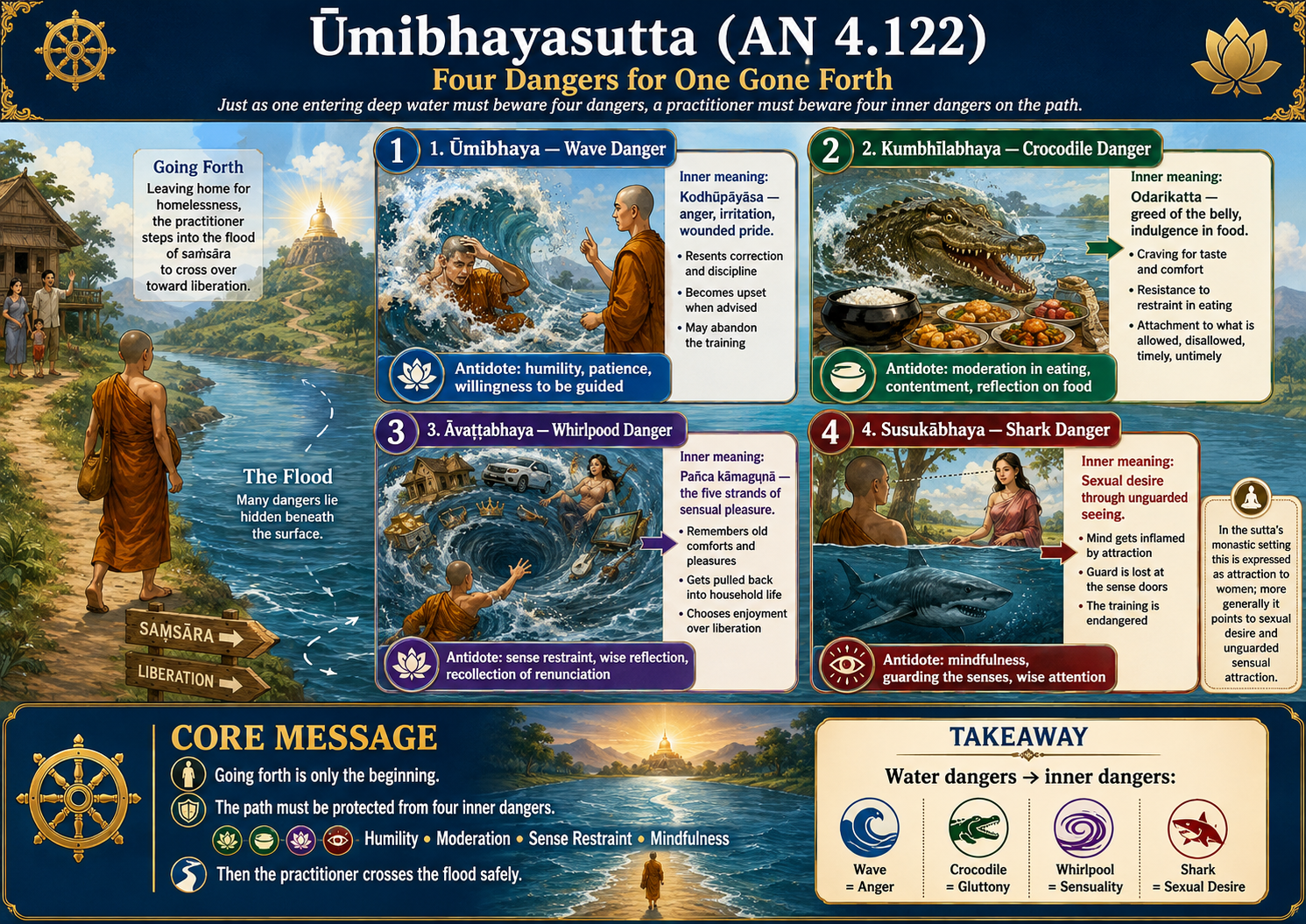
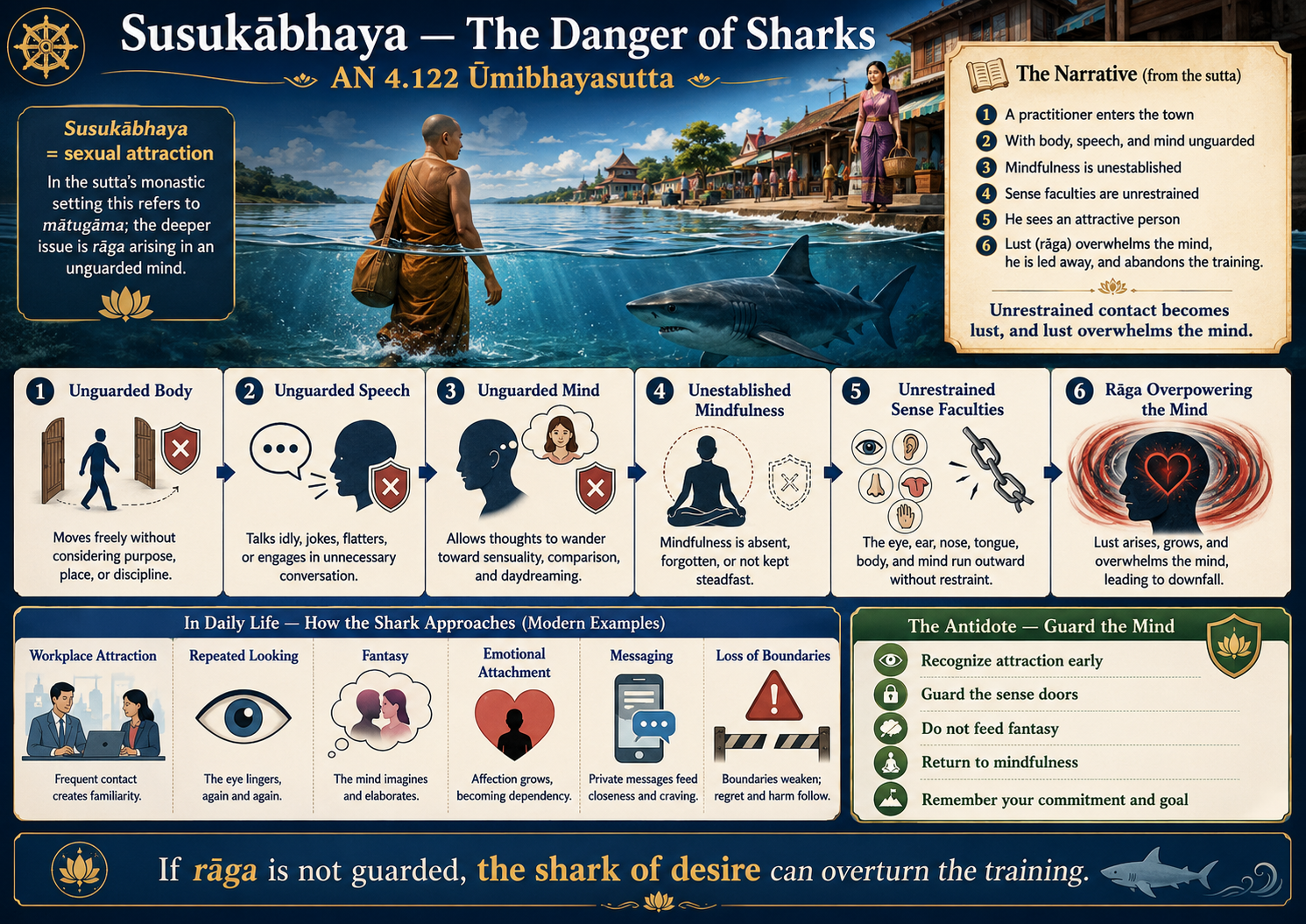
 VISUAL SUMMARYSee this sutta in a pictureOpen the complete infographic for a visual overview before or after reading the full study.View infographic →
“Cattārimāni, bhikkhave, bhayāni udakorohantassa pāṭikaṅkhitabbāni. Katamāni cattāri? Ūmibhayaṁ, kumbhīlabhayaṁ, āvaṭṭabhayaṁ, susukābhayaṁ—
Imāni kho, bhikkhave, cattāri bhayāni udakorohantassa pāṭikaṅkhitabbāni. Evamevaṁ kho, bhikkhave, cattāri bhayāni idhekaccassa kulaputtassa imasmiṁ dhammavinaye agārasmā anagāriyaṁ pabbajitassa pāṭikaṅkhitabbāni.
Katamāni cattāri? Ūmibhayaṁ, kumbhīlabhayaṁ, āvaṭṭabhayaṁ, susukābhayaṁ.”
“Bhikkhus, there are four dangers to be expected by one who enters the water. What four? The danger of waves, crocodiles, whirlpools, and sharks.
In the same way, there are four dangers to be expected by a certain son of good family who has gone forth from the household life into homelessness in this Dhamma and discipline.
What four? The danger of waves, crocodiles, whirlpools, and sharks.”
The four water dangers are analogies for four mental vulnerabilities. The phrase pāṭikaṅkhitabbāni—“to be expected”—is important: these are predictable obstacles, not surprising accidents.
The simile can be used diagnostically. When practice weakens, ask whether the mind is being hit by anger, seized by appetite, spun around by sensual comparison, or overwhelmed by sexual desire.
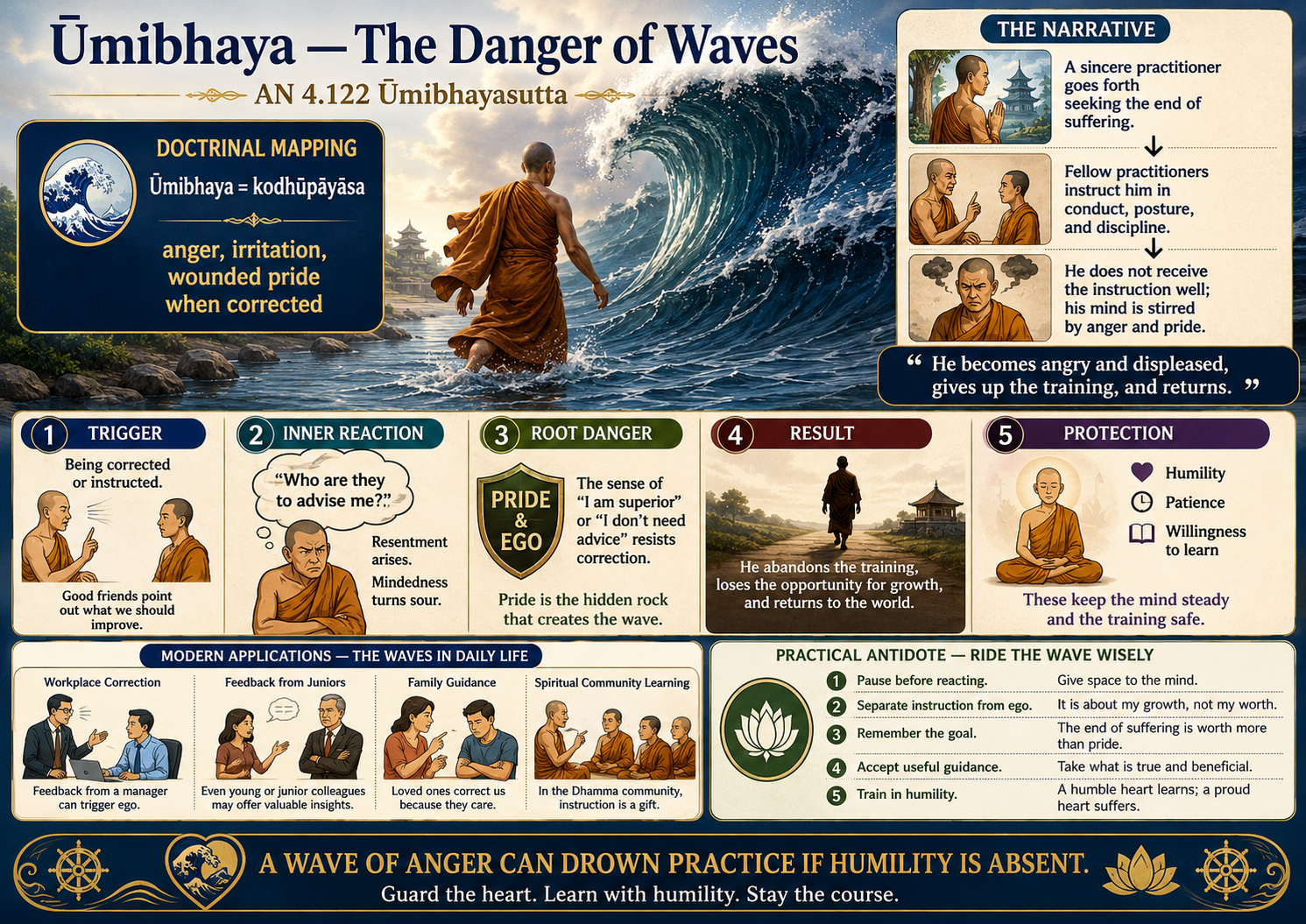
1Ūmibhaya — The Danger of WavesŪmibhaya → kodhūpāyāsa — anger, irritation, wounded pride
“Katamañca, bhikkhave, ūmibhayaṁ? Idha, bhikkhave, ekacco kulaputto saddhā agārasmā anagāriyaṁ pabbajito hoti: ‘otiṇṇomhi jātiyā jarāya maraṇena sokehi paridevehi dukkhehi domanassehi upāyāsehi, dukkhotiṇṇo dukkhapareto; appeva nāma imassa kevalassa dukkhakkhandhassa antakiriyā paññāyethā’ti.
Tamenaṁ tathā pabbajitaṁ samānaṁ sabrahmacārino ovadanti anusāsanti: ‘evaṁ te abhikkamitabbaṁ, evaṁ te paṭikkamitabbaṁ, evaṁ te āloketabbaṁ, evaṁ te viloketabbaṁ, evaṁ te samiñjitabbaṁ, evaṁ te pasāritabbaṁ, evaṁ te saṅghāṭipattacīvaraṁ dhāretabban’ti.
Tassa evaṁ hoti: ‘mayaṁ kho pubbe agāriyabhūtā samānā aññe ovadāmapi anusāsāmapi. Ime panamhākaṁ puttamattā maññe nattamattā maññe ovaditabbaṁ anusāsitabbaṁ maññantī’ti.
So kupito anattamano sikkhaṁ paccakkhāya hīnāyāvattati. Ayaṁ vuccati, bhikkhave, bhikkhu ūmibhayassa bhīto sikkhaṁ paccakkhāya hīnāyāvatto.
Ūmibhayanti kho, bhikkhave, kodhūpāyāsassetaṁ adhivacanaṁ. Idaṁ vuccati, bhikkhave, ūmibhayaṁ.”
“And what is the danger of waves?
A son of good family goes forth out of faith, thinking: ‘I am overwhelmed by birth, aging, death, sorrow, lamentation, pain, distress, and despair. Perhaps the ending of this entire mass of suffering may be known.’
His companions in the holy life advise him how to walk, turn, look, move his limbs, and carry his robe and bowl.
He thinks: ‘When we were householders we instructed others. Yet these people, who seem young enough to be our sons or grandsons, think they should instruct us!’
Becoming angry and displeased, he gives up the training and returns to the lower life.
This is called one who has abandoned the training out of fear of the danger of waves.
‘Danger of waves’ is a designation for anger and irritation.”
The first danger is ego reacting to correction. The practitioner’s original goal is liberation, but a small instruction activates status and pride.
The inner sentence—“I used to instruct others”—shows that the household identity has not yet been fully relinquished. Age, seniority, education, title, or past authority becomes more important than learning.
A wave rises quickly and destabilizes. In the same way, anger can erase perspective in seconds.
The practical quality needed here is teachability. One must learn to receive correction without turning it into humiliation or identity-defense.
Practice response
- Notice bodily irritation as soon as correction is given.
- Separate the instruction from the story ‘Who are they to tell me?’
- Remember the original purpose of training.
- Do not use age, status, education, or seniority to block learning.
- Clarify calmly if needed, but first remove the anger.
Corporate analogy: a senior executive is corrected by a much younger colleague and reacts, ‘Who is this person to tell me?’ The wave is not the feedback itself; it is wounded pride.
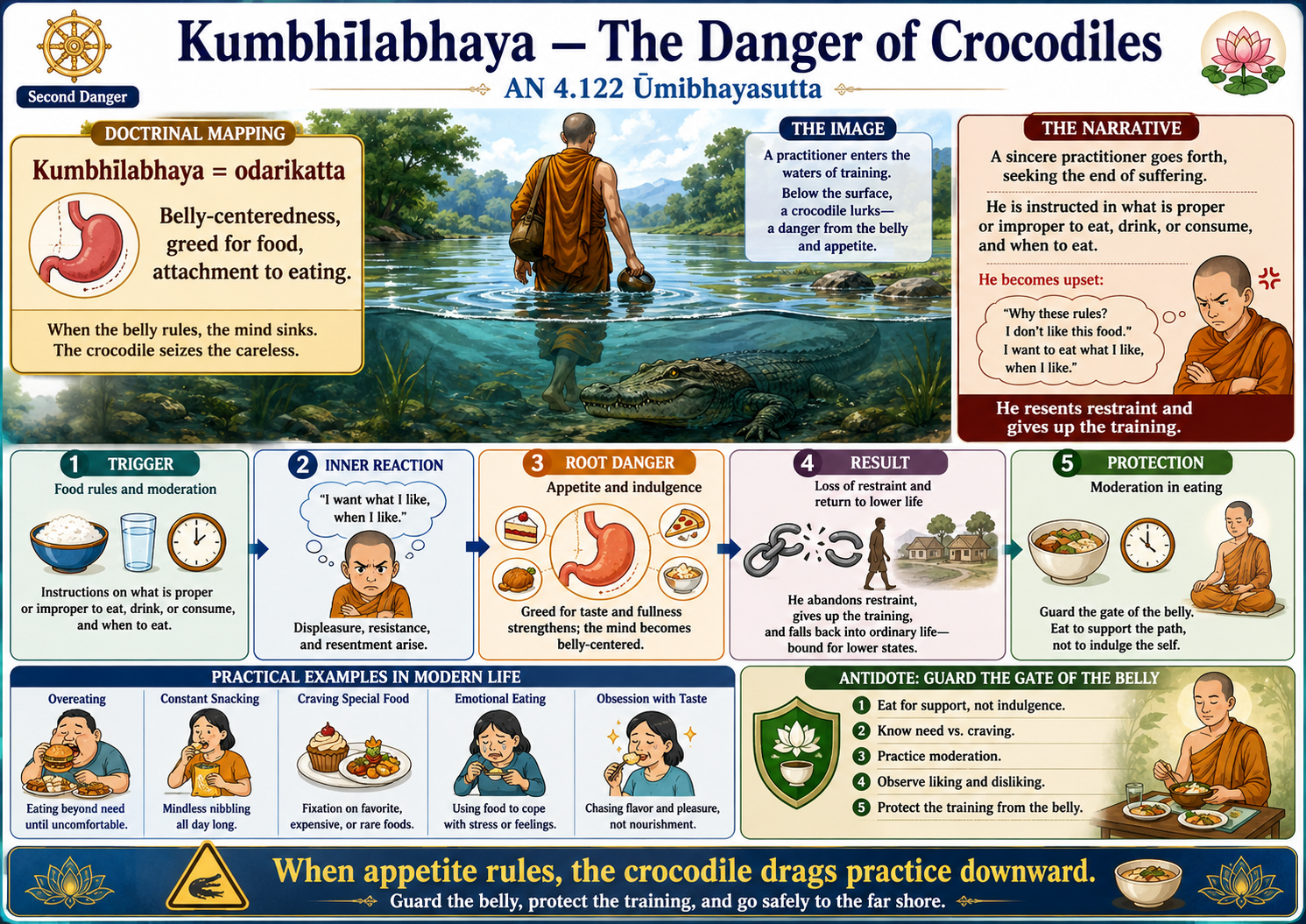
2Kumbhīlabhaya — The Danger of CrocodilesKumbhīlabhaya → odarikatta — belly-centered attachment to eating
“Katamañca, bhikkhave, kumbhīlabhayaṁ? Idha, bhikkhave, ekacco kulaputto saddhā agārasmā anagāriyaṁ pabbajito hoti: ‘otiṇṇomhi jātiyā jarāya maraṇena sokehi paridevehi dukkhehi domanassehi upāyāsehi, dukkhotiṇṇo dukkhapareto; appeva nāma imassa kevalassa dukkhakkhandhassa antakiriyā paññāyethā’ti.
Tamenaṁ tathā pabbajitaṁ samānaṁ sabrahmacārino ovadanti anusāsanti: ‘idaṁ te khāditabbaṁ, idaṁ te na khāditabbaṁ, idaṁ te bhuñjitabbaṁ, idaṁ te na bhuñjitabbaṁ, idaṁ te sāyitabbaṁ, idaṁ te na sāyitabbaṁ, idaṁ te pātabbaṁ, idaṁ te na pātabbaṁ, kappiyaṁ te khāditabbaṁ, akappiyaṁ te na khāditabbaṁ, kappiyaṁ te bhuñjitabbaṁ, akappiyaṁ te na bhuñjitabbaṁ, kappiyaṁ te sāyitabbaṁ, akappiyaṁ te na sāyitabbaṁ, kappiyaṁ te pātabbaṁ, akappiyaṁ te na pātabbaṁ, kāle te khāditabbaṁ, vikāle te na khāditabbaṁ, kāle te bhuñjitabbaṁ, vikāle te na bhuñjitabbaṁ, kāle te sāyitabbaṁ, vikāle te na sāyitabbaṁ, kāle te pātabbaṁ, vikāle te na pātabban’ti.
Tassa evaṁ hoti: ‘mayaṁ kho pubbe agāriyabhūtā samānā yaṁ icchāma taṁ khādāma, yaṁ na icchāma na taṁ khādāma; yaṁ icchāma taṁ bhuñjāma, yaṁ na icchāma na taṁ bhuñjāma; yaṁ icchāma taṁ sāyāma, yaṁ na icchāma na taṁ sāyāma; yaṁ icchāma taṁ pivāma, yaṁ na icchāma na taṁ pivāma; kappiyampi khādāma akappiyampi khādāma kappiyampi bhuñjāma akappiyampi bhuñjāma kappiyampi sāyāma akappiyampi sāyāma kappiyampi pivāma akappiyampi pivāma, kālepi khādāma vikālepi khādāma kālepi bhuñjāma vikālepi bhuñjāma kālepi sāyāma vikālepi sāyāma kālepi pivāma vikālepi pivāma; yampi no saddhā gahapatikā divā vikāle paṇītaṁ khādanīyaṁ vā bhojanīyaṁ vā denti, tatrapime mukhāvaraṇaṁ maññe karontī’ti.
So kupito anattamano sikkhaṁ paccakkhāya hīnāyāvattati. Ayaṁ vuccati, bhikkhave, bhikkhu kumbhīlabhayassa bhīto sikkhaṁ paccakkhāya hīnāyāvatto.
Kumbhīlabhayanti kho, bhikkhave, odarikattassetaṁ adhivacanaṁ. Idaṁ vuccati, bhikkhave, kumbhīlabhayaṁ.”
“And what is the danger of crocodiles?
A son of good family goes forth seeking the ending of suffering. His companions instruct him regarding what may and may not be eaten, consumed, tasted, or drunk; what is allowable and unallowable; and what may be taken at the proper time or improper time.
He thinks: ‘As householders we ate, drank, and tasted whatever we wanted, whenever we wanted. Even when faithful householders give us fine food later in the day, these people seem to put a barrier over our mouths!’
Becoming angry and displeased, he abandons the training.
‘Danger of crocodiles’ is a designation for belly-centeredness or gluttonous attachment to eating.”
The second danger is odarikatta: allowing the belly and food-preference to govern the training.
The long list is deliberate. The issue is not only quantity but the loss of freedom when the mind insists on “what I want, when I want it.”
The former household freedom around food now makes discipline feel like deprivation.
The deeper practice is bhojane mattaññutā—moderation in eating. Food supports the body and the holy life; it is not meant to become a primary entertainment system.
Practice response
- Distinguish bodily need from taste-seeking.
- Watch ‘I want / I do not want’ form around food.
- Use moderation, not self-punishment.
- Notice whether food schedule or preference is becoming more important than practice.
- Recollect the purpose of eating: sustaining the body and training.
Corporate analogy: a person becomes dominated by gourmet food, coffee rituals, late-night snacking, and constant menu-thinking. The crocodile is not the meal; it is appetite taking control of mood and priorities.
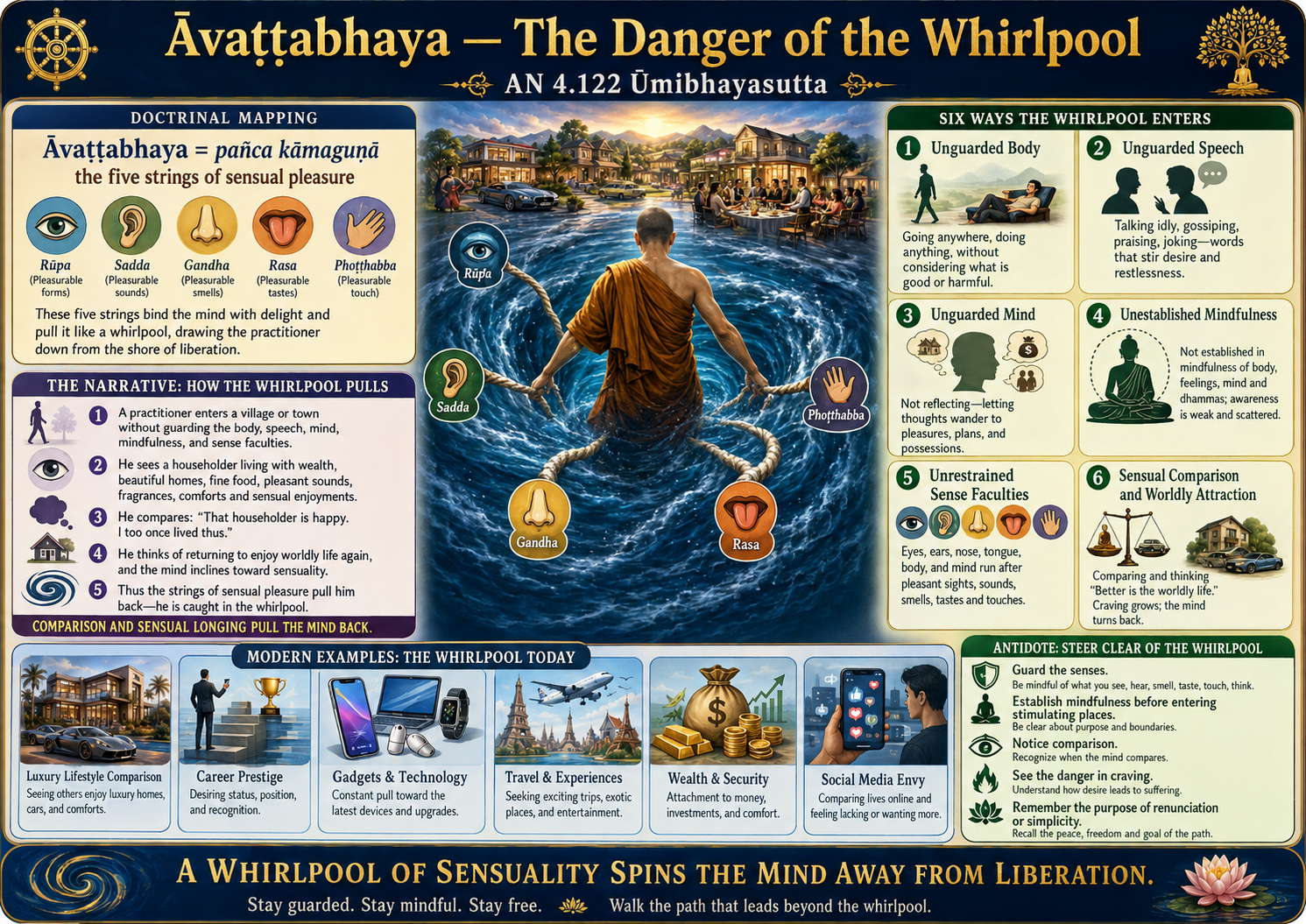
3Āvaṭṭabhaya — The Danger of the WhirlpoolĀvaṭṭabhaya → pañca kāmaguṇā — the five strings of sensual pleasure
“Katamañca, bhikkhave, āvaṭṭabhayaṁ? Idha, bhikkhave, ekacco kulaputto saddhā agārasmā anagāriyaṁ pabbajito hoti: ‘otiṇṇomhi jātiyā jarāya maraṇena sokehi paridevehi, dukkhehi domanassehi upāyāsehi dukkhotiṇṇo dukkhapareto; appeva nāma imassa kevalassa dukkhakkhandhassa antakiriyā paññāyethā’ti.
So evaṁ pabbajito samāno pubbaṇhasamayaṁ nivāsetvā pattacīvaramādāya gāmaṁ vā nigamaṁ vā piṇḍāya pavisati arakkhiteneva kāyena arakkhitāya vācāya arakkhitena cittena anupaṭṭhitāya satiyā asaṁvutehi indriyehi.
So tattha passati gahapatiṁ vā gahapatiputtaṁ vā pañcahi kāmaguṇehi samappitaṁ samaṅgībhūtaṁ paricārayamānaṁ.
Tassa evaṁ hoti: ‘mayaṁ kho pubbe agāriyabhūtā samānā pañcahi kāmaguṇehi samappitā samaṅgībhūtā paricārimhā; saṁvijjanti kho pana me kule bhogā. Sakkā bhoge ca bhuñjituṁ puññāni ca kātuṁ. Yannūnāhaṁ sikkhaṁ paccakkhāya hīnāyāvattitvā bhoge ca bhuñjeyyaṁ puññāni ca kareyyan’ti.
So sikkhaṁ paccakkhāya hīnāyāvattati. Ayaṁ vuccati, bhikkhave, bhikkhu āvaṭṭabhayassa bhīto sikkhaṁ paccakkhāya hīnāyāvatto.
Āvaṭṭabhayanti kho, bhikkhave, pañcannetaṁ kāmaguṇānaṁ adhivacanaṁ. Idaṁ vuccati, bhikkhave, āvaṭṭabhayaṁ.”
“And what is the danger of whirlpools?
A son of good family has gone forth seeking the ending of suffering. In the morning he enters a village or town for alms with body unguarded, speech unguarded, mind unguarded, mindfulness unestablished, and faculties unrestrained.
He sees a householder enjoying the five strings of sensual pleasure.
He thinks: ‘Previously we too enjoyed the five strings of sensual pleasure. My family still has wealth. I could enjoy wealth and also make merit. Why not give up the training and return?’
He gives up the training.
‘Danger of whirlpools’ is a designation for the five strings of sensual pleasure.”
The third danger starts with failure of protection: body, speech, and mind unguarded; mindfulness absent; sense faculties unrestrained.
Then comes comparison with worldly comfort.
The thought is subtle: “I can enjoy wealth and still make merit.” The whirlpool is therefore not crude wickedness; it is a compelling compromise that slowly spins the mind back toward the old life.
The practical protection is sati plus indriya-saṁvara. Without those, one sight of prosperity can reactivate memory, loss, possibility, and justification.
Practice response
- Establish sati before highly stimulating environments.
- Guard body, speech, and mind early.
- Notice comparison: ‘They have it; I used to have it; I could have it again.’
- Identify respectable rationalizations hiding sensual pull.
- Recollect the reason for renunciation or simplification.
Corporate analogy: someone has reduced work for Dhamma practice, then meets former colleagues enjoying huge salaries, travel, prestige, and executive perks. The whirlpool begins with comparison and rationalization.
4Susukābhaya — The Danger of SharksSusukābhaya → mātugāma — sexual attraction in the sutta’s male monastic setting
“Katamañca, bhikkhave, susukābhayaṁ? Idha, bhikkhave, ekacco kulaputto saddhā agārasmā anagāriyaṁ pabbajito hoti: ‘otiṇṇomhi jātiyā jarāya maraṇena sokehi paridevehi dukkhehi domanassehi upāyāsehi, dukkhotiṇṇo dukkhapareto; appeva nāma imassa kevalassa dukkhakkhandhassa antakiriyā paññāyethā’ti.
So evaṁ pabbajito samāno pubbaṇhasamayaṁ nivāsetvā pattacīvaramādāya gāmaṁ vā nigamaṁ vā piṇḍāya pavisati arakkhiteneva kāyena arakkhitāya vācāya arakkhitena cittena anupaṭṭhitāya satiyā asaṁvutehi indriyehi.
So tattha passati mātugāmaṁ dunnivatthaṁ vā duppārutaṁ vā. Tassa mātugāmaṁ disvā dunnivatthaṁ vā duppārutaṁ vā rāgo cittaṁ anuddhaṁseti.
So rāgānuddhaṁsitena cittena sikkhaṁ paccakkhāya hīnāyāvattati. Ayaṁ vuccati, bhikkhave, bhikkhu susukābhayassa bhīto sikkhaṁ paccakkhāya hīnāyāvatto.
Susukābhayanti kho, bhikkhave, mātugāmassetaṁ adhivacanaṁ. Idaṁ vuccati, bhikkhave, susukābhayaṁ.”
“And what is the danger of sharks?
A son of good family goes forth seeking the ending of suffering. He enters a village with body unguarded, speech unguarded, mind unguarded, mindfulness unestablished, and faculties unrestrained.
There he sees a woman who is revealingly dressed. Seeing her, lust overwhelms his mind.
With his mind overwhelmed by lust, he gives up the training.
‘Danger of sharks’ is here a designation for women in relation to the celibate male monastic’s vulnerability to sexual attraction.”
The canonical setting is a celibate male monastic, so the text speaks specifically of mātugāma. The vulnerability being diagnosed is sexual desire arising through unguarded sense contact.
As in the whirlpool section, the Buddha first lists the missing protections. This repetition matters: the danger becomes powerful when sati and saṁvara are absent.
The practice target is not hostility toward women. It is rāga in the practitioner’s own mind.
For broader application, the principle applies to sexual attraction toward whoever one is attracted to: recognize contact early, do not feed it through repeated looking and fantasy, and protect one’s commitments.
Practice response
- Recognize attraction as a mental event, not a command.
- Establish mindfulness in the body.
- Do not feed attraction through repeated looking, fantasy, or messaging.
- Do not blame the person; guard the reacting mind.
- Recollect the commitments and purpose of training.
Corporate analogy: workplace attraction becomes obsessive through repeated looking, private messaging, fantasy, and emotional dependency. Sense restraint is most effective before the mind is already overwhelmed.
“Imāni kho, bhikkhave, cattāri bhayāni idhekaccassa kulaputtassa imasmiṁ dhammavinaye agārasmā anagāriyaṁ pabbajitassa pāṭikaṅkhitabbānī”ti.
“These, bhikkhus, are the four dangers to be expected by a certain son of good family who has gone forth from the household life into homelessness in this Dhamma and discipline.”
The four dangers form a practical progression: ego resists correction; appetite resists restraint; sensuality romanticizes the old life; sexual desire attacks celibacy.
The protective qualities running through the discourse are humility, moderation in eating, sati, and indriya-saṁvara.