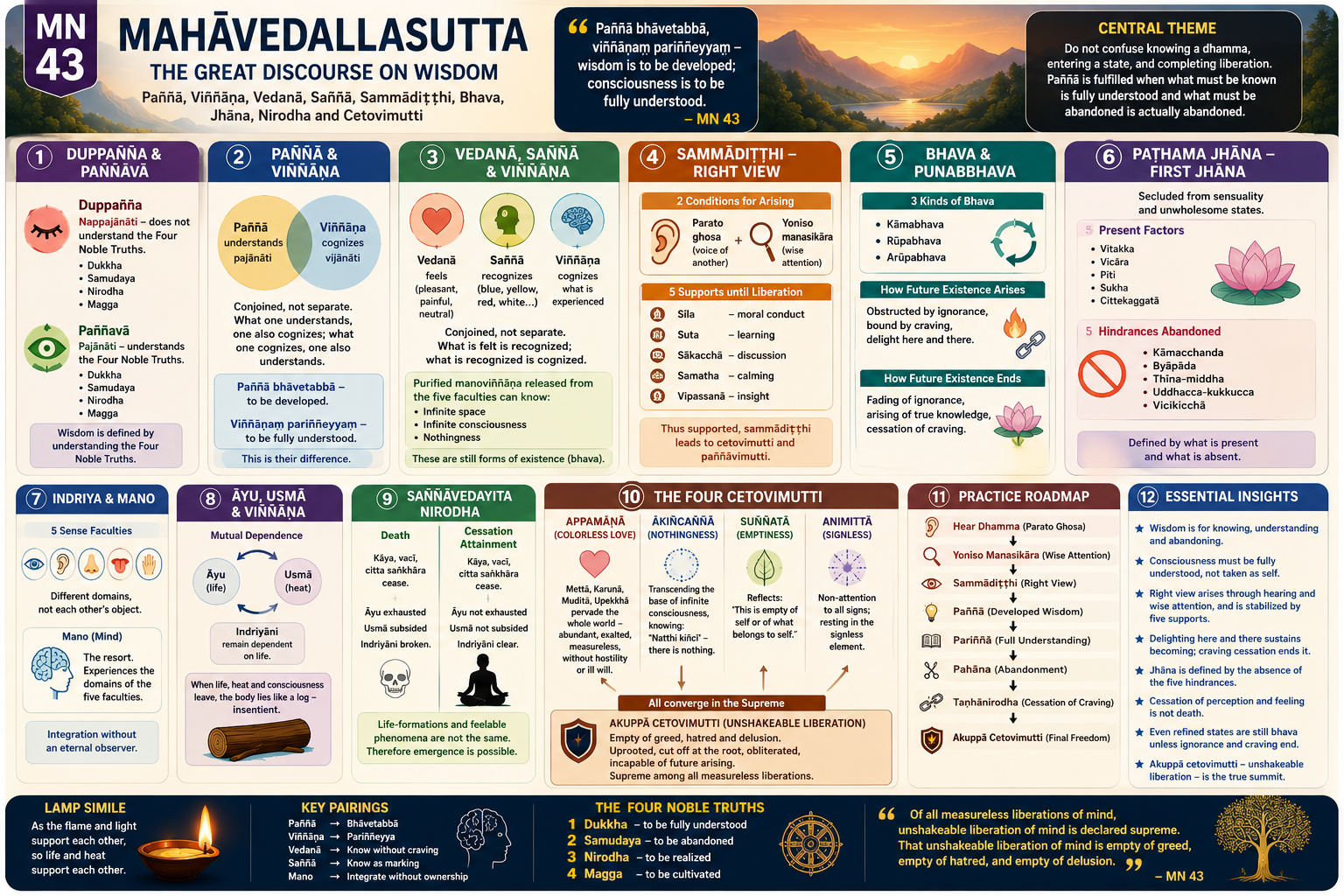
 VISUAL SUMMARYSee this sutta in a pictureOpen the complete infographic for a visual overview before or after reading the full study.View infographic →
Why MN 43 Requires Two Distinct Layers
Mahāvedallasutta is one of the most analytically rich discourses in the Majjhima Nikāya. Venerable Mahākoṭṭhita repeatedly questions Venerable Sāriputta about paññā, viññāṇa, vedanā, saññā, the sense faculties, sammādiṭṭhi, bhava, jhāna, life, heat, consciousness, saññāvedayitanirodha and several kinds of cetovimutti.
The discourse should therefore first be allowed to speak for itself. The entire Pāḷi and translation are presented before doctrinal commentary begins. Each Pāḷi passage is followed immediately by its English rendering, without inserting Deep Dive explanations between them.
Only after the complete translation is finished does the study return to the doctrinal units in substantial essay form. This separation is particularly important in MN 43 because the sutta repeatedly distinguishes dhammas not merely by definition, but by what the practitioner is supposed to do with them.
Paññā is to be developed. Viññāṇa is to be fully understood. Wisdom is for direct knowing, full understanding and abandonment. Right view is to be supported. Bhava is to be understood in terms of its arising and non-arising. Jhāna is diagnosed through both what is absent and what is present. Finally, rāga, dosa and moha are to be uprooted so completely that they become incapable of future arising.
011. Setting at Sāvatthī
Evaṁ me sutaṁ—ekaṁ samayaṁ bhagavā sāvatthiyaṁ viharati jetavane anāthapiṇḍikassa ārāme.
Thus have I heard. On one occasion the Blessed One was staying at Sāvatthī, in Jeta’s Grove, Anāthapiṇḍika’s monastery.
Atha kho āyasmā mahākoṭṭhiko sāyanhasamayaṁ paṭisallānā vuṭṭhito yenāyasmā sāriputto tenupasaṅkami; upasaṅkamitvā āyasmatā sāriputtena saddhiṁ sammodi. Sammodanīyaṁ kathaṁ sāraṇīyaṁ vītisāretvā ekamantaṁ nisīdi. Ekamantaṁ nisinno kho āyasmā mahākoṭṭhiko āyasmantaṁ sāriputtaṁ etadavoca:
Then, in the late afternoon, Venerable Mahākoṭṭhita emerged from seclusion and went to Venerable Sāriputta. On arrival, he exchanged greetings with Venerable Sāriputta. When their courteous and friendly conversation was finished, he sat down to one side. Seated to one side, Venerable Mahākoṭṭhita said to Venerable Sāriputta:
022. Who Is Called One Without Wisdom, and Who Is Paññavā?
“‘Duppañño duppañño’ti, āvuso, vuccati. Kittāvatā nu kho, āvuso, ‘duppañño’ti vuccatī”ti?
“Friend, one speaks of ‘a person without wisdom, a person without wisdom.’ In what respect is someone called ‘a person without wisdom’?”
“‘Nappajānāti nappajānātī’ti kho, āvuso, tasmā ‘duppañño’ti vuccati. Kiñca nappajānāti? ‘Idaṁ dukkhan’ti nappajānāti, ‘ayaṁ dukkhasamudayo’ti nappajānāti, ‘ayaṁ dukkhanirodho’ti nappajānāti, ‘ayaṁ dukkhanirodhagāminī paṭipadā’ti nappajānāti. ‘Nappajānāti nappajānātī’ti kho, āvuso, tasmā ‘duppañño’ti vuccatī”ti.
“Friend, it is because one does not understand—does not understand—that one is called a person without wisdom. And what does one not understand? One does not understand: ‘This is suffering.’ One does not understand: ‘This is the origin of suffering.’ One does not understand: ‘This is the cessation of suffering.’ One does not understand: ‘This is the way of practice leading to the cessation of suffering.’ Because one does not understand—does not understand—one is therefore called a person without wisdom.”
“‘Paññavā paññavā’ti, āvuso, vuccati. Kittāvatā nu kho, āvuso, ‘paññavā’ti vuccatī”ti?
“Friend, one speaks of ‘a person with wisdom, a person with wisdom.’ In what respect is someone called ‘a person with wisdom’?”
“‘Pajānāti pajānātī’ti kho, āvuso, tasmā ‘paññavā’ti vuccati. Kiñca pajānāti? ‘Idaṁ dukkhan’ti pajānāti, ‘ayaṁ dukkhasamudayo’ti pajānāti, ‘ayaṁ dukkhanirodho’ti pajānāti, ‘ayaṁ dukkhanirodhagāminī paṭipadā’ti pajānāti. ‘Pajānāti pajānātī’ti kho, āvuso, tasmā ‘paññavā’ti vuccatī”ti.
“Friend, it is because one understands—understands—that one is called a person with wisdom. And what does one understand? One understands: ‘This is suffering.’ One understands: ‘This is the origin of suffering.’ One understands: ‘This is the cessation of suffering.’ One understands: ‘This is the way of practice leading to the cessation of suffering.’ Because one understands—understands—one is therefore called a person with wisdom.”
033. Why It Is Called Viññāṇa
“‘Viññāṇaṁ viññāṇan’ti, āvuso, vuccati. Kittāvatā nu kho, āvuso, ‘viññāṇan’ti vuccatī”ti?
“Friend, one speaks of ‘consciousness, consciousness.’ In what respect is it called consciousness?”
“‘Vijānāti vijānātī’ti kho, āvuso, tasmā ‘viññāṇan’ti vuccati. Kiñca vijānāti? ‘Sukhan’tipi vijānāti, ‘dukkhan’tipi vijānāti, ‘adukkhamasukhan’tipi vijānāti. ‘Vijānāti vijānātī’ti kho, āvuso, tasmā ‘viññāṇan’ti vuccatī”ti.
“Friend, it is because it cognizes—cognizes—that it is called consciousness. And what does it cognize? It cognizes: ‘pleasant.’ It cognizes: ‘painful.’ It cognizes: ‘neither-painful-nor-pleasant.’ Because it cognizes—cognizes—it is therefore called consciousness.”
044. Paññā and Viññāṇa — Associated, but Their Tasks Differ
“Yā cāvuso, paññā yañca viññāṇaṁ—ime dhammā saṁsaṭṭhā udāhu visaṁsaṭṭhā? Labbhā ca panimesaṁ dhammānaṁ vinibbhujitvā vinibbhujitvā nānākaraṇaṁ paññāpetun”ti?
“Friend, wisdom and consciousness: are these dhammas associated or separate? And is it possible, by separating and distinguishing them one from another, to describe the difference between them?”
“Yā cāvuso, paññā yañca viññāṇaṁ—ime dhammā saṁsaṭṭhā, no visaṁsaṭṭhā. Na ca labbhā imesaṁ dhammānaṁ vinibbhujitvā vinibbhujitvā nānākaraṇaṁ paññāpetuṁ. Yañcāvuso, pajānāti taṁ vijānāti, yaṁ vijānāti taṁ pajānāti. Tasmā ime dhammā saṁsaṭṭhā, no visaṁsaṭṭhā. Na ca labbhā imesaṁ dhammānaṁ vinibbhujitvā vinibbhujitvā nānākaraṇaṁ paññāpetun”ti.
“Friend, wisdom and consciousness are associated, not separate. What one understands, that one cognizes; and what one cognizes, that one understands. Therefore these dhammas are associated, not separate.”
“Yā cāvuso, paññā yañca viññāṇaṁ—imesaṁ dhammānaṁ saṁsaṭṭhānaṁ no visaṁsaṭṭhānaṁ kiṁ nānākaraṇan”ti?
“Friend, if wisdom and consciousness are associated and not separate, what is the distinction between them?”
“Yā cāvuso, paññā yañca viññāṇaṁ—imesaṁ dhammānaṁ saṁsaṭṭhānaṁ no visaṁsaṭṭhānaṁ paññā bhāvetabbā, viññāṇaṁ pariññeyyaṁ. Idaṁ nesaṁ nānākaraṇan”ti.
“Friend, although wisdom and consciousness are associated and not separate, wisdom is to be developed, while consciousness is to be fully understood. This is the distinction between them.”
055. Vedanā — Why It Is Called Feeling
“‘Vedanā vedanā’ti, āvuso, vuccati. Kittāvatā nu kho, āvuso, ‘vedanā’ti vuccatī”ti?
“Friend, one speaks of ‘feeling, feeling.’ In what respect is it called feeling?”
“‘Vedeti vedetī’ti kho, āvuso, tasmā ‘vedanā’ti vuccati. Kiñca vedeti? Sukhampi vedeti, dukkhampi vedeti, adukkhamasukhampi vedeti. ‘Vedeti vedetī’ti kho, āvuso, tasmā ‘vedanā’ti vuccatī”ti.
“Friend, it is because one feels—feels—that it is called feeling. One feels pleasure, pain and what is neither painful nor pleasant. Because one feels—feels—it is therefore called feeling.”
066. Saññā — Why It Is Called Perception
“‘Saññā saññā’ti, āvuso, vuccati. Kittāvatā nu kho, āvuso, ‘saññā’ti vuccatī”ti?
“Friend, one speaks of ‘perception, perception.’ In what respect is it called perception?”
“‘Sañjānāti sañjānātī’ti kho, āvuso, tasmā ‘saññā’ti vuccati. Kiñca sañjānāti? Nīlakampi sañjānāti, pītakampi sañjānāti, lohitakampi sañjānāti, odātampi sañjānāti. ‘Sañjānāti sañjānātī’ti kho, āvuso, tasmā ‘saññā’ti vuccatī”ti.
“Friend, it is because one perceives—perceives—that it is called perception. One perceives blue, yellow, red and white. Because one perceives—perceives—it is therefore called perception.”
077. Vedanā, Saññā and Viññāṇa
“Yā cāvuso, vedanā yā ca saññā yañca viññāṇaṁ—ime dhammā saṁsaṭṭhā udāhu visaṁsaṭṭhā? Labbhā ca panimesaṁ dhammānaṁ vinibbhujitvā vinibbhujitvā nānākaraṇaṁ paññāpetun”ti?
“Friend, feeling, perception and consciousness: are these dhammas associated or separate? And is it possible, by separating and distinguishing them, to describe them independently?”
“Yā cāvuso, vedanā yā ca saññā yañca viññāṇaṁ—ime dhammā saṁsaṭṭhā, no visaṁsaṭṭhā. Na ca labbhā imesaṁ dhammānaṁ vinibbhujitvā vinibbhujitvā nānākaraṇaṁ paññāpetuṁ. Yañcāvuso, vedeti taṁ sañjānāti, yaṁ sañjānāti taṁ vijānāti. Tasmā ime dhammā saṁsaṭṭhā, no visaṁsaṭṭhā.”
“Friend, feeling, perception and consciousness are associated, not separate. What one feels, one perceives; what one perceives, one cognizes. Therefore these dhammas are associated, not separate.”
088. Purified Manoviññāṇa and the Arūpa Domains
“Pañcahi, āvuso, indriyehi nānāvisayehi nānāgocarehi na aññamaññassa gocaravisayaṁ paccanubhonti, seyyathidaṁ—cakkhundriyena sotindriyena ghānindriyena jivhindriyena kāyindriyena. Imesaṁ nu kho, āvuso, pañcannaṁ indriyānaṁ nānāvisayānaṁ nānāgocarānaṁ na aññamaññassa gocaravisayaṁ paccanubhontānaṁ kiṁ paṭisaraṇaṁ, ko ca nesaṁ gocaravisayaṁ paccanubhotī”ti?
“Friend, the five faculties have different domains and fields and do not experience one another’s domain—the eye, ear, nose, tongue and body faculties. What is their resort, and what experiences their respective domains?”
“Pañcannaṁ kho, āvuso, indriyānaṁ nānāvisayānaṁ nānāgocarānaṁ na aññamaññassa gocaravisayaṁ paccanubhontānaṁ—seyyathidaṁ, cakkhundriyassa sotindriyassa ghānindriyassa jivhindriyassa kāyindriyassa—mano paṭisaraṇaṁ, mano ca nesaṁ gocaravisayaṁ paccanubhotī”ti.
“Friend, mano is the resort of these five faculties with their different domains and fields, and mano experiences their respective domains.”
“Pañcahi, āvuso, indriyehi vippayuttena parisuddhena manoviññāṇena kiṁ neyyan”ti?
“Friend, what can be known by purified mind-consciousness separated from the five faculties?”
“Pañcahi kho, āvuso, indriyehi vippayuttena parisuddhena manoviññāṇena ‘ananto ākāso’ti ākāsānañcāyatanaṁ neyyaṁ, ‘anantaṁ viññāṇan’ti viññāṇañcāyatanaṁ neyyaṁ, ‘natthi kiñcī’ti ākiñcaññāyatanaṁ neyyan”ti.
“Friend, by purified mind-consciousness separated from the five faculties, the dimension of infinite space can be known as ‘space is infinite’; the dimension of infinite consciousness as ‘consciousness is infinite’; and the dimension of nothingness as ‘there is nothing.’”
“Neyyaṁ panāvuso, dhammaṁ kena pajānātī”ti?
“Friend, by what does one understand a dhamma that is knowable?”
“Neyyaṁ kho, āvuso, dhammaṁ paññācakkhunā pajānātī”ti.
“Friend, one understands a knowable dhamma with the eye of wisdom.”
“Paññā panāvuso, kimatthiyā”ti?
“Friend, what is the purpose of wisdom?”
“Paññā kho, āvuso, abhiññatthā pariññatthā pahānatthā”ti.
“Friend, wisdom is for direct knowing, for full understanding, and for abandonment.”
099. Conditions for the Arising and Maturation of Sammādiṭṭhi
“Kati panāvuso, paccayā sammādiṭṭhiyā uppādāyā”ti?
“Friend, how many conditions are there for the arising of right view?”
“Dve kho, āvuso, paccayā sammādiṭṭhiyā uppādāya—parato ca ghoso, yoniso ca manasikāro. Ime kho, āvuso, dve paccayā sammādiṭṭhiyā uppādāyā”ti.
“Friend, there are two conditions for the arising of right view: hearing the voice of another and wise attention.”
“Katihi panāvuso, aṅgehi anuggahitā sammādiṭṭhi cetovimuttiphalā ca hoti cetovimuttiphalānisaṁsā ca, paññāvimuttiphalā ca hoti paññāvimuttiphalānisaṁsā cā”ti?
“Friend, supported by how many factors does right view have liberation of mind as its fruit and benefit, and liberation by wisdom as its fruit and benefit?”
“Pañcahi kho, āvuso, aṅgehi anuggahitā sammādiṭṭhi cetovimuttiphalā ca hoti cetovimuttiphalānisaṁsā ca, paññāvimuttiphalā ca hoti paññāvimuttiphalānisaṁsā ca. Idhāvuso, sammādiṭṭhi sīlānuggahitā ca hoti, sutānuggahitā ca hoti, sākacchānuggahitā ca hoti, samathānuggahitā ca hoti, vipassanānuggahitā ca hoti.”
“Friend, right view supported by five factors has liberation of mind and liberation by wisdom as its fruit and benefit. Here right view is supported by ethical conduct, supported by learning, supported by discussion, supported by samatha, and supported by vipassanā.”
1010. Kāmabhava, Rūpabhava and Arūpabhava
“Kati panāvuso, bhavā”ti?
“Friend, how many kinds of becoming are there?”
“Tayome, āvuso, bhavā—kāmabhavo, rūpabhavo, arūpabhavo”ti.
“Friend, there are three kinds of becoming: sensual becoming, form becoming and formless becoming.”
“Kathaṁ panāvuso, āyatiṁ punabbhavābhinibbatti hotī”ti?
“Friend, how does renewed existence come to be in the future?”
“Avijjānīvaraṇānaṁ kho, āvuso, sattānaṁ taṇhāsaṁyojanānaṁ tatratatrābhinandanā āyatiṁ punabbhavābhinibbatti hotī”ti.
“Friend, for beings obstructed by ignorance and bound by craving, delighting here and there brings about renewed existence in the future.”
“Kathaṁ panāvuso, āyatiṁ punabbhavābhinibbatti na hotī”ti?
“Friend, how does renewed existence not come to be in the future?”
“Avijjāvirāgā kho, āvuso, vijjuppādā taṇhānirodhā evamāyatiṁ punabbhavābhinibbatti na hotī”ti.
“Friend, with the fading away of ignorance, with the arising of true knowledge, and with the cessation of craving, renewed existence does not come to be in the future.”
1111. First Jhāna — Five Abandoned and Five Present
“Katamaṁ panāvuso, paṭhamaṁ jhānan”ti?
“Friend, what is the first jhāna?”
“Idhāvuso, bhikkhu vivicceva kāmehi vivicca akusalehi dhammehi savitakkaṁ savicāraṁ vivekajaṁ pītisukhaṁ paṭhamaṁ jhānaṁ upasampajja viharati. Idaṁ vuccati, āvuso, paṭhamaṁ jhānan”ti.
“Here, friend, a bhikkhu, secluded from sensual pleasures and secluded from unwholesome dhammas, enters and dwells in the first jhāna, which has vitakka and vicāra, with pīti and sukha born of seclusion.”
“Paṭhame panāvuso, jhāne kati aṅgānī”ti?
“Friend, how many factors are there in first jhāna?”
“Paṭhame kho, āvuso, jhāne pañcaṅgāni. Idhāvuso, paṭhamaṁ jhānaṁ samāpannassa bhikkhuno vitakko ca vattati, vicāro ca pīti ca sukhañca cittekaggatā ca.”
“Friend, there are five factors in first jhāna: vitakka, vicāra, pīti, sukha and unification of mind.”
“Paṭhamaṁ panāvuso, jhānaṁ kati aṅgāni pahāya kati aṅgāni samannāgataṁ hotī”ti?
“Friend, when one enters first jhāna, how many factors have been abandoned and how many are present?”
“Paṭhamaṁ kho, āvuso, jhānaṁ pañcaṅgāni pahāya pañcaṅgasamannāgataṁ hoti. Idhāvuso, paṭhamaṁ jhānaṁ samāpannassa bhikkhuno kāmacchando pahīno hoti, byāpādo pahīno hoti, thinamiddhaṁ pahīnaṁ hoti, uddhaccakukkuccaṁ pahīnaṁ hoti, vicikicchā pahīnā hoti; vitakko ca vattati, vicāro ca pīti ca sukhañca cittekaggatā ca.”
“Friend, first jhāna is entered having abandoned five factors and possessing five factors. Sensual desire, ill will, dullness and drowsiness, restlessness and remorse, and doubt are abandoned. Vitakka, vicāra, pīti, sukha and unification of mind are present.”
1212. The Five Faculties and Mano
“Imāni panāvuso, pañcindriyāni nānāvisayāni nānāgocarāni na aññamaññassa gocaravisayaṁ paccanubhonti, seyyathidaṁ—cakkhundriyaṁ, sotindriyaṁ, ghānindriyaṁ, jivhindriyaṁ, kāyindriyaṁ. Imesaṁ nu kho, āvuso, pañcannaṁ indriyānaṁ nānāvisayānaṁ nānāgocarānaṁ na aññamaññassa gocaravisayaṁ paccanubhontānaṁ kiṁ paṭisaraṇan”ti?
“Friend, these five faculties have different domains and different fields and do not experience one another’s field. What is their resort?”
“Imesaṁ kho, āvuso, pañcannaṁ indriyānaṁ nānāvisayānaṁ nānāgocarānaṁ na aññamaññassa gocaravisayaṁ paccanubhontānaṁ mano paṭisaraṇan”ti.
“Friend, mano is the resort of these five faculties with their different domains and fields.”
1313. Āyu and Usmā — Mutual Conditionality
“Imāni panāvuso, pañcindriyāni kiṁ paṭicca tiṭṭhantī”ti?
“Friend, dependent upon what do these five faculties persist?”
“Imāni kho, āvuso, pañcindriyāni āyuṁ paṭicca tiṭṭhantī”ti.
“Friend, these five faculties persist dependent upon life.”
“Āyu panāvuso, kiṁ paṭicca tiṭṭhatī”ti?
“Friend, dependent upon what does life persist?”
“Āyu usmaṁ paṭicca tiṭṭhatī”ti.
“Life persists dependent upon heat.”
“Usmā panāvuso, kiṁ paṭicca tiṭṭhatī”ti?
“Friend, dependent upon what does heat persist?”
“Usmā āyuṁ paṭicca tiṭṭhatī”ti.
“Heat persists dependent upon life.”
“Idāneva kho mayaṁ āyasmato sāriputtassa bhāsitaṁ evaṁ ājānāma: ‘āyu usmaṁ paṭicca tiṭṭhatī’ti; idāneva pana mayaṁ āyasmato sāriputtassa bhāsitaṁ evaṁ ājānāma: ‘usmā āyuṁ paṭicca tiṭṭhatī’ti. Yathā kathaṁ panāvuso, imassa bhāsitassa attho daṭṭhabbo”ti?
“Just now we understood Venerable Sāriputta to say, ‘Life persists dependent upon heat’; and now, ‘Heat persists dependent upon life.’ How should this be understood?”
1414. The Oil-Lamp Simile
“Tenahāvuso, upamaṁ te karissāmi. Upamāyapidhekacce viññū purisā bhāsitassa atthaṁ ājānanti. Seyyathāpi, āvuso, telappadīpassa jhāyato yā acci taṁ paṭicca ābhā paññāyati, yaṁ ābhaṁ paṭicca acci paññāyati. Evameva kho, āvuso, āyu usmaṁ paṭicca tiṭṭhati, usmā āyuṁ paṭicca tiṭṭhatī”ti.
“Then, friend, I shall give you a simile. Suppose an oil lamp is burning. Dependent upon its flame, its light is apparent; and dependent upon its light, its flame is apparent. In the same way, life persists dependent upon heat, and heat persists dependent upon life.”
1515. Life-Formations and Things That Are Felt
“Āyusaṅkhārā nu kho, āvuso, vedaniyā dhammā, udāhu aññe āyusaṅkhārā aññe vedaniyā dhammā”ti?
“Friend, are life-formations things that are felt, or are life-formations one thing and things that are felt another?”
“Na kho, āvuso, āyusaṅkhārā vedaniyā dhammā. Āyusaṅkhārā ce, āvuso, vedaniyā dhammā abhavissaṁsu, na yidaṁ saññāvedayitanirodhaṁ samāpannassa bhikkhuno vuṭṭhānaṁ paññāyetha. Yasmā ca kho, āvuso, aññe āyusaṅkhārā aññe vedaniyā dhammā, tasmā saññāvedayitanirodhaṁ samāpannassa bhikkhuno vuṭṭhānaṁ paññāyatī”ti.
“No, friend, life-formations are not things that are felt. If life-formations themselves were things that are felt, there could be no discernible emergence for a bhikkhu who had entered the cessation of perception and feeling. But because life-formations are one thing and things that are felt another, emergence is possible.”
1616. When the Body Lies Like Insentient Wood
“Kati panāvuso, dhammā imaṁ kāyaṁ jahanti, athāyaṁ kāyo ujjhito avakkhitto seti yathā kaṭṭhaṁ acetanā”ti?
“Friend, when how many dhammas have left this body does it lie abandoned and cast aside like a senseless piece of wood?”
“Tayo kho, āvuso, dhammā imaṁ kāyaṁ jahanti—āyu, usmā ca viññāṇaṁ. Atha kho ayaṁ kāyo ujjhito avakkhitto seti yathā kaṭṭhaṁ acetanā”ti.
“Friend, when three dhammas have left this body—life, heat and consciousness—then this body lies abandoned and cast aside like a senseless piece of wood.”
1717. Saññāvedayitanirodha and Death
“Yo cāyaṁ, āvuso, mato kālaṅkato, yo cāyaṁ bhikkhu saññāvedayitanirodhaṁ samāpanno, imesaṁ ko viseso ko adhippayāso kiṁ nānākaraṇan”ti?
“Friend, between one who is dead and a bhikkhu who has entered the cessation of perception and feeling, what is the distinction?”
“Yo cāyaṁ, āvuso, mato kālaṅkato tassa kāyasaṅkhārā niruddhā paṭippassaddhā, vacīsaṅkhārā niruddhā paṭippassaddhā, cittasaṅkhārā niruddhā paṭippassaddhā, āyu parikkhīṇo, usmā vūpasantā, indriyāni paribhinnāni. Yo cāyaṁ bhikkhu saññāvedayitanirodhaṁ samāpanno tassapi kāyasaṅkhārā niruddhā paṭippassaddhā, vacīsaṅkhārā niruddhā paṭippassaddhā, cittasaṅkhārā niruddhā paṭippassaddhā, āyu aparikkhīṇo, usmā avūpasantā, indriyāni vippasannāni.”
“Friend, in the case of one who is dead, the bodily, verbal and mental formations have ceased and subsided; life is exhausted, heat has subsided, and the faculties have broken down.
In the case of a bhikkhu who has entered the cessation of perception and feeling, those formations have also ceased and subsided; but life is not exhausted, heat has not subsided, and the faculties remain exceptionally clear.
This is the difference.”
1818. Adukkhamasukhā Cetovimutti and Fourth Jhāna
“Kati panāvuso, paccayā adukkhamasukhāya cetovimuttiyā samāpattiyā”ti?
“Friend, how many conditions are there for entering the liberation of mind that is neither painful nor pleasant?”
“Cattāro kho, āvuso, paccayā adukkhamasukhāya cetovimuttiyā samāpattiyā. Idhāvuso, bhikkhu sukhassa ca pahānā dukkhassa ca pahānā pubbeva somanassadomanassānaṁ atthaṅgamā adukkhamasukhaṁ upekkhāsatipārisuddhiṁ catutthaṁ jhānaṁ upasampajja viharati.”
“Friend, there are four conditions. With the abandoning of pleasure and pain, and with the previous disappearance of joy and sadness, a bhikkhu enters and dwells in the fourth jhāna, which is neither painful nor pleasant and has purification of mindfulness through equanimity.”
1919. Entering Animittā Cetovimutti
“Kati panāvuso, paccayā animittāya cetovimuttiyā samāpattiyā”ti?
“Friend, how many conditions are there for entering the signless liberation of mind?”
“Dve kho, āvuso, paccayā animittāya cetovimuttiyā samāpattiyā—sabbhānimittānañca amanasikāro, animittāya ca dhātuyā manasikāro.”
“Friend, there are two conditions: not attending to any signs and attending to the signless element.”
2020. Maintaining Animittā Cetovimutti
“Kati panāvuso, paccayā animittāya cetovimuttiyā ṭhitiyā”ti?
“Friend, how many conditions are there for maintaining the signless liberation of mind?”
“Tayo kho, āvuso, paccayā animittāya cetovimuttiyā ṭhitiyā—sabbhānimittānañca amanasikāro, animittāya ca dhātuyā manasikāro, pubbe ca abhisaṅkhāro.”
“Friend, there are three conditions: not attending to any signs, attending to the signless element, and the prior determination.”
2121. Emerging from Animittā Cetovimutti
“Kati panāvuso, paccayā animittāya cetovimuttiyā vuṭṭhānāyā”ti?
“Friend, how many conditions are there for emerging from the signless liberation of mind?”
“Dve kho, āvuso, paccayā animittāya cetovimuttiyā vuṭṭhānāya—sabbhānimittānañca manasikāro, animittāya ca dhātuyā amanasikāro.”
“Friend, there are two conditions: attending to signs and no longer attending to the signless element.”
2222. Four Liberations of Mind
“‘Appamāṇā cetovimutti, ākiñcaññā cetovimutti, suññatā cetovimutti, animittā cetovimuttī’ti, āvuso, vuccati. Ime dhammā nānatthā ceva nānābyañjanā ca, udāhu ekatthā byañjanameva nānan”ti?
“Friend, one speaks of immeasurable liberation of mind, liberation through nothingness, liberation through emptiness, and signless liberation of mind. Are these different both in meaning and expression, or one in meaning and different only in expression?”
“Atthi kho, āvuso, pariyāyo yaṁ pariyāyaṁ āgamma ime dhammā nānatthā ceva nānābyañjanā ca. Atthi pana, āvuso, pariyāyo yaṁ pariyāyaṁ āgamma ime dhammā ekatthā byañjanameva nānan”ti.
“Friend, there is a way in which these dhammas are different both in meaning and expression, and there is also a way in which they are one in meaning while differing only in expression.”
2323. Appamāṇā Cetovimutti
Idhāvuso, bhikkhu mettāsahagatena cetasā ekaṁ disaṁ pharitvā viharati, tathā dutiyaṁ, tathā tatiyaṁ, tathā catutthaṁ; iti uddhamadho tiriyaṁ sabbadhi sabbattatāya sabbāvantaṁ lokaṁ mettāsahagatena cetasā vipulena mahaggatena appamāṇena averena abyāpajjena pharitvā viharati.
Here a bhikkhu dwells pervading one direction with a mind accompanied by loving-kindness; likewise the second, third and fourth. Thus above, below, across, everywhere and in every respect, he pervades the entire world with loving-kindness—abundant, exalted, immeasurable, free from hostility and free from ill will.
Karuṇāsahagatena cetasā ekaṁ disaṁ pharitvā viharati, tathā dutiyaṁ, tathā tatiyaṁ, tathā catutthaṁ; iti uddhamadho tiriyaṁ sabbadhi sabbattatāya sabbāvantaṁ lokaṁ karuṇāsahagatena cetasā vipulena mahaggatena appamāṇena averena abyāpajjena pharitvā viharati.
He dwells pervading the entire world with compassion—abundant, exalted, immeasurable, free from hostility and free from ill will.
Muditāsahagatena cetasā ekaṁ disaṁ pharitvā viharati, tathā dutiyaṁ, tathā tatiyaṁ, tathā catutthaṁ; iti uddhamadho tiriyaṁ sabbadhi sabbattatāya sabbāvantaṁ lokaṁ muditāsahagatena cetasā vipulena mahaggatena appamāṇena averena abyāpajjena pharitvā viharati.
He dwells pervading the entire world with appreciative joy—abundant, exalted, immeasurable, free from hostility and free from ill will.
Upekkhāsahagatena cetasā ekaṁ disaṁ pharitvā viharati, tathā dutiyaṁ, tathā tatiyaṁ, tathā catutthaṁ; iti uddhamadho tiriyaṁ sabbadhi sabbattatāya sabbāvantaṁ lokaṁ upekkhāsahagatena cetasā vipulena mahaggatena appamāṇena averena abyāpajjena pharitvā viharati. Ayaṁ vuccatāvuso, appamāṇā cetovimutti.
He dwells pervading the entire world with equanimity—abundant, exalted, immeasurable, free from hostility and free from ill will. This is called immeasurable liberation of mind.
2424. Ākiñcaññā Cetovimutti
“Katamā cāvuso, ākiñcaññā cetovimutti? Idhāvuso, bhikkhu sabbaso viññāṇañcāyatanaṁ samatikkamma ‘natthi kiñcī’ti ākiñcaññāyatanaṁ upasampajja viharati. Ayaṁ vuccatāvuso, ākiñcaññā cetovimutti.”
“And what is liberation of mind through nothingness? A bhikkhu, completely transcending the dimension of infinite consciousness, enters and dwells in the dimension of nothingness, attending to ‘there is nothing.’ This is called liberation of mind through nothingness.”
2525. Suññatā Cetovimutti
“Katamā cāvuso, suññatā cetovimutti? Idhāvuso, bhikkhu araññagato vā rukkhamūlagato vā suññāgāragato vā iti paṭisañcikkhati: ‘suññamidaṁ attena vā attaniyena vā’ti. Ayaṁ vuccatāvuso, suññatā cetovimutti.”
“And what is liberation of mind through emptiness? A bhikkhu reflects: ‘This is empty of a self or of anything belonging to a self.’ This is called liberation of mind through emptiness.”
2626. Animittā Cetovimutti
“Katamā cāvuso, animittā cetovimutti? Idhāvuso, bhikkhu sabbanimittānaṁ amanasikārā animittaṁ cetosamādhiṁ upasampajja viharati. Ayaṁ vuccatāvuso, animittā cetovimutti.”
“And what is signless liberation of mind? A bhikkhu, by not attending to any signs, enters and dwells in signless collectedness of mind. This is called signless liberation of mind.”
2727. Their Convergence and Akuppā Cetovimutti
Rāgo kho, āvuso, pamāṇakaraṇo, doso pamāṇakaraṇo, moho pamāṇakaraṇo. Khīṇāsavassa bhikkhuno ete pahīnā ucchinnamūlā tālāvatthukatā anabhāvaṅkatā āyatiṁ anuppādadhammā.
Greed imposes limitation, hatred imposes limitation, and delusion imposes limitation. In a bhikkhu whose influxes are destroyed, these have been abandoned, cut off at the root, made like a palm-tree stump, obliterated, incapable of arising again in the future.
Yāvatā kho, āvuso, appamāṇā cetovimuttiyo, akuppā tāsaṁ cetovimutti aggamakkhāyati. Sā kho pana akuppā cetovimutti suññā rāgena, suññā dosena, suññā mohena.
Of all immeasurable liberations of mind, the unshakeable liberation of mind is declared supreme. It is empty of greed, hatred and delusion.
Rāgo kho, āvuso, kiñcano, doso kiñcano, moho kiñcano.
Greed is a something, hatred is a something, and delusion is a something.
Yāvatā kho, āvuso, ākiñcaññā cetovimuttiyo, akuppā tāsaṁ cetovimutti aggamakkhāyati.
Of all liberations through nothingness, the unshakeable liberation of mind is declared supreme.
Rāgo kho, āvuso, nimittakaraṇo, doso nimittakaraṇo, moho nimittakaraṇo.
Greed is a maker of signs, hatred is a maker of signs, and delusion is a maker of signs.
Yāvatā kho, āvuso, animittā cetovimuttiyo, akuppā tāsaṁ cetovimutti aggamakkhāyati.
Of all signless liberations of mind, the unshakeable liberation of mind is declared supreme.
Sā kho pana akuppā cetovimutti suññā rāgena, suññā dosena, suññā mohena.
That unshakeable liberation of mind is empty of greed, empty of hatred and empty of delusion.
2828. Conclusion
Idamavocāyasmā sāriputto. Attamano āyasmā mahākoṭṭhiko āyasmato sāriputtassa bhāsitaṁ abhinandīti.
This is what Venerable Sāriputta said. Satisfied, Venerable Mahākoṭṭhita delighted in Venerable Sāriputta’s words.
2929. Paññā and the Four Noble Truths — Wisdom Is Soteriological
MN 43 establishes its standard of wisdom immediately. Sāriputta does not define a wise person through memory, scholarship, philosophical sophistication or the ability to discuss subtle doctrine. The paññavā is one who understands dukkha, its origin, its cessation and the path leading to cessation.
This makes paññā fundamentally soteriological. Its value is determined by whether it participates in the ending of suffering and the ending of the conditions that sustain renewed existence.
A practitioner may be able to explain dependent arising, describe jhāna, distinguish vedanā from saññā, quote Pāḷi and discuss many schools of Buddhist interpretation. None of that, by itself, satisfies this definition.
The decisive question is not merely, “Do I know the Four Noble Truths as teachings?” It is, “Have they become directly understood in the manner that changes how craving, clinging and becoming operate?”
Dukkha must be understood. Samudaya must be recognized in the operation of craving. Nirodha must become more than a doctrinal possibility. Magga must become a lived training rather than a remembered list.
MN 43 therefore begins with a principle that governs the entire discourse: Dhamma knowledge has a task.
3030. Paññā vs Viññāṇa — Develop One, Fully Understand the Other
The statement paññā bhāvetabbā, viññāṇaṁ pariññeyyaṁ is one of the keys to the entire discourse.
Paññā is to be developed. Viññāṇa is to be fully understood.
The distinction becomes especially important in deep meditation because consciousness can become extraordinarily refined. Ordinary sensory disturbance may disappear. Consciousness may become spacious, luminous, unified or apparently boundless. The practitioner may reach the dimension of infinite consciousness itself.
At that point, an error can arise: the refinement of consciousness may be interpreted as the discovery of an ultimate consciousness, permanent witness, eternal knower or metaphysical Self.
MN 43 blocks that move. Viññāṇa remains pariññeyyaṁ. It is to be fully understood rather than appropriated.
Paññā, on the other hand, is bhāvetabbā. It must be cultivated because it performs the work of correctly understanding conditioned experience.
Do not ask only: “How refined has consciousness become?”
Ask instead: “Has viññāṇa been fully understood without identification?”
3131. Vedanā, Saññā and Viññāṇa — No Permanent Observer Is Required
Vedanā feels. Saññā recognizes. Viññāṇa cognizes. MN 43 explains that these are associated within experience.
What the sutta does not introduce is equally important. It does not add a fourth permanent entity standing behind these functions. There is no hidden observer who “has” feeling, “uses” perception and “watches” consciousness.
Suppose someone speaks harshly. Sound is cognized. Meaning is recognized. Unpleasant vedanā arises. Memory and perception give the words significance. Thoughts may immediately follow: “He insulted me,” “I dislike him,” “I should respond.”
The sense of a personal drama can arise very quickly, yet the directly observable processes are hearing, recognition, feeling, cognition and proliferation.
The practitioner therefore learns to see vedeti — sañjānāti — vijānāti as conditioned functioning rather than as evidence for a permanent experiencer behind experience.
3232. Purified Manoviññāṇa and the Arūpa Attainments
MN 43 explicitly states that purified manoviññāṇa separated from ordinary engagement through the five sensory faculties can know infinite space, infinite consciousness and nothingness.
These are profound attainments, but the sutta later classifies arūpabhava as a form of bhava. That is decisive.
A state can be immensely refined and still belong to becoming. A practitioner can move beyond kāma and beyond rūpa without thereby bringing bhava itself to an end.
This is why infinite consciousness should not automatically be treated as the ultimate. Viññāṇañcāyatana is an attainment. It can be entered. It can be transcended. It therefore remains within the field that must be understood.
The decisive question is not merely whether consciousness has become vast or formless, but whether ignorance and craving can still establish delight, identity and continuation upon it.
3333. Abhiññā → Pariññā → Pahāna — A Diagnostic of Mature Wisdom
Sāriputta says wisdom is for abhiññā, pariññā and pahāna.
Abhiññā means that something is directly known rather than merely believed.
Pariññā means that what has been directly encountered becomes fully understood—its conditions, limits and actual nature are no longer misunderstood.
Pahāna means that where abandonment is required, understanding must finally perform that function.
This is a powerful protection against equating insight with unusual experience. One may see craving arise. One may observe thought cease. One may experience deep jhāna. But the further question remains: what did this knowledge cause to be abandoned?
If the relevant attachment remains intact, the work of paññā has not yet matured to its intended result.
3434. Parato Ghosa + Yoniso Manasikāra — Teacher and Practitioner
Right view arises through two conditions: parato ghosa and yoniso manasikāra.
The first protects against having to rediscover the entire path without guidance. Correct Dhamma is heard from another.
The second protects against blind reliance on authority. The practitioner must investigate what is heard in relation to causes, conditions, arising, cessation and direct experience.
“My teacher said it” is insufficient. But “whatever I experience must be true because it is my experience” is equally unsafe.
The teaching points. Yoniso manasikāra investigates. Paññā penetrates.
3535. The Five Supports of Sammādiṭṭhi — One Integrated System
MN 43 gives five supports for right view: sīla, suta, sākacchā, samatha and vipassanā.
These are not five competing traditions. MN 43 presents them as mutually supporting parts of one liberation architecture.
Samatha without correct view is insufficient. Learning without bhāvanā is insufficient. Vipassanā divorced from ethical training is not the integrated system given here.
3636. Kāmabhava, Rūpabhava and Arūpabhava
MN 43 prevents us from reducing bhava to ordinary sensual existence. Becoming can operate through kāma, rūpa and arūpa.
A practitioner may leave coarse sensuality behind and enter rūpa-jhāna. One may then transcend rūpa and enter arūpa attainments. From the standpoint of ordinary life, this is extraordinary refinement.
But the central question remains: has bhava itself ended?
Freedom from one type of becoming does not automatically imply freedom from another. Arūpabhava remains bhava.
The transition from meditative refinement to liberation therefore requires more than height of attainment. It requires the ending of ignorance and craving.
3737. Tatratatrābhinandanā — Delighting Here and There
Tatratatrābhinandanā exposes a subtle bridge between present attachment and future renewed existence.
At a coarse level, delight may settle upon taste, touch, possessions, praise or sexual experience. But the mechanism can also operate upon refined meditative objects.
The mind can delight in stillness, pīti, sukha, equanimity, luminosity, infinite space, infinite consciousness, nothingness, insight, attainment or even the identity of being an accomplished practitioner.
The object changes. The mechanism may remain.
The question is not whether a meditative state is pleasant or profound. The question is whether the mind appropriates it: “mine,” “what I am,” “what I must preserve,” “where I want to remain.”
MN 43 therefore shows that the mechanism of future becoming is exercised in the present whenever ignorance and craving find something in which to delight.
3838. Avijjāvirāga → Vijjuppāda → Taṇhānirodha
The discourse gives the cessation sequence with remarkable precision:
The solution to becoming is therefore not simply entering a more refined state.
Ignorance must fade. Knowledge must arise. Craving must cease.
This returns us to the opening definition of paññā through the Four Noble Truths. Wisdom is liberating because it directly undermines the ignorance through which craving and becoming are sustained.
3939. First Jhāna — Diagnose Both Absence and Presence
MN 43 gives a particularly strong practical diagnostic of first jhāna because it identifies both what has been abandoned and what is present.
This means pīti alone is not a sufficient diagnosis. Pleasure alone is not sufficient. Stillness alone is not sufficient. One must examine the hindrance side equally carefully.
Do not ask only: “What factors arose?”
Also ask: “What hindrances were actually absent?”
This methodological principle later becomes even more important when the discourse reaches akuppā cetovimutti: temporary absence is not the same as irreversible eradication.
4040. The Five Faculties and Mano — Integration Without a Self
The sensory faculties have distinct domains. The eye does not hear. The ear does not smell. The tongue does not see. Yet experience is integrated.
MN 43 identifies mano as their resort. This need not be interpreted as an inner person sitting behind the senses and receiving reports from them.
There can be coordination without a metaphysical coordinator. There are faculties, their fields, mano, consciousness and conditioned cognition.
The assumption “there must therefore be an unchanging me behind all of this” is an additional interpretation, not something the sutta needs in order to explain experience.
4141. Āyu, Usmā and Viññāṇa — Conditional Life
The oil-lamp simile is given to explain mutual conditionality rather than hidden substance.
Flame and illumination are distinguishable but occur dependently while the lamp burns. Likewise, āyu and usmā are described through mutual dependence.
Later, āyu, usmā and viññāṇa together become central to the distinction between a living body and a corpse.
The discourse therefore explains life functionally and conditionally, without introducing an eternal life-principle or immortal consciousness.
4242. Saññāvedayitanirodha vs Death
This is one of the most important comparisons in the entire sutta.
In both death and saññāvedayitanirodha, bodily, verbal and mental formations are described as ceased and subsided. If one looked only at that similarity, cessation attainment might be mistaken for biological death.
Sāriputta gives the exact distinction.
Saññāvedayitanirodha is therefore not temporary death. The life process has not been exhausted, heat has not subsided, and the faculties have not broken down.
At the same time, the passage does not require an eternal hidden consciousness or Self to explain why the practitioner remains alive. The sutta itself states the relevant difference in terms of āyu, usmā and indriyāni.
This is precisely why the earlier distinction between āyusaṅkhārā and vedaniyā dhammā matters. If life-formations were identical with things that are felt, cessation of perception and feeling would necessarily mean the end of life and emergence could not occur.
4343. Fourth Jhāna and Adukkhamasukhā Cetovimutti
Fourth jhāna is associated with the abandoning of pleasure and pain and the previous disappearance of joy and sadness.
The resulting adukkhamasukha should not be mistaken for numbness or emotional deadness. The defining quality is upekkhāsatipārisuddhi—purification of mindfulness through equanimity.
The mind is no longer dependent upon pīti or sukha in order to remain stable.
Yet fourth jhāna remains an attainment. Its refinement is not itself the same as irreversible liberation.
4444. Animittā Cetovimutti — Entry, Maintenance and Emergence
MN 43 gives three separate diagnostics for animittā cetovimutti.
This tells us that even an extraordinarily refined signless attainment has conditions for entering, remaining and emerging.
Its profundity therefore does not convert it into an eternal unconditioned state.
4545. Appamāṇā, Ākiñcaññā, Suññatā and Animittā — Distinct Yet Converging
Sāriputta does not collapse these liberations into one meditation technique.
Appamāṇā is approached through immeasurable mettā, karuṇā, muditā and upekkhā.
Ākiñcaññā concerns nothingness.
Suññatā concerns emptiness of self and what belongs to self.
Animittā concerns non-attention to signs.
They are therefore distinct in one sense.
But when the discourse turns to what limits, what makes “something,” and what makes signs, it repeatedly identifies rāga, dosa and moha.
The deeper convergence is not that the meditative procedures are identical. It is that liberation reaches its decisive culmination in the destruction of the defilements that distort all of them.
4646. Akuppā Cetovimutti — What Can Never Arise Again?
The final criterion in MN 43 is not simply the profundity of an experience.
Rāga, dosa and moha are described as:
pahīnā — abandoned
ucchinnamūlā — cut off at the root
tālāvatthukatā — made like a palm-tree stump
anabhāvaṅkatā — obliterated
āyatiṁ anuppādadhammā — incapable of arising again in the future
This shifts the criterion from phenomenology to irreversibility.
Kāmacchanda may be absent during jhāna. Thought may cease. Perception may become extraordinarily subtle. Perception and feeling may even cease in saññāvedayitanirodha.
But temporary absence is not the same as destruction at the root.
Akuppā cetovimutti therefore represents a fundamentally different standard: the causes of bondage are no longer merely suppressed by conditions. They are incapable of returning.
4747. The Unifying Thesis of Mahāvedallasutta
MN 43 can initially look like a long collection of doctrinal definitions. But beneath the many questions is one consistent architecture: every dhamma has a task appropriate to it.
The governing question for this entire sutta is therefore:
For this dhamma, what does the Buddha’s teaching require us to do?
Is it to be developed? Fully understood? Directly known? Abandoned? Supported? Transcended? Or brought to such complete cessation that it can never arise again?
Once this question becomes central, Mahāvedallasutta stops looking like a collection of unrelated technical answers and becomes a practical map of liberation.
The final measure is therefore not how extraordinary consciousness becomes, how subtle perception becomes, how long an attainment lasts, or how impressive a meditation experience appears.
The final measure is whether the roots that could generate bondage again have been destroyed.