 VISUAL SUMMARYSee this sutta in a pictureOpen the complete infographic for a visual overview before or after reading the full study.View infographic →
Āsevito — repeatedly resorted to→
Bhāvito — developed→
Bahulīkato — made much of→
Lower Births→
Lightest Human Result
The discourse does not present misconduct merely as a list of rules that one is expected to obey because somebody has commanded it. It asks us to look at conduct as cultivation. Every time a bodily or verbal pattern is repeated, one is strengthening a way of acting, speaking and responding. The crucial words are therefore āsevito, bhāvito, bahulīkato: resorted to, developed and made much of.
This is particularly important for someone preparing for serious Dhamma practice. We often think that meditation begins when we close our eyes. AN 8.40 asks us to look much earlier. What has the citta been practising all day? Has it been practising harmlessness or violence? Honesty or taking what is not given? Loyalty or misconduct? Truth or deception? Harmony or division? Gentleness or aggression? Meaningful speech or heedless chatter? Clarity or intoxication?
The sutta then gives the same three serious destinations for all eight forms of misconduct: niraya, tiracchānayoni and pettivisaya—hell, animal birth and the realm of petas. It then names a distinctive sabbalahuso vipāko, the lightest or slightest result, when one becomes human again.
Important reading note: The canonical statements below are the Pāli paragraphs and their close English translation. The everyday examples and present-life reflections are teaching illustrations added to make the principle easier to see. They should not be mistaken for additional canonical lists of vipāka.
00
How to Read the Repeated Formula
Āsevito points to something one resorts to, associates with, practises or repeatedly engages in. It is not merely an abstract possibility. The conduct is being used.
Bhāvito is especially important. It means developed or cultivated. The same word-family is used throughout the Dhamma for the deliberate development of qualities. Here the warning is sobering: unwholesome behaviour can also be developed. One can become trained in anger, trained in deception, trained in divisiveness and trained in heedlessness.
Bahulīkato means made much of, practised frequently, multiplied or cultivated repeatedly. What initially appears occasional can become familiar, easy and habitual.
Saṁvattaniko means tending toward, conducive to, leading to, or resulting in. The sutta repeatedly says that cultivated misconduct is nirayasaṁvattaniko, tiracchānayonisaṁvattaniko, pettivisayasaṁvattaniko—conducive to hell, animal birth and the preta realm.
Sabbalahuso vipāko is then the lightest or slightest result named by the discourse. The point is striking: even after setting aside the more severe destinations, the Buddha still asks us to understand that misconduct is not barren of consequence.
Practical question: “What am I repeatedly training myself to become through the actions I keep repeating?”
01
Pāṇātipāto — Killing Living Beings
Pāli
Pāṇātipāto, bhikkhave, āsevito bhāvito bahulīkato nirayasaṁvattaniko tiracchānayonisaṁvattaniko pettivisayasaṁvattaniko. Yo sabbalahuso pāṇātipātassa vipāko, manussabhūtassa appāyukasaṁvattaniko hoti.
Translation: “Bhikkhus, the killing of living beings, when repeatedly resorted to, developed and made much of, is conducive to hell, conducive to animal birth and conducive to the realm of petas. The lightest result of killing living beings, when one has become human, is that it is conducive to a short life.”
The first point is not merely that killing is “forbidden.” The Buddha describes what happens when the destruction of life becomes something one resorts to, develops and does repeatedly. A person can gradually train the citta to treat another being’s life as disposable whenever that life becomes inconvenient.
Consider an everyday situation. A mosquito enters a room. Before anything else is considered, the hand immediately moves to kill it. An insect appears in the garden and the first response is destruction. An animal becomes troublesome and the convenient solution is to injure or poison it. The important teaching question is not whether all such situations carry identical weight. The important question is: what response is being rehearsed? If destruction becomes the automatic response to inconvenience, then pāṇātipāta is not merely an isolated event; a disposition is being strengthened.
The sutta then points beyond the present life. When this conduct is cultivated and made much of, it tends toward niraya, tiracchānayoni and pettivisaya. Even if human birth occurs, the discourse names appāyuka—short life—as the lightest human result.
For practice, turn the situation around. Each occasion on which one can refrain from killing becomes an opportunity to cultivate a different direction: restraint, protection of life, patience and harmlessness. In this way sīla is not passive. One is actively changing what the citta becomes accustomed to doing.
Developed→
Made much of→
Lower destinations→
If human: short life

02
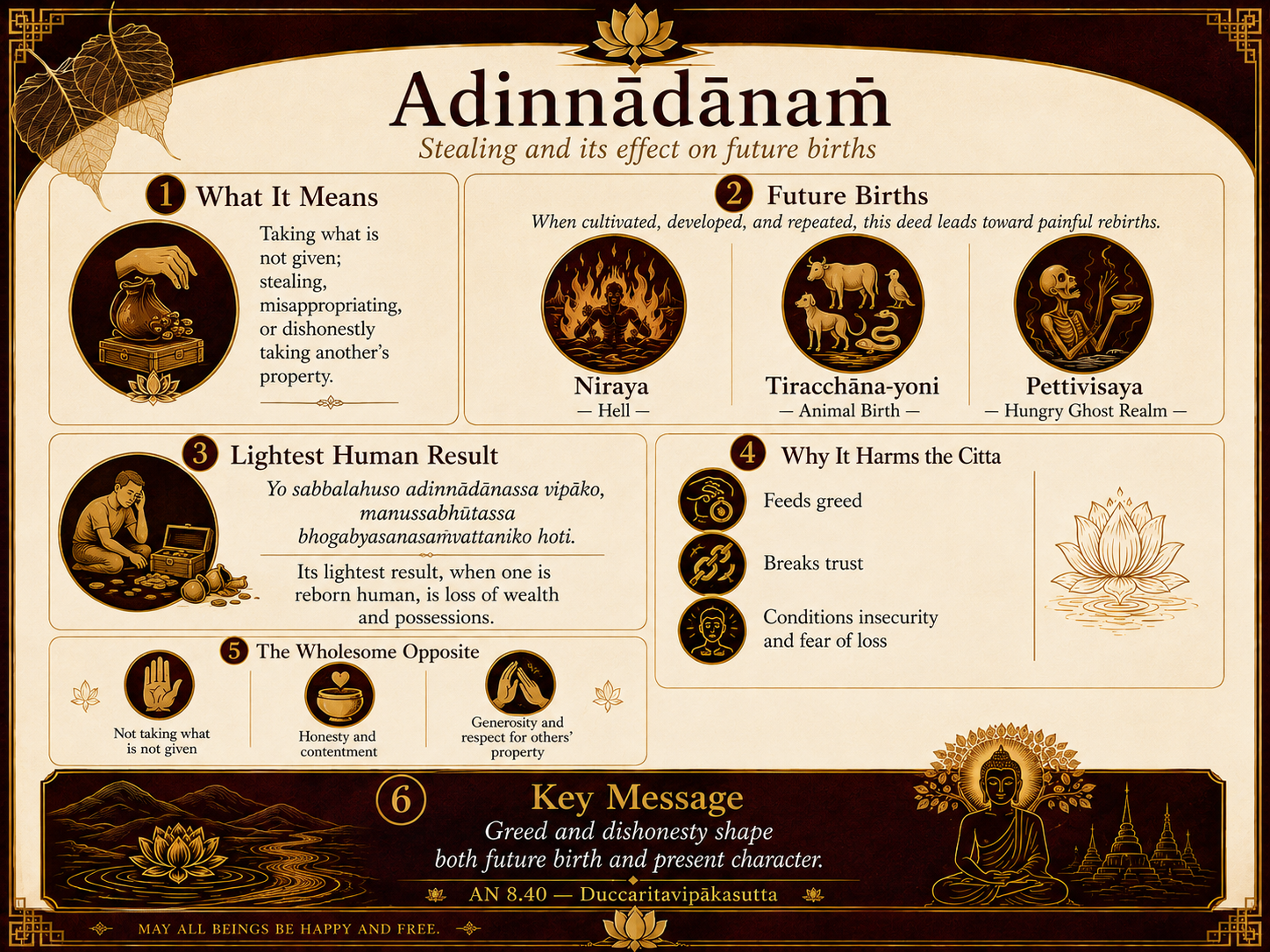
Adinnādānaṁ — Taking What Is Not Given
Pāli
Adinnādānaṁ, bhikkhave, āsevitaṁ bhāvitaṁ bahulīkataṁ nirayasaṁvattanikaṁ tiracchānayonisaṁvattanikaṁ pettivisayasaṁvattanikaṁ. Yo sabbalahuso adinnādānassa vipāko, manussabhūtassa bhogabyasanasaṁvattaniko hoti.
Translation: “Bhikkhus, taking what is not given, when repeatedly resorted to, developed and made much of, is conducive to hell, conducive to animal birth and conducive to the realm of petas. The lightest result of taking what is not given, when one has become human, is that it is conducive to loss of wealth.”
Adinnādāna literally directs attention to a simple boundary: was it given? If not, taking it trains the mind to place its own desire above another person’s ownership, trust or right to decide.
Everyday forms can appear small. Someone knowingly keeps excess money returned by mistake. An employee quietly takes something from the workplace because “the company will not notice.” A person borrows an item, decides to keep it and avoids mentioning it. An expense is deliberately inflated because reimbursement can be obtained. Each time, the mind finds a justification: “It is only a little,” “they have plenty,” “I deserve it,” “nobody knows.”
The sutta asks us to look past the justification and observe the training. If such behaviour is repeatedly resorted to, adinnādāna is being bhāvita—developed. Dishonesty around possession becomes easier the next time.
The future direction named is again the three painful destinations. If human birth occurs, the lightest result is bhogabyasana—loss, ruin or destruction of wealth and possessions. The irony is deliberate and powerful: the conduct by which one tries to gain through taking becomes associated with loss.
The wholesome training is the exact reverse: respecting what has not been given, returning what belongs to another, being transparent in money matters, and learning contentment. Generosity goes still further: rather than training the hand to take, one trains it to give.
Habitual dishonesty→
Lower destinations→
If human: loss of wealth
03
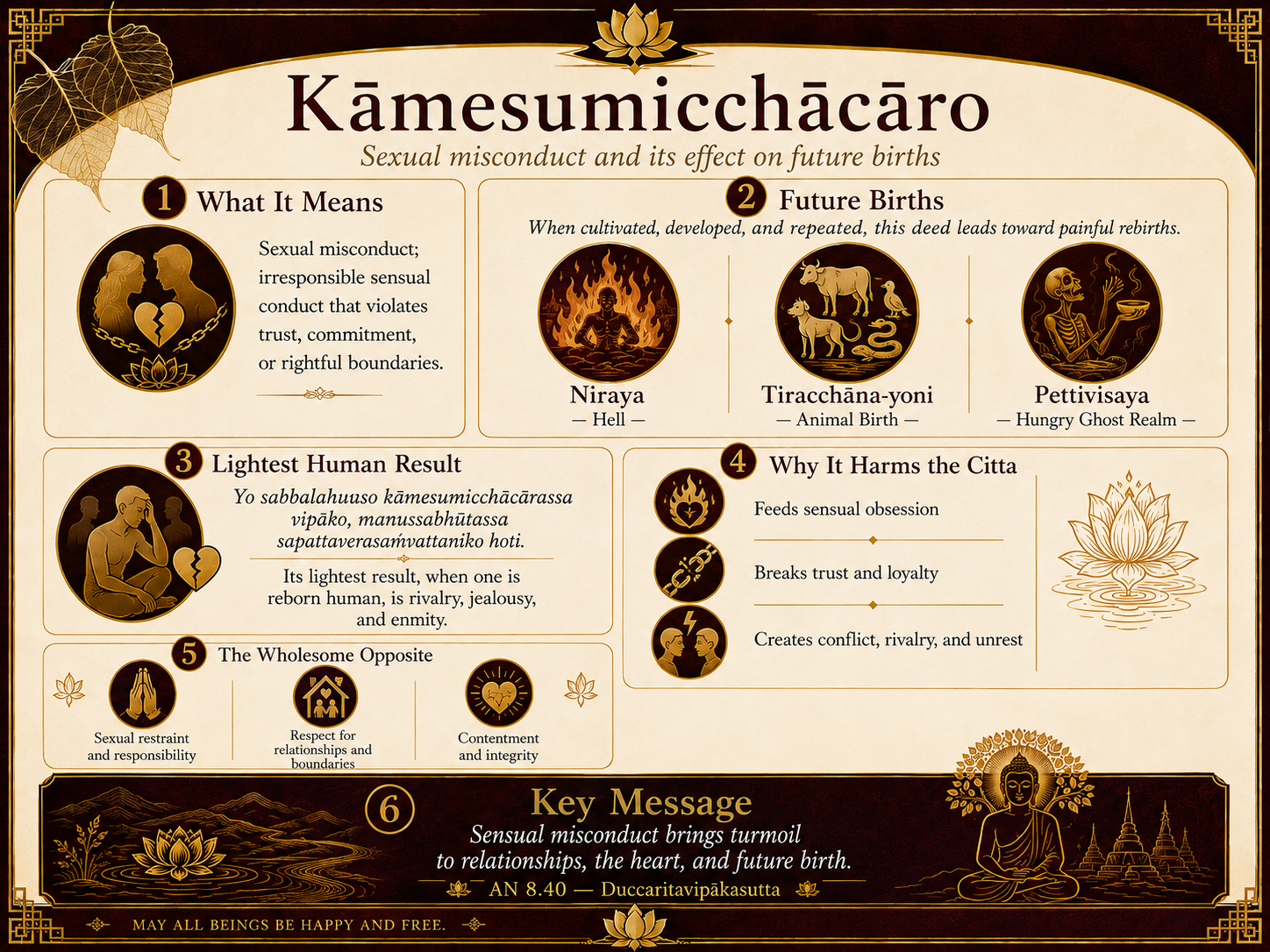
Kāmesumicchācāro — Sexual Misconduct
Pāli
Kāmesumicchācāro, bhikkhave, āsevito bhāvito bahulīkato nirayasaṁvattaniko tiracchānayonisaṁvattaniko pettivisayasaṁvattaniko. Yo sabbalahuso kāmesumicchācārassa vipāko, manussabhūtassa sapattaverasaṁvattaniko hoti.
Translation: “Bhikkhus, sexual misconduct, when repeatedly resorted to, developed and made much of, is conducive to hell, conducive to animal birth and conducive to the realm of petas. The lightest result of sexual misconduct, when one has become human, is that it is conducive to rivalry and enmity.”
The word micchācāra immediately tells us that the issue is not sexuality in itself but wrong conduct in relation to sensuality. Desire can become so dominant that trust, commitment, another person’s welfare and proper boundaries are pushed aside.
An everyday example is a person in a committed relationship beginning a secret relationship and then constructing a second life of concealment around it. Another example is pursuing someone despite knowing that doing so violates an existing commitment or exploits a position of trust. The sensual attraction may last for minutes or months, but the conduct can create suspicion, jealousy, rivalry and resentment among many people.
Notice the lightest human result named by the Buddha: sapattavera—rivalry, hostility, enmity. The result is closely intelligible even at the level of ordinary life. Misconduct driven by sensual desire often places people into competition and opposition: partner against partner, family against family, friend against friend. AN 8.40, however, goes further and treats this as vipāka extending beyond the immediate social consequences.
The practical training is to learn that desire does not automatically authorize action. A feeling of attraction can be known without being obeyed. Restraint protects not only others but the stability of one’s own citta. Contentment, responsibility and respect for commitments prevent a passing desire from becoming a cultivated pattern of misconduct.
Wrong conduct repeatedly chosen→
Lower destinations→
If human: rivalry and enmity
04
Musāvādo — False Speech
Pāli
Musāvādo, bhikkhave, āsevito bhāvito bahulīkato nirayasaṁvattaniko tiracchānayonisaṁvattaniko pettivisayasaṁvattaniko. Yo sabbalahuso musāvādassa vipāko, manussabhūtassa abhūtabbhakkhānasaṁvattaniko hoti.
Translation: “Bhikkhus, false speech, when repeatedly resorted to, developed and made much of, is conducive to hell, conducive to animal birth and conducive to the realm of petas. The lightest result of false speech, when one has become human, is that it is conducive to false accusation.”
A lie often begins because the truth seems inconvenient. A mistake has been made, so a story is invented. A promise was not kept, so a false excuse is produced. A person wishes to appear better than the facts allow, so details are altered. In the short term the lie appears to solve a problem; in reality another training has begun.
Suppose someone arrives late and gives a false explanation. The next time, the same solution is easier. Then a lie is used to hide a financial mistake, to protect reputation, or to escape responsibility. Soon one must remember which version was told to which person. Musāvāda has become āsevito and bhāvito—something repeatedly used and developed.
The Buddha names abhūtabbhakkhāna—being accused of what is not true—as the lightest human result. The symmetry is difficult to miss: one who repeatedly bends truth through speech experiences a human result in which falsehood is directed back toward oneself.
The wholesome alternative is not merely “do not lie.” It is to make truthfulness habitual enough that one no longer needs to construct multiple realities. Sometimes truthful speech may require admitting, “I forgot,” “I made a mistake,” “I do not know,” or “I was responsible.” Such moments are precisely where sīla becomes bhāvanā: one cultivates a citta that can remain with fact without escaping into fabrication.
Falsehood repeatedly used→
Lower destinations→
If human: false accusation

05
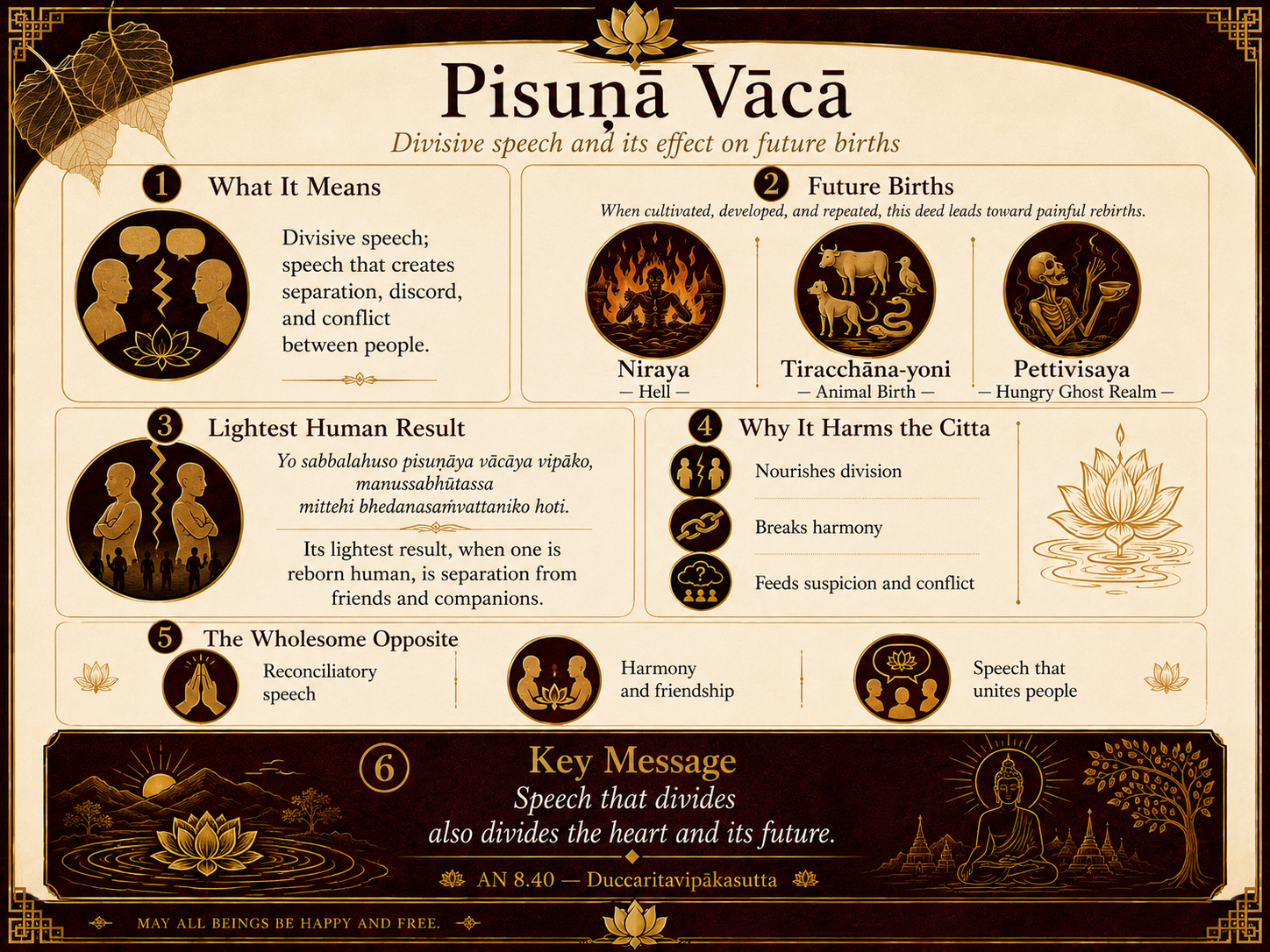
Pisuṇā Vācā — Divisive Speech
Pāli
Pisuṇā, bhikkhave, vācā āsevitā bhāvitā bahulīkatā nirayasaṁvattanikā tiracchānayonisaṁvattanikā pettivisayasaṁvattanikā. Yo sabbalahuso pisuṇāya vācāya vipāko, manussabhūtassa mittehi bhedanasaṁvattaniko hoti.
Translation: “Bhikkhus, divisive speech, when repeatedly resorted to, developed and made much of, is conducive to hell, conducive to animal birth and conducive to the realm of petas. The lightest result of divisive speech, when one has become human, is that it is conducive to separation from friends.”
Pisuṇā vācā becomes especially easy when it is disguised as “just sharing information.” One person says something privately; the listener carries it to another person in a form likely to provoke hurt or anger. A selective screenshot is forwarded. An old remark is repeated without context. Someone says, “Do you know what she really thinks of you?” The words may contain some factual element, yet their function is separation.
Consider a workplace where two colleagues have a minor disagreement. A third person repeatedly carries remarks from one to the other, adding interpretation each time. Within a week the original disagreement is no longer the issue. Two people who could have resolved a problem directly now view each other with suspicion. The speaker has trained in the ability to manufacture division.
AN 8.40 names the lightest human result as mittehi bhedana—division or separation from friends. Again the correspondence is clear. Speech used to break relationships is associated with a human result in which one’s own friendships break apart.
The training opposite to pisuṇā vācā is powerful. Before carrying information from one person to another, ask: Will these words reconcile or divide? Is it necessary for the person to know? Am I passing this on because it genuinely helps, or because the citta enjoys the energy of conflict? Speech that protects harmony can itself become āsevito, bhāvito and bahulīkato.
Suspicion and separation→
Lower destinations→
If human: separation from friends
06
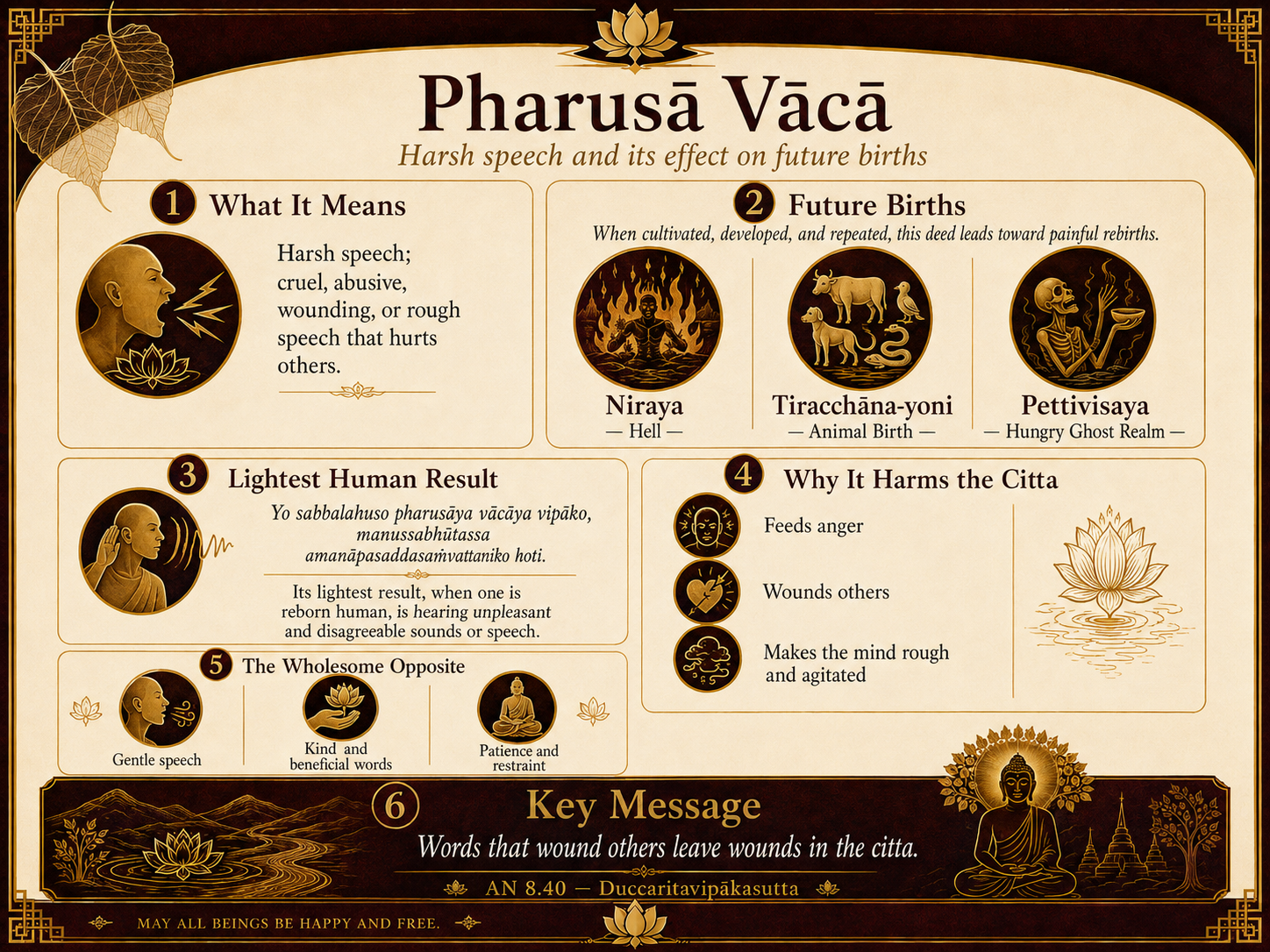
Pharusā Vācā — Harsh Speech
Pāli
Pharusā, bhikkhave, vācā āsevitā bhāvitā bahulīkatā nirayasaṁvattanikā tiracchānayonisaṁvattanikā pettivisayasaṁvattanikā. Yo sabbalahuso pharusāya vācāya vipāko, manussabhūtassa amanāpasaddasaṁvattaniko hoti.
Translation: “Bhikkhus, harsh speech, when repeatedly resorted to, developed and made much of, is conducive to hell, conducive to animal birth and conducive to the realm of petas. The lightest result of harsh speech, when one has become human, is that it is conducive to disagreeable sounds.”
Harsh speech is not defined merely by volume. One can wound another person quietly. Sarcasm intended to humiliate, insults, contemptuous labels, threats, abusive criticism and speech designed to make another person feel small all train the same general direction.
An everyday example is irritation at home. Something minor has gone wrong and a person immediately raises the voice, uses insulting language and attacks the other person rather than addressing the event. At work, a senior person humiliates a junior in front of others because fear seems more efficient than patient explanation. Online, a disagreement becomes permission to use words one would hesitate to use face to face.
Every repetition matters because the next outburst becomes easier. One is not only expressing anger; one is practising a way of speaking while angry. Eventually pharusā vācā can become the default response whenever the citta experiences resistance.
The lightest human result is amanāpasadda—unpleasant, disagreeable or unwelcome sounds. A person who repeatedly creates an unpleasant world through speech is associated with a human result in which unpleasant sound comes toward oneself.
The opposite training is not weakness. Gentle speech can still be clear, firm and corrective. One can say “No,” point out an error, establish a boundary or stop harmful behaviour without cultivating cruelty in the voice. The key is whether the words are being used to communicate what is necessary or to discharge dosa into another person.
Harsh words repeatedly used→
Rough speech becomes familiar→
Lower destinations→
If human: disagreeable sounds
07
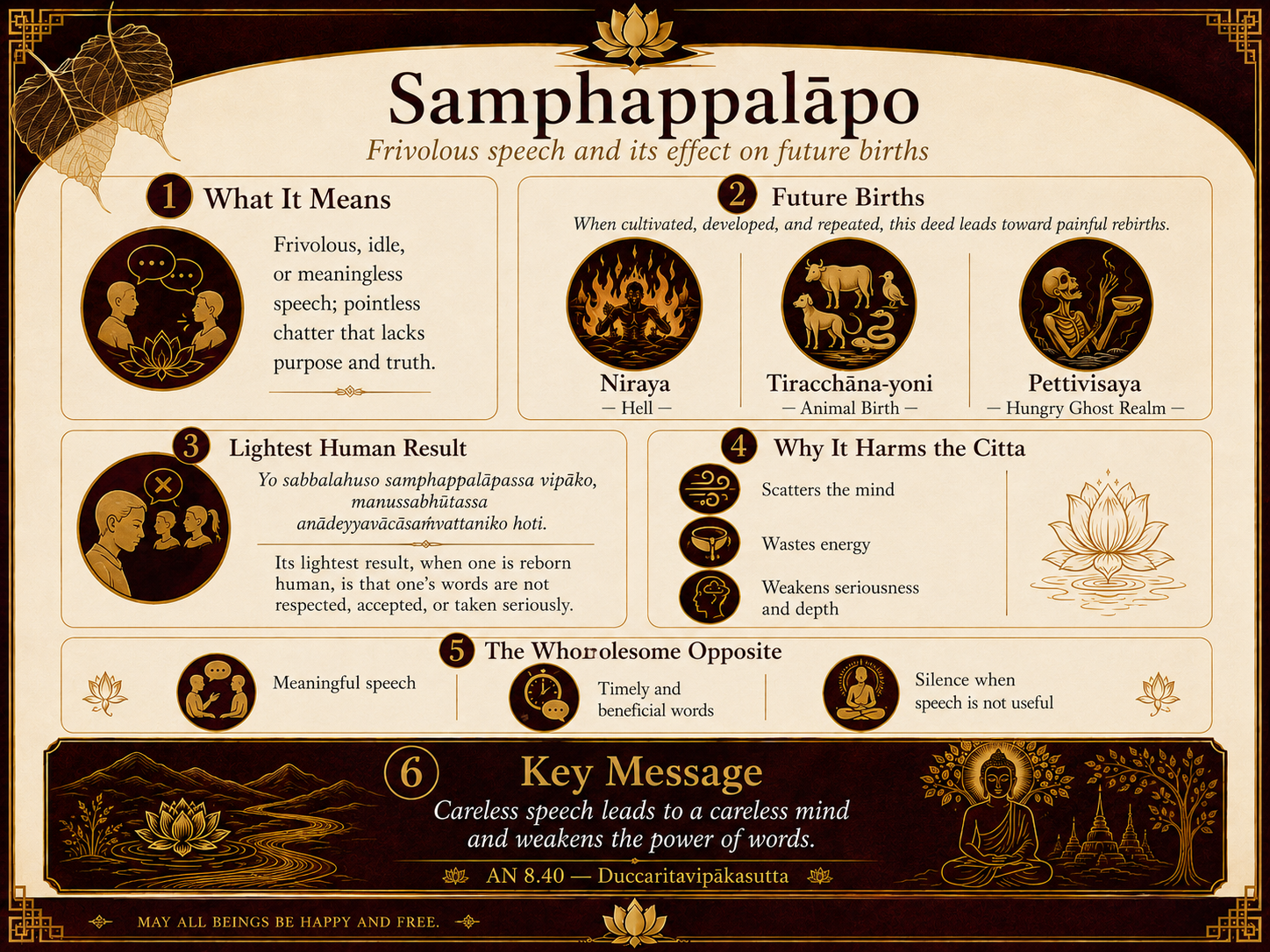
Samphappalāpo — Frivolous or Idle Chatter
Pāli
Samphappalāpo, bhikkhave, āsevito bhāvito bahulīkato nirayasaṁvattaniko tiracchānayonisaṁvattaniko pettivisayasaṁvattaniko. Yo sabbalahuso samphappalāpassa vipāko, manussabhūtassa anādeyyavācāsaṁvattaniko hoti.
Translation: “Bhikkhus, frivolous or idle chatter, when repeatedly resorted to, developed and made much of, is conducive to hell, conducive to animal birth and conducive to the realm of petas. The lightest result of frivolous chatter, when one has become human, is that it is conducive to speech that others do not accept, heed or take seriously.”
This paragraph is easy to underestimate because idle chatter can appear harmless compared with killing or stealing. Yet the Buddha places it in the same structural teaching: it too can be resorted to, developed and made much of.
Imagine a person who speaks continually without caring whether what is said is useful, timely or reliable. Rumours are forwarded immediately. Every silence has to be filled. Stories are exaggerated for entertainment. Private matters are repeated casually. Conversation becomes a stream in which there is no distinction between what matters and what does not.
Over time something happens to speech itself: people stop giving it weight. When the person finally says something important, listeners are unsure whether this is another exaggeration, another rumour or another passing remark. This helps us understand the specific expression anādeyyavācā: speech that is not accepted, not heeded, or not considered worth taking seriously.
The practice is not to become socially cold or to assume that every ordinary friendly conversation is wrong. The teaching point is to stop cultivating speech as heedless noise. One learns the value of speaking when there is something worth saying, listening when another person is speaking, and allowing silence when words add nothing useful.
For a bhāvanā practitioner this has an immediate relevance. A citta accustomed to endless verbal activity does not suddenly become quiet merely because one has sat down for meditation. Restraint in speech is therefore also preparation for inward stillness.
Repeated chatter→
Words lose weight→
Lower destinations→
If human: words not taken seriously
08
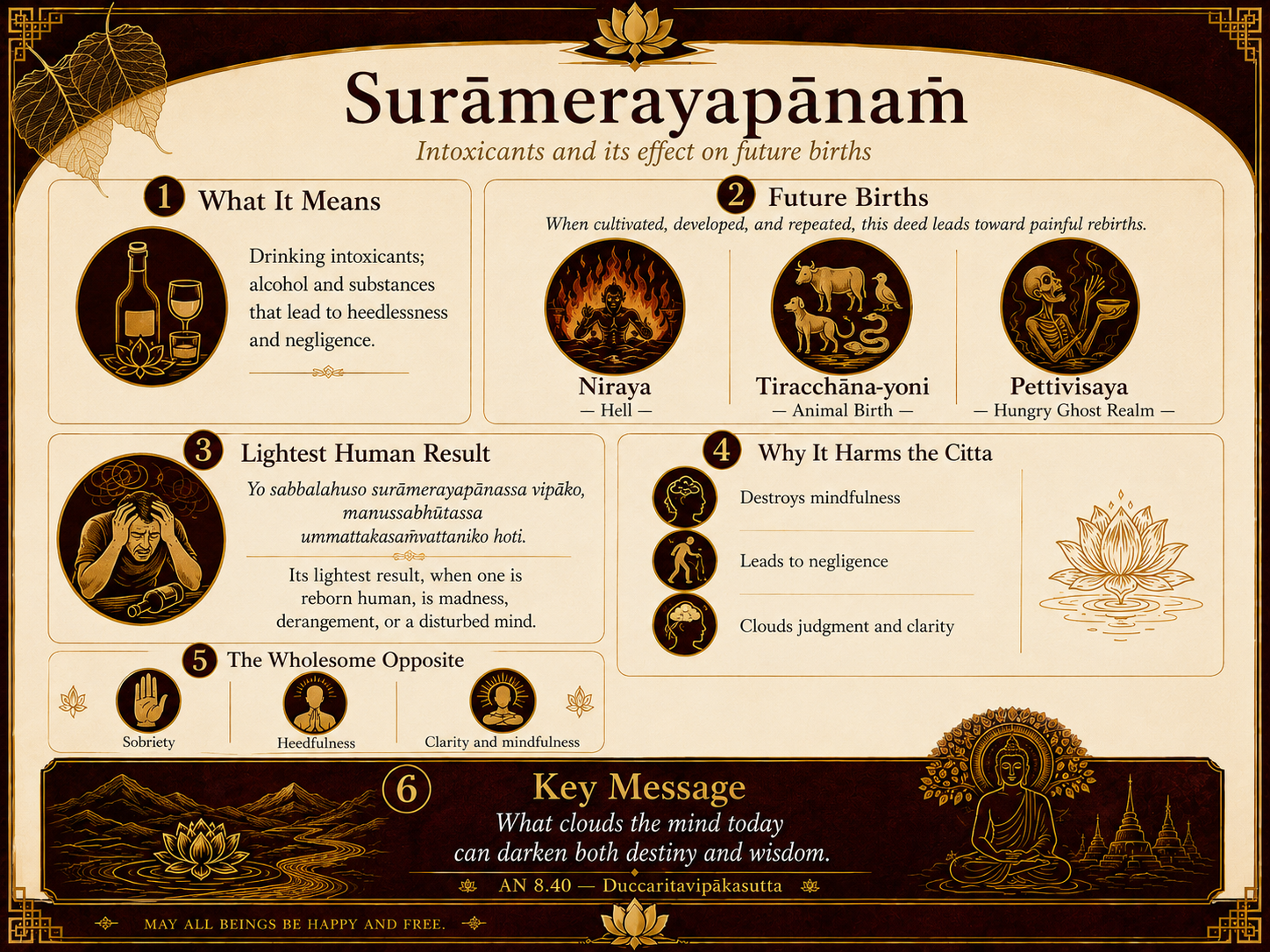
Surāmerayapānaṁ — Drinking Intoxicants
Pāli
Surāmerayapānaṁ, bhikkhave, āsevitaṁ bhāvitaṁ bahulīkataṁ nirayasaṁvattanikaṁ tiracchānayonisaṁvattanikaṁ pettivisayasaṁvattanikaṁ. Yo sabbalahuso surāmerayapānassa vipāko, manussabhūtassa ummattakasaṁvattaniko hotī”ti.
Translation: “Bhikkhus, the drinking of intoxicants, when repeatedly resorted to, developed and made much of, is conducive to hell, conducive to animal birth and conducive to the realm of petas. The lightest result of drinking intoxicants, when one has become human, is that it is conducive to madness or mental derangement.”
The final item is significant because intoxication weakens the very faculties required to protect the other forms of conduct. When judgment is clouded, a person may say what would not normally be said, become aggressive, cross sexual boundaries, damage property, drive dangerously or lose the ability to remember what has happened.
An everyday example begins with the thought, “I need this to relax.” What was occasional becomes weekly, then necessary for socializing, then necessary after a difficult day. The issue in the sutta is again cultivation: āsevito, bhāvito, bahulīkato. A condition of reduced heedfulness becomes something repeatedly sought and developed.
The lightest human result is ummattaka—madness, derangement or serious mental disturbance. The contrast is stark. The short-term purpose of intoxication may be to alter the mind pleasantly; the sutta warns that cultivated intoxication is associated with a future condition in which mental stability itself is damaged.
For Dhamma practice, sobriety is therefore not an arbitrary restriction. Sati, sampajañña, restraint and wise judgment require clarity. A person cannot intentionally cloud the instrument of knowing and at the same time expect that instrument to become increasingly precise.
The wholesome direction is heedfulness: learning to remain present with discomfort, social anxiety, boredom or emotional pain without automatically escaping into intoxication. Clarity itself becomes something one learns to value.
Heedlessness repeatedly cultivated→
Clarity weakened→
Lower destinations→
If human: mental derangement
Σ
Eight Acts and Their Human Results
1. Pāṇātipāto — killing living beings: if human, conducive to short life.
2. Adinnādānaṁ — taking what is not given: if human, conducive to loss of wealth.
3. Kāmesumicchācāro — sexual misconduct: if human, conducive to rivalry and enmity.
4. Musāvādo — false speech: if human, conducive to false accusation.
5. Pisuṇā vācā — divisive speech: if human, conducive to separation from friends.
6. Pharusā vācā — harsh speech: if human, conducive to disagreeable sounds.
7. Samphappalāpo — frivolous speech: if human, conducive to speech that is not heeded or taken seriously.
8. Surāmerayapānaṁ — intoxicants: if human, conducive to madness or mental derangement.
The common formula for all eight: when the misconduct is āsevito / āsevitaṁ, bhāvito / bhāvitaṁ and bahulīkato / bahulīkataṁ—resorted to, developed and made much of—it is said to be conducive to niraya, tiracchānayoni and pettivisaya.
This repetition should change how we understand sīla. Sīla is not merely a boundary imposed from outside. It is a decision about what qualities one is willing to cultivate repeatedly. Every day provides many small opportunities to move in one direction or the other.
The person who refrains from killing is training harmlessness. The person who refuses to take what is not given trains honesty and contentment. The person who respects sexual boundaries trains responsibility. The person who speaks truth trains reliability. The person who refuses to divide friends trains harmony. The person who abandons harsh speech trains gentleness. The person who reduces useless chatter gives weight back to speech. The person who avoids intoxication protects heedfulness.
Seen in this way, AN 8.40 is not only a discourse about what may happen after death. It is a discourse about what we are developing now.
AN 8.40 visual guide
Duccaritavipākasutta Infographics
A nine-page visual guide to the eight unwholesome actions, their consequences, and their wholesome opposites.
At the end of the day, rather than asking only, “Did I meditate today?”, one can review the more fundamental cultivation:
Body: Did I protect life? Did I respect what was not given? Did I respect sexual responsibility and boundaries?
Speech: Was what I said truthful? Did it unite or divide? Was it gentle or wounding? Did my words have purpose?
Heedfulness: Did I preserve clarity, or did I deliberately cultivate a condition of intoxication and negligence?
Then ask one further question:
What did I actually develop by repetition—kusala or akusala?
This is where the sutta becomes practical. A single day is made of many small choices. Repeated choices become habits. Habits become ways of living. AN 8.40 asks us to take that process seriously because cultivation does not end with the present moment.
Repetition→
Cultivation→
Character and tendency→
Vipāka→
Future Birth
The danger is not only that an unwholesome action has occurred. The deeper danger is that it becomes familiar, developed and repeatedly cultivated.
For a bhāvanā practitioner, this gives sīla its full meaning. Before expecting the citta to become calm, clear and capable of deeper Dhamma practice, stop repeatedly feeding the actions and speech that move it in the opposite direction.
Canonical reference: Aṅguttara Nikāya 8.40, Duccaritavipākasutta. The Pāli text in this article has been retained paragraph by paragraph, with an original close English rendering and practical examples added for teaching.