Saṅgāravasutta — When the Water of Citta Becomes Clear
A complete paragraph-by-paragraph study of the five hindrances, the five water similes, nissaraṇa, yathābhūta knowing, and the seven factors of awakening leading toward vijjā-vimutti.
The problem is not merely what appears before the mind, but the condition of the mind through which it is being known.
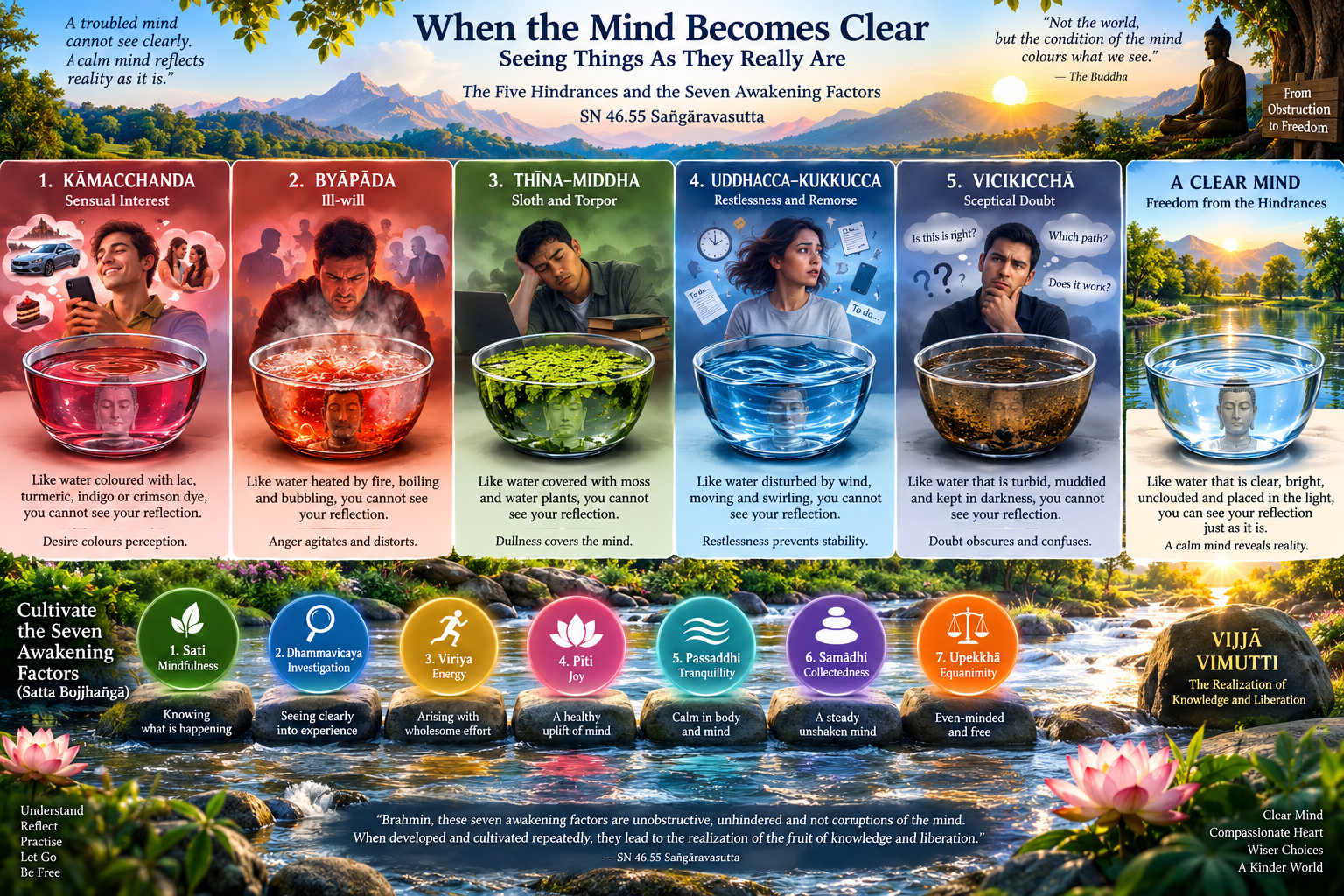 VISUAL SUMMARYSee this sutta in a pictureOpen the complete infographic for a visual overview before or after reading the full study.View infographic →
A question about memory becomes a teaching on the condition of citta
Saṅgārava approaches the Buddha with an apparently ordinary question: why do teachings that have been recited for a long time sometimes fail to come to mind, while at other times even material not recently rehearsed becomes readily available?
The Buddha does not answer by discussing memory storage. He redirects the investigation toward the condition of citta. When citta is overwhelmed by one of the five hindrances, a person cannot clearly know and see attattha, parattha, or ubhayattha—one’s own welfare, another’s welfare, or the welfare of both. The five water similes explain how knowing becomes distorted. The latter half of the discourse then reverses those images and culminates in the seven bojjhaṅgā, which, when bhāvitā bahulīkatā—developed and cultivated repeatedly—lead toward vijjā-vimutti.
SN 46.55 Saṅgāravasutta
All abbreviated pe passages in the supplied text are expanded below so the reader does not have to infer omitted wording.
Sāvatthinidānaṁ.
At Sāvatthī.
Atha kho saṅgāravo brāhmaṇo yena bhagavā tenupasaṅkami; upasaṅkamitvā bhagavatā saddhiṁ sammodi. Sammodanīyaṁ kathaṁ sāraṇīyaṁ vītisāretvā ekamantaṁ nisīdi. Ekamantaṁ nisinno kho saṅgāravo brāhmaṇo bhagavantaṁ etadavoca:
Then the brahmin Saṅgārava approached the Blessed One. Having approached, he exchanged greetings with the Blessed One. When their courteous and cordial conversation was finished, he sat to one side. Sitting to one side, Saṅgārava said to the Blessed One:
“Ko nu kho, bho gotama, hetu, ko paccayo yenekadā dīgharattaṁ sajjhāyakatāpi mantā nappaṭibhanti, pageva asajjhāyakatā? Ko pana, bho gotama, hetu, ko paccayo yenekadā dīgharattaṁ asajjhāyakatāpi mantā paṭibhanti, pageva sajjhāyakatā”ti?
“Master Gotama, what is the cause, what is the condition, whereby sometimes teachings that have been recited for a long time do not occur to the mind, much less those that have not been recited? And what is the cause, what is the condition, whereby sometimes even teachings not recited for a long time occur to the mind, let alone those that have been recited?”
Kāmarāga — sensual passion
“Yasmiṁ kho, brāhmaṇa, samaye kāmarāgapariyuṭṭhitena cetasā viharati kāmarāgaparetena, uppannassa ca kāmarāgassa nissaraṇaṁ yathābhūtaṁ nappajānāti, attatthampi tasmiṁ samaye yathābhūtaṁ na jānāti na passati, paratthampi tasmiṁ samaye yathābhūtaṁ na jānāti na passati, ubhayatthampi tasmiṁ samaye yathābhūtaṁ na jānāti na passati; dīgharattaṁ sajjhāyakatāpi mantā nappaṭibhanti, pageva asajjhāyakatā.
“Brahmin, when one lives with a mind overwhelmed by sensual passion, overcome by sensual passion, and does not understand as it actually is the escape from arisen sensual passion, then at that time one does not know or see as it actually is one’s own welfare, another’s welfare, or the welfare of both. Even teachings recited for a long time do not occur to the mind, much less those not recited.
Seyyathāpi, brāhmaṇa, udapatto saṁsaṭṭho lākhāya vā haliddiyā vā nīliyā vā mañjiṭṭhāya vā. Tattha cakkhumā puriso sakaṁ mukhanimittaṁ paccavekkhamāno yathābhūtaṁ na jāneyya na passeyya.
“Suppose, brahmin, there were a bowl of water mixed with lac, turmeric, indigo, or crimson dye. A person with good eyesight examining the reflection of their own face in it would not know or see it as it actually is.
Evameva kho, brāhmaṇa, yasmiṁ samaye kāmarāgapariyuṭṭhitena cetasā viharati kāmarāgaparetena, uppannassa ca kāmarāgassa nissaraṇaṁ yathābhūtaṁ nappajānāti, attatthampi tasmiṁ samaye yathābhūtaṁ na jānāti na passati, paratthampi tasmiṁ samaye yathābhūtaṁ na jānāti na passati, ubhayatthampi tasmiṁ samaye yathābhūtaṁ na jānāti na passati; dīgharattaṁ sajjhāyakatāpi mantā nappaṭibhanti, pageva asajjhāyakatā.
“In the same way, brahmin, when one lives with a mind overwhelmed by sensual passion, overcome by sensual passion, and does not understand as it actually is the escape from arisen sensual passion, one does not know or see as it actually is one’s own welfare, another’s welfare, or the welfare of both. Even teachings recited for a long time do not occur to the mind, much less those not recited.
Byāpāda — ill will
Puna caparaṁ, brāhmaṇa, yasmiṁ samaye byāpādapariyuṭṭhitena cetasā viharati byāpādaparetena, uppannassa ca byāpādassa nissaraṇaṁ yathābhūtaṁ nappajānāti, attatthampi tasmiṁ samaye yathābhūtaṁ na jānāti na passati, paratthampi tasmiṁ samaye yathābhūtaṁ na jānāti na passati, ubhayatthampi tasmiṁ samaye yathābhūtaṁ na jānāti na passati; dīgharattaṁ sajjhāyakatāpi mantā nappaṭibhanti, pageva asajjhāyakatā.
“Furthermore, brahmin, when one lives with a mind overwhelmed by ill will, overcome by ill will, and does not understand as it actually is the escape from arisen ill will, one does not know or see as it actually is one’s own welfare, another’s welfare, or the welfare of both. Even teachings recited for a long time do not occur to the mind, much less those not recited.
Seyyathāpi, brāhmaṇa, udapatto agginā santatto pakkuthito usmudakajāto. Tattha cakkhumā puriso sakaṁ mukhanimittaṁ paccavekkhamāno yathābhūtaṁ na jāneyya na passeyya.
“Suppose, brahmin, there were a bowl of water heated by fire, boiling and bubbling. A person with good eyesight examining the reflection of their own face in it would not know or see it as it actually is.
Evameva kho, brāhmaṇa, yasmiṁ samaye byāpādapariyuṭṭhitena cetasā viharati byāpādaparetena, uppannassa ca byāpādassa nissaraṇaṁ yathābhūtaṁ nappajānāti, attatthampi tasmiṁ samaye yathābhūtaṁ na jānāti na passati, paratthampi tasmiṁ samaye yathābhūtaṁ na jānāti na passati, ubhayatthampi tasmiṁ samaye yathābhūtaṁ na jānāti na passati; dīgharattaṁ sajjhāyakatāpi mantā nappaṭibhanti, pageva asajjhāyakatā.
“In the same way, brahmin, when one lives with a mind overwhelmed by ill will, overcome by ill will, and does not understand as it actually is the escape from arisen ill will, one does not know or see as it actually is one’s own welfare, another’s welfare, or the welfare of both. Even teachings recited for a long time do not occur to the mind, much less those not recited.
Thīna-middha — sloth and torpor
Puna caparaṁ, brāhmaṇa, yasmiṁ samaye thīnamiddhapariyuṭṭhitena cetasā viharati thīnamiddhaparetena, uppannassa ca thīnamiddhassa nissaraṇaṁ yathābhūtaṁ nappajānāti, attatthampi tasmiṁ samaye yathābhūtaṁ na jānāti na passati, paratthampi tasmiṁ samaye yathābhūtaṁ na jānāti na passati, ubhayatthampi tasmiṁ samaye yathābhūtaṁ na jānāti na passati; dīgharattaṁ sajjhāyakatāpi mantā nappaṭibhanti, pageva asajjhāyakatā.
“Furthermore, brahmin, when one lives with a mind overwhelmed by sloth and torpor, overcome by sloth and torpor, and does not understand as it actually is the escape from arisen sloth and torpor, one does not know or see as it actually is one’s own welfare, another’s welfare, or the welfare of both. Even teachings recited for a long time do not occur to the mind, much less those not recited.
Seyyathāpi, brāhmaṇa, udapatto sevālapaṇakapariyonaddho. Tattha cakkhumā puriso sakaṁ mukhanimittaṁ paccavekkhamāno yathābhūtaṁ na jāneyya na passeyya.
“Suppose, brahmin, there were a bowl of water covered over with moss and water plants. A person with good eyesight examining the reflection of their own face in it would not know or see it as it actually is.
Evameva kho, brāhmaṇa, yasmiṁ samaye thīnamiddhapariyuṭṭhitena cetasā viharati thīnamiddhaparetena, uppannassa ca thīnamiddhassa nissaraṇaṁ yathābhūtaṁ nappajānāti, attatthampi tasmiṁ samaye yathābhūtaṁ na jānāti na passati, paratthampi tasmiṁ samaye yathābhūtaṁ na jānāti na passati, ubhayatthampi tasmiṁ samaye yathābhūtaṁ na jānāti na passati; dīgharattaṁ sajjhāyakatāpi mantā nappaṭibhanti, pageva asajjhāyakatā.
“In the same way, brahmin, when one lives with a mind overwhelmed by sloth and torpor, overcome by sloth and torpor, and does not understand as it actually is the escape from arisen sloth and torpor, one does not know or see as it actually is one’s own welfare, another’s welfare, or the welfare of both. Even teachings recited for a long time do not occur to the mind, much less those not recited.
Uddhacca-kukkucca — restlessness and remorse
Puna caparaṁ, brāhmaṇa, yasmiṁ samaye uddhaccakukkuccapariyuṭṭhitena cetasā viharati uddhaccakukkuccaparetena, uppannassa ca uddhaccakukkuccassa nissaraṇaṁ yathābhūtaṁ nappajānāti, attatthampi tasmiṁ samaye yathābhūtaṁ na jānāti na passati, paratthampi tasmiṁ samaye yathābhūtaṁ na jānāti na passati, ubhayatthampi tasmiṁ samaye yathābhūtaṁ na jānāti na passati; dīgharattaṁ sajjhāyakatāpi mantā nappaṭibhanti, pageva asajjhāyakatā.
“Furthermore, brahmin, when one lives with a mind overwhelmed by restlessness and remorse, overcome by restlessness and remorse, and does not understand as it actually is the escape from arisen restlessness and remorse, one does not know or see as it actually is one’s own welfare, another’s welfare, or the welfare of both. Even teachings recited for a long time do not occur to the mind, much less those not recited.
Seyyathāpi, brāhmaṇa, udapatto vāterito calito bhanto ūmijāto. Tattha cakkhumā puriso sakaṁ mukhanimittaṁ paccavekkhamāno yathābhūtaṁ na jāneyya na passeyya.
“Suppose, brahmin, there were a bowl of water stirred by wind, moving, swirling, and forming waves. A person with good eyesight examining the reflection of their own face in it would not know or see it as it actually is.
Evameva kho, brāhmaṇa, yasmiṁ samaye uddhaccakukkuccapariyuṭṭhitena cetasā viharati uddhaccakukkuccaparetena, uppannassa ca uddhaccakukkuccassa nissaraṇaṁ yathābhūtaṁ nappajānāti, attatthampi tasmiṁ samaye yathābhūtaṁ na jānāti na passati, paratthampi tasmiṁ samaye yathābhūtaṁ na jānāti na passati, ubhayatthampi tasmiṁ samaye yathābhūtaṁ na jānāti na passati; dīgharattaṁ sajjhāyakatāpi mantā nappaṭibhanti, pageva asajjhāyakatā.
“In the same way, brahmin, when one lives with a mind overwhelmed by restlessness and remorse, overcome by restlessness and remorse, and does not understand as it actually is the escape from arisen restlessness and remorse, one does not know or see as it actually is one’s own welfare, another’s welfare, or the welfare of both. Even teachings recited for a long time do not occur to the mind, much less those not recited.
Vicikicchā — doubt
Puna caparaṁ, brāhmaṇa, yasmiṁ samaye vicikicchāpariyuṭṭhitena cetasā viharati vicikicchāparetena, uppannāya ca vicikicchāya nissaraṇaṁ yathābhūtaṁ nappajānāti, attatthampi tasmiṁ samaye yathābhūtaṁ na jānāti na passati, paratthampi tasmiṁ samaye yathābhūtaṁ na jānāti na passati, ubhayatthampi tasmiṁ samaye yathābhūtaṁ na jānāti na passati; dīgharattaṁ sajjhāyakatāpi mantā nappaṭibhanti, pageva asajjhāyakatā.
“Furthermore, brahmin, when one lives with a mind overwhelmed by doubt, overcome by doubt, and does not understand as it actually is the escape from arisen doubt, one does not know or see as it actually is one’s own welfare, another’s welfare, or the welfare of both. Even teachings recited for a long time do not occur to the mind, much less those not recited.
Seyyathāpi, brāhmaṇa, udapatto āvilo luḷito kalalībhūto andhakāre nikkhitto. Tattha cakkhumā puriso sakaṁ mukhanimittaṁ paccavekkhamāno yathābhūtaṁ na jāneyya na passeyya.
“Suppose, brahmin, there were a bowl of water that was turbid, disturbed, turned muddy, and placed in darkness. A person with good eyesight examining the reflection of their own face in it would not know or see it as it actually is.
Evameva kho, brāhmaṇa, yasmiṁ samaye vicikicchāpariyuṭṭhitena cetasā viharati vicikicchāparetena, uppannāya ca vicikicchāya nissaraṇaṁ yathābhūtaṁ nappajānāti, attatthampi tasmiṁ samaye yathābhūtaṁ na jānāti na passati, paratthampi tasmiṁ samaye yathābhūtaṁ na jānāti na passati, ubhayatthampi tasmiṁ samaye yathābhūtaṁ na jānāti na passati; dīgharattaṁ sajjhāyakatāpi mantā nappaṭibhanti, pageva asajjhāyakatā. Ayaṁ kho, brāhmaṇa, hetu ayaṁ paccayo yenekadā dīgharattaṁ sajjhāyakatāpi mantā nappaṭibhanti, pageva asajjhāyakatā.
“In the same way, brahmin, when one lives with a mind overwhelmed by doubt, overcome by doubt, and does not understand as it actually is the escape from arisen doubt, one does not know or see as it actually is one’s own welfare, another’s welfare, or the welfare of both. Even teachings recited for a long time do not occur to the mind, much less those not recited. This, brahmin, is the cause and condition whereby sometimes even teachings recited for a long time do not occur to the mind, much less those not recited.
When kāmarāga no longer overwhelms citta
Yasmiñca kho, brāhmaṇa, samaye na kāmarāgapariyuṭṭhitena cetasā viharati na kāmarāgaparetena, uppannassa ca kāmarāgassa nissaraṇaṁ yathābhūtaṁ pajānāti, attatthampi tasmiṁ samaye yathābhūtaṁ jānāti passati, paratthampi tasmiṁ samaye yathābhūtaṁ jānāti passati, ubhayatthampi tasmiṁ samaye yathābhūtaṁ jānāti passati; dīgharattaṁ asajjhāyakatāpi mantā paṭibhanti, pageva sajjhāyakatā.
“But, brahmin, when one lives with a mind not overwhelmed or overcome by sensual passion, and understands as it actually is the escape from arisen sensual passion, one knows and sees as it actually is one’s own welfare, another’s welfare, and the welfare of both. Even teachings not recited for a long time occur to the mind, let alone those that have been recited.
Seyyathāpi, brāhmaṇa, udapatto asaṁsaṭṭho lākhāya vā haliddiyā vā nīliyā vā mañjiṭṭhāya vā. Tattha cakkhumā puriso sakaṁ mukhanimittaṁ paccavekkhamāno yathābhūtaṁ jāneyya passeyya.
“Suppose, brahmin, there were a bowl of water not mixed with lac, turmeric, indigo, or crimson dye. A person with good eyesight examining the reflection of their own face in it would know and see it as it actually is.
Evameva kho, brāhmaṇa, yasmiṁ samaye na kāmarāgapariyuṭṭhitena cetasā viharati na kāmarāgaparetena, uppannassa ca kāmarāgassa nissaraṇaṁ yathābhūtaṁ pajānāti, attatthampi tasmiṁ samaye yathābhūtaṁ jānāti passati, paratthampi tasmiṁ samaye yathābhūtaṁ jānāti passati, ubhayatthampi tasmiṁ samaye yathābhūtaṁ jānāti passati; dīgharattaṁ asajjhāyakatāpi mantā paṭibhanti, pageva sajjhāyakatā.
“In the same way, brahmin, when one lives with a mind not overwhelmed or overcome by sensual passion, and understands as it actually is the escape from arisen sensual passion, one knows and sees as it actually is one’s own welfare, another’s welfare, and the welfare of both. Even teachings not recited for a long time occur to the mind, let alone those that have been recited.
When byāpāda no longer overwhelms citta
Puna caparaṁ, brāhmaṇa, yasmiṁ samaye na byāpādapariyuṭṭhitena cetasā viharati na byāpādaparetena, uppannassa ca byāpādassa nissaraṇaṁ yathābhūtaṁ pajānāti, attatthampi tasmiṁ samaye yathābhūtaṁ jānāti passati, paratthampi tasmiṁ samaye yathābhūtaṁ jānāti passati, ubhayatthampi tasmiṁ samaye yathābhūtaṁ jānāti passati; dīgharattaṁ asajjhāyakatāpi mantā paṭibhanti, pageva sajjhāyakatā.
“Furthermore, brahmin, when one lives with a mind not overwhelmed or overcome by ill will, and understands as it actually is the escape from arisen ill will, one knows and sees as it actually is one’s own welfare, another’s welfare, and the welfare of both. Even teachings not recited for a long time occur to the mind, let alone those that have been recited.
Seyyathāpi, brāhmaṇa, udapatto na agginā santatto na pakkuthito na usmudakajāto. Tattha cakkhumā puriso sakaṁ mukhanimittaṁ paccavekkhamāno yathābhūtaṁ jāneyya passeyya.
“Suppose, brahmin, there were a bowl of water not heated by fire, not boiling, and not bubbling. A person with good eyesight examining the reflection of their own face in it would know and see it as it actually is.
Evameva kho, brāhmaṇa, yasmiṁ samaye na byāpādapariyuṭṭhitena cetasā viharati na byāpādaparetena, uppannassa ca byāpādassa nissaraṇaṁ yathābhūtaṁ pajānāti, attatthampi tasmiṁ samaye yathābhūtaṁ jānāti passati, paratthampi tasmiṁ samaye yathābhūtaṁ jānāti passati, ubhayatthampi tasmiṁ samaye yathābhūtaṁ jānāti passati; dīgharattaṁ asajjhāyakatāpi mantā paṭibhanti, pageva sajjhāyakatā.
“In the same way, brahmin, when one lives with a mind not overwhelmed or overcome by ill will, and understands as it actually is the escape from arisen ill will, one knows and sees as it actually is one’s own welfare, another’s welfare, and the welfare of both. Even teachings not recited for a long time occur to the mind, let alone those that have been recited.
When thīna-middha no longer overwhelms citta
Puna caparaṁ, brāhmaṇa, yasmiṁ samaye na thīnamiddhapariyuṭṭhitena cetasā viharati na thīnamiddhaparetena, uppannassa ca thīnamiddhassa nissaraṇaṁ yathābhūtaṁ pajānāti, attatthampi tasmiṁ samaye yathābhūtaṁ jānāti passati, paratthampi tasmiṁ samaye yathābhūtaṁ jānāti passati, ubhayatthampi tasmiṁ samaye yathābhūtaṁ jānāti passati; dīgharattaṁ asajjhāyakatāpi mantā paṭibhanti, pageva sajjhāyakatā.
“Furthermore, brahmin, when one lives with a mind not overwhelmed or overcome by sloth and torpor, and understands as it actually is the escape from arisen sloth and torpor, one knows and sees as it actually is one’s own welfare, another’s welfare, and the welfare of both. Even teachings not recited for a long time occur to the mind, let alone those that have been recited.
Seyyathāpi, brāhmaṇa, udapatto na sevālapaṇakapariyonaddho. Tattha cakkhumā puriso sakaṁ mukhanimittaṁ paccavekkhamāno yathābhūtaṁ jāneyya passeyya.
“Suppose, brahmin, there were a bowl of water not covered over with moss and water plants. A person with good eyesight examining the reflection of their own face in it would know and see it as it actually is.
Evameva kho, brāhmaṇa, yasmiṁ samaye na thīnamiddhapariyuṭṭhitena cetasā viharati na thīnamiddhaparetena, uppannassa ca thīnamiddhassa nissaraṇaṁ yathābhūtaṁ pajānāti, attatthampi tasmiṁ samaye yathābhūtaṁ jānāti passati, paratthampi tasmiṁ samaye yathābhūtaṁ jānāti passati, ubhayatthampi tasmiṁ samaye yathābhūtaṁ jānāti passati; dīgharattaṁ asajjhāyakatāpi mantā paṭibhanti, pageva sajjhāyakatā.
“In the same way, brahmin, when one lives with a mind not overwhelmed or overcome by sloth and torpor, and understands as it actually is the escape from arisen sloth and torpor, one knows and sees as it actually is one’s own welfare, another’s welfare, and the welfare of both. Even teachings not recited for a long time occur to the mind, let alone those that have been recited.
When uddhacca-kukkucca no longer overwhelms citta
Puna caparaṁ, brāhmaṇa, yasmiṁ samaye na uddhaccakukkuccapariyuṭṭhitena cetasā viharati na uddhaccakukkuccaparetena, uppannassa ca uddhaccakukkuccassa nissaraṇaṁ yathābhūtaṁ pajānāti, attatthampi tasmiṁ samaye yathābhūtaṁ jānāti passati, paratthampi tasmiṁ samaye yathābhūtaṁ jānāti passati, ubhayatthampi tasmiṁ samaye yathābhūtaṁ jānāti passati; dīgharattaṁ asajjhāyakatāpi mantā paṭibhanti, pageva sajjhāyakatā.
“Furthermore, brahmin, when one lives with a mind not overwhelmed or overcome by restlessness and remorse, and understands as it actually is the escape from arisen restlessness and remorse, one knows and sees as it actually is one’s own welfare, another’s welfare, and the welfare of both. Even teachings not recited for a long time occur to the mind, let alone those that have been recited.
Seyyathāpi, brāhmaṇa, udapatto na vāterito na calito na bhanto na ūmijāto. Tattha cakkhumā puriso sakaṁ mukhanimittaṁ paccavekkhamāno yathābhūtaṁ jāneyya passeyya.
“Suppose, brahmin, there were a bowl of water not stirred by wind, not moving, not swirling, and not forming waves. A person with good eyesight examining the reflection of their own face in it would know and see it as it actually is.
Evameva kho, brāhmaṇa, yasmiṁ samaye na uddhaccakukkuccapariyuṭṭhitena cetasā viharati na uddhaccakukkuccaparetena, uppannassa ca uddhaccakukkuccassa nissaraṇaṁ yathābhūtaṁ pajānāti, attatthampi tasmiṁ samaye yathābhūtaṁ jānāti passati, paratthampi tasmiṁ samaye yathābhūtaṁ jānāti passati, ubhayatthampi tasmiṁ samaye yathābhūtaṁ jānāti passati; dīgharattaṁ asajjhāyakatāpi mantā paṭibhanti, pageva sajjhāyakatā.
“In the same way, brahmin, when one lives with a mind not overwhelmed or overcome by restlessness and remorse, and understands as it actually is the escape from arisen restlessness and remorse, one knows and sees as it actually is one’s own welfare, another’s welfare, and the welfare of both. Even teachings not recited for a long time occur to the mind, let alone those that have been recited.
When vicikicchā no longer overwhelms citta
Puna caparaṁ, brāhmaṇa, yasmiṁ samaye na vicikicchāpariyuṭṭhitena cetasā viharati na vicikicchāparetena, uppannāya ca vicikicchāya nissaraṇaṁ yathābhūtaṁ pajānāti, attatthampi tasmiṁ samaye yathābhūtaṁ jānāti passati, paratthampi tasmiṁ samaye yathābhūtaṁ jānāti passati, ubhayatthampi tasmiṁ samaye yathābhūtaṁ jānāti passati; dīgharattaṁ asajjhāyakatāpi mantā paṭibhanti, pageva sajjhāyakatā.
“Furthermore, brahmin, when one lives with a mind not overwhelmed or overcome by doubt, and understands as it actually is the escape from arisen doubt, one knows and sees as it actually is one’s own welfare, another’s welfare, and the welfare of both. Even teachings not recited for a long time occur to the mind, let alone those that have been recited.
Seyyathāpi, brāhmaṇa, udapatto accho vippasanno anāvilo āloke nikkhitto. Tattha cakkhumā puriso sakaṁ mukhanimittaṁ paccavekkhamāno yathābhūtaṁ jāneyya passeyya.
“Suppose, brahmin, there were a bowl of water that was clear, bright, unclouded, and placed in the light. A person with good eyesight examining the reflection of their own face in it would know and see it as it actually is.
Evameva kho, brāhmaṇa, yasmiṁ samaye na vicikicchāpariyuṭṭhitena cetasā viharati na vicikicchāparetena, uppannāya ca vicikicchāya nissaraṇaṁ yathābhūtaṁ pajānāti, attatthampi tasmiṁ samaye yathābhūtaṁ jānāti passati, paratthampi tasmiṁ samaye yathābhūtaṁ jānāti passati, ubhayatthampi tasmiṁ samaye yathābhūtaṁ jānāti passati; dīgharattaṁ asajjhāyakatāpi mantā paṭibhanti, pageva sajjhāyakatā. Ayaṁ kho, brāhmaṇa, hetu ayaṁ paccayo yenekadā dīgharattaṁ asajjhāyakatāpi mantā paṭibhanti, pageva sajjhāyakatā.
“In the same way, brahmin, when one lives with a mind not overwhelmed or overcome by doubt, and understands as it actually is the escape from arisen doubt, one knows and sees as it actually is one’s own welfare, another’s welfare, and the welfare of both. Even teachings not recited for a long time occur to the mind, let alone those that have been recited. This, brahmin, is the cause and condition whereby sometimes even teachings not recited for a long time occur to the mind, let alone those that have been recited.
The seven awakening factors
Sattime, brāhmaṇa, bojjhaṅgā anāvaraṇā anīvaraṇā cetaso anupakkilesā bhāvitā bahulīkatā vijjāvimuttiphalasacchikiriyāya saṁvattanti. Katame satta?
“Brahmin, there are these seven factors of awakening that are unobstructive, unhindered, and not corruptions of citta. When developed and cultivated repeatedly, they lead to the realization of the fruit of knowledge and liberation. What seven?
Satisambojjhaṅgo kho, brāhmaṇa, anāvaraṇo anīvaraṇo cetaso anupakkileso bhāvito bahulīkato vijjāvimuttiphalasacchikiriyāya saṁvattati.
“The awakening factor of sati is unobstructive, unhindered, and not a corruption of citta. When developed and cultivated repeatedly, it leads to the realization of the fruit of knowledge and liberation.
Dhammavicayasambojjhaṅgo kho, brāhmaṇa, anāvaraṇo anīvaraṇo cetaso anupakkileso bhāvito bahulīkato vijjāvimuttiphalasacchikiriyāya saṁvattati.
“The awakening factor of investigation of dhammas is unobstructive, unhindered, and not a corruption of citta. When developed and cultivated repeatedly, it leads to the realization of the fruit of knowledge and liberation.
Vīriyasambojjhaṅgo kho, brāhmaṇa, anāvaraṇo anīvaraṇo cetaso anupakkileso bhāvito bahulīkato vijjāvimuttiphalasacchikiriyāya saṁvattati.
“The awakening factor of energy is unobstructive, unhindered, and not a corruption of citta. When developed and cultivated repeatedly, it leads to the realization of the fruit of knowledge and liberation.
Pītisambojjhaṅgo kho, brāhmaṇa, anāvaraṇo anīvaraṇo cetaso anupakkileso bhāvito bahulīkato vijjāvimuttiphalasacchikiriyāya saṁvattati.
“The awakening factor of pīti is unobstructive, unhindered, and not a corruption of citta. When developed and cultivated repeatedly, it leads to the realization of the fruit of knowledge and liberation.
Passaddhisambojjhaṅgo kho, brāhmaṇa, anāvaraṇo anīvaraṇo cetaso anupakkileso bhāvito bahulīkato vijjāvimuttiphalasacchikiriyāya saṁvattati.
“The awakening factor of tranquillity is unobstructive, unhindered, and not a corruption of citta. When developed and cultivated repeatedly, it leads to the realization of the fruit of knowledge and liberation.
Samādhisambojjhaṅgo kho, brāhmaṇa, anāvaraṇo anīvaraṇo cetaso anupakkileso bhāvito bahulīkato vijjāvimuttiphalasacchikiriyāya saṁvattati.
“The awakening factor of samādhi is unobstructive, unhindered, and not a corruption of citta. When developed and cultivated repeatedly, it leads to the realization of the fruit of knowledge and liberation.
Upekkhāsambojjhaṅgo kho, brāhmaṇa, anāvaraṇo anīvaraṇo cetaso anupakkileso bhāvito bahulīkato vijjāvimuttiphalasacchikiriyāya saṁvattati. Ime kho, brāhmaṇa, satta bojjhaṅgā anāvaraṇā anīvaraṇā cetaso anupakkilesā bhāvitā bahulīkatā vijjāvimuttiphalasacchikiriyāya saṁvattantī”ti.
“The awakening factor of upekkhā is unobstructive, unhindered, and not a corruption of citta. When developed and cultivated repeatedly, it leads to the realization of the fruit of knowledge and liberation. These, brahmin, are the seven awakening factors that are unobstructive, unhindered, and not corruptions of citta. When developed and cultivated repeatedly, they lead to the realization of the fruit of knowledge and liberation.”
Evaṁ vutte, saṅgāravo brāhmaṇo bhagavantaṁ etadavoca: “Abhikkantaṁ, bho gotama, abhikkantaṁ, bho gotama! Seyyathāpi, bho gotama, nikkujjitaṁ vā ukkujjeyya, paṭicchannaṁ vā vivareyya, mūḷhassa vā maggaṁ ācikkheyya, andhakāre vā telapajjotaṁ dhāreyya ‘cakkhumanto rūpāni dakkhantī’ti; evamevaṁ bhotā gotamena anekapariyāyena dhammo pakāsito. Esāhaṁ bhavantaṁ gotamaṁ saraṇaṁ gacchāmi dhammañca bhikkhusaṅghañca. Upāsakaṁ maṁ bhavaṁ gotamo dhāretu ajjatagge pāṇupetaṁ saraṇaṁ gatan”ti.
When this was said, the brahmin Saṅgārava said to the Blessed One: “Excellent, Master Gotama! Excellent! Just as one might set upright what had been overturned, reveal what had been concealed, show the way to one who was lost, or hold up a lamp in the darkness so that those with eyes might see forms, in the same way the Dhamma has been made clear by Master Gotama in many ways. I go for refuge to Master Gotama, to the Dhamma, and to the Bhikkhu Saṅgha. May Master Gotama remember me as a lay follower who has gone for refuge from today for life.”
Pañcamaṁ.
The fifth.
Five different ways the reflective capacity of citta becomes unreliable
| Hindrance | Water simile | What happens to knowing | Common-day example |
|---|---|---|---|
| Kāmarāga | Water mixed with strong dyes | Perception becomes coloured by the attractive sign. | Wanting a new phone makes features and anticipated pleasure dominate while cost and actual need fade from view. |
| Byāpāda | Water heated until boiling | Heat and agitation deform the reflection. | After a critical email, the mind replays old grievances and drafts an immediate hostile response. |
| Thīna-middha | Water covered by moss and plants | The surface is covered; penetration and reflection are blocked. | After overeating or insufficient sleep, one rereads a Dhamma paragraph without anything registering. |
| Uddhacca-kukkucca | Water stirred by wind and waves | Continuous movement prevents a stable reflection. | During sitting, the mind jumps through messages, plans, unfinished tasks, regret and imagined future events. |
| Vicikicchā | Muddy, disturbed water placed in darkness | Both opacity and lack of illumination prevent direction and discernment. | After accumulating conflicting teachings without disciplined investigation, the practitioner no longer knows what to practise. |
Uppannassa … nissaraṇaṁ yathābhūtaṁ pajānāti — knowing the escape as it actually is
SN 46.55 does not stop at recognizing that a hindrance is present. In every case the Buddha emphasizes whether the practitioner understands nissaraṇa—the escape from the arisen condition—yathābhūtaṁ, as it actually is.
This changes the practice from naming a state to learning its conditional structure. What fed it? What keeps it alive? What happens when that nutriment is withdrawn? What quality of citta appears when the hindrance ceases to dominate? SN 46.51 complements this teaching by presenting the hindrances and awakening factors as conditions that depend on nutriment.
Accho • Vippasanno • Anāvilo • Āloke nikkhitto
The discourse reverses each simile. Water is no longer dyed, boiling, covered, wind-tossed, or muddy and dark. The final image is especially significant: udapatto accho vippasanno anāvilo āloke nikkhitto—a bowl of water that is clear, bright, unclouded, and placed in the light.
Freedom from the hindrances is therefore not the creation of a blank mind. Sights, sounds, memories, feelings and decisions remain possible. What changes is that they are no longer being continually coloured, heated, covered, shaken or obscured. The reflective capacity of citta becomes available for yathābhūtaṁ jānāti passati—knowing and seeing as it actually is.
The seven factors are the cultivation side of the discourse
| # | Bojjhaṅga | Function in bhāvanā |
|---|---|---|
| 1 | Sati-sambojjhaṅga | Keeps the field of experience available without losing the object or the condition of citta. |
| 2 | Dhammavicaya-sambojjhaṅga | Investigates dhammas and distinguishes what is skillful/unskillful, blameworthy/blameless, inferior/refined, dark/bright. |
| 3 | Vīriya-sambojjhaṅga | Supplies energy for abandoning the unskillful and developing the skillful. |
| 4 | Pīti-sambojjhaṅga | Brings non-sensual uplift and brightening of citta. |
| 5 | Passaddhi-sambojjhaṅga | Settles bodily and mental disturbance. |
| 6 | Samādhi-sambojjhaṅga | Collects citta so it is no longer scattered. |
| 7 | Upekkhā-sambojjhaṅga | Establishes balanced observation without compulsive attraction or resistance. |
SN 46.55 describes these seven as anāvaraṇā, anīvaraṇā, cetaso anupakkilesā and says that when they are bhāvitā bahulīkatā, they lead to vijjāvimuttiphalasacchikiriyā.
When the Water of Citta Becomes Clear
Saṅgārava approaches the Buddha with what appears, at first, to be a relatively ordinary question about memory. Why is it that teachings or verses which have been recited for a long time sometimes cannot be recalled, while on other occasions even material that has not been recited for a long time comes readily to mind? The question concerns recollection, but the Buddha’s answer moves immediately beyond memory. He turns attention toward the condition of the mind that is trying to remember.
This is what makes SN 46.55 Saṅgāravasutta particularly important. The discourse is not merely telling us that sensual desire, ill will, sloth and torpor, restlessness and remorse, and doubt interfere with meditation. It is explaining something much more fundamental: the condition of citta determines the clarity with which experience can be known.
The Buddha repeatedly uses the expression attatthampi tasmiṁ samaye yathābhūtaṁ na jānāti na passati, paratthampi tasmiṁ samaye yathābhūtaṁ na jānāti na passati, ubhayatthampi tasmiṁ samaye yathābhūtaṁ na jānāti na passati. At such a time one does not know and see as it actually is one’s own welfare, the welfare of another, or the welfare of both.
This takes the five hindrances far beyond the meditation cushion. A person under the influence of a hindrance may be making decisions about family, money, work, relationships, health, Dhamma practice or another person’s conduct. The person may be highly intelligent and may even possess considerable knowledge. Yet intelligence and accumulated knowledge do not guarantee clear seeing when the medium through which the situation is being examined has itself become distorted.
This is why the Buddha’s choice of water is so precise. Water has the capacity to reflect. If clear, undisturbed and illuminated, it can reveal an image accurately. But that same water can lose its reflective capacity without ceasing to be water. It can be coloured. It can boil. Its surface can become covered. It can be disturbed by wind. It can become muddy and remain in darkness.
The object being reflected has not changed. The eye of the observer may not have changed. What has changed is the condition of the water. The same principle applies to citta.
When desire colours the water
For kāmarāga, the Buddha describes water mixed with lac, turmeric, indigo or crimson dye. A person looking into such water cannot see the face as it actually is. The significance is deeper than saying that sensual desire is distracting. Sensual desire colours perception.
Consider someone thinking of buying an expensive new phone. Before desire becomes established, the matter can be considered quite simply. Is the existing phone working? Is the new one necessary? What will it cost? What other use could be made of that money? But once desire has taken hold, the same object begins to look different. The mind notices the camera, display, design, speed, prestige and anticipated pleasure. It begins imagining ownership. Reviews supporting the purchase become compelling, while reasons not to purchase seem less important.
Nothing has happened to the phone. The water has been coloured.
The same process occurs in sexual attraction. Once rāga colours perception, attention selectively gathers what is attractive. Characteristics inconsistent with the desired image receive less attention. The mind is no longer merely seeing another human being; it is seeing through a medium coloured by its own wanting.
This helps explain why the Buddha does not merely say that kāmarāga is present. He repeatedly adds: uppannassa ca kāmarāgassa nissaraṇaṁ yathābhūtaṁ nappajānāti—one does not understand as it actually is the escape from the arisen sensual passion. This word nissaraṇa is crucial. Recognizing a hindrance is not enough. One must learn its escape.
The practitioner therefore moves from “I have sensual desire” to: What is feeding this? What am I repeatedly attending to? What happens when that nutriment is withdrawn? What allows citta to become uncoloured again? This connects SN 46.55 naturally with SN 46.51, where the hindrances and awakening factors are explicitly treated in terms of nutriment.
When anger makes the water boil
The simile for byāpāda is completely different. Here the water is heated by fire until it boils. This is exactly how anger feels from within. The mind becomes hot. Thoughts accelerate. There is pressure to speak, respond, correct, retaliate or defend. The person may even experience this condition as unusual clarity: “I know exactly what is happening. I can see what kind of person he is. I must respond immediately.” But boiling water cannot produce an accurate reflection.
Imagine receiving an email criticizing something you have done. The first reading produces unpleasant vedanā. Attention then returns to one sentence. That sentence is interpreted through earlier experiences with the sender. Previous disagreements are remembered. Possible motives are attributed. An answer begins forming. Within fifteen minutes, the mind may no longer be responding to the email. It is responding to an entire internally constructed person.
At that moment attattha may not be clearly seen: an angry response may damage one’s own interests. Parattha may not be clearly seen: perhaps the other person’s criticism contained something worth understanding. And ubhayattha may not be seen: the relationship itself may be unnecessarily damaged.
One may still disagree. One may still establish a boundary. One may still say “no.” But these actions do not have to emerge from boiling water.
When dullness covers the water
For thīna-middha, the Buddha does not describe coloured or turbulent water. The bowl is covered by sevāla and paṇaka—moss, algae or water plants. The water underneath may be perfectly still. Yet nothing can be reflected because its surface is covered.
A practitioner may experience precisely this during meditation. There is no particular sensual fantasy, no anger and no strong worry. Nevertheless, citta cannot penetrate the meditation object. Dhamma is heard but does not enter deeply. A paragraph may be read repeatedly without being absorbed.
This can easily be misinterpreted as peacefulness because the mind is not producing many obvious thoughts. But absence of thought is not necessarily clarity. A pond covered with algae may be extremely still. The question is whether it can reflect.
This is why the awakening factors become important. When citta is sluggish, simply making it quieter is not necessarily appropriate. The energizing side of the bojjhaṅgas—dhammavicaya, vīriya and pīti—has a specific role in restoring brightness and workability. The wider Bojjhaṅgasaṁyutta explicitly treats the awakening factors as qualities that need appropriate cultivation rather than mechanical application.
When restlessness turns the surface into waves
For uddhacca-kukkucca, the water is disturbed by wind—moving, swirling and producing waves. Nothing needs to colour the water. Nothing needs to cover it. It simply cannot remain still long enough to reflect.
This can be observed easily in contemporary life. A person sits quietly for meditation. Within moments: “Did I reply to that message?” “What time do I need to leave tomorrow?” “I should have said something different yesterday.” “Perhaps I should check my email.” “I need to remember to order that item.” Each thought may be quite small. There may be no overwhelming emotion. Yet citta never remains with anything long enough to know it deeply.
Modern technology magnifies this condition. Notifications, short videos, rapidly changing screens, multiple browser tabs and constant checking train attention to move before an object has been fully experienced. When that habit enters meditation, the practitioner may mistakenly conclude, “My meditation is bad.” SN 46.55 invites a more useful diagnosis: the water is being moved by wind.
The solution to excessive movement is not more stimulation. It is settling.
When doubt makes the water muddy and leaves it in darkness
The image for vicikicchā is perhaps the most severe of the five. The water is āvilo—turbid; luḷito—disturbed; kalalībhūto—turned muddy; and andhakāre nikkhitto—placed in darkness. Several conditions preventing vision are combined.
This is important because vicikicchā should not be reduced to ordinary indecision. Choosing between two restaurants or wondering which train to take is not necessarily the hindrance of vicikicchā. It becomes spiritually significant when uncertainty prevents the practitioner from seeing a direction and committing intelligently to the training.
A modern practitioner can easily encounter this problem. One teacher says jhāna means one thing. Another says something completely different. A third claims that jhāna is unnecessary. One tradition teaches one meditation technique; another dismisses it. Videos, books, forums and social media multiply the alternatives. The practitioner initially searches in order to obtain clarity, but endless searching can eventually produce the opposite result. More information is poured into already muddy water.
At some point the solution is no longer another hundred opinions. The mud must settle. Investigation is not the same as accumulating viewpoints. It means examining dhammas carefully, comparing them with Dhamma-Vinaya, practising, and observing consequences.
The most important teaching may be nissaraṇa
Across all five hindrances the Buddha repeats the structure uppannassa … nissaraṇaṁ yathābhūtaṁ nappajānāti. The problem is not simply that the hindrance has arisen. The deeper problem is that the person does not understand its escape as it actually is.
This makes SN 46.55 a teaching about learning. A practitioner who becomes angry repeatedly but gradually understands what feeds anger, how attention sustains it, what allows it to cool, what bodily and mental changes accompany its cessation, and what prevents its recurrence is learning the escape. Another practitioner may suppress anger successfully while learning little about its conditions.
The same applies to sensual desire, dullness, agitation and doubt. The aim is not merely to manufacture a temporarily hindrance-free meditation session. It is to understand the conditions so thoroughly that one knows how citta becomes obstructed and how obstruction ceases.
Clear water is not an empty mind
The second half of SN 46.55 reverses every image. The dyed water is no longer coloured. The boiling water is no longer heated. The algae no longer cover the surface. The wind no longer produces waves. Finally, in the reversal of vicikicchā, the Buddha gives perhaps the most beautiful image in the discourse: udapatto accho vippasanno anāvilo āloke nikkhitto—a bowl of water that is clear, bright, unclouded and placed in the light.
Now the person can yathābhūtaṁ jāneyya passeyya—know and see it as it actually is. This tells us what freedom from the hindrances means. It does not mean that citta becomes blank. Sights do not disappear. Sounds do not disappear. Memories do not disappear. Decisions do not disappear. Rather, experience is no longer being continually coloured, heated, covered, shaken or obscured by the five nīvaraṇas.
The reflective capacity of citta becomes available. And at precisely this point the Buddha introduces the seven bojjhaṅgas. That placement is highly significant.
From removing obstruction to developing awakening
The discourse could have ended after explaining why Saṅgārava sometimes remembers his teachings and sometimes does not. Instead, the Buddha continues: Sattime, brāhmaṇa, bojjhaṅgā anāvaraṇā anīvaraṇā cetaso anupakkilesā bhāvitā bahulīkatā vijjāvimuttiphalasacchikiriyāya saṁvattanti.
This gives the positive counterpart to the five hindrances. The training is not completed merely by removing what obstructs citta. Something must be bhāvita—developed—and bahulīkata—cultivated repeatedly and made much of.
Sati keeps the field of experience available. Dhammavicaya investigates what is actually occurring. Vīriya supplies energy. Pīti gives non-sensual uplift. Passaddhi settles disturbance. Samādhi gathers citta so it is no longer scattered. Upekkhā allows experience to be known without compulsively pulling it toward oneself or pushing it away.
These seven should not be understood as seven boxes to be ticked. The wider Bojjhaṅgasaṁyutta shows that their development is responsive to the condition of citta: energizing factors are especially useful when citta sinks, while calming factors are especially useful when it is over-aroused; sati remains central throughout.
MN 118 shows where the awakening factors are going
MN 118 adds an essential dimension. Ānāpānasati fulfills the four satipaṭṭhānas; the four satipaṭṭhānas fulfill the seven bojjhaṅgas; and the seven bojjhaṅgas fulfill vijjā-vimutti. The factors are developed dependent on viveka, virāga, and nirodha, maturing in vossagga. Thus ordinary mindfulness, investigation, effort or calm do not become awakening factors merely because they are useful mental qualities. Their direction is toward seclusion, dispassion, cessation and relinquishment. Depth of Dhamma identifies MN 118 as a principal discourse for this development.
AN 10.61 reveals the larger ecology of awakening
The seven bojjhaṅgas do not arise in isolation. AN 10.61 places them within a larger wholesome ecology: sappurisasaṁsevā → saddhammasavana → saddhā → yoniso manasikāra → sati-sampajañña → indriya-saṁvara → tīṇi sucaritāni → cattāro satipaṭṭhānā → satta bojjhaṅgā → vijjā-vimutti.
This has an important implication for practice. A person cannot spend the whole day feeding sensuality through the sense doors, behaving carelessly, allowing attention to scatter continually, and then expect the awakening factors to become powerful merely because meditation begins in the evening. Bhāvanā is being conditioned throughout the day.
How one looks matters. How one listens matters. How one speaks matters. What one repeatedly thinks about matters. Food and wakefulness matter. Company matters. The Dhamma one hears matters. The quality of attention matters. The water is being conditioned long before one sits down to look into it.
From Saṅgārava’s memory problem to vijjā-vimutti
We can now see the remarkable architecture of SN 46.55. Saṅgārava begins with a question: Why can I sometimes remember what I have studied and sometimes not?
The Buddha begins with the five hindrances. He shows how each prevents seeing one’s own welfare, another’s welfare and the welfare of both. He gives five water similes showing how citta becomes incapable of accurate reflection. He reverses the similes and shows the clarity possible when the hindrances are absent and their escape is understood. Finally, he introduces the seven bojjhaṅgas and takes the discourse all the way to vijjāvimuttiphalasacchikiriyā—the realization of the fruit of knowledge and liberation.
Nīvaraṇa → citta becomes coloured, heated, covered, disturbed or obscured → yathābhūta knowing is compromised → nissaraṇa is understood → the water clears → satta bojjhaṅgā are bhāvitā and bahulīkatā → vijjā-vimutti.
The teaching therefore begins with an everyday experience—forgetfulness—and ends with liberation. That is why SN 46.55 deserves to be studied as much more than “the sutta with the five water similes.” It teaches something fundamental about Buddha Dhamma: before trusting what citta is telling us, understand the condition of citta itself.
When the water is coloured, understand the colour. When it is boiling, understand the heat. When covered, understand what is preventing clarity. When disturbed, understand the wind. When muddy and dark, allow clarity and light to return.
And when the water becomes accha, vippasanna, anāvila—clear, bright and unclouded—do not stop merely because the hindrances have temporarily subsided. Develop and cultivate repeatedly sati, dhammavicaya, vīriya, pīti, passaddhi, samādhi and upekkhā, with their development inclining toward viveka, virāga, nirodha and vossagga.
Then the teaching on the bowls of water becomes what the Buddha ultimately makes it: not simply a lesson about meditation obstacles, but a map from obstructed citta to vijjā-vimutti.
Diagnose the condition of citta before trusting the reflection
| Condition of citta | Image | Immediate investigation | Helpful direction |
|---|---|---|---|
| Kāmarāga | Dyed water | What attractive sign am I repeatedly feeding? | Wise attention; understand the escape from sensual appropriation. |
| Byāpāda | Boiling water | What irritating sign is keeping the heat alive? | Cool hostility; mettā and wise attention; delay reactive speech/action. |
| Thīna-middha | Covered water | Is citta actually peaceful, or merely dull and unworkable? | Dhammavicaya, vīriya, pīti; examine food, sleep, posture and interest. |
| Uddhacca-kukkucca | Wind-tossed water | What is keeping citta moving? | Passaddhi, samādhi, upekkhā; reduce stimulation and unfinished mental movement. |
| Vicikicchā | Muddy water in darkness | Is more information clarifying the issue or adding more mud? | Yoniso manasikāra, dhammavicaya, disciplined practice and verification. |
Balancing the seven awakening factors
| Condition | Emphasize | Reason |
|---|---|---|
| Throughout | Sati | Keeps the actual condition of citta known. |
| Citta is sluggish / līna | Dhammavicaya • Vīriya • Pīti | Investigation, energy and uplift counter sinking. |
| Citta is agitated / uddhata | Passaddhi • Samādhi • Upekkhā | Tranquillity, collectedness and balance counter over-arousal. |
The larger training architecture
Sappurisasaṁsevā → Saddhammasavana → Saddhā → Yoniso manasikāra → Sati-sampajañña → Indriya-saṁvara → Tīṇi sucaritāni → Cattāro satipaṭṭhānā → Satta bojjhaṅgā → Vijjā-vimutti.
From obstructed citta to vijjā-vimutti
Kāmarāga colours the water; byāpāda makes it boil; thīna-middha covers it; uddhacca-kukkucca turns it into waves; vicikicchā makes it muddy and leaves it in darkness. The practice is not merely to label these states, but to know their nissaraṇa as it actually is. When citta becomes clear, bright and unclouded, the work continues through the repeated development of sati, dhammavicaya, vīriya, pīti, passaddhi, samādhi and upekkhā—awakening factors directed toward viveka, virāga, nirodha and vossagga, culminating in vijjā-vimutti.