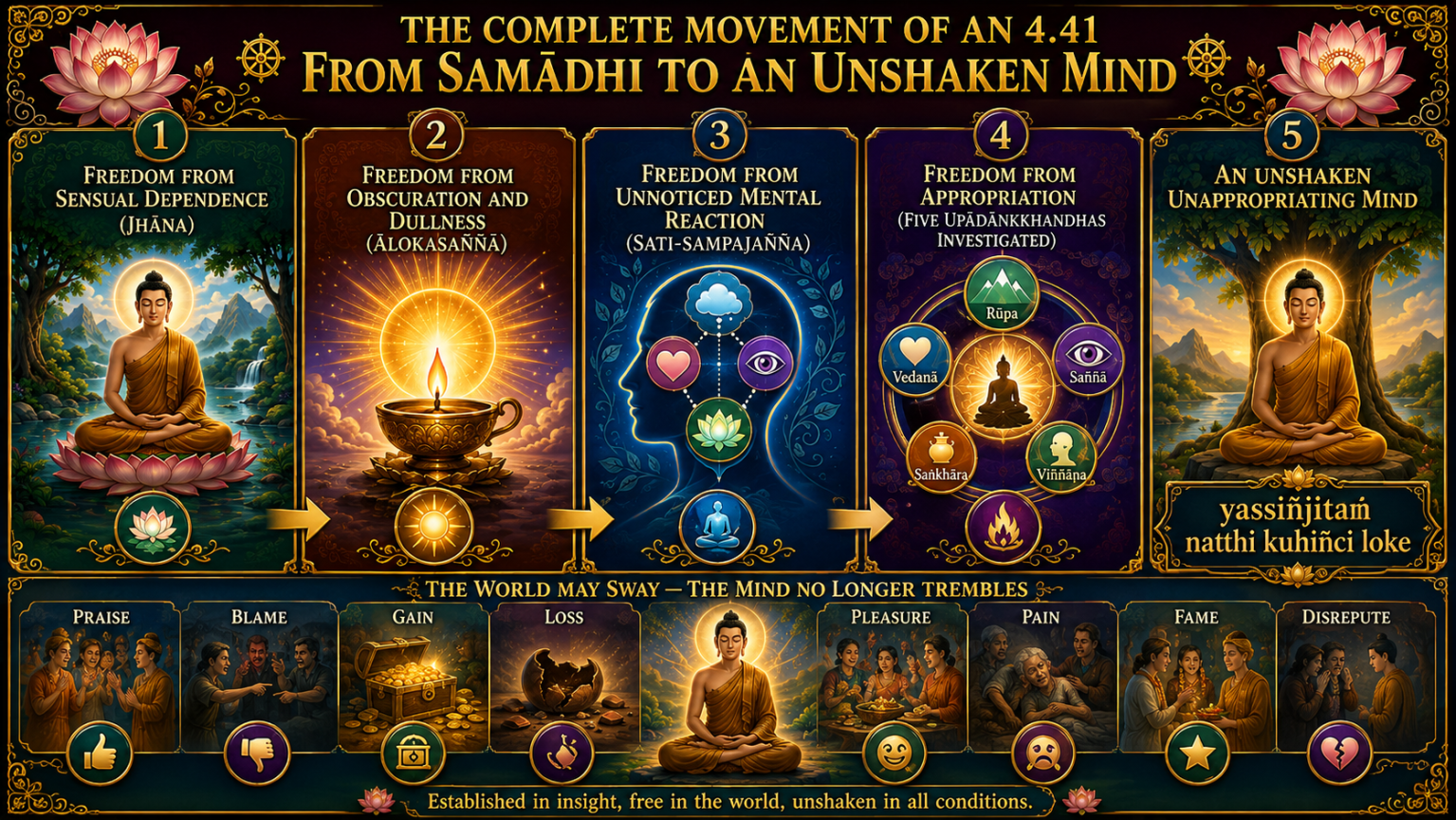
VISUAL SUMMARYSee this sutta in a pictureOpen the complete infographic for a visual overview before or after reading the full study.View infographic →
Central emphasis: the repeated expressions bhāvitā and bahulīkatā point to development through repeated cultivation, not merely intellectual understanding.
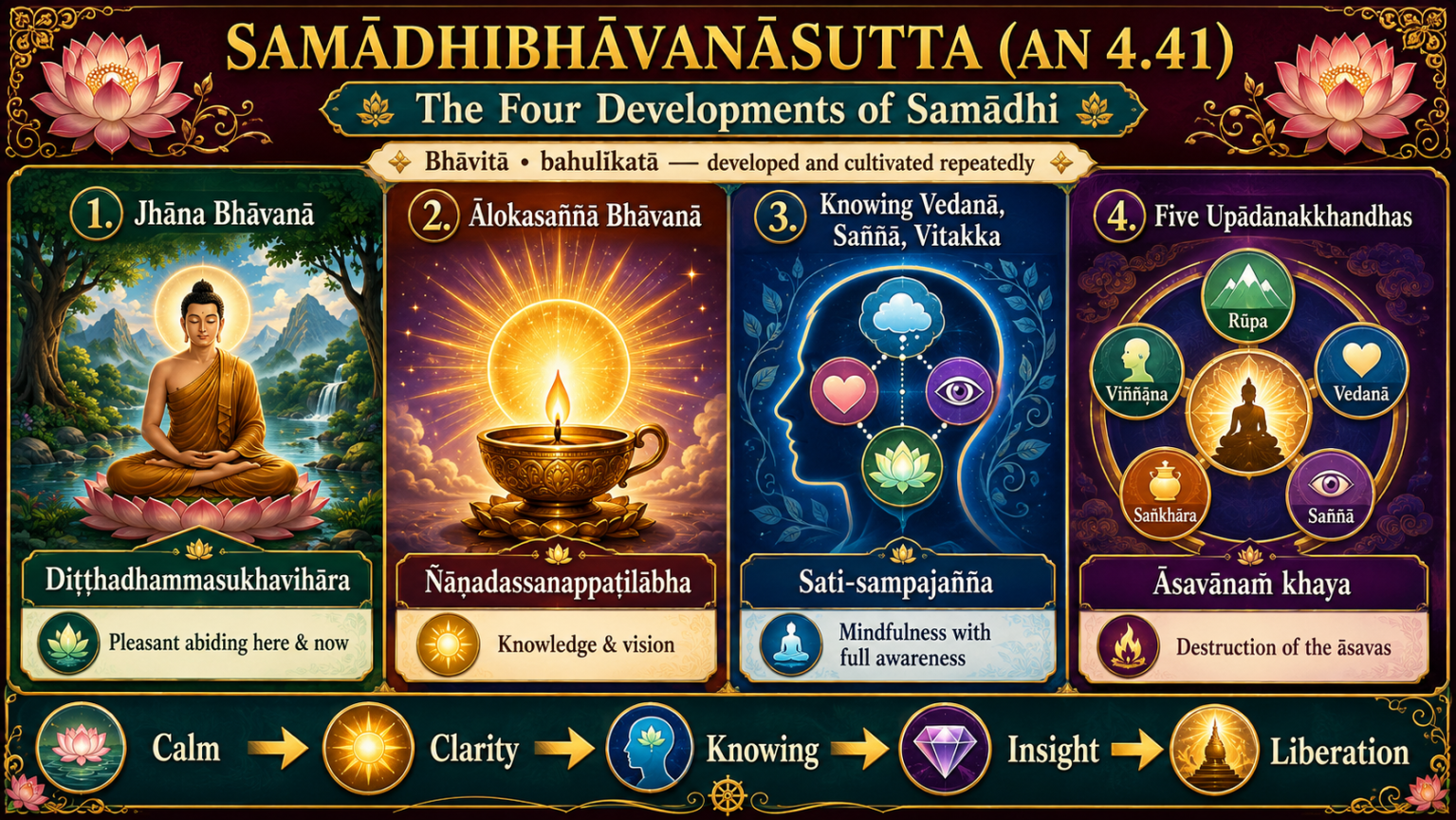
The Samādhibhāvanāsutta (AN 4.41) is an important discourse for understanding what the Buddha means by the development of samādhi. Rather than presenting samādhi as one uniform exercise, the Buddha distinguishes four different samādhibhāvanās according to the result for which they are developed. One leads to pleasant abiding here and now; another to knowledge and vision; another to sati-sampajañña; and the fourth to the destruction of the āsavas.
The opening passage therefore deserves careful attention:
Catasso imā, bhikkhave, samādhibhāvanā. Katamā catasso? Atthi, bhikkhave, samādhibhāvanā bhāvitā bahulīkatā diṭṭhadhammasukhavihārāya saṁvattati; atthi, bhikkhave, samādhibhāvanā bhāvitā bahulīkatā ñāṇadassanappaṭilābhāya saṁvattati; atthi, bhikkhave, samādhibhāvanā bhāvitā bahulīkatā satisampajaññāya saṁvattati; atthi, bhikkhave, samādhibhāvanā bhāvitā bahulīkatā āsavānaṁ khayāya saṁvattati.
“Bhikkhus, there are these four developments of samādhi. What four? There is a development of samādhi which, when developed and cultivated repeatedly, leads to pleasant abiding here and now. There is a development of samādhi which, when developed and cultivated repeatedly, leads to the attainment of knowledge and vision. There is a development of samādhi which, when developed and cultivated repeatedly, leads to mindfulness and full awareness. There is a development of samādhi which, when developed and cultivated repeatedly, leads to the destruction of the āsavas.”
Two expressions are especially important: bhāvitā and bahulīkatā. The Buddha is not speaking merely of understanding these practices intellectually. Bhāveti means to develop, cultivate, bring into being; bahulīkaroti means to make much of something, to practise it repeatedly until it becomes established. The four samādhibhāvanās therefore describe capacities that have to be cultivated again and again.
The architecture of the discourse can be represented simply:
SAMĀDHIBHĀVANĀ
       │
       ├── Jhāna
       │      ↓
       │   diṭṭhadhammasukhavihāra
       │   pleasant abiding here and now
       │
       ├── Ālokasaññā
       │      ↓
       │   ñāṇadassanappaṭilābha
       │   attainment of knowledge and vision
       │
       ├── Knowing vedanā, saññā and vitakka
       │      ↓
       │   sati-sampajañña
       │   mindfulness and full awareness
       │
       └── Udaya–atthaṅgama of the five upādānakkhandhas
              ↓
           āsavānaṁ khaya
           destruction of the āsavas
This immediately shows why reducing samādhi simply to “concentration” can obscure the teaching. The Buddha is describing different ways in which the mind is developed, each directed toward a particular outcome.
01 The First Development: Jhāna and Pleasant Abiding Here and Now
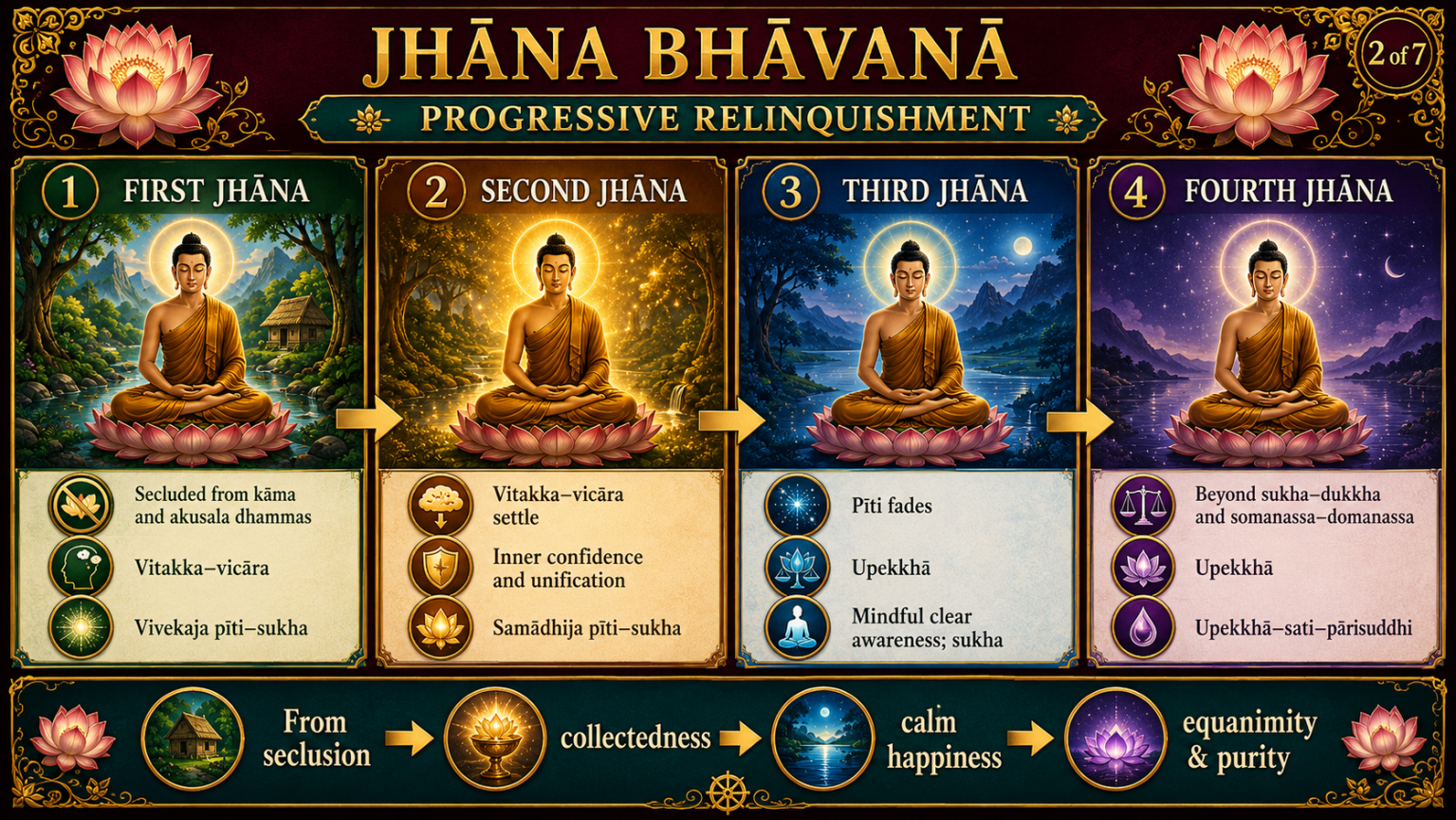
The first samādhibhāvanā is described through the four jhānas. In the received text the passage is abbreviated with …pe…, but for understanding the development it is useful to restore the complete progression.
First Jhāna
Idha, bhikkhave, bhikkhu vivicceva kāmehi vivicca akusalehi dhammehi savitakkaṁ savicāraṁ vivekajaṁ pītisukhaṁ paṭhamaṁ jhānaṁ upasampajja viharati.
“Here, bhikkhus, a bhikkhu, quite secluded from sensual pleasures, secluded from unwholesome dhammas, enters and dwells in the first jhāna, accompanied by vitakka and vicāra, with pīti and sukha born of seclusion.”
The first words explain the foundation:
vivicceva kāmehi — secluded from sensual pleasures
and
vivicca akusalehi dhammehi — secluded from unwholesome dhammas.
This means that first jhāna does not begin simply because attention has become narrow or because thoughts have temporarily slowed down. A qualitative separation has taken place. The mind is no longer feeding upon sensual involvement and unwholesome mental activity in the way it ordinarily does.
From that seclusion arises:
vivekajaṁ pītisukhaṁ — pīti and sukha born of seclusion.
This is important because the source of happiness has changed. Normally the uninstructed mind searches outside itself:
pleasant sight
      ↓
pleasant sound
      ↓
pleasant taste
      ↓
pleasant touch
      ↓
acquisition / possession
      ↓
"I will be happy when I get this."
In first jhāna the direction changes:
seclusion from kāma
        +
seclusion from akusala
        ↓
      viveka
        ↓
      pīti
        +
      sukha
The significance is not merely that the meditator has found another pleasant experience. The mind is learning experientially that well-being need not depend upon continually obtaining pleasurable objects through the six sense doors.
This has profound implications for indriya-saṁvara. Sensual restraint becomes much more workable when the mind discovers a happiness that does not require continuous sensory gratification.
02 The Second Jhāna: From Seclusion-Born Happiness to Samādhi-Born Happiness
Vitakkavicārānaṁ vūpasamā ajjhattaṁ sampasādanaṁ cetaso ekodibhāvaṁ avitakkaṁ avicāraṁ samādhijaṁ pītisukhaṁ dutiyaṁ jhānaṁ upasampajja viharati.
“With the subsiding of vitakka and vicāra, having internal serenity and unification of mind, without vitakka and vicāra, with pīti and sukha born of samādhi, he enters and dwells in the second jhāna.”
The transition is revealing.
In first jhāna:
vivekajaṁ pītisukhaṁ pīti and sukha are born of seclusion.
In second jhāna:
samādhijaṁ pītisukhaṁ pīti and sukha are born of samādhi.
Vitakka and vicāra have now subsided. The mind does not have to keep directing and examining in the same manner. There is ajjhattaṁ sampasādanaṁ, an internal settling or serenity, together with cetaso ekodibhāva, a gathering into oneness or unification.
The movement can be understood as:
FIRST JHĀNA

viveka
   ↓
vitakka + vicāra
   ↓
pīti + sukha


SECOND JHĀNA

vitakka/vicāra settle
         ↓
ajjhattaṁ sampasādanaṁ
         ↓
cetaso ekodibhāva
         ↓
samādhijaṁ pītisukhaṁ
The mind is progressively requiring less activity in order to remain established.
03 The Third Jhāna: Even Pīti Is Relinquished
Pītiyā ca virāgā upekkhako ca viharati sato ca sampajāno, sukhañca kāyena paṭisaṁvedeti; yaṁ taṁ ariyā ācikkhanti: “upekkhako satimā sukhavihārī”ti; tatiyaṁ jhānaṁ upasampajja viharati.
“With the fading away of pīti, he dwells equanimous, mindful and fully aware, experiencing sukha with the body. He enters and dwells in the third jhāna, concerning which the noble ones say: ‘Equanimous and mindful, one dwells happily.’”
Now even pīti is no longer retained.
This reveals a principle running throughout the jhānas: progress does not occur through acquiring more and more experiences; it occurs through relinquishing what is no longer necessary.
First sensuality is relinquished.
Then vitakka and vicāra settle.
Then pīti fades.
What becomes more prominent is:
upekkhako — equanimous sato — mindful sampajāno — fully aware.
It is worth noticing that sato sampajāno already appears here. This does not contradict the third samādhibhāvanā, which the Buddha later says is specifically developed for sati-sampajañña. Here mindfulness and full awareness are qualities present within third jhāna. Later, the Buddha describes another development in which the arising, presence and disappearance of vedanā, saññā and vitakka are themselves continuously known. The contexts are related but not identical.
04 The Fourth Jhāna: Purification of Mindfulness Through Equanimity
Sukhassa ca pahānā dukkhassa ca pahānā pubbeva somanassadomanassānaṁ atthaṅgamā adukkhamasukhaṁ upekkhāsatipārisuddhiṁ catutthaṁ jhānaṁ upasampajja viharati.
“With the abandoning of sukha and dukkha, and with the earlier disappearance of somanassa and domanassa, he enters and dwells in the fourth jhāna, which is neither painful nor pleasant and has purity of mindfulness through equanimity.”
Here the progressive relinquishment reaches still deeper.
Even sukha is relinquished. The mind does not require pleasure in order to remain undisturbed.
The extraordinary expression is:
upekkhā-sati-pārisuddhi — purification of mindfulness through equanimity.
The development can therefore be seen as a progressive reduction of dependence:
KĀMA
 ↓ relinquished

VITAKKA–VICĀRA
 ↓ settle

PĪTI
 ↓ fades

SUKHA / DUKKHA
SOMANASSA / DOMANASSA
 ↓ relinquished

UPEKKHĀ–SATI–PĀRISUDDHI
purity of mindfulness through equanimity
The Buddha then states the result:
Ayaṁ, bhikkhave, samādhibhāvanā bhāvitā bahulīkatā diṭṭhadhammasukhavihārāya saṁvattati.
“This development of samādhi, when developed and cultivated repeatedly, leads to pleasant abiding here and now.”
This does not mean that jhāna has no place in liberation. Rather, within the particular fourfold classification of AN 4.41, the Buddha identifies this aspect of jhāna as diṭṭhadhammasukhavihāra. He will separately identify the development directly leading to the destruction of the āsavas.
05 The Second Development: Ālokasaññā — Developing the Perception of Light
We now come to one of the most interesting and easily misunderstood passages in the discourse.
Katamā ca, bhikkhave, samādhibhāvanā bhāvitā bahulīkatā ñāṇadassanappaṭilābhāya saṁvattati?
“And what is the development of samādhi which, when developed and cultivated repeatedly, leads to the attainment of knowledge and vision?”
The Buddha answers:
Idha, bhikkhave, bhikkhu ālokasaññaṁ manasi karoti, divāsaññaṁ adhiṭṭhāti—yathā divā tathā rattiṁ, yathā rattiṁ tathā divā. Iti vivaṭena cetasā apariyonaddhena sappabhāsaṁ cittaṁ bhāveti.
“Here a bhikkhu attends to the perception of light. He establishes the perception of daytime: as by day, so by night; as by night, so by day. Thus, with a mind that is open and unenveloped, he develops a luminous or brightly manifest mind.”
Every phrase here deserves to be examined.
Ālokasaññaṁ manasi karoti
The Buddha does not merely say ālokaṁ passati—“he sees light.”
He says:
ālokasaññaṁ manasi karoti
He attends to, brings to mind, or gives attention to the perception of light.
The word saññā matters. Saññā is the faculty by which characteristics are recognized, marked and apprehended. The practice is therefore not simply a matter of placing the body underneath a bright lamp.
Nor does AN 4.41 instruct the practitioner to wait until a mysterious light spontaneously appears.
The practice involves deliberately establishing light as a perception within the mind.
The next expression explains this still further.
Divāsaññaṁ adhiṭṭhāti — Establishing the Perception of Day
The Buddha says:
divāsaññaṁ adhiṭṭhāti
He establishes or determines the perception of daytime.
Then comes the practical instruction:
yathā divā tathā rattiṁ, yathā rattiṁ tathā divā
“As by day, so by night; as by night, so by day.”
This tells us something important about the objective of the exercise. The mind ordinarily allows external conditions to determine its internal condition.
During daytime there is brightness, activity and wakefulness.
During nighttime there is darkness, heaviness and a biological inclination toward sleep.
For one cultivating ālokasaññā, the distinction is progressively removed at the level of mental perception.
Ordinary pattern

DAYLIGHT
   ↓
brightness
   ↓
alertness

NIGHT
   ↓
darkness
   ↓
heaviness
   ↓
dullness / sleepiness
The Buddha’s training aims in another direction:
DAY
 ↓
perception of light
 ↓
clarity / wakefulness

                sustained

NIGHT
 ↓
the same perception of light
 ↓
clarity / wakefulness
Hence:
yathā divā tathā rattiṁ as by day, so by night.
The practitioner is training the mind so that external darkness does not automatically become internal darkness.
This interpretation is strongly supported by AN 7.61 Pacalāyamānasutta. When Mahāmoggallāna is struggling with drowsiness, the Buddha gives a sequence of methods for overcoming it. Among them he specifically instructs Moggallāna to attend to ālokasaññā, establish the perception of daytime, and maintain the same relationship between day and night. The same practice that AN 4.41 associates with ñāṇadassana therefore also occurs in a practical context concerned with dispelling middha.
This connection is very important.
Ālokasaññā is not merely about having an interesting visual meditation experience.
It is intimately related to overcoming mental enclosure, obscuration and dullness.
06 How Can Ālokasaññā Actually Be Developed?
The sutta gives the principles rather than a modern step-by-step technique, so we should distinguish carefully between what the Buddha explicitly states and how those instructions can reasonably be implemented in practice.
The Buddha explicitly provides four elements:
ālokasaññā
perception of light
        ↓
divāsaññā
perception of daytime
        ↓
yathā divā tathā rattiṁ
as by day, so by night
        ↓
vivaṭena cetasā apariyonaddhena
mind open and unenveloped
        ↓
sappabhāsaṁ cittaṁ bhāveti
develops a bright / luminous mind
A practical application should preserve this sequence rather than introducing something that the passage itself never mentions.
During the daytime, one can first become clearly aware of brightness as brightness. Rather than merely seeing objects illuminated by daylight, attention is given to the quality of illumination itself—the openness, visibility and absence of darkness associated with daytime. The task is not to think repeatedly, “light, light, light,” but to allow saññā to become established around brightness and clarity.
One should notice the distinction between looking at an object and recognizing the presence of illumination.
Suppose one is sitting near a window during the daytime. Normally the eye immediately goes toward individual objects: a tree, a building, a person walking past, a vehicle or the sky. In ālokasaññā, interest in the individual objects can be reduced and the common characteristic of brightness made prominent.
The mind learns:
This is the quality of daylight. This is brightness. This is openness rather than obscuration.
Once that perception has become familiar, the crucial training is to retain or re-establish it when actual environmental conditions change.
Night arrives.
The room is dim.
The eyes may be closed.
Yet the mind need not adopt darkness as its dominant internal mode.
Instead the divāsaññā developed earlier is brought to prominence.
Not necessarily by constructing an elaborate visual picture of the sun, sky, lamp or white disc, but by re-establishing the mental recognition of brightness, openness and wakefulness.
This is where the expression adhiṭṭhāti becomes useful. The perception is not passively awaited. It is established.
The practical transformation can be depicted as:
External night
      ↓
physical darkness

BUT

physical darkness
      ≠
mental obscuration

Instead:

ālokasaññā
      ↓
divāsaññā
      ↓
wakeful perception maintained
      ↓
vivaṭa citta
open mind
      ↓
apariyonaddha citta
unenveloped mind
      ↓
sappabhāsa citta
bright mind
This also explains why merely switching on a powerful electric light cannot itself constitute the cultivation.
External light may assist the initial recognition of brightness, but the Buddha’s endpoint is not:
“make the room bright.”
It is:
sappabhāsaṁ cittaṁ bhāveti — he develops a bright mind.
The development is occurring in citta.
07 Vivaṭena Cetasā — An Open Mind
The Buddha next says:
vivaṭena cetasā
with a mind that is open, uncovered or exposed.
This expression helps us understand what darkness means in this practice.
The problem is not darkness as a physical phenomenon. Night itself is not an akusala dhamma.
The problem is the manner in which the mind can become closed down, constricted and unavailable for clear knowing.
Anyone who has observed drowsiness carefully will recognize the process. Awareness begins broad and clear. Then the field seems to contract. Perception becomes indistinct. Thoughts lose coherence. Objects fade. Eventually awareness is enveloped and sleep occurs.
Schematically:
clear awareness
      ↓
heaviness
      ↓
narrowing
      ↓
obscuration
      ↓
loss of clarity
      ↓
middha
      ↓
sleep
Ālokasaññā works in the opposite direction:
middha / obscuration
       ↓
ālokasaññā
       ↓
divāsaññā
       ↓
opening of the field
       ↓
clarity
       ↓
wakefulness
This makes the connection with the Pacalāyamānasutta particularly meaningful. There, ālokasaññā is not presented as decoration around meditation but as one of the Buddha’s direct responses to drowsiness.
08 Apariyonaddhena — Not Enveloped
The next word is equally revealing:
apariyonaddhena
not covered, wrapped around, enveloped or obscured.
Imagine a clear window gradually covered by fog. The outside world has not disappeared, but the capacity to see it clearly has been obstructed.
Mental dullness operates similarly.
The practice of ālokasaññā is therefore better understood as removing the mental covering rather than producing a spectacular light phenomenon.
This distinction is extremely important for practice.
A practitioner may experience flashes, colours, luminosity, internal imagery or various visual phenomena during meditation. Some may be useful; some may be incidental. But AN 4.41 does not tell the practitioner:
“Wait until you see a special light and then follow it.”
Nor does this passage instruct one to gaze at a candle, create a kasina disc, or seek a particular visual nimitta.
Its explicit language is:
ālokasaññā → divāsaññā → open mind → unenveloped mind → bright mind.
That distinction protects the practice from becoming a search for unusual meditation experiences.
09 What Would Progress in Ālokasaññā Look Like?
If the practice is developing correctly, the most important sign is not necessarily the appearance of a visual light.
A more meaningful sign would be that clarity becomes less dependent upon environmental conditions.
At first:
bright environment → bright mind
dark environment   → dull mind
With cultivation:
bright environment → clear mind

dark environment   → clear mind

eyes open           → clear mind

eyes closed         → clear mind

day                 → wakeful

night               → wakeful
This does not mean eliminating normal physiological sleep. The Buddha is teaching a meditative development, not advocating biological sleep deprivation. The point is that when one has undertaken wakeful practice, darkness should not automatically produce mental collapse.
This becomes particularly important for a practitioner cultivating jāgariyānuyoga—devotion to wakefulness. One cannot meaningfully practise wakefulness merely by keeping the body upright while the mind is sinking into dullness. Ālokasaññā gives a way of training the perceptual side of wakefulness.
The distinction can be put simply:
BODY AWAKE + MIND DARK
        ≠
true clarity

BODY AWAKE + MIND OPEN
        +
ālokasaññā
        ↓
sappabhāsa citta
AN 4.41 says that this samādhibhāvanā leads to ñāṇadassanappaṭilābha — attainment of knowledge and vision. The discourse does not identify this with the destruction of the āsavas; that result belongs explicitly to the fourth development. Therefore extraordinary perceptions, brightness or clarity should not automatically be interpreted as liberation.
10 The Third Development: Sati-Sampajañña
The third samādhibhāvanā is described very differently.
Idha, bhikkhave, bhikkhuno viditā vedanā uppajjanti, viditā upaṭṭhahanti, viditā abbhatthaṁ gacchanti; viditā saññā uppajjanti, viditā upaṭṭhahanti, viditā abbhatthaṁ gacchanti; viditā vitakkā uppajjanti, viditā upaṭṭhahanti, viditā abbhatthaṁ gacchanti.
“Here, for a bhikkhu, feelings arise known, remain present known, and disappear known; perceptions arise known, remain present known, and disappear known; thoughts arise known, remain present known, and disappear known.”
The word repeated throughout is:
viditā — known.
The Buddha does not say that vedanā must not arise.
He does not say that saññā must be stopped.
He does not say that vitakka must never occur.
The training is that when these processes occur, they no longer occur unrecognized.
Three phases are known:
UPPAJJA
arising

   ↓

UPAṬṬHĀNA
presence / standing

   ↓

ABBHATTHAṄGAMA
disappearance
This is a very practical description of sati-sampajañña.
11 An Example: Someone Criticizes Me
Suppose someone says:
“You handled that very badly.”
Ordinarily the whole event may appear to occur instantaneously:
“He insulted me, and I became angry.”
But sati-sampajañña allows the experience to become differentiated.
A sound is heard.
An unpleasant vedanā appears.
Saññā identifies the words and their meaning: “He is criticizing me.”
Vitakka begins:
“Why did he say that?” “He always behaves like this.” “I should answer him.” “He has no right to speak to me this way.”
The mind then continues elaborating the event.
The practice changes this:
WORDS HEARD
     ↓
vedanā arises
     ↓
"unpleasant" — KNOWN

     ↓
saññā recognizes
"criticism" — KNOWN

     ↓
vitakka appears
"I should answer" — KNOWN

     ↓
vitakka remains
the argument continues internally — KNOWN

     ↓
vitakka disappears
                           — KNOWN
This is very different from merely realizing five minutes later:
“I was angry.”
The Buddha’s language points toward knowing the event while it is occurring.
This is where sampajañña becomes transformative.
The practitioner begins seeing:
A vedanā has arisen.
rather than immediately:
I am hurt.
A perception has arisen.
rather than:
This person is terrible.
A thought has arisen.
rather than:
This is what I must do.
Space begins to appear between an arising dhamma and its appropriation.
12 Vedanā Is Not Restricted to Bodily Sensation
This is especially important.
In SN 22.57 Sattaṭṭhānasutta, vedanā is explained in terms of the six classes associated with contact through eye, ear, nose, tongue, body and mind. Therefore vedanā cannot be restricted to tactile bodily sensation.
A beautiful sight can condition pleasant vedanā.
An offensive sound can condition unpleasant vedanā.
A memory coming through the mind-door can condition painful vedanā.
An idea can condition pleasant vedanā.
A bodily injury can condition unpleasant vedanā.
The field is all six doors.
This considerably enlarges sati-sampajañña practice.
EYE      ─┐
EAR       │
NOSE      │
TONGUE    ├── CONTACT → VEDANĀ → KNOWN
BODY      │
MIND      │
          ┘
The aim is not to manufacture sensations but to recognize the vedanā already arising through lived experience.
13 The Fourth Development: Seeing the Arising and Passing of the Five Upādānakkhandhas
The fourth samādhibhāvanā is the culmination:
Idha, bhikkhave, bhikkhu pañcasu upādānakkhandhesu udayabbayānupassī viharati.
“Here a bhikkhu dwells contemplating arising and passing away in the five aggregates subject to clinging.”
The Buddha then repeats the pattern for each aggregate:
iti rūpaṁ, iti rūpassa samudayo, iti rūpassa atthaṅgamo
“Such is rūpa; such is the arising of rūpa; such is the passing away of rūpa.”
The same is applied to:
vedanā
saññā
saṅkhārā
viññāṇa.
The structure is therefore not merely:
“Watch everything change.”
It is an investigation:
WHAT IS THIS?
       ↓
iti rūpaṁ

HOW DOES IT ARISE?
       ↓
rūpassa samudayo

HOW DOES IT PASS AWAY?
       ↓
rūpassa atthaṅgamo
The same inquiry is performed with all five aggregates.
14 SN 22.57 Makes the Five-Aggregate Investigation Complete
AN 4.41 gives the fourth samādhibhāvanā in a remarkably compressed form. The practitioner dwells as udayabbayānupassī among the five upādānakkhandhas and investigates each one as: iti rūpaṁ, iti rūpassa samudayo, iti rūpassa atthaṅgamo—“such is form, such is the arising of form, such is the passing away of form”—and likewise for vedanā, saññā, saṅkhārā and viññāṇa.
If this is read only as “notice that the five aggregates arise and pass away,” much of the depth can be missed. SN 22.57 Sattaṭṭhānasutta supplies a very useful canonical expansion. It says that a bhikkhu who is sattaṭṭhānakusala—skilled in seven cases—understands each aggregate in seven ways: the aggregate itself, its arising, its cessation, the way leading to its cessation, its gratification, its danger and its escape. After this sevenfold investigation the Buddha adds a further threefold examination: dhātuso, in terms of elements; āyatanaso, in terms of sense fields; and paṭiccasamuppādaso, in terms of dependent arising.
The relationship between the two discourses is therefore extremely helpful. AN 4.41 gives the central vipassanā formula directed to the five upādānakkhandhas. SN 22.57 shows what mature understanding of each khandha actually involves. The latter should not be treated as though it were merely replacing the wording of AN 4.41; rather, it illuminates how deeply “iti rūpaṁ … samudayo … atthaṅgamo” can be penetrated.
The sevenfold framework is:
WHAT IS THIS AGGREGATE?
        ↓
HOW DOES IT ARISE?
        ↓
WHAT IS ITS CESSATION?
        ↓
WHAT WAY LEADS TO ITS CESSATION?
        ↓
WHAT IS ITS ASSĀDA — GRATIFICATION?
        ↓
WHAT IS ITS ĀDĪNAVA — DANGER / DRAWBACK?
        ↓
WHAT IS ITS NISSARAṆA — ESCAPE?
This changes the entire meaning of insight practice. One is not merely waiting for phenomena to disappear. One learns what is happening, what sustains it, why the mind becomes attracted to it, why that attraction is dangerous, and what release from that attraction actually means.
Another point is equally important. For every one of the five aggregates, SN 22.57 states that the way leading to its cessation is the Noble Eightfold Path, from sammādiṭṭhi through sammāsamādhi. Thus the investigation of the aggregates cannot be separated from the rest of the Buddha’s training. It is not an isolated observation technique. Sīla, right effort, sati, samādhi and paññā belong to the same path by which attachment to the aggregates comes to cessation.
The five aggregates can now be examined one by one.
15 Rūpa — Knowing Form, Its Arising, Its Danger and Its Escape
SN 22.57 begins:
Katamañca, bhikkhave, rūpaṁ? Cattāro ca mahābhūtā, catunnañca mahābhūtānaṁ upādāya rūpaṁ. Idaṁ vuccati, bhikkhave, rūpaṁ. Āhārasamudayā rūpasamudayo; āhāranirodhā rūpanirodho.
“And what is form? The four great elements and form derived from the four great elements: this is called form. With the arising of nutriment there is the arising of form; with the cessation of nutriment there is the cessation of form.”
This gives much greater precision to iti rūpaṁ. Rūpa is not merely a vague word for “the body.” The Buddha directs attention to materiality as constituted by the great elements and dependent material form. What we ordinarily compress into the thought “my body” is therefore opened up and examined as conditioned material process.
The body has solidity, cohesion, temperature and movement. It must be nourished. It depends on material conditions that are not under sovereign control. It is affected by climate, food, injury, disease, ageing and innumerable external conditions. The practitioner is therefore learning to move from the conventional perception “I am this body” toward direct recognition: “This is rūpa; this is conditioned materiality.”
The practical movement may be represented as:
ordinary appropriation
        ↓
"my body"
        ↓
careful examination
        ↓
cattāro mahābhūtā
+ derived material form
        ↓
dependent on nutriment
        ↓
arises, persists conditionally, changes and ceases
SN 22.57 next states:
Ayameva ariyo aṭṭhaṅgiko maggo rūpanirodhagāminī paṭipadā.
“This very Noble Eightfold Path is the way leading to the cessation of form.”
This is a crucial safeguard. Insight into rūpa is not achieved simply by staring at bodily change. The path by which attachment to the aggregate is brought to its end is the entire Noble Eightfold Path.
The Buddha then introduces three further dimensions: assāda, ādīnava and nissaraṇa.
Yaṁ rūpaṁ paṭicca uppajjati sukhaṁ somanassaṁ—ayaṁ rūpassa assādo.
The gratification of rūpa is the pleasure and gladness that arise dependent upon form.
This explains why rūpa becomes an object of clinging. We do not cling to the body merely because we possess a philosophical theory about it. We cling because certain forms give pleasure. We delight in youthfulness, health, beauty, physical strength, attractive appearance, pleasant objects and bodily capabilities. The gratification is real at the level of experience; otherwise attachment would have no fuel.
For example, someone may be delighted when told that they look younger than their age. Another may be pleased by physical fitness, appearance, strength or an attractive possession. That pleasure becomes the doorway through which rūpa is appropriated:
rūpa
   ↓
sukha / somanassa arises dependent on it
   ↓
delight
   ↓
"I like this"
   ↓
"I want this to remain"
   ↓
"this is mine"
But the Buddha immediately requires the other side to be understood:
Yaṁ rūpaṁ aniccaṁ dukkhaṁ vipariṇāmadhammaṁ—ayaṁ rūpassa ādīnavo.
The danger or drawback is that rūpa is anicca, dukkha and vipariṇāmadhamma—impermanent, unable to provide lasting security, and subject to change.
The same body that gives confidence at one time becomes ill. The appearance that gives pride changes with age. The physical ability that once seemed dependable weakens. A valued object breaks, deteriorates or is lost. The danger is not that rūpa is evil; the danger is expecting permanence, ownership or reliable refuge from something whose nature is alteration.
Finally:
Yo rūpasmiṁ chandarāgavinayo chandarāgappahānaṁ—idaṁ rūpassa nissaraṇaṁ.
The escape from rūpa is the removal and abandonment of desire-and-lust with regard to rūpa.
Notice how precise this is. Escape does not mean destroying the body or hating material existence. The escape is chandarāgavinaya and chandarāgappahāna—the taming, removal and abandonment of desire-and-passion toward it.
Thus the complete investigation of rūpa becomes:
ITI RŪPAṀ
What is rūpa?
        ↓
four great elements + derived form

RŪPASSA SAMUDAYO
What conditions its arising?
        ↓
āhāra

RŪPANIRODHO
What is its cessation?
        ↓
cessation of the sustaining condition

NIRODHAGĀMINĪ PAṬIPADĀ
What leads beyond attachment to it?
        ↓
Noble Eightfold Path

ASSĀDA
Why does the mind cling?
        ↓
pleasure and gladness dependent on rūpa

ĀDĪNAVA
What is the danger?
        ↓
anicca • dukkha • vipariṇāmadhamma

NISSARAṆA
What is escape?
        ↓
abandoning chanda-rāga toward rūpa
Only now does iti rūpaṁ, iti rūpassa samudayo, iti rūpassa atthaṅgamo begin to reveal its full force. The practitioner is not merely watching a body change. The mechanism by which material form becomes “me” and “mine” is being understood and dismantled.
16 Vedanā — Knowing Feeling Across All Six Doors
SN 22.57 defines vedanā through six classes:
Chayime, bhikkhave, vedanākāyā—cakkhusamphassajā vedanā … manosamphassajā vedanā. Ayaṁ vuccati, bhikkhave, vedanā. Phassasamudayā vedanāsamudayo; phassanirodhā vedanānirodho.
There are feelings born of eye-contact, ear-contact, nose-contact, tongue-contact, body-contact and mind-contact. With the arising of contact comes the arising of vedanā; with the cessation of contact comes the cessation of vedanā.
This is essential because vedanā should not be reduced to bodily “sensation.” Bodily feeling is only one part of the sixfold field. A sight can condition pleasant vedanā. Words heard through the ear can condition painful vedanā. A fragrance, taste or tactile experience can condition vedanā. A memory, expectation, idea or mental image appearing through the mind-door can condition vedanā.
Suppose someone receives a message saying, “Your work was excellent.” The body need not be touched at all. Through the mind-door and the meaning of the words, pleasant vedanā may arise. Later another message arrives: “There is a serious problem with what you submitted.” Unpleasant vedanā may immediately arise. These are not secondary phenomena. They belong directly within the Buddha’s sixfold analysis.
The sequence can be seen as:
EYE   ─┐
EAR    │
NOSE   │
TONGUE ├── PHASSA ──→ VEDANĀ
BODY   │                 │
MIND   ┘                 ├── pleasant
                         ├── painful
                         └── neither-painful-nor-pleasant
The phrase phassasamudayā vedanāsamudayo is therefore of immense practical importance. Feeling does not arise as an independent “me.” It arises dependent on contact.
Consider the familiar example of seeing an attractive device in a shop. The ordinary story is:
“I love that. I want it.”
But sati-sampajañña and insight can reveal a much more precise process:
eye + visible form + eye-consciousness
                ↓
              phassa
                ↓
          pleasant vedanā
                ↓
           craving may arise
Someone standing beside us may see the very same object and experience neutral vedanā. This shows that pleasantness is not a permanent substance residing inside the object waiting to enter us. Vedanā is dependently arisen.
SN 22.57 again says that the Noble Eightfold Path is the way leading to the cessation of vedanā in this framework. The path is therefore what carries the practitioner beyond bondage to feeling; the objective is not to manufacture a permanently pleasant stream of vedanā.
The gratification of vedanā is stated in the same pattern:
Yaṁ vedanaṁ paṭicca uppajjati sukhaṁ somanassaṁ—ayaṁ vedanāya assādo.
Pleasure and gladness arising dependent upon feeling constitute its gratification. This explains why pleasant feeling is so compelling. We naturally want pleasant vedanā to continue, and we want unpleasant vedanā to stop. Without understanding, the mind quickly moves from vedanā to craving and appropriation.
The danger is:
Yā vedanā aniccā dukkhā vipariṇāmadhammā—ayaṁ vedanāya ādīnavo.
Vedanā is impermanent, unsatisfactory as a basis for lasting refuge, and subject to change. Pleasant feeling cannot be commanded to remain pleasant. Painful feeling cannot always be commanded to disappear. Neutral feeling changes without asking permission.
This is where suffering often develops. The mind does not merely experience pleasant vedanā; it demands continuation. It does not merely experience unpleasant vedanā; it demands immediate termination. Thus the second layer of suffering is built around the first event.
pleasant vedanā
      ↓
"remain"
      ↓
grasping

unpleasant vedanā
      ↓
"go away"
      ↓
resistance

both cases
      ↓
mind becomes dependent on vedanā
The escape is:
Yo vedanāya chandarāgavinayo chandarāgappahānaṁ—idaṁ vedanāya nissaraṇaṁ.
The escape is the removal and abandonment of desire-and-lust regarding vedanā. This does not require becoming incapable of experiencing pleasure or pain. It means that feeling no longer automatically generates ownership, hunger, resistance and becoming.
Therefore the deeper contemplation is not merely:
“pleasant feeling arose and passed.”
It is:
this is vedanā
      ↓
it arose dependent on phassa
      ↓
its gratification is understood
      ↓
its instability and danger are understood
      ↓
chanda-rāga toward it is abandoned
      ↓
vedanā no longer has to become "my happiness" or "my suffering"
17 Saññā — Knowing the Perceptual Construction of the Experienced World
SN 22.57 defines saññā as six classes:
Chayime, bhikkhave, saññākāyā—rūpasaññā, saddasaññā, gandhasaññā, rasasaññā, phoṭṭhabbasaññā, dhammasaññā. Ayaṁ vuccati, bhikkhave, saññā. Phassasamudayā saññāsamudayo; phassanirodhā saññānirodho.
There is perception of forms, sounds, smells, tastes, tactile objects and mental objects. With the arising of contact comes the arising of saññā; with the cessation of contact comes the cessation of saññā.
Saññā allows experience to be recognized, distinguished and marked. Without it, the practical world could not be navigated. A collection of colour and shape is recognized as “a person,” “a car,” “my house” or “a phone.” A sound pattern becomes “my name,” “praise,” “criticism” or “music.” A mental event becomes “memory,” “plan,” “danger,” “success” or “failure.”
The significance for practice is that what we experience is very quickly no longer merely a present sensory event. Saññā supplies recognition and meaning, and old associations can immediately enter the present.
Suppose a person who criticized us yesterday walks into the room today. At the visible level there is simply present visual contact. But saññā recognizes:
“That is the person who insulted me.”
In an instant, yesterday can be carried into today.
present visible form
       ↓
phassa
       ↓
saññā recognizes identity
       ↓
"the person who criticized me"
       ↓
memory + meaning + old vedanā become active
       ↓
fresh reaction may arise
This is why viditā saññā in the third samādhibhāvanā is so important. When saññā is known as saññā, the practitioner has a chance to distinguish the perceptual event from the whole story subsequently built around it.
Again SN 22.57 states that the Noble Eightfold Path is the way leading to its cessation. The path is what brings the practitioner beyond bondage to perception, not an attempt to abolish the functional ability to recognize things.
The gratification of saññā follows the same principle as with the other aggregates: the pleasure and gladness that arise dependent upon saññā are its assāda. We enjoy certain recognitions and meanings. The perception “I am respected,” “this belongs to me,” “this person loves me,” “I succeeded,” or “this is beautiful” can give great somanassa. Because of that gratification, the perceptual world becomes very easy to appropriate.
The danger is that saññā is aniccā, dukkhā, vipariṇāmadhammā. Perceptions change. What once appeared attractive later appears unattractive. Someone once perceived as a friend may later be perceived as an enemy. An opinion once held with certainty may be abandoned after new information. The remembered person is not identical to the person presently before us, yet saññā can make the old construction feel immediately real.
The escape is the removal and abandonment of chanda-rāga toward saññā. This does not mean inability to recognize a chair as a chair or a person as a person. It means no longer needing one’s perceptual constructions to establish identity, ownership and emotional security.
The practice therefore evolves from:
"This IS reality exactly as I perceive it"
                 ↓
            investigation
                 ↓
"saññā has arisen dependent on contact"
                 ↓
"it recognizes and marks"
                 ↓
"it changes"
                 ↓
"pleasure can arise dependent on it"
                 ↓
"clinging to it is dangerous"
                 ↓
release of chanda-rāga toward saññā
This is particularly powerful in relation to views, interpersonal conflicts and self-image. A great deal of suffering is sustained not by what is presently occurring, but by what saññā has named, categorized and carried forward.
18 Saṅkhārā — Seeing the Volitional Construction of Experience
SN 22.57 is exceptionally helpful here because it defines saṅkhārā in this context through six classes of cetanā:
Chayime, bhikkhave, cetanākāyā—rūpasañcetanā … dhammasañcetanā. Ime vuccanti, bhikkhave, saṅkhārā. Phassasamudayā saṅkhārasamudayo; phassanirodhā saṅkhāranirodho.
There is volition regarding forms, sounds, smells, tastes, tactile objects and mental objects. These are called saṅkhārā. With the arising of contact comes the arising of saṅkhārā; with the cessation of contact comes the cessation of saṅkhārā.
This prevents saṅkhārā from becoming an abstract or mysterious concept. In the present context we can look directly at cetanā—the volitional movement that begins shaping what happens next.
An attractive object is seen. Pleasant vedanā arises. Saññā recognizes it as desirable. Then cetanā begins to move:
“Let me look at it again.”
“I should compare the models.”
“Perhaps I should buy it.”
“How can I arrange the money?”
Or in an unpleasant situation:
“I should answer him.”
“I will avoid that person.”
“I must prove that I am right.”
Now experience is no longer simply being received. It is being constructed forward through intention.
CONTACT
   ↓
VEDANĀ
   ↓
SAÑÑĀ recognizes the situation
   ↓
CETANĀ forms around it
   ↓
"approach"
"avoid"
"speak"
"acquire"
"defend"
"become"
   ↓
action and further becoming
This is where the link with kamma becomes especially important. Cetanā is not merely a thought floating through the mind; it is the intentional orientation from which bodily, verbal and mental action can proceed.
The gratification of saṅkhārā is the pleasure and gladness arising dependent upon them. Planning can be pleasurable. Imagining future success can be pleasurable. Rehearsing how one will win an argument can perversely be pleasurable. Constructing an identity—“I will become this kind of person”—can give hope and excitement. Thus saṅkhārā themselves can become objects of delight.
The danger is that saṅkhārā are aniccā, dukkhā and vipariṇāmadhammā. Plans fail. Intentions change. Conditions obstruct what we intended. The identity we constructed cannot be made permanent. Even wholesome intentions must eventually be understood as conditioned processes rather than “my permanent essence.”
The escape is the removal and abandonment of chanda-rāga toward saṅkhārā. This is not passivity and does not mean that an arahant has no functional intentions. Rather, the appropriative thirst around volitional construction has ended. Cetanā can function without building a self around what is intended.
The deeper investigation therefore becomes:
"I have decided"
       ↓
look more carefully
       ↓
cetanā has arisen dependent on contact
       ↓
it constructs a direction of action
       ↓
pleasure may arise dependent on that construction
       ↓
the construction is impermanent and subject to change
       ↓
chanda-rāga toward saṅkhārā is abandoned
       ↓
less construction of "what I must become"
This makes the contemplation of saṅkhārā central to understanding how the present becomes a platform for future becoming.
19 Viññāṇa — Consciousness Is Known as Conditioned, Not as a Hidden Permanent Self
SN 22.57 defines viññāṇa through six classes:
Chayime, bhikkhave, viññāṇakāyā—cakkhuviññāṇaṁ, sotaviññāṇaṁ, ghānaviññāṇaṁ, jivhāviññāṇaṁ, kāyaviññāṇaṁ, manoviññāṇaṁ. Idaṁ vuccati, bhikkhave, viññāṇaṁ. Nāmarūpasamudayā viññāṇasamudayo; nāmarūpanirodhā viññāṇanirodho.
There is eye-consciousness, ear-consciousness, nose-consciousness, tongue-consciousness, body-consciousness and mind-consciousness. With the arising of nāmarūpa comes the arising of viññāṇa; with the cessation of nāmarūpa comes the cessation of viññāṇa.
This is perhaps the most important aggregate to examine carefully because after seeing the instability of body, feeling, perception and volitional activity, the mind may still retreat into the idea of a permanent inner witness:
“All these things change, but surely the consciousness that knows them is the real self.”
SN 22.57 does not allow viññāṇa to become such a refuge. It is analyzed into six conditioned classes. Seeing consciousness is not hearing consciousness. Hearing consciousness is not mind-consciousness. Each occurs according to conditions.
visible form + eye conditions
          ↓
   cakkhuviññāṇa

sound + ear conditions
          ↓
    sotaviññāṇa

mental object + mind conditions
          ↓
    manoviññāṇa
Instead of imagining one unchanging entity standing behind all experience, the practitioner sees consciousness itself within dependent conditionality.
The statement nāmarūpasamudayā viññāṇasamudayo is especially significant. Viññāṇa is not presented as an autonomous first principle. Its arising is connected with nāmarūpa. This is consistent with the broader dependent-arising teaching in which viññāṇa and nāmarūpa stand in a deeply conditioned relationship rather than as an independent eternal consciousness observing the rest of existence.
The Noble Eightfold Path is again said to be the way leading to cessation. This prevents the practitioner from turning insight into an attempt to annihilate consciousness. The path leads to release from clinging and the ending of the conditions that sustain the round of suffering.
The gratification of viññāṇa is the pleasure and gladness that arise dependent upon consciousness. There can be delight simply in seeing, hearing, knowing, remembering, imagining and being conscious of desirable worlds of experience. Conscious experience provides the field within which gratification is enjoyed, and therefore passion can attach even to consciousness itself.
The danger is that viññāṇa too is anicca, dukkha and vipariṇāmadhamma. A particular consciousness arises dependent on conditions and does not remain. What is seen changes; seeing ceases. Sound ends; the corresponding hearing consciousness ends. Mental objects change; mind-consciousness changes with them. Something so dependently variable cannot serve as an unchanging self.
The escape is the removal and abandonment of chanda-rāga toward viññāṇa. This is profound because attachment can survive in extremely refined form as attachment to “being the knower,” “pure consciousness,” or “the witness.” SN 22.57 directs the same investigation there: understand its gratification, understand its danger, and abandon desire-and-passion regarding it.
Thus:
"there is a permanent knower behind experience"
                   ↓
              investigate
                   ↓
six classes of viññāṇa
                   ↓
arising in dependence on conditions
                   ↓
subject to cessation and alteration
                   ↓
assāda understood
                   ↓
ādīnava understood
                   ↓
chanda-rāga abandoned
                   ↓
no need to manufacture a self out of viññāṇa
Now iti viññāṇaṁ, iti viññāṇassa samudayo, iti viññāṇassa atthaṅgamo becomes much more than observing moments of consciousness appearing and vanishing. The practitioner is penetrating the very tendency to make consciousness into “who I really am.”
20 The Same Seven Questions Must Be Asked of All Five Aggregates
SN 22.57 is powerful because it does not permit selective insight. The same sevenfold investigation must be applied to all five aggregates. The body cannot be examined deeply while consciousness is quietly retained as self. Vedanā cannot be seen as conditioned while one’s views and perceptions are treated as unquestionable. Saṅkhārā cannot be criticized as “mental fabrication” while one continues delighting in the identity built from them.
The complete movement is:
RŪPA ──────────────┐
VEDANĀ ────────────┤
SAÑÑĀ ─────────────┤
SAṄKHĀRĀ ──────────┤──→ for EACH aggregate:
VIÑÑĀṆA ───────────┘

        what is it?
             ↓
        what is its arising?
             ↓
        what is its cessation?
             ↓
        what path leads to cessation?
             ↓
        what is its gratification?
             ↓
        what is its danger?
             ↓
        what is its escape?
The repeated pattern of assāda → ādīnava → nissaraṇa is particularly important. If only ādīnava is contemplated, practice can become aversive: “The aggregates are bad; I must get rid of them.” The Buddha’s analysis is more intelligent. First understand why the mind is attracted. There is gratification. Then understand why dependence upon that gratification is dangerous. Finally understand what escape actually consists of: not hatred of the aggregate, but the abandonment of chanda-rāga toward it.
ASSĀDA
"This gives pleasure"
        ↓
therefore attachment is understandable

ĀDĪNAVA
"But it is impermanent, dukkha,
and subject to change"
        ↓
therefore it cannot be reliable refuge

NISSARAṆA
"Release chanda-rāga toward it"
        ↓
freedom without hatred
This is a much more complete foundation for vipassanā than repeating “anicca, anicca” while the underlying gratification has never been understood.
21 From Khandha to Upādānakkhandha — Where Suffering Enters
AN 4.41 deliberately says:
pañcasu upādānakkhandhesu udayabbayānupassī viharati
The practitioner dwells contemplating arising and passing away in the five aggregates subject to clinging.
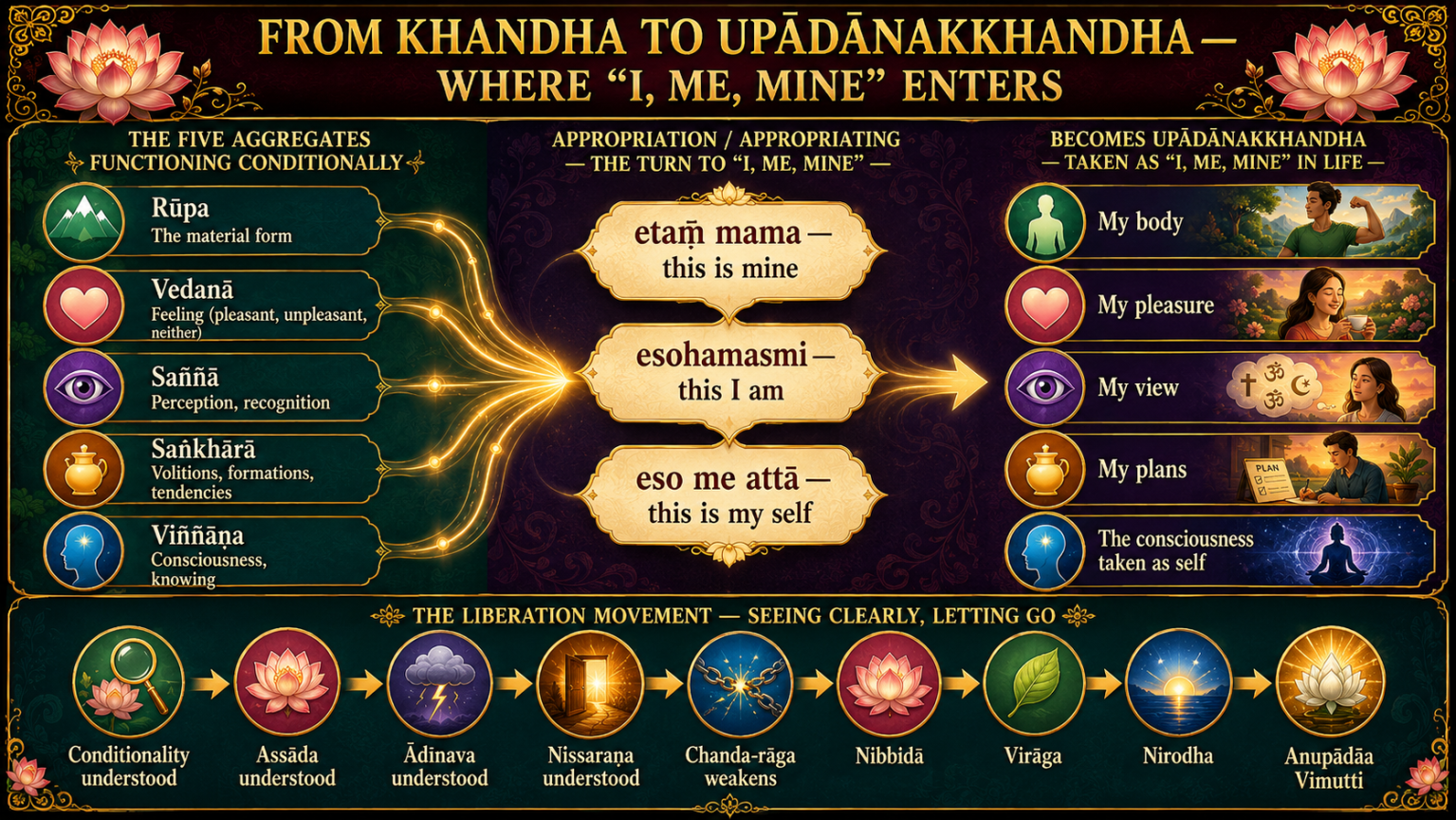
This wording is crucial. The teaching is not merely a metaphysical inventory of the human being. The practical issue is appropriation.
Rūpa occurs. Vedanā occurs. Saññā occurs. Saṅkhārā occur. Viññāṇa occurs. The bondage deepens when these become the ground for:
etaṁ mama — this is mine esohamasmi — this I am eso me attā — this is my self.
The movement from khandha toward upādānakkhandha can be represented as:
RŪPA
   ↓ appropriation
"my body / my appearance / my possession"

VEDANĀ
   ↓ appropriation
"my pleasure / my suffering"

SAÑÑĀ
   ↓ appropriation
"my view / my memory / what I know"

SAṄKHĀRĀ
   ↓ appropriation
"my plans / my intentions / what I will become"

VIÑÑĀṆA
   ↓ appropriation
"the consciousness that is really me"
The purpose of understanding samudaya is therefore not academic. If an aggregate arises because conditions arise, its supposed independence begins to collapse. If it ceases when its conditions cease, its supposed permanence collapses. When its gratification, danger and escape are understood, the emotional basis for appropriation also begins to collapse.
This is where the connection between AN 4.41 and SN 22.57 becomes especially strong. AN 4.41 says the practitioner watches udaya and vaya of the upādānakkhandhas. SN 22.57 shows the depth at which that seeing becomes liberative: one knows the conditioned aggregate, why it attracts, why it cannot provide security, and how passion toward it is abandoned.
22 The Movement from Understanding to Nibbidā, Virāga, Nirodha and Anupādā Vimutti
SN 22.57 does not finish after defining the five aggregates. After explaining the sevenfold investigation, the Buddha tells us what happens when a practitioner really understands an aggregate in this way.
Regarding rūpa, for example, he speaks of those who, having directly understood rūpa, its arising, cessation, the way to cessation, gratification, danger and escape, practise:
rūpassa nibbidāya virāgāya nirodhāya
toward disenchantment with form, fading of passion toward form, and cessation in relation to form. The same pattern is applied to the other aggregates.
He then describes those who, through such understanding, are liberated:
anupādā vimuttā
liberated through non-clinging.
This gives the internal logic of the fourth samādhibhāvanā in AN 4.41.
PAJĀNĀTI / ABHIÑÑĀ
understand directly
        ↓
SAMUDAYA understood
conditional arising is clear
        ↓
ASSĀDA understood
why attraction occurs is clear
        ↓
ĀDĪNAVA understood
impermanence, dukkha and change are clear
        ↓
NISSARAṆA understood
escape is abandonment of chanda-rāga
        ↓
NIBBIDĀ
disenchantment
        ↓
VIRĀGA
fading of passion
        ↓
NIRODHA
cessation
        ↓
ANUPĀDĀ VIMUTTI
liberation through non-clinging
This is why udayabbayānupassanā should not be understood as a fascination with momentariness. Its purpose is the destruction of appropriation. One sees conditionality until the basis for delight and clinging is exhausted.
23 SN 22.57 Adds a Threefold Examination: Dhātu, Āyatana and Paṭiccasamuppāda
After the seven cases, SN 22.57 adds that the fully developed practitioner is tividhūpaparikkhī, one who investigates in three ways:
dhātuso upaparikkhati, āyatanaso upaparikkhati, paṭiccasamuppādaso upaparikkhati.
He investigates in terms of elements (dhātu), sense fields (āyatana) and dependent arising (paṭiccasamuppāda).
This final addition is enormously useful for understanding what “seeing the five aggregates” means. The aggregates are not to be turned into five new metaphysical entities. They are to be examined from multiple conditional perspectives.
Through dhātu, the apparent solidity of a person or thing is broken into elements and conditioned functions. Through āyatana, experience is examined through the six internal and external sense fields rather than immediately becoming “I am seeing,” “I am hearing,” or “this is happening to me.” Through paṭiccasamuppāda, the practitioner examines dependence itself: when this condition is present, this arises; when the condition ceases, this ceases.
Thus the five-aggregate investigation opens into a much wider field:
FIVE AGGREGATES
      ↓
not five permanent things
      ↓
investigate as DHĀTU
      +
investigate as ĀYATANA
      +
investigate as PAṬICCASAMUPPĀDA
      ↓
experience seen as conditioned processes
      ↓
less ground for "I", "me" and "mine"
This is particularly important for teaching vipassanā. If one merely labels “rūpa, vedanā, saññā, saṅkhārā, viññāṇa,” the labels themselves can become static concepts. SN 22.57 insists on investigation: what is it, from what does it arise, what is its danger, where is its escape, and how does it appear when examined through elements, sense fields and dependent arising?
24 A Practical Example: One Ordinary Event Seen Through All Five Aggregates
Suppose a colleague publicly criticizes your work. Ordinarily the event is compressed into a single self-referential conclusion:
“He insulted me and made me angry.”
The aggregate analysis reveals something much more complex.
The visible body of the person and the sound of the words belong within rūpa. Ear-consciousness arises; viññāṇa is present. Contact occurs and an unpleasant vedanā arises. Saññā recognizes the words as criticism and recognizes the speaker as someone whose opinion matters. Saṅkhārā, particularly cetanā, begin constructing responses: “Defend yourself,” “attack him,” “withdraw,” “remember this,” “prove him wrong.”
The whole process may unfold in seconds:
sound / visible form
        ↓
VIÑÑĀṆA — hearing / seeing consciousness
        ↓
PHASSA
        ↓
VEDANĀ — unpleasant
        ↓
SAÑÑĀ — "criticism directed at me"
        ↓
SAṄKHĀRĀ — "answer, defend, retaliate"
        ↓
UPĀDĀNA
"my reputation"
"my position"
"my view"
        ↓
dukkha intensifies
Now apply SN 22.57. What is the gratification? Perhaps being respected normally produces pleasure, so the mind is attached to a favourable perception of itself. What is the danger? Reputation, perception and feeling are all subject to change. What is the escape? Not forcing the colleague to praise us, but abandoning chanda-rāga toward the aggregates around which the identity has been constructed.
The event can then be known in another way:
sound occurred
      ↓
hearing consciousness occurred
      ↓
unpleasant vedanā arose
      ↓
saññā recognized "criticism"
      ↓
cetanā began constructing a response
      ↓
ALL ARE KNOWN AS CONDITIONED
      ↓
no necessity to turn them into
"I am attacked"
      ↓
space for non-clinging response
This example shows why the third and fourth samādhibhāvanās naturally support one another. In the third, vedanā, saññā and vitakka arise, remain and disappear known. In the fourth, the conditioned aggregates themselves are penetrated through arising and passing, gratification, danger and escape. Sati-sampajañña makes the process visible; paññā sees what the visible process actually is.
25 Another Example: Desire for an Attractive Object
Suppose a new device is displayed in a shop window. The event initially seems simple: “I saw it and wanted it.” But the five-aggregate perspective reveals the construction.
There is visible rūpa. Eye-consciousness, a form of viññāṇa, arises. Contact occurs and pleasant vedanā appears. Saññā recognizes the device, perhaps compares it with one’s existing one and marks it as “new,” “better” or “desirable.” Saṅkhārā begin: “Let me check the price,” “I should upgrade,” “perhaps I can buy it next month.”
Then appropriation appears:
“I want this.” “This should be mine.” “I will be happier when I possess it.”
SN 22.57 allows the process to be examined without moral panic and without indulgence.
First, assāda is admitted. There is genuine pleasure dependent upon the sight, the perception and the anticipated acquisition. That is why desire forms.
Then ādīnava is understood. The object is impermanent. The pleasant vedanā is impermanent. The perception “this is wonderful” is impermanent. The intention to acquire it is conditioned. The consciousness of it is conditioned. None can provide stable refuge.
Then nissaraṇa is known. Freedom is not attained by smashing the device or declaring beautiful objects sinful. It lies in chandarāgavinaya, chandarāgappahāna—the removal and abandonment of passion toward the conditioned aggregate experience.
ATTRACTIVE OBJECT
       ↓
assāda recognized
"yes, pleasure is present"
       ↓
ādīnava recognized
"but every part of this experience changes"
       ↓
nissaraṇa recognized
"freedom is not possession;
it is release of chanda-rāga"
       ↓
object may remain
       ↓
clinging need not remain
That is a much deeper form of guarding the sense doors than simply refusing to look at attractive things. The practitioner understands the machinery by which looking becomes delight, delight becomes desire, desire becomes appropriation and appropriation becomes suffering.
Apple Store example — iPhone 18 Pro and Pro Max launch: This infographic brings the Section 25 example together visually. It shows how a seemingly simple experience — “I saw it and wanted it” — can be examined through rūpa, viññāṇa, phassa, vedanā, saññā and saṅkhārā, followed by appropriation, and then understood through assāda, ādīnava and nissaraṇa.
Click the infographic to open the full-size image in a new tab.

26 Why This Fourth Samādhibhāvanā Leads to Āsavānaṁ Khaya
AN 4.41 concludes the five-aggregate contemplation with an extraordinary statement:
Ayaṁ, bhikkhave, samādhibhāvanā bhāvitā bahulīkatā āsavānaṁ khayāya saṁvattati.
“This development of samādhi, when developed and cultivated repeatedly, leads to the destruction of the āsavas.”
SN 22.57 now helps us see why. The destruction of the āsavas is not produced merely because the meditator has watched enough arising and passing events. What is being destroyed is the ignorance and passion that allow conditioned experience to be appropriated again and again.
As long as rūpa can become “my body,” “my beauty,” “my possession” or “my status,” there is something to defend and fear losing. As long as vedanā becomes “my happiness” and “my suffering,” craving and resistance have a foundation. As long as saññā becomes “my view of reality,” perceptions can harden into identity and conflict. As long as saṅkhārā become “what I must do” and “what I must become,” the machinery of future becoming continues to be constructed. As long as viññāṇa is retained as “the permanent knower who is really me,” self-making still has a final refuge.
The sevenfold investigation removes these supports one by one.
AGGREGATE
    ↓
known precisely
    ↓
its conditional arising understood
    ↓
its cessation understood
    ↓
its gratification understood
    ↓
its danger understood
    ↓
its escape understood
    ↓
chanda-rāga weakens
    ↓
nibbidā
    ↓
virāga
    ↓
nirodha
    ↓
anupādā vimutti
    ↓
āsavānaṁ khaya
The decisive shift is therefore from observing change to understanding why nothing in these aggregates can rightly be made into a permanent basis of “I,” “me” or “mine.”
When conditionality is penetrated, ownership loses its philosophical foundation. When assāda is penetrated, one understands why the mind was attracted. When ādīnava is penetrated, one sees why dependence inevitably brings vulnerability. When nissaraṇa is penetrated, one sees that freedom lies not in perfecting the aggregates but in relinquishing passion toward them.
This is why the fourth samādhibhāvanā is the culmination of AN 4.41. It does not end with a more refined experience. It ends with āsavānaṁ khaya.
27 The Four Samādhibhāvanās Now Form One Coherent Teaching
Seen as a whole, AN 4.41 is not a collection of four unrelated meditation techniques.
It presents four profound capabilities of a developed mind.
In the first, the mind learns that happiness need not depend upon sensuality.
KĀMA
 ↓ relinquished
JHĀNA
 ↓
DIṬṬHADHAMMASUKHAVIHĀRA
In the second, the mind learns not to become enveloped by darkness and dullness.
ĀLOKASAÑÑĀ
 ↓
DIVĀSAÑÑĀ
 ↓
VIVAṬA + APARIYONADDHA CITTA
 ↓
SAPPABHĀSA CITTA
 ↓
ÑĀṆADASSANA
In the third, experience becomes known while it is occurring.
VEDANĀ
arises → remains → disappears
        KNOWN

SAÑÑĀ
arises → remains → disappears
        KNOWN

VITAKKA
arises → remains → disappears
        KNOWN

                ↓
        SATI-SAMPAJAÑÑA
In the fourth, even the structures ordinarily appropriated as “I” and “mine” are penetrated in terms of conditional arising and cessation.
RŪPA
VEDANĀ
SAÑÑĀ
SAṄKHĀRĀ
VIÑÑĀṆA
     ↓
what is it?
     ↓
how does it arise?
     ↓
how does it cease?
     ↓
what is its gratification?
     ↓
what is its danger?
     ↓
what is the escape?
     ↓
UPĀDĀNA WEAKENS
     ↓
ĀSAVĀNAṀ KHAYA
There is therefore a beautiful movement through the discourse:
from freedom from sensual dependence, to freedom from mental obscuration, to freedom from unconscious mental reaction, to freedom from appropriation itself.
28 The Concluding Verse: When Nothing in the World Can Make the Mind Tremble
The Buddha closes the discourse by referring to the answer given to Puṇṇaka in the Pārāyana:
Saṅkhāya lokasmiṁ paroparāni, Yassiñjitaṁ natthi kuhiñci loke; Santo vidhūmo anīgho nirāso, Atāri so jātijaranti brūmi.
“Having comprehended the various things, higher and lower, in the world, for whom there is no agitation anywhere in the world; peaceful, with the smoke dispersed, untroubled and without longing—I say that such a one has crossed birth and ageing.”
The word iñjita is particularly powerful.
It points toward movement, trembling, agitation or disturbance.
Why does the mind tremble?
Because something has been appropriated.
Someone praises me.
Someone insults me.
Something pleasurable is coming to me.
Something pleasurable is being taken from me.
My body is ageing.
My possession is threatened.
My view has been challenged.
My future is uncertain.
Where there is appropriation, there is something that can be shaken.
But the five upādānakkhandhas have now been examined:
"This is mine"
       ↓
investigation

"This I am"
       ↓
investigation

"This is my self"
       ↓
investigation

conditioned arising
       ↓
conditioned passing away
       ↓
nothing suitable for permanent appropriation
       ↓
yassiñjitaṁ natthi kuhiñci loke
“There is no agitation anywhere in the world.”
This is why the Samādhibhāvanāsutta begins with the cultivation of samādhi but ends with crossing birth and ageing.
The discourse progressively takes the practitioner from a mind that seeks happiness through conditions, to a mind that can remain collected without sensual dependence; from a mind vulnerable to obscuration, to one that is bright and open; from a mind unknowingly driven by feelings, perceptions and thoughts, to one that knows their arising and disappearance; and finally from a mind that appropriates the five aggregates as “I” and “mine,” to one that understands their arising, cessation, gratification, danger and escape.
Thus the deepest message of AN 4.41 is not simply:
“Develop concentration.”
It is:
Develop the mind in such a way that dependence becomes visible, mental obscuration is removed, every movement of experience becomes known, and finally the very aggregates around which ‘I’, ‘me’ and ‘mine’ are constructed are understood as conditionally arisen and conditionally ceasing.
That is the samādhibhāvanā which the Buddha says leads to:
āsavānaṁ khaya — the destruction of the āsavas.
01AN 4.41 — The Four Developments of Samādhi
Master overview of the four samādhibhāvanās and their distinct purposes.
02Jhāna Bhāvanā — Progressive Relinquishment
The movement through the four jhānas from seclusion to upekkhā-sati-pārisuddhi.
03Ālokasaññā Bhāvanā — Development of Light
Perception of light, perception of day, openness, wakefulness and a luminous mind.

04Sati-Sampajañña Bhāvanā
Vedanā, saññā and vitakka known as they arise, remain and disappear.

05SN 22.57 — Seven Investigations of the Five Aggregates
The sevenfold investigation applied equally to rūpa, vedanā, saññā, saṅkhārā and viññāṇa.

06From Khandha to Upādānakkhandha
Where ‘I, me, mine’ enters and how appropriation weakens through understanding.
07The Complete Movement of AN 4.41
From samādhi to clarity, insight, freedom from appropriation and an unshaken mind.