What Are We Actually Searching For?
The decisive question is not whether an attainment is extraordinary, but whether it leads to nibbidā, virāga, nirodha, upasama, abhiññā, sambodhi and Nibbāna.
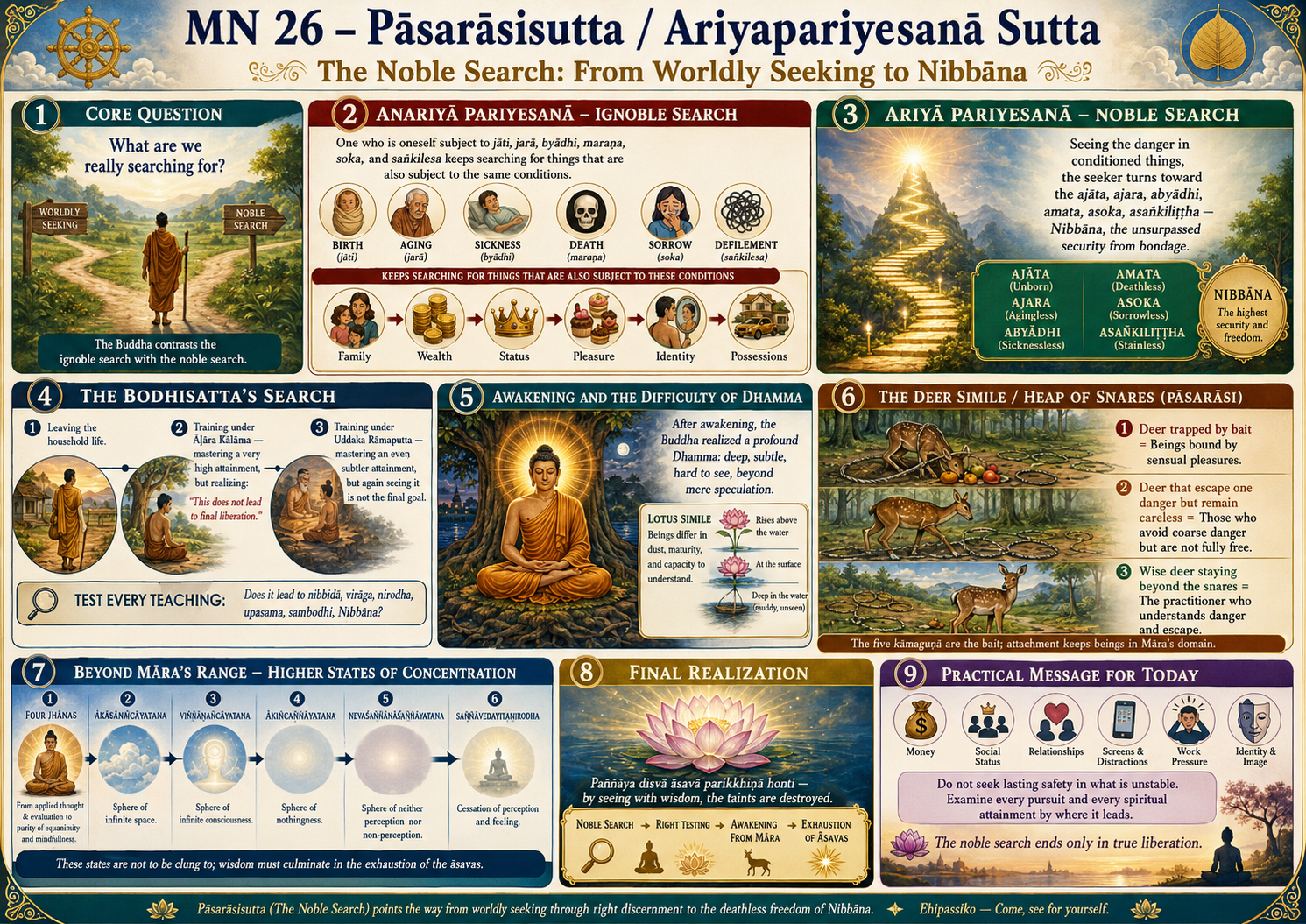 VISUAL SUMMARYSee this sutta in a pictureOpen the complete infographic for a visual overview before or after reading the full study.View infographic →
From the wrong search to freedom beyond Māra’s range
| Stage | What MN 26 is showing |
|---|---|
| 1 · Anariyā pariyesanā | Seeking security in what is itself subject to birth, aging, illness, death, sorrow and defilement. |
| 2 · Ariyā pariyesanā | Seeing ādīnava and seeking ajāta, ajara, abyādhi, amata, asoka and asaṅkiliṭṭha — Nibbāna. |
| 3 · Verify attainment | Āḷāra and Uddaka are directly mastered, then evaluated against liberation. |
| 4 · Awakening | Akuppā vimutti — unshakable liberation; no renewed existence. |
| 5 · Teach by capacity | The lotus simile: beings differ in dust, faculties and teachability. |
| 6 · Escape the snares | The five kāmaguṇā are Māra’s field; danger and escape must be known. |
| 7 · Jhāna and beyond | Four jhānas → four immaterial attainments → cessation of perception and feeling. |
| 8 · Final criterion | Paññāya disvā āsavā parikkhīṇā — seeing with wisdom, the āsavas are destroyed. |
All 30 sections with full Pāḷi, translation and explanation
The Question of Search
Sections 1–7
01 Setting — The Bhikkhus Seek a Dhamma Talk
Evaṁ me sutaṁ— ekaṁ samayaṁ bhagavā sāvatthiyaṁ viharati jetavane anāthapiṇḍikassa ārāme.
Atha kho bhagavā pubbaṇhasamayaṁ nivāsetvā pattacīvaramādāya sāvatthiṁ piṇḍāya pāvisi. Atha kho sambahulā bhikkhū yenāyasmā ānando tenupasaṅkamiṁsu; upasaṅkamitvā āyasmantaṁ ānandaṁ etadavocuṁ: “cirassutā no, āvuso ānanda, bhagavato sammukhā dhammī kathā. Sādhu mayaṁ, āvuso ānanda, labheyyāma bhagavato sammukhā dhammiṁ kathaṁ savanāyā”ti.
“Tena hāyasmanto yena rammakassa brāhmaṇassa assamo tenupasaṅkamatha; appeva nāma labheyyātha bhagavato sammukhā dhammiṁ kathaṁ savanāyā”ti.
“Evamāvuso”ti kho te bhikkhū āyasmato ānandassa paccassosuṁ.
Atha kho bhagavā sāvatthiyaṁ piṇḍāya caritvā pacchābhattaṁ piṇḍapātapaṭikkanto āyasmantaṁ ānandaṁ āmantesi: “āyāmānanda, yena pubbārāmo migāramātupāsādo tenupasaṅkamissāma divāvihārāyā”ti.
“Evaṁ, bhante”ti kho āyasmā ānando bhagavato paccassosi. Atha kho bhagavā āyasmatā ānandena saddhiṁ yena pubbārāmo migāramātupāsādo tenupasaṅkami divāvihārāya. Atha kho bhagavā sāyanhasamayaṁ paṭisallānā vuṭṭhito āyasmantaṁ ānandaṁ āmantesi: “āyāmānanda, yena pubbakoṭṭhako tenupasaṅkamissāma gattāni parisiñcitun”ti.
“Evaṁ, bhante”ti kho āyasmā ānando bhagavato paccassosi.
Atha kho bhagavā āyasmatā ānandena saddhiṁ yena pubbakoṭṭhako tenupasaṅkami gattāni parisiñcituṁ. Pubbakoṭṭhake gattāni parisiñcitvā paccuttaritvā ekacīvaro aṭṭhāsi gattāni pubbāpayamāno. Atha kho āyasmā ānando bhagavantaṁ etadavoca: “ayaṁ, bhante, rammakassa brāhmaṇassa assamo avidūre. Ramaṇīyo, bhante, rammakassa brāhmaṇassa assamo; pāsādiko, bhante, rammakassa brāhmaṇassa assamo. Sādhu, bhante, bhagavā yena rammakassa brāhmaṇassa assamo tenupasaṅkamatu anukampaṁ upādāyā”ti. Adhivāsesi bhagavā tuṇhībhāvena.
Atha kho bhagavā yena rammakassa brāhmaṇassa assamo tenupasaṅkami. Tena kho pana samayena sambahulā bhikkhū rammakassa brāhmaṇassa assame dhammiyā kathāya sannisinnā honti. Atha kho bhagavā bahidvārakoṭṭhake aṭṭhāsi kathāpariyosānaṁ āgamayamāno. Atha kho bhagavā kathāpariyosānaṁ viditvā ukkāsitvā aggaḷaṁ ākoṭesi. Vivariṁsu kho te bhikkhū bhagavato dvāraṁ. Atha kho bhagavā rammakassa brāhmaṇassa assamaṁ pavisitvā paññatte āsane nisīdi. Nisajja kho bhagavā bhikkhū āmantesi: “kāya nuttha, bhikkhave, etarahi kathāya sannisinnā? Kā ca pana vo antarākathā vippakatā”ti?
“Bhagavantameva kho no, bhante, ārabbha dhammī kathā vippakatā, atha bhagavā anuppatto”ti.
Thus have I heard. On one occasion the Blessed One was staying at Sāvatthī, in Jeta’s Grove, Anāthapiṇḍika’s monastery.
A number of bhikkhus approached Ānanda and said that it had been a long time since they had heard a Dhamma talk directly from the Blessed One. Ānanda directed them to the hermitage of the brahmin Rammaka, hoping they might receive such a teaching.
After the alms round and the day’s abiding, the Blessed One and Ānanda eventually came near Rammaka’s hermitage. Ānanda praised the place and asked the Blessed One to go there out of compassion.
When the Blessed One arrived, the bhikkhus were already engaged in Dhamma discussion. He waited outside until their discussion had finished, then entered and asked what they had been discussing. They replied that they had been speaking about the Blessed One himself.
Deep Dive
The setting is pedagogically significant. The Buddha does not interrupt the bhikkhus’ Dhamma discussion; he waits until it ends. His later instruction—Dhamma discussion or noble silence—is therefore embodied in his own conduct.
02 Dhamma Discussion or Noble Silence
“Sādhu, bhikkhave. Etaṁ kho, bhikkhave, tumhākaṁ patirūpaṁ kulaputtānaṁ saddhā agārasmā anagāriyaṁ pabbajitānaṁ yaṁ tumhe dhammiyā kathāya sannisīdeyyātha. Sannipatitānaṁ vo, bhikkhave, dvayaṁ karaṇīyaṁ— dhammī vā kathā, ariyo vā tuṇhībhāvo.
The Blessed One praised them and said that this was fitting for those who had gone forth from home into homelessness out of faith.
“When you are assembled, bhikkhus, there are two things to be done: either Dhamma discussion or noble silence.”
Deep Dive
Ariyo tuṇhībhāvo should not be reduced to awkward social silence. It points toward noble inner quiet. The gathering of practitioners is not for idle talk: either investigate Dhamma meaningfully or protect inner stillness.
Related Sutta
SN 21.1 Kolitasutta — What is Noble Silence?
MN 26 states that when practitioners gather, they should engage in Dhamma discussion or noble silence. SN 21.1 Kolitasutta provides an important companion teaching for understanding noble silence in relation to the settling and unification of the mind.
03 Two Searches: Ariyā and Anariyā Pariyesanā
Dvemā, bhikkhave, pariyesanā— ariyā ca pariyesanā, anariyā ca pariyesanā.
“Bhikkhus, there are these two searches: the noble search and the ignoble search.”
Deep Dive
Pariyesanā means search, quest, seeking. The sutta asks a foundational question: not merely “What do you believe?” but “What are you actually spending your life searching for?”
04 The Ignoble Search — Seeking What Is Also Subject to Birth and Decay
Katamā ca, bhikkhave, anariyā pariyesanā? Idha, bhikkhave, ekacco attanā jātidhammo samāno jātidhammaṁyeva pariyesati, attanā jarādhammo samāno jarādhammaṁyeva pariyesati, attanā byādhidhammo samāno byādhidhammaṁyeva pariyesati, attanā maraṇadhammo samāno maraṇadhammaṁyeva pariyesati, attanā sokadhammo samāno sokadhammaṁyeva pariyesati, attanā saṅkilesadhammo samāno saṅkilesadhammaṁyeva pariyesati.
Kiñca, bhikkhave, jātidhammaṁ vadetha? Puttabhariyaṁ, bhikkhave, jātidhammaṁ, dāsidāsaṁ jātidhammaṁ, ajeḷakaṁ jātidhammaṁ, kukkuṭasūkaraṁ jātidhammaṁ, hatthigavāssavaḷavaṁ jātidhammaṁ, jātarūparajataṁ jātidhammaṁ. Jātidhammā hete, bhikkhave, upadhayo. Etthāyaṁ gathito mucchito ajjhāpanno attanā jātidhammo samāno jātidhammaṁyeva pariyesati.
Textual variant: gathito → gadhito (sya-all, mr)
Kiñca, bhikkhave, jarādhammaṁ vadetha? Puttabhariyaṁ, bhikkhave, jarādhammaṁ, dāsidāsaṁ jarādhammaṁ, ajeḷakaṁ jarādhammaṁ, kukkuṭasūkaraṁ jarādhammaṁ, hatthigavāssavaḷavaṁ jarādhammaṁ, jātarūparajataṁ jarādhammaṁ. Jarādhammā hete, bhikkhave, upadhayo. Etthāyaṁ gathito mucchito ajjhāpanno attanā jarādhammo samāno jarādhammaṁyeva pariyesati.
Kiñca, bhikkhave, byādhidhammaṁ vadetha? Puttabhariyaṁ, bhikkhave, byādhidhammaṁ, dāsidāsaṁ byādhidhammaṁ, ajeḷakaṁ byādhidhammaṁ, kukkuṭasūkaraṁ byādhidhammaṁ, hatthigavāssavaḷavaṁ byādhidhammaṁ. Byādhidhammā hete, bhikkhave, upadhayo. Etthāyaṁ gathito mucchito ajjhāpanno attanā byādhidhammo samāno byādhidhammaṁyeva pariyesati.
Kiñca, bhikkhave, maraṇadhammaṁ vadetha? Puttabhariyaṁ, bhikkhave, maraṇadhammaṁ, dāsidāsaṁ maraṇadhammaṁ, ajeḷakaṁ maraṇadhammaṁ, kukkuṭasūkaraṁ maraṇadhammaṁ, hatthigavāssavaḷavaṁ maraṇadhammaṁ. Maraṇadhammā hete, bhikkhave, upadhayo. Etthāyaṁ gathito mucchito ajjhāpanno attanā maraṇadhammo samāno maraṇadhammaṁyeva pariyesati.
Kiñca, bhikkhave, sokadhammaṁ vadetha? Puttabhariyaṁ, bhikkhave, sokadhammaṁ, dāsidāsaṁ sokadhammaṁ, ajeḷakaṁ sokadhammaṁ, kukkuṭasūkaraṁ sokadhammaṁ, hatthigavāssavaḷavaṁ sokadhammaṁ. Sokadhammā hete, bhikkhave, upadhayo. Etthāyaṁ gathito mucchito ajjhāpanno attanā sokadhammo samāno sokadhammaṁyeva pariyesati.
Kiñca, bhikkhave, saṅkilesadhammaṁ vadetha? Puttabhariyaṁ, bhikkhave, saṅkilesadhammaṁ, dāsidāsaṁ saṅkilesadhammaṁ, ajeḷakaṁ saṅkilesadhammaṁ, kukkuṭasūkaraṁ saṅkilesadhammaṁ, hatthigavāssavaḷavaṁ saṅkilesadhammaṁ, jātarūparajataṁ saṅkilesadhammaṁ. Saṅkilesadhammā hete, bhikkhave, upadhayo. Etthāyaṁ gathito mucchito ajjhāpanno attanā saṅkilesadhammo samāno saṅkilesadhammaṁyeva pariyesati. Ayaṁ, bhikkhave, anariyā pariyesanā.
The ignoble search occurs when a person who is himself subject to birth seeks what is also subject to birth; being subject to aging, illness, death, sorrow, and defilement, he seeks what is likewise subject to aging, illness, death, sorrow, and defilement.
The Buddha then gives concrete examples of such upadhi—acquisitions or bases of attachment: spouse and children, servants, livestock, and possessions such as gold and silver. These are themselves conditioned and vulnerable to birth, aging, illness, death, sorrow, and defilement.
The decisive problem is expressed through gathito, mucchito, ajjhāpanno: one becomes tied to them, infatuated with them, and absorbed in them. Thus, while oneself subject to the same instability, one searches for security in what is equally unstable.
This is called the ignoble search.
Deep Dive
The Buddha does not say spouse, children, animals, or wealth are morally evil. The danger lies in seeking ultimate security in conditioned acquisitions and becoming tied, infatuated, and absorbed in them. This is a critique of misplaced refuge, not of compassionate relationships.
Practice / Everyday Example
Corporate example: a person whose body, career, and status are all unstable seeks permanent security in a designation—CEO, director, partner—or in wealth that is itself unstable. The issue is not having a role; it is expecting a conditioned role to provide unconditioned security.
05 The Noble Search — Seeking the Unborn and the Deathless
Katamā ca, bhikkhave, ariyā pariyesanā? Idha, bhikkhave, ekacco attanā jātidhammo samāno jātidhamme ādīnavaṁ viditvā ajātaṁ anuttaraṁ yogakkhemaṁ nibbānaṁ pariyesati, attanā jarādhammo samāno jarādhamme ādīnavaṁ viditvā ajaraṁ anuttaraṁ yogakkhemaṁ nibbānaṁ pariyesati, attanā byādhidhammo samāno byādhidhamme ādīnavaṁ viditvā abyādhiṁ anuttaraṁ yogakkhemaṁ nibbānaṁ pariyesati, attanā maraṇadhammo samāno maraṇadhamme ādīnavaṁ viditvā amataṁ anuttaraṁ yogakkhemaṁ nibbānaṁ pariyesati, attanā sokadhammo samāno sokadhamme ādīnavaṁ viditvā asokaṁ anuttaraṁ yogakkhemaṁ nibbānaṁ pariyesati, attanā saṅkilesadhammo samāno saṅkilesadhamme ādīnavaṁ viditvā asaṅkiliṭṭhaṁ anuttaraṁ yogakkhemaṁ nibbānaṁ pariyesati. Ayaṁ, bhikkhave, ariyā pariyesanā.
The noble search reverses the direction.
Being subject to birth, one sees the danger in what is subject to birth and seeks the unborn, unsurpassed security from bondage: Nibbāna.
Being subject to aging, one seeks the ageless; subject to illness, the unailing; subject to death, the Deathless; subject to sorrow, the sorrowless; and subject to defilement, the undefiled—each described as the unsurpassed yogakkhema, security from bondage, Nibbāna.
This is the noble search.
Deep Dive
The six contrasts form a complete liberation map: jāta → ajāta; jarā → ajara; byādhi → abyādhi; maraṇa → amata; soka → asoka; saṅkilesa → asaṅkiliṭṭha. Each culminates in anuttara yogakkhema Nibbāna—unsurpassed security from bondage.
Practice / Everyday Example
Practice question: Is what I am pursuing today itself subject to loss, change, aging, or defilement? Am I using it wisely, or asking it to provide a security it cannot give?
06 The Bodhisatta Changes the Direction of His Search
Ahampi sudaṁ, bhikkhave, pubbeva sambodhā anabhisambuddho bodhisattova samāno attanā jātidhammo samāno jātidhammaṁyeva pariyesāmi, attanā jarādhammo samāno jarādhammaṁyeva pariyesāmi, attanā byādhidhammo samāno byādhidhammaṁyeva pariyesāmi, attanā maraṇadhammo samāno maraṇadhammaṁyeva pariyesāmi, attanā sokadhammo samāno sokadhammaṁyeva pariyesāmi, attanā saṅkilesadhammo samāno saṅkilesadhammaṁyeva pariyesāmi. Tassa mayhaṁ, bhikkhave, etadahosi: ‘kiṁ nu kho ahaṁ attanā jātidhammo samāno jātidhammaṁyeva pariyesāmi, attanā jarādhammo samāno jarādhammaṁyeva pariyesāmi, attanā byādhidhammo samāno byādhidhammaṁyeva pariyesāmi, attanā maraṇadhammo samāno maraṇadhammaṁyeva pariyesāmi, attanā sokadhammo samāno sokadhammaṁyeva pariyesāmi, attanā saṅkilesadhammo samāno saṅkilesadhammaṁyeva pariyesāmi? Yannūnāhaṁ attanā jātidhammo samāno jātidhamme ādīnavaṁ viditvā ajātaṁ anuttaraṁ yogakkhemaṁ nibbānaṁ pariyeseyyaṁ, attanā jarādhammo samāno jarādhamme ādīnavaṁ viditvā ajaraṁ anuttaraṁ yogakkhemaṁ nibbānaṁ pariyeseyyaṁ, attanā byādhidhammo samāno byādhidhamme ādīnavaṁ viditvā abyādhiṁ anuttaraṁ yogakkhemaṁ nibbānaṁ pariyeseyyaṁ, attanā maraṇadhammo samāno maraṇadhamme ādīnavaṁ viditvā amataṁ anuttaraṁ yogakkhemaṁ nibbānaṁ pariyeseyyaṁ, attanā sokadhammo samāno sokadhamme ādīnavaṁ viditvā asokaṁ anuttaraṁ yogakkhemaṁ nibbānaṁ pariyeseyyaṁ, attanā saṅkilesadhammo samāno saṅkilesadhamme ādīnavaṁ viditvā asaṅkiliṭṭhaṁ anuttaraṁ yogakkhemaṁ nibbānaṁ pariyeseyyan’ti.
The Buddha says that before awakening, while still an unawakened Bodhisatta, he too sought what was subject to birth, aging, illness, death, sorrow, and defilement.
Then the critical question arose: “Why, being subject to these things myself, do I continue seeking what is subject to the same conditions?”
He resolved instead to see their danger and seek the unborn, ageless, unailing, Deathless, sorrowless, undefiled, unsurpassed security from bondage—Nibbāna.
Deep Dive
The decisive turning point is ādīnavaṁ viditvā—having understood the danger. Renunciation arises from seeing that conditioned objects cannot solve the very conditions to which they themselves are subject.
07 Going Forth — Kiṁkusalagavesī
So kho ahaṁ, bhikkhave, aparena samayena daharova samāno susukāḷakeso, bhadrena yobbanena samannāgato paṭhamena vayasā akāmakānaṁ mātāpitūnaṁ assumukhānaṁ rudantānaṁ kesamassuṁ ohāretvā kāsāyāni vatthāni acchādetvā agārasmā anagāriyaṁ pabbajiṁ.
While still young, in the prime of life, despite his parents’ tears and unwillingness, the Bodhisatta shaved his hair and beard, put on ochre robes, and went forth from home into homelessness.
Deep Dive
The Bodhisatta is described as kiṁkusalagavesī, a seeker of what is genuinely skillful. The criterion is not prestige, tradition, or loyalty to a teacher, but whether a path reaches the unsurpassed peaceful state.
Teachers, Verification & Awakening
Sections 8–13
08 Āḷāra Kālāma — Mastering the Base of Nothingness
So evaṁ pabbajito samāno kiṅkusalagavesī anuttaraṁ santivarapadaṁ pariyesamāno yena āḷāro kālāmo tenupasaṅkamiṁ. upasaṅkamitvā āḷāraṁ kālāmaṁ etadavocaṁ: ‘icchāmahaṁ, āvuso kālāma, imasmiṁ dhammavinaye brahmacariyaṁ caritun’ti.
Evaṁ vutte, bhikkhave, āḷāro kālāmo maṁ etadavoca: ‘viharatāyasmā; tādiso ayaṁ dhammo yattha viññū puriso nacirasseva sakaṁ ācariyakaṁ sayaṁ abhiññā sacchikatvā upasampajja vihareyyā’ti.
So kho ahaṁ, bhikkhave, nacirasseva khippameva taṁ dhammaṁ pariyāpuṇiṁ. So kho ahaṁ, bhikkhave, tāvatakeneva oṭṭhapahatamattena lapitalāpanamattena ñāṇavādañca vadāmi theravādañca, ‘jānāmi passāmī’ti ca paṭijānāmi ahañceva aññe ca.
Tassa mayhaṁ, bhikkhave, etadahosi: ‘na kho āḷāro kālāmo imaṁ dhammaṁ kevalaṁ saddhāmattakena sayaṁ abhiññā sacchikatvā upasampajja viharāmīti pavedeti; addhā āḷāro kālāmo imaṁ dhammaṁ jānaṁ passaṁ viharatī’ti.
Atha khvāhaṁ, bhikkhave, yena āḷāro kālāmo tenupasaṅkamiṁ; upasaṅkamitvā āḷāraṁ kālāmaṁ etadavocaṁ: ‘kittāvatā no, āvuso kālāma, imaṁ dhammaṁ sayaṁ abhiññā sacchikatvā upasampajja viharāmīti pavedesī’ti?
Textual variant: upasampajja viharāmīti pavedesī’ti → upasampajja pavedesīti (bj, sya-all, pts1ed)
Evaṁ vutte, bhikkhave, āḷāro kālāmo ākiñcaññāyatanaṁ pavedesi.
Tassa mayhaṁ, bhikkhave, etadahosi: ‘na kho āḷārasseva kālāmassa atthi saddhā, mayhampatthi saddhā; na kho āḷārasseva kālāmassa atthi vīriyaṁ, mayhampatthi vīriyaṁ; na kho āḷārasseva kālāmassa atthi sati, mayhampatthi sati; na kho āḷārasseva kālāmassa atthi samādhi, mayhampatthi samādhi; na kho āḷārasseva kālāmassa atthi paññā, mayhampatthi paññā. Yannūnāhaṁ yaṁ dhammaṁ āḷāro kālāmo sayaṁ abhiññā sacchikatvā upasampajja viharāmīti pavedeti, tassa dhammassa sacchikiriyāya padaheyyan’ti. So kho ahaṁ, bhikkhave, nacirasseva khippameva taṁ dhammaṁ sayaṁ abhiññā sacchikatvā upasampajja vihāsiṁ.
Atha khvāhaṁ, bhikkhave, yena āḷāro kālāmo tenupasaṅkamiṁ; upasaṅkamitvā āḷāraṁ kālāmaṁ etadavocaṁ: ‘Ettāvatā no, āvuso kālāma, imaṁ dhammaṁ sayaṁ abhiññā sacchikatvā upasampajja pavedesī’ti?
‘Ettāvatā kho ahaṁ, āvuso, imaṁ dhammaṁ sayaṁ abhiññā sacchikatvā upasampajja pavedemī’ti.
‘Ahampi kho, āvuso, ettāvatā imaṁ dhammaṁ sayaṁ abhiññā sacchikatvā upasampajja viharāmī’ti.
‘Lābhā no, āvuso, suladdhaṁ no, āvuso, ye mayaṁ āyasmantaṁ tādisaṁ sabrahmacāriṁ passāma. Iti yāhaṁ dhammaṁ sayaṁ abhiññā sacchikatvā upasampajja pavedemi taṁ tvaṁ dhammaṁ sayaṁ abhiññā sacchikatvā upasampajja viharasi. Yaṁ tvaṁ dhammaṁ sayaṁ abhiññā sacchikatvā upasampajja viharasi tamahaṁ dhammaṁ sayaṁ abhiññā sacchikatvā upasampajja pavedemi. Iti yāhaṁ dhammaṁ jānāmi taṁ tvaṁ dhammaṁ jānāsi, yaṁ tvaṁ dhammaṁ jānāsi tamahaṁ dhammaṁ jānāmi. Iti yādiso ahaṁ tādiso tuvaṁ, yādiso tuvaṁ tādiso ahaṁ. Ehi dāni, āvuso, ubhova santā imaṁ gaṇaṁ pariharāmā’ti.
Iti kho, bhikkhave, āḷāro kālāmo ācariyo me samāno attano antevāsiṁ maṁ samānaṁ attanā samasamaṁ ṭhapesi, uḷārāya ca maṁ pūjāya pūjesi.
Textual variant: samāno attano antevāsiṁ → samāno antevāsiṁ (bj, sya-all, pts1ed) | attanā → attano (bj, pts1ed)
The Bodhisatta approached Āḷāra Kālāma and asked to live the spiritual life under his teaching.
He quickly learned the doctrine intellectually, but did not stop at verbal knowledge. Recognizing that Āḷāra claimed direct realization rather than mere faith, he asked what attainment Āḷāra had realized. Āḷāra declared the base of nothingness, ākiñcaññāyatana.
The Bodhisatta reflected that he too possessed faith, energy, mindfulness, samādhi, and wisdom, and therefore strove to realize the same state directly. He soon entered and dwelt in that attainment.
Āḷāra acknowledged that the Bodhisatta had attained exactly what he himself knew and invited him to co-lead the community, honoring him as an equal.
Deep Dive
This section distinguishes verbal learning from realization. The Bodhisatta refuses to stop at mere recitation and verifies the teaching through direct meditative attainment.
09 Why the Base of Nothingness Was Not the Goal
Tassa mayhaṁ, bhikkhave, etadahosi: ‘nāyaṁ dhammo nibbidāya na virāgāya na nirodhāya na upasamāya na abhiññāya na sambodhāya na nibbānāya saṁvattati, yāvadeva ākiñcaññāyatanūpapattiyā’ti. So kho ahaṁ, bhikkhave, taṁ dhammaṁ analaṅkaritvā tasmā dhammā nibbijja apakkamiṁ.
Despite mastering the attainment and receiving the highest recognition from his teacher, the Bodhisatta examined its destination.
He concluded that this teaching did not lead to disenchantment, dispassion, cessation, peace, direct knowledge, awakening, or Nibbāna. It led only as far as rebirth in the base of nothingness.
Because it did not fulfil the noble search, he became disenchanted with that teaching and left.
Deep Dive
The sevenfold criterion is exceptionally useful: does this practice lead to nibbidā, virāga, nirodha, upasama, abhiññā, sambodhi, and Nibbāna? Extraordinary attainment is not automatically liberation.
Practice / Everyday Example
Teaching example: a powerful meditation experience may be genuine and repeatable, yet the proper question remains: does it end craving and lead toward Nibbāna, or does it become another refined identity—“I am one who attains this state”?
10 Uddaka Rāmaputta — Neither-Perception-nor-Non-Perception
So kho ahaṁ, bhikkhave, kiṁ kusalagavesī anuttaraṁ santivarapadaṁ pariyesamāno yena udako rāmaputto tenupasaṅkamiṁ; upasaṅkamitvā udakaṁ rāmaputtaṁ etadavocaṁ:
Textual variant: udako → uddako (bj, sya-all, pts1ed)
‘icchāmahaṁ, āvuso, imasmiṁ dhammavinaye brahmacariyaṁ caritun’ti.
Textual variant: āvuso → āvuso rāma (sya-all, mr)
Evaṁ vutte, bhikkhave, udako rāmaputto maṁ etadavoca: ‘viharatāyasmā; tādiso ayaṁ dhammo yattha viññū puriso nacirasseva sakaṁ ācariyakaṁ sayaṁ abhiññā sacchikatvā upasampajja vihareyyā’ti.
So kho ahaṁ, bhikkhave, nacirasseva khippameva taṁ dhammaṁ pariyāpuṇiṁ. So kho ahaṁ, bhikkhave, tāvatakeneva oṭṭhapahatamattena lapitalāpanamattena ñāṇavādañca vadāmi theravādañca, ‘jānāmi passāmī’ti ca paṭijānāmi ahañceva aññe ca.
Tassa mayhaṁ, bhikkhave, etadahosi: ‘na kho rāmo imaṁ dhammaṁ kevalaṁ saddhāmattakena sayaṁ abhiññā sacchikatvā upasampajja viharāmīti pavedesi; addhā rāmo imaṁ dhammaṁ jānaṁ passaṁ vihāsī’ti.
Atha khvāhaṁ, bhikkhave, yena udako rāmaputto tenupasaṅkamiṁ; upasaṅkamitvā udakaṁ rāmaputtaṁ etadavocaṁ: ‘kittāvatā no, āvuso, rāmo imaṁ dhammaṁ sayaṁ abhiññā sacchikatvā upasampajja viharāmīti pavedesī’ti?
Evaṁ vutte, bhikkhave, udako rāmaputto nevasaññānāsaññāyatanaṁ pavedesi.
Tassa mayhaṁ, bhikkhave, etadahosi: ‘na kho rāmasseva ahosi saddhā, mayhampatthi saddhā; na kho rāmasseva ahosi vīriyaṁ, mayhampatthi vīriyaṁ; na kho rāmasseva ahosi sati, mayhampatthi sati; na kho rāmasseva ahosi samādhi, mayhampatthi samādhi, na kho rāmasseva ahosi paññā, mayhampatthi paññā. Yannūnāhaṁ yaṁ dhammaṁ rāmo sayaṁ abhiññā sacchikatvā upasampajja viharāmīti pavedesi, tassa dhammassa sacchikiriyāya padaheyyan’ti. So kho ahaṁ, bhikkhave, nacirasseva khippameva taṁ dhammaṁ sayaṁ abhiññā sacchikatvā upasampajja vihāsiṁ.
Atha khvāhaṁ, bhikkhave, yena udako rāmaputto tenupasaṅkamiṁ; upasaṅkamitvā udakaṁ rāmaputtaṁ etadavocaṁ: ‘Ettāvatā no, āvuso, rāmo imaṁ dhammaṁ sayaṁ abhiññā sacchikatvā upasampajja pavedesī’ti?
‘Ettāvatā kho, āvuso, rāmo imaṁ dhammaṁ sayaṁ abhiññā sacchikatvā upasampajja pavedesī’ti.
‘Ahampi kho, āvuso, ettāvatā imaṁ dhammaṁ sayaṁ abhiññā sacchikatvā upasampajja viharāmī’ti.
‘Lābhā no, āvuso, suladdhaṁ no, āvuso, ye mayaṁ āyasmantaṁ tādisaṁ sabrahmacāriṁ passāma. Iti yaṁ dhammaṁ rāmo sayaṁ abhiññā sacchikatvā upasampajja pavedesi, taṁ tvaṁ dhammaṁ sayaṁ abhiññā sacchikatvā upasampajja viharasi. Yaṁ tvaṁ dhammaṁ sayaṁ abhiññā sacchikatvā upasampajja viharasi, taṁ dhammaṁ rāmo sayaṁ abhiññā sacchikatvā upasampajja pavedesi. Iti yaṁ dhammaṁ rāmo abhiññāsi taṁ tvaṁ dhammaṁ jānāsi, yaṁ tvaṁ dhammaṁ jānāsi, taṁ dhammaṁ rāmo abhiññāsi. Iti yādiso rāmo ahosi tādiso tuvaṁ, yādiso tuvaṁ tādiso rāmo ahosi. Ehi dāni, āvuso, tuvaṁ imaṁ gaṇaṁ pariharā’ti.
Iti kho, bhikkhave, udako rāmaputto sabrahmacārī me samāno ācariyaṭṭhāne maṁ ṭhapesi, uḷārāya ca maṁ pūjāya pūjesi.
Still searching for what is wholesome and for the unsurpassed peaceful state, the Bodhisatta approached Uddaka Rāmaputta.
Again, he quickly learned the doctrine but went beyond verbal repetition. Uddaka explained that Rāma had realized the base of neither-perception-nor-non-perception, nevasaññānāsaññāyatana.
The Bodhisatta reflected that he possessed the necessary faith, energy, mindfulness, samādhi, and wisdom. He strove and directly realized that attainment.
Uddaka recognized him as having realized what Rāma had realized and offered him leadership of the community, placing him in the teacher’s position.
Deep Dive
The same rigorous method is repeated. The Bodhisatta respects the attainment, develops it, verifies it, and still evaluates it against the goal. Subtlety is not confused with finality.
11 Why the Second Teaching Was Also Left Behind
Tassa mayhaṁ, bhikkhave, etadahosi: ‘nāyaṁ dhammo nibbidāya na virāgāya na nirodhāya na upasamāya na abhiññāya na sambodhāya na nibbānāya saṁvattati, yāvadeva nevasaññānāsaññāyatanūpapattiyā’ti. So kho ahaṁ, bhikkhave, taṁ dhammaṁ analaṅkaritvā tasmā dhammā nibbijja apakkamiṁ.
Again the Bodhisatta judged the attainment by the goal of the noble search.
Neither-perception-nor-non-perception did not in itself lead to disenchantment, dispassion, cessation, peace, direct knowledge, awakening, or Nibbāna; it led only to rebirth in that corresponding sphere.
He therefore did not glorify or cling to the attainment. Becoming disenchanted with that teaching, he left.
Deep Dive
The sutta is especially important for understanding arūpa attainments: even extremely refined perception does not, merely by being refined, equal Nibbāna.
12 Uruvelā — A Place Suitable for Striving
So kho ahaṁ, bhikkhave, kiṁ kusalagavesī anuttaraṁ santivarapadaṁ pariyesamāno magadhesu anupubbena cārikaṁ caramāno yena uruvelā senānigamo tadavasariṁ. Tatthaddasaṁ ramaṇīyaṁ bhūmibhāgaṁ, pāsādikañca vanasaṇḍaṁ, nadiñca sandantiṁ setakaṁ supatitthaṁ ramaṇīyaṁ, samantā ca gocaragāmaṁ.
Textual variant: samantā → sāmantā (?)
Tassa mayhaṁ, bhikkhave, etadahosi: ‘ramaṇīyo vata bho bhūmibhāgo, pāsādiko ca vanasaṇḍo, nadī ca sandati setakā supatitthā ramaṇīyā, samantā ca gocaragāmo. Alaṁ vatidaṁ kulaputtassa padhānatthikassa padhānāyā’ti. So kho ahaṁ, bhikkhave, tattheva nisīdiṁ— alamidaṁ padhānāyāti.
Continuing his search, the Bodhisatta wandered through Magadha and arrived at Uruvelā near Senānigama.
He saw a beautiful stretch of land, a pleasant forest, a clear flowing river with good bathing places, and a nearby village for alms. He judged it suitable for a person intent on striving and sat down there: “This is suitable for striving.”
Deep Dive
Environment matters. The Bodhisatta deliberately recognizes a location as supportive of padhāna—striving. The sutta does not romanticize hardship for its own sake; it notices conditions conducive to training.
13 The Noble Search Is Fulfilled — Nibbāna Attained
So kho ahaṁ, bhikkhave, attanā jātidhammo samāno jātidhamme ādīnavaṁ viditvā ajātaṁ anuttaraṁ yogakkhemaṁ nibbānaṁ pariyesamāno ajātaṁ anuttaraṁ yogakkhemaṁ nibbānaṁ ajjhagamaṁ, attanā jarādhammo samāno jarādhamme ādīnavaṁ viditvā ajaraṁ anuttaraṁ yogakkhemaṁ nibbānaṁ pariyesamāno ajaraṁ anuttaraṁ yogakkhemaṁ nibbānaṁ ajjhagamaṁ, attanā byādhidhammo samāno byādhidhamme ādīnavaṁ viditvā abyādhiṁ anuttaraṁ yogakkhemaṁ nibbānaṁ pariyesamāno abyādhiṁ anuttaraṁ yogakkhemaṁ nibbānaṁ ajjhagamaṁ, attanā maraṇadhammo samāno maraṇadhamme ādīnavaṁ viditvā amataṁ anuttaraṁ yogakkhemaṁ nibbānaṁ ajjhagamaṁ, attanā sokadhammo samāno sokadhamme ādīnavaṁ viditvā asokaṁ anuttaraṁ yogakkhemaṁ nibbānaṁ ajjhagamaṁ, attanā saṅkilesadhammo samāno saṅkilesadhamme ādīnavaṁ viditvā asaṅkiliṭṭhaṁ anuttaraṁ yogakkhemaṁ nibbānaṁ pariyesamāno asaṅkiliṭṭhaṁ anuttaraṁ yogakkhemaṁ nibbānaṁ ajjhagamaṁ.
Ñāṇañca pana me dassanaṁ udapādi: ‘akuppā me vimutti, ayamantimā jāti, natthi dāni punabbhavo’ti.
The Buddha then declares the fulfilment of the search.
Being himself subject to birth, he saw the danger in birth and sought the unborn, unsurpassed security from bondage—Nibbāna—and attained it.
In the same way he sought and attained the ageless, unailing, Deathless, sorrowless, and undefiled unsurpassed security from bondage.
Knowledge and vision arose in him: “My liberation is unshakable. This is my last birth. Now there is no renewed existence.”
Deep Dive
The language is exact: what was sought is now attained. The knowledge “akuppā me vimutti” marks irreversible liberation, not merely a temporary meditative state.
From Awakening to the First Disciples
Sections 14–21
14 Why the Dhamma Is Difficult to See
Tassa mayhaṁ, bhikkhave, etadahosi: ‘adhigato kho myāyaṁ dhammo gambhīro duddaso duranubodho santo paṇīto atakkāvacaro nipuṇo paṇḍitavedanīyo. Ālayarāmā kho panāyaṁ pajā ālayaratā ālayasammuditā. Ālayarāmāya kho pana pajāya ālayaratāya ālayasammuditāya duddasaṁ idaṁ ṭhānaṁ yadidaṁ—idappaccayatā paṭiccasamuppādo. Idampi kho ṭhānaṁ duddasaṁ yadidaṁ—sabbasaṅkhārasamatho sabbūpadhipaṭinissaggo taṇhākkhayo virāgo nirodho nibbānaṁ. Ahañceva kho pana dhammaṁ deseyyaṁ, pare ca me na ājāneyyuṁ, so mamassa kilamatho, sā mamassa vihesā’ti.
Apissu maṁ, bhikkhave, imā anacchariyā gāthāyo paṭibhaṁsu pubbe assutapubbā:
‘Kicchena me adhigataṁ,halaṁ dāni pakāsituṁ;Rāgadosaparetehi,nāyaṁ dhammo susambudho.
Paṭisotagāmiṁ nipuṇaṁ,gambhīraṁ duddasaṁ aṇuṁ;Rāgarattā na dakkhanti,
Textual variant: ti → āvaṭāti (bj, pts1ed); āvutāti (sya-all)
tamokhandhena āvuṭā’ti.
Itiha me, bhikkhave, paṭisañcikkhato appossukkatāya cittaṁ namati, no dhammadesanāya.
Textual variant: namati → namissati (?)
After awakening, the Buddha reflected that the Dhamma he had realized was deep, difficult to see, difficult to understand, peaceful, sublime, beyond the sphere of reasoning, subtle, and to be experienced by the wise.
People, however, delight in attachment. For those who enjoy and rejoice in attachment, it is difficult to see dependent arising—idappaccayatā paṭiccasamuppāda—and difficult to see the stilling of all constructions, relinquishment of all acquisitions, ending of craving, fading of passion, cessation, Nibbāna.
He therefore initially inclined toward remaining inactive rather than teaching, thinking that failure of others to understand would be wearisome.
Deep Dive
Two insights are singled out as difficult: dependent arising and Nibbāna. The obstacle is ālaya—delight in attachment and settling into what the mind habitually relies upon. This explains why the Dhamma runs against the current.
15 Brahmā Sahampati Requests the Buddha to Teach
Atha kho, bhikkhave, brahmuno sahampatissa mama cetasā cetoparivitakkamaññāya etadahosi: ‘nassati vata bho loko, vinassati vata bho loko, yatra hi nāma tathāgatassa arahato sammāsambuddhassa appossukkatāya cittaṁ namati, no dhammadesanāyā’ti.
Atha kho, bhikkhave, brahmā sahampati—seyyathāpi nāma balavā puriso samiñjitaṁ vā bāhaṁ pasāreyya, pasāritaṁ vā bāhaṁ samiñjeyya; evameva—brahmaloke antarahito mama purato pāturahosi. Atha kho, bhikkhave, brahmā sahampati ekaṁsaṁ uttarāsaṅgaṁ karitvā yenāhaṁ tenañjaliṁ paṇāmetvā maṁ etadavoca: ‘desetu, bhante, bhagavā dhammaṁ, desetu sugato dhammaṁ. Santi sattā apparajakkhajātikā, assavanatā dhammassa parihāyanti. Bhavissanti dhammassa aññātāro’ti.
Idamavoca, bhikkhave, brahmā sahampati. Idaṁ vatvā athāparaṁ etadavoca:
‘Pāturahosi magadhesu pubbe,Dhammo asuddho samalehi cintito;Apāpuretaṁ amatassa dvāraṁ,
Textual variant: Apāpuretaṁ → avāpuretaṁ (bj)
Suṇantu dhammaṁ vimalenānubuddhaṁ.
Sele yathā pabbatamuddhaniṭṭhito,Yathāpi passe janataṁ samantato;Tathūpamaṁ dhammamayaṁ sumedha,Pāsādamāruyha samantacakkhu;Sokāvatiṇṇaṁ janatamapetasoko,
Textual variant: Sokāvatiṇṇaṁ → sokāvakiṇṇaṁ (sya-all)
Avekkhassu jātijarābhibhūtaṁ.
Uṭṭhehi vīra vijitasaṅgāma,Satthavāha aṇaṇa vicara loke;Desassu bhagavā dhammaṁ,
Textual variant: Desassu → desetu (sya-all, mr)
Aññātāro bhavissantī’ti.
Brahmā Sahampati understood this inclination and feared that the world would be lost if the fully awakened Buddha did not teach.
Appearing before the Buddha, he requested him to teach the Dhamma, saying that there were beings “with little dust in their eyes” who would decline if they did not hear it, and that some would understand.
In verse he urged the Buddha to open the door to the Deathless, ascend the palace of Dhamma, look upon beings overcome by birth and aging, and travel through the world as the victorious guide.
Deep Dive
The request dramatizes a teaching principle: not everyone has the same capacity, but the existence of some with little dust is sufficient reason to teach. Compassion responds to teachability rather than demanding universal immediate understanding.
16 The Lotus Simile — Different Capacities Among Beings
Atha kho ahaṁ, bhikkhave, brahmuno ca ajjhesanaṁ viditvā sattesu ca kāruññataṁ paṭicca buddhacakkhunā lokaṁ volokesiṁ. Addasaṁ kho ahaṁ, bhikkhave, buddhacakkhunā lokaṁ volokento satte apparajakkhe mahārajakkhe, tikkhindriye mudindriye, svākāre dvākāre, suviññāpaye duviññāpaye, appekacce paralokavajjabhayadassāvine viharante, appekacce na paralokavajjabhayadassāvine viharante. Seyyathāpi nāma uppaliniyaṁ vā paduminiyaṁ vā puṇḍarīkiniyaṁ vā appekaccāni uppalāni vā padumāni vā puṇḍarīkāni vā udake jātāni udake saṁvaḍḍhāni udakānuggatāni antonimuggaposīni, appekaccāni uppalāni vā padumāni vā puṇḍarīkāni vā udake jātāni udake saṁvaḍḍhāni udakānuggatāni samodakaṁ ṭhitāni, appekaccāni uppalāni vā padumāni vā puṇḍarīkāni vā udake jātāni udake saṁvaḍḍhāni udakaṁ accuggamma ṭhitāni anupalittāni udakena;
Textual variant: ṭhitāni → tiṭṭhanti (bj, sya-all, pts1ed)
evameva kho ahaṁ, bhikkhave, buddhacakkhunā lokaṁ volokento addasaṁ satte apparajakkhe mahārajakkhe, tikkhindriye mudindriye, svākāre dvākāre, suviññāpaye duviññāpaye, appekacce paralokavajjabhayadassāvine viharante, appekacce na paralokavajjabhayadassāvine viharante.
Atha khvāhaṁ, bhikkhave, brahmānaṁ sahampatiṁ gāthāya paccabhāsiṁ:
‘Apārutā tesaṁ amatassa dvārā,Ye sotavanto pamuñcantu saddhaṁ;Vihiṁsasaññī paguṇaṁ na bhāsiṁ,Dhammaṁ paṇītaṁ manujesu brahme’ti.
Atha kho, bhikkhave, brahmā sahampati ‘katāvakāso khomhi bhagavatā dhammadesanāyā’ti maṁ abhivādetvā padakkhiṇaṁ katvā tatthevantaradhāyi.
Moved by Brahmā’s request and by compassion for beings, the Buddha surveyed the world with the Buddha-eye.
He saw beings with little dust and much dust, sharp faculties and dull faculties, good qualities and poor qualities, easy and difficult to teach, some seeing danger in wrongdoing and future consequences and some not.
He compared them to lotuses growing in water: some remain submerged, some stand level with the water, and some rise above the water unstained.
Recognizing this diversity of capacity, he announced that the doors to the Deathless were open for those with ears to hear.
Deep Dive
The lotus simile warns against one-size-fits-all teaching. Beings differ in dust, faculties, disposition, and ease of instruction. Dhamma teaching therefore requires discernment about readiness.
Practice / Everyday Example
Teaching example: in a retreat, one practitioner may understand dependent arising immediately, another may need concrete six-door examples, while another first needs sīla and sense restraint. The same teaching should not be delivered at the same depth to everyone.
17 Whom Should the Buddha Teach First?
Tassa mayhaṁ, bhikkhave, etadahosi: ‘kassa nu kho ahaṁ paṭhamaṁ dhammaṁ deseyyaṁ; ko imaṁ dhammaṁ khippameva ājānissatī’ti?
Tassa mayhaṁ, bhikkhave, etadahosi: ‘ayaṁ kho āḷāro kālāmo paṇḍito viyatto medhāvī dīgharattaṁ apparajakkhajātiko. Yannūnāhaṁ āḷārassa kālāmassa paṭhamaṁ dhammaṁ deseyyaṁ. So imaṁ dhammaṁ khippameva ājānissatī’ti.
Atha kho maṁ, bhikkhave, devatā upasaṅkamitvā etadavoca: ‘sattāhakālaṅkato, bhante, āḷāro kālāmo’ti.
Ñāṇañca pana me dassanaṁ udapādi: ‘sattāhakālaṅkato āḷāro kālāmo’ti.
Tassa mayhaṁ, bhikkhave, etadahosi: ‘mahājāniyo kho āḷāro kālāmo. Sace hi so imaṁ dhammaṁ suṇeyya, khippameva ājāneyyā’ti.
Tassa mayhaṁ, bhikkhave, etadahosi: ‘kassa nu kho ahaṁ paṭhamaṁ dhammaṁ deseyyaṁ; ko imaṁ dhammaṁ khippameva ājānissatī’ti?
Tassa mayhaṁ, bhikkhave, etadahosi: ‘ayaṁ kho udako rāmaputto paṇḍito viyatto medhāvī dīgharattaṁ apparajakkhajātiko. Yannūnāhaṁ udakassa rāmaputtassa paṭhamaṁ dhammaṁ deseyyaṁ. So imaṁ dhammaṁ khippameva ājānissatī’ti.
Atha kho maṁ, bhikkhave, devatā upasaṅkamitvā etadavoca: ‘abhidosakālaṅkato, bhante, udako rāmaputto’ti.
Ñāṇañca pana me dassanaṁ udapādi: ‘abhidosakālaṅkato udako rāmaputto’ti.
Tassa mayhaṁ, bhikkhave, etadahosi: ‘mahājāniyo kho udako rāmaputto. Sace hi so imaṁ dhammaṁ suṇeyya, khippameva ājāneyyā’ti.
Tassa mayhaṁ, bhikkhave, etadahosi: ‘kassa nu kho ahaṁ paṭhamaṁ dhammaṁ deseyyaṁ; ko imaṁ dhammaṁ khippameva ājānissatī’ti?
Tassa mayhaṁ, bhikkhave, etadahosi: ‘bahukārā kho me pañcavaggiyā bhikkhū, ye maṁ padhānapahitattaṁ upaṭṭhahiṁsu. Yannūnāhaṁ pañcavaggiyānaṁ bhikkhūnaṁ paṭhamaṁ dhammaṁ deseyyan’ti.
Tassa mayhaṁ, bhikkhave, etadahosi: ‘kahaṁ nu kho etarahi pañcavaggiyā bhikkhū viharantī’ti? Addasaṁ kho ahaṁ, bhikkhave, dibbena cakkhunā visuddhena atikkantamānusakena pañcavaggiye bhikkhū bārāṇasiyaṁ viharante isipatane migadāye. Atha khvāhaṁ, bhikkhave, uruvelāyaṁ yathābhirantaṁ viharitvā yena bārāṇasī tena cārikaṁ pakkamiṁ.
Textual variant: pakkamiṁ → pakkāmiṁ (sya-all, pts1ed, mr)
The Buddha first thought of Āḷāra Kālāma, judging him wise, intelligent, and long possessed of little dust in his eyes. But a deity informed him that Āḷāra had died seven days earlier, and the Buddha’s own knowledge confirmed it.
He next thought of Uddaka Rāmaputta, but learned that Uddaka had died the previous night.
He then remembered the five ascetics who had attended him during his striving. With purified divine vision he saw that they were staying at Isipatana, the Deer Park at Bārāṇasī, and set out to teach them.
Deep Dive
The Buddha first considers those most likely to understand quickly. Depth of Dhamma does not eliminate the need to assess receptivity and sequence teaching wisely.
18 Upaka Meets the Newly Awakened Buddha
Addasā kho maṁ, bhikkhave, upako ājīvako antarā ca gayaṁ antarā ca bodhiṁ addhānamaggappaṭipannaṁ.
Textual variant: ājīvako → ājīviko (si, pts1ed, mr)
Disvāna maṁ etadavoca: ‘vippasannāni kho te, āvuso, indriyāni, parisuddho chavivaṇṇo pariyodāto. Kaṁsi tvaṁ, āvuso, uddissa pabbajito, ko vā te satthā, kassa vā tvaṁ dhammaṁ rocesī’ti?
Evaṁ vutte, ahaṁ, bhikkhave, upakaṁ ājīvakaṁ gāthāhi ajjhabhāsiṁ:
‘Sabbābhibhū sabbavidūhamasmi,Sabbesu dhammesu anūpalitto;Sabbañjaho taṇhākkhaye vimutto,Sayaṁ abhiññāya kamuddiseyyaṁ.
Na me ācariyo atthi,sadiso me na vijjati;Sadevakasmiṁ lokasmiṁ,natthi me paṭipuggalo.
Ahañhi arahā loke,ahaṁ satthā anuttaro;Ekomhi sammāsambuddho,sītibhūtosmi nibbuto.
Dhammacakkaṁ pavattetuṁ,Gacchāmi kāsinaṁ puraṁ;Andhībhūtasmiṁ lokasmiṁ,
Textual variant: Andhībhūtasmiṁ → andhabhūtasmi (bj, cck, pts1ed); andhabhūtasmi (sya1ed, sya2ed)
Āhañchaṁ amatadundubhin’ti.
‘Yathā kho tvaṁ, āvuso, paṭijānāsi, arahasi anantajino’ti.
‘Mādisā ve jinā honti,ye pattā āsavakkhayaṁ;Jitā me pāpakā dhammā,tasmāhamupaka jino’ti.
Evaṁ vutte, bhikkhave, upako ājīvako ‘hupeyyapāvuso’ti vatvā sīsaṁ okampetvā ummaggaṁ gahetvā pakkāmi.
Textual variant: hupeyyapāvuso’ti → huveyyapāvusoti (bj, pts1ed); huveyyāvusoti (cck, sya2ed)
On the road between the Bodhi region and Gayā, the Ājīvaka Upaka saw the Buddha and remarked on his serene faculties and clear complexion. He asked under whom the Buddha had gone forth and who his teacher was.
The Buddha replied in verses that he had overcome all, knew all, was unstained among phenomena, had abandoned all, and was liberated through the destruction of craving. Having realized directly by himself, whom should he point to as teacher?
He declared himself an arahant, an unsurpassed teacher, a fully self-awakened Buddha, cooled and quenched, going to Kāsi to set the Dhamma wheel in motion and sound the drum of the Deathless.
Upaka responded noncommittally, shook his head, and took another road.
Deep Dive
Upaka’s response shows that direct truth cannot be forced upon someone who is not ready to receive it. The Buddha states his realization; Upaka remains unconvinced and departs.
19 The Five Ascetics Initially Resist
Atha khvāhaṁ, bhikkhave, anupubbena cārikaṁ caramāno yena bārāṇasī isipatanaṁ migadāyo yena pañcavaggiyā bhikkhū tenupasaṅkamiṁ. Addasaṁsu kho maṁ, bhikkhave, pañcavaggiyā bhikkhū dūrato āgacchantaṁ. Disvāna aññamaññaṁ saṇṭhapesuṁ: ‘ayaṁ kho, āvuso, samaṇo gotamo āgacchati bāhulliko padhānavibbhanto āvatto bāhullāya.
Textual variant: bāhulliko → bāhuliko (bj, pts1ed)
So neva abhivādetabbo, na paccuṭṭhātabbo; nāssa pattacīvaraṁ paṭiggahetabbaṁ. Api ca kho āsanaṁ ṭhapetabbaṁ, sace ākaṅkhissati nisīdissatī’ti. Yathā yathā kho ahaṁ, bhikkhave, upasaṅkamiṁ tathā tathā pañcavaggiyā bhikkhū nāsakkhiṁsu sakāya katikāya saṇṭhātuṁ. Appekacce maṁ paccuggantvā pattacīvaraṁ paṭiggahesuṁ, appekacce āsanaṁ paññapesuṁ, appekacce pādodakaṁ upaṭṭhapesuṁ. Api ca kho maṁ nāmena ca āvusovādena ca samudācaranti.
Evaṁ vutte, ahaṁ, bhikkhave, pañcavaggiye bhikkhū etadavocaṁ: ‘mā, bhikkhave, tathāgataṁ nāmena ca āvusovādena ca samudācaratha.
Textual variant: samudācaratha → samudācarittha (bj, sya-all, pts1ed)
Arahaṁ, bhikkhave, tathāgato sammāsambuddho. Odahatha, bhikkhave, sotaṁ, amatamadhigataṁ, ahamanusāsāmi, ahaṁ dhammaṁ desemi. Yathānusiṭṭhaṁ tathā paṭipajjamānā nacirasseva—yassatthāya kulaputtā sammadeva agārasmā anagāriyaṁ pabbajanti, tadanuttaraṁ—brahmacariyapariyosānaṁ diṭṭheva dhamme sayaṁ abhiññā sacchikatvā upasampajja viharissathā’ti.
Evaṁ vutte, bhikkhave, pañcavaggiyā bhikkhū maṁ etadavocuṁ: ‘tāyapi kho tvaṁ, āvuso gotama, iriyāya tāya paṭipadāya tāya dukkarakārikāya nājjhagamā uttari manussadhammā alamariyañāṇadassanavisesaṁ, kiṁ pana tvaṁ etarahi bāhulliko padhānavibbhanto āvatto bāhullāya adhigamissasi uttari manussadhammā alamariyañāṇadassanavisesan’ti?
Evaṁ vutte, ahaṁ, bhikkhave, pañcavaggiye bhikkhū etadavocaṁ: ‘na, bhikkhave, tathāgato bāhulliko, na padhānavibbhanto, na āvatto bāhullāya. Arahaṁ, bhikkhave, tathāgato sammāsambuddho. Odahatha, bhikkhave, sotaṁ, amatamadhigataṁ, ahamanusāsāmi, ahaṁ dhammaṁ desemi. Yathānusiṭṭhaṁ tathā paṭipajjamānā nacirasseva—yassatthāya kulaputtā sammadeva agārasmā anagāriyaṁ pabbajanti, tadanuttaraṁ—brahmacariyapariyosānaṁ diṭṭheva dhamme sayaṁ abhiññā sacchikatvā upasampajja viharissathā’ti.
Dutiyampi kho, bhikkhave, pañcavaggiyā bhikkhū maṁ etadavocuṁ: ‘tāyapi kho tvaṁ, āvuso gotama, iriyāya tāya paṭipadāya tāya dukkarakārikāya nājjhagamā uttari manussadhammā alamariyañāṇadassanavisesaṁ, kiṁ pana tvaṁ etarahi bāhulliko padhānavibbhanto āvatto bāhullāya adhigamissasi uttari manussadhammā alamariyañāṇadassanavisesan’ti?
Dutiyampi kho ahaṁ, bhikkhave, pañcavaggiye bhikkhū etadavocaṁ: ‘na, bhikkhave, tathāgato bāhulliko, na padhānavibbhanto, na āvatto bāhullāya. Arahaṁ, bhikkhave, tathāgato sammāsambuddho. Odahatha, bhikkhave, sotaṁ, amatamadhigataṁ, ahamanusāsāmi, ahaṁ dhammaṁ desemi. Yathānusiṭṭhaṁ tathā paṭipajjamānā nacirasseva—yassatthāya kulaputtā sammadeva agārasmā anagāriyaṁ pabbajanti, tadanuttaraṁ—brahmacariyapariyosānaṁ diṭṭheva dhamme sayaṁ abhiññā sacchikatvā upasampajja viharissathā’ti.
Tatiyampi kho, bhikkhave, pañcavaggiyā bhikkhū maṁ etadavocuṁ: ‘tāyapi kho tvaṁ, āvuso gotama, iriyāya tāya paṭipadāya tāya dukkarakārikāya nājjhagamā uttari manussadhammā alamariyañāṇadassanavisesaṁ, kiṁ pana tvaṁ etarahi bāhulliko padhānavibbhanto āvatto bāhullāya adhigamissasi uttari manussadhammā alamariyañāṇadassanavisesan’ti?
Evaṁ vutte, ahaṁ, bhikkhave, pañcavaggiye bhikkhū etadavocaṁ: ‘abhijānātha me no tumhe, bhikkhave, ito pubbe evarūpaṁ pabhāvitametan’ti?
Textual variant: pabhāvitametan’ti → vabbhāvitametanti (bj); bhāsitametanti (si, sya-all)
‘No hetaṁ, bhante’.
‘Arahaṁ, bhikkhave, tathāgato sammāsambuddho. Odahatha, bhikkhave, sotaṁ, amatamadhigataṁ, ahamanusāsāmi, ahaṁ dhammaṁ desemi. Yathānusiṭṭhaṁ tathā paṭipajjamānā nacirasseva—yassatthāya kulaputtā sammadeva agārasmā anagāriyaṁ pabbajanti, tadanuttaraṁ—brahmacariyapariyosānaṁ diṭṭheva dhamme sayaṁ abhiññā sacchikatvā upasampajja viharissathā’ti.
Arriving at Isipatana, the Buddha approached the five ascetics.
At first they agreed among themselves not to rise for him, greet him, or take his bowl and robe, because they believed he had abandoned striving and returned to abundance. Yet as he drew near they could not maintain their agreement: some received his bowl and robe, some prepared a seat, and some brought water for his feet.
They nevertheless addressed him by name and as “friend.”
The Buddha told them not to address the Tathāgata in that way. He declared: “The Tathāgata is an arahant, perfectly awakened. Listen: the Deathless has been attained. I instruct; I teach the Dhamma.”
The five resisted, arguing that even by his former severe practices he had not attained superior knowledge, so how could he have attained it after abandoning austerity?
The Buddha repeated his declaration. On the third exchange, he asked whether they could remember him ever having made such a claim before. They admitted they could not, and they became willing to listen.
Deep Dive
The five ascetics interpret the Buddha through their old framework: severe austerity equals progress, nourishment equals decline. Their change begins when they recognize that he is making a claim he never made before.
Practice / Everyday Example
Corporate example: a team may reject a new method because it contradicts the framework that previously defined “hard work.” Evidence becomes visible only when the old metric is questioned.
20 The Buddha Teaches the Five Ascetics
Asakkhiṁ kho ahaṁ, bhikkhave, pañcavaggiye bhikkhū saññāpetuṁ. Dvepi sudaṁ, bhikkhave, bhikkhū ovadāmi, tayo bhikkhū piṇḍāya caranti. Yaṁ tayo bhikkhū piṇḍāya caritvā āharanti tena chabbaggiyā yāpema.
Textual variant: chabbaggiyā → chabbaggā (bj, sya-all); chabbaggo (pts1ed)
Tayopi sudaṁ, bhikkhave, bhikkhū ovadāmi, dve bhikkhū piṇḍāya caranti. Yaṁ dve bhikkhū piṇḍāya caritvā āharanti tena chabbaggiyā yāpema.
The Buddha says he was able to convince the five ascetics.
He then trained them intensively: while he instructed two, three went for alms; what those three brought back sustained all six. At another time he instructed three while two went for alms.
The image is one of sustained training rather than a single inspirational talk.
Deep Dive
Training is portrayed as sustained and organized. Realization is supported by repeated instruction and actual paṭipatti, not attendance alone.
21 The Five Ascetics Fulfil the Noble Search
Atha kho, bhikkhave, pañcavaggiyā bhikkhū mayā evaṁ ovadiyamānā evaṁ anusāsiyamānā attanā jātidhammā samānā jātidhamme ādīnavaṁ viditvā ajātaṁ anuttaraṁ yogakkhemaṁ nibbānaṁ pariyesamānā ajātaṁ anuttaraṁ yogakkhemaṁ nibbānaṁ ajjhagamaṁsu, attanā jarādhammā samānā jarādhamme ādīnavaṁ viditvā ajaraṁ anuttaraṁ yogakkhemaṁ nibbānaṁ pariyesamānā ajaraṁ anuttaraṁ yogakkhemaṁ nibbānaṁ ajjhagamaṁsu, attanā byādhidhammā samānā byādhidhamme ādīnavaṁ viditvā abyādhiṁ anuttaraṁ yogakkhemaṁ nibbānaṁ pariyesamānā abyādhiṁ anuttaraṁ yogakkhemaṁ nibbānaṁ ajjhagamaṁsu, attanā maraṇadhammā samānā maraṇadhamme ādīnavaṁ viditvā amataṁ anuttaraṁ yogakkhemaṁ nibbānaṁ pariyesamānā amataṁ anuttaraṁ yogakkhemaṁ nibbānaṁ ajjhagamaṁsu, attanā sokadhammā samānā sokadhamme ādīnavaṁ viditvā asokaṁ anuttaraṁ yogakkhemaṁ nibbānaṁ pariyesamānā asokaṁ anuttaraṁ yogakkhemaṁ nibbānaṁ ajjhagamaṁsu, attanā saṅkilesadhammā samānā saṅkilesadhamme ādīnavaṁ viditvā asaṅkiliṭṭhaṁ anuttaraṁ yogakkhemaṁ nibbānaṁ pariyesamānā asaṅkiliṭṭhaṁ anuttaraṁ yogakkhemaṁ nibbānaṁ ajjhagamaṁsu. Ñāṇañca pana nesaṁ dassanaṁ udapādi: ‘akuppā no vimutti, ayamantimā jāti, natthi dāni punabbhavo’ti.
Textual variant: akuppā no vimutti → akuppā nesaṁ vimutti (mr)
Under this instruction, the five ascetics themselves performed the noble search.
Being subject to birth, they saw its danger and attained the unborn; being subject to aging, illness, death, sorrow, and defilement, they attained the ageless, unailing, Deathless, sorrowless, and undefiled unsurpassed security from bondage—Nibbāna.
Knowledge and vision arose for them: “Our liberation is unshakable. This is the last birth. There is now no renewed existence.”
Deep Dive
The narrative closes the loop: the noble search is not merely the Buddha’s biography. His disciples undertake the same search and reach its goal.
The Heap of Snares
Sections 22–25
22 The Five Kāmaguṇā — The Field of Māra
Pañcime, bhikkhave, kāmaguṇā. Katame pañca? Cakkhuviññeyyā rūpā iṭṭhā kantā manāpā piyarūpā kāmūpasaṁhitā rajanīyā, sotaviññeyyā saddā iṭṭhā kantā manāpā piyarūpā kāmūpasaṁhitā rajanīyā, ghānaviññeyyā gandhā iṭṭhā kantā manāpā piyarūpā kāmūpasaṁhitā rajanīyā, jivhāviññeyyā rasā iṭṭhā kantā manāpā piyarūpā kāmūpasaṁhitā rajanīyā, kāyaviññeyyā phoṭṭhabbā iṭṭhā kantā manāpā piyarūpā kāmūpasaṁhitā rajanīyā. Ime kho, bhikkhave, pañca kāmaguṇā.
The Buddha then identifies the five strands of sensual pleasure: attractive, agreeable, endearing, passion-provoking forms, sounds, smells, tastes, and tangible objects known through the five sense doors.
This opens the final set of similes: the relation between sensuality and Māra is compared to a deer and a hunter’s snares.
Deep Dive
A practitioner may intellectually seek Nibbāna while remaining captured by the five sensuality strands. The deer similes diagnose whether one is actually free.
23 The Deer Bound in the Heap of Snares
Ye hi keci, bhikkhave, samaṇā vā brāhmaṇā vā ime pañca kāmaguṇe gathitā mucchitā ajjhopannā anādīnavadassāvino anissaraṇapaññā paribhuñjanti, te evamassu veditabbā: ‘anayamāpannā byasanamāpannā yathākāmakaraṇīyā pāpimato’.
Textual variant: pāpimato → pāpimato ti
Seyyathāpi, bhikkhave, āraññako mago baddho pāsarāsiṁ adhisayeyya. So evamassa veditabbo: ‘anayamāpanno byasanamāpanno yathākāmakaraṇīyo luddassa. Āgacchante ca pana ludde yena kāmaṁ na pakkamissatī’ti.
Evameva kho, bhikkhave, ye hi keci samaṇā vā brāhmaṇā vā ime pañca kāmaguṇe gathitā mucchitā ajjhopannā anādīnavadassāvino anissaraṇapaññā paribhuñjanti, te evamassu veditabbā: ‘anayamāpannā byasanamāpannā yathākāmakaraṇīyā pāpimato’.
Those contemplatives who consume the five sensuality strands while tied to them, infatuated, absorbed, not seeing the danger and lacking wisdom about escape, are in misfortune and under Māra’s power.
They are compared to a wild deer lying bound on a heap of snares. It has fallen into disaster and is at the hunter’s mercy; when the hunter comes, it cannot go where it wishes.
The bondage is not simply that sense objects exist. It is gathita, mucchita, ajjhopanna—being tied, intoxicated, and absorbed—without seeing danger or escape.
Deep Dive
Pāsarāsi—heap of snares—gives the discourse one of its titles. The hunter is Māra; the snare is sensual captivation. The key terms describe appropriation and intoxication, not bare sensory functioning.
Practice / Everyday Example
Everyday example: a phone, praise, food, or luxury object is present. The snare is completed when the mind becomes tied to it—checking repeatedly, fantasizing, fearing loss, and losing freedom to walk away.
24 The Deer Unbound — Seeing Danger and Escape
Ye ca kho keci, bhikkhave, samaṇā vā brāhmaṇā vā ime pañca kāmaguṇe agathitā amucchitā anajjhopannā ādīnavadassāvino nissaraṇapaññā paribhuñjanti, te evamassu veditabbā: ‘na anayamāpannā na byasanamāpannā na yathākāmakaraṇīyā pāpimato’.
Seyyathāpi, bhikkhave, āraññako mago abaddho pāsarāsiṁ adhisayeyya. So evamassa veditabbo: ‘na anayamāpanno na byasanamāpanno na yathākāmakaraṇīyo luddassa. Āgacchante ca pana ludde yena kāmaṁ pakkamissatī’ti.
Evameva kho, bhikkhave, ye hi keci samaṇā vā brāhmaṇā vā ime pañca kāmaguṇe agathitā amucchitā anajjhopannā ādīnavadassāvino nissaraṇapaññā paribhuñjanti, te evamassu veditabbā: ‘na anayamāpannā na byasanamāpannā na yathākāmakaraṇīyā pāpimato’.
Those who use the five sensuality strands without being tied, intoxicated, or absorbed in them, while seeing the danger and possessing wisdom regarding escape, are not under Māra’s control.
They are compared to a wild deer lying on the heap of snares but not actually bound. When the hunter approaches, the deer can leave in whatever direction it wishes.
This is a subtle distinction: contact with the world does not by itself equal bondage. Bondage is determined by clinging and lack of understanding.
Deep Dive
The unbound deer is a crucial middle image. A practitioner can encounter attractive forms without bondage when ādīnava is seen and nissaraṇapaññā—wisdom regarding escape—is present.
Practice / Everyday Example
Everyday example: one can use a phone, receive praise, eat a pleasant meal, or hold responsibility without being compelled by it, when danger is understood and one can put it down without agitation.
25 The Deer Free in the Forest — Beyond the Hunter’s Range
Seyyathāpi, bhikkhave, āraññako mago araññe pavane caramāno vissattho gacchati, vissattho tiṭṭhati, vissattho nisīdati, vissattho seyyaṁ kappeti. Taṁ kissa hetu? Anāpāthagato, bhikkhave, luddassa.
A wild deer roaming freely in the forest walks, stands, sits, and lies down confidently because it is outside the hunter’s range.
The Buddha uses this as the bridge to meditative release. The practitioner does not merely remain “unbound while near the snare”; through deeper seclusion the mind moves beyond Māra’s perceptual range.
Deep Dive
The simile shifts from restraint near the snare to genuine seclusion. Jhāna is introduced as movement beyond the hunter’s range.
Jhāna, Arūpa & Final Release
Sections 26–29
26 First Jhāna — Out of Māra’s Range
Evameva kho, bhikkhave, bhikkhu vivicceva kāmehi vivicca akusalehi dhammehi savitakkaṁ savicāraṁ vivekajaṁ pītisukhaṁ paṭhamaṁ jhānaṁ upasampajja viharati. Ayaṁ vuccati, bhikkhave, bhikkhu andhamakāsi māraṁ apadaṁ, vadhitvā māracakkhuṁ adassanaṁ gato pāpimato.
Secluded from sensuality and unwholesome qualities, the bhikkhu enters and dwells in the first jhāna, with thought and examination, and rapture and pleasure born of seclusion.
The Buddha says such a bhikkhu has blinded Māra, erased Māra’s tracks, destroyed Māra’s eye, and gone beyond the Evil One’s sight.
Deep Dive
The defining condition is vivicceva kāmehi, vivicca akusalehi dhammehi—secluded from sensuality and unwholesome qualities. This is why the deer image naturally leads into first jhāna.
27 Second, Third, and Fourth Jhāna
Puna caparaṁ, bhikkhave, bhikkhu vitakkavicārānaṁ vūpasamā ajjhattaṁ sampasādanaṁ cetaso ekodibhāvaṁ avitakkaṁ avicāraṁ samādhijaṁ pītisukhaṁ dutiyaṁ jhānaṁ upasampajja viharati. Ayaṁ vuccati, bhikkhave, bhikkhu andhamakāsi māraṁ apadaṁ, vadhitvā māracakkhuṁ adassanaṁ gato pāpimato.
Puna caparaṁ, bhikkhave, bhikkhu pītiyā ca virāgā upekkhako ca viharati, sato ca sampajāno, sukhañca kāyena paṭisaṁvedeti yaṁ taṁ ariyā ācikkhanti ‘upekkhako satimā sukhavihārī’ti tatiyaṁ jhānaṁ upasampajja viharati. Ayaṁ vuccati, bhikkhave, bhikkhu andhamakāsi māraṁ apadaṁ, vadhitvā māracakkhuṁ adassanaṁ gato pāpimato.
Puna caparaṁ, bhikkhave, bhikkhu sukhassa ca pahānā dukkhassa ca pahānā pubbeva somanassadomanassānaṁ atthaṅgamā adukkhamasukhaṁ upekkhāsatipārisuddhiṁ catutthaṁ jhānaṁ upasampajja viharati. Ayaṁ vuccati, bhikkhave, bhikkhu andhamakāsi māraṁ apadaṁ, vadhitvā māracakkhuṁ adassanaṁ gato pāpimato.
With the settling of thought and examination, the practitioner enters the second jhāna: inner confidence, unification of mind, without thought and examination, with rapture and pleasure born of samādhi.
With the fading of rapture, one enters the third jhāna, dwelling equanimous, mindful, clearly comprehending, and experiencing bodily pleasure—the state the noble ones describe as “equanimous, mindful, one who dwells happily.”
With the abandoning of pleasure and pain, and the earlier disappearance of gladness and distress, one enters the fourth jhāna: neither-painful-nor-pleasant, with purification of mindfulness by equanimity.
At each stage the same refrain is applied: the practitioner has blinded Māra and gone beyond his sight.
Deep Dive
The sequence progressively quiets vitakka-vicāra, then pīti, then the affective polarity of sukha/dukkha and somanassa/domanassa. The fourth jhāna culminates in upekkhāsatipārisuddhi—purification of mindfulness by equanimity.
28 The Four Immaterial Attainments
Puna caparaṁ, bhikkhave, bhikkhu sabbaso rūpasaññānaṁ samatikkamā paṭighasaññānaṁ atthaṅgamā nānattasaññānaṁ amanasikārā ‘ananto ākāso’ti ākāsānañcāyatanaṁ upasampajja viharati. Ayaṁ vuccati, bhikkhave, bhikkhu andhamakāsi māraṁ apadaṁ, vadhitvā māracakkhuṁ adassanaṁ gato pāpimato.
Puna caparaṁ, bhikkhave, bhikkhu sabbaso ākāsānañcāyatanaṁ samatikkamma ‘anantaṁ viññāṇan’ti viññāṇañcāyatanaṁ upasampajja viharati. Ayaṁ vuccati, bhikkhave, bhikkhu andhamakāsi māraṁ apadaṁ, vadhitvā māracakkhuṁ adassanaṁ gato pāpimato.
Puna caparaṁ, bhikkhave, bhikkhu sabbaso viññāṇañcāyatanaṁ samatikkamma ‘natthi kiñcī’ti ākiñcaññāyatanaṁ upasampajja viharati. Ayaṁ vuccati, bhikkhave, bhikkhu andhamakāsi māraṁ apadaṁ, vadhitvā māracakkhuṁ adassanaṁ gato pāpimato.
Puna caparaṁ, bhikkhave, bhikkhu sabbaso ākiñcaññāyatanaṁ samatikkamma nevasaññānāsaññāyatanaṁ upasampajja viharati. Ayaṁ vuccati, bhikkhave, bhikkhu andhamakāsi māraṁ apadaṁ, vadhitvā māracakkhuṁ adassanaṁ gato pāpimato.
The practitioner then successively transcends form perceptions and enters the base of infinite space; transcends infinite space and enters infinite consciousness; transcends infinite consciousness and enters nothingness; and transcends nothingness and enters neither-perception-nor-non-perception.
At each stage the sutta again says the practitioner has gone beyond Māra’s sight.
This creates an important contrast with the Bodhisatta’s earlier teachers. The same high immaterial attainments are profound states, but when treated as the final goal they do not fulfil the noble search. Within the Buddha’s path they are not mistaken for Nibbāna; the trajectory continues beyond them.
Deep Dive
The interpretive safeguard is contextual. Earlier, nothingness and neither-perception-nor-non-perception were rejected as final destinations. Here they are legitimate higher attainments within a path that does not stop there. Attainment and liberation must not be conflated.
Practice / Everyday Example
Practice reminder: subtle meditative states should be known accurately and mastered where appropriate, but not converted into metaphysical conclusions or claims of final liberation.
29 Cessation of Perception and Feeling — Āsavas Destroyed
Puna caparaṁ, bhikkhave, bhikkhu sabbaso nevasaññānāsaññāyatanaṁ samatikkamma saññāvedayitanirodhaṁ upasampajja viharati, paññāya cassa disvā āsavā parikkhīṇā honti. Ayaṁ vuccati, bhikkhave, bhikkhu andhamakāsi māraṁ apadaṁ, vadhitvā māracakkhuṁ adassanaṁ gato pāpimato. Tiṇṇo loke visattikaṁ vissattho gacchati, vissattho tiṭṭhati, vissattho nisīdati, vissattho seyyaṁ kappeti. Taṁ kissa hetu? Anāpāthagato, bhikkhave, pāpimato”ti.
Finally, completely transcending the base of neither-perception-nor-non-perception, the bhikkhu enters and dwells in the cessation of perception and feeling. Having seen with wisdom, the āsavas are destroyed.
Here the refrain reaches its culmination: the practitioner has blinded Māra, erased his tracks, destroyed his eye, and gone beyond the Evil One’s sight.
Having crossed over the world’s entanglement, the practitioner walks, stands, sits, and lies down confidently because he is outside Māra’s range.
Deep Dive
Only here does the text explicitly add: paññāya cassa disvā āsavā parikkhīṇā honti—having seen with wisdom, the āsavas are exhausted. This marks the decisive difference between refined meditative dwelling and final liberation.
Conclusion
Sections 30–30
30 Conclusion
Idamavoca bhagavā. Attamanā te bhikkhū bhagavato bhāsitaṁ abhinandunti.
That is what the Blessed One said. The bhikkhus were satisfied and delighted in the Blessed One’s words.
Deep Dive
The whole discourse joins biography, doctrine, pedagogy, meditation, and liberation into one arc: change what you search for, verify teachings by their destination, see the danger in sensual bondage, cultivate seclusion, and do not stop short of the exhaustion of the āsavas.