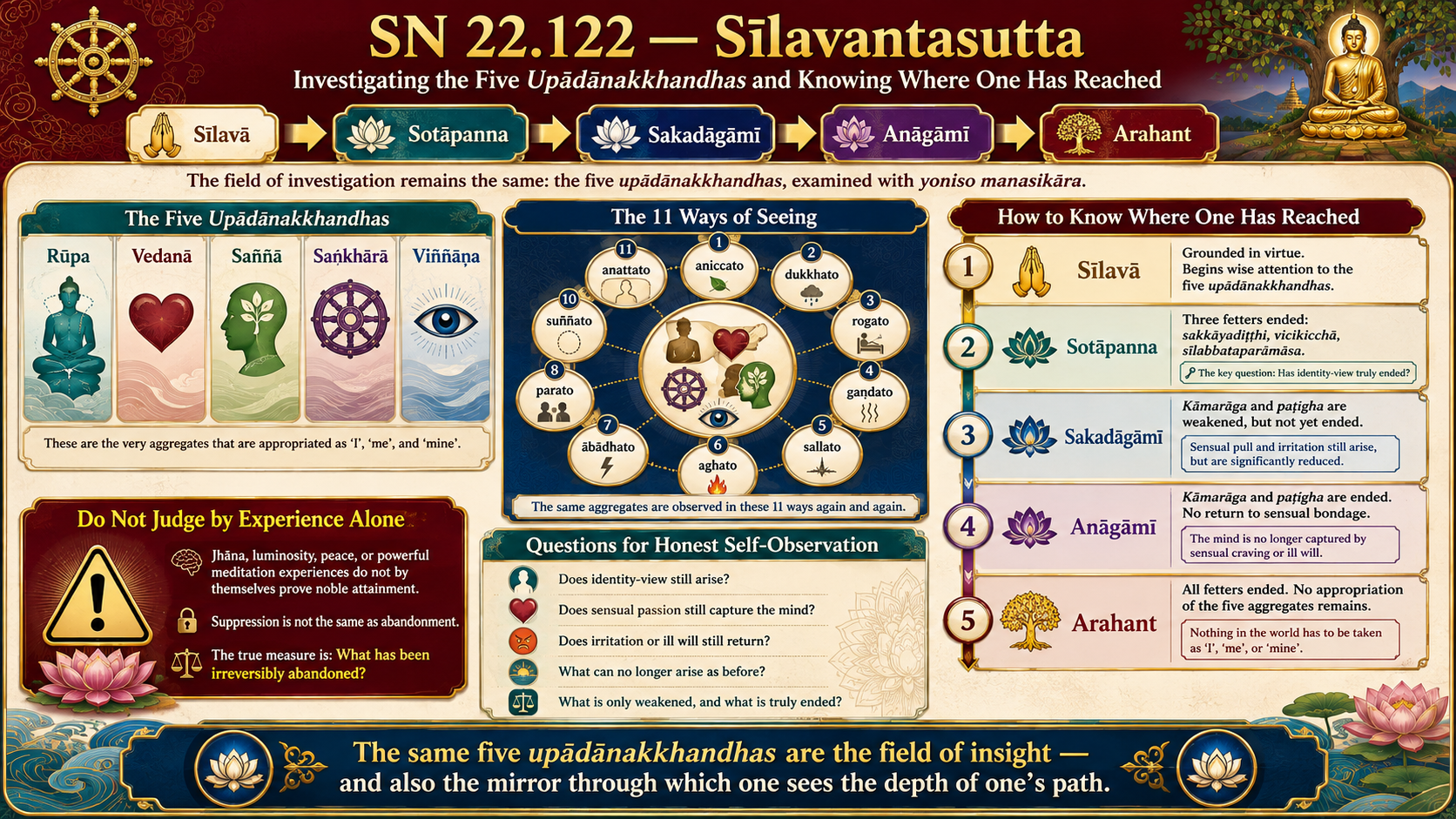
 VISUAL SUMMARYSee this sutta in a pictureOpen the complete infographic for a visual overview before or after reading the full study.View infographic →
Five Upādānakkhandhas→
11 Ways of Seeing→
Sotāpanna→
Sakadāgāmī→
Anāgāmī→
Arahant
The Sīlavantasutta (SN 22.122) is a remarkably concise discourse, but its implications for practice are enormous. In a conversation between Venerable Mahākoṭṭhika and Venerable Sāriputta, one question is repeatedly asked:
What should be given yoniso manasikāra—wise, penetrative attention—at this stage of the path?
The answer never changes.
Whether one is a virtuous bhikkhu who has not yet realized stream-entry, a Sotāpanna, a Sakadāgāmī, an Anāgāmī, or even an Arahant, the field of investigation remains the same:
the five upādānakkhandhas—rūpa, vedanā, saññā, saṅkhārā and viññāṇa.
And Sāriputta does not merely say, “Observe the five aggregates.” He gives eleven ways in which they are to be wisely regarded:
aniccato, dukkhato, rogato, gaṇḍato, sallato, aghato, ābādhato, parato, palokato, suññato, anattato
as impermanent, as dukkha, as a disease, as a boil, as a dart, as misery or calamity, as an affliction, as alien, as breaking apart, as empty, and as not-self. These eleven contemplations are repeated unchanged for every stage from the virtuous practitioner to the Arahant.
This gives the sutta its extraordinary structure:
SĪLAVĀ
virtuous practitioner
       │
       │ five upādānakkhandhas
       │ seen through eleven perspectives
       ↓
SOTĀPATTIPHАLA
       │
       │ same five upādānakkhandhas
       │ same eleven perspectives
       ↓
SAKADĀGĀMIPHАLA
       │
       │ same investigation
       ↓
ANĀGĀMIPHАLA
       │
       │ same investigation
       ↓
ARAHATTA
       │
       │ same investigation continues
       ↓
DIṬṬHADHAMMASUKHAVIHĀRA
+
SATI-SAMPAJAÑÑA
The message is profound: progress on the path does not necessarily mean continually searching for a new meditation object. What changes is the depth with which the same conditioned experience is understood and the extent to which appropriation of it has ended.
01
The Setting: Sāriputta and Mahākoṭṭhika at Isipatana
Ekaṁ samayaṁ āyasmā ca sāriputto āyasmā ca mahākoṭṭhiko bārāṇasiyaṁ viharanti isipatane migadāye. Atha kho āyasmā mahākoṭṭhiko sāyanhasamayaṁ paṭisallānā vuṭṭhito yenāyasmā sāriputto tenupasaṅkami …pe… etadavoca.
“At one time Venerable Sāriputta and Venerable Mahākoṭṭhika were staying near Bārāṇasī, at Isipatana in the Deer Park. Then, in the evening, Venerable Mahākoṭṭhika emerged from seclusion and approached Venerable Sāriputta. After exchanging the appropriate greetings, he said to him…”
The setting is worth noticing. This is not an introductory teaching delivered to newcomers. It is a discussion between two senior disciples, and the question is highly practical:
What should actually be worked on?
Mahākoṭṭhika does not ask for a philosophical definition of enlightenment. He asks what dhammas should receive yoniso manasikāra.
02
The First Question: What Should a Virtuous Bhikkhu Attend To?
“Sīlavatāvuso, sāriputta, bhikkhunā katame dhammā yoniso manasikātabbā”ti?
“Friend Sāriputta, what dhammas should a bhikkhu who is endowed with sīla attend to with yoniso manasikāra?”
The phrase sīlavatā bhikkhunā is important.
Sāriputta does not begin by telling an undisciplined practitioner to perform advanced contemplation while continuing to live carelessly. The starting point is sīlavā—one established in sīla.
But sīla is not presented as the destination.
Once the behavioural foundation has been established, the question becomes:
What should this disciplined mind investigate?
Sāriputta answers:
“Sīlavatāvuso, koṭṭhika, bhikkhunā pañcupādānakkhandhā aniccato dukkhato rogato gaṇḍato sallato aghato ābādhato parato palokato suññato anattato yoniso manasi kātabbā.”
“Friend Koṭṭhika, a bhikkhu endowed with sīla should wisely attend to the five aggregates subject to clinging as impermanent, as dukkha, as a disease, as a boil, as a dart, as misery, as an affliction, as alien, as breaking apart, as empty, and as not-self.”
Then Sāriputta identifies the five:
Katame pañca? Seyyathidaṁ—rūpupādānakkhandho, vedanupādānakkhandho, saññupādānakkhandho, saṅkhārupādānakkhandho, viññāṇupādānakkhandho.
“What five? The form aggregate subject to clinging, the feeling aggregate subject to clinging, the perception aggregate subject to clinging, the volitional-formations aggregate subject to clinging, and the consciousness aggregate subject to clinging.”
And then comes the result:
Ṭhānaṁ kho panetaṁ, āvuso, vijjati yaṁ sīlavā bhikkhu ime pañcupādānakkhandhe aniccato …pe… anattato yoniso manasi karonto sotāpattiphalaṁ sacchikareyyā.
“It is possible, friend, that a virtuous bhikkhu, wisely attending to these five aggregates subject to clinging in this way—from impermanence through not-self—may realize the fruit of stream-entry.”
This is the first major message of the discourse:
Sīla prepares the ground, but penetrative investigation of the five upādānakkhandhas is what Sāriputta directs the virtuous practitioner toward.
03
What Does Yoniso Manasikāra Mean Here?
It would be inadequate to translate yoniso manasikāra merely as “thinking about” the aggregates.
One could repeatedly think:
“Rūpa is impermanent.
Vedanā is impermanent.
Saññā is impermanent…”
without the structure of experience becoming any clearer.
The instruction is to attend in such a way that the aggregate is seen according to its actual nature rather than according to the story of ‘I’, ‘me’ and ‘mine’ built around it.
Suppose ageing becomes noticeable.
Ordinary attention says:
“I am getting old.”
Yoniso manasikāra examines:
What exactly is changing?
Rūpa.
Does rūpa remain according to my wishes?
No.
What happens to the vedanā generated when the change is noticed?
It too changes.
How does saññā interpret what is happening?
Perhaps:
“I used to look better.”
“Others may consider me old.”
What saṅkhārā arise?
“I must hide this.”
“I want to reverse it.”
“I am afraid of what will happen.”
What viññāṇa is operating?
Seeing, thinking, remembering and knowing are all appearing conditionally.
The original experience:
“I am ageing.”
has now opened into conditioned processes:
RŪPA changing
      ↓
VEDANĀ arising
      ↓
SAÑÑĀ recognizing and comparing
      ↓
SAṄKHĀRĀ reacting and constructing
      ↓
VIÑÑĀṆA occurring conditionally
      ↓
where exactly is the permanent "I"?
That movement is much closer to yoniso manasikāra than merely repeating a doctrinal sentence.
04
Why Five Upādānakkhandhas Rather Than Simply Five Khandhas?
The wording of the sutta is precise:
pañcupādānakkhandhā
not merely:
pañcakkhandhā.
The issue is therefore not just that rūpa, vedanā, saññā, saṅkhārā and viññāṇa occur.
The crucial issue is upādāna—appropriation, grasping, taking them up as a basis for identity and possession.
The ordinary process looks like this:
RŪPA
 ↓
"my body"
"my appearance"
"my possessions"

VEDANĀ
 ↓
"my happiness"
"my suffering"

SAÑÑĀ
 ↓
"my memory"
"my opinion"
"what I know"

SAṄKHĀRĀ
 ↓
"my plans"
"my decisions"
"what I will become"

VIÑÑĀṆA
 ↓
"the knower"
"my consciousness"
"what I really am"
The problem is therefore not solved merely by being able to name the five aggregates.
The practitioner must discover where and how each aggregate is being appropriated.
This is why SN 22.57 provides an extremely helpful companion to SN 22.122. SN 22.57 examines each aggregate in terms of what it is, its arising, cessation, the path leading to cessation, gratification, danger and escape. It defines rūpa through the four great elements and derived form, vedanā and saññā through the six sense domains, saṅkhārā through six classes of cetanā, and viññāṇa through the six classes of consciousness.
Thus the present contemplation is not directed at five abstract philosophical categories. It is directed toward what is happening every moment through lived experience.
05
Understanding the Eleven Ways of Seeing
The heart of the Sīlavantasutta is the elevenfold contemplation:
aniccato
dukkhato
rogato
gaṇḍato
sallato
aghato
ābādhato
parato
palokato
suññato
anattato
These should not become eleven labels mechanically repeated over experience.
They are eleven ways of dismantling the assumptions that make the aggregates attractive as a basis for clinging.
For teaching purposes—not as a canonical subdivision—they can be seen as attacking three major illusions:
1. I CAN RELY ON IT

aniccato
palokato

       ↓

its instability is exposed


2. IT CAN GIVE ME SECURE HAPPINESS

dukkhato
rogato
gaṇḍato
sallato
aghato
ābādhato

       ↓

its vulnerability is exposed


3. IT IS ME OR MINE

parato
suññato
anattato

       ↓

ownership and identity are exposed
Let us examine each carefully.
06
1. Aniccato — Seeing It as Impermanent
Anicca should not remain a philosophical statement that “everything changes.”
The question is:
Can this aggregate remain as I want it to remain?
Rūpa changes.
Vedanā changes.
Saññā changes.
Saṅkhārā change.
Viññāṇa changes.
Even within one ordinary disagreement this becomes visible.
At 9:00 a.m. I may be convinced:
“He has insulted me and I am extremely angry.”
At 2:00 p.m. the intensity has reduced.
By evening another event has occupied the mind.
The body has changed, the vedanā has changed, perception of the event has changed, the thought constructions have changed, and the consciousness occurring now is not the same occurrence as during the original confrontation.
But while the anger was occurring, it appeared solid:
“This is how I feel.”
The contemplation aniccato changes the language internally:
“This has arisen under conditions. It is already undergoing change.”
The practical difference is enormous.
WITHOUT INSIGHT

unpleasant vedanā
      ↓
"I am upset"
      ↓
"This is terrible"
      ↓
reaction


WITH ANICCATO

unpleasant vedanā
      ↓
arisen conditionally
      ↓
changing while known
      ↓
cannot remain permanently
      ↓
less need to appropriate it
Impermanence is therefore not something to understand only after an experience has ended.
It is to be recognized while the mind wants the experience to be permanent.
07
2. Dukkhato — Seeing It as Unable to Provide Secure Refuge
Seeing the aggregates dukkhato does not mean convincing oneself that every moment feels painful.
A pleasant vedanā can feel pleasant.
Beautiful rūpa can appear beautiful.
A favourable perception can produce gladness.
The deeper problem is:
Can something that is dependent, unstable and changing provide unchanging security?
If my happiness depends upon praise, what happens when criticism comes?
If it depends upon health, what happens when illness comes?
If it depends upon physical appearance, what happens when ageing comes?
If it depends upon a relationship, what happens when the relationship changes?
If it depends upon a view being accepted, what happens when someone rejects the view?
The problem is dependency.
HAPPINESS DEPENDS ON X
         ↓
X is anicca
         ↓
X inevitably changes
         ↓
my security changes with X
         ↓
DUKKHA
Thus aniccato and dukkhato naturally connect.
If the foundation changes, anything built upon it as permanent refuge becomes vulnerable.
08
3. Rogato — Seeing It as a Disease
Roga means disease or illness.
Sāriputta is not saying that the body is morally bad or that experiencing vedanā is sinful.
The disease perspective points toward continuous vulnerability and dependence upon maintenance.
Consider the body.
It must continually be fed.
It requires water.
It requires sleep.
Its temperature must remain within a limited range.
It must be protected from infection, injury and environmental extremes.
A body that appears perfectly healthy today contains no guarantee that it will remain healthy tomorrow.
The same principle can be applied to psychological constructions.
Suppose one’s identity depends on being admired:
“I am a respected teacher.”
That identity requires continual feeding:
praise
   +
recognition
   +
agreement
   +
social position
   ↓
identity remains comfortable
Then criticism appears.
Suddenly the aggregate-complex becomes painful.
The roga was not created by the criticism. The vulnerability was already built into the dependence.
Seeing rogato asks:
“Why am I treating something that constantly needs supporting conditions as though it were a secure possession?”
09
4. Gaṇḍato — Seeing It as a Boil
Gaṇḍa evokes a boil, swelling or festering sore.
The metaphor is powerful because a boil may appear as a limited swelling while underneath there is pressure, inflammation and vulnerability to rupture.
Applied contemplatively, the image asks us to see beneath the attractive surface of clinging.
Suppose a person receives a major promotion.
At first:
“Excellent! My career is progressing.”
There is pleasant vedanā.
There is the perception:
“I have succeeded.”
Then the identity begins swelling around the position:
“I am now senior.”
But hidden within the delight are new vulnerabilities:
What if I fail?
What if someone else performs better?
What if I lose the position?
What if people no longer respect me?
The gratifying object contains the seed of pressure precisely because it has been appropriated.
promotion
   ↓
pleasant vedanā
   ↓
"I have succeeded"
   ↓
appropriation
   ↓
"I am this position"
   ↓
fear of loss
comparison
defensiveness
pressure
The object did not suddenly become evil.
Upādāna transformed a changing condition into something that must now be protected.
That is the practical power of contemplating it gaṇḍato.
10
5. Sallato — Seeing It as a Dart
Salla means a dart, arrow or piercing object.
A dart hurts because it has penetrated and remains embedded.
The aggregates function similarly when appropriation allows an event to penetrate deeply into identity.
Someone says one sentence:
“You are not competent.”
The sound lasts perhaps two seconds.
But if it becomes:
“He said I am incompetent,”
the dart can remain for days.
sound
 ↓
contact
 ↓
unpleasant vedanā
 ↓
saññā:
"criticism"
 ↓
upādāna:
"criticism of ME"
 ↓
vitakka repeatedly returns
 ↓
the dart remains embedded
The sound disappeared immediately.
What continues hurting?
Not the sound.
The aggregate process has been repeatedly reconstructed through memory, perception, vedanā and saṅkhārā.
Seeing sallato asks:
“Where is the dart actually lodged?”
Often it is lodged precisely where there is:
me, mine, my reputation, my view, my expectation.
11
6. Aghato — Seeing It as Misery or Calamity
Agha carries the sense of distress, misery, trouble or calamity.
This contemplation examines what happens when something inherently unstable has been turned into the foundation of one’s world.
Suppose someone has constructed identity around wealth.
As long as the wealth increases:
“Everything is fine.”
Then a severe financial loss occurs.
The external loss may be substantial, but a second collapse can occur internally:
“I have failed.”
“Who am I now?”
“My whole life is ruined.”
Why does the external event become existential calamity?
Because rūpa, vedanā, perception, constructions and consciousness have been organized around:
“This is mine; this is who I am.”
The contemplation aghato is therefore not pessimism.
It is preventive wisdom:
“If I turn this conditioned aggregate into my identity, what happens when its conditions change?”
12
7. Ābādhato — Seeing It as Affliction
The word ābādha is especially illuminating when read alongside the Anattalakkhaṇasutta, SN 22.59.
There the Buddha explains that if rūpa were truly self, it would not lead to affliction, and one could command:
“Let my form be thus; let my form not be thus.”
The same reasoning is applied to vedanā, saññā, saṅkhārā and viññāṇa. But because the aggregates are not-self, they do lead to affliction and cannot simply be compelled to conform to one’s wishes.
This gives ābādhato enormous practical force.
Try commanding:
“From tomorrow my body will never become sick.”
Or:
“From now on only pleasant vedanā will arise.”
Or:
“I will never perceive anything incorrectly.”
Or:
“No unwanted thoughts or intentions will ever occur.”
Or:
“Only the consciousness I prefer will arise.”
The inability to establish such mastery reveals something fundamental.
IF IT WERE COMPLETELY MINE

I should be able to command it:
"be like this"
"do not be like that"


ACTUAL EXPERIENCE

rūpa changes
vedanā changes
saññā changes
saṅkhārā change
viññāṇa changes

often contrary to preference

        ↓
ĀBĀDHA
        +
ANATTĀ
The problem is not merely change.
The deeper problem is lack of sovereignty over what has been assumed to be “me” or “mine.”
13
8. Parato — Seeing It as Alien, Other, Not Truly One’s Own
Parato points toward seeing the aggregate as other, alien or not one’s own.
This contemplation directly attacks ownership.
SN 22.33 makes the principle strikingly direct: form is not yours, feeling is not yours, perception is not yours, formations are not yours, and consciousness is not yours; their relinquishment is for welfare and happiness.
Ordinary life proceeds from the opposite assumption:
“My body.”
“My feelings.”
“My ideas.”
“My consciousness.”
But what exactly makes them “mine”?
Ownership normally implies some degree of authority.
If a house belongs to me, I can decide whether to paint the wall.
But can I tell rūpa:
“Do not age”?
Can I tell vedanā:
“Pleasant only”?
Can I tell saññā:
“Never misrecognize anything”?
Can I tell viññāṇa:
“Remain exactly as I wish”?
The aggregate behaves according to conditions, not according to a declaration of ownership.
Thus:
"MY BODY"
     ↓
does it obey ownership?
     ↓
No—it follows conditions

"MY FEELING"
     ↓
does it remain as ordered?
     ↓
No—it follows contact and conditions

"MY CONSCIOUSNESS"
     ↓
can I command its every occurrence?
     ↓
No—it is condition-dependent

     ↓

PARATO
seen as not truly one's possession
14
9. Palokato — Seeing It as Breaking Apart
Paloka emphasizes breaking apart, crumbling or disintegration.
It overlaps with anicca but gives impermanence a more concrete direction.
Anicca tells us:
“It cannot remain.”
Paloka makes us look directly at:
“It is already in the process of breaking apart.”
A new car begins ageing the day it leaves the showroom.
A new phone begins moving toward obsolescence as soon as it is purchased.
The young body is already moving toward ageing.
A relationship changes from day to day.
A thought dissolves almost immediately.
A moment of consciousness cannot be preserved.
Yet saññā creates the impression of solidity:
“This is my house.”
“This is my body.”
“This is my career.”
“This is my relationship.”
Palokato penetrates that appearance:
APPARENT SOLIDITY
      ↓
look closely
      ↓
constant dependence
constant alteration
constant deterioration
      ↓
PALOKA
breaking apart
This contemplation is particularly useful whenever the mind says:
“Now I have finally secured this.”
The question becomes:
“What exactly has been secured against change?”
15
10. Suññato — Seeing It as Empty
Suññato should not be left as an undefined philosophical word.
SN 35.85 gives a very direct explanation of emptiness. The “world” of six-sense experience is called empty because eye, forms, eye-consciousness, contact, feelings arising from contact—and likewise the other sense doors—are empty of self and of what belongs to self.
This gives a practical meaning to contemplating the aggregates suññato.
Suppose anger is present.
Ordinary experience says:
“I am angry.”
Emptiness investigation asks:
Where is this “I”?
There is unpleasant vedanā.
There is recognition of an event.
There are thoughts.
There is bodily activation.
There is mind-consciousness knowing these events.
But apart from these conditioned happenings, where is an independent owner of the anger?
"I AM ANGRY"
      ↓
investigate
      ↓
rūpa
vedanā
saññā
saṅkhārā
viññāṇa
      ↓
all condition-dependent
      ↓
empty of an independent self
and empty of anything truly belonging to self
      ↓
SUÑÑATO
This is not claiming that nothing exists.
Anger occurred.
Vedanā occurred.
Thoughts occurred.
The emptiness concerns the assumption:
“There is an independent self inside these events which owns them.”
16
11. Anattato — Seeing It as Not-Self
The elevenfold examination culminates in:
anattato.
The Anattalakkhaṇasutta provides one of the clearest practical tests.
If an aggregate were self, it should not afflict us and should be subject to command.
But rūpa cannot be compelled.
Vedanā cannot be compelled.
Saññā cannot be compelled.
Saṅkhārā cannot be compelled.
Viññāṇa cannot be compelled.
Thus anattā is not something to accept because Buddhism teaches it.
It is something to investigate.
Is rūpa permanently controllable?
NO

Is vedanā permanently controllable?
NO

Is saññā permanently controllable?
NO

Are saṅkhārā permanently controllable?
NO

Is viññāṇa permanently controllable?
NO

        ↓

Can any of them reasonably be taken as
a permanent sovereign self?

        ↓

ANATTĀ
The distinction between suññato and anattato is subtle but useful.
Suññato examines the emptiness of experience:
empty of self and what belongs to self.
Anattato examines the aggregate itself:
this cannot rightly be regarded as self.
Both remove appropriation from slightly different directions.
17
Why Eleven Perspectives Instead of Only Anicca, Dukkha and Anattā?
One might ask why Sāriputta does not simply say:
“See the five aggregates as anicca, dukkha and anattā.”
Because attachment is stubborn.
A practitioner may intellectually accept:
“The body is impermanent,”
while still organizing the entire life around protecting, decorating and identifying with it.
One may say:
“Vedanā is anicca,”
while spending every waking hour seeking pleasant vedanā and escaping unpleasant vedanā.
One may say:
“Consciousness is anattā,”
while quietly believing:
“But there must still be some pure observer who is really me.”
The eleven contemplations repeatedly approach the structure from different directions:
ANICCATO
You cannot keep it.

PALOKATO
It is actually breaking apart.

DUKKHATO
It cannot provide lasting security.

ROGATO
It remains intrinsically vulnerable.

GAṆḌATO
Attachment to it contains pressure and trouble.

SALLATO
When appropriated, it pierces.

AGHATO
Dependence upon it becomes misery when conditions change.

ĀBĀDHATO
It can afflict and cannot be commanded.

PARATO
It is not truly yours.

SUÑÑATO
It is empty of self and what belongs to self.

ANATTATO
It cannot rightly be regarded as self.
The eleven views are therefore not eleven unrelated philosophical propositions.
They work together to erode delight, ownership, identity and dependence.
18
The Sotāpanna Is Told to Continue Exactly the Same Practice
Mahākoṭṭhika next asks:
“Sotāpannena panāvuso sāriputta, bhikkhunā katame dhammā yoniso manasi kātabbā”ti?
“Friend Sāriputta, what dhammas should a bhikkhu who is a stream-enterer wisely attend to?”
One might expect Sāriputta to now prescribe a completely different meditation.
He does not.
“Sotāpannenapi kho, āvuso koṭṭhika, bhikkhunā ime pañcupādānakkhandhā aniccato …pe… anattato yoniso manasi kātabbā.”
“A stream-enterer too, friend Koṭṭhika, should wisely attend to these five aggregates subject to clinging as impermanent … through to not-self.”
And:
Ṭhānaṁ kho panetaṁ … yaṁ sotāpanno bhikkhu … sakadāgāmiphalaṁ sacchikareyya.
“It is possible that a stream-enterer, attending to them in this way, may realize the fruit of once-returning.”
This is extremely important.
Stream-entry does not mean:
“I have understood the five aggregates; now I need another subject.”
The insight has become irreversible in a crucial sense, but the work of disentangling the mind from the aggregates is not complete.
The practitioner returns to exactly the same territory.
But now it is penetrated more deeply.
19
Why Insight Can Be Correct but Still Incomplete
SN 22.89, the Khemakasutta, provides a beautiful explanation of this issue.
Khemaka states that he does not regard any of the five upādānakkhandhas as self or belonging to self, yet the residual conceit “I am”, desire connected with “I am,” and underlying tendency toward “I am” have not yet been completely eradicated.
This gives tremendous clarity to SN 22.122.
A practitioner may no longer explicitly believe:
“Rūpa is my permanent self.”
Yet subtler appropriation can remain:
“I am the one experiencing rūpa.”
“I am the one who has attained this understanding.”
“I am the meditator.”
“I am more advanced.”
“I am the one who is detached.”
Thus the path does not end merely because a gross philosophical self-view has collapsed.
GROSS APPROPRIATION

"This aggregate IS me"
        ↓
penetrated


BUT PERHAPS

"I am the one
who experiences these aggregates"
        ↓

subtle asmimāna may remain
This explains why the same aggregate contemplation remains relevant beyond stream-entry.
20
From Sotāpanna to Sakadāgāmī
The practice becomes increasingly intimate.
At the earlier stage the practitioner may clearly recognize after an event:
“I became angry because I appropriated the unpleasant vedanā.”
With maturation the process may become visible earlier:
unpleasant vedanā is arising.
saññā is identifying this as criticism.
saṅkhārā are preparing retaliation.
this is not worth taking as “me.”
The difference is not necessarily a new meditation technique.
The difference is how quickly and deeply appropriation is seen.
EARLY PRACTICE

event
 ↓
reaction
 ↓
later reflection:
"I became attached"


DEEPENING PRACTICE

event
 ↓
vedanā known
 ↓
saññā known
 ↓
construction known
 ↓
appropriation detected
 ↓
release occurs earlier
The same five aggregates are becoming transparent.
21
From Sakadāgāmī to Anāgāmī
Mahākoṭṭhika asks again:
“Sakadāgāminā panāvuso sāriputta, bhikkhunā katame dhammā yoniso manasi kātabbā”ti?
“What should a once-returner wisely attend to?”
Again Sāriputta answers:
these same five upādānakkhandhas, as anicca … through anattā.
And it is possible that through such contemplation the Sakadāgāmī may realize Anāgāmiphala, the fruit of non-returning.
This repetition carries a practical warning.
One should not mistake decreased reaction for completion.
Suppose earlier anger lasted three days.
Later it lasts three hours.
Later still perhaps three minutes.
There has clearly been development.
But the question is not merely:
“How long does my anger last?”
The deeper question is:
What still makes anger possible?
Where is there still appropriation?
Where does unpleasant vedanā still become:
“This should not happen to me”?
Where does saññā still produce:
“He is my enemy”?
Where do saṅkhārā still construct:
“I should hurt him back”?
The path continues by examining the root structure, not merely measuring the duration of the symptoms.
22
From Anāgāmī to Arahant
The next question is:
“Anāgāminā panāvuso sāriputta, bhikkhunā katame dhammā yoniso manasi kātabbā”ti?
“What should a non-returner wisely attend to?”
And once again:
the five upādānakkhandhas as anicca, dukkha, roga, gaṇḍa, salla, agha, ābādha, para, paloka, suñña and anattā.
Sāriputta says:
Ṭhānaṁ kho panetaṁ … yaṁ anāgāmī bhikkhu … arahattaṁ sacchikareyya.
“It is possible that an Anāgāmī, wisely attending to the five aggregates in this way, may realize arahantship.”
This is perhaps the most important stage for understanding the subtlety of the discourse.
By this point, it would be easy to think:
“Surely the major work has already been completed. What remains?”
The answer is still:
the five upādānakkhandhas.
Why?
Because self-making can retreat into extraordinarily refined territory.
It may no longer depend upon gross sensual possession.
It may become:
“my samādhi.”
“my equanimity.”
“my insight.”
“my attainment.”
“my understanding.”
“I am one who has gone beyond sensuality.”
Even refined dhammas can become a subtle platform for:
asmī — “I am.”
SN 22.89 is particularly relevant here because it shows that even after the grosser identification with the aggregates has been penetrated, a residual “I am” tendency toward the five upādānakkhandhas can remain until complete liberation.
Thus the final work is not necessarily to acquire something more spectacular.
It may instead be the removal of the last subtle appropriation:
"I AM THE BODY"
      ↓
abandoned

"I AM MY FEELINGS"
      ↓
abandoned

"I AM MY THOUGHTS"
      ↓
abandoned

"I AM CONSCIOUSNESS"
      ↓
abandoned

but perhaps:

"I AM THE ONE WHO KNOWS
THESE ARE NOT-SELF"
      ↓
investigate further
      ↓
asmimāna exhausted
The path ends not when the practitioner has constructed the perfect identity.
It ends when the need to construct identity from the aggregates is exhausted.
23
Then Mahākoṭṭhika Asks the Surprising Question: What About an Arahant?
“Arahatā panāvuso sāriputta, katame dhammā yoniso manasi kātabbā”ti?
“Friend Sāriputta, what dhammas should an Arahant wisely attend to?”
At first the question appears unnecessary.
If arahantship has been attained, why continue?
Sāriputta replies:
“Arahatāpi kho, āvuso koṭṭhika, ime pañcupādānakkhandhe aniccato dukkhato rogato gaṇḍato sallato aghato ābādhato parato palokato suññato anattato yoniso manasi kātabbā.”
“An Arahant too, friend Koṭṭhika, should wisely attend to these five aggregates subject to clinging as impermanent, as dukkha, as a disease, as a boil, as a dart, as misery, as an affliction, as alien, as breaking apart, as empty, and as not-self.”
Then comes the crucial qualification:
Natthi, khvāvuso, arahato uttari karaṇīyaṁ katassa vā paticayo.
“For an Arahant, friend, there is nothing further that must be done, nor anything further that needs to be completed or built upon regarding what has already been accomplished.”
Arahantship is not being presented as incomplete.
There is no higher fruit that this contemplation must now produce.
Yet Sāriputta continues:
api ca ime dhammā bhāvitā bahulīkatā diṭṭhadhammasukhavihārāya ceva saṁvattanti satisampajaññāya cā.
“Nevertheless, when these dhammas are developed and cultivated repeatedly, they lead to pleasant abiding here and now and to sati-sampajañña.”
This is a beautiful distinction.
Before arahantship:
five upādānakkhandhas
      +
eleven contemplations
      ↓
further liberation remains to be realized
For the Arahant:
nothing further to accomplish
      ↓
same contemplation
      ↓
diṭṭhadhammasukhavihāra
+
sati-sampajañña
Practice does not become useless after liberation.
Its purpose changes.
24
An Important Connection with the Samādhibhāvanāsutta
This conclusion becomes especially interesting when read alongside AN 4.41, the Samādhibhāvanāsutta.
AN 4.41 distinguished developments of samādhi leading respectively to:
diṭṭhadhammasukhavihāra — pleasant abiding here and now,
ñāṇadassana — knowledge and vision,
sati-sampajañña — mindfulness and full awareness,
and āsavānaṁ khaya — destruction of the āsavas.
Here in SN 22.122, Sāriputta says that for an Arahant, continued cultivation of these dhammas supports precisely:
diṭṭhadhammasukhavihāra and sati-sampajañña.
Thus the liberated person does not continue contemplating the aggregates because liberation remains incomplete.
The contemplation becomes a natural dwelling of a mind that no longer needs to appropriate experience.
25
One Ordinary Event Can Be Used to Work Through the Entire Sutta
Consider a practical example.
Someone publicly criticizes your teaching.
Immediately there may be:
rūpa — sound and bodily changes,
viññāṇa — hearing consciousness,
vedanā — unpleasant feeling,
saññā — “he is criticizing me,”
saṅkhārā — impulses to defend, explain, retaliate or withdraw.
Now the eleven contemplations can be applied—not mechanically, but investigatively.
THE CRITICISM EVENT
        ↓

ANICCATO
Will this vedanā remain?
No.

DUKKHATO
Can dependence on praise provide secure happiness?
No.

ROGATO
Does identity dependent on approval remain vulnerable?
Yes.

GAṆḌATO
Does "my reputation" contain pressure underneath?
Yes.

SALLATO
What exactly makes the words continue to pierce?
"My reputation has been attacked."

AGHATO
If identity collapses when criticized,
is that identity a safe refuge?
No.

ĀBĀDHATO
Can I order vedanā and perception
to behave exactly as I want?
No.

PARATO
Are these aggregates truly my possession?
No.

PALOKATO
Are they already changing and dissolving?
Yes.

SUÑÑATO
Where is an independent self inside this process?

ANATTATO
Can any aggregate rightly be taken as a sovereign self?
No.
Notice what has happened.
We have not tried to suppress the unpleasant feeling.
We have not forced ourselves to like the criticism.
We have investigated why an event lasting a few seconds was capable of disturbing the mind.
Eventually the issue becomes visible:
There was something being defended as me or mine.
That is where the work is.
26
Another Example: Attachment to Meditation Progress
The same sutta must also be applied inside meditation practice itself.
Suppose a practitioner has a particularly deep meditation session.
There is sukha.
The mind is calm.
There is unusual clarity.
Then perception arises:
“This was an excellent meditation.”
Soon saṅkhārā begin:
“I should be able to reproduce this tomorrow.”
Then:
“I am progressing.”
Then:
“Perhaps I have reached a particular stage.”
The next day the meditation is unsettled.
Now disappointment appears.
What happened?
pleasant meditation
       ↓
pleasant vedanā
       ↓
saññā:
"deep state"
       ↓
saṅkhārā:
"I want this again"
       ↓
upādāna:
"my attainment"
       ↓
next session differs
       ↓
unpleasant vedanā
       ↓
dukkha
The problem was never the calm meditation.
The problem was appropriation.
Now apply Sāriputta’s eleven perspectives.
The calm was anicca.
Depending upon it for identity was dukkha.
The need to reproduce it reveals roga.
“My attainment” becomes a gaṇḍa, something requiring protection.
Its loss becomes a salla.
Failure to reproduce it may feel like agha.
It cannot be compelled: ābādha.
The state is not one’s possession: para.
It has already disappeared: paloka.
It is empty of a permanent meditator: suñña.
And it cannot rightly be regarded as self: anattā.
This is how SN 22.122 prevents vipassanā itself from becoming another identity project.
27
The Entire Path Can Be Seen as Progressive De-appropriation
The repeated structure of the Sīlavantasutta can now be understood much more deeply.
At each stage the question is essentially:
What remains appropriated?
The virtuous practitioner begins examining gross assumptions about body, pleasure, perception, intentions and consciousness.
The Sotāpanna continues because insight into the aggregates has not yet exhausted all attachment.
The Sakadāgāmī continues because subtler emotional appropriation remains.
The Anāgāmī continues because even beyond gross sensual entanglement there can remain refined forms of “I am.”
The Arahant continues without any remaining task of liberation, because this clear seeing naturally supports pleasant abiding and sati-sampajañña.
Thus:
SĪLAVĀ
"I take much of experience as me/mine"
        ↓
yoniso manasikāra


SOTĀPANNA
fundamental breakthrough
but further appropriation remains
        ↓
same investigation


SAKADĀGĀMĪ
coarser reactions reduced
but further appropriation remains
        ↓
same investigation


ANĀGĀMĪ
gross sensual entanglement overcome
but subtle "I am" may remain
        ↓
same investigation


ARAHANT
appropriation exhausted
nothing further to accomplish
        ↓
same dhammas cultivated for
pleasant abiding + sati-sampajañña
The striking lesson is:
The object does not have to change because the problem has always been the same—the appropriation of conditioned aggregates.
28
A Practical Way Forward
The Sīlavantasutta gives us a very clear workout.
First, establish sīla. A mind repeatedly disturbed by misconduct will have difficulty examining appropriation with the required clarity.
Then become familiar with the five aggregates in ordinary life, rather than recognizing them only during a formal meditation sitting.
When seeing occurs, recognize rūpa and viññāṇa.
When pleasant or unpleasant experience follows contact, recognize vedanā.
When the mind identifies something as “beautiful,” “dangerous,” “my friend,” “my enemy,” “success,” or “failure,” recognize saññā.
When intention begins moving toward acquisition, avoidance, speech, retaliation or becoming, recognize saṅkhārā.
Then investigate—not merely label.
Take one real event and ask:
WHAT IS HAPPENING?
       ↓
Which aggregates are operating?


WHERE IS UPĀDĀNA?
       ↓
What has become "me" or "mine"?


CAN THIS REMAIN?
       ↓
aniccato


CAN IT PROVIDE SECURE HAPPINESS?
       ↓
dukkhato


WHAT VULNERABILITY COMES WITH DEPENDING ON IT?
       ↓
rogato • gaṇḍato • sallato
aghato • ābādhato


IS IT ACTUALLY MY POSSESSION?
       ↓
parato


IS IT ALREADY BREAKING APART?
       ↓
palokato


IS THERE AN INDEPENDENT SELF WITHIN IT?
       ↓
suññato


CAN IT RIGHTLY BE REGARDED AS SELF?
       ↓
anattato
This should not become eleven sentences hurriedly recited over every experience.
Sometimes one perspective may be sufficient.
A strong desire may need aniccato.
Fear of bodily ageing may benefit from palokato.
An insult repeatedly replayed may be seen sallato.
Pride in an attainment may need parato and anattato.
A sense of permanent consciousness may need suññato and anattato.
The purpose is not to finish a checklist.
The purpose is to find which assumption is allowing upādāna to continue.
29
The Deeper Message of the Sīlavantasutta
SN 22.122 gives a remarkably uncompromising answer to the question:
“What should I practise next?”
The answer is not necessarily:
“Find a new technique.”
It may be:
Look again at what is already being experienced, but more deeply.
Rūpa was present before stream-entry.
Rūpa remains present afterwards.
Vedanā was present before stream-entry.
Vedanā remains.
Saññā, saṅkhārā and viññāṇa continue.
What progressively changes is the relationship to them.
FIRST:

rūpa → "mine"
vedanā → "mine"
saññā → "mine"
saṅkhārā → "mine"
viññāṇa → "mine"


THEN:

rūpa → conditioned
vedanā → conditioned
saññā → conditioned
saṅkhārā → conditioned
viññāṇa → conditioned


FINALLY:

arising processes
changing processes
ceasing processes

without appropriation
This is why Sāriputta can prescribe the same contemplation from the virtuous practitioner to the threshold of arahantship.
It is not repetitive.
It is progressively penetrative.
The practitioner first understands:
“This is impermanent.”
Then:
“Because I depend upon it, I suffer.”
Then:
“What I depend upon is inherently vulnerable.”
Then:
“It is not actually mine.”
Then:
“It is empty of any independent self.”
Finally even the subtle standpoint:
“I am the one who is watching all this”
loses its footing.
The five aggregates remain conditioned aggregates.
What has disappeared is upādāna.
And that is perhaps the central teaching of the Sīlavantasutta:
Liberation does not require finding something within the five aggregates that is finally permanent, safe and truly ‘me’. It comes through repeatedly seeing why none of the five can bear that burden of identity in the first place.
Sīla provides the foundation.
Yoniso manasikāra turns toward the five upādānakkhandhas.
The eleven perspectives dismantle permanence, security, ownership and self-making.
The same field is revisited at every noble milestone.
And when the work is finally complete, nothing further remains to be accomplished; the same clear seeing can continue simply as diṭṭhadhammasukhavihāra and sati-sampajañña—pleasant abiding here and now, with mindfulness and full awareness.
Noble Fruit→
What Has Ended?→
What Is Only Weakened?→
What Can Still Arise?→
What Can No Longer Return?
Core principle: suppression under favourable conditions is not the same as irreversible abandonment of a fetter.
Practical mirror: ordinary life provides the test when attractive objects, criticism, praise, pain, loss, status, conflict or meditation disappointment appear.
Once the Sīlavantasutta is understood as a progressive deepening through the same five upādānakkhandhas, an important practical question naturally arises:
How can a practitioner know whether Sotāpatti, Sakadāgāmi, Anāgāmi or Arahattaphala has actually been realized, rather than merely imagined?
This question is extremely important because meditation can produce powerful experiences.
There may be profound samādhi.
There may be jhāna.
There may be intense pīti and sukha.
There may be luminosity.
There may be periods in which thought almost disappears.
There may be extraordinary equanimity.
There may even be experiences in which ordinary perception seems temporarily to cease.
After such an experience the mind can easily construct:
“Something very important happened.”
And from there:
“Perhaps I have become a Sotāpanna.”
Or:
“Anger hardly affects me now; perhaps I am an Anāgāmī.”
But the early discourses give us a much safer basis for examination.
The question is not principally what experience occurred. The question is what has been irreversibly abandoned.
The distinction can be represented this way:
MEDITATION EXPERIENCE
        ↓
may be profound
may be peaceful
may be extraordinary
may last minutes or hours
        ↓
BUT
        ↓
does not by itself establish a noble fruit


NOBLE FRUIT
        ↓
identified through irreversible
transformation of the fetters
        ↓
what can no longer bind the mind?
This protects the practitioner from both extremes.
One extreme is underestimating genuine transformation because one expects fireworks or mystical phenomena.
The other is overestimating a temporary state because it felt extraordinary.
The Buddha’s descriptions repeatedly direct us toward what has been ended, what has been weakened, and what remains.
V01
The Fundamental Principle: Suppression Is Not Abandonment
Before examining each stage, one distinction must be absolutely clear:
a defilement being absent at one particular time is not the same as the fetter having been abandoned.
A person may enter deep samādhi and experience no sensual desire for an hour.
That does not establish the destruction of kāmarāga.
Someone may spend ten days at a retreat without anger.
That does not establish the destruction of paṭigha.
Someone may intellectually understand anattā and speak very convincingly about the five aggregates.
That does not establish the destruction of sakkāyadiṭṭhi.
The test is what happens when appropriate conditions arise.
TEMPORARY SUPPRESSION

favourable conditions
       +
samādhi
       +
few provocations
       ↓
defilement does not appear


ABANDONMENT

relevant object appears
       +
conditions that formerly triggered the fetter
       ↓
the fetter itself is no longer available
as a mode of appropriation
This is why real-life encounters are such important mirrors.
How does the mind respond when criticized?
How does it respond when praised?
What happens when an attractive sensual object appears?
What happens when something deeply valued is lost?
What happens when bodily pain arises?
What happens when another person’s view directly contradicts one’s own?
What happens when meditation does not go according to expectation?
The answer is not found merely in whether vedanā occurs. Pleasant and unpleasant vedanā continue to arise according to conditions. The important question is:
What does the mind construct from that vedanā?
That brings us directly back to the five upādānakkhandhas of the Sīlavantasutta.
V02
Sotāpanna: What Must Be Irreversibly Gone?
The canonical formula is very clear. A Sotāpanna is one for whom the first three fetters have been ended:
sakkāyadiṭṭhi — identity view,
vicikicchā — doubt,
and
sīlabbataparāmāsa — mistaken grasping at precepts and observances as sufficient means of purification or liberation.
The discourses repeatedly use the formula that one who has ended these three fetters is a stream-enterer, no longer liable to the lower destinations, assured and headed for awakening.
This gives us three separate areas to examine.
V03
1. Has Sakkāyadiṭṭhi Actually Ended?
This is subtler than merely saying:
“There is no self.”
Sakkāyadiṭṭhi concerns the way the five aggregates are taken as self.
SN 22.1 explains the structure very precisely. With regard to rūpa, for example, the uninstructed person may regard:
rūpa as self,
self as possessing rūpa,
rūpa as contained within self,
or self as contained within rūpa.
The same fourfold construction is applied to vedanā, saññā, saṅkhārā and viññāṇa, producing twenty modes of identity view.
Therefore the real question is not:
“Can I explain anattā?”
It is:
Do I still actually regard any of these aggregates as what I fundamentally am?
For example, suppose the body deteriorates.
Does the mind fundamentally conclude:
“Something that constitutes the real me is being destroyed”?
Or can it directly recognize:
“Rūpa is changing according to conditions”?
Suppose a strong mental state disappears.
Does the mind conclude:
“I have lost part of myself”?
Or:
“A conditioned saṅkhāra has ceased”?
Suppose consciousness becomes very refined in meditation.
Does the mind secretly retreat into:
“This pure consciousness is what I truly am”?
If so, the five-aggregate investigation has further work to do.
However, an important distinction must be made. Ending sakkāyadiṭṭhi does not mean that every trace of the sense “I am” has disappeared.
The Khemakasutta, SN 22.89, makes this very clear. Even after one no longer takes any of the five upādānakkhandhas as self or belonging to self, a subtler residual asmimāna—“I am” conceit—can remain until full liberation.
So:
SOTĀPANNA

"This aggregate is my permanent self"
        ↓
cannot be maintained


BUT

subtle "I am"
comparison
pride
self-reference
        ↓
may still remain
This is important because otherwise one may set an Arahant-level standard for stream-entry and conclude incorrectly that stream-entry has not occurred simply because some subtle self-reference remains.
V04
2. Has Vicikicchā Actually Ended?
The second fetter is vicikicchā.
This does not mean that a Sotāpanna suddenly knows the answer to every question about Buddhism.
One may still ask:
“What exactly does this Pāli expression mean?”
“How should this particular meditation be practised?”
“Which interpretation of this passage is more accurate?”
Those are not necessarily the fetter of vicikicchā.
The deeper issue is whether fundamental doubt remains about the Buddha’s awakening, the Dhamma as the path of liberation, and the noble Saṅgha as those who have realized that path.
DN 16 gives an especially valuable teaching called the Dhammādāsa—the Mirror of the Dhamma. The Buddha says that a noble disciple possessing this mirror can, if desired, declare of oneself that one is a stream-enterer. The mirror includes experiential or verified confidence in the Buddha, Dhamma and Saṅgha, together with ethical qualities cherished by the noble ones.
The important word here is not blind belief.
The confidence has become grounded in seeing.
The practitioner no longer thinks:
“Maybe craving really is the way to happiness.”
“Maybe the Noble Eightfold Path does not actually lead out of suffering.”
“Perhaps there is some completely different route that makes the Buddha’s training unnecessary.”
The Dhamma has been seen deeply enough that the fundamental direction is no longer uncertain.
There may still be much that remains to be understood.
But the direction of travel has become irreversible.
BEFORE

"Is this really the path?"
"Perhaps sensuality is the real happiness."
"Maybe liberation works some completely different way."

        ↓
direct seeing of Dhamma

AFTER

details may still be investigated
        ↓
but the fundamental confidence
in Buddha–Dhamma–Saṅgha and the path
is no longer dependent on speculation
V05
3. Has Sīlabbataparāmāsa Actually Ended?
This fetter is sometimes misunderstood as meaning:
“A Sotāpanna no longer cares about precepts or observances.”
That would contradict the repeated sutta descriptions of the noble disciple’s ethical conduct.
The issue is not sīla.
The issue is parāmāsa—mistaken grasping.
One no longer believes that merely performing a ritual, undertaking an observance, obeying an external form, bathing in a sacred river, performing ceremonies, or mechanically maintaining practices can by themselves purify the mind and produce liberation while craving, ignorance and appropriation remain untouched.
The practitioner understands:
SĪLA
     ↓
essential foundation


BUT

SĪLA ALONE
     ≠
complete liberation


because

upādāna
avijjā
taṇhā
identity-making
     ↓
must themselves be penetrated
A Sotāpanna therefore does not abandon sīla.
Rather, sīla is understood correctly.
It supports the path instead of being mistaken for the entirety of the path.
V06
The Sotāpanna’s Practical Verification
The Buddha’s Dhammādāsa is particularly significant because it shows that stream-entry is not necessarily something for which one must wait for another person to issue a certificate. The Dhamma itself becomes a mirror through which the noble disciple can examine the irreversible qualities that are present.
A useful practical examination is:
SOTĀPANNA CHECK

1. SAKKĀYADIṬṬHI
Can any of the five aggregates still
be genuinely maintained as self?

2. VICIKICCHĀ
Is there still fundamental uncertainty
about Buddha, Dhamma, Saṅgha
and the liberating direction of the path?

3. SĪLABBATAPARĀMĀSA
Do I still believe external practices,
rituals or observances themselves
can liberate without penetrating craving,
clinging and ignorance?
If these three have genuinely and irreversibly ended, the canonical criterion for stream-entry has been fulfilled.
But sensual desire may still arise.
Ill will may still arise.
Conceit may still arise.
Restlessness may still arise.
Ignorance has not yet been completely destroyed.
Therefore the presence of these later fetters does not disprove Sotāpatti.
V07
Sakadāgāmī: The Most Difficult Stage to Measure Mechanically
The next standard formula is:
the three fetters have ended and rāga, dosa and moha have become attenuated.
MN 22 and several other discourses describe the Sakadāgāmī precisely in this way: the first three fetters are ended, while greed, hatred and delusion are tanubhūta—weakened, thinned out or attenuated.
This makes Sakadāgāmī somewhat different from the other milestones.
For Sotāpanna we can ask:
Are the first three fetters ended?
For Anāgāmī we can ask:
Are all five lower fetters ended?
For Arahant:
Are all fetters and āsavas ended?
But Sakadāgāmi involves attenuation, not yet complete destruction of sensual desire and ill will.
The suttas do not provide a numerical formula such as:
“Anger has fallen by 70%.”
or:
“Sensual desire must last less than thirty seconds.”
Therefore one should be cautious about inventing measurements that the Buddha did not provide.
This is an important limitation to acknowledge.
A person cannot reliably say:
“My anger used to last three hours and now lasts ten minutes, therefore I am definitely a Sakadāgāmī.”
There may certainly have been substantial development.
But duration alone is not the definition of Sakadāgāmiphala.
What one should look for is a deep, stable and irreversible attenuation of rāga, dosa and moha across life, not merely during retreat, after jhāna, or under protected circumstances.
PUTHUJJANA / EARLIER TRAINING

sense object
     ↓
strong pull

criticism
     ↓
strong resistance

confusion
     ↓
easily dominates


SAKADĀGĀMĪ DIRECTION

same domains appear
     ↓
rāga much thinner
dosa much thinner
moha much thinner
     ↓
less capacity to dominate the mind
The first three fetters must already have ended.
Then one examines the remaining greed, hatred and delusion.
Are they merely being restrained?
Or have they fundamentally lost much of their strength?
Do they return with their former force whenever conditions become difficult?
Or has something irreversible changed in the structure of the mind?
Because the canonical criterion is qualitative rather than numerical, if serious doubt remains over whether the attenuation is sufficient to justify the label, there is little value in forcing a conclusion.
Continue the same practice Sāriputta prescribes:
the five upādānakkhandhas as anicca, dukkha, roga, gaṇḍa, salla, agha, ābādha, para, paloka, suñña and anattā.
The path does not depend upon having a label.
The destruction of the remaining fetters does.
V08
A Useful Boundary: Sakadāgāmī Versus Anāgāmī
There is, however, a very clear boundary at the next stage.
For the Sakadāgāmī:
kāmarāga / rāga
      ↓
WEAKENED

paṭigha / dosa
      ↓
WEAKENED
For the Anāgāmī:
kāmarāga
      ↓
ENDED

paṭigha
      ↓
ENDED
This distinction is far more useful than counting minutes of anger or comparing one’s calmness with someone else’s.
V09
Anāgāmī: The Five Lower Fetters Have Ended
The Anāgāmī is defined by the destruction of the five lower fetters.
AN 10.13 lists them as:
sakkāyadiṭṭhi — identity view,
vicikicchā — doubt,
sīlabbataparāmāsa — mistaken grasping at precepts and observances,
kāmarāga — sensual passion,
and
paṭigha — resistance, aversion or ill will.
The standard descriptions of the Anāgāmī say that with the ending of these five lower fetters one becomes a non-returner.
This gives a much sharper basis for verification.
The question is no longer:
“Is sensual desire less than before?”
It is:
Does kāmarāga still arise at all as a fetter?
And no longer:
“Do I recover from anger quickly?”
but:
Does paṭigha still arise?
V10
What Does the Ending of Kāmarāga Mean in Actual Life?
This does not mean that an Anāgāmī becomes incapable of recognizing pleasant sensory experience.
Pleasant vedanā may still occur when appropriate contact occurs.
Food can have a pleasant taste.
A beautiful object can still be recognized as beautiful.
Comfort can still be distinguished from discomfort.
The question is what happens after pleasant contact.
pleasant sense contact
        ↓
pleasant vedanā

PUTHUJJANA
        ↓
"I want more"
"let this continue"
"I need this"
        ↓
kāmarāga


ANĀGĀMĪ
        ↓
pleasant vedanā known as pleasant
        ↓
no sensual passion takes possession
of the mind
This is a much more demanding criterion than simply practising restraint.
A person can restrain himself from buying something and still intensely want it.
A person can observe celibacy and still experience powerful sexual desire.
A person can avoid luxurious food while mentally craving it.
Restraint is valuable practice.
But restraint is not identical to the ending of kāmarāga.
For Anāgāmiphala the fetter itself has ended.
V11
What Does the Ending of Paṭigha Mean?
Exactly the same care is required here.
An Anāgāmī may still experience an unpleasant vedanā.
Physical pain can still be painful.
Harsh sound is still harsh.
An unpleasant event can still be recognized as undesirable at a functional level.
But paṭigha—the mental resistance, hostility or aversive pushing against experience—has ended as a fetter.
Suppose someone speaks abusively.
harsh words
     ↓
ear-contact
     ↓
unpleasant vedanā may occur
     ↓

BUT

no hatred
no hostility
no wish to injure
no inner resistance constructing
"this should not be happening to ME"
The distinction between pain and mental resistance is important. SN 36.6 illustrates the wider principle that the instructed noble disciple can experience painful feeling without adding the second mental arrow of aversion in the same way as the uninstructed person.
Therefore one should not ask:
“Can I feel pain?”
but:
“Can painful experience still generate paṭigha?”
V12
A Very Clear Anāgāmī Test
Because the five lower fetters are binary at this stage, a practical examination can be made quite direct:
ANĀGĀMĪ CHECK

SAKKĀYADIṬṬHI
ended

VICIKICCHĀ
ended

SĪLABBATAPARĀMĀSA
ended

KĀMARĀGA
ended — not merely controlled

PAṬIGHA
ended — not merely shortened
If sensual passion still genuinely arises, however quickly it is recognized, the Anāgāmī criterion has not yet been fulfilled.
If genuine ill will or paṭigha still arises, however quickly it disappears, the criterion has not yet been fulfilled.
This gives the practitioner something far more reliable than asking:
“Do I feel peaceful most of the time?”
Peacefulness is not the definition.
The ending of the five lower fetters is.
V13
But Anāgāmī Is Still Not Arahant
This distinction is extremely important because profound freedom from sensuality and ill will can feel like complete liberation.
Yet AN 10.13 lists five higher fetters that can still remain:
rūparāga — passion connected with refined form existence,
arūparāga — passion connected with formless existence,
māna — conceit,
uddhacca — restlessness,
and
avijjā — ignorance.
Thus an Anāgāmī may have completely passed beyond kāmarāga and paṭigha while subtle attachment to refined existence, subtle “I am,” restlessness and ignorance remain.
This is why the Sīlavantasutta again prescribes exactly the same workout:
the five upādānakkhandhas … aniccato … anattato.
The remaining self-making has become subtler, but it has not yet ended.
V14
Arahant: Nothing Further Remains to Be Abandoned
Arahantship is different in kind.
The remaining higher fetters have ended.
The āsavas have been destroyed.
The discourses describe the liberated person as one who has destroyed the taints and the fetters of existence and is liberated through final knowledge.
But there is something still more important for the present question of certainty.
The suttas repeatedly use the formula:
vimuttasmiṁ vimuttamiti ñāṇaṁ hoti
“When liberated, there is the knowledge: ‘Liberated.’”
And then:
Khīṇā jāti, vusitaṁ brahmacariyaṁ, kataṁ karaṇīyaṁ, nāparaṁ itthattāyāti pajānāti.
“One understands: ‘Birth is ended; the spiritual life has been fulfilled; what had to be done has been done; there is no more of this state of being.’”
This directly addresses the question:
Would an Arahant remain uncertain whether the work is complete?
The canonical formula points in the opposite direction.
Liberation itself is accompanied by knowledge of liberation.
NIBBIDĀ
   ↓
VIRĀGA
   ↓
VIMUTTI
   ↓
vimuttasmiṁ vimuttamiti ñāṇaṁ hoti
"liberated — known as liberated"
   ↓
khīṇā jāti
   ↓
kataṁ karaṇīyaṁ
"what had to be done has been done"
This is not an inference based upon:
“I feel extraordinarily peaceful.”
It is direct knowledge associated with the complete destruction of the conditions for further bondage.
V15
What Should Be Checked for Arahantship?
All ten fetters provide a useful framework:
LOWER FETTERS

1. sakkāyadiṭṭhi       ✓ ended
2. vicikicchā          ✓ ended
3. sīlabbataparāmāsa   ✓ ended
4. kāmarāga            ✓ ended
5. paṭigha             ✓ ended


HIGHER FETTERS

6. rūparāga            ✓ ended
7. arūparāga           ✓ ended
8. māna                ✓ ended
9. uddhacca            ✓ ended
10. avijjā             ✓ ended
The important late-stage tests are particularly subtle.
Has attachment to refined meditative existence ended?
Has attachment to formless states ended?
Has the comparison-making tendency:
“I am superior,”
“I am equal,”
“I am inferior”
lost its basis?
Has the residual asmimāna—“I am” conceit—ended?
Has ignorance regarding the conditioned nature of the aggregates been fully exhausted?
Has every basis for upādāna ended?
If not, the work described in the Sīlavantasutta continues.
V16
Arahantship Does Not Mean the Body Stops Experiencing Conditions
Another possible misunderstanding should be removed.
Complete liberation does not mean:
“Nothing physically unpleasant can happen.”
An Arahant can experience bodily pain.
Rūpa continues to age.
The sense doors continue functioning.
Vedanā still arises according to contact.
Saññā continues functioning.
Functional intentions occur.
Viññāṇa occurs according to conditions.
The difference is that these no longer become a foundation for clinging.
Thus:
PAIN
     ↓
may occur

LOSS
     ↓
may occur

AGEING
     ↓
occurs

PHYSICAL ILLNESS
     ↓
may occur


BUT

"this is happening to ME"
        ↓
upādāna

has no remaining foundation
The verification of Arahantship is therefore not:
“Can suffering circumstances reach the body?”
It is:
Can the five aggregates still be appropriated in such a way that craving, becoming and ignorance continue?
For the Arahant, the answer is no.
V17
Four Milestones Viewed in One Diagram
The entire progression can now be represented clearly:
SĪLAVĀ
       ↓
five upādānakkhandhas investigated
       ↓

SOTĀPANNA
━━━━━━━━━━━━━━━━━━━━━━━━━━━━
DESTROYED:
• sakkāyadiṭṭhi
• vicikicchā
• sīlabbataparāmāsa

STILL POSSIBLE:
• sensual desire
• ill will
• conceit
• restlessness
• ignorance
       ↓

SAKADĀGĀMĪ
━━━━━━━━━━━━━━━━━━━━━━━━━━━━
first three remain destroyed

PLUS:
• rāga attenuated
• dosa attenuated
• moha attenuated

BUT:
kāmarāga and paṭigha
not yet fully ended
       ↓

ANĀGĀMĪ
━━━━━━━━━━━━━━━━━━━━━━━━━━━━
FIVE LOWER FETTERS DESTROYED

• sakkāyadiṭṭhi
• vicikicchā
• sīlabbataparāmāsa
• kāmarāga
• paṭigha

BUT HIGHER FETTERS REMAIN
       ↓

ARAHANT
━━━━━━━━━━━━━━━━━━━━━━━━━━━━
LOWER FETTERS ENDED
+
HIGHER FETTERS ENDED
+
ĀSAVAS ENDED
       ↓
vimuttasmiṁ vimuttamiti ñāṇaṁ
       ↓
"liberated — known as liberated"
This also explains why Sakadāgāmī and Anāgāmī should never be confused merely because a person’s anger has become weak.
The distinction is not:
strong anger versus mild anger.
It is:
attenuated paṭigha versus paṭigha ended.
Likewise with sensual desire:
attenuated kāmarāga versus kāmarāga ended.
V18
Do Not Use One Exceptional Meditation Session as the Test
This point deserves special emphasis for serious practitioners.
Suppose there is a meditation session in which:
- no sensual desire appears,
- no anger appears,
- the mind is exceptionally clear,
- bodily perception becomes faint,
- enormous equanimity is present,
- and afterward the practitioner feels completely untouched by the world.
That may represent very deep samādhi.
But the correct question is not:
“What title should I give that session?”
The question is:
What happens afterwards when the relevant causes and objects appear again?
DEEP MEDITATION
      ↓
kāmarāga absent
paṭigha absent
"I" construction very weak
      ↓
COME OUT


THEN LIFE PROVIDES THE TEST

attractive object
criticism
loss
success
praise
pain
status
conflict
meditation failure
      ↓
what arises now?
If the fetter returns, it was not destroyed.
It may have been temporarily absent, suppressed, weakened or not triggered.
That is still valuable development.
But the noble milestones should be assessed according to irreversible transformation, not peak experience.
V19
Why Real-Life Situations Become a Powerful Dhamma Mirror
The five aggregates operate continuously.
Therefore ordinary life provides innumerable opportunities for verification.
Consider five situations:
Someone praises you.
Does pleasant vedanā become:
“They recognize me”?
Does māna inflate?
Someone criticizes you.
Does unpleasant vedanā become:
“How dare they treat me this way”?
Does paṭigha arise?
An intensely attractive sensory object appears.
Is there merely recognition and pleasant vedanā?
Or does kāmarāga take hold?
A valued possession is lost.
Is practical action taken appropriately?
Or does the loss become:
“Something belonging to me has been taken; I cannot accept this”?
A profound meditation state disappears.
Is its passing understood as:
“conditioned dhamma has ceased”?
Or does the mind say:
“I have lost my attainment”?
These situations reveal much more than a theoretical declaration.
LIFE EVENT
     ↓
PHASSA
     ↓
VEDANĀ
     ↓
SAÑÑĀ
     ↓
SAṄKHĀRĀ
     ↓
VIÑÑĀṆA
     ↓

LOOK HERE:

does UPĀDĀNA form?

does KĀMARĀGA arise?

does PAṬIGHA arise?

does MĀNA arise?

does AVIJJĀ still obscure?
This is precisely why the Sīlavantasutta remains relevant at every stage.
The five upādānakkhandhas themselves reveal what remains unfinished.
V20
Certainty Should Come From Seeing What Cannot Return
There is therefore a better question than:
“How peaceful am I?”
Ask:
What can the mind no longer do?
For Sotāpanna:
Can it genuinely return to taking one of the five aggregates as a permanent self?
For Sakadāgāmī:
Have greed, hatred and delusion undergone an unmistakable and durable attenuation beyond the stream-entry level?
For Anāgāmī:
Can sensual passion still arise?
Can paṭigha still arise?
If yes, continue practising without forcing the Anāgāmī label.
For Arahant:
Is there any remaining rūparāga, arūparāga, māna, uddhacca or avijjā?
Is there any remaining ground for upādāna?
Has the destruction of the āsavas been directly known?
The progression is:
DO NOT ASK ONLY:

"What did I experience?"


ASK:

"What has been destroyed?"

"What has only been weakened?"

"What can still arise?"

"What can no longer arise?"

"What is still appropriated?"

"What has become impossible to appropriate?"
This produces a much more sober and reliable assessment.
V21
What If Doubt About the Stage Still Remains?
There is a very practical answer.
Do not stop the practice to defend a label.
The Sīlavantasutta itself tells us what to do.
If one is a virtuous practitioner:
investigate the five upādānakkhandhas.
If one is a Sotāpanna:
investigate the same five upādānakkhandhas.
If one is a Sakadāgāmī:
investigate the same five upādānakkhandhas.
If one is an Anāgāmī:
investigate the same five upādānakkhandhas.
And even when one is an Arahant, the same contemplation continues for pleasant abiding here and now and sati-sampajañña.
Therefore uncertainty about the intermediate label need not interrupt the path.
"Am I Sotāpanna?"
      ↓
investigate the aggregates

"Am I Sakadāgāmī?"
      ↓
investigate the aggregates

"Am I Anāgāmī?"
      ↓
investigate the aggregates

"What remains?"
      ↓
investigate the aggregates

until

upādāna itself has no footing
If genuine attainment has occurred, investigation will not undo it.
If it has not occurred, investigation moves the practitioner closer.
Either way, the correct direction is the same.
V22
The Most Important Shift: From Achievement to Remaining Work
The danger in thinking about noble attainments is that they can become another identity:
“I am a Sotāpanna.”
“I am a Sakadāgāmī.”
“I am an Anāgāmī.”
The Sīlavantasutta points in almost the opposite direction.
At every stage Sāriputta asks us to return to:
rūpa, vedanā, saññā, saṅkhārā and viññāṇa
and examine them as:
anicca, dukkha, roga, gaṇḍa, salla, agha, ābādha, para, paloka, suñña and anattā.
So rather than asking primarily:
“What have I become?”
the practitioner asks:
“What remains appropriated?”
That question is far more consistent with the direction of liberation.
"I HAVE ATTAINED"
       ↓
may become new identity


"WHAT REMAINS?"
       ↓
investigation
       ↓
further relinquishment
       ↓
less identity
       ↓
greater freedom
Ultimately, when nothing further remains, there is no need to manufacture certainty through comparison or self-persuasion.
The sutta formula becomes:
vimuttasmiṁ vimuttamiti ñāṇaṁ hoti
“Being liberated, there is knowledge: ‘Liberated.’”
And:
kataṁ karaṇīyaṁ
“What had to be done has been done.”
That is a very different kind of certainty from:
“I think I may have attained something.”
It is certainty grounded in what has irreversibly ceased.
And this makes the Sīlavantasutta even more practical: the five upādānakkhandhas are not only the field through which each noble fruit is developed; they also become the field in which the practitioner can continually see what still binds, what has weakened, what has ended, and what work remains to be done.
Phassa→
Vedanā→
Saññā→
Saṅkhārā→
Viññāṇa→
Does Upādāna Still Form?
Certainty comes increasingly from seeing what the mind can no longer appropriate, what fetters have truly ended, and what work still remains.