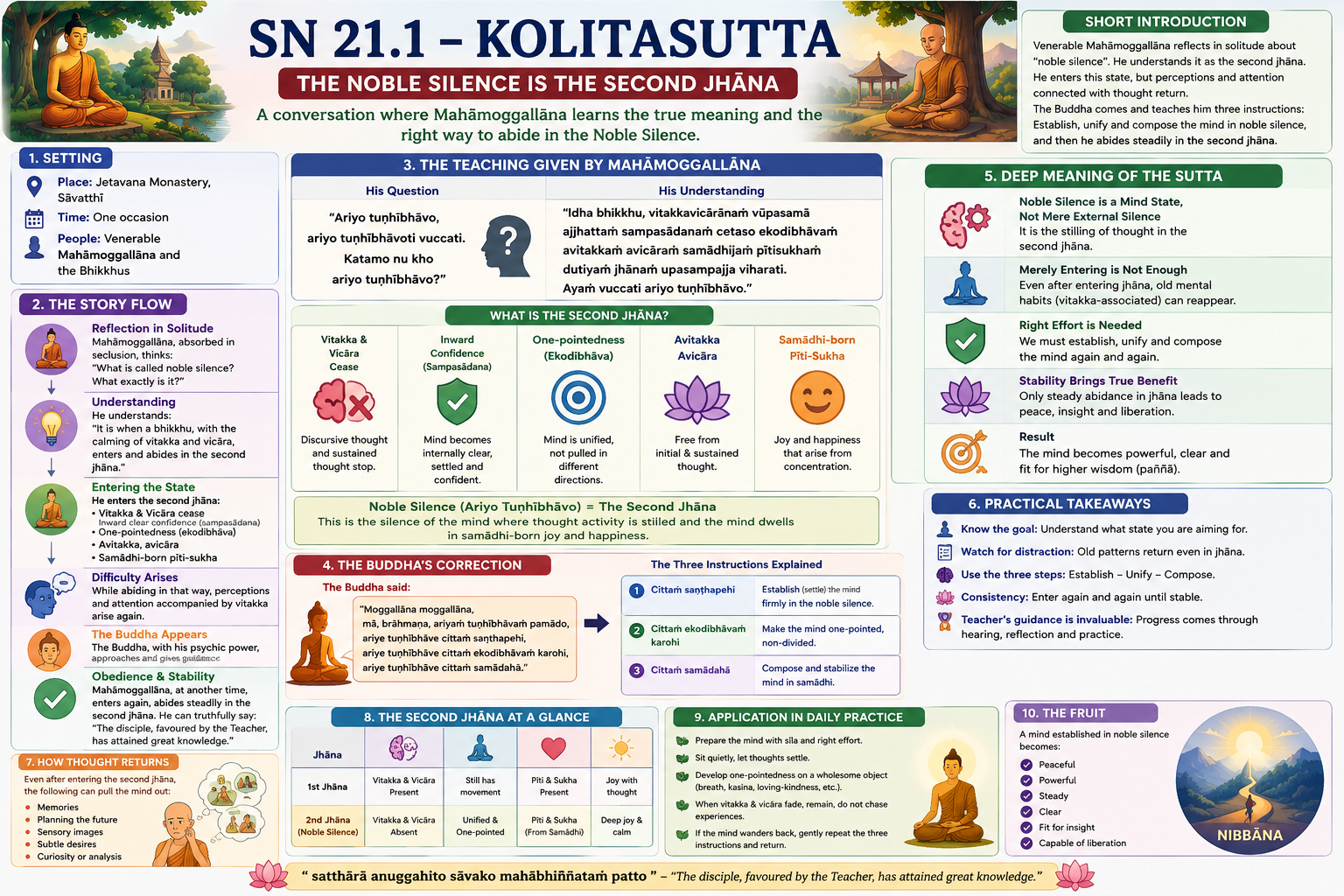
 VISUAL SUMMARYSee this sutta in a pictureOpen the complete infographic for a visual overview before or after reading the full study.View infographic →
01Recognizing Noble SilenceMahāmoggallāna’s question • second jhāna identified as ariya tuṇhībhāva • actual entry into the state
01Mahāmoggallāna Addresses the Bhikkhus
Evaṁ me sutaṁ— ekaṁ samayaṁ bhagavā sāvatthiyaṁ viharati jetavane anāthapiṇḍikassa ārāme. Tatra kho āyasmā mahāmoggallāno bhikkhū āmantesi: “āvuso bhikkhave”ti.
“Āvuso”ti kho te bhikkhū āyasmato mahāmoggallānassa paccassosuṁ.
Āyasmā mahāmoggallāno etadavoca:
Thus have I heard. On one occasion the Blessed One was dwelling at Sāvatthī, in Jeta’s Grove, Anāthapiṇḍika’s monastery. There Venerable Mahāmoggallāna addressed the bhikkhus:
“Friends, bhikkhus.”
“Friend,” those bhikkhus replied to Venerable Mahāmoggallāna.
Venerable Mahāmoggallāna said:
The discourse is presented as Mahāmoggallāna’s own account of practice. This is important because he does not merely define second jhāna theoretically; he describes a difficulty that arose while actually entering the state and the Buddha’s direct correction.
The sutta therefore gives a rare practice narrative: recognition of a meditative state → attempted entry → intrusion of an incompatible mental process → direct guidance from the Buddha → later stabilization of the state.
02What is Ariya Tuṇhībhāva — Noble Silence?
“Idha mayhaṁ, āvuso, rahogatassa paṭisallīnassa evaṁ cetaso parivitakko udapādi: ‘ariyo tuṇhībhāvo, ariyo tuṇhībhāvoti vuccati. Katamo nu kho ariyo tuṇhībhāvo’ti?”
“Friends, while I was alone in seclusion, this reflection arose in my mind:
‘Noble silence, noble silence, it is said. But what is noble silence?’”
Rahogata and paṭisallīna indicate seclusion and withdrawal. In that setting Mahāmoggallāna investigates the meaning of ariya tuṇhībhāva.
This immediately shows that “noble silence” is not merely refraining from speaking. Mahāmoggallāna is already physically secluded and silent, yet he still asks what true noble silence is.
The question is therefore about the silencing of a deeper level of mental activity.
03Second Jhāna is Noble Silence
“Tassa mayhaṁ, āvuso, etadahosi: ‘idha bhikkhu vitakkavicārānaṁ vūpasamā ajjhattaṁ sampasādanaṁ cetaso ekodibhāvaṁ avitakkaṁ avicāraṁ samādhijaṁ pītisukhaṁ dutiyaṁ jhānaṁ upasampajja viharati. Ayaṁ vuccati ariyo tuṇhībhāvo’ti.”
“Then, friends, it occurred to me:
‘Here, with the subsiding of vitakka and vicāra, a bhikkhu enters and dwells in the second jhāna, which has inner clarity and unification of mind, is without vitakka and vicāra, and has rapture and happiness born of samādhi.
This is called noble silence.’”
The definition is explicit: ariya tuṇhībhāva is identified with the second jhāna.
Vitakkavicārānaṁ vūpasamā means the subsiding or calming of vitakka and vicāra. Whatever precise English wording one prefers for these terms, the sutta itself makes their absence essential to this state.
Ajjhattaṁ sampasādanaṁ indicates inner clarity, confidence, or serenity.
Cetaso ekodibhāvaṁ is the mind becoming unified or brought to singleness.
Avitakkaṁ avicāraṁ repeats the crucial feature in unmistakable form: the state is without vitakka and without vicāra.
Samādhijaṁ pītisukhaṁ means the rapture and happiness are born from samādhi itself, unlike the first jhāna formula where pīti-sukha is described as born from seclusion.
The silence is therefore internal: the mental activity associated with vitakka-vicāra has become quiet, while the mind is unified, bright, joyful, and steady.
04Mahāmoggallāna Enters the Second Jhāna
“So khvāhaṁ, āvuso, vitakkavicārānaṁ vūpasamā ajjhattaṁ sampasādanaṁ cetaso ekodibhāvaṁ avitakkaṁ avicāraṁ samādhijaṁ pītisukhaṁ dutiyaṁ jhānaṁ upasampajja vihariṁ.”
“So, friends, with the subsiding of vitakka and vicāra, with inner clarity and unification of mind, without vitakka and vicāra, with rapture and happiness born of samādhi, I entered and dwelt in the second jhāna.”
Mahāmoggallāna does not stop with the conceptual definition. He enters the state.
The wording repeats the standard second-jhāna formula in full. This repetition matters because the next sentence reveals that an instability still remained.
The sutta therefore distinguishes between gaining access to a state and being able to remain there without incompatible mental activity reappearing.
02Instability and the Buddha’s CorrectionVitakka-associated saññā/manasikāra reappear • establish • unify • compose • later stabilization
05Vitakka-Associated Perception and Attention Reappear
“Tassa mayhaṁ, āvuso, iminā vihārena viharato vitakkasahagatā saññāmanasikārā samudācaranti.”
“Friends, while I was dwelling in that state, perceptions and acts of attention accompanied by vitakka kept occurring to me.”
This is the pivotal practice sentence.
Vitakkasahagatā means accompanied by or associated with vitakka.
Saññāmanasikārā combines saññā—perception, recognition, marking—with manasikāra—attention, directing the mind toward something.
Samudācaranti means they occurred, intruded, or became active.
The implication is straightforward: although Mahāmoggallāna had entered the second jhāna, mental activity incompatible with its defining feature began to reappear.
This is useful for understanding meditative stability. A momentary entry does not necessarily mean the state has become fully stable. Residual habits of attending, recognizing, or mentally engaging can pull the mind back toward the mode from which it had emerged.
06The Buddha’s Direct Instruction
“Atha kho maṁ, āvuso, bhagavā iddhiyā upasaṅkamitvā etadavoca: ‘moggallāna moggallāna, mā, brāhmaṇa, ariyaṁ tuṇhībhāvaṁ pamādo, ariye tuṇhībhāve cittaṁ saṇṭhapehi, ariye tuṇhībhāve cittaṁ ekodibhāvaṁ karohi, ariye tuṇhībhāve cittaṁ samādahā’ti.”
“Then, friends, the Blessed One approached me by means of spiritual power and said:
‘Moggallāna, Moggallāna! Brahmin, do not be heedless regarding noble silence.
Establish the mind in noble silence. Make the mind unified in noble silence. Compose and collect the mind in noble silence.’”
The Buddha does not tell Mahāmoggallāna to abandon the attempt or return permanently to a grosser state. He instructs him to stabilize the very quality he had recognized.
Three verbs form the practical core:
Cittaṁ saṇṭhapehi — establish, settle, or station the mind there.
Cittaṁ ekodibhāvaṁ karohi — make the mind unified, bring it to singleness.
Cittaṁ samādahā — compose, collect, stabilize, or bring the mind into samādhi.
This is not passive waiting. Mahāmoggallāna is being instructed to re-establish the mind when incompatible activity reappears.
The phrase mā pamādo—do not be heedless—shows that even advanced meditative states require care, continuity, and repeated development.
07Later the Second Jhāna Becomes Stable
“So khvāhaṁ, āvuso, aparena samayena vitakkavicārānaṁ vūpasamā ajjhattaṁ sampasādanaṁ cetaso ekodibhāvaṁ avitakkaṁ avicāraṁ samādhijaṁ pītisukhaṁ dutiyaṁ jhānaṁ upasampajja viharāmi.”
“And so, friends, at a later time, with the subsiding of vitakka and vicāra, with inner clarity and unification of mind, without vitakka and vicāra, with rapture and happiness born of samādhi, I entered and dwelt in the second jhāna.”
Aparena samayena—at a later time—marks the result of repeated cultivation.
The same second-jhāna formula appears again, but this time the account does not immediately report the return of vitakka-associated perception and attention.
The narrative therefore suggests maturation: the state that was initially vulnerable to interruption later became sufficiently established.
This is an important training principle. The presence of temporary instability does not mean the practice is invalid; it may mean the state has not yet been sufficiently bhāvita and bahulīkata—developed and cultivated repeatedly.
03Teacher Support and Practice SummaryMahāmoggallāna acknowledges the Teacher’s support and summarizes the practical lesson
08“A Disciple Helped by the Teacher”
“Yañhi taṁ, āvuso, sammā vadamāno vadeyya: ‘satthārā anuggahito sāvako mahābhiññataṁ patto’ti, mamaṁ taṁ sammā vadamāno vadeyya: ‘satthārā anuggahito sāvako mahābhiññataṁ patto’”ti.
“Friends, if one were speaking rightly of someone by saying:
‘A disciple, helped and supported by the Teacher, attained greatness of direct knowledge,’
it is of me that one could rightly say:
‘A disciple, helped by the Teacher, attained greatness of direct knowledge.’”
Mahāmoggallāna ends by explicitly acknowledging the Buddha’s assistance.
Anuggahita means supported, helped, encouraged, or assisted.
Mahābhiññatā refers to greatness in direct knowledge.
The statement protects the account from becoming a story of self-generated meditative achievement. Even one of the foremost disciples emphasizes the Teacher’s intervention and guidance.
For practice, this reinforces the value of accurate instruction. Deep meditative states may contain subtle errors that are difficult to diagnose from inside the experience itself.
09Practice Summary: What this Sutta Teaches about Jhāna
Ariyo tuṇhībhāvo = vitakkavicārānaṁ vūpasamā → ajjhattaṁ sampasādanaṁ → cetaso ekodibhāvaṁ → avitakkaṁ avicāraṁ → samādhijaṁ pītisukhaṁ → dutiyaṁ jhānaṁ.
Vitakkasahagatā saññāmanasikārā samudācaranti → cittaṁ saṇṭhapehi → cittaṁ ekodibhāvaṁ karohi → cittaṁ samādahā.
Noble silence = subsiding of vitakka and vicāra → inner clarity → unification of mind → without vitakka and vicāra → rapture and happiness born of samādhi → second jhāna.
If vitakka-associated perception and attention reappear → establish the mind → unify the mind → collect and stabilize the mind.
SN 21.1 gives a compact but unusually practical picture of second-jhāna development.
First, know the defining quality: noble silence is not merely absence of speech, but the internal quieting of vitakka-vicāra.
Second, entry is not necessarily identical with mastery. Mahāmoggallāna entered the state and still experienced incompatible mental activity.
Third, the corrective is stabilization, not analysis inside the state: establish, unify, and compose the mind.
Fourth, repeated practice leads to greater stability.
Finally, the sutta presents advanced practice without triumphalism. Mahāmoggallāna credits the Buddha’s direct assistance.