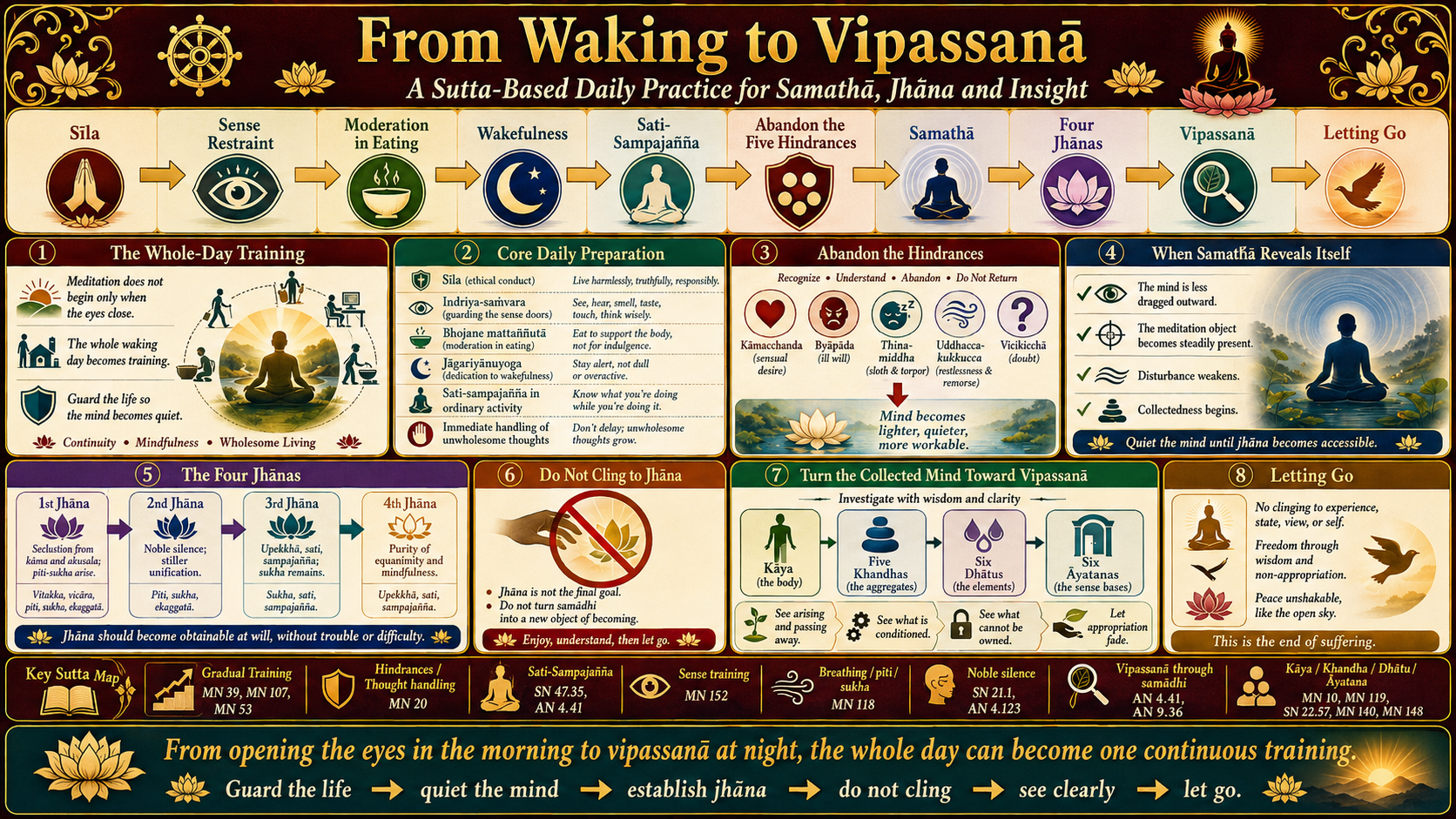
 VISUAL SUMMARYSee this study in a pictureOpen the complete infographic for a visual overview before or after reading the full study.View infographic →
| Practice area | Principal sutta references | How the sutta is used |
|---|---|---|
| The complete gradual training | MN 39 Mahāassapurasutta; MN 107 Gaṇakamoggallānasutta; MN 53 Sekhasutta | sīla → indriya-saṁvara → bhojane mattaññutā → jāgariyānuyoga → sati-sampajañña → abandoning the five hindrances → the four jhānas. MN 53 adds the criterion that jhānas become obtainable at will, without trouble or difficulty. |
| Dealing immediately with unwholesome thought | MN 20 Vitakkasaṇṭhānasutta | Five progressively stronger ways of removing an unwholesome train of thought rather than allowing it to continue feeding a hindrance. |
| Sati-sampajañña throughout ordinary activity | SN 47.35 Satisutta; MN 39; MN 107; AN 4.41 Samādhibhāvanāsutta | Know vedanā, saññā and vitakka as they arise, remain and cease; apply awareness throughout bodily activities. |
| Guarding and developing the six sense faculties | MN 39; MN 107; MN 152 Indriyabhāvanāsutta | Restraint at the sense doors; agreeable, disagreeable and mixed reactions are known and relinquished so equanimity can be established rapidly. |
| Moderation in eating and wakefulness | MN 39; MN 107 | Food sustains the body and practice rather than amusement or indulgence; the waking day and night are organized so sloth and heedlessness do not dominate. |
| Jhāna and systematic meditative development | MN 39; MN 77 Mahāsakuludāyisutta; AN 4.41; MN 53 | Four-jhāna sequence, wider meditative development, samādhi cultivation and the mastery criterion. |
| Breath, pīti, sukha and tranquillizing bodily activity | MN 118 Ānāpānasatisutta | Direct breathing framework for experiencing pīti, sukha and tranquillizing the bodily formation while mindfulness remains continuous. |
| Second jhāna as noble silence | SN 21.1 Kolitasutta; AN 4.123 Paṭhamanānākaraṇasutta | Second jhāna as ariya tuṇhībhāva; repeated dwelling linked with the Ābhassara realm, while liberation remains the higher objective. |
| Turning samādhi toward vipassanā | AN 4.41; AN 9.36 Jhānasutta | Samādhi directed toward sati-sampajañña, aggregate contemplation and ending the āsavas; jhāna phenomena examined as impermanent, stressful, alien, empty and not-self. |
| Kāya | MN 10 Satipaṭṭhānasutta; MN 119 Kāyagatāsatisutta | Body, posture, activity, breathing, anatomical constitution and elements are known directly rather than appropriated as “I” or “mine.” |
| Five khandhas | SN 22.57 Sattatthānasutta; AN 4.41; AN 9.36 | Examine each aggregate, its arising, cessation, gratification, danger and escape. |
| Six dhātus | MN 140 Dhātuvibhaṅgasutta | Investigate earth, water, fire, air, space and consciousness so the apparent solidity of “my body” and “my experience” is dismantled. |
| Six āyatanas | MN 148 Chachakkasutta; MN 152 | Observe sense base + object + consciousness → contact → feeling, and see how craving and appropriation can arise. |
00The Foundation — Give Up the Ten Unwholesome Courses
Before looking at the later aspects of daily training, this beginning must not be forgotten: give up the ten unwholesome courses of action. They are three of body—killing, taking what is not given, and sexual misconduct; four of speech—lying, divisive speech, harsh speech, and idle chatter; and three of mind—covetousness, ill will, and wrong view. When these courses are being abandoned, conduct stops heating and scattering the citta, and the conditions for mindfulness and collectedness become possible.
This training is not limited to the moment of personal performance. One also asks: “Do I encourage it? Do I approve of it? Do I praise or normalise it?” Giving up the ten unwholesome courses is therefore the starting step before the other aspects of practice are developed. It protects the entire day and gives sīla its practical force.
01The Night Before — Set the Direction Toward Noble Silence
The preparation can begin even before sleep. One may make a clear resolve that the following day will be lived in the direction of ariya tuṇhībhāva—noble silence. SN 21.1 explicitly identifies noble silence with the second jhāna. Such a resolve should not become craving for an altered state; its purpose is to provide direction. Every time the practitioner remembers that direction, the question becomes immediate: “Is what I am doing now leading toward stillness, or am I feeding kāmacchanda, byāpāda, agitation or proliferation?” In that way the objective of jhāna begins governing ordinary conduct.
02Upon Waking — Examine and Remove the Hindrances
The work therefore begins immediately upon waking. Before entering the stream of activities, the mind itself is examined. Is sensual desire present? Ill will? Sluggishness? Restlessness or remorse? Doubt? If a hindrance is found, it is not carried casually into the remainder of the morning. Its supporting condition is investigated and removed. MN 20 is especially practical here: change the mental theme, contemplate the danger in the unwholesome thought, withdraw attention from it, investigate the source sustaining it, and, when necessary, firmly restrain the mind. The purpose is explicit—the unwholesome trains of thought disappear and the mind becomes steady, settled and unified.
03Ordinary Activity Becomes the Meditation
From the moment the body leaves the bed, sati-sampajañña takes over. Brushing the teeth, going to the toilet, bathing, dressing, walking and eating cease to be gaps between meditation sessions. They become the meditation. Alongside knowing bodily activity, SN 47.35 supplies an even deeper internal examination: know vedanā, vitakka and saññā when they arise, know them while they remain, and know when they disappear. Thus an unpleasant feeling need not become anger; an attractive perception need not become sensual imagination; a thought need not continue for ten minutes before the practitioner discovers that the mind has been captured by it.
04Walking, Sense Restraint and Moderation in Eating
Walking adds indriya-saṁvara. MN 39 and MN 107 place this restraint early in the gradual training: the eyes continue seeing and the ears continue hearing, but experience is no longer automatically converted into possession, resistance and proliferation. MN 152 then takes the training deeper. When something agreeable, disagreeable, or a mixture of both arises through a sense door, the practitioner learns to recognize the reaction and let it fade rapidly so that equanimity can become established. Eating adds bhojane mattaññutā. Food is taken for the maintenance of the body rather than for entertainment or indulgence. Taste is known as taste. Liking is known as liking. Fullness is known as fullness. The plate gradually empties while the body’s requirement is gradually satisfied. At exactly that point the practitioner can learn something profound: bodily requirement may have ended while mental wanting continues. That remaining movement is not hunger—it is taṇhā. MN 39 and MN 107 therefore make moderation in eating part of the direct preparation for deeper collectedness.
05After Eating — Rebalance Energy and Clear the Mind
After eating, the mind is examined again. If heaviness has arisen, walking with awareness may restore energy. If restlessness is present, the breathing can be followed while walking until bodily and mental activity settle. If remorse is present, conduct should be examined rather than covered over: has sīla been compromised, or has one of the unwholesome courses of conduct begun developing? Sensual relishing can be opposed by attending to unattractiveness; irritation can be met with mettā and gratitude. The governing principle is simple: do not permit a recognised hindrance to become the unquestioned atmosphere of the mind.
06When Samathā Begins to Reveal Itself
When this work has been done repeatedly, samathā begins revealing itself not as forced concentration but as the absence of being dragged about. Sense objects arise but the mind does not have to run after them. Unpleasant objects arise but the mind does not have to fight them. The five hindrances cease dominating experience. From such seclusion the first jhāna becomes possible: vivekajaṁ pītisukhaṁ—pīti and sukha born of seclusion. MN 39 gives the four-jhāna progression and its bodily similes; MN 77 includes the systematic development of the four jhānas among the practices taught by the Buddha; and AN 4.41 identifies development of the four jhānas as the cultivation of samādhi leading to a pleasant abiding in the present life. When ānāpānasati is the meditative framework, MN 118 explicitly trains the practitioner to breathe while becoming sensitive to pīti and sukha.
07Jhāna Mastery — Not One Exceptional Sitting
Mastery should not be measured merely by an unusual experience during one sitting. MN 53 supplies a much more demanding and useful criterion: jhānas become obtainable at will, without trouble or difficulty. This is why daily-life preparation matters so much. If the mind spends sixteen waking hours feeding sensuality, irritation, distraction and careless perception, it cannot reasonably be expected to become effortlessly unified simply because the practitioner sits down for forty-five minutes.
08Second Jhāna — Ariya Tuṇhībhāva, Noble Silence
From first jhāna the mind can deepen into noble silence. Vitakka and vicāra subside. There is no longer a need continually to direct and work the mind upon the meditative experience. Pīti and sukha remain, but are now born of samādhi itself. The Buddha’s simile is beautiful: rather than water being deliberately kneaded into bath powder, as with the first jhāna, the second jhāna resembles a lake whose cool water wells up from within and completely pervades it. This inward self-sufficiency is an excellent experiential test of the transition. SN 21.1 calls precisely this second jhāna ariya tuṇhībhāva, noble silence.
09Do Not Turn Jhāna Into a New Object of Becoming
AN 4.123 also connects sustained second-jhāna dwelling with the Ābhassara devas. Yet this point must be handled carefully. Ābhassara is still within conditioned existence. The practitioner seeking liberation should therefore not convert second jhāna into a new object of delight and becoming. Jhāna is extraordinarily valuable, but it is valuable because it makes the mind fit for seeing.
10Third and Fourth Jhāna — Progressive Relinquishment
As tranquillity deepens further, pīti fades and the third jhāna appears. Sukha remains, accompanied by upekkhā, sati and sampajañña. The energetic uplifting quality is no longer required; a profound ease remains. Then even sukha is relinquished. In the fourth jhāna the mind is purified through equanimity and mindfulness, neither pulled toward pleasure nor pushed away by pain. The movement from first to fourth jhāna is therefore a progressive education in relinquishment: first sensuality and unwholesome states, then vitakka-vicāra, then pīti, then sukha itself.
11Turn the Collected Mind Toward Vipassanā
At this point the practice must not stop with the enjoyment of an exceptionally peaceful mind. This is where vipassanā becomes decisive. AN 4.41 is particularly important because it explicitly shows that samādhi can be developed in different directions: toward the four jhānas, toward knowledge and vision, toward sati-sampajañña through observing vedanā, saññā and vitakka arising, remaining and ceasing, and toward the destruction of the āsavas through observing the arising and ceasing of the five aggregates. AN 9.36 provides the complementary jhāna-to-insight bridge. Depending upon jhāna, the practitioner examines the phenomena present there—including what belongs to rūpa, vedanā, saññā, saṅkhārā and viññāṇa—as impermanent, unsatisfactory, alien, breaking apart, empty and not-self. The mind turns away from appropriation and toward the Deathless. Thus vipassanā is not introduced because samathā failed. It is possible precisely because samathā succeeded.
12Four Fields of Investigation — Kāya, Khandha, Dhātu, Āyatana
The collected mind can now investigate kāya, the five khandhas, the six dhātus and the six āyatanas. MN 10 and MN 119 make the body a direct field of investigation rather than “I” or “mine.” SN 22.57 investigates the aggregates through their nature, arising, cessation, gratification, danger and escape, while AN 4.41 and AN 9.36 connect aggregate contemplation directly with the ending of the āsavas. MN 140 breaks bodily and mental experience down through the six elements—earth, water, fire, air, space and consciousness. Through the six sense doors the practitioner watches an entire world arise: eye and form condition eye-consciousness; their meeting is contact; contact conditions feeling; and feeling provides the occasion for craving. MN 148 makes this laboratory available at every sense door, while MN 152 trains the mind not to remain captured by the agreeable or disagreeable reaction that appears there.
13The Whole Practice Condensed
The whole practice can therefore be condensed into one movement:
Guard the life so that the mind becomes quiet. Quiet the mind until jhāna becomes accessible. Do not cling to the jhāna. Use the collected mind to see phenomena exactly as they have arisen. Seeing their arising, passing away and inability to be owned, let go.
This is how an ordinary waking day—from opening the eyes in the morning, brushing the teeth, walking, eating and bathing, through samathā and the four jhānas—can become preparation for vipassanā and ultimately for liberation.