 VISUAL SUMMARYSee this sutta in a pictureOpen the complete infographic for a visual overview before or after reading the full study.View infographic →
Evaṁ me sutaṁ— ekaṁ samayaṁ bhagavā sāvatthiyaṁ viharati jetavane anāthapiṇḍikassa ārāme. Tatra kho bhagavā bhikkhū āmantesi: “bhikkhavo”ti.
“Bhadante”ti te bhikkhū bhagavato paccassosuṁ. Bhagavā etadavoca:
“Adhicittamanuyuttena, bhikkhave, bhikkhunā pañca nimittāni kālena kālaṁ manasi kātabbāni. Katamāni pañca?”
Thus have I heard. On one occasion the Blessed One was dwelling at Sāvatthī, in Jeta’s Grove, Anāthapiṇḍika’s monastery. There the Blessed One addressed the bhikkhus:
“Bhikkhus.”
“Venerable sir,” those bhikkhus replied. The Blessed One said:
“Bhikkhus, a bhikkhu devoted to the higher mind should from time to time attend to five themes or signs. What five?”
Adhicittamanuyutta means devoted or committed to the higher mind. This places the discourse inside meditative training, not ordinary intellectual debate.
Pañca nimittāni are five “signs,” “themes,” or objects/modes of attention. In this sutta they function as five practical strategies for dealing with unwholesome thought.
Kālena kālaṁ—“from time to time”—is important. These are remedies to apply when needed, not a command to spend the whole day fighting thoughts.
The target is not thinking in general. The Buddha repeatedly specifies pāpakā akusalā vitakkā connected with chanda, dosa, and moha—unwholesome trains of thought rooted in desire, aversion, and delusion.
1 Replace the Unwholesome Theme with a Wholesome One
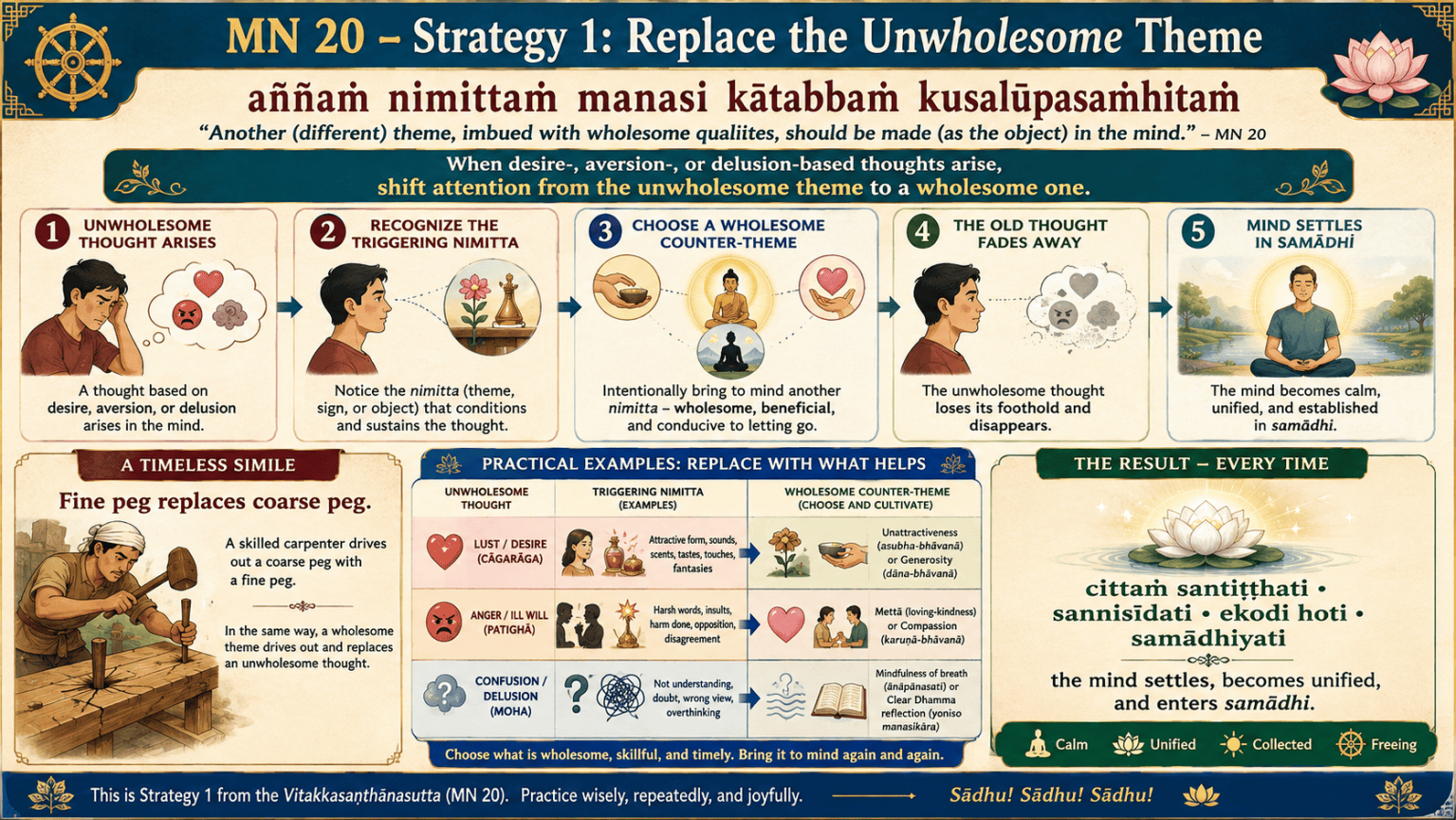
Idha, bhikkhave, bhikkhuno yaṁ nimittaṁ āgamma yaṁ nimittaṁ manasikaroto uppajjanti pāpakā akusalā vitakkā chandūpasaṁhitāpi dosūpasaṁhitāpi mohūpasaṁhitāpi, tena, bhikkhave, bhikkhunā tamhā nimittā aññaṁ nimittaṁ manasi kātabbaṁ kusalūpasaṁhitaṁ.
Tassa tamhā nimittā aññaṁ nimittaṁ manasikaroto kusalūpasaṁhitaṁ ye pāpakā akusalā vitakkā chandūpasaṁhitāpi dosūpasaṁhitāpi mohūpasaṁhitāpi te pahīyanti te abbhatthaṁ gacchanti.
Tesaṁ pahānā ajjhattameva cittaṁ santiṭṭhati sannisīdati ekodi hoti samādhiyati.
Seyyathāpi, bhikkhave, dakkho palagaṇḍo vā palagaṇḍantevāsī vā sukhumāya āṇiyā oḷārikaṁ āṇiṁ abhinihaneyya abhinīhareyya abhinivatteyya;
evameva kho, bhikkhave, bhikkhuno yaṁ nimittaṁ āgamma yaṁ nimittaṁ manasikaroto uppajjanti pāpakā akusalā vitakkā chandūpasaṁhitāpi dosūpasaṁhitāpi mohūpasaṁhitāpi, tena, bhikkhave, bhikkhunā tamhā nimittā aññaṁ nimittaṁ manasi kātabbaṁ kusalūpasaṁhitaṁ.
Tassa tamhā nimittā aññaṁ nimittaṁ manasikaroto kusalūpasaṁhitaṁ ye pāpakā akusalā vitakkā chandūpasaṁhitāpi dosūpasaṁhitāpi mohūpasaṁhitāpi te pahīyanti te abbhatthaṁ gacchanti.
Tesaṁ pahānā ajjhattameva cittaṁ santiṭṭhati sannisīdati ekodi hoti samādhiyati.
“Here, bhikkhus, when a bhikkhu attends to a certain theme and, because of attending to that theme, evil unwholesome thoughts connected with desire, aversion, or delusion arise, he should attend to another theme connected with what is wholesome.
When he attends to another wholesome theme, those evil unwholesome thoughts are abandoned and come to an end. With their abandoning, the mind stands firm inwardly, settles down, becomes unified, and enters samādhi.
Suppose a skilled carpenter or carpenter’s apprentice were to drive out, remove, and replace a coarse peg with a finer peg.
In the same way, the practitioner replaces the unwholesome theme with one connected with what is wholesome. As the unwholesome thoughts are abandoned, the mind settles, becomes unified, and enters samādhi.”
This is the gentlest and therefore the first method: do not wrestle with the thought; change the nimitta that is feeding it.
The simile of the fine peg replacing a coarse peg is precise. One mental theme displaces another.
A lustful thought may be replaced by attention to unattractiveness, impermanence, generosity, or renunciation as appropriate. Ill will may be replaced by mettā, compassion, or reflection on one’s own conduct. Confused mental spinning may be replaced by a clear Dhamma theme, the breath, or another wholesome meditation object.
The principle is not vague “positive thinking.” It is causal substitution: if a particular object of attention is generating akusala, stop feeding that object and deliberately place the mind on a kusala object.
The success criterion is that the unwholesome thought is abandoned and the mind regains inward stability, unification, and samādhi.
How to apply this method
Corporate example: after receiving a colleague’s promotion email, jealousy begins producing comparisons and resentment. Instead of replaying the comparison, deliberately shift to muditā, gratitude, or reflection on your present duties. The aim is to remove the fuel.
2 Examine the Danger and Consequences of the Thoughts
Tassa ce, bhikkhave, bhikkhuno tamhā nimittā aññaṁ nimittaṁ manasikaroto kusalūpasaṁhitaṁ uppajjanteva pāpakā akusalā vitakkā chandūpasaṁhitāpi dosūpasaṁhitāpi mohūpasaṁhitāpi, tena, bhikkhave, bhikkhunā tesaṁ vitakkānaṁ ādīnavo upaparikkhitabbo: ‘itipime vitakkā akusalā, itipime vitakkā sāvajjā, itipime vitakkā dukkhavipākā’ti.
Tassa tesaṁ vitakkānaṁ ādīnavaṁ upaparikkhato ye pāpakā akusalā vitakkā chandūpasaṁhitāpi dosūpasaṁhitāpi mohūpasaṁhitāpi te pahīyanti te abbhatthaṁ gacchanti. Tesaṁ pahānā ajjhattameva cittaṁ santiṭṭhati sannisīdati ekodi hoti samādhiyati.
Seyyathāpi, bhikkhave, itthī vā puriso vā daharo yuvā maṇḍanakajātiko ahikuṇapena vā kukkurakuṇapena vā manussakuṇapena vā kaṇṭhe āsattena aṭṭiyeyya harāyeyya jiguccheyya;
evameva kho, bhikkhave, tassa ce bhikkhuno tamhāpi nimittā aññaṁ nimittaṁ manasikaroto kusalūpasaṁhitaṁ uppajjanteva pāpakā akusalā vitakkā chandūpasaṁhitāpi dosūpasaṁhitāpi mohūpasaṁhitāpi, tena, bhikkhave, bhikkhunā tesaṁ vitakkānaṁ ādīnavo upaparikkhitabbo: ‘itipime vitakkā akusalā, itipime vitakkā sāvajjā, itipime vitakkā dukkhavipākā’ti.
Tassa tesaṁ vitakkānaṁ ādīnavaṁ upaparikkhato ye pāpakā akusalā vitakkā chandūpasaṁhitāpi dosūpasaṁhitāpi mohūpasaṁhitāpi te pahīyanti te abbhatthaṁ gacchanti. Tesaṁ pahānā ajjhattameva cittaṁ santiṭṭhati sannisīdati ekodi hoti samādhiyati.
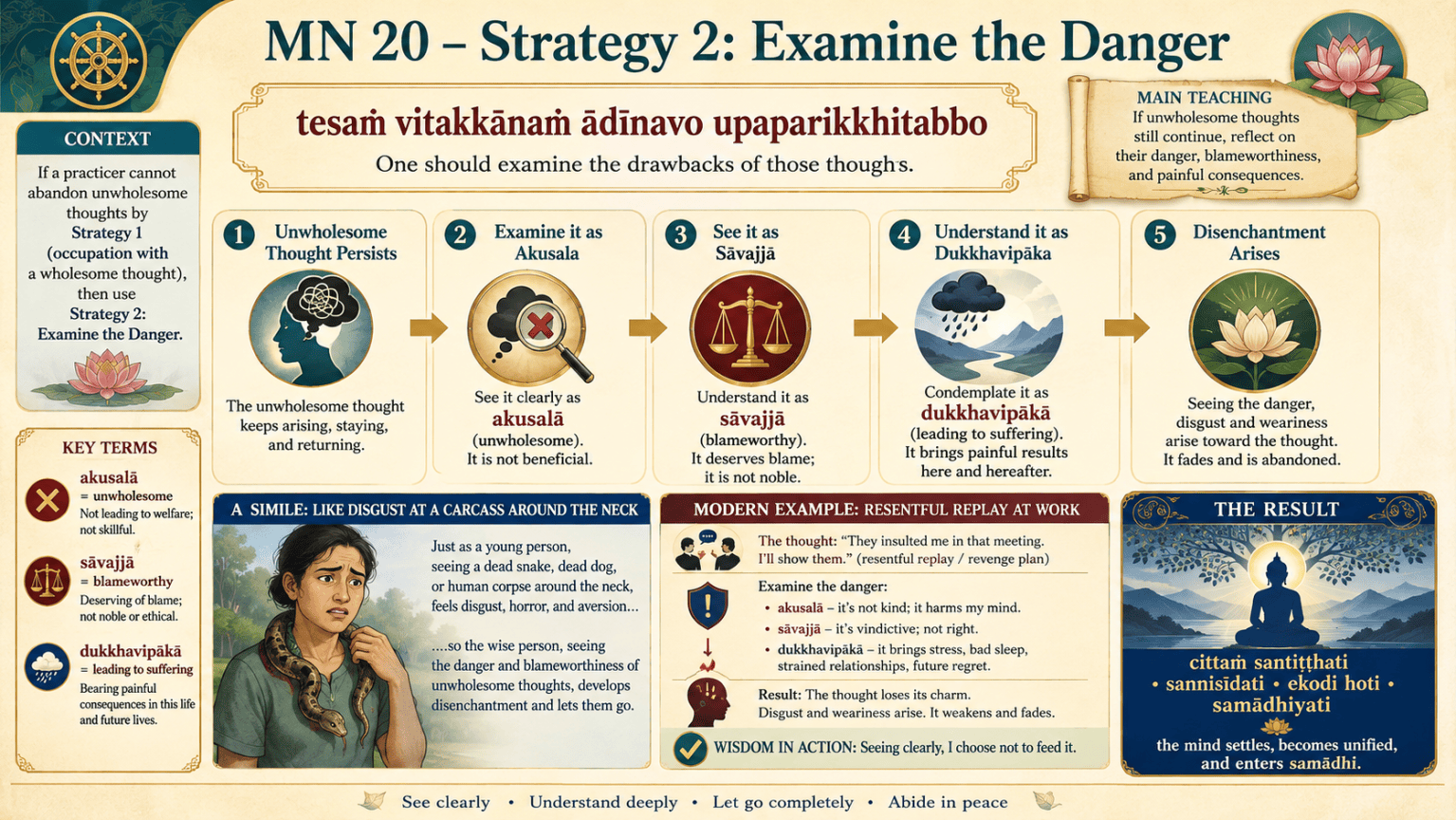
“But if those evil unwholesome thoughts still arise while he is attending to another wholesome theme, he should examine their danger:
‘These thoughts are unwholesome. These thoughts are blameworthy. These thoughts have suffering as their result.’
As he examines their danger, those thoughts are abandoned and come to an end. The mind then stands firm inwardly, settles, becomes unified, and enters samādhi.
Suppose a young woman or man fond of adornment had the carcass of a snake, dog, or human being hung around their neck. They would be horrified, ashamed, and disgusted.
In the same way, the practitioner examines the danger of the unwholesome thoughts until their attraction collapses and the mind settles.”
The second method is not “feel guilty.” It is clear examination of ādīnava—the drawback, danger, disadvantage, and consequence.
The practitioner recognizes three things: akusala—the thought is unskillful; sāvajja—it is blameworthy or ethically defective; dukkhavipāka—if developed and acted upon, it ripens in suffering.
The corpse-necklace simile shows a change of perception. What previously seemed attractive, justified, or compelling is now seen as degrading and dangerous.
This is useful when the thought keeps returning because part of the mind still sees gratification in it. Anger may feel powerful; revenge may feel satisfying; sensual fantasy may feel rewarding. Ādīnava reflection widens the time horizon and exposes the cost to sīla, relationships, kamma, and samādhi.
How to apply this method
Corporate example: you are tempted to damage a colleague’s reputation after a conflict. Examine the ādīnava—loss of integrity, escalation of office politics, anxiety, damaged trust, and reinforcement of dosa.
3 Do Not Remember or Attend to the Thoughts
Tassa ce, bhikkhave, bhikkhuno tesampi vitakkānaṁ ādīnavaṁ upaparikkhato uppajjanteva pāpakā akusalā vitakkā chandūpasaṁhitāpi dosūpasaṁhitāpi mohūpasaṁhitāpi, tena, bhikkhave, bhikkhunā tesaṁ vitakkānaṁ asatiamanasikāro āpajjitabbo.
Tassa tesaṁ vitakkānaṁ asatiamanasikāraṁ āpajjato ye pāpakā akusalā vitakkā chandūpasaṁhitāpi dosūpasaṁhitāpi mohūpasaṁhitāpi te pahīyanti te abbhatthaṁ gacchanti. Tesaṁ pahānā ajjhattameva cittaṁ santiṭṭhati sannisīdati ekodi hoti samādhiyati.
Seyyathāpi, bhikkhave, cakkhumā puriso āpāthagatānaṁ rūpānaṁ adassanakāmo assa; so nimīleyya vā aññena vā apalokeyya;
evameva kho, bhikkhave, tassa ce bhikkhuno tesampi vitakkānaṁ ādīnavaṁ upaparikkhato uppajjanteva pāpakā akusalā vitakkā chandūpasaṁhitāpi dosūpasaṁhitāpi mohūpasaṁhitāpi, tena, bhikkhave, bhikkhunā tesaṁ vitakkānaṁ asatiamanasikāro āpajjitabbo.
Tassa tesaṁ vitakkānaṁ asatiamanasikāraṁ āpajjato ye pāpakā akusalā vitakkā chandūpasaṁhitāpi dosūpasaṁhitāpi mohūpasaṁhitāpi te pahīyanti te abbhatthaṁ gacchanti. Tesaṁ pahānā ajjhattameva cittaṁ santiṭṭhati sannisīdati ekodi hoti samādhiyati.
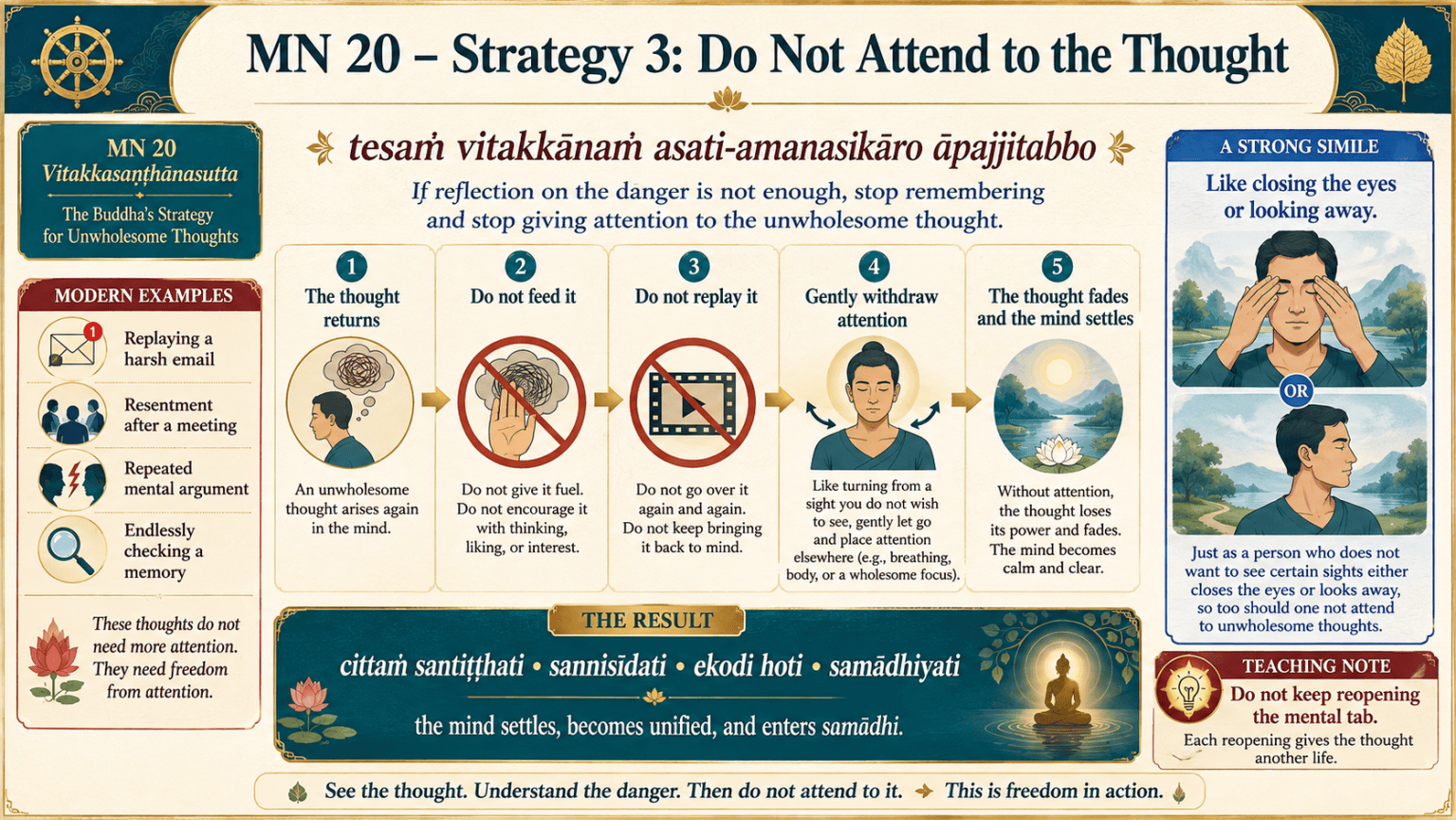
“But if those evil unwholesome thoughts still arise even while he is examining their danger, he should enter upon not remembering and not attending to those thoughts.
As he does not remember them and does not attend to them, those thoughts are abandoned and come to an end. With their abandoning, the mind stands firm inwardly, settles, becomes unified, and enters samādhi.
Suppose a person with good eyesight did not want to see forms that had come into range. They might close their eyes or look away.
In the same way, the practitioner stops remembering and attending to those unwholesome thoughts, allowing them to fade through lack of nourishment.”
Asati-amanasikāra is not amnesia. It is deliberate withdrawal of remembering and attention from a thought already recognized as unwholesome.
The eye simile is simple: if you do not want to keep looking, stop looking.
Many thoughts persist because the mind repeatedly checks them: “Is it still there? What did she mean? What should I have said?” Every re-check is fresh manasikāra.
This method refuses to supply new attention. It differs from unconscious avoidance because the thought has already been recognized and its danger understood. Now the instruction is: do not keep giving it cognitive oxygen.
How to apply this method
Corporate example: after a difficult meeting, the mind keeps replaying one sentence from your manager. You have already understood the issue and decided any needed action. Stop reopening the memory and return to the present task.
4 Relax the Formation that Sustains the Thought
Tassa ce, bhikkhave, bhikkhuno tesampi vitakkānaṁ asatiamanasikāraṁ āpajjato uppajjanteva pāpakā akusalā vitakkā chandūpasaṁhitāpi dosūpasaṁhitāpi mohūpasaṁhitāpi, tena, bhikkhave, bhikkhunā tesaṁ vitakkānaṁ vitakkasaṅkhārasaṇṭhānaṁ manasikātabbaṁ.
Tassa tesaṁ vitakkānaṁ vitakkasaṅkhārasaṇṭhānaṁ manasikaroto ye pāpakā akusalā vitakkā chandūpasaṁhitāpi dosūpasaṁhitāpi mohūpasaṁhitāpi te pahīyanti te abbhatthaṁ gacchanti. Tesaṁ pahānā ajjhattameva cittaṁ santiṭṭhati sannisīdati ekodi hoti samādhiyati.
Seyyathāpi, bhikkhave, puriso sīghaṁ gaccheyya. Tassa evamassa: ‘kiṁ nu kho ahaṁ sīghaṁ gacchāmi? Yannūnāhaṁ saṇikaṁ gaccheyyan’ti. So saṇikaṁ gaccheyya. Tassa evamassa: ‘kiṁ nu kho ahaṁ saṇikaṁ gacchāmi? Yannūnāhaṁ tiṭṭheyyan’ti. So tiṭṭheyya. Tassa evamassa: ‘kiṁ nu kho ahaṁ ṭhito? Yannūnāhaṁ nisīdeyyan’ti. So nisīdeyya. Tassa evamassa: ‘kiṁ nu kho ahaṁ nisinno? Yannūnāhaṁ nipajjeyyan’ti. So nipajjeyya. Evañhi so, bhikkhave, puriso oḷārikaṁ oḷārikaṁ iriyāpathaṁ abhinivajjetvā sukhumaṁ sukhumaṁ iriyāpathaṁ kappeyya.
Evameva kho, bhikkhave, tassa ce bhikkhuno tesampi vitakkānaṁ asatiamanasikāraṁ āpajjato uppajjanteva pāpakā akusalā vitakkā chandūpasaṁhitāpi dosūpasaṁhitāpi mohūpasaṁhitāpi, tena, bhikkhave, bhikkhunā tesaṁ vitakkānaṁ vitakkasaṅkhārasaṇṭhānaṁ manasikātabbaṁ.
Tassa tesaṁ vitakkānaṁ vitakkasaṅkhārasaṇṭhānaṁ manasikaroto ye pāpakā akusalā vitakkā chandūpasaṁhitāpi dosūpasaṁhitāpi mohūpasaṁhitāpi te pahīyanti te abbhatthaṁ gacchanti. Tesaṁ pahānā ajjhattameva cittaṁ santiṭṭhati sannisīdati ekodi hoti samādhiyati.
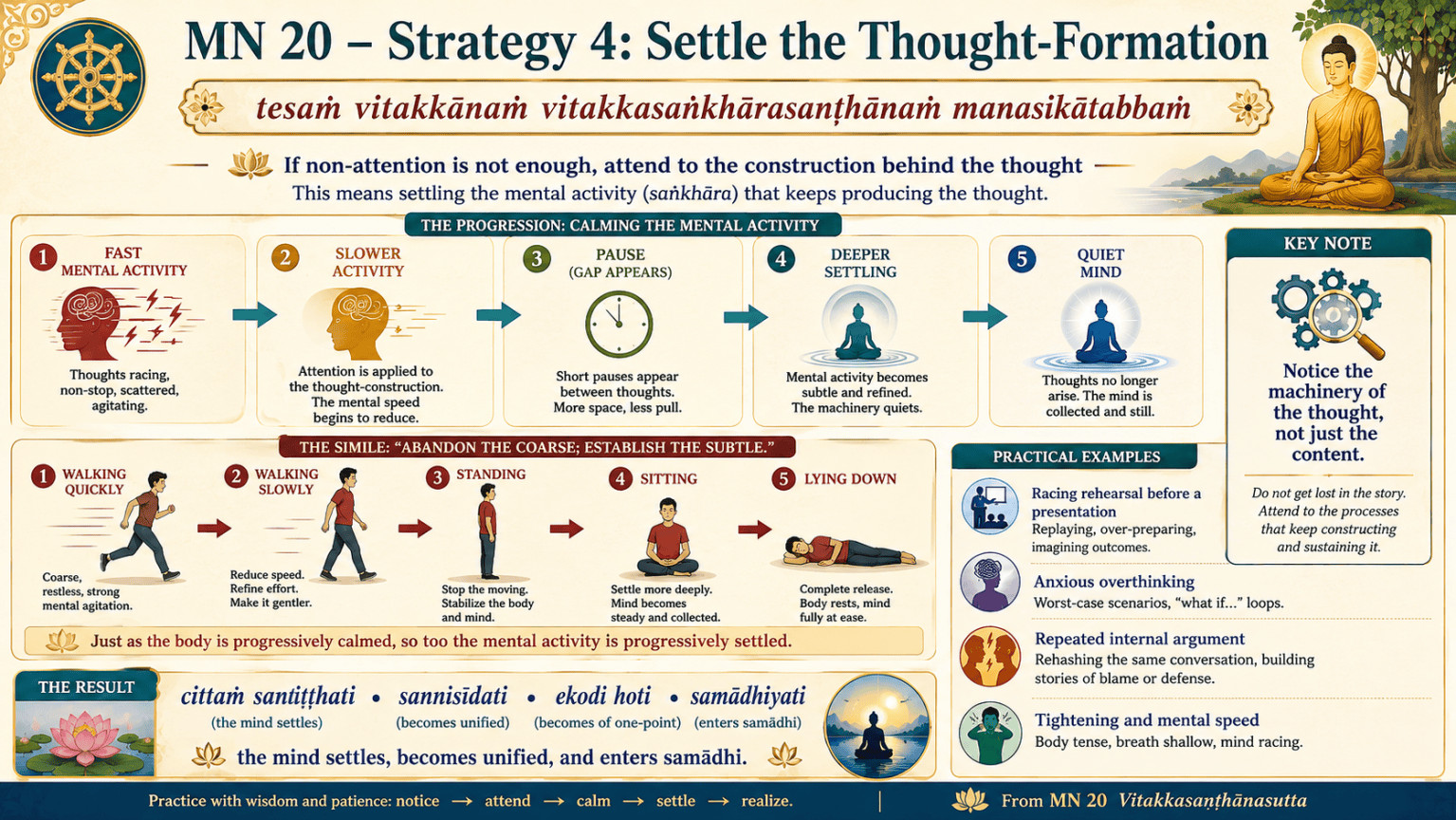
“But if those evil unwholesome thoughts still arise even while he is not remembering and not attending to them, he should attend to the settling or relaxation of the thought-formation underlying those thoughts.
As he attends to that settling, those thoughts are abandoned and come to an end. The mind then stands firm inwardly, settles, becomes unified, and enters samādhi.
Suppose a man were walking quickly and decided to walk slowly; then to stand; then to sit; then to lie down. In this way he would abandon each coarser posture for a progressively subtler one.
In the same way, the practitioner attends to the settling of the thought-formation until the unwholesome thoughts fade and the mind becomes collected.”
Vitakkasaṅkhārasaṇṭhāna is the most technically difficult phrase in the sutta and gives the discourse its title.
Rather than attacking the content of the thought, the practitioner turns to the saṅkhāra that keeps the thought-process going: the mental construction, momentum, pressure, or activity producing and sustaining the thought.
The walking simile shows progressive de-intensification: fast walking → slow walking → standing → sitting → lying down. Each grosser activity is replaced by a subtler one.
Applied internally, ask: what am I doing that keeps this thought alive? Mentally arguing? Visualizing? Narrating? Tightening the body? Anticipating? Comparing? Repeating the same sentence?
Method 3 withdraws attention from the thought. Method 4 notices and relaxes the machinery that keeps generating it.
How to apply this method
Corporate example: before a presentation, anxiety repeats “What if I fail?” Ignoring it does not work because the body and mind keep generating the loop. Slow rehearsal, release bodily pressure, simplify attention to one immediate task, and let the fabrication quiet.
5 Forcefully Restrain the Unwholesome Mental Process
Tassa ce, bhikkhave, bhikkhuno tesampi vitakkānaṁ vitakkasaṅkhārasaṇṭhānaṁ manasikaroto uppajjanteva pāpakā akusalā vitakkā chandūpasaṁhitāpi dosūpasaṁhitāpi mohūpasaṁhitāpi.
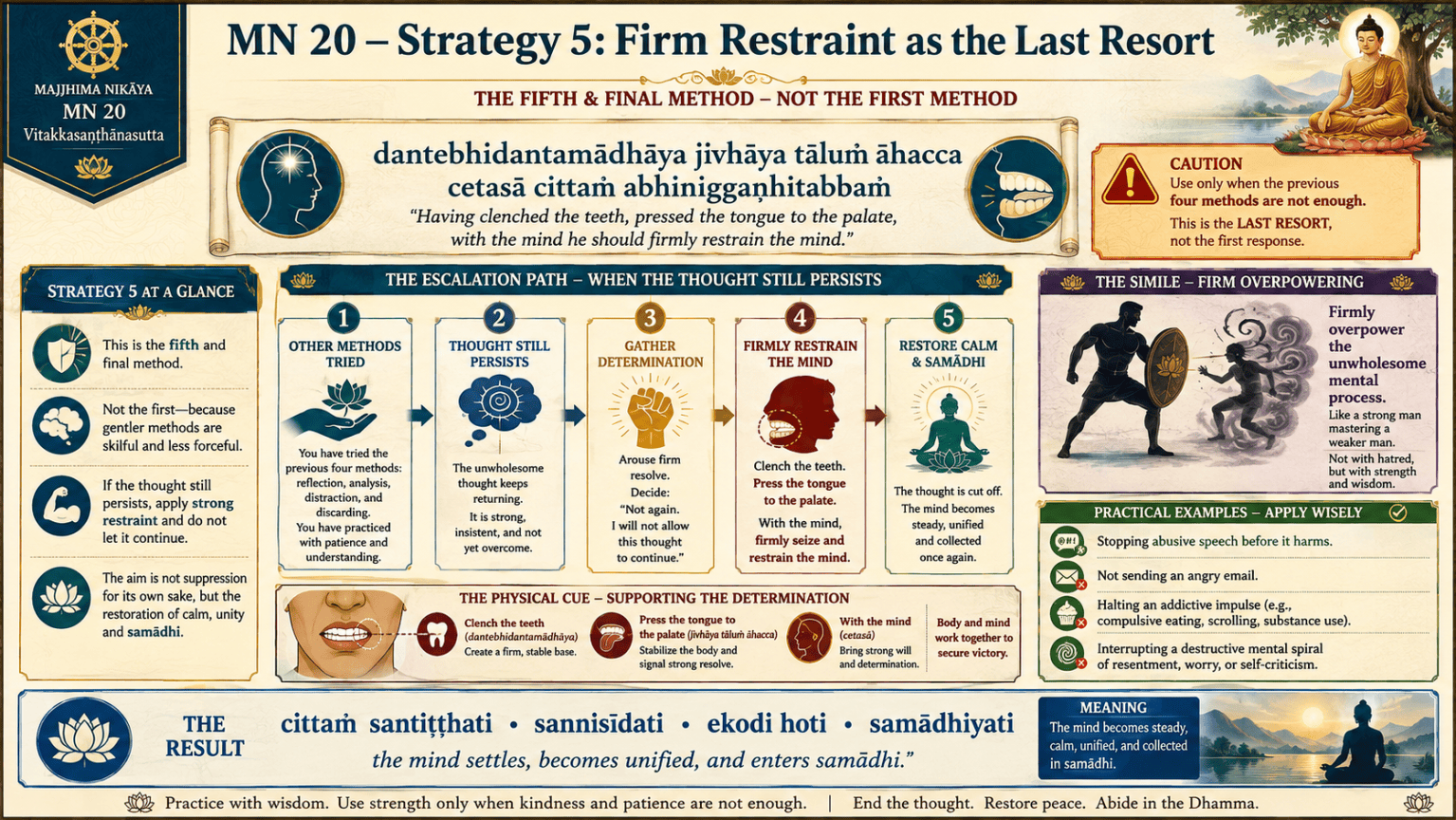
Tena, bhikkhave, bhikkhunā dantebhidantamādhāya jivhāya tāluṁ āhacca cetasā cittaṁ abhiniggaṇhitabbaṁ abhinippīḷetabbaṁ abhisantāpetabbaṁ.
Tassa dantebhidantamādhāya jivhāya tāluṁ āhacca cetasā cittaṁ abhiniggaṇhato abhinippīḷayato abhisantāpayato ye pāpakā akusalā vitakkā chandūpasaṁhitāpi dosūpasaṁhitāpi mohūpasaṁhitāpi te pahīyanti te abbhatthaṁ gacchanti. Tesaṁ pahānā ajjhattameva cittaṁ santiṭṭhati sannisīdati ekodi hoti samādhiyati.
Seyyathāpi, bhikkhave, balavā puriso dubbalataraṁ purisaṁ sīse vā gale vā khandhe vā gahetvā abhiniggaṇheyya abhinippīḷeyya abhisantāpeyya;
evameva kho, bhikkhave, tassa ce bhikkhuno tesampi vitakkānaṁ vitakkasaṅkhārasaṇṭhānaṁ manasikaroto uppajjanteva pāpakā akusalā vitakkā chandūpasaṁhitāpi dosūpasaṁhitāpi mohūpasaṁhitāpi. Tena, bhikkhave, bhikkhunā dantebhidantamādhāya jivhāya tāluṁ āhacca cetasā cittaṁ abhiniggaṇhitabbaṁ abhinippīḷetabbaṁ abhisantāpetabbaṁ.
Tassa dantebhidantamādhāya jivhāya tāluṁ āhacca cetasā cittaṁ abhiniggaṇhato abhinippīḷayato abhisantāpayato ye pāpakā akusalā vitakkā chandūpasaṁhitāpi dosūpasaṁhitāpi mohūpasaṁhitāpi te pahīyanti te abbhatthaṁ gacchanti. Tesaṁ pahānā ajjhattameva cittaṁ santiṭṭhati sannisīdati ekodi hoti samādhiyati.
“But if those evil unwholesome thoughts still arise even while he attends to settling the formation underlying them, then, with teeth clenched and tongue pressed against the roof of the mouth, he should with the mind firmly restrain, press down, and overpower the unwholesome mental process.
As he does so, those thoughts are abandoned and come to an end. With their abandoning, the mind stands firm inwardly, settles, becomes unified, and enters samādhi.
Suppose a strong man, seizing a weaker man by the head, throat, or shoulders, were to restrain, press down, and overpower him.
In the same way, if the previous methods have failed, the practitioner uses firm mental restraint until the unwholesome thoughts are abandoned.”
This is the fifth method, not the first. The sequence matters.
The language—abhiniggaṇhati, abhinippīḷeti, abhisantāpeti—is deliberately forceful. It describes firm restraint when an unwholesome process remains dangerous and persistent despite redirection, danger-reflection, non-attention, and relaxation of its formation.
It should not become a default meditation style of constantly crushing the mind. The Buddha has already supplied four subtler strategies.
The physical description underscores determination. But the operative instruction is cetasā cittaṁ: use the mind to bring the unwholesome process under control.
A practical analogy is an emergency brake. Normally one slows gradually. When immediate danger remains and softer controls have failed, decisive restraint is appropriate.
How to apply this method
Corporate example: during a heated confrontation you are about to send a damaging message or speak abusively. Reframing is not working quickly enough. Stop. Do not send. Do not speak. Physically disengage if needed. Prevent akusala from becoming speech or action.
Yato kho, bhikkhave, bhikkhuno yaṁ nimittaṁ āgamma yaṁ nimittaṁ manasikaroto uppajjanti pāpakā akusalā vitakkā chandūpasaṁhitāpi dosūpasaṁhitāpi mohūpasaṁhitāpi, tassa tamhā nimittā aññaṁ nimittaṁ manasikaroto kusalūpasaṁhitaṁ ye pāpakā akusalā vitakkā chandūpasaṁhitāpi dosūpasaṁhitāpi mohūpasaṁhitāpi te pahīyanti te abbhatthaṁ gacchanti.
Tesaṁ pahānā ajjhattameva cittaṁ santiṭṭhati sannisīdati ekodi hoti samādhiyati.
Tesampi vitakkānaṁ ādīnavaṁ upaparikkhato ye pāpakā akusalā vitakkā chandūpasaṁhitāpi dosūpasaṁhitāpi mohūpasaṁhitāpi te pahīyanti te abbhatthaṁ gacchanti. Tesaṁ pahānā ajjhattameva cittaṁ santiṭṭhati sannisīdati ekodi hoti samādhiyati.
Tesampi vitakkānaṁ asatiamanasikāraṁ āpajjato ye pāpakā akusalā vitakkā chandūpasaṁhitāpi dosūpasaṁhitāpi mohūpasaṁhitāpi te pahīyanti te abbhatthaṁ gacchanti. Tesaṁ pahānā ajjhattameva cittaṁ santiṭṭhati sannisīdati ekodi hoti samādhiyati.
Tesampi vitakkānaṁ vitakkasaṅkhārasaṇṭhānaṁ manasikaroto ye pāpakā akusalā vitakkā chandūpasaṁhitāpi dosūpasaṁhitāpi mohūpasaṁhitāpi te pahīyanti te abbhatthaṁ gacchanti. Tesaṁ pahānā ajjhattameva cittaṁ santiṭṭhati sannisīdati ekodi hoti samādhiyati.
Dantebhidantamādhāya jivhāya tāluṁ āhacca cetasā cittaṁ abhiniggaṇhato abhinippīḷayato abhisantāpayato ye pāpakā akusalā vitakkā chandūpasaṁhitāpi dosūpasaṁhitāpi mohūpasaṁhitāpi te pahīyanti te abbhatthaṁ gacchanti. Tesaṁ pahānā ajjhattameva cittaṁ santiṭṭhati sannisīdati ekodi hoti samādhiyati.
Ayaṁ vuccati, bhikkhave, bhikkhu vasī vitakkapariyāyapathesu. Yaṁ vitakkaṁ ākaṅkhissati taṁ vitakkaṁ vitakkessati, yaṁ vitakkaṁ nākaṅkhissati na taṁ vitakkaṁ vitakkessati. Acchecchi taṇhaṁ, vivattayi saṁyojanaṁ, sammā mānābhisamayā antamakāsi dukkhassā”ti.
Idamavoca bhagavā. Attamanā te bhikkhū bhagavato bhāsitaṁ abhinandunti.
“Bhikkhus, when a bhikkhu succeeds in abandoning such evil unwholesome thoughts by attending to another wholesome theme; by examining their danger; by not remembering and not attending to them; by attending to the settling of the formation underlying them; or by firmly restraining and overpowering the unwholesome mental process—and with their abandoning the mind stands firm inwardly, settles, becomes unified, and enters samādhi—
then he is called a bhikkhu who has mastery over the pathways and courses of thought.
Whatever thought he wishes to think, that thought he thinks. Whatever thought he does not wish to think, that thought he does not think.
He has cut off craving, turned away the fetters, and through the right penetration of conceit has made an end of suffering.”
That is what the Blessed One said. Satisfied, the bhikkhus delighted in the Blessed One’s words.
The endpoint is vasī vitakkapariyāyapathesu—mastery over the pathways or courses through which thought travels.
This is more than temporary distraction. The practitioner develops the ability to govern whether a thought is cultivated.
The progression is: replace the object → expose the danger → withdraw attention → relax the construction sustaining the thought → decisively restrain it.
Each method is escalated only if the previous one fails, and each returns to the same endpoint: cittaṁ santiṭṭhati → sannisīdati → ekodi hoti → samādhiyati.
MN 20 is therefore not ultimately about “getting rid of thoughts.” It is about removing akusala obstruction so that the mind can become steady, unified, and capable of the higher training. The closing places this within liberation itself: craving is cut, fetters are turned away, conceit is penetrated, and suffering ends.