What Are You Feeding?
Āhāra + manasikāra + bahulīkāra: a supporting condition is present, attention is applied in a particular way, and repetition strengthens the pattern.
 VISUAL SUMMARYSee this sutta in a pictureOpen the complete infographic for a visual overview before or after reading the full study.View infographic →
Mental states grow according to what repeatedly nourishes them
Central insight: The Buddha treats hindrances and awakening factors as conditioned processes with a diet. What receives repeated attention grows. The training is therefore not simply “have no hindrances” or “develop bojjhaṅgas,” but learn precisely what to feed, what to starve, and how wise or unwise attention changes the direction of citta.
The pivot of the entire sutta: Ayoniso manasikāra + repeated cultivation feeds the hindrances. Yoniso manasikāra + repeated cultivation feeds the awakening factors and starves the hindrances. Repeated non-attention to the supports for an awakening factor starves that factor. The repeated word-pattern is therefore a training instruction: what you repeatedly attend to becomes strong.
Feed what leads to awakening; starve what obstructs it
Five hindrances — feed vs starve
| Hindrance | Food | Non-food |
|---|---|---|
| Kāmacchanda | Feed: subhanimitta + ayoniso manasikāra | Starve: asubhanimitta + yoniso manasikāra |
| Byāpāda | Feed: paṭighanimitta + ayoniso manasikāra | Starve: mettācetovimutti + yoniso manasikāra |
| Thīna-middha | Feed: arati, tandi, vijambhitā, bhattasammada, līnatta + ayoniso | Starve: ārambha, nikkama, parakkama + yoniso |
| Uddhacca-kukkucca | Feed: cetaso avūpasama + ayoniso | Starve: cetaso vūpasama + yoniso |
| Vicikicchā | Feed: doubt-bases + ayoniso | Starve: discrimination of kusala/akusala etc. + yoniso |
Seven bojjhaṅgas — feed vs starve
| Factor | Food | Non-food |
|---|---|---|
| Sati | Feed: sati-supporting dhammas + yoniso | Starve: repeated non-attention |
| Dhammavicaya | Feed: kusala/akusala, sāvajja/anavajja, hīna/paṇīta, kaṇha/sukka + yoniso | Starve: repeated non-attention |
| Vīriya | Feed: ārambha, nikkama, parakkama + yoniso | Starve: repeated non-attention |
| Pīti | Feed: pīti-supporting dhammas + yoniso | Starve: repeated non-attention |
| Passaddhi | Feed: kāya- and citta-passaddhi + yoniso | Starve: repeated non-attention |
| Samādhi | Feed: samathanimitta + abyagganimitta + yoniso | Starve: repeated non-attention |
| Upekkhā | Feed: upekkhā-supporting dhammas + yoniso | Starve: repeated non-attention |
Nutriment and non-nutriment for hindrances and awakening factors
01Opening — Nutriment and Non-Nutriment
Sāvatthinidānaṁ.
At Sāvatthī.
“Pañcannañca, bhikkhave, nīvaraṇānaṁ sattannañca bojjhaṅgānaṁ āhārañca anāhārañca desessāmi; taṁ suṇātha.”
“Bhikkhus, I will teach you the nutriment and the non-nutriment of the five hindrances and of the seven factors of awakening. Listen.”
02Feeding the Five Hindrances
Ko ca, bhikkhave, āhāro anuppannassa vā kāmacchandassa uppādāya, uppannassa vā kāmacchandassa bhiyyobhāvāya vepullāya? Atthi, bhikkhave, subhanimittaṁ. Tattha ayonisomanasikārabahulīkāro—ayamāhāro anuppannassa vā kāmacchandassa uppādāya, uppannassa vā kāmacchandassa bhiyyobhāvāya vepullāya.
“And what is the nutriment for the arising of unarisen sensual desire, or for the increase and expansion of sensual desire once arisen? There is the sign of beauty or attractiveness. Frequently giving unwise attention to it is the nutriment for the arising of unarisen sensual desire and for the increase and expansion of arisen sensual desire.”
Ko ca, bhikkhave, āhāro anuppannassa vā byāpādassa uppādāya, uppannassa vā byāpādassa bhiyyobhāvāya vepullāya? Atthi, bhikkhave, paṭighanimittaṁ. Tattha ayonisomanasikārabahulīkāro—ayamāhāro anuppannassa vā byāpādassa uppādāya, uppannassa vā byāpādassa bhiyyobhāvāya vepullāya.
“And what is the nutriment for the arising of unarisen ill will, or for the increase and expansion of ill will once arisen? There is the sign of irritation or repulsion. Frequently giving unwise attention to it is the nutriment for the arising of unarisen ill will and for the increase and expansion of arisen ill will.”
Ko ca, bhikkhave, āhāro anuppannassa vā thinamiddhassa uppādāya, uppannassa vā thinamiddhassa bhiyyobhāvāya vepullāya? Atthi, bhikkhave, arati tandi vijambhitā bhattasammado cetaso ca līnattaṁ. Tattha ayonisomanasikārabahulīkāro—ayamāhāro anuppannassa vā thinamiddhassa uppādāya, uppannassa vā thinamiddhassa bhiyyobhāvāya vepullāya.
“And what is the nutriment for the arising of unarisen sloth and torpor, or for the increase and expansion of sloth and torpor once arisen? There are discontent, languor, yawning, drowsiness after eating, and sluggishness of mind. Frequently giving unwise attention to these is the nutriment for the arising of unarisen sloth and torpor and for the increase and expansion of arisen sloth and torpor.”
Ko ca, bhikkhave, āhāro anuppannassa vā uddhaccakukkuccassa uppādāya, uppannassa vā uddhaccakukkuccassa bhiyyobhāvāya vepullāya? Atthi, bhikkhave, cetaso avūpasamo. Tattha ayonisomanasikārabahulīkāro—ayamāhāro anuppannassa vā uddhaccakukkuccassa uppādāya, uppannassa vā uddhaccakukkuccassa bhiyyobhāvāya vepullāya.
“And what is the nutriment for the arising of unarisen restlessness and remorse, or for the increase and expansion of restlessness and remorse once arisen? There is non-stillness of mind. Frequently giving unwise attention to it is the nutriment for the arising of unarisen restlessness and remorse and for the increase and expansion of arisen restlessness and remorse.”
Ko ca, bhikkhave, āhāro anuppannāya vā vicikicchāya uppādāya, uppannāya vā vicikicchāya bhiyyobhāvāya vepullāya? Atthi, bhikkhave, vicikicchāṭṭhānīyā dhammā. Tattha ayonisomanasikārabahulīkāro—ayamāhāro anuppannāya vā vicikicchāya uppādāya, uppannāya vā vicikicchāya bhiyyobhāvāya vepullāya.
“And what is the nutriment for the arising of unarisen doubt, or for the increase and expansion of doubt once arisen? There are dhammas that provide a basis for doubt. Frequently giving unwise attention to them is the nutriment for the arising of unarisen doubt and for the increase and expansion of arisen doubt.”
03Feeding the Seven Awakening Factors
Ko ca, bhikkhave, āhāro anuppannassa vā satisambojjhaṅgassa uppādāya, uppannassa vā satisambojjhaṅgassa bhāvanāya pāripūriyā? Atthi, bhikkhave, satisambojjhaṅgaṭṭhānīyā dhammā. Tattha yonisomanasikārabahulīkāro—ayamāhāro anuppannassa vā satisambojjhaṅgassa uppādāya, uppannassa vā satisambojjhaṅgassa bhāvanāya pāripūriyā.
“And what is the nutriment for the arising of unarisen mindfulness as a factor of awakening, or for the development and fulfillment of mindfulness once arisen? There are dhammas that provide a basis for the mindfulness awakening factor. Frequently giving wise attention to them is the nutriment for the arising of unarisen mindfulness and for its development and fulfillment once arisen.”
Ko ca, bhikkhave, āhāro anuppannassa vā dhammavicayasambojjhaṅgassa uppādāya, uppannassa vā dhammavicayasambojjhaṅgassa bhāvanāya pāripūriyā? Atthi, bhikkhave, kusalākusalā dhammā sāvajjānavajjā dhammā hīnapaṇītā dhammā kaṇhasukkasappaṭibhāgā dhammā. Tattha yonisomanasikārabahulīkāro—ayamāhāro anuppannassa vā dhammavicayasambojjhaṅgassa uppādāya, uppannassa vā dhammavicayasambojjhaṅgassa bhāvanāya pāripūriyā.
“And what is the nutriment for the arising of unarisen investigation of dhammas as a factor of awakening, or for its development and fulfillment once arisen? There are wholesome and unwholesome dhammas, blameworthy and blameless dhammas, inferior and superior dhammas, and dhammas with dark and bright counterparts. Frequently giving wise attention to these is the nutriment for the arising of investigation of dhammas and for its development and fulfillment.”
Ko ca, bhikkhave, āhāro anuppannassa vā vīriyasambojjhaṅgassa uppādāya, uppannassa vā vīriyasambojjhaṅgassa bhāvanāya pāripūriyā? Atthi, bhikkhave, ārambhadhātu nikkamadhātu parakkamadhātu. Tattha yonisomanasikārabahulīkāro—ayamāhāro anuppannassa vā vīriyasambojjhaṅgassa uppādāya, uppannassa vā vīriyasambojjhaṅgassa bhāvanāya pāripūriyā.
“And what is the nutriment for the arising of unarisen energy as a factor of awakening, or for its development and fulfillment once arisen? There are the elements of arousing energy, going forth from stagnation, and vigorous exertion. Frequently giving wise attention to these is the nutriment for the arising of energy and for its development and fulfillment.”
Ko ca, bhikkhave, āhāro anuppannassa vā pītisambojjhaṅgassa uppādāya, uppannassa vā pītisambojjhaṅgassa bhāvanāya pāripūriyā? Atthi, bhikkhave, pītisambojjhaṅgaṭṭhānīyā dhammā. Tattha yonisomanasikārabahulīkāro—ayamāhāro anuppannassa vā pītisambojjhaṅgassa uppādāya, uppannassa vā pītisambojjhaṅgassa bhāvanāya pāripūriyā.
“And what is the nutriment for the arising of unarisen rapture as a factor of awakening, or for its development and fulfillment once arisen? There are dhammas that provide a basis for the rapture awakening factor. Frequently giving wise attention to them is the nutriment for the arising of rapture and for its development and fulfillment.”
Ko ca, bhikkhave, āhāro anuppannassa vā passaddhisambojjhaṅgassa uppādāya, uppannassa vā passaddhisambojjhaṅgassa bhāvanāya pāripūriyā? Atthi, bhikkhave, kāyappassaddhi cittappassaddhi. Tattha yonisomanasikārabahulīkāro—ayamāhāro anuppannassa vā passaddhisambojjhaṅgassa uppādāya, uppannassa vā passaddhisambojjhaṅgassa bhāvanāya pāripūriyā.
“And what is the nutriment for the arising of unarisen tranquility as a factor of awakening, or for its development and fulfillment once arisen? There are tranquility of body and tranquility of mind. Frequently giving wise attention to them is the nutriment for the arising of tranquility and for its development and fulfillment.”
Ko ca, bhikkhave, āhāro anuppannassa vā samādhisambojjhaṅgassa uppādāya, uppannassa vā samādhisambojjhaṅgassa bhāvanāya pāripūriyā? Atthi, bhikkhave, samathanimittaṁ abyagganimittaṁ. Tattha yonisomanasikārabahulīkāro—ayamāhāro anuppannassa vā samādhisambojjhaṅgassa uppādāya, uppannassa vā samādhisambojjhaṅgassa bhāvanāya pāripūriyā.
“And what is the nutriment for the arising of unarisen samādhi as a factor of awakening, or for its development and fulfillment once arisen? There are the sign of serenity and the sign of non-distraction. Frequently giving wise attention to them is the nutriment for the arising of samādhi and for its development and fulfillment.”
Ko ca, bhikkhave, āhāro anuppannassa vā upekkhāsambojjhaṅgassa uppādāya, uppannassa vā upekkhāsambojjhaṅgassa bhāvanāya pāripūriyā? Atthi, bhikkhave, upekkhāsambojjhaṅgaṭṭhānīyā dhammā. Tattha yonisomanasikārabahulīkāro—ayamāhāro anuppannassa vā upekkhāsambojjhaṅgassa uppādāya, uppannassa vā upekkhāsambojjhaṅgassa bhāvanāya pāripūriyā.
“And what is the nutriment for the arising of unarisen equanimity as a factor of awakening, or for its development and fulfillment once arisen? There are dhammas that provide a basis for the equanimity awakening factor. Frequently giving wise attention to them is the nutriment for the arising of equanimity and for its development and fulfillment.”
04Starving the Five Hindrances
Ko ca, bhikkhave, anāhāro anuppannassa vā kāmacchandassa uppādāya, uppannassa vā kāmacchandassa bhiyyobhāvāya vepullāya? Atthi, bhikkhave, asubhanimittaṁ. Tattha yonisomanasikārabahulīkāro—ayamanāhāro anuppannassa vā kāmacchandassa uppādāya, uppannassa vā kāmacchandassa bhiyyobhāvāya vepullāya.
“And what is the non-nutriment for the arising of unarisen sensual desire, or for the increase and expansion of sensual desire once arisen? There is the sign of unattractiveness. Frequently giving wise attention to it is the non-nutriment for the arising of unarisen sensual desire and for the increase and expansion of arisen sensual desire.”
Ko ca, bhikkhave, anāhāro anuppannassa vā byāpādassa uppādāya, uppannassa vā byāpādassa bhiyyobhāvāya vepullāya? Atthi, bhikkhave, mettācetovimutti. Tattha yonisomanasikārabahulīkāro—ayamanāhāro anuppannassa vā byāpādassa uppādāya, uppannassa vā byāpādassa bhiyyobhāvāya vepullāya.
“And what is the non-nutriment for the arising of unarisen ill will, or for the increase and expansion of ill will once arisen? There is liberation of mind through mettā. Frequently giving wise attention to it is the non-nutriment for the arising of unarisen ill will and for the increase and expansion of arisen ill will.”
Ko ca, bhikkhave, anāhāro anuppannassa vā thinamiddhassa uppādāya, uppannassa vā thinamiddhassa bhiyyobhāvāya vepullāya? Atthi, bhikkhave, ārambhadhātu nikkamadhātu parakkamadhātu. Tattha yonisomanasikārabahulīkāro—ayamanāhāro anuppannassa vā thinamiddhassa uppādāya, uppannassa vā thinamiddhassa bhiyyobhāvāya vepullāya.
“And what is the non-nutriment for the arising of unarisen sloth and torpor, or for the increase and expansion of sloth and torpor once arisen? There are the elements of arousing energy, emerging, and vigorous exertion. Frequently giving wise attention to these is the non-nutriment for the arising of unarisen sloth and torpor and for the increase and expansion of arisen sloth and torpor.”
Ko ca, bhikkhave, anāhāro anuppannassa vā uddhaccakukkuccassa uppādāya, uppannassa vā uddhaccakukkuccassa bhiyyobhāvāya vepullāya? Atthi, bhikkhave, cetaso vūpasamo. Tattha yonisomanasikārabahulīkāro—ayamanāhāro anuppannassa vā uddhaccakukkuccassa uppādāya, uppannassa vā uddhaccakukkuccassa bhiyyobhāvāya vepullāya.
“And what is the non-nutriment for the arising of unarisen restlessness and remorse, or for the increase and expansion of restlessness and remorse once arisen? There is stilling of mind. Frequently giving wise attention to it is the non-nutriment for the arising of unarisen restlessness and remorse and for the increase and expansion of arisen restlessness and remorse.”
Ko ca, bhikkhave, anāhāro anuppannāya vā vicikicchāya uppādāya, uppannāya vā vicikicchāya bhiyyobhāvāya vepullāya? Atthi, bhikkhave, kusalākusalā dhammā sāvajjānavajjā dhammā hīnapaṇītā dhammā kaṇhasukkasappaṭibhāgā dhammā. Tattha yonisomanasikārabahulīkāro—ayamanāhāro anuppannāya vā vicikicchāya uppādāya, uppannāya vā vicikicchāya bhiyyobhāvāya vepullāya.
“And what is the non-nutriment for the arising of unarisen doubt, or for the increase and expansion of doubt once arisen? There are wholesome and unwholesome dhammas, blameworthy and blameless dhammas, inferior and superior dhammas, and dhammas with dark and bright counterparts. Frequently giving wise attention to these is the non-nutriment for the arising of unarisen doubt and for the increase and expansion of arisen doubt.”
05Starving the Seven Awakening Factors
Ko ca, bhikkhave, anāhāro anuppannassa vā satisambojjhaṅgassa uppādāya, uppannassa vā satisambojjhaṅgassa bhāvanāya pāripūriyā? Atthi, bhikkhave, satisambojjhaṅgaṭṭhānīyā dhammā. Tattha amanasikārabahulīkāro—ayamanāhāro anuppannassa vā satisambojjhaṅgassa uppādāya, uppannassa vā satisambojjhaṅgassa bhāvanāya pāripūriyā.
“And what is the non-nutriment for the arising of unarisen mindfulness as a factor of awakening, or for the development and fulfillment of mindfulness once arisen? There are dhammas that provide a basis for mindfulness as an awakening factor. Repeatedly not attending to them is the non-nutriment for the arising of mindfulness and for its development and fulfillment.”
Ko ca, bhikkhave, anāhāro anuppannassa vā dhammavicayasambojjhaṅgassa uppādāya, uppannassa vā dhammavicayasambojjhaṅgassa bhāvanāya pāripūriyā? Atthi, bhikkhave, kusalākusalā dhammā sāvajjānavajjā dhammā hīnapaṇītā dhammā kaṇhasukkasappaṭibhāgā dhammā. Tattha amanasikārabahulīkāro—ayamanāhāro anuppannassa vā dhammavicayasambojjhaṅgassa uppādāya, uppannassa vā dhammavicayasambojjhaṅgassa bhāvanāya pāripūriyā.
“And what is the non-nutriment for the arising of unarisen investigation of dhammas as a factor of awakening, or for its development and fulfillment once arisen? There are wholesome and unwholesome dhammas, blameworthy and blameless dhammas, inferior and superior dhammas, and dhammas with dark and bright counterparts. Repeatedly not attending to them is the non-nutriment for the arising of investigation and for its development and fulfillment.”
Ko ca, bhikkhave, anāhāro anuppannassa vā vīriyasambojjhaṅgassa uppādāya, uppannassa vā vīriyasambojjhaṅgassa bhāvanāya pāripūriyā? Atthi, bhikkhave, ārambhadhātu nikkamadhātu parakkamadhātu. Tattha amanasikārabahulīkāro—ayamanāhāro anuppannassa vā vīriyasambojjhaṅgassa uppādāya, uppannassa vā vīriyasambojjhaṅgassa bhāvanāya pāripūriyā.
“And what is the non-nutriment for the arising of unarisen energy as a factor of awakening, or for its development and fulfillment once arisen? There are the elements of arousing energy, emerging, and vigorous exertion. Repeatedly not attending to these is the non-nutriment for the arising of energy and for its development and fulfillment.”
Ko ca, bhikkhave, anāhāro anuppannassa vā pītisambojjhaṅgassa uppādāya, uppannassa vā pītisambojjhaṅgassa bhāvanāya pāripūriyā? Atthi, bhikkhave, pītisambojjhaṅgaṭṭhānīyā dhammā. Tattha amanasikārabahulīkāro—ayamanāhāro anuppannassa vā pītisambojjhaṅgassa uppādāya, uppannassa vā pītisambojjhaṅgassa bhāvanāya pāripūriyā.
“And what is the non-nutriment for the arising of unarisen rapture as a factor of awakening, or for its development and fulfillment once arisen? There are dhammas that provide a basis for rapture as an awakening factor. Repeatedly not attending to them is the non-nutriment for the arising of rapture and for its development and fulfillment.”
Ko ca, bhikkhave, anāhāro anuppannassa vā passaddhisambojjhaṅgassa uppādāya, uppannassa vā passaddhisambojjhaṅgassa bhāvanāya pāripūriyā? Atthi, bhikkhave, kāyappassaddhi cittappassaddhi. Tattha amanasikārabahulīkāro—ayamanāhāro anuppannassa vā passaddhisambojjhaṅgassa uppādāya, uppannassa vā passaddhisambojjhaṅgassa bhāvanāya pāripūriyā.
“And what is the non-nutriment for the arising of unarisen tranquility as a factor of awakening, or for its development and fulfillment once arisen? There are bodily tranquility and mental tranquility. Repeatedly not attending to them is the non-nutriment for the arising of tranquility and for its development and fulfillment.”
Ko ca, bhikkhave, anāhāro anuppannassa vā samādhisambojjhaṅgassa uppādāya, uppannassa vā samādhisambojjhaṅgassa bhāvanāya pāripūriyā? Atthi, bhikkhave, samathanimittaṁ abyagganimittaṁ. Tattha amanasikārabahulīkāro—ayamanāhāro anuppannassa vā samādhisambojjhaṅgassa uppādāya, uppannassa vā samādhisambojjhaṅgassa bhāvanāya pāripūriyā.
“And what is the non-nutriment for the arising of unarisen samādhi as a factor of awakening, or for its development and fulfillment once arisen? There are the sign of serenity and the sign of non-distraction. Repeatedly not attending to them is the non-nutriment for the arising of samādhi and for its development and fulfillment.”
Ko ca, bhikkhave, anāhāro anuppannassa vā upekkhāsambojjhaṅgassa uppādāya, uppannassa vā upekkhāsambojjhaṅgassa bhāvanāya pāripūriyā? Atthi, bhikkhave, upekkhāsambojjhaṅgaṭṭhānīyā dhammā. Tattha amanasikārabahulīkāro—ayamanāhāro anuppannassa vā upekkhāsambojjhaṅgassa uppādāya, uppannassa vā upekkhāsambojjhaṅgassa bhāvanāya pāripūriyā”ti.
“And what is the non-nutriment for the arising of unarisen equanimity as a factor of awakening, or for its development and fulfillment once arisen? There are dhammas that provide a basis for equanimity as an awakening factor. Repeatedly not attending to them is the non-nutriment for the arising of equanimity and for its development and fulfillment.”
The diet of citta: what feeds, what starves, and why attention matters
01Opening — Nutriment and Non-Nutriment
Setting at Sāvatthī
The discourse is set at Sāvatthī. The teaching that follows is framed as a practical analysis of nutriment: what repeatedly feeds obstructive mental states and what repeatedly feeds awakening qualities.
Practical examples
- Example 1
Before trying to change a state, ask what has been nourishing it.
Nutriment and Non-Nutriment
The Buddha announces four tasks at once: know what feeds the five hindrances, what starves them, what feeds the seven awakening factors, and what starves those factors. Āhāra is nutriment or food; anāhāra is lack of nutriment. The teaching is therefore about management of conditions rather than fighting mental states after they are already strong.
Practical examples
- Example 1
Instead of saying, ‘I have too much sensual desire,’ ask: ‘What am I repeatedly feeding?’
- Example 2
Instead of saying, ‘My mindfulness is weak,’ ask: ‘What conditions for sati am I repeatedly neglecting?’
02Feeding the Five Hindrances
Kāmacchanda — Sensual Desire

Subhanimitta is the attractive sign—the aspect of an object that the mind selects as pleasing, desirable, beautiful, exciting, or worth possessing. The decisive factor is not merely that an attractive object is seen; it is ayonisomanasikārabahulīkāra: repeatedly attending to it unwisely. Attention selects and enlarges the attractive side until kāmacchanda becomes established.
Practical examples
- Example 1
You see a new phone once; then repeatedly compare specifications, colors and imagined ownership. The repeated attention, not the first seeing, is the feeding.
- Example 2
You remember a pleasant conversation and replay only the attractive details until longing grows.
Byāpāda — Ill Will
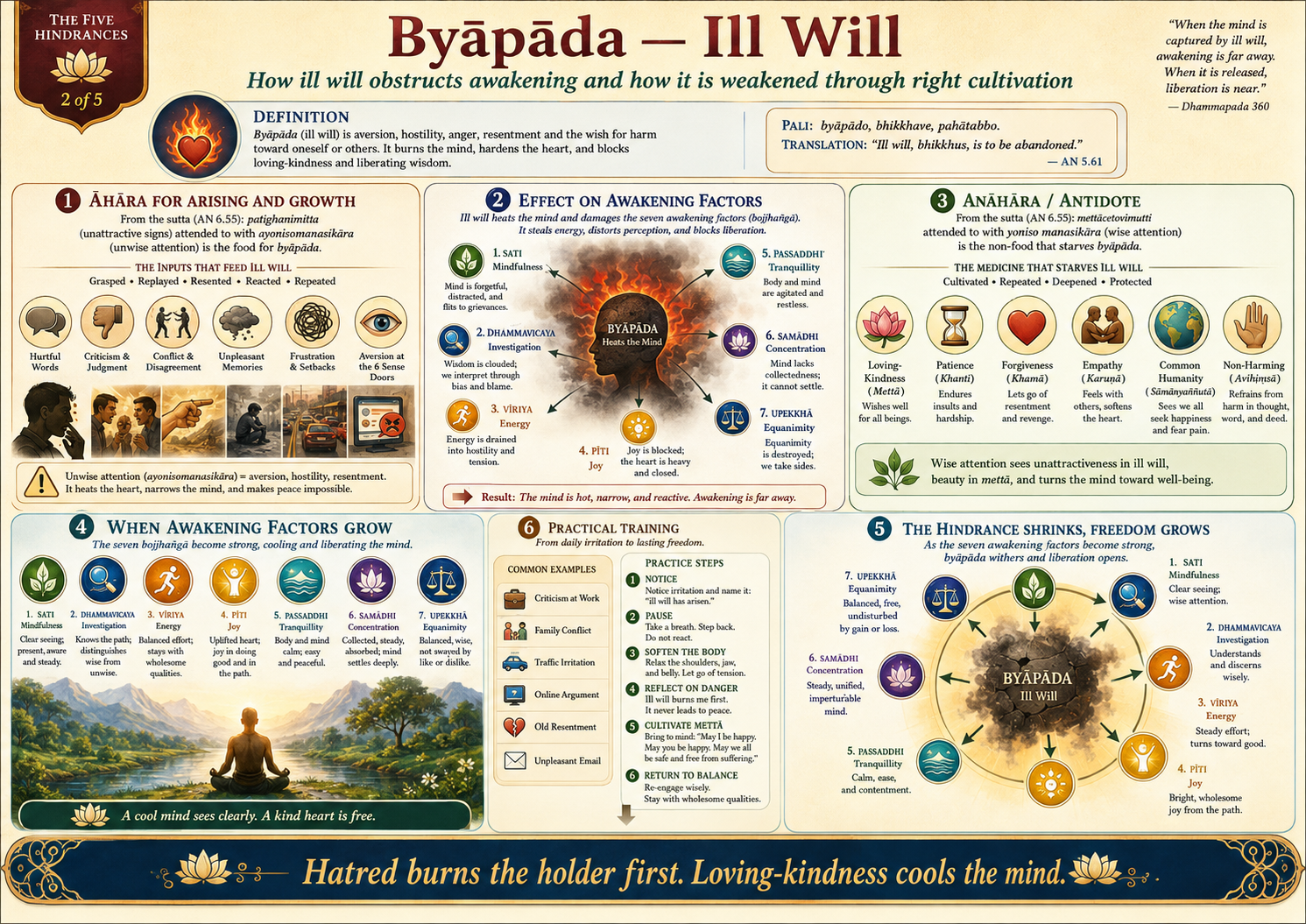
Paṭighanimitta is the irritating, offensive, or repulsive sign. A person says one painful sentence, but the mind may isolate that feature, replay it, add motives, remember previous offences, and build a whole case. Repetition turns contact into byāpāda.
Practical examples
- Example 1
Someone criticizes you for ten seconds; you mentally rehearse the criticism for two hours. The mind is feeding the paṭighanimitta.
- Example 2
A colleague has many qualities, but attention repeatedly selects only the one trait you dislike.
Thīna-middha — Sloth and Torpor

The Buddha gives a cluster rather than one sign: arati (discontent or lack of delight in the wholesome task), tandi (languor), vijambhitā (yawning), bhattasammada (post-meal drowsiness/heaviness), and cetaso līnatta (mental sinking). When these are passively indulged or repeatedly attended to without skill, the mind sinks further.
Practical examples
- Example 1
After a heavy meal, the first wave of dullness is met by collapsing into a chair and scrolling; dullness becomes stronger.
- Example 2
During meditation, the thought ‘this is boring’ is repeatedly believed, and energy drains away.
Uddhacca-kukkucca — Restlessness and Remorse

Cetaso avūpasama is the mind’s non-settling or non-pacification. Jumping between plans, regrets, notifications, unfinished conversations, and imagined futures conditions further agitation. Unwise attention keeps checking the agitation itself in a way that multiplies it.
Practical examples
- Example 1
While meditating you remember one unfinished email; you then mentally open the whole inbox.
- Example 2
A mistake from yesterday is reviewed repeatedly without any new corrective action, turning remorse into rumination.
Vicikicchā — Doubt
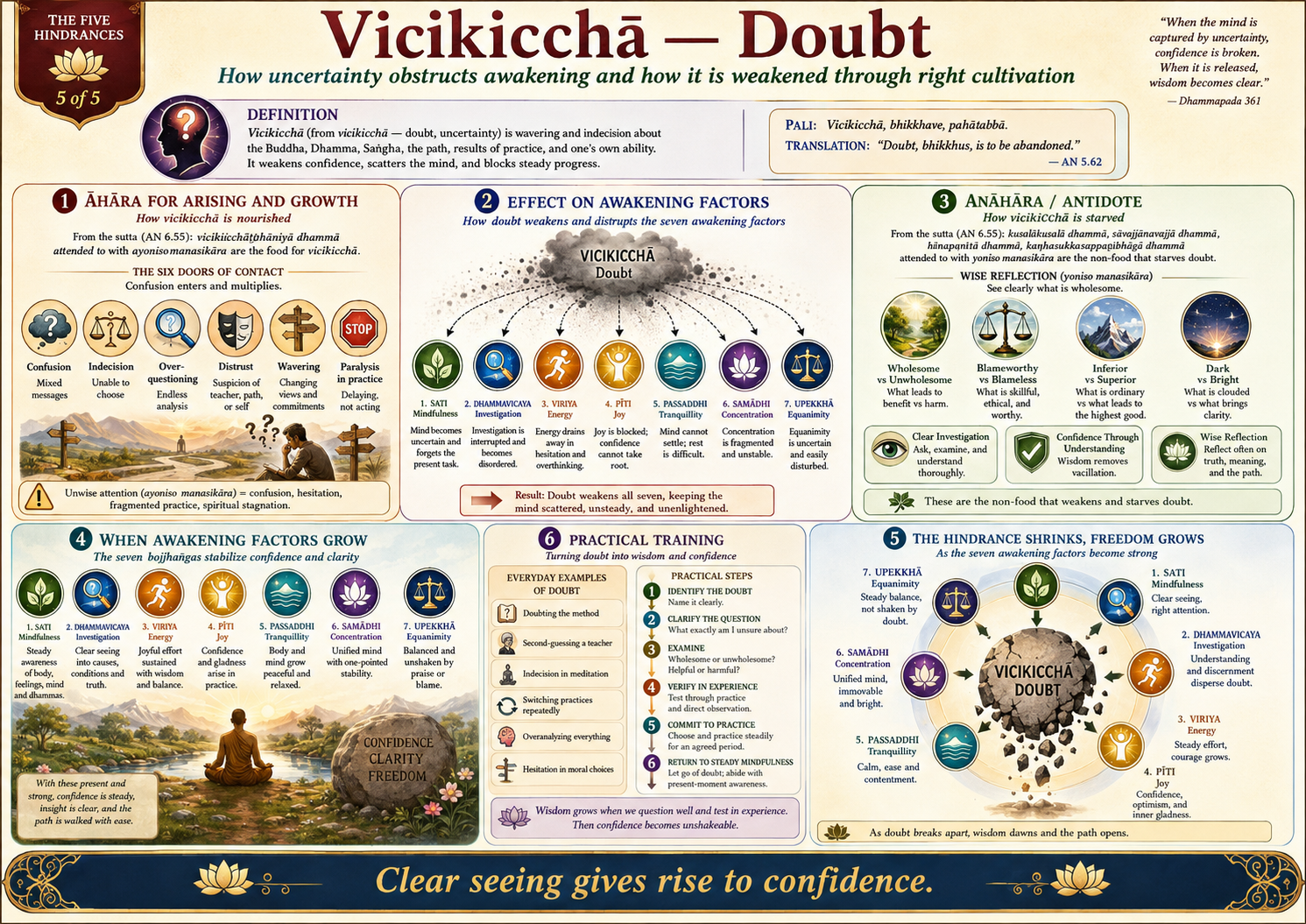
Doubt grows when ambiguity is repeatedly approached in a way that does not clarify causes, wholesome/unwholesome qualities, or what is actually testable. Vicikicchā is not careful investigation; it is indecisive wavering that obstructs commitment to wholesome practice.
Practical examples
- Example 1
You compare five meditation systems every day but never practice one long enough to test it.
- Example 2
A small uncertainty becomes ‘maybe nothing in the path works’ because attention generalizes rather than investigates.
03Feeding the Seven Awakening Factors
Sati — Mindfulness Awakening Factor
Mindfulness is nourished by repeatedly returning wise attention to conditions that support remembering the training and keeping the relevant dhamma present. The sutta deliberately emphasizes cultivation: bhāvanāya pāripūriyā—development to fulfillment.
Practical examples
- Example 1
Use routine transitions—standing up, opening a door, beginning a meal—as repeated sati cues.
- Example 2
Before reacting to criticism, remember: ‘Know vedanā first.’ Repetition turns recollection into a dependable faculty.
Dhammavicaya — Investigation of Dhammas
Dhammavicaya is nourished by discrimination: kusala/akusala, blameworthy/blameless, inferior/superior, dark/bright. It is not endless analysis. Its job is to know what is being cultivated and what should be abandoned.
Practical examples
- Example 1
Irritation arises: instead of analyzing the other person, investigate whether byāpāda is wholesome or unwholesome and what feeds it.
- Example 2
Compare two responses to craving: indulgence versus restraint; observe which produces agitation and which produces clarity.
Vīriya — Energy
The three terms give a progression: ārambhadhātu—initiating energy; nikkamadhātu—getting out, emerging from passivity; parakkamadhātu—pressing on with determined effort. Energy is trained, not awaited as a mood.
Practical examples
- Example 1
When sleepy, first sit upright and begin; then stand and walk; then sustain energetic attention until dullness breaks.
- Example 2
When a wholesome routine lapses, do not wait for inspiration—restart with one concrete act.
Pīti — Rapture
Pīti here is an awakening factor, not ordinary excitement. It is nourished by wisely attending to conditions that gladden and uplift a wholesome, secluded mind. The wider bojjhaṅga framework requires the factor to support awakening rather than attachment.
Practical examples
- Example 1
Recollect genuine progress in restraint or generosity and allow wholesome gladness to strengthen energy.
- Example 2
After a hindrance subsides, notice the relief and brightness rather than immediately seeking another object.
Passaddhi — Tranquility
Kāyappassaddhi and cittappassaddhi show that calm is both embodied and mental. Wise attention recognizes settling, softening, release of tension, and reduced mental movement, and does not disturb that process unnecessarily.
Practical examples
- Example 1
When the body naturally softens after walking meditation, do not immediately change posture or seek stimulation.
- Example 2
When thought quietens, stop checking ‘am I calm yet?’ and let tranquility mature.
Samādhi — Collectedness
Samathanimitta and abyagganimitta point to serenity and non-scatteredness. Samādhi is nourished when attention repeatedly privileges settling and non-distraction instead of novelty and fragmentation.
Practical examples
- Example 1
During ānāpānasati, the mind begins to settle; instead of checking messages, continue attending to the settled continuity.
- Example 2
Choose one wholesome meditation domain and remain with it long enough for non-distraction to strengthen.
Upekkhā — Equanimity
Upekkhā is nourished by repeated wise attention to conditions of balance and non-reactivity. It is not indifference. It knows pleasant, unpleasant, success, failure, praise and blame without being pulled off the path.
Practical examples
- Example 1
A meditation session is pleasant; know the pleasure without wanting tomorrow’s session to reproduce it.
- Example 2
Criticism is heard; know unpleasant vedanā without automatically moving into defense or hostility.
04Starving the Five Hindrances
Kāmacchanda — Starved by Asubhanimitta
The antidote is not hatred of the attractive object. Asubhanimitta corrects selective perception by attending to aspects the lustful mind excludes: dependence, maintenance, bodily unattractiveness, impermanence, decay, limitation, and cost. Wise attention breaks the one-sided beautiful sign.
Practical examples
- Example 1
A desirable device is seen together with cost, maintenance, obsolescence, scratches, battery decay and the craving it provokes.
- Example 2
Attraction to a body is balanced by contemplation of anatomy, aging and impermanence—not by hostility toward the person.
Byāpāda — Starved by Mettācetovimutti
The direct starvation of byāpāda is mettācetovimutti—a mind released through goodwill. The goal is not to declare the harmful action acceptable; it is to remove the mind’s wish for harm and hostility.
Practical examples
- Example 1
Before replying to an offensive message, deliberately establish: ‘May this person be free from suffering and its causes.’ Then decide what response is wise.
- Example 2
Remember that the person you dislike also acts under conditions, ignorance, fear and craving.
Thīna-middha — Starved by Energy
The same three energy elements that feed vīriya-sambojjhaṅga starve thīna-middha. This is a powerful symmetry: removing a hindrance and developing an awakening factor can be the same act viewed from two sides.
Practical examples
- Example 1
Stand up and walk briskly when sitting has become genuinely dull.
- Example 2
Bring to mind urgency, purpose and the value of the opportunity to practice.
Uddhacca-kukkucca — Starved by Stilling
Cetaso vūpasama directly opposes cetaso avūpasama. Feed settling, not turbulence. If remorse concerns a real wrong, correct what can be corrected and then stop repeatedly recreating the event.
Practical examples
- Example 1
Turn off inputs, slow the body, settle with breathing, and allow citta to come down from stimulation.
- Example 2
Apologize for a genuine mistake, resolve not to repeat it, and then do not convert moral learning into endless self-punishment.
Vicikicchā — Starved by Discriminating Investigation
Again the symmetry is exact: what feeds dhammavicaya starves vicikicchā. Doubt is overcome not by blind belief but by discriminating investigation of what is kusala/akusala and what actually leads toward darkness or brightness.
Practical examples
- Example 1
Instead of asking endlessly ‘which method is right?’, test whether a method reduces the hindrances and develops wholesome states.
- Example 2
When uncertain about speech, ask whether it is truthful, beneficial, timely, and free from ill will.
05Starving the Seven Awakening Factors
Sati — Starved by Neglect
The Buddha now explains how awakening factors are starved: not by attending wrongly to their bases, but by repeatedly not attending to them. Amanasikārabahulīkāra means habitual neglect. Mindfulness weakens when cues, recollection, and relevant dhammas are consistently ignored.
Practical examples
- Example 1
You intend to practice sati during walking, but every walk becomes phone time. The support for sati is repeatedly neglected.
- Example 2
You know criticism is a trigger but never remember the training until after reacting.
Dhammavicaya — Starved by Neglect
If the practitioner stops distinguishing kusala from akusala, the investigative factor starves. ‘Just observe everything’ becomes incomplete if it erases the training task of discrimination.
Practical examples
- Example 1
Anger is noticed but never investigated as unwholesome, conditioned, and abandonable; dhammavicaya does not mature.
- Example 2
Pleasant calm is enjoyed without examining whether it leads toward relinquishment or attachment.
Vīriya — Starved by Neglect
Energy withers when effort is repeatedly not initiated, not renewed, and not sustained. The practical opposite of vīriya is often not dramatic laziness but habitual postponement.
Practical examples
- Example 1
‘I will walk later’ repeated twenty times is amanasikāra toward the energy elements.
- Example 2
The first wholesome impulse to sit is ignored until the opportunity disappears.
Pīti — Starved by Neglect
A mind that never notices wholesome success, release from hindrances, or the beauty of Dhamma may become dry and joyless. Pīti is starved by neglecting its wholesome supports.
Practical examples
- Example 1
You abandon anger successfully but immediately move to the next problem instead of recognizing the freedom and gladness of non-hatred.
- Example 2
Practice is treated only as duty, never allowing wholesome appreciation to uplift citta.
Passaddhi — Starved by Neglect
Constant stimulation prevents the practitioner from noticing and allowing tranquility. Even when body and mind begin to settle, one can starve passaddhi by immediately reintroducing noise.
Practical examples
- Example 1
A quiet moment appears and the phone is opened automatically.
- Example 2
The body relaxes in meditation but the practitioner deliberately generates more internal analysis.
Samādhi — Starved by Neglect
Samādhi is starved by repeated neglect of settling and non-distraction. This is especially relevant to fragmented attention: every unnecessary switch teaches citta not to remain.
Practical examples
- Example 1
During meditation the mind settles, but you repeatedly inspect the clock; the non-distraction theme is abandoned.
- Example 2
Throughout the day, rapid switching between apps trains the opposite habit to collectedness.
Upekkhā — Starved by Neglect
Equanimity does not mature accidentally. If every pleasant event is seized and every unpleasant event resisted, the conditions for balanced knowing are never given attention. Upekkhā is starved by habitual partiality.
Practical examples
- Example 1
Praise arrives and is immediately converted into self-inflation; the opportunity to train balance is missed.
- Example 2
A difficult sitting is judged as failure rather than known evenly as conditioned experience.
Attention is the feeding tube
The Core Mechanism
01Real-Time Training Aid
- Name the state: Which hindrance or awakening factor is present?
- Find the food: What sign, thought, bodily condition, or attentional pattern is feeding it?
- Check the attention: Is this yoniso, ayoniso, or simple neglect?
- Change the diet: Stop supplying the feeder and deliberately attend to the opposite nutriment.
- Repeat: One correction helps; repeated correction changes the baseline of citta.
- Review: Did rāga, dosa, moha and agitation weaken? Did sati, vīriya, passaddhi, samādhi or upekkhā strengthen?
02Five Common Situations
| Situation | Use SN 46.51 immediately |
|---|---|
| Phone craving | Recognize subhanimitta. Stop repeated attractive-detail attention. Attend to limitation, impermanence, cost and non-necessity. |
| Anger after criticism | Recognize paṭighanimitta. Stop replay. Establish mettā and distinguish the factual issue from hostility. |
| Post-lunch dullness | Recognize bhattasammada and līnatta. Bring ārambha/nikkama/parakkama: stand, walk, brighten, re-engage. |
| Restless meditation | Recognize cetaso avūpasama. Reduce inputs, settle the body, attend to calm and non-distraction. |
| Technique doubt | Stop generalized wavering. Investigate kusala/akusala and observable results; test rather than endlessly compare. |