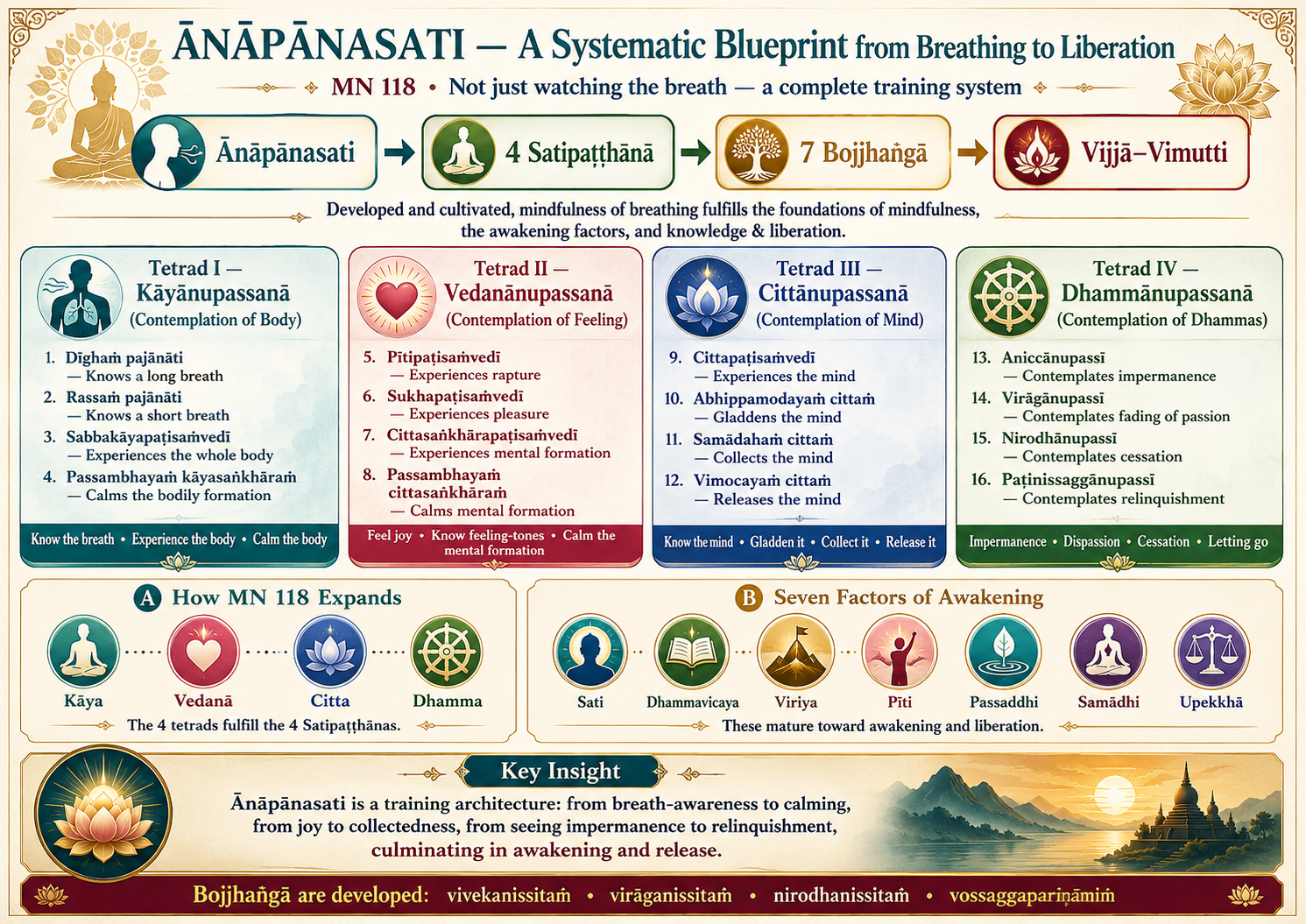
 VISUAL SUMMARYSee this sutta in a pictureOpen the complete infographic for a visual overview before or after reading the full study.View infographic →
MN 118: the full path is more than observing a breath
Listen to the MN 118 study
The sixteen complete paired breathing instructions
01The opening setting and the training community
At the Eastern Monastery, senior bhikkhus train newer practitioners. The Buddha commends the assembly and urges increased energy to reach what has not yet been reached. He identifies arahants, non-returners, once-returners and stream-enterers, and praises the community’s many forms of cultivation.
Evaṃ me sutaṃ—ekaṃ samayaṃ bhagavā sāvatthiyaṃ viharati pubbārāme migāramātupāsāde…
Thus have I heard. At one time the Buddha was dwelling near Sāvatthī in the Eastern Monastery, at Migāra’s mother’s mansion…
02Tetrad 1 — Kāya · Body
01 · Long in/out breathing is known as long
Dīghaṁ vā assasanto ‘dīghaṁ assasāmī’ti pajānāti; dīghaṁ vā passasanto ‘dīghaṁ passasāmī’ti pajānāti.
He understands: Long in/out breathing is known as long, during both breathing in and breathing out.
02 · Short in/out breathing is known as short
Rassaṁ vā assasanto ‘rassaṁ assasāmī’ti pajānāti; rassaṁ vā passasanto ‘rassaṁ passasāmī’ti pajānāti.
He understands: Short in/out breathing is known as short, during both breathing in and breathing out.
03 · Experiencing the whole body
‘Sabbakāyapaṭisaṁvedī assasissāmī’ti sikkhati; ‘Sabbakāyapaṭisaṁvedī passasissāmī’ti sikkhati.
He trains: Experiencing the whole body, during both breathing in and breathing out.
04 · Calming the bodily formation
‘Passambhayaṁ kāyasaṅkhāraṁ assasissāmī’ti sikkhati; ‘Passambhayaṁ kāyasaṅkhāraṁ passasissāmī’ti sikkhati.
He trains: Calming the bodily formation, during both breathing in and breathing out.
03Tetrad 2 — Vedanā · Feeling
05 · Experiencing rapture or uplifting joy
‘Pītipaṭisaṁvedī assasissāmī’ti sikkhati; ‘Pītipaṭisaṁvedī passasissāmī’ti sikkhati.
He trains: Experiencing rapture or uplifting joy, during both breathing in and breathing out.
06 · Experiencing happiness or ease
‘Sukhapaṭisaṁvedī assasissāmī’ti sikkhati; ‘Sukhapaṭisaṁvedī passasissāmī’ti sikkhati.
He trains: Experiencing happiness or ease, during both breathing in and breathing out.
07 · Experiencing mental formation
‘Cittasaṅkhārapaṭisaṁvedī assasissāmī’ti sikkhati; ‘Cittasaṅkhārapaṭisaṁvedī passasissāmī’ti sikkhati.
He trains: Experiencing mental formation, during both breathing in and breathing out.
08 · Calming the mental formation
‘Passambhayaṁ cittasaṅkhāraṁ assasissāmī’ti sikkhati; ‘Passambhayaṁ cittasaṅkhāraṁ passasissāmī’ti sikkhati.
He trains: Calming the mental formation, during both breathing in and breathing out.
04Tetrad 3 — Citta · Mind
09 · Experiencing the condition of mind
‘Cittapaṭisaṁvedī assasissāmī’ti sikkhati; ‘Cittapaṭisaṁvedī passasissāmī’ti sikkhati.
He trains: Experiencing the condition of mind, during both breathing in and breathing out.
10 · Gladdening the mind
‘Abhippamodayaṁ cittaṁ assasissāmī’ti sikkhati; ‘Abhippamodayaṁ cittaṁ passasissāmī’ti sikkhati.
He trains: Gladdening the mind, during both breathing in and breathing out.
11 · Collecting the mind
‘Samādahaṁ cittaṁ assasissāmī’ti sikkhati; ‘Samādahaṁ cittaṁ passasissāmī’ti sikkhati.
He trains: Collecting the mind, during both breathing in and breathing out.
12 · Releasing the mind
‘Vimocayaṁ cittaṁ assasissāmī’ti sikkhati; ‘Vimocayaṁ cittaṁ passasissāmī’ti sikkhati.
He trains: Releasing the mind, during both breathing in and breathing out.
05Tetrad 4 — Dhamma · Insight
13 · Contemplating impermanence
‘Aniccānupassī assasissāmī’ti sikkhati; ‘Aniccānupassī passasissāmī’ti sikkhati.
He trains: Contemplating impermanence, during both breathing in and breathing out.
14 · Contemplating dispassion
‘Virāgānupassī assasissāmī’ti sikkhati; ‘Virāgānupassī passasissāmī’ti sikkhati.
He trains: Contemplating dispassion, during both breathing in and breathing out.
15 · Contemplating cessation
‘Nirodhānupassī assasissāmī’ti sikkhati; ‘Nirodhānupassī passasissāmī’ti sikkhati.
He trains: Contemplating cessation, during both breathing in and breathing out.
16 · Contemplating relinquishment
‘Paṭinissaggānupassī assasissāmī’ti sikkhati; ‘Paṭinissaggānupassī passasissāmī’ti sikkhati.
He trains: Contemplating relinquishment, during both breathing in and breathing out.
The structure and major textual distinctions
Body
Long, short, whole-body experience and calming bodily formation.
Feeling
Pīti, sukha, experiencing and calming mental formation.
Citta
Experiencing, gladdening, collecting and releasing mind.
Dhammas
Impermanence, dispassion, cessation and relinquishment.
The sixteen trainings examined through Pāli and practical cultivation
01Breath Sensations — Source Orientation
| Direct experience | Canonical distinction | Question in cultivation |
|---|---|---|
| Coolness, pressure, tingling, movement | Tangible contact, a bodily object | What was contacted and under what conditions? |
| Pleasant, painful, neutral tone | Vedanā (feeling) | What is the hedonic tone and is there delight or resistance? |
| Recognising or labeling “breath” | Saññā (perception) | What is recognised or designated? |
| Glad, scattered, collected or bound mind | Citta and its present condition | What is being purified or cultivated? |
| Wanting to possess, preserve or reject an experience | Craving and appropriation | Is this feeding rāga, dosa or moha? |
02The 16-Step MN 118 Map
| Tetrad | Steps | What is cultivated | Caution |
|---|---|---|---|
| Kāya | 1–4 | Know long/short breathing; experience sabbakāya; calm kāyasaṅkhāra | Steps 1–2 say pajānāti |
| Vedanā | 5–8 | Experience pīti, sukha, mental formation, and calm it | Cittasaṅkhāra means saññā and vedanā in MN 44 |
| Citta | 9–12 | Experience, gladden, collect and release the mind | A transient release is not necessarily arahantship |
| Dhammas | 13–16 | Contemplate impermanence, dispassion, cessation and relinquishment | Not techniques for stopping the breath |
03So Sato Va Assasati, Sato Va Passasati
04First Tetrad — Kāyānupassanā: Long / Short / Whole Body / Calming
| Pāli | Meaning |
|---|---|
| Dīghaṁ vā | whether long |
| assasanto, passasanto | breathing in, breathing out |
| ‘dīghaṁ assasāmī’ti, passasāmī’ti | “I am breathing in long”, “I am breathing out long” |
| pajānāti | he understands; he clearly knows |
| Pāli | Meaning |
|---|---|
| Rassaṁ vā | whether short |
| assasanto, passasanto | breathing in, breathing out |
| ‘rassaṁ assasāmī’ti, passasāmī’ti | “I am breathing in short”, ‘I am breathing out short.’” |
| Pāli | Meaning |
|---|---|
| Sabbakāya | the whole body |
| paṭisaṁvedī | experiencing directly |
| assasissāmī’ti, passasissāmī’ti | “I will breathe in”, “I will breathe out” |
| sikkhati | trains himself |
| Pāli | Meaning |
|---|---|
| Passambhayaṁ | calming, tranquilizing |
| kāyasaṅkhāraṁ | bodily formations (here, primarily breathing activity itself) |
| assasissāmī’ti sikkhati, passasissāmī’ti | trains himself: “I will breathe in”, I will breathe out” |
Step 1 & 2: Knowing long and short breaths
The meditator becomes aware whether each breath is long or short.
This is not intellectual — it is direct sensing of breath length.
Why is this important?
a. Brings close-up attention.
b. Trains present-moment awareness.
c. Begins perception of anicca (impermanence) — noticing change.
Sensations involved:
The full tactile flow, expansion/contraction sensations from nostrils to abdomen.
Step 3 & 4: Experiencing the whole body (sabbakāya)
sabbakāya = “the entire body” Here, it has two levels of meaning:
| Interpretation | Explanation |
|---|---|
| 1. Breath-body | The entire breathing process: nostrils, windpipe, chest, diaphragm, belly |
| 2. Full physical body | The full field of bodily sensations |
1. Integration of mind and body.
2. Clear bodily awareness.
3. Relaxation and reduced mental agitation.
Step 5 & 6: Calming bodily formations (kāyasaṅkhāra)
kāyasaṅkhāra = the “bodily formation,” here referring primarily to breathing movement itself.
The breath starts to naturally become softer, subtler, calmer and the meditator actively trains to soothe and settle breathing.
As breathing calms: The whole body becomes tranquil leading to reducing mental agitation and subtle joy and comfort arise. This prepares the ground for samādhi (unification of mind), eventually leading toward jhāna.
How it should be practiced?
| Step | What to do |
|---|---|
| Long/Short Awareness | Notice with precision: “Is this in-breath long? Short? Where does it start and end?” |
| Whole Body Experience | Gradually open awareness to include not just breath at nostrils, but whole field of bodily sensations linked to breathing |
| Calming the Formation | As breath becomes refined, allow and encourage natural ease; don’t force the breath; observe softness growing |
| Stage | Description |
|---|---|
| 🌀 Gross Breath Awareness | Noticing in/out breath generally |
| 🔬 Long & Short Discrimination | Noting length variations |
| 🌊 Whole Body Breath | Breath experienced as bodily waves, energy field |
| 🌿 Calming Breath | Breath becomes so subtle it almost disappears |
| 🌌 Deep Unification | Entry into first jhāna becomes possible |
Let me emphasize this because it’s often misunderstood:
In dependent origination, kāyasaṅkhāra means bodily volitional formations. But here in Ānāpānasati context, kāyasaṅkhāra is specifically referring to the breathing process itself, as bodily activity driven by life force. You may also refer to MN43 and MN44 which gives clarity in this regard
As mind calms, breathing activity (kāyasaṅkhāra) itself calms.
🔑 Essence of this whole first tetrad:
Refined awareness → expanded bodily perception → natural calming → entry into deep unification.
05Second Tetrad — Vedanānupassanā: Pīti / Sukha / Cittasaṅkhāra
| Pāli | Meaning |
|---|---|
| Pīti | Rapture, joyful interest |
| paṭisaṁvedī | directly experiencing |
| assasissāmī’ti sikkhati, passasissāmī’ti | he trains himself: “I will breathe in”, “I will breathe out” |
He directly experiences sukha in both inbreath and outbreath
| Pāli | Meaning |
|---|---|
| Sukha | Happiness, comfort, bliss |
| paṭisaṁvedī | directly experiencing |
He directly experiences and learns how to watch mental formation: feeling & perception (vedanā & saññā) in both inbreath and out breath.
What does this consist of?
✅ 1) Direct link of samatha and vipassanā:
Here the Buddha shifts attention from the breath as a purely physical phenomenon (steps 1–4) and its feeling-tone (steps 5–6), to the mental processes arising in relation to the breath — how perception labels the breath, how feeling-tones attach to it, and how these influence the mind’s stability.
✅ 2) Cultivating clear seeing of nama:
This step is the practitioner’s first deep insight into nāma (mental aspect). By observing how vedanā and saññā come and go with each breath, one starts seeing dependent origination inside experience, not as an abstract teaching.
✅ 3) Foundation for insight into anicca:
Each breath triggers subtle shifts in mental tone and perception. Seeing them arise and pass trains awareness in impermanence at the level of mental processes, paving the way to the final tetrad.
✅ 4) Preparing for mental unification:
By understanding how perceptions and feelings condition mental states, one can consciously calm these formations (next step: passambhayaṁ cittasaṅkhāraṁ), leading to the deep stillness required for stable jhāna or insight.
⚠️ What doesn’t it mean?
A common mistake is to equate cittasaṅkhāra with “thoughts in general.” But in suttas (e.g., MN 44), cittasaṅkhāra is defined as vedanā and saññā specifically in relation to the mind. Deliberative engagement and continued examination (vitakka-vicāra) belong to vacīsaṅkhāra (verbal formation); this does not mean every passing thought is vitakka-vicāra.
🔶 How is “assasissāmīti sikkhati, passasissāmīti sikkhati” significant?
The repeated phrase assasissāmīti sikkhati, passasissāmīti sikkhati across the 16 steps is profound because:
✅ It shows intentional training, not passive watching.
The Buddha explicitly says sikkhati — “he trains himself,” which implies active cultivation, not merely waiting for things to happen or observing without engagement.
✅ Each step builds a skill.
For example: At step 3 (sabbakāyapaṭisaṁvedī), the skill is expanding awareness to whole-body breath.
At step 7 (cittasaṅkhārapaṭisaṁvedī), the skill is recognizing subtle mental formations.
At step 13 (aniccānupassī), the skill is seeing impermanence.
✅ Breathing in and out are both used as vehicles for training.
It’s not one-sided or unbalanced: in each step, both inhalation and exhalation are used to develop the same skill, ensuring continuity.
🔶 How this differs from Goenka’s method: In Goenka retreats, the instruction is to observe the bare breath or sensations, but without this explicit intentional training the Buddha describes (sikkhati). The system also doesn’t explore cittasaṅkhāra through breath but moves to scanning bodily sensations, skipping the link between breath and subtle mental formations.
Passambhayaṁ cittasaṅkhāraṁ assasissāmī’ti sikkhati, Passambhayaṁ cittasaṅkhāraṁ passasissāmī’ti sikkhati.
He directly experiences and learns how to calm the mental formations in both inbreath and outbreath.
What this means?
✅ Softening reactions:
You notice how certain perceptions of the breath (e.g., “rough,” “tight,” “subtle”) or feelings (pleasant, unpleasant) trigger mental tightening, anxiety, or anticipation. Here, you gently let them settle, not feeding them with aversion or craving.
✅ Reducing mental chatter:
Calming cittasaṅkhāra means letting go of mental commentary about the breath — the stories, judgments, or expectations you add. You learn to let the breath simply be, without proliferating thoughts.
✅ Harmonizing mind and breath:
As feelings and perceptions settle, the mind and breath start to move together effortlessly, without struggle. The breath becomes naturally smooth, subtle, and refined — a sign of successful calming.
✅ Preparing for samādhi:
This step is key for entering deeper unification. When feelings and perceptions agitating the mind are calmed, the mind becomes unified — paving the way for the third tetrad (Cittānupassanā).
🔶 Why “passambhayaṁ” is a training — not just passive
The Buddha’s use of sikkhati (“he trains himself”) shows this isn’t about ignoring mental formations or suppressing them by force. It’s about actively cultivating a skillful response:
You train to recognize mental arisings and learn to release habitual tightening around them.
You train to incline the mind toward softness, openness, and peace. This is intentional, mindful practice — not waiting for calming to happen by accident.
🔶 What it does not mean?
⚠️ It’s not about suppressing or pushing away feelings or perceptions.
⚠️ It’s not ignoring mental formations — one must be aware of them to calm them.
⚠️ It’s not rigidly controlling the breath — rather, it’s allowing the breath and mind to relax naturally as mental agitation subsides.
🔶 How is this different from cittasaṅkhārapaṭisaṁvedī?
Step 7: cittasaṅkhārapaṭisaṁvedī is about recognizing how feelings and perceptions arise with the breath.
Step 8: passambhayaṁ cittasaṅkhāraṁ is about calming these — releasing reactivity, softening subtle tensions, allowing mental factors to settle into tranquility. The first is seeing; the second is pacifying.
Let us get into detail of this important steps
🔸 Step 1-2: Pīti — Experiencing Rapture
As the bodily calming deepens (first tetrad), pīti arises. This is not coarse excitement but a gentle, uplifting joyful energy which can manifest as: Tingling sensations, Waves of pleasure, Subtle vibrations, Mental upliftment
👉 Important: This pīti is not deliberately created but arises naturally as hindrances weaken and concentration stabilizes. The meditator simply knows it directly (paṭisaṁvedī = directly experiencing).
🔸 Step 3-4: Sukha — Experiencing Happiness / Bliss
Following pīti, a more refined sukha arises. Sukha here is: Soft contentment., Comfortable bodily ease, Stable, unshakable pleasant feeling. and joy of stillness. Thus, sukha replaces the “moving energy” of pīti with calm happiness.
👉 In jhāna development: Pīti dominates early jhāna. and sukha dominates deeper stages.
🔸 Step 5-6: Cittasaṅkhāra — Experiencing the Mental Formation
Here we must be very precise:
| Term | Meaning |
|---|---|
| Cittasaṅkhāra | The mental formations that are intimately associated with consciousness, primarily vedanā (feeling) and saññā (perception). |
How feelings (pleasant, neutral) and perceptions (mental labels) arise and pass in conjunction with breath and subtle feeling-tone attached to each breath. Also, subtle perceptions related to breath object itself.
👉 This is the level where early insight into impermanence, arising-passing begins to sharpen.
🔸 Step 7-8: Passambhayaṁ cittasaṅkhāraṁ — Calming the Mental Formation
As mindfulness deepens, the mind begins to naturally: Calm excitement, Settle perceptions, Subdue discursive thinking and unify into deeper stillness.
👉 Here the mind begins moving toward samādhi with upekkhā — where joy settles into equanimity.
Practical Application in Meditation
| Step | Practice |
|---|---|
| Pīti awareness | Notice pleasant sensations: tingling, joy, subtle waves, but don’t cling. Stay observing. |
| Sukha awareness | Experience comfort, ease, pleasure of tranquility. Mind settles. |
| Cittasaṅkhāra awareness | Observe how mental feelings and subtle labels arise along with breath. No interference. |
| Calming cittasaṅkhāra | Allow perceptions to become extremely subtle. Mind remains unified, peaceful, bright. |
| Jhāna Stage | Correlation |
|---|---|
| First Jhāna | Pīti & Sukha arising with initial concentration |
| Second Jhāna | Pīti calms, sukha deepens, mental formations calm |
06Third Tetrad — Cittānupassanā: Experience / Gladden / Collect / Release
He trains to directly see or witness the mental state in both inbreath and outbreath
Abhippamodayaṁ cittaṁ assasissāmī’ti sikkhati, Abhippamodayaṁ cittaṁ passasissāmī’ti sikkhati.
He trains to greatly gladden or uplifting or delighting the mind in both inbreath and outbreath
Samādahaṁ cittaṁ assasissāmī’ti sikkhati, Samādahaṁ cittaṁ passasissāmī’ti sikkhati.
He trains the mind to unify / be in collectedness / balanced in both inbreath and outbreath
Vimocayaṁ cittaṁ assasissāmī’ti sikkhati, Vimocayaṁ cittaṁ passasissāmī’ti sikkhati.
He trains the mind to release or liberate from the mind in both inbreath and outbreath
🔸 Step 1-2: Experiencing the Mind (Cittapaṭisaṁvedī)
The meditator turns attention inward to directly observe the state of the mind.
What is being experienced here:
Is the mind calm or restless? Is it collected or scattered? Is it joyful or dull? Is it agitated or still?
This is not an intellectual assessment — it is immediate direct knowing.
The mind itself becomes the object — a mirror-like awareness.
👉 This stage leads to intimate knowing of the mind’s condition moment-to-moment.
🔸 Step 3-4: Gladdening the Mind (Abhippamodayaṁ Cittaṁ)
The meditator trains to uplift the mind: Generate wholesome joy, Strengthen confidence (saddhā), energy (viriya), mindfulness (sati), Remove any dullness or discouragement. This is closely linked to the cultivation of pīti and sukha — but now consciously nourishing joy and the gladdened mind easily enters samādhi.
🔸 Step 5-6: Unifying the Mind (Samādahaṁ Cittaṁ)
The mind becomes unified, collected, and stable and distractions fade leading to one-pointedness being developed (ekaggatā) which is deep samādhi.
👉 Here we are very close to jhāna factors: Vitakka, vicāra (initial and sustained attention) settle and Pīti & sukha remain stable while unification becomes solid.
🔸 Step 7-8: Liberating the Mind (Vimocayaṁ Cittaṁ)
As samādhi deepens, the mind experiences freedom from hindrances, craving, agitation.
Temporary release from clinging arises and is sometimes called temporary liberation (tadanga vimutti) — a taste of release. Though not yet full Nibbāna, this is a foreshadowing of full release.
Practical Meditative Application
| Step | What to Observe & Train |
|---|---|
| Experiencing the mind | Notice quality of mind: bright/dull, tense/relaxed |
| Gladdening | Encourage joy: reflect on merits, Dhamma, confidence |
| Unifying | Allow mind to rest, settle deeply into breath — no wandering |
| Liberating | Let go of any tightness or wanting; dwell in natural spaciousness |
| Jhāna Stage | Correlation |
|---|---|
| 1st Jhāna | Pīti-sukha prominent |
| 2nd Jhāna | Unification strengthens |
| 3rd Jhāna | Pīti fades, sukha & upekkhā arise |
| 4th Jhāna | Pure upekkhā and equanimous stillness |
🔑 Essence of Third Tetrad: Mind observing itself → uplifting → unification → temporary release.
07Fourth Tetrad — Dhammānupassanā: Anicca / Virāga / Nirodha / Paṭinissagga
He learns to observe “anicca” in both inbreath and outbreath continuously without a break. Anicca as in “arising” and “passing” of breath, where each breath represents reducing of life span and he is aware just like a insense stick or candle getting burned and one is closely observing it leading to awareness
Virāgānupassī assasissāmī’ti sikkhati, Virāgānupassī passasissāmī’ti sikkhati.
He learns on how to let go or being dispassionate in both inbreath and outbreath by continuously observing their arrival and departure
Nirodhānupassī assasissāmī’ti sikkhati, Nirodhānupassī passasissāmī’ti sikkhati.
He trains during inhalation and exhalation while contemplating nirodha, the cessation of conditioned processes and the conditions of suffering. This is not an instruction to stop breathing or become an eternal observer.
Paṭinissaggānupassī assasissāmī’ti sikkhati, Paṭinissaggānupassī passasissāmī’ti sikkhati.
He trains to relinquish appropriation and the assumption that breathing or the associated experience is ‘mine’. Paṭinissagga is the release of clinging; the passage does not say normal feeling and perception must be forcibly eliminated.
This tetrad is directly vipassanā.
Here the meditator, while dwelling in deep samādhi, begins to see deeply into the nature of existence.
🔸 Aniccānupassī — Contemplating Impermanence
Observes that: Each breath arises and passes away while each bodily sensation arises and fades. Even mental states (pīti, sukha, samādhi itself) are impermanent. This brings deep understanding that nothing is stable or lasting.
👉 This is direct, moment-to-moment perception of impermanence (not philosophical reflection).
🔸 Virāgānupassī — Contemplating Dispassion (Fading of Lust)
As anicca becomes deeply seen: Desire, craving, clinging begin to fade and the mind begins to naturally lose interest in sensuality, clinging to experiences. Virāga literally means fading of color — emotional color fades away.
👉 Dispassion arises not by will, but through understanding.
🔸 Nirodhānupassī — Contemplating Cessation
As dispassion deepens: The cessation of craving becomes visible and the cessation of mental movements can be seen directly and even subtle mental formations seem to stop. The practitioner investigates arising and cessation. A temporary quieting of perceptions or mental activity alone does not establish an experience of Nibbāna.
👉 This is not full Nibbāna yet — but directly perceiving cessation of mental processes prepares the mind for full liberation.
🔸 Paṭinissaggānupassī — Contemplating Letting Go (Relinquishment)
The meditator learns to completely: Let go of holding onto any experience.
Renounce even attachment to refined samādhi or insight experiences and allow mind to completely release clinging.👉 This leads to total non-clinging, which is the final condition for complete liberation.
Practical Meditative Application
| Step | What to Observe |
|---|---|
| Anicca | Watch every breath, sensation, feeling — notice continuous arising-passing |
| Virāga | Notice how clinging weakens as impermanence becomes clear |
| Nirodha | Observe how certain processes simply cease without personal effort |
| Paṭinissagga | Train the mind to release even subtle holding — fully trust letting go |
| Stage | Fruit |
|---|---|
| Anicca | Insight into nature of all formations |
| Virāga | Dispassion |
| Nirodha | Cessation of craving |
| Paṭinissagga | Non-clinging; preparation for arahantship |
Satipaṭṭhāna, seven awakening factors and liberation
08How Ānāpānasati Fulfills Kāyānupassanā
Kathaṁ bhāvitā ca, bhikkhave, ānāpānassati kathaṁ bahulīkatā cattāro satipaṭṭhāne paripūreti?
This sentence begins with the Buddha asking a rhetorical question: “And how, monks (bhikkhave), when mindfulness of breathing (ānāpānassati) is developed (bhāvitā ca), and when it is cultivated repeatedly (bahulīkatā), does it fulfill the four establishments of mindfulness (cattāro satipaṭṭhāne paripūreti)?” This sets up the detailed explanation of how ānāpānasati leads directly into satipaṭṭhāna.
Yasmiṁ samaye, bhikkhave, bhikkhu dīghaṁ vā assasanto ‘dīghaṁ assasāmī’ti pajānāti, dīghaṁ vā passasanto ‘dīghaṁ passasāmī’ti pajānāti;
The Buddha now begins describing the practice. “At the time (yasmiṁ samaye), monks, when a monk (bhikkhu), while breathing in long (dīghaṁ vā assasanto), understands (pajānāti): ‘I am breathing in long (dīghaṁ assasāmī’ti),’ and while breathing out long (dīghaṁ vā passasanto), understands: ‘I am breathing out long (dīghaṁ passasāmī’ti).’” Here, the practitioner is directly aware of the breath’s length, recognizing clearly when the breath is long during both inhalation and exhalation. This is not intellectual knowledge but immediate, experiential awareness.
Rassaṁ vā assasanto ‘rassaṁ assasāmī’ti pajānāti, rassaṁ vā passasanto ‘rassaṁ passasāmī’ti pajānāti;
Continuing, “While breathing in short (rassaṁ vā assasanto), he understands: ‘I am breathing in short (rassaṁ assasāmī’ti),’ and while breathing out short (rassaṁ vā passasanto), he understands: ‘I am breathing out short (rassaṁ passasāmī’ti).’” Now the meditator is discerning variations of the breath’s length — sometimes short, sometimes long. This develops finer sensitivity to the breath and anchors present-moment awareness even more closely.
‘Sabbakāyapaṭisaṁvedī assasissāmī’ti sikkhati, ‘sabbakāyapaṭisaṁvedī passasissāmī’ti sikkhati;
The practice deepens. The meditator trains himself (sikkhati): “I will breathe in experiencing the whole body (sabbakāyapaṭisaṁvedī assasissāmī’ti), I will breathe out experiencing the whole body (sabbakāyapaṭisaṁvedī passasissāmī’ti).” Here, ‘sabbakāya’ refers to experiencing either the entire breath-body — meaning the full cycle of breath movements throughout the bodily frame — or even the whole physical body as affected by breathing. The breath is now perceived as a total-body phenomenon, not just as air at the nostrils. The entire body becomes present within the field of awareness.
‘Passambhayaṁ kāyasaṅkhāraṁ assasissāmī’ti sikkhati, ‘passambhayaṁ kāyasaṅkhāraṁ passasissāmī’ti sikkhati;
The meditator further trains: “I will breathe in calming the bodily formation (passambhayaṁ kāyasaṅkhāraṁ assasissāmī’ti), I will breathe out calming the bodily formation (passambhayaṁ kāyasaṅkhāraṁ passasissāmī’ti).” The term ‘kāyasaṅkhāra‘ here specifically refers to the breath itself, which is the bodily process driven by life. As concentration deepens, the breath naturally becomes subtler, gentler, and finer. The body settles, physical agitation subsides, and tranquility arises. There is no forcing here — the calming happens naturally as the mind becomes more unified with the breath.
Kāye kāyānupassī, bhikkhave, tasmiṁ samaye bhikkhu viharati ātāpī sampajāno satimā vineyya loke abhijjhādomanassaṁ.
Now the Buddha states a key doctrinal point: “At that time, monks, the monk dwells contemplating the body in the body (kāye kāyānupassī), ardent (ātāpī), clearly knowing (sampajāno), mindful (satimā), having removed desire and discontent with regard to the world (vineyya loke abhijjhādomanassaṁ).” This declares that when the monk is observing the breath in this way, he is fully engaged in kāyānupassanā, the first foundation of mindfulness. He maintains energetic effort, clear comprehension, mindfulness, and freedom from greed and distress toward worldly things. The expression “ātāpī sampajāno satimā” is the standard formula for satipaṭṭhāna: diligent, clear, and fully mindful.
Kāyesu kāyaññatarāhaṁ, bhikkhave, evaṁ vadāmi yadidaṁ—assāsapassāsā.
The Buddha further clarifies: “Among bodies, monks, I say that this is one kind of body (kāyesu kāyaññataraṁ ahaṁ vadāmi): namely, in-breaths and out-breaths (yadidaṁ—assāsapassāsā).” Here, he defines breathing itself as a valid aspect of the body to contemplate. In the satipaṭṭhāna formula, ‘body in the body’ includes postures, movements, and decay, but the Buddha explicitly says that breath is itself a legitimate object of body contemplation.
Tasmātiha, bhikkhave, kāye kāyānupassī tasmiṁ samaye bhikkhu viharati ātāpī sampajāno satimā vineyya loke abhijjhādomanassaṁ.
He then repeats for emphasis: “Therefore, monks, at that time, the monk dwells contemplating the body in the body, ardent, clearly knowing, mindful, having removed desire and discontent with regard to the world.” This repetition reinforces that mindfulness of breathing, even at this initial stage, fully accomplishes the establishment of kāyānupassanā.
This entire paragraph is extremely important because the Buddha here directly links the practice of ānāpānasati with the first satipaṭṭhāna without ambiguity. He makes it clear that following these initial steps in ānāpānasati is already fulfilling kāyānupassanā in full, provided that the qualities of ardency, clearly knowing and mindfulness, free from desire and discontent are present.
09How Ānāpānasati Fulfills Vedanānupassanā
Yasmiṁ samaye, bhikkhave, bhikkhu ‘pītipaṭisaṁvedī assasissāmī’ti sikkhati, ‘pītipaṭisaṁvedī passasissāmī’ti sikkhati;
The Buddha begins: “At that time (yasmiṁ samaye), monks (bhikkhave), a monk (bhikkhu) trains himself (sikkhati): ‘I will breathe in experiencing rapture (pītipaṭisaṁvedī assasissāmī’ti); I will breathe out experiencing rapture (pītipaṭisaṁvedī passasissāmī’ti).’”
Here, the practitioner now reaches the stage where pīti arises. Pīti is joyful rapture, an energizing pleasant mental factor that emerges as hindrances diminish and concentration stabilizes. The meditator directly experiences this joyful bodily and mental energy as it naturally arises with the breath. The training is not about generating pīti deliberately, but being directly aware as it unfolds naturally during deepening practice.
‘Sukhapaṭisaṁvedī assasissāmī’ti sikkhati, ‘sukhapaṭisaṁvedī passasissāmī’ti sikkhati;
Next, the Buddha continues: “He trains: ‘I will breathe in experiencing happiness (sukhapaṭisaṁvedī assasissāmī’ti); I will breathe out experiencing happiness (sukhapaṭisaṁvedī passasissāmī’ti).’”
After pīti, as the energy stabilizes and agitation quietens, sukha arises. Sukha here is not coarse pleasure but deep contentment, comfortable bodily and mental happiness associated with calm concentration. The meditator becomes fully aware of this soothing pleasure as he breathes in and out. Sukha is more stable and soft than pīti. Where pīti can be energetic, sukha brings peaceful satisfaction and comfort.
‘Cittasaṅkhārapaṭisaṁvedī assasissāmī’ti sikkhati, ‘cittasaṅkhārapaṭisaṁvedī passasissāmī’ti sikkhati;
The Buddha proceeds: “He trains: ‘I will breathe in experiencing the mental formation (cittasaṅkhārapaṭisaṁvedī assasissāmī’ti); I will breathe out experiencing the mental formation (cittasaṅkhārapaṭisaṁvedī passasissāmī’ti).’”
Here, cittasaṅkhāra refers to the mental factors which accompany consciousness, specifically vedanā (feeling) and saññā (perception). At this stage, the meditator clearly discerns how feelings (pleasant, unpleasant, or neutral) and perceptions arise and interact with each breath. For example, one might notice that with each breath, there is a subtle pleasant sensation, a mental labeling, or imagery connected with the experience. The practice becomes highly refined as one observes how the mind constructs and interprets the ongoing breathing experience through these mental factors.
‘Passambhayaṁ cittasaṅkhāraṁ assasissāmī’ti sikkhati, ‘passambhayaṁ cittasaṅkhāraṁ passasissāmī’ti sikkhati;
Further, the meditator trains: “I will breathe in calming the mental formation (passambhayaṁ cittasaṅkhāraṁ assasissāmī’ti); I will breathe out calming the mental formation (passambhayaṁ cittasaṅkhāraṁ passasissāmī’ti).”
As observation deepens, the mental activities of feeling and perception gradually quiet down. Subtle excitations, conceptual labeling, or emotional responses settle, leaving the mind in a more unified, tranquil state. The breath becomes smooth, effortless, and the mental commentary around the breath diminishes. This natural calming of cittasaṅkhāra leads toward stronger unification of mind, preparing for deep samādhi.
Vedanāsu vedanānupassī, bhikkhave, tasmiṁ samaye bhikkhu viharati ātāpī sampajāno satimā vineyya loke abhijjhādomanassaṁ.
Now the Buddha declares: “At that time (tasmiṁ samaye), monks, the monk dwells (viharati) contemplating feelings in feelings (vedanāsu vedanānupassī), ardent (ātāpī), clearly knowing (sampajāno), mindful (satimā), having removed desire and discontent regarding the world (vineyya loke abhijjhādomanassaṁ).”
This is the critical doctrinal statement: when the monk is practicing these steps of experiencing pīti, sukha, mental formations, and calming mental formations while observing the breath, he is fully practicing Vedanānupassanā Satipaṭṭhāna — contemplation of feeling. This satipaṭṭhāna formula repeats exactly as in the original Satipaṭṭhāna Sutta: there is ardent effort, clear comprehension, steady mindfulness, and freedom from craving and discontent.
Vedanāsu vedanāññatarāhaṁ, bhikkhave, evaṁ vadāmi yadidaṁ—assāsapassāsānaṁ sādhukaṁ manasikāraṁ.
The Buddha adds clarification: “Among feelings (vedanāsu), monks, I say (ahaṁ vadāmi) that this is one particular kind of feeling (vedanāññataraṁ): namely, careful attention (sādhukaṁ manasikāraṁ) to in-breaths and out-breaths (assāsapassāsānaṁ).”
The Buddha here makes it clear that even while working with breath sensations, the meditator is directly engaging with feeling (vedanā) because with every breath there is a corresponding feeling tone — pleasant (sukha), neutral (upekkhā), or even sometimes unpleasant if agitation arises. The careful attention to these breath-associated feelings constitutes valid Vedanānupassanā.
Tasmātiha, bhikkhave, vedanāsu vedanānupassī tasmiṁ samaye bhikkhu viharati ātāpī sampajāno satimā vineyya loke abhijjhādomanassaṁ.
The Buddha repeats: “Therefore, monks, at that time, the monk dwells contemplating feelings in feelings, ardent, clearly comprehending, mindful, having removed desire and discontent regarding the world.” This repetition again seals the point. When breath is observed along with its accompanying feelings and their calming, Vedanānupassanā is fully present.
Summary of this paragraph’s essence:
As the breath is attended to more deeply, pīti and sukha naturally arise, followed by awareness of the mental factors connected to breathing. The meditator directly observes how feelings are present, how they change, and how they can be calmed. Through this process, breath meditation becomes a complete vehicle for practicing Vedanānupassanā. The breath and its associated feeling tones become the living laboratory for insight.
10How Ānāpānasati Fulfills Cittānupassanā
Yasmiṁ samaye, bhikkhave, bhikkhu ‘cittapaṭisaṁvedī assasissāmī’ti sikkhati, ‘cittapaṭisaṁvedī passasissāmī’ti sikkhati;
The Buddha begins: “At that time (yasmiṁ samaye), monks (bhikkhave), a monk (bhikkhu) trains (sikkhati): ‘I will breathe in experiencing the mind (cittapaṭisaṁvedī assasissāmī’ti); I will breathe out experiencing the mind (cittapaṭisaṁvedī passasissāmī’ti).’”
At this stage, attention shifts even more inward. The meditator is no longer just aware of the breath or its associated feelings, but now directly experiences the state of the mind itself. He observes: is the mind collected or scattered? Is it bright or dull? Is it joyful or neutral? This is not analysis or conceptual thinking — rather, it is a direct, non-verbal knowing of the mind’s condition in each moment while breathing in and out.
‘Abhippamodayaṁ cittaṁ assasissāmī’ti sikkhati, ‘abhippamodayaṁ cittaṁ passasissāmī’ti sikkhati;
The Buddha continues: “He trains: ‘I will breathe in gladdening the mind (abhippamodayaṁ cittaṁ assasissāmī’ti); I will breathe out gladdening the mind (abhippamodayaṁ cittaṁ passasissāmī’ti).’”
Here, the meditator makes a subtle intentional training: uplifting, gladdening, or brightening the mind. When mental dullness, discouragement, or weariness arises, this step develops skill to bring forth joy, confidence, energy, and satisfaction. The mind becomes more pliable and joyful, well prepared for stable concentration. This gladdening naturally supports entry into deeper samādhi.
‘Samādahaṁ cittaṁ assasissāmī’ti sikkhati, ‘samādahaṁ cittaṁ passasissāmī’ti sikkhati;
Next, the Buddha says: “He trains: ‘I will breathe in collecting the mind (samādahaṁ cittaṁ assasissāmī’ti); I will breathe out collecting the mind (samādahaṁ cittaṁ passasissāmī’ti).’”
As gladdening succeeds, the mind unifies. This is the establishment of samādhi — stable, collected, one-pointed concentration. The scattered or restless tendencies fade. The meditator trains the mind to remain steadily on the breath with unshakable focus. This is not forced concentration but gentle, natural unification resulting from earlier calming and joy. The mind becomes deeply stable, still, and bright.
‘Vimocayaṁ cittaṁ assasissāmī’ti sikkhati, ‘vimocayaṁ cittaṁ passasissāmī’ti sikkhati;
The Buddha then adds: “He trains: ‘I will breathe in liberating the mind (vimocayaṁ cittaṁ assasissāmī’ti); I will breathe out liberating the mind (vimocayaṁ cittaṁ passasissāmī’ti).’” As concentration deepens, the mind experiences temporary freedom from the hindrances: craving, aversion, restlessness, sloth, doubt, and agitation fall away. The mind becomes light, open, and free. This is not yet full liberation, but it is a profound release from defilements that entangle the ordinary mind. The meditator tastes a kind of temporary liberation, which is a foreshadowing of deeper awakening.
Citte cittānupassī, bhikkhave, tasmiṁ samaye bhikkhu viharati ātāpī sampajāno satimā vineyya loke abhijjhādomanassaṁ.
At this point, the Buddha declares: “At that time, monks, the monk dwells contemplating the mind in the mind (citte cittānupassī), ardent (ātāpī), clearly comprehending (sampajāno), mindful (satimā), having removed desire and discontent with regard to the world (vineyya loke abhijjhādomanassaṁ).”
This is the formal statement that during these stages of mindfulness of breathing, the practitioner is now fully engaged in Cittānupassanā Satipaṭṭhāna — contemplation of mind. He is directly aware of the nature, quality, and condition of the mind itself as it experiences breath. The familiar formula of ardency, clear comprehension, mindfulness, and non-craving remains the framework of correct practice.
Nāhaṁ, bhikkhave, muṭṭhassatissa asampajānassa ānāpānassatiṁ vadāmi.
The Buddha then gives a sharp caution: “Monks, I do not say that one who is idiotic (muṭṭhassatissa) and lacking clearly knowing (asampajānassa) is practicing mindfulness of breathing (ānāpānassatiṁ vadāmi).” Here the Buddha strongly emphasizes that true ānāpānasati requires continuous mindfulness (sati) and full clear knowing (sampajañña). If mindfulness is lost or absent, even if one appears to observe the breath, it is not real ānāpānasati. This is a very important doctrinal point: the quality of awareness must be present; mere mechanical observation is not sufficient.
Tasmātiha, bhikkhave, citte cittānupassī tasmiṁ samaye bhikkhu viharati ātāpī sampajāno satimā vineyya loke abhijjhādomanassaṁ.
Finally, the Buddha repeats for emphasis: “Therefore, monks, at that time, the monk dwells contemplating the mind in the mind, ardent, clearly comprehending, mindful, having removed desire and discontent with regard to the world.”
This repetition seals the teaching: through these steps of experiencing, gladdening, unifying, and liberating the mind while breathing, one fully accomplishes Cittānupassanā, the third foundation of mindfulness.
Summary of this paragraph’s essence:
The focus has now shifted fully into observing and training the mind itself — its conditions, its energy, its stability, its release. As each breath is observed, the meditator directly experiences how the mind operates and gently cultivates its wholesome qualities. Through this direct contact with the mind, ānāpānasati fulfills the third satipaṭṭhāna entirely.
11How Ānāpānasati Fulfills Dhammānupassanā
Yasmiṁ samaye, bhikkhave, bhikkhu ‘aniccānupassī assasissāmī’ti sikkhati, ‘aniccānupassī passasissāmī’ti sikkhati;
The Buddha begins: “At that time (yasmiṁ samaye), monks (bhikkhave), a monk (bhikkhu) trains (sikkhati): ‘I will breathe in contemplating impermanence (aniccānupassī assasissāmī’ti); I will breathe out contemplating impermanence (aniccānupassī passasissāmī’ti).’”
Here the practice shifts into deep insight (vipassanā). The meditator now clearly sees that all experiences — the breath itself, bodily sensations, feelings, mental states — are impermanent (anicca). He directly observes how each in-breath arises and passes away; how each bodily and mental formation involved in breathing is transient, not lasting for even a moment. This is not an intellectual thought but direct experiential seeing of arising and ceasing — every breath cycle is a living demonstration of impermanence.
‘Virāgānupassī assasissāmī’ti sikkhati, ‘virāgānupassī passasissāmī’ti sikkhati;
Next, the Buddha continues: “He trains: ‘I will breathe in contemplating dispassion (virāgānupassī assasissāmī’ti); I will breathe out contemplating dispassion (virāgānupassī passasissāmī’ti).’”
As the perception of impermanence becomes profound, attachment naturally begins to fade. This fading of craving and clinging is called virāga — dispassion or fading away of lust. The meditator no longer takes delight in temporary experiences, even subtle meditative joys. The emotional pull toward clinging weakens as wisdom sees the unsatisfactory nature of all formations. There is a cooling of desire, a gradual natural letting go.
‘Nirodhānupassī assasissāmī’ti sikkhati, ‘nirodhānupassī passasissāmī’ti sikkhati;
The Buddha proceeds: “He trains: ‘I will breathe in contemplating cessation (nirodhānupassī assasissāmī’ti); I will breathe out contemplating cessation (nirodhānupassī passasissāmī’ti).’”
As dispassion deepens, the meditator directly experiences the cessation (nirodha) of certain mental processes. He observes how perceptions, feelings, and even formations temporarily cease when not fueled by craving. The mind experiences stillness — not blankness, but a living clarity in which formations momentarily stop. This brings a taste of cessation that foreshadows Nibbāna — the full cessation of suffering. The meditator sees directly how the ending of craving leads to the ending of suffering.
‘Paṭinissaggānupassī assasissāmī’ti sikkhati, ‘paṭinissaggānupassī passasissāmī’ti sikkhati;
Then, the Buddha adds: “He trains: ‘I will breathe in contemplating relinquishment (paṭinissaggānupassī assasissāmī’ti); I will breathe out contemplating relinquishment (paṭinissaggānupassī passasissāmī’ti).’”
At this ultimate stage, the meditator trains in paṭinissagga, which means complete letting go, total relinquishment. There is no more clinging to even the most refined states of mind, no attachment to samādhi itself, or to insights achieved. Everything is released — there remains pure non-grasping. The meditator allows everything to arise and cease without interference or ownership. This final letting go brings the mind into full readiness for liberation.
Dhammesu dhammānupassī, bhikkhave, tasmiṁ samaye bhikkhu viharati ātāpī sampajāno satimā vineyya loke abhijjhādomanassaṁ.
Now the Buddha declares: “At that time, monks, the monk dwells contemplating dhammas in dhammas (dhammesu dhammānupassī), ardent (ātāpī), clearly comprehending (sampajāno), mindful (satimā), having removed desire and discontent with regard to the world (vineyya loke abhijjhādomanassaṁ).”
Here, the Buddha confirms that during these stages — contemplating impermanence, dispassion, cessation, and relinquishment while attending to the breath — the meditator fully engages in Dhammānupassanā Satipaṭṭhāna, the fourth and highest foundation of mindfulness. This is direct contemplation of dhammas: of conditioned phenomena, of the truth of arising and ceasing, of dependent origination unfolding moment-to-moment through the lens of direct experience.
So yaṁ taṁ abhijjhādomanassānaṁ pahānaṁ taṁ paññāya disvā sādhukaṁ ajjhupekkhitā hoti.
The Buddha further explains: “And seeing with wisdom (paññāya disvā) that abandonment (pahānaṁ) of desire and discontent (abhijjhādomanassānaṁ), he becomes one who observes carefully with equanimity (sādhukaṁ ajjhupekkhitā hoti).”
This is a very important doctrinal sentence. As the abandoning of craving and distress is seen clearly by wisdom, the meditator does not react emotionally; instead, he remains calmly observing with equanimity (upekkhā). This stable equanimity is not indifference but balanced mindfulness, fully aware and deeply peaceful, uninvolved in clinging or rejecting. This is a hallmark of the advanced insight practitioner.
Tasmātiha, bhikkhave, dhammesu dhammānupassī tasmiṁ samaye bhikkhu viharati ātāpī sampajāno satimā vineyya loke abhijjhādomanassaṁ.
Finally, the Buddha repeats: “Therefore, monks, at that time, the monk dwells contemplating dhammas in dhammas, ardent, clearly comprehending, mindful, having removed desire and discontent with regard to the world.”
This repetition completes the sequence, confirming that through this fourth tetrad, by using ānāpānasati alone, one completely fulfills Dhammānupassanā.
Summary of this paragraph’s essence:
At this most refined stage of ānāpānasati, insight directly unfolds into the three characteristics — impermanence, dispassion, cessation, and total letting go. The meditator no longer clings to any state. The breath becomes a direct gateway to seeing reality as it is. Through this, ānāpānasati fulfills the fourth satipaṭṭhāna entirely, bringing the practitioner to the threshold of final awakening.
Thus, through these four tetrads, the Buddha shows that ānāpānasati — when properly practiced — is not merely a concentration technique but a complete path to full awakening, combining both samatha and vipassanā perfectly.
Evaṁ bhāvitā kho, bhikkhave, ānāpānassati evaṁ bahulīkatā cattāro satipaṭṭhāne paripūreti.
The Buddha declares: “Thus developed (evaṁ bhāvitā kho), monks (bhikkhave), mindfulness of breathing (ānāpānassati), thus cultivated repeatedly (evaṁ bahulīkatā), fulfills the four establishments of mindfulness (cattāro satipaṭṭhāne paripūreti).”
This is a summary confirming that when the full sixteen-step ānāpānasati has been practiced as previously described — leading from breath awareness, through feelings, mind, and dhammas — it completes the full cultivation of the four satipaṭṭhānas.
Kathaṁ bhāvitā ca, bhikkhave, cattāro satipaṭṭhānā kathaṁ bahulīkatā satta bojjhaṅge paripūrenti?
The Buddha then raises the next question: “And how, monks (kathaṁ bhāvitā ca, bhikkhave), when the four establishments of mindfulness are developed (cattāro satipaṭṭhānā), and when they are cultivated repeatedly (bahulīkatā), do they fulfill the seven factors of awakening (satta bojjhaṅge paripūrenti)?”
Now the Buddha is about to explain the natural unfolding: how, from proper satipaṭṭhāna, the bojjhaṅgā — the seven awakening factors — arise and mature.
Yasmiṁ samaye, bhikkhave, bhikkhu kāye kāyānupassī viharati ātāpī sampajāno satimā vineyya loke abhijjhādomanassaṁ, upaṭṭhitāssa tasmiṁ samaye sati hoti asammuṭṭhā.
The Buddha explains: “At that time (yasmiṁ samaye), monks (bhikkhave), when a monk (bhikkhu) dwells (viharati) contemplating the body in the body (kāye kāyānupassī), ardent (ātāpī), clearly comprehending (sampajāno), mindful (satimā), having removed desire and discontent with regard to the world (vineyya loke abhijjhādomanassaṁ), then at that time his mindfulness (sati) is present (upaṭṭhitā hoti), unforgotten (asammuṭṭhā).”
Here, the Buddha points out that when one is correctly engaged in kāyānupassanā with energy, clearly knowing, and mindfulness, then mindfulness becomes fully established — not lost, not scattered, but steady. Asammuṭṭhā means “not absent, not confused, not lost.”
Yasmiṁ samaye, bhikkhave, bhikkhuno upaṭṭhitā sati hoti asammuṭṭhā, satisambojjhaṅgo tasmiṁ samaye bhikkhuno āraddho hoti.
The Buddha continues: “At the time (yasmiṁ samaye), monks, when mindfulness is present, unforgotten, at that time the mindfulness factor of awakening (satisambojjhaṅgo) has arisen (āraddho hoti) for that monk.”
The moment mindfulness becomes fully stable, the first awakening factor — sati-sambojjhaṅga — arises naturally. It is not something to be artificially created; it is the result of continuous correct practice.
Satisambojjhaṅgaṁ tasmiṁ samaye bhikkhu bhāveti, satisambojjhaṅgo tasmiṁ samaye bhikkhuno bhāvanāpāripūriṁ gacchati.
The Buddha adds: “At that time, the monk develops (bhāveti) the mindfulness awakening factor (satisambojjhaṅgaṁ), and the mindfulness awakening factor (satisambojjhaṅgo) reaches its full development (bhāvanāpāripūriṁ gacchati).”
When mindfulness is kept alive continuously, it naturally matures into full strength as a bojjhaṅga.
So tathāsato viharanto taṁ dhammaṁ paññāya pavicinati pavicayati parivīmaṁsaṁ āpajjati.
The Buddha then moves forward: “Thus, dwelling mindfully (tathā-sato viharanto), he investigates that dhamma (taṁ dhammaṁ), with wisdom (paññāya), examines (pavicinati), scrutinizes (pavicayati), and thoroughly investigates (parivīmaṁsaṁ āpajjati).”
When mindfulness is well-established, investigation naturally follows. The practitioner begins to directly investigate phenomena as they arise — observing their nature, their arising and passing, their impermanence, unsatisfactoriness, and non-self characteristics. This is active discernment, not intellectual analysis but direct seeing.
Yasmiṁ samaye, bhikkhave, bhikkhu tathāsato viharanto taṁ dhammaṁ paññāya pavicinati pavicayati parivīmaṁsaṁ āpajjati, dhammavicayasambojjhaṅgo tasmiṁ samaye bhikkhuno āraddho hoti.
The Buddha explains: “At that time, monks, when a monk dwelling mindfully investigates, examines, and scrutinizes dhamma with wisdom, then the investigation-of-dhamma factor of awakening (dhammavicayasambojjhaṅgo) has arisen (āraddho hoti) for that monk.”
From stable mindfulness, dhammavicaya-sambojjhaṅga — investigation of dhammas — arises automatically as a natural deepening of the practice.
Dhammavicayasambojjhaṅgaṁ tasmiṁ samaye bhikkhu bhāveti, dhammavicayasambojjhaṅgo tasmiṁ samaye bhikkhuno bhāvanāpāripūriṁ gacchati.
The Buddha continues: “At that time, the monk develops (bhāveti) the investigation-of-dhamma awakening factor, and it reaches its full development.” When this investigation continues consistently, this factor becomes fully matured. The meditator becomes deeply skilled in seeing the nature of phenomena as they truly are.
Tassa taṁ dhammaṁ paññāya pavicinato pavicayato parivīmaṁsaṁ āpajjato āraddhaṁ hoti vīriyaṁ asallīnaṁ.
The Buddha explains further: “For one who is investigating dhamma with wisdom (paññāya pavicinato), examining and scrutinizing (pavicayato, parivīmaṁsaṁ āpajjato), energy arises (āraddhaṁ hoti vīriyaṁ), and it is unsluggish (asallīnaṁ).”
As one investigates phenomena directly with wisdom, natural energy (vīriya) arises. This is not forced effort but an invigorating energy that springs from seeing reality clearly. The practice becomes energized, bright, and joyful. There is no laziness (asallīnaṁ means “not sluggish, not lax”).
Yasmiṁ samaye, bhikkhave, bhikkhuno taṁ dhammaṁ paññāya pavicinato pavicayato parivīmaṁsaṁ āpajjato āraddhaṁ hoti vīriyaṁ asallīnaṁ, vīriyasambojjhaṅgo tasmiṁ samaye bhikkhuno āraddho hoti.
The Buddha says: “At that time, monks, when this energy arises for the one investigating dhamma, the energy factor of awakening (vīriyasambojjhaṅgo) has arisen for that monk.” Thus, from investigation naturally arises vīriya-sambojjhaṅga — the awakening factor of energy or effort.
Vīriyasambojjhaṅgaṁ tasmiṁ samaye bhikkhu bhāveti, vīriyasambojjhaṅgo tasmiṁ samaye bhikkhuno bhāvanāpāripūriṁ gacchati.
Finally, the Buddha says: “At that time, the monk develops the energy awakening factor, and it reaches full development.” As investigation continues, this wholesome energy becomes steady and mature, leading the practice forward with vitality.
Summary of this section’s essence:
The Buddha is here showing the natural unfolding of awakening factors. When satipaṭṭhāna is properly developed through ānāpānasati, mindfulness arises strongly. Mindfulness leads directly to careful investigation of phenomena. That investigation gives rise to natural energy and enthusiastic effort. These stages are not artificially created; they unfold naturally as one practices.
So far, we have covered how sati-sambojjhaṅga, dhammavicaya-sambojjhaṅga, and vīriya-sambojjhaṅga arise and mature. The Buddha will now continue in the sutta with the remaining four bojjhaṅgas: pīti (rapture), passaddhi (tranquility), samādhi (concentration), and upekkhā (equanimity).
Āraddhavīriyassa uppajjati pīti nirāmisā.
The Buddha states: “For one whose energy has been aroused (āraddhavīriyassa), rapture (pīti) arises (uppajjati), which is spiritual, not tied to sensuality (nirāmisā).”
When energy (vīriya) is fully engaged due to the previous stages of mindfulness and investigation, there arises pīti — joyful rapture — which is entirely free from worldly sense pleasures (nirāmisā means “free from material/sensual enjoyment”). This is the pure spiritual joy that arises from deepening samādhi and insight, untainted by ordinary desires.
Yasmiṁ samaye, bhikkhave, bhikkhuno āraddhavīriyassa uppajjati pīti nirāmisā, pītisambojjhaṅgo tasmiṁ samaye bhikkhuno āraddho hoti.
“At that time, monks, when this rapture arises for the monk whose energy has been aroused, the rapture factor of awakening (pītisambojjhaṅgo) arises.” This confirms that at this stage, the fourth factor of awakening — pīti-sambojjhaṅga — is now present. It arises naturally as a fruit of properly applied mindfulness, investigation, and energy.
Pītisambojjhaṅgaṁ tasmiṁ samaye bhikkhu bhāveti, pītisambojjhaṅgo tasmiṁ samaye bhikkhuno bhāvanāpāripūriṁ gacchati.
“At that time, the monk develops (bhāveti) the rapture awakening factor, and it reaches full development (bhāvanāpāripūriṁ gacchati).”
This rapture is not temporary excitement but a stable, uplifting energy that supports deeper tranquility and unification.
Pītimanassa kāyopi passambhati, cittampi passambhati.
“When the mind is full of rapture (pītimanassa), the body (kāyo pi) becomes tranquil (passambhati), and the mind (cittaṁ pi) also becomes tranquil.” Here we see the natural calming effect of pīti: both the body and mind relax deeply. This bodily and mental tranquility is the doorway into deeper peace.
Yasmiṁ samaye, bhikkhave, bhikkhuno pītimanassa kāyopi passambhati, cittampi passambhati, passaddhisambojjhaṅgo tasmiṁ samaye bhikkhuno āraddho hoti.
“At that time, monks, when both body and mind are tranquil for the rapture-filled monk, the tranquility factor of awakening (passaddhisambojjhaṅgo) arises.”
Thus, the fifth factor of awakening arises — passaddhi-sambojjhaṅga, the factor of tranquility or deep calming.
Passaddhisambojjhaṅgaṁ tasmiṁ samaye bhikkhu bhāveti, passaddhisambojjhaṅgo tasmiṁ samaye bhikkhuno bhāvanāpāripūriṁ gacchati.
“The monk develops the tranquility awakening factor, and it reaches full development.”
The deeper the tranquility, the more the body and mind settle into serene stillness, preparing for profound unification.
Passaddhakāyassa sukhino cittaṁ samādhiyati.
“For the one whose body is tranquil (passaddhakāyassa), and who is experiencing happiness (sukhino), the mind becomes concentrated (samādhiyati).” When the body is deeply relaxed and blissful happiness is present, concentration naturally deepens. The mind easily enters unification without strain.
Yasmiṁ samaye, bhikkhave, bhikkhuno passaddhakāyassa sukhino cittaṁ samādhiyati, samādhisambojjhaṅgo tasmiṁ samaye bhikkhuno āraddho hoti.
“At that time, monks, when the mind of one whose body is tranquil and happy becomes concentrated, the concentration factor of awakening (samādhisambojjhaṅgo) arises.” Now the sixth factor arises — samādhi-sambojjhaṅga, the deep mental unification of samādhi.
Samādhisambojjhaṅgaṁ tasmiṁ samaye bhikkhu bhāveti, samādhisambojjhaṅgo tasmiṁ samaye bhikkhuno bhāvanāpāripūriṁ gacchati.
“The monk develops the concentration awakening factor, and it reaches full development.” This is now stable, unshakable samādhi — not merely the entry into jhāna, but a samādhi fully integrated with insight.
So tathāsamāhitaṁ cittaṁ sādhukaṁ ajjhupekkhitā hoti.
“When the mind is thus concentrated (tathāsamāhitaṁ cittaṁ), he carefully observes with equanimity (sādhukaṁ ajjhupekkhitā hoti).”
The concentrated mind becomes poised in upekkhā, balanced and equanimous, neither attracted nor repelled by any arising phenomena. The meditator simply observes with perfect balance and care.
Yasmiṁ samaye, bhikkhave, bhikkhu tathāsamāhitaṁ cittaṁ sādhukaṁ ajjhupekkhitā hoti, upekkhāsambojjhaṅgo tasmiṁ samaye bhikkhuno āraddho hoti.
“At that time, monks, when the monk observes the concentrated mind with equanimity, the equanimity factor of awakening (upekkhāsambojjhaṅgo) arises.” Thus the seventh factor of awakening arises — upekkhā-sambojjhaṅga, the culmination of maturity and balance.
Upekkhāsambojjhaṅgaṁ tasmiṁ samaye bhikkhu bhāveti, upekkhāsambojjhaṅgo tasmiṁ samaye bhikkhuno bhāvanāpāripūriṁ gacchati.
“The monk develops the equanimity awakening factor, and it reaches full development.”
Now all seven factors are fully matured. This is the complete ripening of satipaṭṭhāna leading to bojjhaṅga.
Yasmiṁ samaye, bhikkhave, bhikkhu vedanāsu …pe… citte … dhammesu dhammānupassī viharati ātāpī sampajāno satimā vineyya loke abhijjhādomanassaṁ…
Here, the Buddha repeats the full sequence once again, summarizing that whenever the monk is practicing properly the four satipaṭṭhānas — whether contemplating feelings, mind, or dhammas — he fulfills all seven factors of awakening exactly as described.
The entire remainder is a complete reiteration of the same unfolding sequence: from mindfulness to investigation, to energy, to joy, to tranquility, to concentration, and finally to equanimity.
Evaṁ bhāvitā kho, bhikkhave, cattāro satipaṭṭhānā evaṁ bahulīkatā satta sambojjhaṅge paripūrenti.
Finally, the Buddha concludes: “Thus developed (evaṁ bhāvitā kho), monks, thus cultivated repeatedly (evaṁ bahulīkatā), the four establishments of mindfulness (cattāro satipaṭṭhānā) fulfill the seven factors of awakening (satta sambojjhaṅge paripūrenti).”
Complete summary of this grand teaching:
The Buddha is revealing the full integrated system. Starting from simple mindfulness of breathing, the practitioner naturally fulfills all four satipaṭṭhānas. From there, the seven bojjhaṅgā unfold in precise sequential development, entirely driven by the strength of mindfulness and investigation. The explicit progression should be read together with the wider noble training, including sīla, restraint and wisdom. The discourse does not ask us to separate the sixteen breath instructions from the rest of the path.
This sutta — MN 118 — is one of the most complete and elegant presentations of how samatha (tranquility) and vipassanā (insight) harmoniously develop together in early Buddhist practice.
12Seven Bojjhaṅgas → Vijjā–Vimutti
Kathaṁ bhāvitā ca, bhikkhave, satta bojjhaṅgā kathaṁ bahulīkatā vijjāvimuttiṁ paripūrenti?
The Buddha raises the concluding question: “And how, monks (bhikkhave), when the seven factors of awakening (satta bojjhaṅgā) are developed (bhāvitā ca), and when they are cultivated repeatedly (bahulīkatā), do they fulfill (paripūrenti) knowledge and liberation (vijjāvimuttiṁ)?”
Here the Buddha is directly linking the fully developed seven awakening factors to the attainment of final knowledge (vijjā) and liberation (vimutti) — in other words, Nibbāna.
Idha, bhikkhave, bhikkhu satisambojjhaṅgaṁ bhāveti vivekanissitaṁ virāganissitaṁ nirodhanissitaṁ vossaggapariṇāmiṁ.
The Buddha explains: “Here (idha), monks, a monk develops (bhāveti) the mindfulness factor of awakening (satisambojjhaṅgaṁ), based on seclusion (vivekanissitaṁ), dispassion (virāganissitaṁ), cessation (nirodhanissitaṁ), and culminating in letting go (vossaggapariṇāmiṁ).”
Now, as each bojjhaṅga is cultivated, it must be rooted in these four essential qualities:
Vivekanissitaṁ — based upon seclusion: physical and mental withdrawal from disturbances.
Virāganissitaṁ — based upon dispassion: freedom from craving and attachment.
Nirodhanissitaṁ — based upon cessation: directed toward ending of formations and suffering.
Vossaggapariṇāmiṁ — culminating in relinquishment: total letting go of all clinging.
Thus, even the cultivation of mindfulness itself is not merely awareness but is being developed in the context of these liberating conditions.
Dhammavicayasambojjhaṅgaṁ bhāveti …pe… vīriyasambojjhaṅgaṁ bhāveti … pītisambojjhaṅgaṁ bhāveti … passaddhisambojjhaṅgaṁ bhāveti … samādhisambojjhaṅgaṁ bhāveti … upekkhāsambojjhaṅgaṁ bhāveti vivekanissitaṁ virāganissitaṁ nirodhanissitaṁ vossaggapariṇāmiṁ.
The Buddha continues in the same structure, listing each of the remaining six awakening factors:
He develops the investigation of dhamma awakening factor (dhammavicayasambojjhaṅgaṁ bhāveti), the energy factor (vīriyasambojjhaṅgaṁ), the rapture factor (pītisambojjhaṅgaṁ), the tranquility factor (passaddhisambojjhaṅgaṁ), the concentration factor (samādhisambojjhaṅgaṁ), and finally the equanimity factor (upekkhāsambojjhaṅgaṁ).
Each of these, just like mindfulness, is developed upon the very same four supports: seclusion, dispassion, cessation, and culminating in letting go.
This means that each bojjhaṅga is not developed for its own sake, but always as a vehicle toward deeper renunciation, deeper calming, and final release.
Evaṁ bhāvitā kho, bhikkhave, satta bojjhaṅgā evaṁ bahulīkatā vijjāvimuttiṁ paripūrenti.
The Buddha concludes: “Thus developed (evaṁ bhāvitā kho), monks, and thus repeatedly cultivated (evaṁ bahulīkatā), the seven factors of awakening fulfill (paripūrenti) knowledge and liberation (vijjāvimuttiṁ).”
When all seven bojjhaṅgas are developed in this way, fully rooted in seclusion, dispassion, cessation, and relinquishment, they naturally culminate in vijjāvimutti — meaning complete knowledge and deliverance: full realization of the Four Noble Truths and attainment of Nibbāna.
Idamavoca bhagavā. Attamanā te bhikkhū bhagavato bhāsitaṁ abhinandunti.
The sutta closes: “Thus spoke the Blessed One (idam avoca bhagavā). The monks, satisfied (attamanā), rejoiced (abhinandunti) in the Blessed One’s words.”
Summary of the full culmination:
The Buddha here reveals the full final mechanism of awakening. The seven factors of awakening are not just meditative states but precise causes and conditions leading toward liberation. When they are cultivated correctly — always leaning on seclusion from sensory disturbances, dispassion toward objects, leading toward cessation of formations, and complete letting go — they ripen into vijjā (true knowledge of reality as it is) and vimutti (release from all suffering).
This is the perfection of the gradual path:
Ānāpānasati → Satipaṭṭhāna → Bojjhaṅga → Vijjāvimutti.
Guarding, cultivating and understanding in everyday life
Indriya-saṁvara
Guard the sense doors and observe whether reactions foster rāga, dosa or moha.
Sati–sampajañña
Understand breathing without forcing it; recognise contact, feeling-tone, perception and mental response.
Samatha and jhāna
Train citta: calm bodily and mental formation, gladden, collect and release.
Vipassanā and paññā
Contemplate anicca, virāga, nirodha and paṭinissagga; cease appropriating what arises.
| Posture | Practical cultivation | Source distinction |
|---|---|---|
| Walking | Notice intentions, mental response and sense contact. | Four-posture teaching belongs to wider satipaṭṭhāna instructions. |
| Standing | Observe feeling-tone and whether craving or aversion arise. | Do not identify every bodily sensation as vedanā. |
| Sitting | Use the sixteen trainings, from knowing to calming, collecting and relinquishing. | This is the explicit posture in MN 118’s initial formula. |
| Lying down | Maintain clear comprehension while resting. | Rest and sleep need not be suppressed to cultivate mindfulness. |
Four tetrads, sixteen steps and seven awakening factors
| Tetrad | Four stages |
|---|---|
| 01–04 · Body | Know long/short; experience whole body; calm bodily formation |
| 05–08 · Feeling | Experience pīti and sukha; know and calm mental formation |
| 09–12 · Mind | Know, gladden, collect, and release citta |
| 13–16 · Dhamma | Contemplate anicca, virāga, nirodha and paṭinissagga |
| Step | Pāli training | Close translation |
|---|---|---|
| 1 | Dīghaṁ vā assasanto ‘dīghaṁ assasāmī’ti pajānāti; dīghaṁ vā passasanto ‘dīghaṁ passasāmī’ti pajānāti. | He understands: Long in/out breathing is known as long, during both breathing in and breathing out. |
| 2 | Rassaṁ vā assasanto ‘rassaṁ assasāmī’ti pajānāti; rassaṁ vā passasanto ‘rassaṁ passasāmī’ti pajānāti. | He understands: Short in/out breathing is known as short, during both breathing in and breathing out. |
| 3 | ‘Sabbakāyapaṭisaṁvedī assasissāmī’ti sikkhati; ‘Sabbakāyapaṭisaṁvedī passasissāmī’ti sikkhati. | He trains: Experiencing the whole body, during both breathing in and breathing out. |
| 4 | ‘Passambhayaṁ kāyasaṅkhāraṁ assasissāmī’ti sikkhati; ‘Passambhayaṁ kāyasaṅkhāraṁ passasissāmī’ti sikkhati. | He trains: Calming the bodily formation, during both breathing in and breathing out. |
| 5 | ‘Pītipaṭisaṁvedī assasissāmī’ti sikkhati; ‘Pītipaṭisaṁvedī passasissāmī’ti sikkhati. | He trains: Experiencing rapture or uplifting joy, during both breathing in and breathing out. |
| 6 | ‘Sukhapaṭisaṁvedī assasissāmī’ti sikkhati; ‘Sukhapaṭisaṁvedī passasissāmī’ti sikkhati. | He trains: Experiencing happiness or ease, during both breathing in and breathing out. |
| 7 | ‘Cittasaṅkhārapaṭisaṁvedī assasissāmī’ti sikkhati; ‘Cittasaṅkhārapaṭisaṁvedī passasissāmī’ti sikkhati. | He trains: Experiencing mental formation, during both breathing in and breathing out. |
| 8 | ‘Passambhayaṁ cittasaṅkhāraṁ assasissāmī’ti sikkhati; ‘Passambhayaṁ cittasaṅkhāraṁ passasissāmī’ti sikkhati. | He trains: Calming the mental formation, during both breathing in and breathing out. |
| 9 | ‘Cittapaṭisaṁvedī assasissāmī’ti sikkhati; ‘Cittapaṭisaṁvedī passasissāmī’ti sikkhati. | He trains: Experiencing the condition of mind, during both breathing in and breathing out. |
| 10 | ‘Abhippamodayaṁ cittaṁ assasissāmī’ti sikkhati; ‘Abhippamodayaṁ cittaṁ passasissāmī’ti sikkhati. | He trains: Gladdening the mind, during both breathing in and breathing out. |
| 11 | ‘Samādahaṁ cittaṁ assasissāmī’ti sikkhati; ‘Samādahaṁ cittaṁ passasissāmī’ti sikkhati. | He trains: Collecting the mind, during both breathing in and breathing out. |
| 12 | ‘Vimocayaṁ cittaṁ assasissāmī’ti sikkhati; ‘Vimocayaṁ cittaṁ passasissāmī’ti sikkhati. | He trains: Releasing the mind, during both breathing in and breathing out. |
| 13 | ‘Aniccānupassī assasissāmī’ti sikkhati; ‘Aniccānupassī passasissāmī’ti sikkhati. | He trains: Contemplating impermanence, during both breathing in and breathing out. |
| 14 | ‘Virāgānupassī assasissāmī’ti sikkhati; ‘Virāgānupassī passasissāmī’ti sikkhati. | He trains: Contemplating dispassion, during both breathing in and breathing out. |
| 15 | ‘Nirodhānupassī assasissāmī’ti sikkhati; ‘Nirodhānupassī passasissāmī’ti sikkhati. | He trains: Contemplating cessation, during both breathing in and breathing out. |
| 16 | ‘Paṭinissaggānupassī assasissāmī’ti sikkhati; ‘Paṭinissaggānupassī passasissāmī’ti sikkhati. | He trains: Contemplating relinquishment, during both breathing in and breathing out. |
| Awakening factor | Role in development |
|---|---|
| 1 · Sati — mindfulness | Mindfulness without forgetting |
| 2 · Dhammavicaya — investigation of dhammas | Careful investigation |
| 3 · Vīriya — energy | Non-slackening energy |
| 4 · Pīti — rapture | Joy not based on sensuality |
| 5 · Passaddhi — tranquillity | Settling of body and mind |
| 6 · Samādhi — collectedness | Collectedness |
| 7 · Upekkhā — equanimity | Careful equanimity |
The article’s visual reference
Canonical source library and comparison
MN 118 · Ānāpānassatisutta
Source of the sixteen breathing instructions and the progression to vijjā-vimutti.
Read sourceMN 44 · Cūḷavedallasutta
Defines in-and-out breaths as bodily formation and feeling/perception as mental formation.
Read sourceMN 10 · Satipaṭṭhānasutta
Four satipaṭṭhānas and mindfulness throughout the postures.
Read sourceMN 62 · Mahārāhulovādasutta
The sixteen breathing steps within Rāhula’s training.
Read sourceMN 119 · Kāyagatāsatisutta
Body mindfulness and postures.
Read sourceMN 148 · Chachakkasutta
Contact, six consciousnesses and feeling-tone.
Read sourceSN 46.51 · Āhārasutta
Conditions nourishing the seven awakening factors.
Read sourceCompanion study · How to Practice Cittānupassanā
An expanded practice guide to the eight pairs of citta in satipaṭṭhāna, and to recognising and purifying citta through daily cultivation.
Open Cittānupassanā guide ↗Later-method comparison
13Source Comparison: MN 118 and U Ba Khin / Goenka
| Topic | MN 118 | Goenka course descriptions | Audit conclusion |
|---|---|---|---|
| Training architecture | Four tetrads fulfill satipaṭṭhāna, bojjhaṅga and vijjā-vimutti | Initial natural-breath attention followed by bodily-sensation Vipassanā | The instructional sequences are not identical |
| Attention and feeling | Distinguishes body contact, vedanā, citta and dhammas | Emphasizes sensations and non-reactivity | A tactile sensation is not synonymous with feeling-tone |
| Initial breathing | Long/short breaths are pajānāti; steps 3–16 use sikkhati | Attention commonly rests at nostrils/upper lip during initial ānāpāna | MN 118 does not mandate a single anatomical location |
| Development of citta | Explicitly gladdens, collects and releases citta | Prescribes a definite discipline of observation and equanimity | Do not equate the later method with wholly passive observation |
| Liberating standard | Seven awakening factors are developed on seclusion, dispassion, cessation and relinquishment | The publicly described course has a different practical structure | A course format or extraordinary experience does not establish noble attainment |
Bhāvitā bahulīkatā: cultivation that fulfills liberation
The objective is not an extraordinary bodily sensation but the progressive development of conduct, mindful understanding, tranquility, wisdom, dispassion, cessation and relinquishment. All seven factors mature toward liberation.