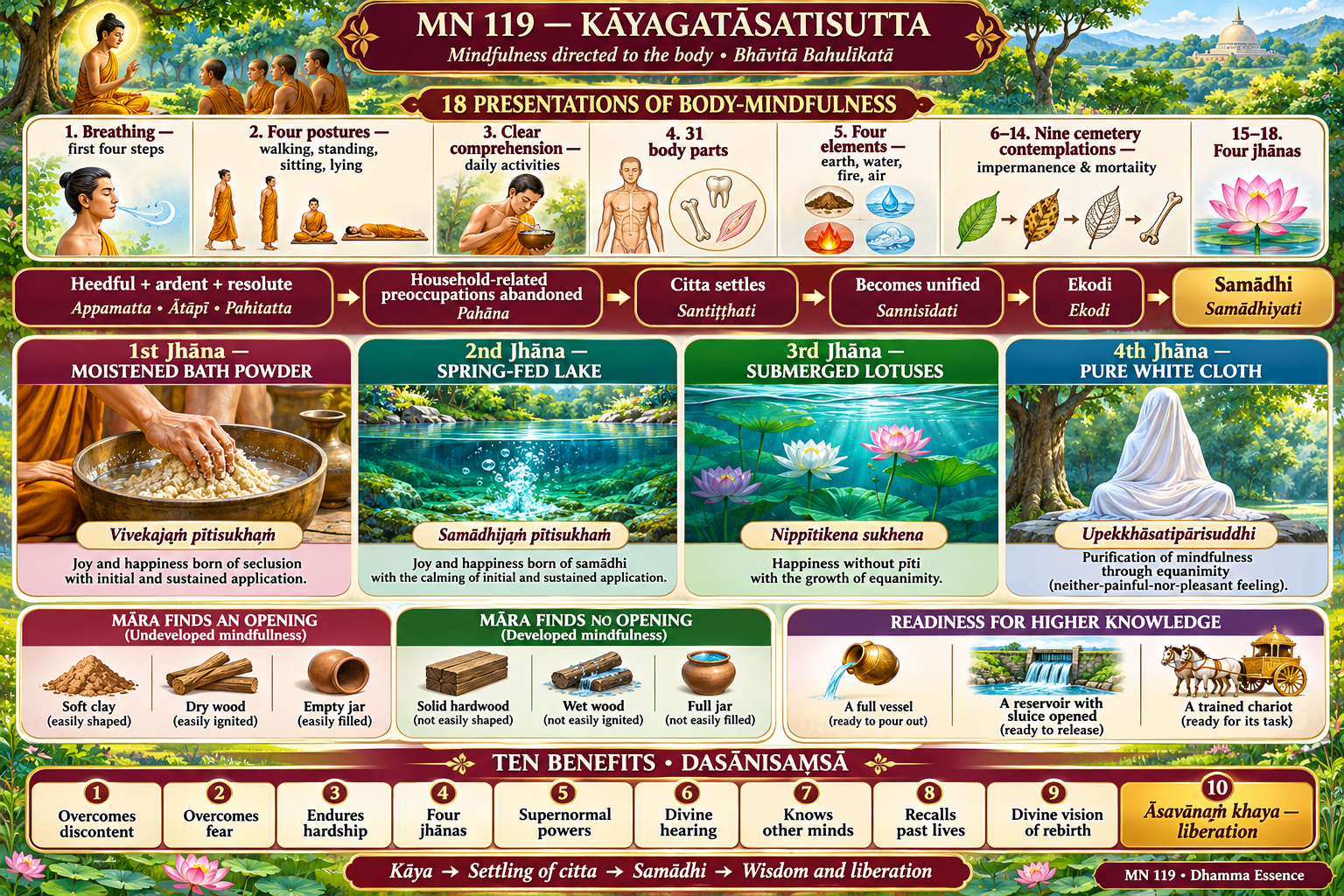
 VISUAL SUMMARYSee this sutta in a pictureOpen the complete infographic for a visual overview before or after reading the full study.View infographic →
From bodily mindfulness to the purification and collection of citta
Kāyagatāsati is not merely registering bodily sensations. In MN 119 the Buddha explains how bodily mindfulness is cultivated through breathing, the four postures, clear comprehension, examination of the body’s constituents and elements, cemetery reflections, and the four jhānas. The repeated refrain links heedful practice and abandonment of household-related preoccupations with the inward settling, unification and collection of citta.
Understanding Kāyagatāsati: Kāya + Gata + Sati
The word kāya must not be taken as an independent, self-existing body. Its central lexical senses include assemblage, collection or group; the ordinary translation “body” is context-dependent. Across the Nikāyas, one also encounters nāmakāya and rūpakāya, the mental and material groupings. The title of MN 119 identifies the field of mindfulness, its directedness, and the faculty of remembering/not forgetting. The discourse then shows how examining the bodily collection supports the abandonment of preoccupations and the refinement of citta.
Assemblage, collection, group; contextually “body.” The word does not, by itself, designate an indivisible entity or a permanent self. It can refer to a material assemblage (rūpakāya) or a mental assemblage (nāmakāya). In MN 119, the instructions concerning breathing, postures, bodily constituents, elements and decay primarily examine the material bodily assemblage, while the recurrent refrain describes their influence on conditioned citta. The broader lexical range must be acknowledged without replacing the passage’s precise object.
Gone to, reached; in compounds, relating to or directed toward. It is the past participle of gacchati (“to go”), from the root √gam. Here it marks where mindfulness has been directed. It does not prescribe physical locomotion, nor say that the body disappears.
Mindfulness, recollection, non-forgetfulness. Connected with Pāli sarati (“remembers”) and Sanskrit smṛti. In cultivation, sati keeps the relevant Dhamma and present field of experience in mind without losing sight of the training; it is not merely an automatic sensory registration.
Kāya is an assemblage: how nāma and rūpa relate
We should not begin from a modern image of a solid, unified “body” and then force that conception back into the Buddha’s use of kāya. In compounds such as viññāṇakāya (a group of consciousnesses) and taṇhākāya (a group of cravings), kāya plainly means a class, collection or assemblage, not a physical torso. In bodily contexts, the material body is likewise a conditioned collection, not a separate owner of experience.
Nāma — mental and relational functions
In SN 12.2, nāma includes vedanā (feeling-tone), saññā (perception), cetanā (volition), phassa (contact), and manasikāra (attention). These are interdependent conditioned processes, not a self or an enduring mental substance.
Rūpa — material constituents
In SN 12.2, rūpa consists of the four great elements and matter derived from them. In MN 119 the body is examined through breathing, movement, constituents, elements and decomposition—precisely so it is no longer misconceived as a stable, independent owner.
MN 119: rūpakāya as the primary field, nāmakāya as the cultivated attainment
Presentations 1–14 — bodily objects and conditions
Breathing and bodily formations; the four postures; movement and ordinary activities; bodily parts; the four great elements; nine cemetery contemplations.
What is directly examined: the conditioned material body (rūpa), its functions, constituents and inevitable change.
Presentations 15–18 — the four jhānas
The successive cultivation of vitakka, vicāra, pīti, sukha, samādhi, upekkhā and purified sati.
What is cultivated: the collected and refined condition of citta, with distinctive mental factors.
This is an editorial analytical grouping of MN 119, cross-read with DN 15 and SN 12.2. The Buddha does not explicitly label presentations 1–14 “rūpakāya” and presentations 15–18 “nāmakāya” in MN 119 itself.
… nāmakāyassa paññatti hoti … rūpakāyassa paññatti hoti …
“… there is designation of the mental assemblage … there is designation of the material assemblage …” These are excerpted phrases from the Buddha’s analysis of conditions for contact and designation, not a quotation of the full DN 15 paragraph.
Vedanā, saññā, cetanā, phasso, manasikāro—idaṁ vuccati nāmaṁ.
“Feeling, perception, volition, contact and attention—this is called nāma.”
Cattāro ca mahābhūtā, catunnañca mahābhūtānaṁ upādāya rūpaṁ—idaṁ vuccati rūpaṁ.
“The four great elements and the material form derived from them—this is called rūpa.”
Do not flatten the contexts. Although the nāma-rūpa framework is essential for seeing conditioned experience as a whole, it does not follow that every occurrence of kāya in MN 119 means the whole of nāma-rūpa. When the Buddha says “from the soles of the feet upward” and enumerates the elements, he is examining the material body; when he explains that household-related thoughts are abandoned and citta settles, he directly teaches the mental consequences of that bodily cultivation. The title and its fruit belong together, without collapsing their categories.
Canonical cross-references: DN 15 · Nāmakāya and rūpakāya · SN 12.2 · Definitions of nāma and rūpa · SN 12.19 · Kāya and external nāma-rūpa. Interpretive cross-comparison is identified here; these passages are not being presented as verbatim statements within MN 119.
A grammatical distinction: kāyagatā sati and kāyagatāsati
In the spaced expression kāyagatā sati, kāyagatā is feminine singular, agreeing with the feminine noun sati: literally, “mindfulness gone to / directed to the body.” The consolidated lexical form kāyagatāsati expresses the same familiar practice. MN 119 itself uses forms such as kāyagatāsatiṁ bhāveti (“develops body-directed mindfulness”) and kāyagatāya … satiyā (“when that body-directed mindfulness has been …”). The vowel and case endings should not be mistaken for new meditative stages.
Evaṁ, bhikkhave, bhikkhu kāyagatāsatiṁ bhāveti.
“In this way, bhikkhus, a bhikkhu develops mindfulness directed to the body.”
Yassa kassaci, bhikkhave, kāyagatāsati bhāvitā bahulīkatā, antogadhāvāssa kusalā dhammā ye keci vijjābhāgiyā.
“For anyone whose body-directed mindfulness has been developed and repeatedly cultivated, all wholesome qualities that contribute to true knowledge are included.”
What the compound does—and does not—say
At first, one knows the embodied collection through breathing, posture and bodily activity. With heedfulness, ardency and resolve, the recurring refrain describes household-related preoccupations being abandoned and citta settling into samādhi. This is not just “watching the body”: the material field of practice supports training in the conditioned mental processes, without positing any permanent owner of either assemblage.
Kāyānupassanā concerns contemplating the body as body, as in the satipaṭṭhāna formula kāye kāyānupassī. The concepts overlap closely, but MN 119 explicitly also describes the four jhānas, Māra similes and the ten benefits. Neither expression alone establishes that observing one bodily spot is a complete liberating path.
Text versus etymological explanation: the translation of MN 119 comes from the canonical Pāli; the word-derivations and grammatical notes are linguistic explanation. The canon itself distinguishes nāmakāya and rūpakāya in DN 15, while SN 12.2 specifies the components of nāma and rūpa. These cross-sutta references illuminate the word kāya as an assemblage; they do not establish that every kāya in MN 119 is synonymous with the full nāma-rūpa complex. The later commentarial explanation that sati has “gone to the body” is a gloss, not another sentence spoken by the Buddha.
Eighteen presentations and their liberating purpose
01 · Ānāpānassati
The first four breath instructions: knowing long and short breathing, experiencing the whole body, calming bodily formation.
02 · Four postures
Walking, standing, sitting and lying down are understood as they occur.
03 · Sampajānakārī
Comprehension in looking, bending, eating, bodily necessities, speaking, sleeping and waking.
04 · Body parts
The 31 constituents in the chosen MN 119 text, along with the bag-of-grain simile.
05 · Four elements
Examining the body according to earth, water, fire and air, as divided at a crossroads.
06–14 · Cemetery reflections
Nine distinct conditions of bodily decomposition and the repeated reflection on one’s own body.
15–18 · Four jhānas
Bath powder, spring-fed lake, submerged lotuses, and clean white cloth: bodily-pervasion similes.
Beyond the eighteen
Ocean simile, six Māra similes, three readiness similes, and ten benefits ending in destruction of the āsavas.
The division identifies the primary field and the developed attainment; it does not make bodily mindfulness a merely physical act or deny the jhānas’ bodily-pervasion similes. Read the detailed explanation.
MN 119 is not a compulsory eighteen-rung checklist. The text presents several ways mindfulness of the body is cultivated, followed by its importance for jhāna, wholesome qualities and higher knowledge.
MN 119 — Pāli with original English, section by section
This reading follows the Mahāsaṅgīti sequence and preserves the distinct Pāli of each teaching. Every passage is paired with English immediately beneath it. Wherever the base edition employs a repetition marker, the expanded standard wording is explicitly identified as editorial; the source is not falsely represented as printing every repeated sentence.
0101 · At Jeta’s Grove: the monks’ question
Evaṁ me sutaṁ—ekaṁ samayaṁ bhagavā sāvatthiyaṁ viharati jetavane anāthapiṇḍikassa ārāme.
Thus have I heard. At one time the Blessed One was dwelling near Sāvatthī, in Jeta’s Grove, in Anāthapiṇḍika’s monastery.
Atha kho sambahulānaṁ bhikkhūnaṁ pacchābhattaṁ piṇḍapātapaṭikkantānaṁ upaṭṭhānasālāyaṁ sannisinnānaṁ sannipatitānaṁ ayamantarākathā udapādi:
Then, after the meal and return from the alms round, a number of bhikkhus were seated together in the assembly hall, and this conversation arose:
“Acchariyaṁ, āvuso, abbhutaṁ, āvuso. Yāvañcidaṁ tena bhagavatā jānatā passatā arahatā sammāsambuddhena kāyagatāsati bhāvitā bahulīkatā mahapphalā vuttā mahānisaṁsā”ti.
“Wonderful, friends, remarkable indeed! The Blessed One—who knows and sees, the Arahant, the Fully Awakened Buddha—has said that mindfulness directed to the body, when developed and repeatedly cultivated, yields great fruit and great benefit.”
Ayañca hidaṁ tesaṁ bhikkhūnaṁ antarākathā vippakatā hoti, atha kho bhagavā sāyanhasamayaṁ paṭisallānā vuṭṭhito yena upaṭṭhānasālā tenupasaṅkami; upasaṅkamitvā paññatte āsane nisīdi.
Their conversation had not been completed when, in the evening, the Blessed One rose from seclusion, went to the assembly hall and sat on the prepared seat.
Nisajja kho bhagavā bhikkhū āmantesi: “Kāya nuttha, bhikkhave, etarahi kathāya sannisinnā, kā ca pana vo antarākathā vippakatā”ti?
Once seated, he asked: “Bhikkhus, what discussion were you having as you sat together? What conversation remained unfinished?”
“Idha, bhante, amhākaṁ pacchābhattaṁ piṇḍapātapaṭikkantānaṁ upaṭṭhānasālāyaṁ sannisinnānaṁ sannipatitānaṁ ayamantarākathā udapādi: ‘acchariyaṁ, āvuso, abbhutaṁ, āvuso. Yāvañcidaṁ tena bhagavatā jānatā passatā arahatā sammāsambuddhena kāyagatāsati bhāvitā bahulīkatā mahapphalā vuttā mahānisaṁsā’ti. Ayaṁ kho no, bhante, antarākathā vippakatā, atha bhagavā anuppatto”ti.
“Venerable sir, following the meal and alms round, we gathered in the hall and were discussing how wonderfully you have declared developed and frequently cultivated mindfulness of the body to bear great fruit and benefit. That was the conversation left unfinished when you arrived.”
“Kathaṁ bhāvitā ca, bhikkhave, kāyagatāsati kathaṁ bahulīkatā mahapphalā hoti mahānisaṁsā?”
“And how, bhikkhus, is mindfulness directed to the body developed and repeatedly cultivated so that it yields great fruit and great benefit?”
0202 · Breathing: the first four steps
Idha, bhikkhave, bhikkhu araññagato vā rukkhamūlagato vā suññāgāragato vā nisīdati pallaṅkaṁ ābhujitvā ujuṁ kāyaṁ paṇidhāya parimukhaṁ satiṁ upaṭṭhapetvā.
Here a bhikkhu, having gone to a forest, the foot of a tree, or an empty dwelling, sits down cross-legged, establishes the body upright, and places mindfulness before him.
Parimukhaṁ satiṁ upaṭṭhapetvā — what is actually prescribed?
The Pāli says to establish mindfulness before oneself. It does not instruct the bhikkhu to close the eyes, nor does it require attention at the entrance of the nostrils or at the upper lip. Closing the eyes or noticing the breath at the nostrils may be chosen as practical aids, but they are not mandatory instructions in this MN 119 sentence. See the grammatical and practical explanation below.
So satova assasati satova passasati.
Mindful, he breathes in; mindful, he breathes out.
Sato on both the in-breath and out-breath
So satova assasati, satova passasati means that sati is maintained while breathing in and while breathing out. The four breathing instructions constitute the first kāyānupassanā tetrad: knowing long and short breaths (pajānāti), then training in experiencing sabbakāya and calming kāyasaṅkhāra (sikkhati).
See the four detailed breathing instructions for assasati and passasati and the emphasized SN 47.42 investigation of the conditions of body, feeling, citta and dhammas.
Dīghaṁ vā assasanto “dīghaṁ assasāmī”ti pajānāti, dīghaṁ vā passasanto “dīghaṁ passasāmī”ti pajānāti.
When the in-breath is long he understands, “I breathe in long”; when the out-breath is long he understands, “I breathe out long.”
Rassaṁ vā assasanto “rassaṁ assasāmī”ti pajānāti, rassaṁ vā passasanto “rassaṁ passasāmī”ti pajānāti.
When the in-breath is short he understands, “I breathe in short”; when the out-breath is short he understands, “I breathe out short.”
“Sabbakāyapaṭisaṁvedī assasissāmī”ti sikkhati, “sabbakāyapaṭisaṁvedī passasissāmī”ti sikkhati.
He trains, “I shall breathe in experiencing the whole body”; and he trains, “I shall breathe out experiencing the whole body.”
“Passambhayaṁ kāyasaṅkhāraṁ assasissāmī”ti sikkhati, “passambhayaṁ kāyasaṅkhāraṁ passasissāmī”ti sikkhati.
He trains, “I shall breathe in calming bodily formation”; and he trains, “I shall breathe out calming bodily formation.”
Sikkhati — by what means does one learn these two trainings?
The Pāli moves from pajānāti (knowing long and short breaths) to sikkhati (training). Sati keeps the breathing field present; sampajañña makes its changes intelligible; manasikāra directs attention; and repeated bhāvanā develops the capacity to experience sabbakāya and calm kāyasaṅkhāra. These functions are a cross-sutta explanation, not a list of four separate “tools” enumerated in this MN 119 sentence.
To learn the method in detail, continue to Sikkhati: the instrument, the training and its practical sequence in the Deep Dive. For the deeper linguistic explanation, also read Paṭisaṁvedī — the grammar of direct experience.
Passambhayaṁ kāyasaṅkhāraṁ — what is being calmed?
The fourth breathing training develops the calming of kāyasaṅkhāra while inhaling and exhaling. MN 44 identifies this bodily formation specifically as the in-and-out breaths. It does not simply mean relaxing muscles, nor does this instruction prescribe breath-holding or forcing the breath to stop. The full Deep Dive examines etymology, cultivation, commentarial interpretations and the distinction between calming and cessation.
Tassa evaṁ appamattassa ātāpino pahitattassa viharato ye gehasitā sarasaṅkappā te pahīyanti. Tesaṁ pahānā ajjhattameva cittaṁ santiṭṭhati sannisīdati ekodi hoti samādhiyati. Evampi, bhikkhave, bhikkhu kāyagatāsatiṁ bhāveti.
For one dwelling thus—heedful, ardent, and resolute—those household-related recollections and intentions are abandoned. With their abandonment, the mind settles inwardly, becomes composed and unified, and enters samādhi. In this way too, a bhikkhu develops mindfulness directed to the body.
0303 · Walking, standing, sitting and lying down
Puna caparaṁ, bhikkhave, bhikkhu gacchanto vā “gacchāmī”ti pajānāti, ṭhito vā “ṭhitomhī”ti pajānāti, nisinno vā “nisinnomhī”ti pajānāti, sayāno vā “sayānomhī”ti pajānāti.
Further, while walking he understands “I am walking”; while standing, “I am standing”; while sitting, “I am sitting”; and while lying down, “I am lying down.”
Yathā yathā vā panassa kāyo paṇihito hoti tathā tathā naṁ pajānāti.
In whatever way the body is positioned, he understands it accordingly.
Tassa evaṁ appamattassa ātāpino pahitattassa viharato ye gehasitā sarasaṅkappā te pahīyanti. Tesaṁ pahānā ajjhattameva cittaṁ santiṭṭhati sannisīdati ekodi hoti samādhiyati. Evampi, bhikkhave, bhikkhu kāyagatāsatiṁ bhāveti.
For one dwelling thus—heedful, ardent, and resolute—those household-related recollections and intentions are abandoned. With their abandonment, the mind settles inwardly, becomes composed and unified, and enters samādhi. In this way too, a bhikkhu develops mindfulness directed to the body.
0404 · Sampajānakārī: clear comprehension throughout activities
Puna caparaṁ, bhikkhave, bhikkhu abhikkante paṭikkante sampajānakārī hoti, ālokite vilokite sampajānakārī hoti, samiñjite pasārite sampajānakārī hoti, saṅghāṭipattacīvaradhāraṇe sampajānakārī hoti, asite pīte khāyite sāyite sampajānakārī hoti, uccārapassāvakamme sampajānakārī hoti, gate ṭhite nisinne sutte jāgarite bhāsite tuṇhībhāve sampajānakārī hoti.
Further, he acts with clear comprehension when moving forward or back, looking ahead or looking around, bending or extending the limbs, carrying outer robe, bowl and robes, eating, drinking, chewing and tasting, relieving himself, walking, standing, sitting, sleeping, waking, speaking and keeping silent.
Tassa evaṁ appamattassa ātāpino pahitattassa viharato ye gehasitā sarasaṅkappā te pahīyanti. Tesaṁ pahānā ajjhattameva cittaṁ santiṭṭhati sannisīdati ekodi hoti samādhiyati. Evampi, bhikkhave, bhikkhu kāyagatāsatiṁ bhāveti.
For one dwelling thus—heedful, ardent, and resolute—those household-related recollections and intentions are abandoned. With their abandonment, the mind settles inwardly, becomes composed and unified, and enters samādhi. In this way too, a bhikkhu develops mindfulness directed to the body.
Go deeper into Sati–Sampajañña
MN 119 describes clear comprehension while walking, looking, eating, speaking and performing everyday activities. The companion study expands this investigation through vedanā, saññā and vitakka—knowing their arising, presence and passing away, rather than merely naming a bodily action.
Read the full Sati–Sampajañña study0505 · Examination of the body’s constituents
Puna caparaṁ, bhikkhave, bhikkhu imameva kāyaṁ uddhaṁ pādatalā adho kesamatthakā tacapariyantaṁ pūraṁ nānappakārassa asucino paccavekkhati:
Furthermore, he examines this same body, from the soles of the feet upward and from the hair tips downward, enclosed by skin and filled with different kinds of impure substances:
“Atthi imasmiṁ kāye kesā lomā nakhā dantā taco maṁsaṁ nhāru aṭṭhi aṭṭhimiñjaṁ vakkaṁ hadayaṁ yakanaṁ kilomakaṁ pihakaṁ papphāsaṁ antaṁ antaguṇaṁ udariyaṁ karīsaṁ pittaṁ semhaṁ pubbo lohitaṁ sedo medo assu vasā kheḷo siṅghāṇikā lasikā muttan”ti.
“In this body are head hair, body hair, nails, teeth, skin, flesh, sinews, bones, bone marrow, kidneys, heart, liver, membranes, spleen, lungs, intestines, mesentery, stomach contents, feces, bile, phlegm, pus, blood, sweat, fat, tears, grease, saliva, nasal mucus, joint fluid and urine.”
Seyyathāpi, bhikkhave, ubhatomukhā putoḷi pūrā nānāvihitassa dhaññassa, seyyathidaṁ—sālīnaṁ vīhīnaṁ muggānaṁ māsānaṁ tilānaṁ taṇḍulānaṁ, tamenaṁ cakkhumā puriso muñcitvā paccavekkheyya: “Ime sālī ime vīhī ime muggā ime māsā ime tilā ime taṇḍulā”ti;
It is like a bag with openings at both ends, filled with various grains—different types of rice, mung beans, beans and sesame. A person with good eyesight opens it and recognizes each kind distinctly.
Evameva kho, bhikkhave, bhikkhu imameva kāyaṁ uddhaṁ pādatalā adho kesamatthakā tacapariyantaṁ pūraṁ nānappakārassa asucino paccavekkhati: “Atthi imasmiṁ kāye kesā lomā nakhā dantā taco maṁsaṁ nhāru aṭṭhi aṭṭhimiñjaṁ vakkaṁ hadayaṁ yakanaṁ kilomakaṁ pihakaṁ papphāsaṁ antaṁ antaguṇaṁ udariyaṁ karīsaṁ pittaṁ semhaṁ pubbo lohitaṁ sedo medo assu vasā kheḷo siṅghāṇikā lasikā muttan”ti.
Similarly, he looks again at this very body, enclosed in skin and filled with these various constituents, and distinguishes them rather than treating the whole as an attractive, permanent possession.
Tassa evaṁ appamattassa ātāpino pahitattassa viharato ye gehasitā sarasaṅkappā te pahīyanti. Tesaṁ pahānā ajjhattameva cittaṁ santiṭṭhati sannisīdati ekodi hoti samādhiyati. Evampi, bhikkhave, bhikkhu kāyagatāsatiṁ bhāveti.
For one dwelling thus—heedful, ardent, and resolute—those household-related recollections and intentions are abandoned. With their abandonment, the mind settles inwardly, becomes composed and unified, and enters samādhi. In this way too, a bhikkhu develops mindfulness directed to the body.
0606 · Examination by four great elements
Puna caparaṁ, bhikkhave, bhikkhu imameva kāyaṁ yathāṭhitaṁ yathāpaṇihitaṁ dhātuso paccavekkhati: “Atthi imasmiṁ kāye pathavīdhātu āpodhātu tejodhātu vāyodhātū”ti.
Furthermore, in whatever position the body is placed, he examines it according to its elements: “In this body are the earth element, water element, fire element, and air element.”
Seyyathāpi, bhikkhave, dakkho goghātako vā goghātakantevāsī vā gāviṁ vadhitvā catumahāpathe bilaso vibhajitvā nisinno assa;
It is as though a skilled butcher or the butcher’s apprentice, having slaughtered a cow, sat at a crossroads after dividing it into portions.
Evameva kho, bhikkhave, bhikkhu imameva kāyaṁ yathāṭhitaṁ yathāpaṇihitaṁ dhātuso paccavekkhati: “Atthi imasmiṁ kāye pathavīdhātu āpodhātu tejodhātu vāyodhātū”ti.
Similarly, he examines this very body by its constituents rather than conceiving a single undivided entity: earth, water, fire and air elements.
Tassa evaṁ appamattassa ātāpino pahitattassa viharato ye gehasitā sarasaṅkappā te pahīyanti. Tesaṁ pahānā ajjhattameva cittaṁ santiṭṭhati sannisīdati ekodi hoti samādhiyati. Evampi, bhikkhave, bhikkhu kāyagatāsatiṁ bhāveti.
For one dwelling thus—heedful, ardent, and resolute—those household-related recollections and intentions are abandoned. With their abandonment, the mind settles inwardly, becomes composed and unified, and enters samādhi. In this way too, a bhikkhu develops mindfulness directed to the body.
0707 · First cemetery contemplation: newly deceased
Textual notice. The source uses …pe… for some recurring comparisons and refrains. They are expanded here editorially with a note, without altering the distinct corpse description.
Puna caparaṁ, bhikkhave, bhikkhu seyyathāpi passeyya sarīraṁ sivathikāya chaḍḍitaṁ ekāhamataṁ vā dvīhamataṁ vā tīhamataṁ vā uddhumātakaṁ vinīlakaṁ vipubbakajātaṁ.
Further, suppose he saw a corpse discarded in a charnel ground, one, two, or three days dead, bloated, discoloured, and festering.
So imameva kāyaṁ upasaṁharati: “Ayampi kho kāyo evaṁdhammo evaṁbhāvī evaṁanatīto”ti.
He brings this observation to bear on this very body: “This body too is of the same nature, will come to such a condition, and cannot escape it.”
Tassa evaṁ appamattassa ātāpino pahitattassa viharato ye gehasitā sarasaṅkappā te pahīyanti. Tesaṁ pahānā ajjhattameva cittaṁ santiṭṭhati sannisīdati ekodi hoti samādhiyati. Evampi, bhikkhave, bhikkhu kāyagatāsatiṁ bhāveti.
For one dwelling thus—heedful, ardent, and resolute—those household-related recollections and intentions are abandoned. With their abandonment, the mind settles inwardly, becomes composed and unified, and enters samādhi. In this way too, a bhikkhu develops mindfulness directed to the body.
0808 · Second cemetery contemplation: creatures consuming the body
Textual notice. The source uses …pe… for some recurring comparisons and refrains. They are expanded here editorially with a note, without altering the distinct corpse description.
Puna caparaṁ, bhikkhave, bhikkhu seyyathāpi passeyya sarīraṁ sivathikāya chaḍḍitaṁ kākehi vā khajjamānaṁ kulalehi vā khajjamānaṁ gijjhehi vā khajjamānaṁ kaṅkehi vā khajjamānaṁ sunakhehi vā khajjamānaṁ byagghehi vā khajjamānaṁ dīpīhi vā khajjamānaṁ siṅgālehi vā khajjamānaṁ vividhehi vā pāṇakajātehi khajjamānaṁ.
Or suppose he saw a corpse left in a charnel ground being eaten by crows, birds of prey, vultures, herons, dogs, tigers, leopards, jackals or various small living creatures.
So imameva kāyaṁ upasaṁharati: “Ayampi kho kāyo evaṁdhammo evaṁbhāvī evaṁanatīto”ti.
He brings this observation to bear on this very body: “This body too is of the same nature, will come to such a condition, and cannot escape it.”
Tassa evaṁ appamattassa ātāpino pahitattassa viharato ye gehasitā sarasaṅkappā te pahīyanti. Tesaṁ pahānā ajjhattameva cittaṁ santiṭṭhati sannisīdati ekodi hoti samādhiyati. Evampi, bhikkhave, bhikkhu kāyagatāsatiṁ bhāveti.
For one dwelling thus—heedful, ardent, and resolute—those household-related recollections and intentions are abandoned. With their abandonment, the mind settles inwardly, becomes composed and unified, and enters samādhi. In this way too, a bhikkhu develops mindfulness directed to the body.
0909 · Third cemetery contemplation: skeleton with flesh and blood
Textual notice. The source uses …pe… for some recurring comparisons and refrains. They are expanded here editorially with a note, without altering the distinct corpse description.
Puna caparaṁ, bhikkhave, bhikkhu seyyathāpi passeyya sarīraṁ sivathikāya chaḍḍitaṁ aṭṭhikasaṅkhalikaṁ samaṁsalohitaṁ nhārusambandhaṁ.
Or suppose he saw a skeleton still bearing flesh and blood, held together by sinews.
So imameva kāyaṁ upasaṁharati: “Ayampi kho kāyo evaṁdhammo evaṁbhāvī evaṁanatīto”ti.
He brings this observation to bear on this very body: “This body too is of the same nature, will come to such a condition, and cannot escape it.”
Tassa evaṁ appamattassa ātāpino pahitattassa viharato ye gehasitā sarasaṅkappā te pahīyanti. Tesaṁ pahānā ajjhattameva cittaṁ santiṭṭhati sannisīdati ekodi hoti samādhiyati. Evampi, bhikkhave, bhikkhu kāyagatāsatiṁ bhāveti.
For one dwelling thus—heedful, ardent, and resolute—those household-related recollections and intentions are abandoned. With their abandonment, the mind settles inwardly, becomes composed and unified, and enters samādhi. In this way too, a bhikkhu develops mindfulness directed to the body.
1010 · Fourth cemetery contemplation: blood-stained skeleton
Textual notice. The source uses …pe… for some recurring comparisons and refrains. They are expanded here editorially with a note, without altering the distinct corpse description.
Puna caparaṁ, bhikkhave, bhikkhu seyyathāpi passeyya sarīraṁ sivathikāya chaḍḍitaṁ aṭṭhikasaṅkhalikaṁ nimmaṁsalohitamakkhitaṁ nhārusambandhaṁ.
Or he saw a skeleton without flesh, smeared with blood, still connected by sinews.
So imameva kāyaṁ upasaṁharati: “Ayampi kho kāyo evaṁdhammo evaṁbhāvī evaṁanatīto”ti.
He brings this observation to bear on this very body: “This body too is of the same nature, will come to such a condition, and cannot escape it.”
Tassa evaṁ appamattassa ātāpino pahitattassa viharato ye gehasitā sarasaṅkappā te pahīyanti. Tesaṁ pahānā ajjhattameva cittaṁ santiṭṭhati sannisīdati ekodi hoti samādhiyati. Evampi, bhikkhave, bhikkhu kāyagatāsatiṁ bhāveti.
For one dwelling thus—heedful, ardent, and resolute—those household-related recollections and intentions are abandoned. With their abandonment, the mind settles inwardly, becomes composed and unified, and enters samādhi. In this way too, a bhikkhu develops mindfulness directed to the body.
1111 · Fifth cemetery contemplation: bare skeleton joined by sinews
Textual notice. The source uses …pe… for some recurring comparisons and refrains. They are expanded here editorially with a note, without altering the distinct corpse description.
Puna caparaṁ, bhikkhave, bhikkhu seyyathāpi passeyya sarīraṁ sivathikāya chaḍḍitaṁ aṭṭhikasaṅkhalikaṁ apagatamaṁsalohitaṁ nhārusambandhaṁ.
Or he saw a skeleton from which flesh and blood were gone but the bones remained joined by tendons.
So imameva kāyaṁ upasaṁharati: “Ayampi kho kāyo evaṁdhammo evaṁbhāvī evaṁanatīto”ti.
He brings this observation to bear on this very body: “This body too is of the same nature, will come to such a condition, and cannot escape it.”
Tassa evaṁ appamattassa ātāpino pahitattassa viharato ye gehasitā sarasaṅkappā te pahīyanti. Tesaṁ pahānā ajjhattameva cittaṁ santiṭṭhati sannisīdati ekodi hoti samādhiyati. Evampi, bhikkhave, bhikkhu kāyagatāsatiṁ bhāveti.
For one dwelling thus—heedful, ardent, and resolute—those household-related recollections and intentions are abandoned. With their abandonment, the mind settles inwardly, becomes composed and unified, and enters samādhi. In this way too, a bhikkhu develops mindfulness directed to the body.
1212 · Sixth cemetery contemplation: scattered bones
Textual notice. The source uses …pe… for some recurring comparisons and refrains. They are expanded here editorially with a note, without altering the distinct corpse description.
Puna caparaṁ, bhikkhave, bhikkhu seyyathāpi passeyya sarīraṁ sivathikāya chaḍḍitaṁ aṭṭhikāni apagatasambandhāni disāvidisāvikkhittāni aññena hatthaṭṭhikaṁ aññena pādaṭṭhikaṁ aññena gopphakaṭṭhikaṁ aññena jaṅghaṭṭhikaṁ aññena ūruṭṭhikaṁ aññena kaṭiṭṭhikaṁ aññena phāsukaṭṭhikaṁ aññena piṭṭhiṭṭhikaṁ aññena khandhaṭṭhikaṁ aññena gīvaṭṭhikaṁ aññena hanukaṭṭhikaṁ aññena dantaṭṭhikaṁ aññena sīsakaṭāhaṁ.
Or he saw bones separated from their connections and scattered in every direction: here a hand bone, there a foot bone, an ankle, lower leg, thigh, hip, rib, back, shoulder, neck, jaw, tooth or skull bone.
So imameva kāyaṁ upasaṁharati: “Ayampi kho kāyo evaṁdhammo evaṁbhāvī evaṁanatīto”ti.
He brings this observation to bear on this very body: “This body too is of the same nature, will come to such a condition, and cannot escape it.”
Tassa evaṁ appamattassa ātāpino pahitattassa viharato ye gehasitā sarasaṅkappā te pahīyanti. Tesaṁ pahānā ajjhattameva cittaṁ santiṭṭhati sannisīdati ekodi hoti samādhiyati. Evampi, bhikkhave, bhikkhu kāyagatāsatiṁ bhāveti.
For one dwelling thus—heedful, ardent, and resolute—those household-related recollections and intentions are abandoned. With their abandonment, the mind settles inwardly, becomes composed and unified, and enters samādhi. In this way too, a bhikkhu develops mindfulness directed to the body.
1313 · Seventh cemetery contemplation: whitened bones
Textual notice. The source uses …pe… for some recurring comparisons and refrains. They are expanded here editorially with a note, without altering the distinct corpse description.
Puna caparaṁ, bhikkhave, bhikkhu seyyathāpi passeyya sarīraṁ sivathikāya chaḍḍitaṁ aṭṭhikāni setāni saṅkhavaṇṇapaṭibhāgāni.
Or he saw whitened bones resembling the colour of seashells.
So imameva kāyaṁ upasaṁharati: “Ayampi kho kāyo evaṁdhammo evaṁbhāvī evaṁanatīto”ti.
He brings this observation to bear on this very body: “This body too is of the same nature, will come to such a condition, and cannot escape it.”
Tassa evaṁ appamattassa ātāpino pahitattassa viharato ye gehasitā sarasaṅkappā te pahīyanti. Tesaṁ pahānā ajjhattameva cittaṁ santiṭṭhati sannisīdati ekodi hoti samādhiyati. Evampi, bhikkhave, bhikkhu kāyagatāsatiṁ bhāveti.
For one dwelling thus—heedful, ardent, and resolute—those household-related recollections and intentions are abandoned. With their abandonment, the mind settles inwardly, becomes composed and unified, and enters samādhi. In this way too, a bhikkhu develops mindfulness directed to the body.
1414 · Eighth cemetery contemplation: old heaped bones
Textual notice. The source uses …pe… for some recurring comparisons and refrains. They are expanded here editorially with a note, without altering the distinct corpse description.
Puna caparaṁ, bhikkhave, bhikkhu seyyathāpi passeyya sarīraṁ sivathikāya chaḍḍitaṁ aṭṭhikāni puñjakitāni terovassikāni.
Or he saw bones more than a year old, gathered into a heap.
So imameva kāyaṁ upasaṁharati: “Ayampi kho kāyo evaṁdhammo evaṁbhāvī evaṁanatīto”ti.
He brings this observation to bear on this very body: “This body too is of the same nature, will come to such a condition, and cannot escape it.”
Tassa evaṁ appamattassa ātāpino pahitattassa viharato ye gehasitā sarasaṅkappā te pahīyanti. Tesaṁ pahānā ajjhattameva cittaṁ santiṭṭhati sannisīdati ekodi hoti samādhiyati. Evampi, bhikkhave, bhikkhu kāyagatāsatiṁ bhāveti.
For one dwelling thus—heedful, ardent, and resolute—those household-related recollections and intentions are abandoned. With their abandonment, the mind settles inwardly, becomes composed and unified, and enters samādhi. In this way too, a bhikkhu develops mindfulness directed to the body.
1515 · Ninth cemetery contemplation: bones reduced to powder
Textual notice. The source uses …pe… for some recurring comparisons and refrains. They are expanded here editorially with a note, without altering the distinct corpse description.
Puna caparaṁ, bhikkhave, bhikkhu seyyathāpi passeyya sarīraṁ sivathikāya chaḍḍitaṁ aṭṭhikāni pūtīni cuṇṇakajātāni.
Or he saw bones decayed and crumbled into powder.
So imameva kāyaṁ upasaṁharati: “Ayampi kho kāyo evaṁdhammo evaṁbhāvī evaṁanatīto”ti.
He brings this observation to bear on this very body: “This body too is of the same nature, will come to such a condition, and cannot escape it.”
Tassa evaṁ appamattassa ātāpino pahitattassa viharato ye gehasitā sarasaṅkappā te pahīyanti. Tesaṁ pahānā ajjhattameva cittaṁ santiṭṭhati sannisīdati ekodi hoti samādhiyati. Evampi, bhikkhave, bhikkhu kāyagatāsatiṁ bhāveti.
For one dwelling thus—heedful, ardent, and resolute—those household-related recollections and intentions are abandoned. With their abandonment, the mind settles inwardly, becomes composed and unified, and enters samādhi. In this way too, a bhikkhu develops mindfulness directed to the body.
1616 · First jhāna: bath powder permeated by water
Puna caparaṁ, bhikkhave, bhikkhu vivicceva kāmehi vivicca akusalehi dhammehi savitakkaṁ savicāraṁ vivekajaṁ pītisukhaṁ paṭhamaṁ jhānaṁ upasampajja viharati.
Moreover, withdrawn from sensual pleasures and unwholesome qualities, he enters and dwells in the first jhāna, accompanied by vitakka and vicāra, with pīti and sukha born of seclusion.
So imameva kāyaṁ vivekajena pītisukhena abhisandeti parisandeti paripūreti parippharati, nāssa kiñci sabbāvato kāyassa vivekajena pītisukhena apphuṭaṁ hoti.
He soaks, fills and pervades this very body with the joy and happiness born of seclusion; no part of his whole body remains untouched by them.
Seyyathāpi, bhikkhave, dakkho nhāpako vā nhāpakantevāsī vā kaṁsathāle nhānīyacuṇṇāni ākiritvā udakena paripphosakaṁ paripphosakaṁ sanneyya, sāyaṁ nhānīyapiṇḍi snehānugatā snehaparetā santarabāhirā phuṭā snehena na ca pagghariṇī;
Imagine a skillful bath attendant, or the attendant’s apprentice, sprinkling water little by little over bathing powder in a metal bowl and kneading it into a ball whose interior and exterior are thoroughly moist, yet which does not drip.
Evameva kho, bhikkhave, bhikkhu imameva kāyaṁ vivekajena pītisukhena abhisandeti parisandeti paripūreti parippharati; nāssa kiñci sabbāvato kāyassa vivekajena pītisukhena apphuṭaṁ hoti.
Likewise he saturates this whole body with joy and happiness born of seclusion; no part is left unpervaded.
Tassa evaṁ appamattassa ātāpino pahitattassa viharato ye gehasitā sarasaṅkappā te pahīyanti. Tesaṁ pahānā ajjhattameva cittaṁ santiṭṭhati sannisīdati ekodi hoti samādhiyati. Evampi, bhikkhave, bhikkhu kāyagatāsatiṁ bhāveti.
For one dwelling thus—heedful, ardent, and resolute—those household-related recollections and intentions are abandoned. With their abandonment, the mind settles inwardly, becomes composed and unified, and enters samādhi. In this way too, a bhikkhu develops mindfulness directed to the body.
1717 · Second jhāna: the spring-fed lake
Puna caparaṁ, bhikkhave, bhikkhu vitakkavicārānaṁ vūpasamā ajjhattaṁ sampasādanaṁ cetaso ekodibhāvaṁ avitakkaṁ avicāraṁ samādhijaṁ pītisukhaṁ dutiyaṁ jhānaṁ upasampajja viharati.
With vitakka and vicāra stilled, he enters and dwells in the second jhāna, inwardly clarified, mind unified, without vitakka or vicāra, with joy and happiness born of samādhi.
So imameva kāyaṁ samādhijena pītisukhena abhisandeti parisandeti paripūreti parippharati; nāssa kiñci sabbāvato kāyassa samādhijena pītisukhena apphuṭaṁ hoti.
He fills and pervades this entire body with joy and happiness born of samādhi so that no part of it remains untouched.
Seyyathāpi, bhikkhave, udakarahado gambhīro ubbhidodako. Tassa nevassa puratthimāya disāya udakassa āyamukhaṁ na pacchimāya disāya udakassa āyamukhaṁ na uttarāya disāya udakassa āyamukhaṁ na dakkhiṇāya disāya udakassa āyamukhaṁ; devo ca na kālena kālaṁ sammā dhāraṁ anuppaveccheyya; atha kho tamhāva udakarahadā sītā vāridhārā ubbhijjitvā tameva udakarahadaṁ sītena vārinā abhisandeyya parisandeyya paripūreyya paripphareyya, nāssa kiñci sabbāvato udakarahadassa sītena vārinā apphuṭaṁ assa;
Suppose a deep lake were fed from springs within, with no inflows from east, west, north or south, and no seasonal showers filling it. Cool water welling up from within the lake would saturate its whole extent; no part would remain unfilled by cool water.
Evameva kho, bhikkhave, bhikkhu imameva kāyaṁ samādhijena pītisukhena abhisandeti parisandeti paripūreti parippharati, nāssa kiñci sabbāvato kāyassa samādhijena pītisukhena apphuṭaṁ hoti.
Similarly, the body is entirely pervaded by the joy and happiness born of samādhi.
Tassa evaṁ appamattassa ātāpino pahitattassa viharato ye gehasitā sarasaṅkappā te pahīyanti. Tesaṁ pahānā ajjhattameva cittaṁ santiṭṭhati sannisīdati ekodi hoti samādhiyati. Evampi, bhikkhave, bhikkhu kāyagatāsatiṁ bhāveti.
For one dwelling thus—heedful, ardent, and resolute—those household-related recollections and intentions are abandoned. With their abandonment, the mind settles inwardly, becomes composed and unified, and enters samādhi. In this way too, a bhikkhu develops mindfulness directed to the body.
1818 · Third jhāna: lotuses submerged in cool water
Puna caparaṁ, bhikkhave, bhikkhu pītiyā ca virāgā upekkhako ca viharati sato ca sampajāno, sukhañca kāyena paṭisaṁvedeti, yaṁ taṁ ariyā ācikkhanti: “upekkhako satimā sukhavihārī”ti, tatiyaṁ jhānaṁ upasampajja viharati.
With pīti fading away, he dwells equanimous, mindful and clearly comprehending, experiencing bodily sukha. He enters the third jhāna, described by the noble ones as dwelling happily with equanimity and mindfulness.
So imameva kāyaṁ nippītikena sukhena abhisandeti parisandeti paripūreti parippharati, nāssa kiñci sabbāvato kāyassa nippītikena sukhena apphuṭaṁ hoti.
He pervades the whole body with happiness apart from pīti; nothing in the body remains unpervaded.
Seyyathāpi, bhikkhave, uppaliniyaṁ vā paduminiyaṁ vā puṇḍarīkiniyaṁ vā appekaccāni uppalāni vā padumāni vā puṇḍarīkāni vā udake jātāni udake saṁvaḍḍhāni udakānuggatāni antonimuggaposīni, tāni yāva caggā yāva ca mūlā sītena vārinā abhisannāni parisannāni paripūrāni paripphuṭāni, nāssa kiñci sabbāvataṁ uppalānaṁ vā padumānaṁ vā puṇḍarīkānaṁ vā sītena vārinā apphuṭaṁ assa;
Suppose blue, red or white lotuses grew beneath the surface of a pond, entirely immersed and nourished underwater from roots to tips, with no part untouched by the cool water.
Evameva kho, bhikkhave, bhikkhu imameva kāyaṁ nippītikena sukhena abhisandeti parisandeti paripūreti parippharati, nāssa kiñci sabbāvato kāyassa nippītikena sukhena apphuṭaṁ hoti.
So too the practitioner completely pervades the body with happiness free from pīti.
Tassa evaṁ appamattassa ātāpino pahitattassa viharato ye gehasitā sarasaṅkappā te pahīyanti. Tesaṁ pahānā ajjhattameva cittaṁ santiṭṭhati sannisīdati ekodi hoti samādhiyati. Evampi, bhikkhave, bhikkhu kāyagatāsatiṁ bhāveti.
For one dwelling thus—heedful, ardent, and resolute—those household-related recollections and intentions are abandoned. With their abandonment, the mind settles inwardly, becomes composed and unified, and enters samādhi. In this way too, a bhikkhu develops mindfulness directed to the body.
1919 · Fourth jhāna: the clean white cloth
Puna caparaṁ, bhikkhave, bhikkhu sukhassa ca pahānā dukkhassa ca pahānā pubbeva somanassadomanassānaṁ atthaṅgamā adukkhamasukhaṁ upekkhāsatipārisuddhiṁ catutthaṁ jhānaṁ upasampajja viharati.
Having abandoned pleasure and pain, with joy and sorrow already gone, he enters and dwells in the fourth jhāna, neither painful nor pleasant, with mindfulness purified by equanimity.
So imameva kāyaṁ parisuddhena cetasā pariyodātena pharitvā nisinno hoti; nāssa kiñci sabbāvato kāyassa parisuddhena cetasā pariyodātena apphuṭaṁ hoti.
He sits pervading this entire body with a mind that is purified and brightened, leaving no portion untouched by that purity.
Seyyathāpi, bhikkhave, puriso odātena vatthena sasīsaṁ pārupitvā nisinno assa, nāssa kiñci sabbāvato kāyassa odātena vatthena apphuṭaṁ assa;
It is like a person sitting wrapped from head to foot in a clean white cloth, with no part of the body uncovered.
Evameva kho, bhikkhave, bhikkhu imameva kāyaṁ parisuddhena cetasā pariyodātena pharitvā nisinno hoti, nāssa kiñci sabbāvato kāyassa parisuddhena cetasā pariyodātena apphuṭaṁ hoti.
In the same way the practitioner sits with the entire body pervaded by pure, bright mind.
Tassa evaṁ appamattassa ātāpino pahitattassa viharato ye gehasitā sarasaṅkappā te pahīyanti. Tesaṁ pahānā ajjhattameva cittaṁ santiṭṭhati sannisīdati ekodi hoti samādhiyati. Evampi, bhikkhave, bhikkhu kāyagatāsatiṁ bhāveti.
For one dwelling thus—heedful, ardent, and resolute—those household-related recollections and intentions are abandoned. With their abandonment, the mind settles inwardly, becomes composed and unified, and enters samādhi. In this way too, a bhikkhu develops mindfulness directed to the body.
2020 · The great ocean: wholesome qualities oriented to knowledge
Yassa kassaci, bhikkhave, kāyagatāsati bhāvitā bahulīkatā, antogadhāvāssa kusalā dhammā ye keci vijjābhāgiyā.
For anyone whose mindfulness of the body has been developed and repeatedly cultivated, whatever wholesome qualities conduce to true knowledge are included within it.
Seyyathāpi, bhikkhave, yassa kassaci mahāsamuddo cetasā phuṭo, antogadhāvāssa kunnadiyo yā kāci samuddaṅgamā; evameva kho, bhikkhave, yassa kassaci kāyagatāsati bhāvitā bahulīkatā, antogadhāvāssa kusalā dhammā ye keci vijjābhāgiyā.
Just as, when one encompasses the great ocean in mind, all the little rivers that run into it are included, so developed mindfulness of the body embraces wholesome qualities that partake of true knowledge.
2121 · Māra’s opening: stone in wet clay
Yassa kassaci, bhikkhave, kāyagatāsati abhāvitā abahulīkatā, labhati tassa māro otāraṁ, labhati tassa māro ārammaṇaṁ. Seyyathāpi, bhikkhave, puriso garukaṁ silāguḷaṁ allamattikāpuñje pakkhipeyya. Taṁ kiṁ maññatha, bhikkhave, api nu taṁ garukaṁ silāguḷaṁ allamattikāpuñje labhetha otāran”ti? “Evaṁ, bhante”. “Evameva kho, bhikkhave, yassa kassaci kāyagatāsati abhāvitā abahulīkatā, labhati tassa māro otāraṁ, labhati tassa māro ārammaṇaṁ.
When bodily mindfulness is undeveloped, Māra finds an opening and support. Imagine someone throwing a heavy stone ball at soft wet clay. Would the stone sink into it? “Yes, venerable sir.” In the same way Māra finds an opening in undeveloped mindfulness.
2222 · Māra’s opening: dry wood catches fire
Seyyathāpi, bhikkhave, sukkhaṁ kaṭṭhaṁ koḷāpaṁ; atha puriso āgaccheyya uttarāraṇiṁ ādāya: “aggiṁ abhinibbattessāmi, tejo pātukarissāmī”ti. Taṁ kiṁ maññatha, bhikkhave, api nu so puriso amuṁ sukkhaṁ kaṭṭhaṁ koḷāpaṁ uttarāraṇiṁ ādāya abhimanthento aggiṁ abhinibbatteyya, tejo pātukareyyā”ti? “Evaṁ, bhante”. Yassa kassaci, bhikkhave, kāyagatāsati abhāvitā abahulīkatā, labhati tassa māro otāraṁ, labhati tassa māro ārammaṇaṁ.
A dry dead piece of wood can be ignited by friction. The bhikkhus agree. The Buddha likens this to the opening available to Māra where body-directed mindfulness has not been developed.
2323 · Māra’s opening: an empty vessel
Seyyathāpi, bhikkhave, udakamaṇiko ritto tuccho ādhāre ṭhapito; atha puriso āgaccheyya udakabhāraṁ ādāya. Taṁ kiṁ maññatha, bhikkhave, api nu so puriso labhetha udakassa nikkhepanan”ti? “Evaṁ, bhante”. Yassa kassaci, bhikkhave, kāyagatāsati abhāvitā abahulīkatā, labhati tassa māro otāraṁ, labhati tassa māro ārammaṇaṁ.
An empty water vessel placed on a stand can receive more water. Likewise the undeveloped state affords Māra an opening.
2424 · Māra finds no opening: thread ball and solid heartwood
Yassa kassaci, bhikkhave, kāyagatāsati bhāvitā bahulīkatā, na tassa labhati māro otāraṁ, na tassa labhati māro ārammaṇaṁ. Seyyathāpi, bhikkhave, puriso lahukaṁ suttaguḷaṁ sabbasāramaye aggaḷaphalake pakkhipeyya. Taṁ kiṁ maññatha, bhikkhave, api nu so puriso taṁ lahukaṁ suttaguḷaṁ sabbasāramaye aggaḷaphalake labhetha otāran”ti? “No hetaṁ, bhante”. Yassa kassaci, bhikkhave, kāyagatāsati bhāvitā bahulīkatā, na tassa labhati māro otāraṁ, na tassa labhati māro ārammaṇaṁ.
When bodily mindfulness has been developed and cultivated repeatedly, Māra gains no opening. A light ball of thread thrown against a solid wooden crossbar cannot penetrate it. “Certainly not,” the bhikkhus answer.
2525 · Māra finds no opening: green wet wood
Seyyathāpi, bhikkhave, allaṁ kaṭṭhaṁ sasnehaṁ; atha puriso āgaccheyya uttarāraṇiṁ ādāya: “aggiṁ abhinibbattessāmi, tejo pātukarissāmī”ti. Taṁ kiṁ maññatha, bhikkhave, api nu so puriso amuṁ allaṁ kaṭṭhaṁ sasnehaṁ uttarāraṇiṁ ādāya abhimanthento aggiṁ abhinibbatteyya, tejo pātukareyyā”ti? “No hetaṁ, bhante”. Yassa kassaci, bhikkhave, kāyagatāsati bhāvitā bahulīkatā, na tassa labhati māro otāraṁ, na tassa labhati māro ārammaṇaṁ.
A moist, sappy piece of wood cannot readily be ignited through the attempted friction. So Māra finds no opening in developed and repeatedly cultivated bodily mindfulness.
2626 · Māra finds no opening: brim-full vessel
Seyyathāpi, bhikkhave, udakamaṇiko pūro udakassa samatittiko kākapeyyo ādhāre ṭhapito; atha puriso āgaccheyya udakabhāraṁ ādāya. Taṁ kiṁ maññatha, bhikkhave, api nu so puriso labhetha udakassa nikkhepanan”ti? “No hetaṁ, bhante”. Yassa kassaci, bhikkhave, kāyagatāsati bhāvitā bahulīkatā, na tassa labhati māro otāraṁ, na tassa labhati māro ārammaṇaṁ.
A vessel filled to the brim, so that a crow could drink from it, cannot receive more poured water. So Māra finds no opening when bodily mindfulness has been thoroughly developed.
2727 · Readiness for knowledge: a vessel of water
Yassa kassaci, bhikkhave, kāyagatāsati bhāvitā bahulīkatā, so yassa yassa abhiññāsacchikaraṇīyassa dhammassa cittaṁ abhininnāmeti abhiññāsacchikiriyāya, tatra tatreva sakkhibhabbataṁ pāpuṇāti sati satiāyatane.
One who has developed and frequently cultivated bodily mindfulness can turn the mind toward direct realization of what may be realized by higher knowledge, becoming capable of realization when the necessary basis is present.
Seyyathāpi, bhikkhave, udakamaṇiko pūro udakassa samatittiko kākapeyyo ādhāre ṭhapito. Tamenaṁ balavā puriso yato yato āviñcheyya, āgaccheyya udakan”ti? “Evaṁ, bhante”.
A water vessel is filled to the very brim. If a strong person tips it to any side, does water flow out? “Yes, venerable sir.”
Yassa kassaci, bhikkhave, kāyagatāsati bhāvitā bahulīkatā, so yassa yassa abhiññāsacchikaraṇīyassa dhammassa cittaṁ abhininnāmeti abhiññāsacchikiriyāya, tatra tatreva sakkhibhabbataṁ pāpuṇāti sati satiāyatane.
Similarly, mature bodily mindfulness renders the mind capable of higher realization, provided the relevant conditions exist.
2828 · Readiness for knowledge: the square reservoir
Seyyathāpi, bhikkhave, same bhūmibhāge caturassā pokkharaṇī assa āḷibandhā pūrā udakassa samatittikā kākapeyyā. Tamenaṁ balavā puriso yato yato āḷiṁ muñceyya āgaccheyya udakan”ti? “Evaṁ, bhante”.
Imagine a square reservoir on level ground, surrounded by embankments and completely full. If a strong person opens any embankment, does water flow out? “Yes, venerable sir.”
Yassa kassaci, bhikkhave, kāyagatāsati bhāvitā bahulīkatā, so yassa yassa abhiññāsacchikaraṇīyassa dhammassa cittaṁ abhininnāmeti abhiññāsacchikiriyāya, tatra tatreva sakkhibhabbataṁ pāpuṇāti sati satiāyatane.
Similarly the capacity of a developed mind can be directed toward what is available to be realized by higher knowledge.
2929 · Readiness for knowledge: the well-trained chariot
Seyyathāpi, bhikkhave, subhūmiyaṁ catumahāpathe ājaññaratho yutto assa ṭhito odhastapatodo; tamenaṁ dakkho yoggācariyo assadammasārathi abhiruhitvā vāmena hatthena rasmiyo gahetvā dakkhiṇena hatthena patodaṁ gahetvā yenicchakaṁ yadicchakaṁ sāreyyāpi paccāsāreyyāpi;
Imagine a well-equipped chariot with trained thoroughbreds at a level crossroads. A skillful charioteer mounts it, holds the reins and goad, and can drive forward or backward where and when intended.
Yassa kassaci, bhikkhave, kāyagatāsati bhāvitā bahulīkatā, so yassa yassa abhiññāsacchikaraṇīyassa dhammassa cittaṁ abhininnāmeti abhiññāsacchikiriyāya, tatra tatreva sakkhibhabbataṁ pāpuṇāti sati satiāyatane.
In the same way, a mind thoroughly developed through bodily mindfulness can be directed toward what is attainable by higher knowledge, if the necessary foundation is there.
3030 · The ten benefits: the final canonical statement
Kāyagatāya, bhikkhave, satiyā āsevitāya bhāvitāya bahulīkatāya yānīkatāya vatthukatāya anuṭṭhitāya paricitāya susamāraddhāya dasānisaṁsā pāṭikaṅkhā.
Bhikkhus, when body-directed mindfulness has been practised, developed, repeatedly cultivated, made a vehicle, made a basis, maintained, familiarized and firmly undertaken, ten benefits may be expected.
Aratiratisaho hoti, na ca taṁ arati sahati, uppannaṁ aratiṁ abhibhuyya viharati.
One can withstand discontent and displeasure; they do not overwhelm one. When discontent arises, one abides having overcome it.
Bhayabheravasaho hoti, na ca taṁ bhayabheravaṁ sahati, uppannaṁ bhayabheravaṁ abhibhuyya viharati.
One overcomes fear and dread; they do not overcome one, and when they arise one can dwell having surmounted them.
Khamo hoti sītassa uṇhassa jighacchāya pipāsāya ḍaṁsamakasavātātapasarīsapasamphassānaṁ duruttānaṁ durāgatānaṁ vacanapathānaṁ, uppannānaṁ sārīrikānaṁ vedanānaṁ dukkhānaṁ tibbānaṁ kharānaṁ kaṭukānaṁ asātānaṁ amanāpānaṁ pāṇaharānaṁ adhivāsakajātiko hoti.
One becomes able to bear cold, heat, hunger, thirst, insects, wind, sun, creeping creatures, harsh speech, and severe bodily pains that are sharp, disagreeable or even threatening to life. This describes forbearance, not an instruction to refuse care.
Catunnaṁ jhānānaṁ ābhicetasikānaṁ diṭṭhadhammasukhavihārānaṁ nikāmalābhī hoti akicchalābhī akasiralābhī.
One gains the four jhānas of the higher mind, happy dwellings in this very life, at will and without difficulty or trouble.
So anekavihitaṁ iddhividhaṁ paccānubhoti. Ekopi hutvā bahudhā hoti, bahudhāpi hutvā eko hoti, āvibhāvaṁ tirobhāvaṁ tirokuṭṭaṁ tiropākāraṁ tiropabbataṁ asajjamāno gacchati seyyathāpi ākāse. Pathaviyāpi ummujjanimujjaṁ karoti seyyathāpi udake. Udakepi abhijjamāne gacchati seyyathāpi pathaviyaṁ. Ākāsepi pallaṅkena kamati seyyathāpi pakkhī sakuṇo. Imepi candimasūriye evaṁmahiddhike evaṁmahānubhāve pāṇinā parāmasati parimajjati. Yāva brahmalokāpi kāyena vasaṁ vatteti.
One is said to experience various supernormal powers: becoming many from one or one from many, appearing or vanishing, passing through obstacles, moving through earth or water, travelling through air, touching sun and moon, and extending bodily mastery to Brahmā worlds. This is an editorial expansion of the canonical standard formula, not a claim of scientific verification.
Dibbāya sotadhātuyā visuddhāya atikkantamānusikāya ubho sadde suṇāti dibbe ca mānuse ca, ye dūre santike ca.
With the purified divine ear surpassing ordinary human hearing, one hears divine and human sounds, far away and close at hand.
Parasattānaṁ parapuggalānaṁ cetasā ceto paricca pajānāti.
One knows, through mind, the mental state of other beings and persons.
Sarāgaṁ vā cittaṁ “sarāgaṁ cittan”ti pajānāti.
When that mind is affected by passion, it is known as affected by passion.
Vītarāgaṁ vā cittaṁ “vītarāgaṁ cittan”ti pajānāti.
When that mind is without passion, it is known as without passion.
Sadosaṁ vā cittaṁ “sadosaṁ cittan”ti pajānāti.
When that mind is affected by aversion, it is known as affected by aversion.
Vītadosaṁ vā cittaṁ “vītadosaṁ cittan”ti pajānāti.
When that mind is without aversion, it is known as without aversion.
Samohaṁ vā cittaṁ “samohaṁ cittan”ti pajānāti.
When that mind is affected by delusion, it is known as affected by delusion.
Vītamohaṁ vā cittaṁ “vītamohaṁ cittan”ti pajānāti.
When that mind is without delusion, it is known as without delusion.
Saṅkhittaṁ vā cittaṁ “saṅkhittaṁ cittan”ti pajānāti.
When that mind is contracted, it is known as contracted.
Vikkhittaṁ vā cittaṁ “vikkhittaṁ cittan”ti pajānāti.
When that mind is distracted, it is known as distracted.
Mahaggataṁ vā cittaṁ “mahaggataṁ cittan”ti pajānāti.
When that mind is expanded or exalted, it is known as expanded or exalted.
Amahaggataṁ vā cittaṁ “amahaggataṁ cittan”ti pajānāti.
When that mind is not expanded, it is known as not expanded.
Sauttaraṁ vā cittaṁ “sauttaraṁ cittan”ti pajānāti.
When that mind is surpassable, it is known as surpassable.
Anuttaraṁ vā cittaṁ “anuttaraṁ cittan”ti pajānāti.
When that mind is unsurpassable, it is known as unsurpassable.
Samāhitaṁ vā cittaṁ “samāhitaṁ cittan”ti pajānāti.
When that mind is collected, it is known as collected.
Asamāhitaṁ vā cittaṁ “asamāhitaṁ cittan”ti pajānāti.
When that mind is uncollected, it is known as uncollected.
Vimuttaṁ vā cittaṁ “vimuttaṁ cittan”ti pajānāti.
When that mind is released, it is known as released.
Avimuttaṁ vā cittaṁ “avimuttaṁ cittan”ti pajānāti.
When that mind is unreleased, it is known as unreleased.
So anekavihitaṁ pubbenivāsaṁ anussarati, seyyathidaṁ—ekampi jātiṁ dvepi jātiyo tissopi jātiyo catassopi jātiyo pañcapi jātiyo dasapi jātiyo vīsampi jātiyo tiṁsampi jātiyo cattārīsampi jātiyo paññāsampi jātiyo jātisatampi jātisahassampi jātisatasahassampi anekepi saṁvaṭṭakappe anekepi vivaṭṭakappe anekepi saṁvaṭṭavivaṭṭakappe. Amutrāsiṁ evaṁnāmo evaṁgotto evaṁvaṇṇo evamāhāro evaṁsukhadukkhapaṭisaṁvedī evamāyupariyanto. So tato cuto amutra udapādiṁ. Tatrāpāsiṁ evaṁnāmo evaṁgotto evaṁvaṇṇo evamāhāro evaṁsukhadukkhapaṭisaṁvedī evamāyupariyanto. So tato cuto idhūpapannoti. Iti sākāraṁ sauddesaṁ anekavihitaṁ pubbenivāsaṁ anussarati.
One recollects former lives in detail: one, two, three and many lives, including periods of cosmic expansion and contraction, remembering names, families, appearance, food, happiness and pain, lifespan, death and ensuing birth. This is the standard formula expanded editorially; it is a canonical extraordinary claim rather than an ordinary dream or recollection.
Dibbena cakkhunā visuddhena atikkantamānusakena satte passati cavamāne upapajjamāne hīne paṇīte suvaṇṇe dubbaṇṇe sugate duggate yathākammūpage satte pajānāti.
With purified divine vision beyond ordinary sight, one sees beings passing away and reappearing, low and high, beautiful and unattractive, in favourable and unfavourable destinations, and knows their destinations according to kamma.
Āsavānaṁ khayā anāsavaṁ cetovimuttiṁ paññāvimuttiṁ diṭṭheva dhamme sayaṁ abhiññā sacchikatvā upasampajja viharati.
Through the destruction of the āsavas, one personally realizes in this very life, by direct knowledge, taintless liberation of mind and liberation through wisdom, and enters and dwells in it.
Kāyagatāya, bhikkhave, satiyā āsevitāya bhāvitāya bahulīkatāya yānīkatāya vatthukatāya anuṭṭhitāya paricitāya susamāraddhāya ime dasānisaṁsā pāṭikaṅkhā”ti. Idamavoca bhagavā. Attamanā te bhikkhū bhagavato bhāsitaṁ abhinandunti. Kāyagatāsatisuttaṁ niṭṭhitaṁ navamaṁ.
These ten benefits may be expected when mindfulness directed to the body has been thoroughly developed and repeatedly cultivated. Thus spoke the Blessed One; the bhikkhus rejoiced in his words. Here ends Kāyagatāsatisutta, the ninth discourse in this group.
How the body becomes the field for cultivation and citta becomes collected
For the complete grammatical breakdown of kāya + gata + sati—including the distinction between the spaced form kāyagatā sati and the compound—see Understanding the title above. The nāmakāya/rūpakāya discussion clarifies why kāya should be understood as a conditioned assemblage and why MN 119’s physical-body instructions must be read together with the accompanying cultivation of citta. The analysis below examines the abandonment of preoccupations and development of samādhi.
Parimukhaṁ satiṁ upaṭṭhapetvā — establishing mindfulness, not prescribing closed eyes or nostril fixation
The Buddha’s sequence in MN 119 is deliberate: the bhikkhu goes to a secluded place, sits with the body upright, establishes sati, and then breathes in and out mindfully. The text does not insert a further step requiring the closing of the eyelids or a fixed point of concentration at the nostrils. Neither does it prohibit closing the eyes when that is useful and appropriate.
Ujuṁ kāyaṁ paṇidhāya parimukhaṁ satiṁ upaṭṭhapetvā. So satova assasati satova passasati.
Having established the body upright and set mindfulness before oneself, he breathes in mindfully and breathes out mindfully.
The grammar of the entire expression
An adverbial expression variously read as “to the fore,” “in front,” or “before oneself.” Mukha has a literal sense of face or mouth, and the precise nuance of this compound has been discussed in later explanations. The word does not itself say “close the eyes” or “focus at the nostril entrance.”
Accusative singular of sati: mindfulness or recollective presence. It is sati that is to be established—not an explicitly named body point.
The absolutive of upaṭṭhapeti, “having established, made present, set up.” It describes preparation accomplished before the immediately following sato va assasati.
What the Pāli says—and what it does not say
Explicit instructions in MN 119
A suitable secluded place; sitting cross-legged; keeping the body upright; establishing sati; breathing in and out with sati; knowing long and short breaths; training in sabbakāya and in calming kāyasaṅkhāra.
Not specified in this passage
Whether the eyes must be open or closed, an obligatory point at the nostril entrance or upper lip, compulsory counting, and a fixed breathing rhythm. None of these can be presented as an explicit command in the MN 119 wording.
Where did the nostril-point explanation come from?
Some later explanations, including the Abhidhamma Vibhaṅga and commentarial traditions, explain parimukhaṁ in relation to the nose tip or a sign near the mouth. That is a historically important interpretation, and an initial local focus may be helpful for some practitioners. However, it must be distinguished from what the MN 119 sentence itself explicitly states. The sutta’s wording does not establish one anatomical contact point as compulsory or turn a practical aid into a universal rule.
How should a practitioner apply the actual instruction?
- Establish bodily steadiness: sit comfortably upright without deliberately constraining the breath. The canonical sitting formula describes folded legs, but it gives no instruction about eyelid position.
- Establish sati: remember and maintain the present purpose of bhāvanā and the breathing activity, without letting the mind repeatedly slip into unrelated preoccupations.
- Know the breathing: recognise long and short inhalations and exhalations with pajānāti. Notice the breath where it can actually be known; do not mistake the locality of a sensation for the definition of sati.
- Train rather than mechanically fixate: proceed with sikkhati—experiencing sabbakāya and calming kāyasaṅkhāra. A local sensation can be a starting support, but it should not be imposed as the only legitimate reading of the entire training.
- Check what happens to citta: are distractions being recognised and abandoned, does sati remain established, and does the mind increasingly settle without force? MN 119 connects heedful cultivation and the abandonment of preoccupations with citta’s internal collection.
Eye position is not the attainment criterion. Closing the eyes is not inherently a mistake; keeping them open is not inherently a virtue. The relevant question is whether mindfulness, clear comprehension, sense restraint and wholesome development are actually being cultivated. MN 119’s wider treatment of standing, walking, ordinary activities and speaking also makes clear that kāyagatāsati is not reducible to a single closed-eye sitting procedure.
For the companion examination of this particular issue, see Did the Buddha Teach “Closed-Eyes Meditation”?. Compare the instructions themselves in MN 119 and MN 118. The anatomical reading should be described as an interpretive tradition, not silently inserted into the translated Nikāya text.
Sato with every in-breath and out-breath: a complete Kāyānupassanā practice guide
Breathing is the continuing field of cultivation, not a demand to repeat the word “mindful” at every breath. The Pāli first says parimukhaṁ satiṁ upaṭṭhapetvā—having established sati—and then so satova assasati satova passasati. Thus the practitioner is mindful during the in-breath and during the out-breath. This is further explained in MN 118, SN 54.13 and SN 47.35.
1. What makes one sato?
Kathañca, bhikkhave, bhikkhu sato hoti?
“How is a bhikkhu mindful?” In SN 47.35, the Buddha answers through contemplation of body, feeling, citta and dhammas, undertaken ātāpī sampajāno satimā, having put aside covetousness and distress.
Sato is a nominative form describing the mindful or recollective practitioner, connected to sati and sarati, remembering. Va in satova is emphatic. Assasati and passasati are breathing in and breathing out. Sati holds the relevant field and training present; it does not demand that the practitioner mentally announce a checklist with every breath. The SN 48.9 definition of the faculty of sati also emphasizes remembering and recollection.
SN 47.35 then clarifies sampajañña: feelings, vitakkā (reflections or deliberations), and perceptions arise being known, remain present being known and pass away being known.
Viditā vedanā uppajjanti, viditā upaṭṭhahanti, viditā abbhatthaṁ gacchanti.
Viditā vitakkā uppajjanti, viditā upaṭṭhahanti, viditā abbhatthaṁ gacchanti.
Viditā saññā uppajjanti, viditā upaṭṭhahanti, viditā abbhatthaṁ gacchanti.
This is knowing conditioned mental processes as they unfold, not a command to generate those processes on every breath.
2. First tetrad — four breathing instructions, applied to assasati and passasati
MN 118 states that in-and-out breathing is a particular body among bodies (kāyesu kāyaññatarā); its first four instructions constitute kāye kāyānupassī. They are four aspects of a developing training, not four compulsory mental comments that must be recited within each individual inhalation. The precise training should be understood as follows.
01 · Dīghaṁ — know a long breath
Dīghaṁ vā assasanto ‘dīghaṁ assasāmī’ti pajānāti; dīghaṁ vā passasanto ‘dīghaṁ passasāmī’ti pajānāti.
When an in-breath is naturally long, know its length and ongoing bodily course without making it longer.
When an out-breath is naturally long, know that too; the exhalation is not a lapse or a new task.
What is learned: Pajānāti is knowing what actually occurs. Do not produce long breaths to satisfy an instruction.
02 · Rassaṁ — know a short breath
Rassaṁ vā assasanto ‘rassaṁ assasāmī’ti pajānāti; rassaṁ vā passasanto ‘rassaṁ passasāmī’ti pajānāti.
If the inhalation is short, recognise it without trying to lengthen or count it.
Know a short exhalation as short; recognise if irritation or expectation has intruded.
What is learned: Long and short are alternatives met in real breathing, not a compulsory routine of long breaths followed by short breaths.
03 · Sabbakāyapaṭisaṁvedī — train to experience the whole body
‘Sabbakāyapaṭisaṁvedī assasissāmī’ti sikkhati; ‘sabbakāyapaṭisaṁvedī passasissāmī’ti sikkhati.
During inhalation, learn to experience the breathing-related bodily process as a whole rather than just an isolated moment of contact.
During exhalation, maintain this fuller experiential comprehension; do not abandon sati while breathing out.
What is learned: Paṭisaṁvedī is direct experiencing and sikkhati is training. The scope of sabbakāya is interpreted as the complete breathing process or the wider embodied field. Neither compulsory body scanning nor a fixed nostril point is specified. See the full etymology of paṭisaṁvedī and the canonical comparison.
04 · Passambhayaṁ kāyasaṅkhāraṁ — train in calming bodily formation
‘Passambhayaṁ kāyasaṅkhāraṁ assasissāmī’ti sikkhati; ‘passambhayaṁ kāyasaṅkhāraṁ passasissāmī’ti sikkhati.
While inhaling, remain mindful as unnecessary strain and agitation soften; do not force breathing to be slow or shallow.
While exhaling, continue the same natural calming without retaining the breath or trying to create an unusual state.
What is learned: MN 44 identifies the in-and-out breaths as kāyasaṅkhāra. Relaxation may accompany the practice but does not replace this definition; quiet breathing alone is not an attainment.
Kāyesu kāyaññatarāhaṁ, bhikkhave, evaṁ vadāmi yadidaṁ—assāsapassāsā.
“I say that in-and-out breathing is a particular body among bodies.” — MN 118.
3. How to maintain sati continuously instead of repeatedly restarting a technique
Establish: Before following the breath, establish sati and recollect the purpose of bhāvanā. The Pāli does not demand closed eyes or fixation at the nostril entrance; see the parimukhaṁ study.
Assasati: As breathing comes in, retain the field. Know the actual breath or train in the relevant stage without inventing a special respiratory rhythm.
Passasati: As breathing goes out, retain the same sati. There is no separate unmindful interval reserved for exhalation.
When experience changes: If feeling, perception, deliberation or a coloured condition of citta becomes salient, know its arising, presence and disappearance as explained in SN 47.35.
When distracted: Recognise the lapse, stop nourishing unwholesome preoccupation and re-establish sati. The MN 119 refrain connects heedfulness and abandonment of household-related thoughts with citta settling and becoming collected.
The five applications above are an editorial practical explanation, not a quotation of five stages explicitly numbered by the Buddha.
Especially important: SN 47.42 — the conditions of the four satipaṭṭhāna fields
SN 47.42 (Samudayasutta) gives the four conditions relevant to arising and ceasing. This deepens practice beyond simply noticing the breath. It must not be confused with SN 45.42, which concerns the purpose of the Noble Eightfold Path.
Kāya
Āhārasamudayā kāyassa samudayo; āhāranirodhā kāyassa atthaṅgamo.
With the arising of nutriment the body arises; with its ceasing the body passes away.
Practical investigation: The breathing body is dependent on sustaining conditions. It does not cease to exist merely because one exhales.
Vedanā
Phassasamudayā vedanānaṁ samudayo; phassanirodhā vedanānaṁ atthaṅgamo.
With contact, feeling arises; with the cessation of contact, feeling ceases.
Practical investigation: Understand pleasant, unpleasant or neutral feeling as conditioned by contact; do not mistake feeling-tone for the bodily breath itself.
Citta
Nāmarūpasamudayā cittassa samudayo; nāmarūpanirodhā cittassa atthaṅgamo.
With nāma-rūpa, citta arises; with its cessation, citta ceases.
Practical investigation: Know irritation, greed, calm or collectedness as conditioned mental states, not a permanent owner of the body.
Dhammas
Manasikārasamudayā dhammānaṁ samudayo; manasikāranirodhā dhammānaṁ atthaṅgamo.
With attention, dhammas arise; with the cessation of attention, dhammas cease.
Practical investigation: Investigate the role of attention in the relevant phenomena. This is not a command to create four separate mental labels on every breath.
Practical implication: While the respiratory process remains the continuing field of sati, one can investigate the relevant conditioned phenomenon when it appears. These four pairs are not four objects to recite with every breath. Breathing out does not automatically bring about the cessation of nutriment, contact, nāma-rūpa or manasikāra.
4. SN 47.40 — from satipaṭṭhāna to satipaṭṭhānabhāvanā
Samudayadhammānupassī kāyasmiṁ viharati, vayadhammānupassī kāyasmiṁ viharati, samudayavayadhammānupassī kāyasmiṁ viharati.
One contemplates arising, passing away, and both arising and passing away in the body. SN 47.40 explains this development for all four fields and identifies the Noble Eightfold Path as the path of cultivation.
5. MN 118 and SN 54.13 — how breathing fulfills four satipaṭṭhānas
| Breathing tetrad | Satipaṭṭhāna | What is trained while breathing continues |
|---|---|---|
| 1–4: long/short, sabbakāya, calming bodily formation | Kāyānupassanā | Direct understanding and training of bodily breathing. |
| 5–8: pīti, sukha, mental formation and its calming | Vedanānupassanā | Knowing feeling and the accompanying mental formation. |
| 9–12: experiencing, gladdening, collecting, releasing citta | Cittānupassanā | Understanding and cultivating the condition of citta. |
| 13–16: impermanence, dispassion, cessation, relinquishment | Dhammānupassanā | Insight toward release, not mere breath fixation. |
The Buddha says yasmiṁ samaye—on the occasion when—each tetrad is undertaken. The breath can remain the continuing field while different foundations are developed; the text does not command four separate investigations simultaneously in every individual breath. See MN 118, SN 54.13 and SN 54.10. In SN 54.6 Ariṭṭha’s mindfulness of breathing is acknowledged, then expanded toward the complete cultivation; SN 47.8 further clarifies the need to discern useful signs of practice.
Why does the Buddha say aññatara for kāya and vedanā, but explain citta and dhammas differently?
In MN 118:24–27 and SN 54.13:5–8, the Buddha explains why each breathing tetrad fulfils its corresponding satipaṭṭhāna. The first two explanations identify one particular instance among a class (aññatara); the next two use different statements. These differences need to be read closely instead of making up matching cittaññatara and dhammaññatara phrases that the text does not contain.
Kāyaññatarāhaṁ and vedanāññatarāhaṁ incorporate aññatara (“a certain one / one among others”) followed by ahaṁ (“I”). Their clauses express “I say that this is one among …” The exact syntactic forms differ slightly in the parallel texts, but the important sense is the explicit selection of a particular member or instance of a wider field.
01 · Kāyānupassanā — a body among bodies
Kāyesu kāyaññatarāhaṁ, bhikkhave, evaṁ vadāmi yadidaṁ—assāsapassāsā.
Meaning: “Bhikkhus, I say that the in-and-out breaths are a particular body among bodies.” — MN 118:24.6.
Why this tetrad belongs here: The in-and-out breath is directly named as a kind of kāya. Knowing its long or short character, experiencing sabbakāya, and calming kāyasaṅkhāra therefore develop kāyānupassanā.
02 · Vedanānupassanā — a particular instance in the field of feeling
Vedanāsu vedanāññatarāhaṁ, bhikkhave, evaṁ vadāmi yadidaṁ—assāsapassāsānaṁ sādhukaṁ manasikāraṁ.
Meaning: “Bhikkhus, I say that careful attention to the in-and-out breaths is a particular instance among feelings.” — MN 118:25.6.
Why this tetrad belongs here: The preceding four trainings concern experiencing pīti, sukha, experiencing cittasaṅkhāra, and calming it. The Buddha explicitly places careful attention to breathing within the vedanā field here.
Do not overgeneralise: This contextual explanation does not establish that manasikāra and vedanā are identical in every passage. In SN 12.2, they are separately identified among the components of nāma.
03 · Cittānupassanā — not forgetful, not without clear comprehension
Nāhaṁ, bhikkhave, muṭṭhassatissa asampajānassa ānāpānassatiṁ vadāmi.
Meaning: “Bhikkhus, I do not speak of mindfulness of breathing for one whose mindfulness is lost and who lacks clear comprehension.” — MN 118:26.6.
Why the wording changes: The Buddha does not say “a certain citta among cittas.” He underscores the indispensable presence of sati and sampajañña while the four trainings develop citta: cittapaṭisaṁvedī, abhippamodayaṁ cittaṁ, samādahaṁ cittaṁ, vimocayaṁ cittaṁ.
Parallel nuance: SN 54.13:7.7 uses the fuller expression ānāpānassatisamādhibhāvanaṁ, explicitly referring to the cultivation of samādhi through mindfulness of breathing. This makes the quality of the developed mind particularly pertinent.
04 · Dhammānupassanā — wisdom sees abandonment
So yaṁ taṁ abhijjhādomanassānaṁ pahānaṁ taṁ paññāya disvā sādhukaṁ ajjhupekkhitā hoti.
Meaning: “Having seen with wisdom that abandoning of covetousness and distress, he properly regards it with equanimity.” — MN 118:27.6.
Why the wording changes: There is no matching “a certain dhamma among dhammas.” Instead the Buddha describes seeing pahāna through paññā, corresponding to the breathing trainings in aniccānupassanā, virāgānupassanā, nirodhānupassanā and paṭinissaggānupassanā.
Important limit: Seeing the abandoning of covetousness and distress during cultivation must not automatically be equated with the irreversible destruction of every fetter. The sutta describes the training’s wisdom-directed character without certifying attainment from a particular breath.
Read the complete explanations: MN 118:24–27 · SN 54.13:5–8 · SN 54.10:5–8. See also SN 47.35 for sato and sampajāno and the SN 47.42 conditionality discussion immediately above.
SN 45.42 — the liberating purpose of practice
Saṁyojanappahānatthaṁ … brahmacariyaṁ vussatī: the holy life is lived for abandoning fetters. This discourse points to the Noble Eightfold Path as the way. SN 45.42 is about the purpose and path; SN 47.42 is about the conditional arising of the four satipaṭṭhāna fields. Both matter, but they should never be presented as the same teaching. The goal is not merely a quiet breath or a fixed attention-point.
6. Example: sensation, feeling, deliberation and citta while breathing continues
A practitioner inhales and becomes aware of a bodily discomfort. Vedanā is unpleasant through contact; perception recognises it; vitakka begins deliberating whether to move. Irritation may colour citta. During the out-breath, sati need not disappear: these events can be known without automatically feeding aversion. With skillful abandoning of preoccupation the mind may settle again. This is a practical synthesis of SN 47.35, SN 47.42 and the repeated refrain of MN 119, not a required four-part commentary for every breath.
Primary references: MN 119, MN 118, MN 44, SN 47.35, SN 47.40, SN 47.42, SN 54.13, SN 54.10, SN 54.6, SN 47.8 and SN 45.42. The numbered practice steps are editorial explanation. For application in everyday life, see Sati–Sampajañña.
Sikkhati — through what instrument does one learn to experience the whole body and calm bodily formations?
Sikkhati is not merely an instruction to understand a concept. The verb, related to sikkhā (training), means that one learns by developing an ability. The first two breathing steps use pajānāti—recognising whether inhalation or exhalation is long or short. Steps three and four change to sikkhati: the practitioner trains to experience sabbakāya and to calm kāyasaṅkhāra. This change asks us to explain the means and process of that learning.
‘Sabbakāyapaṭisaṁvedī assasissāmī’ti sikkhati; ‘sabbakāyapaṭisaṁvedī passasissāmī’ti sikkhati.
He trains: “I shall breathe in experiencing the whole body”; “I shall breathe out experiencing the whole body.”
‘Passambhayaṁ kāyasaṅkhāraṁ assasissāmī’ti sikkhati; ‘passambhayaṁ kāyasaṅkhāraṁ passasissāmī’ti sikkhati.
He trains: “I shall breathe in calming bodily formation”; “I shall breathe out calming bodily formation.”
The instruments of the training, not an externally supplied technique
Keep breathing and the training intention present without continually losing them. The instruction begins with parimukhaṁ satiṁ upaṭṭhapetvā—having established sati.
Direct attention to the actual breathing activity instead of becoming absorbed in a remembered story. This is an explanatory use of attention from the broader Dhamma-Vinaya, not a separately named instrument in these two verses.
Know what is happening, including the distinction between breath, bodily contact, feeling-tone, perception and mental reactions. SN 47.35 describes clear comprehension through knowing feelings, thoughts and perceptions as they arise, remain and cease.
Sustain the wholesome training, recognise lapses and learn through renewed practice. The aim is an increasingly reliable capacity, rather than a single pleasant or unusual experience.
The “tool” is therefore cultivated mindfulness supported by clear comprehension, appropriate attention and effort. These faculties function together; no instrument or mechanical procedure is specified in the MN 119 wording.
Paṭisaṁvedī — the grammar of direct experience, beyond a technique of watching sensations
In the instruction sabbakāyapaṭisaṁvedī assasissāmī’ti sikkhati, the word paṭisaṁvedī bears a meaning that is easily lost when a translation is turned into a fixed procedure. The Buddha does not merely say to watch the breath or to imagine the full body; he says that the bhikkhu trains to experience what the compound names, while breathing in and while breathing out. To understand the training, we must distinguish the grammar of experiencing from the separate question of what kāya denotes.
1. Pada-nirutti — the word’s formation and function
How the word is built: three elements, then the resulting form
paṭi- saṁ- √vid → vedeti paṭisaṁvedeti → paṭisaṁvedin → paṭisaṁvedī
The first two elements are prefixes, the third is the verbal root and its derived verb, and the fourth card explains the complete describing word. They are not four different experiences or four sequential techniques.
1 · Directional and relational prefix
Paṭi- — toward, back, correspondingly, in contact
What it represents: This prefix has a range of meanings: toward, back, against, in response, in correspondence, and in some compounds close contact or togetherness. Its relational sense can be explained as connecting or bonding with something, but “bonding” is not its automatic literal translation.
Its contribution here: It modifies the verb as part of paṭisaṁvedeti, helping express experience in relation to what is encountered. This is a semantic explanation of the complete verb, not a command to attach to the object or physically touch every part of the body.
2 · Combining or intensifying prefix
Saṁ- — together, joined, fully
What it represents: A verbal prefix that can indicate gathering together, conjunction, completeness or intensity, according to its compound.
Its contribution here: In combination with paṭi- and the root, it contributes to the conventional verb paṭisaṁvedeti, “to experience, feel or undergo.” It does not independently mean “all body parts”: the “whole/all” in sabbakāya comes from sabba-, not from saṁ-.
3 · Verbal root and derived verb
√Vid → vedeti — to know, feel or experience
What it represents: The root √vid belongs to the family of knowing. The derived verb vedeti belongs to the semantic field of feeling, experiencing and knowing; the combination paṭi + saṁ + vedeti is conventionally glossed as “experience, feel, undergo or perceive.”
Its contribution here: This is the central experiencing element. It does not narrow every experience to vedanā as pleasant, unpleasant or neutral feeling-tone. MN 118 also speaks of experiencing pīti, sukha, cittasaṅkhāra and citta.
4 · Resulting agentive adjective
Paṭisaṁvedī — the one experiencing
What it represents: From paṭisaṁvedeti (to experience), the adjective stem paṭisaṁvedin means “experiencing.” Its masculine nominative singular is paṭisaṁvedī, agreeing with the bhikkhu who undertakes the training. It is the result of the construction, not a fourth prefix.
Its contribution here: Sabbakāyapaṭisaṁvedī describes one who experiences sabbakāya (the whole body/breath-body as understood in context) while breathing in or out. The word describes experiential engagement—not a specified method of scanning, visualization or fixation at the nostrils.
‘Sabbakāyapaṭisaṁvedī assasissāmī’ti sikkhati; ‘sabbakāyapaṭisaṁvedī passasissāmī’ti sikkhati.
He trains: “I shall breathe in experiencing the whole kāya”; he trains: “I shall breathe out experiencing the whole kāya.” — MN 119, also MN 118.
Putting the complete expression together: sabba- specifies “whole or all”; kāya names what is experienced; and paṭisaṁvedī describes the practitioner as experiencing it. Within paṭisaṁvedī, paṭi- and saṁ- are prefixes modifying the √vid / vedeti verbal family; the resulting -in / -ī form describes the person experiencing. This construction does not itself prescribe scanning body parts, visualizing the body, or concentrating exclusively at the nostrils. Compare its application to pīti, sukha, mental formation and citta in MN 118.
2. Why “experience” is not interchangeable with “observe,” “scan,” or “feel a sensation”
The first two breathing steps recognise long and short inhalations and exhalations as they occur. The text does not ask the practitioner to manufacture a special length.
The third step describes the practitioner’s firsthand experience of the field of practice. There is experiential participation in what unfolds; the phrase does not itself prescribe a scanning path, an anatomical starting point, or verbally describing sensations.
Experiencing is now something repeatedly developed. The future forms assasissāmi and passasissāmi express the training undertaken on inhalation and exhalation.
The English “feeling” is possible in a broad sense, but it can mislead when readers assume that every use of paṭisaṁvedī must refer to vedanā as pleasant, unpleasant or neutral hedonic tone. In the discourses, bodily contact, feeling-tone, perception, mental formations and citta are not interchangeable terms. An experience may be directly known without being defined only by its pleasantness or unpleasantness.
3. The Buddha’s usage across MN 118 settles the semantic range
The repeated use of the same element in the sixteen breathing trainings is a valuable internal cross-check. These are not unrelated technical meanings invented for individual schools:
| Pāli expression | Connected with / related to | What the connection clarifies |
|---|---|---|
| Sabbakāyapaṭisaṁvedī | Sabba-kāya — the whole kāya | Experiencing is related to sabbakāya, interpreted in its breathing context. The compound does not itself instruct a sequence of scanning body parts. |
| Pītipaṭisaṁvedī | Pīti — rapture or uplifting joy | The field is pīti: the direct experiencing of an uplifting quality, not only physical contact at a nostril point. |
| Sukhapaṭisaṁvedī | Sukha — happiness or ease | The field is sukha, rather than a prescribed tour through anatomical regions. |
| Cittasaṅkhārapaṭisaṁvedī | Cittasaṅkhāra — mental formation | What is experienced is related to mental formation; MN 44 identifies saññā and vedanā as cittasaṅkhāra. |
| Cittapaṭisaṁvedī | Citta — the mind | The relationship is to experiencing citta, not simply monitoring a bodily sensation. |
How to read “connected with”: this column identifies the subject or field to which the compound relates the practitioner’s experience. It is a way of clarifying the relationship between the components, not a literal replacement translation of paṭisaṁvedī, whose verbal sense remains “experiencing.” The accompanying word—kāya, pīti, sukha, cittasaṅkhāra or citta—identifies what that experiencing concerns.
The third-jhāna formula offers another comparison: sukhañca kāyena paṭisaṁvedeti—“and he experiences happiness with the body.” That use of the verbal form paṭisaṁvedeti demonstrates that the expression is not defined by a specific breathing technique. Its precise kāyena interpretation may itself be debated; the grammatical point is that the verb has a broader experiential range.
4. What does sabbakāya add? Two matters must not be confused
There is a real question about the extent of sabbakāya in the third instruction. MN 118 supplies the important canonical statement kāyesu kāyaññatarāhaṁ … assāsapassāsā: the in-and-out breaths are a particular body among bodies. This strongly grounds the bodily field in breathing. The surrounding MN 119 presentation also encompasses the whole living body’s posture, activities, constituents and elements.
Reading A · Entire breathing process
The practitioner learns to experience an in-breath and out-breath in their completeness rather than missing their changing course. Later explanation often analyzes the beginning, middle and end of the breath.
Canonical ground: the breaths are explicitly called a particular kāya in MN 118. Interpretive addition: the detailed segmentation into beginning, middle and end.
Reading B · Wider embodied assemblage
The practitioner learns to experience breathing as bodily activity together with its lived physical expression; the broader context makes it reasonable to investigate the embodied field rather than treating one contact sensation as the whole teaching.
Canonical ground: the wider bodily cultivation of MN 119. Interpretive caution: the exact requirement to sense every bodily region during each breath is not stated in the third-step sentence.
Either way, paṭisaṁvedī must not be silently turned into “visualize the body,” “scan each part,” “feel only the air at the nose,” or “generate intense vibrations.” Such procedures may occur in later practice systems, but they are not lexical equivalents of the Pāli term.
5. How later explanatory traditions differ — and how to assess them
The annotated MN 118 text quotes the Paṭisambhidāmagga explanation kāyo ti dve kāyā—nāmakāyo ca rūpakāyo ca, discussing the mental and material assemblages. The Visuddhimagga, by contrast, explains the step through the entire in-breath and out-breath as a breath-body, described by its beginning, middle and end. The Visuddhimagga chapter VIII provides that later analysis. These are interpretive explanations with different emphases, not alternative wording inserted into MN 119 by the Buddha.
The appropriate test is to return to the sutta: the bhikkhu first establishes sati, knows long and short breathing, then sikkhati to be sabbakāyapaṭisaṁvedī while breathing in and out, and trains in calming kāyasaṅkhāra. In MN 44, inhalation and exhalation are expressly defined as bodily formation. A technique must not displace this instruction, nor should a tradition’s practical recommendation be misrepresented as the direct etymology of paṭisaṁvedī.
6. How to train paṭisaṁvedī during assasati and passasati
While breathing in · assasissāmi
Establish and retain sati. Know the actual breathing activity, not an imagined movement. Allow the unfolding inhalation and its bodily expression to become experientially clear, without switching through a compulsory body-part checklist. If feeling or deliberation appears, know it with sampajañña without automatically being carried away.
While breathing out · passasissāmi
Continue experiential knowing through the exhalation; do not let the out-breath become a lapse in mindfulness. Notice the change and easing of respiratory effort as it naturally unfolds. When distraction becomes apparent, restore sati without force or irritation.
Progress in the training: a practitioner increasingly knows the lived breathing process without repeated forgetting, can distinguish bodily activity from feeling-tone and mental reaction, and learns to calm formation rather than mechanically manipulate breath. This practical explanation is a cross-sutta synthesis; the quoted Pāli does not prescribe an exclusive postural, eye-position, nostril-point or scanning procedure.
Source audit: primary suttas MN 119, MN 118, MN 44 and SN 54.13; lexical meaning from the Pāli-English Dictionary’s paṭisaṁvedin / paṭisaṁvedeti entries; commentary comparisons supplied for historical context through the MN 118 annotated edition and Visuddhimagga VIII. The practical steps and evaluation are presented as commentary on the suttas, not as words quoted from MN 119.
Sabbakāya: what is actually being experienced?
Sabba means all or whole; kāya means body or an assemblage; paṭisaṁvedī means directly experiencing, not seeing with the eyes. The compound asks for experiential knowing, not an imagined picture of the body. The extent of kāya in this instruction is contested:
Awareness comprehends an entire in-breath and out-breath, rather than an isolated touch or moment. MN 118 explicitly classifies in-and-out breathing as one kind of body among bodies.
As breathing is experienced, awareness also embraces its living expression across the body, rather than restricting itself to a single contact point. The body-oriented context of MN 119 and its jhāna similes support examining this reading.
Neither reading licenses the assertion that the Buddha commanded an exclusive nostril focus or a fixed sequence of scanning body parts. The training can be explained practically without presenting one interpretive school as the Pāli itself. Compare MN 118 and MN 119.
Kāyasaṅkhāra: what exactly is being calmed?
Assāsapassāsā kho, āvuso visākha, kāyasaṅkhāro.
“Friend Visākha, inhalations and exhalations are the bodily formation.” — MN 44
Assāsapassāsā kho, āvuso visākha, kāyikā ete dhammā kāyappaṭibaddhā, tasmā assāsapassāsā kāyasaṅkhāro.
They are bodily phenomena bound up with the body; that is why they are called bodily formation.
This rules out the claim that passambhayaṁ kāyasaṅkhāraṁ merely means calming every muscular tension. Such relaxation can accompany the training, but the directly identified formation is the breath. Nor does the text command artificial respiratory suppression. Passambhayaṁ concerns calming or tranquillising this formation as the training matures.
Passambhayaṁ kāyasaṅkhāraṁ — the meaning, the formation, and how calming is learned
Different traditions sometimes interpret this fourth breathing instruction as bodily relaxation, controlled slow respiration, the disappearance of sensations, or the intentional stopping of breath. The Nikāya wording needs to be understood before such methods are compared: what is being calmed, what does “calming” mean, and how does the bhikkhu train?
‘Passambhayaṁ kāyasaṅkhāraṁ assasissāmī’ti sikkhati; ‘passambhayaṁ kāyasaṅkhāraṁ passasissāmī’ti sikkhati.
“I shall breathe in calming bodily formation,” he trains; “I shall breathe out calming bodily formation,” he trains. — MN 119; MN 118.
1. Pada-nirutti — the etymology and grammar of the complete instruction
The written word is passambhayaṁ. It must not be divided into passa (“see!”) plus another word, nor translated as “look at the breath.” In this context the term belongs to the passambhati / passambheti verbal family of settling and calming. Its grammatical form explains why the practitioner is training to calm and not merely acknowledging a state that has already been achieved.
This is a lexicographical derivation and verbal-family guide, not four techniques to perform in sequence. The Pali Text Society dictionary traces passambhati to pa- + śrambh; the causative form is passambheti, “to make calm.” The written sequence reflects the Pāli phonological development of the inherited root and should not be read as separate English-like syllables. See the Pāli-English Dictionary entries.
Pa- is a major Pāli upasagga: its meaning has several dimensions
The prefix pa- (historically related to Sanskrit pra-) is widely productive in Pāli. The Pāli-English Dictionary describes it first as a prefix of forward movement, but also records an intensive force, continuation, anteriority, and certain relational or transitive effects. It is therefore inaccurate either to reduce pa- to one English word or to assume that its sense in one verb will remain unchanged in another.
| Dimension of pa- | Pāli illustration | How it modifies meaning |
|---|---|---|
| 1 · Forth, forward, outward | Pabbajati (goes forth); pasāreti (extends, spreads forth) | Movement or extension directed outward or forward, literally or figuratively. |
| 2 · Intensity or thoroughness | Pajānāti (discerns, knows clearly); pajalati (blazes up) | Highlights or intensifies the action. Pa- helps shape a particular verb’s meaning; it never replaces the verbal root. |
| 3 · Continuation or onward movement | Pavattati (proceeds, continues, occurs); patthāya (from … onward) | Expresses carrying on, movement onward or continuation from a point. |
| 4 · Before, in front | Padvāra (before the door) | An anterior or spatial sense found in particular established expressions. |
| 5 · Relational or transitive emphasis | Context-sensitive combinations with verbal roots | The prefix can influence how an action is directed or related to what is affected. This is not a standalone meaning of “bond,” and must be checked in each compound. |
Lexical basis: the entry pa- in the Pali Text Society’s Pāli-English Dictionary, which identifies these five classes of usage. The examples demonstrate possibilities of the prefix, not a universal formula for deriving a word’s translation.
Distinguishing pa-, paṭi-, pari- and superficially similar syllables
The prefix discussed here; its effect varies from movement to intensification. In passambhati, the whole word means to become calm or settle.
A distinct prefix with directional, reciprocal, corresponding or contrary senses. It appears in paṭisaṁvedī; it should not be collapsed into a simple pa- in that word. Compare the paṭisaṁvedī study.
Another distinct prefix, commonly expressing around, all around or comprehensiveness, as in discussions of parimukhaṁ. Compare the parimukhaṁ analysis.
Passati belongs to the verbal family of seeing; passambhati belongs to the family of calming. Similar-looking syllables do not establish identical roots, nor is every Pāli word beginning pa necessarily formed with the prefix pa-.
What it represents: a major upasagga with directional, intensive, continuative, anterior and sometimes relational uses, as explained in the five-dimensional comparison above. Together with the inherited verbal root, it forms passambhati, “to become calm.” The meaning is determined by the whole verb; pa- does not supply a fixed instruction such as “go forward,” “bond,” or “watch.” Nor is passambhati derived from passati, “to see.”
What it represents: the intransitive verbal idea of becoming tranquil or quiet. This gives the semantic direction of the family. Compare the MN 118 awakening-factor sentence kāyopi passambhati, cittampi passambhati: body and citta become tranquil.
What it represents: the causative/transitive side of the verbal family, describing the calming of something. In the fourth breathing training the affected process is named explicitly: kāyasaṅkhāraṁ, the bodily formation.
Its grammatical role: a masculine nominative singular present participial form, describing the practitioner as calming the named formation while breathing. It indicates an activity being developed; it is not the noun passaddhi (tranquillity), nor nirodha (cessation).
How each word works in the sentence
| Word | Form and role | Meaning in cultivation |
|---|---|---|
| Passambhayaṁ | Present participle agreeing with the subject, the bhikkhu | Calming / making tranquil, an activity learned through practice |
| Kāyasaṅkhāraṁ | Accusative singular compound, direct object of calming | The bodily formation being calmed, identified in MN 44 as the in-and-out breaths |
| Assasissāmī | First-person singular future of breathing in | “I shall breathe in,” with the training underway |
| Passasissāmī | First-person singular future of breathing out | “I shall breathe out,” without losing sati during the exhalation |
| Sikkhati | Third-person singular present: “he trains” | Learning the capacity to calm, not announcing the completion of the process |
The more complete rendering: “He trains: ‘While breathing in, I shall be calming the bodily formation’; he trains: ‘While breathing out, I shall be calming the bodily formation.’” This translation brings out the participial activity, though other natural English renderings are possible. Passambhayaṁ does not lexically require suppression, a particular breathing ratio, a specified place to focus or disappearance of breath.
Why “calming” is more than “seeing”
The contrast between the four breathing instructions is instructive. First, the bhikkhu pajānāti: he knows whether the inhalation or exhalation is long or short. Next, he sikkhati to be sabbakāyapaṭisaṁvedī: experiencing the whole relevant bodily/breathing field. Finally, he sikkhati while passambhayaṁ kāyasaṅkhāraṁ: cultivating the calming of that formation. Recognising, experiencing and calming are distinguishable functions within one progressively developed practice.
That progression does not mean the mind should manipulate breathing to satisfy a numerical target. A practitioner may become aware of the relation between agitation, bodily effort and coarse breathing, cease feeding preoccupation, and experience calmer breathing as the cultivation matures. Such a practical illustration is an explanatory synthesis, not an additional technique stated verbatim in MN 119.
2. MN 44 answers the question: exactly what is kāyasaṅkhāra?
Assāsapassāsā kho, āvuso visākha, kāyasaṅkhāro.
“Friend Visākha, in-and-out breathing is the bodily formation.” — MN 44; compare SN 41.6.
Assāsapassāsā kho, āvuso visākha, kāyikā ete dhammā kāyappaṭibaddhā, tasmā assāsapassāsā kāyasaṅkhāro.
Breathing in and out consists of bodily phenomena bound up with the body; that is why the breaths are called bodily formation.
| Pāli term | MN 44 definition | Implication |
|---|---|---|
| Kāyasaṅkhāra | Assāsapassāsā — inhalations and exhalations | The formation being calmed in the fourth bodily breathing instruction. |
| Vacīsaṅkhāra | Vitakka-vicāra — deliberation and consideration | Related to the formation of speech, rather than a second name for the breath. |
| Cittasaṅkhāra | Saññā ca vedanā ca — perception and feeling | Relevant to the different passambhayaṁ cittasaṅkhāraṁ instruction in MN 118’s second tetrad. |
Consequently, relaxation in the shoulders, abdomen or facial muscles may accompany calming the bodily formation, but it does not replace the Buddha’s explicit definition of the in-and-out breaths. Conversely, manipulating breathing mechanically does not demonstrate development of sati, sampajañña or samādhi.
3. Calming, tranquillity and cessation must not be conflated
The activity described in the fourth breath step: learning to quiet the breathing formation while inhaling and exhaling.
MN 118 says Pītimanassa kāyopi passambhati, cittampi passambhati—for one with pīti, body and citta become tranquil. This is part of the cultivation of passaddhisambojjhaṅga, a wider context than a definition of the fourth breath step alone.
The cessation of an activity in a specified attainment is not the same thing as progressively calming it while training. Words describing cessation elsewhere must not be inserted into the fourth step as if it commanded intentional breath suppression.
4. Important advanced context — cessation of breaths in the fourth jhāna
Catutthaṁ jhānaṁ samāpannassa assāsapassāsā niruddhā honti.
“For one who has entered the fourth jhāna, in-and-out breathing has ceased.” — SN 36.11; also AN 9.31.
Catutthaṁ jhānaṁ samāpannassa assāsapassāsā paṭippassaddhā honti.
SN 36.11 also describes the breaths as stilled or fully tranquilised in this attainment context.
The canonical fourth-jhāna statement deserves to be taken seriously. But there is no instruction to deliberately stop breathing in order to manufacture fourth jhāna. The fourth ānāpānassati instruction still explicitly says assasissāmī and passasissāmī—training while breathing in and out. The claim about an advanced attainment must not be converted into a forced-retention technique, nor inferred simply because breathing seems faint.
SN 41.6 also distinguishes the profound cessation attainment from death, referring to continued vitality, warmth and unimpaired faculties. One cannot infer such attainments from external appearances or a single respiratory pause.
5. Where interpretations commonly diverge
Useful as a practical accompaniment if excess strain is present. But reducing kāyasaṅkhāra to relaxing the muscles ignores the direct MN 44 definition.
Counting, nostril fixation, fixed ratios and holding the breath are not specified by this phrase. A more subtle breath may occur in cultivation, but it must not be compelled to fit a predetermined result.
Theravāda exegetical discussions elaborate coarse and subtle breathing, progressive tranquillisation and the process of learning. The Paṭisambhidāmagga is part of the Khuddaka Nikāya in Theravāda; the Visuddhimagga is a later commentary. Their explanatory procedures need to be distinguished from the wording of MN 119.
MN 118 has passambhayaṁ kāyasaṅkhāraṁ in the first tetrad and passambhayaṁ cittasaṅkhāraṁ in the second. They are connected in the broader cultivation but should not be translated as if their objects were identical.
6. How to train through assasati and passasati
Establish mindfulness with the body steady and the breathing process available. Parimukhaṁ satiṁ upaṭṭhapetvā does not prescribe closed eyes, a forced rhythm or exclusive nostril fixation.
Through pajānāti, know the present inhalation or exhalation as long or short. Do not manufacture the length or count breaths compulsively.
Experience the relevant whole bodily/breathing process directly, in the sense developed in the paṭisaṁvedī etymology, without imposing body scanning as a literal instruction.
Remain sato; allow unnecessary bracing, agitation and strain to subside naturally. The aim is to develop calming, not achieve a target respiratory rate.
Maintain sati and comprehension as breathing continues. Do not push, trap or withhold the breath in an attempt to produce a sign or disappearance.
MN 119 connects heedful practice and the abandonment of household-related preoccupations with citta settling, unifying and collecting. This is a deeper direction of cultivation than a sensation of relaxation.
These six steps are an explanatory teaching sequence, not six additional canonical breathing instructions. The text itself specifies the fourth training with the in-breath and the out-breath.
7. Quick audit of common misunderstandings
| Interpretation | What the texts support |
|---|---|
| “It means only relax the muscles.” | MN 44 explicitly identifies kāyasaṅkhāra as in-and-out breathing; muscular relaxation may accompany it. |
| “Make the breath long, slow or stop.” | The phrase does not specify numerical targets or voluntary retention. The initial instruction is training while breathing. |
| “The breath must disappear at step four.” | The cessation discussed in SN 36.11 is an advanced jhāna description, not a command to artificially stop breathing at this point. |
| “Calming bodily and mental formation are the same.” | MN 44 distinguishes breathing from the mental formation of perception and feeling. |
| “A faint breath or an unusual sensation proves jhāna.” | Such a sensation does not by itself establish attainment, collectedness or the abandoning of fetters. |
Primary texts: MN 119, MN 118, MN 44, SN 41.6, SN 36.11 and AN 9.31. For the related discussions see the four Kāyānupassanā instructions and paṭisaṁvedī. Practical guidance and comparisons with explanatory traditions are expressly interpretive, not sentences added to the original Pāli.
A practical way to learn, without adding a compulsory method
Establish the field, rather than manufacture a sensation
Take the seated position described in MN 119, allow natural breathing, and upaṭṭhapeti—establish sati. A breath is bodily activity, not an image one has to construct. Recognise where inhaling and exhaling are actually experienced. The nostrils, chest and abdomen may disclose different aspects, but MN 119 prescribes no exclusive anatomical point.
Understand long and short before trying to calm
Use pajānāti: know a long inhalation as long and a short inhalation as short; likewise exhalation. One is learning to distinguish a naturally varying process, not producing a fixed count or rhythm. When the mind wanders, recognise the loss and restore sati without harshness.
Broaden into sabbakāyapaṭisaṁvedī
Move from identifying an isolated feature to directly experiencing the breathing-related body as a whole. A practitioner may become sensitive to the entire course of each in- and out-breath and its felt expression in the body—movement, effort, expansion and settling—without shifting into compulsory serial body scanning. Sabbakāya is interpreted both as the whole breath process and as the wider embodied field; the Pāli does not explicitly settle the debate.
Recognise kāyasaṅkhāra rather than every sensation
MN 44 identifies assāsapassāsā, in-and-out breathing, as kāyasaṅkhāra. Tight shoulders, abdominal bracing and bodily pressure may be noticed as accompanying phenomena, but they are not a replacement definition of the term. Also distinguish physical touch from the pleasant, painful or neutral vedanā conditioned by contact.
Learn passambhayaṁ through release of unnecessary effort
While breathing continues, notice coarse or strained respiratory effort and allow avoidable tightening to soften; remain attentive to each inhalation and exhalation. Often, as agitation and grasping subside, breathing becomes quieter and less laboured. Do not try to force calm by holding the breath, deliberately depriving yourself of air or chasing a no-breath state.
Check the quality of sati and the condition of citta
If the breath becomes faint, mindfulness should not be replaced by confusion or drowsiness. In MN 119 the recurring refrain connects heedful, ardent cultivation and abandoning household-related preoccupations with citta settling, becoming unified and entering samādhi. Calm breathing alone does not demonstrate that all hindrances or fetters are uprooted.
Repeat the training, and carry understanding into activity
The paired future intentions—assasissāmi, passasissāmi—show training during both inhalation and exhalation. With repeated cultivation, the capacity to experience and calm develops. Outside the specific seated breathing exercise, apply the wider MN 119 instruction of clear comprehension to walking, standing, eating, speaking and resting.
How can the practitioner tell the learning is taking place?
The immediate sign is not a special vibration or a fixed respiratory rate. A more appropriate practical review is whether breathing is known without repeated forgetfulness, whether the fuller breathing/body field can be experienced without strain, whether effort and agitation diminish, and whether the mind is increasingly capable of returning to steady awareness. These are useful practice observations, not canonical certifications of jhāna or any noble fruit.
MN 119 supplies a more important consequence than a physiological measurement: when one dwells heedful, ardent and resolute, household-related preoccupations are abandoned; with their abandonment, cittaṁ santiṭṭhati sannisīdati ekodi hoti samādhiyati. Thus the training of bodily formation is closely connected with the training of citta, not a purely mechanical breathing exercise.
Primary references: MN 119, MN 118, MN 44, SN 47.35. The seven practical steps above are an editorial synthesis intended to make cultivation intelligible, not a numbered method recited verbatim by the Buddha.
Why the refrain determines the whole discourse
After the distinct bodily exercises the Buddha repeatedly states that for one dwelling appamatta, ātāpī, pahitatta, the household-related recollections and intentions are abandoned. Tesaṁ pahānā—with their abandoning—the mind becomes internally established, settles, is unified, and becomes collected in samādhi. Thus MN 119 describes not merely a sensory object but a conditioned development of citta.
| Pāli term | Close sense | Cultivation rather than mere technique |
|---|---|---|
| Appamatta | Heedful | Cultivation is not neglected. |
| Ātāpī | Ardent | Appropriate effort is sustained. |
| Pahitatta | Resolute | The mind is directed toward the training. |
| Gehasitā sarasaṅkappā | Household-/sensual-life-related preoccupations | These are abandoned; not every thought is simply pushed away. |
| Santiṭṭhati | Settles, stands firm | Citta is no longer repeatedly pulled into preoccupation. |
| Sannisīdati | Settles down | Agitation subsides. |
| Ekodi hoti | Becomes unified | The mind gathers rather than remaining dispersed. |
| Samādhiyati | Becomes collected | The cultivated process bears samādhi as a result. |
Important limit: this is an editorial flow visualization of a recurring canonical sentence, not eight independently numbered stages in the Pāli. Momentary suppression of wandering and irreversible uprooting of defilements are not identical achievements.
Four postures, clear comprehension and the ordinary body
Know the posture
Gacchanto vā “gacchāmī”ti pajānāti: walking is known as walking. The first task is to recognize the bodily posture, not to fabricate a special experience.
Act with clear comprehension
Sampajānakārī applies when looking, bending, eating, moving, sleeping, waking, speaking and remaining silent. It is more than an automatic labelling habit.
Read the body without ownership
The 31 constituents, the four elements and the cemetery reflections counter the tendency to fix a permanent or beautiful self onto a changing body.
Cultivate citta
The recurring refrain joins the practice to relinquishing preoccupations and to citta settling and collecting. The body is the field, not the final purpose.
| Form of cultivation | Primary Pāli | What to verify in practice |
|---|---|---|
| Breathing | Pajānāti → sikkhati | Long/short are known; the whole body is experienced and bodily formation is calmed. |
| Four postures | Gacchanto, ṭhito, nisinno, sayāno | The body’s present position is known without forgetfulness. |
| Clear comprehension | Sampajānakārī | Intention and activity are understood through ordinary living. |
| Body constituents | Kesā, lomā, nakhā … | The body is recognized as made of conditioned parts. |
| Four elements | Pathavī, āpo, tejo, vāyo | Solidity, cohesion, heat and movement are not selves. |
| Cemetery contemplations | Evaṁdhammo evaṁbhāvī | One’s own body cannot escape decay and death. |
Why the thirty-one parts matter
The thirty-one substances in the selected MN 119 Pāli are examined so the physical body is recognized without the ordinary projection of beauty, permanence and possession. Some later schemes teach thirty-two parts by including matthaluṅga (brain), but this source is not silently rewritten to match those schemes. The purpose is not aversion to the body; it is release from distorted appropriation.
Four great elements
| Pāli | Approximate traditional category | Avoid the category error |
|---|---|---|
| Pathavīdhātu | Firmness, softness and resistance | Not equivalent to a chemical element. |
| Āpodhātu | Cohesion and liquidity | Not a claim that “water” alone constitutes all bodily fluid processes. |
| Tejodhātu | Heat, temperature and maturation | Not identical to a modern caloric or metabolic measurement. |
| Vāyodhātu | Movement, distension and pressure | Includes bodily processes such as breathing but is not limited to breath. |
The nine cemetery contemplations
The canonical application of each contemplation returns to the same insight: ayampi kho kāyo evaṁdhammo evaṁbhāvī evaṁanatīto. This body too is subject to the same fate. The visual table is deliberately non-graphic, as the doctrinal aim is wisdom rather than shock.
| Stage | Main Pāli marker | What is seen |
|---|---|---|
| 1 | Uddhumātakaṁ, vinīlakaṁ, vipubbakajātaṁ | A recently deceased body, swollen, discoloured and beginning to decay. |
| 2 | Khajjamānaṁ | A body consumed by birds, animals and insects. |
| 3 | Samaṁsalohitaṁ | Skeleton with flesh and blood, joined by sinews. |
| 4 | Nimmaṁsalohitamakkhitaṁ | Without flesh, stained by blood and joined by sinews. |
| 5 | Apagatamaṁsalohitaṁ | Skeletal frame with flesh and blood gone. |
| 6 | Disāvidisāvikkhittāni | Disconnected bones scattered in every direction. |
| 7 | Setāni saṅkhavaṇṇapaṭibhāgāni | Whitened bones resembling shells. |
| 8 | Puñjakitāni terovassikāni | Heaped bones over a year old. |
| 9 | Pūtīni cuṇṇakajātāni | Decayed bones turned to powder. |
In the source Pāli, some cemetery descriptions and refrains are abbreviated with …pe…. In the translation section those recurrent phrases are expanded with explicit editorial notices.
Vitakka and vicāra — deliberation and thinking something through
The pair is easily flattened in translation. Vitakka can mean thought, reflection, reasoning or deliberation—sometimes the inward dialogue of considering alternatives, even debating a matter within oneself. Vicāra, from the language of moving or ranging over something, denotes thinking a matter over, examining or continuing to consider it. Thus “deliberation” for vitakka and “thinking through or examining” for vicāra are useful in explaining their practical relationship. But they are not exclusive dictionary definitions: both words have overlapping uses, and not every vitakka is an argument with oneself.
Vitakka — reflection / deliberation
From vi + takka, relating to thinking, reasoning and considering. In ordinary experience a person may bring up a question, form an intention or internally deliberate: “Should I respond in anger, or refrain?” Such debate is one example, not the required meaning in every passage.
Vicāra — thinking over / examining
From vi + car, to move or range around, giving the sense of investigating or considering a matter further. It is not merely any mental event: it can describe continued thinking or examination of what has been brought to mind.
The Buddha’s explanation in MN 44
Pubbe kho, āvuso visākha, vitakketvā vicāretvā pacchā vācaṁ bhindati, tasmā vitakkavicārā vacīsaṅkhāro.
First one thinks or deliberates and considers the matter; afterwards one gives expression to speech. Therefore vitakka and vicāra are called vacīsaṅkhāra, the formation associated with speech. — MN 44
This shows why both terms concern mental operations preceding speech; it does not establish that vitakka always involves an inner quarrel while vicāra alone means thinking.
MN 19: the content of deliberation matters
In MN 19 — Dvedhāvitakkasutta, the Buddha separates unwholesome kāmavitakka, byāpādavitakka and vihiṁsāvitakka from wholesome nekkhammavitakka, abyāpādavitakka and avihiṁsāvitakka. The important issue is the direction in which repeated thinking and consideration incline citta. The pair anuvitakketi anuvicāreti also shows that these processes can operate together.
How this relates to the first and second jhānas
MN 119 describes the first jhāna as savitakkaṁ savicāraṁ. That does not require a practitioner to keep debating or arguing internally. The mental activity present there is compatible with withdrawal from sensuality and unwholesome states. With vitakkavicārānaṁ vūpasamā in the second jhāna, this activity subsides and there is greater inner clarity and unification. It would therefore be misleading either to translate the first jhāna as noisy internal debate or to claim that the second jhāna is devoid of every form of consciousness or discernment.
The Buddha’s four similes—depicted alongside the Pāli and their implications
Each illustration is an original, self-contained vector diagram placed beside its explanation. The depictions follow the actual imagery in MN 119; they are not measurements of breath, nervous-system activity or proof that unusual bodily sensations constitute jhāna.
First jhāna — the Buddha’s simile
The powder becomes moist inside and out, yet holds together. Likewise joy and happiness born of seclusion pervade the body. Vitakka and vicāra are still part of the attainment. The simile is not a claim that a particular tingle is the first jhāna.
Read its complete Pāli description and translation in primary-text section 16.
Second jhāna — the Buddha’s simile
Water rises from springs within the lake rather than being supplied by streams or rain. Pīti and sukha are now born of collectedness; vitakka and vicāra have become quiet.
Read its complete Pāli description and translation in primary-text section 17.
Third jhāna — the Buddha’s simile
Underwater lotuses are permeated by cool water from root to tip. Pīti has faded, while sukha remains along with mindfulness, clear comprehension and equanimity.
Read its complete Pāli description and translation in primary-text section 18.
Fourth jhāna — the Buddha’s simile
The entire seated person is covered by white cloth. This depicts thorough purity and clarity through equanimity, rather than the continuation of excitement or pleasure.
Read its complete Pāli description and translation in primary-text section 19.
What the four images teach
| Jhāna | Canonical characteristic | Key difference |
|---|---|---|
| First | Vivekajaṁ pītisukhaṁ | Joy and happiness arise with seclusion; vitakka and vicāra remain. |
| Second | Samādhijaṁ pītisukhaṁ | Internal clarity and unity, with vitakka and vicāra stilled. |
| Third | Nippītikena sukhena | Pīti subsides, but refined sukha and upekkhā remain. |
| Fourth | Upekkhāsatipārisuddhi | Neither pleasure nor pain; mindfulness purified by equanimity. |
The source abbreviates some standard jhāna definitions. Full traditional formulas are expanded in the Pāli reading and visibly labelled as editorial. Different editions also preserve small variant spellings in the bath-powder and lake similes.
Where does Māra find an opening?
The Buddha contrasts undeveloped (abhāvitā abahulīkatā) bodily mindfulness with developed and repeatedly cultivated (bhāvitā bahulīkatā) mindfulness. Three examples illustrate vulnerability and three illustrate protection. They are not promises of immunity from physical illness or worldly danger.
UNDERVELOPED KĀYAGATĀSATI — MĀRA FINDS AN OPENING
DEVELOPED KĀYAGATĀSATI — MĀRA FINDS NO OPENING
Readiness for higher knowledge: three further similes
A water jar tipped
When an already full vessel is tipped, water flows out: the capacity is already established.
A reservoir opened
A full reservoir flows when its embankment is opened: appropriate access reveals prepared capacity.
A trained chariot directed
The skilled charioteer can drive forward and back: training has produced a responsive vehicle.
The Pāli phrase sati satiāyatane is grammatically important: the first sati may be the locative participle of “to be” (“when there is”), while the second belongs with āyatana. The phrase qualifies realization by the presence of an appropriate basis; it does not mean every thought becomes a supernatural ability.
How this teaching is lived in walking, standing, sitting and lying down
The following situations apply the discourse as a cultivation, not merely as exercises in labeling sensations. The further investigation of rāga, dosa, moha, feeling-tone and appropriation draws also on MN 10, MN 44, MN 118 and MN 148; those cross-sutta connections are distinguished from the direct wording of MN 119.
| Posture or activity | First recognition | Deeper cultivation without misquoting MN 119 |
|---|---|---|
| Walking | Gacchāmī — walking is recognized | Recognize intention, bodily change and whether resentment occupies citta. |
| Standing | Ṭhitomhī — standing is recognized | Observe impatience and maintain clear comprehension. |
| Sitting | Nisinnomhī — sitting is recognized | Cultivate ānāpānassati without forced breathing. |
| Lying down | Sayānomhī — lying down is recognized | Know fatigue and agitation; permit appropriate rest. |
| Eating | Asite pīte khāyite sāyite | Distinguish taste/contact from pleasant vedanā and craving. |
| Speaking | Bhāsite tuṇhībhāve | Recognize whether speech arises from ill will or clarity. |
After a difficult conversation
While walking, recognize walking. Notice whether the mind is rehearsing yesterday’s argument; cultivate abandonment of ill will rather than merely watching foot contact.
At a meal
Recognize eating with sampajañña. Distinguish the taste and contact from pleasant vedanā; see whether craving turns enjoyment into appropriation.
During a long sitting
Recognize the bodily posture and the change of feeling. If physical strain becomes harmful, adjust the posture without identifying an endurance contest as awakening.
Before sleep
Recognize lying down and the mind’s preoccupation. Rest mindfully without forcing wakefulness or producing needless stress.
After a pleasant samādhi period
Notice whether the mind wants to possess the experience. The purpose of cultivation is dispassion and relinquishment, not a new identity built around attainment.
Practical cautions: do not force breath-holding, push through injury, or impose graphic cemetery imagery on anyone who finds it destabilizing. The Buddha’s intended direction is understanding and the gradual weakening of craving and aversion.
The four postures, four jhānas, eight citta pairs and ten benefits
Ten benefits
| No. | Pāli / name | Canonical benefit | Necessary distinction |
|---|---|---|---|
| 1 | Aratiratisaho | Not defeated by discontent or attraction | This does not abolish all pleasant feeling. |
| 2 | Bhayabheravasaho | Overcoming fear and dread | Not indifference to genuine external danger. |
| 3 | Khamo hoti | Forbearance in discomfort and hardship | Not a command to endure an injury without care. |
| 4 | Catunnaṁ jhānānaṁ nikāmalābhī | Four jhānas accessible without difficulty | Not equivalent to mere relaxation. |
| 5 | Iddhividha | Various supernormal powers | A canonical extraordinary claim. |
| 6 | Dibbasota | Divine hearing | Not simply sharper ordinary hearing. |
| 7 | Cetopariyañāṇa | Knowing others’ minds | Different context from one’s own cittānupassanā. |
| 8 | Pubbenivāsānussatiñāṇa | Recollecting past lives | Not a report about ordinary dreams. |
| 9 | Dibbacakkhu | Seeing passing and rebirth according to kamma | An extraordinary canonical claim. |
| 10 | Āsavānaṁ khaya | Destruction of the āsavas and liberation | The decisive liberating culmination. |
Eight diagnostic pairs of citta in the seventh higher knowledge
| Pair | Conditions of citta | Question when contemplating your own mind |
|---|---|---|
| 1 | Sarāga / Vītarāga | Is citta coloured by passion? |
| 2 | Sadosa / Vītadosa | Is aversion present or absent? |
| 3 | Samoha / Vītamoha | Is citta deluded or free of this colouring? |
| 4 | Saṅkhitta / Vikkhitta | Is it contracted or dispersed? |
| 5 | Mahaggata / Amahaggata | Is it expanded or not expanded? |
| 6 | Sauttara / Anuttara | Is it surpassed by a higher development? |
| 7 | Samāhita / Asamāhita | Is it collected or uncollected? |
| 8 | Vimutta / Avimutta | Is it released or unreleased? |
The eight citta pairs in MN 119 occur in the extraordinary higher-knowledge claim of knowing another’s mind. Their reuse as an aid to observing one’s own citta is a cross-reference to cittānupassanā, not the same claim. See How to Practice Cittānupassanā.
Canonical references, variants and companion studies
SN 47.42 — Conditions of the four fields
Highlighted cross-sutta study: nutriment, contact, nāma-rūpa and attention as conditions for the four fields.
Read the detailed explanatory section · SN 47.42SN 47.35, SN 47.40, SN 54.13
Definitions of sato and sampajāno, development through arising and ceasing, and the connection between breathing and the four satipaṭṭhānas.
SN 47.35 · SN 47.40 · SN 54.13SN 45.42 — Abandoning the fetters
Explains the purpose of cultivation and the Noble Eightfold Path, distinct from the conditional-origination teaching in SN 47.42.
SN 45.42Primary Pāli witness
Mahāsaṅgīti root text, MN 119. The source edition contains explicit repetition markers; editorial expansions are labelled throughout this study.
Compare the Pāli sourceAnnotated textual comparison
The Kāyagatāsatisutta edition with notes on variant readings in BJT, PTS, Thai and Chaṭṭha Saṅgāyana witnesses.
View the textual apparatusMN 118 · Ānāpānassati
Sixteen breathing instructions, completion of the four satipaṭṭhānas, seven bojjhaṅgas and vijjā-vimutti.
Companion Dhamma Essence studyCittānupassanā
The eight pairs of citta, conditioned colouring, mental purification and mindful recognition in everyday life.
Read the Cittānupassanā guideMN 44 · Cūḷavedalla
Inhalation and exhalation are bodily formation; perception and feeling are mental formation.
Read MN 44How sati is established: canonical study references
SN 47.35 — Satisutta: how a bhikkhu is sato and sampajāno; SN 48.9 — Paṭhamavibhaṅgasutta: the faculty of sati and its remembering function; SN 47.8 — Sūdasutta: discerning the signs that support development; and MN 118: unforgotten sati, clear comprehension and the sixteen breathing trainings. The Sati–Sampajañña companion study provides additional everyday examples.
Canonical comparison: kāya, nāmakāya and rūpakāya
DN 15 — Mahānidānasutta distinguishes mental and material assemblages; SN 12.2 — Vibhaṅgasutta defines mental functions and material elements; SN 12.19 — Bālapaṇḍitasutta uses kāya alongside external nāma-rūpa. These provide cross-sutta background and are not passages quoted from MN 119.
Lexicographical sources for the title
The three-part analysis draws on dictionary meanings and grammar, which are distinct from the canonical statements of MN 119. Critical Pāli Dictionary: kāya · Pāli dictionary: gata · Pāli dictionary: sati. The traditional interpretive gloss should be read separately from the Nikāya text.
Editorial policy: canonical Pāli and the explanatory English are paired; variant readings and editorial expansions are disclosed. Practical examples, physiological comparisons and interpretive models are not quotations from the Buddha. Extraordinary higher-knowledge claims are recorded as canonical claims, not as findings established by modern science.
Great fruit and great benefit arise through developed cultivation
Mindfulness directed to the body, developed and frequently cultivated, becomes a field in which heedfulness, abandonment, inner settling, samādhi and liberating understanding are nurtured. The four jhānas and extraordinary knowledges are presented in the discourse, but the decisive culmination is the destruction of the āsavas—not the acquisition of unusual experiences.