Know What Citta Has Become
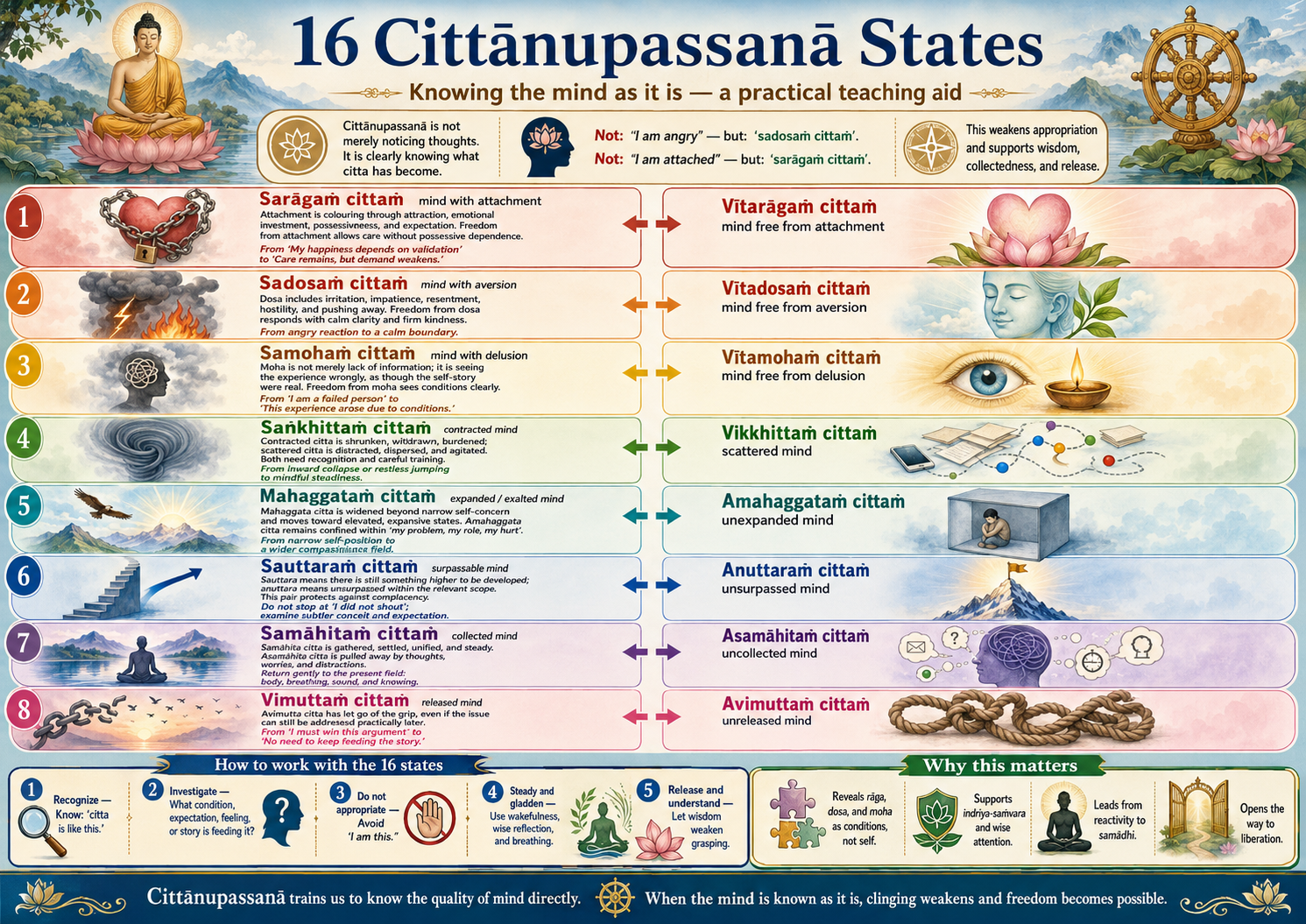 VISUAL SUMMARYSee this study in a pictureOpen the complete infographic for a visual overview before or after reading the full study.View infographic →
Eight Diagnostic Pairs
Sixteen conditions—not sixteen permanent personalities
A single citta may be described along several axes at once. The framework diagnoses colouring, disturbance, development, collectedness and release.
1
Sarāga / Vītarāga. Attachment or absence of attachment.
2
Sadosa / Vītadosa. Aversion or absence of aversion.
3
Samoha / Vītamoha. Delusion or absence of delusion.
4
Saṅkhitta / Vikkhitta. Contraction or scattering.
5
Mahaggata / Amahaggata. Expanded or unexpanded citta.
6
Sauttara / Anuttara. Surpassable or unsurpassed citta.
7
Samāhita / Asamāhita. Collected or uncollected citta.
8
Vimutta / Avimutta. Released or unreleased citta.
From a simple sense event to the colouring of citta
Sense base + object→ Viññāṇa
Door-specific consciousness→ Phassa
Contact→ Vedanā
Feeling→ Saññā
Recognition→ Vitakka
Directed thought→ Papañca
Proliferation→ Maññanā
Conceiving + identity→ Colouring of Citta
Rāga • Dosa • Moha—or clarity and release
A Preliminary Working Model
Viññāṇa, mano and citta are overlapping perspectives on one conditioned process
1
Viññāṇa. What is being cognized, and through which door? Eye-consciousness, ear-consciousness, mind-consciousness, and so on.
2
Mano. What meaning, memory, designation, or identity is being taken up as a dhamma-object?
3
Citta. What has the mind presently become like—attached, irritated, confused, contracted, scattered, collected, or released?
Working distinction: viññāṇa identifies the occurrence of consciousness according to its condition; mano takes meanings, memories and designations as mental objects; cittānupassanā asks what qualitative condition citta has now become.
Five Teaching Images
Visual map of citta, mano and viññāṇa
The five source images are important teaching aids. They are presented here as compact clickable cards and repeated in section 15 where the source discusses them in detail.
The buddhist model of mind – citta, mano and viññana
A preliminary visual model relating citta, mano and viññāṇa.
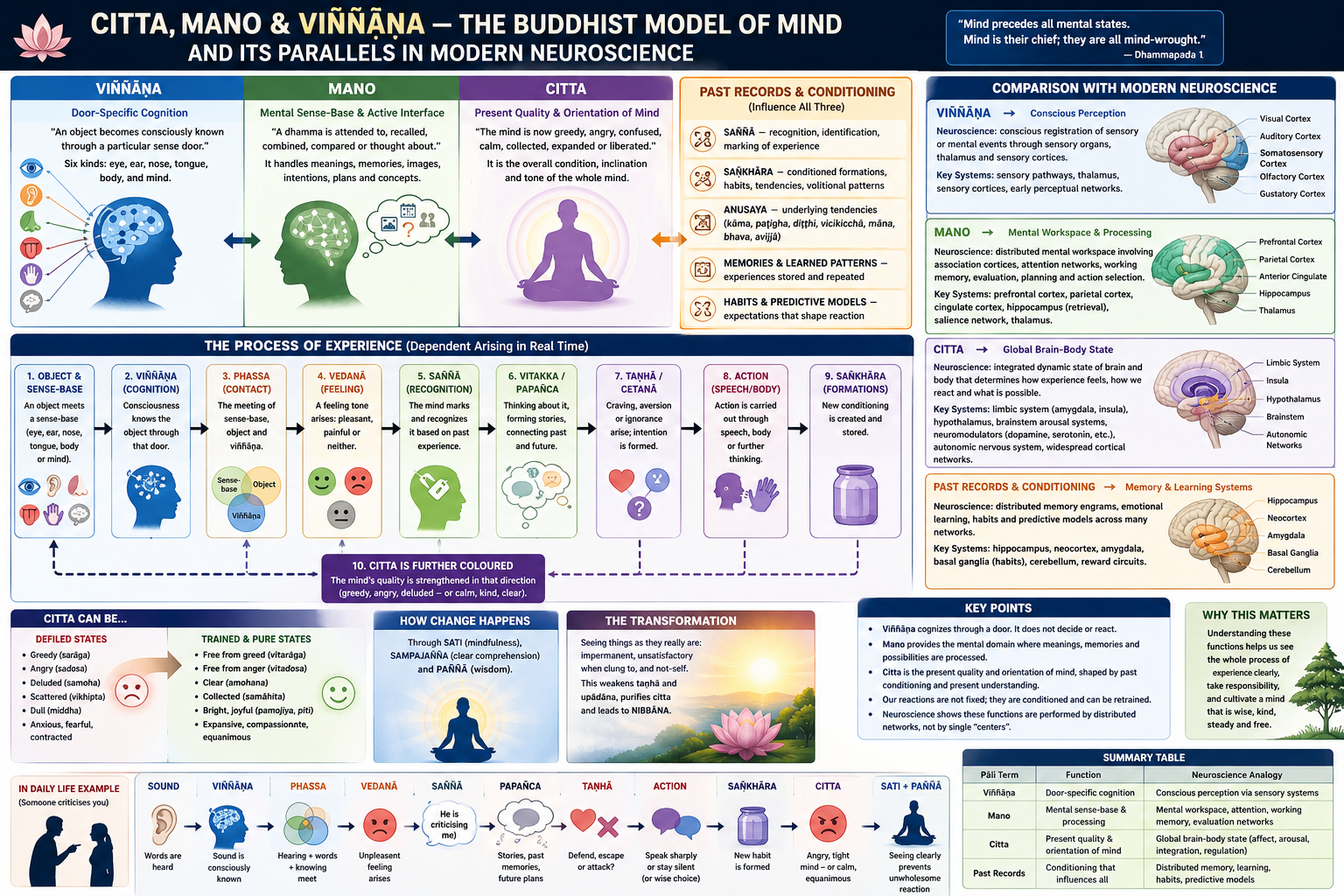
Click infographic to enlarge ↗
What is viññaña?
Viññāṇa as consciousness arising dependent on a particular base and object.

Click infographic to enlarge ↗
Understanding mano
Mano as the mind-base taking meanings, memories, designations and identities as dhamma-objects.
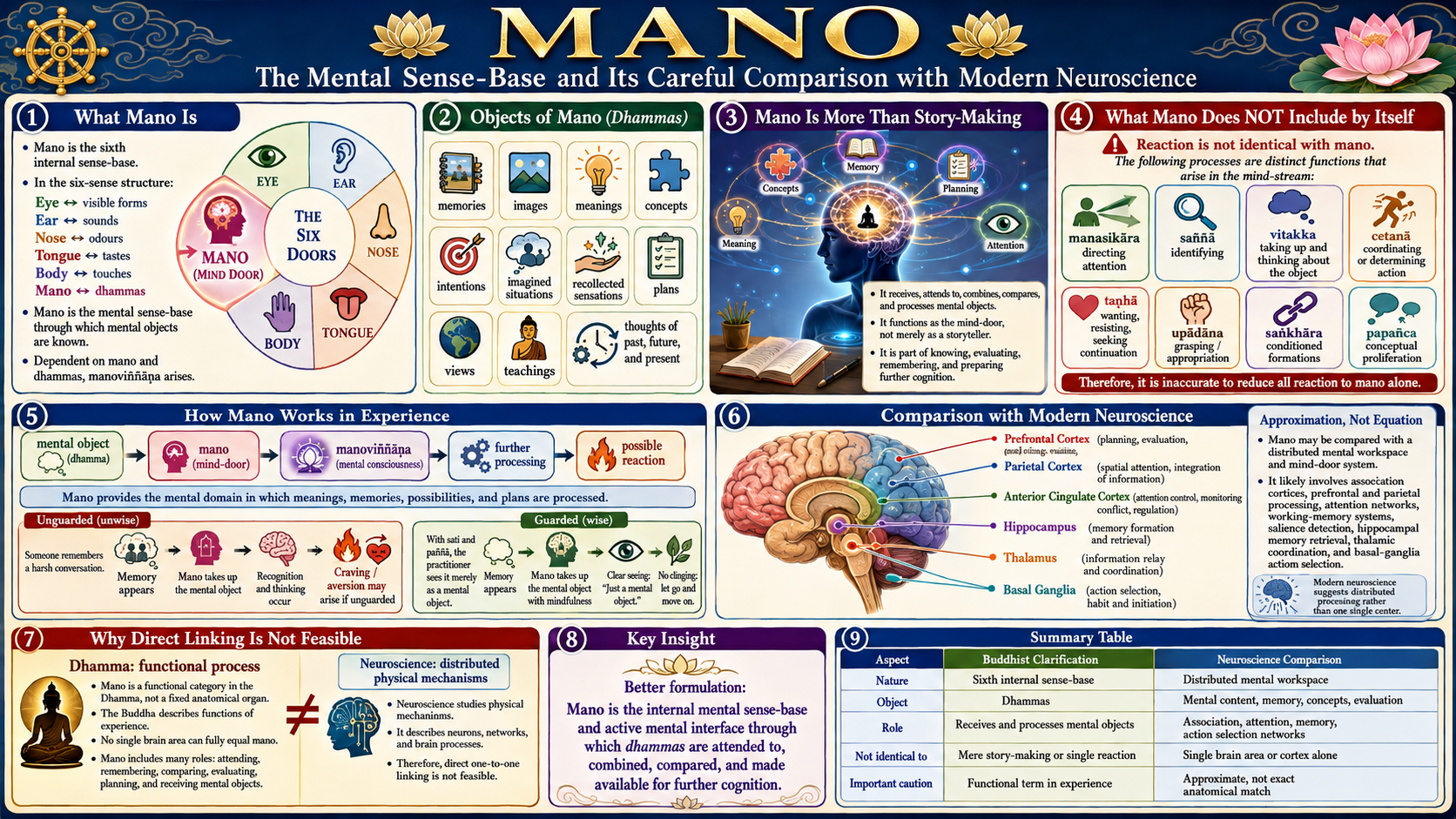
Click infographic to enlarge ↗
Understanding citta
Citta as the presently conditioned quality and orientation of mind.
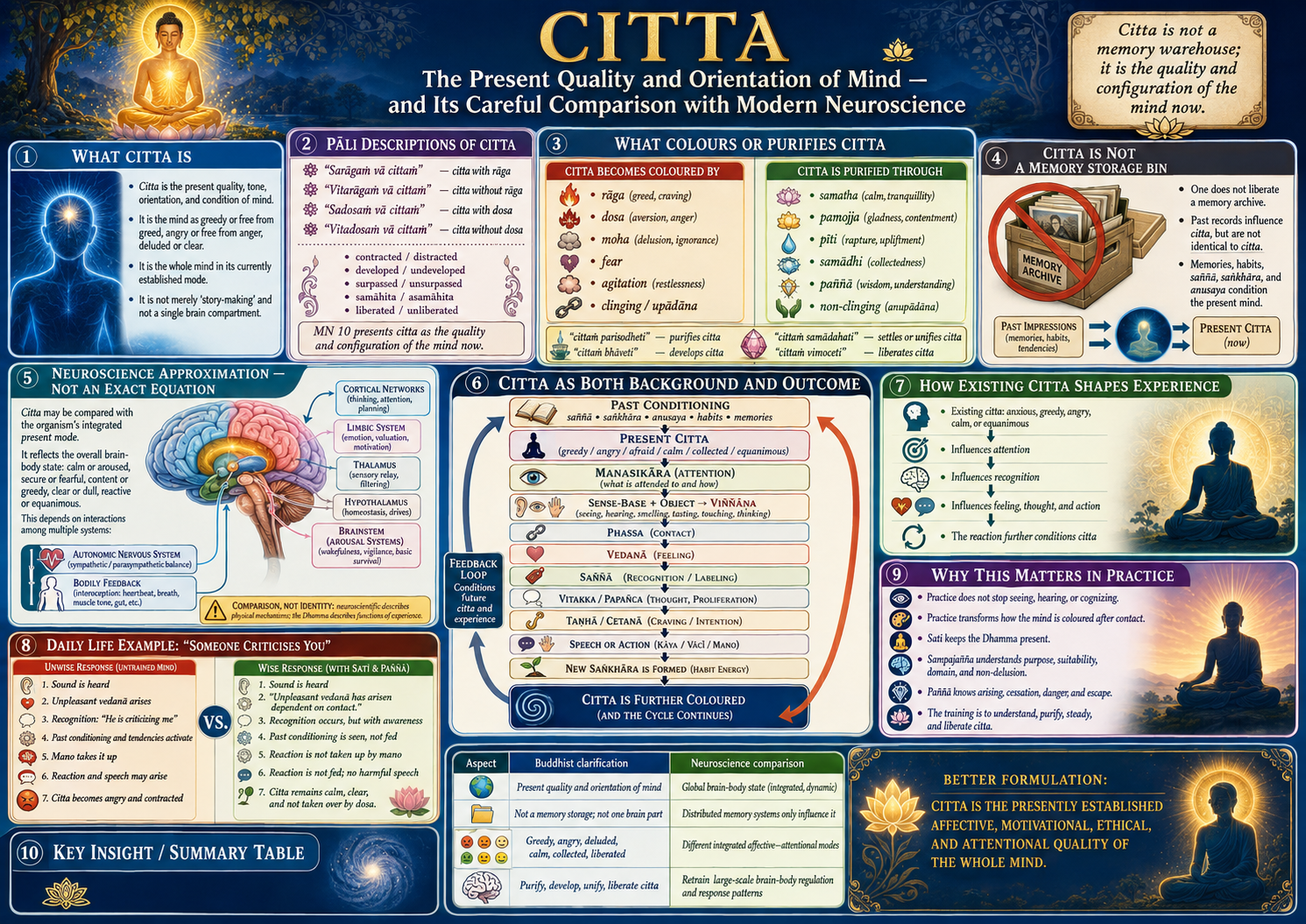
Click infographic to enlarge ↗
Understanding nine stages of citta
A visual study of the progressive stages and conditions of citta.
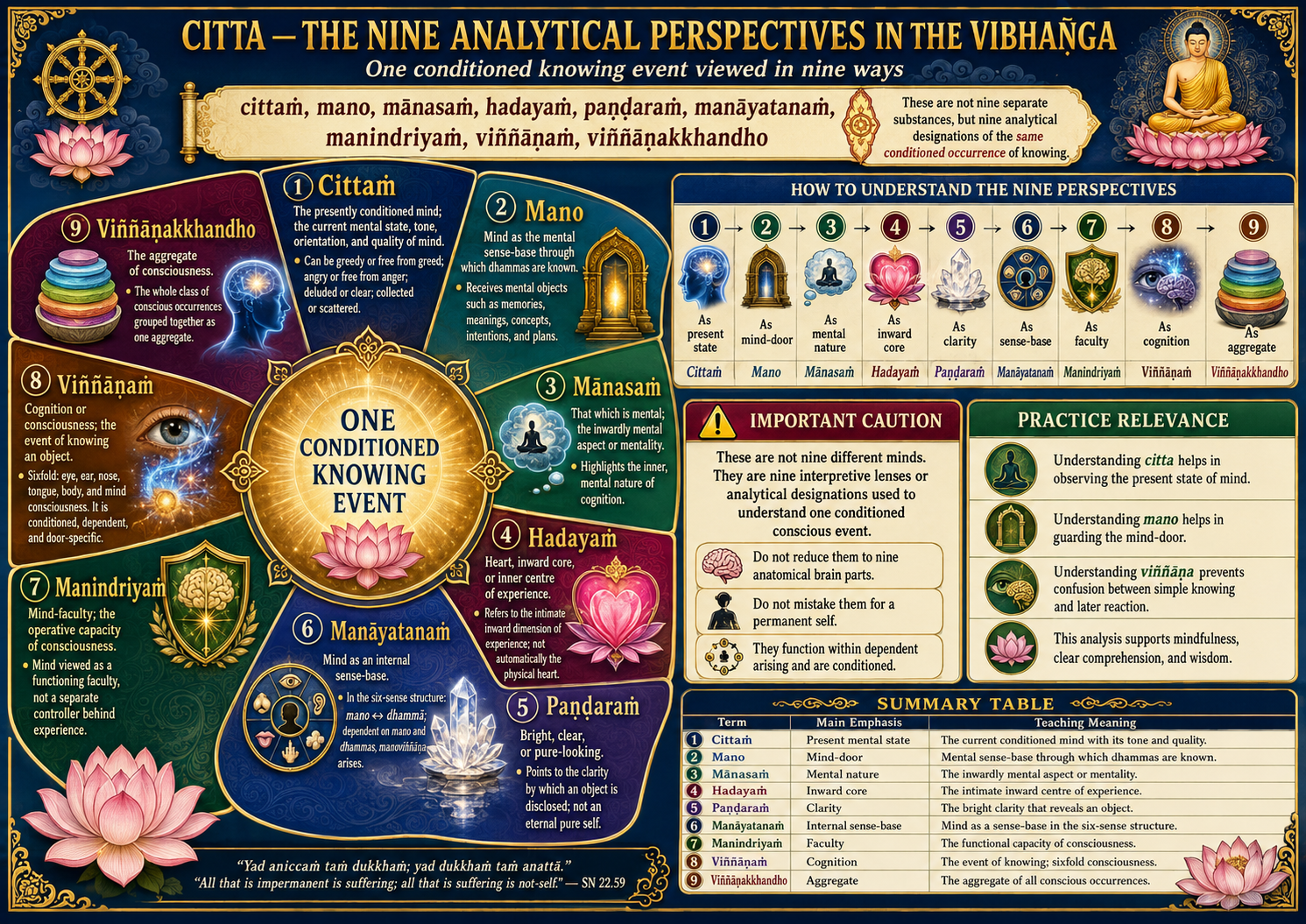
Click infographic to enlarge ↗
Householder Practice Roadmap
Ten steps for purifying citta in ordinary life
The source’s ten-stage training is pulled forward here because it provides the practical bridge between diagnosis and release.
1
Sīla. Do not speak harshly even when irritated.
2
Indriyasaṁvara. Do not seize the sign: “she is always like this”.
3
Sati-sampajañña. Know the presently active role, feeling, and citta-condition.
4
Yoniso manasikāra. Examine the event conditionally rather than personally.
5
MN 19 training. Abandon sensual, hostile, and harmful thought-patterns.
6
MN 20 training. Use the five methods when unwholesome thoughts persist.
7
Ānāpānasati. Experience, gladden, steady, and release citta.
8
Samādhi. Allow citta to become collected rather than fragmented.
9
Vipassanā. Discern arising, passing away, and non-appropriation.
10
Release. Roles function without becoming self.
Seventeen expandable teaching sections
01 Introduction: What Has Citta Become?
Cittānupassanā is presented as direct discernment of the present condition of citta, not merely the noticing of thoughts.
Introduction
Through practical situations involving family, work, expectations and identity, this article examines how citta becomes coloured, disturbed and bound—and how it can be understood without saying, “I am angry,” “I am attached,” or “I am disturbed.” Instead, one learns to recognize: “Citta is presently like this.” This shift weakens appropriation and supports the gradual movement from identification and reactivity toward clarity, collectedness and release.
02 Pair 1 — Sarāga and Vītarāga
Citta coloured by attachment and citta without that colouring, illustrated through expectations within marriage.
The first pair: sarāgaṁ cittaṁ and vītarāgaṁ cittaṁ
Sarāgaṁ vā cittaṁ “sarāgaṁ cittan”ti pajānāti;
vītarāgaṁ vā cittaṁ “vītarāgaṁ cittan”ti pajānāti.
“One knows citta with rāga as citta with rāga; one knows citta without rāga as citta without rāga.”
Rāga is not limited to overt sensual desire. It includes colouring through attachment, attraction, emotional investment, insistence, delight, possessiveness, and the demand that experience satisfy one’s expectation.
Example: Vilas as husband – Vilas expects his wife to appreciate how hard he works. She does not explicitly praise him.
The mind constructs:
“My wife should recognize my sacrifice.”
“She should speak more respectfully.”
“She should understand me without my explaining everything.”
The attachment is not merely to the wife. It is attachment to an image: “I am the deserving husband.”
Removal of the rāga
The first task is not suppression. It is recognition:
sarāgaṁ cittaṁ — sarāgaṁ cittan’ti pajānāti
“Citta is coloured by rāga.” Not:“I am attached.”
The movement from “I am attached” to “citta is coloured by attachment” weakens appropriation.
Then Vilas examines:
What sign or nimitta did the mind grasp?
What expectation is being protected?
What pleasant feeling is being sought?
What happens when the expected response is absent?
Is the wife being seen as designation and changing aggregates, or as a fixed person whose duty is to satisfy “me”? MN 53 describes sense restraint as not grasping at a theme or its variations after seeing, hearing, or cognizing an object, because unwholesome qualities such as greed and distress may otherwise assail the mind.
Vītarāgaṁ cittaṁ – This does not mean that Vilas ceases to care for his wife. It means:
affection remains; responsibility remains; gratitude remains; care remains; possessive emotional dependence weakens.
The difficulty begins when the designation is appropriated:
“This is what I truly am.”
“My status must be protected.”
“My identity has been attacked.”
“My family must behave according to my expectations.”
“My professional position defines my worth.”
At that point, a useful conventional role becomes a basis for mamaṅkāra, ahaṅkāra, maññanā, and upādāna.
Citta: what has the mind become like?
In cittānupassanā, the Buddha does not ask one to merely notice that an object has appeared. He asks one to discern the condition of citta:
Sarāgaṁ vā cittaṁ “sarāgaṁ cittan”ti pajānāti;
vītarāgaṁ vā cittaṁ “vītarāgaṁ cittan”ti pajānāti.
“One knows a mind with lust as ‘a mind with lust’; one knows a mind without lust as ‘a mind without lust.’”
The passage continues with mind affected or unaffected by aversion and delusion, contracted or distracted, developed or undeveloped, concentrated or unconcentrated, liberated or unliberated.
So citta is not merely the presence of a thought. It is the condition into which the mind has moved.
| Sarāga citta | Vītarāga citta |
|---|---|
| “She must behave according to my expectation.” | “Her response arises from her own conditions.” |
| “My happiness depends on her validation.” | “I can care without demanding emotional possession.” |
| “My wife belongs to me.” | “The designation ‘wife’ functions conventionally without mine-making.” |
03 Pair 2 — Sadosa and Vītadosa
Aversion, irritation, resentment, and the difference between a hostile reaction and a calm practical boundary.
Sadosaṁ vā cittaṁ “sadosaṁ cittan”ti pajānāti;
vītadosaṁ vā cittaṁ “vītadosaṁ cittan”ti pajānāti.
“One knows citta with dosa as citta with dosa; one knows citta without dosa as citta without dosa.”
Dosa includes aversion, irritation, impatience, resentment, hostility, resistance, and the impulse to push away.
Example: Vilas as father
Vilas is working on an important software task. His child repeatedly asks:“Papa, can you come now?”
At the ear-door: sound is heard.
At the mind-door: “I am busy.”
“My child should understand.”
“Why am I being disturbed?”
“Nobody respects my work.”
The child is no longer seen merely as a child speaking. The designation becomes solidified:
“This demanding child-person is obstructing me.”
At the same time, Vilas becomes: “the overburdened father-person.”
That is dosa operating through the role-world.
Purification
First discern: sadosaṁ cittaṁ — sadosaṁ cittan’ti pajānāti “Citta is coloured by dosa.”
Then examine the cost of following the thought.
MN 19 records the Buddha’s own method before awakening: when thoughts of ill will arose, he recognized that they lead to his own affliction, the affliction of others, or both; obstruct discernment; promote vexation; and do not lead to Nibbāna. Seeing the danger, he abandoned them.
Vilas can reflect:
| Investigation | Practical observation |
|---|---|
| Does irritation afflict me? | breathing becomes coarse; bodily tension rises |
| Does it afflict the child? | harshness creates fear or hurt |
| Does it obstruct paññā? | the child is seen only as an obstacle |
| Does it lead to calm? | no; the argument continues internally |
| Is the child-person fixed? | no; the image is constructed from sound, memory, feeling, and expectation |
“I will help you in ten minutes. Please wait until I complete this task.” The difference is that the response is not driven by aversion.
| Sadosa citta | Vītadosa citta |
|---|---|
| angry tone | calm boundary |
| personal resentment | practical response |
| “You always disturb me” | “I need ten minutes” |
| child seen as obstruction | child seen with care and clarity |
04 Pair 3 — Samoha and Vītamoha
Delusion as failure to see the conditional construction of an experience, role, and personal story.
Samohaṁ vā cittaṁ “samohaṁ cittan”ti pajānāti;
vītamohaṁ vā cittaṁ “vītamohaṁ cittan”ti pajānāti.
“One knows citta with moha as citta with moha; one knows citta without moha as citta without moha.”
Moha is not merely intellectual ignorance. It is the inability to see the experience accurately.
The mind sees: “My wife is the cause of my anger.”
It does not see: sound-contact occurred; unpleasant feeling arose; recognition occurred; expectation was activated; the husband-person and wife-person were constructed; irritation arose dependent on conditions.
Example: Vilas as son
Vilas’s mother calls and says: “You do not call often enough.”
Immediately citta becomes heavy. A mental construction appears:
“I am an inadequate son.” “Whatever I do is never sufficient.” “My mother always makes me feel guilty.”
Moha hides the constructed nature of the experience.
The role son appears as an actual self rather than as a designation arising dependent on relationship, memory, duty, and expectation.
Purification
Vilas examines the event layer by layer:
| Layer | Observation |
|---|---|
| sound | words were heard |
| feeling | unpleasant feeling arose |
| saññā | words were recognized as criticism |
| mano-dhammā | memories of earlier conversations arose |
| identity | “I am a failed son” appeared |
| citta | heaviness and defensiveness appeared |
| insight | this entire construction arose dependent on conditions |
At a practical level, citta without moha sees the immediate event more accurately: “The designation ‘son’ is functioning. A duty may exist. But the self-condemning son-person is constructed.”
Then wise action becomes possible: call the mother more regularly; explain limitations politely; offer practical support; avoid guilt-based reactivity; avoid blaming her as a fixed difficult person.
05 Pair 4 — Saṅkhitta and Vikkhitta
Contracted citta and scattered citta, together with practical methods for restoring wholesome energy and collectedness.
Saṅkhittaṁ vā cittaṁ “saṅkhittaṁ cittan”ti pajānāti;
vikkhittaṁ vā cittaṁ “vikkhittaṁ cittan”ti pajānāti.
“One knows contracted citta as contracted citta; scattered citta as scattered citta.”
These are not opposites in the sense that one is wholesome and the other unwholesome. Both indicate disturbance.
Saṅkhittaṁ cittaṁ: contracted citta
Saṅkhitta means compressed, shrunken, constricted, or contracted.
Example After a family disagreement, Vilas does not argue. But he withdraws inwardly.
He thinks:
“There is no point speaking.”
“Nobody understands me.”
“I will remain silent.”
Externally, the house may be quiet. Internally, citta has become contracted.
| Appearance | Actual condition |
|---|---|
| silence | citta may still be burdened |
| withdrawal | not necessarily equanimity |
| lack of argument | not necessarily purification |
| low energy | citta may be compressed by resentment, sadness, or dullness |
Recognize: “This is saṅkhitta citta.”
Do not call withdrawal “peace” but gently restore wholesome energy: straighten the body; resume wakeful awareness; cultivate breathing with alertness; reconnect with a wholesome theme; avoid repeatedly rehearsing the grievance.
Vikkhittaṁ cittaṁ: scattered citta
Vikkhitta means dispersed, scattered, distracted, or agitated.
Example: Vilas is sitting with his family but mentally moving between:
software deadlines; financial concerns; a message from one of the student who is upset; a neighbour’s complaint on his students; thoughts about his child’s master’s education; irritation toward his wife; remembered arguments.
The body is at home. Citta is everywhere.
Purification
Recognize: “This is vikkhitta citta.” Do not identify with the content of every thought.
The Buddha’s five methods in MN 20 are useful when unwholesome thought-sequences continue:
| MN 20 method | Vilas’s application |
|---|---|
| replace with a wholesome theme | shift from resentment to non-ill will |
| examine the drawbacks | see how replaying the argument damages the mind |
| withdraw attention | stop feeding the narrative |
| relax thought-fabrication | soften the inner verbal commentary |
| firmly restrain the mind when necessary | refuse to continue the harmful sequence |
06 Pair 5 — Mahaggata and Amahaggata
Expanded or exalted citta contrasted with a mind confined to narrow self-interest and identity defence.
The fifth pair: mahaggataṁ cittaṁ and amahaggataṁ cittaṁ
Mahaggataṁ vā cittaṁ “mahaggataṁ cittan”ti pajānāti;
amahaggataṁ vā cittaṁ “amahaggataṁ cittan”ti pajānāti.
“One knows expanded or exalted citta as expanded citta; unexpanded citta as unexpanded citta.”
Mahaggata literally points to something that has become great, expanded, or exalted.
This term should not be reduced to ordinary emotional openness. In its stronger sutta usage, it relates to developed and elevated conditions of mind, including samādhi and expansive cultivation.
A practical preliminary contrast
| Amahaggata citta | Movement toward mahaggata citta |
|---|---|
| confined to “my problem” | begins to see a wider field |
| trapped in family role-conflict | no longer limited to husband-person versus wife-person |
| repeatedly defending identity | releases the narrow self-position |
| unable to extend goodwill | develops non-ill will and harmlessness |
After a disagreement, Vilas initially sees only: “She hurt me.”
With purification, he sees:
“My wife is also affected by conditions. She may be tired, anxious, or burdened. My child is also affected by the atmosphere. This resentment harms the whole family.”
Citta begins to expand beyond the narrow personal position. This is not yet necessarily the technical fulfilment of mahaggata citta, but it moves away from the narrowness that obstructs deeper cultivation.
07 Pair 6 — Sauttara and Anuttara
Surpassable and unsurpassed citta, with emphasis on avoiding complacency and subtle conceit.
Sauttaraṁ vā cittaṁ “sauttaraṁ cittan”ti pajānāti;
anuttaraṁ vā cittaṁ “anuttaraṁ cittan”ti pajānāti.
“One knows surpassable citta as surpassable citta; unsurpassed citta as unsurpassed citta.”
Sa-uttara means “with something higher beyond it.”
Anuttara means “without something higher beyond it” within the relevant scope.
The practical danger is complacency.
Example
Vilas remains calm during a family conversation and thinks:“Now my citta is purified.” But closer observation shows: irritation did not erupt verbally; subtle expectation remains; pride remains: “I handled this better than everyone else”; the mind still wants recognition for being calm.
So the present citta remains sauttara: there is still a higher purification to be developed.
| Apparent achievement | Deeper examination |
|---|---|
| “I did not shout” | is resentment still present? |
| “I remained silent” | was silence based on clarity or suppression? |
| “I forgave her” | is there subtle superiority? |
| “I understand Dhamma” | is there conceit around understanding? |
08 Pair 7 — Samāhita and Asamāhita
Collected and uncollected citta, linked with the four citta steps of ānāpānasati.
Samāhitaṁ vā cittaṁ “samāhitaṁ cittan”ti pajānāti;
asamāhitaṁ vā cittaṁ “asamāhitaṁ cittan”ti pajānāti.
“One knows collected citta as collected citta; uncollected citta as uncollected citta.”
Samāhita is citta that has become gathered, settled, unified, and steady.
Example: family dinner and Vilas is eating with his family. His wife is speaking. His child is telling a story.
But internally, Vilas is still thinking about work emails. The eyes see the family. The ears hear their voices. But mano repeatedly moves toward software concerns. This is:asamāhita citta — uncollected citta.
Purification
The task is not to force a superficial appearance of attention. Vilas returns to the immediate field:
sound is heard; bodily posture is known; breathing is known; agitation is recognized; work-related dhamma-objects are not fed unnecessarily; citta is gently recollected.
MN 118 gives a direct fourfold citta-training within ānāpānasati: cittapaṭisaṁvedī assasissāmī’ti sikkhati — breathing in, one trains sensitive to citta;
abhippamodayaṁ cittaṁ — gladdening citta;
samādahaṁ cittaṁ — steadying or collecting citta;
vimocayaṁ cittaṁ — releasing citta.
| Ānāpānasati citta-step | Practical application |
|---|---|
| experience citta | recognize agitation without denial |
| gladden citta | release resentment; restore wholesome ease |
| steady citta | remain with breathing without chasing each story |
| release citta | loosen the grip of role-identification and clinging |
09 Pair 8 — Vimutta and Avimutta
Released and unreleased citta, carefully distinguished from automatically assuming final arahant liberation.
Vimuttaṁ vā cittaṁ “vimuttaṁ cittan”ti pajānāti;
avimuttaṁ vā cittaṁ “avimuttaṁ cittan”ti pajānāti.
“One knows released citta as released citta; unreleased citta as unreleased citta.”
This pair must be handled carefully. Vimutta citta may refer to release from a presently binding condition. It should not automatically be equated with irreversible arahant liberation unless the wider context establishes that.
Example
Vilas argued with his wife in the morning and for several hours, mano repeatedly returns to the conversation.
| Sign | Avimutta citta |
|---|---|
| repeated internal dialogue | argument continues mentally |
| imagined replies | citta remains tethered |
| bodily tension | emotional possession remains |
| urge to prove correctness | husband-person is still defended |
| inability to return fully to work or breathing | citta is not released |
| Avimutta citta | Vimutta citta |
|---|---|
| “I need to win the argument.” | no need to rehearse |
| “She must admit that I am right.” | practical discussion can happen later |
| story repeatedly returns | mind no longer grasps it |
| bodily contraction persists | bodily and mental pressure soften |
| role-person remains solid | designation becomes lighter |
10 One Family Event through All Sixteen Conditions
A single statement from the wife is analysed through all sixteen conditions of citta.
Situation
Vilas’s wife says: “You are always busy with work. You are not spending enough time with the children.”
| No. | Citta-condition | How it may appear in Vilas |
|---|---|---|
| 1 | sarāga | attachment to work, reputation, being appreciated |
| 2 | vītarāga | ability to hear without defending the work-identity |
| 3 | sadosa | irritation toward wife’s words |
| 4 | vītadosa | calm response without hostility |
| 5 | samoha | believing “she caused my anger” |
| 6 | vītamoha | seeing the dependent process clearly |
| 7 | saṅkhitta | withdrawing into hurt silence |
| 8 | vikkhitta | replaying the conversation repeatedly |
| 9 | mahaggata | citta expanded beyond narrow self-interest |
| 10 | amahaggata | citta confined to “my time, my pressure, my rights” |
| 11 | sauttara | recognizing that subtle attachment remains |
| 12 | anuttara | no higher purification remaining within the relevant scope |
| 13 | samāhita | citta steady enough to hear and respond wisely |
| 14 | asamāhita | mind pulled between argument, work, and self-defence |
| 15 | vimutta | citta released from the need to preserve the husband-person |
| 16 | avimutta | citta still bound to the story and role-position |
11 Roles Continue while Appropriation Weakens
Purification does not abolish family responsibility; it removes rigid self-positioning and mine-making.
The aim is not to conclude:
“There is no wife.”
“There are no children.”
“I am not a father.”
“Responsibilities are meaningless.”
That would be another conceptual extreme.
The aim is:
wife is known as a conventional designation; husband is known as a conventional designation; father is known as a conventional designation; child is known as a conventional designation;
responsibilities continue; appropriation weakens.
| Before purification | After purification |
|---|---|
| “My wife must satisfy my expectations.” | “I can listen carefully and respond wisely.” |
| “My child is disturbing me.” | “A child needs attention; a practical response is required.” |
| “My mother makes me guilty.” | “A duty may exist, but guilt-self is conditionally constructed.” |
| “My brother insulted me.” | “Words were heard; the brother-person need not become an enemy-person.” |
| “My job defines me.” | “Work is a responsibility, not a self.” |
12 The Householder’s Ten-Step Training
Sīla, sense restraint, clear comprehension, wise attention, thought training, ānāpānasati, samādhi, vipassanā, and release.
Purification does not begin only after sitting down for formal ānāpānasati practice.
MN 53 places sense restraint, moderation in food, wakefulness, wholesome qualities, and jhāna within one integrated training. It explains that when seeing a form, hearing a sound, or cognizing an idea, one does not grasp the theme or variations through which greed or distress might assail the mind.
Daily sequence would be as follows:
| Stage | Training | Vilas’s practical application |
|---|---|---|
| 1 | sīla | do not speak harshly even when irritated |
| 2 | indriyasaṁvara | do not seize the sign: “she is always like this” |
| 3 | sati-sampajañña | know the presently active role, feeling, and citta-condition |
| 4 | yoniso manasikāra | examine the event conditionally rather than personally |
| 5 | MN 19 training | abandon sensual, hostile, and harmful thought-patterns |
| 6 | MN 20 training | use the five methods when thoughts persist |
| 7 | ānāpānasati | experience, gladden, steady, and release citta |
| 8 | samādhi | allow citta to become collected rather than fragmented |
| 9 | vipassanā | discern arising, passing away, and non-appropriation |
| 10 | release | roles function without becoming self |
13 Practical Citta-Purification Worksheet
A repeatable investigation for family interactions, sense contact, designation, mental colouring, and release.
| Question | Example answer |
|---|---|
| Which āyatana was contacted? | ear and spoken words |
| Which viññāṇa arose? | ear-consciousness |
| Which vedanā followed? | unpleasant feeling |
| Which designation became active? | “wife,” “husband,” “my work” |
| Which person-position was constructed? | “I am the unappreciated husband” |
| What is the condition of citta? | sadosa, samoha, vikkhitta, asamāhita, avimutta |
| What am I feeding? | remembered words and imagined replies |
| Which wholesome alternative is appropriate? | non-ill will, harmlessness, calm communication |
| Can the role remain without appropriation? | fulfil responsibility without defending a self-image |
| Has citta released the object? | no repeated internal argument remains |
14 Integrated Purification Framework
The relationship of āyatana, viññāṇa, mano, citta, family roles, thinking, breathing cultivation, and release.
| Dimension | Without purification | Through citta-bhāvanā |
|---|---|---|
| āyatana | sense-contact becomes fuel for grasping | sense-contact is known accurately |
| viññāṇa | consciousness is appropriated as “I see,” “I hear,” “I think” | consciousness is known as conditionally arisen |
| mano | designation becomes a solid personal story | designation remains designation |
| citta | becomes coloured by rāga, dosa, and moha | colouring is discerned and abandoned |
| family role | actualized as husband-person, father-person, son-person | functions conventionally as responsibility |
| thinking | proliferates through papañca | becomes inclined toward nekkhamma, abyāpāda, and avihiṁsā |
| breathing cultivation | used only as temporary relaxation | experiences, gladdens, steadies, and releases citta |
| outcome | avimutta citta | progressive purification and release |
When Vilas sees wife merely as wife-person and himself as husband-person, citta becomes bound.
When he sees the āyatana-process, designation, arising, colouring, and cessation clearly, citta begins to purify. The family remains and responsibility remains, but the solid imagined persons created through rāga, dosa, moha, and maññanā lose their grip.
Relation to sakkāyadiṭṭhi – Sakkāyadiṭṭhi is not only crude belief like: “This body is self.”
It also operates through role-identification based on the five aggregates.
For example:“I am father” through rūpa – “This child is physically mine. My bloodline continues.”
“I am father” through vedanā – “The pleasant feeling of being loved by my child is me.”
“I am father” through saññā – “The recognition ‘father’ defines me.”
“I am father” through saṅkhārā – “My intentions, duties, sacrifices, decisions as father are me.”
“I am father” through viññāṇa – “The awareness of myself as father is my real identity.”
So each role can become a field for all twenty types of identity view while role-person is fabricated out of the five aggregates.
Final clarification
When the Buddha says: Cakkhuñca paṭicca rūpe ca uppajjati cakkhuviññāṇaṁ the meaning is not:
“First there is an eye. Then defilement converts it into an āyatana. Then eye-consciousness arises.”
The meaning is: “The eye is already functioning as the internal eye-base, and visible forms are already functioning as the external visible-form base. Dependent on this āyatana pair, eye-consciousness arises.”
Then: tiṇṇaṁ saṅgati phasso “The meeting of the three is contact.”
Then:phassapaccayā vedanā “With contact as condition, feeling.”
Then the critical point for purification begins
15 Citta, Mano, and Viññāṇa — Teaching Images and Preliminary Model
The supplied visual material and tables distinguish door-specific consciousness, the mind faculty, and the qualitative condition of citta.
| Citta condition | Vilas’s lived experience |
|---|---|
| sarāga citta | attached to praise, salary, status, comfort, affection, or admiration |
| sadosa citta | irritated because his wife interrupted his work |
| samoha citta | unable to see that his reaction arose conditionally |
| saṅkhitta citta | contracted, dull, withdrawn, burdened |
| vikkhitta citta | scattered between code, messages, family, and anxiety |
| samāhita citta | steady, composed, not pulled apart by competing objects |
| vimutta citta | released from the particular grip that previously bound it |
| Possible citta-condition | Vilas’s experience |
|---|---|
| sarāgaṁ cittaṁ | attachment to uninterrupted work, professional success, status, or control |
| sadosaṁ cittaṁ | irritation toward the interruption |
| samohaṁ cittaṁ | inability to see the reaction as dependently arisen |
| vikkhittaṁ cittaṁ | mentally pulled between code, deadline, daughter, and internal dialogue |
| asamāhitaṁ cittaṁ | unable to remain collected |
| avimuttaṁ cittaṁ | caught in the story: “Nobody respects my work” |
| Cultivated citta-condition | Vilas’s response |
|---|---|
| vītadosaṁ cittaṁ | no irritation toward the daughter |
| vikkhittaṁ cittaṁ pajānāti | recognizes that the citta has become scattered |
| samāhitaṁ cittaṁ | returns to steadiness |
| vimuttaṁ cittaṁ | releases the demand: “My work must never be interrupted” |
| wise action | either helps the daughter or calmly explains when he can help |
The buddhist model of mind – citta, mano and viññana
A preliminary visual model relating citta, mano and viññāṇa.
Click infographic to enlarge ↗
What is viññaña?
Viññāṇa as consciousness arising dependent on a particular base and object.
Click infographic to enlarge ↗
Understanding mano
Mano as the mind-base taking meanings, memories, designations and identities as dhamma-objects.
Click infographic to enlarge ↗
Understanding citta
Citta as the presently conditioned quality and orientation of mind.
Click infographic to enlarge ↗
Understanding nine stages of citta
A visual study of the progressive stages and conditions of citta.
Click infographic to enlarge ↗
| Pāli term | Predominant function in this analysis | Question it answers |
|---|---|---|
| viññāṇa | the particular occurrence of consciousness dependent on a base and object | “What is being cognized through which door?” |
| mano | the mind faculty, which takes dhammā as its objects | “What mental object, meaning, memory, or identity is now being taken up?” |
| citta | the qualitative condition of the mind | “What has the mind become like?” |
16 The Sixteen Conditions within the Full Cognitive Process
The source situates the eight pairs within āyatana, contact, feeling, designation, proliferation, identity, and the colouring of citta.
Mano is the mental base through which meanings, memories, and identities are taken as objects.
Citta is the quality and orientation of the mind as it engages with those objects.
However, these are not three separate entities sitting inside Vilas. Nor should they always be understood as three consecutive stages. They are overlapping perspectives on a conditionally arisen process.
Purification of Citta Through the Sixteen Conditions
A detailed study using Vilas and his family as the practical example:
The sixteen conditions of citta in MN 10 and DN 22 are not merely a checklist of emotions. They provide a practical diagnostic framework for examining how the mind becomes coloured, contracted, scattered, expanded, collected, or released.
The purpose is not merely to say:
“Anger is present.”
“Attachment is present.”
“Distraction is present.”
The deeper purpose is to see:
How did a simple āyatana-based event become an apparently real personal world?
How did the designation “wife,” “husband,” “father,” or “son” become solidified into an actual person-position?
How did citta become captured by that construction?
How can citta be purified without abandoning ordinary responsibilities?
The sixteen conditions must therefore be understood within the entire process:
āyatana → viññāṇa → phassa → vedanā → saññā → vitakka → papañca → maññanā → colouring of citta.
The sixteen conditions are eight diagnostic pairs
| Group | Pair | What is being examined |
|---|---|---|
| Root colouring | sarāga / vītarāga | attachment or absence of attachment |
| Root colouring | sadosa / vītadosa | aversion or absence of aversion |
| Root colouring | samoha / vītamoha | delusion or absence of delusion |
| Disturbance mode | saṅkhitta / vikkhitta | contraction or scattering |
| Development | mahaggata / amahaggata | expanded or unexpanded citta |
| Development | sauttara / anuttara | surpassable or unsurpassed citta |
| Collectedness | samāhita / asamāhita | collected or uncollected citta |
| Release | vimutta / avimutta | released or unreleased citta |
A single moment of citta may be described through several axes simultaneously. For example, after an argument, Vilas’s citta may be:
sadosa — coloured by irritation;
samoha — unable to see the construction clearly;
vikkhitta — repeatedly returning to the argument;
asamāhita — unable to remain collected
avimutta — not released from the story.
Where āyatana fits into purification of citta?
The condition of citta does not arise independently but is preceded by the sixfold field of experience:
| Internal āyatana | External āyatana | Consciousness |
|---|---|---|
| eye — cakkhu | visible form — rūpa | eye-consciousness — cakkhuviññāṇa |
| ear — sota | sound — sadda | ear-consciousness — sotaviññāṇa |
| nose — ghāna | smell — gandha | nose-consciousness — ghānaviññāṇa |
| tongue — jivhā | taste — rasa | tongue-consciousness — jivhāviññāṇa |
| body — kāya | tangible object — phoṭṭhabba | body-consciousness — kāyaviññāṇa |
| mind — mano | mental object — dhammā | mind-consciousness — manoviññāṇa |
the first occurrence is only ear + sound → ear-consciousness.
The complete personal world appears through subsequent mental activity of:
“She is my wife.”
“I am her husband.”
“She is interfering with my work.”
“My time is not respected.”
“Nobody understands my pressure.”
The designation becomes reified into two apparently solid persons: husband-person versus wife-person. Citta is then coloured by attachment, aversion, and delusion.
Viññāṇa: consciousness is named according to its condition
In MN 38, the Buddha makes a decisive statement:
Yaṁ yadeva, bhikkhave, paccayaṁ paṭicca uppajjati viññāṇaṁ, tena teneva viññāṇantveva saṅkhyaṁ gacchati.
“Whatever condition consciousness arises dependent upon, it is reckoned according to that very condition.” Thus:
| Conditions | Resulting consciousness |
|---|---|
| eye + visible form | eye-consciousness — cakkhuviññāṇa |
| ear + sound | ear-consciousness — sotaviññāṇa |
| nose + smell | nose-consciousness — ghānaviññāṇa |
| tongue + taste | tongue-consciousness — jivhāviññāṇa |
| body + tangible object | body-consciousness — kāyaviññāṇa |
| mind + mental object | mind-consciousness — manoviññāṇa |
When Vilas hears his child calling: ear + sound → ear-consciousness.
When Vilas remembers that he must call his elderly mother: mano + mental object → mind-consciousness.
The Buddha includes mano among the six internal sense bases:
mano ca dhammā ca “the mind and mental phenomena.”
This appears in SN 35.23, the Sabbasutta, where the Buddha defines “the all” as the six internal bases together with their six corresponding fields of objects.
In MN 148: Manañca paṭicca dhamme ca uppajjati manoviññāṇaṁ.
“Dependent on the mind and mental phenomena, mind-consciousness arises.”
The crucial word is dhammā. In this context, it includes the objects that can be taken up mentally: memories, concepts, intentions, plans, interpretations, internal images, remembered words, opinions, classifications, and relational identities. Thus,
| Identity | What it is at the mind-door |
|---|---|
| “I am a husband” | a mental designation and relational concept |
| “I am a father” | a mental designation linked to memories, duties, affection, and expectations |
| “I am a son” | a mental designation activated in relation to parents |
| “I am a brother” | a relational concept activated by a sibling or memory |
| “I am a neighbour” | a social designation |
| “I am Indian” | a collective and national designation |
| “I am a software engineer” | a professional designation linked to skills, tasks, salary, status, and expectations |
Manoviññāṇa is the consciousness of that mental object.
Citta indicates whether the mind is now attached, irritated, confused, scattered, collected, or released.
| Term | Its role | Example |
|---|---|---|
| viññāṇa | the specific consciousness arising dependent on a base and object | hearing the wife’s words |
| mano | the sixth internal base taking dhammā as objects | remembering, interpreting, planning, identifying |
| manoviññāṇa | consciousness dependent on mano and a mental object | cognizing: “I am being interrupted” |
| citta | the currently conditioned quality of mind | irritated, scattered, collected, or released |
| cittānupassanā | discerning citta as citta through the sixteen conditions | “sadosaṁ cittaṁ”; “vikkhittaṁ cittaṁ”; “asamāhitaṁ cittaṁ” |
17 Final Working Model: Viññāṇa, Mano, Manoviññāṇa, and Citta
A concluding distinction between door-specific knowing, mental objects and designations, mind-consciousness, and the resulting quality of citta.
Viññāṇa – Viññāṇa is the door-specific consciousness.
Example:
seeing the wife — cakkhuviññāṇa
hearing the child — sotaviññāṇa
feeling bodily pressure — kāyaviññāṇa
thinking “I am a father” — manoviññāṇa
Viññāṇa knows according to the door.
Mano – Mano is where designation, memory, identity, story, and relation are taken up as dhammā.
The role appears primarily here.
| Dhamma taken by mano | Role-person constructed |
|---|---|
| memory of marriage | “I am husband” |
| memory of parents | “I am son” |
| memory of child | “I am father” |
| passport, language, culture | “I am Indian” |
| job title, salary, skill | “I am software engineer” |
But due to ignorance, mano does not merely register designation as designation. It reifies it.
It turns: “husband” as a useful convention into: “I am truly this husband-person. and that is maññanā.
Citta – Citta is the condition of the mind after this designation has been taken as real. If the designation is grasped, citta becomes coloured.
| Role taken as real | Citta-condition |
|---|---|
| “I am the husband; she must respect me” | sadosa citta, sarāga citta |
| “I am father; my child reflects my worth” | sarāga, samoha |
| “I am son; I am guilty if I cannot satisfy parents” | saṅkhitta, samoha |
| “I am software engineer; failure means I am worthless” | vikkhitta, asamāhita |
| “I am Indian; criticism of India is criticism of me” | sadosa, samoha |
Or will rāga, dosa, and moha convert the event into a solid person-world:
“my wife,” “my child,” “my status,” “my insult,” “my suffering”?
That is where indriyasaṁvara, sati-sampajañña, cittānupassanā, ānāpānasati, and paññā become indispensable.
The family remains; the solid imagined person-world loses its grip
Practice summary: Know the door, the object, the feeling, the designation, and the present condition of citta—then cultivate clarity, collectedness, non-appropriation and release.