Closed Eyes? • Bhāvanā • Sense Restraint • Continuous Cultivation
Did the Buddha Teach “Closed-Eyes Meditation”?
This article asks whether closing the physical eyes is an essential instruction in the early suttas,
and uses that question to open a much larger investigation into bhāvanā:
cultivation of conduct, sense restraint, mindfulness, clear comprehension, samādhi and paññā throughout daily life.
The central question is not merely “Are the eyes open or closed?” but “What is citta doing when contact occurs?”
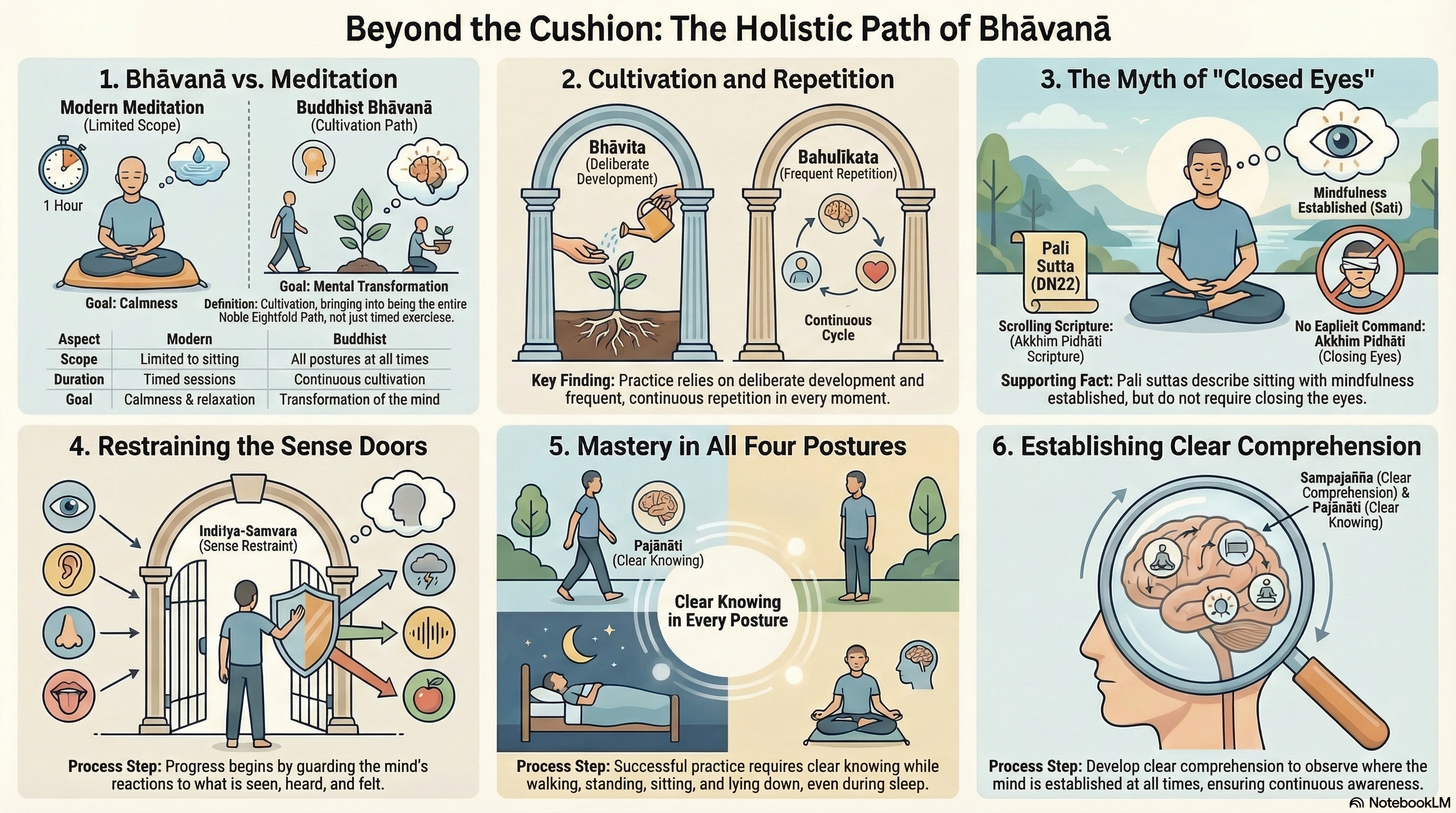 VISUAL SUMMARYSee this study in a pictureOpen the complete infographic for a visual overview before or after reading the full study.View infographic →
The Inquiry
What is prescribed—and what has become conventional?
QuestionDid the Buddha prescribe closing the physical eyes as a requirement?
Sutta FormulaPosture • upright body • parimukhaṁ satiṁ upaṭṭhapetvā
Main TrainingGuard the sense doors rather than merely block sensory input
ScopeWalking • standing • sitting • lying down • daily activity
Bhāvanā
Continuous cultivation rather than one posture-defined session
Careful conclusion: the quoted sitting formula does not explicitly include an instruction equivalent to
“having closed the eyes.” That supports the narrower claim that eye closure is not stated there as a formal prerequisite.
It does not by itself prove that practitioners in the early Buddhist period never closed their eyes.
Meditation vs Bhāvanā
The essay’s broader training framework
SīlaEthical cultivation
→
Indriya-saṁvaraGuarding sense doors
→
Sati–SampajaññaMindfulness & clear comprehension
→
SamādhiCollectedness
→
Paññā
Wisdom directed toward liberation
Terminology caution: the essay deliberately contrasts English “meditation” with Pāli bhāvanā.
This is a useful teaching contrast, but English “meditation” is a broad umbrella term and is not inherently restricted to relaxation,
one-hour sessions, or closed-eye sitting. Likewise, not every occurrence of bhāvanā means “all practices at all times.”
Indriya-saṁvara
The issue is not seeing—it is what the mind does with what is seen
SeeingForm is seenDo not grasp nimitta / anubyañjana
HearingSound is heardNotice the mind’s movement
SmellingOdor is knownNo chasing after pleasant/unpleasant
TastingTaste is knownRestraint rather than suppression
TouchingTangible contact occursKnow contact and feeling
Thinking
Mental objects arise
Guard mano as a sense door too
All Four Postures
Bhāvanā must move beyond one cushion posture
WalkingGacchanto vā gacchāmīti pajānāti
StandingṬhito vā ṭhitomhīti pajānāti
SittingNisinno vā nisinnomhīti pajānāti
Lying Down
Sayāno vā sayānomhīti pajānāti
Essay framing: the article extends this into “at all times including sleep.”
The four-posture formulas support continuity across waking postures and activities; the stronger claim about maintaining the same knowing
during sleep is the author’s practical interpretation as indicated in MN20 sutta where Buddha explains to move from grosser to subtler by showing that walking, standing, sitting and lying down are four postures moving from gross to subtle (Evañhi so, bhikkhave, puriso oḷārikaṁ oḷārikaṁ iriyāpathaṁ abhinivajjetvā sukhumaṁ sukhumaṁ iriyāpathaṁ kappeyya.)
Open, Closed or Lowered?
A practical method should not be confused with the principle
Not required by formulaNo explicit “akkhīni pidhāya” appears in the quoted sitting formula
May still be usefulClosing the eyes can reduce visual distraction for practical reasons
OkkhittacakkhuThe essay uses Snp 4.16 to emphasize a lowered/restrained gaze
Real Target
Freedom from grasping within sensory experience
Textual caution: the essay translates okkhittacakkhu as “eyes partially shut” in one place and “eyes lowered” in another.
“Eyes lowered / gaze lowered” is the safer literal sense. The verse supports restrained gaze and wakefulness; it does not clearly prescribe a specific percentage of eyelid closure.
The Daily Practice Question
Frequently examine where citta moves and what conditions it
Where did citta go?Which object captured it?
Rāga?Was liking / attraction present?
Dosa?Was aversion / resistance present?
Moha?Was confusion / misperception present?
Paccavekkhitabbaṁ
Frequently examine one’s own citta
Practical strength of the article: its conclusion turns the debate away from a posture rule and toward repeated examination:
when seeing, hearing, smelling, tasting, touching or thinking occurs, is citta moving under rāga, dosa or moha?
Neuroscience Discussion
Useful context, but not proof of the sutta interpretation
Scientific caution: the essay discusses increased alpha activity with eyes closed, possible theta activity during drowsiness,
and reduced sensory stimulation affecting alertness. These are plausible broad neuroscience observations, but the article’s stronger inference—
that neuroscience therefore points toward the same practice principle as the Buddha—is interpretive.
Alpha with eyes closed does not itself mean a practitioner is becoming dull, nor does long closed-eye practice necessarily lead to sleep.
Complete Uploaded Article
All essay details preserved in 13 expandable sections
The full article is retained below: the opening closed-eyes question, meditation/bhāvanā comparisons,
all seven tables, bhāvita-bahulīkata discussion, caraṇa, sense restraint, four postures, the “pa” word study,
cakkhu vs akkhi, parimukhaṁ satiṁ upaṭṭhapetvā, Snp 4.16, Bāhiyasutta application,
neuroscience discussion, SN 22.100 and the final verification note.
01 Did the Buddha Teach “Closed-Eyes Meditation”? The opening inquiry: what the standard sitting formula says—and does not explicitly say.
Did Buddha Teach “Closed-Eyes Meditation”?
Today, the word meditation has come to evoke a very specific image in the minds of many people. We immediately think of a person sitting cross-legged on a cushion, setting a timer for one hour or more, closing the eyes, and focusing exclusively on the breath at the nostrils. If the full hour is completed, there is satisfaction. If one is unable to sit that long, there is disappointment, followed by a renewed effort to somehow force oneself to sit longer the next time.
Over time, this has become such a strong conditioning that many assume this is what the Buddha himself taught. In other words, “meditation” is often taken to mean: sit still, close the eyes, and observe the breath for a fixed period.
But is this really how the Buddha presented practice in the suttas?
Did he actually recommend closed-eyes meditation? Is there any clear statement in the early texts where the Buddha instructs a practitioner to close the eyes before beginning practice? These are important questions, because much of what is commonly assumed today may not have been explicitly said in the Buddha’s teaching at all.
Before examining that question directly, it is useful to first look at the relevant Pāli vocabulary. If one wishes to say “to close” in Pāli, dictionaries such as the PTS Dictionary give forms such as pidahati / pidhāti. Likewise, one common Pāli word for “eye” is akkhi.
Now, if the Buddha had intended to instruct practitioners to “close the eyes” as a formal requirement before practice, one would expect some expression involving this sense to appear in the suttas. Yet when we turn to foundational meditation texts such as the Satipaṭṭhāna Sutta (DN 22) and related discourses, what we actually find is the following instruction:
“Araññagato vā rukkhamūlagato vā suññāgāragato vā nisīdati; pallaṅkaṁ ābhujitvā ujuṁ kāyaṁ paṇidhāya parimukhaṁ satiṁ upaṭṭhapetvā.”
That is: one goes to the forest, or to the root of a tree, or to an empty dwelling; one sits down, folds the legs crosswise, sets the body erect, and establishes mindfulness in front.
What is striking here is not merely what is said, but also what is not said. There is no instruction such as “akkhīni pidhāya” — “having closed the eyes” — before sitting down. The sutta speaks about posture, bodily alignment, location, and the establishing of mindfulness, but it does not explicitly say that practice begins by shutting the eyes.
This omission is not trivial. It invites us to reconsider whether later assumptions about meditation have been read back into the Buddha’s teaching. Many traditions and practitioners have come to take eye-closing as natural, obvious, or even essential. Yet the early suttas deserve to be examined carefully on their own terms, rather than through the lens of inherited habits.
This does not automatically mean that closing the eyes is “wrong.” A person may close the eyes for practical reasons, such as reducing distraction. But that is very different from claiming that the Buddha prescribed closed eyes as a standard or defining feature of bhāvanā. If such a claim is to be made, it should be supported by the suttas themselves.
So the inquiry before us is a serious one: when the Buddha spoke about practice, did he mean what we today loosely call “meditation,” or was he pointing to something broader, deeper, and more continuous — namely bhāvanā, cultivation? And within that cultivation, what place, if any, was given to the idea of sitting with closed eyes?
Let us now investigate this step by step by returning to the suttas themselves and examining what the Buddha actually says regarding “closing the eyes” and “meditation.”
02 Step 1 — Meditation vs Bhāvanā The essay contrasts the English word “meditation” with Pāli bhāvanā and related practice vocabulary.
Step 1 – Difference between meditation used in Latin and Pāli word bhavanā
| Aspect | Meditation | Bhāvanā |
|---|---|---|
| Origin | Latin philosophical term | Pāli Buddhist term |
| Meaning | contemplation or mental exercise | cultivation / development |
| Scope | often limited to sitting practice | entire mental training in all postures at all times |
| Goal | calmness, relaxation | transformation of mind |
| Duration | usually a session | continuous cultivation |
| Context | many spiritual traditions | specific to Buddha’s path |
Key pāli words in place of meditation – In the teachings, the following terms are used:
| Pāli term | Meaning |
|---|---|
| bhāvanā | development / cultivation |
| samādhi | collectedness of mind |
| jhāna | complete absorption leading to burning of defilements |
| sati | mindfulness or awareness |
| sampajañña | clear knowing of where the mind is drifting between various objects |
Thus, Buddha describes development of mental qualities, not simply sitting in a posture and meditation for some hours with timers.
Let us look at difference in meaning
| Meditation (English) | Bhāvanā (Pāli) |
|---|---|
| contemplation | cultivation |
| mental exercise | mental development |
| usually a session | continuous training |
| often relaxation | liberation-oriented practice |
So bhāvanā is broader and deeper than meditation.
Why This Difference Is Important?
If Dhamma practice is understood merely as “meditation,” it can easily create the impression that practice means simply sitting quietly with closed eyes. However, the Buddha describes a much broader and more integrated process, which he calls bhāvanā — cultivation or development of the mind.
These include the following and can never be skipped.
1️⃣ sila cultivation
2️⃣ sense restraint or indriya-samvara
3️⃣ mindfulness/awareness or sati with sampajañña
4️⃣ collectedness or samādhi
5️⃣ wisdom or pañña
Thus the entire Noble Eightfold Path is full form of bhāvanā.
Another important distinction to understand in the Buddha’s teaching is the meaning of “bhāvitaṁ bahulīkataṁ.” This expression highlights a fundamental difference between what is often called meditation practice today and what the Buddha actually instructed.
In many contemporary systems, meditation is treated as an activity performed during a limited period of time—typically an hour of sitting with closed eyes. Once the session ends, the practice is considered complete for the day.
However, Buddha’s instruction is of a very different nature.
In the Ānāpānasati Sutta (MN 118), Buddha repeatedly emphasizes that the practice should be “bhāvitaṁ bahulīkataṁ”—that is, developed and made much of, cultivated again and again until it becomes abundant in one’s life. The term bahulīkataṁ literally means “made frequent, multiplied, repeatedly brought into being.”
This indicates that the training is not confined to a particular posture or session. Rather, it is a continuous cultivation of awareness throughout the day, while walking, standing, sitting, speaking, or engaging with the world.
In other words, the Buddha’s path is not about isolated meditation sessions, but about constant development of mindfulness and clear comprehension in every moment of life.
This is why the suttas repeatedly connect the practice with sīla (ethical restraint), indriya-saṁvara (guarding the sense doors), and sati-sampajañña (continuous mindfulness and clear knowing). Only when these are present does the practice of ānāpānasati truly become bhāvitaṁ bahulīkataṁ—a living cultivation rather than a temporary exercise.
Let us dissect below passage in proper detail to understand the essence of practice.
Ānāpānassati bhāvitā bahulīkatā mahapphalā hoti mahānisaṁsā.
Let us deeply understand this key passage and see the difference for ourselves.
1️⃣ Bhavita – a quality that has been deliberately developed in the mind.
Root is √bhū — to be, to become and bhāveti = to develop, cultivate, bring into being
2️⃣ Bahulīkata – To do continuously or frequently
bahula = much, abundant, frequent and kata is to do
Thus bhavita emphasizes on cultivation while Bahulīkata emphasizes on repetition
03 Step 2 — Caraṇa & the Broader Training The essay connects bhāvanā with a larger step-by-step discipline reflected in MN 53, MN 6, MN 118 and related texts.
Step 2 – Bhavanā is to establish all 15 carana dhamma’s and removal of immoral deeds
In many suttas including anāpanasatisutta(MN118), mahānidanasutta(DN15), sekhasutta(MN53), Ākaṅkheyyasutta(MN6) and many other suttas, Buddha has been provide step by step instruction to cultivate and not about sitting in a posture and meditating. Infact, we cannot be called as a Buddha follower without completing the tasks indicated in MN53
04 Step 3 — Sense Restraint The essay presents indriya-saṁvara as central to bhāvanā and contrasts it with mere cushion time.
Step 3 – Bhavanā is about restraining the senses completely.
As indicated in MN152, indriyabhavanāsutta, we need to close the sense doors and then only one becomes a sekha and not without that. Just sitting and spending time on cushion is not going to help much.
05 Step 4 — Practice in All Four Postures Pajānāti applied to walking, standing, sitting and lying down.
Step 4 – Establish bhavanā in all four postures
The key to success is to have “pajānāti” in all the four postures of walking, standing, lying down and sitting. It has become a habit pattern to sit for long hours while it is to be done in all postures at all times including time of sleep.
06 Step 5 — Pajānāti and the ‘pa’ Family The essay’s linguistic exploration of pajānāti, paññā, sampajañña and related practice terms.
Step 5 – Understanding of janati in pajānati and it’s association with “pa“
An important aspect and yet missed out is to completely understand “pa” which is a keyword in the sutta’s that relate to bhavanā. The root of “pa” means “fully” or “clearly” or “completely” and one can see list of words that being with that which shows what we should be doing
1. Direct experiential knowing.
| Word | Root | Meaning |
|---|---|---|
| pajānāti | pa + √ñā | knows clearly |
| paññā | pa + ñā | wisdom |
| sampajañña | sam + pa + ñā | clear comprehension |
| paṭivijjhati | paṭi + vijjh | penetrates, realizes |
| paṭisaṁvedeti | paṭi + saṁ + vid | directly experiences |
2. Words Related to Effort and Practice
| Word | Root | Meaning |
|---|---|---|
| padhāna | pa + dhā | exertion, effort |
| pahāna | pa + hā | abandoning |
| paṭipatti | paṭi + pad | practice |
| paṭipadā | paṭi + pad | path, way of practice |
| padhānappadhāna | pa + dhā | supreme effort |
3. Words Related to Practice Qualities
| Word | Root | Meaning |
|---|---|---|
| paguṇa | pa + guṇa | well-trained |
| pakatatta | pakaṭa | natural state |
| pāmojja | pa + mud | joy |
| passaddhi | pa + śram | tranquility |
4. Words in Satipaṭṭhāna and Mindfulness
| Word | Root | Meaning |
|---|---|---|
| pajānāti | pa + ñā | clearly knows |
| paṭisaṁvedeti | paṭi + vid | experiences |
| passati | pa + √dis | sees clearly |
| paṭivijjhati | paṭi + vijjh | penetrates |
07 Step 6 — What Is Actually to Be Restrained? Cakkhu, rūpa, viññāṇa, nimitta/anubyañjana and guarding the sense doors.
Step 6. Is it the physical eye to close or what to close?
The Nikāya suttas never instruct meditation with the phrase “akkhīni pidhāya” (closing the eyes). This is not accidental; it reflects how the Buddha framed bhavanā and here is the reason that lays down what Buddha would like us to work at.
In the Dhamma the Buddha consistently speaks of the sense base (āyatana), not the anatomical organ.
Cakkhuñca paṭicca rūpe ca uppajjati cakkhuviññāṇaṁ.
cakkhu (eye faculty) and not physical eye as in akkhi. The teaching concerns experience and cognition, not body mechanics. Thus meditation instructions deal with:
1. sense restraint
2. perception that arises from senses
3. contact of subject and object
4. feeling got through contact
—not the physical act of shutting the eyes
Let us understand that the problem Is not seeing, but grasping signs or symbols
Buddha explains the real problem clearly.
Cakkhunā rūpaṁ disvā na nimittaggāhī hoti na anubyañjanaggāhī.
Seeing occurs, but the practitioner does not grasp the sign or details.
So the issue is not the act of seeing itself. and the real issue is: nimitta-grasping and mental proliferation which would not solve the root problem by just closing the eyes
Guarding the Sense Doors Is the Real Training
Buddha’s instruction is: Indriyesu guttadvāro or guarded in the sense doors. This would mean – seeing occurs, hearing, tasting, touching, smelling but the mind is not chasing after them. Thus the emphasis is restraint, not sensory blocking.
08 Step 7 — Parimukhaṁ Satiṁ Upaṭṭhapetvā The essays’s reading of the breath formula and why it does not treat eye closure as essential.
Step 7 – What should be done in watching the front of face?
Breath watching does not require closed eyes as satipatthanasutta says:
parimukhaṁ satiṁ upaṭṭhapetvā which means, having established mindfulness in front.
and then the Buddha says – so sato vā assasati sato vā passasati
He breathes in mindfully, breathes out mindfully and nothing is said about the eyes and hence there is no need to close eyes and sit. Rather one should restrain the senses from going out while watching the breath appearing at the nostrils
09 Step 8 — Okkhittacakkhu in Snp 4.16 Lowered gaze, wakefulness, equanimity and collectedness.
Step 8 – Where the eyes should be foucssed?
In Snp4.16 – Sariputtasutta, under verse no.17, Sariputta explains on how one should meditate with eyes partially shut.
“Okkhittacakkhu na ca pādalolo,
Jhānānuyutto bahujāgarassa;
Upekkhamārabbha samāhitatto,
Takkāsayaṁ kukkucciyūpachinde.”
English Translation:
With eyes lowered and not wandering restlessly,
Devoted to jhāna and practicing great wakefulness;
Established in equanimity with a collected mind,
He should cut off the tendencies toward speculation and remorse.
Conclusion on above verse
1. restrained senses (okkhiṭṭacakkhu) as in lowering gaze
2. diligence (bahujāgarassa)
3. collected mind (samāhita)
4. equanimity (upekkhā)
10 Step 9 — Should the Eyes Never Be Closed? The essay distinguishes a practical method from an essential doctrinal principle.
Step 9 – Should we not then close the eyes?
Closing the eyes became common later because it reduces visual stimuli, helps beginners focus and supports concentration. However, this is a method only, and not the essential principle of the Buddha’s training.
Buddha’s principle: not suppression of the senses by involving with it but freedom within sensory experience by not indulging in it.
Thus the practitioner learns to see without craving and hear without aversion as in while seeing, there is only seeing, while hearing, there is only hearing, while tasting, there is only tasting etc.,
Please refer to Bahiyasutta to know how to practice it.
Thus, Buddha teaching is to come out of “contact or phassa” and that ends the suffering
11 Psychology & Brain Mapping The essay’s neuroscience discussion of eye closure, alpha/theta activity and alertness.
Psychology and brain mapping towards closed eyes
Another important aspect worth understanding is what happens physiologically when the eyes are closed for long periods. Modern medical and neurological studies show that when the eyes close and visual input stops, the brain naturally shifts toward a resting state. Activity in the brain begins to move toward patterns associated with relaxation and sleep preparation. In neuroscience this is often associated with the increase of alpha brain waves, which appear when a person is awake but relaxed with closed eyes. If alertness is not maintained, this can gradually drift toward drowsiness or sleep.
Neurological findings relating to closed eyes meditation
From a neurological perspective, closing the eyes significantly alters the pattern of neuronal activity in the brain. Medical studies using EEG (electroencephalography) show that when the eyes are closed, activity in the visual cortex and related sensory processing areas changes almost immediately. The brain begins to produce stronger alpha wave activity (8–12 Hz), which is associated with relaxed wakefulness. This pattern indicates that the brain is reducing its processing of external visual information and shifting toward an internally oriented state.
If the eyes remain closed for a prolonged period—such as during a one-hour meditation session—this alpha activity may gradually transition toward theta waves (4–8 Hz), which are commonly seen during drowsiness, light sleep, or dream-like mental states. At this stage, neuronal firing becomes more synchronized and slower, and the brain may drift into a semi-sleep condition unless strong alertness is maintained.
Neuroscientists also note that the reticular activating system, which regulates alertness and wakefulness, receives stimulation from sensory input—especially visual signals. When visual input is removed for long periods, the level of cortical activation can decrease. This explains why many practitioners experience sleepiness, mental dullness, or drifting thoughts during long sessions with closed eyes.
This physiological tendency helps explain why the Buddha’s teachings often emphasize wakefulness (jāgariya), mindfulness, and awareness of the senses rather than encouraging passive withdrawal from sensory contact. In several suttas we see the instruction to remain alert, sometimes with the gaze lowered (okkhittacakkhu) rather than completely shutting down sensory awareness.
Thus, both modern neuroscience and the Buddha’s practical instructions point toward the same principle: the practice is not about inducing a passive state, but about maintaining clear, wakeful awareness of the mind as it moves through experience.
Through such cultivation, the practitioner gradually sees the habits of the mind, weakens the defilements, and moves steadily toward liberation from saṁsāra.
12 Conclusion — Observe the Wandering Citta SN 22.100, repeated self-examination, sense restraint and continuous cultivation.
Conclusion from the Study of the Suttas
A careful study of the suttas listed above reveals that the Buddha repeatedly directed practitioners to observe the movement of the mind itself. The mind does not remain still; it continuously moves, wanders, and becomes established upon different objects which is beautifully illustrated in SN22.100 Dutiyagaddulabaddhasutta
This wandering nature of the mind is referred to as “caraṇa nāma citta” — the mind whose very characteristic is to move or roam. It runs toward objects of the five aggregates—form, feeling, perception, formations, and consciousness—becoming involved with them again and again.
For this reason, Buddha instructs practitioners to repeatedly examine their own mind:
“Tasmātiha, bhikkhave, abhikkhaṇaṁ sakaṁ cittaṁ paccavekkhitabbaṁ:
‘Dīgharattamidaṁ cittaṁ saṅkiliṭṭhaṁ rāgena dosena mohenā’.”
“Therefore, bhikkhus, you should frequently examine your own mind:
‘For a long time this mind has been defiled by greed, hatred, and delusion.’”
This instruction gives us a very practical direction for the path.
Instead of limiting practice to occasional sessions of sitting meditation, the practitioner must learn to observe where the mind goes and what it attaches to throughout the day.
Whenever an object appears through the senses—seeing, hearing, smelling, tasting, touching, or thinking—we should carefully observe:
Where is the mind moving?
Is it moving toward liking (rāga)?
Is it reacting with aversion (dosa)?
Is it operating under delusion (moha)?
This is the real work of practice.
Buddha therefore uses the term bhāvanā, meaning cultivation or development. Bhāvanā is not restricted to a posture or place. It is the continuous training of the mind by observing how it moves and becomes conditioned by the senses.
In practical terms, this means:
1. Guarding the sense doors (indriya-saṁvara) so that the mind does not blindly run behind sensory objects.
2. Maintaining mindfulness and clear comprehension (sati–sampajañña) during all activities—walking, eating, speaking, and working.
3. Repeatedly examining the mind (citta-paccavekkhaṇa) to see whether it is operating under greed, aversion, or delusion.
When this observation deepens, one begins to clearly see how the mind keeps revolving around the aggregates. Like a dog tied to a post that runs around the same point again and again, the uninstructed mind keeps circling around the aggregates through attachment and habit patterns.
Through continuous awareness and wise attention, this wandering tendency of the mind becomes understood. As understanding deepens, the grip of defilements gradually weakens.
Thus the essence of the Buddha’s teaching is not merely to sit and meditate, but to understand the wandering mind and train it through continuous cultivation (bhāvanā) in the midst of daily life.When the movement of the mind is clearly seen and understood, the path toward freedom from saṁsāra begins to unfold naturally.
13 Final Thoughts The source’s invitation to verify its claims against the Pāli suttas and reliable dictionaries.
Final thoughts:
The explanations presented here are drawn directly from the Pāli suttas and are not expressions of my personal opinion. Readers are encouraged to verify these points themselves by referring to the relevant sutta passages indicated above and by consulting reliable Pāli sources such as the PTS (Pali Text Society) dictionaries and editions, which form the basis for most modern translations and interpretations.
The intention of this presentation is simply to align understanding with the Buddha’s original teachings as preserved in the suttas, so that practitioners may clearly discern what is beneficial to cultivate and what should be abandoned on the path.
May this study help bring clarity to the Dhamma, guiding one toward right understanding, right practice, and ultimately liberation from saṁsāra.
The deeper question is not whether the eyelids are closed—it is whether craving, aversion and delusion are being cultivated or abandoned.
The article’s strongest practice insight is to move from a posture-centered definition of meditation toward continuous observation of citta:
guard the sense doors, know experience clearly, examine where the mind moves, and cultivate the conditions that weaken appropriation throughout daily life.