 VISUAL SUMMARYSee this sutta in a pictureOpen the complete infographic for a visual overview before or after reading the full study.View infographic →
MN 137 maps the full field of experience through the six internal and six external sense bases, six consciousnesses, six contacts, eighteen mental investigations and thirty-six household-based and renunciation-based paths. It then changes from classification to training: the practitioner is instructed to rely on a higher response in order to abandon and transcend a lower one.
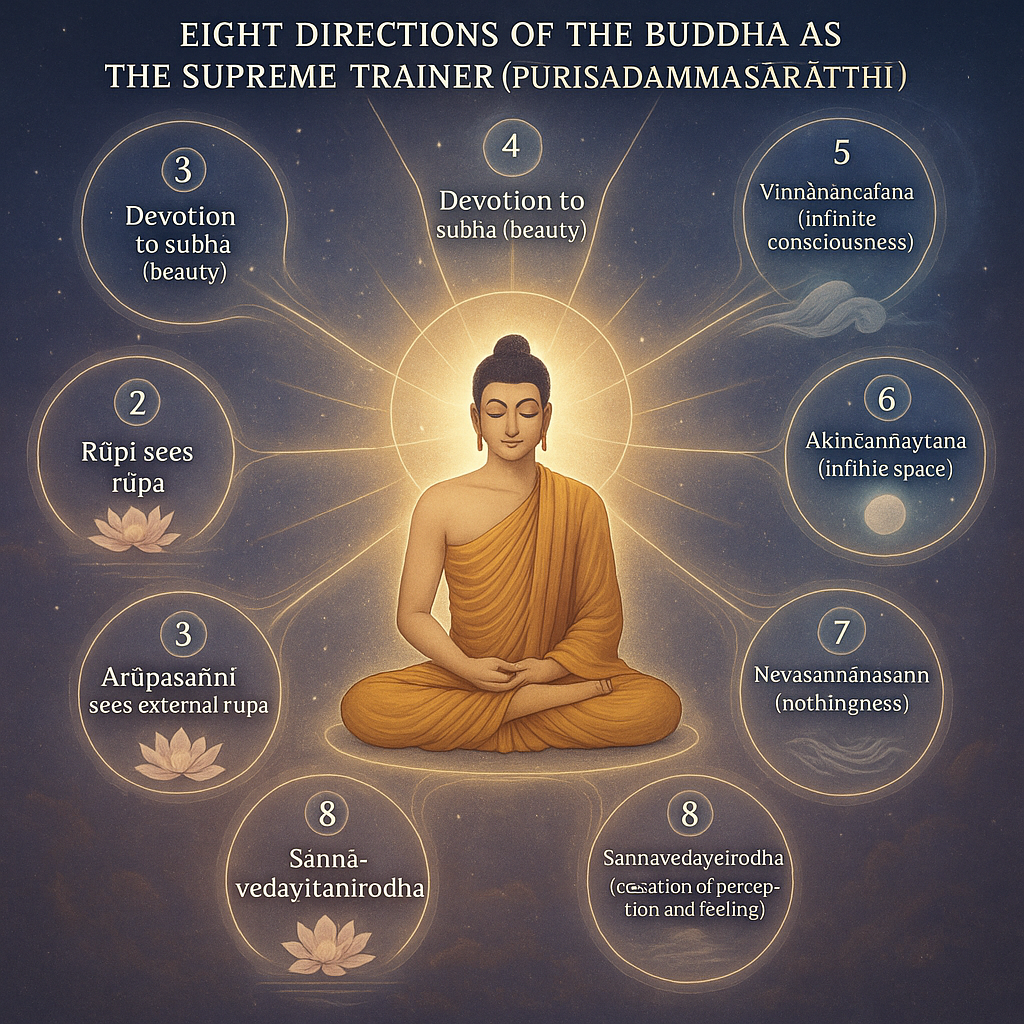
The progression moves through household joy, distress and neutrality; renunciation-based joy, distress and equanimity; equanimity based on diversity and unity; and finally atammayatā. The closing part of the discourse applies mindfulness and equanimity to the act of teaching itself and describes the eight directions in which the Tathāgata trains a person to be tamed.
Reading note: The complete Pāḷi and English material from the supplied source is retained below, while the analytical explanations have been moved into a separate Deep Dive. Etymological derivations, similes and several doctrinal comparisons are preserved as interpretations from the supplied source rather than presented as independent conclusions of the sutta.
01 1. Uddesa — The Sutta’s Structured Summary
“‘Cha ajjhattikāni āyatanāni veditabbāni, cha bāhirāni āyatanāni veditabbāni, cha viññāṇakāyā veditabbā, cha phassakāyā veditabbā, aṭṭhārasa manopavicārā veditabbā, chattiṁsa sattapadā veditabbā, tatra idaṁ nissāya idaṁ pajahatha, tayo satipaṭṭhānā yadariyo sevati yadariyo sevamāno satthā gaṇamanusāsitumarahati, so vuccati yoggācariyānaṁ anuttaro purisadammasārathī’ti— … ayamuddeso saḷāyatanavibhaṅgassa.”
“Six internal sense bases are to be understood, six external sense bases are to be understood, six kinds of consciousness groups are to be understood, six kinds of contact groups are to be understood, eighteen mental investigations are to be understood, thirty-six pathways of beings are to be understood. In regard to these, depending on this, abandon that. The noble one cultivates the three foundations of mindfulness—whoever cultivates them rightly, he is capable of instructing a group as a teacher. He is called the supreme guide of persons to be tamed. This is the summary (uddesa) of the Saḷāyatanavibhaṅga.”
02 2. Six Internal Sense Bases
“‘Cha ajjhattikāni āyatanāni veditabbānī’ti— iti kho panetaṁ vuttaṁ. Kiñcetaṁ paṭicca vuttaṁ?
‘Cakkhāyatanaṁ, sotāyatanaṁ, ghānāyatanaṁ, jivhāyatanaṁ, kāyāyatanaṁ, manāyatanaṁ— cha ajjhattikāni āyatanāni veditabbānī’ti— iti yaṁ taṁ vuttaṁ, idametaṁ paṭicca vuttaṁ.”
“Six internal sense bases are to be understood”—thus it was said. And what was the reason for saying this?
‘The eye base, ear base, nose base, tongue base, body base, mind base—these are the six internal sense bases to be understood.’ That is what was referred to.”
03 3. Six External Sense Bases
“‘Cha bāhirāni āyatanāni veditabbānī’ti— iti kho panetaṁ vuttaṁ. Kiñcetaṁ paṭicca vuttaṁ?
‘Rūpāyatanaṁ, saddāyatanaṁ, gandhāyatanaṁ, rasāyatanaṁ, phoṭṭhabbāyatanaṁ, dhammāyatanaṁ— cha bāhirāni āyatanāni veditabbānī’ti— iti yaṁ taṁ vuttaṁ, idametaṁ paṭicca vuttaṁ.”
“Six external sense bases are to be understood”—thus it was said. What was the reason for saying this?
‘The form base, sound base, smell base, taste base, tangible base, mental-object base—these are the six external sense bases to be understood.’ That is what was referred to.”
04 4. Six Consciousness Groups
“‘Cha viññāṇakāyā veditabbā’ti— iti kho panetaṁ vuttaṁ. Kiñcetaṁ paṭicca vuttaṁ?
‘Cakkhuviññāṇaṁ, sotaviññāṇaṁ, ghānaviññāṇaṁ, jivhāviññāṇaṁ, kāyaviññāṇaṁ, manoviññāṇaṁ— cha viññāṇakāyā veditabbā’ti— iti yaṁ taṁ vuttaṁ, idametaṁ paṭicca vuttaṁ.”
“Six groups of consciousness are to be understood”—thus it was said. What was the reason for saying this?
‘Eye-consciousness, ear-consciousness, nose-consciousness, tongue-consciousness, body-consciousness, mind-consciousness—these are the six consciousness groups to be understood.’ That is what was referred to.”
05 5. Six Contact Groups
“‘Cha phassakāyā veditabbā’ti— iti kho panetaṁ vuttaṁ. Kiñcetaṁ paṭicca vuttaṁ?
‘Cakkhusamphasso, sotasamphasso, ghānasamphasso, jivhāsamphasso, kāyasamphasso, manosamphasso— cha phassakāyā veditabbā’ti— iti yaṁ taṁ vuttaṁ, idametaṁ paṭicca vuttaṁ.”
“Six types of contact groups are to be understood”—thus it was said. What was the reason for saying this?
‘Eye-contact, ear-contact, nose-contact, tongue-contact, body-contact, mind-contact—these are the six contact groups to be understood.’ That is what was referred to.”
06 6. Eighteen Mental Investigations
“‘Aṭṭhārasa manopavicārā veditabbā’ti— iti kho panetaṁ vuttaṁ. Kiñcetaṁ paṭicca vuttaṁ?
‘Cakkhunā rūpaṁ disvā somanassaṭṭhānīyaṁ rūpaṁ upavicarati, domanassaṭṭhānīyaṁ rūpaṁ upavicarati, upekkhāṭṭhānīyaṁ rūpaṁ upavicarati.
Sotena saddaṁ sutvā …pe…
ghānena gandhaṁ ghāyitvā …
jivhāya rasaṁ sāyitvā …
kāyena phoṭṭhabbaṁ phusitvā …
manasā dhammaṁ viññāya somanassaṭṭhānīyaṁ dhammaṁ upavicarati, domanassaṭṭhānīyaṁ dhammaṁ upavicarati, upekkhāṭṭhānīyaṁ dhammaṁ upavicarati.
Iti cha somanassūpavicārā, cha domanassūpavicārā, cha upekkhūpavicārā, aṭṭhārasa manopavicārā veditabbā’ti— iti yaṁ taṁ vuttaṁ idametaṁ paṭicca vuttaṁ.”
“Eighteen mental investigations are to be understood”—thus it was said. What was the reason for saying this?
‘Seeing a form with the eye, one investigates with mental pleasure, mental displeasure, or equanimity.
Hearing a sound with the ear…
Smelling a scent with the nose…
Tasting a flavor with the tongue…
Touching a tangible with the body…
Knowing a mental object with the mind, one investigates it with mental pleasure, displeasure, or equanimity.
Thus, six investigations with pleasure, six with displeasure, and six with equanimity—these are the eighteen mental operations to be understood.’ That is what was referred to.”
07 7. Thirty-Six Paths of Experience
“‘Chattiṁsa sattapadā veditabbā’ti— iti kho panetaṁ vuttaṁ. Kiñcetaṁ paṭicca vuttaṁ?
Cha gehasitāni somanassāni, cha nekkhammasitāni somanassāni, cha gehasitāni domanassāni, cha nekkhammasitāni domanassāni, cha gehasitā upekkhā, cha nekkhammasitā upekkhā.”
“Thirty-six tracks (paths of sentient experience) are to be understood”—thus was it said. What was the reason for this?
Six sense-based pleasures tied to household life (gehasita), six renunciation-based pleasures (nekkhammasita), six sense-based displeasures, six renunciation-based displeasures, six sense-based neutralities, and six renunciation-based neutralities.
08 8. Six Household-Based Joys
Tattha katamāni cha gehasitāni somanassāni?
Cakkhuviññeyyānaṁ rūpānaṁ iṭṭhānaṁ kantānaṁ manāpānaṁ manoramānaṁ lokāmisapaṭisaṁyuttānaṁ paṭilābhaṁ vā paṭilābhato samanupassato, pubbe vā paṭiladdhapubbaṁ atītaṁ niruddhaṁ vipariṇataṁ samanussarato uppajjati somanassaṁ.
Yaṁ evarūpaṁ somanassaṁ, idaṁ vuccati gehasitaṁ somanassaṁ.
Sotaviññeyyānaṁ saddānaṁ iṭṭhānaṁ kantānaṁ manāpānaṁ manoramānaṁ lokāmisapaṭisaṁyuttānaṁ paṭilābhaṁ vā paṭilābhato samanupassato, pubbe vā paṭiladdhapubbaṁ atītaṁ niruddhaṁ vipariṇataṁ samanussarato uppajjati somanassaṁ.
Yaṁ evarūpaṁ somanassaṁ, idaṁ vuccati gehasitaṁ somanassaṁ.
Ghānaviññeyyānaṁ gandhānaṁ iṭṭhānaṁ kantānaṁ manāpānaṁ manoramānaṁ lokāmisapaṭisaṁyuttānaṁ paṭilābhaṁ vā paṭilābhato samanupassato, pubbe vā paṭiladdhapubbaṁ atītaṁ niruddhaṁ vipariṇataṁ samanussarato uppajjati somanassaṁ.
Yaṁ evarūpaṁ somanassaṁ, idaṁ vuccati gehasitaṁ somanassaṁ.
Jivhāviññeyyānaṁ rasānaṁ iṭṭhānaṁ kantānaṁ manāpānaṁ manoramānaṁ lokāmisapaṭisaṁyuttānaṁ paṭilābhaṁ vā paṭilābhato samanupassato, pubbe vā paṭiladdhapubbaṁ atītaṁ niruddhaṁ vipariṇataṁ samanussarato uppajjati somanassaṁ.
Yaṁ evarūpaṁ somanassaṁ, idaṁ vuccati gehasitaṁ somanassaṁ.
Kāyaviññeyyānaṁ phoṭṭhabbānaṁ iṭṭhānaṁ kantānaṁ manāpānaṁ manoramānaṁ lokāmisapaṭisaṁyuttānaṁ paṭilābhaṁ vā paṭilābhato samanupassato, pubbe vā paṭiladdhapubbaṁ atītaṁ niruddhaṁ vipariṇataṁ samanussarato uppajjati somanassaṁ.
Yaṁ evarūpaṁ somanassaṁ, idaṁ vuccati gehasitaṁ somanassaṁ.
Manoviññeyyānaṁ dhammānaṁ iṭṭhānaṁ kantānaṁ manāpānaṁ manoramānaṁ lokāmisapaṭisaṁyuttānaṁ paṭilābhaṁ vā paṭilābhato samanupassato, pubbe vā paṭiladdhapubbaṁ atītaṁ niruddhaṁ vipariṇataṁ samanussarato uppajjati somanassaṁ.
Yaṁ evarūpaṁ somanassaṁ, idaṁ vuccati gehasitaṁ somanassaṁ.
Imāni cha gehasitāni somanassāni.
What are the six sense-bound pleasures (gehasitāni somanassāni)?
With respect to visible forms cognizable by the eye, which are agreeable, lovely, pleasing, charming, and associated with worldly sensual gain—
when one obtains them, or observes them upon obtaining, or recollects forms that were formerly obtained in the past (now gone, ceased, or changed)—
then joy (somanassa) arises.
This kind of joy is called sense-bound joy.
Likewise, with respect to:
Sounds cognizable by the ear,
Smells cognizable by the nose,
Tastes cognizable by the tongue,
Tangible objects cognizable by the body,
Mental phenomena (ideas, concepts) cognizable by the mind—
All of which are agreeable, charming, and associated with worldly sensual pleasures— upon obtaining, observing, or remembering them— joy arises.
This is called sense-bound (household-associated) joy.
These are the six sense-bound joys (gehasitāni somanassāni).
09 9. Six Renunciation-Based Joys
Tattha katamāni cha nekkhammasitāni somanassāni?
Rūpānaṁ tveva aniccataṁ viditvā vipariṇāmavirāganirodhaṁ,
‘pubbe ceva rūpā, etarahi ca sabbe te rūpā aniccā dukkhā vipariṇāmadhammā’ti
evametaṁ yathābhūtaṁ sammappaññāya passato uppajjati somanassaṁ.
Yaṁ evarūpaṁ somanassaṁ, idaṁ vuccati nekkhammasitaṁ somanassaṁ.
Saddānaṁ tveva aniccataṁ viditvā vipariṇāmavirāganirodhaṁ,
‘pubbe ceva saddā, etarahi ca sabbe te saddā aniccā dukkhā vipariṇāmadhammā’ti
evametaṁ yathābhūtaṁ sammappaññāya passato uppajjati somanassaṁ.
Yaṁ evarūpaṁ somanassaṁ, idaṁ vuccati nekkhammasitaṁ somanassaṁ.
Gandhānaṁ tveva aniccataṁ viditvā vipariṇāmavirāganirodhaṁ,
‘pubbe ceva gandhā, etarahi ca sabbe te gandhā aniccā dukkhā vipariṇāmadhammā’ti
evametaṁ yathābhūtaṁ sammappaññāya passato uppajjati somanassaṁ.
Yaṁ evarūpaṁ somanassaṁ, idaṁ vuccati nekkhammasitaṁ somanassaṁ.
Rasānaṁ tveva aniccataṁ viditvā vipariṇāmavirāganirodhaṁ,
‘pubbe ceva rasā, etarahi ca sabbe te rasā aniccā dukkhā vipariṇāmadhammā’ti
evametaṁ yathābhūtaṁ sammappaññāya passato uppajjati somanassaṁ.
Yaṁ evarūpaṁ somanassaṁ, idaṁ vuccati nekkhammasitaṁ somanassaṁ.
Phoṭṭhabbānaṁ tveva aniccataṁ viditvā vipariṇāmavirāganirodhaṁ,
‘pubbe ceva phoṭṭhabbā, etarahi ca sabbe te phoṭṭhabbā aniccā dukkhā vipariṇāmadhammā’ti
evametaṁ yathābhūtaṁ sammappaññāya passato uppajjati somanassaṁ.
Yaṁ evarūpaṁ somanassaṁ, idaṁ vuccati nekkhammasitaṁ somanassaṁ.
Dhammānaṁ tveva aniccataṁ viditvā vipariṇāmavirāganirodhaṁ,
‘pubbe ceva dhammā, etarahi ca sabbe te dhammā aniccā dukkhā vipariṇāmadhammā’ti
evametaṁ yathābhūtaṁ sammappaññāya passato uppajjati somanassaṁ.
Yaṁ evarūpaṁ somanassaṁ, idaṁ vuccati nekkhammasitaṁ somanassaṁ.
Imāni cha nekkhammasitāni somanassāni.
What are the six renunciation-based joys (nekkhammasitāni somanassāni)?
Upon knowing the impermanence of forms (rūpā), and upon understanding their nature of change, fading, and cessation, seeing with right wisdom as it really is:
“Both past and present forms are impermanent, unsatisfactory, and subject to change,”
joy arises. This kind of joy is called renunciation-based joy.
Likewise, upon seeing the impermanence of sounds (saddā), smells (gandhā), tastes (rasā), tangibles (phoṭṭhabbā), and mental objects (dhammā), realizing with full wisdom that “both past and present [sense-objects] are impermanent, unsatisfactory, and subject to alteration,” joy arises. This is called renunciation-based joy. These are the six renunciation-based joys.
10 10. Six Household-Based Distresses
Cakkhuviññeyyānaṁ rūpānaṁ iṭṭhānaṁ kantānaṁ manāpānaṁ manoramānaṁ lokāmisapaṭisaṁyuttānaṁ appaṭilābhaṁ vā appaṭilābhato samanupassato, pubbe vā paṭiladdhapubbaṁ atītaṁ niruddhaṁ vipariṇataṁ samanussarato uppajjati domanassaṁ.
Yaṁ evarūpaṁ domanassaṁ, idaṁ vuccati gehasitaṁ domanassaṁ.
Sotaviññeyyānaṁ saddānaṁ iṭṭhānaṁ kantānaṁ manāpānaṁ manoramānaṁ lokāmisapaṭisaṁyuttānaṁ appaṭilābhaṁ vā appaṭilābhato samanupassato, pubbe vā paṭiladdhapubbaṁ atītaṁ niruddhaṁ vipariṇataṁ samanussarato uppajjati domanassaṁ.
Yaṁ evarūpaṁ domanassaṁ, idaṁ vuccati gehasitaṁ domanassaṁ.
Ghānaviññeyyānaṁ gandhānaṁ iṭṭhānaṁ kantānaṁ manāpānaṁ manoramānaṁ lokāmisapaṭisaṁyuttānaṁ appaṭilābhaṁ vā appaṭilābhato samanupassato, pubbe vā paṭiladdhapubbaṁ atītaṁ niruddhaṁ vipariṇataṁ samanussarato uppajjati domanassaṁ.
Yaṁ evarūpaṁ domanassaṁ, idaṁ vuccati gehasitaṁ domanassaṁ.
Jivhāviññeyyānaṁ rasānaṁ iṭṭhānaṁ kantānaṁ manāpānaṁ manoramānaṁ lokāmisapaṭisaṁyuttānaṁ appaṭilābhaṁ vā appaṭilābhato samanupassato, pubbe vā paṭiladdhapubbaṁ atītaṁ niruddhaṁ vipariṇataṁ samanussarato uppajjati domanassaṁ.
Yaṁ evarūpaṁ domanassaṁ, idaṁ vuccati gehasitaṁ domanassaṁ.
Kāyaviññeyyānaṁ phoṭṭhabbānaṁ iṭṭhānaṁ kantānaṁ manāpānaṁ manoramānaṁ lokāmisapaṭisaṁyuttānaṁ appaṭilābhaṁ vā appaṭilābhato samanupassato,
pubbe vā paṭiladdhapubbaṁ atītaṁ niruddhaṁ vipariṇataṁ samanussarato uppajjati domanassaṁ.
Yaṁ evarūpaṁ domanassaṁ, idaṁ vuccati gehasitaṁ domanassaṁ. Manoviññeyyānaṁ dhammānaṁ iṭṭhānaṁ kantānaṁ manāpānaṁ manoramānaṁ lokāmisapaṭisaṁyuttānaṁ
appaṭilābhaṁ vā appaṭilābhato samanupassato,
pubbe vā paṭiladdhapubbaṁ atītaṁ niruddhaṁ vipariṇataṁ samanussarato uppajjati domanassaṁ.
Yaṁ evarūpaṁ domanassaṁ, idaṁ vuccati gehasitaṁ domanassaṁ.
Imāni cha gehasitāni domanassāni.
🔶 What are the six sense-bound griefs (gehasitāni domanassāni)?
With respect to visual forms (rūpā) cognizable by the eye, which are agreeable, lovely, pleasing, charming, and connected with worldly sensual gratification (lokāmisa)— when one does not obtain them, or reflects on not obtaining them, or when one recollects a formerly obtained form that is now past, ceased, or changed— grief (domanassa) arises. This kind of grief is called sense-bound grief. Likewise, this applies to:
Sounds cognizable by the ear, Smells by the nose, Tastes by the tongue, Tangible objects by the body, Mental phenomena (ideas, views, memories) by the mind, When they are not obtained, or one reflects on not having obtained them,
or recollects their previous presence and current absence,
then sorrow or mental pain arises. This is called sense-bound grief. and these are the six sense-bound griefs.
11 11. Six Renunciation-Based Distresses
Tattha katamāni cha nekkhammasitāni domanassāni?
Rūpānaṁ tveva aniccataṁ viditvā, vipariṇāmavirāganirodhaṁ,
‘pubbe ceva rūpā, etarahi ca sabbe te rūpā aniccā dukkhā vipariṇāmadhammā’ti
evametaṁ yathābhūtaṁ sammappaññāya disvā,
anuttaresu vimokkhesu pihaṁ upaṭṭhāpeti:
‘Kudāssu nāmāhaṁ tadāyatanaṁ upasampajja viharissāmi,
yadariyā etarahi āyatanaṁ upasampajja viharantī’ti.
Iti anuttaresu vimokkhesu pihaṁ upaṭṭhāpayato uppajjati pihāpaccayā domanassaṁ.
Yaṁ evarūpaṁ domanassaṁ, idaṁ vuccati nekkhammasitaṁ domanassaṁ.
Saddānaṁ tveva aniccataṁ viditvā, vipariṇāmavirāganirodhaṁ,
‘pubbe ceva saddā, etarahi ca sabbe te saddā aniccā dukkhā vipariṇāmadhammā’ti
evametaṁ yathābhūtaṁ sammappaññāya disvā,
anuttaresu vimokkhesu pihaṁ upaṭṭhāpeti:
‘Kudāssu nāmāhaṁ tadāyatanaṁ upasampajja viharissāmi,
yadariyā etarahi āyatanaṁ upasampajja viharantī’ti.
Iti anuttaresu vimokkhesu pihaṁ upaṭṭhāpayato uppajjati pihāpaccayā domanassaṁ.
Yaṁ evarūpaṁ domanassaṁ, idaṁ vuccati nekkhammasitaṁ domanassaṁ.
Gandhānaṁ tveva aniccataṁ viditvā, vipariṇāmavirāganirodhaṁ,
‘pubbe ceva gandhā, etarahi ca sabbe te gandhā aniccā dukkhā vipariṇāmadhammā’ti
evametaṁ yathābhūtaṁ sammappaññāya disvā,
anuttaresu vimokkhesu pihaṁ upaṭṭhāpeti:
‘Kudāssu nāmāhaṁ tadāyatanaṁ upasampajja viharissāmi,
yadariyā etarahi āyatanaṁ upasampajja viharantī’ti.
Iti anuttaresu vimokkhesu pihaṁ upaṭṭhāpayato uppajjati pihāpaccayā domanassaṁ.
Yaṁ evarūpaṁ domanassaṁ, idaṁ vuccati nekkhammasitaṁ domanassaṁ.
Rasānaṁ tveva aniccataṁ viditvā, vipariṇāmavirāganirodhaṁ,
‘pubbe ceva rasā, etarahi ca sabbe te rasā aniccā dukkhā vipariṇāmadhammā’ti
evametaṁ yathābhūtaṁ sammappaññāya disvā,
anuttaresu vimokkhesu pihaṁ upaṭṭhāpeti:
‘Kudāssu nāmāhaṁ tadāyatanaṁ upasampajja viharissāmi,
yadariyā etarahi āyatanaṁ upasampajja viharantī’ti.
Iti anuttaresu vimokkhesu pihaṁ upaṭṭhāpayato uppajjati pihāpaccayā domanassaṁ.
Yaṁ evarūpaṁ domanassaṁ, idaṁ vuccati nekkhammasitaṁ domanassaṁ.
Phoṭṭhabbānaṁ tveva aniccataṁ viditvā, vipariṇāmavirāganirodhaṁ,
‘pubbe ceva phoṭṭhabbā, etarahi ca sabbe te phoṭṭhabbā aniccā dukkhā vipariṇāmadhammā’ti
evametaṁ yathābhūtaṁ sammappaññāya disvā,
anuttaresu vimokkhesu pihaṁ upaṭṭhāpeti:
‘Kudāssu nāmāhaṁ tadāyatanaṁ upasampajja viharissāmi,
yadariyā etarahi āyatanaṁ upasampajja viharantī’ti.
Iti anuttaresu vimokkhesu pihaṁ upaṭṭhāpayato uppajjati pihāpaccayā domanassaṁ.
Yaṁ evarūpaṁ domanassaṁ, idaṁ vuccati nekkhammasitaṁ domanassaṁ.
Dhammānaṁ tveva aniccataṁ viditvā, vipariṇāmavirāganirodhaṁ,
‘pubbe ceva dhammā, etarahi ca sabbe te dhammā aniccā dukkhā vipariṇāmadhammā’ti
evametaṁ yathābhūtaṁ sammappaññāya disvā,
anuttaresu vimokkhesu pihaṁ upaṭṭhāpeti:
‘Kudāssu nāmāhaṁ tadāyatanaṁ upasampajja viharissāmi,
yadariyā etarahi āyatanaṁ upasampajja viharantī’ti.
Iti anuttaresu vimokkhesu pihaṁ upaṭṭhāpayato uppajjati pihāpaccayā domanassaṁ.
Yaṁ evarūpaṁ domanassaṁ, idaṁ vuccati nekkhammasitaṁ domanassaṁ.
Imāni cha nekkhammasitāni domanassāni.
🔶What are the six renunciation-based griefs?
Upon knowing the impermanence of forms, and understanding their alteration, fading, and cessation, seeing rightly and as it really is:
“Both past and present forms are impermanent, unsatisfactory, and subject to change,”
one establishes a longing (pihā) toward the supreme liberations:
“When indeed will I attain and dwell in that domain where the noble ones now dwell?”
As one maintains this noble longing for the supreme liberations, grief arises due to longing.
This kind of grief is called renunciation-based grief.
Similarly for: Sounds (sadda), Smells (gandha), Tastes (rasa), Tangibles (phoṭṭhabba), Mental objects (dhamma): Through deep contemplation of their impermanence and nature of cessation,
one longs for liberation and grieves from not yet attaining it.
This is called renunciation-based grief. These are the six renunciation-based griefs.
🔶
12 12. Six Household-Based Equanimities
Cakkhunā rūpaṁ disvā uppajjati upekkhā bālassa mūḷhassa puthujjanassa,
anodhijinassa, avipākajinassa, anādīnavadassāvino, assutavato puthujjanassa.
Yā evarūpā upekkhā, rūpaṁ sā nātivattati.
Tasmā sā upekkhā ‘gehasitā’ti vuccati.
Sotena saddaṁ sutvā uppajjati upekkhā bālassa mūḷhassa puthujjanassa,
anodhijinassa, avipākajinassa, anādīnavadassāvino, assutavato puthujjanassa.
Yā evarūpā upekkhā, saddaṁ sā nātivattati.
Tasmā sā upekkhā ‘gehasitā’ti vuccati.
Ghānena gandhaṁ ghāyitvā uppajjati upekkhā bālassa mūḷhassa puthujjanassa,
anodhijinassa, avipākajinassa, anādīnavadassāvino, assutavato puthujjanassa.
Yā evarūpā upekkhā, gandhaṁ sā nātivattati.
Tasmā sā upekkhā ‘gehasitā’ti vuccati.
Jivhāya rasaṁ sāyitvā uppajjati upekkhā bālassa mūḷhassa puthujjanassa,
anodhijinassa, avipākajinassa, anādīnavadassāvino, assutavato puthujjanassa.
Yā evarūpā upekkhā, rasaṁ sā nātivattati.
Tasmā sā upekkhā ‘gehasitā’ti vuccati.
Kāyena phoṭṭhabbaṁ phusitvā uppajjati upekkhā bālassa mūḷhassa puthujjanassa,
anodhijinassa, avipākajinassa, anādīnavadassāvino, assutavato puthujjanassa.
Yā evarūpā upekkhā, phoṭṭhabbaṁ sā nātivattati.
Tasmā sā upekkhā ‘gehasitā’ti vuccati.
Manasā dhammaṁ viññāya uppajjati upekkhā bālassa mūḷhassa puthujjanassa,
anodhijinassa, avipākajinassa, anādīnavadassāvino, assutavato puthujjanassa.
Yā evarūpā upekkhā, dhammaṁ sā nātivattati.
Tasmā sā upekkhā ‘gehasitā’ti vuccati. Imā cha gehasitā upekkhā.
🔶 What are the six sense-based equanimities (gehasitā upekkhā)?
Upon seeing a form with the eye, equanimity arises in a foolish, deluded ordinary person (puthujjana), who has not transcended desire, who has not known the ripening of actions,
who does not see the danger, who is uninstructed in the teachings. Such equanimity does not surpass the form. Therefore, it is called sense-based equanimity.
Likewise, upon: Hearing sounds with the ear, Smelling odors with the nose, Tasting flavors with the tongue, Touching tangibles with the body, Cognizing ideas with the mind— Equanimity arises in the same kind of uninstructed, deluded worldling, and it does not transcend the object.
Hence, it is called gehasitā upekkhā (equanimity tied to household life and sensual perception). These are the six sense-based equanimities.
13 13. Six Renunciation-Based Equanimities
Tattha katamā cha nekkhammasitā upekkhā?
Rūpānaṁ tveva aniccataṁ viditvā vipariṇāmavirāganirodhaṁ, ‘pubbe ceva rūpā etarahi ca sabbe te rūpā aniccā dukkhā vipariṇāmadhammā’ti evametaṁ yathābhūtaṁ sammappaññāya passato uppajjati upekkhā.
Yā evarūpā upekkhā, rūpaṁ sā ativattati. Tasmā sā upekkhā ‘nekkhammasitā’ti vuccati.
Saddānaṁ tveva aniccataṁ viditvā vipariṇāmavirāganirodhaṁ, ‘pubbe ceva saddā etarahi ca sabbe te saddā aniccā dukkhā vipariṇāmadhammā’ti evametaṁ yathābhūtaṁ sammappaññāya passato uppajjati upekkhā.
Yā evarūpā upekkhā, saddaṁ sā ativattati. Tasmā sā upekkhā ‘nekkhammasitā’ti vuccati.
Gandhānaṁ tveva aniccataṁ viditvā vipariṇāmavirāganirodhaṁ, ‘pubbe ceva gandhā etarahi ca sabbe te gandhā aniccā dukkhā vipariṇāmadhammā’ti evametaṁ yathābhūtaṁ sammappaññāya passato uppajjati upekkhā.
Yā evarūpā upekkhā, gandhaṁ sā ativattati. Tasmā sā upekkhā ‘nekkhammasitā’ti vuccati.
Rasānaṁ tveva aniccataṁ viditvā vipariṇāmavirāganirodhaṁ, ‘pubbe ceva rasā etarahi ca sabbe te rasā aniccā dukkhā vipariṇāmadhammā’ti evametaṁ yathābhūtaṁ sammappaññāya passato uppajjati upekkhā.
Yā evarūpā upekkhā, rasaṁ sā ativattati. Tasmā sā upekkhā ‘nekkhammasitā’ti vuccati.
Phoṭṭhabbānaṁ tveva aniccataṁ viditvā vipariṇāmavirāganirodhaṁ, ‘pubbe ceva phoṭṭhabbā etarahi ca sabbe te phoṭṭhabbā aniccā dukkhā vipariṇāmadhammā’ti evametaṁ yathābhūtaṁ sammappaññāya passato uppajjati upekkhā.
Yā evarūpā upekkhā, phoṭṭhabbaṁ sā ativattati. Tasmā sā upekkhā ‘nekkhammasitā’ti vuccati.
Dhammānaṁ tveva aniccataṁ viditvā vipariṇāmavirāganirodhaṁ, ‘pubbe ceva dhammā etarahi ca sabbe te dhammā aniccā dukkhā vipariṇāmadhammā’ti evametaṁ yathābhūtaṁ sammappaññāya passato uppajjati upekkhā.
Yā evarūpā upekkhā, dhammaṁ sā ativattati. Tasmā sā upekkhā ‘nekkhammasitā’ti vuccati.
Imā cha nekkhammasitā upekkhā.
What are the six equanimities based on renunciation?
Seeing the impermanence of forms, knowing their change, fading away, and cessation—realizing with right wisdom that “both past and present forms are impermanent, unsatisfactory, and subject to change,” equanimity arises.
Such equanimity surpasses (ativattati) the form. Therefore, it is called equanimity based on renunciation.
Likewise for: Sounds (sadda), Smells (gandha), Tastes (rasa), Tangibles (phoṭṭhabba), Mental objects (dhamma), Equanimity arises not due to dull indifference, but from insight into reality. That equanimity is said to transcend its object. These are the six nekkhammasitā upekkhā.
‘Tatra idaṁ nissāya idaṁ pajahathā’ti— iti kho panetaṁ vuttaṁ; kiñcetaṁ paṭicca vuttaṁ?
“In dependence on this, abandon that”—thus was it said. What was the reason for saying this?
14 14. Abandon Household Joy through Renunciation-Based Joy
Tatra, bhikkhave, yāni cha nekkhammasitāni somanassāni, tāni nissāya, tāni āgamma, yāni cha gehasitāni somanassāni, tāni pajahatha, tāni samatikkamatha. Evametesaṁ pahānaṁ hoti, evametesaṁ samatikkamo hoti.
There, bhikkhus, relying on the six renunciation-based joys, approaching them, abandon the six sense-bound joys. Transcend them. Thus their abandonment comes to be; thus their transcendence comes to be.
15 15. Abandon Household Distress through Renunciation-Based Distress
Tatra, bhikkhave, yāni cha nekkhammasitāni domanassāni, tāni nissāya, tāni āgamma, yāni cha gehasitāni domanassāni, tāni pajahatha, tāni samatikkamatha. Evametesaṁ pahānaṁ hoti, evametesaṁ samatikkamo hoti.
Translation:
There, bhikkhus, relying on the six renunciation-based griefs, approaching them, abandon the six household-based griefs. Transcend them. Thus their abandonment comes to be; thus their transcendence comes to be.
16 16. Abandon Household Equanimity through Renunciation-Based Equanimity
Tatra, bhikkhave, yā cha nekkhammasitā upekkhā, tā nissāya, tā āgamma, yā cha gehasitā upekkhā, tā pajahatha, tā samatikkamatha. Evametāsaṁ pahānaṁ hoti, evametāsaṁ samatikkamo hoti.
There, bhikkhus, relying on the equanimity rooted in renunciation, abandon the equanimity tied to household life. Transcend it. Thus their abandonment comes to be; thus their transcendence comes to be.
17 17. Abandon Renunciation-Based Distress through Renunciation-Based Joy
Tatra, bhikkhave, yāni cha nekkhammasitāni somanassāni, tāni nissāya, tāni āgamma, yāni cha nekkhammasitāni domanassāni, tāni pajahatha, tāni samatikkamatha. Evametesaṁ pahānaṁ hoti, evametesaṁ samatikkamo hoti.
Relying on the renunciation-based joys, approaching them, abandon the renunciation-based griefs.
Thus their abandonment and transcendence come to be.
18 18. Abandon Renunciation-Based Joy through Renunciation-Based Equanimity
🔷 V. Abandoning Nekkhammasita Somanassa through Nekkhammasita Upekkhā
Tatra, bhikkhave, yā cha nekkhammasitā upekkhā, tā nissāya, tā āgamma, yāni cha nekkhammasitāni somanassāni, tāni pajahatha, tāni samatikkamatha. Evametesaṁ pahānaṁ hoti, evametesaṁ samatikkamo hoti.
Relying on equanimity based on renunciation, approaching it, abandon the renunciation-based joys.
Thus their abandonment and transcendence come to be.
19 19. Equanimity Based on Diversity and Equanimity Based on Unity
Atthi, bhikkhave, upekkhā nānattā nānattasitā, atthi upekkhā ekattā ekattasitā.
There is, bhikkhus, equanimity rooted in diversity and dependence on diversity (nānattā nānattasitā), and there is equanimity rooted in unity and dependence on unity (ekattā ekattasitā).
Katamā ca, bhikkhave, upekkhā nānattā nānattasitā?
Atthi, bhikkhave, upekkhā rūpesu, atthi saddesu, atthi gandhesu, atthi rasesu, atthi phoṭṭhabbesu—
Ayaṁ, bhikkhave, upekkhā nānattā nānattasitā.
And what, bhikkhus, is equanimity rooted in multiplicity and dependent on multiplicity? There is equanimity toward forms, toward sounds, toward smells, toward tastes, toward tangibles—this, bhikkhus, is equanimity in diversity, based on diversity.
Katamā ca, bhikkhave, upekkhā ekattā ekattasitā?
Atthi, bhikkhave, upekkhā ākāsānañcāyatananissitā,
atthi viññāṇañcāyatananissitā,
atthi ākiñcaññāyatananissitā,
atthi nevasaññānāsaññāyatananissitā—
Ayaṁ, bhikkhave, upekkhā ekattā ekattasitā.
And what, bhikkhus, is equanimity rooted in unity and dependent on unity? There is equanimity dependent on the base of infinite space, on the base of infinite consciousness, on the base of nothingness, and on the base of neither-perception-nor-non-perception—this, bhikkhus, is equanimity in unity, based on unity.
Tatra, bhikkhave, yāyaṁ upekkhā ekattā ekattasitā, taṁ nissāya, taṁ āgamma, yāyaṁ upekkhā nānattā nānattasitā, taṁ pajahatha, taṁ samatikkamatha. Evametissā pahānaṁ hoti, evametissā samatikkamo hoti.
Therefore, bhikkhus, relying on equanimity that is based on unity, depending on it, abandon and transcend equanimity based on multiplicity. Thus its abandonment comes to be; thus its transcendence comes to be.
20 20. Beyond Unity — Atammayatā
Atammayataṁ, bhikkhave, nissāya, atammayataṁ āgamma, yāyaṁ upekkhā ekattā ekattasitā, taṁ pajahatha, taṁ samatikkamatha. Evametissā pahānaṁ hoti, evametissā samatikkamo hoti.
‘Tatra idaṁ nissāya idaṁ pajahathā’ti— iti yaṁ taṁ vuttaṁ, idametaṁ paṭicca vuttaṁ.
Bhikkhus, relying on atammayatā, approaching atammayatā, abandon and transcend even that equanimity which is based on unity.
Thus the abandoning and transcendence of that comes to be.
“This — depending on this, abandon that” — this is what was referred to.
21 21. Three Satipaṭṭhānas in the Context of Teaching
‘Tayo satipaṭṭhānā yadariyo sevati, yadariyo sevamāno satthā gaṇamanusāsitumarahatī’ti— iti kho panetaṁ vuttaṁ; kiñcetaṁ paṭicca vuttaṁ?
“The three foundations of mindfulness that the noble one cultivates—whoever cultivates them rightly is worthy to instruct a group as a teacher”—thus was it said. What was the reason for saying this?
22 22. First Teaching Satipaṭṭhāna — Non-Receptive Disciples
Idha, bhikkhave, satthā sāvakānaṁ dhammaṁ deseti anukampako hitesī anukampaṁ upādāya:
‘Idaṁ vo hitāya, idaṁ vo sukhāyā’ti.
Tassa sāvakā na sussūsanti, na sotaṁ odahanti, na aññā cittaṁ upaṭṭhapenti, vokkamma ca satthusāsanā vattanti. Tatra, bhikkhave, tathāgato na ceva anattamano hoti, na ca anattamanataṁ paṭisaṁvedeti, anavassuto ca viharati sato sampajāno. Idaṁ, bhikkhave, paṭhamaṁ satipaṭṭhānaṁ yadariyo sevati, yadariyo sevamāno satthā gaṇamanusāsitumarahati.
Here, bhikkhus, the teacher gives a Dhamma teaching to the disciples, motivated by compassion and wishing their welfare:
“This is for your benefit, this is for your happiness.”
But those disciples do not listen, do not lend an ear, do not establish an understanding mind, and they turn away from the teacher’s instruction. Therein, bhikkhus, the Tathāgata is not disheartened, nor does he experience displeasure. He abides untroubled, mindful, and fully aware.
This, bhikkhus, is the first foundation of mindfulness that the noble one cultivates—he who cultivates it rightly is capable of instructing a group.
23 23. Second Teaching Satipaṭṭhāna — Mixed Response
Puna caparaṁ, bhikkhave, satthā sāvakānaṁ dhammaṁ deseti anukampako hitesī anukampaṁ upādāya:
‘Idaṁ vo hitāya, idaṁ vo sukhāyā’ti. Tassa ekacce sāvakā na sussūsanti, na sotaṁ odahanti, na aññā cittaṁ upaṭṭhapenti, vokkamma ca satthusāsanā vattanti;
ekacce sāvakā sussūsanti, sotaṁ odahanti, aññā cittaṁ upaṭṭhapenti, na ca vokkamma satthusāsanā vattanti. Tatra, bhikkhave, tathāgato na ceva anattamano hoti, na ca anattamanataṁ paṭisaṁvedeti;
na ca attamano hoti, na ca attamanataṁ paṭisaṁvedeti.
Anattamanatā ca attamanatā ca— tadubhayaṁ abhinivajjetvā upekkhako viharati sato sampajāno.
Idaṁ vuccati, bhikkhave, dutiyaṁ satipaṭṭhānaṁ yadariyo sevati, yadariyo sevamāno satthā gaṇamanusāsitumarahati.
Furthermore, bhikkhus, the teacher teaches the Dhamma out of compassion:
“This is for your benefit, this is for your happiness.” Some disciples do not listen, do not lend an ear, do not open their minds, and turn away from the instruction.
But some disciples do listen, lend an ear, open their minds, and do not turn away from the teacher’s instruction.
In that situation, the Tathāgata neither becomes dejected nor elated.
He avoids both sorrow and satisfaction, and remains equanimous, mindful, and clearly aware.
This is the second foundation of mindfulness a noble one cultivates; such a person is fit to instruct a group.
24 24. Third Teaching Satipaṭṭhāna — Complete Receptivity
Puna caparaṁ, bhikkhave, satthā sāvakānaṁ dhammaṁ deseti anukampako hitesī anukampaṁ upādāya:
‘Idaṁ vo hitāya, idaṁ vo sukhāyā’ti.
Tassa sāvakā sussūsanti, sotaṁ odahanti, aññācittaṁ upaṭṭhapenti, na ca vokkamma satthusāsanā vattanti.
Tatra, bhikkhave, tathāgato attamano ceva hoti, attamanatañca paṭisaṁvedeti, anavassuto ca viharati sato sampajāno.
Idaṁ vuccati, bhikkhave, tatiyaṁ satipaṭṭhānaṁ yadariyo sevati, yadariyo sevamāno satthā gaṇamanusāsitumarahati. Furthermore, bhikkhus, the teacher compassionately teaches the Dhamma:
“This is for your benefit, this is for your happiness.”
And the disciples listen attentively, lend an ear, open their minds, and do not turn away from his instruction.
In that case, the Tathāgata is pleased and experiences gladness, yet remains undisturbed, mindful, and clearly aware.
This is the third foundation of mindfulness a noble one cultivates; such a person is capable of guiding a group.
25 25. Why These Are Called Three Satipaṭṭhānas Here
🔷 So vuccati: Yoggācariyānaṁ Anuttaro Purisadammasārathī
‘So vuccati yoggācariyānaṁ anuttaro purisadammasārathī’ti— iti kho panetaṁ vuttaṁ. Kiñcetaṁ paṭicca vuttaṁ?
Hatthidamakena, bhikkhave, hatthidammo sārito ekaṁyeva disaṁ dhāvati— puratthimaṁ vā pacchimaṁ vā uttaraṁ vā dakkhiṇaṁ vā. Assadamakena, bhikkhave, assadammo sārito ekaññeva disaṁ dhāvati— puratthimaṁ vā pacchimaṁ vā uttaraṁ vā dakkhiṇaṁ vā. Godamakena, bhikkhave, godammo sārito ekaññeva disaṁ dhāvati— puratthimaṁ vā pacchimaṁ vā uttaraṁ vā dakkhiṇaṁ vā. Tathāgatena hi, bhikkhave, arahatā sammāsambuddhena purisadammo sārito aṭṭha disā vidhāvati.
“He is called the supreme charioteer of persons to be trained”—thus was it said. What was the reason for this?
A mahout (hatthidamaka) trains an elephant, and it runs only in one direction—east, west, north, or south.
A horse-trainer (assadamaka) trains a horse, and it too runs only in one direction.
A cattle-trainer (godamaka) trains an ox, and it moves in just one direction. But when the Tathāgata, the Arahant, the Fully Enlightened One trains a person to be tamed, they can go forth in all eight directions.
26 26. Eight Directions of the Supreme Trainer
Source note: the supplied article combines translation and explanation in this final unit; that wording is retained here rather than silently replacing it with a new translation.
Rūpī rūpāni passati— ayaṁ ekā disā.
Ajjhattaṁ arūpasaññī bahiddhā rūpāni passati— ayaṁ dutiyā disā.
Subhantveva adhimutto hoti— ayaṁ tatiyā disā.
Sabbaso rūpasaññānaṁ samatikkamā, paṭighasaññānaṁ atthaṅgamā, nānattasaññānaṁ amanasikārā:
‘Ananto ākāso’ti ākāsānañcāyatanaṁ upasampajja viharati— ayaṁ catutthī disā.
“Rūpī rūpāni passati” – A being with form sees forms → this is ordinary jhāna with form → First direction.
“Ajjhattaṁ arūpasaññī, bahiddhā rūpāni passati” – Internally abandoning form, but still perceives external forms → Second direction.
“Subhantveva adhimutto hoti” – Fully devoted to beauty → meditation based on subha-nimitta, refined visual or conceptual form → Third direction.
“Sabbaso rūpasaññānaṁ samatikkamā… ākāsānañcāyatanaṁ upasampajja” – Fully transcending perceptions of form, resistance (paṭigha), and diversity → enters the base of infinite space → Fourth direction.
Sabbaso ākāsānañcāyatanaṁ samatikkamma, ‘anantaṁ viññāṇan’ti viññāṇañcāyatanaṁ upasampajja viharati— ayaṁ pañcamī disā.
Sabbaso viññāṇañcāyatanaṁ samatikkamma, ‘natthi kiñcī’ti ākiñcaññāyatanaṁ upasampajja viharati— ayaṁ chaṭṭhī disā.
Sabbaso ākiñcaññāyatanaṁ samatikkamma, nevasaññānāsaññāyatanaṁ upasampajja viharati— ayaṁ sattamī disā.
Sabbaso nevasaññānāsaññāyatanaṁ samatikkamma, saññāvedayitanirodhaṁ upasampajja viharati— ayaṁ aṭṭhamī disā.
Viññāṇañcāyatana – Base of infinite consciousness → Fifth direction
Ākiñcaññāyatana – Base of nothingness → “There is nothing at all” → Sixth direction
Nevasaññānāsaññāyatana – Base of neither perception nor non-perception → Seventh direction
Saññāvedayitanirodha – Cessation of perception and feeling → Eighth and final direction
Tathāgatena, bhikkhave, arahatā sammāsambuddhena purisadammo sārito imā aṭṭha disā vidhāvati.
So vuccati: ‘Yoggācariyānaṁ anuttaro purisadammasārathī’ti— iti yaṁ taṁ vuttaṁ, idametaṁ paṭicca vuttaṁ”ti.
Thus, bhikkhus, when the Tathāgata, the Arahant, the Fully Awakened One trains a person to be tamed, that person is trained across all eight directions.
Therefore he is called: “The Supreme Trainer of Persons to Be Tamed.”
That is what was meant by the phrase.
Key Points
The structure of MN 137 in eight points
These rows keep the sutta’s architecture visible before entering the analytical detail.
1
The field of experience is structured through six internal and six external bases. Eye through mind meet forms through mental objects.
2
Each sense door operates dependently. Faculty, object and corresponding consciousness condition contact.
3
The mind’s affective engagement is classified into eighteen investigations. Six each connected with somanassa, domanassa and upekkhā.
4
Those eighteen are further divided into thirty-six household-based and renunciation-based paths. The distinction is not the object alone, but how the mind relates to it.
5
The method is graded replacement rather than mere suppression. Relying on a higher response, the practitioner abandons and transcends a lower one.
6
Not every upekkhā is liberative. Household-based neutrality remains tied to the object; renunciation-based equanimity is presented as surpassing it.
7
Even refined unity is not the endpoint. Equanimity based on unity is itself abandoned by relying on atammayatā.
8
The discourse closes with the teacher’s mindful equanimity and the eight directions of training. Practice extends from sense experience to refined meditative attainments and cessation.
01 Āyatana, the six sense doors, and the architecture of experience
Āyatana — Etymology and the Grazing-Field Metaphor
Let us first begin with the etymology of “āyatana” and then proceed to MN 137: Saḷāyatanavibhaṅgasutta (The Exposition of the Six Sense Bases), exploring it paragraph by paragraph with full Pāli and detailed translation.
🔍 Etymological Analysis of Āyatana
Pāli: āyatana (आयतन)
Sanskrit: āyatana (आयतन)
Root: The word is a compound or derived term with the following components:
ā-: a prefix indicating direction toward, upon, over, or completeness/intensity.
√yam (root verb): to extend, stretch out, control, or restrain.
-ta / -ana: noun-forming suffix indicating a place or state.
Thus, ā- + √yam → āyatati (to extend towards, to reach out, to stretch forth).
Then with the suffix -ana → āyatana: “that which is extended,” “a field,” “a sphere,” or “a domain.”
Meaning:
Literal: A stretched-out place or sphere.
Functional Usage in Suttas: Sense sphere: fields where consciousness and contact operate (e.g., eye and forms).
Mental domain: e.g., the six internal and six external āyatanas. Liberative dimensions: in higher Dhamma, as in animitta–āyatana, suññata-āyatana, etc. In practical terms, āyatana refers to the “domain” where sense consciousness arises through the contact of a sense faculty with a sense object. It can also refer to meditative or supramundane domains.
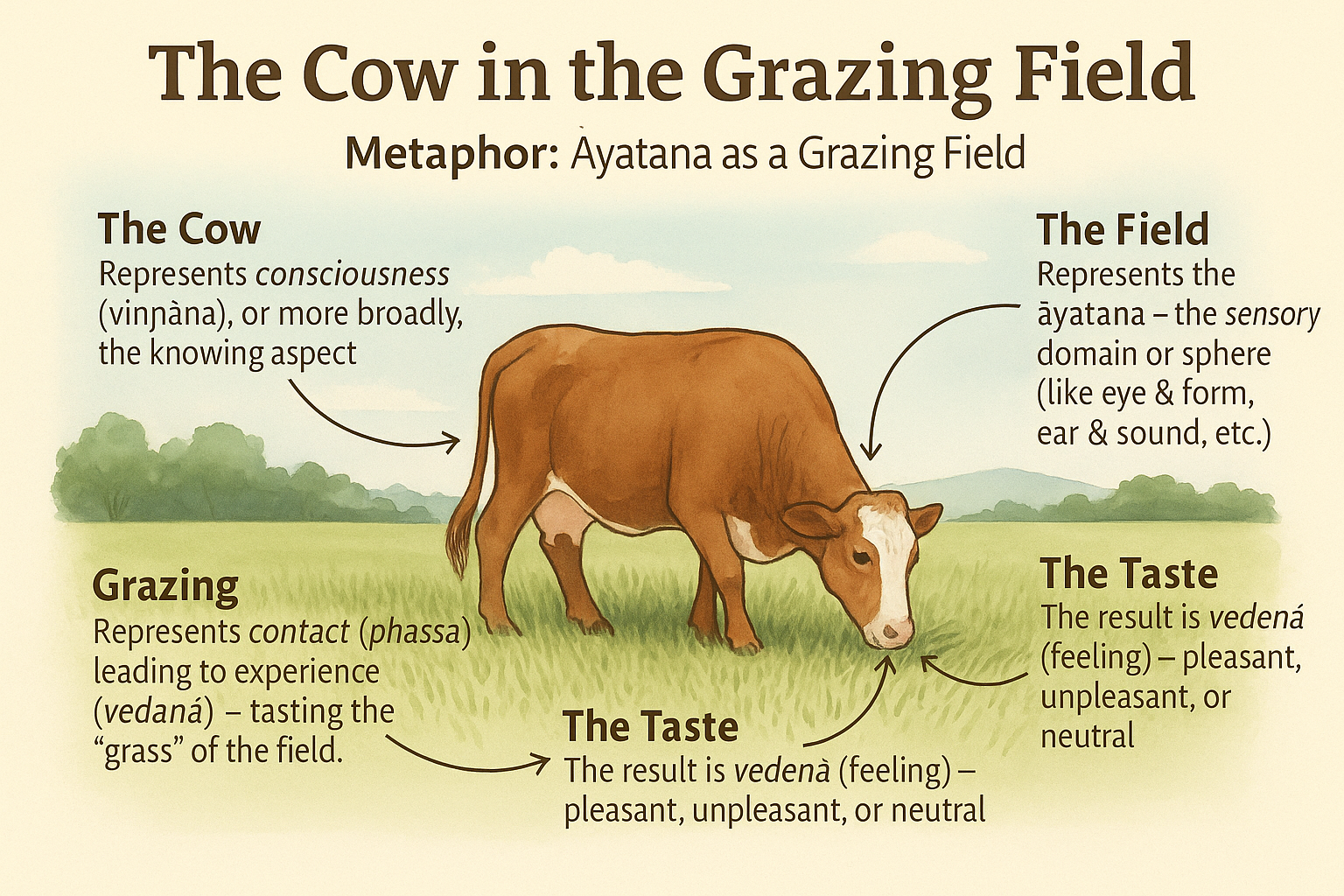
🐄 Metaphor: Āyatana as a Grazing Field
The Cow: Represents consciousness (viññāṇa), or more broadly, the knowing aspect.
The Field: Represents the āyatana — the sensory domain or sphere (like eye & form, ear & sound, etc.).
Grazing: Represents contact (phassa) leading to experience (vedanā) — tasting the “grass” of the field.
The Taste: The result is vedanā (feeling) — pleasant, unpleasant, or neutral.
The Wandering or Clinging: Arises when taṇhā (craving) follows that experience, leading to suffering.
| Element | Pāli Term | Function | Simile |
|---|---|---|---|
| Eye, Ear, etc. | Ajjhattikāni āyatanāni | Internal sense bases | Cow’s mouth and senses |
| Form, Sound, etc. | Bāhirāni āyatanāni | External bases (objects) | Grass in the field |
| Consciousness | Viññāṇa | Knowing agent | Cow itself |
| Contact | Phassa | Coming together | Cow chewing the grass |
| Feeling | Vedanā | Resultant taste | Flavor of the grass |
| Craving | Taṇhā | Reaction | Cow going for more, or avoiding |
Uddesa — The Sutta’s Structured Summary
This is a structured table of contents for what the sutta will analyze:
Six internal āyatanas: the sense faculties.
Six external āyatanas: their corresponding objects.
Six consciousnesses (viññāṇakāya): eye-consciousness, etc.
Six types of contact (phassa): arising from sense faculty + object + consciousness.
Eighteen mental operations (manopavicāra): affective responses arising via the six senses.
Thirty-six “sattapadā”: later explained as pairs of joy & sorrow toward internal and external.
The sutta aims to lead to letting go (pajahatha) based on discernment (nissāya).
The Ariyan practitioner who cultivates the three satipaṭṭhānas becomes a true teacher.
Six Internal Sense Bases
The ‘internal bases’ (ajjhattikāni āyatanāni) are the six faculties:
Cakkhu (eye), Sota (ear), Ghāna (nose), Jivhā (tongue), Kāya (body), Mano (mind), “Here, āyatana means “sense domain” or “sphere of contact” as explained above as definition. These are the points of contact through which experience arises.
Six External Sense Bases
These are the external counterparts of the internal sense organs:
Rūpa (form) for eye, Sadda (sound) for ear, Gandha (smell) for nose, Rasa (taste) for tongue, Phoṭṭhabba (tangible objects) for body, Dhamma (mental objects) for mind. Together, the twelve āyatanas explain how all experiential data enter consciousness.
Six Consciousness Groups
Here, viññāṇa is the awareness that arises from contact:
Eye + form + light → cakkhuviññāṇa ; Ear + sound + vibration → sotaviññāṇa Etc.
Each is dependent co-arising, not autonomous. Consciousness is a composite, not a self.
Six Contact Groups
Phassa arises when three things come together: Sense organ, Sense object, Corresponding consciousness. Without any of these three, there is no phassa, and hence no vedanā (feeling) arises.
Eighteen Mental Investigations
Manopavicāra means the mental elaboration, often involuntary or habitual, that follows contact.
The mind reacts to sense experience with: Somanassa (mental agreement), Domanassa (mental disagreement), Upekkhā (neutrality)
Across the six senses, this leads to 18 types of affective engagement.
Thirty-Six Paths of Experience
Satta-pada = “being’s paths” or “modes of living”
These 36 are the affective reactions (pleasant, unpleasant, neutral) toward the six sense-objects, divided into:
Gehasita: tied to sense-pleasures and household attachment.
Nekkhammasita: tied to renunciation and wisdom.
It covers 6 x 3 feelings x 2 modes (household vs renunciate) = 36.
02 Household-based joy, distress, and equanimity
Six Household-Based Joys
🔹 Key Vocabulary:
Gehasita: “associated with household life” (lit. “tied to the home”), meaning bound to worldly sensual pleasures. Iṭṭhā, Kantā, Manāpā, Manoramā: All degrees of pleasantness. This layering emphasizes sensory attraction and craving (taṇhā).
Lokāmisa: Literally “worldly bait” — refers to pleasures that are baited hooks; they catch beings into saṁsāra.
Samanussarato uppajjati somanassaṁ: Even recollection of past pleasures causes new joy—this shows the deep binding force of memory-based craving (āsava).
🔹 The Three Contexts Causing Somanassa:
Paṭilābhaṁ – Obtaining the sensual object now.
Paṭilābhato samanupassato – Reflecting on the presence of what one has just obtained.
Pubbe paṭiladdhapubbaṁ … samanussarato – Remembering something pleasant that is now past, ceased, or altered.
Thus, the joy may arise: From direct contact, From observation of possession, From memory
This is highly significant: all three are rooted in craving and are to be understood as upādānakkhandha—aggregates subject to grasping.
🔸 Explanation:
These pleasures arise from craving and attachment to sensual gratification (kāmataṇhā).
“Lokāmisa” = worldly bait or sensual lures.
Even recollection of past pleasures causes joy—this shows saññā and vitakka feed taṇhā.
Six Household-Based Distresses
🔹 1. Gehasita Domanassa = Suffering due to sensual deprivation
This passage shows that domanassa (mental suffering) in ordinary beings arises through:
Loss (vipariṇāma-dukkha), Non-attainment (icchā-vibhāga),, Memory of lost pleasures (saññā-sankhāra influence). Craving (taṇhā) leads to clinging (upādāna), which when obstructed, manifests as grief.
🔹 2. Appaṭilābhaṁ vā, appaṭilābhato samanupassato
Even thinking about not getting a desirable object triggers dukkha.
Samanupassati = actively contemplates or attends to this fact, intensifying suffering.
🔹 3. Pubbe paṭiladdhapubbaṁ atītaṁ niruddhaṁ vipariṇataṁ
Grief arises from memory of past sensual pleasures that are now:
Atītaṁ – gone, Niruddhaṁ – ceased, Vipariṇataṁ – altered or changed.
This shows how much dukkha is generated by memory itself, not just current conditions.
🔹 4. Lokāmisapaṭisaṁyutta – “Associated with worldly bait (lokāmisa)” = these perceptions are not neutral. They are loaded with craving and social/emotional investment.
🔸 Explanation: This is dukkha from taṇhā and vipariṇāma (change) and the pain comes from loss of pleasure, even when merely recalled.
These are signs of being under the sway of upādāna (clinging).
Six Household-Based Equanimities
🔹 1. The Structure of False Equanimity
This is not true liberative upekkhā. It is a form of neutral feeling (adukkham-asukha vedanā) in someone ignorant of the true nature of things.
The person is: Bāla: foolish, immature, Mūḷha: deluded, Assutavā: uninstructed, Anodhijina: has not overcome craving (odhi = craving/bondage),Avipākajina: has not understood kamma and vipāka and Anādīnavadassāvī: does not see the danger (ādīnava) in sensual pleasure.
🔹 2. “Nā’tivattati” – It Does Not Surpass the Object
This is key. The equanimity: Is still dependent on the object. Is not rooted in wisdom, hence does not result in liberation or insight. Such equanimity is shaky and temporary—can collapse into pleasure or displeasure anytime.
🔹 3. Relevance to Practice
This category is vital for meditators: One might believe they are “equanimous,” but if there is no insight into anicca/dukkha/anattā, it remains gehasita. True renunciant equanimity must surpass and be independent of object and perception.
🔸 Explanation:
This is moha-mūla upekkhā: equanimity without insight.
It is a dull neutrality, not true equipoise and it lacks transcendence or liberation insight. The person remains bound to the object due to ignorance.
03 Renunciation-based joy, distress, and equanimity
Six Renunciation-Based Joys
🔹 1. “Aniccataṁ viditvā vipariṇāma-virāga-nirodhaṁ”
This phrase encapsulates the vipassanā insight process:
Aniccataṁ: direct knowledge of impermanence.
Vipariṇāma: the truth of transformation, decay.
Virāga: dispassion arises naturally from understanding.
Nirodha: cessation—both of craving and compounded formations.
🔹 2. “Pubbe ceva … etarahi ca sabbe te … aniccā dukkhā vipariṇāmadhammā’ti”
The analysis includes both past and present sense-objects.
Demonstrates the universality of impermanence across time and experience.
🔹 3. “Yathābhūtaṁ sammappaññāya passato”
This marks the insight as non-conceptual direct seeing.
“Sammappaññā” refers to correct penetrative wisdom, not intellectual reflection.
🔹 4. “Uppajjati somanassaṁ”
The arising of joy here is not due to contact (phassa) with pleasant things, but due to the relief and release from attachment. This is pīti-pāmujja (rapture and gladness) arising from letting go, not from gaining. This is nibbidā-pamojja (joy from dispassion) and Nekkhammasita is the joy arising from letting go, not indulging. It is the happiness of insight (vipassanā-sukha), rooted in wisdom.
Six Renunciation-Based Distresses
🔹 1. Noble Grief vs Worldly Grief
This is not dukkha born of taṇhā, but of piha (aspiration), emerging from seeing impermanence.
It represents saṁvega—a wholesome restlessness and urgency on the path.
Like a bodhisatta’s longing for awakening.
🔹 2. “Kudāssu nāmāhaṁ…”
“When will I too dwell in that domain…?” This is the aspirational cry of one who sees the noble attainments from afar. Not yet fulfilled, but inspired. It is not craving, but yearning with clarity.
🔹 3. “Anuttaresu vimokkhesu pihaṁ upaṭṭhāpeti”
Anuttara vimokkha = the highest liberations (including jhānas, arūpa samāpattis, and Nibbāna).
Pihā = a deep wish, not rooted in lack, but in knowing what is possible and being drawn toward it but a noble longing; not taṇhā, but a motivating sorrow.
The distress is not rooted in defilement, but arises from urgency (saṁvega). It is like a Bodhisatta’s sorrow for not having yet attained awakening.
Six Renunciation-Based Equanimities
The source distinguishes wisdom-born upekkhā from household-based neutrality. Renunciation-based equanimity is presented as arising through insight into impermanence, change, fading and cessation; the key term ativattati is explained as “surpasses,” meaning that the mind is not bound to the object in the same way.
The passage then becomes practical with the formula “Tatra idaṁ nissāya idaṁ pajahatha”: relying on this, abandon that. In the source explanation, this marks the movement from merely classifying responses to using a higher, wiser response as the support for relinquishing a lower one. The source connects this with right view, mindfulness, samādhi, letting go and release.
04 “Relying on this, abandon that” — the five-step transformation
Abandon Household Joy through Renunciation-Based Joy
The wholesome somanassa that arises from insight and renunciation (nekkhammasita) should become the support (nissāya) for removing the worldly kind of joy based on craving (gehasita).
It’s not about suppression but transcending (samatikkama) through clear seeing and replacing.
This is stepwise purification of emotion: from sensual delight to insight-based serenity.
Abandon Household Distress through Renunciation-Based Distress
This may seem counterintuitive: one kind of domanassa is used to overcome another.
However, the renunciation-based domanassa (arising from noble longing, pihā for Nibbāna) is motivational, whereas the gehasita domanassa is rooted in craving loss. The sutta shows even noble urgency (saṁvega) can help us relinquish mundane sorrow.
Abandon Household Equanimity through Renunciation-Based Equanimity
Not all upekkhā is wise. The gehasita upekkhā is passive indifference (often rooted in delusion or inattention).
But nekkhammasita upekkhā is born of dispassion and clear understanding, and should be cultivated to supersede dull neutrality.
Abandon Renunciation-Based Distress through Renunciation-Based Joy
Even noble grief must eventually be abandoned. One progresses from saṁvega (motivated sorrow) to pasāda (serene clarity) and ultimately upekkhā. The goal is to not remain sorrowful, even for the noble; ultimately all forms of mental unrest must be resolved.
Abandon Renunciation-Based Joy through Renunciation-Based Equanimity
Even wholesome joy (somanassa) is ultimately a movement of mind, a conditioned excitation.
True peace lies in upekkhā: deep balance rooted in wisdom and freedom from disturbance.
The hierarchy of development becomes clear:
Replace sensual joy with insight-based joy.
Replace insight-joy with calm detachment (upekkhā).
In the next section, the Buddha distinguishes between two kinds of equanimity: nānatta-sitā and ekatta-sitā, and shows how one transcends the other.
05 From diversity to unity and beyond unity through atammayatā
Equanimity Based on Diversity and Equanimity Based on Unity
The source explains nānattā as multiplicity or diversity and ekattā as unity or oneness. Equanimity based on diversity remains related to the varied field of sense objects; equanimity based on unity is related to the four formless attainments.
The practical movement is again one of graded transcendence: relying on the more unified equanimity, the practitioner abandons and transcends equanimity based on multiplicity. The source therefore reads this section as a refinement of samādhi in which the mind moves from the diversified sensory field toward increasingly unified modes of experience.
Beyond Unity — Atammayatā
Atammayatā = “non-identification,” not-made-of-thisness, total non-fabrication.
Even the sublime formless equanimities are conditioned, and must be let go of for final liberation.
This points to Nibbāna itself, beyond all constructed meditative states.
Thus the path is: From sensual equanimity → to renunciation equanimity → to arūpa jhānic equanimity →
to total non-clinging (atammayatā).
06 The three satipaṭṭhānas of a teacher
Three Satipaṭṭhānas in the Context of Teaching
This is the contextual application of satipaṭṭhāna—not just as internal meditation themes (like kāyānupassanā), but as modes of relational presence in teaching and guiding others.
Now the sutta elaborates on each of these three types.
First Teaching Satipaṭṭhāna — Non-Receptive Disciples
The Buddha maintains upekkhā even when the audience is unresponsive.
Anattamano: disappointment, discouragement.
Anavassuto: “not drenched,” i.e., emotionally unentangled.
This is the teacher’s mindfulness in rejection, demonstrating mental composure.
Second Teaching Satipaṭṭhāna — Mixed Response
This is midway equanimity: not affected by partial praise or blame, mixed results. The Buddha remains balanced, not swinging emotionally with outcomes. This highlights upekkhā as impartial clarity, not indifference.
Third Teaching Satipaṭṭhāna — Complete Receptivity
Even in positive outcomes, the Buddha is not swept away. He experiences wholesome gladness (attamanatā) but stays not overwhelmed (anavassuto). This is mindfulness in success—rejoicing without clinging.
07 Purisadammasārathī — the supreme trainer and the eight directions
Why These Are Called Three Satipaṭṭhānas Here
This exemplifies how satipaṭṭhāna is being used in this passage as a foundation of mindful presence in teaching and guidance.
Worldly trainers (mahouts, riders, herders) can only guide their trainees within one worldly discipline or path.The Buddha, however, trains puggala (persons) across all levels of spiritual attainment, including jhānas, arūpa states, and beyond. The “eight directions” symbolize the total mastery of the entire meditative path—from form to formless, from perception to cessation.
Eight Directions of the Supreme Trainer
The purisadammasārathī is not just a metaphor; it is the living function of the Buddha as a supreme teacher of liberation. He doesn’t merely show jhāna; he guides beings all the way to cessation (nirodha). The eight directions here are progressive stages of samādhi, culminating in nibbāna through saññāvedayitanirodhasamāpatti.
01 Know the entire sense process, not just the object
At each door, know the internal base, the external object, the corresponding consciousness and the contact that arises from their meeting. The source then tracks how the mind engages that experience through pleasure, displeasure or equanimity.
The practical question is therefore not merely “What did I see, hear, smell, taste, touch or think?” but “What response arose around that experience, and what is that response dependent on?”
02 Distinguish household-based responses from renunciation-based responses
Household-based joy depends on obtaining, possessing or remembering agreeable objects; household-based distress appears with non-attainment, loss and change; household-based equanimity remains tied to the object without surpassing it.
Renunciation-based responses arise in the source from seeing impermanence, change, fading and cessation with right wisdom. This distinction is the diagnostic heart of the sutta.
03 Use the higher response as the support for abandoning the lower
The repeated instruction is “Tatra idaṁ nissāya idaṁ pajahatha”—relying on this, abandon that. Renunciation-based joy replaces household joy; renunciation-based distress displaces household distress; wisdom-based equanimity replaces household neutrality; even noble distress is abandoned through renunciation-based joy; and finally renunciation-based joy is transcended through renunciation-based equanimity.
04 Do not stop at equanimity based on diversity or unity
The sutta distinguishes equanimity associated with the diversity of sense objects from equanimity associated with unity in the formless attainments. The latter becomes the support for abandoning the former, but even equanimity based on unity is not held as final: the text proceeds to atammayatā as the basis for abandoning it.
05 Remain mindful and clearly aware in teaching outcomes
In the three teaching satipaṭṭhānas, the Tathāgata is not carried away by rejection, mixed response or success. When disciples do not listen, when only some listen, and when all listen, the decisive qualities are mindful presence, clear awareness and freedom from emotional entanglement with the outcome.
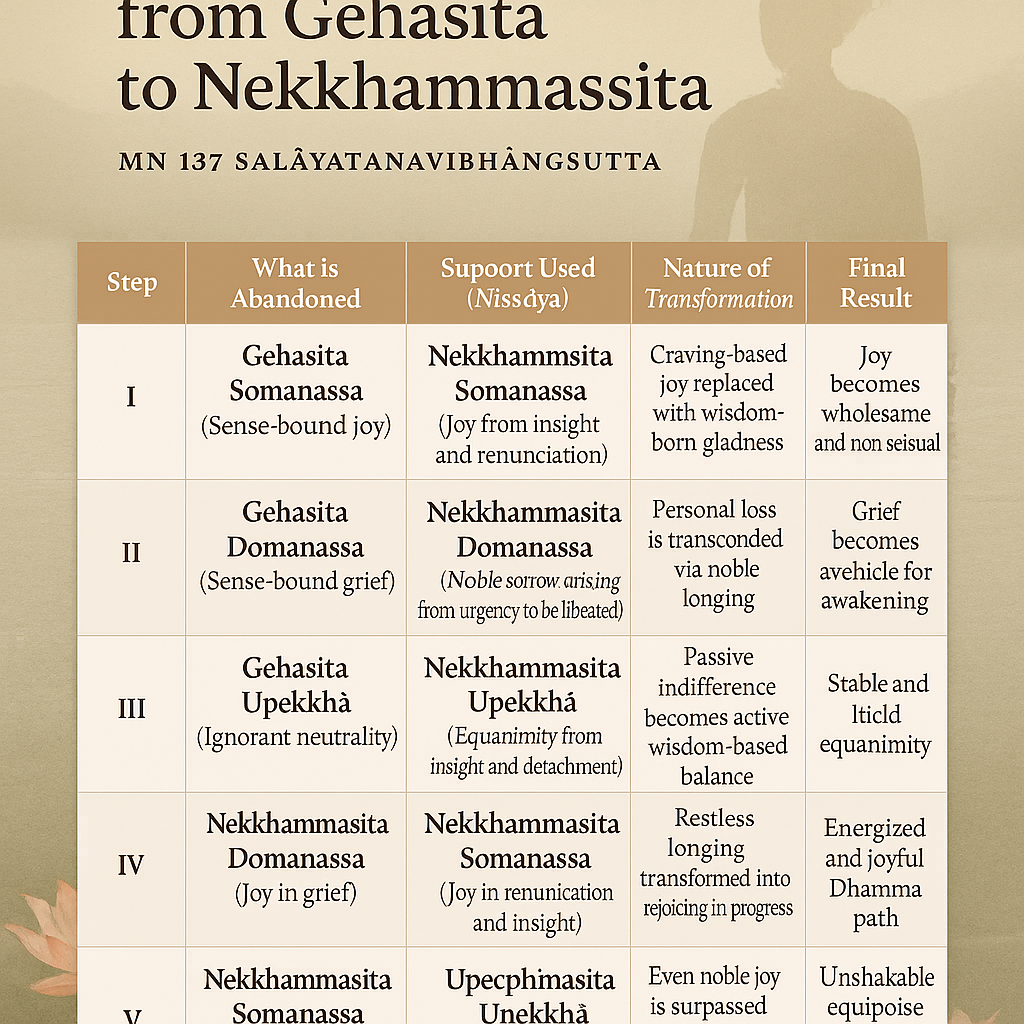
Five-Step Transformation from Gehasita to Nekkhammasita
| Step | What is Abandoned | Support Used (Nissāya) | Nature of Transformation | Final Result |
|---|---|---|---|---|
| I | Gehasita Somanassa (Sense-bound joy) | Nekkhammasita Somanassa (Joy from insight and renunciation) | Craving-based joy replaced with wisdom-born gladness | Joy becomes wholesome and non-sensual |
| II | Gehasita Domanassa (Sense-bound grief) | Nekkhammasita Domanassa (Noble sorrow arising from urgency to be liberated) | Personal loss is transcended via noble longing | Grief becomes a vehicle for awakening |
| III | Gehasita Upekkhā (Ignorant neutrality) | Nekkhammasita Upekkhā (Equanimity from insight and detachment) | Passive indifference becomes active wisdom-based balance | Stable and lucid equanimity |
| IV | Nekkhammasita Domanassa (Noble grief) | Nekkhammasita Somanassa (Joy in renunciation and insight) | Restless longing transformed into rejoicing in progress | Energized and joyful Dhamma path |
| V | Nekkhammasita Somanassa (Joy from insight) | Nekkhammasita Upekkhā (Dispassionate clarity) | Even noble joy is surpassed for deeper serenity | Unshakable equipoise poised for liberation |
Three Teaching Satipaṭṭhānas
| Situation | Emotional Outcome | Noble Response |
|---|---|---|
| 1. Disciples reject Dhamma | Potential frustration | Equanimity with mindfulness (upekkhā) |
| 2. Mixed disciple response | Potential partiality | Balanced impartiality (neither up nor down) |
| 3. Disciples fully receptive | Joy and success | Gladness without attachment |
Eight Directions of the Supreme Trainer
| Stage | Meditative Sphere | Direction |
|---|---|---|
| 1 | Rūpī sees rūpa | 1st |
| 2 | Arūpasaññī sees rūpa | 2nd |
| 3 | Subhantveva adhimutto | 3rd |
| 4 | Ākāsānañcāyatana | 4th |
| 5 | Viññāṇañcāyatana | 5th |
| 6 | Ākiñcaññāyatana | 6th |
| 7 | Nevasaññānāsaññāyatana | 7th |
| 8 | Saññāvedayitanirodha | 8th |
The same form, sound, smell, taste, touch or mental object may become the basis for household joy, household distress, dull neutrality, renunciation-based gladness, noble urgency, wisdom-born equanimity, unified equanimity, or complete non-identification. MN 137 therefore provides both a diagnostic map and a graded path of transcendence.
Understand the field, know the response, rely on the higher to abandon the lower, and continue until the mind is no longer fashioned by the experience.