How to Develop the Sense Faculties?
The Buddha does not teach liberation by shutting out sights, sounds, smells, tastes, touches, and thoughts. He teaches a mind that can meet them, know the reaction as conditioned, and establish upekkhā without being ruled by attraction or repulsion.
Saṅkhataṁ • Oḷārikaṁ • Paṭiccasamuppannaṁ — “This is conditioned, coarse, dependently arisen.” Etaṁ santaṁ etaṁ paṇītaṁ yadidaṁ upekkhā — “This is peaceful, this is sublime: equanimity.”
 VISUAL SUMMARYSee this sutta in a pictureOpen the complete infographic for a visual overview before or after reading the full study.View infographic →
Not Seeing and Not Hearing Is Not Development of the Faculties
ekaṁ samayaṁ bhagavā gajaṅgalāyaṁ viharati suveḷuvane. – At one time, the Blessed One was dwelling at Gajaṅgala, in the Suveḷuvana.
Atha kho uttaro māṇavo pārāsiviyantevāsī yena bhagavā tenupasaṅkami; upasaṅkamitvā bhagavatā saddhiṁ sammodi.
Then Uttara the student, a pupil of the Pārāsiviya (Brahmin), approached the Blessed One. Having approached, he exchanged courteous greetings with the Blessed One.
Sammodanīyaṁ kathaṁ sāraṇīyaṁ vītisāretvā ekamantaṁ nisīdi.
After that courteous and friendly exchange of words, he sat down to one side.
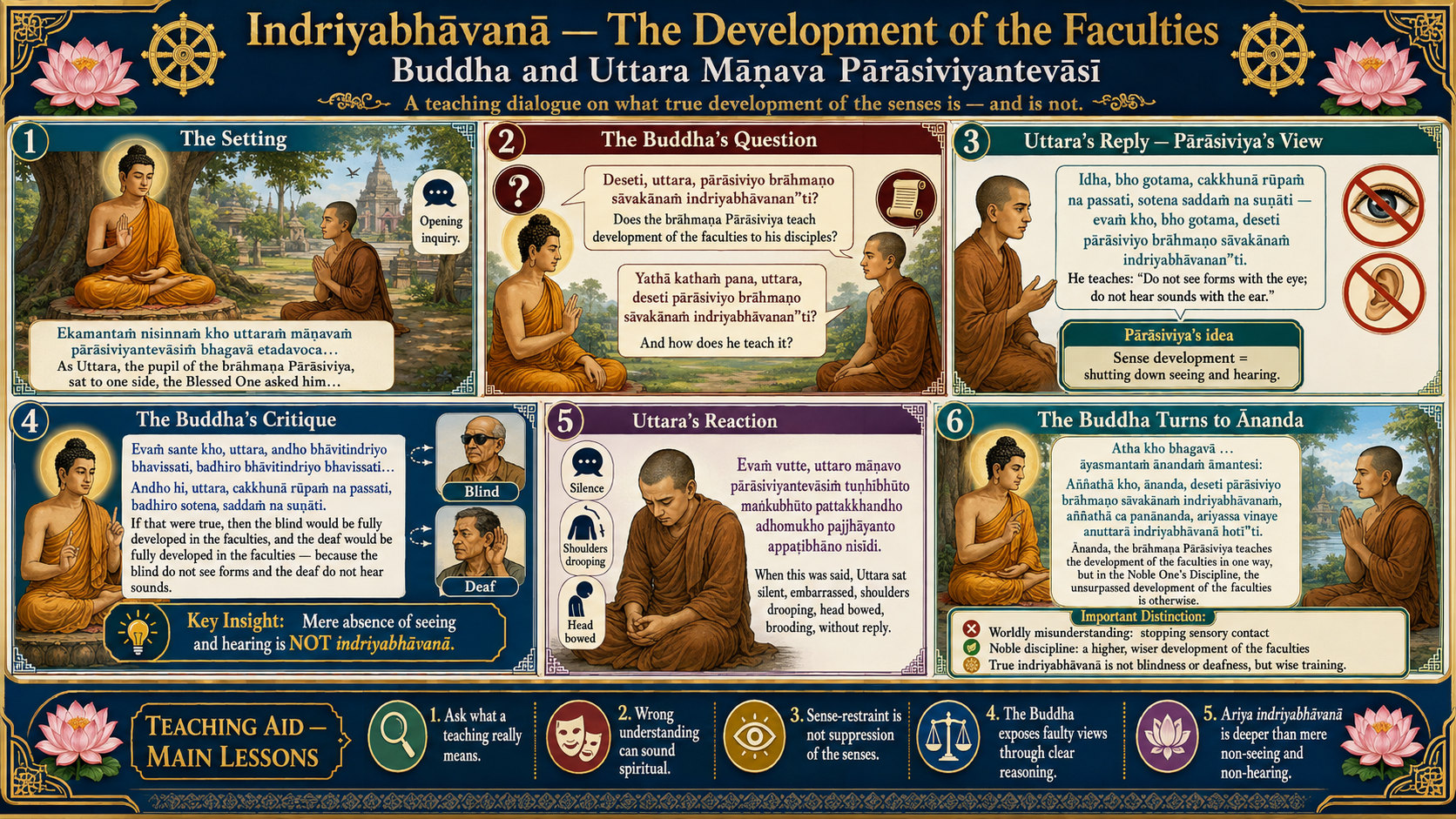
Ekamantaṁ nisinnaṁ kho uttaraṁ māṇavaṁ pārāsiviyantevāsiṁ bhagavā etadavoca: “Deseti, uttara, pārāsiviyo brāhmaṇo sāvakānaṁ indriyabhāvanan”ti?
As he was sitting there, the Blessed One said to Uttara the student, the pupil of the Pārāsiviya Brahmin:
“Uttara, does the Pārāsiviya Brahmin teach the development of the faculties to his disciples?”
“Deseti, bho gotama, pārāsiviyo brāhmaṇo sāvakānaṁ indriyabhāvanan”ti.
“Yes, Master Gotama, the Pārāsiviya Brahmin does teach the development of the faculties to his disciples.”
“Yathā kathaṁ pana, uttara, deseti pārāsiviyo brāhmaṇo sāvakānaṁ indriyabhāvanan”ti?
“And how, Uttara, does the Pārāsiviya Brahmin teach the development of the faculties to his disciples?”
“Idha, bho gotama, cakkhunā rūpaṁ na passati, sotena saddaṁ na suṇāti— evaṁ kho, bho gotama, deseti pārāsiviyo brāhmaṇo sāvakānaṁ indriyabhāvanan”ti.
“Here, Master Gotama, he teaches that one should not see forms with the eye, nor hear sounds with the ear— thus, Master Gotama, the Pārāsiviya Brahmin teaches the development of the faculties to his disciples.”
“Evaṁ sante kho, uttara, andho bhāvitindriyo bhavissati, badhiro bhāvitindriyo bhavissati; yathā pārāsiviyassa brāhmaṇassa vacanaṁ.
“If that is so, Uttara, then the blind will be the ones with developed faculties, the deaf will be the ones with developed faculties— as per the Pārāsiviya Brahmin’s instruction.
Andho hi, uttara, cakkhunā rūpaṁ na passati, badhiro sotena saddaṁ na suṇātī”ti.
For, Uttara, the blind do not see forms with the eye, the deaf do not hear sounds with the ear.”
Evaṁ vutte, uttaro māṇavo pārāsiviyantevāsī tuṇhībhūto maṅkubhūto pattakkhandho adhomukho pajjhāyanto appaṭibhāno nisīdi.
When this was said, Uttara the student, pupil of the Pārāsiviya, sat silent, humiliated, with shoulders drooping, head bowed, brooding, without response. Next, the Buddha turns to Ānanda:
Atha kho bhagavā uttaraṁ māṇavaṁ pārāsiviyantevāsiṁ tuṇhībhūtaṁ maṅkubhūtaṁ pattakkhandhaṁ adhomukhaṁ pajjhāyantaṁ appaṭibhānaṁ viditvā āyasmantaṁ ānandaṁ āmantesi:
Then the Blessed One, knowing Uttara the student was silent, humiliated, with shoulders drooping, head down, brooding, without response, addressed Venerable Ānanda:
“Aññathā kho, ānanda, deseti pārāsiviyo brāhmaṇo sāvakānaṁ indriyabhāvanaṁ, aññathā ca panānanda, ariyassa vinaye anuttarā indriyabhāvanā hotī”ti.
“Ānanda, the Pārāsiviya Brahmin teaches the development of the faculties in one way, but in the Noble One’s Discipline, the unsurpassed development of the faculties is otherwise.”
Click infographic to enlarge ↗
“It is time, Blessed One! It is time, Well-gone One, for the Blessed One to teach the unsurpassed development of the faculties in the Ariyan discipline. Having heard it from the Blessed One, the monks will retain it in memory.”
Dhamma Meaning
Ānanda expresses the appropriate occasion (etassa kālo) and eagerness to receive instruction. The emphasis on “unsurpassed” (anuttarā) indicates that what the Buddha is about to teach goes beyond mere sensory restraint—it leads to insight and liberation. He also invokes the importance of transmission: this Dhamma will not just be heard but remembered (dhāressantī), implying recitation, reflection, and preservation.
“Tenahānanda, suṇāhi, sādhukaṁ manasi karohi; bhāsissāmī”ti. “Evaṁ, bhante”ti kho āyasmā ānando bhagavato paccassosi. Bhagavā etadavoca:
“Well then, Ānanda, listen carefully, pay close attention; I will speak.” “Yes, Bhante,” Venerable Ānanda replied to the Blessed One. Then the Blessed One said this:
Indriyabhāvanā is not the elimination of contact. It is the transformation of the mind’s relationship to what is contacted.
The Six Sense Doors: Know the Reaction, See Its Conditions, Establish Upekkhā
The same liberating formula is applied at every door. What changes is the sense object and the simile; what does not change is the movement from agreeable or disagreeable reaction to wisdom-based equanimity.
Eye and Forms — Cakkhunā Rūpesu
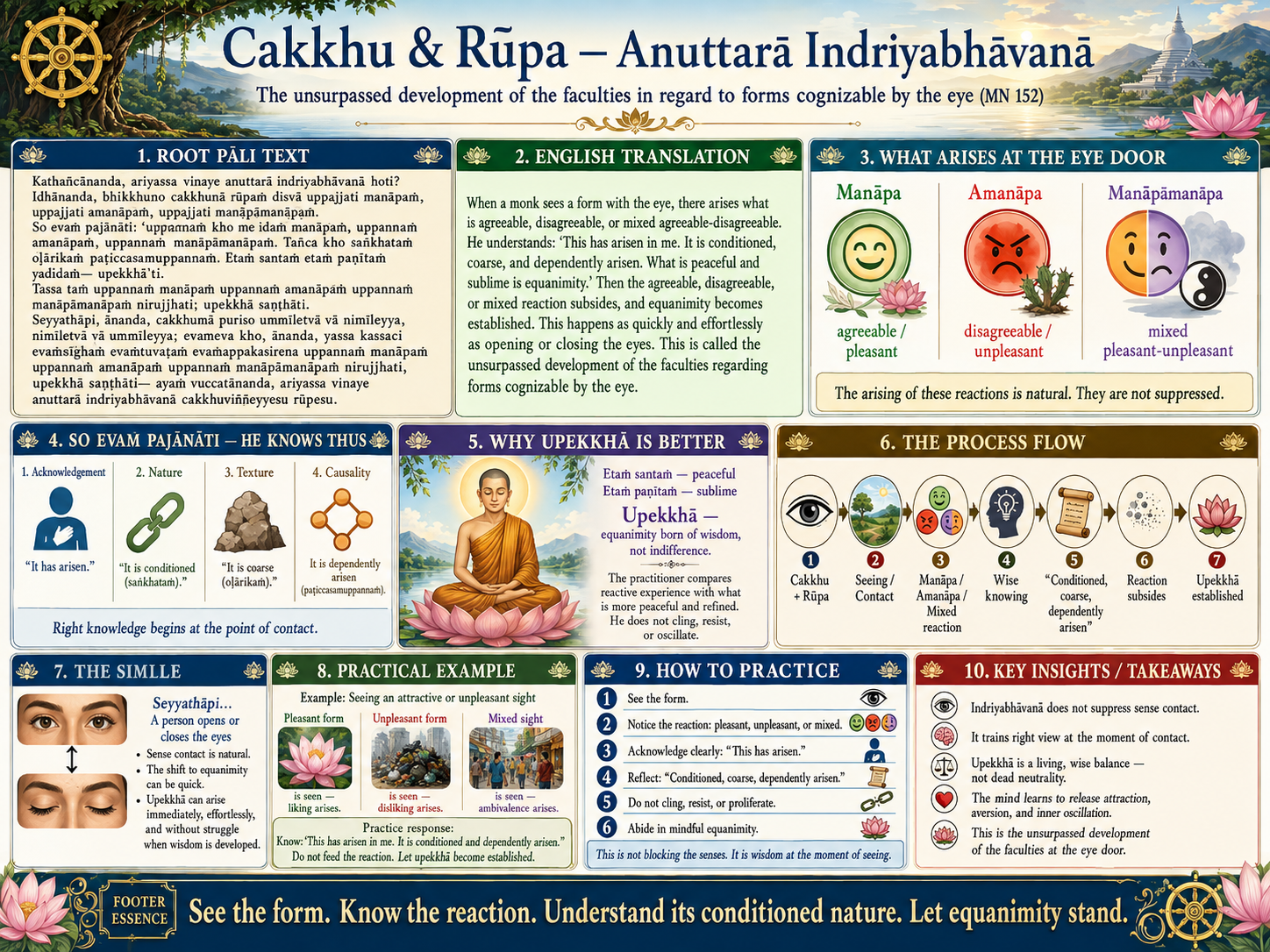
Idhānanda, bhikkhuno cakkhunā rūpaṁ disvā uppajjati manāpaṁ, uppajjati amanāpaṁ, uppajjati manāpāmanāpaṁ.
So evaṁ pajānāti: ‘uppannaṁ kho me idaṁ manāpaṁ, uppannaṁ amanāpaṁ, uppannaṁ manāpāmanāpaṁ. Tañca kho saṅkhataṁ oḷārikaṁ paṭiccasamuppannaṁ. Etaṁ santaṁ etaṁ paṇītaṁ yadidaṁ— upekkhā’ti.
Tassa taṁ uppannaṁ manāpaṁ uppannaṁ amanāpaṁ uppannaṁ manāpāmanāpaṁ nirujjhati; upekkhā saṇṭhāti.
Seyyathāpi, ānanda, cakkhumā puriso ummīletvā vā nimīleyya, nimīletvā vā ummīleyya; evameva kho, ānanda, yassa kassaci evaṁsīghaṁ evaṁtuvaṭaṁ evaṁappakasirena uppannaṁ manāpaṁ uppannaṁ amanāpaṁ uppannaṁ manāpāmanāpaṁ nirujjhati, upekkhā saṇṭhāti— ayaṁ vuccatānanda, ariyassa vinaye anuttarā indriyabhāvanā cakkhuviññeyyesu rūpesu.”
“And how, Ānanda, does there come to be the unsurpassed development of the faculties in the Ariyan training? Here, Ānanda, when a monk has seen a form with the eye, there arises what is agreeable, or there arises what is disagreeable, or there arises what is both agreeable and disagreeable. He understands it thus: ‘Indeed, this agreeable has arisen in me; this disagreeable has arisen in me; this mixed agreeable-disagreeable has arisen in me. But this is conditioned, coarse, dependently arisen. That which is peaceful, that which is sublime—namely, equanimity (upekkhā)—this is better.’ To him, that arisen agreeable, that arisen disagreeable, that mixed agreeable-disagreeable subsides; and equanimity is established.
Just as, Ānanda, a person with eyesight would open his eyes or close them—so quickly, so effortlessly—as quickly, as immediately, as effortlessly as that, for anyone in whom agreeable, disagreeable, or mixed feelings have arisen and subsided, with equanimity becoming established: that is called, Ānanda, the unsurpassed development of the faculties in regard to visible forms cognizable by the eye.”
Click infographic to enlarge ↗
Ear and Sounds — Sotena Saddesu
So evaṁ pajānāti: ‘uppannaṁ kho me idaṁ manāpaṁ, uppannaṁ amanāpaṁ, uppannaṁ manāpāmanāpaṁ. Tañca kho saṅkhataṁ oḷārikaṁ paṭiccasamuppannaṁ. Etaṁ santaṁ etaṁ paṇītaṁ yadidaṁ— upekkhā’ti.
Tassa taṁ uppannaṁ manāpaṁ uppannaṁ amanāpaṁ uppannaṁ manāpāmanāpaṁ nirujjhati; upekkhā saṇṭhāti.
Seyyathāpi, ānanda, balavā puriso appakasireneva accharaṁ pahareyya; evameva kho, ānanda, yassa kassaci evaṁsīghaṁ evaṁtuvaṭaṁ evaṁappakasirena uppannaṁ manāpaṁ uppannaṁ amanāpaṁ uppannaṁ manāpāmanāpaṁ nirujjhati, upekkhā saṇṭhāti— ayaṁ vuccatānanda, ariyassa vinaye anuttarā indriyabhāvanā sotaviññeyyesu saddesu.
Furthermore, Ānanda, when a monk hears a sound with the ear, there arises what is agreeable, there arises what is disagreeable, there arises what is both agreeable and disagreeable. He understands thus:
“This agreeable feeling has arisen in me; this disagreeable one has arisen in me; this mixed agreeable-disagreeable one has arisen in me. But this is conditioned, it is coarse, it is dependently arisen. That which is peaceful, that which is sublime—namely, equanimity—is better.” Then, whatever agreeable, disagreeable, or mixed feeling has arisen in him subsides; equanimity is established.
Just as, Ānanda, a strong man could snap his fingers with little effort,
even so, Ānanda, for anyone in whom such agreeable, disagreeable, or mixed feeling arises and subsides just as swiftly, just as effortlessly, equanimity becomes established—this, Ānanda, is called the unsurpassed development of the faculties in regard to sounds cognizable by the ear.

Click infographic to enlarge ↗
Nose and Smells — Ghānena Gandhesu
So evaṁ pajānāti: ‘uppannaṁ kho me idaṁ manāpaṁ, uppannaṁ amanāpaṁ, uppannaṁ manāpāmanāpaṁ. Tañca kho saṅkhataṁ oḷārikaṁ paṭiccasamuppannaṁ. Etaṁ santaṁ etaṁ paṇītaṁ yadidaṁ— upekkhā’ti.
Tassa taṁ uppannaṁ manāpaṁ uppannaṁ amanāpaṁ uppannaṁ manāpāmanāpaṁ nirujjhati; upekkhā saṇṭhāti.
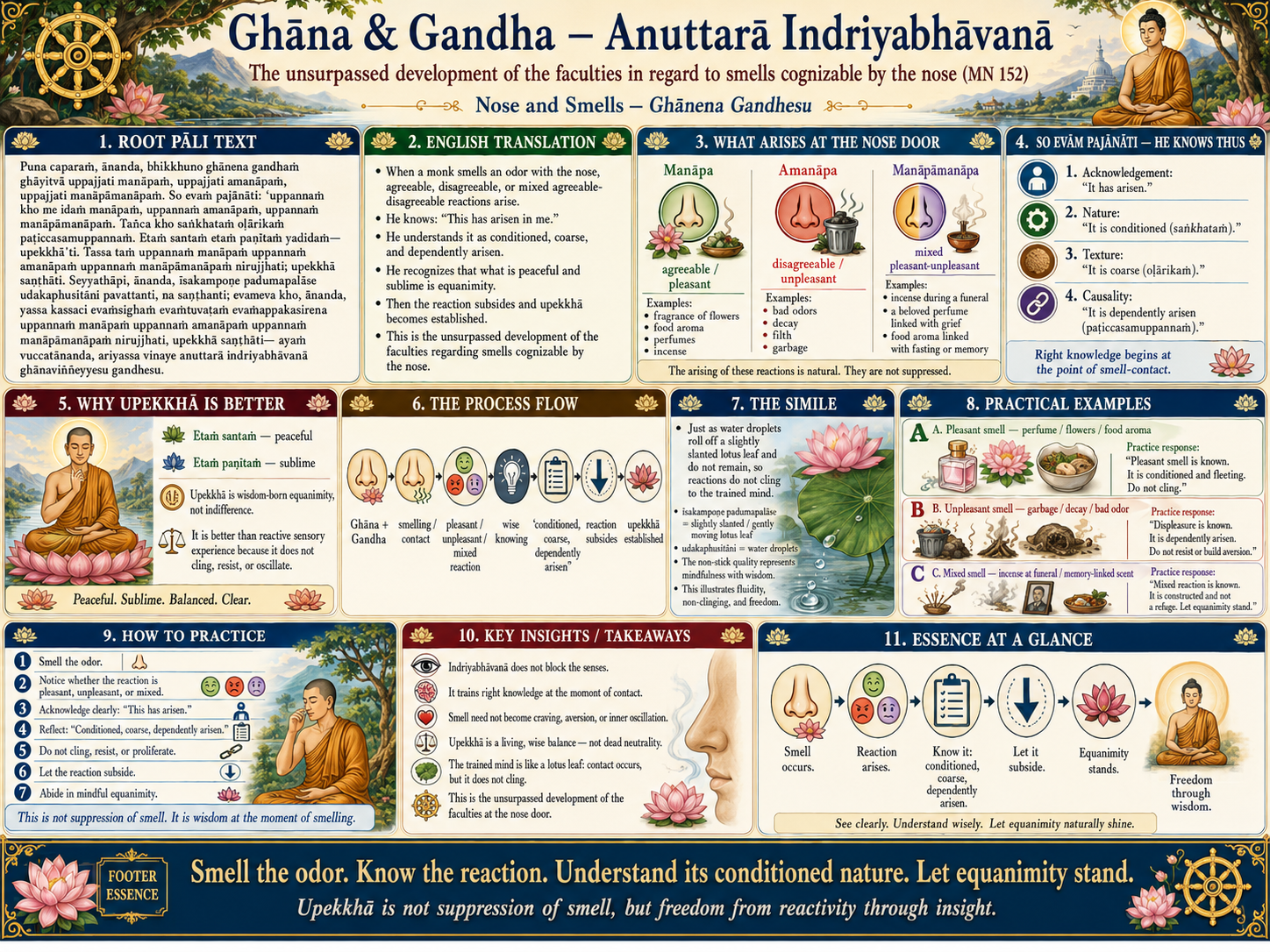
Seyyathāpi, ānanda, īsakampoṇe padumapalāse udakaphusitāni pavattanti, na saṇṭhanti; evameva kho, ānanda, yassa kassaci evaṁsīghaṁ evaṁtuvaṭaṁ evaṁappakasirena uppannaṁ manāpaṁ uppannaṁ amanāpaṁ uppannaṁ manāpāmanāpaṁ nirujjhati, upekkhā saṇṭhāti— ayaṁ vuccatānanda, ariyassa vinaye anuttarā indriyabhāvanā ghānaviññeyyesu gandhesu.
Furthermore, Ānanda, when a monk smells an odor with the nose, there arises what is agreeable, there arises what is disagreeable, there arises what is both agreeable and disagreeable. He understands it thus: “This agreeable has arisen in me; this disagreeable has arisen in me; this mixed agreeable-disagreeable has arisen in me. But this is conditioned, it is coarse, it has arisen due to conditions. That which is peaceful, that which is sublime—namely, equanimity—is better.”
Then, whatever agreeable, disagreeable, or mixed feeling has arisen in him subsides; equanimity becomes established. Just as, Ānanda, water droplets roll off a slightly-slanted lotus leaf, they do not remain or cling—
in the same way, Ānanda, for anyone in whom such agreeable, disagreeable, or mixed feeling arises and subsides just as swiftly, just as effortlessly, equanimity becomes established—
this, Ānanda, is called the unsurpassed development of the faculties in relation to smells cognizable by the nose.
Click infographic to enlarge ↗
Tongue and Tastes — Jivhāya Rasesu
So evaṁ pajānāti: ‘uppannaṁ kho me idaṁ manāpaṁ, uppannaṁ amanāpaṁ, uppannaṁ manāpāmanāpaṁ. Tañca kho saṅkhataṁ oḷārikaṁ paṭiccasamuppannaṁ. Etaṁ santaṁ etaṁ paṇītaṁ yadidaṁ— upekkhā’ti.
Tassa taṁ uppannaṁ manāpaṁ uppannaṁ amanāpaṁ uppannaṁ manāpāmanāpaṁ nirujjhati; upekkhā saṇṭhāti.
Seyyathāpi, ānanda, balavā puriso jivhagge kheḷapiṇḍaṁ saṁyūhitvā appakasirena vameyya; evameva kho, ānanda, yassa kassaci evaṁsīghaṁ evaṁtuvaṭaṁ evaṁappakasirena uppannaṁ manāpaṁ uppannaṁ amanāpaṁ uppannaṁ manāpāmanāpaṁ nirujjhati, upekkhā saṇṭhāti— ayaṁ vuccatānanda, ariyassa vinaye anuttarā indriyabhāvanā jivhāviññeyyesu rasesu.
Furthermore, Ānanda, when a monk tastes a flavor with the tongue, there arises what is agreeable, what is disagreeable, and what is both agreeable and disagreeable. He understands it thus:
“This agreeable has arisen in me; this disagreeable has arisen in me; this mixed agreeable-disagreeable has arisen in me. But this is conditioned, it is coarse, it has arisen due to conditions. That which is peaceful, that which is sublime—namely, equanimity—is better.” Then, whatever agreeable, disagreeable, or mixed feeling has arisen in him subsides; equanimity is established. Just as, Ānanda, a strong man might collect phlegm at the tip of his tongue and spit it out effortlessly,
even so, Ānanda, for anyone in whom agreeable, disagreeable, or mixed feeling arises and subsides just as swiftly, just as easily, equanimity becomes established—
this, Ānanda, is called the unsurpassed development of the faculties in regard to tastes cognizable by the tongue.

Click infographic to enlarge ↗
Body and Tangibles — Kāyena Phoṭṭhabbesu
So evaṁ pajānāti: ‘uppannaṁ kho me idaṁ manāpaṁ, uppannaṁ amanāpaṁ, uppannaṁ manāpāmanāpaṁ. Tañca kho saṅkhataṁ oḷārikaṁ paṭiccasamuppannaṁ. Etaṁ santaṁ etaṁ paṇītaṁ yadidaṁ— upekkhā’ti.
Tassa taṁ uppannaṁ manāpaṁ uppannaṁ amanāpaṁ uppannaṁ manāpāmanāpaṁ nirujjhati; upekkhā saṇṭhāti.
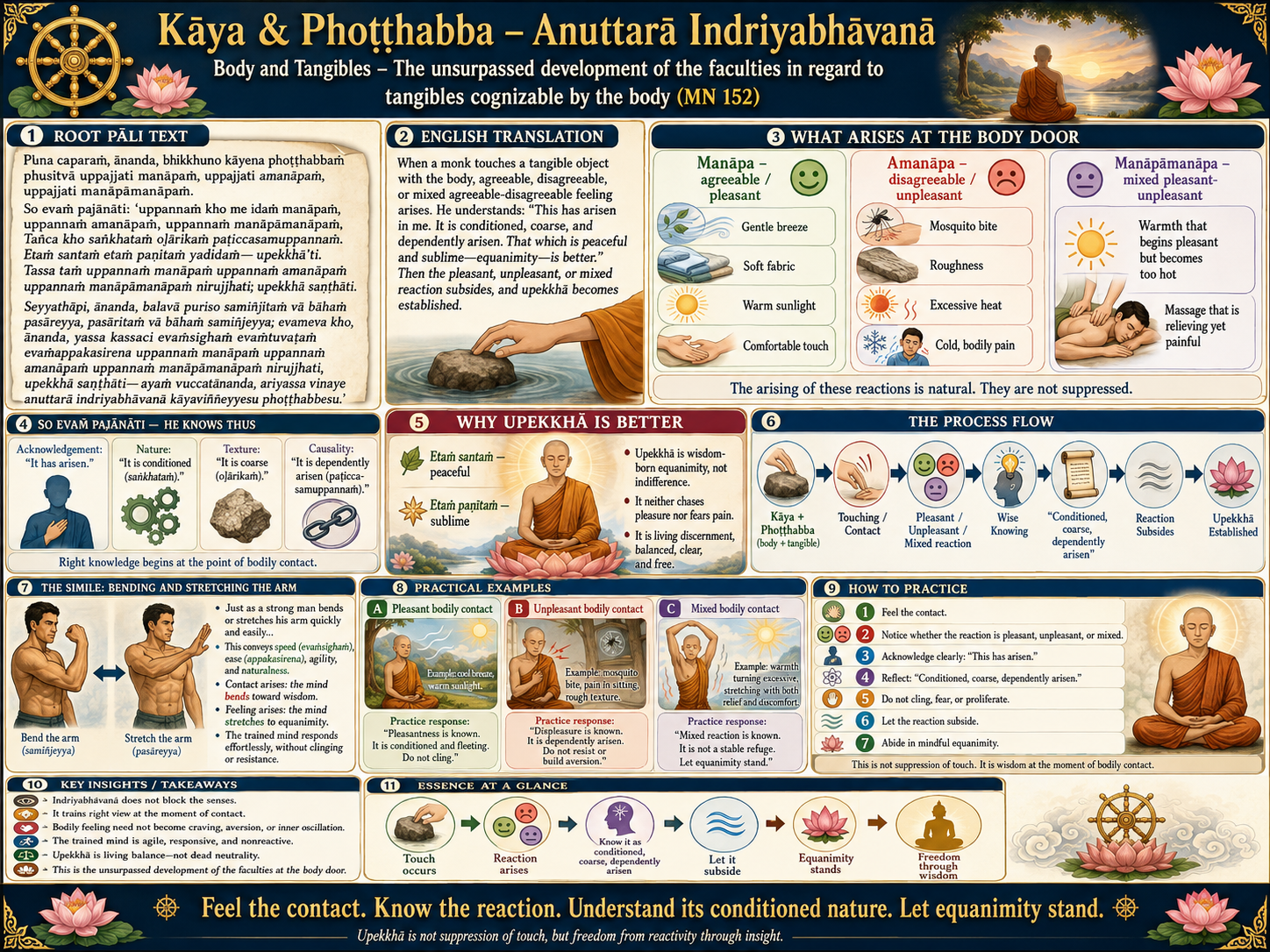
Seyyathāpi, ānanda, balavā puriso samiñjitaṁ vā bāhaṁ pasāreyya, pasāritaṁ vā bāhaṁ samiñjeyya; evameva kho, ānanda, yassa kassaci evaṁsīghaṁ evaṁtuvaṭaṁ evaṁappakasirena uppannaṁ manāpaṁ uppannaṁ amanāpaṁ uppannaṁ manāpāmanāpaṁ nirujjhati, upekkhā saṇṭhāti— ayaṁ vuccatānanda, ariyassa vinaye anuttarā indriyabhāvanā kāyaviññeyyesu phoṭṭhabbesu.
Furthermore, Ānanda, when a monk touches a tangible object with the body, there arises what is agreeable, what is disagreeable, and what is both agreeable and disagreeable. He understands it thus: “This agreeable has arisen in me; this disagreeable has arisen in me; this mixed agreeable-disagreeable has arisen in me. But this is conditioned, it is coarse, it has arisen due to conditions. That which is peaceful, that which is sublime—namely, equanimity—is better.”
Then, whatever agreeable, disagreeable, or mixed feeling has arisen in him subsides; equanimity becomes established. Just as, Ānanda, a strong man might bend his arm or stretch it out—or stretch it out and then bend it back again—easily and quickly, So too, Ānanda, for anyone in whom such agreeable, disagreeable, or mixed feeling arises and subsides just as swiftly, just as easily, equanimity becomes established— this, Ānanda, is called the unsurpassed development of the faculties in regard to tangibles cognizable by the body.
Click infographic to enlarge ↗
Mind and Mental Objects — Manasā Dhammesu
So evaṁ pajānāti: ‘uppannaṁ kho me idaṁ manāpaṁ, uppannaṁ amanāpaṁ, uppannaṁ manāpāmanāpaṁ. Tañca kho saṅkhataṁ oḷārikaṁ paṭiccasamuppannaṁ. Etaṁ santaṁ etaṁ paṇītaṁ yadidaṁ— upekkhā’ti.
Tassa taṁ uppannaṁ manāpaṁ uppannaṁ amanāpaṁ uppannaṁ manāpāmanāpaṁ nirujjhati; upekkhā saṇṭhāti.
Seyyathāpi, ānanda, balavā puriso divasaṁsantatte ayokaṭāhe dve vā tīṇi vā udakaphusitāni nipāteyya. Dandho, ānanda, udakaphusitānaṁ nipāto, atha kho naṁ khippameva parikkhayaṁ pariyādānaṁ gaccheyya;
evameva kho, ānanda, yassa kassaci evaṁsīghaṁ evaṁtuvaṭaṁ evaṁappakasirena uppannaṁ manāpaṁ uppannaṁ amanāpaṁ uppannaṁ manāpāmanāpaṁ nirujjhati, upekkhā saṇṭhāti— ayaṁ vuccatānanda, ariyassa vinaye anuttarā indriyabhāvanā manoviññeyyesu dhammesu.
Furthermore, Ānanda, when a monk knows a mental object with the mind, there arises what is agreeable, what is disagreeable, and what is both agreeable and disagreeable. He understands it thus: “This agreeable has arisen in me; this disagreeable has arisen in me; this mixed agreeable-disagreeable has arisen in me. But this is conditioned, it is coarse, it has arisen due to conditions. That which is peaceful, that which is sublime—namely, equanimity—is better.” Then, whatever agreeable, disagreeable, or mixed feeling has arisen in him subsides; equanimity becomes established. Just as, Ānanda, if a strong man were to drop two or three water droplets into an iron pan heated all day,
though the falling of the droplets would be slow, they would instantly evaporate and vanish—
so too, Ānanda, for anyone in whom such agreeable, disagreeable, or mixed feeling arises and subsides just as swiftly, just as effortlessly, equanimity becomes established—
this, Ānanda, is called the unsurpassed development of the faculties in regard to mental objects cognizable by the mind.

Click infographic to enlarge ↗
How Quickly the Reaction Ceases when the Faculties Are Developed
| Sense Base | Object | Simile | Key Insight |
|---|---|---|---|
| Eye | Form | Opening/closing eyes | Swift establishment of upekkhā |
| Ear | Sound | Snapping the fingers | Swift responsiveness |
| Nose | Smell | Water on lotus leaf | Non-clinging |
| Tongue | Taste | Spitting phlegm | Releasing without attachment |
| Body | Touch | Bending/straightening arm | Natural flexibility |
| Mind | Thought | Water on hot pan | The reaction vanishes quickly |
The Sutta Ends by Showing Training, Mastery, and the Need to Practise
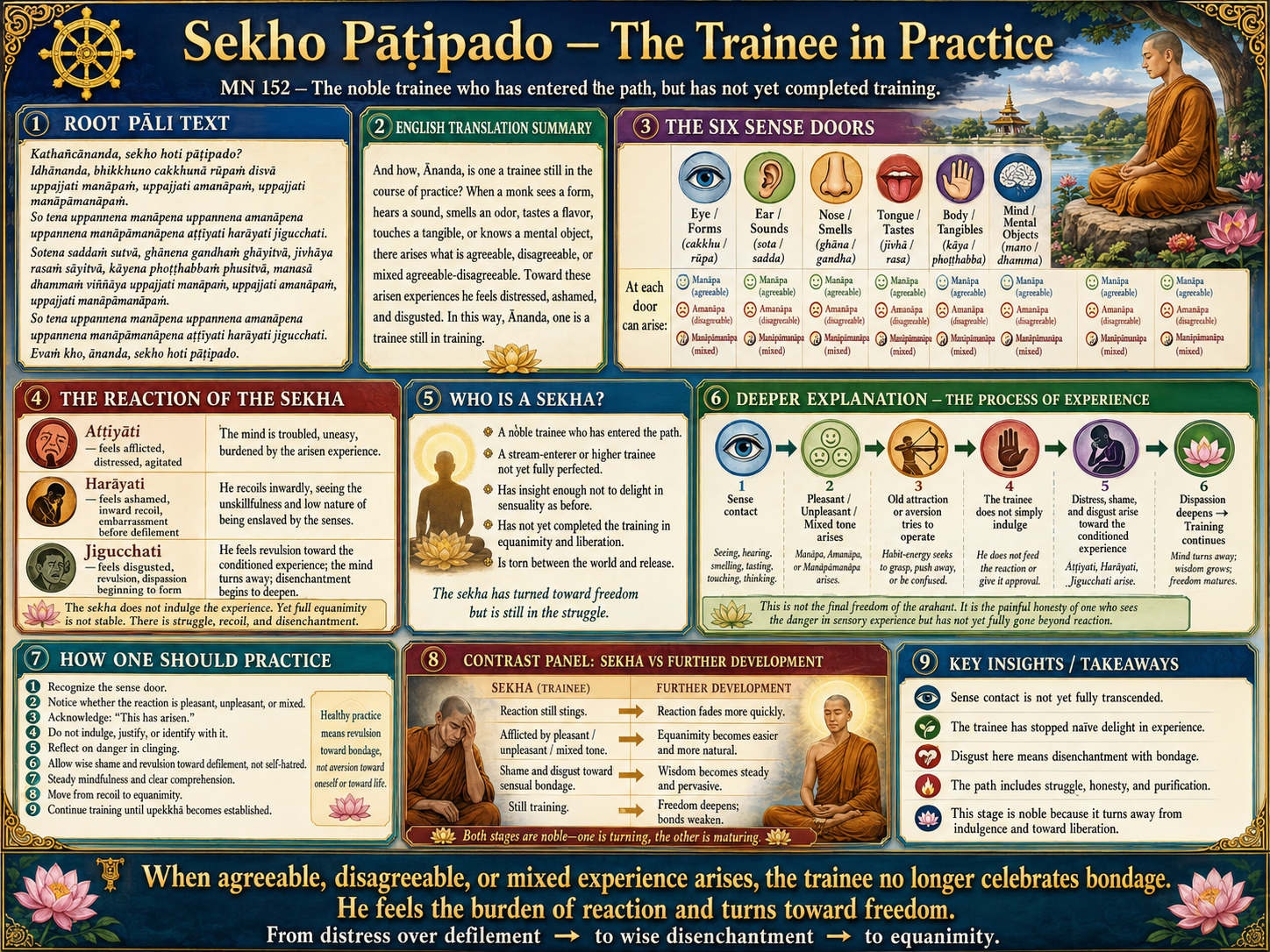
Sekho Pāṭipado — The Trainee Still in Training
Idhānanda, bhikkhuno cakkhunā rūpaṁ disvā uppajjati manāpaṁ, uppajjati amanāpaṁ, uppajjati manāpāmanāpaṁ.
So tena uppannena manāpena uppannena amanāpena uppannena manāpāmanāpena aṭṭīyati harāyati jigucchati.
Sotena saddaṁ sutvā, ghānena gandhaṁ ghāyitvā, jivhāya rasaṁ sāyitvā, kāyena phoṭṭhabbaṁ phusitvā, manasā dhammaṁ viññāya uppajjati manāpaṁ, uppajjati amanāpaṁ, uppajjati manāpāmanāpaṁ.
So tena uppannena manāpena uppannena amanāpena uppannena manāpāmanāpena aṭṭīyati harāyati jigucchati. Evaṁ kho, ānanda, sekho hoti pāṭipado.
And how, Ānanda, is one a trainee who is still in the course of training?
Here, Ānanda, when a monk sees a form with the eye, there arises what is agreeable, there arises what is disagreeable, there arises what is both agreeable and disagreeable.
Toward that arisen agreeable, arisen disagreeable, and arisen mixed agreeable-disagreeable experience, he feels distressed, ashamed, and disgusted.
Similarly, when he hears a sound with the ear, smells an odor with the nose, tastes a flavor with the tongue, touches a tangible with the body, and cognizes a mental object with the mind, and pleasant, unpleasant, or mixed feelings arise, he becomes distressed, ashamed, and disgusted toward them. It is in this way, Ānanda, that one is a trainee still in the course of practice.
Click infographic to enlarge ↗
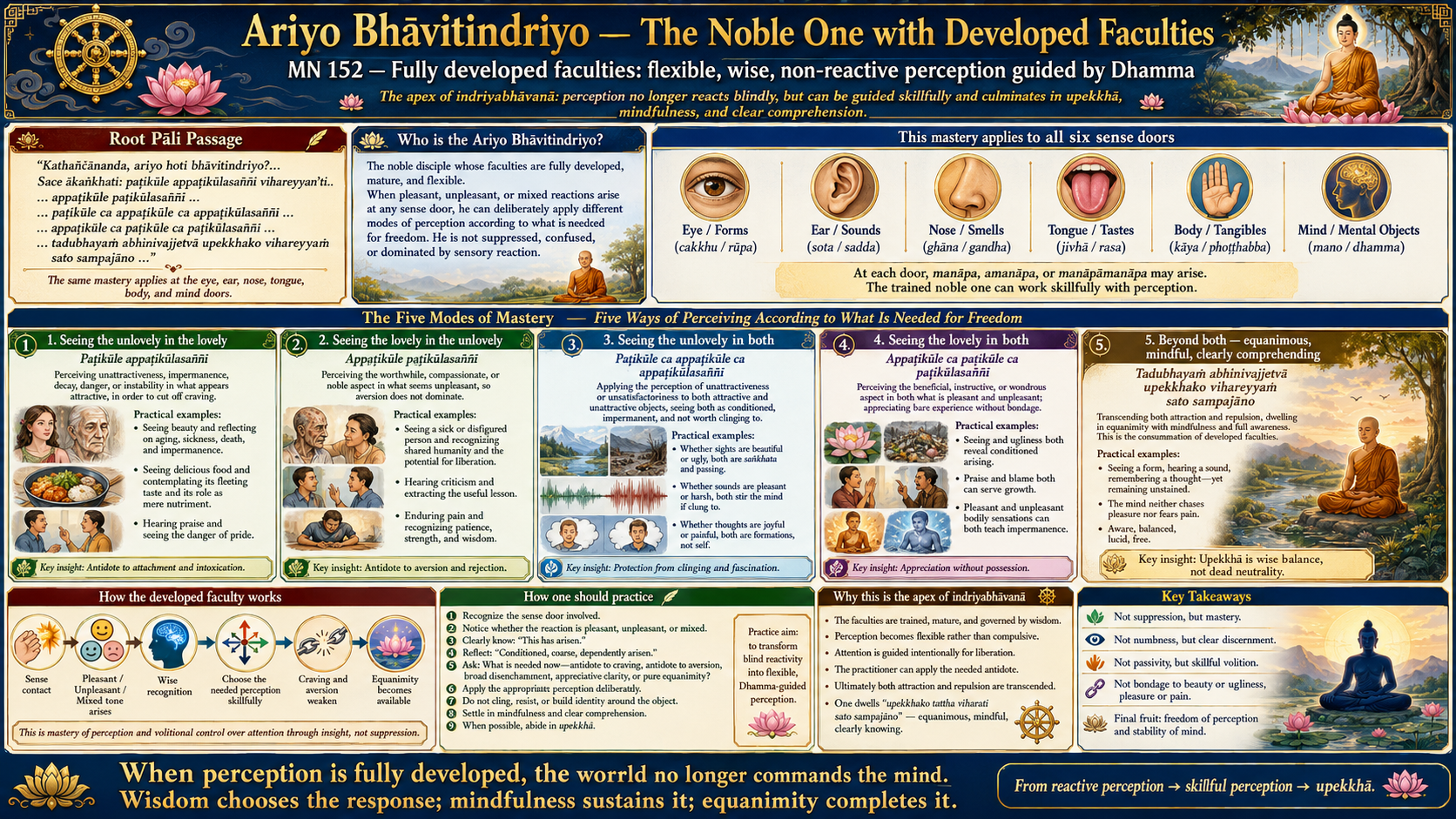
Ariyo Bhāvitindriyo — The Noble One with Developed Faculties
Idhānanda, bhikkhuno cakkhunā rūpaṁ disvā uppajjati manāpaṁ, uppajjati amanāpaṁ, uppajjati manāpāmanāpaṁ.
So sace ākaṅkhati: ‘paṭikūle appaṭikūlasaññī vihareyyan’ti, appaṭikūlasaññī tattha viharati.
Sace ākaṅkhati: ‘appaṭikūle paṭikūlasaññī vihareyyan’ti, paṭikūlasaññī tattha viharati.
Sace ākaṅkhati: ‘paṭikūle ca appaṭikūle ca appaṭikūlasaññī vihareyyan’ti, appaṭikūlasaññī tattha viharati.
Sace ākaṅkhati: ‘appaṭikūle ca paṭikūle ca paṭikūlasaññī vihareyyan’ti, paṭikūlasaññī tattha viharati.
Sace ākaṅkhati: ‘paṭikūlañca appaṭikūlañca tadubhayaṁ abhinivajjetvā upekkhako vihareyyaṁ sato sampajāno’ti, upekkhako tattha viharati sato sampajāno.
Puna caparaṁ, ānanda, bhikkhuno sotena saddaṁ sutvā, ghānena gandhaṁ ghāyitvā, jivhāya rasaṁ sāyitvā, kāyena phoṭṭhabbaṁ phusitvā, manasā dhammaṁ viññāya uppajjati manāpaṁ, uppajjati amanāpaṁ, uppajjati manāpāmanāpaṁ.
So sace ākaṅkhati… (same as above repetition for each of the sense bases)
Evaṁ kho, ānanda, ariyo hoti bhāvitindriyo.
And how, Ānanda, is one a noble disciple with fully developed faculties?
Here, Ānanda, when a monk sees a form with the eye, and pleasant, unpleasant, or mixed feelings arise,
if he wishes, “May I dwell perceiving the unlovely in what is lovely,” then he dwells perceiving the unlovely there.
If he wishes, “May I dwell perceiving the lovely in what is unlovely,” he dwells perceiving the lovely there.
If he wishes, “May I dwell perceiving the unlovely in both the lovely and unlovely,” he does so.
If he wishes, “May I dwell perceiving the lovely in both the unlovely and the lovely,” he does so.
If he wishes, “May I dwell having transcended both the lovely and unlovely, as one equanimous, mindful and clearly comprehending,” he does so—dwelling equanimous, mindful, and clearly comprehending. Likewise, Ānanda, when hearing sounds with the ear, smelling odors with the nose, tasting flavors with the tongue, touching tangibles with the body, or knowing mental objects with the mind, and pleasant, unpleasant, or mixed feelings arise— if he wishes, he can apply any of the above modes of perception. Thus, Ānanda, is a noble disciple with faculties that are fully developed.
Click infographic to enlarge ↗
Jhāyatha, Mā Pamādattha — The Buddha’s Final Instruction
Iti kho, ānanda, desitā mayā ariyassa vinaye anuttarā indriyabhāvanā, desito sekho pāṭipado, desito ariyo bhāvitindriyo.
Yaṁ kho, ānanda, satthārā karaṇīyaṁ sāvakānaṁ hitesinā anukampakena anukampaṁ upādāya, kataṁ vo taṁ mayā.
Etāni, ānanda, rukkhamūlāni, etāni suññāgārāni, jhāyatha, ānanda, mā pamādattha, mā pacchā vippaṭisārino ahuvattha. Ayaṁ vo amhākaṁ anusāsanī”ti. Idamavoca bhagavā. Attamano āyasmā ānando bhagavato bhāsitaṁ abhinandīti.
Thus, Ānanda, in the Noble One’s discipline, I have taught the unsurpassed development of the faculties, I have taught the trainee who is in training, I have taught the noble one with developed faculties. Ānanda, whatever should be done by a Teacher out of compassion, for the welfare of his disciples, that I have done for you. Here, Ānanda, are the roots of trees; here are empty huts.
Meditate, Ānanda! Do not be heedless! Do not later regret it. This is my instruction to you. The Blessed One said this. Venerable Ānanda was delighted and approved of the Blessed One’s words.
Click infographic to enlarge ↗
Deepen the Training at the Six Sense Doors
These Dhamma Essence studies develop specific aspects of indriyasaṁvara and indriyabhāvanā rather than merely mentioning sense restraint as part of the gradual training.
01SN 35.239 — Rathopamasutta
The chariot simile shows why the faculties require disciplined governing rather than suppression, so that the senses do not carry the practitioner wherever attraction and aversion pull.
02SN 35.247 — Chappāṇakopamasutta
The six animals pulling in different directions illustrate the natural tendency of the six faculties to chase their preferred objects and the need for a firm internal anchor.
03SN 47.20 — Janapadakalyāṇīsutta
The bowl-of-oil simile demonstrates sustained care and mindfulness even when highly attractive sensory objects are present around the practitioner.
04Ud 1.10 Bāhiyasutta and SN 35.95 Mālukyaputtasutta
These teachings take the practice directly to sensory experience itself: in what is seen, heard, sensed, or cognized, avoid constructing the additional appropriation from which proliferation develops.
05SN 35.245 — Kiṁsukopamasutta
The city and gatekeeper imagery further clarifies guarding the sense doors while maintaining clear knowledge of what enters and arises within experience.
Why Upekkhā Becomes Possible without Suppressing Experience
The central move in MN 152 is not “I should not feel this.” The practitioner knows that an agreeable, disagreeable, or mixed reaction has arisen and then sees its status clearly: it is saṅkhataṁ, conditioned or fabricated; oḷārikaṁ, coarse in comparison with what is peaceful and sublime; and paṭiccasamuppannaṁ, arisen in dependence on conditions.
That recognition changes the hierarchy of value. The reaction may be compelling, but it is no longer treated as the final authority. Upekkhā is recognized as santaṁ and paṇītaṁ—peaceful and sublime. The six similes then emphasize how quickly and easily the trained mind can cease feeding the reaction.
Eye — From Visual Reaction to Upekkhā
This is the first and foundational application of indriyabhāvanā — development of sense faculties, beginning with the eye (cakkhu). The arising of manāpa (pleasant), amanāpa (unpleasant), or manāpāmanāpa (mixed) experiences is natural and not suppressed in this teaching. This differs from ascetic practices that emphasize blocking sense contact. The Buddha teaches right view and right knowledge at the point of contact: “So evaṁ pajānāti…” — “He knows thus…”This recognition contains 4 aspects:
Acknowledgement: “It has arisen.” Nature: “It is conditioned (saṅkhataṁ)” Texture: “It is coarse (oḷārikaṁ)” Causality: “It has arisen depending on conditions (paṭiccasamuppannaṁ)”
The practitioner then compares these with what is better, peaceful and sublime (santaṁ, paṇītaṁ)—that is upekkhā, equanimity born of wisdom, not indifference. The simile of opening or closing the eyes emphasizes: The naturalness of sense contact The effortless shift from sensory impression to equanimous awareness. A state where the mind does not cling, nor get repelled, nor oscillate.
The equanimity (upekkhā) is not a dead neutrality, but a deep wisdom response—recognizing the fleeting, constructed nature of experiences.
Ear — Sound without Being Carried Away
This second application of indriyabhāvanā concerns the ear (sota) and sounds (sadda). The experience of sound similarly leads to three types of vedanā: manāpa (pleasant): sweet music, praise, kind words; amanāpa (unpleasant): harsh speech, noise, insult; manāpāmanāpa (mixed): ambiguous or conflicting sounds (e.g., a beautiful song with painful memories)
The trained response begins by recognizing the truth of arising: It is not-self-created (paṭiccasamuppannaṁ), It is fabricated (saṅkhataṁ) and coarse (oḷārikaṁ), in contrast to santam paṇītaṁ (the peaceful and sublime equanimity)
The simile used here is: “Just as a strong man could easily snap his fingers (accharaṁ pahareyya)” This conveys: How effortlessly the shift to upekkhā can occur with proper development and how refined and responsive the mind becomes. Upekkhā is not suppression of sound, but transcending reactivity through insight.
Nose — Like Water on a Lotus Leaf
This third case applies indriyabhāvanā to olfactory experience: the nose (ghāna) and smells (gandhā). Threefold Response: Manāpa: e.g., fragrance of flowers, food aroma, perfumes
Amanāpa: bad odors, decay, filth; Manāpāmanāpa: e.g., the smell of incense during funerals—a pleasant scent with unpleasant associations
Evaṁ Pajānāti — Knowing It Thus The monk does not push away, nor grasp, but sees it as: Saṅkhataṁ – a conditioned phenomenon
Oḷārikaṁ – crude, sensory, not subtle wisdom
Paṭiccasamuppannaṁ – arising only because of contact conditions
And so, he reflects: “This is not lasting, not worth clinging to. Peace is better. Equanimity is better.” Simile: Water Droplets on a Lotus Leaf
“īsakampoṇe padumapalāse udakaphusitāni pavattanti, na saṇṭhanti”
Padumapalāsa = lotus leaf īsakampoṇa = slightly slanted or trembling (from wind or subtle movement) udakaphusitāni = water droplets. This image conveys that: Just as water doesn’t stick to the leaf, so too contact and reactions do not cling to the trained mind. The non-stick quality of the leaf is like mindfulness coupled with wisdom. The simile emphasizes non-adherence: the reaction does not find a place to remain when the faculties are developed. In contrast to the ascetic notion of blocking the senses, the Buddha encourages a wise presence that lets phenomena arise and pass like dew on a lotus.
Tongue — Taste Released without Clinging
The fourth sense base discussed is jivhā (tongue) and rasā (tastes). The Buddha shows that even with the intimate sensory delight of taste, the development of equanimity is possible and essential. Examples of the response: Manāpa – sweet, savory, well-seasoned foods
Amanāpa – bitter, sour, spoiled food; Manāpāmanāpa – complex foods that evoke both pleasure and aversion (e.g., food tied to memories of both comfort and suffering)
The practitioner doesn’t resist taste but observes its arising without clinging. He understands that:
It is constructed (saṅkhataṁ); It is coarse, not refined Dhamma; It is dependently arisen, not intrinsic or permanent and hence, he naturally prefers upekkhā, the sublime peace beyond fleeting. pleasure.
Simile: Spitting Out Saliva
“Jivhagge kheḷapiṇḍaṁ saṁyūhitvā appakasirena vameyya”
Kheḷapiṇḍaṁ = a ball of saliva or spittle; Saṁyūhitvā = having gathered it together; Vameyya = he spits it out; Appakasirena = with little difficulty. This simile may feel blunt or even crude, but its meaning is profound: A natural, reflexive, effortless rejection of something unclean.
Just as one has no attachment to mucus, the trained mind spontaneously lets go of sensory reactions. The point is not suppression but the ease and immediacy with which the trained mind releases the reaction.
What This Reveals
This stage shows that even one of the most strongly conditioned forms of gratification—taste—can be disarmed through wisdom and mindfulness. The mind, like one who quickly spits out phlegm, doesn’t argue with or indulge sensory pleasure, but releases it by recognizing its true nature.
Body — The Flexibility of a Trained Mind
This is the fifth application, pertaining to touch or tactile sensations—through kāya (body) and phoṭṭhabba (tangible objects), such as: Temperature, Pressure, Texture, Movement, Pain or pleasure on the skin. Examples of the response:
Manāpa: a gentle breeze, soft fabric, warm sunlight; Amanāpa: mosquito bite, roughness, heat, cold, pain; Manāpāmanāpa: e.g., warmth that starts pleasant but becomes too hot.
What does the practitioner do?
As in the previous cases: He recognizes the arising feeling (uppannaṁ kho me idaṁ…)
He understands: This is fabricated (saṅkhataṁ), coarse (oḷārikaṁ), and dependently arisen (paṭiccasamuppannaṁ). Thus, he lets it go, allowing upekkhā—balanced awareness—to arise and remain.
Simile: Bending and Stretching the Arm
“Seyyathāpi, ānanda, balavā puriso samiñjitaṁ vā bāhaṁ pasāreyya, pasāritaṁ vā bāhaṁ samiñjeyya”. A strong person bends or stretches his arm as easily and naturally as breathing. This reflects the agility of the trained mind: Contact arises? The mind bends toward wisdom.
Feeling arises? The mind stretches to equanimity. This simile highlights: Speed (evaṁsīghaṁ); Ease (appakasirena); Nonresistance to experience, and nonclinging and equanimity is not dead neutrality, but living discernment that neither chases pleasure nor fears pain.
Mind — Like Water on a Hot Iron Pan
This is the sixth application: the mind (manasā) engaging with mental objects (dhammā), which includes: Memories, Thoughts, Mental images, Fantasies, Hopes and fears, Concepts, philosophies, and ideas. These are not physical objects, but arise internally, in the mind-door.
Examples of the response: Manāpa: pleasant memory, joyful vision, uplifting idea; Amanāpa: worry, grief, aversion, painful thought; Manāpāmanāpa: nostalgia, bittersweet memories, philosophical doubt.
The Monk’s Wisdom: He sees: “This has arisen.” and is conditioned (saṅkhataṁ), not pure mind or essence. It is oḷārikaṁ—though subtle in content, still coarse in nature; It is paṭiccasamuppannaṁ—not-self, not-lasting and thus, he values not the object, but the quality of peace: upekkhā.
Simile: Water on a Hot Iron Pan – “Divasaṁsantatte ayokaṭāhe… udakaphusitāni…”
“In an iron pan heated all day, even a drop of water falls slowly (dandho nipāto), but it instantly vanishes.” This is powerful imagery: The simile need not be decoded element by element. Its force is the speed of cessation: even if the drop takes time to fall, it vanishes almost immediately on contact with the heated pan; likewise, the agreeable, disagreeable, or mixed reaction does not remain.
In a well-trained mind: Arising is known; Clinging does not occur’ Upekkhā remains, unwavering and cool, like clear space
What This Reveals
Across all six sense bases—eye, ear, nose, tongue, body, and mind—the Buddha teaches not suppression, but wisdom-based equanimity:
Sekho — When Reactivity Is Still Burdensome
This describes the sekha, one who has entered the Noble Path (stream-enterer or beyond), but has not yet completed training. Uppajjati manāpaṁ / amanāpaṁ / manāpāmanāpaṁ = standard formula describing the threefold feeling tone (agreeable, disagreeable, or mixed) that arises at sense contact. The response of the sekha is not indulgence, but rather revulsion:
Aṭṭīyati – becomes afflicted, emotionally agitated
Harāyati – is ashamed or feels inward recoil
Jigucchati – is disgusted, averse
The point is not that the trainee should cultivate aversion toward sense objects. Rather, agreeable, disagreeable, and mixed reactions are still experienced as burdensome and objectionable because the training is not yet complete; the effortless establishment of upekkhā described earlier has not yet become mastery.
Ariyo Bhāvitindriyo — Perception No Longer Dictated by the Object
Here the Buddha describes the ariyo bhāvitindriyo — the noble one whose faculties are developed, mature, and flexible. This passage itself does not assign a specific stage of awakening.
He can: See repulsiveness in the attractive – e.g., seeing impermanence in beauty
See attractiveness in the repulsive – e.g., understanding compassion in suffering
Apply these perceptions flexibly depending on what’s needed to cut off craving
Abandon both and dwell in upekkhā – equanimous, mindful, discerning
This shows mastery of perception: the practitioner is no longer compelled to accept the first attractive or repulsive appearance as the only possible way of regarding the object. Note the line: “Upekkhako tattha viharati sato sampajāno” – He dwells equanimous, mindful, and clearly knowing of internal workings. This is the apex of indriyabhāvanā: when perception is no longer reactive but guided by the Dhamma.
Jhāyatha — The Teaching Must Be Practised
This is the Buddha’s final blessing and wake-up call. He affirms that he has done his duty as teacher (kataṁ vo taṁ mayā). He invites personal responsibility: go to the forest, find solitude, and meditate deeply. His sharp call: “Mā pamādattha, mā pacchā vippaṭisārino ahuvattha.” “Don’t be heedless; lest you regret it later.” The sutta ends with Ānanda’s joyful approval, signifying that the transmission of the Dhamma is received with understanding and reverence.
A Developed Faculty Is Not Imprisoned by the First Appearance
Five Ways the Developed Practitioner Can Relate to Perception
Paṭikūle appaṭikūlasaññī – perceiving the repulsive in what is non-repulsiveAppaṭikūle paṭikūlasaññī – perceiving the non-repulsive in what is repulsive
Paṭikūle ca appaṭikūle ca appaṭikūlasaññī – perceiving the repulsive in both
Appaṭikūle ca paṭikūle ca paṭikūlasaññī – perceiving the non-repulsive in both Tadubhayampi abhinivajjetvā upekkhako sato sampajāno – transcending both, dwelling in equanimity with mindfulness and full awareness
Click infographic to enlarge ↗
The developed practitioner can deliberately change the mode of perception when useful, or leave both attraction and repulsion behind and dwell upekkhako, sato sampajāno—equanimous, mindful, and clearly comprehending.
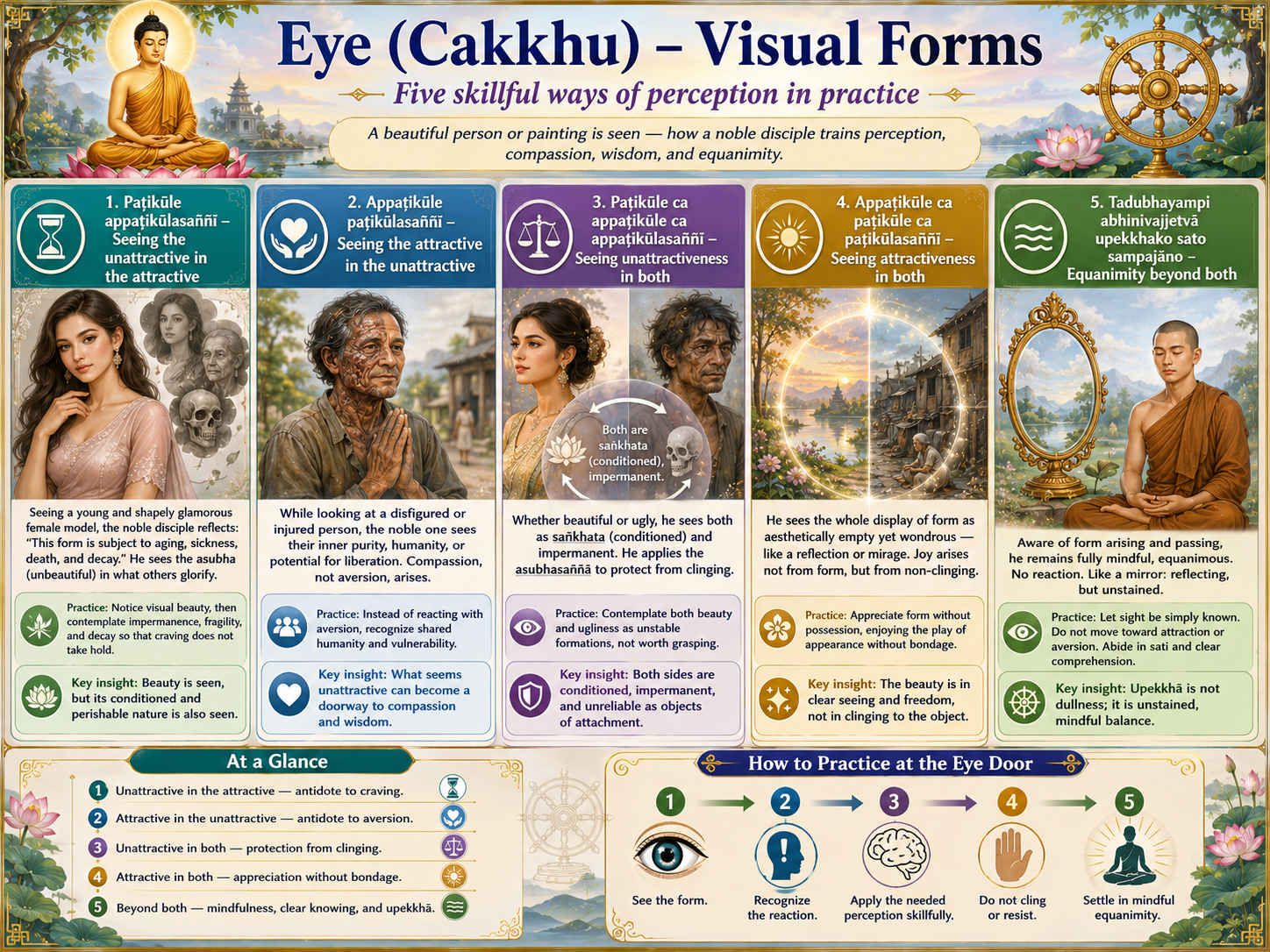
Eye — Visual Forms
Unattractive in Attractive: Seeing a glamorous model, the noble disciple reflects: “This form is subject to aging, sickness, death, and decay.” He sees the asubha (unbeautiful) in what others glorify.
Attractive in Unattractive: While looking at a disfigured or injured person, the noble one sees their inner purity, humanity, or potential for liberation. Compassion, not aversion, arises.
Unattractive in both: Whether beautiful or ugly, he sees both as saṅkhata (conditioned) and impermanent. He applies the asubhasaññā to protect from clinging.
Attractive in both: Sees the whole display of form as aesthetically empty yet wondrous — like a reflection or mirage. Joy arises not from form, but from non-clinging.
Equanimity beyond both: Aware of form arising and passing, he remains fully mindful, equanimous.
No reaction. Like a mirror: reflecting, but unstained.
Click infographic to enlarge ↗
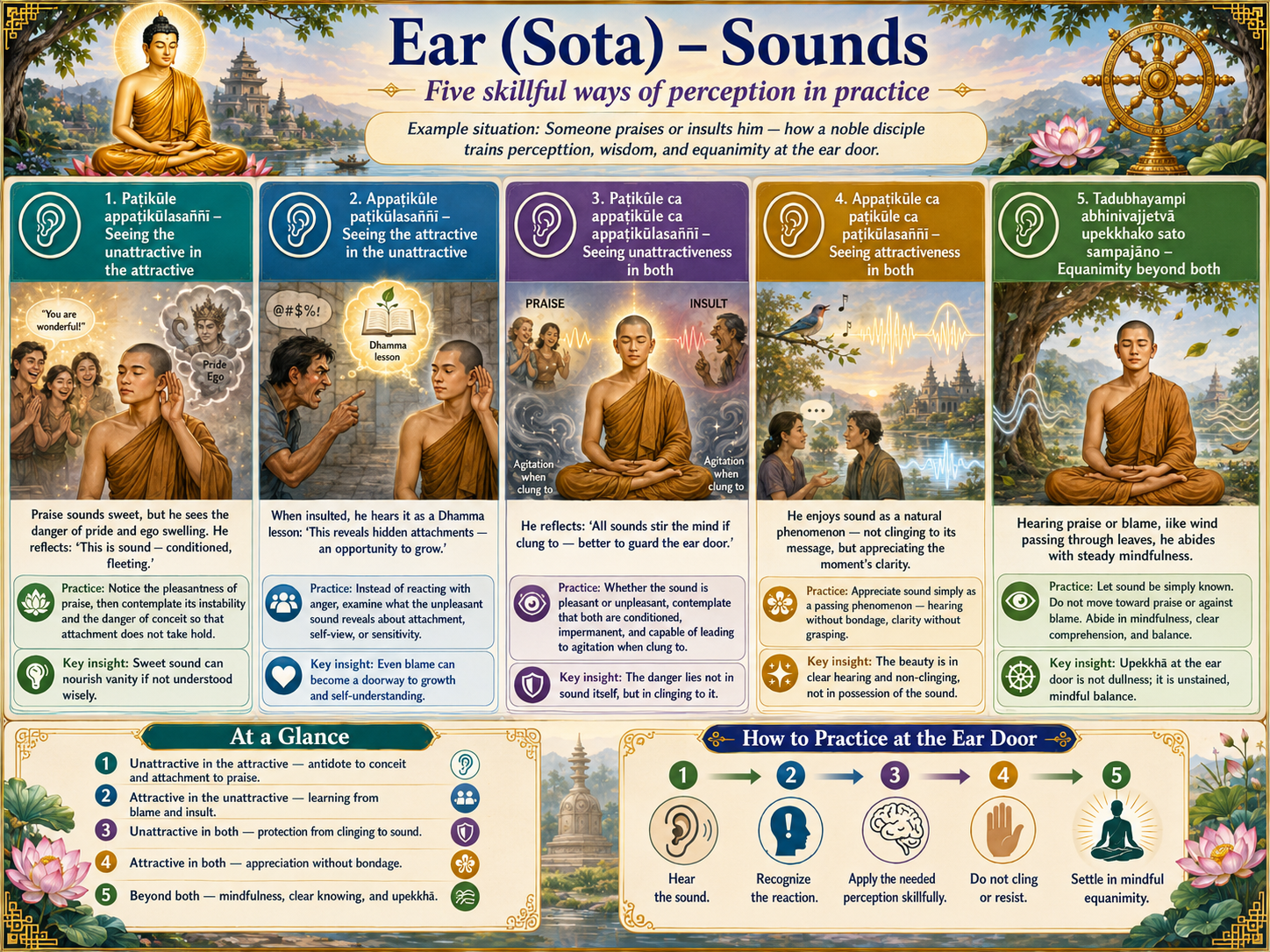
Ear — Sounds
Unattractive in Attractive: Praise sounds sweet, but he sees the danger of pride and ego swelling.
He reflects: “This is sound — conditioned, fleeting.”
Attractive in Unattractive: When insulted, he hears it as a Dhamma lesson: “This reveals hidden attachments — an opportunity to grow.”
Unattractive in both: He reflects: “All sounds stir the mind if clung to — better to guard the ear door.”
Attractive in both: He enjoys sound as a natural phenomenon — not clinging to its message, but appreciating the moment’s clarity.
Equanimity beyond both: Hearing praise or blame, like wind passing through leaves, he abides with steady mindfulness.
Click infographic to enlarge ↗
Nose — Smells
Unattractive in Attractive: Smelling pleasant incense, he reflects: “This is transient, fabricated. It leads to craving if indulged.”
Attractive in Unattractive: At a foul smell, he reflects: “The body is just elements. There’s dignity even in decay — it’s part of nature.”
Unattractive in both: “All smells are conditions. They deceive and fade. There’s nothing lasting here.”
Attractive in both: He enjoys the sense moment as it is — pleasant or foul — with refined appreciation of its impermanence.
Equanimity beyond both: He experiences smell as contact — no aversion or attraction. Just awareness.

Click infographic to enlarge ↗
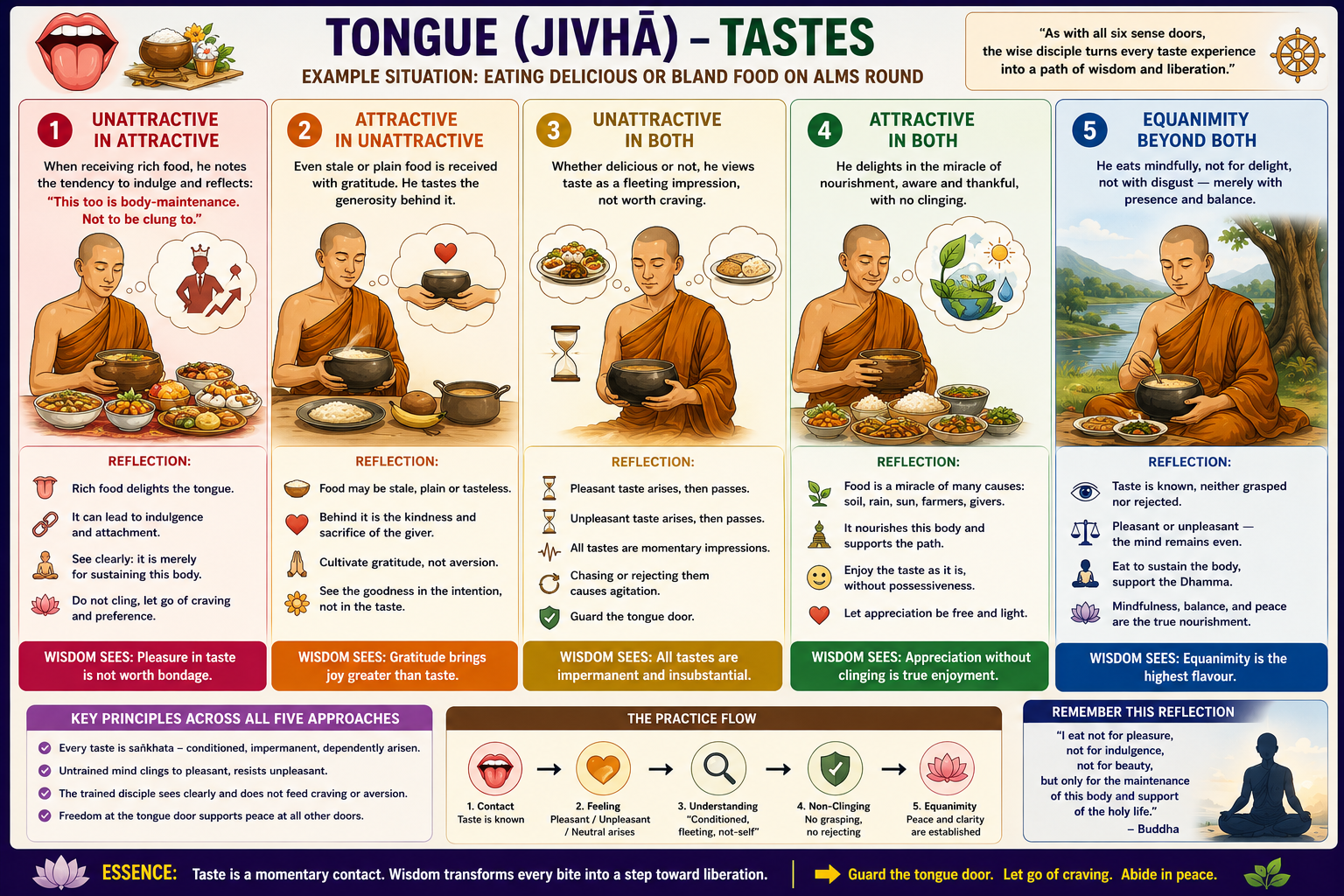
Tongue — Tastes
Unattractive in Attractive: When receiving rich food, he notes the tendency to indulge and reflects: “This too is body-maintenance. Not to be clung to.”
Attractive in Unattractive: Even stale or plain food is received with gratitude. He tastes the generosity behind it.
Unattractive in both: Whether delicious or not, he views taste as a fleeting impression, not worth craving.
Attractive in both: He delights in the miracle of nourishment, aware and thankful, with no clinging.
Equanimity beyond both: He eats mindfully, not for delight, not with disgust — merely with presence and balance.
Click infographic to enlarge ↗
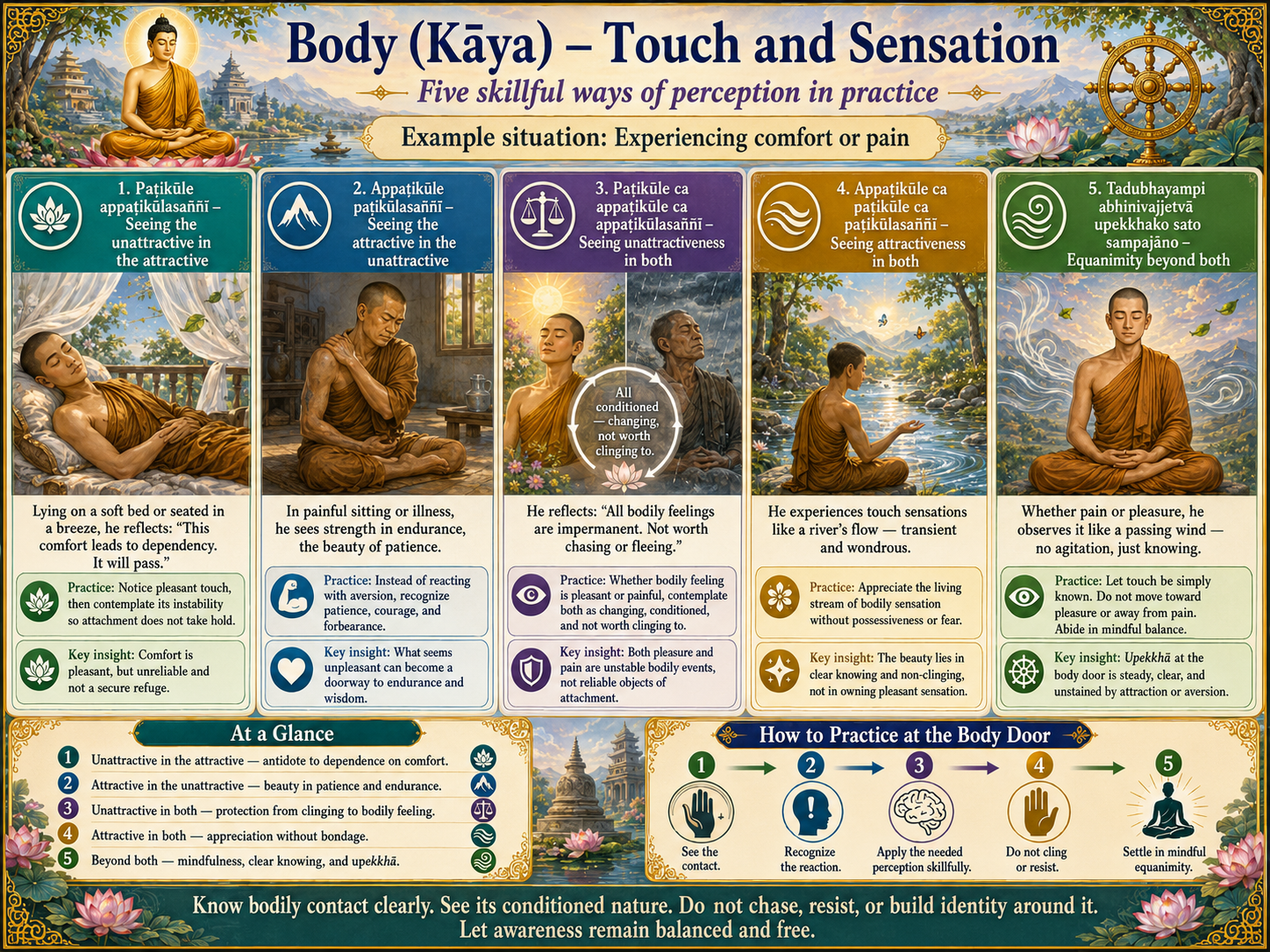
Body — Touch and Sensation
Attractive in Unattractive: In painful sitting or illness, he sees strength in endurance, the beauty of patience.
Unattractive in both: He reflects: “All bodily feelings are impermanent. Not worth chasing or fleeing.”
Attractive in both: He experiences touch sensations like a river’s flow — transient and wondrous.
Equanimity beyond both: Whether pain or pleasure, he observes it like a passing wind — no agitation, just knowing.
Click infographic to enlarge ↗
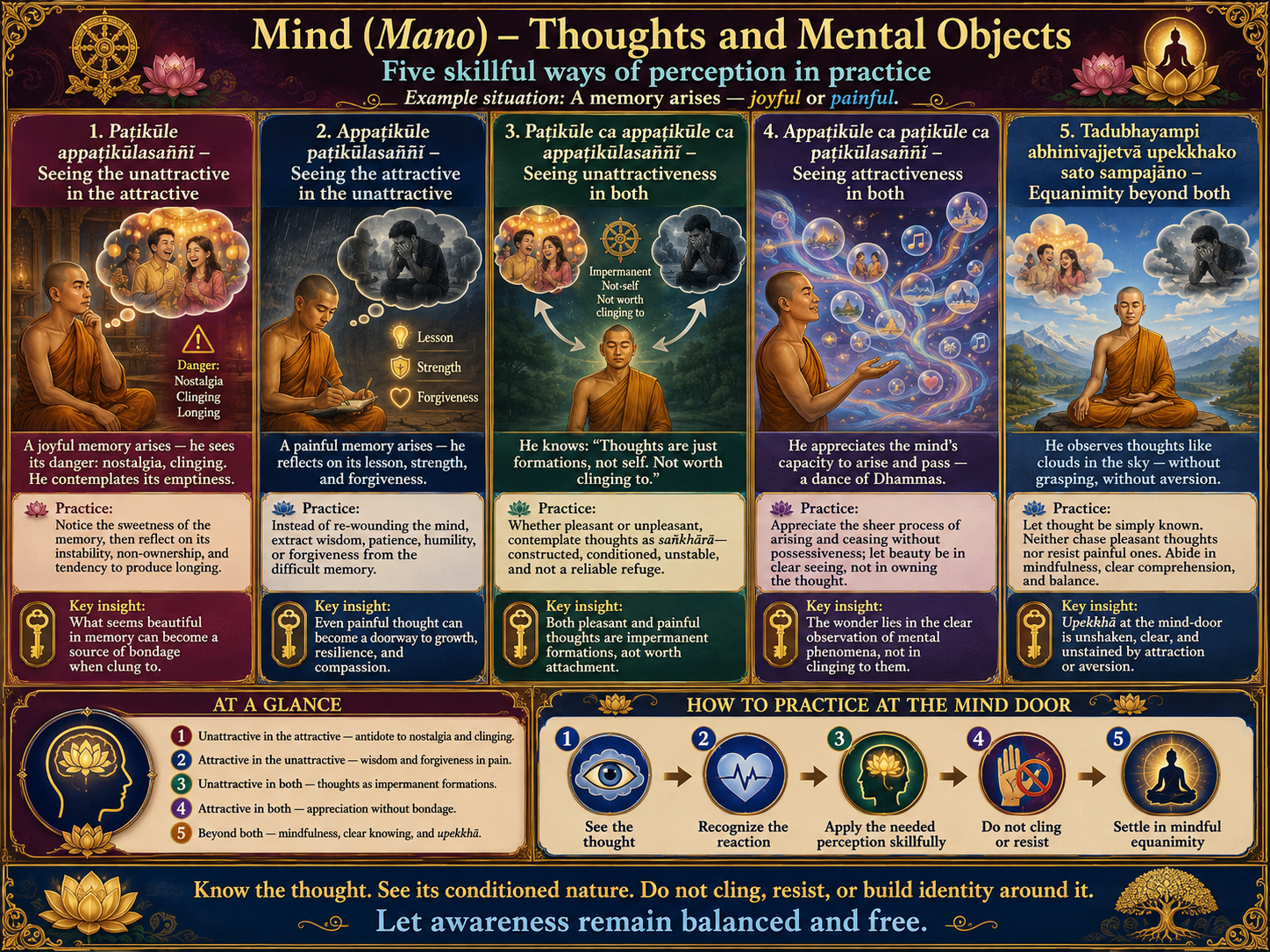
Mind — Thoughts and Mental Objects
Unattractive in Attractive: A joyful memory arises — he sees its danger: nostalgia, clinging. He contemplates its emptiness.
Attractive in Unattractive: A painful memory arises — he reflects on its lesson, strength, and forgiveness.
Unattractive in both: He knows: “Thoughts are just formations, not self. Not worth clinging to.”
Attractive in both: He appreciates the mind’s capacity to arise and pass — a dance of Dhammas.
Equanimity beyond both: He observes thoughts like clouds in the sky — without grasping, without aversion.
Click infographic to enlarge ↗
Two Visual Overviews of the Same Perceptual Freedom

Click infographic to enlarge ↗

Click infographic to enlarge ↗
| Sense Base | Repulsive in the Non-Repulsive | Non-Repulsive in the Repulsive | Repulsive in Both | Non-Repulsive in Both | Beyond Both — Upekkhā |
|---|---|---|---|---|---|
| Eye | Reflects on decay in beauty | Sees dignity in deformity | Sees all as clinging traps | Enjoys without craving | Pure awareness of sight |
| Ear | Pride check on praise | Learns from insult | All sounds stir mind | Appreciates sound’s play | Hears with serenity |
| Nose | Incense is impermanent | Decay part of nature | Smells deceive | Momentary wonder | Just awareness of scent |
| Tongue | Taste leads to greed | Grateful for plain food | All tastes pass | Receives with joy | Eats mindfully |
| Body | Comfort breeds attachment | Pain reveals strength | Neither worth clinging | Flow of experience | No reaction to sensation |
| Mind | Joyful memory is clinging | Painful memory yields growth | All thoughts empty | Mind’s miracle seen | Thoughts as clouds |
Guarding the Door Protects the Mind; Developing the Faculty Transforms the Reaction
Practical aspect of Guarding the Six Sense Doors
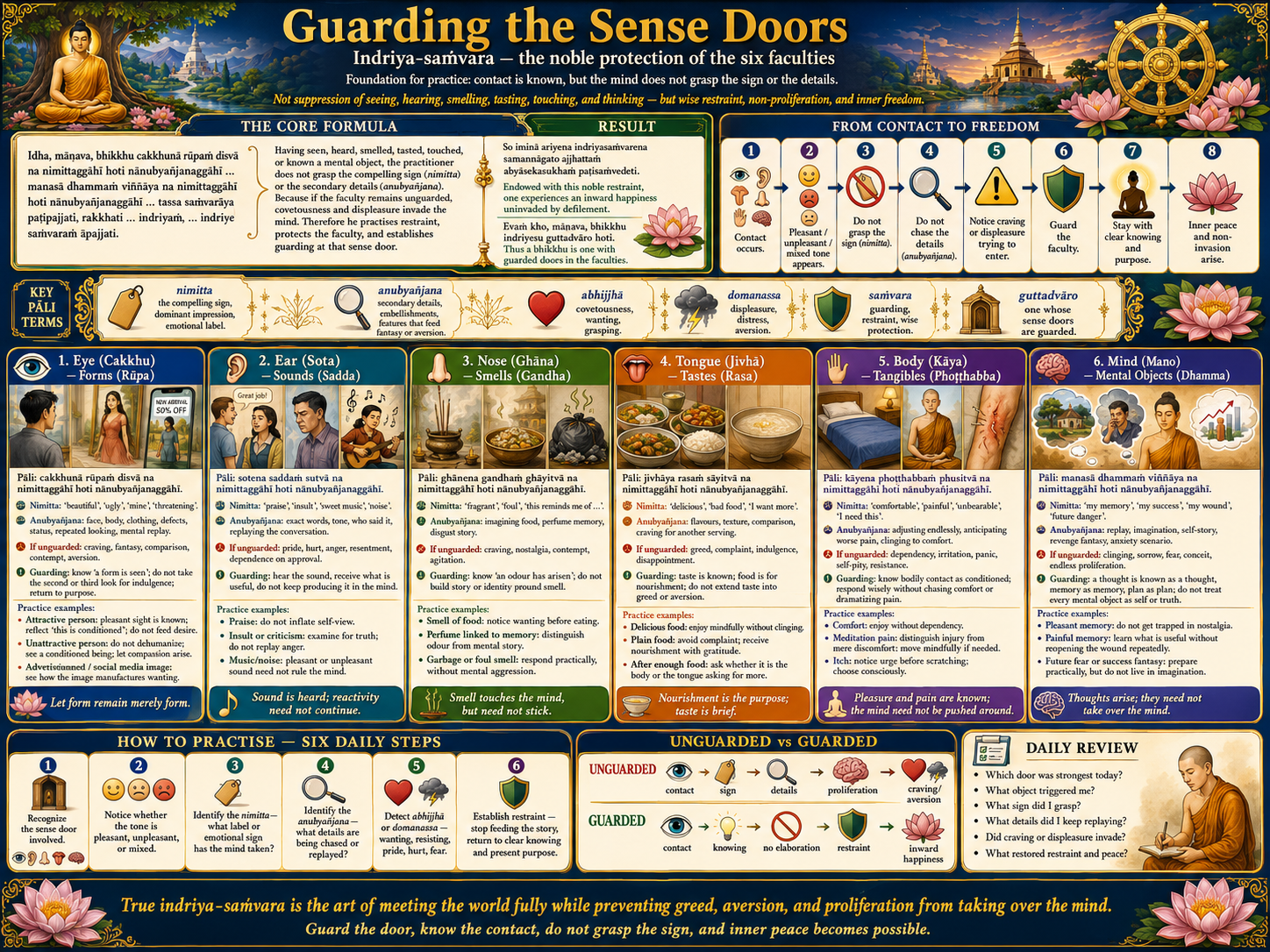
The central principle
Buddha does not say:
Do not see forms.
Do not hear sounds.
Do not experience taste, smell, touch, or thought.
Make yourself insensitive.
Regard the sense object itself as sinful.
The training begins after contact has occurred:
cakkhunā rūpaṁ disvā — having seen a form with the eye.
The danger does not lie merely in seeing. It lies in what the mind does immediately afterward:
It grasps a nimitta—a compelling sign, appearance, theme, or impression.
It grasps the anubyañjana—the subsidiary details that feed and elaborate that impression.
Covetousness or displeasure enters and occupies the mind.
The object is converted into craving, aversion, identity, fantasy, resentment, or proliferation.
Thus, sense restraint means:
See without being carried away by what is seen.
Hear without being possessed by what is heard.
Know contact without building craving or aversion upon it.
Sense restraint prevents the mind from feeding nimitta and anubyañjana in ways that allow covetousness and displeasure to invade. MN 152 then shows a further mastery: when reactions arise, their conditioned nature is known and upekkhā is established.
The Eye and Visible Forms
Here, student, having seen a visible form with the eye, a bhikkhu does not grasp its compelling sign, nor does he grasp its subsidiary details. Because, if he were to dwell with the eye faculty unrestrained, harmful and unwholesome states of covetousness and displeasure might flow in and overwhelm him, he practises for its restraint. He protects the eye faculty and establishes restraint regarding the eye faculty.
Cakkhunā rūpaṁ disvā – “Having seen a form with the eye.” Seeing has already occurred. Therefore, restraint is not blindness, avoidance, or suppression. The issue is how the mind relates to what has been seen.
Na nimittaggāhī hoti – “He does not grasp the sign.” A nimitta is the dominant impression under which the object is mentally apprehended:
“Beautiful woman.”
“Ugly person.”
“Expensive car.”
“My enemy.”
“A threatening face.”
“Something I must possess.”
“Something I cannot tolerate.”
The mind reduces the entire visual event to one emotionally charged sign.
Not grasping the sign does not mean failing to recognize the object. It means not allowing the perception to become the foundation for greed, hatred, identity, or mental proliferation.=
Nānubyañjanaggāhī – “He does not grasp the subsidiary details.” Having grasped the general sign, the mind normally begins examining and collecting details:
the person’s eyes
facial features
skin
clothing
bodily shape
gestures
manner of walking
perceived faults
signs of wealth
signs of social status
The mind may later replay these details, compare them, fantasize about them, or use them to reinforce aversion. The problem is not accurate observation. The problem is selective attention serving craving or aversion.
Abhijjhādomanassā – “Covetousness and displeasure.” These represent the two directions in which the unguarded mind is pulled:
abhijjhā: “I want it; may it become mine.”
domanassa: “I dislike it; may it disappear.” The mind is no longer simply seeing. It has begun leaning toward possession or rejection.
Practice example 1: Seeing an attractive person
A person sees someone physically attractive. The first visual recognition is natural:
“A person has been seen, and pleasantness has arisen.”
The unrestrained sequence is:
“Very beautiful.”
Attention moves repeatedly to selected features and the mind takes a second and third look.
It imagines conversation, relationship, possession, or gratification and the image continues after the person has gone.
Desire becomes stronger than the original contact. Sense restraint interrupts the process:
“A form has been seen. Pleasantness has arisen dependent upon eye, form, eye-consciousness, and contact. There is no need to collect details or build a story.” The practitioner can then return attention to the purpose of the present activity. This is not hatred of beauty. It is freedom from being captured by beauty.
Practice example 2: Seeing someone considered unattractive
A person sees an injured, disfigured, elderly, or poorly dressed individual.
The unguarded mind may seize the sign: “Ugly, unpleasant, undesirable.” It then collects details that reinforce rejection.
The restrained practitioner recognizes: “Aversion has begun constructing an identity out of visual features. This is a living being subject to conditions, pain, aging, and death, just as I am.” The practitioner does not have to falsely call the appearance beautiful. He simply does not allow unpleasant visual contact to turn into contempt, cruelty, or dehumanization. Compassion replaces aversion.
Practice example 3: Social media and advertising
A practitioner sees an advertisement for a costly phone, vehicle, house, or holiday.
The mind grasps the nimitta: “Success, prestige, happiness.”
It then grasps details:
the design;
colour;
lifestyle;
admiration from others;
imagined social status.
Practice:
“This is a constructed visual presentation designed to produce wanting. The image is not happiness. Wanting is arising in the mind.” The practitioner may still make a rational purchase when necessary. What is abandoned is psychological captivity. Practical eye-door reflection – “Seeing is occurring.
Pleasantness or unpleasantness has arisen.
I will not convert the appearance into craving or aversion.
I will not feed it by collecting details.
Let the form remain merely a form.”

Click infographic to enlarge ↗
The Ear and Sounds
Having heard a sound with the ear, he does not grasp its compelling sign, nor does he grasp its subsidiary details.
Because, if he were to dwell with the ear faculty unrestrained, harmful and unwholesome states of covetousness and displeasure might flow in and overwhelm him, he practises for its restraint. He protects the ear faculty and establishes restraint regarding the ear faculty.
How sound becomes a nimitta?
The sound itself may last only a few seconds. But the mind takes a sign from it:
He praised me.
She insulted me.
They respect me.
Nobody listens to me.
That voice is beautiful.
That noise is unbearable.
The mind then grasps subsidiary details:
the exact words
tone of voice
volume
facial implications
what should have been said
how one should reply
what others may have thought
A ten-second sound can therefore become ten hours of mental proliferation.
Practice example 1: Receiving praise
Someone says: “Your teaching was excellent. Nobody explains the Dhamma as clearly as you.”
The unrestrained ear-door grasps the sign: “I am an exceptional teacher.”
It then begins collecting confirming details:
who praised
who heard the praise
whether others agreed
how one compares with other teachers
Pride, superiority, and dependence on approval can develop.
The restrained response is:
“Pleasant words have been heard. Pleasantness has arisen. The sound has already ceased. Whatever was useful may be received, but no identity needs to be constructed.” The practitioner may respond courteously:
“I am glad that the explanation was useful.” Internally, he does not convert appreciation into conceit.
Practice example 2: Hearing criticism or insult
Someone says: “You do not understand what you are teaching.”
The unrestrained sequence is:
The sound is taken as “an insult.”
The person becomes “my opponent.”
Particular words and tone are replayed.
Defensive replies are imagined.
Anger continues long after the sound has ceased.
Sense restraint does not mean ignoring legitimate criticism. It means separating useful information from emotional poison.
The practitioner examines:
“Is there anything true or useful in what was said?” If yes, he learns from it.
If no, he lets the sound cease without carrying it further.
“The sound ended. I need not continue producing it inside my own mind.”
Practice example 3: Music
Pleasant music is heard. There is nothing inherently wrong with recognizing harmony. But an unguarded mind may:
seek repeated stimulation;
become dissatisfied with silence;
use music to escape every unpleasant mental state;
continually replay the melody mentally.
The restrained practitioner knows:
“Pleasant sound is present. It is changing moment by moment. I can hear it without demanding that it continue.”
Practical ear-door reflection “Sound has touched the ear.
The sound is already changing and ceasing.
I will receive whatever information is useful.
I will not turn praise into conceit or criticism into hatred.”

Click infographic to enlarge ↗
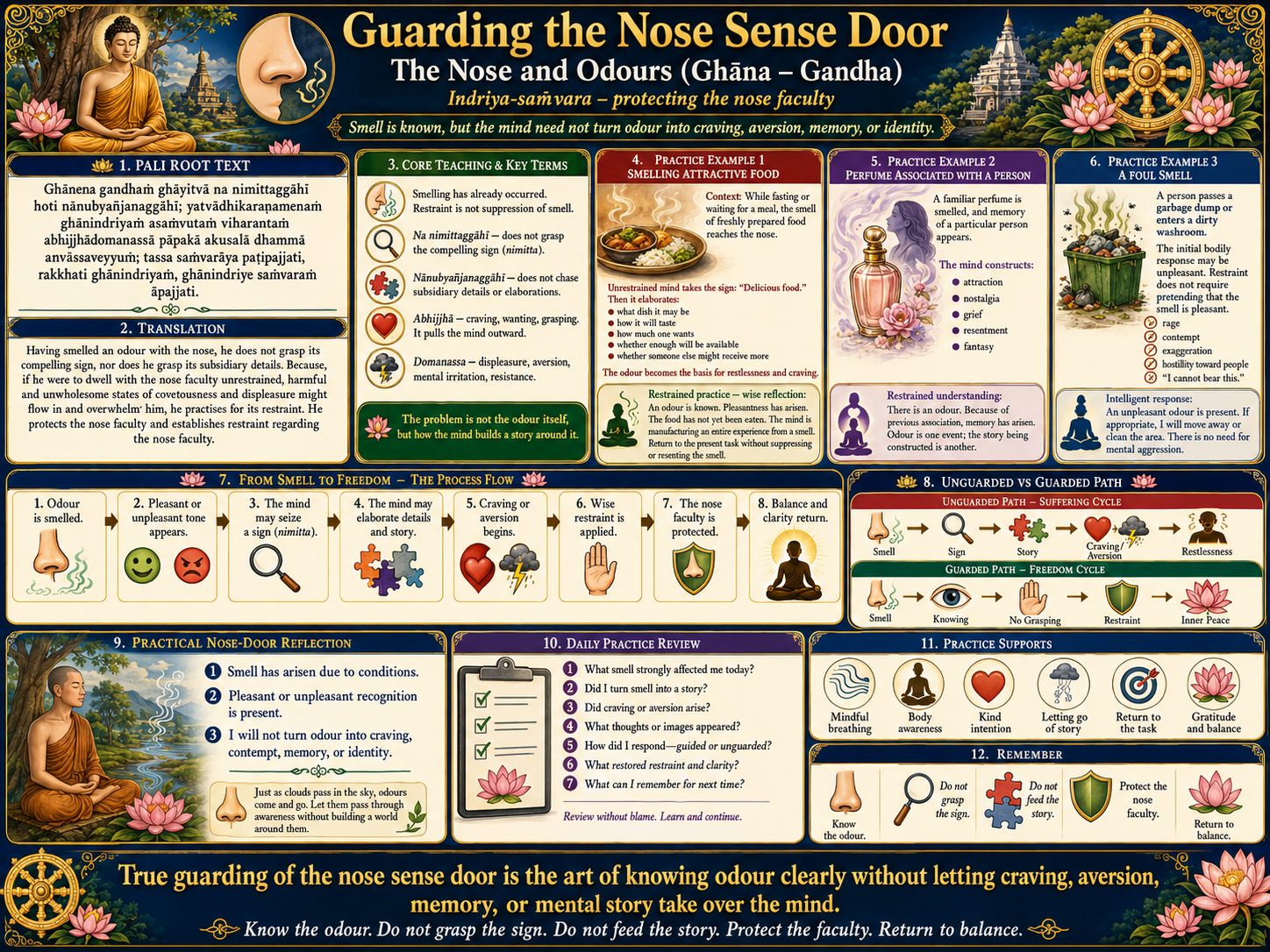
The Nose and Odours
Having smelled an odour with the nose, he does not grasp its compelling sign, nor does he grasp its subsidiary details.
Because, if he were to dwell with the nose faculty unrestrained, harmful and unwholesome states of covetousness and displeasure might flow in and overwhelm him, he practises for its restraint. He protects the nose faculty and establishes restraint regarding the nose faculty.
Practice example 1: Smelling attractive food
While fasting or waiting for a meal, the smell of freshly prepared food reaches the nose.
The unrestrained mind takes the sign: “Delicious food.” Then it elaborates:
what dish it may be
how it will taste
how much one wants
whether enough will be available
whether someone else might receive more
The odour becomes the basis for restlessness and craving
Practice: “An odour is known. Pleasantness has arisen. The food has not yet been eaten. The mind is manufacturing an entire experience from a smell.”Return to the present task without suppressing or resenting the smell.
Practice example 2: Perfume associated with a person
A familiar perfume is smelled, and memory of a particular person appears.
The mind may immediately construct:
attraction
nostalgia
grief
resentment
fantasy
The restrained practitioner separates the events:
“There is an odour. Because of previous association, memory has arisen. Odour is one event; the story being constructed is another.”
Practice example 3: A foul smell
A person passes a garbage dump or enters a dirty washroom.
The initial bodily response may be unpleasant. Restraint does not require pretending that the smell is pleasant.
It means not adding:
rage
contempt
exaggeration
hostility toward people
“I cannot bear this.”
The practitioner responds intelligently
“An unpleasant odour is present. If appropriate, I will move away or clean the area. There is no need for mental aggression.”
Practical nose-door reflection
“Smell has arisen due to conditions.
Pleasant or unpleasant recognition is present and I will not turn odour into craving, contempt, memory, or identity.”
Click infographic to enlarge ↗
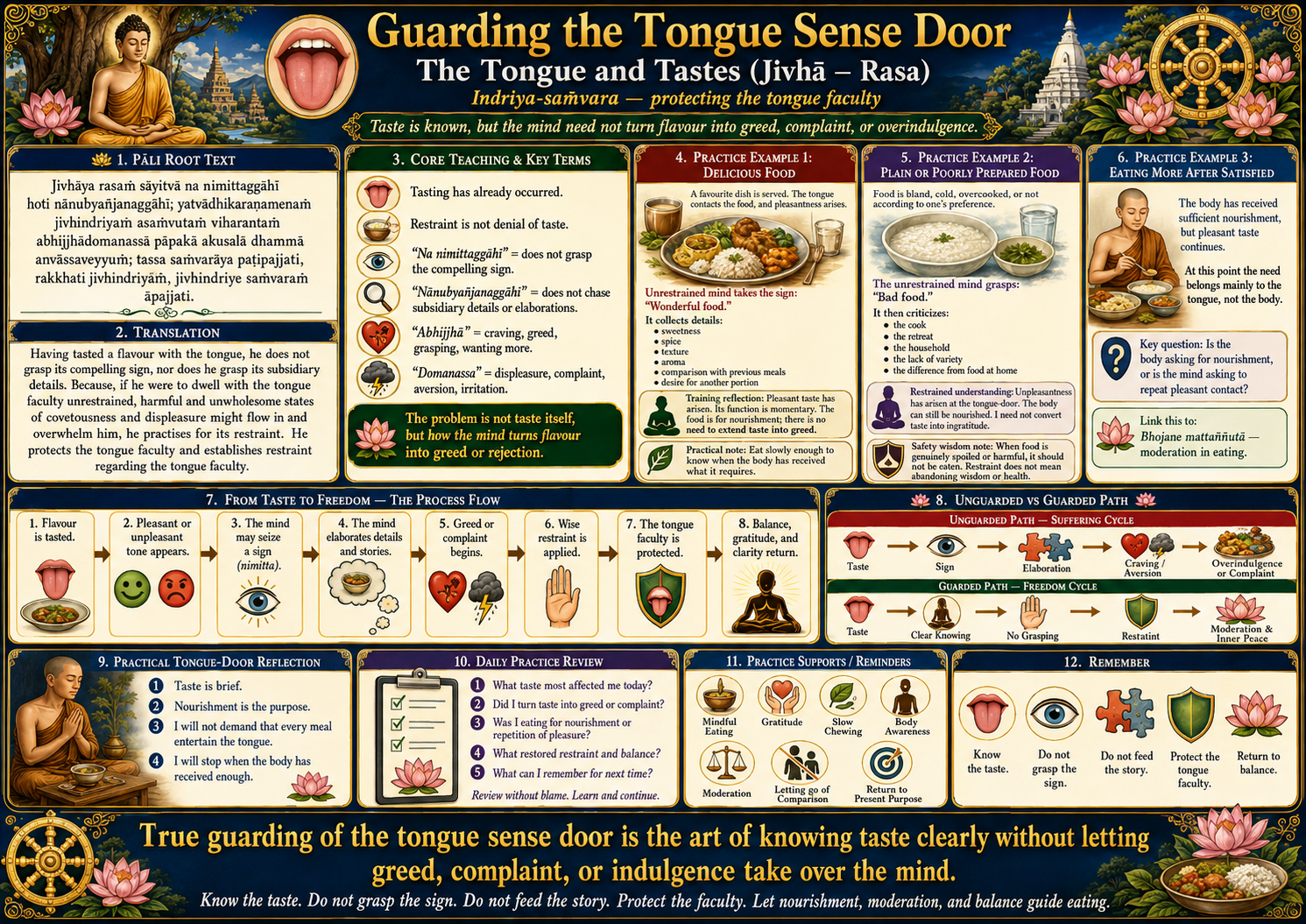
The Tongue and Tastes
Having tasted a flavour with the tongue, he does not grasp its compelling sign, nor does he grasp its subsidiary details.
Because, if he were to dwell with the tongue faculty unrestrained, harmful and unwholesome states of covetousness and displeasure might flow in and overwhelm him, he practises for its restraint. He protects the tongue faculty and establishes restraint regarding the tongue faculty.
Practice example 1: Delicious food – A favourite dish is served. The tongue contacts the food, and pleasantness arises. The unrestrained mind takes the sign: “Wonderful food.”
It then collects details:
sweetness;
spice;
texture;
aroma;
comparison with previous meals;
desire for another portion.
The practitioner does not need to deny that the food tastes good. The training is:
“Pleasant taste has arisen. Its function is momentary. The food is for nourishment; there is no need to extend taste into greed.” Eat slowly enough to know when the body has received what it requires.
Practice example 2: Plain or poorly prepared food
Food is bland, cold, overcooked, or not according to one’s preference. The unrestrained mind grasps: “Bad food.”
It then criticizes:
the cook;
the retreat;
the household;
the lack of variety;
the difference from food at home.
The restrained practitioner knows: “Unpleasantness has arisen at the tongue-door. The body can still be nourished. I need not convert taste into ingratitude.” When the food is genuinely spoiled or harmful, it should not be eaten. Restraint does not mean abandoning wisdom or health.
Practice example 3: Eating more after the body is satisfied
The body has received sufficient nourishment, but pleasant taste continues. At this point the need belongs mainly to the tongue, not the body. The practitioner asks: “Is the body asking for nourishment, or is the mind asking to repeat pleasant contact?” This directly supports bhojane mattaññutā—moderation in eating. Practical tongue-door reflection
“Taste is brief and yet nourishment is the purpose’
I will not demand that every meal entertain the tongue and will stop when the body has received enough.
Click infographic to enlarge ↗
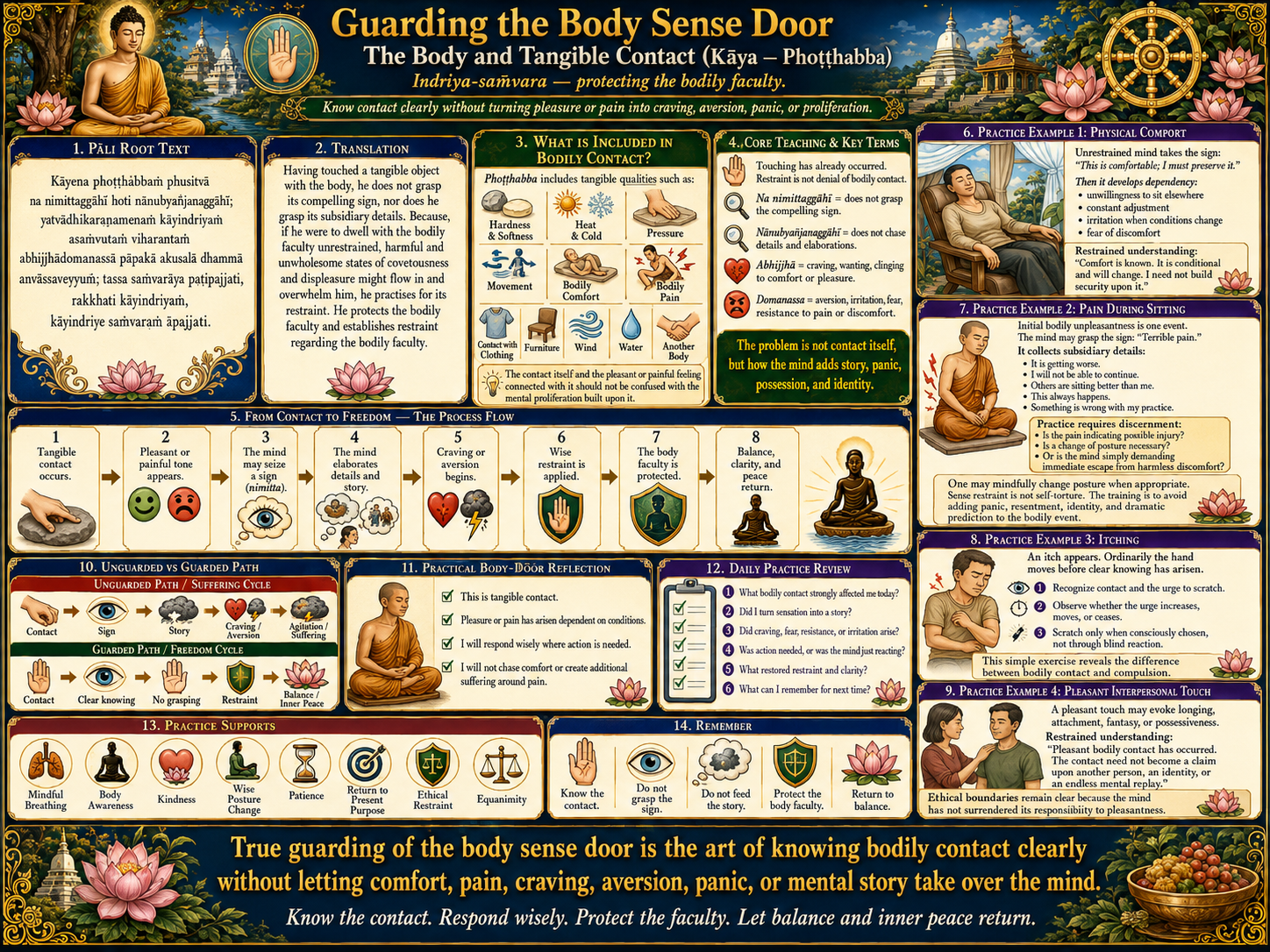
The Body and Tangible Contact
Having touched a tangible object with the body, he does not grasp its compelling sign, nor does he grasp its subsidiary details. Because, if he were to dwell with the bodily faculty unrestrained, harmful and unwholesome states of covetousness and displeasure might flow in and overwhelm him, he practises for its restraint. He protects the bodily faculty and establishes restraint regarding the bodily faculty.
What is included in bodily contact? Phoṭṭhabba includes tangible qualities such as:
hardness and softness;
heat and cold;
pressure;
movement;
bodily comfort;
bodily pain;
contact with clothing, furniture, wind, water, or another body.
The contact itself and the pleasant or painful feeling connected with it should not be confused with the mental proliferation built upon it.
Practice example 1: Physical comfort
A practitioner sits in a comfortable chair, lies on a soft bed, or feels a cool breeze. The unguarded mind takes the sign:
“This is comfortable; I must preserve it.” It then develops dependency:
unwillingness to sit elsewhere;
constant adjustment;
irritation when conditions change;
fear of discomfort.
The restrained practitioner enjoys neither through blindness nor dependency: “Comfort is known. It is conditional and will change. I need not build security upon it.”
Practice example 2: Pain during sitting
Pain arises in the knee or back.
The initial bodily unpleasantness is one event. The mind may then grasp the sign: “Terrible pain.”
It collects subsidiary details:
It is getting worse.
I will not be able to continue.
Others are sitting better than me
This always happens
Something is wrong with my practice
Practice requires discernment:
Is the pain indicating possible injury?
Is a change of posture necessary?
Or is the mind simply demanding immediate escape from harmless discomfort?
One may mindfully change posture when appropriate. Sense restraint is not self-torture. The training is to avoid adding panic, resentment, identity, and dramatic prediction to the bodily event.
Practice example 3: Itching – An itch appears. Ordinarily the hand moves before clear knowing has arisen.
Practice:
Recognize contact and the urge to scratch.
Observe whether the urge increases, moves, or ceases.
Scratch only when consciously chosen, not through blind reaction.
This simple exercise reveals the difference between bodily contact and compulsion.
Practice example 4: Pleasant interpersonal touch
A pleasant touch may evoke longing, attachment, fantasy, or possessiveness especially with a man and woman.
The restrained practitioner recognizes: “Pleasant bodily contact has occurred. The contact need not become a claim upon another person, an identity, or an endless mental replay.” Ethical boundaries remain clear because the mind has not surrendered its responsibility to pleasantness.
Practical body-door reflection “This is tangible contact.
Pleasure or pain has arisen dependent on conditions.
I will respond wisely where action is needed and will not chase comfort or create additional suffering around pain.”
Click infographic to enlarge ↗
The Mind and Mental Objects
Having cognized a mental object with the mind, he does not grasp its compelling sign, nor does he grasp its subsidiary details. Because, if he were to dwell with the mind faculty unrestrained, harmful and unwholesome states of covetousness and displeasure might flow in and overwhelm him, he practises for its restraint. He protects the mind faculty and establishes restraint regarding the mind faculty.
What are mental objects—dhammā? At the mind-door, dhammā may include:
memories
plans
mental images
concepts
opinions
expectations
fantasies
fears
doctrines
judgments
remembered sights, sounds, smells, tastes, and touches
ideas concerning oneself and others
Even when the external object is no longer present, the mind can reconstruct it internally. Therefore, the mind-door is where the other five sense contacts are often prolonged.
Practice example 1: A pleasant memory
A joyful retreat memory arises. The unguarded mind takes the sign: “Those were the best days of my life.”
It then elaborates:
particular people
conversations
special experiences
comparison with the present
desire to recreate the past
What began as memory becomes nostalgia and dissatisfaction. The restrained practitioner knows:
“A pleasant memory has appeared. It is a present mental object representing a past event. I need not live inside it.” The value of the experience can be retained without clinging to its image.
Practice example 2: A painful memory
Someone remembers an insult or betrayal. The mind grasps the sign:
“I was wronged.” It then repeatedly examines details:
exact words;
facial expression;
what should have been said;
imagined revenge;
anticipated future conflict.
The other person may be absent, but the mind continues reproducing the suffering.
Practice: “Memory has arisen. The event is not occurring now. Pain connected with the memory is known. I will learn whatever needs to be learned without repeatedly injuring the mind.”
Practice example 3: Imagined future success
A plan or aspiration appears. Planning itself may be appropriate. But the mind may grasp a sign of future identity:
“When this succeeds, I will be important, secure, or admired.” It then becomes intoxicated with imagined outcomes.
The restrained practitioner distinguishes:
the practical action presently required;
the fantasy of who “I” will become.
He performs the action without feeding self-construction.
Practice example 4: Fear of a future event
A medical appointment, journey, interview, or difficult conversation is approaching.
The mind creates one threatening sign and then gathers every detail that confirms danger.
Practice:
“A mental image of a possible future is being known. It is not the actual event. What practical preparation is required now?” After the necessary preparation, the practitioner does not keep rehearsing fear.
Practice example 5: Attachment to Dhamma experience
A peaceful sitting, jhānic experience, insight, or unusual state is remembered.
The mind may take the sign:
“I attained something exceptional.”
It then grasps details:
how long it lasted;
how it compares with others;
whether it proves a particular attainment;
how it can be reproduced;
how others might respond if told.
Even a wholesome experience can become material for conceit and appropriation.
The restrained response is: “That conditioned experience arose and ceased. What matters is whether greed, aversion, delusion, and identification are diminishing now.”
Practical mind-door reflection
“A thought is known as a thought.
A memory is known as a memory and a mental image is known as a mental image.
I will not automatically accept it as self, truth, command, or reality.

Click infographic to enlarge ↗
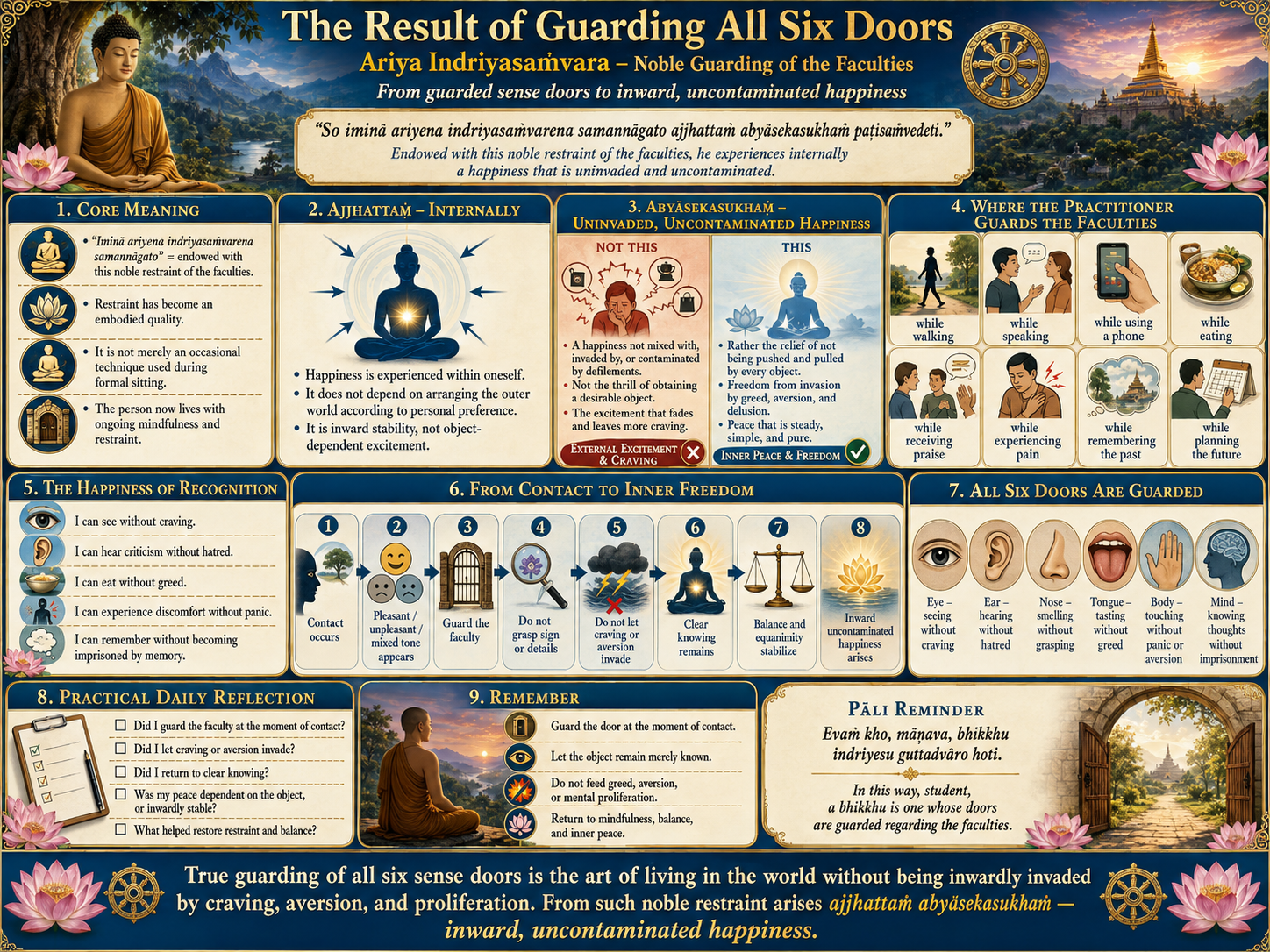
The Happiness of a Mind Not Invaded through the Six Doors
So iminā ariyena indriyasaṁvarena samannāgato ajjhattaṁ abyāsekasukhaṁ paṭisaṁvedeti.
Endowed with this noble restraint of the faculties, he experiences internally a happiness that is uninvaded and uncontaminated.
Iminā ariyena indriyasaṁvarena samannāgato – “He is endowed with this noble restraint of the faculties.”
Restraint has become an embodied quality. It is no longer an occasional technique used only during formal sitting.
The practitioner guards the faculties:
while walking
while speaking
while using a phone
while eating
while receiving praise
while experiencing pain
while remembering the past
while planning the future
Ajjhattaṁ – “Internally” or “within himself.”
The happiness does not depend upon constantly arranging the outer world according to personal preference.
Abyāsekasukhaṁ – A happiness that is not mixed with, invaded by, or contaminated by defilement.
This is not the excitement of obtaining a desirable object. It is the relief of not being internally pushed and pulled by every object.
It is the happiness of recognizing:
I can see without craving
I can hear criticism without hatred.
I can eat without greed.
I can experience discomfort without panic.
I can remember without becoming imprisoned by memory
Evaṁ kho, māṇava, bhikkhu indriyesu guttadvāro hoti.
In this way, student, a bhikkhu is one whose doors are guarded regarding the faculties.
Click infographic to enlarge ↗
What Guarding the Sense Door Looks Like in Daily Life
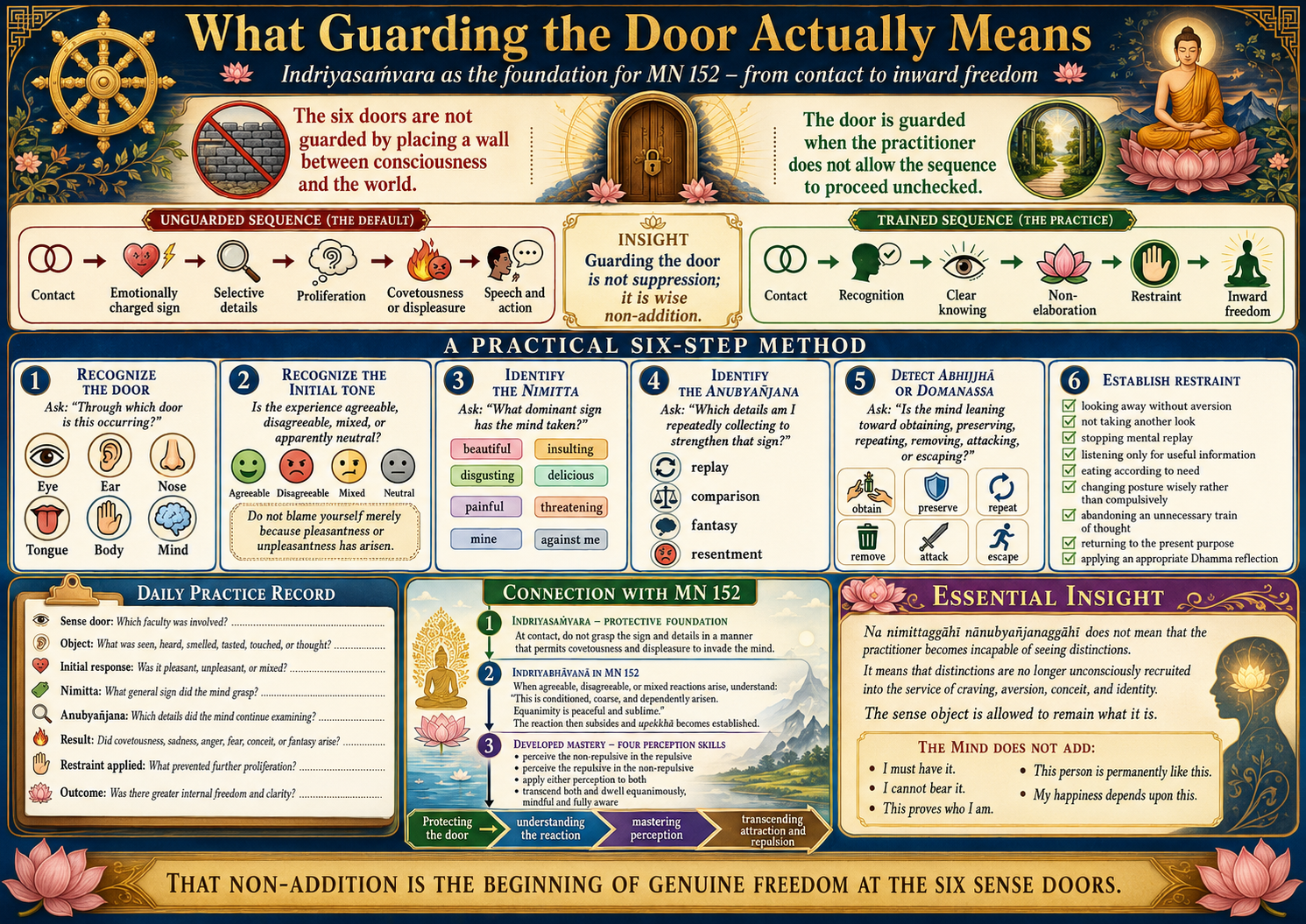
The six doors are not guarded by placing a wall between consciousness and the world. The door is guarded when the practitioner does not allow the sequence to proceed unchecked:
Contact → emotionally charged sign → selective details → proliferation → covetousness or displeasure → speech and action.
Instead, the trained sequence becomes: Contact → recognition → clear knowing → non-elaboration → restraint → inward freedom.
A Practical Six-Step Method
Recognize the door Ask: “Through which door is this occurring?”
Eye?
Ear?
Nose?
Tongue?
Body?
Mind?
Recognize the initial tone – Is the experience: agreeable / disagreeable / mixed / apparently neutral?
Do not blame yourself merely because pleasantness or unpleasantness has arisen
Identify the nimitta – Ask: “What dominant sign has the mind taken?”
Examples:
beautiful
insulting
disgusting
delicious
painful
threatening
mine
against me
Identify the anubyañjana – Ask: “Which details am I repeatedly collecting to strengthen that sign?”
This is where mental replay, comparison, fantasy, and resentment are often found.
Detect abhijjhā or domanassa – Ask: “Is the mind leaning toward obtaining, preserving, repeating, removing, attacking, or escaping?”
Establish restraint – Restraint may involve:
looking away without aversion;
not taking another look;
stopping mental replay;
listening only for useful information;
eating according to need;
changing posture wisely rather than compulsively;
abandoning an unnecessary train of thought;
returning to the present purpose;
applying an appropriate Dhamma reflection.
Daily Practice Record
At the end of the day, one can review a single strong contact:
Sense door: Which faculty was involved?
Object: What was seen, heard, smelled, tasted, touched, or thought?
Initial response: Was it pleasant, unpleasant, or mixed?
Nimitta: What general sign did the mind grasp?
Anubyañjana: Which details did the mind continue examining?
Result: Did covetousness, sadness, anger, fear, conceit, or fantasy arise?
Restraint applied: What prevented further proliferation?
Outcome: Was there greater internal freedom and clarity?
Click infographic to enlarge ↗
Indriyasaṁvara Creates the Space in Which Indriyabhāvanā Can Mature
Indriyasaṁvara – At contact, do not grasp the sign and details in a manner that permits covetousness and displeasure to invade the mind.
Indriyabhāvanā in MN 152 – When agreeable, disagreeable, or mixed reactions arise, understand:
“This is conditioned, coarse, and dependently arisen. Equanimity is peaceful and sublime.” The reaction then subsides and upekkhā becomes established.
Developed mastery – The noble practitioner is not helpless before the first perception. He can:
perceive the non-repulsive in the repulsive;
perceive the repulsive in the non-repulsive;
apply either perception to both;
or transcend both and dwell equanimously, mindful and fully aware.
Thus, the development moves from: protecting the door → understanding the reaction → mastering perception → transcending attraction and repulsion.
Essential Insight – Na nimittaggāhī nānubyañjanaggāhī does not mean that the practitioner becomes incapable of seeing distinctions. It means that distinctions are no longer unconsciously recruited into the service of craving, aversion, conceit, and identity. The sense object is allowed to remain what it is.
The mind does not add:
I must have it.
I cannot bear it.
This proves who I am.
This person is permanently like this
My happiness depends upon this
That non-addition is the beginning of genuine freedom at the six sense doors.

Click infographic to enlarge ↗
Click infographic to enlarge ↗
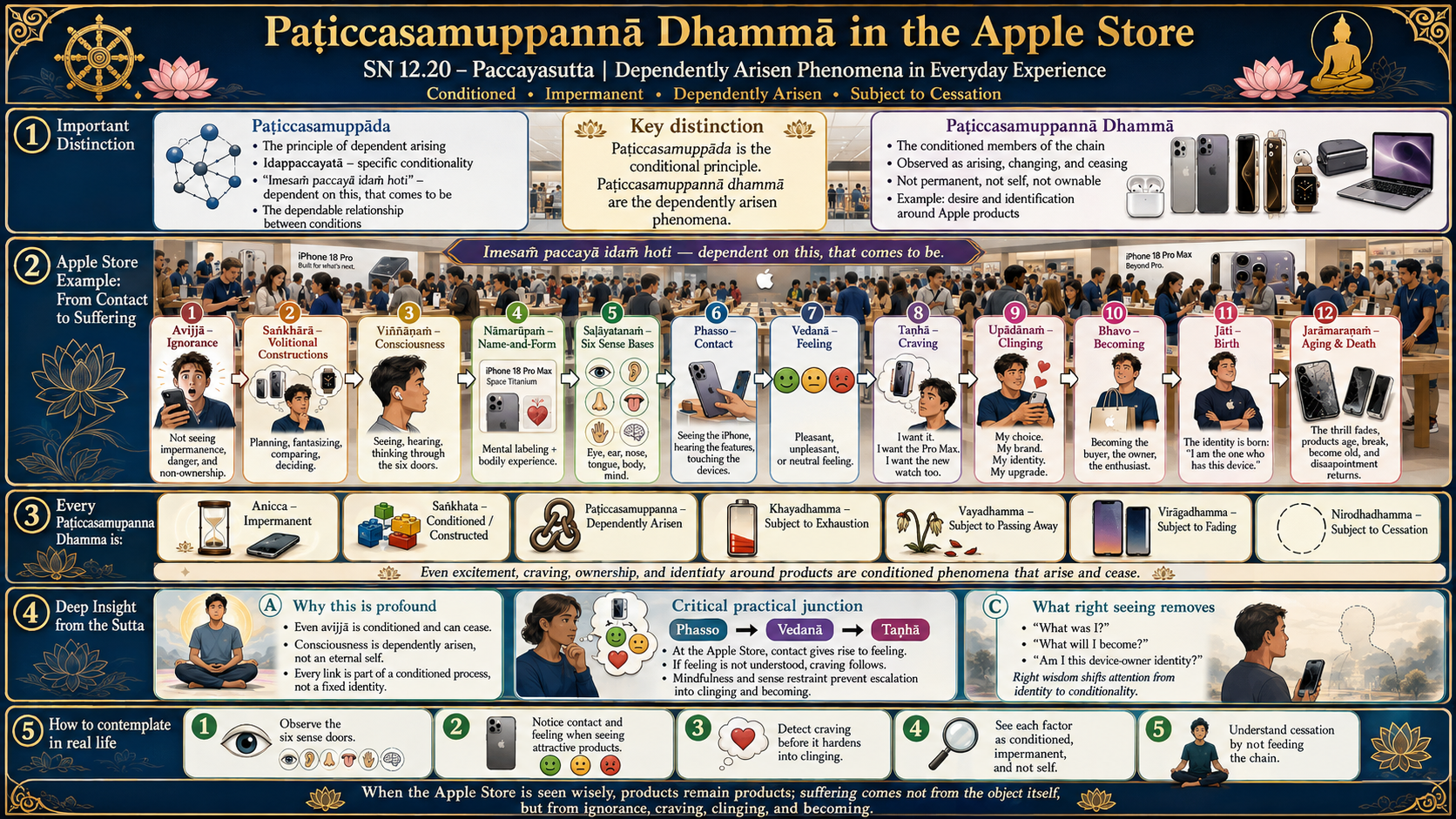
Essential movement: protecting the door → understanding the reaction → mastering perception → transcending attraction and repulsion.
The sense object is allowed to remain what it is. The mind does not add: “I must have it,” “I cannot bear it,” or “This defines me.” That non-addition is the beginning of genuine freedom at the six sense doors.