Carry the Bowl Without Spilling
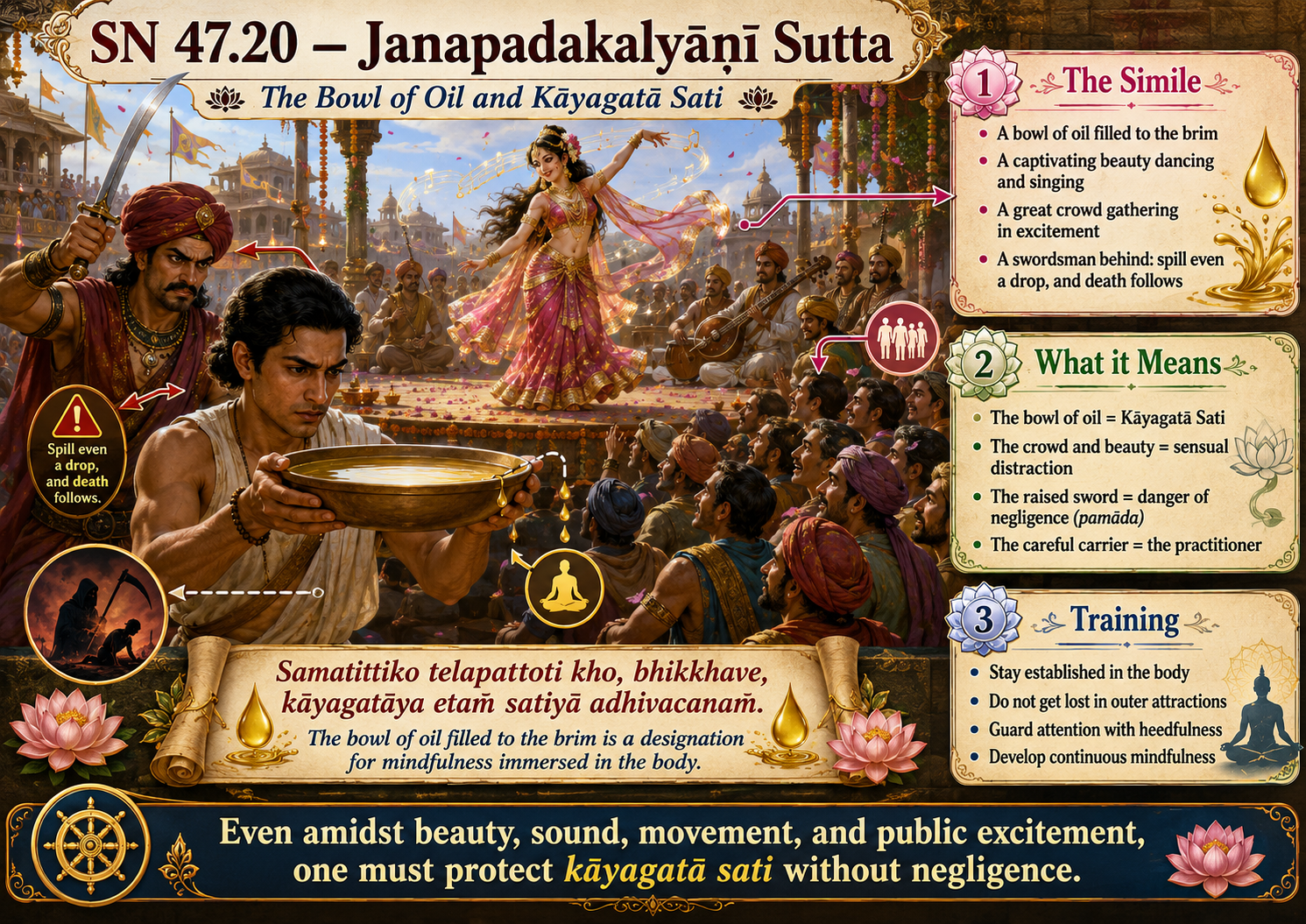 VISUAL SUMMARYSee this sutta in a pictureOpen the complete infographic for a visual overview before or after reading the full study.View infographic →
Why this sutta matters
The sutta begins with a simile which asks the bhikkhus to reflect thus:
“Seyyathāpi, bhikkhave, ‘janapadakalyāṇī, janapadakalyāṇī’ti kho, bhikkhave, mahājanakāyo sannipateyya. ‘Sā kho panassa janapadakalyāṇī paramapāsāvinī nacce, paramapāsāvinī gīte. Janapadakalyāṇī naccati gāyatī’ti kho, bhikkhave, bhiyyoso mattāya mahājanakāyo sannipateyya.
“Suppose, bhikkhus, that a great crowd of people were to assemble, saying:
‘The most beautiful woman of the country! The most beautiful woman of the country!’
And suppose that this renowned beauty of the country were supremely accomplished in dancing and supremely accomplished in singing.”
Beauty, music, movement, and collective excitement
Seyyathāpi introduces a simile: “Suppose,” “Just as,” or “Imagine that.”
Janapadakalyāṇī – Janapada means a country, district, territory or populated region and Kalyāṇī means beautiful, attractive, excellent or pleasing.
A janapadakalyāṇī is therefore a woman celebrated throughout the region for extraordinary beauty and attractiveness.
She is not simply physically beautiful. The discourse adds that she is:
paramapāsāvinī nacce — supremely accomplished or captivating in dancing;
paramapāsāvinī gīte — supremely accomplished or captivating in singing.
She therefore represents a powerful combination of desirable sensory objects:
◉ attractive visible form
◉ beautiful bodily movement
◉ pleasing sound
◉ social excitement
◉ public fascination
◉ collective enthusiasm
The repeated announcement—“janapadakalyāṇī, janapadakalyāṇī”—shows how public excitement intensifies attention. People do not merely see something attractive; they speak about it, advertise it and draw one another toward it.
The arrival of the singing and dancing causes bhiyyoso mattāya, an even greater degree of excitement and gathering.
This represents how the citta becomes pulled outward when several conditions come together:
an attractive object;
◉ anticipation of pleasure
◉ the excitement of other people
◉ sight and sound operating simultaneously
◉ the belief that something desirable must not be missed
The danger is therefore not merely the woman. The deeper issue is the citta’s tendency to become fascinated, scattered and negligent when an attractive sensory presentation appears.
Beauty and music — The external world can be vividly attractive and emotionally charged.
The bowl filled to the brim — Represents kāyagatā sati that must not be abandoned.
The raised sword — Shows the seriousness of heedlessness and the urgency of careful training.
The task — Move through the world without letting the citta fall into outward negligence.
The bowl filled to the brim

Open the original image to study the details at full resolution.
Click infographic to enlarge ↗
The bowl, attention, meaning, training, and daily application
01 The complete passage and detailed explanation
Atha puriso āgaccheyya jīvitukāmo amaritukāmo sukhakāmo dukkhappaṭikūlo. Tamenaṁ evaṁ vadeyya: ‘ayaṁ te, ambho purisa, samatittiko telapatto antarena ca mahāsamajjaṁ antarena ca janapadakalyāṇiyā pariharitabbo. Puriso ca te ukkhittāsiko piṭṭhito piṭṭhito anubandhissati. Yattheva naṁ thokampi chaḍḍessati tattheva te siro pātessatī’ti.
“Then a man might arrive who wanted to live, did not want to die, desired happiness and recoiled from suffering.
They would say to him: ‘Here, good man, is a bowl of oil filled level to the brim. You must carry it between the great gathering and the beauty of the country.
A man with a raised sword will follow closely behind you. Wherever you spill even the slightest amount of that oil, right there he will cause your head to fall.’”
Detailed explanation
The man is described through four expressions:
Jīvitukāmo – Jīvituṁ means “to live,” and kāmo means wanting or desiring. He is one who wants to live.
Amaritukāmo – He is one who does not want to die.
The Buddha expresses the matter both positively and negatively:
◉ he wants life;
◉ he does not want death.
This removes any ambiguity concerning the seriousness with which he receives the instruction.
Sukhakāmo – He desires well-being, safety and happiness.
Dukkhappaṭikūlo – He is opposed to suffering, recoils from suffering and does not welcome pain or destruction.
These expressions establish that the man has the strongest possible motivation to remain careful.
Samatittiko telapatto – Samatittiko means filled evenly or exactly to the rim and Tela means oil. and Patta means a bowl or vessel.
The bowl is not half-filled. It is filled precisely to the brim, so that even a slight careless movement may cause the oil to spill. This represents a condition in which negligence cannot be dismissed as unimportant.
A small loss of awareness may be enough for the citta to be carried away.
Through the crowd and beside the beauty the man must carry the bowl:
antarena ca mahāsamajjaṁ antarena ca janapadakalyāṇiyā
He must pass through or between the great gathering and the renowned beauty of the country.
This means that he is not protected by seclusion from the attractive object. He must move directly through the circumstances that ordinarily produce distraction.
He will encounter:
◉ movement
◉ noise
◉ singing
◉ dancing
◉ attractive form
◉ excitement
◉ people pushing or gathering;
◉ the natural desire to look around.
The practice is therefore tested while attractive objects are present.
The man with the raised sword – Puriso ca te ukkhittāsiko piṭṭhito piṭṭhito anubandhissati.
A man with an uplifted sword will follow immediately behind him.
ukkhatta/ukkhitta — raised or lifted up;
asi — sword;
piṭṭhito piṭṭhito — from behind, following closely;
anubandhissati — will follow, pursue or keep close behind.
The sword represents the urgency of the situation.
The man cannot say:
◉ “A small distraction does not matter.”
◉ “I will become attentive later.”
◉ “Let me first enjoy the performance.”
◉ “One moment of negligence is harmless.”
The consequence is immediate.
Even the slightest spilling
Yattheva naṁ thokampi chaḍḍessati tattheva te siro pātessati.
Wherever he spills even a little, there his head will be struck off.
Thokampi means even a small amount, even a little. The emphasis is not on maintaining the bowl approximately. He must protect it continuously. The simile shows the required quality of appamāda, non-negligence or heedfulness.
It does not mean that the practitioner should develop fear, tension or bodily rigidity. It means that the practitioner understands the danger of allowing the citta to become lost in attractive sensory objects.
Just as the man understands the consequence of spilling the oil, the practitioner understands the consequences of:
◉ abandoning sati
◉ delighting in nimitta and anubyañjana
◉ allowing attraction to grow
◉ becoming intoxicated by sensory experience
◉ losing the bodily frame of reference
◉ falling into pamāda
02 Amanasikaritvā, bahiddhā, and pamāda
Taṁ kiṁ maññatha, bhikkhave, api nu so puriso amuṁ telapattaṁ amanasikaritvā bahiddhā pamādaṁ āhareyyā”ti?
“What do you think, bhikkhus? Would that man, failing to attend to that bowl of oil, bring negligence toward what is external?”
Detailed explanation
This is the central question of the simile.
Amanasikaritvā – Manasikaroti means to attend to, take to mind, direct the mind toward or give consideration to.
Amanasikaritvā means:
◉ not attending to
◉ failing to keep in mind
◉ not directing the citta toward
◉ disregarding
The question is whether he would cease attending to the bowl.
Bahiddhā – Bahiddhā means outwardly, externally or toward what is outside.
In this context, it refers to allowing attention to go outward toward:
◉ the dancing woman;
◉ the singing;
◉ the crowd;
◉ the excitement;
◉ the various sights and sounds.
The problem is not that sights and sounds are present. The problem is that the citta abandons its proper foundation and becomes negligently absorbed in them.
Pamādaṁ āhareyya
Pamāda means negligence, heedlessness, carelessness or failure to remain diligently established in what should be cultivated.
Āhareyya literally carries the sense of bringing, taking up or introducing.
Thus, bahiddhā pamādaṁ āhareyya means bringing about negligence through external involvement—allowing the citta to be drawn outward in a careless way.
The Buddha is not asking whether the man will know that a woman is dancing or that music is playing. The question is whether he will abandon responsibility for the bowl and become absorbed in what is external.
Similarly, in practice, one may know that:
◉ a sound has arisen;
◉ a visible form has appeared;
◉ someone is moving nearby;
◉ heat, cold or contact is present.
But one does not have to produce fascination, delight, resistance or identification around it.
The practitioner does not become blind or deaf. Rather, the practitioner does not allow the citta to lose its established frame of reference.
The bhikkhus answer
“No hetaṁ, bhante”. “No, Venerable Sir.”
Detailed explanation
The answer is obvious because the danger is clearly understood.
The man would not forget the bowl because:
◉ his life depends upon it;
◉ the danger is immediate;
◉ the task is unambiguous;
◉ he knows the consequence of negligence;
◉ he has no mistaken belief that distraction is harmless.
The bhikkhus’ answer prepares the way for the Buddha to reveal the meaning of the simile.
The spiritual difficulty is that practitioners often do not perceive the danger of pamāda as clearly as the man perceives the sword.
One may believe that:
◉ looking with delight is harmless
◉ listening with fascination is harmless
◉ allowing resentment to continue is harmless
◉ indulging imagination is harmless
◉ losing the body as the field of sati is harmless
The simile corrects this casual attitude.
03 The explicit meaning of the simile
“Upamā kho myāyaṁ, bhikkhave, katā atthassa viññāpanāya. Ayaṁ cevettha attho— samatittiko telapattoti kho, bhikkhave, kāyagatāya etaṁ satiyā adhivacanaṁ.
“Bhikkhus, this simile has been made by me in order to communicate the meaning.
And this is its meaning: ‘A bowl of oil filled level to the brim’ is a designation for sati directed to and established in the body.”
Detailed explanation
Upamā kho myāyaṁ katā – The Buddha states that he has deliberately constructed this simile.
An upamā is an analogy or comparison used to make a subtle principle understandable through a visible example.
Atthassa viññāpanāya
Attha means meaning, significance, purpose or beneficial principle.
Viññāpanāya means for making known, communicating or causing to be understood.
The simile is therefore not merely a dramatic story. It conveys a precise practice instruction.
What does the bowl represent?
The Buddha explicitly identifies the bowl filled to the brim:
samatittiko telapattoti kho, bhikkhave, kāyagatāya etaṁ satiyā adhivacanaṁ.
It is a designation for kāyagatā sati.
Kāyagatā sati – The expression may be understood as:
◉ sati gone to the body;
◉ sati directed toward the body;
◉ sati established with reference to the body;
◉ sati immersed in or pervading the body.
It should not be reduced to merely thinking, “This is my body,” nor to mechanically observing a single sensation.
The body becomes the immediate field within which the practitioner remains established.
Depending on the practice context, this includes knowing:
◉ breathing in and breathing out
◉ long and short breathing
◉ bodily posture
◉ walking, standing, sitting and lying down
◉ bodily activities
◉ the bodily formation
◉ the body’s anatomical nature
◉ the body as elements
◉ arising and passing in relation to the body
The key point of this discourse is that the practitioner does not abandon this bodily frame of reference and become lost in external attractions.
Why is the bowl filled to the brim?
The oil is easily spilled. In the same way, sati can be lost when the citta:
◉ follows attractive visible forms;
◉ becomes enchanted by sounds;
◉ reacts with liking or disliking;
◉ produces stories around sensory contact;
◉ forgets the purpose of the practice;
◉ ceases to recognize the movement of the citta.
The bowl does not represent a tense fixation on one tiny object. It represents the continuity, carefulness and completeness with which kāyagatā sati is maintained.
The practitioner remains aware of the body while sights and sounds occur, without becoming carried away by them.
The crowd and the woman
Although the Buddha explicitly identifies only the bowl in this passage, the remaining aspects of the simile can be understood in relation to the practice:
◉ the crowd represents the multitude of distracting conditions;
◉ the singing and dancing represent attractive sights and sounds;
◉ the janapadakalyāṇī represents an object capable of producing strong desire and fascination;
◉ the raised sword represents the danger accompanying negligence;
◉ the man carrying the bowl represents the practitioner;
◉ the unspilled oil represents the uninterrupted maintenance of kāyagatā sati.
These correspondences help illuminate the simile, but the explicit statement made by the Buddha is that the brim-full bowl is a designation for kāyagatā sati.
04 The full detailed training explanation
Tasmātiha, bhikkhave, evaṁ sikkhitabbaṁ: ‘kāyagatā sati no bhāvitā bhavissati bahulīkatā yānīkatā vatthukatā anuṭṭhitā paricitā susamāraddhā’ti. Evañhi kho, bhikkhave, sikkhitabban”ti.
“Therefore, bhikkhus, you should train yourselves in this way:
‘Our sati directed to the body will be developed, repeatedly cultivated, made into a vehicle, made into a basis, maintained and established, made familiar, and properly undertaken.’
It is in this way, bhikkhus, that you should train.”
Detailed explanation
The discourse concludes with an instruction to train:
evaṁ sikkhitabbaṁ — “You should train in this way.”
This is not merely something to understand intellectually. It must become a repeated training.
The Buddha gives a sequence of expressions showing how thoroughly kāyagatā sati should be developed.
Bhāvitā
Bhāvitā comes from bhāveti, to develop, cultivate, bring into being or cause to grow.
“Kāyagatā sati will be developed.”
This means that sati regarding the body is not assumed to be naturally complete. It must be intentionally cultivated.
Development includes:
◉ repeatedly bringing the body into the field of sati;
◉ recognizing when the citta has moved away;
◉ re-establishing the bodily frame;
◉ learning how the body and citta affect one another;
◉ preventing sensory contact from becoming proliferation.
Bahulīkatā
Bahulīkatā means made much of, practised frequently or repeatedly cultivated.
A single period of practice is insufficient.
Kāyagatā sati must be maintained:
◉ while sitting
◉ while walking
◉ while standing
◉ during ordinary activities
◉ when attractive objects appear
◉ when unpleasant objects appear
◉ when alone
◉ when among people.
The bowl must be carried throughout the journey, not only at its beginning.
Yānīkatā
Yāna means a vehicle or means of travel.
Yānīkatā means made into a vehicle.
Kāyagatā sati becomes that by which one travels along the path.
It is not treated as an occasional technique used only during a formal sitting. It becomes the practical means by which one moves:
◉ from negligence to heedfulness;
◉ from sensory involvement to restraint;
◉ from agitation to composure;
◉ from unwise attention to wise examination;
◉ from identification with the body to understanding the body according to actuality.
A vehicle must be used to travel. In the same way, kāyagatā sati must actually carry the practitioner through daily circumstances.
Vatthukatā
Vatthu means a basis, ground, foundation or support.
Vatthukatā means made into a foundation.
Kāyagatā sati becomes the stable basis from which other Dhamma qualities can develop.
When established in relation to the body, the practitioner can more clearly know:
◉ the arising of desire
◉ bodily tightening associated with aversion
◉ agitation
◉ sloth and heaviness
◉ changes in breathing
◉ changes in posture
◉ the movement from composure into distraction
◉ the conditions supporting samatha and vipassanā
Without a stable basis, the citta is easily carried outward
Anuṭṭhitā
Anuṭṭhitā carries the sense of being established, maintained, pursued or kept active.
Kāyagatā sati is not allowed to remain undeveloped or dormant.
It is deliberately sustained and brought forth again whenever it has weakened.
This requires:
◉ continuity
◉ repeated recollection
◉ correction after distraction
◉ practical persistence
◉ non-negligence
It does not mean that the practitioner never notices external conditions. It means that the practitioner does not abandon the training when those conditions arise.
Paricitā
Paricitā means made familiar, practised, acquainted with or thoroughly known through repetition.
At first, remaining established in the body may require deliberate effort.
Through repeated cultivation, it becomes familiar.
The practitioner learns to recognize quickly
◉ when the breath has changed
◉ when the body has become tense
◉ when the eyes are searching for attractive forms
◉ when the ears are leaning toward pleasing sounds
◉ when the citta has moved from knowing into delighting
◉ when pamāda is beginning
Because the territory becomes familiar, departure from it is detected early.
“What do you think, bhikkhus, would that man stop attending to that bowl of oil and out of negligence turn his attention outwards?”
“No, venerable sir.”
Susamāraddhā
Su means well or properly.
Samāraddhā means undertaken, initiated, established or energetically engaged in.
Susamāraddhā therefore means well undertaken, properly established or thoroughly set in motion.
The training should not be:
◉ careless
◉ occasional
◉ poorly understood
◉ forced for a short time
◉ abandoned when difficulties arise
It should be properly undertaken with:
◉ right understanding
◉ appropriate energy
◉ continuity
◉ balance
◉ careful examination
◉ awareness of the purpose
Seven training terms in sequence
Bhāvitā — Developed.
Bahulīkatā — Repeatedly cultivated.
Yānīkatā — Made into a vehicle.
Vatthukatā — Made into a basis or foundation.
Anuṭṭhitā — Maintained and established.
Paricitā — Made familiar.
Susamāraddhā — Properly undertaken and well begun.
05 Central practice principle and essential meaning
The man does not suppress the existence of the crowd, singing, dancing or beautiful form. He simply does not abandon the bowl.
In the same way, the practitioner does not need to destroy the external world. Instead, the practitioner trains so that:
◉ sight remains merely within the domain of seeing
◉ sound remains merely within the domain of hearing
◉ attraction is recognized before it becomes appropriation
◉ the body remains the field of sati
◉ the citta does not run outward through pamāda
◉ kāyagatā sati remains continuous
The simile therefore teaches a form of active vigilance.
Sati is not a passive witness standing apart from experience. It remembers the task, keeps the proper field present and recognizes when the citta is beginning to leave that field.
The practitioner is like the man who clearly knows:
◉ what must be protected
◉ what can cause distraction
◉ what the danger is
◉ why continuity matters
◉ how carefully the training must be undertaken
Essential meaning of the discourse
The renowned beauty represents an exceptionally attractive sensory presentation. The crowd represents the pressure and excitement created by the surrounding world. The sword represents the danger of negligence. The bowl filled to the brim represents kāyagatā sati.
The practitioner must move through a world containing attractive and unpleasant objects without abandoning the bodily frame of sati.
Therefore, kāyagatā sati should be:
◉ developed
◉ repeatedly cultivated
◉ made one’s vehicle
◉ made one’s foundation
◉ continuously maintained
◉ made thoroughly familiar
◉ properly and energetically undertaken
This is the training given by the Buddha in the Janapadakalyāṇī Sutta, SN 47.20 as the man who wants to live
Daily-life application at a glance
Sight — Remains merely within the domain of seeing.
Sound — Remains merely within the domain of hearing.
Attraction — Is recognized before it becomes appropriation.
The body — Remains the field of sati.
The citta — Does not run outward through pamāda.
Kāyagatā sati — Remains continuous.
How kāyagatā sati must be cultivated
Bhāvitā — Developed.
Bahulīkatā — Repeatedly cultivated.
Yānīkatā — Made into a vehicle.
Vatthukatā — Made into a basis or foundation.
Anuṭṭhitā — Maintained and established.
Paricitā — Made familiar.
Susamāraddhā — Properly undertaken and well begun.
The discourse does not present bodily mindfulness as a vague mood. It is a discipline to be developed, repeatedly cultivated, made into a vehicle and basis, maintained, made familiar, and properly undertaken.
Move through the world without abandoning the bodily frame of sati
Sight — Remains merely within the domain of seeing.
Sound — Remains merely within the domain of hearing.
Attraction — Is recognized before it becomes appropriation.
The body — Remains the field of sati.
The citta — Does not run outward through pamāda.
Kāyagatā sati — Remains continuous.
The renown of the beautiful woman, the pressure of the crowd, and the threat of the sword all show that the practice must remain continuous in the midst of attraction, danger, and movement.