Six Wild Animals—and the Solid Stake of Mindfulness
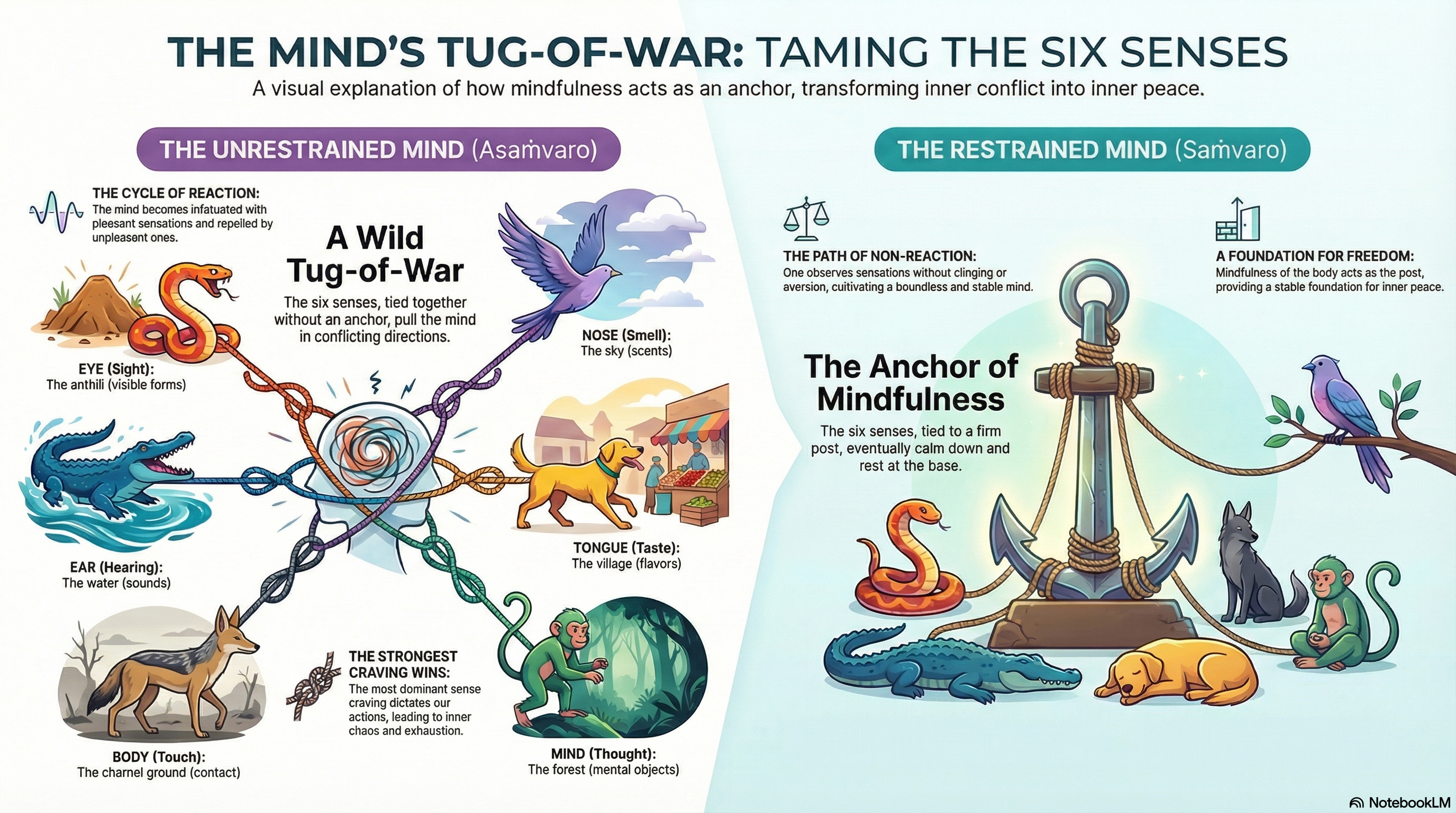 VISUAL SUMMARYSee this sutta in a pictureOpen the complete infographic for a visual overview before or after reading the full study.View infographic →
Pleasant Contact Pulls; Unpleasant Contact Repels
Sense restraint is not withdrawal from seeing, hearing, smelling, tasting, touching, or thinking. The discourse asks what happens when pleasing and displeasing experience meets a mind in which kāyagatāsati is either undeveloped or well established.
Without that stable basis, the six doors pull in different directions and the strongest attraction or aversion gains control. With kāyagatāsati developed and cultivated, the same six doors no longer drag the practitioner toward agreeable objects or make disagreeable objects automatically repulsive.
From the Thorny Thicket to the Solid Stake
| Movement in SN 35.247 | What it shows |
|---|---|
| Thorny thicket | Lack of restraint compounds pain and distress. |
| Six doors under attraction and aversion | Pleasant objects pull; unpleasant objects repel when body-mindfulness is not established. |
| Six animals tied only to one another | Different pulls compete; the strongest dominates the rest. |
| Restraint at the six doors | Pleasant and unpleasant experience no longer governs the mind in the same reactive way. |
| Six animals tied to a strong stake | The pulls remain, but they no longer drag the whole system away. |
| The stake is kāyagatāsati | The Buddha explicitly identifies the strong post with mindfulness directed to the body. |
| Training instruction | Kāyagatāsati is to be developed, repeated, made a vehicle and foundation, established, familiarized and well undertaken. |
The Buddha does not leave the “stake” metaphor unexplained: the strong stake or post is a designation for kāyagatāsati.
Six Different Pulls toward Six Different Feeding Grounds
| Animal in the simile | Its own domain | How to read the simile |
|---|---|---|
| Snake | Anthill | One of six different pulls |
| Crocodile | Water | One of six different pulls |
| Bird | Sky | One of six different pulls |
| Dog | Village | One of six different pulls |
| Jackal | Charnel ground | One of six different pulls |
| Monkey | Forest | One of six different pulls |
SN 35.247 names the six animals and then compares their competing pulls with the six faculties. It does not explicitly say “snake = eye,” “crocodile = ear,” and so on. That one-to-one mapping belongs to the essay’s explanatory analogy.
The Difference Is What Happens When Contact Occurs
| At the six doors | Asaṁvara — lack of restraint | Saṁvara — restraint |
|---|---|---|
| Pleasant object | Adhimuccati — becomes intent / infatuated | Nādhimuccati — does not become intent / infatuated |
| Unpleasant object | Byāpajjati — becomes repelled | Na byāpajjati — does not become repelled |
| Mindfulness | Anupaṭṭhitakāyassati — body-mindfulness not established | Upaṭṭhitakāyassati — body-mindfulness established |
| Mind | Parittacetaso — limited / contracted | Appamāṇacetaso — measureless |
| Liberation | Does not understand mind-release and wisdom-release as they really are | Understands mind-release and wisdom-release as they really are |
The restrained practitioner still sees, hears, smells, tastes, touches, and cognizes. The change is that pleasing experience does not seize the mind and displeasing experience does not automatically become repulsive.
The Solid Stake Is Kāyagatāsati
When the six animals are tied only to one another, the strongest eventually dominates the others. When they are tied to a solid stake or post, they may continue pulling toward their own domains, but they cannot carry the whole group away.
The discourse makes the parallel explicit: when kāyagatāsati is developed and cultivated, the eye, ear, nose, tongue, body, and mind no longer pull toward agreeable objects in the same way, and disagreeable objects no longer become automatically repulsive.
The senses are not made identical and their objects do not disappear. What changes is whether the practitioner has a stable basis from which attraction and aversion are known without being governed by them.
Develop Kāyagatāsati until It Becomes the Vehicle and Foundation
Bhāvitā — Developed
Bahulīkatā — Cultivated repeatedly / made much of
Yānīkatā — Made a vehicle
Vatthukatā — Made a basis or foundation
Anuṭṭhitā — Established
Paricitā — Made familiar
Susamāraddhā — Properly undertaken / firmly set up
The discourse ends by emphasizing development, repetition, establishment, familiarity, and proper undertaking. The stake must become dependable enough that the senses can pull without dragging the practitioner away.
Thicket, Six Doors, Six Animals, Restraint, and the Stake
Open each section to read the complete Pāḷi passages, translations, explanations, and practical implications from the essay.
The Thorny Thicket and the Meaning of Lack of Restraint — An already wounded person enters a thicket and suffers further injury; so unrestrained conduct multiplies pain and distress.
The thicket simile introduces the cost of unrestrained conduct before the discourse defines restraint and non-restraint at the six doors.
The simile of the man entering the thicket
Seyyathāpi, bhikkhave, puriso arugatto pakkagatto saravanaṁ paviseyya. Tassa kusakaṇṭakā ceva pāde vijjheyyuṁ, sarapattāni ca gattāni vilekheyyuṁ. Evañhi so, bhikkhave, puriso bhiyyoso mattāya tatonidānaṁ dukkhaṁ domanassaṁ paṭisaṁvediyetha.
“Bhikkhus, suppose a man with sores and wounds were to enter a reed thicket. The barbed grass and reeds would cut his feet, and the leaves of the reeds would scratch his body. As a result, that man would experience pain and distress to an even greater degree because of that.”
The parallel with a monk who lacks sense restraint
Evameva kho, bhikkhave, idhekacco bhikkhu gāmagato vā araññagato vā labhati vattāraṁ: ‘ayañca so āyasmā evaṅkārī evaṁsamācāro asucigāmakaṇṭako’ti. Taṁ kaṇṭakoti iti viditvā saṁvaro ca asaṁvaro ca veditabbo.
“In the same way, bhikkhus, here a certain monk, whether in a village or forest, receives criticism: ‘This venerable one acts in such and such a way, behaves like this — he is a thorny disgrace to the community.’ Realizing that this is a thorn, one should understand both restraint and lack of restraint.”
How is lack of restraint understood?
Kathañca, bhikkhave, asaṁvaro hoti?
“And how, bhikkhus, does lack of restraint arise?”
Six Sense Doors under Craving and Aversion — At every door, attraction to the pleasant and aversion to the unpleasant contract the mind and obscure liberation.
This section preserves the repeated six-door formulas. The key contrast is not whether contact occurs, but whether pleasing and displeasing experience captures the mind when kāyagatāsati is absent.
Eye: Cakkhu-dvāra (seeing)
Idha, bhikkhave, bhikkhu cakkhunā rūpaṁ disvā piyarūpe rūpe adhimuccati, appiyarūpe rūpe byāpajjati, anupaṭṭhitakāyassati ca viharati parittacetaso. Tañca cetovimuttiṁ paññāvimuttiṁ yathābhūtaṁ nappajānāti, yatthassa te uppannā pāpakā akusalā dhammā aparisesā nirujjhanti.
“Here, bhikkhus, when a monk sees a form with the eye, he becomes infatuated with pleasant forms, and is repelled by unpleasant forms. He dwells with body-mindfulness unestablished, with a narrow mind. He does not understand, as it really is, that liberation of mind and liberation by wisdom, where these arisen evil unwholesome states cease without remainder.”
Ear: Sota-dvāra (hearing)
Sotena saddaṁ sutvā piyarūpe sadde adhimuccati, appiyarūpe sadde byāpajjati, anupaṭṭhitakāyassati ca viharati parittacetaso. Tañca cetovimuttiṁ paññāvimuttiṁ yathābhūtaṁ nappajānāti, yatthassa te uppannā pāpakā akusalā dhammā aparisesā nirujjhanti.
“When he hears a sound with the ear, he becomes infatuated with pleasant sounds, and is repelled by unpleasant sounds. He dwells with body-mindfulness unestablished, with a narrow mind. He does not understand, as it really is, that liberation of mind and liberation by wisdom, where these arisen evil unwholesome states cease without remainder.”
📜 Nose: Ghāna-dvāra (smelling)
Ghānena gandhaṁ ghāyitvā piyarūpe gandhe adhimuccati, appiyarūpe gandhe byāpajjati, anupaṭṭhitakāyassati ca viharati parittacetaso. Tañca cetovimuttiṁ paññāvimuttiṁ yathābhūtaṁ nappajānāti, yatthassa te uppannā pāpakā akusalā dhammā aparisesā nirujjhanti.
“When he smells an odor with the nose, he becomes infatuated with pleasant odors, and is repelled by unpleasant odors. He dwells with body-mindfulness unestablished, with a narrow mind. He does not understand, as it really is, that liberation of mind and liberation by wisdom, where these arisen evil unwholesome states cease without remainder.”
Tongue: Jivhā-dvāra (tasting)
Jivhāya rasaṁ sāyitvā piyarūpe rase adhimuccati, appiyarūpe rase byāpajjati, anupaṭṭhitakāyassati ca viharati parittacetaso. Tañca cetovimuttiṁ paññāvimuttiṁ yathābhūtaṁ nappajānāti, yatthassa te uppannā pāpakā akusalā dhammā aparisesā nirujjhanti.
“When he tastes a flavor with the tongue, he becomes infatuated with pleasant tastes, and is repelled by unpleasant tastes. He dwells with body-mindfulness unestablished, with a narrow mind. He does not understand, as it really is, that liberation of mind and liberation by wisdom, where these arisen evil unwholesome states cease without remainder.”
Body: Kāya-dvāra (touching)
Kāyena phoṭṭhabbaṁ phusitvā piyarūpe phoṭṭhabbe adhimuccati, appiyarūpe phoṭṭhabbe byāpajjati, anupaṭṭhitakāyassati ca viharati parittacetaso. Tañca cetovimuttiṁ paññāvimuttiṁ yathābhūtaṁ nappajānāti, yatthassa te uppannā pāpakā akusalā dhammā aparisesā nirujjhanti.
“When he touches a tangible object with the body, he becomes infatuated with pleasant touches, and is repelled by unpleasant touches. He dwells with body-mindfulness unestablished, with a narrow mind. He does not understand, as it really is, that liberation of mind and liberation by wisdom, where these arisen evil unwholesome states cease without remainder.”
Mind: Mano-dvāra (thinking)
Manasā dhammaṁ viññāya piyarūpe dhamme adhimuccati, appiyarūpe dhamme byāpajjati, anupaṭṭhitakāyassati ca viharati parittacetaso. Tañca cetovimuttiṁ paññāvimuttiṁ yathābhūtaṁ nappajānāti, yatthassa te uppannā pāpakā akusalā dhammā aparisesā nirujjhanti.
“When he cognizes a mental object with the mind, he becomes infatuated with agreeable mental objects, and is repelled by disagreeable mental objects. He dwells with body-mindfulness unestablished, with a narrow mind. He does not understand, as it really is, that liberation of mind and liberation by wisdom, where these arisen evil unwholesome states cease without remainder.”
Detailed Explanation
Adhimuccati (“becomes infatuated”) shows how delight, clinging, and craving arise when encountering attractive objects.
Byāpajjati (“is repelled”) reveals how aversion, irritation, or anger arise toward unattractive objects.
Anupaṭṭhitakāyassati means body-based mindfulness is absent or not firmly established, which opens the door to distraction and heedlessness.
Parittacetaso (“narrow mind”) describes a mind contracted by partiality, unable to maintain broad, stable awareness.
Cetovimuttiṁ paññāvimuttiṁ yathābhūtaṁ nappajānāti shows the root problem: not knowing, through direct insight, the states of liberation of mind and wisdom where unwholesome states cease.
This pattern repeats identically for all six sense doors — sense restraint is the key to freedom, because unguarded contact with sights, sounds, smells, tastes, touches, or mental objects immediately triggers craving or aversion, fueling suffering.
The Six Wild Animals Pulling toward Their Own Domains — Snake, crocodile, bird, dog, jackal, and monkey represent the competing pulls of the six faculties.
The essay assigns each particular animal to a particular sense faculty. SN 35.247 itself does not make those one-to-one assignments. The six animals collectively illustrate six different pulls toward their own domains; the detailed animal-to-sense mapping should therefore be read as the essay’s analogy.
Setting up the simile
Seyyathāpi, bhikkhave, puriso chappāṇake gahetvā nānāvisaye nānāgocare daḷhāya rajjuyā bandheyya. Ahiṁ gahetvā daḷhāya rajjuyā bandheyya. Susumāraṁ gahetvā daḷhāya rajjuyā bandheyya. Pakkhiṁ gahetvā daḷhāya rajjuyā bandheyya. Kukkuraṁ gahetvā daḷhāya rajjuyā bandheyya. Siṅgālaṁ gahetvā daḷhāya rajjuyā bandheyya. Makkaṭaṁ gahetvā daḷhāya rajjuyā bandheyya. Daḷhāya rajjuyā bandhitvā majjhe gaṇṭhiṁ karitvā ossajjeyya.
“Bhikkhus, suppose a man were to catch six animals of different domains and feeding grounds, and bind them tightly with a strong rope: he would bind a snake with a strong rope, he would bind a crocodile with a strong rope, he would bind a bird with a strong rope, he would bind a dog with a strong rope, he would bind a jackal with a strong rope, he would bind a monkey with a strong rope. Having bound them tightly with a strong rope, he would tie a knot in the middle and let them loose.”
Each animal pulls towards its natural domain
Atha kho, te, bhikkhave, chappāṇakā nānāvisayā nānāgocarā sakaṁ sakaṁ gocaravisayaṁ āviñcheyyuṁ— ahi āviñcheyya ‘vammikaṁ pavekkhāmī’ti, susumāro āviñcheyya ‘udakaṁ pavekkhāmī’ti, pakkhī āviñcheyya ‘ākāsaṁ ḍessāmī’ti, kukkuro āviñcheyya ‘gāmaṁ pavekkhāmī’ti, siṅgālo āviñcheyya ‘sīvathikaṁ pavekkhāmī’ti, makkaṭo āviñcheyya ‘vanaṁ pavekkhāmī’ti.
“Then, bhikkhus, those six animals, being of different domains and feeding grounds, would each pull towards its own territory: the snake would pull thinking ‘I will enter an anthill’; the crocodile would pull thinking ‘I will go into the water’; the bird would pull thinking ‘I will fly into the sky’; the dog would pull thinking ‘I will enter the village’; the jackal would pull thinking ‘I will go to the charnel ground’; the monkey would pull thinking ‘I will enter the forest.’”
Outcome if animals are not restrained
Yadā kho te, bhikkhave, chappāṇakā jhattā assu kilantā, atha kho yo nesaṁ pāṇakānaṁ balavataro assa tassa te anuvatteyyuṁ, anuvidhāyeyyuṁ vasaṁ gaccheyyuṁ.
“But, bhikkhus, when those six animals became worn out and exhausted, then whichever among those animals was the strongest, the others would follow it, be led by it, and come under its control.”
Detailed Explanation
🔹 Six animals = six sense faculties
Each animal represents one sense door:
Snake → Eye (sight): quick, striking, drawn to forms.
Crocodile → Ear (hearing): moves in water, like sound waves traveling.
Bird → Nose (smell): flies through air, parallel to scents carried by air.
Dog → Tongue (taste): scavenger, drawn to flavors.
Jackal → Body (touch): roams for contact, scavenger’s curiosity.
Monkey → Mind (thought): restless, ever-leaping, symbolizing discursive mind.
🔹 Their pulling symbolizes sensual attraction: each sense pulls the mind towards its own object of desire or aversion.
🔹 Tying them together represents lack of training: without mindfulness, the senses drag the mind in conflicting directions, leading to inner conflict and suffering.
🔹 The strongest animal leading parallels how a dominant craving — sight, sound, thought — drives behavior; if mindfulness is absent, the strongest desire governs us.
Practical Insight
The Buddha’s teaching implies:
Without sense restraint (indriya-saṁvara), life is like a wild tug-of-war.
Mindfulness and insight train the senses to work together instead of in conflict.
When the mind is concentrated and stabilized, it doesn’t follow whichever sense craving is strongest.
From Asaṁvara to Saṁvara at All Six Doors — Established body-mindfulness transforms infatuation and repulsion into spacious, direct knowing.
The restrained formula reverses the decisive features of the unrestrained one: no infatuation in the pleasant, no repulsion toward the unpleasant, established kāyagatāsati, a measureless mind, and direct understanding of liberation.
When mindfulness is untrained, the senses drag the mind (asaṁvaro)
Evameva kho, bhikkhave, yassa kassaci bhikkhuno kāyagatāsati abhāvitā abahulīkatā, taṁ cakkhu āviñchati manāpiyesu rūpesu, amanāpiyā rūpā paṭikūlā honti; sotaṁ āviñchati manāpiyesu saddesu, amanāpiyā saddā paṭikūlā honti; ghānaṁ āviñchati manāpiyesu gandhesu, amanāpiyā gandhā paṭikūlā honti; jivhaṁ āviñchati manāpiyesu rasesu, amanāpiyā rasā paṭikūlā honti; kāyaṁ āviñchati manāpiyesu phoṭṭhabbesu, amanāpiyā phoṭṭhabbā paṭikūlā honti; mano āviñchati manāpiyesu dhammesu, amanāpiyā dhammā paṭikūlā honti.
“In the same way, bhikkhus, if a bhikkhu’s mindfulness directed to the body (kāyagatāsati) is undeveloped and not cultivated, then his eye pulls him towards pleasing forms, and unpleasing forms become repulsive; his ear pulls him towards pleasing sounds, and unpleasing sounds become repulsive; his nose pulls him towards pleasing odors, and unpleasing odors become repulsive; his tongue pulls him towards pleasing tastes, and unpleasing tastes become repulsive; his body pulls him towards pleasing touches, and unpleasing touches become repulsive; his mind pulls him towards pleasing mental objects, and unpleasing mental objects become repulsive.”
Evaṁ kho, bhikkhave, asaṁvaro hoti.
“Thus, bhikkhus, there is lack of restraint.”
How sense restraint (saṁvaro) is established
Kathañca, bhikkhave, saṁvaro hoti?
“And how, bhikkhus, does sense restraint arise?”
Eye: seeing with restraint
Idha, bhikkhave, bhikkhu cakkhunā rūpaṁ disvā piyarūpe rūpe nādhimuccati, appiyarūpe rūpe na byāpajjati, upaṭṭhitakāyassati ca viharati appamāṇacetaso, tañca cetovimuttiṁ paññāvimuttiṁ yathābhūtaṁ pajānāti, yatthassa te uppannā pāpakā akusalā dhammā aparisesā nirujjhanti.
“Here, bhikkhus, when a monk sees a form with the eye, he does not become infatuated with pleasant forms, nor does he harbor aversion toward unpleasant forms; he dwells with body-mindfulness established, with a boundless mind, and he understands, as it really is, that liberation of mind and liberation by wisdom where these arisen evil unwholesome states cease without remainder.”
Ear: hearing with restraint
Sotena saddaṁ sutvā piyarūpe sadde nādhimuccati, appiyarūpe sadde na byāpajjati, upaṭṭhitakāyassati ca viharati appamāṇacetaso, tañca cetovimuttiṁ paññāvimuttiṁ yathābhūtaṁ pajānāti, yatthassa te uppannā pāpakā akusalā dhammā aparisesā nirujjhanti.
“Having heard a sound with the ear, he does not become infatuated with pleasant sounds nor repelled by unpleasant sounds; he dwells with established body-mindfulness, with a boundless mind, and understands, as it really is, the liberation where evil unwholesome states cease without remainder.”
Nose: smelling with restraint
Ghānena gandhaṁ ghāyitvā piyarūpe gandhe nādhimuccati, appiyarūpe gandhe na byāpajjati, upaṭṭhitakāyassati ca viharati appamāṇacetaso, tañca cetovimuttiṁ paññāvimuttiṁ yathābhūtaṁ pajānāti, yatthassa te uppannā pāpakā akusalā dhammā aparisesā nirujjhanti.
“Having smelled an odor with the nose, he does not become infatuated with pleasant odors nor repelled by unpleasant odors; he dwells with established body-mindfulness, with a boundless mind, and understands, as it really is, the liberation where evil unwholesome states cease without remainder.”
Tongue: tasting with restraint
Jivhāya rasaṁ sāyitvā piyarūpe rase nādhimuccati, appiyarūpe rase na byāpajjati, upaṭṭhitakāyassati ca viharati appamāṇacetaso, tañca cetovimuttiṁ paññāvimuttiṁ yathābhūtaṁ pajānāti, yatthassa te uppannā pāpakā akusalā dhammā aparisesā nirujjhanti.
“Having tasted a flavor with the tongue, he does not become infatuated with pleasant tastes nor repelled by unpleasant tastes; he dwells with established body-mindfulness, with a boundless mind, and understands, as it really is, the liberation where evil unwholesome states cease without remainder.”
Body: touching with restraint
Kāyena phoṭṭhabbaṁ phusitvā piyarūpe phoṭṭhabbe nādhimuccati, appiyarūpe phoṭṭhabbe na byāpajjati, upaṭṭhitakāyassati ca viharati appamāṇacetaso, tañca cetovimuttiṁ paññāvimuttiṁ yathābhūtaṁ pajānāti, yatthassa te uppannā pāpakā akusalā dhammā aparisesā nirujjhanti.
“Having touched a tangible object with the body, he does not become infatuated with pleasant touches nor repelled by unpleasant touches; he dwells with established body-mindfulness, with a boundless mind, and understands, as it really is, the liberation where evil unwholesome states cease without remainder.”
Mind: thinking with restraint
Manasā dhammaṁ viññāya piyarūpe dhamme nādhimuccati, appiyarūpe dhamme na byāpajjati, upaṭṭhitakāyassati ca viharati appamāṇacetaso, tañca cetovimuttiṁ paññāvimuttiṁ yathābhūtaṁ pajānāti, yatthassa te uppannā pāpakā akusalā dhammā aparisesā nirujjhanti.
“Having cognized a mental object with the mind, he does not become infatuated with pleasant mental objects nor repelled by unpleasant mental objects; he dwells with established body-mindfulness, with a boundless mind, and understands, as it really is, the liberation where evil unwholesome states cease without remainder.”
Key Points
✅ Upaṭṭhitakāyassati: firmly established body-based mindfulness, the foundation for sense restraint.
✅ Appamāṇacetaso: a boundless, spacious mind — contrasting the narrow, reactive mind of asaṁvaro.
✅ Yathābhūtaṁ pajānāti: insight into liberation, seeing reality “as it is” rather than through craving or aversion.
✅ Practical lesson: sense restraint doesn’t mean suppression, but clear awareness of sensations without clinging or aversion — leading to freedom.
The Solid Stake: Kāyagatāsati as the Foundation — When the senses are tied to a firm post, they may struggle, but they eventually settle at the foundation.
This is the doctrinal center of the simile: the discourse itself explicitly says that the ‘strong stake or post’ is a designation for kāyagatāsati, and then gives the sevenfold training language for developing it.
The simile with the khīla (stake) or thambha (post)
Seyyathāpi, bhikkhave, puriso chappāṇake gahetvā nānāvisaye nānāgocare daḷhāya rajjuyā bandheyya. Ahiṁ gahetvā daḷhāya rajjuyā bandheyya. Susumāraṁ gahetvā daḷhāya rajjuyā bandheyya. Pakkhiṁ gahetvā daḷhāya rajjuyā bandheyya. Kukkuraṁ gahetvā daḷhāya rajjuyā bandheyya. Siṅgālaṁ gahetvā daḷhāya rajjuyā bandheyya. Makkaṭaṁ gahetvā daḷhāya rajjuyā bandheyya. Daḷhāya rajjuyā bandhitvā daḷhe khīle vā thambhe vā upanibandheyya.
“Bhikkhus, suppose a man were to catch six animals of different domains and feeding grounds, and bind them tightly with a strong rope: he would bind a snake, a crocodile, a bird, a dog, a jackal, and a monkey. Having tied them with a strong rope, he would secure them firmly to a solid stake or post.”
The animals struggle but end up staying at the post
Atha kho te, bhikkhave, chappāṇakā nānāvisayā nānāgocarā sakaṁ sakaṁ gocaravisayaṁ āviñcheyyuṁ— ahi āviñcheyya ‘vammikaṁ pavekkhāmī’ti, susumāro āviñcheyya ‘udakaṁ pavekkhāmī’ti, pakkhī āviñcheyya ‘ākāsaṁ ḍessāmī’ti, kukkuro āviñcheyya ‘gāmaṁ pavekkhāmī’ti, siṅgālo āviñcheyya ‘sīvathikaṁ pavekkhāmī’ti, makkaṭo āviñcheyya ‘vanaṁ pavekkhāmī’ti. Yadā kho te, bhikkhave, chappāṇakā jhattā assu kilantā, atha tameva khīlaṁ vā thambhaṁ vā upatiṭṭheyyuṁ, upanisīdeyyuṁ, upanipajjeyyuṁ.
“Then, bhikkhus, those six animals, being of different domains and feeding grounds, would each pull towards its own territory: the snake towards the anthill, the crocodile towards the water, the bird towards the sky, the dog towards the village, the jackal towards the charnel ground, and the monkey towards the forest. But when those six animals became worn out and exhausted, they would eventually stand by, sit down near, or lie down at that same stake or post.”
The parallel to a monk with developed mindfulness of the body
Evameva kho, bhikkhave, yassa kassaci bhikkhuno kāyagatāsati bhāvitā bahulīkatā, taṁ cakkhu nāviñchati manāpiyesu rūpesu, amanāpiyā rūpā nappaṭikūlā honti; sotaṁ nāviñchati manāpiyesu saddesu, amanāpiyā saddā nappaṭikūlā honti; ghānaṁ nāviñchati manāpiyesu gandhesu, amanāpiyā gandhā nappaṭikūlā honti; jivhā nāviñchati manāpiyesu rasesu, amanāpiyā rasā nappaṭikūlā honti; kāyaṁ nāviñchati manāpiyesu phoṭṭhabbesu, amanāpiyā phoṭṭhabbā nappaṭikūlā honti; mano nāviñchati manāpiyesu dhammesu, amanāpiyā dhammā nappaṭikūlā honti. Evaṁ kho, bhikkhave, saṁvaro hoti.
“In the same way, bhikkhus, for any monk who has developed and cultivated mindfulness directed to the body, the eye does not pull him towards agreeable forms, and disagreeable forms do not become repulsive; the ear does not pull him towards agreeable sounds, and disagreeable sounds do not become repulsive; the nose does not pull him towards agreeable odors, and disagreeable odors do not become repulsive; the tongue does not pull him towards agreeable tastes, and disagreeable tastes do not become repulsive; the body does not pull him towards agreeable touches, and disagreeable touches do not become repulsive; the mind does not pull him towards agreeable mental objects, and disagreeable mental objects do not become repulsive. Thus, bhikkhus, there is restraint.”
The stake/post is kāyagatāsati
‘Daḷhe khīle vā thambhe vā’ti kho, bhikkhave, kāyagatāya satiyā etaṁ adhivacanaṁ.
“Bhikkhus, the expression ‘solid stake or post’ is a designation for mindfulness directed to the body.”
The Buddha’s injunction to train in kāyagatāsati
Tasmātiha vo, bhikkhave, evaṁ sikkhitabbaṁ: ‘kāyagatā no sati bhāvitā bhavissati bahulīkatā yānīkatā vatthukatā anuṭṭhitā paricitā susamāraddhā’ti. Evañhi kho, bhikkhave, sikkhitabban”ti.
“Therefore, bhikkhus, you should train yourselves thus: ‘Our mindfulness directed to the body will be developed, cultivated, practiced frequently, made a vehicle and a foundation, established, consolidated, and properly undertaken.’ In this way, bhikkhus, should you train.”
🪷 Detailed Explanation
✅ Each animal again represents one sense faculty: they all have natural tendencies pulling in different directions — this is the reality of the untrained senses.
✅ Binding them to a solid stake/post illustrates that when mindfulness of the body (kāyagatāsati) is strong, the mind becomes centered; the senses may agitate initially but eventually settle down at that stable foundation.
✅ Saṁvaro hoti — “there is restraint” — arises not through forceful suppression but through steady mindfulness that prevents the senses from dragging the mind around.
✅ The Buddha’s final instruction shows sense restraint depends on cultivating kāyagatāsati until it is bhāvitā (developed), bahulīkatā (practiced often), yānīkatā (used as a vehicle), vatthukatā (made the foundation), anuṭṭhitā (established), paricitā (familiarized), susamāraddhā (properly undertaken).
Read and Listen Alongside the Study
Use the discourse reference and audio teaching while working through the simile and the training in kāyagatāsati.