From the Buddha’s Training to Modern Meditation Techniques
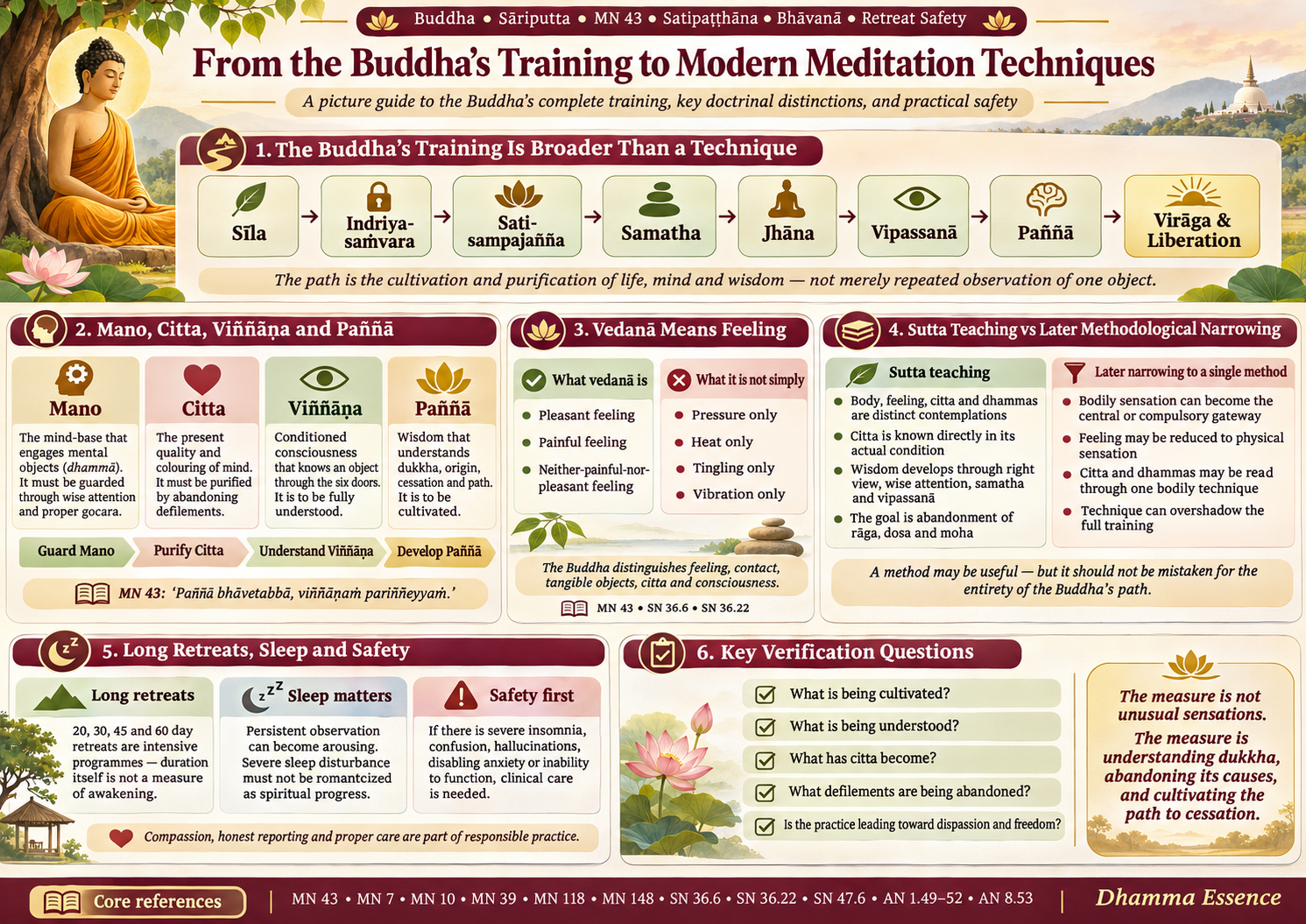 VISUAL SUMMARYSee this study in a pictureOpen the complete infographic for a visual overview before or after reading the full study.View infographic →
What must be developed, fully understood and abandoned?
The question is not how extraordinary an experience becomes. It is whether the complete training is developed, and whether rare expressions about consciousness are interpreted with their full canonical context.
A method can be useful without being the whole path. Sāriputta’s distinctions in MN 43, the Buddha’s teachings on citta and the sense doors, and the evidence concerning meditation-related harms demand an exact comparison of sources.
Source discipline: the Nikāyas govern canonical statements; Goenka’s own 1994 essay governs the interpretation attributed to him; clinical studies govern claims about unwanted experiences. A personal account, however serious, cannot alone prove psychiatric diagnosis or causation.
Mano, citta, viññāṇa and paññā
The direct instructions of the Buddha and Sāriputta, including purification, luminosity, feeling and right view.
01The question: what is bhāvanā meant to accomplish?
Purpose and method
Breathing, body scanning, observing vibrations and sitting for long periods can all become familiar activities within modern retreat culture. Their presence, however, does not establish that the complete training taught by the Buddha has been developed. The crucial question is: what has been understood, what wholesome qualities have matured, and which unwholesome conditions have been abandoned?
This essay separates three kinds of evidence. First, the Sutta-Vinaya records what the Buddha and his disciples instructed. Second, historical documents describe how later teachers and institutions organised their methods. Third, clinical research examines potential outcomes and adverse experiences. One kind of evidence must not silently stand in for another. A historical lineage does not independently prove canonical identity; a distressed practitioner’s experience does not, on its own, establish a particular medical cause.
Our particular focus is MN 43. Sāriputta explains feeling, perception, consciousness, wisdom, purified mind-consciousness, the five physical faculties and right view. These topics provide a much richer standard than judging practice by the constant observation of bodily phenomena.
Reading rule: when a section says “the text states,” it describes an explicit passage; when it says “practical synthesis,” it draws together distinct suttas; when it says “canonical assessment,” it assesses a modern interpretation against the primary texts.
02Āyatana and the six doors: where experience arises
MN 148 • SN 35.23
Āyatana denotes a field, sphere, domain or base. In the analysis of sensory life, the twelve āyatanas comprise six internal bases and six corresponding external classes of objects. The sense of extension or range helps explain the translation “sense sphere”; “sense base” emphasises the functional condition supporting an event. Neither expression denotes a tiny permanent observer inside the sense organ.
| Internal āyatana | External āyatana | Consciousness conditioned by the pair |
|---|---|---|
| Cakkhu — eye | Rūpā — visible forms | Cakkhuviññāṇa |
| Sota — ear | Saddā — sounds | Sotaviññāṇa |
| Ghāna — nose | Gandhā — odours | Ghānaviññāṇa |
| Jivhā — tongue | Rasā — tastes | Jivhāviññāṇa |
| Kāya — body | Phoṭṭhabbā — tangible objects | Kāyaviññāṇa |
| Mano — mind | Dhammā — mental objects | Manoviññāṇa |
As MN 148 explains, the corresponding consciousness arises dependent on a sense base and object. The coming together of the three is phassa, contact. Feeling then arises dependent on contact. This account does not turn the body-door into a compulsory conduit for all experience. It includes the mind-door and its mental objects.
For example, the spoken words of a wife are sounds; a recollection of the words is a mental object; the expectation “I must be obeyed” is also something taken up and known at the mind-door. Physical tension may accompany these events, but it is analytically distinct from the remembered designation or demand. Compare SN 35.23 — Sabbasutta.
03Mano must be guarded: do not wander outside the proper gocara
MN 43 • SN 47.6 • MN 19
In MN 43, Sāriputta identifies mano as the common resort of the five physical faculties: mano paṭisaraṇaṁ, mano ca nesaṁ gocaravisayaṁ paccanubhotī — mind is their resort, and mind experiences their domains. This statement does not elevate the physical body into the source of every experience, nor does it present mind as an eternal self.
To develop the handling of mental objects, we must examine what is repeatedly attended to and what is not worth feeding. The field of dhammā includes remembered words, expectations, plans, interpretations and the representation of roles. Yoniso manasikāra is not endless replaying of those objects; it is appropriate attention that investigates conditions and consequences.
In SN 47.6 — Sakuṇagghisutta, the Buddha uses a quail and a hawk to explain the danger of wandering into the wrong range, agocara. He identifies the five strands of sensual pleasure as the unsuitable field for the bhikkhu and the four satipaṭṭhānas as the proper range. This passage is about the practitioner’s range of cultivation; applying the metaphor specifically to how mano handles mental objects is a practical application, not a new Pāli definition of mano.
MN 19 — Dvedhāvitakkasutta adds an important psychological observation: what one frequently thinks and deliberates upon inclines the mind in that direction. The Buddha recognises the danger of sensual, ill-will and harmful deliberation and cultivates thoughts of renunciation, non-ill-will and non-harming. The cowherd similes illustrate the difference between guarding the field when cattle would destroy crops and allowing them space when the danger has passed.
Practice: while walking, standing, sitting or lying down, ask: What mental object is being taken up? Is attention feeding rāga, dosa or moha? Is this the proper field of sati and sampajañña? Guard the mind-door without trying to make ordinary cognition disappear.
04Citta is to be purified: the cloth simile and all sixteen defilements
MN 7 • MN 10
In MN 7 — Vatthūpamasutta, the Buddha compares citta to cloth. Dye applied to dirty cloth takes badly; dye applied to clean cloth takes well. The point is not a mystical theory of a permanent purified entity. It is that defilements matter and are to be known as defilements and abandoned.
MN 7 explicitly names the following sixteen cittassa upakkilesā, corruptions of citta:
| No. | Pāli | Meaning and manifestation |
|---|---|---|
| 1 | Abhijjhāvisamalobha | Covetousness and wrongful greed |
| 2 | Byāpāda | Ill will |
| 3 | Kodha | Anger |
| 4 | Upanāha | Sustained resentment |
| 5 | Makkha | Denigration or contempt |
| 6 | Paḷāsa | Presumption and contentiousness |
| 7 | Issā | Envy |
| 8 | Macchariya | Stinginess and possessive withholding |
| 9 | Māyā | Deceit |
| 10 | Sāṭheyya | Duplicity |
| 11 | Thambha | Obstinacy |
| 12 | Sārambha | Aggressive rivalry |
| 13 | Māna | Conceit and self-measurement |
| 14 | Atimāna | Excessive conceit |
| 15 | Mada | Intoxication with status and advantages |
| 16 | Pamāda | Heedlessness |
The discourse does not stop at diagnosis: recognising each defilement, the practitioner abandons it. A temporary decrease in irritation is not necessarily the final uprooting of dosa; a tranquil sitting does not establish that conceit or greed has been destroyed. Purification requires an examination of the actual conditional processes and the depth of abandonment, not self-certification by altered experience.
MN 10 and DN 22 give the direct method for recognising the present condition of citta. The sixteen descriptions of cittānupassanā and the sixteen corruptions of MN 7 are two different lists, not identical taxonomies. The first describes what is presently known; the second itemises corruptions that require removal. Together they illuminate the meaning of citta-bhāvanā.
05Pabhassara citta: brightness without inventing an eternal self
AN 1.49–52
In the Pabhassara passages, commonly numbered AN 1.49–52 (numbering differs between editions), the Buddha says pabhassaramidaṁ, bhikkhave, cittaṁ — this citta is luminous. He also speaks of incoming defilements and of freedom from those defilements. The passage is directly relevant to the cultivation of citta.
Pabhassara means luminous or radiant; āgantuka means incoming or adventitious; upakkilesa means corruption or defilement. Read together with MN 7, the practical task is not to hunt for a permanently shining inner substance but to know how corruption obstructs the mind and how cultivation frees it from its burden.
Important textual distinction: the Pabhassara passages explicitly name citta. They do not say that every eye-, ear-, nose-, tongue-, body- and mind-consciousness is intrinsically pure and unchanging. Nor do they equate citta’s luminosity with a separately existing self.
Some editions number the cluster AN 1.50–53 rather than 1.49–52. The identified text, not an edition-specific numbering scheme, should govern interpretation. Later commentarial explanations such as the bhavaṅga-citta interpretation must be distinguished from what these brief Nikāya passages explicitly state.
06Viññāṇa: sixfold conditioned consciousness and purified manoviññāṇa
MN 43 • MN 148 • SN 12.61
In the ordinary sixfold classification, viññāṇa arises dependent on the corresponding internal sense base and external object. Hearing requires ear and sound; remembering the words later involves the mind-door. Consciousness is an event to be understood in terms of dependence, not an enduring controller behind the senses.
MN 43 makes another precise statement. Sāriputta asks what may be known through parisuddhena manoviññāṇena — purified mind-consciousness — when the five physical faculties are not involved. He names three knowable formless attainments: the spheres of infinite space, infinite consciousness and nothingness. The passage establishes that refined mind-consciousness is not reducible to sensory signals arising at the body-door.
| MN 43 attainment | Formula | Meaning |
|---|---|---|
| Ākāsānañcāyatana | Ananto ākāso | Infinite space |
| Viññāṇañcāyatana | Anantaṁ viññāṇaṁ | Infinite consciousness |
| Ākiñcaññāyatana | Natthi kiñci | Nothingness |
However, purified mind-consciousness in this specific context is not a universal assertion that all viññāṇa is naturally pure and permanently bright. The passages must not be blended without distinction. SN 12.61 — Assutavāsutta refers to what is called citta, mano and viññāṇa, and explains their continual arising and ceasing, using the image of a monkey grasping one branch after another. This is a fundamental safeguard against reifying these terms as three lasting entities.
The rare expression viññāṇaṁ anidassanaṁ anantaṁ sabbato pabhaṁ in DN 11 and MN 49 cannot be resolved by a one-line translation. The next module gives the complete relevant DN 11 stanza, the MN 49 context, lexical and manuscript variants, and the conflicting commentarial and contemporary interpretations. Read the expanded investigation.
07Viññāṇaṁ anidassanaṁ anantaṁ sabbato pabhaṁ — the two suttas, the Pāli variants and the cessation question
DN 11 • MN 49 • SN 12.61 • SN 12.64 • SN 35.23 • MN 43 • AN 1.49–52
Why an apparently luminous phrase needs deeper investigation
Viññāṇaṁ anidassanaṁ anantaṁ sabbato pabhaṁ is sometimes presented as though it simply meant “an eternal, infinite, bright consciousness.” That gloss leaves unanswered the main questions raised by the discourses. Why is the expression found in a sutta that concludes with viññāṇassa nirodhena — the cessation of consciousness? Why does MN 49 introduce it while challenging Baka Brahmā’s claim to an eternal realm? What does it mean for earth, water, fire, air and name-and-form to find no footing? Is sabbato pabhaṁ even the only transmitted reading? We must read the entire relevant textual context before deciding what kind of illumination, manifestation or knowledge is in view.
The phrase appears in DN 11 — Kevaṭṭasutta and MN 49 — Brahmanimantanikasutta. That extreme rarity itself warrants caution about treating one English translation as a settled doctrinal definition.
1. Close Pāli reading: grammar and semantic possibilities
| Form | Grammatical and lexical point | What should not be assumed |
|---|---|---|
| Viññāṇaṁ | Neuter singular; literally consciousness or knowing/discerning, associated with vi-jānāti. Its exact referent must be settled by context. | That it necessarily identifies the ordinary sixfold consciousness, or necessarily an eternal substrate. |
| Anidassanaṁ | A- (negation) + nidassana (a showing, appearance, indication, manifest mark). Readings include “non-manifesting,” “without demonstrable feature,” “without visible mark” and “not displaying a sign.” | That it simply describes an invisible physical object, or proves a disembodied observer. |
| Anantaṁ | An- + anta (boundary, limit, end): boundless, without limit, unbounded. The dimension of infinity need not be clock-time. | That “boundless” automatically means an individually existing permanent soul. |
| Sabbato | From every side, in every respect or throughout; an adverbial formation. | That it specifies a physical light literally spreading through all spatial directions. |
| Pabhaṁ / sabbato-pabhaṁ | On the commonly printed reading, connected with radiance or illumination: “luminous all around,” “bright in every respect.” | That all editions preserve precisely this reading, or that radiance necessarily denotes photons, visions or a permanent self. |
| Pahaṁ / sabbato-pahaṁ | An important textual alternative; interpreted by some earlier translators and commentaries in terms of a ford, route or accessibility “from all sides.” | That the luminous translation is the only possible one, or that the alternative is undisputed. |
The popular rendering “consciousness, invisible, infinite and luminous all around” selects one interpretation at several points. A translation may be defensible without being exhaustive. The etymology opens a range of meanings; it does not decide the doctrinal referent independently of DN 11 and MN 49.
2. DN 11: what the wandering bhikkhu was asking
In DN 11 a bhikkhu attempts to learn where the four great elements cease without remainder. He ascends through successive heavenly domains, but even Great Brahmā cannot answer the question; after publicly declaring his greatness, Brahmā privately admits his ignorance and directs the bhikkhu back to the Buddha. This is no minor narrative decoration. The discourse contrasts displays of extraordinary power and status with the miracle of instruction, the teaching that brings defilements to an end.
The Buddha corrects the bhikkhu’s framing. Instead of locating a geographical where in the universe where the elements disappear, he reformulates the question in terms of where they find no footing and where name-and-form come to an end. The Pāli question is:
Kattha āpo ca pathavī,
tejo vāyo na gādhati;
Kattha dīghañca rassañca,
aṇuṁ thūlaṁ subhāsubhaṁ;
Kattha nāmañca rūpañca,
asesaṁ uparujjhatī?Where do water and earth, fire and wind find no foothold? Where do long and short, fine and coarse, fair and foul have no foothold? Where do name-and-form cease without remainder?
The answer: complete relevant Pāli stanza
Viññāṇaṁ anidassanaṁ,
anantaṁ sabbatopabhaṁ;
Ettha āpo ca pathavī,
tejo vāyo na gādhati.
Ettha dīghañca rassañca,
aṇuṁ thūlaṁ subhāsubhaṁ;
Ettha nāmañca rūpañca,
asesaṁ uparujjhati;
Viññāṇassa nirodhena,
etthetaṁ uparujjhatī.Close explanatory rendering: Non-manifesting or not-showable viññāṇa, boundless, described in the common reading as luminous all around: here water, earth, fire and wind gain no footing; here long and short, subtle and coarse, fair and foul gain no footing; here name-and-form cease without remainder. With the cessation of consciousness, here all this ceases.
The final sentence cannot be omitted. Viññāṇassa nirodhena says “through/with the cessation of viññāṇa”; etthetaṁ uparujjhati says “here this comes to an end.” A reading that introduces an everlasting conscious substance must explain how it coheres with this ending. Merely repeating “luminous awareness remains forever” does not perform that textual work.
Likewise, na gādhati means that no foothold or place of establishment is found; it should not be flattened into a claim that the material world has physically vanished, or that Nibbāna is another distant world located above the Brahmā realms. The Buddha has just corrected a question looking for a location.
3. DN 11’s central interpretive challenge: is one or more sense of viññāṇa involved?
There are two occurrences of viññāṇa within the answer: an opening description qualified by anidassana and a closing declaration of nirodha. What is their exact relation? The verse does not provide a separate scholastic definition of each, and the available interpretations differ.
| Reading | How it handles the opening | How it handles the cessation line |
|---|---|---|
| Nibbāna as what is to be known | The commentary reads viññāṇaṁ through viññātabbaṁ, “that which is to be known,” a designation of Nibbāna. | Ordinary conditioned consciousness ceases; the opening is not asserting an everlasting cognising aggregate. |
| Non-manifestative or non-objectifying experience | The opening speaks of an extraordinary mode beyond ordinary demonstrable signs and habitual objectification. | It must still be clarified what ceases and in what sense: one cannot simply ignore nirodha. |
| Refined noble samādhi | The opening may describe a boundless, exceptional state of samādhi where the elements find no footing as objects. | The final lines may answer a second aspect of the question, concerning the cessation of name-and-form and consciousness. |
The proposal that the stanza has two related answers is advanced by Bhikkhu Brahmāli, who argues that the opening may refer to a noble attainment of samādhi while the ending deals with cessation. That is a scholarly reconstruction, not an explicit division made by the Buddha. Other interpreters find the line referring to Nibbāna or to non-manifestative consciousness. The difficulty cannot be resolved by removing the last line or pretending the alternatives do not exist.
4. MN 49: why the same expression occurs in a dispute with Brahmā
In MN 49, Baka Brahmā believes that his domain is permanent, eternal and the highest possible refuge. The Buddha identifies this as ignorance. He exposes the limits of Brahmā’s knowledge and refuses to conceive earth, water, fire, beings, gods, Brahmā or “the all” as an eternal self or possession. At this point the expression recurs:
Viññāṇaṁ anidassanaṁ anantaṁ sabbato pabhaṁ.
Taṁ pathaviyā pathavattena ananubhūtaṁ, āpassa āpattena ananubhūtaṁ, tejassa tejattena ananubhūtaṁ, vāyassa vāyattena ananubhūtaṁ, bhūtānaṁ bhūtattena ananubhūtaṁ, devānaṁ devattena ananubhūtaṁ, pajāpatissa pajāpatittena ananubhūtaṁ, brahmānaṁ brahmattena ananubhūtaṁ, ābhassarānaṁ ābhassarattena ananubhūtaṁ, subhakiṇhānaṁ subhakiṇhattena ananubhūtaṁ, vehapphalānaṁ vehapphalattena ananubhūtaṁ, abhibhussa abhibhuttena ananubhūtaṁ, sabbassa sabbattena ananubhūtaṁ.
Explanatory rendering: What is termed non-manifesting, boundless and all-luminous (on the common reading) is not experienced in terms of the earthness of earth, the waterness of water, fire, wind, beings, gods, Pajāpati, Brahmā, the various higher Brahmā populations, or the allness of the all. The repeated ananubhūtaṁ is crucial: the Buddha is not simply adding one more brilliant heavenly location to Baka Brahmā’s domain.
What is the “all” here?
SN 35.23 — Sabbasutta calls the six internal bases and their six external objects “the all” for the purpose of this analysis. MN 49’s phrase sabbassa sabbattena ananubhūtaṁ is especially significant in that context. It points to a limitation of experience structured and conceived through the usual categories. Yet the exact metaphysical implications are disputed; the sentence cannot be turned, without further argument, into proof of an eternal witness outside those categories.
Notice also the dramatic setting: Brahmā claims eternality and supremacy. The Buddha denies the claim and points beyond Brahmā’s conceptual range. A reading that replaces the false eternal Brahmā with another independently existing, unlimited conscious Self would require careful justification; it is not established merely by the adjective anantaṁ.
5. The textual variants: “radiant all around” versus “accessible from every side”
Many modern editions read sabbato pabhaṁ or sabbatopabhaṁ, permitting a translation such as “radiant on every side” or “luminous in every respect.” Some textual witnesses and the Pali Text Society edition read sabbato pahaṁ; the commentarial tradition has also connected the reading with a ford or an accessible crossing. Earlier translations accordingly use expressions like “accessible from every side.”
The textual scholar Bryan G. Levman, in Towards a Critical Edition of the Tipiṭaka (2018), describes manuscript and language variation among readings associated with shining, passage, extension and lordship. He argues that pahaṁ merits special consideration as a possible older form. This is a text-critical scholarly proposal, not a consensus resolution.
| Reading | Common English sense | Interpretive consequence |
|---|---|---|
| Sabbato pabhaṁ | Luminous all around; radiant in every respect | Emphasises brightness or clarity; the brightness need not be visual light. |
| Sabbato pahaṁ | Alternative transmitted wording; not self-evidently equivalent to pabhaṁ | Disrupts the assumption that “luminous” is secured by every witness. |
| Traditional ford/accessibility explanation | Approachable or accessible from every side | Expresses accessibility rather than physical radiance, but is an explanatory interpretation. |
Therefore, the entire doctrine cannot be made to depend upon one English adjective such as “bright”. Even with pabhaṁ, brightness here does not automatically prove an entity that shines eternally. The surrounding statements concerning non-manifestation, non-establishment and cessation retain decisive weight.
6. Four interpretive families — keep them properly distinguished
| Interpretation | Principal claim | What remains to be explained |
|---|---|---|
| Early Theravāda commentaries | The expression is a name for Nibbāna, something to be known (viññātabba), rather than an ever-present conscious person. | The explanatory derivation is later exegesis, not an explicit etymology spoken in DN 11 itself. |
| Non-manifestative / non-objectifying account | What is described is not displayed as an ordinary graspable sense-object or differentiating knowledge. | The exact relationship between the opening and viññāṇassa nirodhena. |
| Non-landing / without-surface account | Connects the expression with a consciousness that has no place to establish itself; compare the light-ray simile in SN 12.64. | Whether the analogy establishes a distinct category beyond the six doors or describes the absence of nutriment and clinging. |
| Refined noble samādhi | Reads the boundless/luminous qualities and lack of footing as describing a special noble absorption or release known by noble disciples. | Why a particular samādhi is named here, how DN 11’s last line fits, and whether the account can be independently verified. |
These are interpreters’ positions, not four different teachings attributed to the Buddha. The commentarial explanation is found in the Sumaṅgalavilāsinī on DN 11 and the Papañcasūdanī on MN 49; modern discussions include Bhikkhu Ñāṇananda, Ṭhānissaro Bhikkhu, Bhikkhu Brahmāli and text-critical studies by Levman. The commentaries are secondary guides; the Nikāyas remain primary.
7. Relationship to AN 1.49–52, MN 43, SN 12.61 and SN 12.64
| Source | Actual wording or concern | What must remain distinct |
|---|---|---|
| AN 1.49–52 | Pabhassaramidaṁ cittaṁ: citta is luminous, affected or freed from incoming defilements. | It says citta, not viññāṇaṁ anidassanaṁ; do not silently equate the expressions. |
| MN 43 | Parisuddhena manoviññāṇena: purified mind-consciousness knows particular formless domains; wisdom is to be developed, consciousness fully understood. | A qualified contemplative experience is not automatically the same as Nibbāna or an eternal consciousness. |
| MN 38; MN 148 | The six consciousnesses depend on their relevant conditions; without conditions there is no origination of consciousness. | These passages define ordinary dependent consciousness; a rare phrase in two other discourses must be read alongside them. |
| SN 12.61 | What is called citta, mano and viññāṇa arises and ceases repeatedly, like a monkey moving from branch to branch. | No everlasting individual mind or witnessing self can be inserted without confronting this passage. |
| SN 12.64 | Where craving and delight do not provide sustenance, consciousness does not become established; the ray of light has nowhere to land. | “No landing” expresses conditional non-establishment; whether DN 11 has precisely the same referent remains interpretive. |
| DN 11 | Non-manifestative, boundless; elements gain no footing; name-and-form cease; viññāṇassa nirodhena. | Do not drop the cessation line when proposing a bright conscious essence. |
| MN 49 | The Buddha speaks of what is not apprehended in terms of earth, gods, Brahmā or the “all”. | This does not simply describe a Brahmā-world, a creator or an experiential self. |
We can now see why three simple slogans fail: “all consciousness is already pure,” “Nibbāna is eternal awareness,” and “the phrase is merely a bright sensation.” Each omits crucial qualifications elsewhere in the Nikāyas. Nor should one assert the opposite—that the phrase has no positive significance—without accounting for the extraordinary language the Buddha actually uses.
8. A practice-oriented understanding without appropriating the mysterious
Imagine a practitioner in deep tranquillity who perceives an extraordinary luminosity, spaciousness or absence of ordinary sensory characteristics. The sight, feeling and interpretation of that experience must still be examined: What has arisen dependent on conditions? Is there delight in the experience, fear of its disappearance, or the assumption “this is my true eternal consciousness”? Has citta become free from rāga, dosa and moha? Has paññā fully understood consciousness?
The DN 11 and MN 49 passages do not license the practitioner to claim an attainment merely because unusual brightness or a vibration has appeared. Their contexts challenge dependence on cosmic rank, extraordinary phenomena and conceptual identification. The secure path of practice remains indriya-saṁvara, sati-sampajañña, appropriate samatha, clear investigation, relinquishment and the full understanding of conditioned experience.
In walking, standing, sitting and lying down, recognise the tendency to locate an ultimate self in “my luminous awareness.” That desire to appropriate the experience is precisely what must be investigated. If one has no such experience, the suttas do not require its manufacture. Do not attempt to induce prolonged sleeplessness, extreme perceptual alterations or destabilising states to verify a disputed translation.
9. Canonical cross-examination: what would it mean for viññāṇa not to become established?
The most productive next step is not to declare a new eternal kind of consciousness. It is to investigate the Buddha’s explicit teaching on how consciousness becomes established, what sustains it, and what follows when its support is withdrawn. Three passages are particularly illuminating: SN 12.64 — Atthirāgasutta, SN 22.53 — Upayasutta, and SN 12.61 — Assutavāsutta. They offer a testable account of dependent consciousness, although none explicitly says that its own terminology is an exact definition of anidassana in DN 11.
A. SN 12.64: when nutriment is not accompanied by rāga, nandī and taṇhā
Yato kho, bhikkhave, kabaḷīkāre āhāre atthi rāgo atthi nandī atthi taṇhā, patiṭṭhitaṁ tattha viññāṇaṁ virūḷhaṁ.
Where there is passion, enjoyment or craving in relation to edible nutriment, consciousness finds a footing there and grows.
The same principle is applied in the discourse to the four nutriments: kabaḷīkāra āhāra (edible food), phassa (contact), manosañcetanā (mental volition) and viññāṇa (consciousness). The contrasting formula is decisive:
Yato kho, bhikkhave, kabaḷīkāre āhāre natthi rāgo natthi nandī natthi taṇhā, appatiṭṭhitaṁ tattha viññāṇaṁ avirūḷhaṁ.
Where there is no passion, delight or craving in relation to edible nutriment, consciousness is not established there and does not grow.
The discourse uses a beam of sunlight entering a house: if there is nowhere for it to land or become established, no surface provides its footing. The metaphor is about the absence of a basis for establishment, not a claim that a free-floating luminous entity persists as a second self. When consciousness has no footing and does not grow, the dependent sequence toward renewed becoming and suffering is cut off. This is more precise than saying either “nothing at all is known” or “an everlasting awareness survives.”
The contrast is establishment versus non-establishment, not the discovery of an eternal consciousness hiding beyond objects.
Wall → earth → water: each can serve as a surface on which the ray lands.
No supporting surface: in the Buddha’s simile, the ray is not established anywhere.
B. SN 22.53: where consciousness seeks support among the aggregates
SN 22.53 — Upayasutta makes establishment concrete. Consciousness may be involved with rūpa, vedanā, saññā or saṅkhārā; those aggregates become its object or support, watered by delight. When passion for them is abandoned, that support is cut off:
Rūpadhātuyā ce, bhikkhave, bhikkhuno rāgo pahīno hoti, rāgassa pahānā vocchijjatārammaṇaṁ, patiṭṭhā viññāṇassa na hoti.
When passion for the form-element is abandoned, the object or support is severed through that abandonment; there is no establishment for consciousness there.
The discourse applies the pattern to the other relevant aggregates and culminates in appatiṭṭhitaṁ viññāṇaṁ — consciousness not established — and liberation. Non-establishment here means that craving no longer provides the conditions for further fastening, growth and becoming. It must not be confused with the everyday inability to recognise an object, an induced trance, a blank mind or an unconscious interval.
C. Distinguish the terms rather than equating them
| Pāli expression | Where it is used | What the text supports | Interpretive limit |
|---|---|---|---|
| Anidassanaṁ | DN 11; MN 49 | Not displaying a perceptible or demonstrable feature; a rare expression whose precise referent is debated. | It is not the same Pāli word as appatiṭṭhitaṁ. |
| Appatiṭṭhitaṁ viññāṇaṁ | SN 12.64; SN 22.53 | Consciousness does not become established or grow when its craving-supported footing is absent. | The parallel illuminates DN 11 but does not by itself settle its grammar. |
| Viññāṇassa nirodhena | DN 11 | The verse explicitly invokes cessation of consciousness in the ending of name-and-form. | Any account of permanent experiencing must face this line directly. |
| Pabhassaramidaṁ cittaṁ | AN 1.49–52 | The cultivation and release of luminous citta from defilements. | This is not a textual equation of luminous citta with a metaphysically eternal viññāṇa. |
| Parisuddhena manoviññāṇena | MN 43 | Purified mind-consciousness knows the specified formless attainments. | A refined attainment is not automatically liberation or the referent of DN 11. |
D. Assess Buddhaghosa’s interpretation without adopting or dismissing it by authority
The later commentarial explanation treats the opening viññāṇaṁ as viññātabbaṁ — “that which is to be known” — and understands the expression as a designation of Nibbāna rather than an actually existing everlasting consciousness. This has one important doctrinal advantage: it avoids introducing a permanent consciousness-aggregate. But the substitution from the noun viññāṇaṁ to the proposed sense viññātabbaṁ is an exegetical move, not a grammatical transformation explicitly supplied by the stanza itself. It must be tested against both discourses, especially DN 11’s ending and MN 49’s repeated ananubhūtaṁ. Thus we need neither repeat the commentary as the Buddha’s words nor conclude that every interpretive insight it contains is false.
A Nikāya-based working reading emphasises the ending of establishment through delight, craving and identification. It makes good sense of the release taught in SN 12.64 and SN 22.53 and helps explain why the Buddha is not describing a supreme heavenly object in MN 49. Nonetheless, this is a comparative interpretation of anidassana, not a conclusive proof that DN 11’s opening and the language of appatiṭṭhita are interchangeable.
E. How can this be approached through bhāvanā in everyday experience?
Consider hearing an unpleasant remark. Ear, sound and ear-consciousness condition contact; feeling occurs. Then the mind-door takes up a remembered phrase, and the thought “Why did they speak to me like that?” may nourish resentment, self-reference and repetition. The training is not to suppress hearing or remove the capacity to know. It is to see exactly how feeling is followed by nandī or aversion, how appropriation constructs “I” and “mine”, and how continued attention makes that pattern grow. The same investigation applies in walking, standing, sitting and lying down.
When appropriate attention, restraint and cultivation weaken and ultimately abandon rāga, dosa and moha, there is less fuel for grasping and becoming. MN 19 guides what patterns of thinking are fed; MN 7 identifies what must be purified from citta; MN 43 distinguishes what must be fully understood from the wisdom that must be developed. In SN 22.53 and SN 12.64 the decisive issue is not a mysterious sensation but the ending of the conditions on which consciousness becomes established.
Experiential verification, carefully stated: notice contact, feeling, delight or resistance, clinging, and the result of their relinquishment. This can reveal the conditional process taught in the Nikāyas; it does not mean that a moment of calm, absence of thought, extraordinary brightness or unusual perception proves the attainment of Nibbāna, or settles the philology of DN 11. For the liberated person, non-establishment refers to a far more radical ending of the supporting conditions of renewed becoming.
F. The conclusion that survives the comparison
The most defensible practical direction is to stop searching for a permanent inner witness and examine how viññāṇa finds a basis through rāga, nandī, taṇhā and appropriation. As those supports cease, consciousness is not established for further growth and becoming. That is explicitly taught by SN 12.64 and SN 22.53. Whether this fully exhausts the remarkable viññāṇaṁ anidassanaṁ formula remains an open textual question; the article therefore does not claim an exact doctrinal identity where the surviving sources do not demonstrate one.
10. Provisional textual synthesis: what can responsibly be stated?
What the suttas establish: DN 11 and MN 49 employ the rare expression viññāṇaṁ anidassanaṁ anantaṁ sabbato pabhaṁ in discussions of non-establishment, limits of elemental and conceptual description, and the surpassing of Brahmā’s claims. DN 11 ends with the cessation of consciousness; MN 49 rejects locating ultimacy in Brahmā or the “all.”
What requires further argument: Whether the phrase directly designates Nibbāna, describes a non-manifesting mode of consciousness, or refers to a distinctive noble samādhi. How sabbato pabhaṁ and sabbato pahaṁ should be weighed text-critically. Whether the first and last occurrences of viññāṇa in DN 11 have distinct referents.
What should not be asserted as established: A permanent individual luminous soul; the identity of all viññāṇa with AN 1’s luminous citta; the identity of this phrase with MN 43’s purified manoviññāṇa; or the claim that one bodily or visual sensation reveals the meaning of the passage.
This disciplined uncertainty is not an evasion. The Buddha’s expression is genuinely profound, and the textual record is complex. Its depth becomes clearer when we investigate all its words, variants and contexts, instead of relying on one attractive translation.
Canonical and interpretive sources for this investigation
Each source is listed separately, with its role in understanding viññāṇaṁ anidassanaṁ. Primary discourses are distinguished from later translations and textual studies.
01 · Primary Nikāya texts
Read the Buddha’s words first. The linked passages provide the canonical foundation for the analysis.
Dīgha and Majjhima Nikāyas
- DN 11Kevaṭṭasutta
The rare expression, the four elements and cessation of consciousness
Baka Brahmā’s claims and the meaning of non-manifestation
- MN 43Mahāvedallasutta
Purified mind-consciousness, knowledge and wisdom
Saṃyutta and Aṅguttara Nikāyas
- SN 12.61Assutavāsutta
Conditioned arising and ceasing of citta, mano and viññāṇa
- SN 12.64Atthirāgasutta
Sunbeam simile: absence of a footing for consciousness
- SN 22.53Upayasutta
How the supports for establishing consciousness are abandoned
- SN 35.23Sabbasutta
The “all” of the six internal and external sense bases
- AN 1.49–52Pabhassara citta
Distinguishing luminosity of citta from the rare DN 11 wording
02 · Translations and textual scholarship
These works offer interpretations, variant readings and historical analysis—not additional statements by the Buddha.
DN 11: Translation and notes
Compare the rendering of the verse with its Pāli wording and concluding cessation line.
What the Nikāyas Say and Do Not Say about Nibbāna
An interpretation of Nibbāna and related consciousness passages; distinguish its proposals from the suttas.
Towards a Critical Edition of the Tipiṭaka
Manuscript and language variants relevant to sabbato pabhaṁ and alternative readings.
Source hierarchy: the Pāli discourses establish what the Buddha taught; commentaries, translations and modern studies are identified separately as interpretations. Editorial renderings aid comprehension but do not replace the Pāli.
For the complete classified bibliography, including scientific research, visit the Source Library on this page.
08Paññā: conjoined with consciousness, cultivated through conditions
MN 43
In MN 43, Sāriputta says wisdom and consciousness are conjoined, not disjoined: what is understood with wisdom is cognised, and what is cognised with wisdom is understood. Their difference is in the task assigned to them:
Paññā bhāvetabbā, viññāṇaṁ pariññeyyaṁ.
Wisdom is to be cultivated; consciousness is to be fully understood.
He further states that wisdom is for direct knowledge, full understanding and abandonment: abhiññatthā, pariññatthā, pahānatthā. This is a more exact measure of spiritual progress than extraordinary sensations or increasing time in retreat.
Sāriputta identifies two conditions for the arising of right view: parato ghoso, hearing the teaching of another, and yoniso manasikāra, wise or appropriate attention. He then describes five factors supporting right view so that liberation of mind and liberation by wisdom become its fruit: sīla, suta, sākacchā, samatha and vipassanā.
| Condition or support | Function in cultivation |
|---|---|
| Parato ghoso | Hear reliable Dhamma rather than relying on an unexamined doctrine |
| Yoniso manasikāra | Investigate according to causes, conditions, arising and cessation |
| Sīla | Ethical conduct supports freedom from remorse |
| Suta | Study and retain what the teaching actually says |
| Sākacchā | Discuss and clarify the Dhamma correctly |
| Samatha | Cultivate tranquillity and collectedness |
| Vipassanā | Investigate conditioned phenomena with wisdom |
Integrated practical synthesis: guarding the mind-door prevents repeatedly nourishing unwholesome stories; recognising and abandoning defilements purifies citta; the sixfold processes of consciousness are fully understood; and wise attention, collectedness and insight support the maturation of paññā. These tasks are mutually supportive. MN 43 does not describe paññā as a material or luminous product transferred through viññāṇa into two independent compartments called mano and citta.
A correct study map: Guard mano and its engagement with dhammā; purify citta from upakkilesa; fully understand conditioned viññāṇa; develop paññā through the stated supporting conditions; abandon what perpetuates dukkha. This is a cross-sutta teaching synthesis, not a fixed five-stage causal sequence quoted from one discourse.
09The eight pairs of cittānupassanā: know what citta has become
MN 10 • DN 22
The sixteen descriptions of citta in MN 10 and DN 22 must be directly recognised in experience. They are not sixteen stages that every practitioner must pass through, and temporary freedom from a defilement does not by itself prove its final eradication.
| Pair | Pāli | What the practitioner must recognise |
|---|---|---|
| 1 | Sarāga / Vītarāga | With attachment / without attachment |
| 2 | Sadosa / Vītadosa | With aversion / without aversion |
| 3 | Samoha / Vītamoha | With delusion / without delusion |
| 4 | Saṅkhitta / Vikkhitta | Contracted / scattered |
| 5 | Mahaggata / Amahaggata | Expanded / not expanded |
| 6 | Sauttara / Anuttara | Surpassable / unsurpassed |
| 7 | Samāhita / Asamāhita | Collected / uncollected |
| 8 | Vimutta / Avimutta | Released / not released |
The central question is “What has citta become now?” A person may be quiet yet resentful, collected yet attached to an attainment, or physically relaxed while deeply identified with an imagined role. In all cases the instruction is to know the actual citta condition rather than infer it exclusively from the presence or absence of bodily vibration.
The instructions remain connected to understanding arising and disappearance, cultivating the wholesome and abandoning the unwholesome. Read them alongside the MN 7 corruptions, but do not merge the two classifications into one list.
10Vedanā is feeling: bodily touch and the mental tone are different
MN 43 • SN 36.22 • SN 36.6
In MN 43 Sāriputta explains vedanā through vedeti: it feels pleasure, pain or neither. The technical teaching concerns hedonic tone, not simply the detection of pressure, warmth, tingling or movement. Such tactile characteristics may have their own feeling-tone, but the two must not be defined as identical.
SN 36.22 — Aṭṭhasatapariyāyasutta describes feeling in two divisions (bodily and mental), three (pleasant, painful and neutral), five faculties, six contact-born classes, eighteen, thirty-six and 108. Mind-contact-born feeling cannot be removed from the classification simply because a modern technique emphasises body-contact.
| Term | Canonical role | A common confusion |
|---|---|---|
| Phoṭṭhabba | Tangible object known at the body-door | Mistaking every tactile quality for vedanā |
| Kāyaviññāṇa | Body-consciousness dependent on its conditions | Treating body-consciousness as all consciousness |
| Phassa | Threefold meeting of base, object and consciousness | Equating contact with vibration |
| Vedanā | Pleasant, painful or neutral feeling born of contact | Limiting every feeling to physical touch |
| Cetasikā vedanā | Mental feeling distinguished from bodily feeling | Assuming the mental aspect is simply an anatomical sensation |
In SN 36.6 — Sallasutta, the Buddha distinguishes an unpleasant bodily feeling from the additional mental suffering of the second arrow. Observing bodily pain does not automatically establish that the second arrow has been understood or abandoned. English “sensation” may be a useful ordinary term, but it is not a substitute for all the separate Pāli categories of experience.
11The complete training: satipaṭṭhāna, restraint, ānāpānassati and jhāna
MN 39 • MN 118
MN 39 — Mahāassapurasutta places purified bodily, verbal and mental conduct, guarding the faculties, moderation in eating, dedication to wakefulness and clear comprehension within a progressive training. The point is development of the whole life, not mere intensity of attention.
MN 118 — Ānāpānassatisutta presents sixteen trainings in four tetrads. They progress through bodily processes, feeling and mental formation, citta, and contemplation of impermanence, dispassion, cessation and relinquishment. This cannot be accurately represented as simply counting or watching the breath without end.
| Tetrad | Trainings in outline | What they develop |
|---|---|---|
| Body | Long and short breathing; experiencing the whole body; calming bodily formation | Knowing and calming the bodily process |
| Feeling | Experiencing pīti, sukha and citta formation; calming mental formation | Gladness, feeling and calming the mind’s formation |
| Citta | Experiencing, gladdening, collecting and releasing citta | Cultivation of the present mental condition |
| Dhammas | Contemplating impermanence, dispassion, cessation and relinquishment | Insight directed toward relinquishment |
The Buddha likewise teaches awareness and clear comprehension while walking, standing, sitting and lying down. Formal sitting is one posture in a wider cultivation. The measure remains development of right conduct, collectedness and wisdom leading toward release, not unbroken perception of a chosen physical stimulus.
From a method to an exclusive doctrinal claim
Test the actual published claims of a teaching lineage against MN 43, MN 10 and DN 22.
12The modern Goenka method: what its original article actually requires
Historical method • 1994 source
S. N. Goenka learned from Sayagyi U Ba Khin and began teaching in India in 1969. His tradition traces its history through earlier Burmese teachers including Saya Thetgyi and Ledi Sayadaw. Standardised residential ten-day courses, together with longer courses for eligible experienced students, made the approach widely accessible.
The relevant primary document is Goenka’s January 1994 article, Sensation, the Key to Satipatthāna. In that text he recognises mental states and mental contents, but argues that every mental event is accompanied by bodily sensation and that bodily-sensation observation is necessary for all four satipaṭṭhānas. He makes a method of bodily observation central to the complete investigation of body and mind.
This is a substantial doctrinal claim, not merely a harmless preference about how to begin. The Buddha’s explicit instructions to recognise the present citta, its rāga, dosa and moha, and the distinct dhamma categories, do not state that tactile body scanning must first occur for those recognitions to be valid. A chosen technique and a compulsory canonical prerequisite are not the same thing.
It would still be inaccurate to write that Goenka denied mind, never taught equanimity, or advocated only a physicalist view of reality. His own article distinguishes mental and material fields; it is precisely his asserted indispensability of bodily sensations that must be examined critically.
13Canonical audit: what is explicitly required, and what a method adds
Direct comparison
| Question | Buddha or Sāriputta | Goenka article | Assessment |
|---|---|---|---|
| Where are the physical faculties’ domains experienced? | MN 43: five faculties have distinct domains; mano is their common resort. | Bodily sensations are an indispensable route to exploring the whole. | The MN 43 statement does not make tactile sensation the universal gateway. |
| What is vedanā? | MN 43: pleasant, painful and neutral feeling; SN 36.22: bodily, mental and six contact-born types. | Vedanānupassanā centres on bodily sensations. | The full canonical range of feeling exceeds body-touch characteristics. |
| What is cittānupassanā? | MN 10/DN 22: know citta across the eight pairs. | Citta must be investigated through associated physical sensations. | No compulsory body scan is stated in those direct citta instructions. |
| What is dhammānupassanā? | Hindrances, aggregates, āyatanas, awakening factors and Four Noble Truths are examined. | Bodily sensation is treated as essential to the full contemplation. | One body-door exercise cannot be equated with the entire stated field. |
| What is spiritual progress? | MN 43: paññā is developed, viññāṇa fully understood; wisdom is for understanding and abandonment. | Refined direct experience of bodily change is a central method. | Sensory refinement is not by itself proof of paññā or abandonment. |
Textual judgment: making systematic body-sensation observation an exclusive or compulsory gateway to all four satipaṭṭhānas is a later methodological assertion, not a condition explicitly imposed by MN 43, MN 10 or DN 22. The critique concerns the claim of necessity, not a claim that bodily observation can never be useful.
Nor should we infer from doctrinal difference that every practitioner is harmed or that every retreat generates psychiatric symptoms. These questions require independent evidence.
What long retreats and adverse-event research can establish
Separate published programme requirements, clinical evidence and unproven causal assumptions.
14Long retreats: what 20, 30, 45 and 60 days can—and cannot—show
Programme requirements
Official Goenka-tradition long-course requirements recognise 20-, 30-, 45- and 60-day retreats. Eligibility generally increases with course length and may depend on previous courses, years of regular practice, service, teacher recommendations and other commitments. These are programme qualifications, not independent medical guarantees.
Long periods of silence and intense inward attention may be valuable for some practitioners and destabilising for others, especially when sleep is impaired or distressing perceptions persist. Published case reports document serious psychiatric presentations in temporal association with meditation, but the reviewed evidence does not provide a reliable psychosis rate for each retreat duration. The 2023 clinical case series and another 2023 case series underscore why a report of psychosis calls for clinical assessment; neither supplies a denominator for calculating a risk from a 20-, 30-, 45- or 60-day course. A 2025 cross-sectional U.S. survey found an association between prior retreat participation and adverse experiences, but not a demonstrated causal effect of the retreat.
It would be unsupported to say all extended courses are dangerous or that a 60-day retreat inevitably causes psychosis. It would be equally unsupported to assume that more days necessarily indicate better liberation. The fundamental assessment remains what qualities have actually been cultivated and whether safe, healthy functioning is being sustained.
15Jāgariyānuyoga and sleep: watchfulness is not insomnia
MN 39 • clinical evidence
In MN 39, the Buddha’s training in wakefulness includes practice in the day and first and last watches of the night, but also lying down in the middle watch in the lion’s posture, mindful and aware, with the intention to rise. It is not a modern prescription of exactly how many hours everybody must sleep. It is nevertheless not a command to abolish sleep.
Some practitioners report that they continue monitoring subtle breath changes, bodily vibration or awareness itself when trying to rest. In such circumstances, the attempt to maintain an uninterrupted watch may become part of a cycle of increased arousal, frustration and difficulty sleeping. This is a possible clinical mechanism, not a universal conclusion about meditation.
A 2018 systematic review of severe sleep deprivation examined 21 eligible studies of healthy people deprived of sleep for 24 hours up to 11 nights. Perceptual distortions, hallucinations, mood disturbance and disordered thinking emerged with extended wakefulness. These were not meditation-retreat cohorts, and laboratory total sleep deprivation is not identical with many years of chronic insomnia. The review explains why severe sleep loss demands assessment; it cannot establish the cause of any particular student’s symptoms.
16Meditation-related adverse experiences: what the clinical evidence supports
Research audit
The 2020 systematic review by Farias and colleagues identified 83 eligible studies involving 6,703 participants. Its pooled estimate of reported adverse experiences was approximately 8.3%, but the experimental-study estimate (3.7%) differed markedly from the observational-study estimate (33.2%). The studies varied in design, detection of adverse events, population and intensity of practice. This is not a psychosis incidence estimate, nor a rate specific to Goenka courses.
The 2017 Varieties of Contemplative Experience project used qualitative methods to examine challenging meditation experiences, including cognitive, perceptual, emotional, somatic and social disturbances. It gives important detailed accounts of potential difficulties and their contexts but deliberately selected persons who had encountered challenges; it is not a population prevalence survey.
The US NCCIH overview likewise notes limitations in systematic safety assessment. Short, clinically adapted mindfulness programmes cannot simply be treated as identical exposures to long silent retreats. Severe experiences reported after practice may involve sleep deprivation, mental-health vulnerabilities, medications, physical illness, psychosocial stress or multiple interacting conditions.
Why methods of measuring harm produce very different percentages
Scientific studies do not use one uniform definition of an adverse meditation experience. Some measure anything that feels unpleasant; some ask whether functioning was impaired; others ask whether a difficulty lasted days or months. Asking spontaneously “Did anything bad happen?” detects fewer experiences than a structured list of specific perceptual, emotional and cognitive changes. For this reason, percentages from different studies must not be put beside one another as though they measure the same clinical event.
Cebolla and colleagues (2017), in a multicentre survey of practitioners, found that 25.4% reported unwanted effects. Most were transient and did not require clinical treatment. The study was a survey, not an experiment proving meditation caused those events. Read the multicentre survey.
Schlosser and colleagues (2019) surveyed 1,232 regular meditators. Some 25.6% reported a particularly unpleasant experience that they believed might be related to meditation. This was a cross-sectional self-report study; neither the 25.6% nor its associations should be presented as the risk of psychosis after a retreat. Read the 2019 practitioner survey.
Britton and colleagues (2021) used structured interviews after eight-week mindfulness-based programmes (96 participants). Experiences with negative valence and negative impact on functioning were distinguished from all reported side effects. Depending on the duration threshold, lasting negative impacts occurred in roughly 6–14% of the studied sample. This result concerns the specifically studied programmes, not 20- or 60-day Goenka retreats. Read the structured adverse-effects assessment.
Van Dam and colleagues (2025) surveyed 886 U.S. adults using several questionnaires. Rates varied substantially according to the instrument; 9.1% reported functional impairment. Psychological distress and retreat participation were associated with adverse reports, but the cross-sectional design cannot establish that retreat participation caused the impairment. Read the 2025 survey.
Severe presentations: case reports are warning signals, not incidence estimates
Charan and colleagues (2023) published Meditation Practices and the Onset of Psychosis: A Case Series and Analysis of Possible Risk Factors, describing clinically significant cases and potential contextual risks. Yadav and colleagues (2023) presented two further cases in Meditation—A Slippery Slope for Psychosis. Such case reports establish that clinicians encounter serious psychiatric presentations in temporal association with meditation, but they do not demonstrate sole causation, a population-level frequency, or the risk from one specific lineage. Charan et al. · Yadav et al.
Evidence that prevents an overgeneralised verdict
A 2024 systematic review by O’Brien-Venus and colleagues examined adapted mindfulness interventions for people with psychosis in controlled clinical contexts. It did not find the same safety profile one might infer from unsupervised intensive practice; several harm outcomes were not elevated, while reporting remained inconsistent. This shows why one must distinguish clinically adapted practice from long residential retreat exposure. Read the clinical safety review.
Simonsson and colleagues (2026) studied brief five- and ten-minute digital practices in a randomised comparison against ordinary internet use. Brief meditation did not increase reports of distressing experiences compared with the control in that setting; the ten-minute condition was more likely to provoke distress than the five-minute condition. This is evidence about brief digital exposures and cannot be used to declare prolonged retreat formats harmless or harmful. Read the 2026 randomised trial.
What the complete scientific record supports: unwanted meditation-related experiences are documented, some can be serious, and they are measured inconsistently. Severe sleep loss merits clinical attention. But a reported association, a case series, a short clinical programme and a 60-day retreat are not interchangeable types of evidence. Their different populations, methods, intensities and outcomes must remain visible to the reader.
| Source | What it supports | What it cannot prove |
|---|---|---|
| 83-study review, 2020 | Meditation-associated adverse experiences are documented and heterogeneous. | Risk of psychosis for any specific retreat length or proven cause for an individual. |
| Qualitative investigation, 2017 | Detailed accounts of difficult and sometimes impairing experiences exist. | How often such events happen in all retreats. |
| Sleep-deprivation research, 2018 | Extended wakefulness can cause hallucinations and altered thinking. | That meditation induced a specific person’s longstanding sleep disorder. |
| Case reports | A possible temporal association requiring investigation. | Sole causation by one technique without clinical differential assessment. |
17When a student deteriorates: why care takes precedence
Safeguards
Consider a non-identifying hypothetical example: a practitioner persistently monitors breathing and bodily vibrations, develops long-standing sleep difficulty, becomes frightened by unusual perceptions and eventually requires hospital treatment. Such an account warrants serious attention to practice history and sleep. It cannot, by itself, establish a medical diagnosis or prove that the practice was the sole cause.
Where hallucinations, confusion, severe depression, disabling anxiety, suicidal thoughts, inability to function or prolonged insomnia develop, the appropriate first steps are medical assessment and stabilisation. A teacher should not claim that every such experience is a sign of jhāna, insight, purification or awakening. Nor should a hospitalised person be urged to intensify the technique that appears to be distressing them without treating-team approval.
Clinicians benefit from clear, factual details: the technique followed, time spent practising, retreat schedule, previous response to practice, sleep history, symptom timeline, medications and relevant physical or psychiatric conditions. The teacher’s role is to cooperate with the team, protect the student’s dignity and avoid adding incompatible spiritual instructions.
Medical safeguard: This essay makes no diagnosis and identifies no individual patient or hospital. Psychological or neurological symptoms should never be retrospectively attributed to meditation alone without a proper assessment of alternatives.
Recognising the conditions and responding responsibly
A household example, the Buddha’s verification criteria and a path back to appropriate practice.
18Responsible retreat teaching before, during and after a course
Prevention and response
Before retreat: Explain the actual schedule, likely demands of silence, intensity and rest. Invite private disclosure of significant current sleep problems, severe psychiatric symptoms, relevant medication and any prior serious adverse experiences, and seek qualified professional advice when indicated. Avoid using disclosure to stigmatise students.
During retreat: A safe teaching environment needs a clear way to report distress. Persistent inability to sleep, increasing confusion, frightening perceptual experiences, agitation, severe mood disturbance, loss of judgement or inability to care for oneself must trigger prompt reassessment. Pausing, reducing or modifying practice—and seeking clinical care—is not failure of faith.
After retreat: Follow-up should include the ability to resume normal sleep, ordinary responsibilities and stable interpersonal functioning. A student who has completed a long course should be able to report harm without being blamed for lacking equanimity. Teachers and administrators should document significant concerns and review how instructions are delivered.
Ethical principle: No retreat should require a participant to hide deterioration in order to be judged spiritually serious. A teacher’s responsibility is both to preserve Dhamma integrity and to act compassionately when clinical help is needed.
19Worked example: husband, wife, designation and the five aggregates
Mano • citta • viññāṇa • paññā
A wife says, “I disagree with this decision.” The husband hears her words. In the six-base analysis there are ear, sound and ear-consciousness; the threefold meeting is contact. A painful or neutral feeling may arise. Later the remembered words can occur as dhammā at the mind-door. A physical tightening of the chest may accompany these events, but it is not the whole event.
| Aspect | What is present | What must be examined |
|---|---|---|
| Āyatana | Ear and sound; later mind and remembered mental object. | The relevant functional base and object. |
| Viññāṇa | Hearing and mind-consciousness arise dependently. | Understand the conditioned nature of each consciousness. |
| Mano / dhammā | “My wife,” “my authority,” an earlier quarrel, imagined disrespect. | Is the story being fed by improper attention? |
| Vedanā | Pleasant, unpleasant or neutral feeling with contact. | Feel the tone; do not equate it with the chest’s pressure. |
| Citta | May be sadosa, sarāga, samoha, vikkhitta, asamāhita. | Know the present colouring and its conditions. |
| Paññā | Sees the designation as conventional and the aggregates as not self. | Cultivate wise response and relinquishment. |
The husband may observe a rapid heartbeat or tight chest; that alone does not establish knowledge of dosa, the desire for obedience, the convention “husband”, or self-view. Guarding what is taken up by mano and recognising citta’s true condition allow a wiser response. The relationship and responsibilities continue without insisting that a social role is an enduring self.
For the canonical discussion of the twenty views of identity concerning the five aggregates, see MN 44 — Cūḷavedallasutta. The detailed eight-pair exercise is in How to Practice Cittānupassanā?.
20Verify against the Dhamma-Vinaya: not reputation or retreat duration
DN 16 • AN 8.53
In DN 16, the great references require a proposed teaching to be checked against the Sutta and Vinaya. A teacher’s reputation, a long lineage or a widely followed method does not override the textual examination. Read a modern statement fairly, and then ask what the primary discourse actually says.
In AN 8.53 — Saṅkhittasutta, the Buddha gives Mahāpajāpatī Gotamī eight tests for recognising what agrees with the Dhamma-Vinaya: movement toward dispassion rather than passion; freedom from bondage rather than bondage; dismantling rather than accumulation; fewness of wishes rather than strong desires; contentment rather than discontent; solitude rather than company-seeking; energy rather than indolence; and being easy rather than difficult to support.
These are spiritual criteria, not a clinical diagnostic instrument. They nevertheless direct attention away from achievement narratives based on hours, days, extraordinary perceptions or identity as a particular kind of practitioner. An appropriately cultivated path moves toward less rāga, dosa and moha and toward understanding and release.
Return finally to MN 43: cultivate paññā, fully understand viññāṇa, guard the mind-door and purify citta. These are interrelated tasks but not a rigid conveyor belt by which consciousness manufactures wisdom. The profound language of viññāṇaṁ anidassanaṁ must be examined with DN 11’s cessation formula, MN 49’s challenge to Brahmā and the variant readings, rather than treated as proof of a permanently luminous internal self.
21Final inquiry: from technique back to liberation
Nibbidā • virāga • nirodha
A technique can be useful without being the whole path. Bodily sensation may be observed, but it does not replace the Buddha’s separate analysis of six sense domains, feelings, mental objects, the condition of citta, right view, collectedness and wisdom.
Mano is to be guarded in its engagement with objects; citta is to be freed from corruptions; viññāṇa is to be fully understood in dependence on conditions; paññā is to be cultivated. These are not four eternal entities or a sequence of material transfers. They are functional aspects of a conditioned cultivation whose measure is the ending of dukkha.
Where a practitioner is suffering, compassion and appropriate medical help come before defending a technique. Where a method claims exclusive canonical authority, the proper response is examination against Sutta and Vinaya. The final measure is neither the brilliance of a sensation nor the length of a course, but the weakening and relinquishment of craving, ignorance and clinging.
Final principle: Do not exchange the complete Buddha-Dhamma for a narrower instrument of attention. Use what is helpful without grasping it; understand what arises; cultivate the path that leads to nibbidā, virāga, nirodha and liberation.
Primary texts and research evidence
References are arranged by what they can establish: the words of the Buddha and Sāriputta, the tradition’s own statements, philological interpretation, and the modern clinical literature.
01 · Primary Nikāya texts
Grouped by Nikāya. Every discourse has its own line, its title and the reason it matters to the argument.
Majjhima Nikāya
- MN 43Mahāvedallasutta
Sāriputta on mano, purified mind-consciousness, feeling and wisdom
- MN 7Vatthūpamasutta
Sixteen corruptions and purification of citta
- MN 10Satipaṭṭhānasutta
Four contemplations and the eight citta pairs
- MN 19Dvedhāvitakkasutta
Mental inclination and repeated deliberation
- MN 39Mahāassapurasutta
Graduated training, wakefulness and middle-watch rest
- MN 44Cūḷavedallasutta
Feeling, cessation and identity-view
Anidassana viññāṇa in a dialogue with Baka Brahmā
- MN 118Ānāpānassatisutta
Sixteen trainings extending through citta and liberation
- MN 148Chachakkasutta
Six bases, consciousness, contact and feeling
Dīgha Nikāya
- DN 11Kevaṭṭasutta
The anidassana expression and its cessation context
- DN 16Mahāparinibbānasutta
Great references: verify against Sutta and Vinaya
Body, feeling, citta and dhammas
Saṃyutta Nikāya
- SN 12.61Assutavāsutta
Conditioned citta, mano and viññāṇa
- SN 12.64Atthirāgasutta
Consciousness, sustenance and unestablished support
- SN 35.23Sabbasutta
Six paired internal and external sense domains
- SN 36.6Sallasutta
Bodily pain and the second arrow
- SN 36.22Aṭṭhasatapariyāyasutta
Bodily and mental feeling; six contact-born kinds
- SN 47.6Sakuṇagghisutta
Proper pasture: the four satipaṭṭhānas
Aṅguttara Nikāya
- AN 1.49–52Pabhassara citta
Luminous citta and incoming corruptions; numbering varies by edition
- AN 8.53Saṅkhittasutta
Criteria for discerning Dhamma-Vinaya
02 · The tradition’s own statements
The fairest comparison begins with the method’s actual published claims and admissions requirements.
Sensation, the Key to Satipatthāna
The author’s own case for observing bodily sensations across all four satipaṭṭhānas.
Distinction. Primary historical source; its assertions are not quotations of the Buddha.
Old Student Course Qualification Requirements
Admission criteria for 20-, 30-, 45- and 60-day programmes.
Distinction. Programme eligibility is not a clinical safety assessment.
03 · The viññāṇaṁ anidassanaṁ debate
Translations and textual studies are distinguished from the Nikāya text itself. Editions, variants and interpretations must not be silently collapsed.
DN 11 translation and notes
Rendering and annotation of the DN 11 stanza, including interpretive difficulties.
Reading note. Compare with the original Pāli and the concluding cessation line.
MN 49 translation and notes
Context of Baka Brahmā and the anidassana expression.
Reading note. This is a translation and its interpretation, not a universal scholarly consensus.
What the Nikāyas Say—and Do Not Say—about Nibbāna
Theological/textual examination of Nibbāna and consciousness expressions.
Reading note. A modern interpretive study; separate it from canonical quotation.
Towards a Critical Edition of the Tipiṭaka
Textual transmission and manuscript/edition variants.
Reading note. Use as a textual-study reference, not as evidence of clinical effects.
04 · Clinical research and safety
Eleven peer-reviewed papers, plus a major institutional overview. Each entry records what it contributes and what it cannot establish.
Systematic reviews and how harms are measured
These papers explain why reported percentages depend on definitions, interview method and study design.
Adverse events in meditation practices and meditation-based therapies
Finding. 83 studies, 6,703 participants; pooled reported adverse experiences 8.3%, varying markedly by design.
Limit. Heterogeneous definitions and studies; not a rate of psychosis in long retreats.
Defining and measuring meditation-related adverse effects in mindfulness-based programs
Finding. N=96; structured interviews detected negative experiences and some lasting functional impacts.
Limit. Small eight-week clinical programme sample; not Goenka long courses.
Incidence and Predictors of Meditation-Related Unusual Experiences and Adverse Effects
Finding. N=886; 9.1% reported functional impairment; results varied with the questionnaire used.
Limit. Self-report and cross-sectional design do not establish meditation or retreat causation.
Practitioner surveys and lived experience
Observational and qualitative evidence: useful for identifying challenges, not proving sole causation.
The varieties of contemplative experience
Finding. Detailed accounts of perceptual, emotional, cognitive, somatic and social challenges among Buddhist practitioners.
Limit. Purposive sample of difficult experiences; not a population prevalence estimate.
Unwanted effects: Is there a negative side of meditation?
Finding. 25.4% reported unwanted effects; most were transient and did not require clinical treatment.
Limit. Retrospective survey; occurrence does not prove causation.
Unpleasant meditation-related experiences in regular meditators
Finding. 315 of 1,232 respondents (25.6%) reported particularly unpleasant experiences they linked to meditation.
Limit. Self-attribution and sampling restrict causal and general-population conclusions.
Psychosis case reports and sleep deprivation
Clinical warning signals and the independent effects of prolonged sleep loss.
Meditation Practices and the Onset of Psychosis: Possible Risk Factors
Finding. Documents psychiatric presentations temporally associated with meditation and examines potential risks.
Limit. Case series cannot establish a psychosis rate or isolate meditation as sole cause.
Meditation—A Slippery Slope for Psychosis
Finding. Two cases illustrate the need for screening and early recognition of concerning symptoms.
Limit. Case reports cannot prove general causality or retreat-specific risk.
Severe Sleep Deprivation Causes Hallucinations and a Gradual Progression Toward Psychosis
Finding. 21 studies support substantial perceptual and thought disturbances after prolonged wakefulness.
Limit. Sleep-deprivation studies are not meditation cohorts and not equivalent to chronic insomnia.
Carefully adapted programmes and controlled comparisons
A necessary counterweight: short supervised practices and long residential retreats differ greatly.
Safety of mindfulness-based interventions for psychosis
Finding. Examines harm indices in supervised, adapted clinical programmes for people with psychosis.
Limit. Adapted clinical interventions cannot be equated with unsupervised intensive retreats.
Adverse Experiences in Brief Meditation Practices
Finding. Brief digital meditation did not produce more distressing experiences than internet-use control overall.
Limit. Five- or ten-minute digital practice does not establish long-retreat safety.
Meditation and Mindfulness: Effectiveness and Safety
Outlines effectiveness and the limits of harms research; distinguishes what is known from what remains uncertain.
Limit. An institutional information summary is not a primary clinical trial.
How to read these sources responsibly
A sutta establishes canonical wording, not a modern clinical risk rate. A teacher’s article establishes the teacher’s stated interpretation, not necessarily the Buddha’s original instruction. A survey identifies reports and associations, not necessarily causation. A case series describes possible clinical presentations, not their population frequency. A controlled trial measures effects in its specific intervention and sample; it cannot automatically be generalised to multiweek residential retreats.
References open in a new tab. Pāli extracts in this essay do not replace the complete texts. The interpretations of viññāṇaṁ anidassanaṁ are debated, and the claim that any particular student’s illness was caused solely by meditation is not established by these sources.
Use a method without making it the measure of liberation
Medical note: Severe sleep disturbance, confusion, hallucinations, suicidal thinking or marked inability to function require qualified clinical attention. Suspend intensive unsupervised meditation during acute distress and follow the treating team’s guidance. This article does not diagnose any individual.